



Abstract
Will the World Cup become the next international arena for containing Iran? Let the political games begin.
SANCTIONS: Bad sports
The drumbeat started last year and accelerated quickly. Frustrated by Iran's dogged pursuit of nuclear technology and disheartened by the lack of international consensus over viable punishments, policy makers, commentators, and a host of others began contemplating which softer punitive measures would best persuade Tehran. “You want to create a ladder of escalation,” says Ariel Levite, the Israel Atomic Energy Commission's principal deputy director-general of policy.
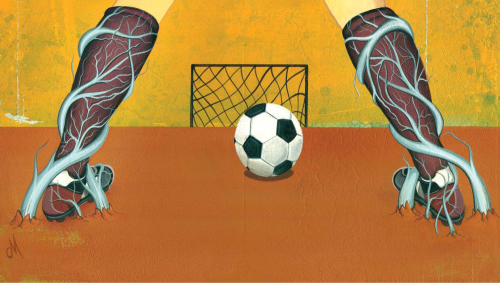
The first rung of Levite's ladder: banning Iran from the June 2006 World Cup in Germany. “Their national pride is deprived of an opportunity to play, and it's because of the nuclear issue,” he argues. “It would be a quick, unmistakable, and easily communicable message that every Iranian would understand.”
Such straightforward messages are a rarity in nuanced geopolitical matters, which is why a multitude of global thinkers have echoed Levite's call for sports sanctions against Iran. “Political isolation methods, like banning Iranian participation in the World Cup, may be easier for energy-hungry China to support than a ban on foreign investment in Iran's oil and gas industry,” the Washington Institute for Near East Policy's Patrick Clawson, a longtime sports sanctions proponent, wrote for The New Republic's website in August 2005. As the World Cup grows nearer, some European politicians have made similar statements. They all cite the same precedent–South Africa.
Like most matters involving sanctions, the role that sports sanctions played in toppling the apartheid regime is disputed. Certainly banishment from the Olympics and international rugby and cricket competitions didn't do it alone. What is generally agreed upon, however, is that for many years sports sanctions were the only real punishment enacted against South Africa and that this symbolic snubbing kept the issue at the fore while big business and most governments dawdled in strongly censuring Pretoria. And if the goal was to manipulate national pride, it worked.
“South Africans who might claim that trade sanctions provided a stimulant to ending apartheid would say to us in the next breath, ‘But the international community had no right to ban the cricket team from the Commonwealth Championship. That was inhumane!’” says George Lopez, a senior fellow at the Institute for International Peace Studies at Notre Dame.
Many global sports organizations such as the International Olympic Committee (IOC) believed they had a clear-cut case for excluding South Africa: Pretoria was violating the integrity of sport by refusing to field the most competitive team possible. “The best South Africans weren't at the Olympics,” says Barrie Houlihan, a sport policy professor at Lough-borough University in Britain. “It was the best white South Africans.” Yet, in the case of Tehran, the issue is murkier since, as Houlihan notes, the current nuclear impasse in no way reflects upon the country's ability to field “the best Iranian team.”
That distinction could prove crucial. If economic sanctions against Tehran are futile without Russia and China's cooperation, then sports sanctions are equally useless without the support of the IOC or the Federation Internationale de Football Association (FIFA), the organization that governs the World Cup. (At press time, FIFA had given no indication that it would halt Iran's participation.) “The ideological framework of international sporting organizations is premised on achieving the widest participation possible,” says David Black, a professor at Canada's Dal-housie University who has studied sports sanctions. “It's very difficult to get their cooperation [in sanctioning particular countries].”
Cong. Brad Sherman
The California congressman and senior Democrat on the House Subcommittee on International Terrorism and Nonproliferation chats about duck-and-cover drills for the terrorism age and his call for stringent economic sanctions against Iran.
JOSH SCHOLLMEYER
Regardless of the potential barriers, the drumbeat to bar Iran from the World Cup continues to grow louder. Sport, it seems, has moved onto a much larger playing field. “It's easy to exaggerate the influence of sport,” Houlihan opines. “But over the long term and as part of a broad campaign, sports sanctions provide a significant platform for stimulating debate and engaging attention.”
JOSH SCHOLLMEYER
Lost boys found
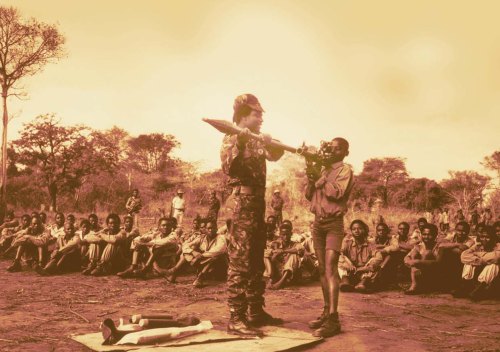
The carnage defied description. “They killed my mother,’ a 9-year-old former child soldier in Mozambique's barbarous civil war told a television newsmagazine in 1990. “They cut her into pieces, and then they cooked her in the pot. My father, too.”
That hundreds of thousands of Mozambican children witnessed such brutality so regularly–in one study, 77 percent of the children surveyed said they had witnessed murder, usually on a mass scale–led many observers to predict that a sadistic “lost generation” would emerge in Mozambique. Child psychologist Neil Boothby, director of Columbia University's Program on Forced Migration and Health, challenges this hypothesis. Boothby has closely studied the lives of 39 former child soldiers whom he met in the middle of the Mozambican civil war in the 1980s when he was a staff psychologist at a government-sponsored child soldier rehabilitation center in the country's capital of Maputo.
His findings are surprisingly hopeful. Almost to a man, these former child soldiers are considered good husbands, fathers, and neighbors; they all, however, suffer from varying degrees of post-traumatic stress disorder. “They're not barbarians,” Boothby says. “Their major issue is poverty.”
What accounts for their recovery?
According to Boothby, a community sensitization program readied rural communities for the return of their displaced sons; by their nature, Mozambicans are a very forgiving people; and traditional cleansing ceremonies–a sacred hallmark of many African cultures–helped rebuild communal bonds and foster community acceptance. “It's a statement about human resiliency,” Boothby says. “What you can extrapolate to the child soldiers in Sierra Leone or Myanmar is more debatable. But my hunch is that with the right conditions, most of the kids would do pretty well.”
In their own words
Insights from and about former Mozambican child soldiers
SOURCE: NEIL BOOTHBY ETAL, “MOZAMBIQUE CHILD SOLDIER LIFE OUTCOME STUDY: LESSONS LEARNED IN REHABILITATION AND REINTEGRATION EFFORTS,” GLOBAL PUBLIC HEALTH, FEBRUARY 2006, PR 87-107,
AIRPORT SECURITY: Keep your clothes on
Last year, privacy activists criticized the Transportation Security Administration over the potential use of “back-scatter” body scanners, which can expose fully clothed citizens' bodies-literally-to screening officials. Hence, a denuding dilemma: How to thoroughly search travelers for suspicious objects without “undressing” them with sensors?

Researchers at Lehigh University in Pennsylvania and the University of Ottawa may have an alternative. They developed a new system, the outcome of more than a decade of research, that is capable of fusing together several types of images gathered from a variety of sensors-including optical, infrared, X-ray, and millimeter wave.
The system can pinpoint particularly suspicious elements of, for example, an infrared scan, before stitching the images together and highlighting the shape of a hidden object along with a person's face, while the body remains clothed in the fused image. “We just want to show the region with the higher probability of containing a concealed weapon,” says Zheng Liu, one of the University of Ottawa researchers-and leave the rest to the imagination.
JONAS SIEGEL
RE: GLOBAL HEALTH: Going needle-free
A children's hospital in Libya is an unlikely locale for an international incident. But seven years ago, the Libyan government arrested seven foreign medical workers, accusing them of deliberately infecting hundreds of Libyan children with HIV. Testifying at the trial in Libya, Luc Montagnier, the French researcher who codiscovered the virus, dismissed the allegations, saying that the most likely causes of the infection were poor hygienic conditions and the reuse of infected medical material, such as hypodermic needles.
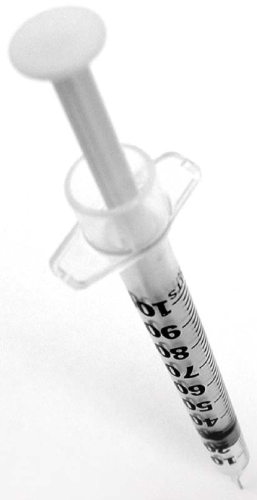
Unfortunately, such accidental disease transmission is commonplace in the developing world. The World Health Organization estimates that 40 percent of hepatitis C infections, 32 percent of hepatitis B infections, and 5 percent of HIV infections in the world's most impoverished areas are caused by the liberal reuse of needles and syringes by medical workers, a practice mostly necessitated by cost. The problem has been exacerbated in recent decades by the uptick in the number of worldwide child vaccinations for maladies such as polio and tuberculosis.
The desire to stem accidental infections, combined with emerging technologies, has inspired a push for needle-free immunization. Two of the most promising needle alternatives are topical application to the skin and nasal sprays. Samir Mitragotri, a chemical engineer who researches novel drug delivery at the University of California, Santa Barbara, acknowledges that the development costs of these technologies could initially push up the cost of immunizations. But the long-term health and economic benefits could make them a worthwhile investment.
Which method ultimately wins out depends on three main factors, according to Mitragotri: “It must be cheap, easy to use, and amenable to mass use.”
JOSH SCHOLLMEYER
NUCLEAR SECURITY: Gunning up the works
It's deterrence in the tradition of the Wild West: He who has the biggest gun wins. On February 2, Linton Brooks, the National Nuclear Security Administration (NNSA) head, announced that his agency was planning to deploy high-powered Gatling guns at its major nuclear weapons facilities. The guns, capable of spewing up to 4,000 rounds per minute from their rotating barrels, are part of a broader strategy of deterrence that is increasingly becoming the centerpiece of the Energy Department's plan to protect its stockpile of dangerous fissile material scattered at locations throughout the country.

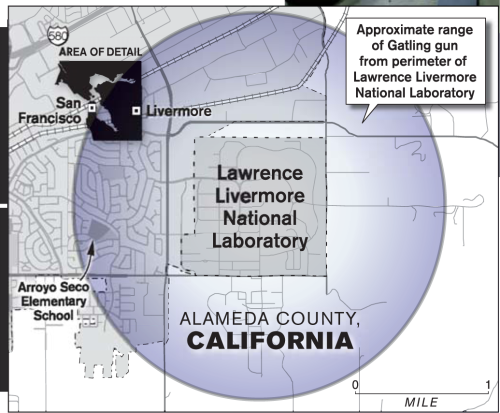
The Dillon Aero M134D Gatling gun (on display at Livermore, above) has the equivalent firepower of 10–12 guards armed with high-powered rifles. The weapons range is 1,500 meters, potentially putting the lab's neighbors in the firing line, according to some critics.
Linton Brooks, NNSA head, announcing the deployment of Gatling guns at some nuclear weapons facilities.
“In view of finite resources and an escalating threat, it was clear that we needed a force multiplier. That's exactly what these weapons provide,” says David Schwoegler, a spokesman for Lawrence Livermore National Laboratory, which will deploy the guns to protect the Superblock, where fissile materials are stored. But will deploying the guns work as intended?
In the event of a full-scale attack, the increased firepower would certainly help. “If you've got 20 guys coming from different directions, you've got to lay down one hell of a fire to keep them away from Superblock,” says Peter Stockton, a senior investigator at the Project on Government Oversight (POGO). Yet rather than fighting defensively on several fronts, POGO advocates consolidating the U.S. storage of fissile material to reduce the number of facilities that need protection.
More broadly, safeguarding facilities provides no guarantee of actually discouraging a terrorist plot or a potential insider threat, according to security analysts. “[Preventive measures] will always be somewhat unreliable as long as a dedicated group of trained individuals can construct at least crude WMD,” wrote Daniel Whiteneck, a research analyst at the Center for Naval Analyses, in the Summer 2005 Washington Quarterly. Deterrence has its limits.
JONAS SIEGEL