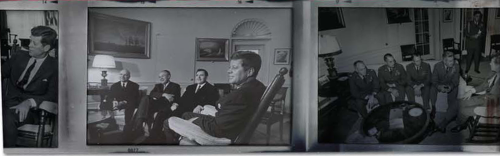
Never-before published transcripts of a secret White House meeting reveal President John F. Kennedy struggling with the grim realities of the nuclear age.
Quantifying nuclear security has always been contentious. The tendency to err on the side of too much rather than too little has long proven irresistible to military planners. President Dwight D. Eisenhower was among the first presidents to diagnose the ailment, even if he never found the cure, telling his advisers, “We are piling up these armaments because we do not know what else to do to provide for our security.”
1
By the early 1960s, when there were already more nuclear weapons than targets, Democratic Sen. George Mc-Govern of South Dakota pointedly asked, “How many times is it necessary to kill a man or a nation?”
2
Thanks to never-before published transcripts of recently declassified White House tapes prepared by the Presidential Recordings Program at the University of Virginia's Miller Center, we now have a rare insight into President John F. Kennedy's nuclear thinking. The question “How much is enough?” took on an extra air of gravity in the aftermath of the October 1962 Cuban Missile Crisis-the closest the two superpowers ever came to nuclear war. It was a crucial juncture; the United States was poised to gauge whether expanding its nuclear arsenal actually translated into additional security.
On December 5, 1962, Kennedy met with his advisers for a top-secret meeting on the defense budget. Unbeknownst to the other participants, the discussion was captured on tape by Kennedy himself. At the president's behest, in July the Secret Service had installed hidden microphones in the walls of the Cabinet Room and Oval Office and wiretapped his telephone.
3
The transcript of this 1962 meeting captures Kennedy struggling with his personal responsibilities as president. and with the grim realities of the nuclear age. The Pentagon already had more than 27,000 nuclear weapons stockpiled. And yet it wanted more. Each branch of the military was asking for more money to increase its flagship strategic nuclear programs: The air force wanted to accelerate and expand by several hundred the building of Minuteman intercontinental ballistic missiles (ICBMs), along with a thousand Skybolt air-launched ballistic missiles; the navy wanted to build another six Polaris submarines, each of which could be outfitted with 16 ICBMs; and the army wanted money to build an untested Nike-Zeus antiballistic missile system.
It had become routine for each service to imply that if its chosen program went unfunded or underfunded, the United States would be left vulnerable. Such charges could become potent political weapons. Kennedy knew that game only too well. In his 1960 campaign he had become an expert on how to play the security card, relentlessly charging the Eisenhower administration with perilous neglect for allowing a so-called missile gap with the Soviet Union to develop. But Kennedy had also promised to reduce America's reliance on nuclear weapons for its security. It now fell upon him to reconcile these two threads.
These excerpts from the transcript of Kennedy's secret tapes provide a unique window into the inner sanctum of White House decision making, as the president and his advisers debated the assumptions underlying the U.S. nuclear deterrent and the purpose of strategic nuclear forces:
President John F. Kennedy: … If our point really then is to deter them [the Soviet Union], it seems to me that we are getting an awful lot of–I mean, with the Polaris submarines, with the planes we have, the navy's strategic force, and with the missiles we have, we have an awful lot of megatonnage to put on the Soviets [that is] sufficient to deter them from ever using nuclear weapons…. Otherwise, what good are they? I don't–you can't use them as a first weapon yourself, so they're only good for deterring…. I don't see quite why we're building as many as we're building….
Gen. Maxwell Taylor, commander of the Joint Chiefs of Staff: I think there's always a question whether we've got too much or not. As you know, in the past I've always said we probably have too much, and I think if we were starting from scratch I would still take that position. Right now, but sir, I would recommend staying with the program essentially as it is. There are too many imponderables for us to back away and go back to a very small force, which is invulnerable, which may be our eventual objective….
Kennedy: I mean, we're just trying to think: What is it that will deter them? And [French President Charles] de Gaulle thinks what he's got is going to be a big deterrent. And even what they had in Cuba alone would have been a substantial deterrent to me….
COMING ONLY A FEW WEEKS after the Soviets removed their missiles from Cuba, Kennedy's statement was a remarkable admission. And it was precisely the kind of confession that no U.S. president would dare make in public for fear of weakening the nuclear deterrent. Not surprisingly, the comment was not recorded in the official minutes of the meeting. One staunch opponent of an arms race with the Soviet Union was Jerome Wiesner, Kennedy's chief science adviser. The United States was at an inherent disadvantage in such a competition, he argued in the meeting, because of its inability to keep budget and defense decisions out of public debate. Wiesner further contended that the Pentagon's targeting plans were inflating its force requirements. (Later in the meeting, Kennedy pressed this point himself, questioning the need for so many targets.) Wiesner also cast doubt on the notion that an arms race might bankrupt the Soviet Union:
Jerome Wiesner, science adviser: … The additional thing that worries me is that we don't really have control over the game and that we are in a sense running an arms race with ourselves because we, in the kind of society we live in, torpedo our opportunity for secrecy and surprise. We have to tell the Congress what we want to do four years from now. In that turnaround time, the Soviet Union, they can make these analyses and when they do they say, “Well, we can't tolerate that, so we'll buy some more missiles.” So, in essence, I'm afraid that what we are doing is just establishing a deterrent at a somewhat higher level. By the time we get these missiles in place, we're talking about ‘67-’68, they could turn around and match us to create any force they think is necessary to make it unprofitable for us to do anything. And the price we will pay is, first of all in money, which is considerable, and secondly, in the event that war occurs, it will be more disastrous for both of us because we'll each be exchanging much larger forces. So I don't think we can win this game … unless we bankrupt the Soviet Union. There are people who propose carrying out [an] armament race for that purpose….
Kennedy: Well, there's no evidence that you can bankrupt a totalitarian [regime]. Their resources are still generous enough.
Robert McNamara, defense secretary: Mr. President, I think there are problems–
Kennedy: The space program is the one that s going to … [laughter].
DECADES LATER, in a vastly different geopolitical landscape, McNamara would declare U.S. nuclear weapons to be “immoral, illegal, militarily unnecessary, and dreadfully dangerous.”
4
But in this post-Missile Crisis meeting, he proposed a simple yardstick for calculating an adequate strategic force:
McNamara: … I think that there are many uncertainties in all of these estimates. And I would say that my recommendation to you on our strategic forces is to take the requirement and double it and buy it. Because I don't believe we can, under any circumstances, run the risk of having too few here. So I, in my own mind, I just say, “Well, we ought to buy twice what any reasonable person would say is required for strategic forces.” I think it's money well spent….
Kennedy: Will it deter?
McNamara: It's both–it's principally to deter. And it's also to give ourselves the confidence that we have that deterrent power, give ourselves and our allies the confidence that we have it….
LATER IN THE MEETING, McNamara returned to this point in recommending that new nuclear weapons be procured, albeit at lower numbers than the Joint Chiefs had originally requested:
McNamara: I think if we don't buy them that two claims will be made which we can't rebut. One, that we're changing the basic military strategy of this country to exclude procurement of weapons necessary to destroy the nuclear capability of the Soviet Union. This will be the charge that will be made. It will come out in the open because the air force feels very strongly on this already. We've cut them down substantially. And basically, what is being proposed is a change in the military target plan, if we cut back these Minutemen and Polaris as I suggest. That charge will be made; we can't rebut it. The second charge will be made that we will end up, and we are following a program that will lead us to a position, where the Soviets have more megatonnage and more warheads than we do. And I think those two charges, which I don't believe we can rebut, will seriously weaken our position within this country and with our allies.
COMING INTO THE MEETING, the Joint Chiefs of Staff had reason to believe they were preaching to the choir. Kennedy had declared in his inaugural address, “Only when our arms are sufficient beyond doubt can we be certain beyond doubt that they will never be employed.” And during his 1960 presidential campaign, Kennedy relentlessly attacked the Eisenhower administration for allowing the Soviets to establish a lead in the missile race-a notion that proved to be a myth. Within months of taking office, the new administration confirmed that the advantage lay with the United States in terms of strategic striking power, especially ICBMs:
McNamara: I think that there was created a myth in this country that did great harm to the nation. And it was created by, I would say, emotionally guided but nonetheless patriotic individuals in the Pentagon. There are still people of that kind at the Pentagon. I wouldn't give them any foundation for creating another myth.
Kennedy: You mean like the missile gap?
McNamara: The missile–that's right.
Kennedy: That missile gap–as one of those who put that myth around, a patriotic and misguided man–[laughter]–that came right out of…. You were one of them and, it's because we assumed–
Taylor: We saw the possibilities going out of the Sputnik program….
Kennedy: … It wasn't just generals at the Pentagon and [the] Democratic opposition. I think it was an [Eisenhower] administration decision, the missile gap…. But I think if we could dig up the record of the quotes that were made by [Defense Secretary Neil H.] McElroy and accepted by the administration–the previous administration–of the fact that this was the situation. Otherwise, what it looks like is that we, some of us, distorted the facts and created a myth of a gap which didn't exist. The point that, I think this is really true, is that from the top to the bottom they really believed there would be.
Taylor: Well, it was an honest mistake….
ANOTHER ASPECT OF THE NUCLEAR numbers problem addressed at the meeting was targeting. In essence, more targets required more weapons. This was the very heart of the “overkill” phenomenon that had developed in the late 1950s and that manifested itself in the Single Integrated Operational Plan, which called for a massive strike of thousands of nuclear weapons against the Communist bloc in the first 24 hours of a conflict, with estimated casualties of between 360 and 450 million people.
5
Conversely, if targets could be limited, it would presumably undercut many of the arguments for large increases in the nuclear stockpile. The debate pivoted on whether a nuclear war was in any sense a “normal” military operation-and whether or not Soviet cities should be targeted. In Kennedy's mind, the issue of saying he would target Soviet cities, as a means of deterring Soviet leaders, was quite separate from actually doing so:
Kennedy: The argument I'd make is that they [the Soviet Union] could be getting into a position … where we won't be able to fire these things.
Taylor: But that's because we have enough that the Soviets are indeed deterred. And deterrence–I don't know how to measure it; no one does–but I would say it's the effective capability to destroy the other fellow if indeed this kind of thing starts up.
Kennedy: … I think de Gaulle is right: You get 40 missiles that you could get through and [if] you're aiming them at the 40 largest population centers of the Soviet Union, it ought to deter them from an awful lot. It wouldn't make them surrender, but it would certainly not make them adventurous.
Taylor: Well, they're also starting an antiballistic missile system around there. Someday that's going to be a factor….
Kennedy: The only targets seem to me that really make any sense are at their missiles, firing in order to lessen–to the degree that we can–the amount of megatonnage the United States receives. That makes some sense to us. We should always suggest that … they assume that we'd fire at their cities if we have to, because that will deter them. But as a practical matter, if the deterrent fails and they attack, what we want to do is be firing at their missile sites. Beyond that, these targets don't seem to me to make much sense.
6
DESPITE SOME SPECIFIC CHANGES in programs and force levels-two weeks after this meeting, the entire Skybolt program was canceled-the increases requested in the fiscal year 1964 budget were approved. But over the next few years, that buildup plateaued at levels lower than originally planned. McNamara had originally recommended a total program of 1,300 Minutemen by the end of 1968 but ultimately capped the total number of ICBMs at 1,054 and submarine-launched ballistic missiles at 656, levels that endured until 1980.
7
By the mid-1960s, when the Soviets developed an authentic strategic force, McNamara abandoned the idea of matching the Soviets missile for missile, instead endorsing an acceptance of mutual assured destruction. “When calculating the force required, we must be conservative in all our estimates of both a potential aggressor's capabilities'; and his intentions,” he declared in 1967. “We must be able to absorb the total weight of nuclear attack on our country-on our retaliatory forces, on our command and control apparatus, on our industrial capacity, on our cities, and on our population-and still be capable of damaging the aggressor” to the point that his society would be simply no longer viable in twentieth-century terms.”
Nearly 40 years later, McNamara endorsed an altogether different number for the U.S. nuclear arsenal: zero.
Footnotes
1.
MemCon, January 26, 1956, Foreign Relations of the United States, 1955-1957 (Washington, D.C.: U.S. Government Printing Office) vol. 20, p. 297.
2.
George McGovern, August 2, 1963; . David Alan Rosenberg, “The Origins of Overkill: Nuclear Weapons and American Strategy, 1945-1960,” International Security 7, Spring 1983, pp. 3-71.
3.
Detailed information on Kennedy's recording system and tapes is available online at .
4.
Robert S. McNamara, “Apocalypse Soon,” Foreign Policy, May/June 2005, p. 28.
5.
David Alan Rosenberg, “U.S. Nuclear War Planning, 1945-1960,” in Strategic Nuclear Targeting, edited by Desmond Ball and Jeffrey Richelson (Ithaca: Cornell University Press, 1986), p. 45; Desmond Ball, “The Development of the SIOP, 1960-1983,” ibid., pp. 57-83; Lawrence Freedman, The Evolution of Nuclear Strategy (Houndmills: Palgrave Macmillan, 2003), p. 222.
6.
Susan Dunham, Marc Selverstone, and Ken Hughes contributed to this draft transcript of the December 5, 1962 meeting. (For more on the Miller Center's Presidential Recordings Program, see .)