



Abstract
Wilson Quarterly, Woodrow Wilson International Center for Scholars, Spring 2006.
On a relatively small street in Paris's well-heeled fifth arrondissement, Islam and the West have calmly gazed at each other for decades: The expansive, lush greenery at the public Garden of Plants lies just across the street from the ornate Grand Mosque and its popular tearoom.
It's a reminder that–despite the riots that swept France last fall, when young Muslims waged violent protests against racism and unemployment–“the Arab Street” is only a crosswalk away from Old Europe. According to Martin Walker, editor of United Press International and a senior scholar at the Wilson Center, the gulf between Islam and Europe isn't very wide.
Writing in the spring 2006 issue of the Wilson Quarterly, Walker acknowledges that the riots, the uproar over the Danish cartoons, and the Madrid and London bombings have spurred “apocalyptic visions of a Muslim invasion.” But most Muslims don't immigrate to Europe “to promote an Osama bin Laden fantasy of reestablishing the Caliphate and converting the Notre Dame and St. Paul cathedrals into mosques.” With more than 500 million people and only 15 million to 18 million Muslims (or 3 to 3.6 percent of the population), Europe is hardly being “invaded,” especially considering that the continent has survived and thrived in the face of sectarian violence, from the Crusades to Northern Ireland.
And, the historical connections between the two cultures are deeper than we usually recognize: Rome's footholds in North Africa; Islam's rule over Spain; centuries of cross-Mediterranean trade in both goods and ideas. It was only in the nineteenth century that colonialism served to “deeply complicate the assimilation of today's immigrants into the homelands of the colonial masters.”
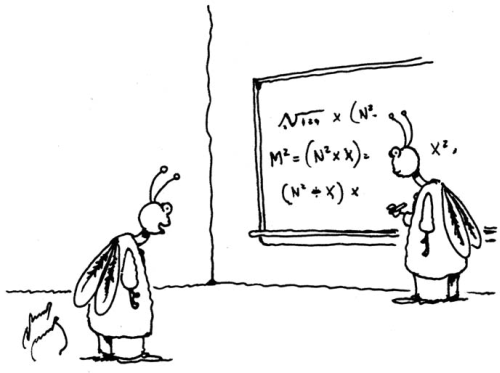
“I think you're right, Nigel. We revolve around the bulb.”
That brings us to Europe circa 2006 and three “alarmist myths” about Muslims that Walker seeks to dismantle. First, he says, there is no “European Islam.” In Germany, Muslims are Turks, but also ethnic Kurds; in France, they are North African and West African; in Great Britain, they are Pakistani, Bengali, and Indian. Muslims are millionaires, doctors, unemployed, students, and prosperous members of the middle class. In short, they are like any other group in a country, with a cross section of incomes and traditions.
Walker easily discounts the second myth: that high Muslim birthrates and flagging European ones will overwhelm the continent's non-Muslim population with disaffected, young radicals. Walker reminds readers that in Britain, second-generation immigrant birthrates have traditionally fallen rapidly, thanks to increasing prosperity and education. Meanwhile, “native birthrates” in Sweden, France, and Britain are rising.
Then Walker sets up his third and final myth: that a higher Muslim population must a priori be “alarming.” Not so. In France, the violence last fall was a symptom of two crises that collided: long-term economic sluggishness and outdated labor policies–not radical Islam. Therefore, the government must enact “some of the detested Anglo-Saxon remedies,” like affirmative action and labor reform. Unfortunately, the latest round of French unrest in March–when half a million protesters demonstrated against proposals making it easier to hire and fire workers–doesn't bode well. Government officials backed away from the very economic policies that Walker says are essential to allaying tensions.
The so-called Muslim Problem, Walker concludes, is more a question of income, education, and social mobility than a clash of civilizations. However, absent a serious commitment to tackling these underlying issues, rioters may well fill the streets again, raging against economic stasis and long-festering racism, burning tires and cars in the once quiet street dividing a stately mosque from a peaceful park.