



Abstract
When you need accurate disaster information, who ya gonna call? Not Homeland Security
EMERGENCY PREPAREDNESS: Ready … or not
Obscured beneath a stock photograph of a smiling, disaster-ready American family of four and the green check marks that dot every branded component on the Department of Homeland Security's Ready.gov main page exists a link to a disclaimer. “We are not responsible if information we make available on this site is not accurate, complete, or current,” the disclaimer warns visitors, ostensibly the American public. “The materials on this site are provided for general information only, and any reliance upon the material found on this site will be at your own risk.”

Sadly, it may represent one of the few clear, accurate statements on Ready.gov, Homeland Security's supposed go-to source for all things preparedness. “The average user visiting the government site comes away flummoxed, without any additional help on how to think about the problem,” says Ivan Oelrich, the Federation of American Scientists's (FAS) vice president of strategic security. “Plus, many of the instructions are plain wrong.”
Three years and one digital face-lift after its February 2003 unveiling, Ready.gov continues to receive the same criticism and ridicule consistently directed at the government agency that created it. Parodies of the site's disaster advice abound on the internet, mocking its simplified graphics and often generic advice. A favorite target: An icon in Ready.gov's chemical threat visual guide that features a drawing of three overlapping dead fish and a lifeless bird with the accompanying warning, “Many sick or dead birds, fish, or small animals are also cause for suspicion.”

“If every time someone who saw a dead fish in the Hudson River thought we were experiencing a chemical weapons attack, Manhattan would be permanently closed,” Oelrich quips. “Ready.gov has a real problem with false alarm signals.”
In the spirit of scientific accuracy, this summer Oelrich and Michael Stebbins, director of biology policy at FAS, decided to craft ReallyReady (www.fas.org/reallyready), a website that both addresses their problems with Ready.gov and offers what they view as more factually correct, concise, and sensible preparedness material. What's more, Oelrich and Stebbins built the site in nine weeks, for the price of a domain name, and with a 20-year-old University of Virginia student at the helm, further demonstrating how easily and inexpensively Homeland Security could improve Ready.gov's content.
The effort also came with a promise: If Homeland Security amended Ready.gov (with or without FAS's help) by September, which the agency dubbed “National Preparedness Month,” FAS would take down ReallyReady immediately. “We don't want to embarrass them,” Stebbins says. “But if they won't provide a good place to go for information, we will.”
Thus far, however, Homeland Security has only rebuked ReallyReady through the media, claiming on CNN that the site is “counterproductive” and “woefully uninformed.” Their direct response to FAS consisted of a legal complaint alleging FAS infringed on the use of the department's ubiquitous green check marks. “They've already spent more money on their cease-and-desist letter than we did on the entire site,” Stebbins notes. (To ensure that the discussion stays focused on the quality of information and not legal matters, FAS made minor cosmetic changes to ReallyReady in early September.)
As National Preparedness Month ends and Ready.gov more or less remains the same–despite a recent “important news update” announcing “two new areas!”–Stebbins hopes Homeland Security will still revamp its content in the near future. If they do, the offer to remove ReallyReady stands. “We've gotten requests from all over,” he says. “People are asking, ‘Can you do a section for seniors or a section for farmers?’ They aren't looking to Homeland Security anymore, they're looking to us. We don't want that to happen. We want Homeland Security to fix its site.”
JOSH SCHOLLMEYER
Q+A Nancy Bernkopf Tucker
The assistant deputy director of national intelligence for analytic integrity and standards and the intelligence community's first analytic ombudsmen describes the challenges of instituting new intelligence standards.

JONAS SIEGEL
THREAT ASSESSMENT: A fiery proposition
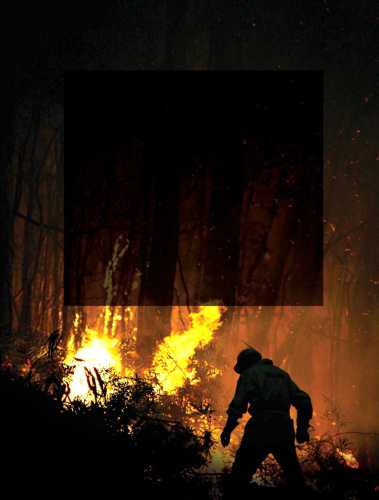
A precedent exists. Israeli authorities believe that Palestinians set hundreds of forest fires along the Israel/West Bank border during a three-year span of the first Intifada, and the Japanese shot incendiary munitions at the U.S. West Coast during World War II in hopes of igniting large-scale fires. In 2003, the FBI sent a memo to law enforcement agencies warning of an AI Qaeda plot that schemed to stage simultaneous forest fires in Colorado, Montana, Utah, and Wyoming. And although they vow to protect the environment, domestic terrorist organizations such as the Earth Liberation Front (ELF) commonly use arson as a tactic.
The director of the Center for Terrorism and Intelligence Studies and an expert in environmentalist-inspired extremist groups and terrorist behavior.
“We should consider it a threat, but other vulnerable targets exist that from terrorists' perspective would provide more reliable consequences, disrupt Americans' daily lives to a greater extent, and leave a longer-lasting psychological impact. So it's certainly not in the top three attacks in the jihadist playbook.”
JOSH SCHOLLMEYER
ENERGY CONSUMPTION: The environment and the single-person household
Bridget Jones, environmental menace? At least in Britain. An increase in the number of one-person households in the country and a shift in the demographic from lonely spinsters to confirmed, affluent bachelors and bachelorettes (á la the fictional Jones) put an enormous strain on resources such as electricity, natural gas, and land. For example, Fujitsu Siemens Computers' chief technology officer recently claimed the popularity of plasma screen televisions-a bachelorhood staple-could necessitate the construction of two new British nuclear power plants. Coincidentally, Jo Williams, a lecturer at University College London, found that a one-person household consumes 55 percent more electricity per capita than the average four-person household. The reason for the differential is simple. “If you're living on your own, you need all the goods that you'd have if you were living with other people,” Williams says. “Only, you can't share those goods.”

JOSH SCHOLLMEYER
RE: CYBERSECURITY: Getting jitterbugged
Buyer beware. A device stealthily inserted in your computer keyboard could one day leak secrets as you type. Computer scientist Gaurav Shah and a team of University of Pennsylvania researchers recently demonstrated how easy it is to build a new type of programmable bugging device (see right), dubbed a “jitterbug” for the small jittery delays in keyboard signals it creates, that can recognize important typed phrases such as a username in order to record and mark the keystrokes that usually come next–i.e., a password. When the user connects to a network, the device secretly broadcasts the sensitive data, allowing someone looking for the delayed signals to capture it.

Shah says consumers shouldn't fear jitterbugs popping up in their personal computers anytime soon, but he warns that the device heightens the risk of a “supply chain attack” that could compromise the security of governments, universities, or corporations. “[A person could] subvert a large number of keyboards in the hope that a target of interest acquires one,” Shah and his colleagues assert.
CHARLOTTE TOOLAN
SPACE: In pursuit of life
The ice covering Europa, one of Jupiter's largest moons, measures 3 miles thick and may top an ocean of liquid water that reaches 30 miles deep, stoking possibilities that excite astrobiologists and space enthusiasts alike.
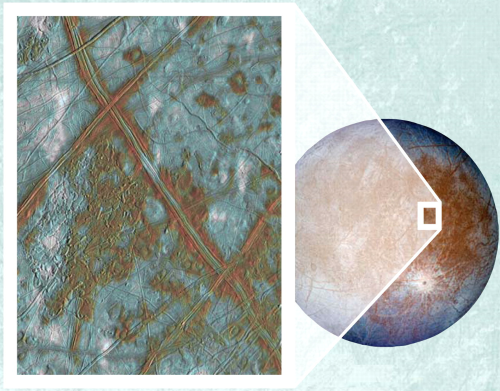
But it's the charged particles that bombard the moon's surface that fascinate physicists and have helped inspire a new avenue of research dubbed “the space physics of life.”
Since its origin, astrobiology has incorporated many disciplines, including biology, chemistry, and planetary science. Now, physicists have joined in, investigating the role the space environment (including radiation and magnetic fields) plays in the potential development of extraterrestrial life. “[After the Galileo mission discovered the charged particle barrage of Europa's surface], I asked whether radiation products could reach the ocean and contribute energy for life,” remembers John Cooper, the chief scientist of the Space Physics Data Facility at NASA's Goddard Space Flight Center and a space physics of life pioneer.
Similar questions are being applied to other extraterrestrial environments; the June 2006 issue of the journal Astrobiology, guest edited by Cooper, featured several papers on related subjects, including a look at the production of hydrogen peroxide by electrically charged dust storms on Mars that effectively render the Martian surface uninhabitable.
However, just as it's pondering compelling issues, the field may face its greatest challenge from budget cuts. NASA plans to slash astrobiology research funding by 50 percent as part of a broader realignment to support the Vision for Space Exploration. That leaves little money for new initiatives, including a space physics of life proposal Cooper submitted. “The whales of Europa, if they exist, have waited billions of years for us to create the capabilities to find them,” he says. “They now may have to wait a while longer.”
JEFF FOUST