



Abstract

During a span of several weeks in late 2005, the number of African migrants seeking entrance to the Spanish enclaves of Melilla and Ceuta on Morocco's Mediterranean coast spiked sharply. In order to make it to Spain, thousands of migrants stormed the twin razor-topped fences separating the Spanish territory from Morocco. The reaction of the Spanish and Moroccan authorities was swift, brutal, and deadly.

Police from Spain's Guardia Civil shot rubber bullets at the migrants from close range, beat them, and forcibly pushed them back through the fence into Morocco, according to testimony provided by migrants to human rights groups. Some eyewitnesses reported that migrants clambering through barbed wire were at times fired upon simultaneously by authorities on both sides of the fence. Not all the bullets fired were rubber: Autopsies revealed that two of the dead were killed by live ammunition. More than 10 other migrants died in the encounter.
With images of the violence beamed across the globe, Spain found itself uncomfortably positioned at the center of an increasingly fervid European debate. Driven by extreme poverty and in some cases escaping persecution, the number of Africans and others migrating to Europe has grown substantially in recent years. In addressing the influx, as well as fears of attendant security concerns, European governments are pursuing unprecedented measures and also raising concerns about the treatment of migrants and asylum seekers.
The Spanish government's get-tough stance in Melilla and Ceuta simply shifted its problem. With the northern route closed off, West African migrants began targeting Spain's Canary Islands, located off the Pacific coast of Morocco, in unprecedented numbers. By early summer 2006, the number of migrants landing in the Canaries had already doubled the number that arrived in all of 2005.
Spain's next move: Boost naval patrols along the African coast and ship detainees to Mauritania, where the Spanish Defense Ministry began constructing a migrant detention and processing center in an abandoned school in March. For migrant advocates in Spain, concerned that detainees will not receive proper medical treatment or hearings to determine their status, the detention center is simply an attempt by the government to wash its hands of the problem and hide it from public view.
Trapped by the system: African migrants exercise at an immigrant detention center in the Canary Islands in March.
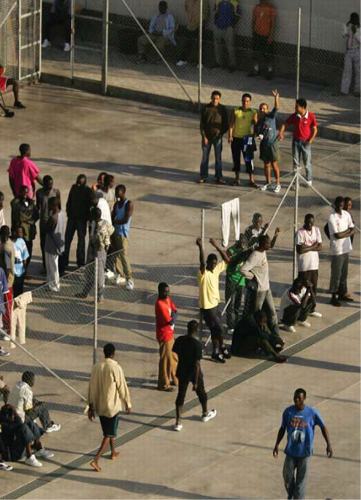
Driven by extreme poverty and in some cases escaping persecution, the number of Africans and others migrating to Europe has grown substantially in recent years.
“When they began building this center there was no public reaction,” says Fernando Herrera of the Spanish Commission for Refugee Assistance. “[Spaniards] fear there is an invasion; they worry about losing their jobs; and Spanish politicians increase this fear by pointing to the riots in France as an example of what can happen when you allow too many immigrants into the country. So the government exports the problem, builds camps, and relieves itself of the responsibility of doing anything for these people.”
For Herrera and other migrant rights activists in Europe, the Mauritania facility is the latest example of what they call the “externalization” of Europe's migration controls to the fringes of the continent and beyond. While the borders between European countries have become more open in recent years, European governments have agreed to a number of external border control policies aimed at stopping migrants and asylum seekers before they enter the European Union (EU).
As part of this effort, European governments have undertaken joint naval patrols along the Mediterranean and “West African coasts and established high-tech surveillance facilities in various Mediterranean countries to help detect illicit crossings. Island outposts on the Canaries, Malta, and Italy's Lampedusa Island have become key detention sites as part of this strategy.
The intensified policing effort corresponds closely with the EU's expansion to 25 member states in 2004, which extended its borders further east. Consequently, EU governments have spent lavishly on training programs aimed at increasing the border policing capacities of the newest member states, in the hope of addressing criminal activity there and clamping down on illegal migration.
To coordinate a joint response, the European Commission (EC) also created a new border security agency called Frontex, which went into operation in May 2005 on the strength of a 9 million euro ($11.5 million) budget. During the agency's June 2005 inauguration event, Franco Frattini, the EC's commissioner for justice, freedom, and security, said that cooperation on border policing was necessary to address an array of security problems, including “the specter of international terrorism, the human tragedies of victims of trafficking, and the equally sad and grave consequences of illegal immigration into the EU.”
Frontex dispatched a fleet of boats, planes, and special response teams in May to aid patrolling efforts off the coasts of Morocco, Mauritania, and Senegal. According to a Frontex spokesperson, the effort, which included support from nine European countries, was aimed at “helping assure the proper flow of information about illegal immigrants … helping Europol with the identification of traffickers … [and] helping the Spanish authorities with repatriations.” The action, however, drew sharp criticism from human rights organizations, which argued that patrolling the coast simply forced migrants to take more perilous routes.
EU leaders have also vigorously lobbied their counterparts in Africa and Eastern Europe to help stop the influx of migrants. In July, officials from 57 African and European countries held a ministerial conference in Rabat, Morocco, to discuss cooperative strategies. Among the 62 measures adopted at the conference were proposals to undertake joint monitoring of sea and land routes, to implement poverty reduction aid packages, and to produce rules aimed at streamlining repatriation efforts. Noticeably absent from the agreements was any mention of asylum. “All they were really interested in talking about is security and the external dimension of migration,” Caroline Intrand of the French-based group Migreurop comments. “Their action plan is about how to manage migration; there was nothing about refugees or asylum.” She adds: “The fundamental rights of these people are often ignored.”
Few issues have received as much criticism as Europe's push to build so-called offshore detention centers. Spain's decision to build the Mauritania center came on the heels of a long, heated discussion in Europe over whether to establish processing procedures in neighboring countries aimed at forcing migrants to submit asylum claims before reaching European soil. In 2003, the government of British Prime Minister Tony Blair suggested establishing “transit processing centers” on the non-EU side of Europe's borders, but the idea was quickly abandoned after it met strong resistance from a number of European governments, including Germany, which referred to the proposed centers as “concentration camps.” The idea was revived a year later but ultimately met the same fate.
“While publicly rejecting the idea, the EU has found other, more discrete ways to push through plans for “offshore” detention, as Human Rights “Watch discovered during a 2005 investigation of migrant and asylum seeker conditions in Ukraine. The group reported that the EU had given the International Organization for Migration (IOM), a Geneva-based intergovernmental organization dedicated to “promoting humane and orderly migration for the benefit of all,” 4 million euros ($5.1 million) to develop two northern Ukrainian detention centers, which one IOM official described as “sanatoriums.” According to Human Rights Watch, work on the project was eventually suspended because of difficulties IOM encountered when trying to establish governmental partners in Ukraine.
Julia Hall, a Human Rights Watch researcher who closely monitors IOM's work, says the EU's decision to turn to the IOM is troubling because its new activities are a far cry from its original mandate to aid the voluntary return of migrants to their home countries. According to Hall, when Human Rights Watch asked EU officials in Ukraine why they decided to fund detention centers in a country that has no laws enabling migrants to challenge their detention, they argued that the “currently existing centers were so bad that they felt it was the best option they had.”
Meanwhile, back on the Canary Islands, the situation went from bad to worse by summer's end. Spanish authorities estimated that the number of migrants who arrived there during the first eight months of 2006 had grown to nearly 20,000–some 5,000 arriving in August alone. There is also an alarming increase in the number of drowning deaths. The Spanish government claims about 600 migrants died by August, though advocacy groups placed the figure closer to 3,000.
Spain's frustrations led to more talks in Europe in late August, during which it pleaded for more help. Yet its neighbors have been noncommittal. An EU spokesperson told the International Herald Tribune, “We are already doing a lot, what we can at this moment. But we unfortunately cannot stop the arrival of the illegal immigrants immediately.”
Supplementary Material
Euro-African Ministerial Conference on Migration and Development Action Plan