



Abstract
Seismograms put a country's nuclear bluster to the test.
NUCLEAR TESTING: Reading between the lines
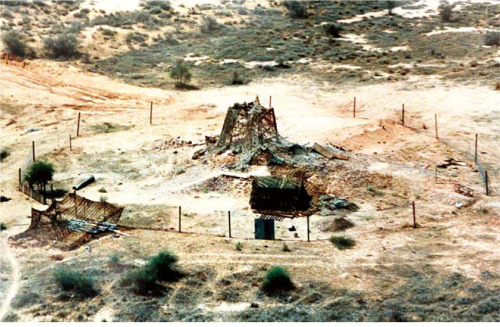
The undulating waves on the seismogram that recorded North Korea's first nuclear test provided the most immediate and telling sign that the underground test went more bust than boom. When geologists saw the test's minimal seismic effects–no more than a magnitude 4 on the Richter scale–they began to question its efficacy. “I spoke out within the first 24 hours,” says Jeffrey Park, a geology professor at Yale University. “I and others weren't going to wait a month to write an academic paper that the media would ignore. That's affected how this has played out. Based mostly on the seismic readings, there's a significant amount of skepticism about the North Korean test.”
That wasn't the case during India and Pakistan's 1998 nuclear tit-for-tat, when geologists did wait, allowing the political rhetoric to outpace reality.
JOSH SCHOLLMEYER


SCIENCE: Comic pursuits

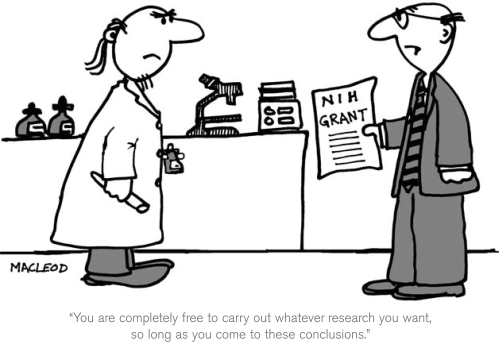
JAMES MACLEOD IS DRAWING FOR A political fight. The Scottish-born, University of Evansville, Indiana, history professor's weapon of choice-the cartoon. The medium lends him a strategic advantage: “When you're forced to confront issues using another part of your brain, you think about them very differently.” His approach won acclaim in early October, when the Union of Concerned Scientists awarded him the top prize from among hundreds of entrants in its “Science Idol” editorial cartoon contest (MacLeod's entry, at right). Judged by national cartoon editors, including the New Yorker's famed Bob Mankoff, the contest solicited work commenting on the importance of independent scientific research in an era of increasing political meddling. MacLeod turned to scientific colleagues for inspiration but found that his ilk-historians-have faced similar political struggles: “If history was taken more seriously today, maybe [the government] would be interfering with us, too.”
“You are completely free to carry out whatever research you want, so long as you come to these conclusions.”
WEBWATCH: 1918-1920 INFLUENZA EPIDEMIC ESCAPE COMMUNITY DIGITAL DOCUMENT ARCHIVE WWW.MED.UMICH.EDU/MEDSCHOOL/CHM/INFLUENZA/INDEX.HTM
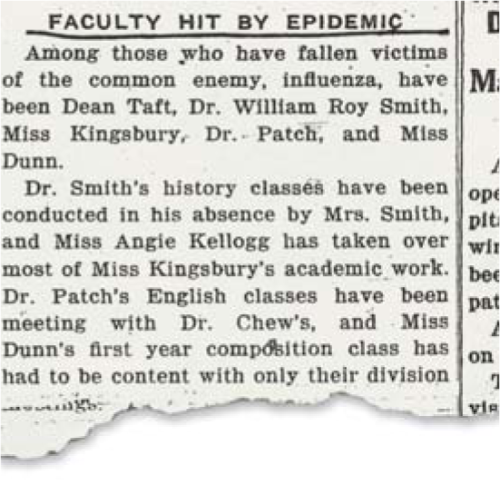
Conventional wisdom says separating the sick from the healthy is a good way to stem an epidemic's spread, especially absent pharmaceutical solutions. And yet, research quantitatively gauging the effectiveness of nonpharmaceutical interventions (NPI), such as school closures and quarantines, doesn't exist. “We don't have many studies on NPI in a pandemic flu situation,” says Howard Markel, the director of the University of Michigan's Center for the History of Medicine. “But we have an enormously large database called the 1918-1920 pandemic.”
Markel and his colleagues investigated this database statistically last year, evaluating what role NPI played in the low death toll of eight U.S. communities during the infamous flu outbreak that killed 675,000 people. (The Defense Threat Reduction Agency funded the research.) For future scholars, Markel posted the primary source material that underpins the work online in PDF form–almost 2,000 pages in total. “This is a fascinating database with countless interesting areas,” he says. “So we want to encourage people to conduct their own studies.”
Primary sources: A 1918 article detailing the effects of the flu on Bryn Mawr College.
It appears as though defeating the Republicans in the midterm elections will prove far easier for Democrats than vanquishing the latest incarnation of the U.S. missile defense system. Given the political timing (domestic concerns about North Korean and Iranian missile capabilities and a party desire to appear strong on defense), Democrats will be leery of curtailing the missile defense budget, according to Space and Missile Defense Report
THREAT ASSESSMENT: In plane sight
An increasing amount of aircraft repair and maintenance work (on engines, airframes, components, etc.) is done at commercial repair stations, including hundreds overseas in Singapore, China, Britain, and Qatar, to name a few. This trend raises the potential for foreign malcontents or terrorists to sabotage an airplane or smuggle explosives on board. The risk worries a number of lawmakers and labor unions. At their prompting, in 2003 the Federal Aviation Administration (FAA) altered reporting criteria for airlines using repair stations, and an FAA work group recommended instituting risk-based oversight of all repair stations–domestic and foreign–that would prioritize station inspections. Today, implementation of the new system is behind schedule.
Senior adviser to the president of the Rand Corporation, a member of the 1996 White House Commission on Aviation Safety and Security, and coeditor of Aviation Terrorism and Security (1999).
“We still have frontline issues to deal with. We have to improve explosives detection and streamline passenger screening. What about the cargo that goes in the aircraft's hold? Are the service people who swarm over a plane on the ground, cleaning it and putting food in it, properly vetted, badged, and monitored? We are making progress in these areas, but gradually.”
JONAS SIEGEL
IRAQ: The Coalition, 2007
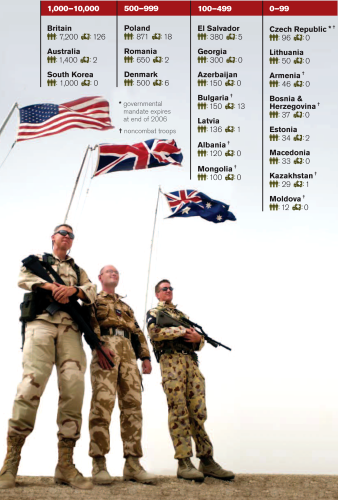
With British troop reductions slated for early 2007 and Poland stating it will leave Iraq at year's end, the willingness of Coalition members appears to be waning as the fighting deepens. A look at who remains alongside 140,000 U.S. troops:
“The idea that Australia could walk out of Iraq and walk out of the Coalition and imagine that that would be prosperous in terms of our alliance and our friendship with the United States is living in fairyland.”
AUSTRALIAN PRIME MINISTER JOHN HOWARD IN LATE OCTOBER 2006
“The government's point of view is that we should remain in Iraq as long as the Iraqi government wants us to.”
DANISH PRIME MINISTER ANDERS FOGH RASMUSSEN IN OCTOBER 2006
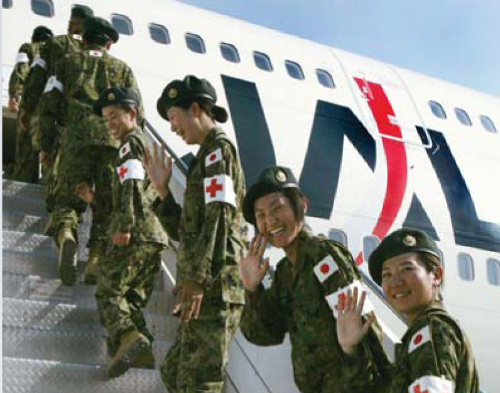
Sayonara: Japanese troops on their way home after completing their missions in Iraq.
INFORMATION FOR THIS CHART WAS TAKEN FROM OPEN PRESS SOURCES AND UNCLASSIFIED GOVERNMENT STATEMENTS. SOURCES INCLUDE GLOBALSECURITY.ORG, IRAQ COALITION CASUALTY COUNT, BBC, AND CNN. TROOP NUMBERS ARE APPROXIMATIONS; CASUALTY FIGURES ARE AS OF DECEMBER 12, 2006.