




Abstract
The truth about Afghanistan
I met Sarah Chayes at the age of three in kindergarten, and one of my first memories of her–of anything–was tackling her from behind in a bear hug in order to wrestle her to the ground. That didn't happen, though, because she clamped her teeth onto my forearm and bit down until I started crying. I let her go, and she won the fight. We were evenly matched adversaries: I was stronger, but she always had an unexpected move that I could never anticipate.
Sarah grew up in a big family with lots of siblings, but I didn't, and we needed each other for different reasons. We became more or less brother and sister. As children we went hiking and camping together. In college we went to Morocco and drifted down into the Sahara, where Tuareg tribesmen invited us to go deeper into the desert with them for six months. After a tortured debate, we declined. Sarah later returned to Morocco to join the Peace Corps, and I visited her in her lonely, desperately poor village. Here was the daughter of a Harvard professor living by herself in one of the poorest parts of the Arab world, and I was home in safe old Boston, wasting my time waiting tables in a Cambridge bar. Sarah always seemed to have the surprise move; she always seemed to be darting ahead in some incredibly audacious way.
Our lives went on; our friendship waxed and waned. I was in Bosnia during the war. She turned up in Kosovo a few years later, also working as a reporter. I went to Afghanistan in the fall of 2000 and spent a month with Ahmed Shah Massoud, leader of the Northern Alliance (assassinated by Al Qaeda two days before 9/11). Sarah defied all journalistic wisdom and completely ignored fall of Kabul in 2001, concentrating on Kandahar instead. It was a city all but passed over by the international press corps: There was no fighting in Kandahar; it was a cultural and political story that couldn't hope to compete with the drama of armies massing on the Shomali plain.
The Clock
For nearly 60 years, the Dooms day Clock has been the world's most recognizable symbol of global catastrophe. Since 1947, the Clock has moved forward and back 18 times, reflecting changes in the state of international security. The Bulletin's Board of Directors–in consultation with a prestigious group of sponsors that includes 18 Nobel laureates–is the “keeper” of the Clock, deciding when to move the Clock's hand, and by how much. The Clock now stands at five minutes to midnight.
But she was right–Kandahar wasn't just part of the story, it was the heart of the story. It was the heart of the story. It was the seat of Taliban ideology and lay on the trunk line of Pakistani power and influence that spread throughout the region. Without Pakistan there was no Taliban, and without the Taliban there was no safe haven for Al Qaeda. Sarah went straight for that most basic truth while the rest of us journalists were hundreds of miles north watching the U.S. Air Force bomb one group of warlords so that a different group of warlords could take over the capital.
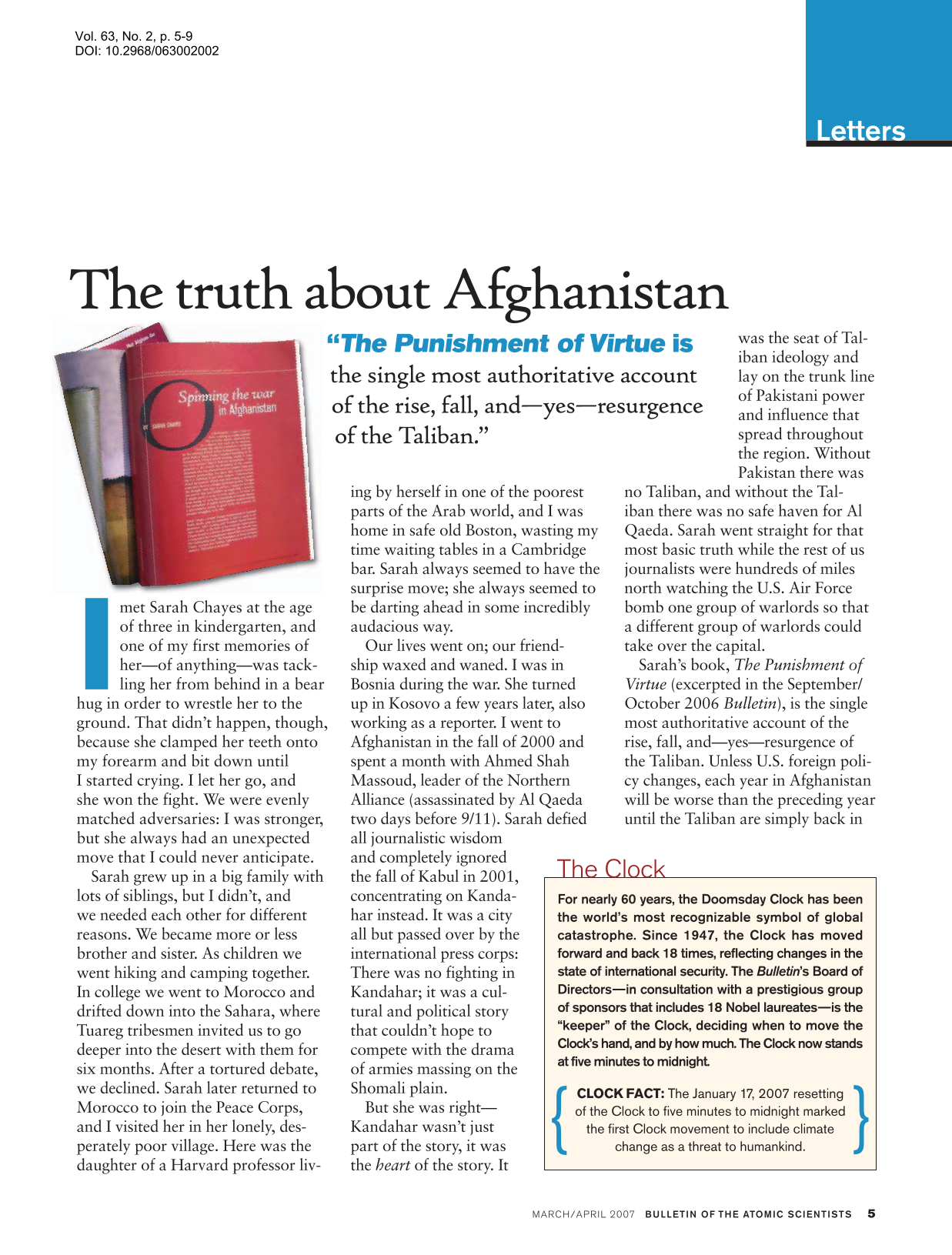
Sarah's book, The Punishment of Virtue (excerpted in the September/ October 2006 Bulletin), is the single most authoritative account of the rise, fall, and–yes–resurgence of the Taliban. Unless U.S. foreign policy changes, each year in Afghanistan will be worse than the preceding year until the Taliban are simply back in power. It would not surprise me if they were operating within Kandahar City by next summer. How this could conceivably happen–in a war that had massive worldwide approval and included a true coalition of NATO forces–requires someone of Sarah's experience and wisdom to explain. She takes down this story–and the diplomatic lies that surround it–like she took me down in kindergarten, with one long, grinding bite. Believe me, it hurts.
Boston, Massachusetts
The buzz phrase since the United States invaded Iraq and Afghanistan is “embedded reporter.” But instead of embedding herself with an army unit, Sarah Chayes embedded herself with the Afghans who were getting killed by the army or by the tribes, warlords, and religious fanatics who thrive on creating social violence and spreading hate. There have been other war correspondents who possessed the diplomatic skills and journalistic integrity necessary to earn the trust of the leaders on both (or all) sides of a conflict, but Chayes's courage–coupled with her genuine compassion for the Afghan people–distinguishes her from mainstream reporters. This allows her to articulate the weakness and ineptitude of the U.S. leadership, including the military–a key contribution to understanding the morass in Afghanistan.
Aurora, Colorado
Terrorists at sea
In “Maritime Legends” (September/ October 2006 Bulletin), Charles Dragonette argues that emphasis on sea-borne terrorism is overblown and inappropriately diverting policy attention from the more pressing need to counter maritime crime more generally. The thrust of the analysis is that theoretical links between terrorism and piracy are unproven and that many of the attacks that terrorists are supposedly seeking to carry out–such as detonating radiological or nuclear bombs at target ports or sinking vessels so as to block critical maritime passages–considerably inflate their known capabilities.
I wholeheartedly agree that there is little to support the supposed nexus between piracy and terrorism–not least because the two actors are motivated by differing and frequently conflicting objectives. In addition, I concur that the current emphasis on worst-case scenarios is not very useful to the policy-making community.
That said, the potential scope for marine terror goes well beyond narrow considerations of large-scale disruptive and catastrophic attacks or an assumed relationship with piracy. The relative attractiveness of operating at sea has grown for terrorists because of the increased security on land post-9/11. Simultaneously, the proliferation of companies specializing in maritime equipment and water sports has increased extremists' options for gaining the resources and skills needed to operate at sea.
More importantly, cruise liners and passenger ferries provide terrorists with a contained target that, even if partially destroyed, would likely satisfy the twin requirements of coercive punishment and publicity that drives the contemporary terrorist phenomenon.
The latent danger of focusing on large-scale attacks to the exclusion of smaller ones is well demonstrated by the 2004 onboard bombing of Super-Ferry 14 in the Philippines. Costing roughly $400 and carried out using only 16 sticks of dynamite, the attack was executed by Abu Sayyaf, a highly fragmented and increasingly cornered Islamist entity of no more than 90 members. However, the incident left 116 people dead, generated considerable local, regional, and even international publicity, and remains the fourth most destructive act of terrorism since 9/11.
Political scientist
The Rand Corporation
Santa Monica, California
Nuclear shutdown
Nick Schwellenbach and Peter D.
H. Stockton's “Nuclear Lockdown” (November/December 2006 Bulletin) provides a valuable glimpse into the security woes of the U.S. nuclear warhead complex. But what's the solution? Schwellenbach and Stockton imply that it's consolidating proliferation-sensitive nuclear materials–along with the laboratories and production plants that use them. Consolidating warhead design and production into centralized facilities looks like the answer only if the overall security problem is construed in the narrowest possible terms. Nuclear security, however, depends upon many things. Narrowly focusing on guards, guns, and berms runs the risk of making the security problem much worse.
Building new facilities to maintain the U.S. arsenal offers political legitimacy for nuclear weapons for all concerned–for Pyongyang and Tehran, as well as for Washington. Lest we forget, the Nuclear Non-Proliferation Treaty includes a binding legal obligation to pursue–and, as a 1996 International Court of Justice decision found and the United States agreed in 2000, to achieve–full nuclear disarmament. Doesn't breaking faith with the vast majority of signatories on this point have profound security risks that are far greater than the risk of a hypothetical terrorist cell blowing up the Y-12 National Security Complex or Los Alamos National Laboratory?
Opportunity costs must also be considered. Rebuilding and running the warhead complex through the end of fiscal year 2030 (the starting point for operating the National Nuclear Security Administration's [NNSA] proposed “Complex 2030”) at current spending levels will cost about $160 billion. Adding a conservative $20 billion per year for the Defense Department's nuclear deterrent expenses brings the total to $640 billion. Out of this, NNSA consolidation will not save much money. Is investing more than a half trillion dollars in U.S. nuclear weapons over the next 25 years really the best security investment?
Executive director
Los Alamos Study Group
Albuquerque, New Mexico
Within the arms control community, particularly those critical of the National Nuclear Security Administration's Complex 2030 plan and the Reliable Replacement Warhead (RRW) program, our call for consolidation of special nuclear materials is sometimes seen as consistent with efforts to ramp up production of new nuclear weapons. This is not our intention, or necessarily a logical consequence of consolidation.
We are both seriously concerned about RRW and related plans to reshape the U.S. nuclear weapons complex to more efficiently produce new weapons–not only because of the arms control implications, but because we question whether either are needed. Unnecessary domestic production of nuclear weapons and the international proliferation of nuclear weapons and materials both work against nuclear security.
Criminal pursuits
The Bulletin's special report on the A. Q. Khan network (November/December 2006) paints a disturbing picture of fecklessness in sufficiently punishing important actors of the network, all of whom violated the export laws of one or more countries.
While it is important to bring bad actors to justice, we should not lose sight of the larger proliferation and policy picture. The Khan network was a consequence of policy decisions made in both Islamabad and Washington during the 1980s when the United States decided that pursuing Cold War politics in Afghanistan was more important than stopping Pakistan's pursuit of the Bomb. U.S. support for the fanatical mujahideen in Afghanistan not only led to Pakistan's nuclear weapons capability, but also to Al Qaeda's rise, 9/11, and current fears regarding nuclear terrorism.
These decisions have bedeviled the nonproliferation regime for nearly three decades. But its problems since the advent of the Nuclear Non-Proliferation Treaty (NPT) go beyond those raised by the Khan network. Since India's 1974 nuclear test, the nonproliferation regime has too often been in the mode of closing the barn door after the horse has bolted. Consider the support for nuclear fuel guarantees by President George W. Bush and International AtomicEnergy Agency Director General Mohamed ElBaradei for nations willing to forego the construction of domestic nuclear fuel-cycle facilities. This kind of deal might have appealed to a country such as Iran in the 1970s when Congress first endorsed the idea in the Nuclear Nonproliferation Act of 1978, but times change and the attractiveness of that idea to Iran and others has dimmed.
It's also ironic that the Bush administration, which removed all sanctions in 2001 imposed on India and Pakistan after their 1998 nuclear tests, is pursuing similar sanctions as a means of punishing North Korea. North Korea could withstand such sanctions, which the United Nations is unlikely to adopt anyway, much better than Pakistan, whose economy is much more dependent on international lending institutions. This maneuver raises a fair question: Does the United States only favor sanctions when they won't work? (See also Cuba.)
These revived ideas and the recent focus on law enforcement, interdiction, physical protection of materials, and data collection are symptoms of the nonproliferation regime's rising distress. At its inception, it was recognized that the NPT–and by extension the overall regime–would not be effective over the long term if it remained discriminatory at heart. Hence, the addition of Article VI to the NPT, which requires good faith efforts toward nuclear disarmament by the weapon states. Clearly, this proviso remains unsatisfied.
As we pursue the criminals who helped Khan and, in accordance with U.N. resolution 1540, criminalize the pursuit of nuclear weapons by any individual or group, we should also ask when it will be a crime for a state to possess nuclear weapons. The satisfaction of Article VI alone won't relieve the nonproliferation regime's distress, but it is a necessary condition for the survival of an effective regime.
Senior science fellow
Center for International Security and Cooperation
Stanford University
“Special Report: The Khan Network” offers an illuminating picture of the ease and relative impunity with which global nuclear black marketeers conduct their trade. It also highlights the need to strengthen existing means for bringing illicit nuclear traffickers to justice and to improve controls on the sensitive exports necessary to construct nuclear weapons.
However, the articles contained in the report failed to acknowledge the incentives that drive this illicit market. For instance, what political, strategic, and economic factors motivated Khan and his associates to clandestinely transfer these items to countries such as North Korea and Iran?
It's worth noting that a national desire for nuclear capabilities provides an important source of demand for the nuclear black market. Indeed, the Khan network's customers were national nuclear programs. To the extent that these countries want nuclear arms, curbing the illicit market that stocks these nuclear programs necessitates addressing the underlying incentives that drive countries to pursue such weapons.
Proliferation scholars have identified security and economic variables that influence a country's decision to go nuclear. These insights could be readily applied to U.S. policy regarding Iran, a Khan network customer. Specifically, U.S. policies should aim to reduce Mideast security tensions caused by–from an Iranian point of view–the large U.S. troop presence in Iraq and Afghanistan and the perceived threat from both Israeli conventional and nuclear weapons. To calm this tension, the United States should foster a bilateral dialogue with Iran and make a nonaggression pledge. Similarly, integrating Iran into the global economy will empower Iranian advocates of nuclear moderation.
Policies that address these and other incentives promise to curtail illicit nuclear trade and to bolster the troubled nuclear nonproliferation regime.
Geneva, Switzerland
Gas attack
In “The Other Gas” (September/ October 2006 Bulletin), Jonas Siegel describes the human causes of methane emissions, the second most abundant and significant greenhouse gas. Molecule-for-molecule, methane is much more effective than carbon dioxide at reradiating heat back to Earth's surface, and global methane concentration has increased over the last few decades.
While Siegel highlights a variety of human activities that contribute to methane emissions (e.g., rice production, biomass burning, leakage of natural gas production), it is critical to consider the extent to which the organization of human activities–as well as the relative scale of particular human activities–impacts this and other forms of noxious gas emissions. Currently, I'm investigating how foreign-funded production in less developed countries contributes to the emission of methane, as well as the emission of carbon dioxide, carbon monoxide, nitrogen oxides, and non-methane volatile organic compounds. Results of my cross-national quantitative analyses consistently show that transnational corporations and foreign capital are more likely than domestically controlled firms to invest in outdated production equipment, transportation vehicles, and less eco-efficient facilities, which increase methane emissions and the discharge of other noxious gases, air pollutants, and industrial water pollution.
Indeed, this research underscores the need for less developed countries to formulate and enforce more stringent regulations that force transnational firms to invest in more environmentally friendly production and transportation processes. These regulatory needs are quite consistent with the suggestions offered by F. Sherwood Rowland in Siegel's article. Rowland, a world renowned atmospheric chemist, asserts that decreasing the leakage of natural gas in environmentally unfriendly production and transportation processes would greatly help suppress human-caused methane emissions.
Department of Sociology
Washington State University
Bio-shift
“A Brave New World in the Life Sciences” by Eileen Choffnes, Stanley Lemon and David Relman (September/ October 2006 Bulletin) makes clear that using science for biological warfare or bioterrorism takes on an added dimension with the rise of emerging and enabling technologies.
The authors predict that “previously unanticipated paradigm shifts are likely to occur in the future” because new technologies can be combined in unexpected ways, creating applications far different than originally intended. It's a sound prediction, considering a present-day paradigm shift has emerged in the relatively nascent field of systems biology, which tries to understand the function of interacting biological systems as a whole. Vital physiological systems such as the immune, nervous, and endocrine systems do not operate alone, but are intricately connected through complex regulatory mechanisms directed by biochemical substances such as cytokines, neurotransmitters, and peptide hormones (bioregulators) acting within this network. This shifts the focus away from the possibility of using microorganisms malevolently to the possibility of using bioregulators as weapons to disrupt the operation of interacting biological systems. The perturbation of one system's function with such a bioregulator will profoundly affect the functions of the network's other systems. This creates a new level of complexity, with the possibility of either inadvertent or deliberate misuse.
Choffnes, Lemon, and Relman's concern about the increased potential for bioregulator dissemination as a result of the developments in emerging and enabling technologies deserves particular consideration. More efficient delivery of bioactive compounds for therapeutic purposes is a subject of intense pharmacological research. The production of defined nanoparticles combined with new methods for making substances absorbable through the nasal and respiratory tracts represent advances that could yield good or ill consequences. Great strides are also being made in the use of viral vectors as gene ferries. In this regard, manipulating viruses to infect specific tissues or cells (changing the tropism of viruses) is being actively researched.
Trying to exploit the benefits of advances in the life sciences while minimizing the risks–without impeding vital biomedical progress–will become more and more difficult with time. The authors accurately describe the way forward–a multifaceted approach that addresses the “problems and threats posed by biological warfare and bioterrorism.” Graham Pearson, the former director general of Britain's Chemical and Biological Defence Establishment at Porton Down, refers to this approach as building a “web of deterrence” and the International Committee of the Red Cross as a “web of prevention.”
Department of Microbiology and Genetics
Darmstadt University of Technology
Darmstadt, Germany
Dependency theory
Jeff Hecht's “Space: Dual Threat” (September/October 2006 Bulletin) points out the many advantages of using autonomous robots in space. It also begs a larger question regarding the judicious U.S. use of advanced satellite technology for a major strategic edge. The United States possesses an overwhelming superiority in the number and quality of its space assets. Therefore, it has far more to lose militarily, commercially, and scientifically by engaging in space warfare–clandestine or otherwise.
Since the United States depends on both commercial and military satellite bandwidth for global communication to project command and control from the continental United States and to target globally deployed ordinances, it would suffer more than other regimes that possess minimal satellite assets and guided munitions. The losses would be mostly asymmetric if satellites were targeted by an adversary without space assets. A simple retaliation in near space will generate orbital debris, with indiscriminate destruction of assets in the region perhaps via a chain reaction collision effect. The United States could suffer staggering loses in a retaliatory exchange simply because it is target rich in space assets.
PUT IT IN WRITING
Send your letter to Bulletin of the Atomic Scientists, 6042 South Kimbark Avenue, Chicago, IL 60637, by fax to 773/702-0725, or via e-mail to
Satellite use for intelligence, global positioning, reconnaissance, and targeting is currently acceptable and in U.S. interests. This advantage can be jeopardized by attacking the space assets of a weaker adversary; current rules and space treaties favor the United States. Also, interfering with satellites could be perceived as initiating war. Reconnaissance satellites are useful instruments for pursuing peace by providing transparency of strategic activities and limiting preemptive surprise attacks. A nation that desires world peace should use space assets for this purpose and not as an opportunity to extend the regions of direct conflict into near space.
Department of Astronomy
Harvard University Cambridge, Massachusetts
Fermilab's first lady
Thank you for your remembrance of Jane Wilson (“Passings,” November/December 2006 Bulletin). Indeed, she was a remarkable woman, who, in addition to being Robert Wilson's widow, was an author, teacher, mother, and the “first lady of Fermilab.”
Born in San Francisco in 1916, Jane studied English at the University of California, Berkeley. While there, she met Robert, then a graduate student in physics. When he was recruited to the Manhattan Project, Jane taught English at Los Alamos High School. Before long, she made many lasting cultural and intellectual contributions.
After Robert's appointment as Fermilab's director in 1967, they moved to a farmhouse on lab property. She used her position as honorary president of the lab's women's organization to encourage many artistic and social initiatives. During this time, Jane also served as book editor and a frequent contributor to the Bulletin. She also edited three books–Alamogordo Plus Twenty Five Years, All in Our Time, and Standing By and Making Do: Women of Wartime Los Alamos.
Upon moving to Ithaca, New York, in 1982, Jane began to take her lifelong penchant for writing poetry more seriously. On the occasion of her 75th birthday, she self-published 60 of her poems (Verse Terse and What's Worse: Some Love Poems), which drew unexpected critical acclaim. Encouraged, she organized a second compilation in 1992 and a third three years later.
Reflecting on her years at Los Alamos, Jane wrote, “At no other time and at no other place has such a community mushroomed in secrecy, so apart from the world, yet with a purpose so significant that the world itself would so be irrevocably changed by the product of its labor.”
My mother was an astute observer of–and contributor to–a seminal time for international physics.
Somerville, Massachusetts
The map accompanying the Novem ber/December 2007 Nuclear Notebook, “Where the Bombs Are, 2006,” mistakenly listed Trident I C4 missiles in Bangor, Washington, and Kings Bay, Georgia, as carrying W76 warheads. Advanced Trident II D5 missiles carry all active W76 warheads. The map also pointed to Kirtland, New Mexico, as the location of an air force nuclear weapons storage site. The correct location is adjacent to Kirtland Air Force Base.
The Bulletin mistakenly omitted a photo credit for one of the images accompanying Steven Heller's essay, “The Other Icon of our Age” (January/February 2007). Mike Epstein took the photo of mushroom cloud graffiti, labeled image no. 8 on page 23.