




Abstract

Nuclear power struggle
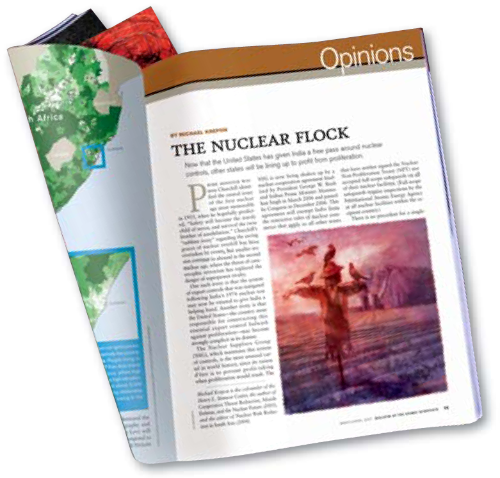
Michael Krepon's “The Nuclear Flock” (March/April 2007 Bulletin) predicts that the U.S.-India nuclear agreement will gravely injure the global system of export controls, and by implication, the nonproliferation regime. However, the article's narrow focus on the Nuclear Suppliers Group (NSG) obscures the larger context in which the deal was negotiated and leads to its pessimistic conclusions.
Krepon fears that exempting India from “the global rules of nuclear commerce” would open the door to other outliers. First, the rules will have to be revised in any case as many countries ranging from Brazil to Saudi Arabia are interested in adding nuclear power to their energy strategy. Second, although Krepon criticizes nuclear technology export policies based on evaluations of recipients as “good” or “bad,” the entire nonproliferation regime is based on the assumption that nuclear weapons are safer in some countries than in others.
In fact, if other countries see India as being rewarded for its “responsible” policies, the U.S. India deal could become a model for nuclear commerce in this century. This is a big “if” since, as Krepon correctly points out, the Bush administration has “asked little of India.” Apparently driven by geostrategic wishful thinking into believing that India could become a counterweight to China, the U.S. political leadership seems to have hobbled its negotiators.
Krepon's focus on “profit taking” is also misplaced. The United States, the country that is spearheading India's entry into the global nuclear order, will face stiff competition from vendors of fuel and reactors based in France and Russia.
Simons Centre for Disarmament and Non-Proliferation Research University of British Columbia
Michael Krepon's commentary against the U.S.-India nuclear deal makes a point of highlighting the role of export controls, and therefore of the Nuclear Suppliers Group (NSG), as the sole bulwark against the tide of proliferation. However, his interpretation is selective in explaining the origins and functioning of the NSG.
It is ironic that Krepon portrays the system of export controls that followed India's 1974 nuclear test as the “global rules” of nuclear commerce. In reality, it has always been a self-selected cartel of states that do not recognize the rules of nuclear commerce as established by the Nuclear Non-Proliferation Treaty (NPT). The NSG's dualuse control list and full-scope safeguard requirements go beyond NPT regulations. Furthermore, the NSG's nonproliferation principle allows members to deny technology to a state regardless of its standing within the NPT. In sum, the NSG has always operated on the principle of differentiating between “good” and “bad” states.
The Clock
UPDATE: Bulletin honored
The “Ellies” are named for Alexander Calder's stabile Elephant

The Bulletin of the Atomic Scientists was selected from a group of five nominees for a 2007 National Magazine Award for General Excellence. Bulletin editors joined Executive Director Kennette Benedict and Board Chair Cathryn Cronin Cranston in New York City for the black-tie awards ceremony, presented by the American Society of Magazine Editors (ASME), which called the Bulletin “urgent but methodical, sensitive to nature and history…sharply reported, argued, and designed–and always profoundly humane.” Accepting the award was Editor Mark Strauss.
“The Bulletin remains relevant today because of its persuasive insight into the range of causes for our eroding global security. Its iconic atomic clock now ticks more urgently than ever,” said ASME President Cynthia Leive in presenting Strauss with the award.
This year the Bulletin joined the ranks of Foreign Policy, New York magazine, Wired, Rolling Stone, and National Geographic, all of which won the general excellence award in their respective circulation categories. This is the second time the Bulletin received an “Ellie”–it also won in 1987 for best single-topic issue for its coverage of Chernobyl.
As an oligopoly operating in an environment of ever-changing technology, the NSG has had to be pragmatic and flexible to predict future scenarios that might weaken its power, and to take preemptive action. The resulting strategy has almost always involved co-opting strong challengers within as well as without. Despite severe objections to Russia building two 1,000-megawatt light water pressurized reactors in India, the NSG could not disown Russia. Similarly, the revelation that China had been supplying nuclear technology and equipment as well as weapons designs to Pakistan raised few eyebrows within the NSG. The discovery of a secret enrichment program being conducted by South Korean scientists in 2000 was also swept under the carpet. In sum, the NSG has survived and become stronger–though not necessarily legitimate–precisely because it is not rigid and inflexible like the NPT.
The India deal is a means to co-opt a country that is now both an attractive market for and a potential supplier of dual-use technologies. India's record on horizontal proliferation and its system of export controls is better than many NSG members. The Bush administration is not placing profits ahead of nonproliferation–it is recognizing a reality that confronts the future of hi-tech commerce: If the NPT cannot be changed to accommodate the reality of responsible nuclear states such as India and Israel, then the NSG has to become the means to ensure their willing participation in the existing system of export controls.
Center for International Trade and Security University of Georgia
In “The Nuclear Flock,” Michael Krepon repeats a scare tactic used by opponents of the U.S. India nuclear deal by raising the possibility that other states seeking nuclear weapons will now demand similar deals with nuclear supplier nations. The argument is fallacious for the following reasons:
First, countries often have compelling security reasons for going nuclear, such as an enduring rivalry with a nuclear-equipped adversary or a conventionally superior challenger. However, acquisition of nuclear weapons is costly and it is unlikely that a state will acquire them in the hope it will receive a special deal from the United States similar to India's.
Second, from Krepon's point of view, all states are equal and hence discriminatory treatment is not possible or desirable under the Nuclear Non-Proliferation Treaty (NPT). However, the regime has two classes of states: nuclear weapon states and non-nuclear weapon states, with different responsibilities and rights. The perceived character of the state also does increasingly matter under the NPT. Otherwise, why is there such a fuss about Iran developing enrichment technology while such technologies are allowed for Japan?
Finally, the NPT assumes that the U.N. Security Council's P-5 members–China, the United States, Russia, Britain, and France–will retain their status with special privileges and that no power transition will take place in the international system. By any measure of hard and soft power indicators, India is the leading candidate for major power status; it simply missed the boat in 1945 when the U.N. Security Council was created and in 1970 when the NPT bestowed nuclear weapon state status on nations that had manufactured and detonated a nuclear weapon before January 1, 1967. As a latecomer in the international nuclear order, what India is facing is the challenge of integration as a major power. The U.S.-India agreement serves the larger goal of peaceful integration of a rising power.
Department of Political Science McGill University
It's important to think carefully about the consequences of adopting a good guy/bad guy approach to proliferation. If this standard had been adopted by the Johnson administration, the Nuclear Non-Proliferation Treaty (NPT) could never have been negotiated, because the Soviet Union certainly qualified as a bad actor. Had every president from Lyndon B. Johnson to Bill Clinton adopted this standard, the International Atomic Energy Agency would not have evolved into a global guardian against proliferation because states belonging to the NPT could never have accepted a good guy/bad guy approach to strengthening safeguards. Nuclear test-ban treaties could never have been negotiated if they applied only to bad actors. Export control regimes could never have been constructed if they were only targeted against bad states.
All of these accomplishments required worldwide norms against proliferation–not one set of rules for good guys and another for bad actors. Global norms are needed because not everyone agrees who the good guys and the bad guys are. Norms are also needed because countries change over time. We can't strengthen nonproliferation institutions except by strengthening the rules. Success in preventing, reducing, and eliminating nuclear dangers fundamentally depends upon our refusal to distinguish between good proliferation and bad proliferation.
The misuses of fear
John Mueller's article “Fear Not” (March/April 2007 Bulletin) is a welcome piece of well-researched, well-documented, and well-written common sense about the exaggerated threat of terrorism. Other countries are less receptive to this blatantly illogical propaganda than is the United States. But the perverse effects of the terrorism industry go well beyond the bureaucrats and the suppliers of equipment and “intelligence” that Mueller so correctly indicts. The very essence of cities has been affected by what he describes. Barriers to entry of public buildings, security screenings, random searches, and the “hardening” of purportedly high-risk targets are ubiquitous. The cost of planning the New York City Convention Center has increased by $100 million because of police concerns about terrorism; indeed the police have become virtually the final planning authority. The design of public space has become distorted in ways that inhibit its public use. The negative effects of what Mueller describes are far-reaching.
Furthermore, I have made the argument elsewhere that fostering fear of terrorism displaces legitimate anxieties about society and its future that many people share, from issues of unemployment to cultural decline, to a pervasive feeling that things are out of control and getting worse. Such fears effectively distract from a clear, critical look at what is going on in our society and undercut efforts at change and reform. The issues Mueller raises in his article are critically important for public policy today.
Professor of urban planning, emeritus Columbia University
Universal health care
As Laura Kahn states in “The Zoonotic Connection,” (March/April 2007 Bulletin) the emergence of West Nile virus in the Western Hemisphere highlighted both critical links between human and animal disease and gaps in animal and human disease surveillance and reporting. In fact, animal and human health are linked not only through shared (zoonotic) diseases, but also through the food chain and the human-animal bond.
A recent survey of veterinarians and physicians shows that veterinarians diagnose zoonotic diseases significantly more often than their physician counterparts, and also are far more likely than physicians to discuss zoonotic diseases with their clients. Small animal practitioners are the most fully engaged segment in this study. Thus, in stark contrast to Kahn's treatment of veterinarians “practicing pet medicine,” our community-based, private veterinary workforce is our most highly trained, educated, and aware front line defense against zoonotic and emerging infectious diseases. This misconception of the capabilities and focus of modern veterinary clinicians is rampant in the anthropomorphic medical community. At the organizational and professional levels, it is the true root source of today's gulf between animal and human disease surveillance.
My friend and colleague, Tracey McNamara–a veterinary pathologist and chief of the Bronx Zoo's pathology department–played a leading role in linking avian and human neurologic disease, which led to the eventual diagnosis of West Nile virus. Yet we both agree that she simply performed to standard as an educated, trained, and experienced comparative pathologist. More impressive was her determination to hold a steady moral compass while weathering the storm of disbelief, hostility, and blatant disregard doled out by the human-centric public health infrastructure.
The deficit, then, does not lie in substandard veterinary training, awareness, or engagement. We have an outmoded public health system in an era of exponential change and explosive emerging infectious diseases. The challenge is in elucidating and breaking down the organizational, institutional, and professional barriers to an improved system of information flow between the animal and human health communities.
Kahn makes a call for increased training to generate larger numbers of veterinarians directly engaged in public health. I couldn't agree more. In fact there are numerous programs in the United States, from veterinary master of public health and PhD programs, to preventive medicine and epidemiology residencies leading to certification from the American College of Veterinary Preventive Medicine, to web-based training programs such as Purdue University's graduate certification program in veterinary homeland security.
I challenge our leading human-centric public health officials to come down from their ivory tower and engage with our remarkable cadre of comparative-medicine professionals, the veterinarians. It is an old veterinary adage that “humans make a poor surveillance system.”
Department of Veterinary Clinical Sciences Purdue University
Laura Kahn's excellent commentary on surveillance of zoonotic diseases points out the need for collaboration between all branches of medicine if we are to effectively carry out the core functions of public health: assessment, policy development, and creating healthy environments for all people and animals.
Growing international trade and travel mean that many threats to human and animal health, once isolated by geography, have become easily and rapidly transmittable across the globe. The consolidation and vertical integration of agricultural production systems have increased the risk of agroterrorism and natural disasters. And as societies demand more protein in human diets, pressure has been placed on animal production systems to respond, often to the detriment of ecosystem health and frequently with little concern for biosecurity. Veterinarians are uniquely trained to understand production systems as well as clinical medicine.
Moreover, despite the majority of recent graduates entering companion-animal, urban private practice, veterinarians are still in the vanguard of diagnosticians for foreign animal diseases, many of which are transmissible to humans. Doctors in small animal veterinary clinics in Illinois recognized the outbreak of monkey pox in 2004, for example, and veterinarians in livestock practice have traditionally served as the first line of defense against animal diseases that affect the food supply and human health.
Veterinarians are trained in a community approach to medicine whether that community is made up of people, pets, livestock, or, more commonly, all three. It is this “herd health” approach that allows veterinarians, especially those formally trained in public health, to quickly identify the factors that contribute to strategic health issues.
If our society is truly committed to improving the health of all of our citizens, we must utilize the training and talents of all medical professionals and make sure that communication and collaboration between physicians, veterinarians, public health professionals, policy makers, environmental scientists, city planners, and many others are the standard rather than the exception. We are attempting to do exactly that at the University of Illinois with our proposed Illinois Center for One Medicine. It's time to realize that medicine is medicine, whether used to help people, animals, or the environment in which we all live.
Department of Veterinary Clinical Medicine University of Illinois
Unholy war
In the March/April 2007 Bulletin, Rev. Barbara G. Green offers a Christian perspective on national defense, finding “pretty strong consensus that nuclear weapons are never an option.” The Jewish tradition is also clearly against the idea of nuclear weapons. In Halachic tradition (Jewish law), nuclear weapons are prohibited. Our tradition, as well as others, is to believe that God will not permit global destruction to occur, and that we have the power to control human aggression and what the priorities of a society ought to be. A central question, then, is whether military strength is central to national security or the quality of life of our citizens.
In Preventing the Nuclear Holocaust: A Jewish Response, Rabbi David Saperstein wrote, “The nuclear arms race has not only threatened us with great destruction in the future, it has already led in the present to the neglect of the immediate human needs of all the nations in the world. For the more we spend in time, money, and energy on the arms race, the less we spend in dealing with poverty, crime, alienation, and all of the human ills which plague us more and more.”
What happens to one nation happens to us all. People of all faiths understand that God created the universe as a rich, beautiful space not to be blown into oblivion. This tiny piece of creation is ours to destroy or to fulfill our deep religious traditions. We are capable of destroying one another or calling upon and bringing to bear our great moral strength.
It is best stated in the Torah: “See, I have set before you this day the blessing and the curse, life and death, therefore choose life that you may live, you and your seed after you.”
Founder, Rabbi Steven B. Jacobs
Progressive Faith Foundation Woodland Hills, CA
Britain's energy choices
Whilst I agree with Sir David King that climate change is the biggest threat currently facing the planet (“The Man Who Flipped a Nation,” March/April 2007 Bulletin), his view that nuclear power has an important role to play in tackling it is a lot of hot air. Nuclear power is an expensive and dirty distraction from the real solutions we need to use to avert a climate catastrophe.
Prime Minister Tony Blair has had a damascene revelation over nuclear energy in the last few years, swallowing the industry's spin that a new generation of nuclear plants will help Britain slash carbon emissions and maintain energy security. Yet ten new nuclear power stations will only reduce our CO2 emissions by around 4 percent and are unlikely to come online before 2020. Too little, too late.
Nuclear power, like coal, oil, and gas, relies on an antiquated energy model that is intrinsically inflexible, insecure, expensive, and wasteful. Centralized power stations waste over two-thirds of the energy in their fuel by throwing it away as heat. More is wasted in sending the electricity down the power lines, so that only 35 percent of the original energy ends up actually being used in the home.
Greenpeace is promoting a decentralized energy (DE) system in which energy is produced near where it is needed so that both heat and electricity can be used. With DE, individual buildings can stop being just consumers of energy and start generating it. Generating energy near to its point of use and using heat as well as power is cheaper, more secure, and cleaner than nuclear.
We are now at an energy crossroad. Blair and advisers such as King happily push the nuclear option, but if Britain is serious about tackling climate change and setting itself on a path to a clean energy future, it should kiss goodbye the idea of new nuclear power stations. Britain should take instead the more efficient DE and renewable road, meaning less reliance on dirty power, lower costs, and crucially, lower carbon emissions.
Senior climate and energy campaigner Greenpeace UK
Your excellent article on Sir David King is properly complimentary of him and his scientific approach to finding solutions for difficult problems. I also commend author Jonathan Leake for emphasizing King's unequivocal stand that, as the provocative title of his article in the Guardian reads, “The Nuclear Option Isn't Political Expediency but Scientific Necessity.”
The Bulletin would be doing a great service to our country if it, too, were to move to a position more clearly in favor of more nuclear power.
Political opposition killed many of the nuclear plants that were planned for the 1970s. As a result, coal-fired plants have flourished. Among the consequences are: acidified lakes, mercury-contaminated wildlife, coal miner fatalities, plus the health and human cost of air pollution. This combination has earned the United States its reputation for being the worst polluter, per capita, in the world.
The problems we have experienced with nuclear power plants are trivial in comparison to the consequences of burning fossil fuels. These facts should be made widely known so that people will see the wisdom of building more nuclear power plants.
Concord Energy Policy Group Concord, NH
Controlling small arms
In “Conventional Wisdom,” (March/April 2007 Bulletin) Natalie Goldring draws much-needed attention to the problems associated with illicit proliferation and misuse of conventional weapons. This year, the U.S. Congress has a golden opportunity to help reduce the threat from a particularly deadly type of conventional weapon: man-portable air defense systems (MANPADS), or shoulder-fired, surface-to-air missiles. As part of the fiscal 2008 budget request for foreign aid, President George W. Bush has requested a five-fold increase in funding for the State Department's Office of Weapons Removal and Abatement, which secures and destroys surplus and illicit weapons worldwide. In just five years and on a shoestring budget, this program has already destroyed 21,000 MANPADS and secured thousands more in Nicaragua, Ukraine, Cambodia, Bosnia-Herzegovina, Afghanistan, Chad, and Liberia–where a State Department team arranged in 2003 for the destruction of 45 poorly secured missiles, including four that were discovered at the private residence of a former government official. (According to one of the team members, the four missiles were found in a metal shed “guarded only by a chicken with no tail feathers.”)
The extra funding in the budget request would allow the State Department to eliminate the threat from thousands of additional MANPADS, thereby significantly reducing the pool of missiles that are vulnerable to theft, loss, and diversion to terrorists. This program exemplifies the practical, commonsense approach to national and international security for which the United States is known, and it deserves Congress' full support.
Manager, Arms Sales Monitoring Project Federation of American Scientists