



Abstract
With ttie Gold War superpowers looking for new military opportunities, an lowan physicist discovered how to take the heavens out of the equation.
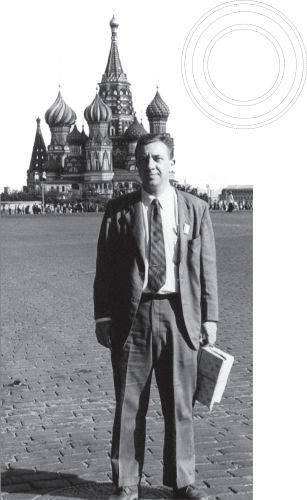
Physicist James Van Allen faced a tense and skeptical crowd of Russian scientists at the July 1959 Cosmic Ray Conference of the International Union of Pure and Applied Physics in Moscow. A year earlier, Van Allen had made the space age's first seminal scientific discovery: The instruments he designed and placed aboard Explorer I, the maiden U.S. satellite, and Explorer III revealed that natural belts of radiation surround Earth across thousands of miles of space.
The University of Iowa professor came to Moscow to discuss this finding. But many of the conference attendees had doubts about Van Allen's assertion that the belts occurred naturally. They were convinced that the belts, which today bear Van Allen's name, provided telltale evidence of nuclear testing. The Americans thought Russian nuclear tests were to blame; the Russians thought U.S. nuclear tests were to blame. Van Allen brought the scientific evidence to prove them wrong.
The single Geiger tube cosmic ray detectors Van Allen developed for Explorer I and Explorer III only revealed the belts because the amount of radiation contained within them blanked the instruments to zero, which allowed Van Allen to determine when the satellite entered and exited the zones. The four detectors he built for the July 1958 U.S. satellite mission, Explorer IV, however, allowed him to directly study the belts for the first time. Explorer IV also gave cover to a hidden agenda–the survey of a series of nuclear bomb explosions (dubbed Project Argus) that the United States hoped would prove the feasibility of using artificial radiation belts to create an anti-intercontinental ballistic missile (ICBM) shield capable of warding off a Soviet nuclear attack.
The U.S. Air Force exploded the low-yield nuclear missiles above the atmosphere, and electrons from the blasts did indeed create the artificial belts intended for the shield. But Van Allen found that the blasts produced puny, short-lived artificial belts when compared to the belts his instruments aboard Explorer I and Explorer III discovered.
To the astonishment of the Russian physicists present at the Cosmic Ray Conference, Van Allen candidly presented these findings: The narrow bands of the artificial belts decayed in a matter of weeks while cosmic rays and solar plasma replenished the natural belts. The artificial belts also showed the spiked fingerprints of radiation levels characterized by a nuclear blast. Van Allen's message was clear: Nuclear tests in space would leave a signature that a satellite loaded with charged particle detectors could monitor.
From belts to blasts
The New York Times, Time, ana other publications touched on the military significance of Argus four months earlier in March 1959. They wrote about Nicholas Christofilos, a brilliant, visionary Greek elevator mechanic who rose to the highest circles of Lawrence Livermore National Laboratory. The Soviet's 1957 launch of Sputnik sparked Christo filos's original inspiration for defending democracy with a space shield, a concept dusted off and refined 30 years later by the Reagan administration for its “Star Wars” defense model.
Christofilos took the experimental results of confining particles in an earthbound nuclear reactor and applied the strategy to space. He reasoned that from the mushroom clouds of nuclear blasts, electrons would radiate around the globe like a huge nuclear umbrella trapped by Earth's magnetic field. This would weave a space shield that could burn up spy satellites and prematurely trigger bombs to disintegrate before they ever reached their targets.
Van Allen joined the project when he visited the Jet Propulsion Laboratory (JPL) headquarters at the California Institute of Technology in Pasadena in March 1958–just as JPL Director William Pickering heard about Argus. Pickering, Van Allen, and rocket expert Wernher von Braun worked together on the first Explorer missions, and Pickering suggested Van Allen as the man with the detectors to monitor the Argus tests.
By early April, Van Allen had evidence of the natural radiation belts that Christofilos hoped to create artificially. Van Allen got an informal go-ahead to customize instruments for the Argus project on May 1, the same day he announced his discovery of the inner radiation belt at the National Academy of Sciences in Washington. Nine days later, he and graduate student George Ludwig, who helped fabricate all the previous Explorer instruments, traveled to Pasadena. They met with von Braun's team from the Army Ballistic Missile Agency (ABMA) in Huntsville, Alabama, and representatives from the Naval Research Laboratory (NRL) in “Washington.
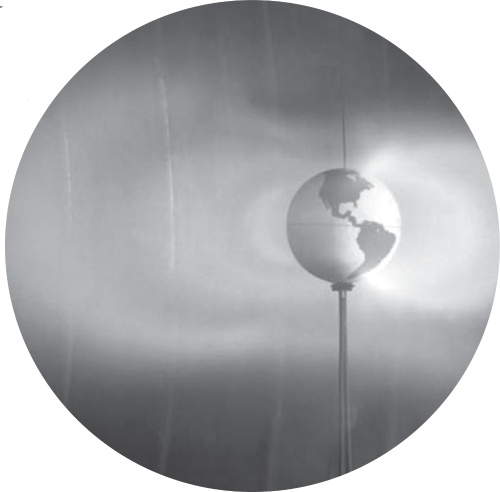
The discovery: (left) A NASA simulation of the Van Allen radiation belts; (previous page) Van Allen in Moscow at the 1959 Cosmic Ray Conference
“That was a very important meeting, all undocumented except for these notes,” Van Allen said, referring to his 11-page handwritten summary of the meeting. In the course of the freewheeling discussion, Van Allen matter-of-factly confirmed that the University of Iowa would build all the payload instruments, meaning they would be constructed in the overcrowded basement of a physics building on campus. “Agreed: [Iowa] will coordinate payload assembly!” he wrote exultantly. 1 His excitement reflected the fact that he knew what he was looking for this time around and developed instruments accordingly.
“The really revolutionary thing was the new system of four detectors, designed to cope with the [radiation] intensity that we had previously found to be present,” Van Allen said. “In [planning] Explorers I, II, and III, we had no idea the radiation belts existed. They were a total surprise, and our instruments were essentially overwhelmed by the radiation. Still, we got good results, and by the time we designed Explorer IV, all the detectors were designed with the fresh knowledge we had and we were very eager to go out there.” The detectors were now much smaller, miniaturized over a matter of months from the size of a D battery in Explorer I to the size of a triple-A battery in Explorer IV.
ABMA (rather than JPL) took responsibility for the satellite, using the previous Explorers as models but slightly redesigning them to allow for more instruments, more battery power, and a total payload weight of 37 pounds instead of about 31 pounds. JPL and von Braun's team boosted the Jupiter C rocket performance to allow for the heavier pay-load. The army and air force developed a launch plan to maximize the range of the orbit, promising Van Allen a cinematic “view” of the radiation belts. JPL and NRL added new ground stations in Nigeria, Singapore, and other locations in a worldwide network that received data transmissions.
“It was all decided on a handshake so to speak,” Van Allen said. “We didn't have to ask anybody about our decisions. We understood each other well enough to just go out and do it.” But the meeting assigned Iowa a rigorously tight schedule of deadlines for Explorer IV and the companion Explorer V missions. “June 6, first complete prototype,” Van Allen wrote in his notes. “July 1, two flight units; July 15, two flight units.” 2 Flight-testing needed to be completed right after that. It was 77 days to launch when Van Allen left Pasadena, a schedule that even he saw required “lots of miracle work.” The Iowa team took up the task immediately, not waiting for the formal contract approval of $123,000 to build all of the instrument packages. This included $13,060 for 2,500 hours of engineering labor and $5,224 for 3,200 hours of manufacturing labor. The laborers included graduate students Carl Mcllwain and Ludwig, faculty member Ernest Ray, and shop instrument maker Joseph Sentinella. “Even undergraduates could count on finding part-time employment,” said Bruce Randall, Van Allen's longtime research assistant whose carpentry skills got him his first job in the physics department while still a freshman in the early 1960s.
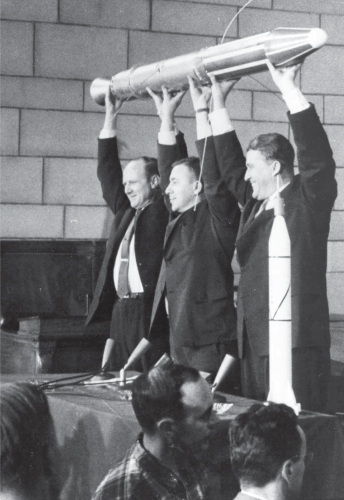
Proud parents: The men responsible for Explorer I, the first U.S. satellite, which launched on January 31, 1958. From left, William Pickering, James Van Allen, and Wernher von Braun.
The Iowa group designed, built, lab-tested, and field-tested the promised instruments for Explorer IV in those 77 days, working furiously under a sign that read, “This job is so secret even I don't know what I'm doing.” 3
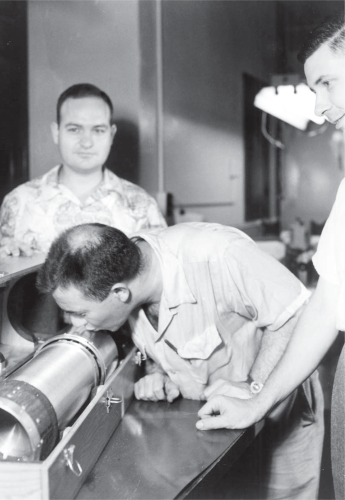
Fond farewell: Van Allen kisses Iowa's scientific payload for Explorer IV, flanked by graduate students Carl McIlwain (left) and George Ludwig
Ludwig and ABMA rocket scientists Josef Boehm and Ernst Stuh-linger commuted back and forth between Huntsville and Iowa City as debates raged over transmitters, batteries, and other details to make the instruments responsive to the intense radiation of the natural belts and the readings from the expected artificial belts.
Pentagon brass showed up at the physics building and returned home incredulous. “Visitors to the University of Iowa during the spring and summer of 1958 were astonished to find that a crucial part of this massive undertaking had been entrusted to two graduate students and two part-time professors working in a small, crowded basement laboratory of the 1909 physics building,” Van Allen noted in his 1983 book Origins of Magnetospheric Physics.
Despite the secrecy, the Iowa team could build everything in the open since both the satellite and the instrumentation officially served as programs to further study the radiation belts. Only the double-duty aspect of the mission to study the nuclear blasts was secret, and Mcllwain and Van Allen alone had full security clearance to remain informed of all details.
To accomplish direct measurement, Van Allen ordered Geiger tubes designed to withstand the possible onslaught of 40,000 electrons or protons per square centimeter per second in the belts' intense radiation zones. The secret to the sensitivity was in the scaling. One Geiger tube would transmit one tone for every 64 particles counted, perfect to detect the relatively low intensity of cosmic rays outside of the belts. In addition, a lead shield on this tube would reveal whether the particles had enough energy to pierce through lead.
Anton Electronics in Brooklyn built all the miniaturized Geiger tubes at a total cost of $316. In addition, the suite of detectors included a scintillator with a pho-tomultiplier that produced an electronic pulse each time a high-energy charged particle passed through it. Another scintillator was filtered to measure total changes in energy input (rather than individual particles), a good way to register energy from a nuclear blast.
When two tiny parts of the pho-tomultiplier tubes failed in vibration tests, RCA immediately redesigned them and put them into production as “a standard item for satellite and rocket experiments for years to come,” Mcllwain noted in the 1997 book Discovery of the Magnetosphere. Iowa commandeered the service with a top-priority contractor status guaranteed to cut through red tape, work shortages, back orders, or delivery delays with any defense contractor. Hughes Aircraft, Raythe-on, and Texas Instruments provided parts along with dozens of big-name contractors and family-run Iowa City hardware stores. 4
Mcllwain concentrated on the instruments' sensitivity, and Ludwig took charge of overall assembly. Ludwig strapped whole setups of instruments on the vibration table at the southeast corner of the basement, testing to see what parts sprung away. “Continued hard work in the laboratory on potting,” Ludwig wrote in his laboratory notebook, referring to the palm-sized discs of electronic components “potted” in pink plastic foam that hardened to secure them in place. He also checked wiring, the power supply, and weight. “Got one-day delay in delivery of prototype to June 7,” he wrote, quoting his lab notebook in an unpublished manuscript, Opening Space Research at the University of Iowa.
That morning, Van Allen, Ludwig, and Mcllwain loaded the completed cylindrical instrument package into a shipping case. Before they closed the lid, Van Allen gave the metal cylinder a kiss for good luck. Mcllwain and Ludwig escorted it on army aircraft to Huntsville. They returned with it to Iowa to make repairs on June 14, went back to Hunstville for new rounds of testing five days later, and returned to Iowa City two days after that. With the prototype now operating to everyone's satisfaction, intense work on the flight units began.
One package of finished instruments went to NRL for the telemetry testing and three flight units went to Huntsville. Temperature testing, calibration testing, and vibration testing proceeded until July 16 when two of the units went to Cape Canaveral, Florida. Mcllwain and his wife flew down for the launch; Ludwig drove down with his wife. After the strained weeks of unremitting work, they gave way to almost giddy levity during the ride's brief retreat. “We sang variations on the ‘Purple People Eater’ song en route,” Ludwig noted in his unpublished manuscript.
Ludwig and Mcllwain spent the final days before the launch assessing ground station readiness and testing the spare flight unit still on hand. “Once, curious about a Redstone rocket on a neighboring launchpad, we climbed the gantry and found a dummy test capsule for manned flight. There, high above the ground inside the capsule, we tried to imagine what it would be like to have the rocket beneath us ignite and carry us into space,” Mcllwain recalled in Discovery of the Magnetosphere.
Van Allen traveled to Washington for the launch while Mcllwain and Lud-wig remained at the Cape. Explorer IV launched successfully into orbit on July 26, 1958. Shortly after, Mcllwain and Ludwig went to a press conference at the Cape with von Braun. Von Braun captured most of the media attention, even though he deferred questions regarding the radiation belts to his two young colleagues. Over lunch, von Braun made light of his star treatment: “You are the important ones. I'm just the trucker.” 5
Technical brilliance
A downpour of Explorer IV tapes quickly arrived in Iowa, adding to the load of Explorer III data. With the Pentagon pushing for top-priority analysis of the Explorer IV data, a major part of the Explorer III tapes gathered dust because Explorer IV gave so much more substance to the measurements. In a matter of six months, NRL had turned orbit mapping into a precise science and closed many of the gaps in real-time data acquisition that backed up Lud-wig's invention of a data recorder, used in satellite transmissions for the first time on Explorer III.
“When I paid another visit [to Iowa], the rolls of tape recorded from the satellites by the far-flung network of stations filled shelves that reached to the tall ceiling of their archive,” New York Times science reporter Walter Sullivan wrote in his 1961 book Assault on the Unknown. He described the data plotted nonstop on nine consoles: “Nine needles–quivering, pulsing, or wandering–inscribed nine lines on a rapidly moving roll of paper. The pulsing needles marked the passing seconds.”
The data drifted higher and higher, the deadlines for other missions pressed on the lab, and reporters continually invaded the physics building for the latest word from space. Yet every morning he was in town, Van Allen came down to the basement smoking his pipe and asked for the newest reports. Van Allen, Ludwig, and Mcllwain would then huddle over the graphs, piecing together the picture of the natural versus the artificial radiation belts.
Van Allen estimated that it took 12,000 hours to read and tabulate one year of data from the Explorer IV tapes–at an average wage of $1.33 per hour. The first Explorer IV readings clearly identified the slot between the inner and outer belts and then observed the effects of two 10-megaton nuclear missile tests prior to the Argus blasts. These missiles were fired at about 48 miles and 27 miles above uninhabited Johnston Island in the Central Pacific.
The first blast, code-named Teak, unleashed a fireball that covered nearly 20 miles of sky within a fraction of a second on August 1. The Teak blast, clearly photographed from more than 700 miles northeast in Hawaii, knocked out radio communication from Sydney, Australia, to Vancouver, British Columbia, in an electromagnetic tidal wave. It couldn't remain secret long. The Associated Press sent out the first dispatch about the high-altitude blast. The second explosion, code-named Orange, seemed to blot out the sky over the Central Pacific Islands on August 12 as it detonated some 20 miles lower than Teak.
The Explorer IV readings from the Teak blast confirmed instrument reliability to observe the impact of the three Argus nuclear tests. On August 4, Van Allen left for his annual family summer vacation on Long Island. He was still there when Explorer V launched three weeks later with another Iowa flight unit of detectors as a backup to Explorer IV He monitored the launch from Mackey Radio Station on Long Island and promptly heard the bad news that the final stage of the rocket failed to ignite. A whole suite of instruments, working to perfection in early transmissions, burned up in the atmosphere as the satellite plummeted back to Earth.
The entire Argus mission now depended on the orbiting Explorer IV The air force launched Argus 1, 2, and 3–eafrh approximately 1.5 kilotons–between August 27 and September 6 twer the South Atlantic Ocean near the Falkland Islands. The Defense Department decided on the shipboard launch from the U.S.S. Norton Sound for secrecy and safety reasons. Van Allen specified launch locations to maximize the potential formation of artificial belts in the slot between the natural belts. Despite their yield and the havoc they produced, Van Allen reported that Teak and Orange created marginal belts that lasted only a few days due to the relatively low altitudes of the blasts. 6
As he participated in Argus, Van Allen fought on the side of those who pushed for a civilian space agency-the fledgling NASA formed in 1958
The Argus blasts, detonated at approximately 300 miles above Earth, sparked a fireworks of auroral lights at the north and south poles. As Christofilos predicted, electrons from the blast quickly radiated across the globe and created three thin, artificial radiation belts above the inner natural belt. The Explorer IV detectors indicated that Earth's magnetic shield forged only about 3 percent of the electrons from the Argus blasts into these belts, while most of the rest decayed into a shower of particles as they hit the atmosphere. In the end, however, the Argus belts lasted only a few weeks, and the test proved that Earth's magnetic field wasn't powerful enough to hold in place a shield capable of damaging an incoming ICBM.
But Argus was an audacious experiment by almost any other measure–it enveloped the entire planet, was carried out successfully after only four months of preparations, and made use of satellite techniques beyond human experience less than a year before. The results were quickly declassified, partly because U.S. officials understood that ground stations in Russia probably would register the blasts just as stations in the United States detected Soviet blasts.
Space cooperation
The Argus program reflected several aspects of Van Allen's character and background. As he participated in Argus, he fought on the side of those who pushed for a civilian space agency–the fledgling NASA formed in 1958. He was also a navy veteran who maintained navy contacts, and he recognized the benefits, as well as the conflicts, of military and civilian space agendas in promoting space exploration. While Argus epitomized the Cold War, Van Allen, like many scientists, still looked to space as an arena for international cooperation.
The International Geophysical Year (IGY) gathered dozens of nations together for cooperative research in 1957-1958, though it ironically ushered in the space race when the United States and Soviet Union became the only two nations to compete in the IGY call to place a satellite in orbit.
After the IGY officially disbanded on December 31, 1958, the International Union of Pure and Applied Physics made one of the first overtures to continue the international dialogue on space. Hence, Van Allen's invitation to give a paper on the radiation belts at the Conference of the Cosmic Ray Committee in July 1959. The National Science Foundation gave him a $1,200 grant to participate and a federal official whom Van Allen presumed was from the CIA paid a visit to enlist him for a special assignment. The official asked him for a “trip report” covering questions in several areas of interest, including full description of recent cosmic ray developments, names of institutions and leading scientists, leads on anyone who was secretive or evasive, and all the materials from the conference. Van Allen also received a suggested itinerary of locations to visit such as the Institute of Physics of the Atmosphere in Moscow, Moscow State University, and the Moscow Higher Technical School. He matter-of-factly assumed that his Soviet colleagues were sizing him up based on similar requests from the KGB. That didn't dim his fascination as he toured Soviet laboratories where he met his counterpart Sergei Vernov and saw the prototypes of Sputnik II and III.
The Russians were equally fascinated by Van Allen and his discovery. Leonid Sedov, the man who once suggested that Sputnik won the first race into space because Americans were too enamored with their cars and refrigerators, extended an impromptu invitation to Van Allen to give a more detailed seminar on the radiation belts and Argus at the USSR Academy of Sciences. 7 The unscheduled stop for the session in a remote location of Moscow left Van Allen apprehensive, and he invited conference delegates John Simpson of the University of Chicago and George Clark of MIT to accompany him.
“I figured that if all three of us disappeared, someone would certainly investigate,” Van Allen said.
Van Allen spoke and showed slides to a select expert audience. The scientists asked pointed and searching questions about the natural origin of the pre-Argus radiation. “The Russians were just as suspicious as we were that the radiation belts had been injected into the geomagnetic field by clandestine bomb testing,” Van Allen said. “They could see for themselves from the slides how different the Argus belts were from the natural belts. That pretty much laid the question to rest.”
The Russians returned the visit, traveling to the United States for an American Rocket Society meeting that November, and Van Allen asked to host them at the University of Iowa. “Suggest visit to our laboratories on Monday and Tuesday,” Van Allen wrote the Soviet Embassy on November 18. “Would be very grateful if Professor Sedov would give a general university lecture on Monday evening on space research in the Soviet Union.” The Embassy okayed the visit, and Van Allen hastily prepared for the arrival of the group that included Sedov, former Soviet Army Lt. Gen. Anatoli Blagonra-vov, and physicist Valerian Krasovskii.
The gregarious Sedov had become the unofficial ambassador of the Soviet space program, widely respected as an astrophysicist and carrying the ambitious title of chairman of the Interdepartmental Commission on Interplanetary Communications of the Astronomical Council, USSR Academy of Sciences. The International As-tronautical Federation elected Sedov its president earlier in 1959. Sedov mastered the mix of humor, science, and Soviet propaganda. When the Russians withdrew a paper from a scientific meeting in London, Sedov told a Russian colleague the paper had errors made obvious by a British report. Pressed for a confirmation by Western reporters, Sedov sidestepped the errors issue and fired off a succession of other explanations. “He chuckled merrily at each new alibi,” Time reported.
Blagonravov and the other visitors were less known in the West. But inside Russia, Blagonravov was the relentless space advocate who pushed for both missile development and space satellites. 8
The miniaturized detectors and palm-sized discs of electronics potted in pink foam, all configured in the modest quarters of the physics building basement, impressed the Russians immeasurably. Van Allen displayed the streams of paper tapes rolling off the Iowa data analysis assembly line, streams of data not always available to the Russians because foreign ground stations didn't have access to their data transmission codes.
Fulfilling Van Allen's request, Sedov delivered a general university lecture to a packed audience. His subject of lunar flights and the sheer novelty of having a Soviet scientist on campus drew a standing-room-only crowd. Also during the trip, Krasovskii gave a physics department colloquium on the findings of Sputnik III.
Van Allen's wife, Abigail, invited the Russian visitors to a family dinner. “Blagonravov entertained our young children by letting them listen to the ticking of his big pocket watch, a genial grandfatherly activity that I found to be an interesting footnote to his reputation as a tough-minded lieutenant general of the Soviet Army,” Van Allen wrote in Origins of Magneto-spheric Physics.
As he arrived the next morning for breakfast with the Soviets at a local restaurant, Blagonravov congenially translated the story in the student newspaper about the Russian visit. It was a reminder that the space race, even amid the rivalries of the Cold “War, offered a relatively safe haven where scientists reached toward the boundaries of the universe rather than toward the chasm of extinction.
Two years after surprising Soviet physicists at the Cosmic Ray Conference of the International Union of Pure and Applied Physics by candidly disclosing the results of the Argus nuclear tests, Van Allen shared his findings with Bulletin readers—along with details of his other work on the radiation belts, described in his author bio as “the now well-known Van Allen radiation belts”:
“Energetic electrons have been injected into the geomagnetic field by artificial means-bursting small atomic bombs at high altitude and the subsequent release of beta rays from the fission product. These experiments, called the Argus tests, were proposed by Nicholas Christofilos before discovery of the natural radiation but were not conducted until afterwards (August-September 1958). These injections of a known number of known energy particles at known positions in space provided a splendid test of many aspects of the dynamics of trapping of charged particles in the geomagnetic field. The immediately preceding hydrogen bomb tests in the Pacific (Hardtack series) and the Argus tests resulted in the first manmade aurorae in the atmosphere and in many geophysical effects of global scale.”
“The Earth and Near Space,” by James Van Allen, Bulletin of the Atomic Scientists, May/June 1961.
Footnotes
1.
James A. Van Allen Papers, University of Iowa Archive, Department of Special Collections, University of Iowa Libraries, Iowa City, Box 89-3. See James Van Allen, Origins of Mag-netospheric Physics (Iowa City: University of Iowa Press, 2004 edition) for a full account of Project Argus and Explorer IV instrumentation.
Carl Mcllwain and George Ludwig established eminent careers in space science. Mcllwain is physics professor emeritus of the Center for Astrophysics and Space Science at the University of California, San Diego. Ludwig retired from NASA in 1984 as assistant to the chief scientist and later served as the visiting senior scientist stationed at NASA for the California Institute of Technology, Pasadena.
Quotes in the text from interviews with the author are generally not cited in the notes below.
2.
James A. Van Allen Papers, Box 89-3.
3.
Mcllwain has quoted the sign, as did New York Times science reporter Walter Sullivan in Assault on the Unknown (New York: McGraw-Hill, 1961), p. 129.
4.
With Van Allen's permission, Texas Instruments used a photo of one of the disk-shaped pink foam pancakes of electronics from Explorer IV as an inset in company advertisements.
5.
Quoted by Mcllwain, “Music and the Magnetosphere,” in C. Stewart Gillmor and John R. Spreiter, eds., Discovery of the Magnetosphere (Washington, D.C.: American Geophysical Union, 1997), p. 140. Mcllwain interview with the author.
6.
Van Allen, Origins, pp. 78-81.
7.
“Sputnik's Week,” Time, October 28, 1957, p. 51.
8.
Blagonravov promoted cooperative space programs as the Soviet representative to the UN. Committee on the Peaceful Uses of Outer Space in the 1960s.