




Abstract
Using nationally representative samples for public school teachers and principals, the authors inquired into whether principal background and school processes are related to teacher job satisfaction. Employing hierarchical linear modeling (HLM), the authors were able to control for background characteristics at both the teacher and school levels. They found that 17% of the total variance in teacher job satisfaction is between schools, a statistically significant amount that indicates schools can make a difference in teacher job satisfaction. The authors found that school processes—particularly career and working conditions, staff collegiality, administrative support, and to a lesser extent, positive student behavior and teacher empowerment—are positively associated with teacher job satisfaction. Although two principal background variables—the experience of being a department head or an athletic coach/director—are statistically significant, the authors found the block of school process variables explains far more variance than the block of principal background variables. Based on the findings, the authors discussed issues such as the complexity of the phenomenon of teacher job satisfaction, the role of school process versus principal background, and monetary versus cultural factors.
What leads to happy teachers? One lingering education problem—teacher attrition—is giving this issue increasing importance and urgency (Ingersoll, 2003; Keigher, 2010; Shen, 1997; Shen & Palmer, 2009). Shen and Palmer (2009) analyzed data from the Baccalaureate and Beyond Longitudinal Study 1993-97 and found that the cumulative attrition rate of new teachers was 45% after 5 academic years (see also Ingersoll, 2001a). According to National Center for Education Statistics’ Schools and Staffing Surveys, for American public school teachers, attrition rates increased from 5.6% between 1987-88 and 1988-89 to 7.4% between 1999-2000 and 2000-01 and to 8.0% between 2007-08 and 2008-09. A very small percentage of those “leavers” left teaching involuntarily. For example, among the 269,800 public school teachers who left teaching (8.0% of the public teaching force), only 5.3% of them left leaching due to termination of contracts (Keigher, 2010). Because of their exodus from the profession, qualified teachers are becoming difficult to obtain and retain (Murnane, Singer, Willett, Kemple, & Olsen, 1991; Petty, 2007). The National Commission on Teaching and America’s Future (2007) estimated that teacher turnover cost the nation more than $7 billion in the 2003-04 school year alone. The National Education Association states that the average cost of recruiting, hiring, preparing, and then losing a teacher is $50,000 (Vail, 2005).
The premise of the present study is that teacher job satisfaction contributes to teacher turnover. Teachers with job dissatisfaction leave the profession (Ingersoll, 2001a, 2002; Osborne, 2002). If working conditions at school drive teachers to leave (Ingersoll, 2001b), they would logically prevent people from considering the profession. Even if dissatisfied teachers stay in the profession, they are hardly motivated to do their best. Overall, addressing the issue of teacher job satisfaction can produce numerous educational benefits on both schools (organizational commitment, organizational performance, and teacher quality) and students (behavior, academic achievement, and satisfaction with school) (Bogler, 2002).
While various factors are considered in the ongoing research on teacher job satisfaction, attitudes and behaviors of the principal predominate (Goldberg & Proctor, 2000; Johnson et al., 2001; Richards, 2005). The principal sets the tone of the school and can therefore foster a climate of respect, recognition, and appreciation, which in turn contributes to teacher job satisfaction (Kouzes & Posner, 1999; Petzko, 2004; Richards, 2005; Richardson, Lane, Flanigan, & Jackson, 1996). School principals, however, do not single-handedly lead schools to greatness (Spillane, 2005). Principal leadership is one aspect of what is often referred to as school process that speaks to various daily educational practices of both principals and teachers that impact the well-being of not only students but also teachers (see Teddlie & Reynolds, 2000). For example, a relationship exists between staff collegiality (examined in the present study) and teacher job satisfaction and teacher willingness to stay in the profession (Brunetti, 2001; Woods & Weasmer, 2004). The premise of the present study therefore also postulates that school process (including principal leadership) contributes to the level of teacher job satisfaction.
Job satisfaction or related topics such as commitment and efficacy have been researched. In non-educational settings, Hackman and Oldman’s (1980) job characteristics model posited that five core job characteristics (i.e., skill variety, task identity, task significance, autonomy, and feedback) are associated with job satisfaction, among others. In educational settings, Rosenholtz (1989) and Lee, Dedrick, and Smith (1991) found a relationship between the so-called social organization of schools and teacher job efficacy and satisfaction, while Louise’s (1998) research supported the association between “teacher quality of work life” and teacher commitment and efficacy. Our study on teacher job satisfaction is conceptualized from the perspective of leadership—inquiring into the relationships (a) between principals’ static qualifications and teacher job satisfaction and (b) between the school process (i.e., a function of principals’ dynamic leadership) and teacher job satisfaction. Some of our school process variables overlap with the constructs in Hackman and Oldman’s “job characteristics,” Rosenholtz’s and Lee et al.’s “social organization of schools,” and Louise’s “teacher quality of work life.” However, we frame our study from the leadership perspective and model sequentially the effects of principals’ static leadership qualifications and principals’ dynamic leadership as reflected in the school process.
The present study utilizes a nationally representative database from the Schools and Staffing Survey (SASS) to explore the relationship between teacher job satisfaction and principal background and school process. Hierarchical linear modeling (HLM) is used because teachers are nested within schools (see Raudenbush & Bryk, 2002). SASS includes a rich set of variables, allowing control for teacher and school characteristics so as to isolate the key relationships of interest. The following three questions guide this study:
Research Question 1: To what extent is teacher job satisfaction attributable to the teacher and school levels? Is there a significant variation among schools in teacher job satisfaction?
Research Question 2: After controlling for (a) teachers’ gender, education, certification, experience, and teaching level and (b) schools’ enrollment size and socioeconomic status (SES), are principals’ education level and work experience related with teacher job satisfaction?
Research Question 3: After controlling for (a) teachers’ gender, education, certification, experience, and teaching level; (b) schools’ enrollment size and SES; and (c) principals’ education level and work experience, is school process related with teacher job satisfaction?
Review of Literature
Teacher Job Satisfaction
Because teachers are not unified in their perspectives about what makes them satisfied with their careers (Woods & Weasmer, 2004), there are different approaches to understanding teacher job satisfaction. Adopting the pioneering work of Herzberg, Mausner, and Snyderman (1959), Sylvia and Hutchinson (1985) defined job satisfaction as gratification derived from higher order needs (rather than lower order needs) of individuals being met. Dinham and Scott (1998) associated higher order needs with the intrinsic aspects of work (e.g., achievement, recognition, responsibility, and opportunity for career advancement) and lower order needs with the extrinsic aspects of work (e.g., salary, supervision, working conditions, and work policy).
Others approach the concept of teacher job satisfaction from a cognitive (rather than an affective) perspective. Schonfeld (1990) defined job satisfaction as a composite of morale and motivation. According to Csikszentmihalyi (1990), individuals reach a state of happiness and satisfaction when they are part of an activity in which they are able to function at the peak of their capabilities. In other words, individuals are happy and satisfied with their job when they experience high levels of concentration, immersion, strength, and control at work.
Still another approach in understanding teacher job satisfaction combines affective and cognitive elements from the perspective of interpersonal relationships. Dinham (1995) argued that teachers derive their job satisfaction first from their relationships with students (both current and past) and second from their relationships with parents and colleagues. These interpersonal relationships are considered as the main sources of teacher job satisfaction in contrast to (surrounding) structural and administrative factors that are considered as the main sources of teacher job dissatisfaction. “Teachers felt that teacher-pupil relationships were most important and reported that they were more satisfied with this aspect of their job than any other” (Shann, 1998, p. 72).
Regardless of perspectives, Taylor and Tashakkori (1995) found that teachers commonly indicate job satisfaction in terms of looking forward to coming to work (school) every day and feeling good when their students succeed in school work. Manifestations of feelings like these have become effective indicators of teacher job satisfaction. In fact, these manifestations constitute what is often referred to as the empirical definition of teacher job satisfaction (see Oshagbemi, 1999).
Teacher job satisfaction has been used frequently in the research literature as an overall construct that encompasses “working with students, societal attitudes, status of teachers, recognition, and achievement” (Holdaway, 1978, p. 46). Evans (1997), however, argued that such conceptualization lacks a clear distinction between “satisfactory” and “satisfying” that results in problems for construct validity. She reconceptualized teacher job satisfaction into job fulfillment (i.e., how well the job is performed) and job comfort (i.e., under what conditions the job is performed).
Items selected from SASS for the present study aim at job fulfillment, thus defining the concept of teacher job satisfaction for the present study. An examination of these items indicates that they capture relevant manifestations of feelings associated with teaching as a profession, thus obviously operationalizing the concept of teacher job satisfaction as job fulfillment for the present study. Please see Table 1 and the Appendix in the online version of the journal for the items defining teacher job satisfaction.
School Context and Teacher Job Satisfaction
School context is often referred to as the “hardware” of a school, defined by the physical background (e.g., location and resources), the student body (e.g., socioeconomic and racial-ethnic compositions), and the educator body (e.g., levels of education and experience of teachers and principals) (see Ma, Ma, & Bradley, 2008). 1 The literature on the relationship between school context and teacher job satisfaction is somewhat limited, and what is available is not always consistent.
Henke, Choy, Geis, and Broughman (1996) reported that most contextual characteristics associated with schools, classrooms, and teachers are weakly related to satisfaction with teaching as a career. However, Perie and Baker (1997) reported two school contextual characteristics—school setting and school size—are related to teacher job satisfaction. Using the SASS 1993-94, they found that teachers at suburban schools have the highest level of job satisfaction, whereas teachers at urban schools have the lowest level of job satisfaction, with teachers at rural schools sandwiched in between. Perie and Baker also found that school size has a negative impact on teacher job satisfaction (i.e., teachers at small schools have a higher level of job satisfaction than teachers at large schools). In contrast, Henke et al. reported no relationship between school size and teacher job satisfaction. Perie and Baker have also linked two school contextual characteristics associated with the student body to teacher job satisfaction: socioeconomic and racial-ethnic compositions. Perie and Baker reported that teacher job satisfaction decreases as the percentage of minority students increases. They also reported that teachers in schools with less than 5% of the school population on free or reduced-price lunch have high levels of satisfaction, while teachers in schools with 20% or more students on free or reduced-price lunch have low levels of satisfaction.
Few teacher characteristics stand out as being strongly associated with teacher job satisfaction (Henke et al., 1996; Perie & Baker, 1997). Perie and Baker (1997) found that elementary school teachers are more satisfied than secondary school teachers. They also found that younger teachers are more satisfied than older teachers. However, both differences were very small. As to the educator body, Henke et al. did not find consistent differences by teachers’ race-ethnicity, educational background, or main teaching field, with regard to teacher job satisfaction.
There is little in the literature relating education level and work experience of principals to job satisfaction of teachers. One way to cope with this lack of evidence is to turn to student school performance as a parallel to teacher job satisfaction. 2 The relationship between education level of principals and academic performance of students is either negative (Ballou & Podgursky, 1995; Eberts & Stone, 1988) or not important (Clark, Martorell, & Rockoff, 2009; Haller, Brent, & McNamara, 1997). The relationship between work experience of principals and academic performance of students is either not important (Ballou & Podgursky, 1995) or positive (Clark et al., 2009; Eberts & Stone, 1988). Similarly, the relationship between principals’ teaching experience (as teachers as opposed to their work experience as principals) and students’ academic performance is either not important (Brewer, 1993) or positive (Ballou & Podgursky, 1995; Eberts & Stone, 1988).
Clark et al. (2009) also examined positions held before principalship. The relationship between principals’ prior work experience and students’ academic performance is positive. They emphasized that student school performance is higher among principals in their first 2 years if they are previously an assistant principal at their current schools. Clark et al. also reported a negative correlation between principal experience and teacher turnover (a close “relative” to teacher job satisfaction). They estimated that teacher turnover rate is approximately 1% lower under a principal with 5 or more years of experience compared to a new principal.
School Process and Teacher Job Satisfaction
School process is often referred to as the “software” of a school, defined by the learning environment (e.g., administrative policies, instructional organization, school operation, and attitudes, values, and expectations of students, parents, teachers, and principals) (see Ma et al., 2008). Various aspects of school process are found to be associated with teacher job satisfaction.
Overall, teachers are more satisfied with teaching as a career when they receive support from administrators, cooperation from their colleagues, and resources they need to teach; when they are not burdened with nonteaching duties; and when they teach in schools where parents support teachers’ efforts, principals and teachers discuss approaches to instruction, teachers have the perception of control over their classrooms and influence over school policies, and student misbehavior, apathy, and violence are not a problem (Henke et al., 1996; Leithwood & McAdie, 2007; Perie & Baker, 1997; Petty, 2007; Thornton, 2004; Whiteford, 1990).
Data at hand (from SASS) adequately provide measures on several aspects of school process: teacher empowerment, staff collegiality, career and working conditions, administrative leadership, parental support, and student behavior. These aspects were selected in the present study because of their potential relationships with teacher job satisfaction as demonstrated in the literature. Teacher empowerment is defined as self-efficacy specifically about professional worth and growth, often as a result of teachers being given autonomy, creating impact on the life of students, receiving professional respect, and partaking in decisions that directly affect their work (Sheppard, 1996). 3 The concept of teacher empowerment can clearly be appreciated from two different levels: classroom and school. In other words, classroom control and school influence are two key indicators of teacher empowerment (Shen, 1998, 2001; Sheppard, 1996).
Teacher empowerment influences teachers’ perceptions of their profession and therefore their satisfaction with the profession. Empowerment has been found to enhance performance and productivity; improve self-esteem, morale, and work efficiency; increase content and pedagogy knowledge; result in higher levels of motivation, energy, and collegiality among teachers and higher levels of motivation and achievement among students; and develop a more trusting attitude toward colleagues, the principal, and school district leaders (Gonzales & Short, 1996; Henke et al., 1996; Marks & Louis, 1997; Moye, Henkin, & Egley, 2005; Perie & Baker, 1997; Short, 1998). Empowered teachers are satisfied teachers, demonstrating a greater retention rate and a lower rate of absenteeism (Bogler & Somech, 2004; Muijs & Harris, 2003).
Collegiality refers to a positive working relationship among teachers highlighted by a sense of collaboration with and recognition from colleagues (Huang, 2000; Whiteford, 1990). Elementary school teachers consider collegiality more important than high school teachers, and younger faculty members consider collegiality more important than older faculty members (Brunetti, 2001). Collegiality promotes satisfaction, feelings of professional involvement, and willingness to stay in the profession (Huang, 2000; Leithwood, Leonard, & Sharratt, 1998; Whiteford, 1990; Woods & Weasmer, 2004). In particular, collegiality is a strong component of teacher job satisfaction at the high school level (Brunetti, 2001).
Career and working conditions, defined as the economic and psychological perspectives of the profession, have a strong relationship with teacher job satisfaction (Dagenhart, O’Conner, Petty, & Day, 2005; Eberhard, Reinhardt-Mondragon, & Stottlemyer, 2000; Kelly, 2004; Sultana, 2002). These researchers have identified three issues about which teachers have the most concern: salary, class size, and school resources (for curriculum and instruction).
Principals’ administrative leadership is a critical element in the success of a school (Baughman, 1996; Dinham & Scott, 2000; Marzano, Waters, & McNulty, 2005; Richards, 2005; Richardson et al., 1996). Principals’ administrative leadership describes their abilities and skills to develop a collaborative culture and a supportive structure that facilitates teaching and learning (Leithwood & McAdie, 2007). Principals provide administrative leadership through clear communication and supportive behavior as they work to promote an atmosphere of dialogue and participation among both teachers and students (Ma & MacMillan, 1999; Richardson et al., 1996). In the present study, administrative communication and administrative support tap into these two domains of principals’ administrative leadership.
A poor relationship with principals and a lack of principals’ administrative leadership are leading factors for teachers who leave the profession (Anhorn, 2008; Hanushek & Rivkin, 2007). Principals create distinct working environments within schools, and these atmospheres are highly predictive of teacher job satisfaction and professional commitment (Anderson, 1991). Perie and Baker (1997) found that teachers with higher job satisfaction experience higher administrative support. Principals who work to reduce teacher frustrations (e.g., administrative paperwork) increase teacher job satisfaction (Blasé & Roberts, 1994). On the other hand, inconsistent behavior on the part of principals and frequent failure to follow through on decisions contribute to teacher stress (Leithwood & McAdie, 2007).
Parental support is defined as parents working together with teachers to reinforce each other’s efforts in the education of their children (Shann, 1998). The lack of parental support has been a concern among teachers as some parents actually take an adversarial position by blaming teachers for student and school underperformance (Certo & Fox, 2002; Shann, 1998). This lack of parental support makes professional life difficult and unpleasant for teachers (Tye & O’Brien, 2002).
Interaction with students can be the greatest source of both frustration and satisfaction for teachers (Brunetti, 2001; Garrahy, Kulinna, & Cothran, 2005; Shann, 1998; Tye & O’Brien, 2002; Wright & Custer, 1998). Student behavior refers to the degree in which misbehavior of students interferes with instruction of teachers. A lack of classroom discipline has topped the annual Gallup Poll of Public Attitudes toward public schools since 1968 (Mitchell & Arnold, 2004). Student misbehavior leads to indifference toward students, stress, burnout, and turnover on the part of teachers (Certo & Fox, 2002; Garrahy et al., 2005; Wright & Custer, 1998). Nevertheless, satisfaction in working with students can also become a powerful motivator for teachers to remain in the classroom (Brunetti, 2001).
Items selected from SASS for the present study are obviously constructed to reflect the definitions of the aforementioned school process variables. In particular, items selected from SASS address the degree of teacher control over classroom and teacher influence over school, thus operationalizing the concept of teacher empowerment into two key dimensions, and items selected from SASS also address the level of administrative communication and administrative support, thus operationalizing the concept of administrative leadership into two key dimensions.
Conceptual Framework
The present study aims to examine correlates of teacher job satisfaction with principal background and school process. Based on the literature, a conceptual framework was developed for the study (see Figure 1). The conceptual framework indicates that teacher job satisfaction is a function of school background, teacher background, principal background (education level and work experience), and multiple aspects of school process (classroom control and school influence as teacher empowerment, collegiality, career and working conditions; communication and support as administrative leadership, parental support, and positive student behavior). There is control for school and teacher background characteristics in order to focus on the relationship between teacher job satisfaction and principal background and school process. The dotted lines in the conceptual framework indicate control purposes, while the solid lines are the relationships of interest for the present study.
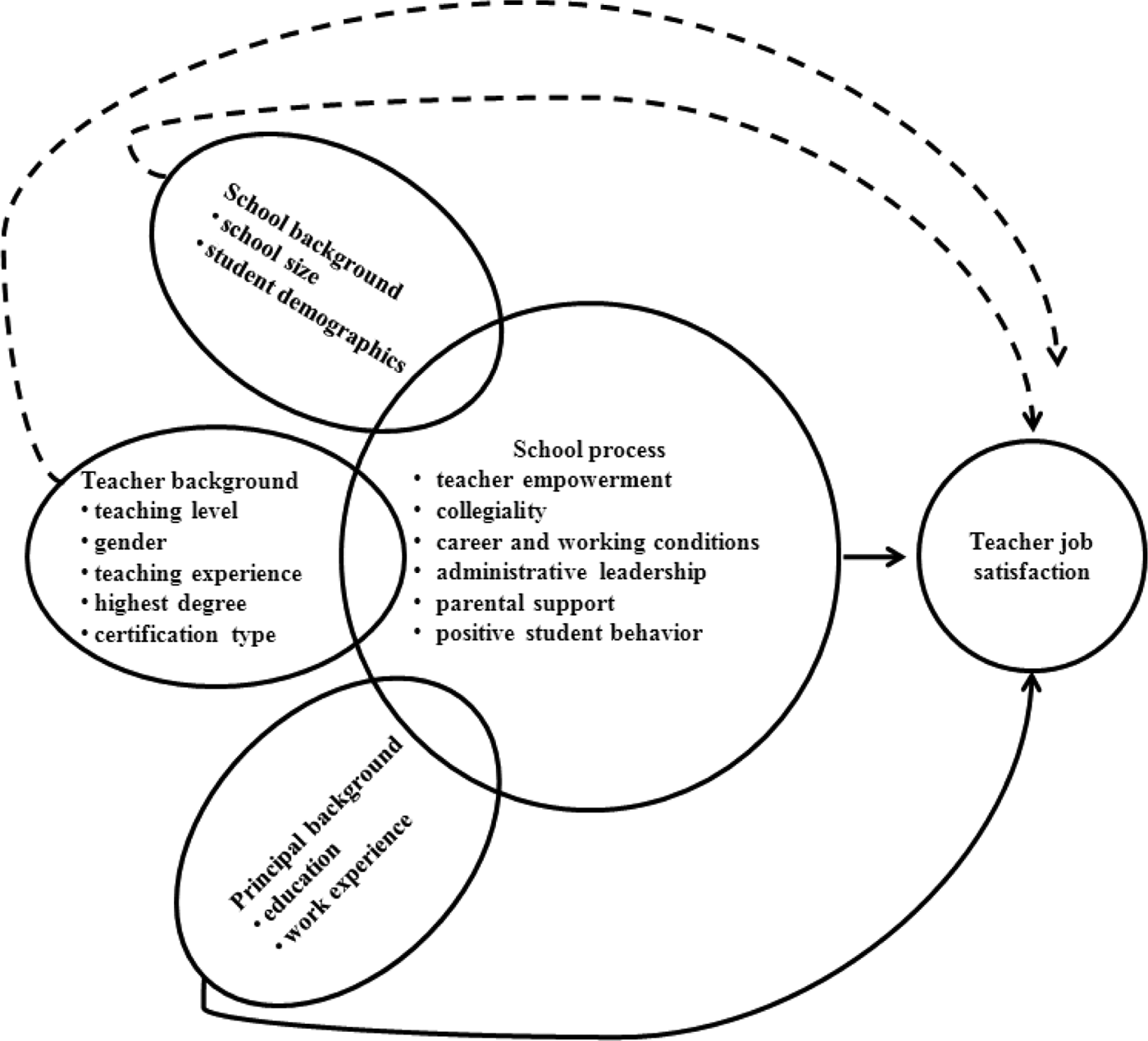
Conceptual framework.
We model the relationship between teacher job satisfaction and principal background first, and then the relationship between teacher job satisfaction and school process. There is a rationale for the separate modeling of principal background and school process. Relatively speaking, principal background (education and experience) represents a principal’s static characteristics, while school process reflects the principal’s dynamic leadership. The steps in modeling enable us to ascertain the relative contribution of principal background and school process to teacher job satisfaction.
Although the elements in the conceptual framework have been explored in local studies, the relationships have rarely been studied using a large, nationally representative sample, with stringent control for background at both teacher and school levels and multilevel modeling to consider both teacher and school levels simultaneously. In addition, the conceptual framework that emphasizes on how principal background and school process are associated with teacher job satisfaction extends all conceptual frameworks used in previous studies and become thus more malleable from the policy perspective.
Method
Data Source and Samples
The present study is based on data from SASS 2003-04, a set of integrated questionnaires that collect information about schools and the staff who work in them (Alt, Kwon, & Henke, 1999). We used Public School Teacher Questionnaire, Public School Principal Questionnaire, and Public School Questionnaire. The purpose of the teacher questionnaire is to obtain teacher information, such as education and training, teaching assignment, certification, workload, and perceptions and attitudes about teaching (Strizek, Pittsonberger, Riordan, Lyter, & Orlofsky, 2006). The principal questionnaire contains similar items but is geared toward principals to collect information about principal demographic characteristics, training, experience, salary, and judgments about school problems. The school questionnaire collects data such as school size, student population composition, and program offerings.
According to the National Center for Education Statistics (NCES), SASS employs a stratified probability sample design. Public and private schools are oversampled into groups based on certain characteristics. After schools are stratified and sampled, teachers within the schools are also stratified and sampled based on their characteristics. SASS aims to provide accurate estimates of school characteristics by clearly defining key analytical domains: the nation as a whole, elementary and secondary levels by public and private sectors, schools associated with the Bureau of Indian Affairs and schools with a student population at least 25% American Indian or Alaska Native, school levels of public schools by state, and private schools by association group, region, and school level.
The sample for the present study was restricted to principals and teachers from traditional public schools (7,670 principals and 40,770 teachers; the numbers were rounded to the nearest 10 per NCES clearance requirements; the degrees of freedom in Tables 2–4 were also rounded to the nearest 10 for the same reason). Because of the aforementioned sampling and weighting measures implemented in SASS, the sample for the present study was nationally representative of traditional public school principals and teachers with representative participation from all states. The sample was also representative of the elementary and secondary school principals and teachers in the public sector. SASS provides relative sampling weights for teachers and schools to (a) help approximate the national populations of public school teachers and schools and (b) still keep the original sample sizes. All HLM analyses used appropriate teacher relative weights at the first level and school relative weights at the second level.
Variables, Measures, and Descriptive Statistics
Variables selected for the present study are listed in Table 1. Some were based on single items, some were composites created by NCES (ready-made in the SASS database), and some were composites created in the present study based on the operationalization of the relevant constructs. We created the composite variable of teacher job satisfaction, TJS, based on items selected from the Teacher Attitudes and School Climate Scale of the SASS Public School Teacher Questionnaire. These items empirically define teacher job satisfaction as a teacher’s manifestations of feelings about his or her job fulfillment. Most school process variables were also composites. The online Appendix presents items used to construct these composite variables. Table 1 also includes descriptive statistics for the selected variables plus reliability measures for those composite variables. Means and standard deviations are provided for continuous variables, while percentages or proportions are provided for categorical variables.
Selected Variables and Measures and Their Descriptive Statistics

Note. TQ denotes teacher questionnaire. PQ denotes principal questionnaire. SQ denotes school questionnaire.M = mean.SD= standard deviation.
Data Analysis Approach
When teachers are nested within schools, teachers’ responses within a school become correlated because they share commonalities characterizing the (same) context (Liu & Meyer, 2005; Myers, Gamst, & Guarino, 2006). The data hierarchy of teachers nested within schools makes a two-level HLM the appropriate analytical technique. In the model, Level 1 represents teachers and Level 2 represents schools. 4 We developed four HLM models to explore our research questions: (a) the baseline model or unconditional model; (b) the control model that adjusts for teachers’ gender, education, certification, experience, and teaching level at the teacher level as well as enrollment size and school SES at the school level; 5 (c) the principal background model that is built on the control model and includes variables on principal background (education and experience); and (d) the school process model that is built on the principal background model and includes variables measuring various aspects of school process. 6 Each subsequent model builds on the earlier model.
Specifically, the teacher-level model for the baseline model (Model 1) is:

where TJS is the score on teacher job satisfaction for teacher i in school j, β 0j is the average score of teacher job satisfaction in school j, rij is the teacher-level random effect, and σ2 is the variability within schools. The corresponding school-level model is:

where γ 00 is the grand mean (or intercept), µ 0j is the school-level random effect, and τ00 is the variability across schools.
The teacher-level model for the control model (Model 2) is as follows:

where β 1j –β 5j are the coefficients (effects) of the covariates on TJS with other parameters remaining the same as in the baseline model. The school-level model for the control model is as follows:

where γ 01 –γ 02 are the coefficients (effects) of the covariates on the intercept with other parameters remaining the same as in the baseline model.
The teacher-level model for the principal background model (Model 3) remains the same as Equation 3. The school-level model for the principal background model is as follows:
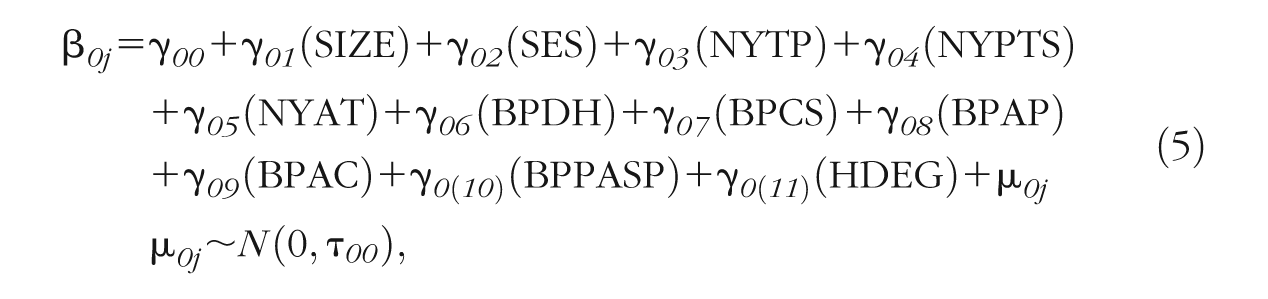
where γ 03 –γ 0(11) are the coefficients (effects) of the covariates on the intercept with other parameters remaining the same as in the control model.
The school process model builds on the principal background model by including school process variables at the school level. The teacher-level model for the school process model (Model 4) is the same as Equation 3. The school-level model for the school process model is as follows:
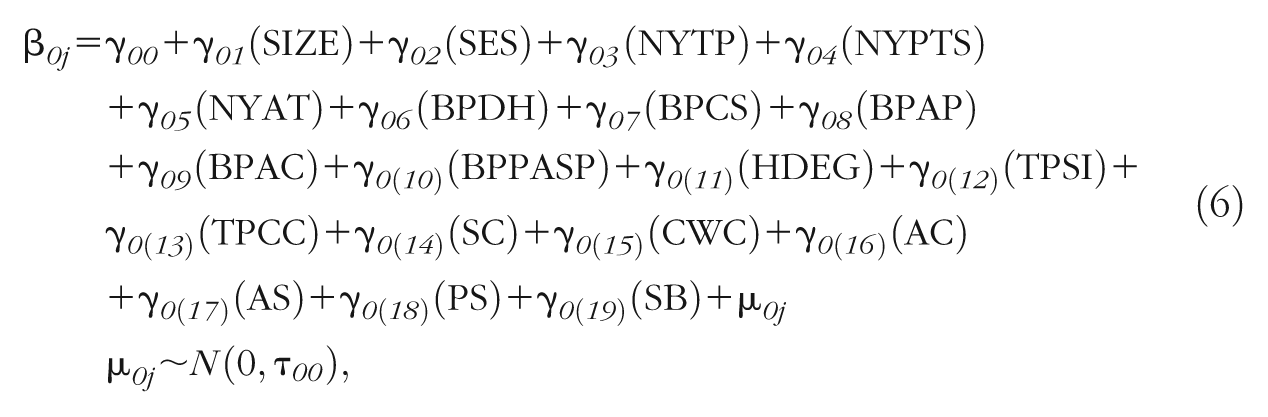
where γ 0(12) –γ 0(19) are the coefficients (effects) of the covariates on the intercept with other parameters remaining the same as in the principal background model.
Findings
Variance of Teacher Job Satisfaction
The results from the unconditional model, Model 1, are presented in Table 2. Variance in teacher job satisfaction was partitioned into a variance component at the teacher level and a variance component at the school level. The intraclass correlation is .17, thus approximately 17% of the variance in teacher job satisfaction lies between schools and 83% lies within schools. By introducing teacher-level and school-level characteristics into Model 1, we expected to explain away variance at both levels.
Hierarchical Linear Modeling (HLM) Results of the Unconditional Model (Model 1)

Teacher Job Satisfaction and Teacher and School Background Variables
For the next step of our analyses, the control model was built on the unconditional model by including teacher and school background variables. As noted earlier, we included gender, education, certification, experience, and teaching level (as control variables) at the teacher level. We also included enrollment size and socioeconomic level (as control variables) at the school level. The results are presented in Table 3.
Hierarchical Linear Modeling (HLM) Results of the Control Model (Model 2)
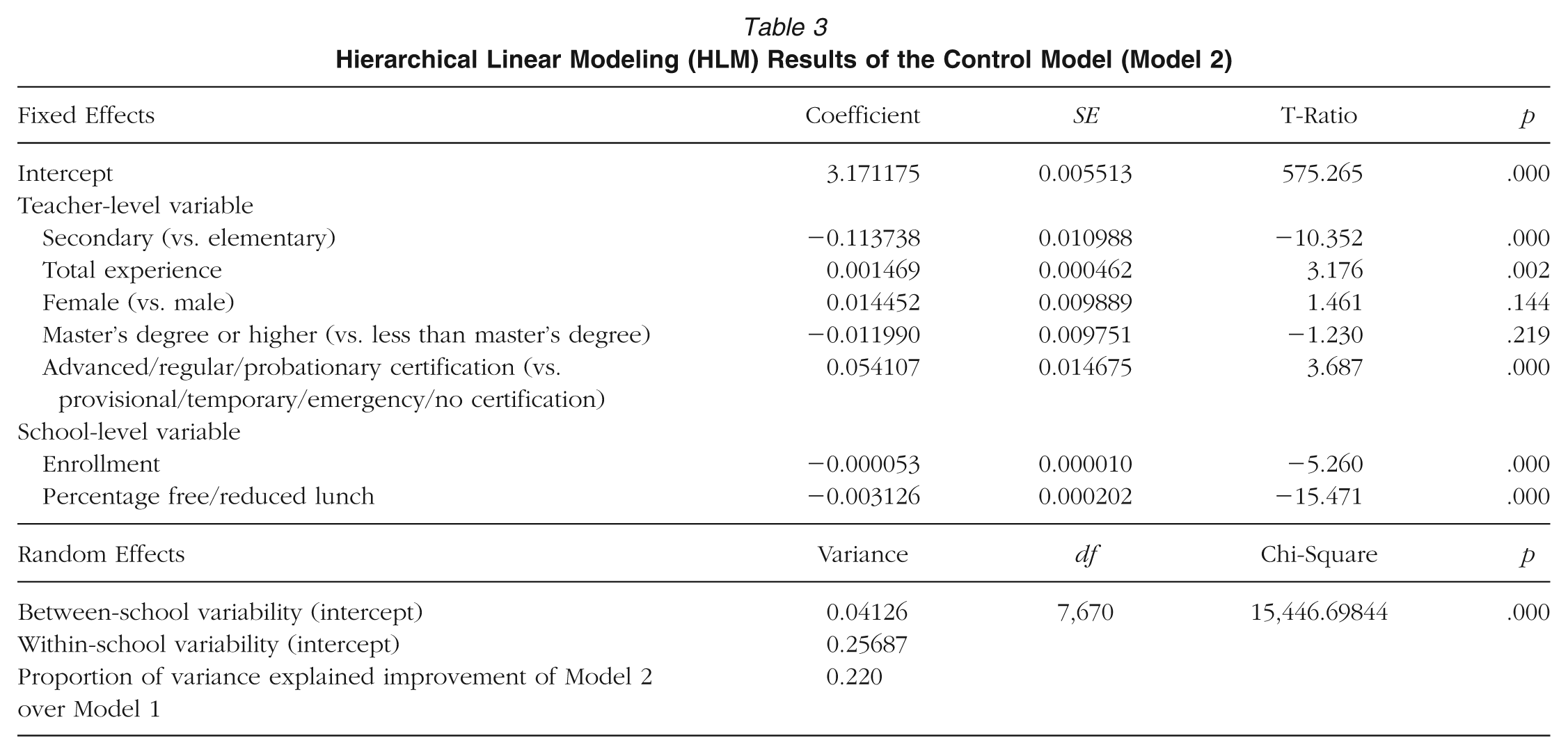
Three teacher-level characteristics yielded significant results: teaching level, experience, and certification. Overall, elementary school teachers had higher job satisfaction than secondary school teachers, teachers with more experience had higher job satisfaction than teachers with less experience, and teachers with advanced, regular, or probationary certification had higher job satisfaction than teachers with provisional, temporary, emergency, or no certification. At the school level, overall, teachers at smaller schools showed a higher level of job satisfaction than teachers at larger schools, and teachers at schools with a larger percentage of free or reduced-price lunch students showed a lower level of job satisfaction than teachers at schools with a smaller percentage of free or reduced-price lunch students.
By including these control variables at the teacher and school levels, we explained approximately 22% of the original between-school variance. However, the remaining between-school variance, .04, is still significant (p < .001), which suggests the existence of important school-level variables that were not included in the model but are responsible for differences in teacher job satisfaction between schools.
Teacher Job Satisfaction and Principal Background
Building on Model 2, we entered principal background variables associated with education and experience into the school level to examine their association with teacher job satisfaction. The results are presented in Table 4. Two principal education and experience variables had a significant association with teacher job satisfaction. Specifically, an increase in a principal’s experience at the current school was associated with an increase in his or her teacher job satisfaction. However, principal experience as a department head before becoming a principal showed a significantly negative association with teacher job satisfaction.
Hierarchical Linear Modeling (HLM) Results of the Principal Background Model (Model 3)

The reduction in variance after including principal background variables was trivial, which convincingly ruled out principal (education and experience) background as a critical factor in explaining teacher job satisfaction. The remaining between-school variance, .04, is still significant (p < .001), suggesting the existence of important school-level variables that were not included in this model. We proceeded to examine whether school process could explain differences in teacher job satisfaction between schools.
Teacher Job Satisfaction and School Process
The final model that we tested aimed to examine the relationship between school process and teacher job satisfaction. The school process model was built on Model 3 by including two domains of teacher empowerment (school influence and classroom control), staff collegiality, career and working conditions, two domains of administrative leadership (administrative communication and administrative support), parental support, and student behavior. The results from Model 4 are provided in Table 5.
Hierarchical Linear Modeling (HLM) Results of the School Process Model (Model 4)
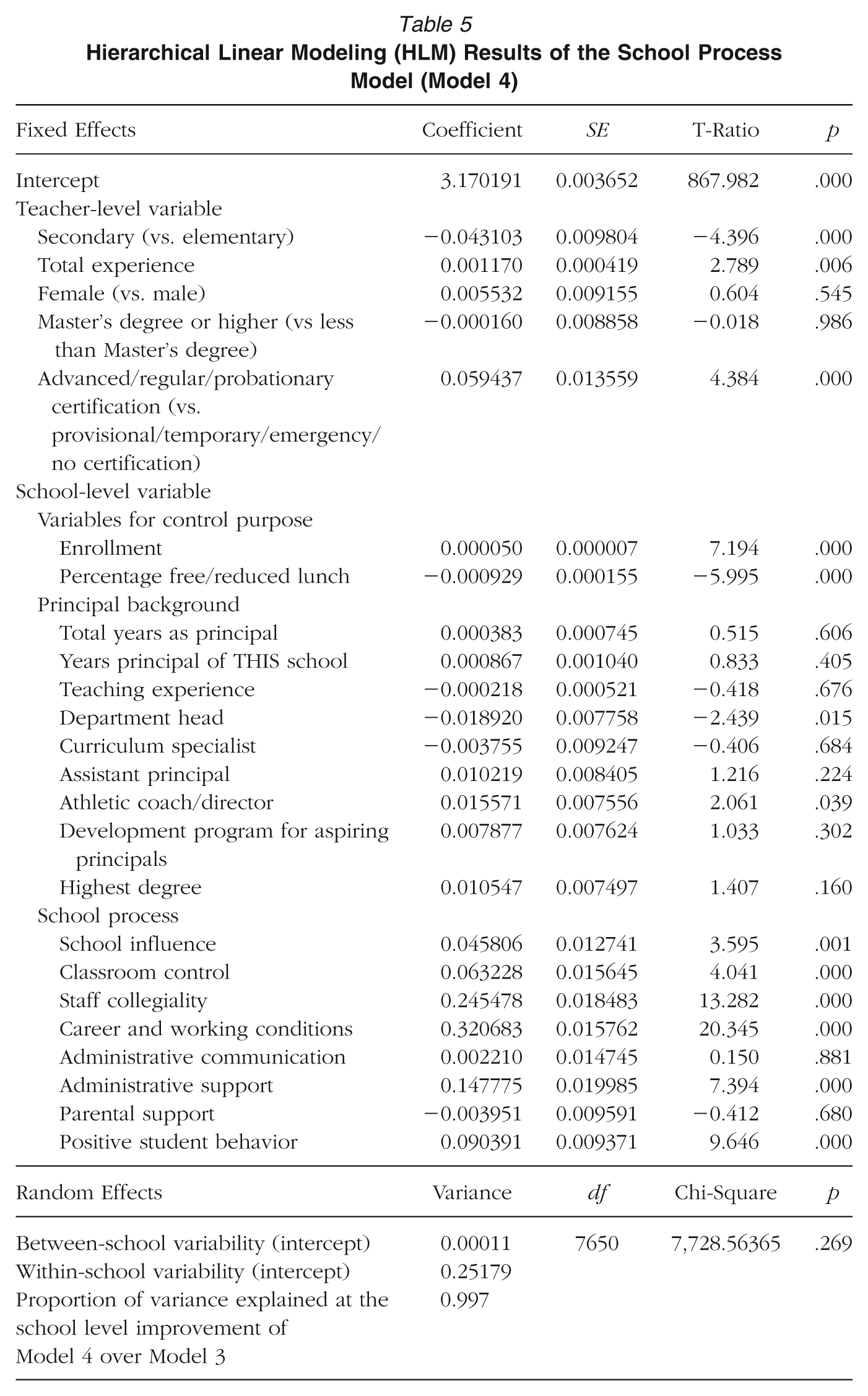
An examination of the coefficients of the school process variables indicated that school influence (a domain of teacher empowerment), classroom control (a domain of teacher empowerment), positive student behavior, and administrative support (a domain of administrative leadership) had significantly positive, small effects on teacher job satisfaction (effect size = .08, .11, .16, and .26, respectively). 7 In comparison, staff collegiality and especially career and working conditions had significantly positive, moderate, and large effects on teacher job satisfaction (effect size = .43 and .57, respectively). Neither parental support nor administrative communication (a domain of administrative leadership) had any significant association with teacher job satisfaction. The findings highlight the critical importance of career and working conditions and staff collegiality and, to some extent, administrative support to teacher job satisfaction.
In Model 4, the between-school variance was reduced to .00011 and is no longer significant between schools. Therefore, the addition of the school process variables explained almost the entire variance between schools that was present in Model 3 (i.e., 99.7%). This is a good indication that we successfully identified powerful school-level variables that are responsible for the variation in teacher job satisfaction between schools. We found that these powerful school-level variables were associated with various aspects of school process.
In the presence of school process, a principal’s work experience at the current school was no longer significant on teacher job satisfaction. However, a principal’s prior experience as a department head was still significantly negative to teacher job satisfaction, emerging as a quite stable principal background variable given the powerful impact of school process. Meanwhile, a principal’s prior experience as an athletic coach or director before becoming a principal showed a significantly positive association with teacher job satisfaction. Nevertheless, effects of both variables were small, with effect size as .03 in both cases.
Finally, significant teacher and school background (control) variables in Model 2 (see Table 3) continued to be significant in the final model. Effect size was .08 for elementary school teachers; .02 for more experienced teachers (after adjusting experience from 1 year to 10 years as one measurement unit); .11 for teachers with advanced, regular, or probationary certification; .01 for teachers at small schools (after adjusting enrollment from 1 student to 100 students as one measurement unit); and .02 for teachers at schools with a small percentage of free or reduced-price students (after adjusting proportion from 1% to 10% as one measurement unit). Overall, these teacher and school background variables had small effects on teacher job satisfaction.
Summary and Discussion
The aim of the present study was to determine whether principal background and school process are predictors of teacher job satisfaction. We built a series of nested models to examine this postulation, including the unconditional model, the control model, the principal background model, and the school process model. A two-level HLM model with teachers nested within schools was used as the primary statistical technique to build these models. The present study has its strength in using a nationally representative sample, a rich array of variables at the teacher and school levels, and a statistical technique that capitalizes on the nested data structure.
Summary of Major Findings
Although most of the variation in teacher job satisfaction occurs within schools, there is sufficient variation between schools to conclude that school-level factors can make a difference in teacher job satisfaction. Specifically, 17% of the total variance in teacher job satisfaction lies between schools. Previous literature suggests that school-level factors account for 10% to 38% of the total variance in outcomes at the school level (e.g., Barnett, McCormick, & Conners, 2000; Newmann, Rutter, & Smith, 1989). In general, research on school effects suggests that the variability at the individual level (among students or among teachers) is usually much larger than the variability at the organization level (among classrooms or among schools) (see Raudenbush & Bryk, 2002). The intraclass correlation of the present study is well within the range suggested by previous literature.
Staff collegiality and particularly career and working conditions demonstrate a strong positive association with teacher job satisfaction (with moderate and large effect sizes). School influence and classroom control of teachers (two domains of teacher empowerment), positive student behavior, and administrative support (one domain of administrative leadership) also demonstrate a (weaker) positive association with job satisfaction (with small effect sizes). Generally speaking, our findings on school process variables are consistent with prior findings. For example, Lee et al. (1991) found that orderly environment, principal leadership, and communal school organization are positively related to teacher efficacy.
Two of the principal background variables (prior experience as a department head and prior experience as an athletic coach or director) are significant in the final model (Table 5). A principal’s prior experience as a department head correlates with lower teacher job satisfaction, while a principal’s prior experience as an athletic coach or director correlates with higher teacher job satisfaction. Both effects are very small in terms of effect size.
Although the present study does not focus on teacher and school background variables (functioned as control variables), some of those variables are significant. Teacher job satisfaction is higher with elementary school teachers (as opposed to secondary school teachers); more experienced teachers (as opposed to less experienced teachers); teachers with advanced, regular, or probationary certification (as opposed to teachers with provisional, temporary, emergency, or no certification); teachers at small schools (as opposed to teachers at large schools); and teachers at schools with a small percentage of free or reduced-price lunch students (as opposed to teachers at schools with a large percentage of free or reduced-price lunch students). Effect sizes for these variables are all small.
Which Is More Important to Teacher Job Satisfaction: Principal Background or School Process?
Compared with principal (education and experience) background, school process is far more important to teacher job satisfaction. This claim is supported by the following. First, there are a greater number of significant school process variables than principal background variables. Specifically, six out of eight school process variables are significant, compared with two out of nine principal background variables. More importantly, the magnitude of the effects is larger for school process than principal background. That is, principal background demonstrates very small effect sizes (.03 in both cases), while school process demonstrates effect sizes from .08 to .57. As a matter of fact, two out of six significant school process variables are moderate and large in effect size. Finally, principal background does not explain additional school-level variance that remained in the control model, while school process explains 99.7% of the school-level variance that remained in the principal background model.
There is still another indication of school process being more important than principal background. Significant (positive) effects on teacher job satisfaction associated with a principal’s tenure at the current school are present in the principal background model (Table 4) but absent in the school process model (Table 5). This situation suggests that a principal’s tenure at the current school is secondary to the school process variables.
Our conclusion that emphasizes school process over principal background is a new contribution to the literature. Two implications come directly from this conclusion. First, we can improve teacher job satisfaction via improvement in school process. Stated differently, schools can make a difference in teacher job satisfaction. We suggest that administrators and policymakers target staff collegiality and in particular, career and working conditions—the two school process variables that can effectively bring changes in teacher job satisfaction. Second, instead of being well educated and well experienced, a principal who can effectively bring out job satisfaction from teachers is good at improving school process (particularly improving collegiality among teachers and improving their career and working conditions). We are not dismissing the importance of principals’ education and experience; rather, we would argue that they should not become a roadblock in hiring principals. According to the present study, the very key question to ask is whether he or she has the leadership in improving school process.
Which Is More Important to Teacher Job Satisfaction: Money or Culture?
An examination of the school process variables indicates that they are either monetary or cultural (in other words, either resource or support). Pertaining to salary and class size, the variable of career and working conditions is monetary or largely determined by resource. Pertaining to relationship, the variable of staff collegiality is cultural or largely determined by support. Although the variable of career and working conditions demonstrates the largest effects (also large in effect size) among all school process variables, the reality is that school process is much more about culture and support than money and resource (see Teddlie & Reynolds, 2000).
The contribution of the present study is that culture and support can compensate for money and resource. For example, effect size is .43 for staff collegiality and .26 for administrative support. Because both are estimated as unique effects with statistical control of other variables in Model 4 (Table 5), their combined effects are .69, surpassing the effects of career and working conditions (effect size = .57). This is surely good news for education authorities facing financial hardship.
Which Is More Important to Teacher Job Satisfaction: Experience as a Department Head or an Athletic Director?
The interesting findings of negative effects of prior experience as a department head and positive effects of prior experience as an athletic director on teacher job satisfaction will surely generate debates (note that the magnitude of both effects is the same). This is a rather tentative conclusion. First, effect size is too small to make any recommendation (effect size = .03). Second, the amount of variance explained by principal background is trivial. Finally, the fact that it takes the school process variables to bring out the positive effects associated with prior experience as an athletic director indicates that the effects are actually conditional (on some aspects of school process). Therefore, we are not in a position to suggest that an athletic director can serve better as principal than a department head. Such a debate may not be fruitful at all given particularly the presence of a far more important relationship between school process and teacher job satisfaction.
We bring this issue to discussion only because the negative effects of prior experience as a department head are quite stable though small: significant in both the principal background model and the school process model. This stability may raise some questions about whether the experience as a department head tends to interfere with the technical core (teaching and learning of subject matters) (see Elmore, 2000), which leads to teacher job dissatisfaction. We believe that it is a sound educational practice to emphasize principal instructional leadership and it is a fact that department heads are well prepared for instructional leadership (Rodriguez-Campos, Rincones-Gomez, & Shen, 2005; Shen et al., 2005). Nevertheless, we call for investigations into what we call a weak “disturbance” associated with prior experience as a department head. For example, do department heads tend to be a stringent standards overseer rather than a relational goal-oriented motivator (as some would characterize athletic coaches)?
Technical Limitation and Future Research
Principal background is based on objective data (i.e., hard facts) while school process is based on subjective data (i.e., self-reported perceptions). The advantage of school process over principal background in terms of teacher job satisfaction may become a function of measurement (how well school process is measured). Although psychometric properties of the school process constructs are satisfactory to us (Table 1), we suggest that large-scale assessments such as SASS may consider a fact-based data collection system.
Furthermore, teacher job satisfaction and school process are both evaluated by the same sample of teachers. Although in terms of the school process variables used in the present study research on school effects supports teachers as the best source of data (see Teddlie & Reynolds, 2000), this measurement practice may create what is referred to as same-source bias that tends to produce a high correlation between teacher job satisfaction and school process. We believe that this limitation can also be overcome with a fact-based data collection system.
Such a fact-based data collection system requires a shift from measuring perception to measuring frequency. For example, school disciplinary climate is usually measured using teacher ratings of seriousness on disciplinary problems. However, a school record of disciplinary incidents would be more accurate to portray disciplinary climate of a school. In fact, some school process constructs are already measured in this fashion in the literature. For example, parental involvement is often measured as how many times parents come to school meetings (e.g., orientation). Further studies play a critical role in establishing a fact-based data collection system for large-scale assessments.
For researchers who continue to investigate teacher job satisfaction with SASS, one issue we would like to suggest regarding principal background is degree of education and field of studies in relation to teacher job satisfaction. For example, do principals who studied education as an undergraduate major impact differently on teacher job satisfaction from principals who studied subject matters such as mathematics and science as their undergraduate majors? Do those with a graduate degree in educational administration versus other areas impact differently on teacher job satisfaction? The present study did not include principal background variables relevant to this issue to avoid a further imbalance in number between principal background variables (nine) and school process variables (six). However, addressing this issue in further studies may help generate further practical implications for education policymakers.
Footnotes
Notes
References
Supplementary Material
Please find the following supplemental material available below.
For Open Access articles published under a Creative Commons License, all supplemental material carries the same license as the article it is associated with.
For non-Open Access articles published, all supplemental material carries a non-exclusive license, and permission requests for re-use of supplemental material or any part of supplemental material shall be sent directly to the copyright owner as specified in the copyright notice associated with the article.
