




Abstract
This article presents a grounded theory of “integration of learning” among traditional aged college students, which is characterized by the demonstrated ability to link various skills and knowledge learned in a variety of contexts. The author analyzed 194 interviews with students at liberal arts colleges to investigate empirically the ways undergraduates bring knowledge and experiences together so that educators might be able to more intentionally promote the integration of learning. Three distinct types of integration of learning emerged during analysis: (a) connection, the discovery of a similarity between ideas that themselves remain distinctive; (b) application, the use of knowledge from one context in another; and (c) synthesis, the creation of new knowledge by combining insights.
The ability to make connections among disparate elements of information, meaningfully synthesize concepts, and make ideas mobile from one context to another has been heralded as a necessary skill for success in the knowledge economy of the 21st century (American College Personnel Association, 1994; Association of American Colleges and Universities [AAC&U], 2002, 2007; AAC&U & Carnegie Foundation, 2004; Joint Task Force on Student Learning, 1998; Keeling, 2004; U.S. Department of Labor, 1991). As access to technology grows and limitless information is literally at our fingertips, the ability to connect information has become increasingly valued in society and a crucial skill for higher education to cultivate among students.
Despite the increasing desire for college graduates to be proficient in broadly linking knowledge and skills, there is a lack of detailed information about the ways in which learning is integrated. That is, we do not understand the process of integration. To fill this gap, this study explores how traditionally aged undergraduates integrate learning; in particular, I look at the ways in which students undertake this process in their first two years of college. Thus, the intent of this study is to investigate empirically the ways in which college students bring knowledge and experiences together so that educators can better understand undergraduate student learning and more intentionally promote the integration of learning.
Integrating Concepts and Definitions
Integration of learning has received much attention as of late and is identified as a primary outcome of a college education by AAC&U and Carnegie Foundation’s (2004) Statement on Integrative Learning: “Fostering students’ abilities to integrate learning—over time, across courses, and between academic, personal, and community life—is one of the most important goals and challenges of higher education” (p. 1). However, based on a review of literature in student development, learning, and psychology, it is apparent that there is no clear description about how students undertake this process of integration.
Use of the generic term integration in the literature complicates studying this area of student learning because integration and related words (integrative, integrated) are used to describe the learning process as an educational outcome (AAC&U, 2002; Huber et al., 2007; Leskes, 2004), as well as the educational practices, sometimes referred to as high-impact practices, that promote this kind of learning (Kuh, 2008; Nelson Laird, Shoup, Kuh, & Schwarz, 2008). This array of descriptors and conceptualizations reflects both a terminology problem and a conceptual problem for those in higher education interested in promoting and assessing integrated learning among college students. In short, the practices facilitate the process. The sort of practices described as integrative (e.g., working on a paper/project that requires drawing on multiple sources, taking an interdisciplinary studies course, or participating in a service learning initiative) may facilitate integration of learning, but they do not describe an individual’s learning process per se.
Interdisciplinarity is another term often conflated with integration. Interdisciplinarity is a subset of integrative educational practices that fosters connections among disciplines and interdisciplinary fields (Klein, 2005) and that may lead a student to the process of integration. Boix Mansilla (2005) has comprehensively explored the characteristics of interdisciplinary work and proposed the following definition of interdisciplinary understanding:
the capacity to integrate knowledge and modes of thinking drawn from two or more disciplines to produce a cognitive advancement— for example, explaining a phenomenon, solving a problem, creating a product, or raising a new question—in ways that would have been unlikely through single disciplinary means. (p. 16)
Boix Mansilla and colleagues used this definition of interdisciplinary understanding to develop an empirically grounded assessment of interdisciplinary work (Boix Mansilla & Dawes Duraisingh, 2007; Boix Mansilla, Dawes Duraisingh, Wolfe, & Haynes, 2009). My conceptualization of integration of learning is broader in scope than interdisciplinarity itself, extending beyond academe and traditional disciplinary boundaries to encompass multiple contexts, life experiences, and identity roles.
Cognitive developmental theory also informs the conceptualization of integration of learning. Bloom’s (1956) taxonomy of educational objectives is useful for considering the process of learning and envisioning learning as a hierarchy of increasingly sophisticated ways of thinking. Fischer’s (1980) skill theory presented a framework for understanding the increasing cognitive complexity indicative of integration of learning. This theory posited that as people develop into adulthood, they have an escalating number of ways to make connections among the discrete facts that compose their knowledge base and lived experience.
Just as there are a number of routes for connections within Fischer’s theory as the level of abstraction increases, there are multiple potential pathways to integration of learning. King and VanHecke (2006) applied Fischer’s skill theory to student development and clarified that “cocurricular as well as curricular learning contexts offer many rich opportunities for students to learn and practice skills associated with making connections . . . developing these skills improves students’ capacity to function in a complex world” (p. 16). This statement emphasizes the point that the study of integration of learning should consider student experiences broadly, investigating learning within the disciplines (Schwartz & Fischer, 2006) and among disciplines (interdisciplinary), as well as with a keen interest in the cocurriculum and experiences wholly outside of academe (intercontextual).
Integration of Learning Defined
The current article is concerned with examining integration of learning as an educational outcome, specifically focusing on the process (i.e., the how) of integration of learning, opposed to the content (i.e., the what) being learned. I see the capacity to undertake this process successfully as a critical outcome of undergraduate education. This outcome includes the ability to integrate one’s learning into both a larger framework and a frame of reference for making meaning from the information and knowledge one possesses. The definition I created for integration of learning takes into consideration various definitions discovered in a review of the literature; it has been developed and refined as a result of the analyses described in this article:
Integration of learning is the demonstrated ability to connect, apply, and/or synthesize information coherently from disparate contexts and perspectives, and make use of these new insights in multiple contexts. This includes the ability to connect the domain of ideas and philosophies to the everyday experience, from one field of study or discipline to another, from the past to the present, between campus and community life, from one part to the whole, from the abstract to the concrete, among multiple identity roles—and vice versa.
My definition is intentionally broad in terms of context to allow for consideration of experiences not traditionally linked to the formal curriculum, for example, work experience, family life, and living situation. The growing interest in integration of learning among college students and the lack of a shared definition of terms underscore the current need for a more detailed investigation of the ways in which learning is integrated. To this end, the ideas of transfer of learning and experiential learning have been beneficial in building a conceptual framework for exploring integration of learning.
Conceptual Framework
The conceptual framework for this study is anchored in the literature describing individual learning, which has an established foundation of theory, research, and practice that is robust enough to provide theoretical support for an in-depth inquiry into the development of integration of learning (Bruner, 1960; Dewey, 1938; Judd, 1939; Thorndike, 1924). The transfer of learning literature provides a rich source for a discussion of how knowledge becomes mobile, which is an important component of integration of learning. Experiential learning offers a strong knowledge base about the contexts and conditions that facilitate learning, including both formal and informal educational environments.
Transfer of learning
Transfer of learning as a body of knowledge is concerned with how individuals think about ideas, beliefs, and information; it is centered on how people know and apply knowledge (Perkins & Salomon, 1988, 1992; Tuomi-Gröhn & Engeström, 2003). Transfer theory contributes a sense of how individuals mobilize knowledge and is a useful lens for studying the development of integration of learning among college students. The current understandings of cognitive and learning processes are the result of over a century of research and theorizing on how, why, where, and when a transfer of learning takes place. There are two main classical theories of transfer, the first of which is Thorndike’s (1924) concept of identical elements. Thorndike concluded the ability to transfer learning depended not on learning specific subjects but rather on the presence of identical elements in two situations.
Judd (1939) disagreed with Thorndike’s theory of identical elements and posited that understanding the general principles of subject matter was most important (rather than the specific context or task); this concept of general principles is the second major classical theory of transfer. The shift to a focus on general principles rather than discrete details introduced a new way of thinking about teaching and learning that privileged conceptual learning over memorizing pieces of information. These seminal ideas are critical to the conceptualization of integration of learning and paved the way for more recent theories about transfer of learning, which explore in more depth issues of how influential the environment is on individuals’ cognition and ability to transfer learning. Such concepts set the stage for the more recent discussion of a transition from an instruction paradigm to a learning paradigm in American higher education (Barr & Tagg, 1995).
Perkins and Salomon (1988, 1992) categorized transfer into two dichotomies, positive and negative, and near and far. Positive transfer occurs when learning in one situation improves learning in another. For example, learning a new language such as French might help a student to learn another similar language, such as Spanish. Negative transfer occurs when learning in one area inhibits learning in another. To continue with the language acquisition example, a native Mandarin speaker might initially engage in negative transfer when learning German due to assumptions about grammar, pronunciation, or syntax, creating a challenge to learning (Perkins & Salomon, 1992). Near transfer refers to mobility of learning between similar contexts (suggesting a contextual version of Thorndike’s identical elements concept), while far transfer involves larger, often more abstract leaps between situations.
Experiential learning
Many scholars explored the role of context and experience in learning during the 20th century (Bruner, 1960; Dewey, 1916, 1938; Kolb, 1984), investigating learning in both formal and informal settings. Dewey’s (1938) theory of experience argued that students’ past experiences, including those outside of the formal educational environment, figure prominently in the learning process. This key perspective fits well with 21st-century approaches to holistic education and supports the broad contextual view I put forward in my definition of integration of learning above.
The notion that experience plays an important role in learning complements the findings of the transfer literature; both areas of research are deeply rooted in the interaction of individual and context captured in Lewin’s (1936) assertion that behavior is a function of the interaction between person and environment. Bruner (1960) captured the relationship between transfer and experience in The Process of Education, explaining,
The teaching and learning of structure, rather than simply the mastery of facts and techniques, is at the center of the classic problem of transfer. . . . If earlier learning is to render later learning easier, it must do so by providing a general picture in terms of which the relations between things encountered earlier and later are made as clear as possible. (p. 12)
Bruner’s suggestion for scaffolding learning aligns closely with Perkins and Salomon’s (1988) model of teaching for transfer.
Ideas about the role of experience in the learning process such as those advanced by Lewin, Dewey, and Bruner underlie many modern approaches to learning in American higher education (e.g., service learning, living learning communities, study abroad/away) and hold great relevance for inquiry into college students’ integration of learning (Eyler & Giles, 1994; Rowan-Kenyon, Soldner, & Inkelas, 2007). Despite the significant contributions of scholars in the domains of transfer theory and experiential learning, existing conceptualizations are not sufficient to fully understand the process of integration of learning among college students. As such, it is necessary to engage in theory building to advance the discussion and scholarship about integration as a collegiate outcome.
Method
The following analysis of college student learning is rooted in a constructivist paradigm using grounded theory methodology and is shaped by the epistemological belief that individuals make meaning of their experiences differently, and therefore construct their own unique perspectives of the world. 1 In terms of axiology, an authentic respect for individuals’ viewpoints and the personal meaning that they make from their accumulated experiences factors prominently in my investigation of integration of learning, and I positioned the students as co-constructors of the research. Using a grounded theory approach, the researcher does not attempt to be objective in the analysis, but rather surfaces his or her personal assumptions and biases in an effort to manage subjectivities. As such, I immersed myself in the analytical process and played an active role in theory construction (Strauss & Corbin, 1998). The outcome of this analysis is a perspective on student learning that emerged from nearly 300 hours of conversations with college students and is firmly grounded in the experiences of the participants in the study.
The data for this analysis originated from the Wabash National Study of Liberal Arts Education (hereafter, WNS). The WNS employed a longitudinal mixed-methods design in which two types of data (surveys and interviews) were collected for investigating related but separate research questions; this article focuses on findings from the interview data. Participating institutions were chosen using a two-step process. Initially, 19 colleges and universities were selected from more than 60 institutions responding to a national invitation to join the study; selection criteria included a commitment to and success implementing practices of liberal arts education. These institutions were also selected to create a national sample that included a variety of institutional types, sizes, and locations. Students from these campuses were randomly selected to participate in the survey portion of the study. In the second step, six colleges and universities were selected from the survey campuses to also participate in the in-depth interview portion of the study. I was a member of the research team that selected the campuses for the interview sample and subsequently collected and analyzed data.
Data Collection
Interview participants were selected from the students at these six institutions who completed the quantitative survey component of the study and also indicated interest in participating in a one-on-one interview about their experiences while in college, oversampling men and students of color to yield a more balanced distribution. Students were offered compensation of $30 for participation in each interview.
These steps yielded a sample of 315 first-year students who were interviewed in the fall of 2006 (hereafter, Year 1). About one third of these students identified as students of color (African American/Black, Hispanic, or Asian/Pacific Islanders); the remainder identified as White. About 10% were born in countries other than the United States. Researchers were able to contact and reinterview 228 of these students in the fall of 2007 (Year 2). The interviews were 60 to 90 minutes in length, recorded digitally, and transcribed verbatim. Students were offered a copy of each year’s interview transcript and invited to make corrections, fill in words that were inaudible, and offer comments or additional insights after receiving the transcript.
The interview protocol used for this study was Baxter Magolda and King’s (2007) WNS Interview, which was designed to yield information about important student experiences and how students make meaning of them. The WNS Interview is composed of three sections. The first is designed to establish rapport between the interviewer and the student and collect basic background information about the student (e.g., hometown, information about family, intended major). The second seeks to access the student’s process for meaning making through asking questions about significant experiences and challenging decisions for the student that reveal how he or she thought about and interpreted the experiences. The third and final section of the interview is specifically targeted toward synthesis of information and the assessment of integration of learning as a liberal arts outcome. However, examples of integration of learning may appear at any point in the interview due to the conversational and semistructured design.
The interview data were well suited to the study of a complex process such as integration of learning, which is one of seven liberal arts outcomes of interest in the overarching WNS (King, Kendall Brown, Lindsay, & VanHecke, 2007). The richness of the data gained from longitudinal personal interviews lends itself well to the type of in-depth analysis necessary to explore the process of integration of learning. For purposes of learning about how students integrate learning, the semistructured interview allowed the student to discuss how he or she put things together (as opposed to a course assignment that is more likely to be instructor driven) and, in some cases, provided a context for students to integrate learning in situ. In addition, in-depth constructivist interviews are effective in assessing the complex meaning making indicative of integration of learning (Baxter Magolda, 2001; Baxter Magolda & King, 2007; Berger, 2010; Kegan, 1994).
Two of the six campuses were selected for the in-depth investigation into integration of learning that is the focus of this article, Hudson College (pseudonym) and Wabash College (actual name). I chose these two campuses for this specific analysis based on the richness of the data from student interviews and because these sites offered a variety of experiences in both curricular and cocurricular settings that are intentionally designed to promote integration of learning. Selecting campuses with established programs to facilitate integration of learning was of the utmost importance because the study was concerned with how students integrate learning (as opposed to whether students integrate learning). As such, it was vital to select campuses with a strong likelihood of providing examples of integration of learning.
The data from these two campuses are composed of 194 longitudinal interviews (n = 97 individuals) for this study. This sample included 45 students from Hudson College (30 women and 15 men) and 52 students from Wabash College (all-male institution). Students of color accounted for 19% students in the sample (n = 18). I visited both campuses and personally conducted 28 of the 194 interviews. Classroom observations at Wabash College were used to add context to the student narratives. The following section provides brief profiles of these two campuses.
Campus Contexts
Hudson College
This institution is a small, private liberal arts college in the eastern United States situated in a rural town. The institution prides itself as a residential liberal arts college, and 85% of its 2,000 students live on campus. At the time of the study, the racial/ethnic demographics of the undergraduate population were approximately 69% White, 14% students of color, and 8.5% international students, with 8.5% of the students not identifying race or ethnicity. Hudson College has two academic programs that are of interest to my study of integration of learning: the Liberal Arts Workshop and the Freshman Symposium. The Liberal Arts Workshop is an intentionally integrative program in which students participate for the three weeks immediately preceding their first year in college. The aims of this program are for students to learn to read and listen more thoughtfully, to express ideas, to review their own work critically, and to recognize the link between thinking and expressing. The curriculum of this program culminates in a written assignment that a student must pass in order to matriculate. Upon matriculating to the college, all students must enroll in Freshman Symposium. This is a two-semester sequence focused on what the college considers the important cultural and intellectual ideas that form a basis for liberal arts education.
Wabash College
Wabash College is an all-male private liberal arts college in the rural Midwest. There are currently 900 students enrolled, most of which (86.7%) live on campus in one of four residence halls or 10 fraternity houses. At the time of the study, the racial/ethnic demographics of the undergraduate population were 80% White, 13% students of color, and 5% international students, with 2% of the students not identifying race or ethnicity. A program at Wabash that is of interest in terms of integration of learning is the Freshman Tutorial, which all students take either first or second semester during their first year. Each section of the Freshman Tutorial enrolls approximately 15 students. The main objective of the Wabash Freshman Tutorial is to give students the skills they need to be critical thinkers, successful in a discussion-based seminar environment, and well prepared for the intensity of college writing. This course is followed in the second year with a two-semester sequence on classic world texts, Cultures and Traditions, a requirement for all sophomores.
Data Analysis
Based on the nature of my question, that is, learning about the ways in which students begin to bring together information, I used grounded theory methodology to analyze the data. I found grounded theory best suited to this study of integration of learning because of the flexibility it allows in analyzing and conceptualizing the data. Since there is not an existing model delineating the process of integration of learning for college students, it was necessary to develop theory. I wanted to allow the ways in which students integrate learning (or fail to do so), what learning they integrate, and how they make meaning of that process to emerge from the data rather than to establish a priori the steps of this learning process.
Data reduction began with what Strauss and Corbin (1998) called microanalysis, “the detailed line-by-line analysis necessary at the beginning of a study to generate initial categories (with their properties and dimensions) and to suggest relationships among categories” (p. 57). To operationalize this overall plan for examining the data, I organized my analytical process into four basic steps (Charmaz, 2006; Glaser & Strauss, 1967): initial coding, ongoing memoing, and focused and axial coding. In utilizing the constant comparison process recommended in grounded theory (Charmaz, 2006; Glaser & Strauss, 1967), categorization was a fluid process, and categories were merged or broken apart as needed as the analysis progressed.
Trustworthiness
To bolster the trustworthiness of my work, I recruited a peer debriefer, who played an invaluable role in the analytical process. Her role was to review my coding as I went along, providing a check against personal biases, and to aid with consistency and reliability throughout the coding process. I encouraged her to challenge me to acknowledge my sensitizing concepts as they may influence my work. She reviewed the initial coding of 48 interviews (25%) as well as over 20% of the examples of integration of learning identified across all 194 interviews. We met in person to discuss the similarities and differences in our coding, and any discrepancies were debated and resolved during each meeting. The peer debriefer’s memos and all notes from our meetings were added to the file for each interview we discussed to maintain a complete record of analysis.
Sensitizing Concepts and Subjectivities
As I consider the issues surrounding integration of learning among college students, I also consider what draws me to this topic as a researcher. Within the qualitative research tradition, it is important to discuss the personal assumptions and biases that I bring to the study. As the researcher, I am intimately involved in the interpretation of the data I analyze in this study. As such, it is relevant to disclose my own background and the sensitizing concepts that accompany me in my inquiry.
I once worked as an administrator at a liberal arts college, so the environment of a private liberal arts institution was familiar to me, albeit not my personal education experience. I attended public institutions of higher education for all of my postsecondary study, though my undergraduate institution prides itself on offering a liberal arts education. For many years I was a student affairs practitioner, and I have a strong belief that learning takes place both inside and outside of the classroom. This is one reason I am drawn to the concept of integration of learning, I see it as essential for college students to integrate learning from the formal curriculum with the learning they are doing at home, at work, with family and friends, through student organizations, and so on. These are my lenses. Each of these characteristics, and certainly others, affects the ways I interact with college students and interpret their narratives.
Findings
I was initially concerned that there might not be a wealth of data contained in the interviews related to integration of learning as an educational outcome, given the burgeoning literature stressing a need for more integration of learning among undergraduates. However, I was met with quite a different situation. The initial line-by-line read of the 194 interviews yielded 662 examples of integration of learning. The pool was deep as well as wide; the information present in the interviews provided rich descriptions of the many ways that students experienced integration of learning in their first year of college.
In the categorization phase of data analysis, all 662 examples were reviewed in greater detail. Under increased scrutiny, some examples were deemed not to illustrate integration of learning and excluded from further analysis. This resulted in a total of 577 examples; 484 of these were categorized into one category alone, with the other 93 examples (16%) categorized in multiple categories.
Categories of Integration
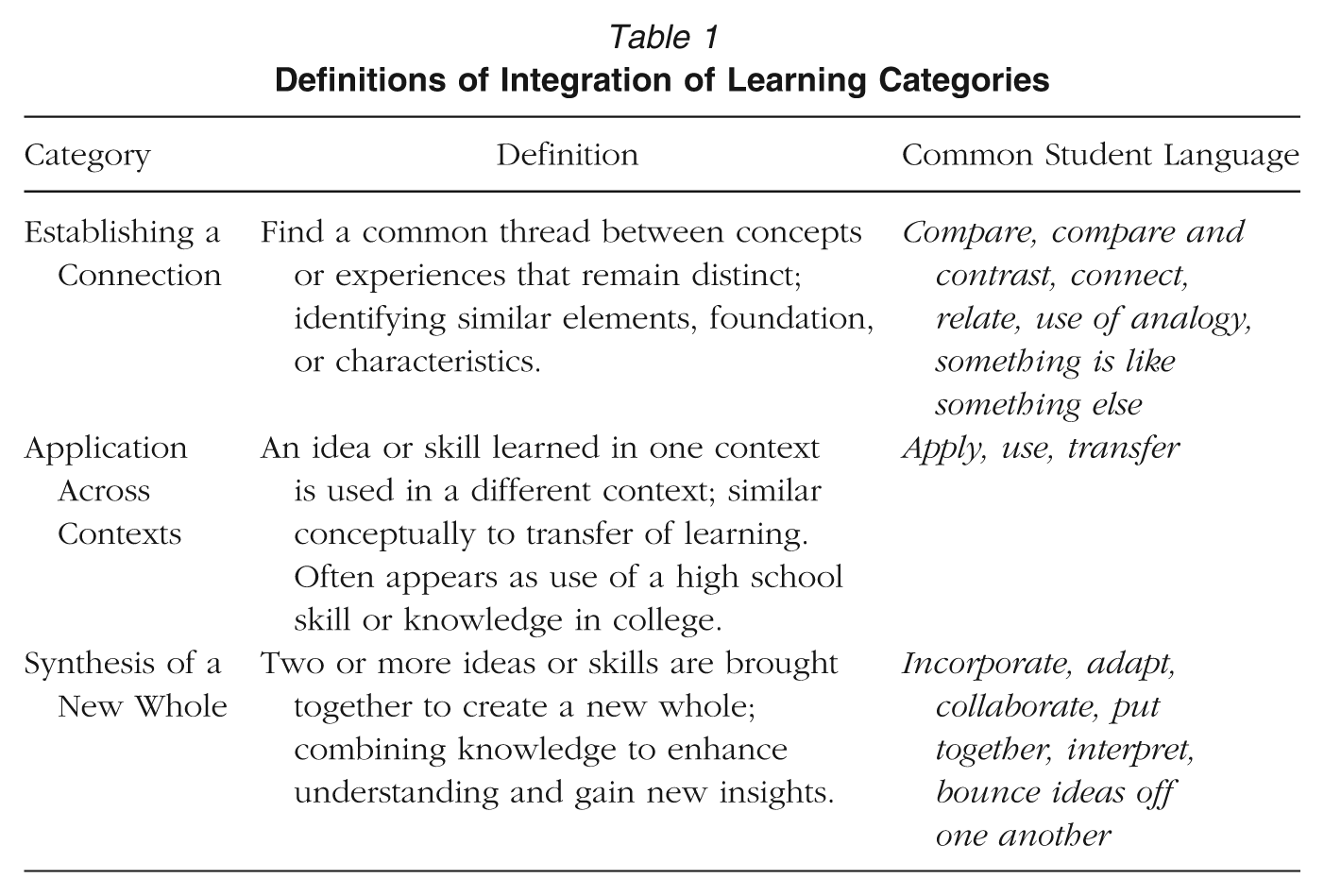
Three main categories emerged from the data during the analysis, which I see as distinct in their complexity. Arranging the categories in order of increasing cognitive complexity aligns with prominent models of intellectual and personal development, including Bloom’s (1956) taxonomy, Perry’s (1970) scheme of intellectual and ethical development, the reflective judgment model (King & Kitchener, 1994), and self-authorship theory (Baxter Magolda, 2001, 2009; Kegan, 1994). Therefore, I consider degree of complexity a logical way to organize the emergent categories of integration: (a) Establishing a Connection (n = 172), the discovery of a similarity or common bond between ideas or skills which themselves remain distinctive; (b) Application Across Contexts (n = 296), the use of knowledge or skills from one context in another; and (c) Synthesis of a New Whole (n = 201), the creation of new knowledge or understanding by combining two or more insights.
Connection is a relationship between two things, often at a single point in time in a single context; this can be as straightforward as recognizing a similarity between two ideas. By contrast, application is an action on the student’s part to make use of knowledge in a new context; this requires a greater degree of complexity on the student’s behalf than recognizing or establishing a connection. Last, synthesis is an evolution into something new, the student’s creation of a new insight; this construction of a novel concept entails an even deeper involvement with the information, experiences, or skills. Table 1 provides more detailed definitions of each category; common student language associated with each category is also listed. Figure 1 illustrates the frequency of integration of learning (delineated by category) in Years 1 and 2 of the study.
Definitions of Integration of Learning Categories
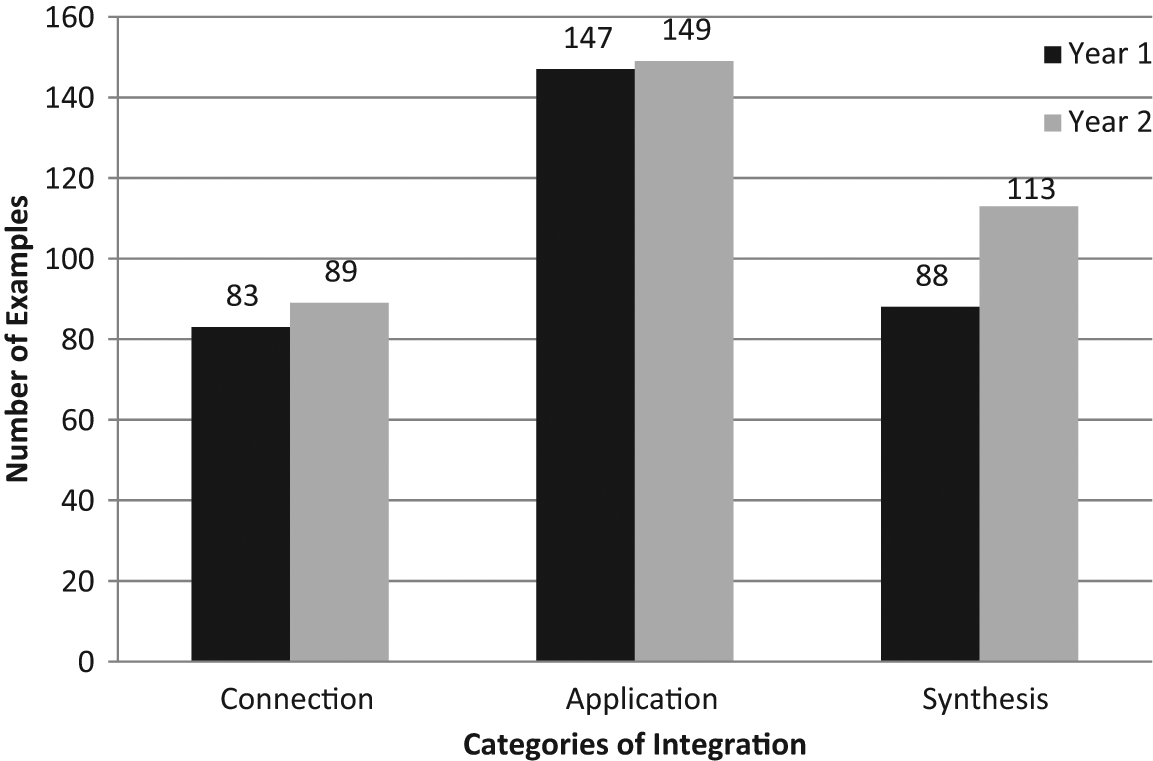
Distribution of integration of learning examples by category and year.
In the following sections, I illustrate each category with excerpts from student interviews. I limited the number of examples due to space considerations and have chosen the most clear and concise passages. The demographics of the students quoted are not intended to characterize the categories as a whole; men and women and students of a variety of races and ethnicities were represented in each category.
The longitudinal data examined in this analysis support that there is a developmental process at work in relation to integration of learning, meaning that it evolves over time. Due to space considerations, I chose to focus on identifying the types of integration of learning in this article; future analyses will explore the development of students’ integration over time.
Category 1: Establishing a Connection
The first category of integration of learning involves identifying a similarity or common thread between ideas, skills, or pieces of information. In this type of integration, a student finds that two or more ideas have a common element. Students recognize that a novel concept is similar to something well known, one skill relates to another, or a new text illustrates a familiar point.
Experiences within the Establishing a Connection category were most often in the realm of ideas, such as making a connection mentally between ideas or pieces of information. Connections can be literal in nature or more abstract. Below, Aisling and Fran offer examples that illustrate the types of experiences that compose the Connection category of integration of learning. 2
Aisling, a White woman in her sophomore interview at Hudson College, talked about an experience of connecting information in the moment, within a relatively brief time frame. Her example described a connection that happened among several classes she was taking concurrently. She said,
Sometimes there are classes that weave together but it’s always very short periods of time. It doesn’t work out in the whole two-month, three-month-type nice, continuous, sameness way. It’s more the points of contact and radiating out in different directions rather than constantly being, constantly contacting and constantly linking. It’s more like one point and then they each go different ways.
For Aisling, although she saw her classes weaving together, she viewed the connections she made in her academic experiences as temporary, fleeting, and local. She made connections among courses she took in the same semester, but not from one semester to another. Her description of the connections suggests a coincidental nature to the similarities that was not planned or sought after on the part of the faculty or the student.
By contrast, Fran, in her first year at Hudson College, described connections that spanned long periods of time, and bridged in-class and out-of-class experiences. In this excerpt, Fran talked about integrating learning by making connections among her courses as well as with her past experience living abroad as an exchange student in high school. She explained,
Just connecting two things in my classes that supposedly would have nothing to do with each other. Like my literature class, that Freshman Symposium, what this essay’s for, and we’re reading Plato right now, and I’m taking another class called Race and Ethnicity in Brazil, and with this one thing we’re talking about Plato and . . . how we use all these things with eugenics. Well, it just so happens that we just finished a book that had a section on that and now I’m able to connect that like, “Oh, I can see how we got the idea from this and now I can write about them both in my paper.” It’s just I never thought about that. Who would’ve thought Plato, and I could connect those—I don’t know. That’s what I’m saying, the classes can go together, which I thought they were so unrelated, but they’re not.
Fran is White and spent a year in high school as an exchange student in Brazil, where she became fluent in Portuguese; she was able to bring these experiences to the conversation about race and ethnicity as well.
In this instance, Fran connected several experiences, studying Plato in two different classes (in two semesters) as well as connecting her class on Brazil to her experience living there as an exchange student. She readily spoke about these connections when prompted but did not indicate that she actively made contributions to the class discussion that allowed others to hear about the connections she was making.
Both of the students who illustrate connections have established a mental link between ideas or skills. Some links are small steps akin to near transfer discussed in the transfer of learning literature (i.e., transfer between closely related contexts; Perkins & Salomon, 1992), such as Aisling’s observations about the fleeting similarities of ideas within a single semester’s courses. Other connections are more complex, such as Fran’s comparison of distinct international contexts. The defining characteristic of the Connection category of integration of learning is the establishment of a link that associates two or more ideas in a student’s mind.
Category 2: Application Across Contexts
The largest and most concrete category of integration of learning experiences focuses on application. Although the experiences described in the Connection category above are most often mental links among concepts, the examples in the Application category carry the connotation of action (i.e., the student is applying an idea or skill). In this category, students described experiences where they used one idea or skill elsewhere in both formal and informal contexts, both in and out of the classroom. This group of examples is aligned closely with the transfer of learning literature. Sometimes this application was in the realm of ideas, using concepts learned in one class to inform study in another. Other times, the application was literally more hands-on, for example applying woodworking skills learned at home to construction of the fraternity homecoming float.
Elliott and Braxton each provide a rich example to bring this category to life. Elliott was a first year student at Wabash College when he talked about integration of learning outside of classroom contexts. He is a White student, who attended small Catholic schools for all of his education prior to college. In this excerpt from his interview, he shared how his previous interests and skills acquired at home had been put to use in building a homecoming float in college. His father worked in construction, and Elliott often helped him with construction projects around the family home. Elliott realized that he was good with his hands, and when asked about his initial awareness that he was talented in building things, he explained,
I can’t put my finger on a first memory, but I’ve always liked to do puzzles. I’ve always liked, not just pieces of puzzles in general, but mind puzzles. I don’t know if you are familiar with the Sudokus, in the newspaper. I thoroughly enjoy doing those. I really like those a lot so it kind of transfers over into thinking of the many different things that can go on a piece of paper. Different ways the float could have been constructed.
Elliott later made the application across contexts more explicit, stating, “I’ve done things like that [designing and constructing the float] in the past, so it can also go back to my past experiences knowing what I’ve done in similar situations and applying them to the now.”
By contrast, in his first year at Hudson College, Braxton talked about a more abstract type of application, applying an idea rather than a skill. Braxton is a White, first-generation American and received a scholarship to attend Hudson. In the following passage, he described a time when he applied a concept learned in one class (Liberal Arts Workshop) to a different context.
What the teacher said and what I keep repeating whenever I usually write, is that what you write and what you produce isn’t you, it’s just what you produce. So, he’d say, it may reflect certain aspects of you, but it’s not you and you can’t be judged upon it because of it. . . . It allowed me, at least, more free[dom] in my writing because I didn’t put as much pressure on it to be a representative of me, of my mind. . . . When I’m writing or when I’m making a sculpture or when I’m on Facebook . . . that’s one of the things he [the professor] said, “Always keep in mind that what you make in your Facebook is not you. It’s just a picture of you. . . . It’s not you, it’s just a tool.” He said to always keep that in mind with everyone else’s profile you look at too.
Braxton discussed applying a concept he learned from a professor (the idea that what he writes does not define him) to his writing in nonclassroom environments such as Facebook, and also to other forms of expression such as sculpting. Braxton’s story is unusual in this data set because of the direct involvement of a faculty member. Very few of the examples of integration of learning I found in this analysis noted faculty/staff as mentors.
These two students integrated learning in a manner that indicated an application of knowledge from one context to another. Elliott demonstrated that application is not limited to the academic arena, as he used his love of Sudoku and previous experience learning carpentry from his dad to assist with the construction of his fraternity’s float for homecoming. Braxton’s example of applying a concept learned in class to other academic and nonacademic contexts illustrates a more abstract variety of application in that it he took a way of thinking about writing and applied it to sculpting and social networking on Facebook. Elliott and Braxton’s experiences demonstrate that application can involve both in-class and out-of-class contexts. Taken together, these examples demonstrate two main characteristics of the Application category of integration, the mobility of knowledge across contexts, and the active role of the student in this mobility.
The mobility of knowledge across contexts is also a key link to the transfer of learning literature. The concepts of transfer of learning are concentrated in the Application category and hold much more relevance with this group of examples than with those of Connection or Synthesis, in large part because of the practical (i.e., applied) nature of transfer of learning.
Category 3: Synthesis of a New Whole
The third category of integration of learning experiences is Synthesis of a New Whole. This group of experiences is the least concrete and includes instances when two or more ideas come together to form a new idea or concept. It is different from Application, which centers on the utilization of knowledge or skill from one context to another, and is also set apart from Connection, which describes finding a similarity between two or more items that remain distinct. Synthesis is at its foundation a process of constructing new understanding or skills. In the following excerpts, Colin and Tom provide examples of synthesis as a means of integrating learning.
Colin is a White student from rural Indiana. In his sophomore interview at Wabash, he talked about bringing together his education in a Christian school that taught intelligent design and the perspectives he was gaining in college biology courses that taught evolution. When asked about how he processed different opinions he encountered in his classes, Colin replied,
I take them [different opinions] all in and chew on them and then go to through the digestive process, mentally check it against what I think or thought and how I kind of add this to my ideas and subtract some of the stuff and then combine it all. Kind of getting what I feel is the best of everything.
Colin provided a vivid description of his synthesis process in this example. He talked about the “digestive process” of comparing new information to his previously held views and deciding what to add in, what to subtract, and how to reconcile divergent beliefs. There are also other elements of integration of learning noticeable in Colin’s response. He later noted that the new classes that he was taking in college allowed him to compare and contrast different religious and scientific ideas and ultimately synthesize them into his own belief system, in effect creating a new belief system, a “new whole” composed of familiar concepts and new insights. Boix Mansilla (2005) used the term integrative leverage to describe synthesizing perspectives to create “a new and preferred understanding” that would not have been possible with a single lens (p. 19). Colin’s example also fits into the Connection category because he makes a connection between the concepts of intelligent design and evolution, compares and contrasts them, and then takes his thinking further in order to synthesize them.
In Tom’s sophomore interview at Hudson, he discussed what I call the collaborative nature of synthesis, where ideas are combined through group process rather than by an individual. Tom is White and grew up in a suburban environment. He enjoyed the discussion-based classes at Hudson and described how the act of engaging in a discussion could lead to new understanding. He reflected,
. . . [T]he courses are run, in large part, as sort of like a guided discussion, so to really take part in the course you have to contribute. But in that act of contributing, it becomes a much more active engagement, at least for me, when I’m having to just talk about what I think about something, and then as I’m talking the thought sort of folds out on itself and it leads somewhere and it doesn’t lead somewhere unless somebody else picks it up and takes it somewhere. It works really well to get into understanding and to go about it that way.
Tom’s description indicated the importance of dialogue in synthesizing knowledge and in the integration of learning process broadly. His description of the thought folding out on itself is an illustration of meaning making in action in the course of the discussion. He also noted that this process happens in interaction with other students; it is a collaborative process. In his explanation, in order for the thought to lead somewhere, somebody else must pick it up, and the result was a greater understanding.
The central characteristic of the examples in the Synthesis category is the fusion of two or more ideas, perspectives, or items to form a new view. This creative form of integration goes beyond the link established in the Connection category and is also distinct from the examples reported in the Application category. In the act of synthesis, there is a creation of something greater than the sum of its parts. Colin highlighted the role of evaluation in synthesis and talked about how he decided which ideas to integrate and in what way they were synthesized, and Tom talked about how this process unfolded in classroom discussions, where individual perspectives come together to form shared understandings. The examples from both Colin and Tom are indicative of a more abstract form of integration, more similar to high-road transfer of learning than to low-road variety (Perkins & Salomon, 1992).
Discussion
In this section, I discuss the relationship of integration of learning to the models of transfer and experiential learning introduced as the conceptual framework. I explore the implications of context and introduce the idea of intercontextuality as a hallmark of integration of learning. To conclude the article, I offer several detailed recommendations for practice and ongoing research based on my findings and revisit the definition I developed for integration of learning.
Relation to Transfer and Experiential Learning
The conceptual lens of transfer of learning was a useful in the initial stage of considering what processes might underlie integration of learning. Its rich history and the manner in which the literature tries to explain how information or concepts learned in one context can be moved or applied to another context were valuable. This focus on mobility and application resonated with the notion of integrating learning and ideas. However, the transfer of learning research is not sufficient to characterize integration of learning. Despite the similar terminology, I make a distinction between transfer of learning and integration of learning as follows: Transfer of learning is applying the skills and knowledge from one context to another, while integration of learning is a more complex, iterative phenomenon than transfer.
Similarly, the established literature related to experiential learning was helpful in thinking about integration of learning, but not sufficient to describe the concept completely. I find the main tenets of Dewey’s work to be very relevant to today’s student learning, nearly 75 years after his original writing. He explained that many of the educational benefits of experience are lost when the learning is not connected: “Each experience may be lively, vivid, and ‘interesting,’ and yet their disconnectedness may generate dispersive, disintegrated, centrifugal habits” (Dewey, 1938, p. 14). The environment of many 21st-century college students in the United States is much more complex than the world that the early experiential learning theorists knew. Student demographic data indicate that just under half of students take classes at more than one institution while earning the bachelor’s degree (Peter & Forrest Cataldi, 2005). Nearly 75% of undergraduate students are employed part- or full-time while attending college (Horn & Nevill, 2006). Students today move between contexts frequently and easily; how do we, as educators, structure our work to promote integration of learning given this often dispersive landscape?
Intercontextual Nature of Integration
For college students, the majority of life’s day-to-day activities, problems, and choices are neither disciplinary nor interdisciplinary. The world is more complex than that and rarely organized into orderly disciplines. Ours is an arguably intercontextual world in which daily life spills over many disciplines and contexts simultaneously. The data in this study illustrate the wide variety of contexts in which integration of learning happens—in classroom discussions, at work, in the residence hall or fraternity/sorority house, and even in online virtual spaces, just to name a few. As educators interested in promoting integration of learning for college students, we are missing untold opportunities for learning if we are focused only on the classroom and curricular contexts. Although the contexts of integration were not a focus of this analysis, I would be remiss not to point out a compelling finding, that integration of learning was by no means limited to academic content or settings. For many students in this study, out-of-the-classroom experiences were vitally important to integration of learning.
Based on the data in this study, I conclude that students’ experiences on college and university campuses are much more related and fluid than our organizational charts might suggest. The stories from students indicate that it is in fact the students who are bridging boundaries to integrate learning, often unaided by a mentor or guide. Braxton’s example in the Application section, of responding directly to feedback from an adult, is not typical of the data in this study. More often, students described turning to peers when seeking advice.
Despite the pleas for more and better integration and critiques that integrative programs may involve only a select few students on a campus (AAC&U & Carnegie Foundation, 2004; Huber et al., 2007), the data from the WNS demonstrated a surprisingly great amount of integration of learning (often outside of those programs developed by institutions to promote integration). These data lead me to believe that integration of learning is happening much more often than many educators may realize and frequently without the support of faculty or staff. This lack of involvement and feedback from adults (in academic affairs, student affairs, or outside of the university entirely) was surprising and represents an opportunity for educators to facilitate integration of learning more intentionally. This point was highlighted on several occasions when the interview itself appeared to be the context for integration.
Importance of the interview as intervention
In several cases, it became clear that a student was integrating “in the moment” during the interview. In these instances, it appeared integration of learning was sparked by the interview questions, in particular the probing follow-up questions typical of semistructured interview protocols. I interpret this as evidence regarding the role of reflection as an important tool for integration; the interview is indeed a context that intentionally tries to promote reflection among the participants. For example, Kayla expressed one of these moments of discovery promoted by the interview in her sophomore interview at Hudson College. Kayla is an international student of East Asian descent, although her family has lived in India for more than a decade. Here, she reflects on the impact of an ongoing community service project working with children:
Kayla: . . . I feel being a good student, you also have to be very involved with your community because essentially the purpose of your education is to become I think a productive individual. And just with books you cannot, I mean even if you’re a stellar academic student, if you don’t have the people skills, if you haven’t learned how to work with people in need, if you’re not a good leader, you are not a whole productive individual. Interviewer: How did you develop these ideas? Where did they come from? . . . Kayla: I think it’s been, I think this is the first I’ve articulated whatever I felt. . . . This is the first time I actually put [these ideas] into words. . . . It feels good now. I can tell this to other people [chuckle]. It’s out now.
Kayla has a difficult time responding to the questions “How did you develop these ideas?” and “Where did they come from?” referring to her ideas about community involvement and outreach. Although she says she has been thinking about these ideas for some time, it was not until the interview that she transformed her ideas into words. This example of integration of learning, a synthesis of her academic work and community outreach, is in part a result of Kayla’s conversation with the interviewer. Conversation about what is important to the student and how she is thinking about her college life created a context for reflection and ultimately integration (Baxter Magolda & King, 2007).
Limitations
This study of integration of learning is based on students on only two campuses, and specific types of campuses at that. The findings should not be generalized for all college students or institutions. Both Hudson College and Wabash College are small, private liberal arts colleges in rural settings. Both had intentionally integrative programs for first year students established at their institutions (Liberal Arts Seminar and Freshman Symposium at Hudson; First-Year Tutorial courses and Culture and Traditions sequence at Wabash), and both were selected for the larger WNS based on interest in and programs on liberal arts education.
Working with a large-scale, complex project such as the WNS brings both benefits and limitations. This situation increased the amount of data I could include in this analysis, but also increased the opportunity for inconsistencies in data collection and analysis. Although such inconsistencies are inevitable, systematic review of a random selection of the analyzed data served to minimize areas of discrepancy and maintain high quality in both data collection and analysis.
The gender balance in the sample was skewed toward men in part because Wabash is an all-male institution. This two to one ratio of men to women in the sample (30 women, 67 men) may have played a role in the findings. Although gender was not an area of interest in my research question, the predominately male sample may have affected the outcome as it is not representative of the current college student population: 57.3% women, 42.7% men (Knapp, Kelly-Reid, & Ginder, 2011).
Last, the similar ages of students in the sample (all were traditionally aged first year college students, 18 to 20 years old) may also have limited the types of integration I observed in the interviews and thus limited the number of categories. It is to be expected that students early in college have less complex ways of thinking than more advanced students (Baxter Magolda, 1999; Kegan, 1994).
Implications for Practice
A central implication of my research for practice is an awareness of the components of integration of learning. I encourage colleagues in all areas of higher education to consider ways in which they might intentionally create new opportunities both in and out of the classroom that will promote integration for students and become involved in some of the integration of learning that students are already doing. The concept of integration of learning also holds promise and utility for assessment and accreditation. Systematically investigating and documenting how students on our campuses are integrating learning will not only illuminate areas where student learning is exceptional but also guide curricular design to promote integration further.
The next logical step is to operationalize these recommendations and determine how to create scaffolding that promotes integration of learning for college students. As demonstrated in this study, many students are quite adept at multitasking and making connections among various tasks and concepts, but based on the literature calling for increased integration among undergraduates, this skill is often unrecognized in academe. Based on what I have learned about integration of learning in the course of this analysis, I offer four recommendations for how college educators both inside and outside the traditional classroom can use these insights to foster a culture of integration for undergraduates.
Invite conversations with students
The data in this analysis revealed that (a) students often did not have a faculty or staff mentor to whom they turned for guidance, (b) students were eager to share their experiences with an interested adult (in this case, the interviewer), (c) the interview conversations promoted reflection for students that in some cases prompted integration of learning (see Kayla’s excerpt above), and (d) there is a great deal of integration of learning happening in students’ lives of which many educators are unaware. Intentionally creating opportunities for individual conversations with students can positively address each of these items. Faculty, staff, and students alike have full schedules and hectic lives. However, making time in the day for authentic conversations with students, even if only for 10 to 20 minutes, can encourage reflection, build relationships, and promote integration of learning.
Actively bridge contexts for and with students
The intercontextual nature of integration of learning, that integration can happen in and across multiple contexts simultaneously, is a characteristic that emerged from the data. Students (in fact, most members of an academic community) live in a complex and interconnected world. The issues that we face each day are not limited to one context or discipline. Our lives are a nexus of various, and at times competing, environments, discourse communities, and belief systems. Educators can work to actively bridge contexts for students who have difficulty doing so and can encourage students who are already skilled in thinking intercontextually. For example, asking students to present an artifact from their home life, work experience, childhood, and so on can provide a venue for individuals to illustrate their understanding of material by connecting the curriculum to a context outside of the classroom. This can help to promote integration of learning by deliberately inviting students’ previous experience into the classroom and signaling that it is encouraged for students to bring their unique identities, characteristics, and stories into class discussions.
Promote perspective taking
Perspective taking (standing in another’s shoes) can be a powerful exercise for encouraging students to see multiple perspectives, just as bridging contexts can aid students in connecting curricula to their own personal perspectives. However, stepping outside of one’s own position and trying to see the world from someone else’s vantage point can be a difficult (and sometimes frightening) task. I understand this and suggest providing a number of spaces, both public (e.g., class activities, discussions, service learning) and private (e.g., reflective journals, writing assignments), for students to experiment with perspective taking. Stretching to see an issue from an alternative point of view can help students clarify their own values and beliefs while gaining a greater understanding of others’ experiences.
Encourage reflection
Integration of learning is too often approached as an end point. I see the process to be cyclical in nature. Even after learning is integrated, a number of factors can cause an individual to take another look: New information, changing contexts, and evolution of meaning making can all lead to a new perspective. As a collegiate educational outcome, I believe integration of learning should be conceptualized as a continuous, iterative process—a habit of mind rather than an accomplishment. Challenging students to regularly reflect and reconsider what they know can assist them in developing this frame of reference for integration of learning.
Writing assignments can be useful for giving individuals the space to reflect and organize thoughts; such assignments are also helpful for understanding someone’s way of seeing the world. Writing can also allow students who may not be inclined to participate in a classroom discussion or debate an opportunity to explore ideas and communicate their ideas, questions, and insights to the teacher. Imagine the possibilities for harnessing students’ integration of learning if faculty, staff, or other mentors invited students into conversation and guided the discussion (either in written reflections or spoken conversation) away from objective questions such as “Do you have questions about the material in this class?” to more reflective prompts such as “How are you thinking about the concepts?” or simply “Tell me about what’s important to you.” Students might have a difficult time responding to these questions initially, as illustrated by Kayla in the excerpt above, but the questions may prompt the reflection crucial for integration of learning.
Implications for Research
In addition to the implications for educational practice, the analysis of integration of learning has also introduced several opportunities for future study. Following are five areas of continued investigation that will contribute to the knowledge about how college students integrate their learning.
Expand the analyses within the WNS data
As discussed, the campuses from which the data were drawn for my study are two of six campuses across the country where we conducted interviews. As a reminder, these two liberal arts colleges were chosen primarily because they offered environments rich in potential to learn about integration. However, at the time of this study, they were less diverse in terms of race and ethnicity than the overall college student population in the United States and the other four institutions where interviews were collected in the WNS. The other four campuses would add greater racial, ethnic, and gender diversity to the sample as well as expand the study to different institutional types and instructional approaches.
The data analyzed in this study represent the first 2 years of a 4-year longitudinal study. Extending the analysis to include data from the 3rd and 4th years would enable the mapping of the integration of learning processes in students over the course of their college careers. This work also has many avenues for continuing lines of research beyond the scope of the WNS and into young adults’ postcollege experiences.
Study the salience of contexts and demands
In the course of this study, contexts were intentionally placed in the background in favor of process or meaning making. Although I coded the data for context and considered the often intercontextual nature of integration, I did not analyze by context per se. In order to best address my primary research question, I focused on the students’ process for integration over where the integration took place and what prompted or facilitated the integration (i.e., the demands of the experience). In this light, the direction of this project required me to focus on meaning making over context. An investigation of the demands of integrative learning experiences may reveal insights for andragogy and practice to promote integration of learning (Barber & King, 2007).
Consider additional data sources beyond the WNS
One of the strengths of these data is that the semistructured interviews allowed the participants to describe their own experiences and talk about integration of learning in their own words. However, this form of data also has limitations; the student may not have chosen to share an experience about integration of learning or may not have had the verbal skills to effectively describe his or her integration to the interviewer. Observing class discussions or student organization meetings is one way of searching for integration of learning in action. Reading papers for integrative assignments and designing an interview specifically about integration of learning are additional means. Artifacts that reveal integration of learning, such as student writing or e-portfolio collections, also would be rich sources of data to inform the research on integration as a learning outcome.
Examine links between learning and development
I focused on the overall process of how students integrate learning in this article. Although all of the students included in this analysis were traditional-aged first- and second-year college students (18–20 years old), we cannot make the assumption that each student is entering college with a similar level of maturity or meaning making. In fact, the literature on college student development suggests that students enter college with a wide variety of developmental levels. Future studies of integration of learning can benefit from comparing individual students’ process of integration with their ways of meaning making. An analysis such as this may shed additional light on the intersections of college student learning and development.
Investigate student characteristics in relation to integration of learning
As the student body enrolled in American higher education continues to diversify, it is imperative to consider the learning experiences of students outside of the majority culture. There is a substantial literature indicating that students respond to course content and college experiences differently, depending on the linguistic, socioeconomic, cultural, and other background experiences they bring to the learning environment (e.g., Abes, Jones, & McEwen, 2007; C. W. Barber, 2010; Kiyama, 2010; Ladson-Billings, 1995; Pizzolato, 2005). The WNS data set is itself quite diverse in terms of race and ethnicity; the subsample analyzed in this article is nearly 20% students of color. Analyzing the data in light of student characteristics such as race, ethnicity, gender, sexual orientation, faith background, privilege, or national origin could uncover important differences in the ways students integrate learning.
Integration of learning is widely becoming recognized as an essential educational outcome for U.S. college and university students in the 21st century (AAC&U, 2004, 2005; King et al., 2007). In conclusion, I return to my proposed definition of integration of learning, itself a result of this grounded theory process, to summarize the key concepts gained from my investigation.
Integration of learning is the demonstrated ability to connect, apply, and/or synthesize information coherently from disparate contexts and perspectives, and make use of these new insights in multiple contexts. This includes the ability to connect the domain of ideas and philosophies to the everyday experience, from one field of study or discipline to another, from the past to the present, between campus and community life, from one part to the whole, from the abstract to the concrete, among multiple identity roles—and vice versa.
This study provides empirical data on the process of integrating learning for college students in an effort to uncover the how of integration of learning, namely the emergent categories of Connection, Application, and Synthesis. In addition, the findings demonstrate that integration of learning is not limited to the classroom, residence hall, or any one specific context. By nature, integration of learning is an intercontextual process. Higher education professionals both inside and outside of the traditional classroom can begin to consider which contexts and experiences may promote integration of learning by first understanding the ways in which students connect, apply, and synthesize their complex knowledge, experiences, and identity roles in a wide variety of contexts.
Footnotes
Notes
J