




Abstract
Students’ ability to evaluate emotionally challenging situations and identify effective strategies for managing emotions in themselves and others was negatively related to poor classroom social behavior across three studies. These studies, involving 463 students from two Spanish high schools and one American university, examined indicators of adaptation to school based on teacher ratings and official school records. Relationships between the ability to manage emotions, measured with a situational judgment test, and indicators of social adaptation to school remained significant or marginally significant after controlling for demographic factors, personality traits, and indicators of cognitive ability. These findings suggest that emotion regulation knowledge and skills that can be taught explain important aspects of socio-emotional adaptation to school over and above other relevant constructs.
Students’ ability to respect school rules and interact reasonably well with their teachers is thought to influence their capacity to learn, commitment to school, and broader socialization. It is important for their future, both in the educational system and in life outside of the classroom. It is also relevant for teachers because it influences educators’ capacity to teach effectively and derive satisfaction from their work. Many teachers find it difficult to handle classroom disruptions caused by students who cannot regulate their impulsive tendencies and emotional reactions effectively, or who cannot sustain the motivation for studying. This problem is likely to contribute to high levels of occupational stress among teachers (prevalence estimates ranging from 30% to as high as 90% in the United States; e.g., Dorman, 2003; Guglielmi & Tatrow, 1998; Travers, 2001) and to the high percentage of teachers leaving the profession within their first 5 years (40% to 50% in the United States; e.g., Sutton & Wheatley, 2003).
Students’ experience of school is suffused with diverse emotions. The emotions that students experience in academic settings are related to their motivation, learning strategies, self-regulation, and academic achievement (Pekrun, Goetz, Titz, & Perry, 2002). There has been substantial research on self-regulated learning—students’ capacity to manage their own learning experiences efficiently and adaptively, as active learners (Schunk & Zimmerman, 1994). Most of this research has examined how students use various cognitive and metacognitive strategies to learn, with a clear focus on cognitive regulation (Pintrich, 2003). In contrast, emotion regulation has been relatively neglected in the field of education, despite some fruitful research in this area—including research on the regulation of motivation (e.g., Wolters, 1998) and on students’ need to balance academic learning and growth, on the one hand, and emotional well-being and ego protection, on the other (e.g., Boekaerts & Niemivirta, 2000).
Emotions influence the way people think and behave, and they are intimately linked to motivation (e.g., Buck, 1985). They serve important adaptive functions, including guiding attention and cognition to deal with threats and opportunities, facilitating learning, and coordinating social interaction (e.g., Baumeister, Vohs, DeWall, & Zhang, 2007; Fredrickson, 1998; Lazarus, 1991; Schwarz, 1990). Yet, intense and unregulated emotions can also undermine complex information processing, rational decision making, and social interaction (Keinan, 1987; Lerner & Tiedens, 2006; Loewenstein & Lerner, 2003; Simon, 1967). For example, when people are angry, they might do or say things that harm relationships with others, without due consideration of alternative solutions and possible consequences. Thus, appropriate emotion regulation is thought to contribute to social, emotional, and academic adaptation. Students who cannot regulate their emotional reactions and impulsive behavior effectively, either because they are temperamentally overreactive or because they failed to develop emotion regulation skills, tend to experience difficulties in adapting to school, work, and social environments later in life (Caspi, 2000; Eisenberg, Fabes, Guthrie, & Reiser, 2000; Kagan, 1998; Metcalfe & Mischel, 1999). In particular, the failure to develop emotion regulation skills—perhaps because of a lack of appropriate models—is thought to predict a lack of social competence (Denham & Burton, 2003) and various kinds of antisocial behaviors (Lotze, Ravindran, & Myers, 2010) as children grow older.
Situational Judgment and Managing Emotions
Definitions of emotion regulation vary considerably, although we are guided by the general view that it involves “physiological, behavioral, and cognitive processes that enable individuals to modulate the experience and expression of positive and negative emotions” (Bridges, Denham, & Ganiban, 2004, p. 340). The importance of learning to understand and regulate emotion is made salient in various models of emotional development (see Denham, 1998; Eisenberg, 2000; Garber & Dodge, 1991). Emotion regulation is a key component in the most comprehensive models of the development of emotional competencies. For example, Saarni (1999) views the ability to cope adaptively with aversive emotions as one of eight skills children learn in becoming emotionally competent adults. An earlier hierarchy of emotional skills development presented emotional self-control as the culmination of learning to express, represent, and understand emotion (Fischer, Shaver, & Carnochan, 1990). Individuals who have learned, usually in childhood, to regulate their emotions are able to inhibit inappropriate behavior motivated by strong emotional experiences; calm themselves when highly aroused; deploy emotions to help focus attention; organize their thoughts and feelings to pursue goals; use emotions to influence the feelings, thoughts, and behaviors of other people; and attempt to be “in synch” with cultural rules for displaying emotions (Hyson, 1994).
To study emotion regulation in the social context of the classroom and school, we focused on students’ ability to manage emotions in both self and others. In this context, intrapersonal and interpersonal emotion regulation are interlinked because emotions are contagious (e.g., Hatfield, Cacioppo, & Rapson, 1994), and individuals tend to “catch” others’ emotions in social encounters. For example, curbing our own anger can help to attenuate others’ anger as well. Similarly, appeasing someone who felt offended by our behavior may help us to calm down by dissipating tension in the interaction. Accordingly, in this article, we adopt a broad definition of emotion regulation, encompassing both intrapersonal and interpersonal regulation, in line with the concept of managing emotions described in Mayer and Salovey’s (1997; Salovey & Mayer, 1990) theory of emotional intelligence, which views emotional intelligence as a set of interrelated abilities involving perceiving, understanding, using, and managing emotions. Thus, we consider that managing emotions involves influencing the experience and expression of emotion in self and others, so as to reach one’s goals, achieve well-being, and adapt to the environment. To clarify that we are studying the regulation of emotion in both oneself and other people, we will henceforth generally use the expression managing emotions in this article.
In studying the role of managing emotions in adaptation to school, we focused on students’ ability to identify effective and appropriate responses to emotionally challenging situations. In other words, we examined situational judgment in the emotional realm. We view the ability to evaluate emotional situations as an important dimension of managing emotions that lies at the interface of emotion and cognition, involves the intelligent processing of emotional information, relies on both knowledge of emotions and judgment skills, and can be learned or developed.
From a theoretical standpoint, this ability is critical for emotion regulation because the way that we evaluate emotional stimuli and situations (i.e., our appraisals) determines our emotional reactions (Lazarus & Folkman, 1984; see also Scherer, Schorr, & Johnstone, 2001). In Gross’s (1998) model of emotion regulation, appraisal is considered a key process of antecedent-focused emotion regulation, occurring early in the chain of events that constitutes an emotional response.
The importance of situational judgment is also emphasized by social information processing models and research, which indicate that biases in the interpretation of social and emotional situations can trigger inappropriate emotional reactions (Crick & Dodge, 1994). For example, aggressive children tend to reveal hostile attribution bias in evaluating ambiguous situations: If a classmate pushes them when they are standing in line in the cafeteria, they tend to think that the other person did it on purpose. When asked to identify effective responses to challenging situations, they also reveal a limited repertoire of response strategies: They may think that the only way to deal with a public affront is to respond aggressively, push back, or start a fist fight (Crick & Dodge, 1994). Evidence that effective emotion regulation should be flexibly attuned to situational demands and opportunities rather than rely systematically on any one emotion regulation strategy (e.g., Cheng, 2001) further highlights the importance of emotionally intelligent situational judgment and response selection.
We focused on judgment in emotionally challenging situations to examine knowledge and skills that can potentially be taught, as opposed to personality traits that are difficult to change. Numerous studies of emotion regulation in school have relied on measures that do not distinguish temperamental dispositions and personality traits, on the one hand, and acquired emotion regulation knowledge and skills, on the other. In fact, temperament and personality are closely linked to emotional reactivity and automatic emotion regulation processes. For example, Larsen (2000) proposed that the personality traits of extraversion and neuroticism reflect positive and negative emotional reactivity, respectively, whereas agreeableness and conscientiousness reflect response modulation. For both theoretical and educational purposes, however, it is important to distinguish the effects of personality dispositions from those of acquired knowledge and skills.
In the present studies, we used a situational judgment test that asks respondents to evaluate emotional situations described in brief vignettes and to rate the effectiveness of various strategies for managing them. This test does not measure people’s capacity actually to implement these strategies in conditions of heightened emotional arousal. In fact, there may be a big difference between what people know they should do and what they actually do when they experience intense emotions or stress (Baumeister, Heatherton, & Tice, 1994; Metcalfe & Mischel, 1999). The way people think and behave may differ in conditions of high versus low emotional arousal, which activate “hot” versus “cold” systems of cognitive processing. Nonetheless, it is important to know whether the ability to evaluate emotional situations and to identify effective emotion regulation strategies (under conditions of low arousal) is related to appropriate classroom behavior, positive interactions with teachers, and social adaptation to school. This question is of both theoretical and practical interest. If the answer is positive, it may be useful to teach students (at developmentally appropriate levels of instruction) to use their intelligence to manage emotionally challenging situations and identify effective response strategies. If the answer is negative, this cognitively based approach to teaching emotion regulation is likely to be ineffective. Thus, we examined the effects of this “strategic” dimension of managing emotions, emphasizing cognitive processes of emotion regulation.
Note that the test used in our studies measures both knowledge of emotions and the ability to evaluate emotional situations. Judging complex or ambiguous situations and identifying effective response strategies entails using prior knowledge to think intelligently about emotional situations and to weigh the pros and cons of alternative responses. These judgments may rely on deliberate and systematic analysis, or on fast and intuitive processes involving procedural knowledge codified as complex sets of if-then contingencies (Sternberg et al., 2000), heuristics (Gigerenzer, 2007), or pattern recognition (Klein, 2003), as often happens in naturalistic decision making (Lipshitz, 1993). Either way, such judgments involve intelligent processing of emotional information and problem solving rather than blind application of knowledge. Therefore we consider that the ability to judge emotional situations investigated in the present studies reflects both emotional knowledge and skills, rather than knowledge alone.
Linking the Ability to Manage Emotions and Adaptation to School
The present studies focused on appropriate behavior in school and the quality of student-teacher interactions as aspects of social behavior and adaptation to school that are important in their own right and have received relatively little attention in prior research on emotion regulation. Inappropriate classroom behavior is an important issue in education because, as we argued previously, many teachers are concerned not only with enhancing students’ academic achievement but also with handling unruly students and maintaining positive discipline in the classroom. Moreover, there is evidence that the quality of students’ relationships with teachers is a critical component of adaptation to school and contributes to academic achievement (Pianta, Steinberg, & Rollins, 1995). Perceived teacher social support is positively related to participation in and identification with school, which in turn contribute to academic achievement among adolescents (Wang & Holcombe, 2010). The effect of student-teacher relationships on academic achievement also appears to be mediated by student and teacher behaviors in the classroom (E. O’Connor & McCartney, 2007). Students who like school reveal less problem behavior and misconduct, in general, than those who feel less bonded to school (Simons-Morton, Crump, Haynie, & Saylor, 1999; Smetana & Bitz, 1996). These findings justify our focus on appropriate classroom and school behavior and on the quality of student-teacher interactions.
Both theory and research suggest that the ability to manage emotions contributes to appropriate and effective social behavior. Emotions serve important social functions, including facilitating communication, coordinating social encounters, cementing relationships, defining groups, and fostering socialization (e.g., Keltner & Haidt, 2001). They convey information about people’s thoughts and intentions. They influence others’ emotional states (Hatfield et al., 1994), and indeed there is evidence of emotional transmission between students and teachers in the classroom (e.g., Frenzel, Goetz, Lüdtke, Pekrun, & Sutton, 2009). Thus, people need to regulate their emotions in order to navigate the social world. They may be ostracized in social settings or reprimanded in the classroom if they fail to conform to prevailing feeling and display rules (Ekman, 2003). In school and other contexts, socializing often entails nurturing positive emotions and dampening negative emotions, as people tend to seek the company of individuals who radiate positive affect and avoid those who spread negative affect persistently (Argyle & Lu, 1990; Furr & Funder, 1998). In managing interpersonal conflict, regulating emotional arousal can help people to avoid reciprocating destructive behavior and escalating hostilities (Arriaga & Rusbult, 1998; Zillmann, 1993). Consistent with this line of argument, there is evidence that the ability to manage emotions, measured with a situational judgment test, is positively related to the quality of interaction with friends and peers among university students (e.g., Lopes et al., 2004, 2011; Lopes, Salovey, Côté, & Beers, 2005). The present studies extend these findings into the realm of classroom behavior and student-teacher interaction.
There is also theory and research linking emotion regulation and academic achievement. Emotions may influence learning and achievement in school through cognitive and motivational mechanisms (Pekrun, 1992; Schutz & Pekrun, 2007). The emotions (positive and negative) that students experience in school are associated with their perceptions of academic competence and control, as well as with their values and goals regarding learning and achievement (Pekrun et al., 2002). Effective emotion regulation may contribute to academic achievement by helping students to manage test anxiety, concentrate on the task at hand, think clearly, and perform effectively under stress (Seipp, 1991; Zeidner, 2007). It may also help students to adopt learning and growth goals, deal with the frustrations of grappling with difficult material (Boekaerts & Niemivirta, 2000), absorb negative feedback, maintain optimistic expectations, and nurture intrinsic motivation for studying (Csikszentmihalyi & Larson, 1984). Many school-based interventions designed to teach skills associated with social competence, captured by the label social and emotional learning (SEL), focus in some way on developing emotion regulation skills with an eye toward their application in the school setting (reviewed by Elbertson, Brackett, & Weissberg, 2010; Zins, Payton, Weissberg, & Utne-O’Brien, 2007).
Consistent with this idea, some studies have found the ability to regulate emotions to be related to school readiness (Raver, 2002) and academic achievement (Gumora & Arsenio, 2002). Scores on a situational judgment test of managing emotions were also positively related to performance on logical-reasoning problems under time pressure, controlling for general intelligence (Lam & Kirby, 2002). However, the evidence that situational judgment tests of managing emotions predict school grades is mixed (Mayer, Roberts, & Barsade, 2008).
Overview of the Three Studies
We conducted three studies to examine relationships between the ability to identify effective strategies for managing emotions in oneself and others (henceforth designated ability to manage emotions, or AME, for ease of presentation) and: (a) indicators of inappropriate behavior, the quality of student-teacher interaction, and students’ socio-emotional competence and (b) academic achievement. We also examined whether this ability explains variance in indicators of adaptation to school over and above demographic factors and existing measures of personality traits and cognitive ability. We recruited two samples of high school students in Spain and a sample of college students in the United States. The three studies we conducted allowed us to address concerns about external validity and enhance confidence in the generalizability of our findings. Our main goal was to show that relationships between the ability to apply situational judgment to the realm of managing emotions, on the one hand, and appropriate classroom behavior or the quality of student-teacher interaction, on the other, generalized to varying age groups and educational contexts.
Study 1
In the first study we examined relationships between the ability to manage emotions and teacher ratings of adaptation to school in a sample of Spanish high school students 1 and tested the following hypotheses: (a) AME is negatively related to teacher ratings of conflict and hostility; (b) AME is positively related to teacher ratings of adaptation to school, academic achievement, and acceptance by peers; (c) these relationships remain significant after controlling for gender, age, IQ, and the Big Five personality traits. Because previous research has identified gender differences in emotion regulation (e.g., McRae, Ochsner, Mauss, Gabrieli, & Gross, 2008), we also examined whether gender moderated relationships between AME and adaptation to school.
Method
Participants and Procedure
Data were collected from 204 Spanish high school students in two high schools in the province of Cádiz in southern Spain. These students were enrolled in the third and fourth years of the Spanish secondary school system, corresponding approximately to Grades 9 and 10 in the United States. Nearly all students in these schools were Caucasian, and according to school officials, most came from middle-class families. Data collection was authorized by the school principals and took place during class time. The students who participated in the present study were nested in seven different homeroom groupings (four from School A and three from School B). Students from each homeroom were together in class for core disciplines. Although not officially sanctioned, it is usual practice in Spanish high schools to assign students to homerooms according to their academic performance and school conduct, and this was apparent in School A. Partly for this reason, teacher ratings varied significantly across homerooms, and we controlled for this source of variability in statistical analyses.
One participant who copied responses to the situational judgment test of managing emotions from a classmate was excluded from all analyses. The remaining 203 participants were aged 14 to 17 (M = 15.11, SD = .87); 50.2% were girls; 66 students were in the third year of high school (two homerooms from School A), and the remaining 137 in the fourth year (five homerooms); 126 students belonged to four homerooms from School A and the remaining to three homerooms from School B.
Measures
Managing emotions ability was measured using a situational judgment test: the managing emotions section of the Mayer-Salovey-Caruso Emotional Intelligence Test (MSCEIT Version 2.0; Mayer, Salovey, & Caruso, 2002; Spanish version by Extremera, Fernández-Berrocal, & Salovey, 2006). Respondents are asked to rate the effectiveness of different strategies for managing emotionally challenging intrapersonal and interpersonal situations described in eight brief vignettes. Five vignettes are used to measure managing emotions in oneself, describing situations that involve improving one’s mood when one is feeling down, managing anger triggered by an unfair decision, maintaining one’s own good mood, and dealing with anxiety resulting from personal difficulties, for example. Three vignettes are used to measure managing one’s own and others’ emotions in interpersonal contexts. These concern preserving a good relationship with a colleague who is leaving, talking to someone who is not being helpful, and interacting with friends when one feels happy and proud about one’s achievements. Both sets of vignettes describe emotional states and point to the challenge involved in managing them. The response options encompass a range of strategies for managing emotions, varying across vignettes. There are four response options for each intrapersonal situation and three options for each interpersonal situation. Altogether, this measure includes 29 items, 2 using a 1 (very ineffective) to 5 (very effective) response format.
The test publisher does not authorize reproduction of actual test items, but the following are abridged examples of items considered during the development of the test:
Debbie just came back from vacation. She was feeling peaceful and content. How well would each action preserve her mood? (1) She started to make a list of things at home that she needed to do. (2) She began thinking about where and when to go on her next vacation. (3) She called a friend to tell her about the vacation . . . . Ken and Andy have been good friends for over 10 years. Recently, however, Andy was promoted and became Ken’s manager. Ken felt that the new promotion had changed Andy in that Andy had become very bossy toward him. How effective would Ken be in maintaining a good relationship, if he chose to respond in each of the following ways? (1) Ken tried to understand Andy’s new role and tried to adjust to the changes in their interactions. (2) Ken approached Andy and confronted him regarding the change in his behavior . . . .
Scores are standardized based on consensus or expert norms (M = 100, SD = 15). Consensus scores reflect the degree of agreement between a participant’s responses and those provided by a sample of about 5,000 individuals from various nations. For example, if a participant answers “A” and 21% of the normative sample also chose that response option, the participant receives a score of .21 for that item. Expert scores reflect the degree of agreement between a participant’s responses and those provided by 21 emotion researchers belonging to the International Society for Research on Emotion. The two scoring methods correlate highly (r > .9; Mayer, Salovey, Caruso, & Sitarenios, 2003), and findings tend to replicate across the two scoring methods (e.g., Brackett & Mayer, 2003). The rationale for using consensus and expert criteria is described elsewhere (Legree, 1995; Mayer et al., 2001). Additional information appears in Lopes et al. (2005) and Mayer et al. (2003). In this study we used consensus norms because the capacity to identify emotion regulation strategies that are deemed effective by most people may be particularly relevant for social adaptation. In the present study the mean score for AME was 81.39 (SD = 11.26; intraclass correlation [ICC] = .18), and the split-half reliability (corrected by the Spearman-Brown formula) was .82. Mayer et al. (2003) found a split-half reliability of .81, based on 2,112 English-speaking adults, and Extremera et al. (2006) reported a reliability of .85, based on 946 Spanish individuals aged 16 to 58.
The MSCEIT was originally developed for late adolescents and adults. In the present study we used it with a slightly younger age group because it was the only well-established situational judgment test of managing emotions ability available at the time. The emotion regulation strategies implicit in the response options of this test are relevant to the age group that we studied, and we checked that students of this age could understand the test instructions and items fully.
Teacher ratings of adaptation to school were obtained using four single-item scales measuring: disruptive behavior and hostility (“to what extent does this student create conflict—i.e., reveal hostility towards peers and/or teachers, misconduct in the classroom, etc?”), academic adaptation (“to what extent is this student well adapted to school—i.e., does s/he attend classes regularly, complete homework in a timely manner, respect rules, etc?”), academic achievement (“what is this student’s average academic achievement?”), and peer acceptance/recognition (“to what extent is this student well accepted and socially recognized by his or her peers in the class?”).
In School A, 4 teachers (2 men, 2 women) who knew all the participants well, having taught them for at least 2 years, rated each participant using 10-point response scales (1 = lowest, 10 = highest). These ratings were then aggregated across the 4 teachers. Interrater agreement among these 4 teachers, estimated using intraclass correlations, ranged from .73 to .96. Descriptive statistics for School A were as follows: for disruptive behavior and hostility, M = 3.25, SD = 2.14; for academic adaptation, M = 5.64, SD = 2.03; for academic achievement, M = 5.13, SD = 2.05; and for peer acceptance/recognition, M = 5.78, SD = 1.25.
For each of the three homerooms in School B, a different set of 4 teachers who taught the core subjects provided a single consensual rating for each student on the measures identified previously, following joint deliberation. If there was disagreement among the 4 teachers, a 5th teacher, who had a coordinating role, arbitrated. In this school, teachers preferred a different response format: they used a 3-point response scale for disruptive behavior and hostility (1 = low, 2 = medium, 3 = high) and a 6-point response scale for the other measures (1 = lowest, 6 = highest). Based on these response scales, descriptive statistics for School B were: for disruptive behavior and hostility, M = 1.29, SD = 0.51; for academic adaptation, M = 3.42, SD = 1.16; for academic achievement, M = 3.10, SD = 1.20; and for peer acceptance/recognition, M = 3.36, SD = 1.18.
For subsequent analyses, ratings from School B were transformed so that they would be roughly comparable (i.e., use a similar metric and yield comparable means and variances) to those based on the 1 to 10 response scales used in School A. For example, for the 1 to 6 response scales used in School B, the transformation used was: 1 = 1.75, 2 = 3.25, 3 = 4.75, 4 = 6.25, 5 = 7.75, and 6 = 9.25. Based on these scores, intraclass correlations were .13 for disruptive behavior and hostility, .31 for academic adaptation, .27 for academic achievement, and .53 for peer acceptance/recognition.
IQ or general cognitive ability was measured using a standardized, multilevel, 70-item IQ test that yields a global score for general intelligence (IGF-M; Yuste, 1997). This test encompasses verbal, numerical, spatial, and abstract reasoning as well as verbal understanding and has been validated for the Spanish student population. We administered the intermediate-level version of the test recommended for high school students aged 13 to 16 (M = 101.69, SD = 16.78; ICC = .49). 3 Split-half reliability corrected by the Spearman-Brown formula was .93.
The Big Five personality traits were measured with the 120-item Big Five Questionnaire (BFQ; Caprara, Barbaranelli, & Borgogni, 1995), which has been validated in Spain. The response format was 1 (completely false) to 5 (completely true). The five traits measured by this questionnaire (with 24 items each) are: emotional stability, encompassing emotional control and impulse control (e.g., “sometimes even small difficulties can get me worried”; reverse scored; M = 2.90, SD = .40; α = .76; ICC = .00); extraversion/energy, encompassing interpersonal dominance and energy/positive emotions (e.g., “it is easy for me to talk to strangers”; M = 3.22, SD = .39; α = .73; ICC = .15); openness, encompassing openness to experience and openness to culture (e.g., “I am always looking for new experiences;” M = 3.30, SD = 0.37; α = .61; ICC = .11); agreeableness, encompassing cooperation/empathy and cordiality/trust (e.g., “I believe every person has a good side”; M = 3.43, SD = .35; α = .70; ICC = .05); and conscientiousness, encompassing scrupulousness/order/dutifulness and persistence/achievement striving (e.g., “I follow through on my decisions, even if this entails unexpected effort”; M = 3.32, SD = .45; α = .80; ICC = .08). Prior research with Spanish adolescents (Ortet et al., 2010) suggests that the five factors measured by the BFQ correspond approximately to those measured by the NEO Five Factor Inventory by Costa and McCrae (1992), except for openness, which emphasizes somewhat different dimensions.
Participants also reported age and gender.
Results
Students were nested within homerooms, constituting a hierarchically nested data structure. Nested data structures violate the assumption of independent observations underlying ordinary least squares analyses. Therefore we analyzed the data using multilevel random coefficient models, also called multilevel models (Bryk & Raudenbush, 1992), which allow simultaneous estimation of individual- and classroom-level effects. For this purpose, we used the program HLM (Version 6; Raudenbush, Bryk, Cheong, Congdon, & du Toit, 2004). Intraclass correlations indicated that variance between homerooms represented a significant percentage of the total variance in teacher ratings (ICCs ranged from .13 for disruptive behavior and hostility to .53 for peer acceptance, ps < .01). Note that classroom-level effects took into account differences across both homerooms and schools (school-level effects could not be estimated separately in multilevel models using these data). Individual differences were modeled at Level 1, and no predictors were entered at Level 2 (the classroom level). Level-1 predictors were centered around their group mean to disentangle student- and classroom-level effects. Using group mean centering, the fact that the original response scales used by teachers in Schools A and B were different should have little impact on the statistical tests of fixed effects of interest in this study. To facilitate the interpretation of results, all predictors (except age and gender) were standardized prior to multilevel analyses. We report fixed effects coefficients and the corresponding tests of statistical significance based on the t ratio.
Preliminary moderation analyses revealed significant gender differences in relationships between AME and teacher ratings. Therefore we estimated separate intercepts and slopes for boys and girls using the following Level-1 model:

M and F are dummy variables coding gender (male and female, respectively), and AME is the predictor of interest (centered around the group mean). Thus, β0j represents the intercept for girls, β1j the intercept for boys, β2j the slope for girls, and β3j the slope for boys. At Level 2, intercepts were modeled as varying randomly across homerooms, but slopes were fixed (because the small number of homerooms precluded reliable estimation of random slopes). Note that this model, used to estimate separate parameters for boys and girls, is functionally equivalent to a model that includes, at Level 1, terms for an overall intercept, gender, AME, and the interaction of gender and AME (Nezlek, 2011).
In Table 1 we report the (nonstandardized) gamma coefficients representing the average slopes or relationships between AME and teacher ratings, for boys and girls. These analyses indicated that AME was negatively related to teacher ratings of disruptive behavior and hostility for both boys and girls, supporting our first hypothesis. Given that trait-level measures were standardized, the coefficients in the table represent the expected change in standardized scores of teacher ratings for 1 SD increase in AME. For example, an increase of one standard deviation in AME was associated with a reduction of .39 standard deviations in teacher ratings of disruptive behavior and hostility for boys, a moderate to strong effect.
Study 1 (Spanish High School Students): Relationships Between the Ability to Manage Emotions and Teacher Ratings—Multilevel Analyses of Fixed Effects
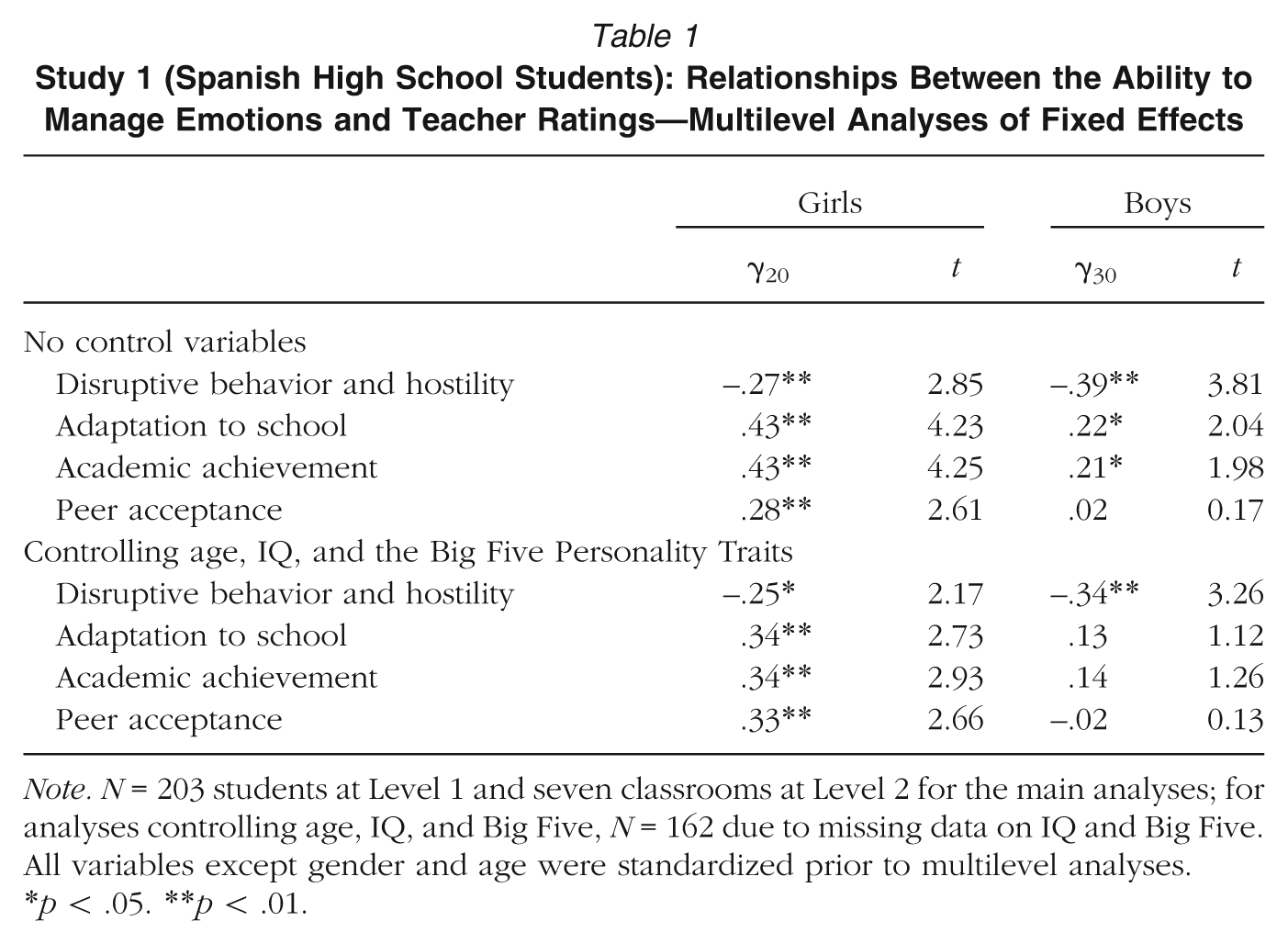
Note. N = 203 students at Level 1 and seven classrooms at Level 2 for the main analyses; for analyses controlling age, IQ, and Big Five, N = 162 due to missing data on IQ and Big Five. All variables except gender and age were standardized prior to multilevel analyses.
p < .05. **p < .01.
AME was also positively related to teacher ratings of adaptation to school and academic achievement (for both genders) and to teacher ratings of peer acceptance (for girls only). These findings generally supported our second hypothesis.
Next we controlled for age, IQ, and the Big Five by adding these variables to the model described previously. In these analyses (also reported in Table 1), relationships between AME and teacher ratings of disruptive behavior remained statistically significant and essentially unchanged for both genders. Relationships between AME and other teacher ratings remained significant for girls but were somewhat reduced and no longer significant for boys. Thus, our third hypothesis was partially supported.
Supplementary Analyses
Some readers may want to know how control variables were related to teacher-rated criteria. We examined these relationships using separate multilevel models including only one predictor and report here only those relationships that were statistically significant (p < .05). IQ was positively related to academic achievement (γ = .48) and peer acceptance (γ = .40). Openness was negatively related to peer acceptance (γ = −.16) and disruptive behavior (γ = −.20) and positively related to adaptation to school (γ = .16); agreeableness was negatively related to disruptive behavior (γ = −.19) and positively related to adaptation to school (γ = .18); emotional stability, extraversion/energy, and conscientiousness were unrelated to criteria. Gender (coded boys = −1, girls = 1) was related to disruptive behavior (γ = −.24), adaptation to school (γ = .21), and academic achievement (γ = .17), indicating that teachers perceived girls to be generally better adjusted than boys. Finally, age was associated with all four criteria, with older students rated higher on disruptive behavior (γ = .43) and lower on adaptation to school (γ = −.43), academic achievement (γ = −.46), and peer acceptance (γ = −.19) than younger students. This could be due to the fact that students who were held back one or more years (because they experienced difficulties in school and failed to meet appropriate standards for promotion) were likely to be older than their peers.
Discussion
The first study indicated that students scoring higher on a situational judgment test of AME received lower teacher ratings of disruptive behavior and hostility and higher ratings of adaptation to school and academic achievement. Among girls, AME was also associated with higher ratings of peer acceptance. The gender differences observed in these relationships could be due to different patterns of emotion regulation, socialization, and learning for boys and girls; or differences in teacher perceptions of both genders; or random sampling fluctuations. One limitation of this study is that teacher ratings may reflect in part the extent to which teachers like students. The next study addressed this concern by relying on official school records of disruptive behavior and academic achievement.
Study 2
In the second study, we examined relationships between the ability to manage emotions and official records of two indicators of adaptation to school (disruptive behavior and academic achievement) in a sample of early teenage Spanish high school students, an age group that exhibits a high incidence of disruptive behavior in Spain (Álvarez et al., 2006). We examined the following hypotheses: (a) AME is negatively related to disruptive behavior in high school, (b) AME is positively related to academic achievement, and (c) these relationships remain significant after controlling for gender, age, IQ, and the Big Five personality traits. Two meta-analyses of emotional intelligence research suggest that ability and self-report measures tap into different aspects of competence (Joseph & Newman, 2010; O’Boyle, Humphrey, Pollack, Hawver, & Story, 2010). Therefore in this study we also controlled for self-perceived intrapersonal emotion regulation ability when examining the incremental validity of AME.
Method
Participants and Procedure
Data were collected from 151 Spanish high school students, enrolled in the second and third years of the Spanish secondary school system, in two schools in the province of Cádiz in southern Spain. These schools were not the same as those participating in Study 1. As in the previous study, nearly all students in these schools were Caucasian, and according to school officials, most came from middle-class families. Data collection was authorized by the school principals and took place during c1ass time. School grades, records of disruptive behavior, and IQ scores were obtained from official school records. Achievement and disruptive behavior varied significantly across homeroom groupings. Although we sought to collect data from eight homerooms, it was not possible to collect trustworthy data from one of these due to students’ noncompliant behavior. Thus, the students who participated in the present study were grouped in seven different c1assrooms.
One participant who reported being 12 years old and another who obtained an extremely low score on the test of AME were excluded from all analyses. The remaining 149 participants were aged 13 to 15 (M = 13.66, SD = .75); 53% were girls; 60 were in the second year and 89 in the third year of high school; 121 students belonged to six homerooms from one school and 28 belonged to one (third-year) homeroom from the other school.
Measures
The ability to manage emotions was measured using the emotion regulation section of the Spanish version of the MSCEIT, scored based on consensus norms, as in the previous study (M = 80.93, SD = 12.30; ICC = .01; split-half reliability corrected by the Spearman-Brown formula = .85).
Disruptive behavior was measured based on official school records, as the sum of disciplinary problems recorded during the course of the academic year under five categories: (a) disturbing the class (e.g., interrupting class or making inappropriate noises or jokes), (b) disturbing other students (e.g., undermining others’ attention to class), (c) disrespecting peers or teachers (e.g., insulting or threatening others), (d) refusing to follow teachers’ instructions or to pay attention in class, and (e) damaging school equipment or furniture. For 60.4% of students there was no official record of disruptive behavior, but 18.1% of students had five or more such records (M = 4.01, SD = 10.54; range = 0 to 75; ICC = .11). Note that this measure corresponds to the total count of disciplinary problems recorded in the official document books and therefore does not rely on retrospective and subjective teacher evaluations. Academic achievement was also measured through official school transcripts, as the average grade for five core subjects: mathematics, Spanish, natural sciences, social sciences, and English. The lowest possible grade was 1 (fail) and the highest 5, the passing grade being 2 (M = 2.13, SD = 1.13; ICC = .23; α = .93; 51% of students passed all core subjects).
Control variables
IQ percentile scores were obtained from official school records, based on a revised version of the IQ test that was used in Study 1 (IGF-5r; Yuste, 2002; M = 53.72, SD = 17.87; ICC = .11). The test was administered by the school district (Forms A and B, totaling 144 items). Yuste (2002) reported a test reliability of .95 for the normative sample. 4 The Big Five personality traits were measured with the BFQ, as in Study 1 (for emotional stability, M = 2.88, SD = .48; α = .78; ICC = .00; for extraversion/energy, M = 3.18, SD = .43; α = .71; ICC = .08; for openness, M = 3.28, SD = .43; α = .72;ICC = .11; for agreeableness, M = 3.35, SD = .45; α = .74; ICC = .24; and for conscientiousness, M = 3.40, SD = .43; α = .75; ICC = .01). Perceived emotional regulation ability was measured with an eight-item version of the mood repair subscale of the Trait Meta Mood Scale (TMMS; Salovey, Mayer, Goldman, Turvey, & Palfai, 1995; Spanish version by Fernández-Berrocal, Extremera, & Ramos, 2004), using a 1 to 5 response scale (1 = strongly disagree, 5 = strongly agree; M = 3.82, SD = .62; α = .71; ICC = .00). Sample item: “When I become upset, I remind myself of all the pleasures in life.” Participants also reported age and gender.
Results
The data were analyzed using multilevel models, as in Study 1. Intraclass correlations indicated that variance between homerooms represented a significant percentage of the total variance in the two outcomes of interest. As expected for count data, the distribution of disruptive behavior was strongly positively skewed and semi-continuous, with a high frequency at zero and a long tail of students with many disciplinary problems. Academic achievement was also positively skewed, with many students receiving the lowest possible mark. These variables could not be adequately modeled as normally distributed (even if transformed). Instead, they were dichotomized and then analyzed using multilevel logistic regression: hierarchical generalized linear models with a Bernouilli sampling distribution and a logarithmic link function (Bryk & Raudenbush, 1992). For disruptive behavior, we created a dichotomous variable to divide students into two groups: those who had no record of disruptive behavior versus those who had one or more records. For academic achievement, we used the pass grade of 2 (on a grading scale from 1 to 5) as the cut-off point to divide the sample into low versus acceptable to high achievement groups.
As in the previous study, individual differences were modeled at Level 1, and no predictors were entered at Level 2 (the classroom level). Level-1 predictors (except gender) were centered around their group mean to disentangle student- and classroom-level effects. Intercepts were modeled as varying randomly across homerooms, but slopes were fixed. All independent variables except age and gender were standardized prior to multilevel analyses to facilitate the interpretation of results. Preliminary analyses revealed no substantial gender difference in relationships between AME and outcomes, and for the sake of parsimony we report results for boys and girls combined (fixed effects based on population-average models), based on the following Level-1 model:

These multilevel analyses indicated that AME was negatively and significantly related to disruptive behavior, supporting the first hypothesis (slope γ = −.64, t = 3.30, p < .01). This was a substantial effect. Holding other factors constant, the probability of disruptive behavior was 24% for a child scoring 1 SD above the mean on AME but 52% for a child scoring 1 SD below the mean on AME—a difference of 28 percentage points.
The relationship between AME and academic achievement was positive, as expected, but did not reach statistical significance (γ = .27, t = 1.57, p = .12). Therefore the second hypothesis was not supported.
The relationship between AME and disruptive behavior remained significant after controlling for age, gender, IQ, and the Big Five personality traits (γ = −.51, t = 2.48, p = .01). In this analysis, an increase of 1 SD in the AME amounted to a decrease of 11% in the probability of disruptive behavior. This supported the third hypothesis. Furthermore, the relationship between AME and disruptive behavior remained significant even when we included self-perceived intrapersonal emotion regulation ability as an additional control variable in the model. 5
Supplementary Analyses
As in Study 1, we examined relationships between control variables and criteria using separate multilevel models including only one predictor. In these analyses, only age (γ = .97) and self-perceived intrapersonal emotion regulation ability (γ = −.36) were significantly related to disruptive behavior (ps < .05). The strong association with age can be explained by the fact that students who were held back one or more years (because they failed to meet standards for promotion) also tended to engage in disruptive behavior.
Discussion
As hypothesized, AME was negatively related to official records of disruptive behavior in school, controlling age, gender, IQ, the Big Five personality traits, and self-perceived emotion regulation ability. These findings are consistent with and extend those of the first study, which were based on teacher perceptions of disruptive behavior and adaptation to school. They suggest that AME contributes to our understanding of an important dimension of adaptation to school over and above existing constructs.
AME was unrelated to official records of academic achievement. It is possible that the relationship between AME and academic achievement is weak because this outcome is influenced by many different factors, such as IQ, motivation, conscientiousness, social adaptation to school, and the influence of parents and peers.
One limitation of the first two studies is that the test of AME was administered to students younger than the age group for which this test was designed (late adolescents and adults). Thus, mean scores on this test were substantially below the mean of 100 for the normative sample. We used this test because it was the only validated situational judgment test of AME available at the time (as far as we were aware). It is possible that verbal comprehension might influence scores on this test. However, one researcher was present during the administration of the test to ensure that students understood test questions. Moreover, this concern is attenuated by the fact that the relationship between AME and disruptive behavior remained significant controlling for IQ scores that also tap verbal comprehension. Nonetheless, we addressed this concern in the following study by recruiting a sample of college students.
Study 3
Does the relationship between the ability to manage emotions and adaptation to school observed in the previous studies generalize to late rather than early adolescents, in a college rather than a high school environment, and in a different country? The third study sought to extend the previous findings in a sample of American college students, so as to address concerns about external validity. As mentioned previously, one concern about a situational judgment test of managing emotions such as the MSCEIT is that test scores may reflect reading comprehension and the tendency to provide socially desirable responses (because these scores are based on consensus or expert norms). Therefore in this study we controlled specifically for verbal ability and socially desirable responding. We focused on teachers’ perceptions of students’ social skills because disruptive behavior is much less of a problem in college than in high school classrooms.
Thus, we examined the following four hypotheses: AME is positively related to (a) teacher ratings of students’ social and emotional competence, (b) teacher ratings of the quality of student-teacher interaction, and (c) official records of academic achievement; and (d) these relationships between AME and criteria remain significant after controlling for age, gender, the Big Five personality traits, verbal ability (as an indicator of cognitive ability), socially desirable responding, and self-perceived emotion regulation ability.
Method
Participants and Procedure
Data for this study were obtained from a broader research project that included other measures (and additional respondents) for different research purposes. Data were collected from undergraduate student volunteers at a university in New England, in two waves of data collection spanning two academic years, using partially overlapping sets of questionnaires. The present study focused on all of the 91 students from the department of education at this university who completed a test of AME and were rated by a teacher on measures of interaction quality and social and emotional skills. 6 Wave 1 participants were first-year students, whereas Wave 2 participants were in their second, third, or fourth year of university. Participants completed a battery of questionnaires on paper during classes (in small batches, over several classes) while nonparticipants did other work. The test of AME was completed online. Each participant was rated by one teacher only. Altogether, there were nine raters. The seven raters in Wave 1 were teachers who had been randomly assigned to freshman orientation groups and met first-year students in small groups once a week during the fall semester. Three teachers rated participants in Wave 2. One of these raters, who interacted with Wave 2 students in a seminar, provided most of the ratings in Wave 2 and also rated one group of students in Wave 1.
Based on the information available, 90% of participants were women and 10% men; 91% were Caucasian, 5% African American or African, and 5% reported other ethnic identities; 42% were freshmen and 58% upperclassmen; and 99% were native English speakers. Ages ranged from 17 to 38 (M = 19.9, SD = 2.7).
Measures
The ability to manage emotions was assessed with the corresponding subscale of the MSCEIT (V. 2.0; Mayer et al., 2002), as in the previous studies (M = 90.54, SD = 8.57; split-half reliability corrected by the Spearman-Brown formula = .71; ICC = .00). Teacher ratings of social and emotional competence included nine items, using a 1 to 9 Likert scale anchored at not at all (much below average) and extremely (far above average); (M = 6.18, SD = 1.50; α = .95; ICC = .14). Sample items: “Does this person have good ‘people skills?’”; “Is this person easy to get along with?”; “Is this person sensitive to the feelings and concerns of others?”; and “Does this person understand other people’s points of view?” 7 The quality of student-teacher interaction was measured using teacher ratings on a single-item scale (“Do you have a good relationship with this person?”), with an identical 1 to 9 response format (M = 6.64, SD = 1.58; ICC = .40). Academic achievement was measured using college grade point average (GPA), obtained from university records (with participants’ prior consent) more than 3 years after the first wave of data collection, when 78% of participants had already graduated (M = 3.21, SD = .64; ICC = .20).
Control variables
We measured the Big Five personality traits with the BFI-44 (John & Srivastava, 1999), a 44-item, self-report measure, using a 1 to 5 response scale anchored at 1 (disagree strongly) and 5 (agree strongly): emotional stability (M = 2.29, SD = 0.73; α = .80; ICC = .00); extraversion (M = 3.24, SD = 0.63; α = .77; ICC = .00); openness (M = 3.34, SD = 0.58; α = .78; ICC = .00); agreeableness (M = 3.57, SD = 0.56; α = .75; ICC = .07); and conscientiousness (M = 3.33, SD = 0.54; α = .73; ICC = .05). Verbal ability was measured with the Mill Hill vocabulary scale for adults, a 66-item, multiple-choice test that requires respondents to identify synonyms (Raven, Court, & Raven, 1994; M = 29.33, SD = 5.89; split-half reliability corrected by the Spearman-Brown formula = .85; ICC = .00). In the instructions for this test, we reminded participants that their answers were confidential and asked them not to consult a dictionary or ask others for assistance so as not to distort the results. We also included a 20-item version of the Marlowe-Crowne Social Desirability Scale, with a true-false response format—for example, “I’m always willing to admit it when I make a mistake” (Strahan & Gerbasi, 1972; M = .46, SD = .19; α = .79; ICC = .00; note that we calculated the mean rather than the sum of 0 to 1 items). Self-perceived intrapersonal emotion regulation ability was measured using the Mood Repair subscale of the Trait Meta Mood Scale (Salovey et al., 1995), as in Study 2. Due to practical constraints, a four-item version of this scale was used here, with a 1 to 7 response format (M = 4.88, SD = .94; α = .61; ICC = .00).
Results
Exploratory analyses identified five outliers on GPA and age. 8 These extreme values were shrunk toward the mean and replaced with values close to those of the nearest participant in the distribution, to minimize the distorting effect of outliers on covariance analyses. Winsorized GPA scores were then further transformed to attenuate skewness (by reflecting scores and computing the inverse). All subsequent analyses were based on these transformed variables.
Relationships between AME and criteria were analyzed using multilevel models where students were nested within raters (and classrooms), as in the previous studies. Variables were centered around their group means to disentangle individual- and group-level effects. Note that group-level effects take into account differences across both classrooms and raters. Individual difference variables were modeled at Level 1, and once again, there were no predictor variables at Level 2. Intercepts were modeled as varying randomly across groups, and slopes were fixed across groups. To facilitate the interpretation of results, all variables except age and gender were standardized prior to multilevel analyses. Preliminary analyses revealed no significant gender differences in relationships between AME and teacher ratings. Although there was a significant interaction between AME and gender in predicting GPA, we report results for men and women combined as the small number of men in this sample precluded reliable inferences regarding gender differences.
Relationships Between AME and Teacher Ratings
AME was positively related to teacher ratings of socio-emotional competence (γ = .16, t = 1.54, p = .13) and the quality of student-teacher interaction (γ = .15, t = 1.64, p = .10). These relationships were only marginally significant and relatively weak, as indicated by the low percentage of variance at Level 1 explained by AME (1.6% for socio-emotional competence and 2.1% for student-teacher interaction). Nonetheless, AME revealed incremental validity over a large set of control variables, suggesting that these effects were robust.
Considering that the sample size for this study provided modest statistical power and that there were some missing data for age, we examined the incremental validity of AME in two stages. In the first set of analyses, where we controlled for gender, the Big Five, and verbal ability, AME was significantly related to teacher ratings of socio-emotional competence (γ = .22, t = 2.06, p < .05) and marginally related to the quality of student-teacher interaction (γ = .20, t = 1.92, p = .06). In the second set of analyses, when we also included age, self-perceived emotion regulation ability, and social desirability as additional control variables, AME remained marginally related to teacher ratings of socio-emotional competence (γ = .21, t = 1.76, p < .10) and to the quality of student-teacher interaction (γ = .20, t = 1.73, p < .10). Note that these last analyses included 10 control variables, and the coefficients of interest were not reduced. These findings broadly support our hypotheses regarding the relationships between AME and teacher ratings of socio-emotional competence and the quality of student-teacher interactions.
Relationships Between AME and GPA
AME was significantly and positively related to GPA (γ = .28, t = 2.89, p < .01), explaining 8.5% of the individual-level variance in this criterion. This relationship remained marginally significant controlling gender, the Big Five, and verbal ability (γ = .16, t = 1.67, p < .10). It was practically unchanged but no longer statistically significant when we included age, self-perceived emotion regulation ability, and socially desirable responding as additional control variables (γ = .14, t = 1.30, p > .10). Further analyses suggested that the zero-order relationship between AME and GPA might be more positive for women than for men (as in Study 1), but this finding should be interpreted with caution because the sample included few men.
Supplementary Analyses
As in previous studies, we examined relationships between control variables and criteria using separate multilevel models including only one predictor. In these analyses, teacher ratings of socio-emotional competence were significantly related to gender only (γ = .33, indicating that women tended to be rated higher than men). The quality of student-teacher interaction was significantly related to age (γ = −.13) and socially desirable responding (γ = .19) only. GPA was significantly related to age (γ = .17), verbal ability (γ = .27), and conscientiousness (γ = .25) only (all ps < .05).
Discussion
The findings of Study 3 are generally consistent with and extend those of our previous studies. Teachers tended to rate university students scoring highly on a situational judgment test of emotion regulation as more socially and emotionally competent than students who scored lower on this test. Teachers also tended to report better interactions with students who scored highly on AME. These effects were weak and did not reach traditional criteria of statistical significance when we examined zero-order relationships, possibly due to limited statistical power and the restricted nature of student-teacher interactions in the university context. Nonetheless, these effects proved statistically significant or marginally significant when we controlled for a range of possible confounds, including gender, the Big Five personality traits, and verbal ability. AME was also positively related to academic achievement, measured through official school records. This effect also remained marginally significant controlling for gender, verbal ability, and personality traits. The limitations of this study include possible self-selection bias, gender imbalance, and the fact that the number of students rated by each teacher was uneven.
General Discussion
To summarize, three studies conducted in Spain and the United States yielded evidence that students scoring higher on a situational judgment test of managing emotions in self and others revealed better socio-emotional adaptation to school than their lower scoring counterparts. In Study 1, the ability to manage emotions was negatively related to teacher ratings of inappropriate behavior and hostility and positively related to teacher ratings of adaptation to school and of peer acceptance (the latter among girls only). In Study 2, the ability to manage emotions was negatively related to official records of inappropriate behavior in high school. In Study 3, the ability to manage emotions was positively (although marginally) related to teacher ratings of the quality of student-teacher interaction and of students’ social and emotional competence in an American college. Most of these relationships remained significant or marginally significant controlling for demographic factors, indicators of cognitive ability, and the Big Five personality traits. Controlling for self-perceived intrapersonal emotion regulation ability and (in Study 3) socially desirable responding did not diminish these relationships substantially. The fact that the findings were broadly consistent across different educational contexts, age groups, and criterion measures, reflecting varying demands on emotion regulation, enhances our confidence in their generalizability.
Taken together, the findings from the three studies highlight the importance of managing emotions in self and others for students’ adaptation to high school and university. The ability to judge emotionally challenging situations and identify effective strategies for managing them was positively related to appropriate behavior in school, the quality of teacher-student interactions, and other indicators of socio-emotional adaptation to school. One of the limitations of most prior research on emotion regulation is its reliance on measures that could not distinguish temperamental reactivity from knowledge and skills that can be taught and learned in school. An important contribution of the present studies was precisely to show that emotion regulation knowledge and skills that are potentially teachable are related to key dimensions of students’ adaptation to school. Although we cannot infer causality, our findings suggest that the ability to judge emotional situations and to identify effective strategies for managing these makes a difference in adaptation to school, pointing to the potential benefits of helping students to learn about emotion regulation.
These results extend previous research linking the ability to manage emotions and social adaptation (e.g., Lopes et al., 2004, 2005, 2011) into the realm of school. In particular, they break new ground by linking the ability to judge emotional situations and identify effective emotion regulation strategies, on the one hand, to inappropriate behavior in school and the quality of student-teacher interactions, on the other. Furthermore, this ability to manage emotions was found to explain variance in important dimensions of adaptation to school over and above other important constructs. Our findings are consistent with prior research suggesting that emotional intelligence is associated with prosocial behavior and other dimensions of adaptation (e.g., Brackett & Mayer, 2003; Mayer, Roberts, et al., 2008).
In the present studies we examined teachers’ perceptions of students’ behavior and socio-emotional competence to understand how students behave and fare in the classroom or at school. Although teachers may have limited information about students’ relationships with their peers, our findings focus on the school environment, and students’ capacity to interact reasonably with teachers and respect school rules is likely to influence their future in the educational system. These findings should be of interest to teachers at all levels because, from a developmental perspective, behaviors demonstrated in high school often have a history rooted in earlier school behaviors (Kremenitzer, Mojsa, & Brackett, 2008).
Academic Achievement
The ability to manage emotions was significantly related to academic achievement in Study 1 (based on teacher ratings in high school) and in Study 3 (based on official university records), but this relationship did not reach statistical significance in Study 2. Moreover, the ability to manage emotions was not consistently related to academic achievement after controlling for other explanatory variables. It is important to note that the situational judgment test used in the present studies was not focused on academic situations. It is possible that a situational judgment test focused on intrapersonal emotion regulation in academic situations, and specifically on situations related to studying and test taking, would be a better predictor of academic achievement. The development of such a test would be an interesting avenue for further research. Note that the situational judgment test of managing emotions used in the present studies does not yield reliable separate scores for intrapersonal and interpersonal regulation, precluding meaningful analyses of the unique effects of these two dimensions.
The lack of significant relationships between managing emotions scores and academic achievement could also be explained by limited statistical power. If emotion regulation influences academic achievement in part through adaptation to school, the indirect effect on academic achievement may be weak and therefore difficult to detect. Academic achievement is influenced by many different factors (e.g., cognitive ability, conscientiousness, motivation, and the influence of parents and peers), and our studies lacked statistical power to detect weak effects. Note also that students with strong interpersonal skills are not always focused on grades. Some other studies based on college students have also failed to detect significant relationships between the scores on situational judgment tests of managing emotions and academic achievement (e.g., Barchard, 2003; R. M. O’Connor & Little, 2003).
Further theoretical development is warranted to link emotion regulation to existing models of self-regulated learning. Boekaerts’ (2007) dual-process model of self-regulation suggests that students may switch between learning and well-being/self-protection goals depending on affective processes. We would argue that emotion regulation plays an important role in sustaining the motivation to pursue learning or mastery goals in the face of frustration or self-doubt and helps to explain why people sustain or give up learning goals.
Theoretical and Measurement Issues
We measured the ability to manage emotions using a situational judgment test that asks respondents to rate the effectiveness of different strategies for managing emotions in self and others, in various situations described in brief vignettes. This test taps into the ability to judge emotionally challenging situations as well as knowledge of effective emotion regulation strategies. It focuses on a strategic dimension of emotion regulation that may be particularly important for antecedent-focused strategies of emotion regulation involving situation modification and cognitive reappraisal (Gross, 1998). Note that this test does not measure automatic processes of emotion regulation or the actual capacity to regulate emotions in everyday life. Thus, we have used the expression managing emotions for ease of presentation, with the understanding that existing tests do not measure all the skills that contribute to effective emotion regulation and without claiming that managing emotions represents a cohesive domain of ability.
There is ongoing debate about the cohesiveness of emotional skills constructs and about the psychometric properties of performance measures of emotional skills such as the MSCEIT (see Mayer et al., 2011). In the present studies we focused on managing emotions as one dimension of emotional ability, recognizing that it may overlap to some extent with other skills, including interpersonal skills. Although factor analyses of the MSCEIT have supported the idea that managing emotions can be viewed as a single dimension (Mayer et al., 2003), further research will be needed to examine the factor structure of emotion regulation skills, encompassing other measures and disentangling method variance. It is important to keep in mind the measurement challenges involved in assessing emotion regulation skills. In particular, the situational judgment test used in the present studies measures the ability to evaluate emotional situations for which there is no absolutely right or wrong answer—as often happens when situations are complex or challenging—and this contributes to measurement error.
Another concern about the use of situational judgment tests scored according to consensus norms is that they might measure conformity bias or social desirability more than actual knowledge or skill. This concern is attenuated by the fact that the relationship between managing emotions scores and teacher ratings remained significant or marginally significant controlling for social desirability bias in Study 3. Moreover, other studies have found that scores on the same test of managing emotions were unrelated to social desirability (Lopes, Salovey, & Straus, 2003). Scores based on consensus and expert norms correlate strongly (Mayer et al., 2003) and reveal similar patterns of relationships with other variables (e.g., Brackett & Mayer, 2003; Mayer, Salovey, et al., 2008).
Further Research and Practical Implications
Interesting avenues for future research include examining emotion regulation skills in school settings through longitudinal or experimental studies, using larger samples and more reliable measures to examine underlying mechanisms, distinguishing intrapersonal and interpersonal emotion regulation skills, and attending to the specific emotions that students experience in school. The research design that we used cannot determine causality. It is possible that adaptation to school also facilitates emotion regulation and the development of emotion regulation skills. Nonetheless, the notion that emotion regulation contributes to school adaptation is supported by various lines of research. In particular, some school-based interventions focused on emotional and interpersonal skills have been shown to yield positive effects on school behavior (e.g., Conduct Problems Prevention Research Group, 1999; Hawkins, Catalano, Kosterman, Abbott, & Hill, 1999; see also the meta-analysis by Durlak, Weissberg, Dymnicki, Taylor, & Schellinger, 2011). Moreover, there is evidence that individual differences in emotion regulation in children predict later adjustment in various realms of life. In light of this evidence, our results suggest the possibility that educating students to identify effective strategies for managing emotionally challenging situations may contribute to their social adaptation to school. This approach can be incorporated into existing programs of social and emotional learning. Although the effects found in the present studies varied in magnitude, even small effects should not be dismissed when the outcomes are important and are influenced by many different factors, as is the case of adaptation to school (Meyer et al., 2001).
We have argued that appropriate student behavior in school and the quality of student-teacher interaction are important for both students’ and teachers’ achievement and well-being. Student misconduct is a common source of strain for teachers, and stress at work appears to be a greater problem in teaching than in other professions (Guglielmi & Tatrow, 1998; Vandenberghe & Huberman, 1999). This suggests that interventions aimed at enhancing the social and emotional climate in schools could target both students’ and teachers’ ability to manage emotions in self and others. Teachers who model emotional skills should find it easier to foster socially competent behavior in students, cultivate a stronger sense of community in the classroom, and enhance students’ academic performance (Wentzel, 2002). Thus, emotionally engaged teachers who receive training in emotional intelligence may be in a better position to help students develop self-regulation (Brackett & Kremenitzer, 2011). Although teachers who are trained in emotional regulation techniques may be able to thwart some of the negative impact of poorly behaving students, such interventions are only beginning to be introduced into the preparation of pre-service teacher candidates or in-service teaching professional development, and deserve further attention (e.g., Kremenitzer, 2005).
Footnotes
Notes
P
J
R
J
P