




Abstract
Using data from the Education Longitudinal Study of 2002, this study examines the association between high school socioeconomic segregation and student attainment outcomes and the mechanisms that mediate those relationships. The results show that socioeconomic segregation has a strong association with high school graduation and college enrollment. Controlling for an array of student and school factors, students who attend high socioeconomic composition (SEC) schools are 68% more likely to enroll at a 4-year college than students who attend low SEC schools. Two mediating mechanisms were examined, including socioeconomic-based peer influences and school effects. The results indicate the association between SEC and attainment is due more to peer influences, which tend to be negative in the low SEC setting. However, school practices that emphasize academics also play a major role, particularly in mediating the relationship between SEC and 4-year college enrollment. These findings suggest that integrating schools is likely necessary to fully addressing the negative consequences of attending a low SEC school.
Keywords
Segregation has long been a threat to educational equality in American schools. Even after the Supreme Court abolished separate schools for Black children due to their negative emotional and educational consequences (Brown v. Board of Education, 1954), de facto segregation by race and socioeconomic status (SES) continued to be widespread. This was due in large part to neighborhood segregation, district boundaries, and school attendance zones within districts that created structural barriers to integration. In 1964, partially in response to this de facto segregation, Congress commissioned James Coleman to lead a vast research study on equality of educational opportunity in American schools. One issue the study examined was the effect of the social composition of a school’s student body on educational outcomes. In addition to the effects of racial composition, Coleman et al. (1966) investigated the effects of socioeconomic composition (SEC), which measures the average SES of students attending a school. The study concluded that SEC had the strongest association with student achievement of any school factor, suggesting the SES of one’s classmates matters more than school facilities, curriculum, per pupil expenditures, teacher quality, and racial composition and that segregating low SES children in schools creates an inherently inequitable learning context. This controversial result propelled SEC to the center of the educational policy debate at the height of the civil rights movement. Together with the Brown ruling, the Coleman report facilitated a conceptual shift in what constitutes equality of educational opportunity in schools from a prevailing view that opportunity is based predominantly on school inputs, such as the quality and quantity of facilities and resources, to a new position that it has more to do with school outputs such as achievement, attainment, and social experiences (Coleman, 1966; Kahlenberg, 2001b). The current study examines the associations between SEC and attainment measured at two critical transitions—high school graduation and college enrollment—and investigates school mechanisms that mediate those associations.
Court rulings subsequent to Brown led to judicial orders to address de facto segregation of Black children in some large cities. Due to the structural barriers mentioned previously, transportation was a critical component of the integration plans. Desegregative busing, the primary intervention, had some success in integrating those schools (Armor, 1995; Frankenberg, Lee, & Orfield, 2003; Kahlenberg, 2001b; Rossell, 1990). Due to the racial focus of the court orders, busing programs were designed to achieve racial integration. Yet, because race and poverty were strongly correlated at that time, significantly more so than presently (Mantil, Perkins, & Aberger, 2012), busing programs also facilitated socioeconomic integration. However, desegregative busing quickly became broadly unpopular. By the late 1970s political opposition, legal challenges, and social unrest resulted in busing programs being discontinued or optionalized. Consequently, schools where busing had been implemented resegregated (Orfield, 2005). Other demographic factors also contributed to the school resegregation that has occurred over the past three decades. These factors include a middle class and White migration out of inner cities and substantial Hispanic immigration to certain regions. 1 In addition, some recent studies suggest the easing of court desegregation supervision (i.e., being granted “unitary status”) has contributed to resegregation (Reardon, Grewal, Kalogrides, & Greenberg, 2012). It is also worth noting that resegregation has been more pronounced along socioeconomic lines than racial lines. Even as neighborhoods have integrated racially, neighborhoods and schools have become increasingly segregated by SES (Altonji & Mansfield, 2011). Exacerbating the matter, the earnings gap between low- and high-income families increased approximately threefold during the half century after Brown (Duncan & Murnane, 2011, Figure 1.1), suggesting that the socioeconomic difference between high and low SEC schools may also have widened. This socioeconomic resegregation is troubling because over the past 40 years a body of research has accumulated substantiating Coleman’s findings (Borman & Dowling, 2010; Bryk & Driscoll, 1988; Chubb & Moe, 1990; Gamoran, 1992; Jencks & Mayer, 1990; Kahlenberg, 2001a; Konstantopoulos & Borman, 2011; McNeal, 1997; Mickelson & Bottia, 2010; Mosteller & Moynihan, 1972; Murnane, 1981; Palardy, 2008; Perry & McConney, 2010; Rumberger & Palardy, 2005a; Willms, 1986). 2 Hence, inequality of educational opportunity based on SEC remains a serious concern. Indeed, it has likely become more pronounced and pervasive over the past two decades as schools have resegregated and the earnings difference between low and high SES families has widened.
One shortcoming in the literature is that surprisingly few studies have examined the association between SEC and attainment, especially college enrollment. In fact, until recently, very few studies examined how high schools in general impact postsecondary outcomes. This is a significant gap in the research literature for a number of reasons. First, as Wells and Crain (1994) have argued, longer term consequences of segregation merit the greatest attention. Second, research has demonstrated that school effects can differ for attainment outcomes as compared with achievement outcomes (Rumberger & Palardy, 2005b). Thus, the mechanisms through which SEC impacts achievement and attainment may differ. For example, a schoolwide focus on academics may reduce the negative consequences of attending a low SEC school on learning while increasing the likelihood of dropping out. Third, over the past few years federal educational policy mandates have shifted from an overwhelming focus on raising student achievement (e.g., No Child Left Behind) to addressing multiple outcomes including attainment (e.g., Race to the Top). For example, the Obama administration has committed billions of dollars of federal funds to implement large-scale educational reforms designed to reorganize high schools to increase graduation and college enrollment rates, among other objectives, with a stated goal that “America will once again have the highest proportion of college graduates in the world” (Race to the Top Fund, 2009). Yet, little is known about how socioeconomic segregation impacts college-going behaviors. Finally, fourth, attainment is arguably the most critical lifelong educational outcome as it is associated with many desirable life conditions such as health, participation in society, and economic prosperity (College Board, 2004). For example, research has shown that a college degree substantially increases earnings power and provides access to a range of occupations (Kolesnikova, 2009; Long & Kurlaender, 2009; Monk-Turner, 1990). For these reasons, a greater understanding of how high school SEC affects attainment is needed.
Another gap in the literature on SEC is much of the research is based on data that are more than 20 years old. Not only has income inequality widened and resegregation occurred over that period, but other changes in society may have altered the associations between SEC and educational outcomes. These changes include new technology (e.g., the Internet, mobile devices, and the prevalence of personal computers) that modify teaching, learning, and communication processes and for which availability is partially circumscribed by SES; a decline in the funding of social services for the poor, including financial aid for college; an increase in achievement gaps between low and high SES children (Reardon, 2011), which may heighten the negative consequences of attending a low SEC school; and labor markets that increasingly require postsecondary education for entry. Hence, research on the effects of socioeconomic segregation that utilizes more recent data is needed.
Objectives of the Study and Research Questions
The present study utilizes recently released data from the Education Longitudinal Study of 2002 to address these gaps in the literature by examining the associations between high school SEC and the sequential attainment outcomes of high school graduation and college enrollment. A key objective was to provide new evidence on the mechanisms through which SEC impacts attainment, for which there are competing socio-education theories. To that end, this study is designed to establish the degree to which the data support the two most prominent theories: (a) SEC influences attainment through socioeconomic-based peer influences and (b) SEC influences attainment through school effects that are associated with schools’ student body composition. Beyond the theoretical ramifications, understanding the roles of peer influences and school effects is important for developing effective policies and practices for addressing the negative consequences of socioeconomic segregation.
The following research questions will be addressed:
Research Question 1: To what degree do student attainment, academic and family background, and school factors vary in low, medium, and high SEC schools? The answer to this question will provide a tangible description of contextual differences in schools across SEC settings. Research Question 2: What is the total effect of SEC on each attainment outcome and to what degree do student factors, peer influences, and school effects mediate the SEC-attainment associations?3,4 This question addresses the mechanisms through which SEC affects attainment by identifying key mediating factors and is designed to provide insight into the degree to which SEC is due to peer influences versus school effects. Research Question 3: Is the effect of SEC consistent for students from different SES and ethnic backgrounds? This question pertains to whether socioeconomic segregation in schools has differential consequences on students depending on their background characteristics.
Review of the Literature and Theory
School-based segregation has long been a prominent issue in research on educational equity. Empirical investigations into the effects of school-based segregation have generally focused on compositional effects, which are the association between aggregate or average measures of student demographic characteristics and educational outcomes (Coleman et al., 1966; Jencks & Mayer, 1990; Mosteller & Moynihan, 1972; Rumberger, 2011; Rumberger & Palardy, 2005a). Compositional effects impact educational outcomes above and beyond the student’s own family and academic background. While a number of compositional effects have been examined (Bryk & Thum, 1989; McNeal, 1997; Rumberger & Palardy, 2005a), SEC is commonly considered to have the most robust associations with student outcomes. For example, research suggests SEC trumps racial composition as a predictor of educational outcomes (Coleman et al., 1966; Jencks & Mayer, 1990; Rumberger & Palardy, 2005a). 5 Moreover, compositional effects tend to be correlated. Although data suggest the correlations between SEC and other compositional measures has weakened in recent decades, statistically controlling for the others types of compositional measures may be necessary to minimize bias in estimates of the SEC effects. 6
Although a large number of studies have examined the effect of SEC on student achievement, relatively few have examined its effect on high school graduation (Bryk & Driscoll, 1988; Jencks & Mayer, 1990; McNeal, 1997; Murnane, 1981; Rumberger & Palardy, 2005b). Even fewer studies have investigated the effect of SEC on college enrollment (Coleman & Hoffer, 1987; Engberg & Wolniak, 2010; Hill, 2008; McDonough, 1997; Perna & Titus, 2005). Furthermore, while recent research has documented a positive association between SEC and college enrollment (Engberg & Wolniak, 2010; Hill, 2008; Perna & Titus, 2005), hardly any studies focused on that topic; rather, the SEC effect is a minor component of the research and the results often provide little insight into the mechanisms through which SEC influences attainment.
The remainder of this review examines the literature associated with the two explanatory theories described previously: (a) SEC influences outcomes through socioeconomic-based peer influences and (b) SEC influences outcomes indirectly through a number of associated school effects.
Socioeconomic-Based Peer Influences
Peer influences have been linked to a range of school outcomes, behaviors, and attitudes, including achievement, attainment, educational aspirations, misbehavior, drug use, and delinquency (Hallinan & Williams, 1990; Jang, 2002; Mounts & Steinberg, 1995; Rumberger, 1983). Research (described in the following) has also shown that students’ academic achievement, attainment, attitudes, and behaviors tend to be circumscribed by their family’s socioeconomic status. Additionally, peer influences tend to peak at ages 15 to 18 (Jang, 2002; Patacchini, Rainone, & Zenou, 2011). Given these research findings, it is not surprising that one explanation for the association between SEC and educational outcomes is peer influences. That is, SEC serves as a proxy measure for socioeconomic-related peer influences that directly impact student outcomes. This perspective asserts that school peers transmit social norms, educational values, and even academic skills through interactions at school, which in turn influence other students’ attitudes and behaviors and ultimately their cognitive development, attainment, and other educational outcomes (Coleman et al., 1966; Dreeben & Bar, 1988; Engberg & Wolniak, 2010; Hanushek, Kain, Markman, & Rivkin, 2003; Jencks & Mayer, 1990; Kahlenberg, 2001a; Orfield, 1996). These peer influences tend to depress educational performance, attitudes, and values in low SEC schools where students typically have lower levels of the educational and cultural attributes that enhance those outcomes. Conversely, peers at high SEC schools tend to have an abundance of the positive characteristics and hence peers tend to serve as educational catalysts.
It is worth noting that the study of peer influences has been plagued with measurement inadequacies. The most common approach to measuring peer influences in schools is to use variables measuring aspects of the student composition of the school such as SEC, percentage minority, or mean achievement (Willms, 2010). This approach is problematic because compositional measures may not accurately represent the influences of the set of peers students interact with at school (Willms, 2010), particularly given the degree of academic tracking in American public high schools and evidence that this tracking tends to sort students by social class (Epstein, 1985; Lucas, 1999; Moody, 2001; Oakes, 2005). This imprecision in the measurement of peer influences introduces measurement error that bias statistical estimates of their effects.
Although the most common approach of measuring peer influences in educational research is to use school measures of student composition, a number of studies have developed more proximal or more direct measures that reduce concerns about measurement error. For example, some researchers have used compositional measures of the classroom (Hoxby, 2000) or the academic track (Hallinan & Williams, 1990), which should more closely represent the characteristics of school peers students interact with. Other studies have examined the effects of the academic characteristics of freshman dorm mates (Sacerdote, 2001; Zimmerman, 2003). Because dorm mates were randomly assigned, the statistically significant results support causal inferences about their peer influences. However, random assignment of students to peers is highly rare and generally infeasible on a large scale in K–12 settings, and therefore this approach is of limited applicability in educational research.
Under the notion that friends are the most influential peers, some recent studies measure peer influences using self-reported survey data of the attitudes, values, and behaviors of friends. These measures may be aggregated to create school means and to model compositional effects. For example, some recent studies have constructed composite measures of peer support for academics from survey items such as the importance friends place on studying hard, earning good grades, and attending college (Bryk, Sebring, Allensworth, Luppescu, & Easton, 2010; Engberg, & Wolniak, 2010; Massey, Charles, Lundy, & Fischer, 2003). Other studies have used individual measures of the attitudes and behaviors of friends such as the educational aspirations of friends (Perna & Tinto, 2005) or whether a friend dropped out of school (Rumberger, 1983; Rumberger & Palardy, 2005b).
A Proxy for Socioeconomic-Based School Practices
A second prominent theory is that SEC influences educational outcomes indirectly through a variety of school effects that are associated with both SEC and educational outcomes. That is, SEC serves as a proxy measure for a number of intercorrelated school factors that are associated with achievement or attainment. For example, low SEC schools tend to have lower levels of per pupil funding, be less able to attract and retain quality teachers, and be less able to staff college prep courses (Betts, Rueben, & Danenberg, 2000). Thus, those factors may mediate the effect of SEC on achievement or attainment.
School effects can be classified into four types including compositional effects, resources, structures, and practices (Gamoran, 1996; Morgan & Sorensen, 1999; Rumberger & Palardy, 2005a). The first three are considered school inputs because they are typically “given” to public schools, whereas school site personnel typically have far greater control over the practices they utilize. Yet, while classifying school effects as either under the control or not under the control of school personnel is helpful for assessing policy implications and accountability, many factors do not strictly conform to this dichotomy (Willms, 2010). That is, factors may be partially under the control of teachers and administrators, but also influenced by student inputs and district, state, and federal policies. An example of this is disciplinary practices. Whereas school personnel typically have flexibility in determining their disciplinary practices, they must also respond to student inputs and are restricted by various external policies (Coleman, 1966; Thrupp, 1999).
School Resources and Structures
The effect of school resources on educational outcomes has been intensely debated. Some economists have argued that resources play only a minor role in the education production function (Hanushek, 1997; Hanushek & Lindseth, 2009). Other educational researchers have countered that resources are critical for student success and their effects tend to be underestimated in the literature because of how resource levels are typically measured (Greenwald, Hedges, & Laine, 1996; Hedges, Laine, & Greenwald, 1994). Moreover, it is difficult to dispute the notion that low SEC schools tend to have lower levels of physical, human, and monetary resources such as quality facilities, qualified teachers, and funding (Betts et al., 2000). Similarly, structural features of schools that tend to challenge educational objectives, such as an inner-city or rural location and very small or very large student enrollments, are more prevalent among low SEC schools (Bryk et al., 2010; Lee & Smith, 1997).
School Practices
Several school practices have been linked with both SEC and attainment outcomes. Low SEC high schools tend to have less rigorous and less academically oriented curricula resulting in part from efforts by school personnel to match instructional rigor with students’ aspirations (Coleman, 1966; McDonough, 1997; Thrump, 1999). This is noteworthy because the rigor of the high school curriculum, particularly in terms of math courses, is a potent predictor of college enrollment (Adelman, 1999; McDonough, 2004; Perna, 2004). Similarly, low SEC schools typically have stricter disciplinary practices, which may be a response to higher levels of disorder, disruptions, misbehavior, and safety concerns. However, strict disciplinary policies regarding misbehavior, attendance, or grades can facilitate voluntary and involuntary dropout (Bowditch, 1993; Fine, 1991; Riehl, 1999; Romo & Falbo, 1996). Furthermore, the focus on discipline may come at the expense of academics, leaving students that attend low SEC schools at a competitive disadvantage for admissions to selective colleges and underprepared for the rigors of college studies if they are admitted.
Lee and Smith (1999) found that academic press, which measures the school’s emphasis on academics, was a significant predictor of academic achievement and academic engagement and had an especially powerful effect in low SEC schools when coupled with appropriate social support. Attending a high school with a strong academic press may be especially important for admission to 4-year colleges, which tend to require specific academic coursework and minimum achievement test scores for admissions.
Another critical school factor related to SEC is the quality and effectiveness of the teachers and the level of administrative support they receive. The literature on teacher effects suggests that teacher satisfaction, morale, and retention are related to SEC. For example, low SEC and high minority schools tend to have higher teacher turnover rates (Boyd, Lankford, Loeb, & Wyckoff, 2005; Carroll, Reichardt, Guarino, & Mejia, 2000). Moreover, school contexts that are positively associated with SEC, such as disciplinary climate, prevalence of disorder and misbehavior, and level of school safety, seem to be the underlying culprits driving teacher that turnover (Haberman & Rickards, 1990).
Consistency of the SEC Effect
Some research suggests that the effects of SEC on educational outcomes is not consistent, but rather depend in part on the demographic background of students. For example, compared with students from low SES families, students from high SES families tend to garner additional benefits on learning outcomes from attending a high SEC school (Palardy, 2008). Similarly, nonimmigrant children receive comparatively greater benefits than immigrant children from attending a high SEC school in terms of increases in attainment expectations (Wells, 2010). That students from relatively advantaged backgrounds tend to derive greater benefits from attending high SEC schools suggests high SEC schools perpetuate social reproduction (Bourdieu, 1977). This may be facilitated by structures such as academic tracking that is related to social class or immigration status (Lucas, 1999; Oakes, 2005) and through more subtle social mechanisms related to cultural capital (Engberg & Wolniak, 2010; McDonough, 1997; Perna & Titus, 2005).
Family and Academic Background
While the current study focuses on school effects, many measures of the academic, family, and behavioral background of students are associated with both SEC and attainment. Therefore, when estimating SEC-attainment associations, omitting relevant student background characteristics may bias estimates (Ballou, Sanders, & Wright, 2004; Willms & Raudenbush, 1989). For that reason, extensive statistical controls of student background characteristics related to SEC and attainment are employed in this study and a brief overview of the research literature on the effects of student background characteristics is provided here.
SES is perhaps the most robust predictor of educational outcomes such as achievement and attainment (Coleman et al., 1966; Farkas, 2011; Reardon, 2011; Rumberger & Palardy, 2005b) and is particularly important in the present study because SEC is the school aggregate of SES. However, even after controlling for SES, ethnic differences in both achievement and attainment remain substantial (Perna & Titus, 2005; Rumberger & Palardy, 2005b). Several studies have found that student engagement, both social and academic, are correlated with SEC and account for part of the differences in the drop-out rates at low versus high SEC schools (Bryk & Driscoll, 1988; Jencks & Mayer, 1990; Lee & Smith, 1995, 1999; Rumberger & Palardy, 2005b). In addition, measures of social engagement at school, such as participation in extracurricular activities, are predictive of academic engagement, especially for low SES students (Fredricks & Eccles, 2006; Wehlage, Rutter, Smith, Lesko, & Fernandez, 1989). These research findings suggest it is important to control for SES, ethnicity, and social and academic engagement when modeling the effects of SEC.
A number of student characteristics are predictive of college enrollment, some of which are also associated with SEC and therefore mediate the effects of SEC on attainment. Two factors that stand out are access to financial aid and social capital. The literature on higher education indicates that financial aid plays a critical role in college enrollment decisions for students from low SES families (Bowen, Chingos, & McPherson, 2009; Paulsen & St. John, 2002). Unfortunately, knowledge of the financial aid process is often inadequate at low SEC schools, which tends to form a barrier to college matriculation. Social capital in the form of parental, peer, and college linking networks may facilitate college enrollment (Engberg & Wolniak, 2010). However, the availability of such social capital tends to be substantially greater among students from high SES families who are more concentrated in high SEC schools (Ream & Palardy, 2008).
Conceptual Framework
This study is guided by a conceptual framework that views the likelihood of graduating from high school and enrolling in college as a function of two interrelated general factors including the student’s background and aspects of the high school he or she attends. Figure 1 outlines this framework with an emphasis on the mechanisms through which SEC affects educational attainment. The arrows indicate the direction of influence. Within the two general factors are subfactors and examples of specific measures. SEC is a compositional variable. It is considered a school input in that it is an aspect of the school that is “given” to school personnel. In the figure (and subsequent results tables), it is separated from other compositional measures because it is the central focus of this study. SEC may impact high school graduation and college enrollment directly. It may also impact attainment indirectly through its associations with other school inputs, peer influences, and school practices and contexts. That is, each of the other classes of variables may mediate the SEC-attainment associations. The current study is designed to test this conceptual framework and the related socio-educational theories.
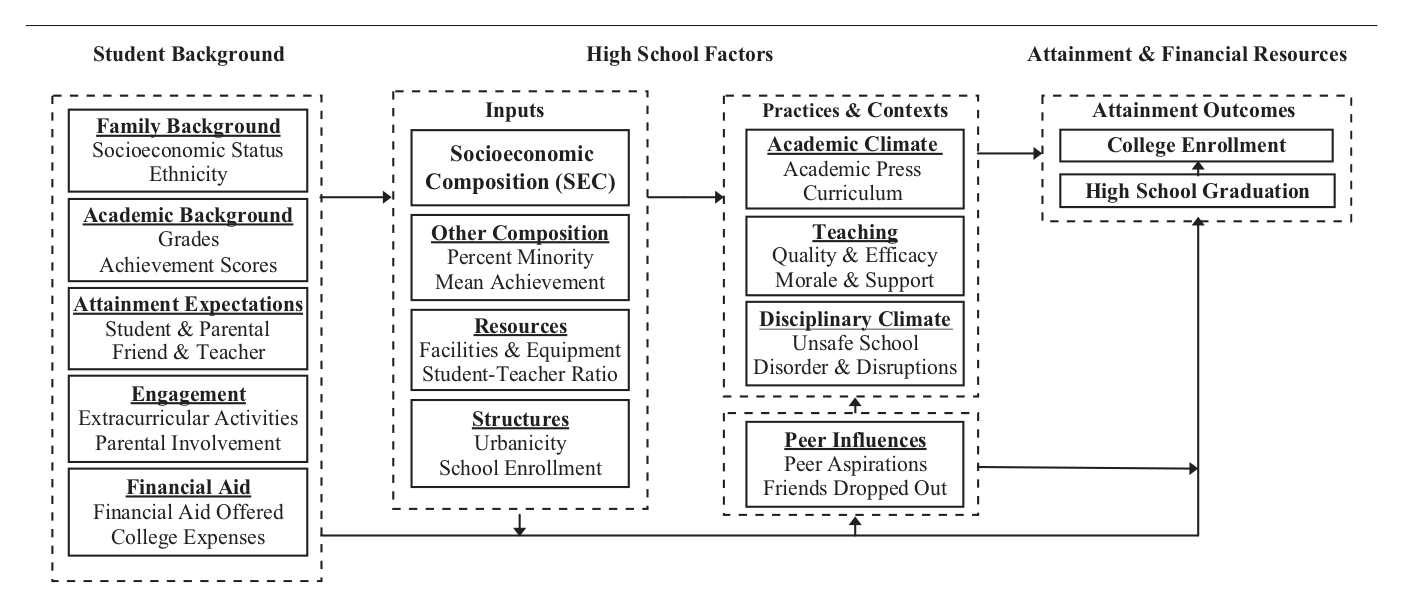
Conceptual framework for mechanisms through which socioeconomic composition impacts educational attainment.
Methods
Data Source
Data from the Education Longitudinal Study (ELS), a survey of 2002 high school sophomores conducted by the National Center for Education Statistics (NCES), was used in the present study. 7 The ELS is an excellent data source for addressing the research questions of this study for at least five reasons. First, students were surveyed in the spring of their 10th-grade year (2002), the spring of their 12th-grade year (2004), and 2 years after their expected graduation (2006), and high school transcripts were collected a year after their expected graduation date (2005). This longitudinal sampling design provides accurate data on high school graduation and subsequent college enrollment. Second, NCES used a two-stage sampling design of schools and then students within schools, resulting in appropriately nested data for modeling high school effects using multilevel models. Third, the survey includes an extensive number of student and school variables relevant to the current study. Fourth, the large and nationally representative sample of schools provides sufficient statistical power for studying school effects and making inferences generalizable to American high schools. Finally, the data set is relatively new—the second follow-up was released in October of 2007—which makes the results more relevant for addressing current policies and practices. This is important because the current literature on socioeconomic composition is based primarily on data that are over 20 years old, a period during which there was considerable social and educational change.
The present study uses two subsamples of ELS data. The first subsample, for modeling high school graduation, includes all students who attended a public high school and were members of the base year (2002)–first follow-up (2004) panel for which NCES developed a sample weight that yields an approximately representative sample of 2002 American 10th graders. 8 The second subsample, for modeling college enrollment, includes only former public high school students who were college-eligible in summer of 2004, omitting those who did not receive their diplomas by their expected graduation date of June 2004. 9 While the ELS includes public and private schools, this study uses only public schools because their funding, policies, and practices are largely public domain. Moreover, private school attendance is more prone to selection biases that can confound the modeling of school effects.
Outcome Variables
High school graduation and college enrollment are the outcome variables and are modeled separately. Graduation is a binary measure with nongraduates being the reference category. Nongraduates are students who did not earn their diploma by the summer of 2004, which was their expected graduation date. College enrollment is a three-category multinomial variable. High school graduates who do not enroll in college by fall 2004, which is directly after their expected high school graduation date, are the reference category. The other two categories are fall 2004 enrollment at a 2-year college and fall 2004 enrollment at a 4-year college.
Independent Variables
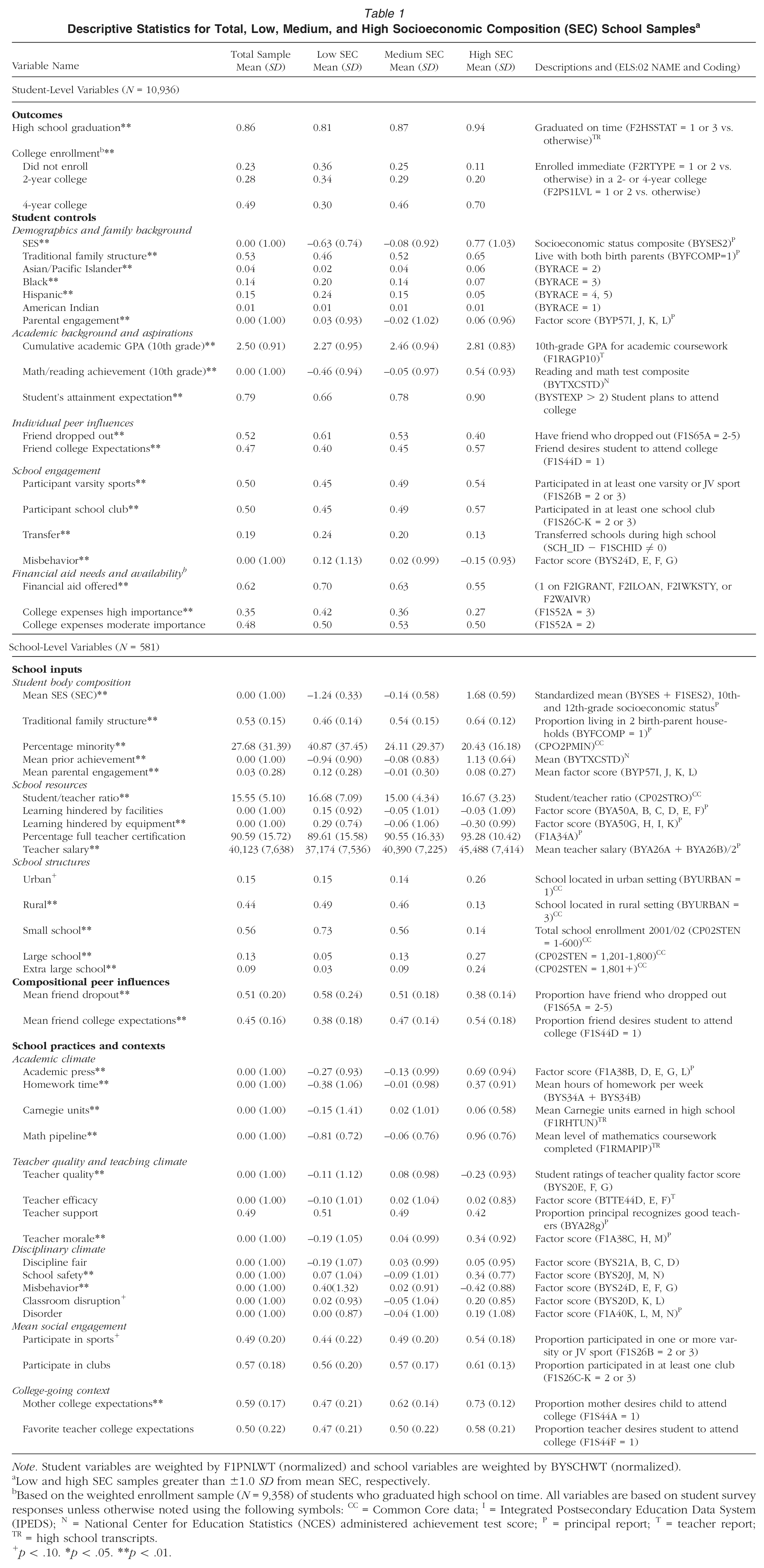
Variable selection was guided by the conceptual framework outlined in Figure 1 and by previous research that identified student and school factors associated with SEC and attainment (Choy, 2002; Lee & Burkam, 2003; Light & Strayer, 2000; Rumberger, 2011; Rumberger & Palardy, 2005a). Table 1 provides a list of those variables grouped by low, medium, and high SEC schools and organized into four broad classes including student controls, school inputs, peer influences, and school practices and contexts. Those classes are comprised of 13 subclasses. Note that several of the variables are factor scores. The measurement details of the factor scores are provided in the appendix table in the online journal.
Descriptive Statistics for Total, Low, Medium, and High Socioeconomic Composition (SEC) School Samples a
Note. Student variables are weighted by F1PNLWT (normalized) and school variables are weighted by BYSCHWT (normalized).
Low and high SEC samples greater than ±1.0 SD from mean SEC, respectively.
Based on the weighted enrollment sample (N = 9,358) of students who graduated high school on time. All variables are based on student survey responses unless otherwise noted using the following symbols: CC = Common Core data; I = Integrated Postsecondary Education Data System (IPEDS); N = National Center for Education Statistics (NCES) administered achievement test score; P = principal report; T = teacher report; TR = high school transcripts.
p < .10. *p < .05. **p < .01.
The SES variables available from the ELS were constructed by NCES as equally weighted composites of five measures including mother’s and father’s education levels and occupational statuses and family income. 10 SES was measured in 2002 when students were 10th graders and again in 2004. The 2002 variable is used in this study to control for family background. SEC is the school mean of SES, which is the typical method of measuring SEC. The average of the 2002 and 2004 SEC measures was used under the rationale that the average provides a better estimate of SEC of the school during the period students sampled were in attendance. Note that the correlation between the 2002 and 2004 SEC variables is .94, suggesting SEC was fairly stable at most schools during that period.
Student control variables include subclasses measuring demographics, academics, attainment expectations, engagement, and financial aid. The financial aid subclass includes measures of financial needs for college, and the availability of financial aid was included only in the college enrollment model because it is not conceptually related with high school graduation. School inputs are considered to be aspects of schools that are largely beyond the control of school site personnel and include subclasses measuring compositional effects, school structures, and school resources. Student controls and school inputs are used to control for selection biases and to estimate the degree to which they mediate the SEC-attainment associations.
Peer influences include variables measuring student reports of whether a friend dropped out or whether the student’s closest friend at school desired the student to attend college. These measures of peer influences are more proximal than the vast majority used in educational research in that they are based on students’ own reports of their close school friends’ attitudes and behaviors rather than the typical average attitudes or characteristics of school mates (Willms, 2010). These variables are also outcome specific in that they are directly related to the attainment outcomes used in the present study. Together, these characteristics result in more precise measures of peer influences than typically used in educational research, which should provide more accurate estimates of their effects.
Peer influence is conceptualized as a multifaceted construct. To the degree that students are directly influenced by their friends’ attitudes and behaviors, peer influence can be considered an individual effect best modeled using a student level measure. However, there may also be a compositional peer influence whereby the average attitudes and behaviors of the student body influence students over and above their friends, which is best measured using a student peer influence variable aggregated to the school level to create a school mean. An innovation of this study is the disentangling of the individual and compositional components of peer influences. To that end, the peer influence variables, friend dropped out and friend desires student to attend college, are measured at both the student level (i.e., individual peer influences) and aggregated to a school mean (compositional peer influences). The individual effects are expected to be more potent because friends are a more proximal influence.
School inputs and school practices
School practices are subdivided into five categories including academic climate, teacher quality and teaching climate, disciplinary climate, social engagement, and college-going context. Academic climate includes three measures: academic press, which is a factor score of principal-reported items on the degree to which the curriculum and instruction focus on academics; Carnegie units, which measure the mean number of credit hours accumulated by students; and math pipeline, which measures how far the average student advances in the mathematics curriculum. Math pipeline is a proxy measure of curricular rigor, particularly in terms of math coursework, while Carnegie units is a proxy for a school context that promotes academic course-taking and school practices that provide opportunity for credit recovery (e.g., summer school). Teacher quality and teaching climate include factor scores measuring average student ratings of teacher quality and teacher ratings of teacher efficacy, administrative support, and teacher morale. Disciplinary climate includes factor scores measuring average student reports of the levels of misbehavior, classroom disruptions, school safety, and fairness of the discipline policy and a factor score measuring principal reports of the level of disorder at the school. Social engagement includes measures of the proportion of students who report that they participated in sports and clubs. College-going context includes measures of the proportion of students who report that their mother and favorite teacher desired that the student attends college.
Missing Values
Multiple imputations (MI) of missing values were conducted (Rubin, 1987) based on a newer technique designed for nested data (Browne, 2009). This new method differentiates between response variability due to individual effects and response variability due to cluster effects (e.g., schools). Ignoring the variance source when imputing missing values can result in imprecision that undermines the objectives of a multilevel study. MLwiN software was used to generate five complete data sets, which were subsequently analyzed using Mplus.
Centering, Variable Transformations, and Multicollinearity
To estimate SEC and other compositional effects, a corresponding student-level variable was included in the model and centered on its grand mean. 11 Most other continuous student variables are also grand mean centered to adjust the school means for differences in student inputs across schools. For ease of interpretation, dummy-coded variables were left uncentered, which also adjusts the school means for differences across schools. The distribution of SEC and most of the other continuous variables used in this study were standardized to a mean of zero and standard deviation of 1.0. This was done to facilitate the interpretation of the results including comparisons of the magnitude of the SEC-attainment effects with the effects of other factors. However, the original metric of variables was retained if informative (e.g., GPA).
Multicollinearity was examined by computing the variance inflation factor (VIF) for each variable. VIF estimates ranged from 1.04 (teacher efficacy) to 2.68 (teacher morale). All values were far below the conventionally suggested level for concern of 10.0.
Results
Inequitable Learning Contexts and Unequal Attainment Outcomes
The first set of results addresses Research Question 1 regarding differences in student and school factors across SEC categories. Note that throughout this study, SEC categories are defined as follows: Low SEC is greater than 1.0 SD below mean SEC; medium SEC is within ±1.0 SD of mean SEC; high SEC is greater than 1.0 SD above mean SEC. The box plots in Figure 2 show the distributions of success rates on each attainment outcome for each SEC category. The figure indicates there is considerable variation among the schools in each SEC category for each attainment outcome. For example, a few low SEC schools have perfect graduation rates, while others have graduation rates below 50%—schools that may be characterized as “drop-out factories” (Rumberger, 2011). Yet, while there is variation in each category, the attainment rates for high SEC schools are substantially higher, on average, than at low SEC schools. Enrollment at 2-year colleges is the exception to that pattern, where students from high SEC schools tend to have lower observed success rates. That is likely because students from high SEC schools typically enroll at 4-year colleges instead of 2-year colleges.
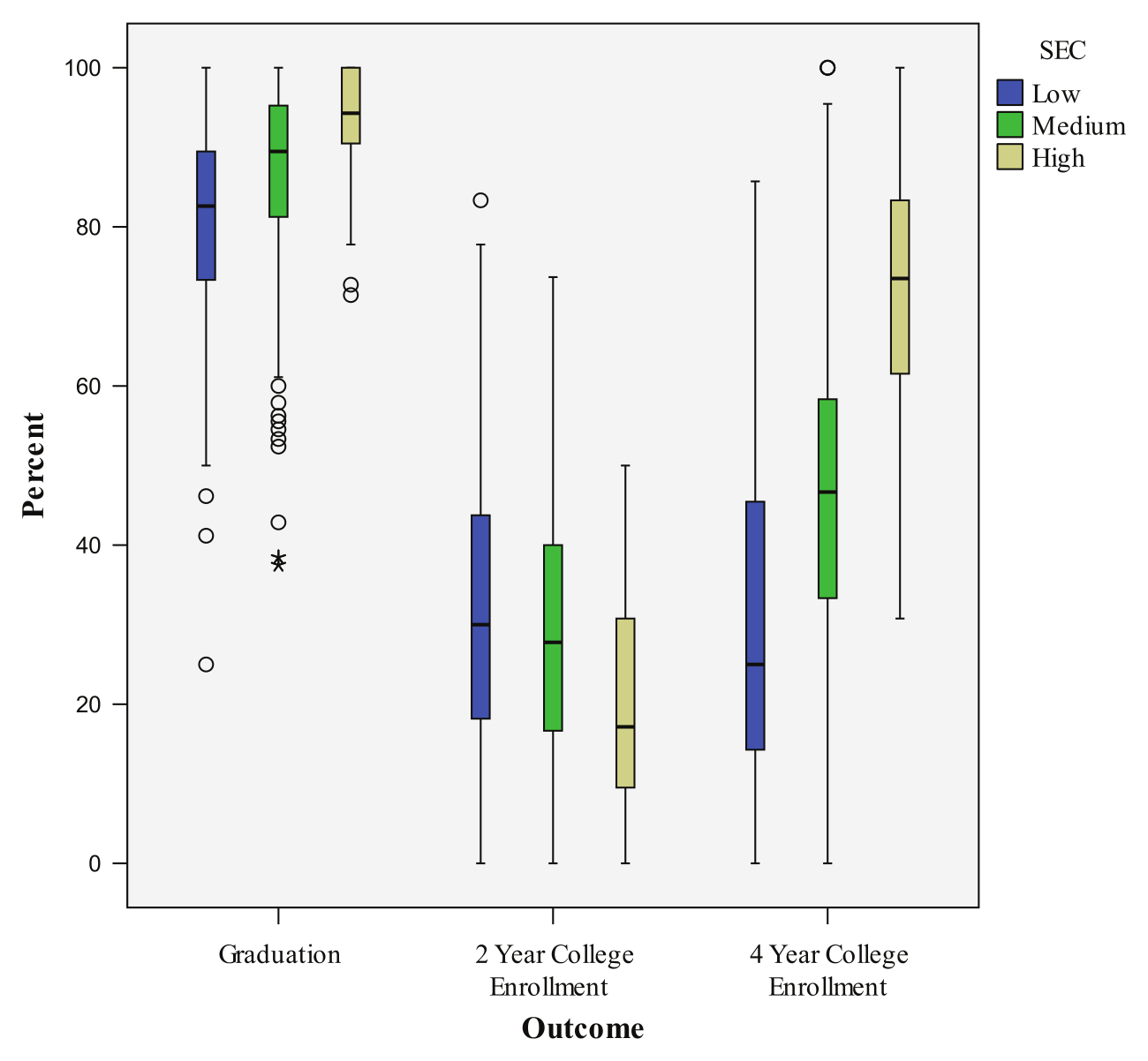
Distribution of school success percentages by attainment outcome and socioeconomic composition (SEC) category.
Table 1 provides descriptive statistics for the variables used in this study broken down by SEC categories. The table indicates there are pervasive differences across SEC categories on measures from each class of variables. These differences consistently compromise the learning environment at low SEC schools and enhance the learning environment at high SEC schools. For example, compared with students attending high SEC schools, students at low SEC schools had, on average, lower GPAs for academic coursework (0.54 units lower) and lower math/reading achievement test scores (1.0 SD lower). Moreover, principals at low SEC schools were far more likely to report that learning is hindered by poor facilities and inadequate equipment. Teacher salaries at low SEC schools lagged by over $8,000 annually and low SEC schools were nearly four times more likely to be in rural areas and over five times more likely to be small (enrollment < 600). School practices also differed by SEC groups. One subclass of school practices that had particularly pervasive differences between low and high SEC groups was academic climate. For example, the mean level of math pipeline progression was 1.77 standard deviations lower at low SEC schools while the average academic press was nearly a standard deviation lower. These finding indicate students at low SEC schools are comparatively far less likely to take advanced math coursework and low SEC schools tend to deemphasize academics. In addition, students at low SEC schools tended to have more negative peer influences. For example, students at low SEC schools were more than 50% more likely to have a friend who dropped out of high school. There were also significant differences in the disciplinary climate with higher levels of student reports of misbehavior, classroom disruptions, and feeling unsafe at low SEC schools. Perhaps consequently, teacher morale was lower at low SEC schools. Finally, students at low SEC schools were 2.67 times more likely to be Black or Hispanic, which likely has negative educational, social, and economic consequences for underrepresented minority students.
Substantial Effects of SEC on Attainment
This section addresses Research Question 2 on the magnitude of the associations between SEC and high school graduation and college enrollment as well as the mechanisms that mediate those associations. To address this, a sequence of five models were fit to each outcome beginning with the baseline model and followed by models controlling for progressively larger numbers of variable classes including student background, school inputs, peer influences, and school practices. Coefficient values are provided in units of odds ratios (OR) and effect sizes (ES). 12 It is important to reiterate that students who did not graduate from high school were omitted from the enrollment analysis, which prevents a carryover effect that could bias enrollment model coefficient estimates in an upward direction (see note 9).
Baseline Effect of SEC
The baseline model, which includes only SEC and SES, provides an estimate of the total effect of SEC on each attainment outcome. The results (see Table 2 and Figure 3a) indicate SEC has a statistically and substantially significant association with each attainment outcome. A one standard deviation increase in high school SEC (i.e., approximately half the difference between an average medium SEC school and an average high SEC school) corresponds with a 40% increase in the odds of graduating from high school (ES = .19), a 16% increase in the odds of enrolling at a 2-year college compared with not enrolling in college at all (ES = .08), and a 55% increase in the odds of enrolling in a 4-year college compared with not enrolling in college at all (ES = .24). The size of the total SEC effect on graduation is comparable to SES, which, as stated previously, is widely considered to be one of the most robust predictors of educational outcomes. These findings reveal a pattern that is also present in subsequent results: SEC has a larger effect on 4-year college enrollment than 2-year college enrollment. This was expected because high SEC schools tend to facilitate college-prep course-taking and academic achievement, which are key criteria for admission to 4-year colleges, but less important for admissions to 2-year colleges.
Socioeconomic Composition (SEC) Effect and Model Fit Across Sequence of Models

Note. Likelihood ratio test is based on comparison with the previous model.
Because restricted maximum likelihood estimation was used, likelihood ratio tests were adjusted using the scaling correction provided on the software output.
p < .05. **p < .01.
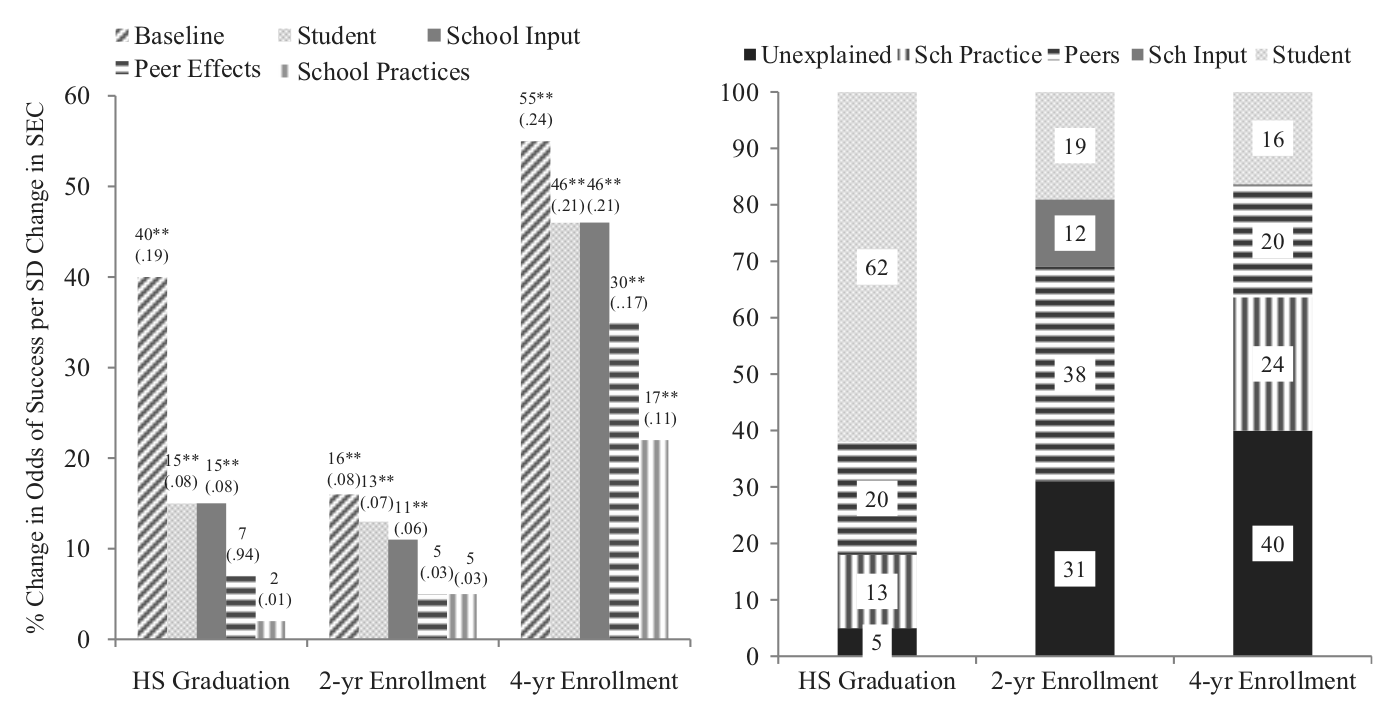
Explaining the socioeconomic composition (SEC) effect with student and school factors.
Mechanisms That Mediate the SEC Effects
Figure 3b shows the degree to which each subsequent class of variables mediates the SEC-attainment associations. The figure shows that student background controls mediate the SEC effect on each outcome. This mediation was particularly strong for high school graduation where the magnitude of the SEC effect was reduced by 62%. Student background controls also reduced the SEC effect by 19% and 16% for 2- and 4-year college enrollment, respectively. 13
The results in Table 3 show that only one school input—urbanicity— was significantly associated with attainment and only with 4-year college enrollment. In addition, no compositional measure other than SEC was associated with attainment. As a result, school inputs as a class of variables had only a modest mediation effect on the SEC-attainment associations. However, caution is in order when interpreting these results because while this study examines a number of school input variables, ELS data do not include some salient measures such as per pupil expenditures.
Final Model Results

Note. The odds ratio is the change in the odds of success per unit change in the predictor. Values greater than 1 indicate an increase in the odds of success, while values less than 1 indicate a decrease in the odds. Effect size estimates are based on Chinn’s (2000) method for converting odds ratios to Cohen’s d.
Individual peer influences are measured at the student level, and composition peer influences are measured at the school level.
p < .10. *p < .05. **p < .01.
The peer influence model substantially mediated the SEC effect on each attainment outcome, reducing its magnitude by 20%, 38%, and 20% for graduation, 2-year, and 4-year college enrollment, respectively. These results suggest that the effect of SEC on attainment is due in part to school-based peer influences. After controlling for peer influences, SEC was no longer statistically associated with graduation or 2-year college enrollment. However, it continued to be significantly associated with 4-year college enrollment. As shown in Table 2, a one standard deviation change in SEC corresponded to a 35% change in the odds of enrolling in a 4-year college (ES = .17).
Because the SEC effect was no longer statistically significant for graduation or 2-year college enrollment after adding peer influences to the model, the school practice model had little or no mediating effect for those outcomes. However, school practices accounted for 24% (see Figure 3b) of the total SEC–4-year college enrollment association. Nevertheless, the SEC association with 4-year college enrollment continued to be both significant and substantial; a one standard deviation increase in SEC corresponded with a 22% increase in the odds of enrolling at a 4-year college (ES = .11).
It may be helpful to accentuate these results visually. One way of doing so is to graph the simulated probability of attainment success on each outcome for students from low, medium, and high SEC schools for each of the five models described in the previous section. The two panels in Figure 4 graphically represent those success probabilities for high school graduation and 4-year college enrollment. For the graduation outcome, the baseline model results show the expected probabilities of success for students attending low, medium, and high SEC schools are .76, .86, and .93, respectively. Controlling for progressively more factors narrows the differences in the success probability between low and high SEC schools incrementally until it reaches zero for the school practice model. This means after controlling for differences in student background, peer influences, and school inputs and practices, the expected probability of high school graduation is equal in low and high SEC schools.

Simulated success probabilities at low, medium, and high socioeconomic composition (SEC) schools.
The 4-year college enrollment outcome is of special importance because success requires stronger academic preparation and increases the odds of completing a bachelor’s degree, which has long-term implications to social mobility including income and access to a range of careers (Kolesnikova, 2009; Long & Kurlaender, 2009; Monk-Turner, 1990). The differences in expected success probabilities of success at low and high SEC schools for 4-year college enrollment are distinctly larger than for graduation (see Figure 4). The baseline model results show graduates of low SEC schools have a .28 expected probability of enrolling at a 4-year college immediately after high school compared with a .76 expected probability for graduates of high SEC schools. The school practice model results show that even after controlling for a range of factors, the difference in the expected probability of enrolling at a 4-year college for graduates of low SEC and high SEC schools is substantial (.44 compared with .56).
The school input model results are arguably most appropriate for isolating the SEC effects because that model controls student background and school inputs, which are conceptualized as being beyond the influence of school personnel. What remain are the SEC-attainment associations that arise mostly due to the SEC effect, SEC-based peer influences, and school practices, the latter of which are relatively within the control of school personnel. 14 The results of the school input model show students from low SEC schools have a .38 probability of graduating high school and enrolling at a 4-year college compared to .64 at high SEC schools, a .26 difference in the probability. Stated another way, controlling for family and academic background and school inputs, students who attend a high SEC school have a 68% higher probability of enrolling in a 4-year college than students who attend a low SEC school.
Individual Measures of Peer Influence and School Effects
Controlling for student background, several measures of school inputs, peer influence, and school practice were associated with at least one attainment outcome (see Table 3). The two measures of individual peer influence were robust predictors of attainment, having strong associations with both outcomes. Moreover, compositional peer influences were predictive of attainment above and beyond their individual counterparts, although their effects were both smaller in magnitude and less pervasive. The proportion of students at the school who reported that a friend dropped out was negatively associated with graduation (OR = 0.82; ES = −0.11), whereas the proportion of students with friends who desire that they attend college was positively correlated with 2-year college enrollment (OR = 1.18; ES = 0.09). School practices were only sparsely associated with graduation and 2-year college enrollment. For example, only mean Carnegie units accumulated was associated with graduation (OR = 1.24; ES = 0.12). However, several school practices that promote academic preparation were predictive of 4-year college enrollment, including academic press (OR = 1.12; ES = 0.06), teacher morale (OR = 1.16; ES = 0.08), and mean math pipeline (OR = 1.34; ES = 0.16). The implications of these results are discussed in the following section.
As Figure 3a shows, the effect of SEC on high school graduation and 2-year college enrollment are almost fully accounted for by student and school factors. However, the effect of SEC on 4-year college enrollment remains significant. A comparison of the magnitude of that SEC effect with school practices that are predictive of 4-year college enrollment is provided in Figure 5. The figure shows that the magnitude of the SEC effect is comparable with salient school practices. Only the effect of math pipeline is larger. 15

Comparison of the effects of socioeconomic composition (SEC) and school factors on 4-year college enrollment.
Consistent SEC Effects for Students of Different SES and Ethnic Backgrounds
Research Question 3 addresses whether the SEC-attainment associations depend on a student’s SES or ethnicity. To answer this question the baseline models were respecified. The new specification is designed to test whether the association between SES or ethnicity and each attainment outcome varied across the sample of schools and if so whether those effects depend on SEC. That is, the new models test whether the SEC effect is consistent for students with different SES and/or ethnic backgrounds. The results indicate that the associations between SES and attainment and between underrepresented minority and attainment do not vary across the sample of schools for either outcome. 16 Furthermore, the associations between SEC and both attainment outcomes were consistent for students of varying SES backgrounds and for minority and non-minority students. 17
Discussion
This section examines the implications of the results for theory, practice, and policy. The shortcomings of the study are also described.
Mechanisms of Influence: Peer Influences or School Effects?
An objective of this study is to examine the mechanisms through which SEC affects attainment. As described in the literature review, there are two leading theories informing this: (a) SEC affects attainment through socioeconomic-related peer influences and (b) SEC affects attainment indirectly through school effects that tend to be coincide with SEC. While the results illustrated in Figure 3b provide support for both theories, peer influences tended to have stronger mediating effects on the SEC-attainment associations than school inputs and school practices combined, the minor exception being for 4-year college enrollment. 18 Moreover, the results in Table 1 show that compositional peer influences at low SEC schools tend to undermine attainment while facilitating attainment at high SEC schools. For example, students attending low SEC schools are 1 standard deviation less likely to have a close friend that desires the student to attend college (proportion at low SEC school = .38; proportion at high SEC school = .54; SD = 0.16) and 1 standard deviation more likely to have a friend who dropped out of high school.
These findings suggest peer influences are a critical mechanism through which SEC affects attainment, corroborating the results of some earlier studies on socioeconomic-related peer influences for achievement and behavioral outcomes (Coleman et al., 1966; Dreeben & Bar, 1988; Jencks & Mayer, 1990). These results are also consistent with the body of literature documenting the robust effects peers have on school outcomes, behaviors, and attitudes (Hallinan & Williams, 1990; Jang, 2002; Mounts & Steinberg, 1995; Rumberger, 1983). Moreover, given that peer influences tend to peak around ages 15 to 18 (Jang, 2002; Patacchini et al., 2011), high school students are particularly impressionable by their peers’ attitudes and behaviors during the time they are typically making decisions about transitioning out of high school and about postsecondary options.
While the mediating capacity of school practices tended to be less than for peer influence, practices that encouraged academics substantially reduced the association between SEC and 4-year college enrollment. Academic press, math pipeline, and teacher morale had positive associations with 4-year college enrollment. As mentioned previously, academic press was nearly a full standard deviation lower, on average, at low SEC schools as compared to high SEC schools. This may be the result of strategic efforts by school personnel to match instructional rigor and the academic orientation of the school with student aspirations and parental support as Coleman (1966) suggested. If so, that effort may be misguided because some research indicates academic press has a powerful effect in low SEC schools when coupled with appropriate social supports (Lee & Smith, 1999). However, this is a point of contention in the literature as other research shows that strong academic orientation can have adverse consequences in low SEC schools (Thrupp, 1999).
Math pipeline was the strongest predictor of 4-year college enrollment of any measure of school practice used in this study. Moreover, students at high SEC schools progressed nearly two standard deviations further in the math curriculum, on average, than students at low SEC schools (see Table 1). Together this suggests math pipeline is a potent mediator of the association between SEC and 4-year college enrollment. The math curriculum at most high schools is highly sequential, and advanced math courses are the domain of the college-prep curriculum. Thus, schools where students progress far into the curriculum, on average, emphasize enrolling in college-prep math courses and preparing students for college attendance. Such emphases not only prepare students to meet math course requirements for admission to 4-year colleges, but improve their math achievement test scores, which also increases their chances of admissions to selective colleges. These results are consistent with previous research that found a rigorous curriculum in high school, particularly in terms of math courses, significantly increases the odds of college enrollment (Adelman, 1999; McDonough, 2004; Perna, 2004).
Low scores on the teacher morale factor indicate teacher dissatisfaction with aspects of the school environment such as the students or the level of administrative support, which likely undermine teacher effectiveness and exacerbate teacher turnover (see the appendix table for the list of survey items used to estimate the teacher morale factor). Note that teacher morale is significantly lower at low SEC schools (Table 1), suggesting that the low SEC setting presents special challenges for teachers that undermine their morale. Some of those challenges are also documented in Table 1, including greater disorder, disruptions, and disciplinary problems; substantially lower salaries; poor facilities and equipment; and higher student drop-out and transfer rates. While it may seem counterintuitive that teacher morale is associated with 4-year college enrollment and not high school graduation, previous research indicates teacher morale has the strongest impact on retention of the most talented teachers in high-poverty schools, who tend to have greater opportunities to work elsewhere (Boyd et al., 2005; Carroll et al., 2000). Because those teachers tend to cover college-prep courses that may play an important role in promoting 4-year college enrollment, retention of these teachers is more relevant for 4-year college enrollment than for graduation.
After controlling for student background, school inputs, and peer influence, which essentially equalizes schools on input characteristics, only one school practice was associated with high school graduation: mean Carnegie units earned. Students who attend schools with higher mean Carnegie unit production are significantly more likely to graduate. Given the statistical controls employed, this effect is not a matter of differences in inputs across schools per se. Rather, it is considered to be a proxy measure for practices and policies that increase mean Carnegie unit production such as an emphasis on college-prep course-taking and programs for course credit recovery (e.g., summer school). In addition, as Table 1 shows, Carnegie unit production is significantly lower at low SEC schools compared with high SEC schools. These findings suggest that low SEC schools may offset their typically lower graduation rates by implementing programs that improve Carnegie unit production.
Addressing the Consequences of Socioeconomic Segregation
The critical implication of the results of this study is integrating public schools is likely necessary for addressing the negative effect of being segregated in a low SEC school. That is because the SEC-attainment associations are in part due to peer influences—both individual and compositional—that are associated with SES and that school resources and practices do not sufficiently counterbalance those peer influences. In addition, the research literature suggests that low SES students are more strongly influenced by school peers due to lower levels of school support from home (Coleman et al., 1966; Jencks & Mayer, 1990; Palardy, 2008). But what can be done to promote socioeconomic integration? Kahlenberg (2001b, 2012) outlines several viable strategies, including locating new schools to maximize socioeconomic diversity and using school assignment criteria based partially on student SES, which is currently being employed in at least 83 school districts in the United States with some success. Another strategy is to use magnet schools, which have historically been utilized to promote racial integration in large urban districts (although they often fell short on that objective). While a recent federal court ruling has prohibited the use of race-based admissions practices at magnet schools unless the school’s district is under court desegregation oversight (see Parents Involved in Community Schools v. Seattle School District No. 1, 2007), socioeconomic-based admissions practices are permissible and some districts have begun using magnet schools to promote socioeconomic integration with some success (Kahlenberg, 2012, p. 296).
Structural barriers such as neighborhood segregation and district boundaries are obstacles to school integration efforts (Mantil et al., 2012). Effective integration strategies will likely require overcoming those barriers. Moreover, as Mantil et al. (2012) contend, history indicates municipalities cannot be relied upon to address this matter; instead, state and federal governments must provide leadership. Perhaps one of the more obvious and yet underutilized interventions for overcoming these structural barriers is to increase low-income housing development in high-income neighborhoods (Rothwell, 2012). Another strategy is redrawing school boundaries to maximize diversity (Kahlenberg, 2001b). In addition, intradistrict programs may be necessary to overcome these structural barriers in some geographic areas. Mantil et al. offer recommendations for state and federal government programs that may assist in that effort, including providing financial incentives such as grants for new initiatives, support for transportation, and funding for feasibility studies and for programs that facilitate school choice.
While interdistrict programs may be necessary for achieving socioeconomic integrations of schools, past failures of such programs due to community resistance, political opposition, and legal challenges raise questions about their viability for addressing structural barriers to integration. That may depend largely on whether new programs are optional as opposed to compulsory. Kahlenberg (2012, p. 297) notes that Americans tend to support integration programs that provide choice and positive incentives for participation while opposing compulsory desegregation policies, such as desegregative busing. Compulsory programs are also more likely to face legal challenges. Additionally, some recent demographic changes may assist integration efforts. Census data indicate that suburban communities tend to be becoming more diverse, while for the first time since the 1920s several urban centers are seeing a net gain in educated, White, and professional citizens (Frey, 2013). While these demographic shifts are minor, very recent, and could be short-term fluctuations due to recessionary economic conditions, if they continue, the result will be more socioeconomic diversity within urban and suburban school districts, which should lead to more integrated schools or at least help overcome the structural barriers to school desegregation.
Integrating schools will address the effects of SEC and socioeconomic-based compositional peer influences on attainment. It may also provide students from low SES families with increased opportunity to interact with more affluent peers at school. However, integrating schools is not likely to fully address SES-based individual peer influences if socioeconomic segregation persists within schools. Fully addressing SES-based individual peer influences will likely require dissolving structures that support within-school segregation, such as academic tracking, and promoting practices that encourage interaction among students from diverse socioeconomic backgrounds, such as sports and other extracurricular activities (Lucas, 1999; Moody, 2001; Oakes, 2005).
To the degree that within- and between-school integration remains a reality, school inputs and practices can be optimized to address the consequences of socioeconomic segregation. The results suggest emphasizing school practices that promote academics and high teacher morale will have positive effects on 4-year college enrollment for students attending low SEC schools. However, previous research suggests that strong social support must coincide with the emphasis on academics if it is to be effective in the low SEC setting (Lee & Smith, 1999). Furthermore, improving social relations among school personnel may be necessary for increasing the typically low teacher morale in low SEC schools (Lee & Smith, 1997). Indeed, optimizing school inputs and practices to mediate socioeconomic segregation may require first improving the educational environment at low SEC schools. As Table 1 shows and was described previously, pervasive differences in the conditions at low and high SEC schools consistently challenge the work and learning context at low SEC schools. Substantial differences exist in teacher salary, quality of facilities and equipment, school safety, classroom disruption, and school disorder. Even though these factors were not individually associated with attainment, collectively they may interfere with the implementation of optimal practices at low SEC schools.
Limitations
While ELS is an outstanding data source for addressing the research questions, it has limitations. One limitation is self-selection of students and teachers into high schools. While self-selection bias is a lesser concern for studies like this one that focus on an all-public-school sample where school attendance is typically dictated by geographical boundaries, self-selection can still threaten the validity of causal claims. This study attempts to address this issue by controlling for an array of student and school factors that may be related to SES, SEC, attainment, and self-selection. However, because it is difficult to ascertain whether all confounding endogenous factors have been included, self-selection may still be a threat. A second limitation of ELS data is optimal items for measuring some constructs were not available. For example, some salient measures of both school inputs, such as per pupil expenditures, and school practices, such as whole school reform and extended day, were not available.
Summary and Conclusions
This study provides new evidence on the effects of socioeconomic segregation in American high schools on student attainment and the mechanisms that mediate those relationships. The results indicate that the socioeconomic composition of the school one attends is associated with whether one graduates high school and enrolls in college. Widespread differences in the educational context at low and high SEC schools systematically disadvantage students attending low SEC schools. Differences in the characteristics of the students enrolled at the schools account for a fair proportion of the SEC effects, especially for high school graduation. However, even after controlling for an array of student background characteristics and school inputs, students who attended high SEC schools were 68% more likely to enroll at a 4-year college than students from low SEC schools. Because educational attainment is associated with several important life outcomes—access to careers, income, and even health—this finding suggests that attending a low SEC high school may have lifelong negative consequences.
The results indicate that two prominent mechanisms mediate the effects of SEC on attainment, peer influences and school effects, with peer influences being the stronger of the two. An innovation of this study is the distinction between individual and compositional peer influences. The results show that the effects of individual type, which are transmitted directly through friends at school, are larger and more consistent than compositional peer influences. However, compositional peer influences were also observed that affect attainment above and beyond individual peer influences. A number of school practices were also associated with attainment and mediated the effects of SEC on attainment. For example, a schoolwide focus on academics was positively associated with 4-year college enrollment and mediated the effect of SEC on 4-year college enrollment. However, while altering school practices can reduce the negative consequences of socioeconomic segregation to some degree, fully addressing that will likely require integrating schools.
Footnotes
Notes
G
References
Supplementary Material
Please find the following supplemental material available below.
For Open Access articles published under a Creative Commons License, all supplemental material carries the same license as the article it is associated with.
For non-Open Access articles published, all supplemental material carries a non-exclusive license, and permission requests for re-use of supplemental material or any part of supplemental material shall be sent directly to the copyright owner as specified in the copyright notice associated with the article.
