




Abstract
Students’ opportunities to learn how to think are embedded in the instructional tasks with which they are invited to engage in the classroom. Prior research has revealed that the selection and use of cognitively demanding tasks does not guarantee high-level student thinking during their enactment. To address this challenge, we designed and implemented a professional development (PD) in which participants analyzed video clips of the enactment of cognitively demanding science tasks. Using transcripts of pre- and post-PD interviews during which participants were asked to respond to specially selected video clips, we analyzed what the participants attended to and how they made sense of what they saw. The findings suggested a change in terms of a growing tendency to attend to teaching as constituted in the interaction of the teacher, students, and task and to adopt an interpretive stance while talking about what was seen in the video clip.
Keywords
Introduction
Over the past 20 years, reforms in science and mathematics have emphasized the need to provide opportunities for students to work on complex tasks that challenge them to think, reason, and make sense of the core ideas of the discipline and to engage in the practices of the discipline. This call for thinking and reasoning in the curriculum began with standards-setting initiatives in the late eighties and early nineties that were initiated by professional groups such as the National Council of Teachers of Mathematics (1989) and the American Association for the Advancement of Science (1990, 1993). Currently, thinking, reasoning, and engaging in disciplinary practices have become key pillars of the Next Generation Science Standards (NGSS; NGSS Lead States, 2013) and Common Core State Standards in mathematics (CCSS-M; National Governors Association Center for Best Practices & Council of Chief State School Officers, 2010).
Students’ opportunities to learn how to think and reason are embedded in the instructional tasks with which they are invited to engage in the classroom (Doyle, 1983). Tasks that ask students to memorize facts or repeat already demonstrated procedures require one kind of student thinking; tasks that ask students to authentically engage in the disciplinary practices such as constructing arguments, modeling, and evidence-based reasoning to develop an understanding of disciplinary ideas demand another kind of thinking.
The reforms advocated by the CCSS-M and the NGSS demand a huge transformation in the kinds of tasks to which students are exposed. Research suggests that today’s students primarily engage with tasks that require memorization or simple procedural thinking (Roth et al., 2006; Roth & Garnier, 2006; Stigler & Hiebert, 2004; Weiss, Pasley, Smith, Banilower, & Heck, 2003). According to NGSS and CCSS-M, however, students need to spend a significant amount of their time in the classroom working on tasks that demand higher kinds of thinking and reasoning and that reflect the practices of mathematical and scientific thinking. Therefore, to meet the expectations set by these rigorous science and mathematics standards, the tasks that comprise classroom work need to be selected carefully to provide rich opportunities for students’ thinking and reasoning.
That being said, the selection and set-up of high-level tasks in the classroom does not guarantee that students will think and reason in more cognitively complex ways (Stein, Grover, & Henningsen, 1996). For example, the results of the most recent TIMSS video study in mathematics show that even though many higher achieving countries did not use a greater percentage of high-level tasks than in the United States, they were all successful in not reducing high-level mathematics tasks into procedural exercises (virtually all of the high-demand tasks in the United States were turned into opportunities for students to apply procedures or became problems in which only the answer was given) (Stigler & Hiebert, 2004). Similarly, although there was a significant focus in U.S. science classrooms on inquiry activities (e.g., creating models, conducting experiments, observing phenomena), such activities were used for verifying knowledge or following a procedure (Roth et al., 2006; Roth & Garnier, 2006). All of this suggests that although it may be relatively easy to get teachers to select and set up high-level tasks to use in their classrooms, it is much more difficult to assure that those tasks are actually implemented in ways that support students’ high-level thinking and meaningful engagement in disciplinary practices.
Past research identifies several factors that are consistently present in classrooms in which high levels of cognitive demand are maintained (Henningsen & Stein, 1997; Stein et al., 1996). The majority of these factors involve teachers closely attending to how students are making sense of the task (e.g., pressing students to justify, explain, and/or make meaning) and/or actively assisting student thinking without taking over and doing the thinking for the students (scaffolding student thinking and reasoning). Levin, Hammer, Elby, and Coffey (2013) call this “responsive teaching,” which requires closely listening and responding to students’ ideas and arranging classroom activities in response to their understandings.
We argue that instruction that maintains the high-demand thinking associated with rigorous tasks requires teachers to weave a lesson cloth comprised of three threads: the cognitive demands of the task, how students are responding to and thinking about the task, and their own actions with and responses to students. Ultimately, it is this interaction of the task, teacher, and students (sometimes referred to as the instructional triangle; Cohen & Ball, 1999, 2000) that determines the nature of the opportunities students have to think and reason in the classroom. When teachers “get inside” the thinking of students in response to tasks and offer support (not directions or answers) to the thinking process, they catalyze student thinking in ways required by the cognitively demanding task. Therefore, to be able to maintain high cognitive demand levels of tasks, teachers need to closely attend to and make sense of students’ thinking when students are working on these tasks as well as monitor their own actions that are critical for facilitating students’ high-level thinking about the disciplinary ideas and practices embedded in the task.
Instruction that supports students’ thinking, as discussed previously, is very different than the kind of teaching that occurs in most U.S. classrooms (e.g., Weiss et al., 2003), which typically plays out as a solo act, with the teacher at the center of the classroom; what the teacher says or does is viewed as the primary determinant of learning (Cohen, 1989; Levin, Grant, & Hammer, 2012). In these classrooms, when teachers respond to students’ engagements with cognitively complex tasks, they often turn them into teacher-led activities that “tell” students what and how to think. According to this conventional view, the teacher presents information, “hopefully clearly, for students to hear and, hopefully, understand and retain” (Levin et al., 2013 p. 4).
All of this suggests that teachers will not be able to arrest the typical decline in cognitive demand that most challenging tasks experience once unleashed in the classroom unless they learn to “see” classroom-based teaching and learning in new ways: Teachers must shift their vision of teaching from a solo endeavor to an interactional event among their own teaching actions, students’ thinking, and the nature of the task that they selected. In addition to learning how to select and set up challenging instructional tasks, teachers need to recognize students’ sense-making efforts as they engage with the task as well as the critical role played by teachers’ efforts to assist students’ thinking processes. In the absence of such a shift in how teaching is viewed, teachers’ practice will continue to consist of telling, and their students will continue to repeat and practice what they hear. This article is based on the assumption that supporting teachers’ learning to view teaching in more interactional terms constitutes a critical foundation for raising the levels of thinking and reasoning in America’s classroom.
The purpose of this study was to examine changes in teachers’ learning to view teaching and students’ thinking in new ways as a result of a video-based intervention that built on and extended work conducted under the framework of teacher noticing (Sherin, Jacobs, & Philipp, 2011; van Es & Sherin, 2002). Toward that end, we designed and implemented a professional development intervention in which teachers analyzed short video clips that illustrated enactments of cognitively challenging tasks in science classrooms and discussed what they noticed. The professional development was conducted as part of a larger NSF-funded project that focused on the development and implementation of a set of scalable design-based STEM units that aim to teach rigorous mathematics tied to big ideas in biology.
Our decision to focus the intervention (hereafter referred to as Noticing-PD) on teachers’ learning to notice was purposeful. First, past research has demonstrated success in helping mathematics and science teachers learn to notice (that is, attend to and interpret) noteworthy classroom-based events as a result of video-based professional development (including preservice teacher training courses) efforts (e.g., Jacobs, Lamb, Phillip, Schappelle, & Burke, 2007; Levin, Hammer, & Coffey, 2009; Levin & Richards, 2011; Sherin & Han, 2004; Sherin & van Es, 2005; Star, Lynch, & Perova, 2011; Star & Stickland, 2008; van Es & Sherin, 2006). This line of research made a strong argument for shifting teachers’ attention to student thinking and provided evidence for the effectiveness of video-based professional development efforts in changing teachers’ instructional practice toward more attention to student thinking (Sherin & van Es, 2009; van Es & Sherin, 2009). This is important because research suggests that what a teacher notices is fundamental to what a teacher acts on (Erickson, 2011; Jacobs, Lamb, Philipp, & Schappelle, 2011; Schoenfeld, 2011). Here, we argue that—while shifting teachers’ attention to students’ thinking is important—it is not enough to help teachers maintain high levels of thinking as their students work on cognitively demanding instructional tasks. Teachers need to be aware of their own actions while interacting with the students surrounding a cognitively demanding task. Building on both theory and evidence, we designed a “noticing” professional development intervention to support teachers’ learning to view teaching and students’ thinking in new ways.
In the Noticing-PD, teachers’ learning was situated within the artifacts of instructional practice (Ball & Cohen, 1999; Borko & Koellner, 2008; Fishman & Davis, 2006; Stein, Smith, & Silver, 1999) that represent the enactment of cognitively demanding tasks. Because the Noticing-PD targeted a particular instructional challenge (i.e., maintaining cognitive demand during the instruction), we used video clips that illustrated enactments of cognitively challenging tasks in science classrooms. Each video clip was used as a case of a particular kind of enactment of cognitively demanding tasks in different science classrooms (e.g., high-level tasks that stay at a high level; high-level tasks that decline into low-level thinking). These video cases provide a realistic picture of teaching and learning by capturing the richness and complexity of classroom instruction, which involves the voices, body language, and interactions of students and the teacher (Borko, Jacobs, Eiteljorg, & Pittman, 2008; Colestock & Sherin, 2009; Koc, Peker, & Osmanoglu, 2009; Le Fevre, 2003; Miller & Zhou, 2007).
The article unfolds in four main sections. First, we briefly review the literature on cognitive demand and on teachers’ learning to notice. Then we introduce the study, including a description of the Noticing-PD and the data collection and analysis. After that, we present our findings. In the conclusion, we discuss the results of the study, which suggested a change in teachers’ views of teaching and student thinking, particularly in terms of a growing tendency to notice interactions between teachers, students, and task (the instructional triangle) and to actively interpret student thinking.
Theoretical Framework
Cognitive Demand: The Level and Kind of Thinking Demanded of Students
As noted previously, not all tasks provide similar opportunities for students to engage with the disciplinary ideas (Doyle, 1983; Hiebert & Wearne, 1993; Stein et al., 1996). The Task Analysis Guide (Stein, Smith, Henningsen, & Silver, 2000) has been used widely in mathematics education research and practice to identify four different levels of cognitive demand of mathematical tasks. A similar framework has recently been developed to analyze science tasks based on their cognitive demand (Tekkumru Kisa, Stein, & Schunn, 2014). The design of the Task Analysis Guide in Science (TAGS) was guided by the recent framework published by National Research Council (NRC; 2012), a foundation for the development of the Next Generation Science Standards. Building on the TAG in mathematics education, the TAGS places science tasks into categories based on the two critical features of the NGSS: cognitive demand and the integration of science content and scientific practices.
As depicted in Figure 1, TAGS is a two-dimensional framework. The first dimension, which we call integration, is addressed in the vertical columns. The second dimension, cognitive demand, is presented in the horizontal portion of the framework. Each cell in the framework represents different levels of student thinking demanded by science tasks that focus on either science content, scientific practices, or the combination of the two. Cognitively demanding science tasks (placed at Level 4 and Level 5), as defined in the TAGS, have the potential to engage students in the kinds of learning opportunities called for in the NGSS, that is, “learning science and engineering involves integration of the knowledge of scientific explanations (i.e., content knowledge) and the practices needed to engage in scientific inquiry and engineering” (NRC, 2012, p. 11). The TAGS can be used to analyze science tasks based on their cognitive demand levels and also to monitor the ways in which teachers and students enact these tasks in science classrooms.
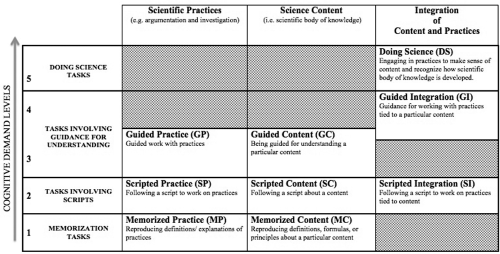
Task Analysis Guide in Science (TAGS) (Tekkumru Kisa, Stein, & Schunn, 2014).
Prior research provided strong evidence that how tasks are enacted shape students’ opportunities to learn by determining whether students spend their time memorizing, following procedures, or thinking and reasoning during the instruction (Henningsen & Stein, 1997; Stigler & Hiebert, 2004; Stein et al., 1996). Interactions between teachers and students play an important role in shaping whether the cognitive demand of tasks is maintained or declines during their enactment in the classroom (Henningsen & Stein, 1997). Sometimes interactions help to maintain a high level of cognitive demand, such as when a teacher presses for explanations or scaffolds students’ emerging understandings, but often unwittingly, teachers turn cognitively challenging, complex tasks into procedurally based activities in which students simply reproduce previous knowledge without making sense of the disciplinary ideas (Stein et al., 1996). In fact, studies consistently show that high-level tasks are much more likely to decline into lower level demand—as opposed to stay at a high level—when students actually begin working on the task. Often, teachers proceduralize the task by providing step-by-step directions that lead students to the correct answer without thinking or they allow unfocused student work on a task to deteriorate into unsystematic exploration rather than providing tailored scaffolding that directs students’ thinking in a productive way (Henningsen & Stein, 1997). Eventually, how tasks are enacted in the classroom is important because classrooms in which cognitively demanding tasks were used and their high cognitive demand levels were maintained during their enactment were much more conducive to students’ learning than were classrooms in which the demand declined (Boaler & Staples, 2008; Hiebert & Wearne, 1993; Stein & Lane 1996; Stigler & Hiebert, 2004; Tarr et al., 2008).
Although most of the research on the enactment of cognitive demand of tasks has been done in the context of mathematics education, there is evidence in the literature that revealed similar patterns observed in science classrooms in terms of the possibility of reducing students’ thinking during the enactment of high-level tasks (e.g., Sanford, 1987). Even though it was not framed around the enactment of cognitively demanding tasks, prior research about the use of inquiry-oriented, project-based activities has revealed various challenges to the enactment of high-level tasks in science classrooms. As Blumenfeld and colleagues (1991) claimed, project-based tasks “are complex and inherently ambiguous and risky (see Doyle, 1983)” (p. 380). Even though high-level science tasks often require students to independently work on complex activities, many teachers are reluctant to provide autonomy, believing that their students are not equipped to do the task on their own (Marx et al., 1994). Other challenges associated with using such tasks include allocating enough time for in-depth exploration of ideas, classroom management for maintaining productive independent work, and being able to provide appropriate amounts of scaffolding (e.g., Blumenfeld et al., 1991; Marx, Blumenfeld, Krajcik, & Soloway, 1997).
All of this suggests that an important learning agenda for teachers who wish to use cognitively challenging tasks in order to raise the level of thinking and discourse in their classrooms is to learn to pay attention to students’ thinking and identify helpful (and not so helpful) ways of interacting with their students during the enactment of cognitively challenging tasks. One way of supporting such learning is through professional development focused on video cases of the enactment of cognitively demanding tasks in which participating teachers are encouraged to attend to the teachers’ actions in relation to student ideas and/or actions (because this is what will be consequential for maintenance or decline of cognitive demand), interpret students’ thinking while they are trying to make sense of disciplinary ideas, and make judgments about the level and type of student thinking in the classroom. Prior research provided promising evidence regarding the consequences of what teachers notice during the enactment of high-level tasks in the classroom, suggesting that teachers who attended to the details of student thinking while teaching cognitively challenging tasks maintained the complexity of the tasks while those who failed to attend to student thinking reduced task complexity (Choppin, 2011).
Teachers’ Learning to Notice
Within the past decade a significant body of research, mostly in mathematics education, has focused on how teachers notice and make sense of complex classroom environments given that teachers cannot be aware of or respond to everything that is occurring in the classroom (Jacobs, Lamb, & Philipp, 2010). Learning to notice is related to developing expertise in a profession in terms of seeing and understanding complex situations in particular ways (Goodwin, 1994; Sherin, 2001; Sherin et al., 2011). Because our goal in this study is to support teachers’ learning to see and make sense of classroom interactions during the enactment of cognitively demanding tasks in particular ways, learning to notice served as a pivotal construct of our study. Sherin and colleagues, who have offered the most extensive work on teacher noticing (Jacobs et al., 2010), focused on “noticing as professional vision in which teachers selectively attend to events that take place and then draw on their existing knowledge to interpret these noticed events” (Sherin, Russ, & Colestock, 2011, p. 80). Their research showed that mathematics teachers’ attention often focuses on issues such as classroom organization, classroom management, and general pedagogical practices rather than students’ thinking (e.g., Sherin & Han, 2004; van Es & Sherin, 2008). Others have also explained differences in what and how mathematics teachers notice (e.g., Jacobs et al., 2007; Star & Stickland, 2008).
Although most of the research about teachers’ learning to notice is situated within mathematics education, recent studies in science education have begun to focus on understanding science teachers’ noticing in the classroom (e.g., Levin et al., 2009; Russ, Coffey, Hammer, & Hutchison, 2009; Talanquer, Tomanek, & Novodvorsky, 2013). Levin and Richards (2011) stated that similar to the work on teacher noticing in mathematics education, they consider attending to the substance of student thinking an important aspect of professional vision. Like in mathematics education, the noticing literature in science education has made an argument for focusing teachers’ attention to the substance of students’ thinking. The main underlying assumption in this research is that supporting teachers’ learning to notice students’ ideas from classroom videos can amplify teachers’ tendencies to attend to students’ thinking in their own classrooms (Levin & Richards, 2011).
We examine science teachers’ learning to notice using the Learning to Notice Framework as put forth by van Es and Sherin (2002) because it allows us to decompose aspects of noticing and describe changes in each of them separately at a more fine-grained level. The framework identifies three key aspects of noticing. The first is identifying what is noteworthy about a classroom situation. This is important because certain aspects of the classroom should receive more attention from the teacher compared to the others (Sherin, 2007; van Es & Sherin, 2002). In this study, we argue that—in the context of classrooms that use cognitively challenging tasks—PD participants, who are analyzing classroom video clips, should learn to pay attention to the interactions between teachers and their students surrounding instructional tasks, that is, to what students say or do about the task, and what the teacher does in relation to students’ ideas or actions surrounding the task. As noted earlier, this view of teaching, although required for classrooms in which students think and reason, is not common among American teachers.
The second aspect of noticing is reasoning about—or interpreting— classroom interactions. Noticing requires analyzing a teaching situation in purposeful ways, in ways that make sense of what happened, including what students were thinking about and how a teacher’s actions influenced students’ thinking (Putnam & Borko, 2000; van Es, 2011; van Es & Sherin, 2002). In the present study, PD participants were helped to develop an interpretative stance that would allow them to reason about how students were approaching high demand tasks and whether teacher actions helped or hindered students’ thinking at a high level. This represents an advance over what teachers typically do when viewing video cases, which is to adopt an evaluative rather than an interpretative stance (Sherin & Han, 2004; Sherin & van Es, 2005).
Finally, the third aspect of noticing is making connections between the specifics of classroom interactions and the broader principles of teaching and learning they represent (van Es & Sherin, 2002, 2008). Experts see specific events in connection with the broader principles that they represent (Glaser & Chi, 1988; van Es & Sherin, 2002). Similarly, expert teachers can connect a specific classroom event to a larger concept or principle they know about teaching and learning, such as equity or how students learn the best (Copeland, Birmingham, DeMeulle, D’Emidio-Cason, & Natal, 1994; van Es & Sherin, 2002). One of the main goals of this study was to help teachers recognize each video case as representing a particular level or type of student thinking. Different than other studies about teachers’ learning to notice, in this study, we used the TAGS (Tekkumru Kisa et al., 2014) to facilitate teachers’ identifying each video case as an instance of a particular level and kind of student thinking.
Overview of Present Study
The goal of this study was to examine teachers’ learning—within video-based professional development—to view the act of teaching and students’ thinking in new ways, ways that could build a foundation for maintaining high cognitive demand levels during the instruction. To this end, the following research questions guided our investigation:
Research Question 1: In what ways did what teachers attended to in the video cases change from the beginning to the end of the Noticing-PD?
Research Question 2: In what ways did teachers’ stance (i.e., descriptive, evaluative, or interpretive) for making sense of what they attended to in the video cases change from the beginning to the end of the Noticing-PD?
Research Question 3: To what extent did teachers learn to recognize video cases as an instance of a particular level or type of student thinking as defined in the TAGS?
Answering the first question allowed us to identify the shifts in teachers’ views of teaching. The second question allowed us to understand the extent to which teachers learned to make sense of students’ thinking and also the extent to which they learned to interpret what they see in the video cases of task enactment. Finally, the last question allowed us to capture changes in teachers’ ability to make accurate judgments about the level and type of student thinking (i.e., deciding whether or not the cognitive demand was maintained during the instruction).
As noted earlier, this study was situated within a project that focused on the development and implementation of STEM units that aimed to teach rigorous mathematics tied to big ideas in biology. It took place during the implementation of one of these units named “Modeling Genetics: The Gecko Breeder Challenge” (hereafter referred to as Design Unit). All the video clips that were discussed in the Noticing-PD were selected from the video records of classrooms during prior and current implementations of cognitively demanding biology tasks in the Design Unit. Teachers who participated in the study agreed to implement the four-week–long Design Unit and attend two project-related meetings and seven Noticing-PD sessions, which were specifically designed for this study. These seven sessions took place once or twice a week from the first week of February 2012 to the first week of March 2012 for a total of seven sessions, each of which was three hours in duration (about half of each session was allocated to viewing and discussing the video cases). The first three sessions of the Noticing-PD were conducted before teachers started implementing the Design Unit in their classrooms. The remaining four sessions were conducted as teachers were implementing the unit in their classrooms.
The Noticing-PD aimed to support teachers’ learning to notice important classroom events during the enactment of cognitively demanding biology tasks. During the PD sessions, teachers (hereafter referred to as participants) analyzed short video cases that presented enactments of cognitively challenging tasks in science classrooms and discussed what they noticed. As shown in Table 1, the sessions progressed from learning about the TAGS, to observing and discussing single or contrasting video cases of other teachers’ classroom, to viewing and discussing their own and each others’ video cases.
Noticing Professional Development (PD) Sessions

In all the PD-sessions, participants first discussed what they noticed (attended to and interpreted) in the video case. Then, they identified the level/type of student thinking in the video case by using the TAGS after being asked by the facilitator. Making this judgment about the level/type student thinking (i.e., deciding on whether cognitive demand was maintained or not) requires paying attention to what the teacher and the students do and how they interact around the cognitively demanding task.
Data and Methods
Participants of the Study
Five high school biology teachers from several different school districts from the Northeastern region of the United States participated in the Noticing-PD. These teachers, who voluntarily participated in the study, were paid for their participation. Table 2 provides information about the participants of the study.
Information About the Participants of the Study
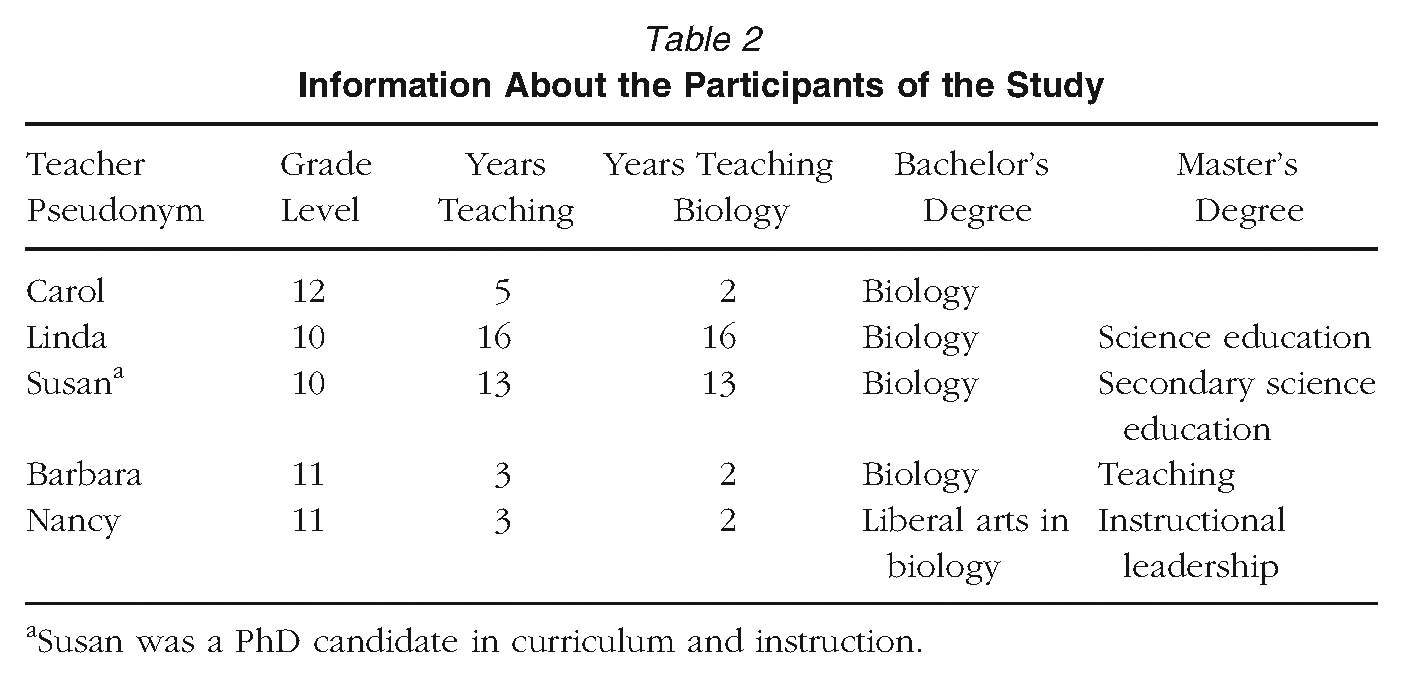
Susan was a PhD candidate in curriculum and instruction.
As summarized in Table 2, all the participants were teaching biology at various grade levels in high school. Linda and Susan were the two most experienced teachers from the same public school, while the others were in their early years of teaching biology. While all of them had a bachelor’s degree in biology, there was variation in their master’s degree. Linda was the only teacher in the Noticing-PD who had prior experience in implementing the Design Unit. Carol was from a private religious school. Like Linda, Carol had experience in working with the project team, but on a different biology unit. Barbara and Nancy were from two different schools operating under the same charter school organization, which focused on the use of research-based practices in the classroom. Because of their prior exposure to teaching science in a more inquiry-based manner (as presented in many video cases in the Noticing-PD), these teachers may have started the Noticing PD in a more advantageous place than others in terms of their familiarity with inquiry-oriented teaching and learning in science classrooms.
Data Sources and Analyses
Each teacher was interviewed before the Noticing-PD began and again at or near the conclusion of the Noticing PD. These two interviews constituted the primary sources of data. In each interview, teachers viewed two video cases from two different high school biology classrooms. Each video case was same in duration and showed high-level student thinking during the enactment of a cognitively demanding biology task, one about Mendelian Inheritance from the Design Unit and one about osmosis (Levin et al., 2013). The reason for using the osmosis video case was that it covered content different from Mendelian Inheritance, the topic of the Design Unit. Using a different content video allowed us to provide evidence that changes in teachers’ learning cannot be attributed to their getting more familiarized with the Inheritance content. To be able to make a comparison across teachers from pre- to post-professional development, we kept the video clips constant across all the interviews.
All interviews were transcribed and the portions of the transcripts that were used for this paper were divided into two parts: (1) participants’ talk related to what they noticed in the video case and (2) participants’ talk in response to the interview question “what level or type of student thinking is going on in this class?” (See Appendix in the online journal for the complete interview protocol.) For the analysis of the first part, the first author divided the transcripts into idea units (Sherin & van Es, 2009), which are defined as “a distinct shift in focus or change in topic” (Jacobs, Yoshida, Stigler, & Fernandez, 1997, p. 13). The second step involved coding each idea unit into the dimensions of topic and stance (Sherin & van Es, 2009; van Es & Sherin, 2008). Each idea unit was assigned only one code for each dimension. The analytical framework, which involves the description of the codes and their examples, was developed based on the earlier work by Crespo (2000), Jacobs et al. (2007), Sherin and van Es (2009), van Es and Sherin (2008), van Es (2011), and the goals of the current study.
To answer the first research question, we investigated what teachers attended to in the video cases that they viewed during the interview. We coded each idea unit with one of the following codes related to the topic dimension: pedagogy, student thinking, student engagement, student talk, classroom climate, management, or other (see Table 3). The change in PD-participants’ attention to student thinking from the baseline to exit interviews allowed us to see the extent to which participants learned to attend to students’ ideas about the content of the biology task. When idea units were coded as being about the topic of pedagogy, we further identified the idea unit as being about one of the following subcodes: (1) pedagogy not explicitly tied to students; (2) pedagogy explicitly tied to students, but at a general, non–content-specific level; or (3) pedagogy explicitly tied to students at a specific, content-informed level. The first subcode characterized participants’ comments that were only about what the teacher did/said. In contrast, the comments that were categorized under the second subcode (pedagogy explicitly tied to students) focused on what the teacher did/said in response to students’ ideas/actions as well as students’ ideas/actions in response to what the teacher did/said. While the pedagogy-related comments under this second subcode were not at a specific content level, the third subcode captured comments about teachers’ actions in relation to students at a specific content level. These detailed analyses with respect to what exactly about pedagogy the participants attended to allowed us to capture possible shifts in their view of teaching.
Description of the Codes Related to the “Topic”
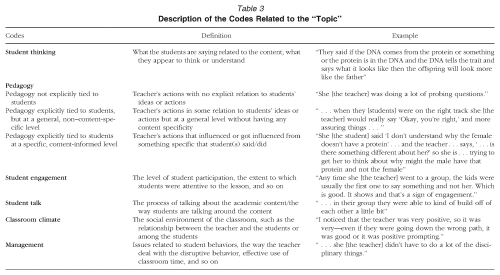
To address the second research question related to how PD participants made sense of what they attended to, we analyzed the stance they used while talking about the video case. This included whether participants (1) described which features of the activity stood out to them in the video case, (2) evaluated what they saw in the video case instead of trying to understand what was happening, or (3) interpreted what they saw in the video case. Table 4 provides details about the stance codes.
Description of the Codes Related to the “Stance”
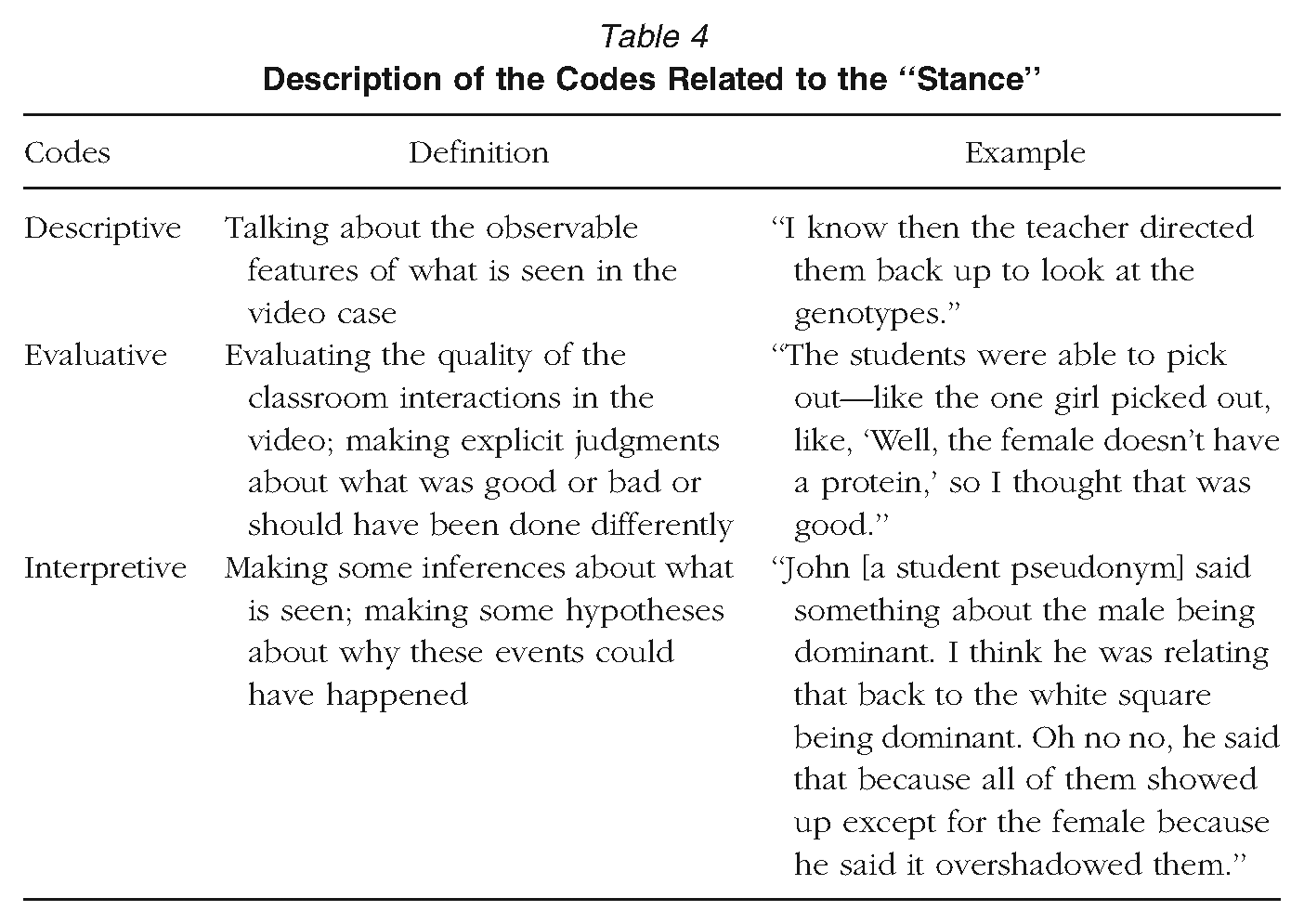
The analyses for Research Questions 1 and 2 began with an effort to stabilize the coding procedures. The first author analyzed part of the interviews along these two dimensions through multiple iterations until the coding framework was solidified. During this process, the two authors discussed the description of the codes several times. To sharpen the definition of the codes and the distinctions between them, they coded the same part of an interview and then discussed the codes several times (Miles & Huberman, 1994). Through these iterations, a codebook, which included the description of the codes, their examples, and the decision rules to be used during the analysis, was developed. Using this codebook, the second author, who was blind to the participants, coded 20% of randomly selected transcripts. Half of the transcripts were from the osmosis interviews and the other half were from the Inheritance interviews. Because the categories were not topic specific (i.e., osmosis or Inheritance), the codebook was used for the analysis of both sets of interviews. Overall interrater reliability was 81% (kappa = .64). Even though we made further detailed analysis of pedagogy-related comments, there was still good agreement between raters in terms of the allocation of each pedagogy-related idea unit into one of the pedagogy-related subcategories that we described previously (kappa = .628). After completing double coding, differences between the two coders were discussed and resolved through consensus. Then, the first author coded the remainder of the interviews.
Based on these analyses, a table was created for the results of the baseline and exit interviews to show the number and percentage of idea units relating to the various codes underneath the topic and stance dimensions. This allowed us to identify the change in the percentage of the idea units related to each code from baseline to exit for the Inheritance as well as the osmosis interviews. Statistical analyses—one-tailed t test for dependent samples—were then used to assess the significance of the changes. We used one-tailed tests because we expected to see significant increases in a particular direction, that is, in the percentages of comments related to (1) the topic code, “pedagogy explicitly tied to students at a specific, content-informed level”; (2) the stance code, “interpretative”; and (3) participants’ interpretive stance while talking about the student thinking. In contrast, we expected to see a significant decrease in (1) the topic code, “pedagogy not explicitly tied to students”; (2) the stance code, “evaluative”; and (3) participants’ evaluative stance while talking about the student thinking. The t tests were calculated using the percentages of idea units per teacher for the categories that we mentioned previously and comparing the changes in the proportions between baseline and exit interviews for all teachers.
To assess the extent to which participants started to recognize each video case as an instance of a particular level or type of student thinking (Research Question 3), we began by examining whether or not the participants identified the level of student thinking in the video cases as “high” or “low” level. For this analysis we focused on the second portion of the interviews: participants’ talk in response to the interview question “what level or type of student thinking is going on in this class?” In 19 out of 20 interviews (2 video cases at 2 time points × 5 teachers), the participant correctly identified the level of thinking as high. Next, we read through those parts of the transcripts and generated codes for the constructs used by participants to describe high-level student thinking (e.g., the application of knowledge, deep student engagement, etc.). After we were satisfied with the codes, the second author coded this section of the transcript, assigning as many codes as applicable to each participant’s description of student thinking. Finally, we created a table that showed the number of participants that used each construct in the baseline and the exit interviews and examined this table to determine if participants’ descriptions of what constitutes high-level student thinking shifted from baseline to exit interviews to include more references to constructs associated with the TAGS.
Findings
Analysis of the baseline and exit interviews revealed changes in what PD participants attended to in the video cases (Research Question 1) and how they made sense of what they attended to (Research Question 2). The findings are particularly promising in terms of the effectiveness of the Noticing-PD in supporting participants’ learning to view teaching in new ways, that is, in ways constituted in the interaction of the teacher, students, and task. Moreover, even though there was not a big change in participants’ attention to students’ thinking from baseline to exit, their stance while talking about student thinking changed. Overall, they adopted a more interpretive stance and less evaluative stance while talking about what they saw in the video cases. This change to an interpretative stance, we argue, sets teachers up to analyze students’ cognitions—in particular, the level and type of their thinking and reasoning—during the enactment of cognitively demanding tasks. In line with that, we found a shift in their judgments about the levels of thinking as outlined in the TAGS, suggesting that this analytical framework provided teachers a language to describe how students think in science classrooms during the enactment of cognitively demanding tasks.
What Participants Attended to in the Video Cases: Changing Views of Teaching
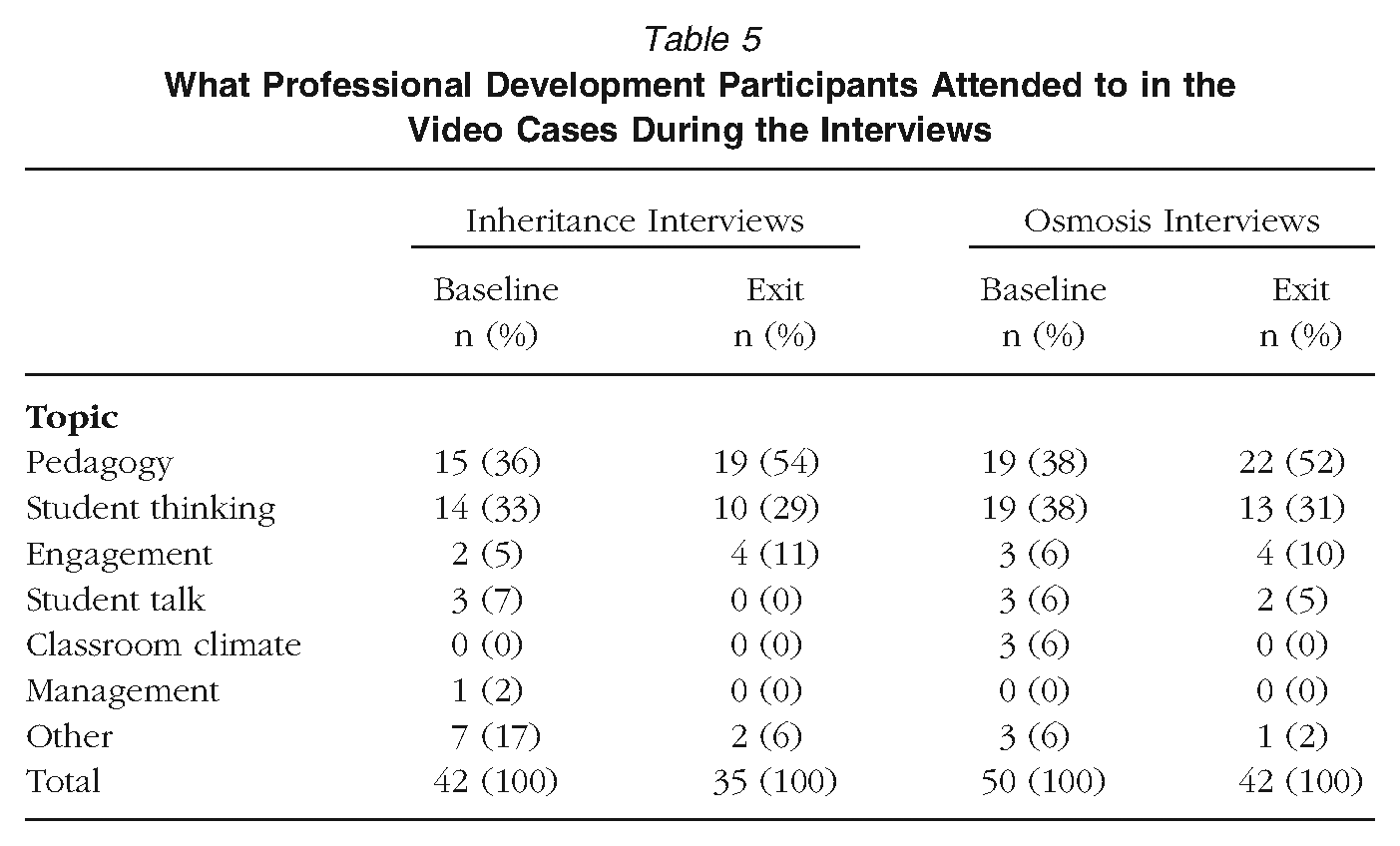
Across both the inheritance and osmosis interviews and both time points, the majority of topics to which participants attended in the video cases fell under either student thinking or pedagogy compared to other issues such as climate, classroom management, or student engagement (Table 5). Because teachers began at such high levels with regards to noticing pedagogy and student thinking, there was not much room for growth from baseline to exit interviews. Only 17% of the comments for each video case were not about student thinking and pedagogy in the exit interviews. The large number of comments related to these two topics allowed us to conduct further analysis about the nature of idea units related to the pedagogy and student thinking categories.
What Professional Development Participants Attended to in the Video Cases During the Interviews
Our analysis of exactly what about the pedagogy the participants commented on revealed an interesting pattern (see Table 6). Analyses of the baseline idea units related to the Inheritance video case indicated that 40% of the participants’ comments were initially about general pedagogy not linked to students. For example, one participant said, “The teacher didn’t just give them [the students] answers. She was trying to pull it out of them.” Such comments focused on the teacher apart from what students appeared to be doing in relation to the task. Moreover, they were not grounded in the content of the task. There were slightly fewer of such comments in the baseline interviews related to the osmosis video case (30%).
What Participants Attended to Related to Pedagogy in the Video Cases During the Interviews
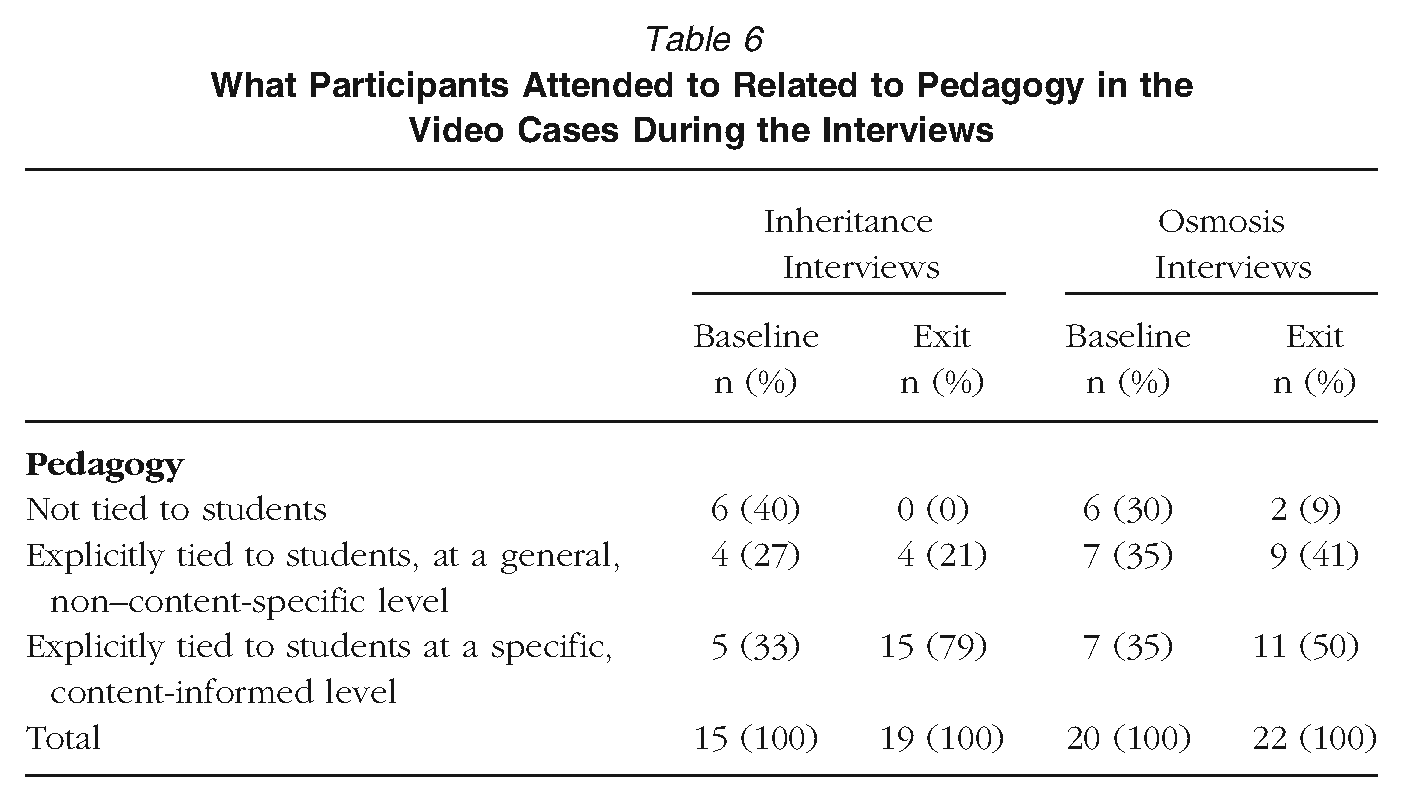
In the exit Inheritance interviews, none of the participants’ pedagogy-related comments was independent of students’ actions and ideas. A one-tailed t test indicated that this decline from baseline to exit interviews in participants’ comments related to teachers’ actions not linked to students was statistically significant (t = 2.47, p < .05). Only 9% of the comments were in this category in exit osmosis interviews. Again, this decline from baseline to exit interviews with the osmosis video case was statistically significant (t = 2.33, p < .05).
At the same time that pedagogy-related comments independent of students declined, there was a large increase in pedagogy-related comments that were explicitly tied to students at a specific, content-informed level. During the exit inheritance interviews, the majority of the pedagogy-related comments (79%) involved talking about the teacher’s actions in relation to students’ ideas and actions at a content-specific level while only 33% of their comments during the baseline interview was at that level (an increase of 46%). Once again, a one-tailed t test indicated that this was a significant shift from baseline to exit in the inheritance interviews (t = 6.48, p < .01). A similar pattern was observed in the osmosis interviews. There was a marginally statistically significant increase in participants’ pedagogy-related comments about the teacher’s actions in relation to students’ ideas and actions at a content-specific level (t = 1.83, p < .10). The following statement by a PD-participant during her Inheritance exit interview illustrates the nature of such pedagogy-related comments:
I noticed that at one point when they [students] said that it [the offspring] is going to look like the male, and the teacher said “for this one trait,” so kind of redirecting them that, again, we are only talking about one gene when organisms have tons of genes.
As this excerpt elucidates, the participants focused on a teaching action specifically linked to a content-specific issue—that is, how the teacher in the video responded to students after she had listened to their interpretation of the phenotype data and realized that students needed to understand that they were discussing the phenotype of an organism for a particular gene.
Because such large percentages of participants’ comments coded for “pedagogy” included attention to student ideas, we suspected that idea units coded as pedagogy might harbor incidences of teacher’s “attention to student thinking” (that were not captured under the code “student thinking”). Thus, each time we coded an idea unit as (1) pedagogy explicitly tied to students or (2) pedagogy explicitly tied to students at a specific, content-informed level, we also coded whether or not there was an explicit “reference to student thinking.” A new, composite code was created by combining the positive instances of attending to student thinking (under the pedagogy code) and the separate student thinking code for which we reported the percentages related to idea units in Table 5. When we analyzed the extent to which the percentage of idea units related to the composite student thinking code changed from baseline to exit interviews, we found 12% increase for the inheritance interviews and 5% decrease for the osmosis interviews.
Participants’ Stance Analyzing the Video Cases: Growing Tendency Toward Sense-Making
To address the second research question, we examined the stance participants took while analyzing the video cases. As shown in Table 7, participants’ comments were fairly evenly distributed among descriptive, evaluative, and interpretive stances in the baseline interviews. Interestingly, in the baseline interviews for inheritance and osmosis, exactly the same percentage of comments (38%) was coded as interpretive, and that was slightly higher than both evaluative comments and descriptive comments.
Professional Development Participants’ Stance While Analyzing Video Cases During the Interviews

In the exit interviews, however, the distribution of the descriptive, evaluative, and interpretive comments was different. As we were expecting, there was a decline in participants’ evaluative comments from baseline to exit, and this decline was found to be marginally significant in both the inheritance interviews (t = 2.07, p < .10) and osmosis interviews (t = 1.75, p < .10). For example, one participant said, “I think she [the teacher] is impressive in that she kept sticking with it and really not giving them the answer.” In this evaluative comment, the participant expressed that she found the teacher’s actions “impressive.” She did not, however, explain her reasoning about why she found the teacher’s not providing the answer as impressive.
In contrast to the decrease in the evaluative comments, there was an increase in the percentages of interpretive comments from baseline to exit interviews. The increase was found to be marginally statistically significant in the inheritance interviews (t = 1.90, p < .10) and statistically significant in the osmosis interviews (t = 4.54, p < .01). The majority of the comments both in the exit osmosis and inheritance interviews were reflecting participants’ interpretive stance (74% in inheritance, 60% in osmosis). The following comment illustrates the nature of interpretive comments in the exit interviews:
She [the teacher] put back a question to them, “Can you relate this to the genotypes you saw?,” they [the students] were able to understand that the bottom part [the bottom of the worksheet that showed Western blot data] . . . why all those offspring looked—because it was because of the male. But they couldn’t relate it back right away to the top part [the top of the worksheet that showed PCR data] until she asked them, can you relate this [Western blot data] back to the genotypes that you saw [in the PCR data] and that got them all thinking again.
We conducted further analysis regarding the participants’ stance and analyzed the changes in the way in which participants commented on students’ thinking. More specifically, we anticipated that early on participants would take an evaluative stance when commenting on student thinking but during the exit interviews, they would mostly adopt an interpretive stance. The analysis indicated a significant increase in participants’ interpretive comments related to student thinking from baseline to exit interviews (t = 2.51, p < .05) (based on combined inheritance and osmosis interview data). However, even though there was a decreasing trend in participants’ evaluative comments about student thinking, this decline was not statistically significant (t = .85, p > .05). Moreover, the findings also revealed a decline in participants’ descriptive comments (a decline of 27%). Overall, it is possible to say that in the exit interviews when PD-participants talked about student thinking, there was a growing tendency to make interpretive remarks.
Learning to Recognize Each Video Case as an Instance of a Level of Student Thinking
To assess the extent to which participants started to recognize each video case as an instance of a particular level or type of student thinking, we began by examining whether or not the participants identified the level of student thinking in the video cases as high or low level. Even at baseline, the nature of the interview question (How would you describe the level and type of student thinking?) invited PD-participants to connect what they saw on the video clip to larger, more general ideas. Because they had not yet been introduced to the TAGS, participants in the baseline interviews needed to rely on their own knowledge base for larger ideas with which to connect. All teachers (with one exception) called the level of student thinking high in both of the video cases that were shown in the baseline and exit interviews.
When pressed to provide a reason for identifying student thinking as high level, they reached for a range of constructs or ideas. As shown in Table 8, all participants connected students’ actions with “thinking or sense-making.” This covered a range of thinking processes including reasoning, making connections, and trying to deeply understand something. For example, after viewing the Inheritance video one participant stated, “They’re [the students] trying to get those three connections that I’d mentioned, those relationships, and it’s not—it only comes from you thinking it through and interpreting data. It’s not like you can read it and highlight it.”
Ideas/Constructs Used to Describe High-Level Student Thinking
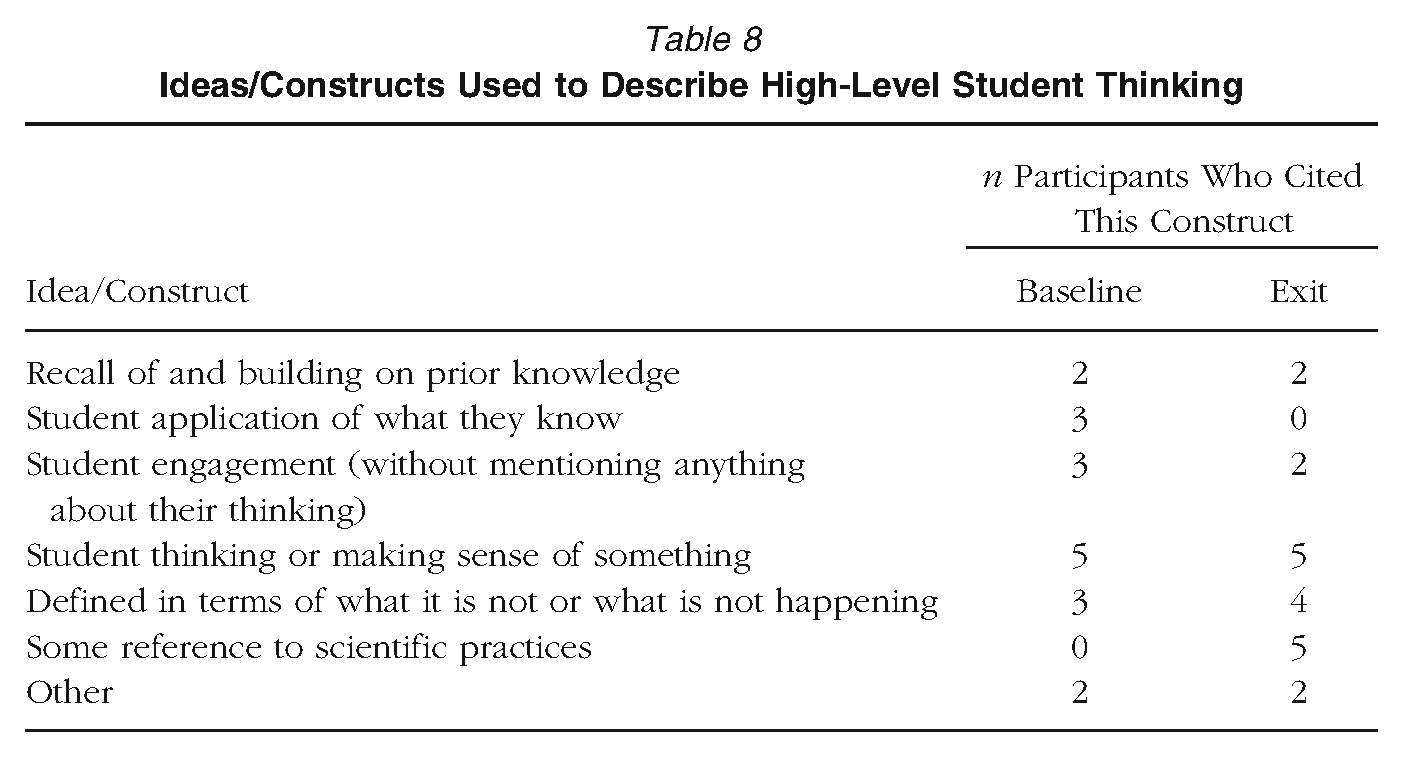
Three teachers talked about the students’ engagement with the task; however, engagement tended to be associated with the “look” of focused work without additional details regarding the kind of thinking students appeared to be doing. The application of what one knows to a new situation was another way of describing the high-level thinking in which they said students were engaging in the videos (n = 3 teachers). For example, while discussing the osmosis video, one participant said:
Again, I think it’s that application piece. I mean the first—I’m trying to think of that tier you have, like your first tier of level of understanding is, you know, repetition or identification, and your second tier is maybe like applying or creating.
This participant went on to identify Bloom’s taxonomy as the framework she was using to describe what constitutes high-level thinking.
Three participants found it helpful to explain students’ high-level thinking in terms of what was not going on. One participant stated, “High-level thinking requires more than just memorizing given information” while another said, “It’s more than knowing a definition of a scientific concept but understanding it more deeply.” The two participants who used constructs coded as other talked about high-level student thinking as encompassing a multitude of different skills and the level of thinking one needs to engage in in order to teach.
After the Noticing-PD, participants were expected to reach for and use ideas embedded in the TAGS to describe high-level thinking. As shown in the final column in Table 8, all participants did refer to scientific practices in some way when describing students’ levels of thinking. Two additional things are noteworthy about Table 8. First, participants’ use of other constructs to describe high-level thinking lessened somewhat but not entirely. In particular, participants still talked about thinking (in a general sense) as a key aspect of higher level cognition, and they still defined high-level thinking in terms of what it is not or what did not happen. Whereas the baseline descriptions of what high-level thinking tended to point toward memorization and definitions, the exit descriptions were different. They tended to point to what the teacher and/or task did not do that defined the work as high level. In other words, participants started to refer to other components of the instructional triangle (i.e., task and the teacher) while talking about students’ thinking. For example, several participants noted that the teacher did not provide extra help and that she made students do the thinking. One participant referred to the nonscripted nature of the instructional task:
There is no set procedure. She [the teacher] is not telling every group to do the same thing, to come up with this answer. So that’s another indicator [of high-level thinking] that they’re not using some procedure that you have to use. You can get to this answer anyway that your brain is allowing you to get there.
Although all five teachers referred to scientific practices at some point in their description of high-level thinking, their use of the term did not reveal a fully developed understanding of scientific practice. Most common was the idea that scientific practices necessarily involved engaging in investigation or data analysis. For example, in discussing the osmosis task, one participant noted that there was no scientific practice going on because:
They’re not performing an experiment. They’re not analyzing control groups versus experimental groups. They’re not analyzing a graph or a data table. They’re not observing a natural phenomenon. So I think anything that I would think of as a scientific practice, actually doing science is kind of missing from this.
Another participant noted:
They weren’t looking at data or looking at an analysis of the board before and after or something like that or looking at pictures of salt water concentrations or something. You know what I mean? They weren’t looking at data.
Similarly, another PD-participant commented regarding how the teacher in the osmosis video might include scientific practices in the lesson: “Afterwards she might say something like, ‘Now I want you to find some materials and do this example like show me this example hands on in real life, full time.’”
Finally, some participants incorrectly stated that the lack of engagement in scientific practices meant that a task could not be high level. This, however, is actually not the only requirement for high-level thinking in the TAGS.
Conclusions and Discussion
We started this article by calling attention to one of the most persistent problems of practice in American classrooms: low levels of student thinking and reasoning. Despite the introduction of more complex instructional tasks into U.S. classrooms, the risk of declining levels of cognitive demand once students go about actually working on these complex tasks persists. For us, one potential solution to this enduring problem of practice is to help teachers shift their vision of teaching from a solo act to interactional events that include students, the teacher, and the instructional task. Making this shift will allow teachers to not only attend to and make sense of students’ thinking within the context of cognitively demanding tasks but also to monitor their own actions so as to maintain high levels of student thinking in the classroom. Therefore, we argue that even though attention to students’ thinking is important, teachers’ being aware of their own teaching actions while teaching is also critical, particularly in classrooms that are using cognitively challenging tasks. However, this focus has been absent from many recent research endeavors about teachers’ learning to notice.
In the Noticing-PD, we asked participants to analyze video cases that illustrated complex classroom events during the enactments of cognitively demanding tasks in high school biology classrooms and to make judgments about the level and type of student thinking. The analysis of the baseline and exit interviews revealed shifts in terms of what the participants saw in the video cases and how they made sense of what they saw. First, there was a major shift in the way they viewed teaching. In the baseline interviews, consistent with van Es (2011), participants’ pedagogy-related comments varied, with some of them attending to what the teacher did independent of the students. However, there was a large decline in such comments during the exit interview. At the same time, a significant increase was observed in participants’ pedagogy-related comments that were grounded in the content of the task and that were tightly linked to students’ ideas and actions. This shift suggests that participants were beginning to change their view of teaching as a solo act to teaching as the “assistance-of-student-learning” (Tharp & Gallimore, 1988). As such, we contend that the Noticing-PD supported participants’ learning to see teaching as an interaction among task, teacher, and students (i.e., instructional triangle).
The second noteworthy finding concerns the ways in which participants commented on students’ thinking. Inconsistent with previous studies on teacher noticing (e.g., Sherin & Han, 2004; Sherin & van Es, 2005), there was no overall prominent increase in the proportion of participants’ comments about student thinking from baseline to exit interviews. This was primarily because our participants exhibited high levels of attention to student thinking at baseline. However, our findings are consistent with Levin and Richards (2011) who found that teacher candidates in a graduate-level science teacher preparation course were able to attend to students’ ideas and understandings from the beginning. After the course though, they found differences in the nature of candidates’ talk related to student thinking. Similar to Levin and Richards (2011), we found that participants in our PD were trying to make sense of students’ ideas more during the exit interviews.
Third, related to participants’ increased sense-making of students’ ideas, our analysis revealed a significant increase in participants’ interpretive comments alongside a significant decrease in evaluative comments and some decline in their descriptive comments. These findings differ from the evaluative stance that past research has suggested teachers typically adopt when viewing video cases of instruction (Sherin & Han, 2004; Sherin & van Es, 2005). This shift is important because an interpretive stance affords a deeper examination of classroom events, which in turn leads to better warranted assessments of teaching and learning including participants’ inferences about instructional responses that will be supportive of student learning (Levin & Richards, 2011). Moreover, making sense of why and how students’ thinking is shaped by particular teaching moves can help participants to reflect on their own teaching practices by considering what they would do in similar situations in their own classrooms. As a next step in our research, we will investigate the extent to which PD-participants reflected on their own teaching during discussions of the video cases (Tripp & Rich, 2012)—a move that we hypothesize may be a necessary prerequisite for transferring what was learned in the PD to participants’ own teaching.
Overall, this study provides examples of new ways to study teachers’ learning to notice from the video cases of classroom interactions. By calling attention to teachers’ learning to see their own roles within the instructional triangle, we surface the need to help teachers learn to monitor their own teaching actions (in addition to student thinking). This focus on learning to see teaching in new ways in cognitively rich environments is unique. Moreover, our work points to the affordances that close attention to the nature of the task can provide to researchers and PD providers. In prior research, the nature of the task had not been considered as an important aspect in the selection of classroom videos for PD sessions or in researchers’ analyses of participants’ conversations about the videos.
We contend, however, that the nature of the task that is enacted in classrooms sets boundaries on the kinds of ways in which the teacher and students interact surrounding the task (see Stein & Kim, 2009), thereby shaping the types of things that are available for PD participants to notice in the video cases depicting its enactment. For example, a lab task, which requires students to derive factors associated with a scientific phenomenon through a scientific investigation, can demand high-level reasoning about various potential factors and their relations with that scientific phenomenon (Tekkumru Kisa et al., 2014). This demand on students in turn positions the teacher to assist students’ development of understanding the scientific phenomena through engagement in scientific practices. Moreover, there is apt to be a much wider range of teacher facilitation moves both within and across teachers during the enactment of such tasks (e.g., some teachers might take over the thinking by providing too much structure, other teachers might scaffold student thinking in more productive ways, the same teacher might exhibit a range of moves depending on the student with whom she is interacting or the remaining class time available). On the other hand, there are many lab tasks that require students to follow scripted procedures focusing students on the correctness of the procedures and the produced results (Tekkumru Kisa et al., 2014). These scripted procedural tasks do not position the teacher to facilitate students’ capacity to productively engage in the disciplinary ideas and practices; instead, the teacher is often positioned to make sure students correctly follow procedures and reach the “correct” conclusions. Based on this critical attribute of tasks, then, we argue that researchers should consider the nature of the task while examining teachers’ noticing in the classroom and that professional developers should consider it as well as they analyze classroom videos with teachers.
Recent research focusing on science teachers’ learning to notice has suggested that professional development experiences should introduce a new framing to the teachers. According to this line of research, science teachers can attend to student thinking, but what they notice depends on how they frame what is taking place (Levin et al., 2009; Tang, Coffey, Elby, & Levin, 2010). For example, Levin and his colleagues showed that whether and how teachers attend to student thinking is influenced by the institutional contexts such as the pressure for students to perform well on high-stakes tests or leaders’ press for curricular fidelity (Levin, 2008; Levin et al., 2009). Similarly, Russ and Luna (2013) found that the science teacher they studied was capable of noticing students’ thinking but that her noticing depended on her framing of the classroom activities. For example, attending to student thinking was not part of her practice during labs. In line with what is suggested in these studies, the current research can be viewed as having introduced a new framing to teachers: the enactment of tasks that have high levels of cognitive demand. By framing classroom events in this way during the viewing of the video clips in the professional development, participants were cued into the possibility of declining cognitive demand and thus learned to be aware of the importance of attending to student thinking and monitoring their own actions with regards to maintaining high cognitive demand levels of the task throughout the lesson.
This study was also unique with respect to one of its primary goals: to help teachers learn to identify each video case as an instance of a broader teaching and learning principle. PD participants were asked to identify each video case as an instance of a level or type of student thinking as defined in the TAGS, which was used to facilitate teachers’ making connections between the specifics of what they noticed in the video cases to the larger set of ideas about the level and type of student thinking. How participants described what constitutes high-level thinking changed from the beginning to the end of the Noticing-PD. By the end, they began to use ideas embedded in the TAGS to describe the level or type of student thinking, and the TAGS provided them with a language for making this description. Even though participants were not always able to successfully articulate the connection between what they saw in the video case and the big ideas related to the level or type of student thinking presented in TAGS, their ability to understand how students think and how the task and the teacher influenced students’ thinking in science classrooms developed. Our future research will explore in detail the nature of PD-participants’ discussions about the level and type of student thinking that was going on in the video cases and the challenges that they encountered using a framework like the TAGS, which depicts the vision of science teaching as represented in the NGSS (NGSS Lead States, 2013). This work can provide insights into science teachers’ reasoning about student thinking during this new NGSS era in which there is a huge focus on the integration of science content and the scientific practices (NRC, 2012).
To conclude, this study was a way to combine efforts to facilitate teachers’ learning to notice within a video-based professional development with a problem of practice: maintaining high cognitive demand levels of student thinking during the instruction. Therefore, the study contributes to the current knowledge base by combining two important bodies of research: teachers’ learning to notice and the enactment of cognitively demanding tasks in the classroom and, in so doing, extends each. In particular, the study provides evidence that video-based professional development situated within the enactment of cognitively challenging tasks can be effective in focusing teachers on high-demand instruction to view and make sense of teaching and students’ thinking in new ways.
Footnotes
Notes
M
M