



Abstract
Student assignment policies (SAPs) in K–12 schools can either reproduce or help ameliorate existing inequality. Some districts are trying to maintain voluntarily adopted integration policies despite the Supreme Court’s recent 2007 decision in Parents Involved, which prohibited most race-conscious school choice policies that were effective and popular ways of accomplishing integration. While alternative policies with minimal or no use of race are still permitted, it is unclear whether they will create diverse schools. This research examines the new generation of school choice policies post-Parents Involved to understand how they affect diversity in our multiracial yet increasingly race-neutral era. Analysis of the use of a new generalized, race-conscious SAP in Jefferson County (Kentucky) Public Schools suggests that their plan is largely able to maintain integrated schools, albeit with some increasing racial segregation; economic segregation patterns are mixed. Moreover, the controlled choice policy has lower segregation than simulated, non–integration focused policy alternatives.
One hundred years ago, John Dewey (1916/2011) argued that his notion of democracy helped to break down barriers of race and class, causing individuals to alter their behavior as they considered different viewpoints through interaction with others. Today, in a more demographically diverse landscape, the consensus of educational research about the short- and long-term benefits of integrated schools continues to motivate many larger districts’ integration efforts. After substantial progress from the late 1960s to late 1980s in reducing the segregation of Black and White students, students have become increasingly separate from one another in public schools as they have resegregated (Fiel, 2013). In future decades, educators will need to understand how to attend to the development of children and youth in a multiracial setting, especially with respect to cross-cultural/racial understandings. Although this has long been an important aim of education, due to current and future demographic changes, it has increased urgency. If schools cannot facilitate such development, young people are likely to have increased prejudice and higher dropout rates, with significant implications for the United States’s social and economic health. Whether districts effectively stem resegregation and prepare all students for democratic citizenship in this diverse society is a persistent challenge that educational policies have sought to address and remains a central dilemma that will define education in the 21st century.
Student assignment policies (SAPs) have historically been a means of altering school composition to reduce segregation and/or enhance diversity and therefore offer students more equitable access to educational resources. Diverse schools are more likely to have stable faculties with experienced, racially diverse teachers and exposure to middle-class peers (Albert Shanker Institute, 2015; Hanushek, Kain, & Rivkin, 2004; Orfield, Kucsera, & Siegel-Hawley, 2012). As Helen Ladd (2008) noted, “The more unevenly students of different races are distributed across schools, the more potential there is for resources, such as quality teachers, to be unevenly distributed by race” (p. 313). Interdisciplinary research illustrates how sustained desegregation experiences improve students’ learning outcomes by closing the racial achievement gap, reducing dropout rates, and increasing educational attainment and intergenerational mobility for students of color (Mickelson, 2015; Saatcioglu, 2010). Moreover, integration facilitates positive longer-term outcomes for students that are essential for social cohesion and the well-being of multiracial democracies (Mickelson & Nkomo, 2012; Page, 2007; Wells, Holme, Revilla, & Atanda, 2009). As such, evidence about potential strategies for mitigating racial and economic segregation and inequality are essential for the field. This article examines the SAP used by Jefferson County (Kentucky) Public Schools (JCPS), 1 a district characterized by a long-standing commitment to integration, a racially and economically diverse enrollment similar to many other larger districts, and which has adopted a new race-conscious policy seeking to maintain integration within new legal constraints. JCPS’s SAP has been approved by local leaders and the courts and if effective, may be a model for other school districts seeking such benefits.
Knowledge continues to grow about the relationship between school composition and student outcomes, even as race remains one of the most salient social indices in contemporary U.S. society. Yet, educators and policymakers are confronted with the conundrum that law and politics are increasingly skeptical of race-conscious policies. There has been an inversion of the federal role regarding desegregation since the Supreme Court’s 1954 ruling in Brown v. Board of Education. Whereas the federal government once forced recalcitrant districts to desegregate, some districts now maintain voluntarily adopted integration policies within challenging new federal limits. These constraints include the Supreme Court’s Parents Involved in Community Schools v. Seattle School District (2007) decision, which struck down a commonly used type of voluntary integration policies in two districts (one of which was JCPS). In the fractured decision, a majority of justices agreed that there were “compelling” reasons that school districts would want to implement policies to mitigate segregation or create diverse schools. Yet there was also a (different) majority of justices who found that the two districts’ SAPs were unconstitutional because of the way in which they used the racial identity of individual students to make school assignments. Parents Involved is thus the latest in a string of Supreme Court decisions constraining what districts are required to do or, more recently, permitted to voluntarily do to reduce racial isolation, creating a new politics around diversity (Frankenberg, McDermott, DeBray, & Blankenship, 2015).
Even with these limits, because school composition relates to a variety of important educational goals, many larger districts employ some type of voluntary desegregation efforts, and hundreds of others remain under court supervision for desegregation (Reardon, Grewall, Kalogrides, & Greenberg, 2012). Although alternative policies with minimal or no use of race are permitted, it is unclear whether they will create diverse schools. Indeed, several such policies adopted in response to Parents Involved have been revised or may be discontinued because of their ineffectiveness (Smith, 2015). The decision has created a new era in K–12 education that threatens the ability to use student assignment to mitigate effects of inequality.
This research examines the new generation of controlled choice policies post-Parents Involved to understand how they affect diversity in our multiracial era. Most voluntary integration policies are controlled choice policies that allow districts to grant students’ choices while also achieving diversity goals. Though studies have documented the many legal and political responses to the Parents Involved decision (Frankenberg, 2011; McDermott, DeBray, & Frankenberg, 2012), few have explored what happened to students and schools in the wake of the decision. This new generation of controlled choice policies utilizes a “generalized use” of race (also called generalized, race-conscious policies) to comply with Parents Involved’s restriction on considering an individual student’s race/ethnicity (U.S. Departments of Education and Justice, 2011). Such generalized use of race plans is a specific type of race-conscious policy in that they consider the racial demographics of a unit—in this case the racial (and economic) diversity of students’ neighborhoods—as their measure of diversity. Yet, these policies’ definitions of diversity are distinct from earlier plans in that all students in the unit have the same diversity value even if they may differ from the area’s diversity profile by race or economic status (e.g., White, Black, and Latino students in the same unit would be treated identically).
Because of concerns about how Parents Involved would impede locally adopted integration efforts, this article explores whether this new generation of controlled choice policies creates diverse schools. Research questions are:
Research Question 1: To what extent are schools racially and economically diverse under the new generation of controlled choice policies?
Research Question 2: How does school racial and socioeconomic composition under the new generation of controlled choice policies differ from school composition under a non–integration focused SAP?
To answer these questions, I analyze SAPs in JCPS, whose policy was invalidated by Parents Involved. Because of a commitment to integration and a strong policy design retaining a generalized use of race, JCPS may represent a best case scenario in assessing whether alternatives to individual race-conscious policies can create diverse schools. The district is also informative because of its demographic, legal, and historical context and is well regarded for its integration commitment (Samuels, 2015). This study uses unique student-level data to provide evidence about this new type of generalized race-conscious policy and may inform new policies to enhance the learning, socio-emotional, and lifelong development of all students, particularly from marginalized backgrounds.
Literature Review
Despite the Supreme Court’s decision limiting the types of permissible race-conscious policies, other federal agencies have taken a more active role to encourage integration. Both Parents Involved and subsequent 2011 guidance from the U.S. Departments of Education and Justice reiterated that achieving diverse schools or reducing racially isolated schools are compelling governmental interests justifying voluntary integration (Parents Involved, 2007; U.S. Departments of Education and Justice, 2011). Districts balance policy goals of improving student outcomes with demographic changes that might hamper SAPs’ effectiveness. Debate around these policies is complex as districts seek to implement effective policies supported by their communities.
Theoretical Rationale of Integration Policies
Designing SAPs to alter school composition has been a central focus of desegregation efforts. SAPs with voluntary integration as their goal typically have two aims: (a) to reduce racially isolated schools and (b) to create diverse schools. Each goal implies different means of reducing inequality.
In the first goal, research across various disciplines shows racially isolated minority schools have fewer educational resources that enable students’ learning, affecting short- and long-term outcomes (Linn & Welner, 2007). A recent analysis of NAEP data found that Black and White students had lower achievement in schools with the highest percentages of Black students, even when controlling for other student and school characteristics (Bohrnstedt, Kitmitto, Ogut, Sherman, & Chan, 2015; see also Vigdor & Ludwig, 2008). SAPs designed to reduce minority isolation intend to reallocate students’ access to resources—including peers—that will improve learning, benefiting low-income and/or minority students enrolled in such schools. JCPS finds school-level segregation impedes its ability to achieve strategic goals such as improving literacy and graduating college/career-ready students, particularly for students of color (JCPS, 2013).
Second, diverse schools create an opportunity for White students, who are more isolated than any other group (Orfield & Frankenberg, 2014), to interact with non-White students. Such exposure can help perpetuate desegregation as students are more likely to live and work in more diverse settings as adults (Goldsmith, 2010; Stearns, 2010; Wells & Crain, 1994). More broadly, attending diverse schools can interrupt the self-perpetuating cycle of segregation in the institutions these students are associated with, thereby improving social cohesion in diverse societies like the United States (Mickelson & Nkomo, 2012). As one example, if schools are diverse, they will matter less in families’ home-buying decisions, which could lead to greater residential integration (Rowley & McNeill, 2015; Siegel-Hawley, 2013). This is particularly important for middle/upper-class Whites, who use their power and resources to engage in “opportunity hoarding,” including through residential decisions tied to perceived school quality that reflect an in-group preference (DiTomaso, 2013). Residential integration in turn would reduce concentrated poverty, which impacts the cognitive development of young people (Hilton, 2014). SAPs, then, might disrupt this means of reproducing inequality.
Demographic and Policy Context of Integration Efforts
U.S. public school enrollment has shifted dramatically since initial desegregation efforts. Today, half of all public school students are White; Latinos are the largest group of non-White students and are expanding rapidly, including into many formerly White-Black districts (Orfield & Frankenberg, 2014). Desegregation today often occurs in districts with three or more racial groups, where no group is a majority. Residential segregation remains high, albeit with modest declines (Lichter, Parisi, & Taquino, 2015), which affects schools because districts are organized geographically. Thus, for school integration to occur, residential segregation means that SAPs must break the link between neighborhoods and schools.
Public school segregation is rising, and class and racial segregation strongly overlap (Orfield & Frankenberg, 2014; Stroub & Richards, 2013). Indeed, some integration efforts target socioeconomic concentration in part because of research showing rising income-achievement gaps (Reardon, 2011). Additionally, some scholars have noted the role that school segregation plays in increasing racial and economic inequality (Reardon, 2011; Stiglitz, 2012), which may in turn complicate integration efforts.
This demographic context and increasing inequality has important implications for many contemporary integration efforts involving some type of student choice. School choice is an increasingly popular form of student assignment, including to desegregate schools (Orfield, 2013). Choice-only policies, which allow families to choose schools without any “control,” tend to produce further stratification because they affect parents’ preferences in ways that exacerbate segregation and achievement gaps (Hastings, Kane, & Staiger, 2010; Roda & Wells, 2013). Families also have varying preferences about school quality and different access to information and/or resources to make choices (Fuller, Elmore, & Orfield, 1996; Laureau, 2014).
Despite these tendencies, choice policies can be designed to further integration (Orfield & Frankenberg, 2013). Policies with a race-conscious mechanism to manage school choice are more likely to create desegregated schools than choice-only policies (Betts, Rice, Zau, Tang, & Koedel, 2006). Integration-focused choice policies are less a part of the current discourse about school choice, but they have been popular in many larger districts.
Although Parents Involved curtailed some policies, controlled choice is under consideration in a number of large districts (whether using generalized consideration of race or not). An estimated 56 districts in 24 states use either a race-conscious or race-neutral controlled choice policy; these districts enroll 2.93 million students of the nation’s 50 million public school students (personal communication, Michael Alves, September 8, 2015; personal communication, Kimberly Quick, September 18, 2015). Other districts such as Washington, D.C., or New York City have considered controlled choice proposals as a means to alleviate segregation, stabilize racially transitioning schools, and improve academic outcomes (Archer, 2014; Lander & Torres, 2015). Yet other districts, such as Coral Gables, Florida, Rockford, Illinois, and Boston, have ended their use of controlled choice, typically because parents and community members dislike the lack of stability in student assignment when neighborhoods aren’t linked to schools (DeBray, McDermott, Frankenberg, & Blankenship, 2015; McDermott & Fung-Morley, 2015; Veiga, 2015).
Current Integration Efforts
Remedial desegregation orders are ending in hundreds of districts, resulting in increasing segregation (Reardon et al., 2012), with few new cases filed. Efforts to create integrated schools now focus on voluntarily adopted policies by school districts that are legally permissible and politically acceptable, often through a “new generation” of controlled choice policies (Frankenberg, 2011). While districts pursuing some type of integration effort may seem counter to the judicial trend ending remedial desegregation orders, they may conversely offer important lessons for other districts that will become more diverse in the coming decades. Moreover, there is currently more local- and federal-level discussion of desegregation than in many years, which may open the door for new integration efforts (e.g., Cramer, Decker, Wall, & Disare, 2015; Lander & Torres, 2015).
Because of the perceived legal risk of race-conscious policies, many districts now use socioeconomic status (SES) in assigning students, which may not be as effective for racial integration as policies using race. Dozens of districts disproportionately enrolling students of color use SES characteristic(s), sometimes in combination with race (Kahlenberg, 2011; Reardon & Rhodes, 2011). Research is not conclusive but suggests that plans with the strongest use of SES were moderately effective as substitutes for race-conscious assignment policies depending on district characteristics and policy design (Reardon & Rhodes, 2011; Reardon, Yun, & Kurlaender, 2006).
Race-conscious plans remain, but those with a generalized use of race are new, and their effectiveness is unknown. Berkeley, California, is a medium-sized multiracial district whose choice-based policy with a generalized use of race had been upheld by the California Supreme Court after a state ban on race-conscious policies. Berkeley’s plan is relatively successful, particularly for racial integration (Frankenberg, 2013; Richards, Stroub, Heilig, & Volonnino, 2012). 2 A hypothetical estimate of generalized race-conscious SAPs suggested such a policy may be reasonably effective in integrating schools in populated, diverse areas depending on the policy’s design (Richards et al., 2012). Other districts adopted policies considering a variety of individual student characteristics including race, but relatively little is known about them; these differ from generalized race-conscious policies because they use characteristics of individuals not of larger areas. A commonality among plans resulting in relatively integrated schools is that the policy design considers the diversity of every child in making initial school assignments (a strong use of diversity) as compared to SAPs that only consider diversity if a student wishes to transfer, for example (a weaker consideration).
To assist some districts pursuing integration, in 2009, the federal government authorized competitive grant funds (TASAP) for 11 districts to redesign their SAPs. JCPS was one of several TASAP districts to use federal funds to implement an integration-focused controlled choice policy. Two other TASAP districts adopted race-neutral controlled choice policies with different measures of diversity—Champaign, Illinois, using five SES characteristics, and San Francisco (SFUSD), using academic quality of a child’s neighborhood. SFUSD’s leaders consider the policy to be a major factor in the rise of racially isolated schools and are considering other SAP options (SFUSD, 2014; Smith, 2015). Signifying the political and technical challenges in designing integration policies, a number of TASAP districts that previously demonstrated a commitment to integration ended up adopting SAPs without diversity as a focus (Frankenberg et al., 2015). While JCPS was the only TASAP district to adopt race-conscious policies, other districts not receiving federal funds continue to voluntarily implement race-conscious SAPs.
Methods
This article addresses the impact of SAPs in mitigating the effects of inequality in public schools in the United States. To do this, I extend what is known about how legal decisions like Parents Involved affects districts’ ability to use student assignment to reduce segregation and create diverse schools through an in-depth analysis of one district’s new approach that uses a generalized, race-conscious SAP. It is a quantitative analysis from 2006–2007 to 2014–2015 using publicly available data and unique student-level data, which allows for innovative approaches to understanding various dimensions of a new type of SAP aimed at ameliorating segregation.
Context
I focus on the controlled choice policies of a district that is exploiting the flexibility that Parents Involved allowed for some types of race-conscious policies. JCPS, a city-county district with approximately 100,000 students, is instructive for several reasons. Historically a Black-White district, Latino student enrollments have doubled since 2006–2007. JCPS is emblematic of many formerly Black-White districts that now enroll three major racial groups. It also has a substantial share of students from low-income households, although some of the district’s suburban regions are wealthy enclaves. Because of its large geographic spread, JCPS also represents how student assignment across disparate parts of a metropolitan area could reduce segregation if its new approach is successful.
The district is historically and legally significant: It formed as a 1970s-era court-ordered merger of city and suburban districts to further desegregation. It first reluctantly implemented a mandatory reassignment plan to desegregate and then adopted policies incorporating more choice during the 1990s, becoming one of the nation’s most desegregated systems (Rowley & McNeill, 2015). In 2000, the district’s desegregation case was dismissed, and JCPS voluntarily continued desegregation. In 2007, Parents Involved invalidated JCPS’s SAP. It is one of the first and certainly the largest and most legally scrutinized districts to adopt a new generalized use of race in its SAP. The district’s post-Parents Involved SAPs were contested in court and challenged by the state legislature, but the district remains committed to voluntary integration (McDermott, Frankenberg, & Diem, 2015).
In 2008, JCPS adopted a controlled choice policy that altered geographic clusters, which provide students a preference if selecting schools within the cluster and redefined how it measured school-level diversity through a generalized use of race. Whereas the district’s invalidated diversity policy considered each student’s racial/ethnic identity, its new definition of diversity changed in two ways: (a) using both racial and socioeconomic characteristics and (b) the unit of analysis for considering diversity is now a student’s neighborhood instead of the individual student. The goal was having each school enroll between 15% and 50% students from less advantaged neighborhoods (areas with higher minority and lower socioeconomic characteristics). After three years of rocky implementation, the district redesigned the policy, changing the geographic clusters, definition of diversity, and including English learner students for the first time. The current SAP defines residential areas on smaller geographic scale (a census block group) using three characteristics—racial composition, educational attainment, and household income—to categorize a student’s diversity code as 1 (most disadvantaged), 2, or 3 (most advantaged). The diversity goal is for each school to have an average of student diversity codes between 1.4 and 2.5.
Today, all students new to JCPS and students making a structural move (e.g., from elementary to middle school) must submit an application in the spring prior to enrollment, indicating their preferences for regular schools or district-wide magnet and traditional schools. 3 In making assignments, the district considers students’ preferences, how their assignment would affect the school’s diversity, and other considerations such as school capacity. The district has undertaken extensive outreach efforts to educate potential students about the application process and their options. Because the SAP affects all students’ assignments (in comparison to only those who desire to transfer schools), I consider it a “strong” policy design.
Data
For the first research question analyzing district- and school-level diversity after Parents Involved, I rely primarily on data from the NCES Common Core of Data. This provides annual school-level information about students’ race/ethnicity and free/reduced lunch status from 2006–2007 to 2012–2013. I supplement with JCPS data from 2013–2014 and 2014–2015. To answer the second question, I analyze de-identified student-level data provided by JCPS from kindergarten students’ applications and subsequent enrollment. These applications provide information on the schools parents chose for their children; the data file has been merged with administrative data including selected student personal characteristics. Information for each applicant includes: student race, free/reduced lunch status, grade level, diversity code, nearest school, choice preferences (ranked up to eight schools), whether the application was submitted on time, assigned school, and whether the student enrolled. These data provide a unique opportunity to understand how the existing SAP compares to popular alternatives.
Analytic Plan
Segregation is a multidimensional phenomenon (Massey & Denton, 1988), and I rely on several different measures to assess segregation in JCPS. Together, these various measures and comparisons with policy alternatives give an indication of the effectiveness of a generalized race-conscious SAP.
For Research Question 1, I calculate segregation measures beginning in 2006–2007 (before Parents Involved). Because JCPS has historically had low segregation, examining segregation over time helps to understand whether segregation is rising under the new policies. I assess both the overall district composition and within-district segregation. The latter helps to assess how the SAPs are sorting students within the district while the former helps to understand the composition of students who can be assigned by JCPS. Because a secondary goal of SAPs often relates to attracting a more advantaged enrollment (Frankenberg et al., 2015), I also compare JCPS enrollment changes to student enrollment changes in alternatives to JCPS: private schools and neighboring public school districts in Kentucky. I analyze diversity and segregation of students in the entire district and for kindergarten and first grade separately to ensure that any “grandfathering” of older students does not obscure changes for the grades most affected by the new policy. The segregation analysis uses three common measures of racial segregation to provide different information about students’ school contexts: concentration, exposure, and multigroup diversity (Theil’s H). Additionally, I examine economic segregation since the new policy includes socioeconomic measures. Concentration measures how many students enroll in schools with high (or low) percentages of minority or low-income students. The exposure index (or isolation, which is exposure to one’s own group) indicates the school racial composition of the “typical” student of a given race. If schools were perfectly integrated, all students would have the same exposure to each racial group. Theil’s H assesses the extent to which smaller units (schools) are less diverse than larger units (districts) and analyzes multiple racial/ethnic groups simultaneously.
For the second research question, using JCPS student-level data, I simulate two hypothetical assignment scenarios: (a) neighborhood schools and (b) choice-only schools. In the first scenario, I assign a student to their closest school using the “proximity school” variable in the administrative data set. In the second scenario, I assign students to the school listed as their first choice. After assigning students, I calculate segregation measures for students under these hypothetical scenarios and compare to those under the actual assignments. The comparison illustrates how school-level trends would differ using the same group of students and preferences but under different assignment scenarios not prioritizing integration.
Limitations
JCPS is a single, predominantly Black-White district. Yet it is representative of many districts with emerging Latino populations, making integration multiracial. It is arguably a best case scenario because of the district’s commitment to diversity and utilization of a race-conscious policy (on the assumption that a generalized use of race is better able to reduce segregation than no use of race). Although these factors may limit the generalizability of these findings, if JCPS’s new policies are not creating diverse schools in a district that has long implemented integration, that provides important evidence about this new generation of policies and a foundation for studying other districts’ new controlled choice plans.
Findings
After the Supreme Court prohibited its controlled choice policy in June 2007, JCPS first implemented a new SAP in 2009–2010 and then in 2012–2013 began implementing a revised SAP, with the full revisions by 2013–2014. Both were race-conscious, as was the plan they were replacing, but the technical details differed.
Enrollment Post-Parents Involved
Enrollment Size
The enrollment of JCPS and surrounding districts has been increasing since 2006–2007. JCPS is by far the largest district, enrolling approximately three times as many students as all other districts combined (Table 1). Oldham County is frequently described as a place where Whites might move to avoid diversity. Indeed, Oldham and two adjacent districts were more than 85% White in 2014–2015. Yet, Oldham’s percentage change in enrollment was only slightly higher than JCPS’s during the time period examined. Further, the percentage of White students in Oldham County declined 6 percentage points during the time examined, while JCPS’s White percentage point decline was 8. JCPS has the highest percentage of free/reduced price lunch (FRL) students. The increase in the percentage of FRL students since 2006–2007, however, was lower than some adjacent districts.
K–12 Enrollment in Jefferson County (Kentucky) Public Schools (JCPS) and Surrounding Districts

Source. National Center for Education Statistic Common Core Data from 2006–2007 to 2012–2013; 2013–2014 and 2014–2015 from Kentucky Department of Education.
Data do not indicate flight to private schools to avoid JCPS’s new SAP. The percentage of students attending private schools in Jefferson County in 2011–2012 was lower than prior to the changed SAP, although it remains higher than surrounding counties. 4 The percentage of White students in Jefferson County private schools was also lower in recent years when the new policies were implemented, although White students enroll in private schools at a disproportionately higher rate (Table 2). The share of Latino students in Jefferson Country private schools during this period has also declined (5.5% in 2011–2012) while remaining steady for Black students (approximately 2.0%).
Private School Share for Jefferson County and Surrounding Counties
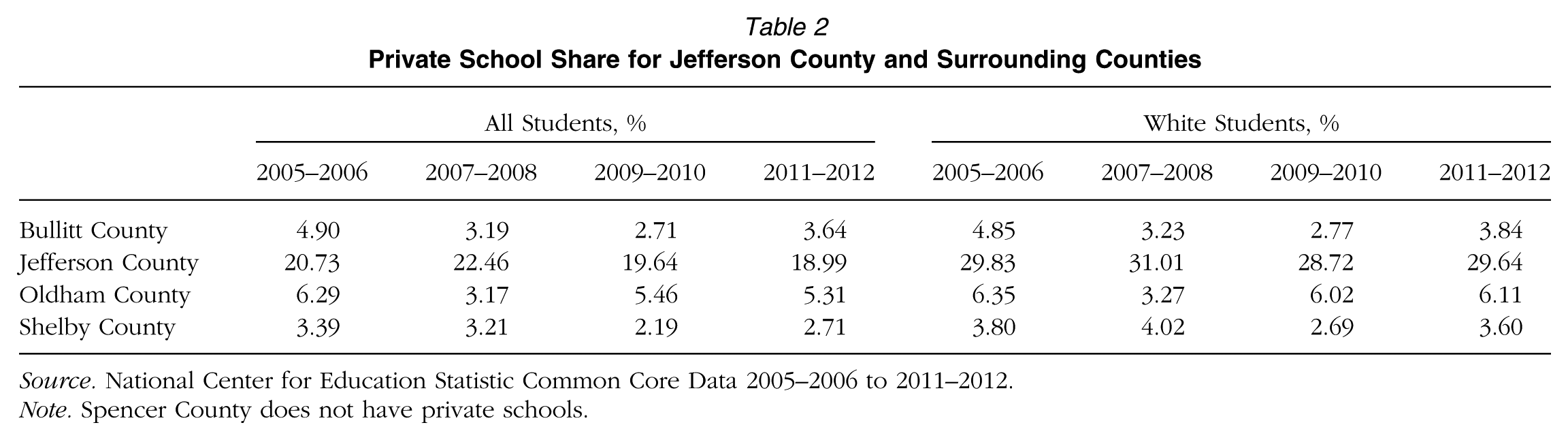
Source. National Center for Education Statistic Common Core Data 2005–2006 to 2011–2012.
Note. Spencer County does not have private schools.
Composition of District Enrollment
As mentioned, JCPS has largely been a Black-White district, although Latino student enrollments are increasing rapidly (Table 3). 5 The district has recently become majority non-White. Kindergarten and first-grade students have a higher share of students of color, including 11% who were Latino by 2014–2015; the percentage of White students in younger grades has declined more steeply than the overall enrollment. Surrounding districts experienced similar patterns in declining White enrollment of younger students. Black students remained steady at 36% of JCPS’s enrollment. The percentage of students receiving free or reduced lunch has fluctuated but is slightly lower in 2014–2015 than in 2006–2007.
Racial and Economic Composition of Jefferson County (Kentucky) Public Schools (JCPS) Enrollment, 2006–2007 to 2014–2015
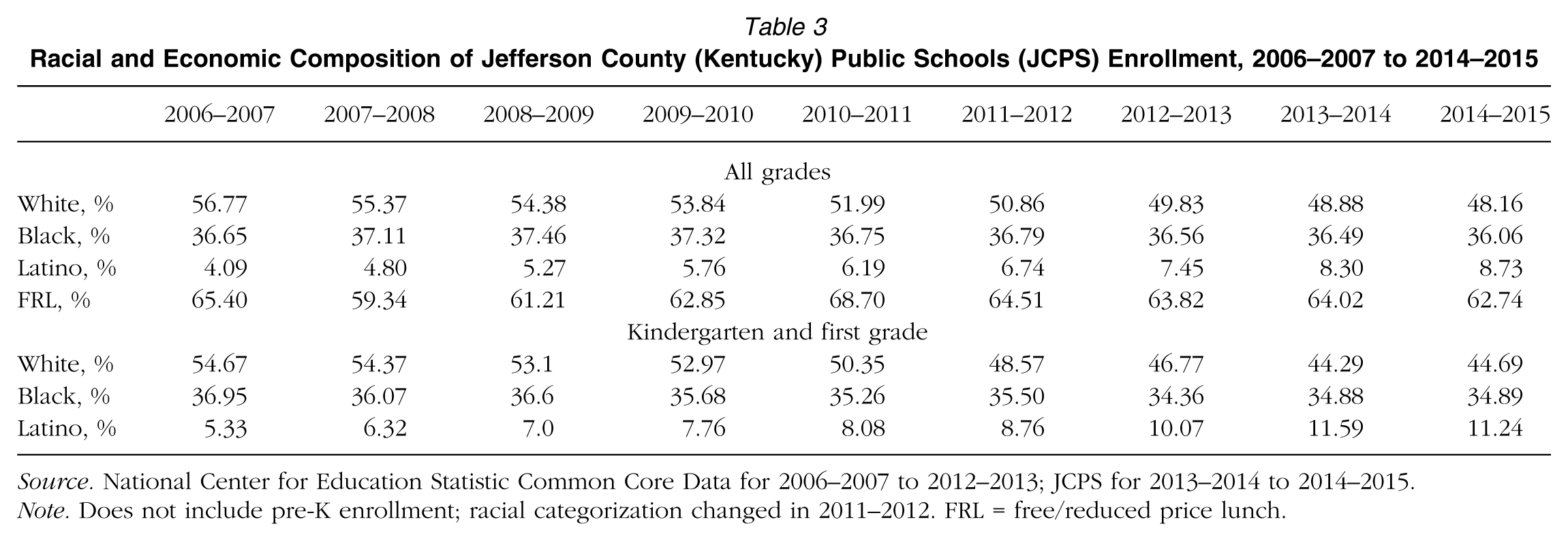
Source. National Center for Education Statistic Common Core Data for 2006–2007 to 2012–2013; JCPS for 2013–2014 to 2014–2015.
Note. Does not include pre-K enrollment; racial categorization changed in 2011–2012. FRL = free/reduced price lunch.
In sum, these data suggest that there has been no substantial movement away from the district since Parents Involved. Indeed, the district enrollment has increased during this time. This period also coincides with a national economic recession, which may help explain private school declines in Jefferson County (although there was a slight uptick in private school enrollment in some nearby counties). JCPS’s percentage of White students declined, particularly among younger students, but the district retains a large share of White students, a steady share of Black students, and growing Latino enrollment. The percentage of economically disadvantaged students remained constant.
Distribution of Students Across District Schools
To understand whether school-level patterns have shifted since Parents Involved, I use three measures: concentration, exposure, and multigroup segregation (H) to look at JCPS segregation by race and class. As context, I examined the residential segregation of young children in JCPS by their school cachement area using SABINS data and found substantial segregation: White students are in neighborhoods with over two-thirds White students while Black and Latino students’ neighborhoods are majority of same-race peers. The multigroup segregation index for children living in their cachement areas was 0.188, meaning that each area was approximately 19% less diverse than the overall county population. The geographic concentration of White, Black, and Latino students indicates a fair amount of residential segregation that any SAP would need to overcome to create diverse schools (Figure 1). In particular, the areas of highest concentration of Black and Latino students did not overlap. Moreover, Black students were concentrated in Louisville and the northwestern corner of the expansive district while White students were heavily concentrated in the east end and far southwest of the district.
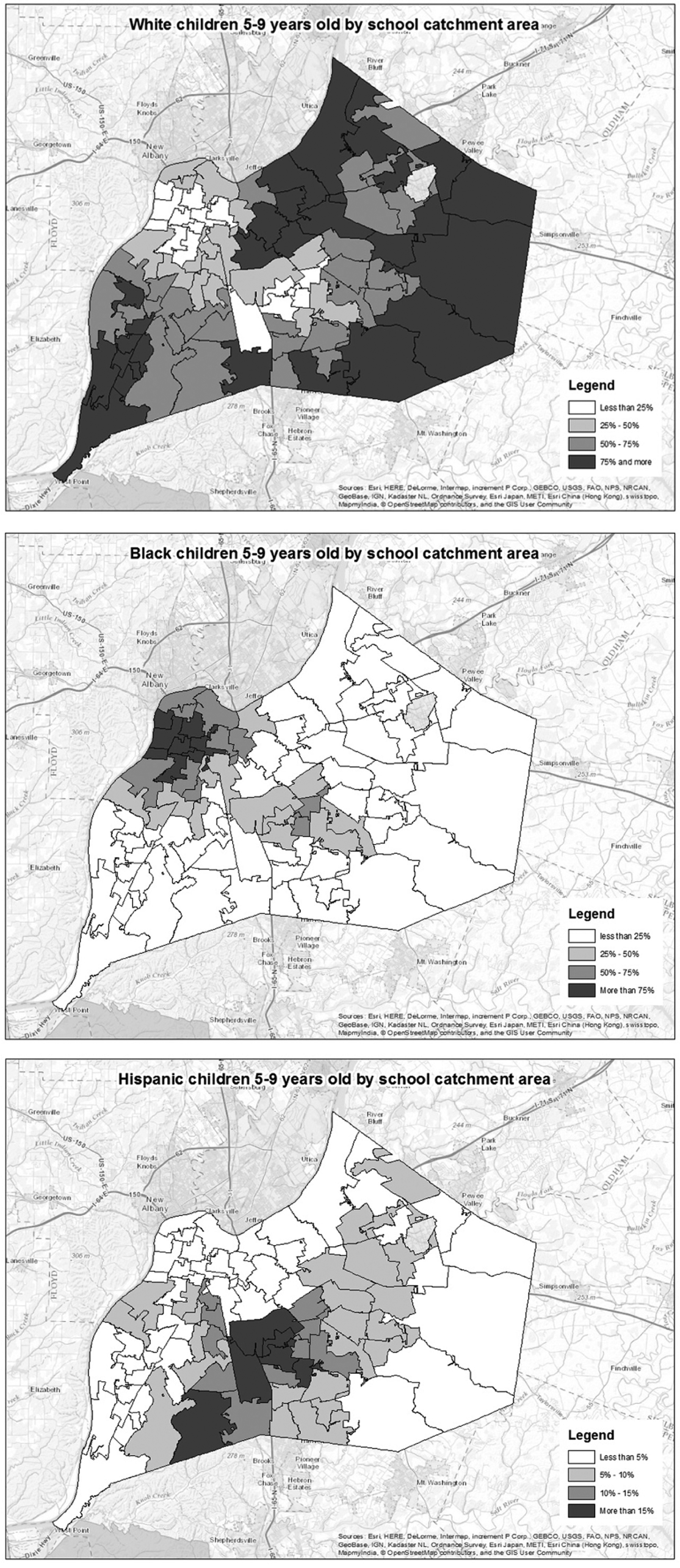
Residential distribution of children in Jefferson County by race.
Racial Segregation
As measured by racial concentration, JCPS has experienced low levels of segregation during this time, with a slight increase in the last year. No school during this time was 90% to 100% White, and less than 2% of students were in schools with 75% to 100% White students in 2014–2015. This percentage was lower than in 2006–2007. Conversely, higher and increasing shares of students were in minority concentrated schools. In 2014–2015, 3% of students were in 90% to 100% minority schools (Figure 2). The percentage of students in schools with more than 75% minority students has increased since 2006–2007, with a particularly sharp increase in the first year after Parents Involved and in 2013–2014 as the newest version of the SAP was implemented. In year 2 of the newest SAP implementation (2014–2015), the percentage of students in minority concentrated schools declined. Taken together, the percentage of students in largely White or minority schools (e.g., 75%–100% White or minority) is less than 15% of the JCPS enrollment, indicating low concentration.
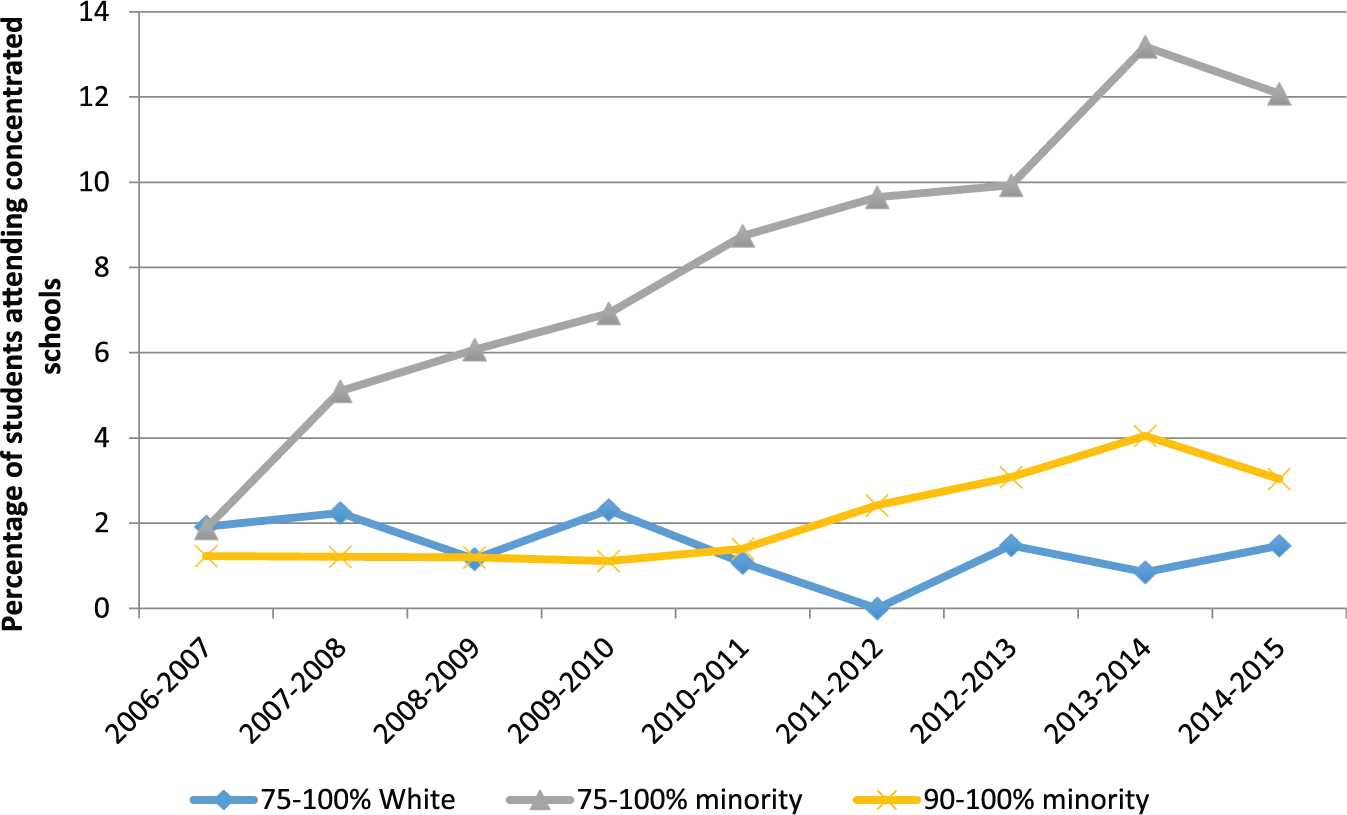
Percentage of students attending racially concentrated schools in JCPS.
The concentration of kindergarten and first graders was similar to all students with increasing percentages of students in racially concentrated schools since 2006–2007. Compared to the entire enrollment, the percentage of younger students in concentrated minority schools was lower while the percentage in concentrated White schools was higher.
When examining racial segregation using the exposure index, diverging trends appear for Black, Latino, and White students. While White and Black students’ exposure is relatively similar in 2006–2007—and Latino students most segregated—Black and White students’ exposure becomes less similar over time, suggesting increasing racial segregation. Latino students become more integrated with White students and less so with Black students.
A common measure of desegregation is exposure to White students. White isolation (White students’ exposure to other Whites) declined slightly but remained relatively constant. The typical White student attended a nearly 60% White school in 2006–2007, whereas by 2014–2015 it was 54.2% White (Table 4). By contrast, the percentage of White students in the typical Black student’s school declined much more rapidly (12 percentage points) by 2014–2015. Latino exposure to White students declined the least of all three groups. In 2014–2015, Latino students had higher exposure to Whites than Black students did, indicating more integration, marking a reversal with Black students who in 2006–2007 had higher exposure to Whites than Latino students did. Thus by 2014–2015, Latinos were more integrated with White students while Black students were the most segregated.
Interracial Exposure of JCPS Students

Source. National Center for Education Statistic Common Core Data from 2006–2007 to 2012–2013; Jefferson County (Kentucky) Public Schools for 2013–2014 and 2014–2015.
Patterns of exposure to Black students also illustrate segregation. The exposure of White and Latino students to Black students declined while Black isolation increased. In fact, the typical Black student had a higher percentage of Black students in their school than White students even though White students comprise a much higher percentage of the district’s enrollment. While Black and Latino students had similar exposure to Black students in 2006–2007, this diverged by 2014–2015 with Latino students having lower exposure to Black students. The decline in White and Latino exposure to Black students was even more pronounced among kindergarten and first graders.
Latinos attended schools with higher percentages of other Latino students, on average, although all three groups experienced relatively similar increases in exposure to Latinos since 2006–2007. Among the districts’ youngest students, exposure to Latinos for White and Latino students increased since 2006–2007.
Finally, there was a slight increase in multigroup segregation for all students immediately after Parents Involved. Segregation stabilized through 2011–2012 before increasing as the newest version of the SAP was implemented. Prior to 2013–2014, segregation was considered low (e.g., below 0.1 on a 0–1 scale). Schools were approximately 10% less racially diverse than the district in 2014. Multigroup segregation was somewhat higher for younger students (Grades K–1).
Segregation by Socioeconomic Status
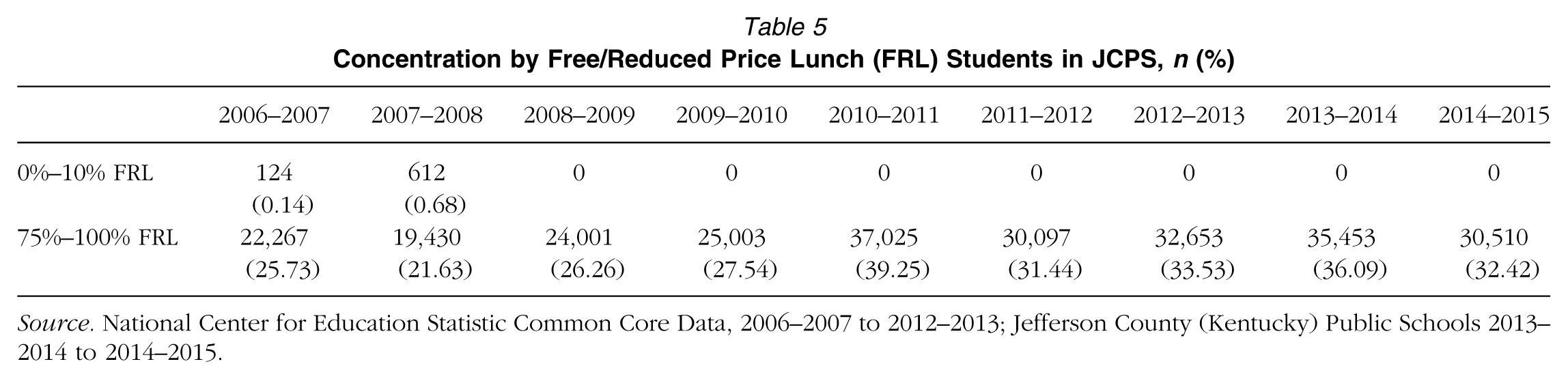
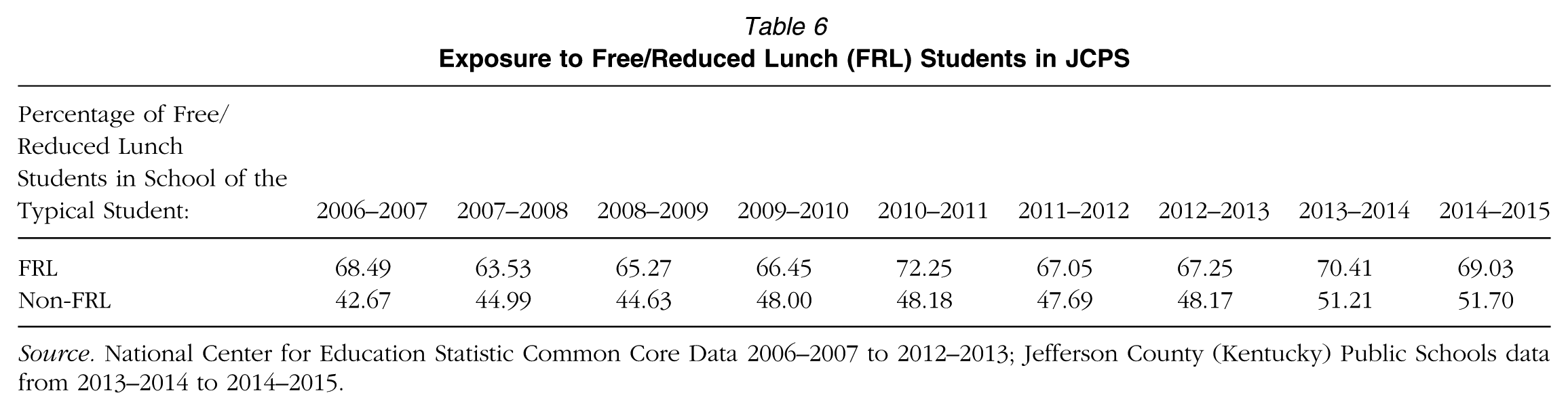
Due to the overall fairly high percentage of students receiving free and/or reduced price lunch, since 2008–2009, no schools had very low percentages (0%–10%) of low-SES students (Table 5). The percentage of students in schools with high concentrations of low-SES students (75%–100%) rose, although that declined in the last several years. As measured by exposure, however, the exposure of FRL and non-FRL students to low-SES students converged over time, particularly once the first generalized race-conscious plan was implemented in 2009–2010 (Table 6). The exposure of FRL students to other low-SES students remained constant while the exposure of non-FRL students to these students increased substantially. While the exposure for FRL and non-FRL students remained different in 2014–2015, these trends suggest lessening socioeconomic segregation.
Concentration by Free/Reduced Price Lunch (FRL) Students in JCPS, n (%)
Source. National Center for Education Statistic Common Core Data, 2006–2007 to 2012–2013; Jefferson County (Kentucky) Public Schools 2013–2014 to 2014–2015.
Exposure to Free/Reduced Lunch (FRL) Students in JCPS
Source. National Center for Education Statistic Common Core Data 2006–2007 to 2012–2013; Jefferson County (Kentucky) Public Schools data from 2013–2014 to 2014–2015.
Overlap of Racial and Economic Segregation
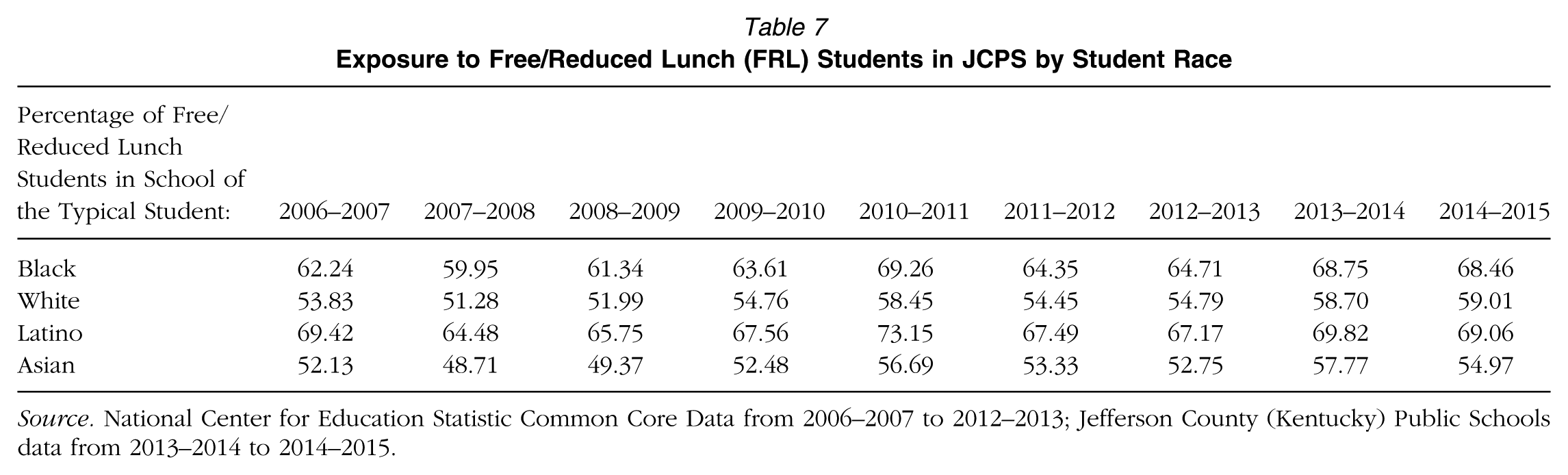
The relationship between school-level racial and economic segregation remained constant during this time. The exposure to low-SES students for students of most racial groups increased from 2006–2007 to 2014–2015 (Table 7). The increase for White students (who had less exposure to low-SES students) indicates more integration, while the higher increase for Black students is indicative of their intensifying segregation by race and class. Latino students experienced a slight decline in exposure to low-SES students. While differences in exposure to low-SES students by race remain, with the exception of Black students, patterns became more similar by 2014–2015. 6
Exposure to Free/Reduced Lunch (FRL) Students in JCPS by Student Race
Source. National Center for Education Statistic Common Core Data from 2006–2007 to 2012–2013; Jefferson County (Kentucky) Public Schools data from 2013–2014 to 2014–2015.
Two trends emerge regarding segregation within JCPS. First, racial segregation has grown, although the picture is mixed and remains low compared to national trends. The percentage of students in minority concentrated schools rose while the exposure of White and Black students became more dissimilar— and segregative—over time. Latino students became more integrated with Whites and segregated from Blacks since 2006–2007. Second, economic segregation appears stable with mixed findings about whether it is increasing. The race/poverty overlap remains fairly weak.
Alternative Assignment Scenarios
To examine the second research question, I assigned kindergarten students to schools under several hypothetical student assignment policies and then calculated segregation measures under these scenarios, the actual assignment, and where they enrolled. This comparison illustrates whether the SAP in 2014 assigned students in ways that are more or less integrative than other popular alternatives. 7
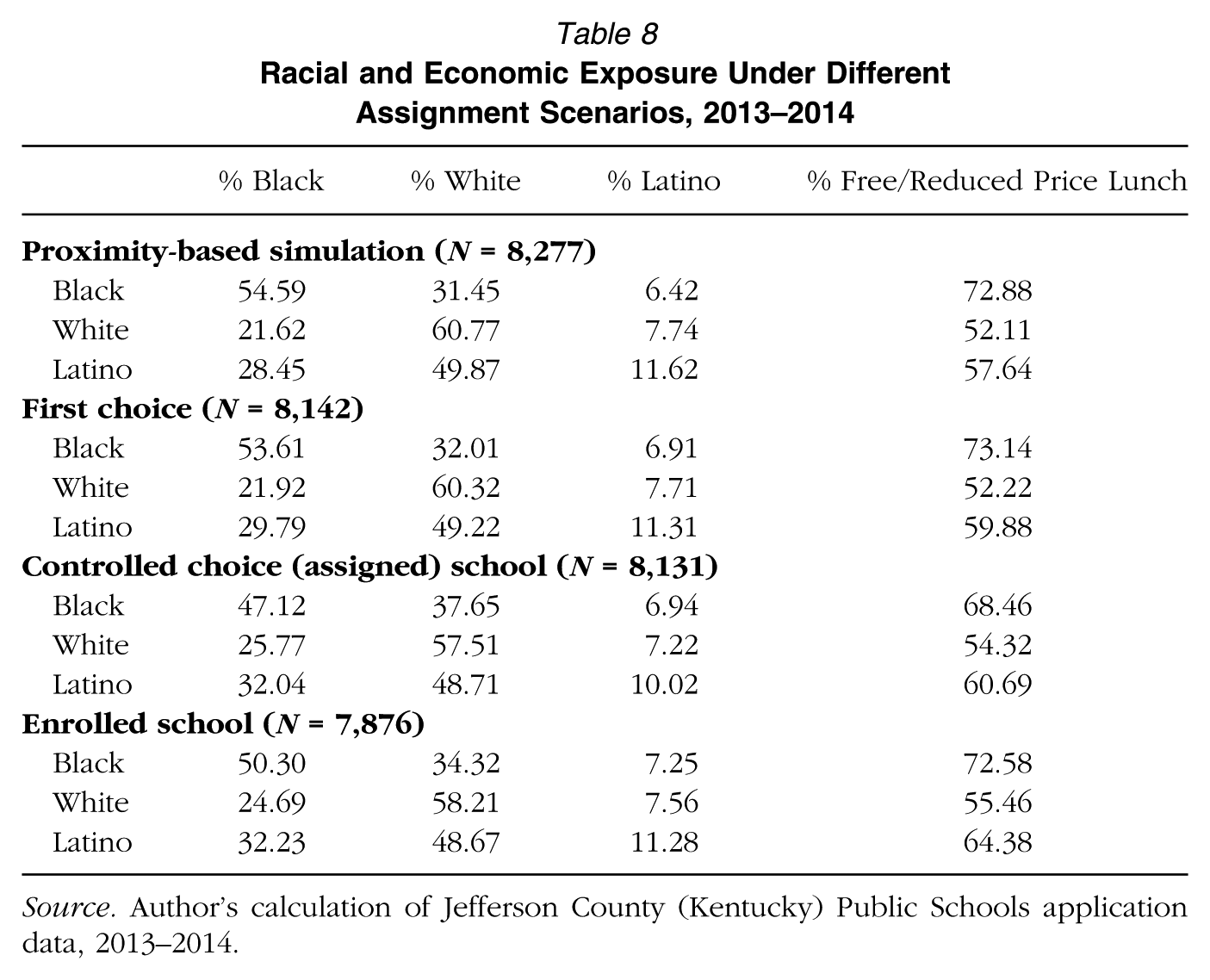
In the proximity-based scenario, students were assigned to the school closest to their home. Black, White, and Latino students in JCPS have the highest isolation in the proximity-based simulation than in any scenario (Table 8). The typical Black student in such a scenario would attend a school with approximately half the percentage of White students (31%) as the typical White student would (61%). Proximity-based plans often result in segregation when neighborhoods are segregated (Figure 1).
Racial and Economic Exposure Under Different Assignment Scenarios, 2013–2014
Source. Author’s calculation of Jefferson County (Kentucky) Public Schools application data, 2013–2014.
Isolation is slightly lower under the choice-only simulation, which grants all students their first choice (note, choices under the assignment policy receive a preference within the cluster, which may influence parents’ ranking). The isolation for Black students is about 1 percentage point lower than proximity-based; differences for White and Latino students are smaller.
When examining exposure under the actual assignments, isolation is lower for students of each racial group, particularly Black students. Compared to the aforementioned findings regarding the segregation of Latinos from Black students, under the controlled choice scenario, Latinos have higher percentages of Black students in their schools. White students have lower isolation but are still fairly highly isolated, and for all three groups, even the “lower” isolation under this scenario still reflects relatively high isolation. White and Latino students are being assigned to schools with very different racial composition, on average, than are Black students. Similar patterns are seen when looking at exposure of low-income students (not shown) in that they have higher exposure to low-income students than do more affluent students, but exposure of low-income and more affluent students is more similar (e.g., less segregated) under the controlled choice assignments than under the hypothetical assignments.
Finally, in comparison to the different assignments, the isolation of students in the school they enroll in is slightly more segregated than under the actual assignment. This may reflect the result of an appeals process after students receive their initial assignment or the way in which students choose not to enroll in JCPS that results in higher segregation.
When examining the various assignment scenarios using other segregation measures, segregation is less pronounced for the existing controlled choice assignment in comparison to other potential assignment scenarios. In particular, the controlled choice assignments have lower percentages of students in schools with either more than 75% Black/Latino students or more than 75% White (Figure 3). The multigroup segregation index is also lower under the controlled choice assignments (0.130) than under proximity (0.185) or first-choice (0.173) scenarios. There is a smaller difference in the percentage of students in economically concentrated schools under various assignment scenarios, and in fact, fewer students would be in schools with high shares of low-income students under a neighborhood-based plan than the existing controlled choice plan, although these differences aren’t substantial.

Racial and economic concentration under different assignment scenarios, 2013–2014.
Discussion and Implications
At a time of rising segregation and inequality, some school districts are trying to mitigate these trends by revising their SAPs to promote diversity, albeit within the current legal guidelines limiting the use of race. Whether these policies are effective takes on an increasing urgency because current population projections estimate there will be no racial/ethnic majority in the United States within a few decades—a reality that our public schools are already experiencing. Thus, understanding the effects of these shifts in policy is important because they could lead to improved student outcomes. This research advances our understanding of the impact of contemporary policy and legal developments facing a growing number of school districts that are seeking to achieve diverse schools. The policy examined is a new approach that promises to address pressing concerns to improve public schools’ ability to help all students learn and work together as enrollments become increasingly diverse. Indeed, JCPS has repeatedly cited the importance of its SAP to help it achieve goals such as improving the achievement and attainment of its students (JCPS, 2013).
Because of the visibility of JCPS’s integration efforts and the design of its plan, this study provides important evidence for educators, policymakers, district leaders, and advocates about whether the design of legally acceptable policies may help mitigate existing inequality. Through two years of implementing the second iteration of a SAP using race in a generalized way, JCPS has experienced steady enrollment growth with no evidence of flight by White and/or affluent students. While schools remain considerably diverse under this new generation of policies and are more diverse than if students were assigned under the simulated alternative scenarios, there is also evidence of growing racial segregation particularly for Black students; evidence is mixed regarding economic segregation but appears stable. JCPS segregation levels remain considerably lower than most large districts (Orfield et al., 2012). Importantly, this research, like that on Berkeley’s similar policy, finds Black and Latino students are not concentrated in the same schools. Indeed, in JCPS, the burgeoning Latino enrollment has become more similar to White students in their exposure to other-race students, particularly White students, and more segregated from Black students. To date, these findings suggest that this new generalized race-conscious policy might help navigate barriers to inequality, albeit perhaps not to the same extent as policies using individual student race/ethnicity.
This study also sheds light on how the generalized race-conscious controlled choice policy compares with other non-integration focused policy alternatives. Importantly, using the same group of students, their school preferences, and residence, simulated race-neutral assignment methods (e.g., proximity-based or choice-only) would result in higher racial and economic segregation than the district’s actual SAP. This provides real-time evidence of the benefit of JCPS’s controlled choice policy—and the potential of higher segregation if the integration policy ended. Similar analyses could provide useful evidence in other districts considering integration-focused SAPs.
This analysis of JCPS’s policy highlights broader lessons for the field, suggesting that a generalized use of race still matters in efforts to promote school diversity and integration. First, these findings are important because of what they do not show. If a district with a prior race-conscious SAP replaces it with a generalized race-conscious policy and cannot maintain diversity or if schools are not more diverse than under the simulated alternative assignment scenarios, then it is unlikely that other districts will be more successful with such policies. JCPS might be a “best case scenario” for student assignment polices after Parents Involved because of its strong policy design (e.g., applies to every student) and desegregation history (Reardon & Rhodes, 2011; Richards et al., 2012). JCPS has spent six years implementing two iterations of generalized race-conscious SAPs, which replaced the district’s policy that was race-only and used an individual student’s race/ethnicity for school assignments. To date, the district has experienced some increases in segregation under these new generalized, race-conscious policies, but segregation remains fairly low.
Beyond finding that there is not much segregation occurring, however, there are also some advantages to JCPS’s new SAPs in comparison to the one invalidated by the Court. In recent years, JCPS has experienced relative integration of Latinos and stable socioeconomic integration. There are also encouraging declines in segregation in the second year of implementing the newest iteration of the SAP. These findings are noteworthy given the district’s size, growing multiracial diversity, and residential segregation.
In the immediate aftermath of Parents Involved, considerable confusion existed about what remained legally permissible but also of the options, what would be most effective. At the time, virtually no evidence on the latter question existed. Not surprisingly, few districts without a history of race-conscious policies chose to implement such new policies. Thus, we do not know how generalized, race-conscious policies would fare in districts without prior policy history. However, this does shed light on the next generation of controlled choice options for districts that have either voluntarily implemented integration policies or have had their court-ordered desegregation efforts end. This study builds on a survey of districts using SES integration that found strong plans to be modestly successful when replacing race-conscious plans (Reardon & Rhodes, 2011) with a “by-product” of addressing SES segregation. The implications of this study for education policy and practice are by necessity dependent on how local policymakers use such evidence. Nevertheless, the study points the way in demonstrating that policies with a generalized use of race can be effective. Particularly if combined with federal-level policy directives emphasizing the effectiveness of integration (Cramer et al., 2015), data such as those provided in this study may make local leaders more willing to adopt such policies.
While Parents Involved caused districts to change their SAPs and represents a larger chilling effect on integration policies, at a time of growing student diversity and simultaneous “race-neutral” policy, district personnel may be unclear as to what policies will effectively support integration (Smith, 2015). In this regard, JCPS is typical of many public school districts. Looking into the future, the efforts of districts like JCPS could well prove to be significant for maintaining the status quo through their generalized, race-conscious SAP amid demographic, legal, and political trends that in the short term make school integration more challenging. Moreover, should the political/legal climate become more hospitable to race-conscious policies in the longer term, districts like JCPS would have more options and a demographic context with more possibilities. By maintaining a commitment to generalized race-conscious policies, such districts are limiting the growth of school segregation and potentially interrupting mechanisms that would perpetuate segregation. As such, the policies of JCPS as a large, multiracial district provide a useful example for other communities as we look to the next century of legal, political, and demographic transformation affecting the nation’s public schools.
Footnotes
Notes
E