



Abstract
Our nation’s classrooms have become increasingly racially and ethnically diverse. Given these demographic changes, many policymakers and practitioners have expressed the need for increased attention to how teacher diversity might be linked to reducing racial/ethnic differences in teachers’ ratings of social-emotional skills for students of color. Using the most recent nationally representative data, we investigated whether kindergarteners have different social-emotional ratings when they had a teacher whose racial/ethnic group was the same as their own. We found that having a teacher of the same race was unrelated to teachers’ ratings of children’s internalizing problem behaviors, interpersonal skills, approaches to learning, and self-control. However, students whose teachers’ race/ethnicity matched their own had more favorable ratings of externalizing behaviors. Results are discussed in terms of implications for school disciplinary policies.
Although people of color represent 41% of elementary and secondary students in the United States, this proportion drops to only 16.5% when looking at the population of elementary and secondary teachers (Ingersoll & May, 2011). Even within urban and high-poverty schools, which enroll a high proportion of students of color and where teachers of color might be expected to be employed, White teachers make up 71% and 65% of the faculty, respectively (Ingersoll & May, 2011). As the nation’s student population is becoming increasingly diverse, policymakers have raised concerns that the teaching force will fall even further behind at reflecting the demographics of the student population it serves. To address this discrepancy between the racial and cultural backgrounds of students and their teachers, a number of initiatives have been designed to increase representation of teachers of color within teacher recruitment and preparation programs. For example, nearly half of U.S. states have implemented teacher recruitment programs or policies that focus on attracting teachers of color (Achinstein, Ogawa, Sexton, & Freitas, 2010).
Underlying these calls for reforming teacher recruitment and retention are persistent disparities in school readiness between students of color and White students. Although most existing literature has focused on achievement differences (Fryer & Levitt, 2013), research has also reported racial/ethnic differences in teachers’ ratings of social-emotional skills for students of color. As operationalized in this study, social-emotional skills relate to children’s ability to manage their emotions (e.g., self-control) and behavior (e.g., externalizing behaviors), establish warm relationships with others (e.g., interpersonal skills), and display a positive attitude toward school (e.g., approaches to learning). García (2015) found that African American kindergarteners were rated by their teachers as having poorer self-control, worse approaches to learning, and higher frequencies of externalizing behaviors compared to White kindergarteners. In a similar vein, Latino children were rated by their kindergarten teachers as having poorer attention skills (Duncan & Magnuson, 2011) and lower persistence on classroom tasks than White children (West, Denton, & Reaney, 2001). From a policy standpoint, it is important to address these differences because studies have shown that social-emotional ratings upon kindergarten entry are predictive of a range of future outcomes, including achievement in later grades (Chetty et al., 2011), educational attainment (Lleras, 2008), and future income (Cunha & Heckman, 2009; Hall & Farkas, 2011). This study examines whether students of color have higher social-emotional ratings when they have a kindergarten teacher of the same race/ethnicity, and whether the findings vary by student or teacher characteristics.
Cultural Synchronicity as a Framework for Understanding Racial/Ethnic Differences in Social-Emotional Ratings
Some educators have argued that racial/ethnic differences in teachers’ ratings of social-emotional skills for students of color can be addressed through an increase in the diversity of the teacher workforce, which would allow for greater rates of student-teacher race matching for students of color. Proponents of student-teacher race matching contend that teachers of color whose race/ethnicity matches their students may be more effective than White teachers because of cultural synchronicity (Irvine, 1988), in which teachers of color are able to capitalize on a shared cultural background. Through interactions with their parents and others within their community, students of color learn to adopt social behaviors, linguistic conventions, and cognitive proficiencies that reflect the norms of their culture (Sameroff & Fiese, 2000). However, the schooling system, which is staffed predominantly by White teachers and administrators, tends to espouse White, middle-class standards of classroom deportment and behaviors (Morris, 2005), and these cultural discontinuities may lead students of color to struggle to conform to the academic and behavioral norms of school (Delpit, 1995). Cultural synchronization can enhance the educational outcomes of students of color because teachers of color whose race/ethnicity matches their students can leverage their common cultural experiences to create a culturally relevant learning environment and engage in culturally appropriate pedagogical strategies (Achinstein & Ogawa, 2011; Ladson-Billings, 1992).
Some researchers have argued that broad racial labels such as African American or Latino obscure the fact that members of the same racial group can have vastly different background experiences, cultural affiliations, language, and social class (Perez & Hirschman, 2009). Latinos, for example, encompass diverse groups such as Mexicans, Puerto Ricans, Cubans, and Central Americans (Etzioni, 2002), each of whom have unique assimilation histories and cultures. However, due to difficulties capturing cultural, economic, and social diversity within the same racial categories (Logan & Turner, 2013), the literature continues to proxy cultural synchronicity by determining whether there is matching between teachers’ and students’ race/ethnicity, broadly defined (Ingersoll & May, 2011).
To date, the notion of cultural synchronicity has been used primarily as a framework for understanding the academic achievement of students of color (Villegas & Irvine, 2010), but cultural synchronicity can also be thought of as a way to understand students’ motivations and behaviors. Many White teachers may fail to recognize the behavioral strengths of their students of color because those behaviors reflect the expected norms of another culture (Galindo & Fuller, 2010). This may result in students of color feeling marginalized or alienated because they do not perceive their schooling experiences as culturally relevant (Weinstein, Curran, & Tomlinson-Clarke, 2003). These types of cultural incompatibilities may strain student-teacher relationships (Crosnoe, Johnson, & Elder, 2004), which can result in impaired social-emotional outcomes and more frequent manifestations of disruptive behaviors (Monroe, 2005).
Studies Suggesting a Lack of Cultural Synchronicity Within Schools
One consequence of the lack of cultural synchronicity is that White teachers’ assessments of students of color may be less positive than those of White students. Studies have found this to be true for African American, Latino, and Native American students but not for most groups of Asian American students (Chang & Demyan, 2007; McGrady & Reynolds, 2013). For this study, we focus on African American and Latino students because there is evidence that teachers direct fewer positive and neutral comments toward African American and Latino students (Tenenbaum & Ruck, 2007), hold lower academic expectations for them (Oates, 2003), and perceive them to be less mature than White students (Alexander, Entwisle, & Thompson, 1987). Studies have also found that teachers rate African American and Latino students as having lower levels of attentiveness (McGrady & Reynolds, 2013), lower task orientation (Sbarra & Pianta, 2001), and poorer work habits than White students (McClelland, Morrison, & Holmes, 2000). 1
Of particular interest is whether assessments of externalizing behaviors, such as acting out, arguing, and getting angry, are particularly sensitive to the effects of having a teacher with a shared cultural background. Studies have shown that teachers assign students of color significantly lower ratings than White students in frustration tolerance (Sbarra & Pianta, 2001) and significantly higher ratings on aggressiveness and disobedience (Chang & Demyan, 2007). African American and Latino students also have considerably higher rates of suspensions and expulsions than do White students, with 15% of African American students and 6.8% of Latino students being suspended or expelled compared to 4.8% of White students (Hoffman, 2014). In addition, over 70% of the students involved in school-related arrests and referrals to law enforcement were African American or Latino (Rudd, 2014). Even after controlling for socioeconomic status, students of color continue to be overrepresented among expulsions and suspensions (McCray, Beachum, & Yawn, 2015; Taylor, Crego, & Lane, 2014).
In light of research showing that the racial/ethnic gaps in expulsions and suspensions are not explained by more frequent or more serious misbehaviors by students of color (Skiba & Williams, 2014), and that students of color are punished more severely than White students for the same offense (Rudd, 2014), some educators have questioned whether these findings can be traced to cultural misunderstandings that lead teachers to interpret African American and Latino students’ behaviors as “disruptive” (Noguera, 2008). For example, if a student of color is accustomed to responding to strong directive speech from his or her parents, then he or she may be considered noncompliant when responding to an indirect command from a White teacher (Delpit, 1995). There is some evidence that subjective interpretations may play a role in the racial gap in disciplinary outcomes, as White students are more likely to be referred to the office for observable, objective offenses (e.g., vandalism or smoking), whereas students of color are more likely to be referred for behaviors requiring subjective evaluations, such as defiance, excessive noise, or disrespectfulness (Gregory & Weinstein, 2008; Skiba et al., 2014).
Racial/Ethnic Congruence and Teachers’ Assessments of Students’ Social-Emotional Outcomes
From the perspective of cultural synchronicity, teachers of color may be able to draw upon their understanding of the lack of congruence between children’s home culture and school’s mainstream culture to consider a wider range of behaviors to be acceptable (Rimm-Kaufman, Pianta, & Cox, 2000) or to address any misbehaviors in a manner that does not further escalate tensions (Monroe & Obidah, 2004). If cultural synchronicity does indeed confer benefits to students of color in terms of a shared cultural understanding, then we would expect to observe more favorable assessments of students of color by teachers of color, especially with respect to externalizing behaviors. The empirical literature is generally sparse in this area, and the existing studies have reported mixed results. Analyzing ECLS-K:1999, Downey and Pribesh (2004) found that African American students, on average, were rated as exhibiting more externalizing behaviors than White students, but when same-race matching was taken into account, African American teachers rated their African American students as having fewer behavioral problems than White teachers rating White students. Using NELS:88, Dee (2005) analyzed students in eighth grade to examine how teachers of different races evaluated the same-race student. He found that students who did not share the race of their teacher were more likely to be labeled as disruptive and inattentive. By way of contrast, Bradshaw, Mitchell, O’Brennan, and Leaf (2010) examined data from 21 elementary schools and found that the racial match between students and teachers did not reduce the rate of disciplinary referrals among African American students.
Other relevant work includes empirical examinations of how race/ethnicity interactions affect teacher assessments of other social-emotional skills. Using ECLS-K:1999, Jennings and DiPrete (2010) analyzed data on kindergarten and 1st-grade students and found no effect for African American or Latino students of having a same-race teacher on a composite social/behavioral scale composed of approaches to learning, self-control, and interpersonal skills. In contrast, using 10th-grade data from NELS:88, Ehrenberg, Goldhaber, and Brewer (1995) examined teachers’ ratings on a composite scale that included items about students’ ability to work hard and students’ chances of going on to college. They found that relative to White teachers, Latino and African American teachers rated students of their same race/ethnicity more favorably. These results were similar to that of McGrady and Reynolds (2013), who analyzed 10th-grade data from the nationally representative ELS:2002. They reported that African American teachers rated African American students’ academic progress more positively than did White teachers and that Latino teachers were more likely than White teachers to believe that Latino students related well to others.
Current Study
The purpose of this study was to examine whether students of color have higher social-emotional ratings when they have a kindergarten teacher whose racial/ethnic group is the same as their own. Our study contributes to the literature on cultural synchronicity and student-teacher race matching in two ways. First, we applied this framework to assess the most current nationally representative dataset available. National-level efforts to diversify the teacher workforce merit exploration with national-level data in order to make relevant conclusions. Although some studies have previously examined the impact of student-teacher race matching using large-scale data (e.g., Dee, 2005; Downey & Pribesh, 2004; Ehrenberg et al., 1995; Jennings & DiPrete, 2010; McGrady & Reynolds, 2013), these datasets were collected more than a decade ago and preceded many critical schooling policies and social trends that have shifted classroom curriculum and demographics. For example, these datasets preceded the implementation of No Child Left Behind, which increased the prominence of standards and accountability in K–12 schools nationwide and raised concerns about whether the heightened focus on academics may negatively impact the attention span, self-regulation, and interpersonal skills of students (Stipek, 2006). In addition, these datasets predated the marked increases in the Latino population, which has accounted for over half the growth in the total U.S. population between 2000 and 2010 (Humes, Jones, & Ramirez, 2011). Finally, none of these prior studies that have used national-level data explored these issues in the framework of cultural synchronicity as we have done.
Second, our study focuses on kindergarten students. We focused on kindergarten because studies have shown that teachers’ assessments of children during kindergarten may influence their behaviors and outcomes in later years (Meisels, Steele, & Quinn-Leering, 1993). In a seminal study, Rist (2000) found that African American children who did not conform to White middle-class norms in terms of appearance, behavior, or family structure were judged by their kindergarten teachers to be less likely to be successful at school and received less teaching time, attention, and reward-directed behavior. Furthermore, realizing the self-fulfilling prophecy of their teachers’ low expectations, children who had been judged to be less likely to be successful at kindergarten demonstrated lower academic achievement and more disruptive behaviors at second grade. Thus, it is important to determine whether there is evidence of cultural incongruities early on in a student’s educational career that can affect teachers’ expectations and assessments of students and to put policies in place that foster and support an educational environment that sets all children on a trajectory of school success.
Method
Sample
We analyzed data from the Early Childhood Longitudinal Study–Kindergarten Class of 2010-2011 (ECLS-K:2011). Created by the National Center for Education Statistics (NCES), ECLS-K:2011 has the most current data available for young children and their schooling experiences in early education. During the 2010–2011 academic year, NCES collected data about children in kindergarten through assessments and parent, teacher, and school administrator surveys.
Assessments and surveys were administered in the fall and spring of the kindergarten school year. ECLS-K:2011 used a three-stage stratified sampling strategy in which geographic region represented the first sampling unit, public and private schools represented the second sampling unit, and students stratified by race/ethnicity represented the third sampling unit. For this study, we refined our sample of student-level observations based on three primary criteria. First, we analyzed only African American and Latino teachers and students, with White teachers and students serving as the reference group. We did not include Asian American, Native American, or Pacific Islander teachers and students in our study because there were very few same-race student-teacher matches for these groups (although our results are robust to their inclusion in the analyses). Second, in order to identify student and teacher race/ethnicity and include student controls in our regression specifications, we required non-missing data on relevant teacher and student background characteristics and at least one social-emotional assessment. Third, each student must have had at least one math or reading test score with a corresponding math or reading teacher assessment in both the fall and spring so that they could be included in the empirical test for teacher bias (appendix available in the online journal). These restrictions resulted in 9,140 students for the analytical sample. To comply with NCES reporting standards, sample sizes were rounded to the nearest 10.
Determination of Race/Ethnicity
Students’ race/ethnicity was designated by NCES based on a combination of parent and school reports. Teachers’ race/ethnicity was self-reported.
Social-Emotional Outcomes
In fall and spring of the kindergarten year, teachers completed survey assessments on those students in their classrooms who were in the ECLS-K:2011 sample. The surveys contained a series of question items that were then combined to create the social-emotional scales. In this study, we analyzed all teacher-rated social-emotional scales in the dataset. These social-emotional scales were constructed based on the Social Skills and Rating System (SSRS; Gresham & Elliott, 1990). The National Center for Education Statistics adapted the SSRS to create its own teacher Social Rating Scales (SRS). The SRS in the dataset consisted of five scales that gauged the extent to which students exhibited various social-emotional skills. The 5-item externalizing behaviors scale assessed the frequency with which a child argued, fought, got angry, acted impulsively, and disturbed ongoing activities. The 4-item internalizing behaviors scale measured the extent to which the child exhibited anxiety, loneliness, low self-esteem, and sadness. The 5-item interpersonal skills scale measured the frequency with which a child got along with others, formed and maintained friendships, helped other children, showed sensitivity to the feelings of others, and expressed feelings, ideas, and opinions in positive ways. The 7-item approaches to learning scale rated the frequency with which the child kept his or her belongings organized, showed eagerness to learn new things, adapted to change, persisted in completing tasks, paid attention, and followed classroom rules. The 4-item self-control scale measured the extent to which the child was able to control his or her temper, respected others’ property, accepted his or her peers’ ideas, and handled peer pressure.
Teachers’ responses to each 4-point Likert-type item were averaged to create scale scores. Note, however, that individual question items were not available, even in the restricted user’s manual of the dataset. Higher scale scores denoted more frequently exhibited behaviors. For the externalizing and internalizing scales, a higher score reflects a less favorable outcome. On the three other scales, a higher score reflects a more favorable outcome. All the scales had high internal consistency, with the alpha reliability coefficients ranging from .79 to .89 (Tourangeau et al., 2012). We limited our sample so that the same teacher assessed each child in the fall and spring surveys, thereby providing for consistency between assessment waves.
Control Variables
Student Demographic Characteristics
Our analysis included control measures for a commonly upheld set of demographics associated with differences in social-emotional ratings, including gender, age, race, and an indicator for English language learner (ELL) based on the primary language spoken at home (Duncan & Magnuson, 2011; García, 2015). We also included a parental-rated scale of child health (1 being highest, 5 being lowest) because poor health has been linked to weaker social-emotional functioning (Meijer, Sinnema, Bijstra, Mellenbergh, & Wolters, 2000).
Student Care
Research supports the link between child care in the years prior to kindergarten and social-emotional outcomes in kindergarten (Loeb, Bridges, Bassok, Fuller, & Rumberger, 2007; Magnuson, Ruhm, & Waldfogel, 2007; Yamauchi & Leigh, 2011), although the literature is mixed with respect to the direction of this relationship. Nonetheless, we included the following commonly employed childcare measures as indicators for care in the year prior to kindergarten: center-based care, Head Start, non-relative care, and relative care (parental care serves as the reference group). We also included an indicator for whether the child has ever participated in any type of center-based care as well as the number of non-parental weekly care hours to control for the fact that intensity of care might be linked to social-emotional outcomes in kindergarten (Loeb et al., 2007).
Family Characteristics
Family characteristics included socioeconomic status (SES), family structure, and home environment. Research has linked lower SES to worsened social-emotional functioning in children (Bradley & Corwyn, 2002). Therefore, we included an NCES-created composite of SES, which was composed of items relating to parental educational attainment, occupational prestige, and family income. We separated this composite into quartile indicators for our regression analysis. We also included information about whether two biological or adoptive parents were present in the student’s home, as parental structure can influence children’s social-emotional development (Amato, 2005; Kupersmidt, Griesler, DeRosier, Patterson, & Davis, 1995).
In addition, we replicated two scales from Votruba-Drzal, Li-Grining, and Maldonado-Carreño’s (2008) study that assessed the quality of the home environment. We controlled for home environment because previous studies have found the quality of the home environment to be positively correlated with students’ social-emotional outcomes (Harden & Whittaker, 2011). The first scale consisted of 10 items measured on a 4-point Likert-type metric. The scale assessed the frequency with which parents engaged the child in activities that promoted cultural, academic, or social enrichment. These activities included playing games, singing songs, and reading books. The second scale, composed of 15 dichotomously scored items, assessed children’s access to learning materials. This scale assessed whether in the past month the child engaged in activities such as visiting a book store, taking music lessons, or attending tutoring lessons. These composite scores were transformed to have a mean of 0 and standard deviation of 1 within the sample.
Classroom Characteristics
We also included a key classroom characteristic that varied by student: the percentage of same-race peers in the classroom. Previous literature has found a positive association between having more peers of the same race/ethnicity and positive socio-emotional outcomes (Benner & Crosnoe, 2011). Because the proportion of same-race classmates was highly correlated with having a same-race teacher for students of color in our sample (p = .55), it was imperative to control for this percentage to separately identify the association between having a same-race teacher and student outcomes.
Analytic Approach
As conceptualized in Figure 1, social-emotional outcomes were influenced by cultural synchronicity, as represented by the teacher-student race matching measure, as well as other key child-level and classroom control variables. Mapping from our conceptual model to an analytic model that would allow us to empirically assess whether students of color demonstrated social-emotional gains from having a teacher of color of the same race/ethnicity, we used a gain-score model of student-level social-emotional outcomes. We adopted a similar approach to other studies that have examined student-teacher race matching (Fairlie, Hoffman, & Oreopoulos, 2014) and estimated the gain-score (spring rating minus fall rating),

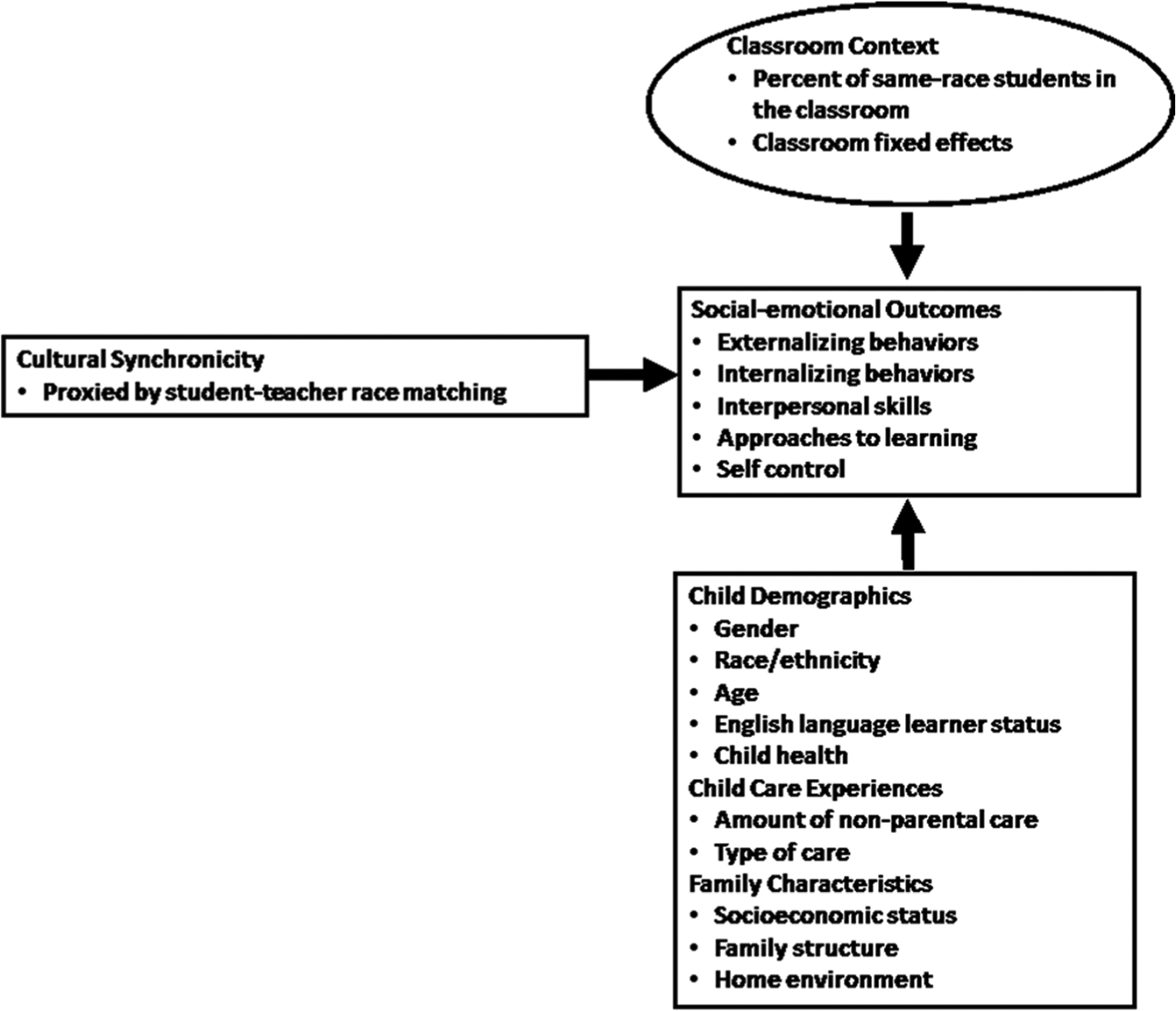
Theoretical model linking cultural synchronicity to social-emotional outcomes.
where students were indexed by i and classrooms by c. In the model, the variable
Of primary interest was the parameter
In our preferred specification, we included classroom fixed effects. That is, we included indicator variables for each classroom with one classroom omitted to serve as the reference category. Including indicators for classrooms means that we controlled for classroom-to-classroom (and hence teacher-to-teacher) differences in the sample. It is important that students in the kindergarten classes in ECLS-K were contained in one classroom, and they did not move to other classrooms throughout the day. Thus, by including classroom fixed effects, we have held constant all unobserved classroom-level experiences and teacher influences during the school year. Controlling for classroom-specific factors alleviates issues such as the possibility that different instructors systematically assessed their students differently. Note that when holding classroom factors constant, any classroom-level variables would drop away as they would be collinear with the indicator for classroom. This means that we dropped the teacher of color indicator variable as it was collinear with this classroom indicator. We also allowed the person-of-color student-teacher match to vary by whether the match was of the same race/ethnicity or different races/ethnicities. This model with classroom fixed effects,

where the indicator
By holding constant all classroom-specific factors with the classroom fixed effect, the key source of variation used to identify the effects of student-teacher race matching for students of color (the coefficients
Finally, in all models, standard errors were clustered at the classroom level. Because students in the same classroom shared common but unobservable characteristics and experiences, clustering student data at the classroom level provided for a corrected error term given this non-independence of student observations. In addition, observations were weighted using ECLS-K:2011 sample weights (W12T0) to estimate representative effects.
Given our preferred specification, there were two primary threats to identifying the relationship between student-teacher race match and student outcomes: nonrandom sorting of students to classrooms and race-based teacher bias in teacher-assessed outcomes. Our tests for sorting and bias, which can be found in the online appendix, suggest that neither of these issues were significant factors in our analyses.
Results
Descriptive Statistics
Table 1 presents descriptive statistics for the outcomes used in the main empirical analysis. Panel A of Table 1 gives student and teacher composition by race/ethnicity and Panel B gives the mean and standard deviation of social-emotional outcomes by race/ethnicity. Approximately 14% of all students were students of color matched with teachers of color; within this subsample, 12% were same-race matches and 2% were matches of different races.
Descriptive Statistics
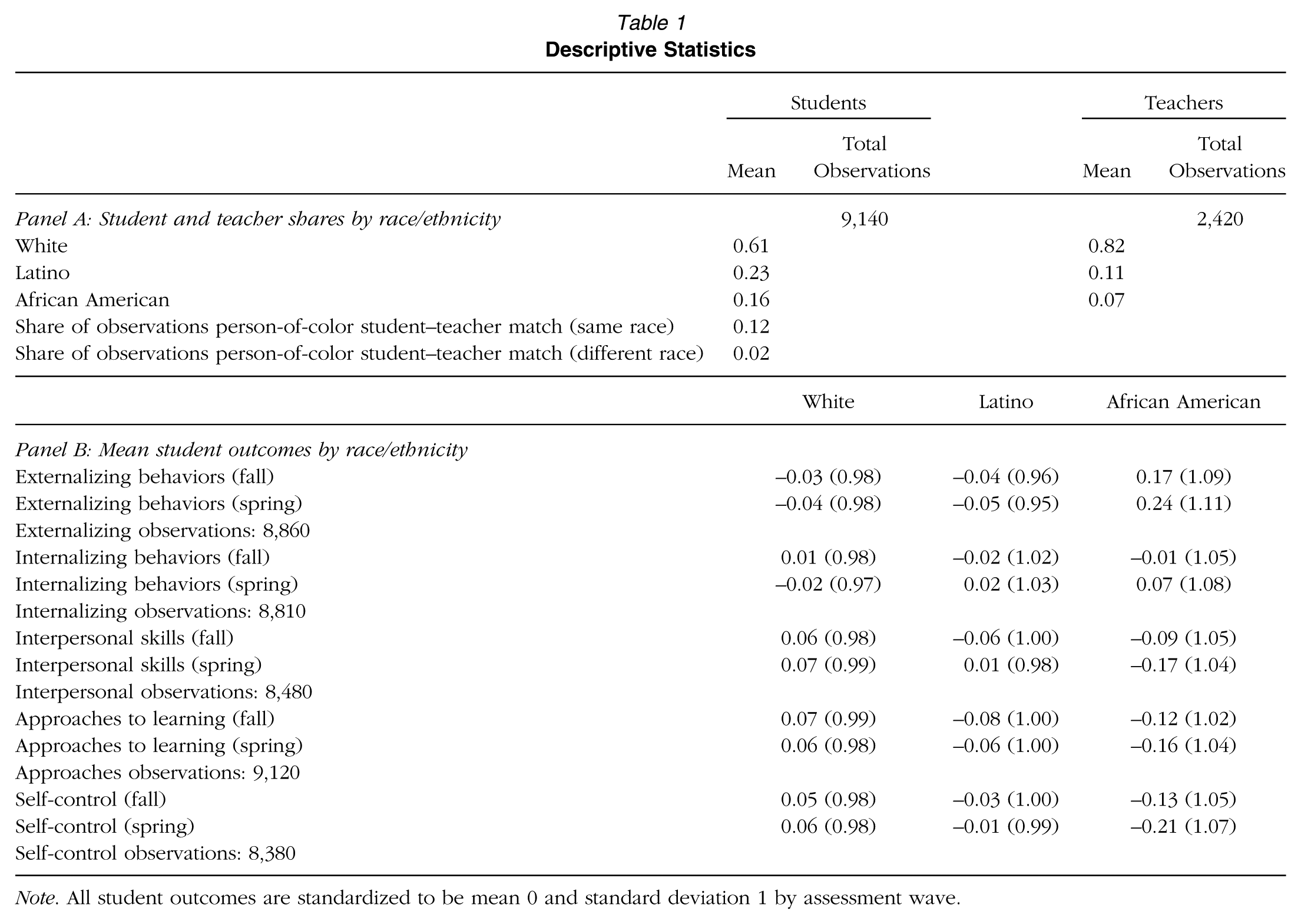
Note. All student outcomes are standardized to be mean 0 and standard deviation 1 by assessment wave.
Social-Emotional Outcomes
We report estimates of the same-race and different-race interaction variables for the five social-emotional gain-score outcomes in Table 2. Column (3) gives estimates from the preferred specification described in equation (2). Classroom fixed effects and student controls were omitted from the regressions in Column (1). The importance of controlling for unobserved classroom influences is evident in column (2) where classroom fixed effects were added; the magnitudes of the point estimates change drastically moving from column (1) to column (2). Adding student controls in column (3), on the other hand, did not substantially affect the estimates or their precision. The same-race coefficient was null for internalizing behaviors, interpersonal skills, approaches to learning, and self-control. However, the same-race coefficient for externalizing behaviors was significantly different from zero and indicates that the student of color versus White gap in disruptive behavior improved by 0.26 standard deviations for students of color matched with a same-race teacher. We found no significant effect of the different-race person-of-color interaction on student outcomes in our preferred model.
Estimated Effects of Teacher-Student Race Matching

Note. Each pair of same race and different race interactions represents a separate ordinary least squares regression.
p < .05.
Externalizing Behaviors
Differences by specific race and ethnicity
Because cultural synchronicity may be most demonstrably manifested on teachers’ assessments of students’ externalizing behaviors, we focused the rest of our analysis on externalizing behaviors. In the previous analysis, we assumed that the coefficient associated with same-race interaction between African American teachers and students was equivalent to the coefficient associated with same-race interaction between Latino teachers and students. To further analyze specific teacher-student race/ethnicity interactions, the person-of-color student-teacher indicator was broken down into four categories: Latino student-Latino teacher, African American student-Latino teacher, Latino student-African American teacher, and African American student-African American teacher. The results of this analysis are presented in Table 3 for externalizing behaviors. The associated p value for a t test for the equality of the Latino-Latino and African American-African American interaction effect is also presented in Table 3. Both same-race interaction coefficients were significantly different from zero. Although the African American same-race effect was nearly double the magnitude of the Latino same-race effect, we could not reject the equality of these two coefficients. Additionally, we found no statistically significant effect of either different-race interaction.
Estimated Effects of Specific Teacher-Student Race Interactions on Externalizing Behaviors
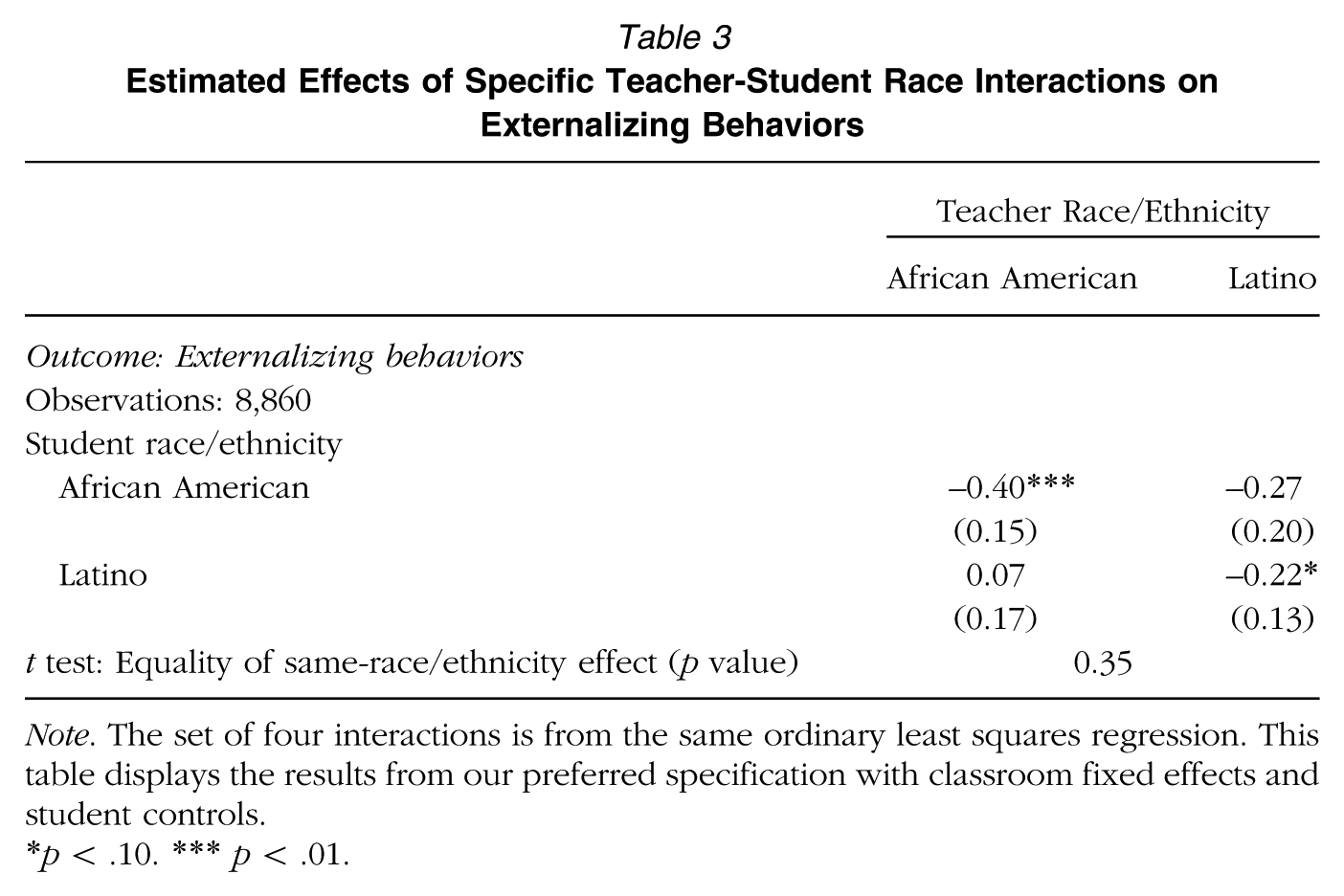
Note. The set of four interactions is from the same ordinary least squares regression. This table displays the results from our preferred specification with classroom fixed effects and student controls.
p < .10. ***p < .01.
Heterogeneity
To examine what might be driving the relationship between person-of-color teacher-student race match and externalizing behaviors, we broke down the same-race interaction by student and family traits in Table 4. The first column presents results for the aggregated same-race interaction term for teachers and students of color and the second and third columns describe the African American student-teacher match and the Latino student-teacher match, respectively. For comparison, we provide the baseline estimates from column (3) of Table 2 and Table 3 in the first row.
Estimated Effects of Teacher-Student Race Matching on Externalizing Behaviors, by Student and Family Traits
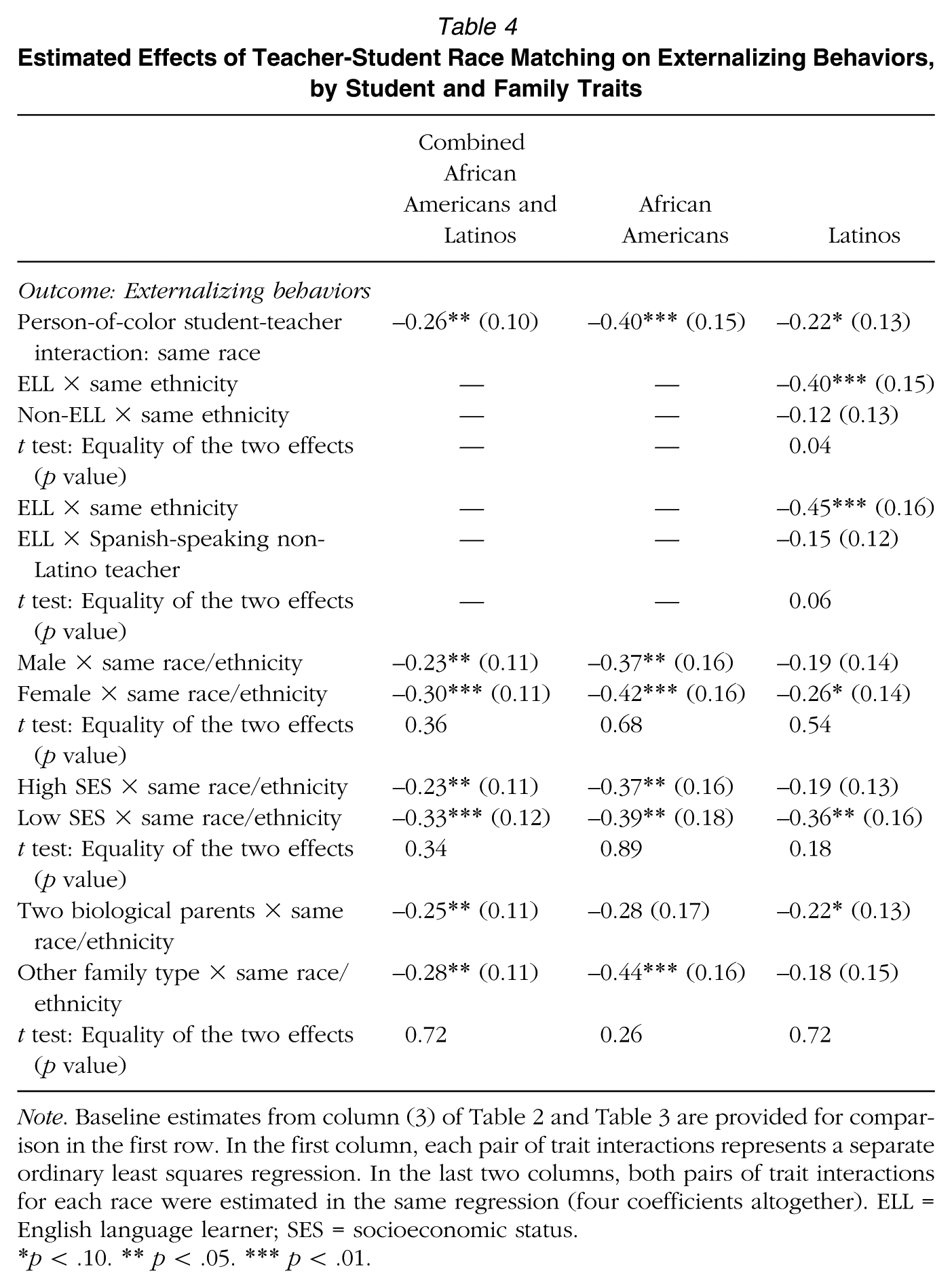
Note. Baseline estimates from column (3) of Table 2 and Table 3 are provided for comparison in the first row. In the first column, each pair of trait interactions represents a separate ordinary least squares regression. In the last two columns, both pairs of trait interactions for each race were estimated in the same regression (four coefficients altogether). ELL = English language learner; SES = socioeconomic status.
p < .10. **p < .05. ***p < .01.
As Latino teachers may be able to better connect with Latino ELL students working to overcome a language barrier at school, we separated the same-race interaction for Latino students by ELL status. We restricted our analysis to Latino ELLs because they made up over 99% of all ELLs with a same-race teacher. On average, Latino ELL students exhibited a relatively large, favorable response to Latino teachers; race-matched ELL students experienced an improvement in externalizing behaviors of 0.40 standard deviations, whereas the effect on non-ELL students was not statistically different from zero. Furthermore, the null hypothesis that the ELL and non-ELL same-race interactions were equal was rejected at the 5% level.
Thus far, we have used sharing the same race/ethnicity exclusively as our proxy for cultural synchronicity between teachers and students. Another way that teachers may form connections with students, irrespective of race/ethnicity, is through language. We explored this notion by creating a new category of Spanish-speaking African American and White teachers and examined the interaction between these Spanish-speaking teachers and Latino ELL students. Interestingly, we found no evidence that Latino ELL students with non-Latino, Spanish-speaking teachers improved their externalizing behavior ratings. We also found no significant difference in the same-race interaction by gender, SES (students are designated as either high or low SES based on whether their SES composite score was above or below the SES median for students of color in a classroom with a teacher of the same race/ethnicity), or family structure.
Discussion
As students of color continue to grow as a percentage of the U.S. population, many policymakers have called for increased representation of people of color among the teacher workforce in order to reflect these changing student demographics (Ingersoll & May, 2011). To date, much of the empirical research about cultural synchronicity and student-teacher race matching has focused on achievement outcomes (Villegas & Irvine, 2010). Our study is one of the first empirical studies to examine students’ social-emotional outcomes from a cultural synchronicity perspective while simultaneously employing large-scale national data as well as tests for teacher bias and student selection into classrooms. Analyzing the most current national-level dataset of U.S. kindergarteners, we found that same-race matching was unrelated to teachers’ ratings of children’s internalizing problem behaviors, interpersonal skills, approaches to learning, or self-control. This is consistent with the findings from earlier studies (Jennings & DiPrete, 2010). The mostly null findings may reflect the limitations of our analysis, where we could not adequately capture variation in cultural experiences for members of the same racial/ethnic group, so we had to proxy cultural synchronization through broad categorizations of race/ethnicity matching.
That being said, having a student-teacher race match for students of color was associated with a decline in externalizing behaviors by 0.26 standard deviations. This is comparable to the initial (fall) regression-adjusted gap between students of color and White students in disruptive behavior of 0.27 standard deviations, which suggests that having a student-teacher race match for students of color nearly extinguished the externalizing behavior gap by the end of kindergarten. Furthermore, using Cohen’s (1988) guidelines, where a regression coefficient of 0.15 is considered a medium effect and a regression coefficient of 0.35 is considered a large effect, the effect sizes for student-teacher race match are considered medium for Latinos and large for African Americans.
Notably, Latino ELL students demonstrated much lower externalizing behaviors when paired with a Latino teacher, but there was no improvement in externalizing behaviors when Latino ELL students were paired with a Spanish-speaking, non-Latino teacher. This finding bolsters the argument that cultural synchronicity and a shared cultural identity and background, as opposed to an ability to communicate using a common language, are key to reducing externalizing behaviors.
Given these findings, there are three important implications from our study. First, the results suggest that increasing the representation of teachers of color may be a promising way to address externalizing behaviors. Policies regarding disciplinary actions have come under scrutiny in light of studies showing that students of color are suspended or expelled at three times the rates of White students (U.S. Department of Education for Civil Rights, 2014). In schools that reported expulsions under zero tolerance policies, Latino and African American students made up 45% of the student population but represented 56% of the students expelled under such policies (U.S. Department of Education for Civil Rights, 2014). Studies have shown that many of the disciplinary actions are for minor misbehaviors such as insubordination, which may reflect subjective or biased interpretations on the parts of teachers (American Psychological Association Zero Tolerance Task Force, 2008). Our study provides some support for this notion, as students of color were less likely to be perceived as acting out when assessed by their same-race teachers. This finding suggests that the disparate impact of disciplinary policies on students of color could be alleviated by hiring teachers who share the same cultural background and experiences as their students and who may interpret externalizing behaviors in the context of students’ cultural backgrounds.
Second, this study found that student-teacher race matching plays a significant role in student behavior at the onset of schooling. Therefore, elementary schools can use this information to help design environments that are most supportive for student behavior given a set of student populations and teaching resources. In light of the fact that same-race matching could almost erase the gap in externalizing behaviors by the end of the academic year, this study urges that interventions be implemented early in the school year, thereby strengthening the potential for school success from the very start of formal education.
Finally, the results suggest increased training for all teachers to become more familiar with the diverse cultural backgrounds of students of color. Many of the behavioral management strategies found in teacher education and professional development programs reflect mainstream values and may not adequately capture culturally responsive strategies that reflect the speech patterns, voice tones, word choices, and facial expressions familiar to students of color (Monroe & Obidah, 2004). In a review of school-wide positive behavior supports that emphasized culturally responsive practices, Fallon, O’Keeffe, and Sugai (2012) recommended several best practices that may increase teachers’ self-awareness of their own biases that could alleviate unduly harsh assessments of students’ externalizing behaviors. These strategies include identifying the characteristics of students who are most likely to be punished, encouraging students to share their home culture and learning histories so that teachers may better understand students’ motivations for their behaviors, and refraining from punishing students for behaviors that may be appropriate in other contexts. As policymakers and educators grapple with how to mitigate the disproportionate racial/ethnic patterns in suspension and disciplinary actions, adopting diverse behavioral management strategies that reflect the cultural backgrounds of students of color may prove to be a particularly promising strategy, although more research is warranted to understand whether different approaches are needed for Latinos and African Americans, given the different cultural histories of experience for members of these racial/ethnic groups.
In sum, the findings from our study provide tangible policy and practice strategies to address issues of culture, race/ethnicity, and equity in developing supportive classroom environments as the demographic makeup of our nation’s students continues to diversify. The approach taken in this study also provides implications for developing the future direction of education research. Prior research has often existed in silos—in terms of both discipline and methodological approach. This study, which involved multiple disciplines in the conceptualization of the classroom vis-à-vis culture and race/ethnicity, exemplifies the necessity of future research to develop a multifaceted, interdisciplinary perspective. Further, the theory was not disconnected from the empirical model, as is often the case. Rather, prior qualitative and quantitative research was used not only to directly build our specification but also to identify appropriate measures for the model.
Future education research must not simply be about one discipline “informing” the other. Instead, the approach taken by education researchers should be to capitalize on how each field intersects such that we, as one field, can conceptualize and measure the nuances of the classroom in ways that simultaneously advance research and ensure child success. In this vein, our study calls on the next generation of data collection efforts to draw upon multiple disciplines to more effectively capture these nuances. For instance, the national data used in our study takes into account much of the context of the classroom but is limited by lacking detailed information on teachers’ background experiences, cultural affiliations, language, and social class. While we have these data for children, the perspective remains imbalanced without analogous teacher data. Current national datasets, like the one in this study, certainly help to provide key evidence of trends and patterns to build supportive learning systems for children. However, to move the field forward over the next century, we call for new data to rely on the interdisciplinary and multi-faceted body of research to move research and analysis forward rather than rigidly mirroring previous data collection efforts. Doing so not only makes for stronger research but also more appropriately reflects the changing demographics of our nation.
Footnotes
Notes
A
M
V