




Abstract
Many community college students start college in developmental education and leave before enrolling in college-level coursework or making much progress toward a degree; thus, developmental education courses represent the primary education these students receive. Using student-unit record data from two large community college systems linked to wage record data, this is the first study to estimate the labor market returns to developmental education. For two cohorts of students who attended community college in North Carolina and Virginia, we find that earning developmental English credits led to an increase in earnings due to an increased likelihood of employment. In contrast, in both states, developmental math credits had negative impacts on earnings, particularly for those assigned to the lowest level of the developmental math sequence.
Keywords
Introduction
A community college education can yield substantial labor market benefits to students. College coursework likely improves labor market returns by building students’ knowledge and skills as well as signaling acquired skill sets to employers (Monks, 2000; Rumberger & Thomas, 1993; Weisbrod & Karpoff, 1968; Weiss, 1995). Postsecondary education helps Americans from low-income households, who disproportionately attend community colleges, rise above their socioeconomic origins (Attewell, Lavin, Domina, & Levey, 2006). A review of research finds that the average gain in earnings from an associate’s degree is 13% for males and 22% for females, and the average gain in earnings from some college-level credits (and no degree) is 9% for males and 10% for females (Belfield & Bailey, 2011). While extant research offers information on returns for students who persist in their college career and earn a credential or some college-level credits, it sheds little light on the economic returns to a community college education for a large student population that these institutions serve: students deemed academically underprepared who start college in developmental education and never earn a credential.
Nationally, about two-thirds of community college students are considered academically underprepared for college-level coursework and referred to developmental education courses intended to prepare students for college-level coursework in math and English (Bailey, Jeong, & Cho, 2010). Yet, many of these students drop out without reaching college-level courses, and thus developmental education is the main postsecondary education these students may receive (Bailey et al., 2010). Among those who do successfully progress into college courses, many do not earn a credential or degree. For example, only a quarter of recent high school graduates who took at least one developmental course in community college earned a degree within eight years (Attewell et al., 2006).
Numerous studies have explored the impact of developmental education on student outcomes using quasi-experimental strategies (e.g., Bettinger & Long, 2009; Boatman & Long, 2010; Calcagno & Long, 2008; Dadgar, 2012; Hodara, 2012; Martorell & McFarlin, 2011; Scott-Clayton & Rodriguez, 2015; Xu, 2013), yet almost all these studies exclusively examine the effects of developmental education on college outcomes, such as enrollment in and completion of college English and math, persistence from year to year, and degree completion. Overall, these studies find little evidence that developmental education helps improve the college outcomes of students considered academically underprepared for college-level coursework. Given the overwhelmingly negative or null impacts of developmental education on student academic outcomes (Calcagno & Long, 2008; Martorell & McFarlin, 2011; Scott-Clayton & Rodriguez, 2015), there has been an increasing national push to reform these programs.
However, developmental education may provide other benefits without necessarily improving academic outcomes. For example, the literacy and numeracy skills imparted in these courses may improve students’ ability to function as employees and therefore improve their labor market options and performance (McCabe, 2000). Given the large proportion of students taking developmental courses at community colleges across the country and the substantial proportion of these students who drop out early from college after taking a small number of courses, policymakers, taxpayers funding public education, and students themselves may be concerned as to whether or not developmental education yields any labor market benefits to students and how such benefits compare to the benefits of college-level credits. Yet, since most existing studies of labor market returns to postsecondary education focus on returns to college credentials or college-level credits only, we do not know the economic value of developmental education credits and to what extent the economic returns to developmental education are comparable to the returns to college-level credits.
Using longitudinal student-unit record data from the North Carolina and Virginia Community College Systems linked to wage data before and after college enrollment, we filled this research gap by estimating the labor market returns to developmental math and English (i.e., reading and/or writing) credits in terms of their impact on wages and employment and comparing their labor market returns to the returns to college credits. Both systems have recently undergone substantial reforms to their developmental education sequences, and the time period of this study occurred prior to those reforms, when each state’s developmental education system was quite similar to those of other states nationwide (Hodara, Jaggars, & Karp, 2012). The longitudinal data structure allowed us to use an individual fixed effects model that has been commonly used in the job training literature (e.g., Dyke, Heinrich, Mueser, Troske, & Jeon, 2006; Jacobson, LaLonde, & Sullivan, 2005) to estimate the effects of developmental education on labor market outcomes. Overall, we find that in both states, earning developmental reading and writing credits increased wages due to an increased likelihood of employment, though we find no direct impact on wages conditional on employment. Alternatively, we find a consistent negative impact of developmental math on wages.
In the following section, we introduce a conceptual framework based on foundational theories tying education to labor market outcomes—the human capital theory and signaling or sorting hypothesis—to understand the labor market impacts of developmental education. We then review relevant prior studies. Next, we describe the data and research context, sample, and our methodology. Then, we present our results and conclude with a discussion of the findings and their implications for policy and practice.
Conceptual Framework
Existing literature that explores the labor market returns to education builds on two competing explanations for the relationship between education and earnings—education as a human capital investment and education as a signaling or sorting mechanism. In this section, we draw on both concepts in understanding the theoretical role of developmental education in individual labor market performance.
Developmental Education Coursework as a Human Capital Investment
The human capital theory, initially formulated by Becker (1962), argues that individual workers have a set of skills or abilities that they can improve or accumulate through training and education. As students accumulate human capital through education, such as college coursework, their value in the marketplace should increase as they bring more skills and effectiveness to their job tasks. Yet, human capital investments in education involve costs, not only direct costs such as college tuition and fees but also indirect or opportunity costs. Opportunity costs involve loss in earnings and lower productivity due to a decrease in work experience (Becker, 1962; Voiculescu, 2009). Therefore, during schooling, earnings may be below actual productivity and continue to be below productivity within a short period of time after the educational training is concluded. Yet over the long term, the costs of human capital investment should be recovered and result in positive and growing wage returns. Indeed, a large set of studies from the field of economics has shown that college is worth this investment of time and resources (e.g., see reviews of literature by Ashenfelter, Harmon, & Oosterbeek, 1999; Card, 1999; Monks, 2000; Rumberger & Tomas, 1993; Weisbrod & Karpoff, 1968).
Developmental education represents a human capital investment that may influence labor market outcomes in two opposing ways: productivity increases from improvements in basic numeracy and literacy skills and a decline in productivity due to decreases in labor market engagement. Whether a student may expect to economically benefit from developmental coursework depends on how well the skills learned in developmental education result in labor market productivity and whether such enhanced productivity can recover the opportunity costs associated with taking these courses.
Increases in Productivity From Skill Development
Developmental education intends to build skills that prepare students for college-level coursework, which may also be valuable in the labor market. Developmental reading and writing courses may impart skills that are necessary to function in the labor market through improvements in English proficiency and communication skills. Deming (2015) theorized that social skills, such as language proficiency, improve job productivity by reducing “worker-specific coordination costs” (p. 4), where effective human interactions reduce costs and allow workers to produce more efficiently. In addition, English proficiency and strong communication skills have long been tied to a greater likelihood of employment and increased wages for immigrant populations (Chiswick & Miller, 2007). For an individual with limited literacy skills, the enhanced productivity and interactional capacity gained from developmental reading and writing coursework may even outweigh the field-specific knowledge and skills gained from college-level courses.
Although the theoretical basis tying math skills and labor market productivity is less clear, basic numeracy and cognitive skills, measured by test scores, have been found to increase wages (McIntosh & Vignoles, 2001; Murnane, Willett, & Levy, 1995). Additionally, one study (Jacobson et al., 2005) on the returns to community college credits in Washington State for displaced workers examines quantitative courses specifically. Courses are divided into “quantitative or technically oriented vocational courses” and “non-quantitative courses.” Jacobsen et al. (2005) find that credits from “quantitative or technically oriented vocational courses” increase quarterly earnings by about $16 for men and $17 for women, while credits from “non-quantitative courses” have no impact on earnings. However, it is difficult to infer what this result means regarding the returns to developmental math credits specifically since the authors grouped college courses and “basic skills education” courses together.
Decreases in Productivity From Opportunity Costs
Traditional developmental math, reading, and writing programs consist of a set of multiple courses that students must enroll in sequentially. Students at the lowest levels are often required to complete at least three semesters of developmental coursework for the corresponding subject area. Developmental education sequence length increases the opportunity cost of schooling in that students need to spend extra time and resources on developmental education instead of in the labor market gaining wages and working experience. Opportunity costs also result from the inability to make progress toward a degree since students assigned to developmental education cannot enroll in most college-level credit-bearing courses until they complete their developmental requirements. Even if developmental education leads to increases in productivity, these large opportunity costs may outweigh any positive benefits leading to overall negative effects of developmental education on labor market outcomes.
Heterogeneous Returns to Developmental Education
Since opportunity costs and investment choices vary across individuals, the human capital model postulates that the economic returns to education differ across individuals with different abilities and specific training trajectories (Becker, 1962). Similarly, the returns to developmental education may vary across the student population. Indeed, most existing research finds no difference in the outcomes of students who start in developmental education versus college-level coursework on average (Calcagno & Long, 2008; Martorell & McFarlin, 2011; Scott-Clayton & Rodriguez, 2015), but both Dadgar (2012) and Xu (2013) found that students assigned to the lowest level of developmental sequence are subject to worse academic outcomes than similar students assigned to the level above the lowest level. One reason for this finding may be higher opportunity costs: In a three-course sequence, students assigned to the lowest level have to compete three semesters of non–credit bearing coursework before progressing into college coursework, a delay that imposes heavier opportunity costs and increases the likelihood that students will leave college before entering college-level courses.
In addition, the opportunity costs associated with taking developmental education coursework, even delivered in exactly the same way at the same assignment level, may vary across individuals with different work histories. Considering that the majority of adults returning to college are likely to be employed, opportunity costs from a decrease in workplace engagement are likely to be more substantial with older college students than traditionally aged college students transitioning into college from high school. Further, the extent to which skills learned in developmental education coursework are effectively transmitted to workplace performance may be different for adult learners and traditionally aged college learners. Since adult learners’ educational pursuits are largely job related (Ford & Bosworth, 1995; Kim & Baker, 2015; Merriam, Caffarella, & Baumgartner, 2007; Pickering & Watts, 2000; Watts, 2002), basic literacy and numeracy skills may have limited implications in work, especially when compared to field-specific skills imparted in college-level courses. In contrast, since the majority of traditionally aged college students do not have a full-time job prior to college enrollment (Broadbridge & Swanson, 2006; Mortimer, Pimentel, Ryu, Nash, & Lee, 1996), the general knowledge gained from developmental education courses may be more easily transmitted to a variety of employment opportunities leading to enhanced productivity.
Developmental Education as a Sorting Mechanism
The sorting model challenges the notion that education is related to earnings merely by influencing individual productivity. Instead, students are sorted into tiers of education that may influence individual labor market outcomes in two distinct ways: by providing an initial “signal” to employers about an individual’s potential future productivity—for example, attendance at a four-year institution may signal greater productivity to employers compared to community college attendance—and by influencing an individual’s motivation and self-perception and ultimately their academic and labor market choices (Spence, 1973; Weiss, 1995).
The latter is particularly relevant to developmental education if assignment to developmental courses triggers a “stereotype threat” (Steele & Aaronson, 1995) by stigmatizing students as low ability. Developmental education may also result in segmented learning environments of students with similar levels of academic underpreparedness. The developmental education stigma and negative peer effects may negatively influence individual motivation, learning, and subsequent educational and labor market outcomes. Students placed in developmental education may also sort themselves into low skilled jobs due to self-perception of low ability.
Such negative psychological factors may be the most prevalent among two groups of students: those placed in the lowest levels of developmental education and those who are prepared for college-level courses yet are placed into developmental education, which is referred to as “underplacement” (Scott-Clayton & Rodriguez, 2015). In two different college systems, researchers found underplacement to be fairly common (Scott-Clayton, Crosta, & Belfield, 2014). The prevalence of underplacement suggests that any positive impacts of developmental education courses on either student academic or labor market outcomes may be overwhelmed by particularly large and negative effects of underplacement on academically prepared students.
Implications for the Empirical Model
Overall, applying the human capital model to developmental education suggests that developmental education may result in increases in productivity due to skill development and decreases in productivity due to opportunity costs. Opportunity costs may be particularly high during and immediately after participation in developmental education when students have made little progress toward a degree, emphasizing the importance of allowing for sufficient time post-college before assessing the labor market value of developmental education. The human capital theory also highlights the importance of examining variation in wage returns, and in the case of developmental education, differences in opportunity costs are most apparent for students based on their course placement level and age at college entry. An application of the sorting model to developmental education largely suggests that developmental education may stigmatize students as low ability and result in negative peer effects. Such negative influences may be particularly strong for students placed into the lowest levels of developmental or underplaced, further highlighting the importance of examining heterogeneous effects by course placement level.
Relevant Literature
Given the widespread nature and importance of the developmental education function, there is surprisingly little evidence on its impacts on student labor market outcomes. While a series of studies have explored returns to community college credits overall and find a positive earnings premium (see Belfield & Bailey, 2011, for their review of these studies), they do not distinguish between different types of courses, or if they do, they do not identify developmental education credits specifically.
However, the potential link between developmental education and labor market skills may be inferred from qualitative research that examines developmental education instruction. One of the most in-depth qualitative studies of developmental education examined classroom instruction in 169 developmental education classes at 29 community colleges in California (Grubb, 2013). Researchers found a prevalence of “remedial pedagogy.” They describe this instructional approach in the following way: This approach emphasizes drill and practice (e.g., a worksheet of similar problems) on small subskills that most students have been taught many times before. . . . Moreover, these subskills are taught in decontextualized ways that fail to clarify for students the reasons for or the importance of learning these subskills. (Grubb, 2013, p. 52)
Remedial pedagogy does not include the types of tasks students are expected to complete in college classes, and it is not directly connected to the content, skills, or knowledge in any particular field of study. Developmental education courses characterized by remedial pedagogy may fail to impart the kinds of skills and knowledge students need to be successful in college coursework, and they may have little value in the labor market if students do not gain useful skills and knowledge that can be applied or transferred to real-world situations and work environments.
The most relevant evidence on labor market returns to developmental education so far comes from one study in Texas (Martorell & McFarlin, 2011) that estimates the effect of developmental education on both student academic and labor market outcomes. Using a regression discontinuity approach that compares students just above and below test score cutoffs for remediation, Martorell and McFarlin (2011) find little evidence that the students who score close to the remediation placement cutoff benefit from remediation, either in terms of academic outcomes or labor market earnings.
Martorell and McFarlin’s (2011) study makes an important initial step toward understanding the labor market benefit of developmental education. However, due to the empirical design, regression discontinuity, the analytical sample was restricted to a small proportion of students around the test score cutoff, which substantially limits the generalizability of the findings. In addition, the study does not differentiate between different developmental subject areas when exploring labor market outcomes but instead focuses on whether a student is in remediation for any subject. As a result, the “no effects” findings may simply be an average between negative and positive impacts on labor market returns of different developmental education subjects on students around the cutoff. Finally, the study explores returns to developmental education overall rather than cumulative credits, and the results therefore cannot be directly compared to the labor market benefit of college-level credits.
The current study builds on previous studies and seeks to fill a gap in both the literature on the effects of developmental education and returns to a community college education to understand the impact of developmental education credits on labor market outcomes and how it is comparable to college-level credits. This article estimates the returns to developmental math and English credits separately and will provide the first evidence on the heterogeneous impacts of developmental education on labor market outcomes based on course placement level and age at entry.
Study Background
Data and Research Context
The central question posed in this study is whether developmental education improves individual labor market outcomes. We answer this question with data from two different states to explore if there are consistent patterns of wage returns to developmental education across states with distinct labor market conditions. Specifically, we use restricted-use data sets from the Virginia Community College System (VCCS) and North Carolina Community College System (NCCCS); both are linked to quarterly wages from unemployment insurance (UI) wage record data. The NCCCS data set includes wage record data only in the state of North Carolina while the VCCS data sets include wage record data from five states (Virginia, Maryland, New Jersey, Ohio, Pennsylvania, and West Virginia) and the District of Columbia (DC). Both data sets also have National Student Clearinghouse (NSC) data. We used both administrative data from the community college systems and NSC data to identify students’ highest degree, so degree attainment is based on receipt of credentials (i.e., short- and long-term certificates) and degrees at any college in the United States that reports to NSC. About 96% of postsecondary institutions in the United States report to NSC (National Student Clearinghouse, n.d.).
Both states’ community college systems comprise a mix of large and small colleges as well as institutions located in rural, suburban, and urban settings. However, the North Carolina system is much larger, and thus the North Carolina study sample is larger. NCCCS has 58 community colleges and is the third largest community college system in the United States. According to the Integrated Postsecondary Education Data System (IPEDS), fall 2012 total enrollment at the North Carolina community colleges was 244,815 students. The Virginia Community College System has 23 community colleges. According to IPEDS, the Virginia community colleges total fall 2012 enrollment was 192,895 students.
Both systems have undergone substantial reforms to their assessment and placement process and developmental education sequences beginning first in Virginia in 2012. The time period of this study occurred prior to the redesign of the assessment and placement process for incoming students and developmental education math and English course structures and curricula. During the time period of this study, both states had fairly traditional assessment and placement policies and developmental education sequences similar to those of other states nationwide. Specifically, during the time period of our study, in both states, entering students who scored above statewide “college ready” cut scores on standardized math, reading, and writing exams were placed in college English and math; otherwise, their score determined what level of developmental math, reading, and/or writing they were referred. Colleges in Virginia used the COMPASS placement exam to assess math, reading, and writing skills, while colleges in North Carolina used ACCUPLACER or COMPASS. While both states had statewide assessment and placement policies, individual colleges also tended to implement their own policies regarding cut scores, retesting, test exemption, and other practices.
During the time period of our study, North Carolina offered four levels of developmental math and three levels of developmental reading and writing; Virginia community colleges offered three levels of developmental math and two levels of reading and writing. These courses did not bear credit or count toward a degree program.
Developmental courses tend to cover similar general topics (Grubb, 2013). In both states, the lowest level of developmental math covered arithmetic and some introductory elements of algebra and statistics, the middle level taught beginning algebra concepts, and the highest level prepared students for college algebra. In developmental writing and reading, the lowest level courses taught basic writing and reading skills, such as constructing complete sentences and building vocabulary; in North Carolina, the middle level courses focused on writing a coherent essay and identifying main ideas; the highest level courses prepared students for college English, focusing on reading college-level texts and writing a college-level essay.
In both systems, developmental education courses served as prerequisites to college math and English as well as other college courses. As a result, in math, for example, students at the lowest levels needed to complete at least three semesters of developmental coursework before they could enroll in college math and courses that had math prerequisites. In English, students at the lowest levels needed to complete at least two or three semesters of developmental reading and writing coursework before they could enroll in college English and courses that had English prerequisites.
Sample
The sample in Virginia includes first-time students who entered one of the 23 Virginia community colleges in the summer or fall of 2006; we track the transcript and employment records of these students from 2005 to 2013, where we have at least one year of pre-enrollment wage records and transcript and wage records for seven years since college entry. Using a similar tracking window, the sample in North Carolina includes students who entered NCCCS in the summer or fall of 2003. These students are tracked from 2002 to 2010, which includes one year of pre-college wage records and seven years of transcript and wage information since college enrollment. 1
We limit the sample as follows. We exclude from the sample individuals who earn more than $100,000 in a quarter since these are extreme outliers representing less than 0.1% of the sample in both states. We also exclude individuals who have zero wages across all quarters. Zero wages could mean that the individual did not enter the labor market, the individual worked outside the states covered in the wage data, or the individual had a job that did not report UI data to the NC or VA department of labor. Individuals with missing wage data represent a relatively small proportion of the total sample: 15% in Virginia and 7% in North Carolina. Thus, this limitation likely has a minimal impact on the analysis. Finally, given that most individuals are not active in labor market below 18 or above 65, we impose age restrictions and drop quarters in which an individual was younger than 18 or older than 65 years old. In a robustness check, we kept all quarters in, and the results are not qualitatively different from those presented in the study.
All wages were adjusted to 2010 dollars to account for inflation. To link the course transcript data (which contain records for three semesters per year) with wage record data (which contain records for four quarters per year), we created three wage quarters by averaging first and second quarter wages. The average of first and second quarter wages are linked to the spring transcript records, third quarter wages are linked to the summer semester, and fourth quarter wages are linked to the fall semester.
Table 1 provides characteristics of the study sample in each state, compared to characteristics of a nationally representative sample of community college students. The North Carolina and Virginia samples are similar in that slightly over two-thirds of students are White, and they have a larger proportion of Black community college students and lower proportion of Hispanic community college students compared to the national sample. The North Carolina sample is older than both the national sample and Virginia sample, and the Virginia sample is younger than the national average. Finally, the largest difference across the samples is developmental education enrollment. Nearly 70% of the national 2003 cohort took at least one developmental education course, compared to 57% of the Virginia 2006 cohort and 41% of the North Carolina 2003 cohort.
Characteristics of Study Sample Compared to Nationally Representative Sample of Community College Students

Author-derived data from the U.S. Department of Education, National Center for Education Statistics, BPS: 2009 Beginning Postsecondary Students study using the NCES QuickStats tool. We report data on students who started in a public, two-year college only. Sample size is approximate since BPS: 2009 reports approximate sample sizes.
We also present selected outcomes for North Carolina and Virginia community college students who took developmental education (Table 2) to illustrate two main points. First, students who took at least one developmental education course in both community college systems have very low degree attainment. Therefore, the vast literature on returns to college credentials does not provide much insight into the benefits of a community college education for these students, the majority of whom earn a fair number of credits on average (42 or 43 total credits, 3 developmental math credits, and 3 developmental English credits) but do not earn a credential. Second, despite the fact that few students who took developmental education earn degrees, on average, students’ quarterly wages increased after college. This study will fill a gap in knowledge by identifying if different types of credits are tied to improvements in community college students’ labor market outcomes.
Outcomes of Students in Study Sample Who Developmental Education

Methodology
Individual Fixed Effects Model
The major challenge in exploring the economic returns to college is that some unobserved individual characteristics, such as motivation and ability, may influence both educational outcomes and individual earnings (Ashenfelter et al., 1999; Card, 1999, 2001). We might be concerned, for example, that the same students who are able to complete more credits or earn a credential are likely to have some positive qualities that also benefit them in the labor market. To address potential problems of omitted variable bias, we take advantage of the panel data structure, which includes multiple wage observations for each student before, during, and after college enrollment, and employ an individual fixed effects model. This approach has been commonly used in the job training literature (Dyke et al., 2006; Jacobson et al., 2005) and has been recently adapted by several researchers to examine returns to schooling (Cellini & Chaudhary, 2011; Dadgar & Weiss, 2014; Jepsen, Troske, & Coomes, 2014). The major advantage of the individual fixed effects model over a traditional Mincerian model in estimating returns to credits is its ability to control for any unobserved individual characteristics that are constant over time.
Although we extended the basic individual fixed effects model to focus on estimating the long-term returns to developmental credits (see Equation 2 for details), we begin by explaining the basic individual fixed effects model (Equation 1):
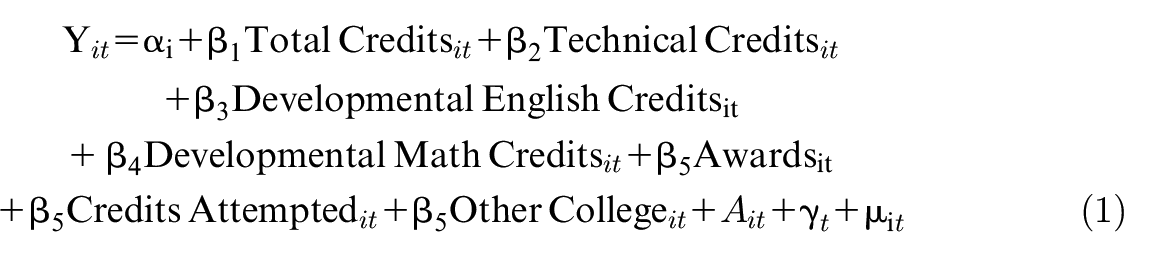
where Y it represents an individual i’s quarterly earnings at time t, which depend on observed and unobserved student-specific fixed effects α i .
Our primary variables of interest are credits accumulated prior to each quarter (i.e., coefficient estimates β1, β2, β3, and β4). Due to potential variation in the returns to different types of credits, we divided credits into college-level credits and developmental credits. We further divided college-level credits into academic credits (e.g., humanities, science, social science, etc.) or technical credits (e.g., nursing, manufacturing, protective services, etc.). 2 We classified developmental credits by subject area: developmental math credits versus developmental reading and writing credits (which we combined into a single category of developmental English credits).
Total Credits it is the total number of credits individual i completed prior to quarter t. Therefore, we compare students who have completed the same number of credits but who vary in their mix of credit types. Since the model controls for three specific types of credits (i.e., technical credits, developmental English credits, and developmental math credits), β1 is interpreted as the change in earnings associated with a one-credit increase that does not belong to any of these three categories—that is, college-level credits in an academic field. β2, β3, and β4 are interpreted as the additional change in earnings associated with a one-credit increase in the corresponding category of credits, respectively. As a result, β1 + β2 represents the increase in quarterly earnings for each one-credit increase in college-level credits in a technical field, β1 + β3 represents the increase for each one-credit increase in developmental English, and β1 + β4 represents the increase for each one-credit increase in developmental math.
Using college-level academic credits as the base group has the advantage of enabling direct comparisons between the labor market benefit of developmental credits versus traditional college-level credits and therefore can help examine the extent of the “crowding out” effects: Will developmental education incur negative impacts on student labor market outcomes if developmental requirements crowd out attainment of academic credits?
Considering that credentials can signal employers about an individual’s productivity and therefore may have economic value in addition to the accumulated human capital inherent in the associated bundle of credits (Bahr, 2014; Weiss, 1995), we also control for receipt of credentials and degrees at any college in the United States. The vector award (Award it ) indicates the type of award(s) a student has attained by the beginning of a given quarter and contains four dichotomous variables: bachelor, associate, long-term certificate, and short-term certificate. These different awards are not mutually exclusive; therefore, a student may have multiple awards by the beginning of a quarter.
We include two variables to account for the opportunity cost (in terms of forgone earnings) associated with college attendance. The first variable is CreditsAttempted it , which is the total number of credits enrolled in NCCCS or VCCS during the current quarter. The second variable, OtherCollege it , indicates whether the student is enrolled in any college outside of the community college system in that quarter. We used NSC enrollment data to create this variable. Finally, we include a dichotomous variable for “Ashenfelter’s Dip.” 3 Specifically, we are concerned that a negative income shock prior to college enrollment may influence both college enrollment and earnings patterns and adjust for this possibility by including indicators for two quarters prior to community college entry represented by Ait in the model.
Finally, we include a series of quarter-specific fixed-effects (γ t ) in order to capture any trends in earnings over time and any seasonal or economic shocks in a particular quarter (Wooldridge, 2002).
The basic individual fixed effects model presented in Equation 1 only provides an overall estimate of how earnings change in proportion to accumulated credits on average, which does not allow the impacts of credits to depend on whether the student is still in college. Yet, as mentioned previously, schooling may lead to some foregone earnings. This is referred to as a “lock-in” effect in job training literature (Andersson, Holzer, Lane, Rosenblum, & Smith, 2013; Van Ours, 2004), meaning that participation in training may inhibit students’ ability to work to their full wage potential. Although we have partly addressed this problem by controlling for the total number of credits attempted and whether a student is enrolled in colleges out of the community college systems during the current quarter, students may still experience negative, short-run returns to credentials earned and/or credits accumulated before leaving college. For example, some students may not take any courses during the summer but may still be subject to foregone earnings by working part-time or working in a temporary position that does not fully capture their human capital.
In addition, researchers have also identified a reverse Ashenfelter’s Dip immediately after students leave college, where students’ earnings tend to be lower than they eventually become in the long term (Jacobson et al., 2005). Since our primary interest is in the effect of developmental education on student earnings in a long run, it is important to capture these temporal patterns in schooling effects.
Therefore, in our model, we build on the econometric model used by Jacobson and colleagues (2005) to differentiate between returns to credits in college and post enrollment and returns to credits in the short term and long term by adding a term to Equation 1 that takes into account returns to credits during different time periods in a student’s life. We interact this term with each of the four credit variables from Equation 1 (i.e., total credit, technical credit, developmental English credits, and developmental math credits). In addition, we interact each of the four credit variables from Equation 1 with an indicator of whether or not the student was enrolled in college in the term or not. An example of these interactions with the total credit variable follows:

where
In our model, the long-run effects of various types of community college credits are given by the parameter β1, while the two interaction terms capture in-college β2 and short-run deviations from the long-run effects β3. The dichotomous variable Beforecollexit
it
is equal to 1 when students are enrolled in college. This variable is interacted with different types of cumulative credits to capture the in-college derivations from the returns to credits in a long run. The term (
Validity of the Individual Fixed Effects Approach
Our research design is intended to identify the effects of earning developmental education credits on student earnings over time. While the individual fixed effects approach can effectively address any student characteristics that are constant over time, the validity of the estimates is based on the assumption that the wage growth trend should be the same among individuals in the absence of any educational training. In other words, the individual fixed effects model will effectively address a situation where a student had a constant advantage in wage earnings over time but will be problematic if students who earn more credits, especially more credits through developmental education courses, inherently follow a different wage growth trajectory than students who earn fewer credits or different types of credits.
Although we cannot directly rule out this possibility, we can explore the extent of this problem by comparing the pre-college wage trajectories of students with different amounts of developmental credits. This is the time when students had not been exposed to college training, and therefore, substantial between-student differences in their wage trajectories imply that the changes of wages may be different even in the absence of any college coursework. Therefore, we divide students into four groups based on the total number of developmental course credits they eventually earned and examine pre-enrollment wage trajectories of these four groups (figures available on request).
In both states, despite a small constant wage gap favoring students who did not earn any developmental credits, the four groups generally share similar wage trajectories prior to college entry. This finding provides important support to the validity of our design since if students with different amounts of developmental credits generally had similar wage trajectories prior to college enrollment, it is more plausible to attribute changes in their wage trajectories to the college coursework.
Additionally, building on Jacobson’s model (Jacobson et al., 2005), in a robustness check, we include individual-specific time trends in addition to fixed effects. This not only addresses any unobserved individual characteristics that are constant over time (e.g., gender, race) but also effectively controls for any unobserved individual factors that are changing at a constant rate over time (e.g., age, working experiences). Allowing for this richer form of individual-specific heterogeneity in the wage growth rate further addresses selection bias in estimating returns to credits.
Finally, since our model controls for attainment of certificates and degrees, we can examine if our degree estimates are similar to other prior studies using the same strategy. We find that our estimates are similar, providing further confidence in our model. However, due to limited space, we do not discuss the coefficients on certificate and degree attainment; they are presented in Table A1 in the Appendix.
Examining the Mechanism Underlying Impact on Wages
In our main model, the outcome is quarterly wages, and quarters with no reported UI earnings are assigned values of zero earnings. However, in addition to understanding the overall effects of credits on earnings, we are also interested in understanding what is driving the overall impact since schooling could influence earnings through at least two distinct ways: by influencing one’s probability of employment and increasing or decreasing wages conditional on employment. Therefore, we separately estimate two outcomes. The first identifies the impact of community college credits on the probability of employment. The employment outcome is a dichotomous variable, and individuals receive a 1 in quarters where earnings are greater than 0 and a 0 in quarters where earnings are 0 or missing. 4 The second identifies the impact of community college credits on earnings among those who were employed during that quarter. We use the same wage outcome as the main model, but now earnings are set to missing in quarters that they are 0.
Heterogeneity Analyses
Finally, we conduct three additional analyses to examine potential heterogeneity of the effects by age, certificate/degree award, and developmental placement level. First, we explore potential differences in effects for students who were 19 years or younger when they entered college (traditionally aged college students) compared to students who were older than 19 (older college students) when they entered college. Thus, this analysis examines if returns to developmental education vary for traditionally aged college students compared to older college students who may bear greater opportunity costs represented by foregone earnings and work experience.
Second, since average effects may mask substantial variations in the actual returns to students who received an award and those who did not, we examine differences in developmental education wage returns for students who did not earn any award compared to students who earned a short-term certificate, long-term certificate, associate’s degree, and/or bachelor’s degree.
Third, we examine heterogeneity based on incoming students’ course placement level in Virginia only. The VCCS data include the reading, writing, and math placement test scores that students earned when they took the college placement exams and the system sets cut scores that determine if students are placed in either college level or different levels of developmental sequences for both English and math. 5 We used this information to determine students’ developmental placement level in English and math, respectively. Then, we conducted an additional analysis to further explore whether the impacts of developmental education on labor market outcomes vary by developmental placement level for English and math. We conducted this analysis for the Virginia sample only because North Carolina data do not include placement scores.
Results
The Long-Term Impact of Developmental Credits on Labor Market Outcomes
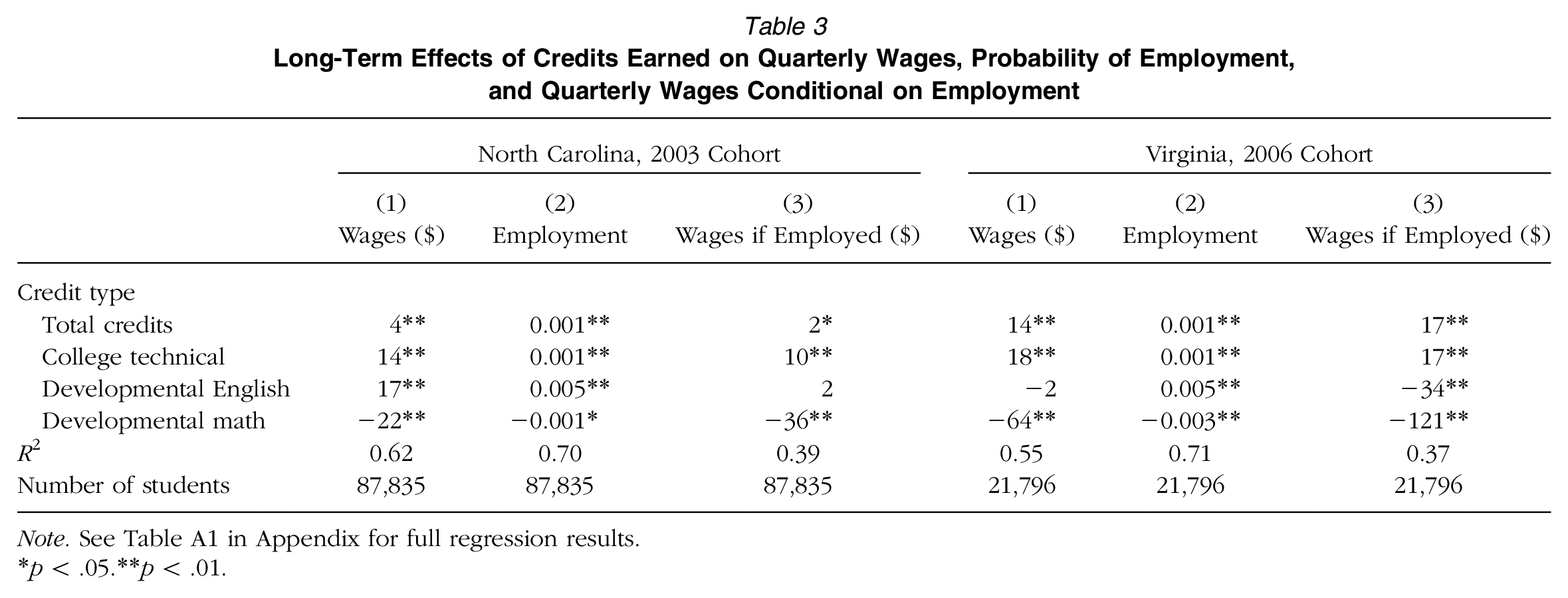
Table 3 (Column 1) presents the long-term effects of various types of accumulative credits on individual quarterly earnings, and the full results on all the coefficients in the model are presented in Table A1 in the Appendix as a reference. 6 Since college academic credits are the omitted group in the model specification, the coefficient on “total credits” represents the long-term returns to each college academic credit earned, while the coefficients on the other three types of credits represent the returns in addition to those to academic credits.
Long-Term Effects of Credits Earned on Quarterly Wages, Probability of Employment, and Quarterly Wages Conditional on Employment
p < .05.**p < .01.
In North Carolina, over the long run, developmental English credit increases quarterly earnings by about $21 ($4 + $17), which is equivalent to $63 per quarter for each developmental English course. Developmental English credits lead to larger gains than college-level academic credits ($4 a credit) and college-level technical credits ($18 a credit). A developmental math credit decreases quarterly earnings by about $18 ($4 – $22), which is equivalent to –$54 per quarter for each developmental math course. In Virginia, a developmental English credit increases quarterly earnings by about $12 ($14-$2) and a developmental math credit decreases quarterly earnings by about $50 ($14 – $64). That is equivalent to an increase in earnings of about $36 for a three-credit developmental English course and a decrease in earnings of $150 for a three-credit developmental math course. College-level academic and technical credits lead to greater gains in earning than developmental English credits in Virginia. The patterns of results remain similar even after we added individual-specific time trends in addition to fixed effects as a robustness check. 7
Mechanisms Underlying Impact on Earnings
Table 3 (Columns 2 and 3) separately presents the long-run impact of different credits on the probability of employment and earnings conditional on employment, respectively. In each state, while college-level credits lead to significant gains in both outcomes, it seems that the positive returns to developmental English credits are almost entirely driven by the extensive margin, namely, by increasing the probability of employment. Yet, the effect size of developmental English credits on student employment in the long run are noticeably larger than that of either type of college-level credits in both North Carolina and Virginia. Specifically, earning a college academic credit increased the probability of employment by one-tenth of a percentage point per quarter, earning a college technical credit doubled the effect to one-fifth of a percentage point, and earning a developmental English credit more than doubled the effect to half of a percentage point per quarter in both states. For a three-credit developmental English course, this is equivalent to increasing the probability of employment by 1.5 percentage points per quarter. In Virginia, this impact is equivalent to impact of earning a long-term certificate (see Table A1). On the other hand, developmental math credits seem to have either null or negative impacts on both the probability of employment and earnings conditional on employment.
These results suggest that the main labor market benefit of developmental English is through increasing individual’s probability of employment in the labor market but not through career advancement or promotion among those who are already employed. Yet, for students whose poor academic literacy and English proficiency skills may act as a strong impediment to finding a job, the language skills imparted in these courses seem to substantially improve their chance of employment with an effect size that even outweighs college-level courses.
Heterogeneous Effects
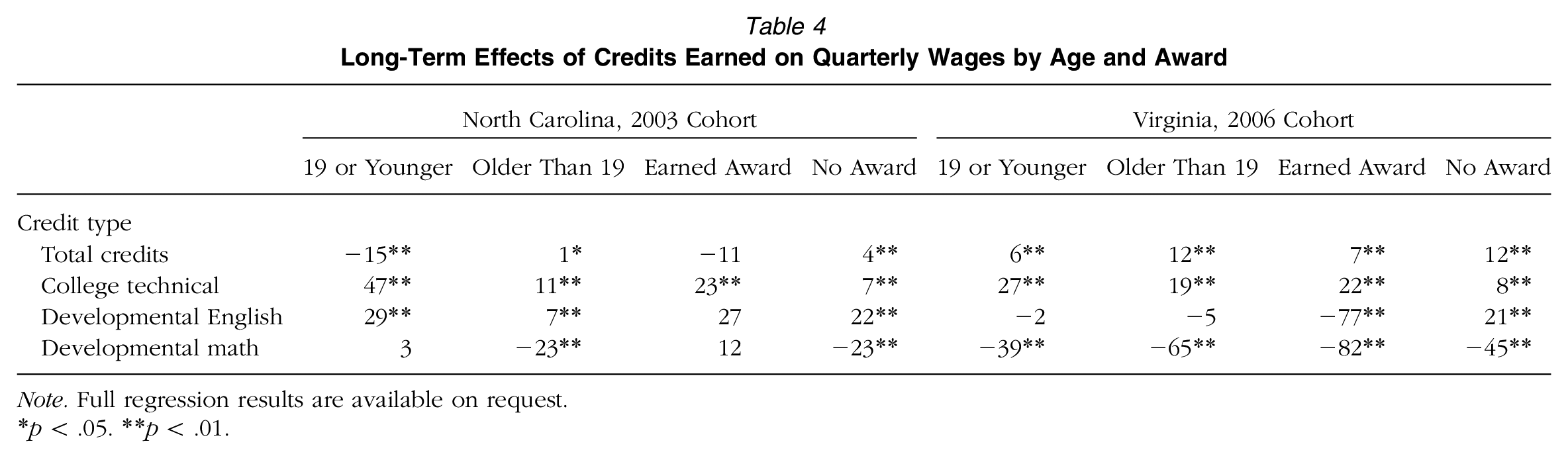
Next, we explore the potential heterogeneous effects of developmental education on student labor market performance by age. In North Carolina, earning a developmental English credit increases quarterly earnings of traditionally aged college students by $14 (–$15 + $29) and of older college students by $8 ($7 + $1) (Table 4). In Virginia, the extent to which developmental credits increase earnings are not significantly different from college academic credits. Specifically, earning a developmental English credit increases quarterly earnings of traditionally aged college students by $6 and of older college students by $12.
Long-Term Effects of Credits Earned on Quarterly Wages by Age and Award
Note. Full regression results are available on request.
p < .05. **p < .01.
Developmental math has negative returns for all groups, but these returns are less negative for traditionally aged college students. In North Carolina, earning developmental math credit or college academic credit decreases quarterly earnings of traditionally aged college students by $15 and of older college students by $22 ($1 – $23). In Virginia, earning developmental math credit decreases quarterly earnings of traditionally aged college students by $33 ($6 – $39) and of older college students by $53 ($12 – $65).
Compared to traditionally aged college students, older college students seem to benefit less in the labor market from developmental English and experience larger negative effects on earnings from developmental math. This may be due to larger opportunity costs. For example, math skills tend to diminish over time, and thus older college students tend to enter college with greater needs in math than students entering straight out of high school. They may be placed in lower levels of developmental math than their younger counterparts.
Returns to developmental education on students who earned a degree or certificate versus earned no award reveal that in both states, the positive impacts of English credits are mainly driven by students who never received any educational award, and the size of the effects is much larger than the average effects (Table 4). In North Carolina, developmental English does not increase wages for students who earned an award while it increases wages by $26 per credit among students who did not earn an award. In Virginia, developmental English decreases wages by $70 per credit for students who earned an award while it increases wages by $33 per credit for students who did not earn an award. As Table 2 illustrates, a very small proportion of students who enroll in developmental education earn credentials. Our results therefore highlight the labor market value of developmental English coursework for the majority of developmental education students who may have lacked literacy skills and failed to earn any credential. In North Carolina, developmental math does not impact wages for students who earned an award and decreases wages by $19 per credit for students who earned no award. In Virginia, developmental math decreases wages for both students who earned an award and did not earn an award.
As shown in Table 5, there are substantial variations in the impacts on both earnings and employment for students assigned to different developmental levels. In general, for both English and math, the largest returns are observed among students just one level below college ready (i.e., “highest level”). For English, the returns to a developmental English credit for students assigned to the highest level of developmental writing is $30 ($5 + $25); for math, the returns are also significantly positive, at $26 ($5 + $21), both of which are noticeably larger than the labor market benefit of college-level credits in an academic field ($5). Yet, consistent with the overall pattern of results illustrated in Table 3, such positive impacts are mainly driven by the impact of developmental coursework on increasing the probability of employment, while returns to earnings conditional on employment are negative or insignificant. These results suggest that developmental coursework is most beneficial to students who place one level below college-level coursework through substantially increased probability of employment.
Long-Term Effects of Credits Earned on Different Outcomes for Virginia Students by Their Course Placement Level in Math and Writing, 2006 Cohort

Note. Full regression results are available on request.
p < .05. **p < .01.
Alternatively, the economic returns to developmental education for students assigned to lower levels diminish: For English, the returns to a developmental English credit for students assigned to the lowest level of developmental writing are no different from the returns to a college academic course (i.e., $5); for math, the returns are consistently negative, and the magnitude of such negative effects becomes larger the lower the course placement level in math. Thus, even if the math content had value in the labor market, the opportunity costs associated with taking multiple developmental math courses substantially outweighed any positive skill development, and negative opportunity costs were largest for students who placed in the lowest level course.
The possibility that taking developmental courses may impose opportunity costs on students and therefore result in zero or even negative returns is further supported by the attenuated returns to developmental English and negative returns to developmental math credits for students who placed in college English and college math. About 15% of students in Virginia were assigned to college-level English but took developmental English, and 13% of students were assigned to college-level math but took developmental math. There are two potential reasons why students may end up taking developmental education even though they scored at or above the “college-ready” cut score on the placement exam. First, the placement level variable may not accurately reflect the placement level for all students since the placement variable is based on system-level policies and some colleges have their own standards for placement. Some colleges may have slightly higher standards, so students deemed college ready by the system may have actually been assigned to developmental education at their college. Second, students may have been advised or simply chose to take developmental education even though they scored at or above the “college-ready” cut score on the placement exam. In either case, our results highlight the labor market impacts of earning developmental credits on students who were deemed academically prepared by the system standards but took developmental courses due to idiosyncratic reasons.
Overall, we identified substantial heterogeneity in returns to developmental credits by placement level. Specifically, the returns to a developmental English credit for students who placed in college English is –$1 ($5 – $6) while the returns to a developmental math credit for students who placed in college math is –$108 ($5 – $113). These results suggest that for students who are considered academically prepared, the opportunity cost associated with taking developmental courses far outweigh their potential benefit, leading to negative returns to developmental credits. This finding also further supports a discouragement effect for students who are potentially misplaced into developmental education.
Discussion and Conclusion
Our study addresses a major gap in the scholarly research by identifying the returns to developmental education and applying two theories—the human capital model and sorting model—to understand the impact of developmental education on labor market outcomes. Our findings are consistent across North Carolina and Virginia. For the 2003 community college entrants in North Carolina and 2006 community college entrants in Virginia, we find evidence that developmental English represents a worthwhile human capital investment that leads to increases in labor market productivity. On the other hand, for the same cohorts in North Carolina and Virginia, we find that developmental math represents a human capital investment that bears large opportunity costs for students that lead to a decrease in earnings and probability of employment. In both states, positive wage returns of developmental English are smaller and negative wage returns of developmental math are larger among older students because these students bear larger opportunity costs than younger students. The findings from Virginia on the impact of students’ placement level on labor market outcomes illuminate how the sorting mechanism of developmental education may lead to negative effects on wages and employability by potentially stigmatizing students and discouraging their persistence. In the following, we discuss the implications of our results for practice.
Implications for Developmental English
In both Virginia and North Carolina, community college students’ earnings increased due to earning developmental English credits, and both traditionally aged and older college students experienced positive impacts from developmental English on labor market outcomes. Wage increases were many times larger than returns to college-level credits, suggesting that developmental English may be worth students’ time and resources even if they do not progress into college coursework. In both states, however, this increase was entirely driven by a positive impact on the likelihood of employment, not quarterly earnings. In other words, developmental English courses represent a benefit for individuals whose language skills posed a great impediment to securing a job, but the credits did not lead to increases in earnings through career advancement or promotion. Further, the results from Virginia suggest the positive impact of developmental English is limited to students placed into the highest level of the sequence, while students placed in lower levels do not experience positive labor market outcomes due to large opportunity costs and/or negative signals about their ability that decreases motivation.
Current English acceleration reforms that have been in place across all Virginia community colleges since spring 2013 and all North Carolina community colleges since fall 2014 may further enhance the benefits of developmental English on students’ labor market outcomes that we found in this study as well as decrease opportunity costs and negative signaling effects that may be associated with traditional sequences. In both states, developmental redesign involved combining reading and writing sequences into a single, shorter developmental English sequence, aligning the developmental English curriculum to college-level English, and allowing students who place into the highest developmental course to take college English and developmental English concurrently. Similar models in other states have had a positive impact on students’ likelihood of completing college English and college credit accumulation (Jaggars, Hodara, Cho, & Xu, 2015) and thus may lead to improvements in earnings as well. Future studies should explore the impact of the new developmental English programs in Virginia and North Carolina on individuals’ earnings, employment, and earnings conditional on employment.
Implications for Developmental Math
In contrast, we find negative impacts of developmental math on both the likelihood of employment and quarterly earnings, suggesting opportunity costs outweigh any benefits of earning developmental math credits. The Virginia results illustrate that these negative impacts were particularly pronounced for students placed in the lowest level of the sequence, and in both states, older college students experienced greater negative returns to developmental math than traditionally aged college students. The negative impacts of developmental math credits on labor market outcomes provide further motivation for many of the developmental math reforms taking place across the country. In particular, changes to sequence length and curriculum may address two mechanisms underlying the negative impact of developmental math on labor market outcomes.
First, the time required to complete developmental math credits and progress into college-level math and other courses with college math prerequisites both increases foregone earnings and negatively influences long-run earnings by preventing students from accumulating work experience. Math acceleration reforms that have been in place at all Virginia community colleges since spring 2012 and all North Carolina community colleges since fall 2013 are intended to decrease the time it takes for students to complete their developmental math requirements and thus reduce the opportunity costs of taking developmental math.
Second, the algebra-based content of the developmental math courses, at least during the time period of this study, may not have been tied to the quantitative skills required in the labor market. A curricular math reform that is growing in popularity replaces the traditional algebra-based developmental math curriculum with a statistics-based developmental math sequence designed for liberal arts students. These new statistics-based pathways focus on teaching mathematics content that can be applied to solve everyday problems, content that may be more closely aligned with the skills liberal arts students need to be successful in their degree programs and the labor market (Cullinane & Treisman, 2010; Merseth, 2011). The new pathways also seek to promote positive mindsets, a sense of belonging, and self-efficacy. These skills may be important for combatting negative attitudes about ability that may result from the signal students get from a developmental math placement.
Implications for Course Placement Practices
Recent research suggests that inaccurate course placement is quite pervasive (Scott Clayton et al., 2014). College staff may be less likely to recognize the problem and pervasiveness of underplacement because students who are underplaced may be doing quite well in their developmental courses (Jaggars & Hodara, 2011). Yet, underplacement may have serious consequences for students’ longer-term outcomes by discouraging their college progression (Scott-Clayton & Rodriguez, 2015) and as our results suggest, harming students’ labor market outcomes. Specifically, we find returns from earning both developmental math and English credits decreased the lower students’ placement level, emphasizing the importance of placing students in the highest level of coursework where they are predicted to succeed not just to improve college success but also long-term labor market outcomes. Further, students considered academically prepared who instead enrolled in developmental education were also subject to negative returns to developmental credits, suggesting that developmental courses represent only a negative opportunity cost among students who are underplaced.
To conclude, our findings add to the breadth of literature finding positive returns to higher education credentials and course credits, both reinforcing the role of community colleges as a public good and providing further motivation to investigate how subsidies to public institutions can benefit society as a whole (Courant, McPherson, & Resch, 2006). Developmental English credits, in particular, seem to be related to improvements in an individual’s well-being through increased employability and may also be related to other far-reaching benefits related to education, such as health, civic participation, and reductions in crime (Wolfe & Haveman, 2002). In the coming years, as more community colleges implement developmental education reforms, it will be important to study how these redesigned courses not only impact students’ progression into college coursework and degree attainment but also benefit students in the labor market.