



Abstract
Social-affective neuroscience is revealing that human brain development is inherently social—our very nature is organized by nurture. To explore the implications for human development and education, we present a series of interdisciplinary studies documenting individual and cultural variability in the neurobiological correlates of emotional feelings. From these studies, we derive educational research hypotheses and a theoretical framework that facilitates integrating sociocultural and neurobiological levels of analysis. Our overarching aim is to begin to conceptualize a role for neurobiological evidence in educational studies of sociality, emotion, culture, and identity. Overcoming the historical distance between educational and neuroscientific research on social-affective development would enable a more complete science of human experience and enhance appreciation of cultural learning, benefiting both fields.
Research on learning in the mid- to late-20th century was dominated by cognitive scientific and computational approaches that divorced cognition from emotion and social relationships (Gardner, 1985). However, contemporary educational research is increasingly tying academic achievement to the contextual dynamics of personal meaning-making and social-emotional feelings. Abundant research documents that students’ cognitive skills are influenced by situational cues that prime personally relevant identity stereotypes (Steele, 2010) and by students’ perceived alignment between situational task demands and culturally constructed identities (Nasir, 2012). Substantial evidence has also accrued that even small interventions aimed at social-emotional functioning and self-conceptions can have long-lasting effects on academic performance (Oyserman, 2015; Yeager & Walton, 2011). Why is cognition so emotion-dependent? And how might a better understanding of the mechanisms by which people experience social emotions inform the next generation of educational research, including research on learning but also on broader, pressing problems such as achievement/opportunity gaps?
In this article, we lay out a series of interdisciplinary neurobiological and psychosocial studies that begin to explore these questions. We then use these studies to illustrate a proposed framework for understanding the relations between neurobiological and sociocultural processes in the cognitive construction of emotional feelings. Given promising recent advances in the expanding field of social-affective neuroscience, our overarching aim is to forge a more productive integration of neurobiological and human developmental levels of analysis and argue for the need to conceptualize the contributions of biological processes to complex social processes relevant to education. Biological and educational analyses cannot replace each other, but we aim to show how they can inform each other for mutual benefit, even in the absence of prescriptive findings that move directly from neural evidence to educational practice. The central premise of our work is that neurobiological and sociocultural development are co-dependent; neither can exist without the other, and each influences and organizes the other over time. Human beings are biologically cultural (Tomasello, 2009), and education is a major acculturating force.
In both the biological and social sciences, there is a historical precedent for considering the roles of emotion and sociality in learning. Early educators intuitively recognized the ubiquity and power of emotion and embodied sensation in learning—for example, Montessori (1914/2009)—and substantial early work was devoted to describing the cultural and social organization of children’s thinking—for example the work of Bruner (1990). Similarly, James (1894) and his contemporaries described the evolutionarily adaptive, biological functions of emotions. As formal education research heads into its second century, the (re)discovery of the importance of social, emotional, and identity-related functioning in education (Pekrun & Linnebrink-Garcia, 2014) has occurred in parallel with similar shifts in other fields, such as law, philosophy, and economics (Damasio, 1994/2005). These shifts mark a departure from traditional Western philosophical views, most notably those of Descartes (1641/1986), which divorced high-level, rational thought from what were thought of as the basal, emotional, instinctual processes of the body.
Propelling these shifts, in part, are new discoveries about the brain (Farah, 2010). In particular, a field of neuroscientific research on social and affective processing has emerged over the past two decades and has rapidly expanded (Adolphs, 2003; Damasio, 1994/2005; Ochsner & Lieberman, 2001). Neuroscience is the study of neurobiological processes—how nervous systems develop and function across organisms. In humans, neuroscience addresses cellular, molecular, genetic, and epigenetic processes as well as neural processes that support the body and mind. Social-affective neuroscience investigates neurobiological mechanisms in social and emotional contexts, using tools such as neuroimaging (to measure brain structure and function), psychophysiological recording (to measure bodily arousal and reactivity), and hormonal analysis (to measure modulation of physiological signaling chemicals in the body—for example, those associated with stress, puberty, social relationships, and gender-related behaviors). Issues studied include, for example, how social relationships influence biological mechanisms and development and how the brain processes social stimuli.
We are just beginning to explore what the neuroscientific findings mean for human development and education (Immordino-Yang, 2015). Despite parallel advances in education and neuroscience research on emotion and sociality, researchers from the two fields are generally not connected. This chasm is partly due to the fact that neuroscientists usually limit their research to highly controlled settings and frame their questions at a level that deconstructs affective and social processing into components, given methodological and technological constraints. But education researchers, especially in the field of human development, seek to understand complex dynamics that are individually variable, shaped by culture and context, and changing over time. This means that despite substantial overlap in the interests of researchers in the two fields, research findings in each field are usually not framed to translate well into the other field or to inform the other’s research questions, models, or practices.
For instance, there has been a surge of research on “self-processing” in social-affective neuroscience—that is, on how the brain perceives, recognizes, recalls, generates, regulates, and synthesizes information about one’s own traits, experiences, and personal information (e.g., Northoff et al., 2006). Education researchers, too, are interested in how people think about themselves and how students’ environments, relationships, and experiences shape those thoughts, but they study the complexities of “identity”—that is, students’ understandings of who they are in terms of sociocultural, familial, and group affiliations; future hopes; skills; tastes; and values (Damon, 2008; Gee, 2000–2001; Hill &Tyson, 2009). Clearly, neuroscientists’ “self-processing” construct must be relevant to education researchers’ “identity” construct and vice versa, since calling up and thinking about self-relevant information is an essential starting point for building identity and identity shapes self-processing both psychologically (Markus & Kitayama, 1991) and neurologically (Chiao et al., 2010). However, neither field has framed its work to be translatable to the other. Similar points could be made about educational studies of “self-efficacy” (e.g., studies building from Bandura, 1977) and neuroscientific studies of “agency” (e.g., Farrer & Frith, 2002), educational studies of “intrinsic motivation” (e.g., Ryan & Deci, 2000) and neuroscientific studies of “reward processing” (e.g., McClure, York, & Montague, 2004; but see Murayama, Matsumoto, Izuma, & Matsumoto, 2010), educational studies of collaborative learning and neuroscientific studies of “social cognition” (Adolphs, 2003), and studies in both fields on memory, emotion, executive functioning, and other topics.
Another related disconnect is that some educational researchers interested in social, cultural, and affective aspects of development are wary of biological perspectives, which can be perceived as overly quantitative, reductionist, and deterministic (see Varma, McCandliss, & Schwartz, 2008), and as equating a person’s biology with his or her destiny. Given especially the danger of fueling deficit models of culture that privilege particular styles of behavior and undermine educators’ appreciation of their students’ rich social-relational lives (Hoffman, 2009), these researchers are rightfully cautious. It is not immediately obvious how research concerned with deconstructing the person into component biological mechanisms could contribute to knowledge about context-dependent, subjective, value-laden personal choices and private experiences—for example, those associated with relationships, identity, and cultural heritage. And perhaps more importantly, it is not obvious whether we would want it to.
Education research has rich tools for documenting how people behave, feel, think, and learn, and for supporting people in engaging these processes adaptively. But, traditional education research cannot access the biopsychosocial mechanisms that undergird the human mind and its development. This is why, when appropriately designed and interpreted, neuroscience can provide a unique source of constraints and hypotheses for education research by elucidating the neural mechanisms underlying cognition, social and affective processing, and cultural learning. When done well, specific benefits for education could include constraining and supporting existing educational theories by testing their biological plausibility, and leveraging insights about brain mechanisms to inform the development of new educational theories and research questions. Neuroscience also would benefit: By expressly designing cross-modal methods to reconcile and integrate educational with neuroscientific research (Immordino-Yang, 2010, 2015), new neuroscience experiments could be designed with more direct educational relevance and increased ecological validity. Through this work, educators would also be able to inform neuroscientists about the broader dynamics of development—what development and learning look like in real-world contexts. By working to accommodate each other’s evidence and theory, these approaches together could build a more complete, actionable science of human experience (Immordino-Yang & Damasio, 2007). What is needed are research methods that align neuroscientific with educational levels of analysis (to overcome the long-standing incommensurability problem; see Bruer, 1997) and a theoretical framework that honors both levels of analysis while facilitating their convergence.
To provide a way forward, in this article we first present case study–style reports describing a series of studies of social emotions and self-processing that combine neuroscientific methods (functional magnetic resonance imaging [fMRI] and psychophysiological recording) with self-report methods (questionnaires, qualitative interviewing outside the MRI scanner, and real-time reports of emotional experience from inside the scanner). In each study, we model how accomplishing interdisciplinary alignment involves adjusting the analytic level of both the neural and psychological constructs, and sometimes sacrificing resolution, so that the findings from each domain will be interpretable for the other. For example, we interpret neural activations not at the cellular or microstructural levels but at the level of functional systems (e.g., somatosensory systems), and we examine intercultural psychological differences (e.g., in emotional expressiveness) without fully addressing documented intracultural variability. We interpret the findings from each study by analyzing how the educationally relevant psychological processes associated with our task recruit neural regions with known functions in the broader brain/body system. Finally, from the findings and interpretations, we derive a biologically and evolutionarily plausible, ecologically valid framework for aligning educational and neuroscientific levels of analysis in the study of embodiment, emotional experience, and sociality.
An Introduction to the Neuroscience of Emotion (and Feelings)
To appreciate why emotions matter so much in education, it helps to understand from an evolutionary, neurobiological perspective what emotions are. At their core, emotions are neural and somatic events whose function is to prepare an organism to respond adaptively to a change in its social or physical context (Darwin, 1872; James, 1894). That is, emotions are packages of mental and bodily responses that are deployed automatically when an organism recognizes that a situation warrants such a reaction (Damasio, 1994/2005). For example, when an animal or person recognizes danger, a cascade of bodily and mental changes ensues that is aimed at resolving the situation: Heart rate and blood pressure increase, digestion slows, blood is shunted to the skeletal muscles, and notably, the mind becomes occupied with strategies for fighting, hiding, or escaping. Alternatively, when poison or spoiled food is encountered, digestion shifts to reverse peristalsis and the mind to avoidance or withdrawal—the phenotypic behaviors and thoughts associated with disgust. Notably, due to humans’ intellectual capacities, emotional reactions are not necessarily triggered by immediate (real) physical or social circumstances but can also be precipitated by inferences, memories, beliefs, or imaginings.
Once emotions are induced, people (and likely other intelligent animals) can become aware of them (that is, people can experience their emotions) by mentally constructing a feeling (Barrett, Mesquita, Ochsner, & Gross, 2007; Damasio, 1999). Like feelings of hunger, heartbeat, or body temperature, feelings of emotion are, in essence, cognitive interpretations of changes to body and mental states (Barrett et al., 2007; Critchley, Wiens, Rotshein, Öhman, & Dolan, 2004; Damasio, 1999; Schachter & Singer, 1962). Given this, it is unsurprising that feelings of basic emotions like fear, disgust, and happiness have been associated in neuroimaging experiments with increased activation of the brain’s somatosensory systems and systems critical for consciousness (Damasio, 1999). Somatosensory, proprioceptive systems sense the physical body, while systems critical for consciousness monitor and regulate alertness, arousal, and self-awareness. 1 Consistent with observational evidence and theoretical models originating in the 19th century (but largely not incorporated into 20th-century research on cognition), modern neurobiological work on emotion demonstrates that emotions and emotional feelings 2 recruit brain systems that are critical to survival and fundamental to managing the mind, body, and behavior in the physical and social worlds (Immordino-Yang & Damasio, 2007).
How is this relevant for educational researchers? First, and most generally, the knowledge that emotions recruit survival-related neural mechanisms and shift cognitive processing helps us to appreciate anew their psychological power. No wonder emotional skills trump standardized measures of intelligence in predicting academic and personal achievement (Duckworth & Seligman, 2005). Second, and more specifically, the neuropsychological research teaches us the distinction between emotions, which come first, and feelings, which follow. Specifically, emotions are packages of bodily and mental reactions (e.g., the increased heart rate variability and working memory load that occur under conditions of stereotype threat; Croizet et al., 2004). Feelings are elaborated psychological states informed by the sensation of emotion-related physiological reactions that have already happened (e.g., the feeling of being threatened or inadequate). Feelings are influenced by powerful, subjective, cognitive elaborations and cultural interpretations of bodily and mental states in context. Unlike emotions, feelings are conscious and can sometimes become reportable. Feelings contribute to self-narratives and meaning-making.
Given that education researchers mainly work in complex, real-world settings, their findings richly document the situational and temporal dynamics of individuals’ emotional feelings and their ensuing cognitive effects. Neuroscientists, by contrast, work mainly in laboratory settings, where they hold contexts relatively constant and study the underlying neuropsychological mechanisms that give rise to the effects that educators observe. By bringing these bodies of evidence together, both education and neuroscience researchers could gain richer perspectives on affective processing, including the interpretive processes by which feelings are built from emotions. Educators could then use these insights to decide how best to support the learning we most value in education.
Some research has begun to head in this direction. For example, Beilock and colleagues have shown that students could experience physiological arousal (e.g., a racing heart) during a math test as anxiety, causing them to waste cognitive resources worrying (Beilock, 2010; Lyons & Beilock, 2012). Or, they could interpret their arousal as implying that they are facing an important challenge, causing them to focus harder on the math. It is the students’ interpretations—the process by which they construct a conscious, socially situated feeling of their arousal—that determine how their emotions will influence their math performance. These interpretations in turn are partly learned: They are influenced by the feelings that the students’ teachers and parents express when doing math (Beilock, 2010).
These findings illustrate the utility of strategically leveraging educational and neuropsychological methods. In order to begin to build a broader biopsychosocial framework in which to situate findings such as these, in the following, we describe a series of studies that target the neural underpinnings of social-emotional feelings and connections to biological reactivity, cultural exposure, and other factors. The studies presented next were conducted in the laboratory and not in an educational setting and given the constraints of neurobiological research, utilize relatively small sample sizes. Nonetheless, they bridge from biological reactions to conscious meaning-making about self and the social world. In so doing, they help us to appreciate the relations among the neurobiological and psychological factors and lay the groundwork for future research.
Interdisciplinary Studies of Social Emotion
We began with a simple but potentially far-reaching question. Research in the final decades of the 20th century showed that basic emotions like fear and disgust recruit survival-related neural mechanisms (see Damasio, 1994/2005). This makes sense as the evolutionary purpose of these emotions is to keep animals (including people) alive, safe, and physically well. But arguably, the most thorny, important problems currently facing education (and society) are rooted in education stakeholders’ emotionally charged and socially constructed beliefs as they impact policies and opportunities for teaching and learning. We asked, how does the brain support feelings of social emotions, that is, of emotions that pertain not directly to one’s own bodily situation but to value-driven, cultural, and subjective interpretations of one’s own and other people’s psychological situations, abilities, perspectives, values, and qualities?
To start to answer this question, we undertook a series of three studies to investigate the neural underpinnings of two emotions that facilitate pro–socially oriented “challenge” interpretations: admiration (a rewarding, inspiring social emotion that challenges the person experiencing it to emulate the accomplished person) and compassion (a painful social emotion that challenges the person experiencing it to help the hurting person). A fourth study bridged from the neural results to identity development among bicultural youth.
We examined group-level effects (Study 1, in the following) as well as individual variability (Study 2) and effects of developmental social experience and culture (Studies 3 and 4). Most broadly, these experiments aimed to test whether and how brain systems responsible for sensing and regulating the body and consciousness, including those that sense blood chemistry and pressure, respiration, arousal, and digestion, would be involved when participants feel social emotions. Depending on whether and how these brain systems’ activity corresponded to participants’ feelings, we could provide evidence that mechanisms originally evolved for physical survival and maintenance of the body have been evolutionarily repurposed and extended through ontogenetic development and potentially through education to also support complex, acculturated social functioning. If the neural results reflected cultural exposure (not racial group differences but variability associated with living in a particular sociocultural context), it would suggest that emotion-related neurobiological functioning is influenced by sociocultural expectations and norms. It would suggest that for humans, biological “survival” and “wellness” have become complex social-cognitive processes that are at least partly learned. In essence, it would enrich our understanding of how nurture organizes nature.
Given the aforementioned, the studies presented next inform educational research in three main ways. First, they can be seen as providing additional validation of educational research techniques and constructs. For example, there is a long tradition in educational research of studying individuals’ verbal reasoning and descriptions of feelings to document individuals’ experiences and ways of making meaning (Seidman, 2013). Demonstrating that these methods capture processing differences that can be measured at the neurobiological level (e.g., in Study 2) extends their validity. Second, by revealing relationships between individuals’ feelings and their underlying brain mechanisms, the studies begin to establish alignment between educational and neurobiological levels of analysis. Prospectively, such alignment opens the door to interdisciplinary research conversations and projects and to the development of new research questions and hypotheses both in education and in neuroscience. This alignment also forms the basis for the framework we derive. Third (and related), the studies can inform future education research by identifying previously unknown factors that could contribute to explaining educationally relevant processes and outcomes (e.g., in Study 4).
In sum, in the following we present a selected series of key studies, followed by the theoretical framework that they inform. These studies are not comprehensive and are not meant to be prescriptive for educational practice. Instead, they are meant to model the step-wise integration of neurobiological with sociocultural levels of analysis in the service of informing questions and processes relevant to educational researchers.
Study 1 (Immordino-Yang, McColl, Damasio, & Damasio, 2009)
This initial study was the first to examine the neurobiological underpinnings of admiration and among the first to examine compassion. To investigate both emotions and feelings, we utilized qualitative interviewing (a method used in education research; Seidman, 2013) followed by neuroimaging (fMRI) and psychophysiological recording (recording of bodily reactions including heart rate, respiration, and skin sweating). Participants reacted to the stories first during a 2-hour interview in which they explained their feelings to each story by answering the interviewer’s question, “How does this story make you feel?” They then reacted to the stories again in the fMRI scanner and pushed buttons to report their feeling strength to each. Our analyses aimed to identify patterns of bodily and neural activations that corresponded to participants’ meaning-making around the stories (in the interview) and ensuing reports of feelings (verbally in the interview and again via button presses in the fMRI scanner). Participants were not told the specific emotions the stories were piloted to elicit and were asked to be as honest and open as possible in reporting their feelings about each of the stories. Relatively unemotional control stories were included to ensure that participants experienced a range of feeling strengths.
For example, in one true story meant to induce admiration, a blind German teenager, despite all odds, learns fluent Tibetan language by ear, invents a computerized Tibetan Braille system to translate schoolbooks, and travels into the mountains of Tibet to open a school for blind children, to which she dedicates her life. One control narrative, meant to be less extraordinary and emotion provoking, tells the story of a high school student who organizes a drama production and donates the proceeds to the school library.
Participants comprised an ethnically mixed, gender-balanced sample of 13 native English-speaking Americans, aged 20 to 57 years, recruited from the university community. We used the participants’ reports of their feelings to identify fMRI trials in which they felt particular varieties and strengths of emotion (e.g., mildly compassionate or strongly inspired) and then analyzed participants’ psychophysiological reactions to the stories to identify the time window of maximal emotional response. As is standard in fMRI research, we tested our hypothesis by examining whether there was significantly more blood flow in prespecified regions of interest in the brain and brain stem during trials when the person felt emotional as compared to during trials when they did not.
Overview of Study 1 Results and Their Implications for Education
Consistent with our hypothesis, we found that both admiration and compassion strongly activated cortical and subcortical somatosensory and body-regulatory systems and subcortical systems critical for consciousness (see Figure 1). Prominent among these activations was the anterior insula, a region known since 1950s neurosurgeries with epilepsy patients to be involved in visceral somatosensation and visceromotor activation. (Penfield & Jasper, 1954, described how people experience nausea and gastric mobility when the insula is stimulated.) This finding linked the cortical system involved in sensing and contracting the viscera with social emotional “gut feelings,” despite that those emotional feelings are completely divorced from digestion in the literal sense.
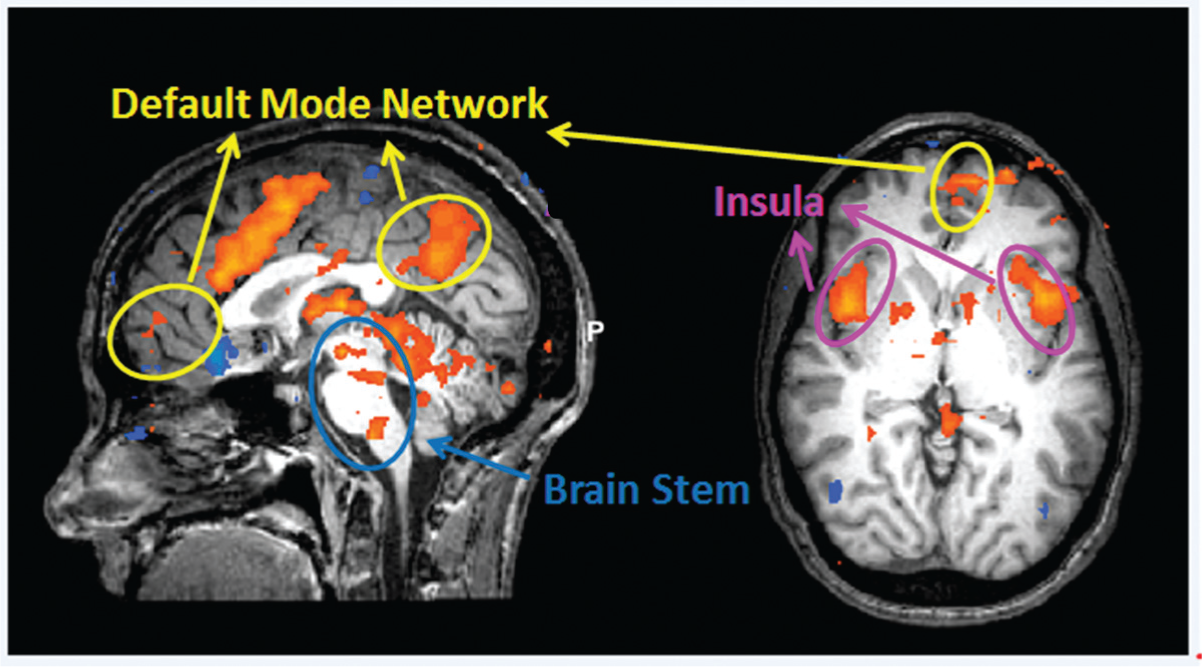
Neural correlates of processing complex social emotions (compassion for social pain and admiration for virtue) contrasted with relatively unemotional control social processing. The right and left visceral somatosensory cortices (insulae), circled in purple, can be thought of as providing a dynamic, integrative map of emotion-related “gut” body responses so that they have the possibility of informing conscious cognition. The brainstem, involved in homeostatic regulation and consciousness, is essential for survival, and is circled in blue. The regions circled in yellow are part of the brain’s so-called Default Mode Network, involved in processing psychological self, building coherent narratives, memory, and other cognitive and emotional functions. Data are from Immordino-Yang, McColl, Damasio, and Damasio (2009). The image is thresholded at the False Discovery Rate q < .05.
Not only did these social emotions activate the anterior insula, they strongly activated subcortical systems in the brainstem that are associated with consciousness regulation. (Brainstem structures operate below conscious awareness and are evolutionarily old. Damage in the brainstem results in profound disturbances of consciousness, including varieties of coma and persistent vegetative state.) Admiration for virtue (which many participants described as feeling “inspired”) especially activated the medulla, a brainstem region just above the spinal cord so fundamental to survival that damage there is eminently fatal.
What was demonstrated, from a broad conceptual standpoint, is that complex, abstract social emotions like admiration and compassion activate survival-related and somatosensory brain functions just as strongly as do more basic emotions, fear and disgust, and just as do primitive affective states like physical pain. As many humanitarians, poets, civil rights leaders, and educational researchers had suspected, social emotions about values, virtues, and moral qualities could feel to us like a matter of life and death because they literally hook themselves into the basic life-regulatory machinery that keeps us alive, awake, and aware. Admiration and compassion also activated high-level cortical systems involved in narrative construction, critical thinking, and memory, to be sure (including in the brain’s Default Mode Network; see Immordino-Yang, Christodoulou, & Singh, 2012; Immordino-Yang & Singh, 2013). But the fact that these high-level systems activated concertedly with low-level, subcortical systems provides a powerful, if nonspecific, clue that the feelings that undergird our social learning get their psychological punch from co-opting low-level mechanisms originally evolved to feel physical pain and pleasure and to keep us alive.
Study 2 (Saxbe, Yang, Borofsky, & Immordino-Yang, 2013)
Study 1, described previously, examined a group-level effect and established that social emotions are supported neurologically by life-regulatory and somatosensory (body-feeling) systems. Study 2 was the first to investigate whether individual differences in how people talk about their feelings (a social-cognitive measure) correspond to measurable neurobiological differences in recruitment of embodied neural mechanisms during processing of emotional feelings. If they do, the findings would demonstrate that individuals vary in the processes by which they construct feelings of emotions and that educational research techniques like open-ended interviewing can capture this variance.
An ethnically mixed, gender-balanced sample of 28 native English-speaking Americans from the university community participated. Transcripts of the emotion-induction interviews were analyzed using LIWC software (Pennebaker, Booth, & Francis, 2007), which generates word count rates in multiple categories, including in the “cognitive” and “affect” categories we focused on. The “cognitive words” category includes 730 words such as think, know, assume, should; the “affect words” category includes 915 words such as happy, inspiring, crying, abandon, and cruel.
We found that cognitive words accounted for about 20% of participants’ speech on average and that affect words accounted for about 7%. As expected, cognitive and affect word use rates displayed high intra-individual stability across the different categories of emotional and control stories (Cronbach’s alphas were .80 for cognitive and .83 for affect words). The total counts for affect and for cognitive words were negatively correlated, r(26) = −0.43, p = .02. Word use was not associated with the strength of feelings individuals reported over the course of the scanning session.
Given these findings, we calculated standardized scores reflecting each participant’s relative use of affect versus cognitive words and found a relatively normal distribution. These scores were then correlated with the change in neural activity levels associated with responding to the emotional and control stories in the fMRI scanner.
Overview of Study 2 Results and Their Implications for Education
In each emotion condition but not in the control condition (when participants reacted to relatively unemotional stories), we found that the more affect relative to cognitive words a participant used during the 2-hour interview, the more activation they showed in somatosensory cortices, both in the insula (which senses the guts/viscera) and in the primary and secondary somatosensory regions (which sense the arms-and-legs body). These findings were specific; no other neural system’s activity correlated significantly with differences in word use.
These findings suggest that individuals’ styles of speaking about feelings—which can be indexed using the self-report data that education researchers collect—reflect distinct neurobiological styles of emotion processing. People appear to differ in the process by which they convert their bodily-emotional reactions into conscious psychological feelings, even if the feelings that result do not differ in strength or category (here, participants almost universally reported strongly feeling the variety of admiration or compassion we intended).
Thinking back to the earlier discussion of “challenge” versus “threat” interpretations during a math test, this finding suggests the importance of understanding not just what individuals feel (e.g., challenged, threatened) but how individuals construct those conscious feelings (e.g., through more cognitive or more embodied processes), since, as Beilock’s (2010) work exemplifies, the feeling process has instrumental implications for cognition and academic performance. For example, stereotype threat produces psychophysiological arousal that impacts cognitive performance (Croizet et al., 2004; Levy, Heissel, Richeson, & Adam, 2016). One hypothesis that could be generated from the Study 2 finding is that individuals (and cultural groups) with a more embodied emotion-processing style are more susceptible to threat-related performance decrements, as bodily sensations potentially influence their cognition more directly/strongly.
Study 3 (Immordino-Yang, Yang, & Damasio, 2014)
Given that Study 2 demonstrated individual variability in how feelings are constructed neurally, in Study 3 we set out to test whether exposure to cultural norms and values measurably influences the neural construction of feelings. The conceptual aim of this work was not to document racial or ethnic group differences. Instead, a cultural effect would be evidence that individuals learn from other people how to interpret their emotions and construct conscious feelings. The assumption that feelings are learned undergirds whole bodies of educational research (e.g., Nasir, 2012) but has not been tested outside the psychological level of analysis or connected to the development of neural functioning.
Three gender-balanced groups of young adults aged 18 to 30 were recruited from two equivalently urban and academically competitive universities, one in Beijing and one in Los Angeles. One participant group was comprised of 15 monolingual Mandarin-speaking Chinese participants. A second group was comprised of 16 monolingual English-speaking Americans. (This group was ethnically representative of the broader university community except that no Asian Americans were included.) A final group was comprised of 16 English-speaking first/second-generation East Asian Americans who had lived in the United States from the start of formal schooling. These participants’ parents had been born and raised in East Asia to adulthood. (Results were replicated with additional groups of 13 American and 14 Chinese participants.) The corpus of stories used in this study was gathered and piloted in the United States and China to ensure that the stimuli were equivalently effective in both countries. Notably, because this was the first cross-cultural, neurobiological study of social-emotional feelings, we did not attempt to disentangle the nuances of cultural and ethnic identity from nationality as such nuances would be uninterpretable at this early stage in the neurobiological domain.
Overview of Study 3 Results and Their Implications for Education
The findings provide a striking demonstration that exposure to culture organizes the processing of social emotional feelings. There were no significant differences in brain activity or in the kinds of feelings participants reported in the American and Chinese groups. Yet, participants’ real-time reports of feelings correlated with neural activity differently across the groups (an effect we replicated). Within the group of American participants not of Asian descent, feelings correlated on average most strongly with anterior insula activity in the dorsal sector. This sector is responsible for visceral somatosensation and interoceptive awareness; it is the sector that is active when we feel our heart beating or feel a stomach ache. By contrast, Chinese participants’ feelings correlated on average most strongly with activity in the neighboring but distinct ventral sector of the anterior insula. The ventral sector is part of the system that regulates autonomic arousal and induces and modulates emotional reactions in the body. Arguing against the possibility that the results reflect genetic group-level (“racial”) differences, the bicultural East Asian American group (who are genetically East Asian but developmentally bicultural) showed a hybrid result that privileged the dorsal sector (like other Americans) but was statistically intermediate between the results from the other two groups.
Interestingly, a follow-up study of participants’ behavior during the interview revealed that individuals’ emotional expressiveness—that is, their magnitude of gestures, postural shifts, and facial expressions—statistically mediated the cultural group difference (Immordino-Yang et al., 2016). In each of the three groups studied, more expressive people showed the correlation between feelings and neural activity found in the American group results (that is, among both Chinese and American participants, the more expressive a participant, the more closely his or her feelings tracked with activity in the dorsal [somatosensory] anterior insula). Presumably, individuals whose emotions manifest in larger, more marked bodily/behavioral responses would find the sensation of those responses more salient and, potentially, psychologically informative. It seems possible that over time, bodily reactions could therefore come to play a more prominent role in conscious feelings among more expressive people. Since Americans (including East Asian Americans) were more expressive than Chinese on average, the findings suggest that through teaching emotional behavior, culture may have indirectly shaped what social-emotional feelings are based on—in essence, what emotions feel like or how the participants knew how they were feeling. Though more work is needed, these results forge a first link between individuals’ styles of processing private experiences of emotion and individuals’ observable patterns of social-emotional behaviors, which are shaped by cultural learning (perhaps via what Gutiérrez & Rogoff, 2003, call development of “repertoires of practice”) and by educational interventions (see e.g., Brackett, Rivers, Reyes, & Salovey, 2012). Notably, educational researchers can (and do) study individuals’ emotional behavior and their feelings; studies such as this one could inform understanding of the connection between these.
For example, returning to the earlier discussion of challenge versus threat interpretations during a math test, these findings suggest the possibility of an additional layer of complexity: Students with different behavioral norms and ideals may be sensitive to different dimensions of their arousal. More expressive students could feel challenged versus threatened depending on what their arousal feels like, while less expressive students could judge their emotional state based on how hard their arousal is to regulate. We expect that as we learn more about these hidden psychobiological processes, we will be able to build a more differentiated model of the emotion-feeling cycle that would more effectively address individual and cultural variability in how experience is constructed. This model could help educators design more nuanced interventions to support a diversity of adaptive, beneficial patterns for reacting to situations and for interpreting (feeling) those reactions, for example, under conditions of stereotype threat (Croizet et al., 2004) or to promote intergroup empathy (Stephan & Finlay, 1999).
Study 4 (Cheng, Yang, Hobeika, & Immordino-Yang, 2015)
Study 3 demonstrated that cultural norms and values, in particular around emotional arousal and expressiveness, influence the neural process through which individuals experience their emotions. Study 4 provides a first test of what these findings might mean for bicultural American adolescents’ identity development. Bicultural adolescents are working to reconcile their American social experience with their home culture social experience to decide which sets of cultural values better suit them (Suárez-Orozco & Todorova, 2003). Since one dimension of social experience is the bodily sensations associated with social emotion, we hypothesized that natural individual variation in youths’ interoceptive awareness, which serves as a behavioral index of neural sensitivity to embodied sensations, may interact with cultural ideals to influence the decision about whether home or American cultural values are a better fit. For example, compared to mainstream American culture, East Asian cultures idealize suppression of bodily arousal in order to promote other-oriented focus (Markus & Kitayama, 1991; Tsai, 2007). We reasoned that this could potentially facilitate adoption of Asian values for bicultural Asian youths who are not naturally sensitive to feelings of bodily arousal (and, presumably, adoption of mainstream American values for those who are). By contrast, relative to mainstream American culture, many Latino cultural groups value expressiveness as a way to build relationships and trust. In bicultural Latino youths, we reasoned that visceral sensitivity could therefore facilitate stronger adoption of Latino values. As discussed previously, the conceptual aim of this work was not to document youths’ identities or expressiveness in a nuanced way since education research can accomplish those tasks much better (see e.g., Fuller & García Coll, 2010). Instead, we aimed to investigate with a broad brush how embodied interoceptive sensitivity, a variable with a clear neural substrate linking it to somatosensory processing and emotion (Critchley et al., 2004), may interact with cultural ideals to influence identity development. The design of this experiment bridges from “self-processing” (how insula activation tracks body states and emotional feelings) to “identity” (a broader sociocultural construct utilized by educators) by connecting experiences of body states to complex constructions of selfhood.
A gender-balanced group of 51 adolescents from immigrant families living in low socioeconomic status (SES) Los Angeles neighborhoods participated. Participants ranged in age from 14 to 18 years and were successful students from stable homes. Participants’ parents had come to the United States as adults from East Asia (26 participants) or from Latin America (25 participants).
Participants underwent 1 to 2 minutes of self-paced exercise until they reported clearly feeling their heartbeat. They were then connected to an electrocardiogram (ECG) hidden from view and asked to continuously count their heartbeats and to press a button every fifth beat. By modeling participants’ loss of accuracy as their heart rate returned to baseline, we were able to score youths’ interoceptive sensitivity.
Participants’ ethnic identity was calculated using items from the General Ethnicity Questionnaire (GEQ; Tsai, Ying, & Lee, 2000) that relate to ethnic attitudes (rather than cultural practices). We also utilized a questionnaire meant to probe participants’ perceptions of their parents’ warmth toward them, chaos versus order in the household, and interpersonal aggression in the household.
Overview of Study 4 Results and Their Implications for Education
We found that ethnic identity was stronger in older participants and was stronger in youths who reported higher quality relationships with their parents and better household social environments. As hypothesized, controlling for these effects, identity also interacted with natural variance in interoceptive sensitivity. Among Asians, less sensitivity to heartbeat sensations was associated with stronger endorsement of home culture values, while among Latinos, greater sensitivity predicted stronger identification with home culture (F1,44 = 4.61, p = .04, η = .09, R 2 = .35). There were no cultural group or gender differences in interoceptive awareness or ethnic identity. Interestingly, a follow-up analysis showed that there were no effects for items on the GEQ that tap cultural practices (e.g., eating traditional food); the effects were specific to attitudes.
In addition to known social factors such as family relationships, these findings suggest that youths’ embodied experiences may influence their adoption of social values, perhaps by influencing how strongly a youth “feels like” an “Asian” or a “Latino” person. Studies in this vein could provide useful insights for education researchers working to understand how adolescents develop identity. They may also offer insights into how variation in youths’ exposure to arousing circumstances more generally (i.e., through exposure to crime prevalent in low-SES urban neighborhoods) may influence the values they adopt. Connecting to the stereotype threat example, one hypothesis going forward is that racial/ethnic identification moderates the magnitude of stereotype threat effects (see Levy et al., 2016) in part because it is related to interoceptive sensitivity to physiological arousal. Identity and values have implications for social roles, relationships, and achievement stereotypes (e.g., Walton & Cohen, 2007). Our study exemplifies how education research on identity could be enriched by including behavioral variables that are derived from knowledge of affective neurobiology.
Embodied Brains, Social Minds, Cultural Meaning: A Biopsychosocial Framework for Studying Social-Affective Development
To begin to explicate the alignment of neurobiological with education-relevant processes in the emotion-feeling cycle, we finish by presenting a framework that situates the emotional brain and its physiological regulatory functions ecologically, spiraling from bodily behavior to embodied neural functioning to social functioning to cultural functioning (see Figure 2). Though models exist describing the social factors that contribute to health across development (see e.g., Shonkoff, 2010), we were interested in establishing a framework that spans from the body (as a unit) to acculturated experience—the range of analytic levels that corresponds to educational research and practice. Though the framework focuses on the individual, it should be understood that individuals co-regulate and shape each other’s psychobiological selves through all kinds of interactions and relationships, including those that constitute formal systems for education.

A biopsychosocial framework for affective processing.
The four levels of the model—bodily functioning, embodied brain, social mind, and culturally situated meaning-making—are always present and dynamically interacting in healthy human living (see also Rogoff, 2003). At the bottom of the diagram, bodily functioning is modulated in accordance with social-cognitive appraisals of situations, and these modulations are controlled and mapped by the embodied brain. (We see an example of this in Study 1, in which individuals’ emotional reactions to stories produce psychophysiological responses in the body and neural activations in somatosensory systems and systems critical for consciousness.) The embodied functions of the brain in turn constrain and support the social functions of the mind, including, for example, facilitating empathy, social-emotional feelings, perspective taking (see Adolphs, 2003), and ultimately the adoption of social beliefs, norms, and roles. (We see an example of the correspondence between the embodied brain and the social mind in Study 2, in which word use reflecting social cognition corresponds to inter-individual variability in somatosensory neural activations during emotion processing.)
The social mind in turn constrains and supports acculturation by interpreting patterns of social interaction, social-emotional feelings, beliefs, norms, and roles in light of experienced interoceptive sensations so that these social-interactive patterns take on broader meaning and become related to identity and values more generally. (We see an example of this in Study 4, in which variance in interoceptive sensitivity interacts with sociocultural context to influence the adoption of cultural values and identity.) At the top of the diagram, cultural meaning-making surrounds and guides the development of the social mind, which in turn co-opts embodied brain systems and embeds itself within patterns of neurobiological functioning supporting homeostasis (management of body systems for action and emotion to sustain life; see also Damasio, 2010). (We see an example of this in Study 3, in which social-emotional feelings track with neural activity in different brain regions depending on participants’ cultural exposure.)
Moving from the lower to the higher levels of the biopsychosocial self involves cognitive processing and constructing feelings. It is a process of increasing conscious awareness and enacting social-cognitive skills. As individuals interact with each other and work to mentally accommodate these interactions, they integrate their own actions and thoughts into the broader social context of others’ actions and thoughts. (Of course, these accommodations are developmentally and cognitively constrained; infants do not experience and understand social interactions the same way that adults do. However, both infants’ and adults’ interactions happen in predictable, meaningful cultural contexts, with social minds, and hooked into bodily regulation.) In this way, bodily regulation and patterns of action become incorporated into social cognition and in turn into abstract interpretations associated with cultural meaning (see also Gutiérrez & Rogoff, 2003). The cultural differences in emotional expressiveness and neural correlates of feelings that we measure in Study 3 are an example of how cultural values (here, concerning emotional expression) can influence patterns of emotional behavior and mechanisms of processing feelings through development.
The process of moving down the levels, by contrast, is a process of inducing emotion (and organized action) in the current physical and social context. The downward influence of culture on the social mind and of the social mind on the brain and body is generally automatic and below the level of conscious awareness. Organized patterns of responding at each level influence and organize functioning at the level below. For example, in our studies, participants’ social cognitive appraisals of the stories precipitate changes to bodily function (measured as emotional expressiveness and as psychophysiological reactions). This is also the route by which social stress can make people physically ill (see Sapolsky, 2004), stereotype threat induces arousal (Levy et al., 2016), and cultural practices like mindfulness meditation influence bodily health and mental well-being (see Kabat-Zinn & Davidson, 2012).
To conclude, the studies and framework we present illustrate how it is both possible and valuable to integrate neurobiological with sociocultural levels of evidence in the study of human development, and to bridge from this work to educationally relevant insights and hypotheses. The framework and approach we lay out could facilitate: (1) testing the biological plausibility of educational research constructs and the ecological plausibility of neurobiological research constructs, (2) externally validating educational and neuroscientific research methods by showing that they predict variance in the other domain, (3) identifying new sources of variance in educational and neuroscientific constructs, and, via 1 through 3, (4) interdisciplinary dialog and research into the future.
We present one methodological approach by integrating psychological measures of feelings and values with neurobiological measures of brain and body functioning. However, other productive approaches are also possible and could lead in new directions. After all, education researchers know a lot about what natural behaviors look like and feel like in social contexts like families, neighborhoods, and schools. Neuroscientists have tools that allow them to probe psychobiological mechanisms but few tools for putting the mechanisms back together to understand whole people living in the world. This is why neuroscientific research will never supplant education research in describing the situated complexity of the human condition or in informing the design of learning environments and materials. It is also why a truly interdisciplinary, bidirectional collaboration between these fields would be useful. In the coming decades, educators can teach neuroscientists about the broader dynamics of development, learning, and teaching; neuroscientists can teach educators about the hidden mechanisms that give rise to the mind.
Footnotes
Notes
M
R