




Abstract
This mixed-methods study couples large-scale analyses of student course-taking with case study data to explore what blocks the gate to enrollment in and successful completion of secondary math courses for students ever classified as English learners (ever ELs). Initial quantitative findings indicate that half of all students across six California districts, including ever ELs, repeated a math course between 8th and 10th grades, with limited evidence of additional learning during students’ second time in the course. Ever EL case study findings indicate that interactions between institutional (course placement policies), classroom (ways of knowing), and individual (student motivation) factors shaped students’ math course-taking trajectories, suggesting that opportunity to learn is necessary but not sufficient for educational success.
Secondary mathematics courses are often seen as gatekeepers to postsecondary education. Students who enroll and are successful in high-level mathematics courses in high school are more likely than their peers to graduate from high school, enter postsecondary education, and complete a college degree (e.g., Adelman, 2006; Long, Conger, & Iatarola, 2012; Schneider, Swanson, & Riegle-Crumb, 1998). Yet successful completion of secondary mathematics courses remains elusive for many, particularly English learners (ELs). For example, only 58% of ELs who graduate from high school have successfully completed Algebra II, compared to 76% of non-ELL students, and the ELL–non-ELL gap in Algebra II completion is approximately three times larger than the equivalent Black-White gap (National Center for Education Statistics, 2012). This study uses mixed-methods to explore what blocks the gate to enrollment in and successful completion of high-level secondary math courses for all students ever classified as English learners (ever ELs), including both current and former ELs.
A wave of recent research has applied the opportunity to learn framework to analyze course-taking among ELs (e.g., Callahan, 2005; Callahan, Wilkinson, & Muller, 2010; Dabach, 2014, 2015; Dabach & Callahan, 2011; Kanno & Kangas, 2014; Mosqueda, 2010; Thompson, 2015; Umansky, 2016a). Simultaneously, a large body of literature has examined factors impacting math course-taking among high school students. Research on math course-taking ranges from quasi-experimental analyses of statewide data that explore the effect of math curricular intensification on student outcomes (e.g., Domina, McEachin, Penner, & Penner, 2015) to ethnographic studies examining the ways in which particular classroom practices shape students’ views of themselves as learners of mathematics as well as their math achievement (e.g., Boaler & Greeno, 2000). Here, I apply key concepts from the literature on course-taking among ELs and the literature on math course-taking to examine three research questions:
Research Question 1: How does enrollment in and successful completion of high school math courses compare among current ELs, former ELs, and never ELs?
Research Question 2: How do ever ELs explain their math course selection in high school?
Research Question 3: How do ever ELs explain what prevented or facilitated their successful completion of high school math courses?
Disparities in Math Course-Taking
A large body of literature documents substantial disparities in math course-taking that exist across socioeconomic, racial, ethnic, and gender categories. For example, in 2009, 77% of White high school graduates had completed Algebra II/trigonometry, compared to 70% of African Americans, 71% of Latinos, and 67% of Native Americans (National Center for Education Statistics, 2012). There is a 4-point gender gap in Algebra II/trigonometry completion and a gap of 10 points in Algebra II/trigonometry completion between students attending schools with the lowest and highest percentages of students from low-income families (National Center for Education Statistics, 2012). 1 Meanwhile, new research from California exploring the mathematics course-taking trajectories of 24,000 students across both the middle and high school years finds that one-half of students repeated either Algebra I, geometry, or Algebra II, and students who repeated courses were unlikely to attain proficiency on tests of course content (Finkelstein, Fong, Tiffany-Morales, Shields, & Huang, 2012). While data about math course-taking disparities for ELs exist (National Center for Education Statistics, 2012), prior literature within math education has focused primarily on disparities related to socioeconomic, racial, ethnic, and gender categories, not on EL disparities.
Why Examine Math Course-Taking Among Ever English Learners?
Approximately 1 in 5 students in U.S. K–12 public schools speaks a language other than English at home (Ryan, 2013), and approximately 1 in 10 is classified as an English learner (National Center for Education Statistics, 2016). Thus, EL math course-taking disparities are consequential for large numbers of students. ELs are a diverse group who vary in home language, socioeconomic status, level of parental education, immigration status, and race/ethnicity, among other characteristics (e.g., National Center for Education Statistics, 2016). However, together, they constitute a protected class under civil rights law. School districts must take “affirmative steps” to provide students not yet proficient in English with a “meaningful education” (Lau v Nichols, 1974). Services provided to ELs can take many forms, but in theory, the services must enable students to learn English and also learn grade-level content. While laws and regulations are intended to facilitate rather than constrain ELs’ opportunity to learn, research has shown that in practice, services for ELs can sometimes—though certainly not always—have negative consequences for students (e.g., Callahan, 2005; Callahan et al., 2010; Dabach, 2014; Estrada, 2014; Kanno & Kangas, 2014; Umansky, 2016b).
Prior research has demonstrated that ELs are disproportionately represented in lower track classes generally (Estrada, 2014; Kanno & Kangas, 2014; Umansky, 2016a), but this work has not typically focused on math course-taking. In addition, prior work has primarily focused on course-taking patterns for students currently classified as ELs. Recent research argues that to adequately understand outcomes for students who enter school as English learners, we must examine outcomes for the full group of current and former ELs (Hopkins, Thompson, Linquanti, August, & Hakuta, 2013). 2 While former English learners often have relatively high levels of achievement (Hill, Weston, & Hayes, 2014), they may need continued monitoring and attention after attaining English proficiency (Boyle, Taylor, Hurlburt, & Soga, 2010).
This study builds on three recent papers that examine math learning for ELs at the secondary level. First, Mosqueda (2010) uses data from the Education Longitudinal Study of 2002 (ELS:2002) to analyze the relationship between English proficiency, track placement, and math achievement for Latina/o high school students. He finds a strong relationship between English proficiency and math assessment scores, with English proficiency having a greater impact on the math assessment scores of Latina/o ELs in the college preparatory track than on their peers in the general track. Second, Callahan and Humphries (2016) use ELS:2002 data to analyze the relationship between math course-taking and postsecondary enrollment for groups that vary by immigration generation and EL classification. Their findings indicate that the relationship between math course-taking and postsecondary enrollment is different for ELs than for other groups. For example, ELs who complete college-prep math courses, such as pre-calculus and calculus, are more likely than their peers to enroll in community college but not more likely to enroll in four-year institutions, suggesting that high-achieving ELs tend to select postsecondary options for which they are overprepared. Finally, Jaquet and Fong (2017) analyze Algebra I repetition rates among different student groups in one California high school district, finding that students who remain classified as ELs for longer time periods are more likely to repeat the course. The authors of these studies argue that students in the process of developing English proficiency must have access to rigorous math courses and may need ongoing language supports to succeed in these courses (Callahan & Humphries, 2016; Jaquet & Fong, 2017; Mosqueda, 2010).
Here, I extend this recent quantitative research by using mixed-methods to examine the math course-taking trajectories of both current and former English learners. Drawing on analysis of longitudinal administrative data and case studies of individual students, I analyze how ever ELs’ math course-taking unfolds over time and explore students’ own explanations for their math course-taking trajectories, documenting ways in which specific factors at the institutional, classroom, and individual levels impacted these trajectories.
Factors Impacting Math Course-Taking at the Institutional, Classroom, and Individual Levels
Figure 1 illustrates how a variety of factors at the institutional, classroom, and individual levels impact students’ math course-taking trajectories. Past research typically focuses on one of these levels; for example, a particular study might analyze the role of a change in policy on math course-taking (an institutional factor), while another study might analyze the role of motivation (an individual-level factor). In this study, I am interested in the ways factors at different levels interact to shape students’ math course-taking trajectories over time. I use the term math course-taking ecologies to describe the overarching system of institutional-, classroom-, and student-level factors that interact to shape students’ trajectories. In the following, I highlight one key factor at each level that emerges both from prior research and from my data analysis while briefly mentioning other factors. In the subsequent section, I then describe how these three key factors serve as the basis for the conceptual framework I use to examine math course-taking ecologies, focusing on how interactions among these factors shape students’ opportunities to learn math.

Conceptual framework for the math course-taking ecologies in which ever English learners participate.
Key Institutional Factor Impacting Math Course-Taking: Course Placement Policies
In her seminal work on tracking within U.S. high schools, Oakes (1985) demonstrated pervasive differences in opportunities to learn across different academic tracks. These included differences in time spent on academic work as opposed to behavior management, differences in teachers’ expectations of students, and differences in teachers’ goals for students and students’ goals for themselves. As has been exhaustively demonstrated, students from historically marginalized groups, including Latino, African American, and Native American students, as well as students from low-income families are disproportionately represented in lower track classes (e.g., Gamoran, 2010). Thus, differences in opportunities to learn across academic tracks may exacerbate inequities. In other words, opportunity gaps may produce achievement gaps (Darling-Hammond, 2006).
Echoing conventional arguments in support of grouping students by ability level in math or reading, arguments in support of tracking for ELs focus on the need to provide targeted instruction that takes into account students’ current English proficiency level. While there is great variation in the “curricular steams” into which schools place ELs (Estrada, 2014), typically, services for ELs at the secondary level include a class period in which they receive English as a Second Language (ESL) instruction. For content area courses, ELs may be placed in separate courses from their non-EL peers, with the intention that teachers of these courses will use specific instructional strategies designed to make the content accessible for ELs. These courses are sometimes called “sheltered,” and recent research suggests that sheltered courses are often less rigorous than their mainstream counterparts, may carry social stigma, and may be less desirable teaching assignments (Dabach, 2014, 2015). In other cases, secondary ELs may be placed in mainstream content area courses taught by teachers with special training in teaching ELs (Thompson, 2015). In a small number of secondary schools across the United States, secondary ELs receive some content area instruction in their primary language, though this is relatively rare. 3 Given the wide variety of course placement policies for ELs, there is much still to be learned about how students’ classification as current or former English learners may impact their math course-taking opportunities.
A major question in literature on course-taking among ELs is whether tracking for ELs operates in ways that are distinct from tracking among non-ELs. Umansky (2016a) distinguishes between leveled tracking, in which students are grouped into classes based largely on prior achievement, and exclusionary tracking, in which students are excluded from core content classes. Using longitudinal student-level data from a large urban district in California, she finds that ELs’ concentration in lower track classes (leveled tracking) is largely explained by prior achievement. However, she finds that ELs are disproportionately excluded from core content classes (exclusionary tracking), and these differences cannot be explained by prior achievement.
It might initially appear that former ELs would not be impacted by EL-specific tracking policies. However, it is well established that prior course-taking influences future course-taking (e.g., Adelman, 2006). Therefore, if students exit EL services in middle or high school, the tracking they may have experienced as ELs may impact their course-taking in later years. In addition, recent research suggests that initial EL classification can have a significant, cumulative, negative effect on later achievement, perhaps because ELs may miss out on core content instruction to receive ESL instruction and/or because EL classification may carry social stigma that impacts students’ self-concept (Umansky, 2016b). If students experienced this negative effect when classified as ELs, their long-term achievement outcomes might be impacted even after they have exited EL services.
Other Institutional Factors to Consider
In addition to course placement policies, other institutional factors impacting math course-taking trajectories include high school graduation requirements, college admissions requirements, and college tuition policies. Researchers who find strong relationships between math course-taking and later outcomes often suggest encouraging or requiring higher levels of math course-taking (e.g., Long et al., 2012; Schiller & Muller, 2003). Yet scholars who have examined the causal impact of policies that raise math course-taking requirements have found that these policies may not improve outcomes for students, and may produce a variety of unintended consequences and implementation challenges (Buddin & Croft, 2014; Domina et al., 2015; Liang, Heckman, & Abedi, 2012). Regarding college tuition, state policies allowing undocumented students to pay in-state college tuition, which impact many current and former English learners, have been found to have positive effects on high school graduation and college matriculation (Flores, 2010; Kaushal, 2008), impacting students’ opportunity to learn.
Key Classroom Factor Impacting Math Course-Taking: Ways of Knowing
At the classroom level, researchers have explored how differences in classroom practices create different opportunities for learning. This research documents how specific classroom practices position students differently, allow students different opportunities to engage with math content, and lead students to have different perceptions of what constitutes mathematical competence—all of which impacts students’ engagement, success, and interest in math (e.g., Boaler & Greeno, 2000; Gresalfi, Martin, Hand, & Greeno, 2009; Hand, 2010). For example, Boaler and Greeno (2000) conducted interviews with students in calculus classes at six different high schools and found that classroom practices fell into two categories: didactic teaching, the more common type, in which students worked individually to carry out procedures described by the teacher, with a focus on accuracy and memorization; and discussion-based teaching, in which students worked collaboratively to solve problems, with an emphasis on creativity and multiple possible approaches to solutions.
Boaler and Greeno (2000) described the type of knowing that was valued in didactic classrooms as “received knowing,” with knowledge derived from an outside authority (in this case, the teacher), and the type of knowing that was valued in discussion-based classrooms as “connected knowing,” with knowledge constructed collaboratively through social interactions. Boaler and Greeno found that students’ interest in pursuing higher-level math courses depended on whether their values and identities aligned with the types of knowing that were valued in their math class: “Most of the students who had rejected mathematics in the four didactic classrooms . . . did so because they wanted to pursue subjects that offered opportunities for expression, interpretation, and agency” (p. 197).
Other Classroom Factors to Consider
A wide variety of other classroom factors impact students’ math learning, including factors noted by Oakes (1985), such as teachers’ expectations for students and the amount of time spent on academic tasks as opposed to behavior management. For English learners, a classroom factor impacting their success in math courses, and therefore impacting their math course-taking trajectories, is the extent to which teachers support students in meeting disciplinary language demands (Bunch, 2013), with a growing body of literature documenting the specialized vocabulary and discourse features that students must learn to be successful in particular content areas (e.g., Moschkovich, 2011).
Key Individual Factor Impacting Math Course-Taking: Motivation
Motivation has gained increasing attention as an important factor in student achievement, including math achievement. Expectancy-value theory, an influential framework for analyzing student motivation developed by Eccles and colleagues, posits that individuals’ motivation for particular actions center around individuals’ answers to two questions: (a) Can I do it? (i.e., expectancy of success or self-beliefs) and (b) Do I want to do it? (i.e., the value of the task itself or task beliefs) (Eccles & Wigfield, 2002). Importantly, Eccles and colleagues have found that motivation is domain specific, with individuals having different self-concepts (i.e., different answers to the question, “Can I do it?”) in different domains, including mathematics (e.g., Jacobs, Lanza, Osgood, Eccles, & Wigfield, 2002). Researchers have found a reciprocal relationship between motivation and achievement, with success positively influencing subsequent motivation, which in turn positively influences later achievement (Eccles & Wigfield, 2002). In addition, research has found that students’ self-concepts (i.e., self-beliefs) in math influence their math course-taking (Simpkins, Davis-Kean, & Eccles, 2006).
Other Individual-Level Factors to Consider
Unsurprisingly, students’ prior math knowledge impacts their math course-taking (Schiller & Muller, 2003), in part because many schools have policies requiring students to meet certain achievement criteria, such as attaining grades at or above a certain level, to enroll in higher level math courses. In addition, students’ language proficiency may impact math course-taking, as well, in part because of schools’ course placement policies for ELs, as discussed previously.
In summary, prior research has demonstrated the strong relationship between math course-taking and postsecondary success and also has documented disparities in math course-taking. In addition, researchers have described how factors at the institutional, classroom, and individual levels impact students’ math course-taking trajectories. However, only limited research considers how factors at these three levels interact to shape student outcomes, and no prior research of which I am aware examines current and former ELs’ explanations of their math course-taking trajectories.
Conceptual Framework
Drawing from research on the institutional-, classroom-, and individual-level factors impacting math course-taking, I explore the math course-taking ecologies in which students participate. As illustrated in Figure 1, I focus on how the three key factors described previously—course placement policies at the institutional level, ways of knowing at the classroom level, and motivation at the individual level—interact to shape students’ math course-taking. These three factors emerged both from prior literature and data analysis. In the following, I describe how I use these factors in my analysis.
Institutional Level: Course Placement Policies
When examining the ways in which course placement policies impact students’ math course-taking trajectories, I analyze the extent to which students can exercise agency over their own math course placement. I am interested in how student agency interacts with math course placement policies for two reasons. First, much prior research on tracking and opportunity to learn, including tracking and opportunity to learn for ELs, describes course placement as a school function over which individual students have little or no control (Dabach, 2014; Estrada, 2014; Umansky, 2016a; though see Harklau, 1994, for exploration of how two ELs exercised agency in changing their track placement). In part, this may be a result of the fact that much of this literature focuses on tracking at the middle school level, where students typically do exercise little to no control over course placement. In other cases, researchers have explored how ELs and their families responded to schools’ course placement recommendations but found almost uniform acquiescence (Kanno & Kangas, 2014). Expanding the focus from students currently classified as ELs to ever ELs provides an opportunity to examine whether the degree of agency that students attempt to exercise over course placement is related to EL classification. Second, past research on course-taking among ELs focuses broadly on course-taking across all content areas. Because high school graduation requirements in most states, including California where this study takes place, do not mandate four years of math coursework, an element of choice is explicitly part of math course-taking decisions at the high school level (Simpkins et al., 2006). Thus, I have the opportunity to explore how students make decisions about course-taking when, at least theoretically, different options are available to them.
Classroom Level: Ways of Knowing in Mathematics
Drawing on Boaler and Greeno’s (2000) application to math classrooms of a typology for different ways of knowing, I consider the ways of knowing students describe in their math classrooms. Specifically, I focus on the dichotomy between received knowing and connected knowing, exploring whether students describe engaging in mathematical practices focused on accuracy and execution of procedures independently—as with received knowing—and/or whether students describe engaging in mathematical practices focused on collaboration, creativity, and social interaction—as with connected knowing. I also consider how students’ descriptions of the ways of knowing in their math classrooms relate to their decisions about math course-taking and their success in math courses.
Individual Level: Motivation in the Domain of Mathematics
I also use constructs from research on motivation, particularly expectancy-value theory, to explore students’ math course-taking, considering how students’ self-beliefs—their answer to the question, “Can I do it?”—and their task beliefs—“Do I want to do it?”—shape their course-taking. In examining students’ self-beliefs in the domain of mathematics, I explore connections students make either explicitly or implicitly between their mathematics self-concept (i.e., their belief about their competence in math) and their decisions about math course-taking. To analyze students’ task beliefs, I use four constructs (Eccles & Wigfield, 2002). The first, attainment value, describes the extent to which individuals view the task as important to their identity and self. The second, intrinsic value, describes the extent to which individuals view the task as inherently enjoyable and/or interesting. The third, utility value, refers to the degree of usefulness or relevance individuals assign to a task. Finally, cost, the fourth construct, describes the extent to which individuals view the task as requiring investments, such as investments of time, effort, and stress. My emphasis is not on determining the precise relationship among these four types of task beliefs but rather on understanding how students’ motivation interacts with course-taking policies and ways of knowing in math classrooms to shape math course-taking trajectories.
Integrating Constructs From Different Disciplines
At first glance, these analytical constructs can seem disparate, drawn from different research traditions. In some cases, tensions between these constructs exist. For example, in the work of Boaler, Greeno, Hand, and colleagues, which is linked to anthropology, competence in math is viewed as situational, a feature of particular environments, dependent on the participation structures in operation and the mathematical practices that teachers choose to emphasize (Boaler & Greeno, 2000; Gresalfi et al., 2009; Hand, 2010). In work by motivation researchers, from a psychological research tradition, competence is viewed as a more stable construct, though domain specific and influenced by external factors (Eccles & Wigfield, 2002; Jacobs, Lanza, Osgood, Eccle, & Wigfield, 2002; Simpkins et al., 2006). However, I focus on these particular factors (course placement policies, ways of knowing, and motivation) because they all emerged as themes during my iterative data analysis process.
In designing a conceptual framework that builds on research from different disciplines, I build on prior frameworks for understanding the mathematics learning of students from historically marginalized groups that recognize the complex interplay of factors at multiple levels (Martin, 2000; Nasir, 2002). As the bidirectional arrow in Figure 1 suggests, individual factors, such as students’ motivation, likely influence their level of engagement in their math classes, but the specific practices within their math classrooms (e.g., the ways of knowing valued within the classroom) also likely influence individuals’ motivation. There is also a reciprocal relationship between individual-level factors and institutional factors, as the bidirectional arrow between these levels in Figure 1 also illustrates. For example, ELs in a school with restrictive course placement policies may lose motivation if they decide they have no opportunity to gain access to a rigorous higher level math course. At the same time, factors about individuals within an institution, such as whether large numbers of students within a school are English learners, may impact policies the institution implements, such as course placement policies for ELs. Finally, institutional factors and classroom factors impact one another as well. For example, practices in math classrooms may differ depending on the extent to which schools track students by ability level and/or language proficiency. I aim to illuminate the math course-taking ecologies in which students participate by illuminating the interplay between the institutional, classroom, and individual factors that define these ecologies, analyzing how students’ agency in navigating institutional policies, ways of knowing valued in their math classrooms, and their motivation interact to shape their math course-taking trajectories.
Research Methods and Data Sources
For this study, I use a parallel mixed-methods design, incorporating both a quantitative and a qualitative strand (Teddlie & Tashakori, 2009). To answer the first research question about comparing course-taking patterns of current ELs, former ELs, and students who were never ELs, I use seven years of longitudinal, student-level administrative data from six California school districts. To address the second and third research questions about ever ELs’ explanations for their math course selection in high school and factors that prevented or facilitated their success in these courses, I use case study data—including interviews, field notes, and students’ cumulative school records—for 14 ever ELs enrolled in a California district. The quantitative results illustrate general patterns that I then explore in greater depth using the case study data. Data for these two strands were collected separately. However, analyses of data from each strand informed analysis of data from the other strand, and I integrated results from each strand to construct meta-inferences (Creswell & Plano Clark, 2011; Teddlie & Tashakori, 2009), detailed later.
Analysis of Course-Taking Patterns Among Ever ELs Using Administrative Data
For the quantitative strand, I use data from four cohorts of students who were enrolled in the sample districts in 7th to 10th grades from 2005–2006 through 2011–2012 (N = 11,966). 4 During the beginning of this time, California was engaged in a push to enroll all 8th graders in Algebra I, from which it has since retreated (Domina et al., 2015). This has implications for the analyses presented here, which are discussed in more detail later. Throughout these years, California students in Grades 8 and above took state standardized assessments specific to the particular math course in which they were enrolled (i.e., separate assessments for Algebra I, geometry, Algebra II, etc.). The standardized math tests students took can therefore be used as a proxy for the math course in which they were enrolled, an approach other researchers have also employed (e.g., Domina et al., 2015; Liang et al., 2012).
Data include demographic information about students, their results on the California Standards Tests in Mathematics and in English Language Arts (CST-Math and CST-ELA), and for ever ELs, information about their language proficiency classification. For former ELs, I also have information about when students exited EL services. Table 1 presents descriptive statistics about the analytic sample used for this first research question separately by district and for the full sample. Across districts, in seventh grade, when the longitudinal data on students begin, 16% of students were currently classified as ELs, 18% were classified as former ELs, and 66% had never been classified as ELs.
Descriptive Characteristics of Students in Six California Districts Included in Quantitative Analyses of Math Course-Taking Patterns
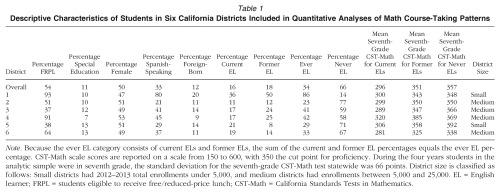
Note. Because the ever EL category consists of current ELs and former ELs, the sum of the current and former EL percentages equals the ever EL percentage. CST-Math scale scores are reported on a scale from 150 to 600, with 350 the cut point for proficiency. During the four years students in the analytic sample were in seventh grade, the standard deviation for the seventh-grade CST-Math test statewide was 66 points. District size is classified as follows: Small districts had 2012–2013 total enrollments under 5,000, and medium districts had enrollments between 5,000 and 25,000. EL = English learner; FRPL = students eligible to receive free/reduced-price lunch; CST-Math = California Standards Tests in Mathematics.
My goal is to simply describe math course-taking patterns among current ELs, former ELs, and never ELs. Analysis of the causal effect of EL classification on math course-taking is of crucial importance, but conducting this analysis lies outside the scope of this article. My focus here is to contextualize the in-depth analysis of ever ELs’ explanations of their math course-taking from case study data with a simple descriptive framing, documenting general math course-taking patterns for ever ELs in similar districts. 5 I follow students longitudinally from 7th to 10th grades for several reasons. While analyzing students’ full math trajectories from kindergarten through high school graduation would be ideal, data are only available from 2005–2006 through 2011–2012. Following cohorts of students beginning in 7th grade allows for the inclusion of information about their math achievement prior to 8th grade, when students typically first have the opportunity to take Algebra I. I follow students through 10th grade because prior research suggests that successful completion of Algebra I and geometry by 10th grade is the strongest predictor of 12th-grade math outcomes and also predicts postsecondary enrollment (Schneider et al., 1998). Following students through 10th grade rather than 11th grade allows me to include an additional cohort of students, maximizing sample size.
Detailed Case Studies of Math Course-Taking Among Ever ELs
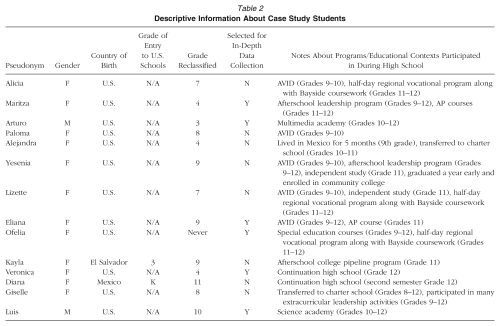
For the qualitative strand involving Research Questions 2 and 3, about ever ELs’ explanations for their math course selection and factors that prevented or facilitated their success in math courses, more detailed information is needed than is available from administrative data. Therefore, I use case study data consisting of interviews, field notes, and students’ cumulative school records for 14 ever ELs from a different California district (Yin, 2009). As part of a research project exploring long-term outcomes for students who entered school as ELs, I collected case study data from this group of 14 students, all of whom I taught when they were in fourth grade and were seniors in high school during data collection. Table 2 presents descriptive characteristics of case study students. All attended schools in Bayside, a suburban Northern California district, for most of their K–12 years, and participated in a Spanish-English bilingual program during elementary school. 6 Bayside enrolls a racially, ethnically, linguistically, and socioeconomically diverse student population. About half of Bayside students qualify for free or reduced-price lunch, and about one-fourth are classified as ELs, two-thirds of whom speak Spanish as their home language. The district operates a large comprehensive high school and several alternative programs for high school students.
Descriptive Information About Case Study Students
I interviewed each student in the sample twice during their senior year, once near the beginning of the year and once near the end, with each interview lasting approximately one hour. In the first interview, I used a variation of the life history calendar method (Nelson, 2010), asking students to complete a timeline together with me, documenting experiences that had shaped them. I also interviewed students’ parents, and as part of these interviews, I showed parents the timelines their children and I had created and asked for their input and feedback. A key component of my second interview with each student was reviewing their middle and high school transcripts and asking for their thoughts and reflections, beginning with a general prompt, “What do you notice?,” and then probing for specific details. After each interview, I wrote field notes documenting key details from the interview.
In my initial data collection, I was interested in exploring a wide range of factors that had shaped students’ trajectories. During data collection and analysis, I realized that 11 out of 14 students in my sample had received a D or F in one term of math in high school and that math was by far the most common subject area in which students received failing grades. Therefore, I became interested specifically in students’ math course-taking and incorporated questions about this into my data collection, particularly my second interviews with students.
To further understand students’ educational trajectories, I examined their cumulative school records, including all report cards from kindergarten through 12th grade, all assessment results, notes from meetings between teachers and counselors about students, and portfolios of student work. I photographed all documents in students’ records, creating digital albums of approximately 30 to 60 documents per student and tagging each photo for relevant content. To analyze these data, I created a spreadsheet to record important details from each student’s file and wrote field notes reflecting on what I learned from students’ records.
I also selected six students, participating in distinct programs within their high school and representative of different patterns within my sample, for additional data collection. I shadowed each of these students for two full days, writing detailed field notes about each of their classes, particularly the opportunities to learn presented by the tasks in which students were asked to engage. I also interviewed at least one teacher for each of these six students, seeking their perspectives on students’ school experiences. Again, I wrote field notes after each interview. As I further refined my research questions to focus on math course-taking, I interviewed four staff members with specific knowledge about course placement policies for ELs in the district.
Throughout this process, I attended to the ways in which my positionality as a middle-class, White, native English-speaking woman who was the former teacher of the individuals in my sample might bias my results. I suspect that my preexisting relationship with students likely increased the trust between students and myself, perhaps leading them to disclose more information than they otherwise might. However, my positionality likely led students (and their parents) to focus on certain topics rather than others in our conversations. For example, students may have talked less about the role of race and ethnicity with me than they would have with a researcher who shared their racial and/or ethnic backgrounds. Through triangulation of data—using interview transcripts, field notes, and school records—I attempted to validate the information I learned from students and address both validity and reliability concerns. However, my positionality invariably influenced both data collection and analysis.
Integrated Analysis of Quantitative and Qualitative Strands
I began with an analysis of general patterns in math course-taking using the quantitative data set and then explored those patterns in greater depth using the qualitative data. While I initially conducted these analyses separately, as findings emerged, I searched for confirming and disconfirming evidence of these findings across the two data sets. For the quantitative data analysis, I began with the approach of Finkelstein and colleagues (2012), calculating the percentages of students experiencing a variety of events, including enrolling in Algebra I in eighth grade, repeating Algebra I, repeating any math course in Grades 8 through 10, ever scoring proficient in Algebra I, and enrolling in an accelerated math sequence (which is defined as taking Algebra I in 8th grade, geometry in 9th grade, and Algebra II in 10th grade). I disaggregated these results by students’ language proficiency classifications, reporting results for current ELs, former ELs, and never ELs.
To analyze the qualitative case study data, I first used an open coding process to note topics that emerged from the interview transcripts, field notes, and student records, creating a list of over 400 initial codes, which I then grouped into 10 thematic categories (Emerson, Fretz, & Shaw, 1995). As math course-taking emerged as a focus, I consulted literature, reviewed the data, and iteratively developed a set of focused codes around the core analytic themes of course placement policies, ways of knowing, and motivation. Beginning with data collection and continuing through focused coding around central themes, I developed a set of key assertions and documented the analytic choices I made, creating a chain of evidence (Yin, 2009).
As patterns emerged, I moved back and forth between the two data sets to search for confirming and disconfirming evidence to better understand the generalizability and nuances of findings. For example, as noted previously, during qualitative data collection, I observed that a large proportion of case study students repeated math courses between 8th and 12th grades. After analyzing the proportion of students across the six districts in the quantitative data set who repeated math courses, I was able to determine that the pattern I found in the qualitative data among case study students was not unique to their school or district. Similarly, after seeing in the administrative data that many students who repeated a math course had end-of-course assessment scores that were the same or lower during their second year in the course, I examined the case study data and confirmed that this pattern existed for case study students as well. This process enabled me to create meta-inferences (see Table 5 in the Discussion section), providing a fuller picture of math course-taking trajectories than would be possible from the quantitative and qualitative strands separately.
Findings
General Course-Taking Patterns Among Current ELs, Former ELs, and Never ELs
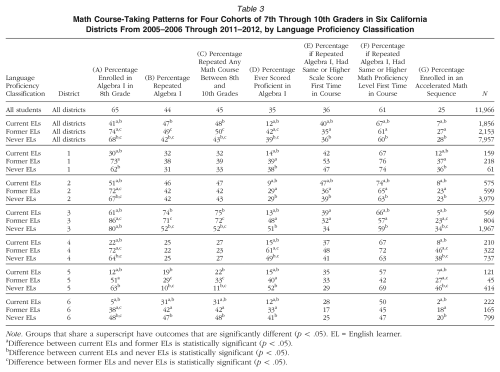
Table 3 presents data about math course-taking outcomes first for all students across all districts, then separately by language proficiency classification (for current, former, and never ELs) across all districts, and finally by language proficiency classification within each district. Across language proficiency classifications (first among all districts and then within districts), groups sharing a superscript have outcomes that are significantly different from one another (p < .05). Specifically, a superscript of a indicates that the outcome for current ELs and former is significantly different, a superscript of b indicates that the outcome for current ELs and never ELs is significantly different, and a superscript of c indicates that outcomes for former ELs and never ELs is significantly different (p < .05).
Math Course-Taking Patterns for Four Cohorts of 7th Through 10th Graders in Six California Districts From 2005–2006 Through 2011–2012, by Language Proficiency Classification
Note. Groups that share a superscript have outcomes that are significantly different (p < .05). EL = English learner.
Difference between current ELs and former ELs is statistically significant (p < .05).
Difference between current ELs and never ELs is statistically significant (p < .05).
Difference between former ELs and never ELs is statistically significant (p < .05).
Looking at results by language proficiency classification across all districts, we see that descriptively, current ELs 7 show evidence of attaining less math knowledge and completing less rigorous math coursework than former ELs and never ELs. Specifically, current ELs are between three and four times less likely to: (a) attain proficiency in Algebra I (Column D) and (b) enroll in an accelerated math sequence than former ELs and never ELs (Column G). On the other hand, former ELs’ math course-taking patterns are relatively similar to (and in several cases, statistically indistinguishable from) patterns for never ELs. For example, across all districts, 7% of current ELs enrolled in an accelerated math sequence compared to 27% of former ELs and 28% of never ELs. There is no statistically significant difference in the proportion of former ELs and never ELs enrolling in an accelerated math sequence (as indicated by the fact that superscript c does not appear for this outcome). However, the proportion of current ELs in an accelerated math sequence is significantly different from the proportions of both former ELs and never ELs (as indicated by the superscripts a and b).
Strikingly, about half of all students repeated a math course between 8th and 10th grades (48% of current ELs, 50% of former ELs, and 43% of never ELs; Column C), with the vast majority repeating Algebra I (Column B). Here, we see that the difference between current and former ELs is not significantly different (p > .05), while the proportion of never ELs repeating a math course between 8th and 10th grades is significantly lower than both current and former ELs. However, the magnitude of the difference between never ELs and the other groups is substantially smaller than the magnitude of the differences between current ELs and the other groups on the key outcomes discussed previously (ever scoring proficient in Algebra I and being enrolled in an accelerated math sequence). The percentages of students repeating math courses observed here are in line with other findings from California districts during these years (e.g., Finkelstein et al., 2012; Fong, Jaquet, & Finkelstein, 2014; Rosin, Barondess, & Leichty, 2009).
Importantly, many students continued to experience challenges in mastering math content when repeating courses. As shown in Table 3, 36% of all students who repeated Algebra I had a scale score on the state Algebra I assessment that was the same or lower their second year in the course (Column E). Current ELs were more likely than former ELs and never ELs to show no improvement in Algebra I test scores when repeating the course. (There was no statistically significant difference between former ELs and never ELs on this outcome, whereas the differences between current ELs and both groups were statistically significant, p < .05.) The lack of substantial improvement in math knowledge after repeating a course is even more striking when we compare students’ math proficiency levels in both years. Students could score at one of five math proficiency levels, with each proficiency level corresponding to a particular range of scale scores. Among all students repeating Algebra I, 61% scored at the same math proficiency level or lower their second time in the course (with 45% of students scoring at the same proficiency level and 16% of students scoring at a lower proficiency level; Column F). Again, current ELs were more likely than former or never ELs to show no improvement in math proficiency level their second time in Algebra I, and the differences between current ELs and both groups were statistically significant (p < .05).
Since results indicate that current ELs in these districts repeated math courses in Grades 8 through 10 at rates that were relatively similar to former ELs and never ELs, why were current ELs three to four times less likely to attain proficiency in Algebra I and enroll in an accelerated math sequence? Results suggest several reasons. First, there is a gap of approximately one full standard deviation in the 7th-grade CST-Math scores of current ELs compared to never ELs and former ELs. (The gap between current ELs and former ELs is 55 points; the gap between current ELs and never ELs is 61 points; see Table 1.) Current ELs’ significantly lower likelihood of attaining proficiency in Algebra I by 10th grade suggests that this math proficiency gap remains wide as students progress through school. Another reason that current ELs may be much less likely to ever score proficient in Algebra I than former and never ELs is that they are significantly less likely to show improvement when repeating the course (as discussed previously). Finally, a key reason that current ELs are much less likely to enroll in an accelerated math sequence is that current ELs are much less likely to be enrolled in Algebra I in 8th grade than former or never ELs (41% for current ELs compared to 74% for former ELs and 68% for never ELs; differences between all groups are statistically significant at p < .05). Because enrolling in an accelerated math sequence is defined as completing Algebra I in 8th grade, geometry in 9th grade, and Algebra II in 10th grade, current ELs, with their lower rates of enrollment in Algebra I in 8th grade, are necessarily less likely to be enrolled in an accelerated math sequence.
Turning to the final section of Table 3, which shows math course-taking outcomes by language proficiency classification within each district, we see substantial variation in math course-taking patterns across districts. This variation by district is likely driven by differences in district characteristics as well as differences in district policies and practices. This echoes findings by Domina and colleagues (2015), who observed wide variation in the percentage of eighth graders enrolled in Algebra I across California districts. Districts that enrolled higher proportions of eighth graders in Algebra I, such as District 3, tend to have higher proportions of students repeating Algebra I. Yet across all districts, current ELs are between 2.5 and 9 times less likely than former ELs and never ELs to (a) attain proficiency in Algebra I (Column D) and (b) enroll in an accelerated math sequence (Column G), and the differences between current ELs and the other groups are statistically significant in all cases (as indicated by the appearance of superscripts a and b for these outcomes in all districts).
In some cases, math course-taking outcomes also differ by cohort. A major reason for this is likely that, as noted previously, California’s push to enroll eighth graders in Algebra I was at its height during the first years examined here. For the first and second cohorts, approximately 70% of all eighth graders were enrolled in Algebra I. However, for the last cohort of students, the proportion of all eighth graders enrolled in Algebra I had declined to 54%. The proportions of eighth-grade current ELs, former ELs, and never ELs enrolled in Algebra I were at their lowest levels for the last cohort. Earlier cohorts, who were more likely to be enrolled in Algebra I in eighth grade, were also more likely to repeat Algebra I. However, for later cohorts, although lower proportions of students repeated Algebra I, proportions of students scoring proficient on the end-of-course Algebra I assessment remained relatively flat. Again, this holds true for current ELs, former ELs, and never ELs. In other words, although students in later cohorts were less likely to repeat Algebra I, the majority of students in these later cohorts were still not mastering Algebra I content. Across all cohorts, current ELs were much less likely to ever score proficient in Algebra I than former ELs or never ELs, with gaps ranging from 20% to 35% depending on the cohort and comparison group. (Full results by cohort are available from the author.)
My intention here is to simply describe the math course-taking patterns that existed for current ELs, former ELs, and never ELs. No causal relationship between language proficiency classification and math course-taking can be inferred from these data. As noted previously, the differences in course-taking patterns are likely shaped by a variety of factors, including prior achievement. Future research using quasi-experimental methods is needed to explore whether EL classification itself has an effect on math course-taking patterns.
Ever ELs’ Explanations for Their Math Course Selection and Factors Facilitating or Preventing Their Success in Math Courses
Now, turning to case study data, I explore ever ELs’ own explanations for their math course selection and the institutional-, classroom-, and individual-level factors that prevented or facilitated their success in math courses in high school. I aim to illuminate the math course-taking ecologies in which students participated, with a focus on the interactions between course placement policies, ways of knowing valued in their math classrooms, and motivation (see Figure 1). Before considering students’ explanations of their math course-taking trajectories, it is useful to consider school and district policies related to math course-taking and describe students’ trajectories.
Math Course-Taking Policies in Bayside
Bayside’s math requirements for high school graduation are basically equivalent to California’s requirements. Students need to complete 20 credits of math coursework for high school graduation, generally equal to four semesters of coursework. 8 Importantly, if a student receives any grade above an F, they earn credit for the course. In addition, to meet statewide requirements, students need to complete at least the equivalent of Algebra I and pass the math portion of the California High School Exit Exam (CAHSEE).
Bayside High offered the following math courses: Algebra I, geometry, advanced algebra/trigonometry, pre-calculus, AP calculus, and AP statistics. There were four different levels of Algebra I: two versions for students in special education with varying levels of disabilities, a “sheltered” version for certain students classified as ELs, college prep (the lowest level in the general education program), and honors. At the time of this study, to be placed in the sheltered version of Algebra I, ELs had to score at or below the intermediate level (Level 3 out of 5) on the state’s English Language Proficiency assessment. One case study student scored below Level 3 on the ELP assessment in high school but had a learning disability and participated in a version of Algebra I for students in special education. One other student was scoring at Level 3 on the ELP assessment in high school but nonetheless, for reasons that are unclear, was not enrolled in sheltered math courses in high school. All other students in the sample who entered high school as ELs were scoring above Level 3 on the ELP assessment so were not placed in sheltered math courses in high school. However, three students were enrolled in sheltered versions of Algebra I in eighth grade. Three other math courses were also tracked. There were three levels of geometry (sheltered, college prep, and honors), two levels of advanced algebra/ trigonometry (college prep and honors), and two versions of AP calculus (AB and BC).
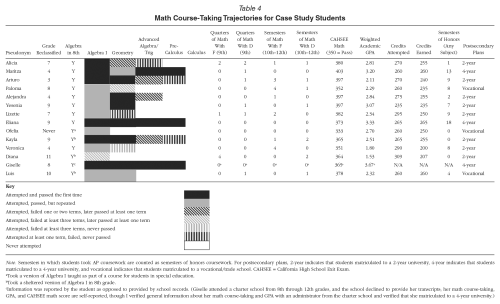
Explicit policies governed placement in each math course, but these policies generally allowed for some discretion. For example, Bayside’s ninth-grade math course placement policy reads, “Placement is determined by a combination of students’ grades, final exam and teacher recommendation.” Districtwide, Bayside enrolled about half of all students in Algebra I in eighth grade (including 30% of current ELs, 70% of former ELs, and 45% of never ELs) during the school year that case study students were in eighth grade, somewhat below the proportion of eighth graders enrolled in Algebra I across all districts in the quantitative data set. However, all case study students took Algebra I in eighth grade. Thus, case study students were more likely than other students in their district to be enrolled in algebra in eighth grade. Because some case study students earned low grades and/or low test scores in this course as eighth graders, eight students (57%) retook all or part of Algebra I in ninth grade. (See Table 4, discussed in detail later, for specifics about each student’s math course-taking trajectory.) This is somewhat higher than the 44% of all students who repeated Algebra I across all districts in the quantitative data set.
Math Course-Taking Trajectories for Case Study Students
Note. Semesters in which students took AP coursework are counted as semesters of honors coursework. For postsecondary plans, 2-year indicates that students matriculated to a 2-year university, 4-year indicates that students matriculated to a 4-year university, and vocational indicates that students matriculated to a vocational/trade school. CAHSEE = California High School Exit Exam.
Took a version of Algebra I taught as part of a course for students in special education.
Took a sheltered version of Algebra I in 8th grade.
Information was reported by the student as opposed to provided by school records. (Giselle attended a charter school from 8th through 12th grades, and the school declined to provide her transcripts; her math course-taking, GPA, and CAHSEE math score are self-reported, though I verified general information about her math course-taking and GPA with an administrator from the charter school and verified that she matriculated to a 4-year university.)
Grades and in some cases teacher recommendations also impacted placement in later math courses. For example, to enroll in the honors version of geometry or advanced algebra/trigonometry, students needed to have earned a B in their previous math course and for advanced algebra/trigonometry, receive a teacher recommendation. To progress to the next course in the mathematics sequence—for example, to enroll in geometry after completing Algebra I—students needed to have earned at least a C in the previous math course.
Math Course-Taking Patterns for Case Study Students
Table 4 displays key information about each of the 14 case study students’ math course-taking. Shading provides detailed information about the students’ experiences in key math courses offered by the students’ high school, indicating the number of times the student was enrolled in the course (including if the student never attempted the course) and whether the student passed the course (either on her first attempt or after one or more failed attempts). Information about the grade level when students exited EL services, the number of terms in which students received a D and/or an F in a math course, 9 scores on the mathematics portion of the CAHSEE, GPA, the number of semesters in which students were enrolled in honors coursework, and postsecondary plans are also provided.
Table 4 shows that, as in the quantitative data set, most students experienced challenges in their high school math coursework. Only three students (Maritza, Eliana, and Giselle) successfully completed math coursework through pre-calculus, and these are the only three students who matriculated to four-year universities. Out of the 14 students in the sample, only four (Arturo, Eliana, Kayla, and Giselle) did not repeat either Algebra I and/or geometry. Thus, case study students were even more likely to repeat math courses between 8th and 10th grades (with 71% repeating a math course during these grades) than were students across all six districts in the quantitative data set (with 45% of students repeating a math course). Of the four students who did not repeat Algebra I or geometry, 2 (Arturo and Kayla) went on to fail at least one semester of advanced algebra/trigonometry. All but three of the 14 students (Eliana, Ofelia, and Giselle) received a D and/or an F in at least one term (either quarter or semester) of math. Specifically, 57% of case study students (8/14) received an F in at least one term of math (similar to the 45% of students in the quantitative data set who repeated math courses), and an additional 21% (3/14) received at least one D.
As found in all six districts in the quantitative data set, case study students often continued to struggle with math content when repeating a math course. For the five students who took the Algebra I assessment in both eighth and ninth grades, 10 3 (60%) scored at the same proficiency level or lower on the state Algebra I exam their second year in the course. This is similar to the 61% of students in the quantitative data set who scored at the same proficiency level or lower their second time in Algebra I. Among the 11 students who received a D or F in one term of math, 9 (82%) received at least one more D or F. Three students (Paloma, Veronica, and Diana) failed the same math course in three or more terms.
The grade when students exited EL services seems to have a limited relationship to their math course-taking trajectories. For example, among the six students with at least four terms of Ds or Fs in math (Alicia, Arturo, Paloma, Lizette, Veronica, and Diana), two exited EL services in elementary school, three exited in middle school, and one exited in high school. Among the three students who successfully completed pre-calculus (Maritza, Eliana, and Giselle), one exited EL services in elementary school, one exited in middle school, and one exited in high school. While this limited sample cannot provide generalizable information about math course-taking trajectories for Ever ELs, understanding these students’ trajectories provides important background to interpreting their explanations for their math course-taking trajectories, and it is to this that we now turn.
Institutional Factors
Course Placement Policies and Student Agency
Current and former ELs often describe exercising agency over some aspects of the course placement process. Bayside High was divided into a series of several distinct academies, including an academy that focused on multimedia and an academy that focused on science. Students also had the option to take AP classes, participate in the college prep program AVID, and enroll in a regional vocational education program for part of their school day. Importantly, math courses operated outside of the academy structure. Students tended to view their choices about programs in which to participate, particularly their choices about whether to join a particular academy, as important events over which they exercised agency. (See Table 2 for information about the particular programs in which each student participated.)
Apart from these larger decisions about programs in which to participate, in most cases, students seemed more able to exercise agency over course placement in cases where they wanted to move to a less rigorous version of a course rather than cases where they wanted to switch to a more rigorous version of a course. Paloma, Lizette, and Yesenia all dropped out of AVID and eventually stopped taking honors courses after experiencing course failure. Paloma went to her counselor during her senior year to request dropping geometry after the fall semester. “I have all my math credits but she wants me to stay in math, but I’m failing that class, so what’s the point?” she explained. “I don’t need math, I have all my math credits.” Eventually, the counselor honored Paloma’s request.
In contrast to the limited agency that Paloma and Kayla were able to exercise to drop math classes in which they were struggling, Kayla describes being unable to switch into honors courses earlier in her high school years. She is one of only three students who never took any honors courses in high school. Her grades in middle and high school were not substantially lower than other students who took multiple honors courses, suggesting some discretion and idiosyncrasy at work in the honors course placement process.
Eliana and Martiza, the highest-achieving case study students enrolled in Bayside High, represent exceptions to the larger pattern of exercising agency to jump down but not up tracks, suggesting that this pattern may not operate for students with higher GPAs. Both Eliana and Martiza chose to enroll in AP courses during their final years of high school. They both took AP Spanish as juniors, and Martiza also took AP English and AP government her senior year. Maritza reported that her counselor recommended she take AP English, but she decided on her own to sign up for AP government after learning that many of her classmates were enrolling.
The Interaction Between Language Proficiency and Math Course Placement Policies
As noted previously, no case study students were enrolled in math courses designed specifically for English learners in high school (though three were enrolled in sheltered versions of Algebra I in 8th grade). Thus, language proficiency did not play a formal role in math course placement for any case study students. As students reflected on the challenges they experienced in their math courses, no students explicitly mentioned issues related to language proficiency either. However, two students, with very different high school trajectories, did spontaneously discuss times when they their English proficiency impacted their experiences. Luis, who remained classified as an EL through 10th grade, described feeling nervous when called on to read or speak in his English class but not in his Spanish class. Maritza, who exited EL services in elementary school and took AP English her senior year, described having to work harder than other students. “I feel like in the AP classes I had to try more than the other kids that had already been in English all their life,” she explained. Although EL course placement policies did not formally constrain students’ opportunity to learn, students’ experiences as ELs may have impacted their self-beliefs.
The Interaction Between Institutional Policies and Motivation
In addition to course placement policies for math and course placement policies for ELs, other policies influenced students’ math course-taking as well. Kayla, one of two case study students born outside the United States, immigrated from El Salvador and entered U.S. schools for the first time in third grade. She describes how her status as an undocumented immigrant influenced her educational aspirations and course-taking. Specifically, she wishes she had known earlier about state law AB 540, which allows undocumented students who meet certain requirements to pay in-state college tuition:
I went and talked to my counselors and they told me all this information about the AB 540, I think it’s called like that. So then right there, my junior and sophomore year, I was basically kind of panicking because I didn’t know there was a AB 540 and stuff. I didn’t really know that people who aren’t born here can get help.
So, if you had known about AB 540 earlier, how might high school have been for you?
I would have tried harder. ’Cause since—I think somebody told me this, I don’t know—but if you get good grades, like really good grades, no matter what, the AB 540, some people can help you out.
In retrospect, Kayla expresses regret for not completing honors coursework, not earning better grades in high school (she had a 3.79 academic GPA in middle school compared to a 2.51 academic GPA in high school), and not applying to a four-year university. Kayla’s conjecture that she would have worked harder in high school if she had known about AB 540 earlier is of course speculation. Nonetheless, as noted previously, existing analyses of in-state resident tuition policies such as AB 540 suggest that they have positive effects on outcomes for undocumented students (Flores, 2010; Kaushal, 2008). However, students must know about these policies and ideally receive guidance in navigating them from counselors, admissions officers, and financial aid administrators for them to impact students’ motivation and outcomes.
Classroom Factors
Seeking Out Connected Knowing to Increase Motivation
In response to difficulties in math courses, students sought support in creative ways. Three students in particular—Eliana, Yesenia, and Lizette—found and/or created spaces in which math teaching and learning could be a dialogic process, involving the social interaction that is the hallmark of connected knowing (Boaler & Greeno, 2000). After describing the different dialogic math spaces that students found/created, I highlight the similarities between them.
Eliana successfully completed Algebra I, geometry, advanced Algebra II/trigonometry, and pre-calculus and was one of only three students who never received a D or F in a high school math course, but she found her math courses very challenging nonetheless. She describes hating geometry because she didn’t understand it and encountered even more difficulties in her later math courses. Her junior year, to keep her pre-calculus and physics grades at a C or above, she sought out additional tutoring, beyond what she already participated in as part of the AVID program:
My AVID teacher, she recommended me to stay after school because in our school library they have tutoring groups of people that help us with our classes. There was a teacher from that school that helped me with physics. And my same pre-calculus teacher, she used to volunteer at the library to help so it would be easier. I would get help for physics and pre-calculus at the same time. That helped me a lot. . . . I would stay after school every day expect Fridays. Then I had to come home because I had to babysit since my mom had to work.
Yesenia also describes going to great lengths to work with a math teacher at lunch and after school to understand math concepts and improve her math grades. Although she earned a D in geometry, Yesenia remembers her geometry teacher fondly and appreciates the opportunities and support she provided to facilitate Yesenia’s learning:
I remember she was very patient because I would ask her to explain something to me that she had already explained to me like four times, and she was patient. I don’t think I would be able to be that patient. I think she was a great math teacher, even though I didn’t do well.
In addition, Yesenia and Lizette both went outside Bayside High’s conventional math tracks to find/create a different space in which to engage in dialogic math teaching and learning through the district’s independent study program. Typically, Bayside’s independent study program, like most high school independent study programs, is intended to provide opportunities for students who are unable to attend regular high school classes and/or who have experienced significant academic difficulties and need to recover credits. But both Yesenia and Lizette used the district’s independent study program for their own purposes. Lizette explains:
They called me, and they thought I was pregnant or something, because they were like, “Usually people are pregnant, or have an excuse like that want to take it.” I was like, “Actually no, I want to get my credits.”
In Yesenia’s case, she was not missing credits but was frustrated by her experiences at Bayside High, and following in her older sister’s footsteps, she investigated independent study as an option. Without consulting her counselor, Yesenia simply went to the office for the independent study program at the beginning of her junior year, filled out an application, and completed two years of high school coursework in one year while enrolled in independent study. She graduated a year ahead of schedule and entered community college.
Both Yesenia and Lizette liked working independently and appreciated the one-on-one interactions with their teachers. Lizette especially valued the way her math teacher worked with her to make sure she understood the content:
We used to get tutored in AVID. Even with the tutoring, some of the work I still didn’t get. That’s the thing I also liked about independent studies. I had my own teacher, and I had my own meetings with my teacher, and they had to find out a way to make me understand in my own way. For example, for math, there were things I didn’t understand, and they tried their best to find a way for me to understand it the best, whether if it was to draw things out or just write it, or don’t even bother me, just, “Here, do it.” Whatever was best for me, they did. I think I liked that as well, a lot. I think that was the reason I passed math, with them. Without that, I wasn’t going to pass it at all.
Whether in after-school tutoring or independent studies, Eliana, Lizette, and Yesenia valued opportunities for personalized math learning through social interaction, and these personalized contexts positively impacted their motivation. In each case, students’ math self-concepts seemed to improve once they started to receive more tailored, individualized instruction, with each student coming to believe that they could learn the content necessary to successfully pass their math courses. In these situations, outside conventional classroom settings, teachers were able to provide explanations, engage students in activities tailored to their particular needs, and provide immediate feedback to students, all aspects of connected knowing (Boaler & Greeno, 2000).
Attention to Language Demands Within Math Classrooms and Its Interaction With Motivation
During my 12 days of shadowing students, I only attended two periods of math, both in Maritza’s pre-calculus class. None of the other students I shadowed were enrolled in math courses during spring semester of their senior year. (Out of the 13 students for whom transcript data are available, only 2 were enrolled in a math course during spring semester of senior year, and 4 were enrolled in a math course at any point during that year. This aligns with Finkelstein and colleagues’, 2012, findings that only 30% of 12th graders in their sample took a math course.) Therefore, I had very limited opportunities to observe firsthand how language proficiency could/did function as a barrier to success in math courses. However, during my time in the classroom, the teacher spent the periods modeling how to carry out procedures—for example, how to divide polynomials, such as (20m2 + 48m – 36)/(2m – 6)—while students followed along at their seats. While a few students did ask questions and the teacher did sometimes elicit ideas from students about how to carry out the next step in the procedure, communication largely flowed from teacher to student using abstract language with potentially confusing referents (i.e., “These are the coefficients of the reduced polynomial. So this is always one power lower. This started as x2, so now it’s x, and you just go down the line.”). This type of language is likely to pose challenges for all students, both ever ELs and never ELs (Moschkovich, 2011). At no point did the teacher connect course content to students’ lives or provide examples of when division of polynomials, or other course content, is used, either in more advanced courses or outside of school contexts. This may have negatively impacted students’ motivation by obscuring the utility value of learning the math content.
Individual Factors
The Interaction Between Institutional Policies and Motivation: Working for Credits Versus Working for Grades
Many case study students described a shift in their academic goals during their high school years. Luis, a tall, lanky, athletic student with dreams of one day opening a restaurant like his relatives in Mexico, articulated this shift most clearly. When looking back at his high school transcript, he described how he switched from working for grades to working for credits:
In 9th grade, I think I didn’t really understand about credits, I wasn’t sure about the 230 credits and everything. I just worried about the letter grades. Then in 10th grade, when I started doing poorly, I really looked at the grades, and I was like, “If I’m getting the credits, I don’t have to really worry about the letter grade.” By getting the credits, I was fine with it.
The three students who matriculated to four-year universities, on the other hand, remained clearly focused on working for grades throughout high school. They are the only students in the sample with GPAs above 3.0. Giselle explains,
Now, I only have one C on my transcript, and I look at it I’m like, “Oh my God, I want it to go away.” . . . It’s like I can’t go to sleep without knowing I finished all my work. If I didn’t finish it, I really can’t sleep comfortably, and I wake up the next day like, “Oh my God, I’m going to fail.”
Contrast this with Arturo, a student who qualified for gifted and talented services and scored above the 95th percentile on a norm-referenced math test in early elementary school but earned a GPA of 2.1 in high school. A reflective young man, Arturo looked back at his middle school transcript somewhat wistfully and described how he adjusted to getting lower and lower grades in high school:
If only my high school grades were like that, that would be nice. There’s one F [on his middle school transcript], but that’s a lot of good grades right there. . . . I hit Ds [beginning with Ds in geometry and geography during the second quarter of ninth grade], and I’m like, “Ow.” . . . I went up the ladder again, then I fell, I actually fell down lower. . . . Now I’m doing it for credits. . . . When I got a D, I thought, “Cool, I got my credits.” . . . I’m like, “Good, I’m still safe.” So I think of the D as a safety net.
Applying the terminology of expectancy-value theory, the utility value of earning high grades varied depending on what students’ goals were—and as I will discuss in more detail later, students’ grades influenced the goals they set for themselves. Because students were more likely to receive low grades in math courses than in any other subject area, their math grades had a particularly important relationship to their goals. By the middle of high school, students were responding to two distinct sets of policies and requirements. The three students who matriculated to a four-year university remained focused on meeting the college entrance requirements specified by the state university system, including earning at least a C in core subject area courses. On the other hand, those who never aspired to attending a four-year university and those whose goals shifted away from four-year universities during high school focused on meeting the district’s requirements for high school graduation. Because a D counted as a passing grade and was sufficient to earn credit toward high school graduation, those students who did not feel (or no longer felt) that attending a four-year university was their immediate goal had no incentive to work for a grade above a D. Arturo speculated that if the district had required a higher grade to earn credit toward graduation, he would have met those higher standards. “If the bar was a C, then I’d try to get a C,” he explained, describing how he sometimes daydreamed in class or simply did not turn in his work because from his perspective, the costs—in terms of time and effort—were not worth it.
The Impact of a Low Grade on Students’ Self-Concept and Goals
Unsurprisingly, whether students successfully completed math courses impacted their future math course-taking. Echoing the quantitative findings across six California school districts discussed previously and others’ findings in California during this time period (Finkelstein et al., 2012; Jaquet & Fong, 2017), many case study students repeated math courses. Perhaps most strikingly, students sometimes repeated the same math course over and over. For example, after earning an A in all four quarters of Algebra I in 9th grade, Paloma failed four consecutive semesters of geometry. Her senior year, Paloma finally earned the lowest possible passing grade, a D–, in one semester of the course. Similarly, Lizette earned a D and an F in two quarters of geometry her freshman year and then failed two semesters of geometry in 10th grade, never passing a single semester of the course. 11 As noted previously, and as found in the quantitative data set, case study students often showed little evidence of learning more math content when repeating a course. For example, Paloma’s scale score on the CST in geometry actually dropped from 252 in tenth grade to 235 in eleventh grade.
These experiences of repeated failure impacted students’ self-concepts and their goals. Lizette’s family went to Mexico for a month when she was in eighth grade. Although she asked for work she could complete while she was away, her Algebra I grade ended up dropping to a C. “I wasn’t used to getting all these Cs,” Lizette recalls. “I was used to getting straight As. I was very shocked.” Lizette participated in the college prep program AVID during her freshman year and took two honors courses during both ninth and tenth grades. But she found much of her coursework challenging, and her math self-concept declined. Lizette explains that her parents
told me to do my work, but the thing is that they didn’t realize how hard it actually was. It wasn’t just go to class and sit down and do my work. Some of the work, most of the work I really didn’t understand, even with the help of teachers or tutors.
Nonetheless, Lizette also acknowledges that at times, she did not put forth her best effort because the work did not have sufficient intrinsic, utility, or attainment value to outweigh the costs. She explains, “I did try, in some classes. Then some of the things were just not interesting.”
Lizette’s reflection illustrates the complex, reciprocal relationship between self-beliefs, task beliefs, and achievement. As Lizette received feedback in the form of low math grades, her math self-concept declined, and her beliefs about the utility of completing advanced math coursework shifted too. As attending a four-year university started to seem like an unattainable goal, she focused on working for credits rather than working for grades, dropped out of AVID, and never passed geometry. Gender and race/ethnicity may also be factors moderating the impact of low grades on students’ self-concept and goals. Prior research suggests that experiences of failure may impact girls’ subsequent performance on related tasks more negatively (e.g., Dweck & Reppucci, 1973). Additional research suggests that students from stigmatized social groups, including students of color, may be more sensitive to teacher expectations, with low teacher expectations potentially becoming self-fulfilling prophecies (Jussim & Harber, 2005).
Discussion
Integrated analysis of administrative and case study data leads to three overarching meta-inferences about the math course-taking ecologies in which students participated. I list these in Table 5, with examples of the quantitative and qualitative evidence supporting each. In the following, I discuss each meta-inference in greater detail.
Meta-Inferences About Math Course-Taking Trajectories From Administrative and Case Study Data
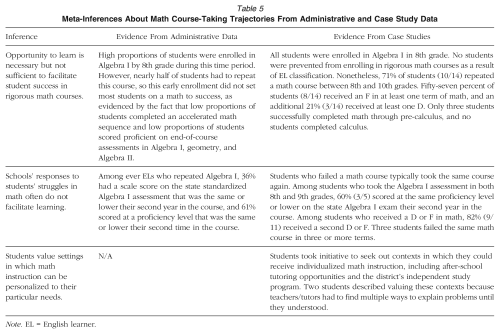
Note. EL = English learner.
Opportunity to Learn Is Necessary but Not Sufficient
Much current literature on tracking and English learners focuses on increasing opportunity to learn by expanding ELs’ access to rigorous academic courses (Callahan, 2005; Callahan & Humphries, 2016; Dabach, 2014, 2015; Estrada, 2014; Kanno & Kangas, 2014; Mosqueda, 2010; Umansky, 2016a). This study, however, provides a cautionary note about opportunity to learn. In the quantitative data, high proportions of students, including ELs, were enrolled in Algebra I by 8th grade. However, nearly half of students had to repeat this course, and low proportions of students scored proficient on end-of-course assessments in Algebra I. In the case study data, we see that ever ELs in Bayside faced challenges not in gaining access to core academic classes but in succeeding in those classes once they were enrolled, particularly in their math courses. For example, 57% of students (8/14) received an F in at least one term of math between 8th and 10th grades, and an additional 21% (3/14) received at least one D (see Table 5).
These findings suggest that opportunity to learn is necessary but not sufficient for students’ educational success. This cautionary note about opportunity to learn echoes other recent research indicating that curricular intensification efforts designed to increase opportunity to learn, such as requiring Algebra I in eighth grade or increasing high school graduation requirements, did not lead to positive effects on student outcomes (Buddin & Croft, 2014; Domina et al., 2015; Liang et al., 2012).
Schools’ Responses to Students’ Struggles in Math Often Do Not Facilitate Learning
While removing institutional barriers to enrollment in rigorous courses is important, these findings suggest that educators and policymakers should also reconsider pathways for students who fail a course. As both the administrative data and case study data illustrate, when students fail a math course, they typically repeat the same course again. However, they are often no more successful the second time around. As noted previously, among students who repeated Algebra I in the quantitative sample, 36% of students received a scale score on the state end-of-course Algebra I assessment that was the same or lower their second year in the course, and for 61% of students, their proficiency level on this end-of-course assessment stayed the same or dropped the second year. This suggests many students learned little from taking the course again. 12 Among case study students, we also see students experiencing repeated struggle in the same course, with 60% of those who repeated Algebra I scoring at the same proficiency level or lower their second year in the course. Eighty-two percent of case study students who received a D or F in math went on to receive at least one more D or F (see Table 5). Three of 13 case study students (Lizette, Paloma, and Veronica) failed the same math course (geometry) in four consecutive terms, and a fourth student (Diana) failed another math course (Algebra I) in four consecutive terms. These students’ math achievement prior to Algebra I varied, but Lizette in particular had been a strong math student, scoring proficient on the state math assessment in both sixth and seventh grades.
While case study students acknowledge that they could have invested more effort in their math coursework, they also describe losing motivation because of their low grades. The content of their high school math courses was hard for them, and they wanted help. They eventually found ways to get the help they needed to graduate—making up math credits via independent study for Lizette, switching out of math courses for Paloma, and enrolling in the district’s continuation high school for Veronica and Diana. But the alternative pathways that students carved for themselves came late in their high school years, after repeated course failure seems to have impacted their math self-concept and their goals.
It is important to remember that multiple case study students did have access to classes and structures designed to provide extra support and ensure their academic success. Six were invited to enroll in the college prep program AVID, for example. Lizette, Paloma, and Yesenia participated for two years in high school, Arturo participated for one year in middle school, and Kayla declined to participate. Only Eliana participated in AVID for four full years in high school (and credited it as a major factor in her academic success). For two years, Alejandra attended a small charter school explicitly focused on enabling all students to enroll in four-year universities but eventually convinced her parents to let her return to Bayside High. Thus, students had access to what, on paper, seems like support. However, the students did not always experience these programs and contexts as supportive.
Applying the constructs of expectancy-value theory, it seems that students rejected types of support if the costs were high, the utility was not clear, and/or the students did not find them intrinsically valuable. Once Lizette, Paloma, and Yesenia began experiencing math course failure, they began to resent AVID’s requirement that they enroll in honors courses. For example, Yesenia was already interested in attending a community college because that is the path her older sister had taken, and she wished that AVID had provided information about two-year postsecondary options in addition to four-year universities. Ultimately, Yesenia found her own supportive context, enrolling in independent study, graduating a year early, and moving on to community college. Given these experiences, administrators, counselors, and teachers should consider the match between students’ goals and types of support they are providing.
Both the administrative and case study data suggest a need for earlier intervention and support to enable students to be successful in math courses. The Common Core State Standards in Mathematics construct mathematics as a social practice, emphasizing explanation, argumentation, and critiquing the reasoning of others. Therefore, the implementation of these standards represents an opportunity to incorporate more discussion and open-ended problem solving in secondary math classrooms, in line with the vision of connected knowing laid out by Boaler and Greeno (2000). However, past mathematics reform efforts, including those that have attempted to implement discussion-based approaches, have encountered substantial roadblocks (Schoenfeld, 2004), so relying solely on Common Core implementation to improve outcomes for students seems unwise. In recent years, districts included in the quantitative data set have added a variety of programs and structures to support students’ success in secondary math courses. For example, one district now partners with a local university to offer a summer math program for incoming ninth graders that previews math course content while also incorporating college field trips and other activities focused on college readiness, helping students to better understand the utility value of their high school math courses, thereby increasing students’ motivation in math.
Students Value Contexts in Which Math Learning Is Personalized
In addition to possible curricular changes and shifts in classroom practices, Lizette, Yesenia, and Eliana’s experiences suggest that students may benefit from opportunities to learn mathematics outside conventional classroom settings. All three sought out environments in which teachers could provide them with personalized, dialogic math teaching. Building on this, districts and schools might consider how to expand math tutoring opportunities, for example. Given funding limitations, schools could potentially explore peer tutoring models or partner with local universities or nonprofits to implement volunteer-based tutoring programs, targeting students beginning to show signs of struggle in math. The potential of technology-enabled personalized learning merits further exploration as well, to better understand the conditions under which it may be most effective (Taylor et al., 2016). Districts and schools might also consider experimenting with mathematics support classes, in which students receive tailored instruction during one period of the school day to support them in being successful in their core mathematics courses. While such support classes have drawbacks—such as constraining students’ curricular choices by removing the opportunity to enroll in an elective—a recent study employing rigorous quasi-experimental methodology found that students enrolled in a support class alongside their Algebra I class experienced long-term benefits (Cortes, Goodman, & Nomi, 2015). Importantly, this support class emphasized problem-solving skills, small group work, and responding to open-ended questions, not memorization of formulas and execution of procedures.
Currently, educators recognize a need for improving math course-taking outcomes for all students, including ELs. However, findings from this study suggest that there are no simple solutions to this issue. Current approaches such as providing students with access to more rigorous courses, implementing support programs such as AVID, and/or having students repeat a course if they fail it are all unlikely to be successful without attention to the larger ecosystem in which students’ math course-taking trajectories take shape. Like ecologists, who consider interactions among organisms and their environments when seeking to understand ecosystems, educational leaders would be well served to consider the interplay of factors at different levels—particularly the interactions between course placement policies, ways of knowing valued in math classrooms, and students’ motivation—when working to address impediments to student success in secondary math courses. For example, to ensure that changes in course placement policies designed to make rigorous math courses available to ELs actually translate into more math learning for students, it would be useful to consider how to address classroom practices and motivation as well. What types of professional development might teachers need to make the rigorous content accessible to students? How could students more clearly understand the utility of successfully passing rigorous math courses so that they will be more motivated to expend the necessary effort to learn the challenging content? By more fully understanding how course placement policies, ways of knowing valued in classrooms, and student motivation interact to shape students’ math course-taking, educators can intentionally design structures that attend to all of these factors, thereby maximizing the potential of their initiatives to support students’ math achievement.
Limitations and Future Directions
Much remains to be done to better understand how to facilitate ever ELs’ enrollment and success in rigorous secondary math courses. The research presented here provides only a descriptive analysis of general math course-taking patterns among ever ELs. Future work should analyze the causal impact of classification as a current EL and a former EL on math course-taking outcomes. In the case study data employed here, I primarily analyzed students’ retrospective explanations for their math course-taking—along with students’ school records. Future work analyzing ever ELs’ math course-taking incorporating more observations of students’ math classrooms is needed to understand more fully how students’ decision making and motivation evolve in real time. In addition, examining math course-taking patterns for current and former ELs of different linguistic, ethnic, and racial backgrounds in states with different math course-taking requirements would provide useful insights as well.
Ensuring that all students, including current and former English learners, have both the opportunities and support they need to succeed in secondary math courses is a pressing challenge that requires innovation and collaboration. Working to understand the math course-taking ecologies in which students participate may enable us to better facilitate students’ success.
Footnotes
Notes
K