



Abstract
This article investigates children’s elementary school experiences, exploring how they become autonomous, rational individuals—the type of person envisioned in the European Enlightenment and generally imagined as the outcome of Western schooling. Drawing on ethnographic research that followed one cohort of Latinx children across five years, we examine how schooling practices change across the elementary school years in a context that foregrounds high-stakes testing. We describe how practices that focus heavily on testing mold children into autonomous, rational individuals while marginalizing those who don’t fit this model. Adhering to these practices and naturalizing the Enlightenment subject limits educators’ ability to serve students who resist the normative practices of schooling.
As Mrs. Cole, the math specialist, handed out scored math tests to the fourth graders, Gregorio quickly leafed through his three tests, which had scores of 1.5 of out 4, 2 out of 4, and 3 out of 4 points. Raising his hand and waving it back and forth, he asked, “Who got 3s?” Mrs. Cole responded with several names and then announced the name of one student who had earned perfect scores on all three tests. (Field note, March 13, 2013)
This scene took place one month before Gregorio and his fourth-grade peers took the State Standardized Assessment (SSA). Why was he so interested in which of his classmates had earned a “proficient” score (3 out of 4) on these tests? It was not simply natural competitiveness. We had known Gregorio since kindergarten, and as a younger child, he did not want to know others’ grades or compare his performance to theirs. But four years later, he did. In this article, we investigate how Gregorio and other students learned to compete against and compare themselves to their peers. Our central question is: What kind of student is produced over the course of elementary school? We examine the routine elementary school teaching and learning practices that help children learn subject matter and at the same time change who they are. We investigate the regulatory techniques that lead children to become different kinds of people across the early years of schooling. We trace the development of the “ideal schooled subject” in the U.S. public school system—a type of person characterized by competitiveness, independence, and self-regulation—showing how changing school practices produce these characteristics across the elementary school years (cf. Link, 2016). We do this by following two students, Gregorio and his classmate Abi, from kindergarten through fourth grade, examining how these ideals were developed and reinforced through daily classroom routines.
We illustrate how these characteristics align with those of the 18th-century Kantian, Enlightenment subject—the type of autonomous, rational individual that many Westerners assume is the natural endpoint of human development (Pongrantz, 2007). We certainly do not deny that people are capable of being autonomous and rational, but this is not the natural state of all mature humans. This type of person is produced in significant part across the elementary school years, and our analysis describes how. Our empirical analysis draws on five years of ethnographic research in a Title I school we refer to as Grant Elementary, where the majority of students lived in low-income households and were from Latinx (primarily Mexican immigrant) and African American backgrounds. 1 Grant’s designation as a Title I school mattered because its federal funding depended on the use of scripted curricula geared toward test preparation. We examine how teaching and learning practices changed across the grades with the intensifying focus on high-stakes testing, a focus that dominated teaching and learning by third and fourth grades. In our analysis, as we follow Gregorio and Abi across elementary school, we examine how they responded to these new educational practices and how they came to be identified in strikingly different ways—and in the process became different kinds of people.
We show how the types of selves that emerged for these two students across their elementary school years did not follow natural pathways but rather were produced as children were positioned in characteristic ways both through organized educational practices and contingent, heterogeneous processes. By showing how schooling produces Enlightenment subjects, we demonstrate that commonsense ways of understanding learning, knowing, and being are not natural but are instead constructed ontogenetically as well as historically. We argue that by adhering to these practices and unquestionably adopting the Enlightenment subject as the single ideal of formal education, we limit our understanding of how best to work with all students—and especially with those who may resist, challenge, or reject the normative practices of schooling. If we as educators and education scholars remain unaware of how apparently natural practices produce the Enlightenment subject, we miss the opportunity to build on and promote other ways of learning and being in school, and we fail to serve students who may challenge or reject the normative practices of schooling—often marginalizing students who do not fit the mainstream model.
Drawing on five years of ethnographic research with one cohort of students, we describe how teaching and learning practices changed as we followed Gregorio and his peers from kindergarten through fourth grade. We delineate three phases of their elementary school experience. The first phase includes kindergarten and first grade, a period during which children participated in flexible, heterogeneous activities that allowed frequent peer interaction and learning and in which young children both learned how to regulate themselves and were treated as collaborative, cooperative learners. The second phase covers second grade, a transition period between the more flexible and heterogeneous activities seen in kindergarten and first grade to teacher-fronted lessons and deliberate socialization into test-taking practices—although with limited focus on grades or test scores. In this phase, children started to become independent learners. The final phase, third and fourth grades, involved significant change. The majority of the school day was spent on whole class instruction followed by periods of individual, independent work. In this phase, there was a heavy emphasis on individual achievement based on grades, test preparation, and test scores. To understand the production of Enlightenment subjects across these phases of elementary school, we use a Foucauldian (Foucault, 1977) lens, investigating technologies of power, disciplinary and regulatory techniques that teachers and students used across the elementary grades. Our analysis shows how Gregorio and Abi became very different types of students by the end of elementary school.
Producing the Individual Through Schooling
Previous Research
As educators and educational researchers caught up in the current educational policy climate of accountability, standardized testing, and school reforms, we often focus on measuring the skills and concepts children learn and how their performance aligns with broader trends in school achievement (e.g., Kieffer, 2011; Lee, 2012; Slavin, Lake, Davis, & Madden, 2011). Such research is typically used to evaluate the effectiveness of new pedagogies or curricula emerging from school reform efforts. Others argue, however, that such research can reinvigorate deficit-oriented ways of understanding differential school performance for students from Latinx immigrant and other minoritized 2 backgrounds (e.g., Contreras, 2010; Gibson, Gándara, & Peterson Koyama, 2004). For example, research focused on measuring learning outcomes can lead to assumptions that low-performing students “fail” because they and/or their families devalue education or are culturally deficient (Doucet, 2011; Murrell, 2007). As Packer (2011) notes, the mainstream approach addresses what he refers to as epistemological and not ontological questions about learning. In other words, it focuses on knowledge as the endpoint of schooling, ignoring the fact that children become different kinds of people as they learn. Especially for students from minoritized backgrounds, we also must attend to ontological questions about who they are becoming through processes of schooling.
Instead of focusing on standard performance outcomes, we examine how schooling practices constitute children as certain kinds of learners. We situate our work within the anthropology of education, following ethnographic research on the processes through which people are “formed in practice, within and against larger societal forces and structures which instantiate themselves in schools and other institutions” (Levinson & Holland, 1996, p. 14). Much prior work looks at how classroom routines can produce student (dis)ability and (in)competence (e.g., “gifted and talented,” “learning disabled,” “struggling” readers and writers, etc.) (e.g., Erickson, 1987; Foley, 1991; Ladson-Billings, 2006; McDermott, Goldman, & Varenne, 2006; McDermott & Varenne, 1995; Pollock, 2008). We build on this work by showing how across the elementary school grades the ideal schooled subject is produced.
Ethnographic research on schooling has also investigated broader processes of social identification for young people in educational contexts (e.g., Eckert, 1989; Flores-González, 2002; Fordham, 1996; Levinson, 2001; Rymes, 2001; Wortham, 2006), how they respond to teaching and learning practices through which they are identified, and how they come to identify themselves as certain kinds of people. Most of this research studies students at the middle or high school levels, exploring how they resist, appropriate, or transform the dominant cultural, social, and linguistic norms of schooling and how this affects students’ educational pathways. There is little longitudinal research examining how students become particular kinds of people over the course of elementary school (with a few exceptions, e.g., Ferguson, 2001). Our research examines the disciplinary and regulatory techniques involved in these processes and documents how children are constituted and constitute themselves as certain kinds of people across the early years of schooling.
Kant, Foucault, and the Ideal Schooled Subject
Our investigation follows Foucault’s (1984) critique of Kant’s Enlightenment subject, the autonomous, rational individual. By the autonomous, rational individual, we mean the ideal Enlightenment figure who is able “to make use of his reason without direction from another” (Kant, 1996, p. 7). Foucault shows how such a subject is not natural but historically specific and emergent, constituted through institutional processes such as schooling (Foucault, 1977, 1980). Schooling for this type of subject, who is seen as having the capacity to formulate both his or her own accounts of the world and his or her own intentions, is about developing the individual’s autonomous capacities to reason, think, and set goals. In this article, we analyze the teaching and learning practices through which this subject is ontogenetically produced, showing how schooling is crucial to the construction of the Kantian Enlightenment subject. We demonstrate how these practices emphasize children’s development of competitiveness, independence, and self-regulation, characteristics that align with the Kantian subject. By tracking these practices over time and showing how they change across the elementary school years, we show how the ideal schooled subject may seem natural but is in fact produced in significant part through the institution of schooling.
The Kantian Enlightenment subject forms representations of reality through transcendental reason and is characterized by radical self-determination (Foucault, 1984; Packer, 2011). This subject has the capacity to develop his or her own account of the world, to think and set goals apart from other individuals. As Packer (2011) discusses, critical to the vision of the Kantian subject is that “every individual has an innate capacity for the same [italics added] reason” (p. 147). This notion of universal reason obscures difference across individuals and groups as well as presupposing that this kind of reason is natural and ideal. Our empirical analysis describes the negative consequences for children who don’t adhere to the model of an ideal Kantian subject. We investigate how such a view of the individual is both presupposed and constructed through teaching and learning practices in elementary school, practices in which young students are regulated and taught to regulate themselves as independent thinkers and actors. We do not agree that all individuals can or should become fully autonomous in a Kantian sense. We show that the development of this kind of subject is not natural, and we suggest that such assumptions limit our understanding of other ways of being—such as being connected to and dependent on others—in school and in life.
Foucault historicized Kantian claims about the autonomous, rational individual by tracing the formation of the Enlightenment subject within the modern Western episteme, or system of discourse, that dominates this current historical era and dictates what counts as knowledge (Foucault, 1972, 1973; Packer, 2011). An episteme is “a distinct ‘regime of truth’ with its own specific systems of possible discourse—the discursive formations— that dominate the historical era” (Packer, 2011, p. 355). As we discuss in this article, ideals of independence, competition, and self-regulation are not natural but are produced as part of the modern Western episteme. Schooling is a key institution for subject formation. In schools, these ideals are constructed over time through disciplinary and regulatory techniques enacted in the classroom. Our empirical analysis describes how school practices construct the ideal schooled subject.
Foucauldian Technologies of Power
To track this process of subject formation, we draw on Foucault’s (1977) concept of disciplinary power, in which “discipline” is a mechanism of power regulating the bodies and behaviors of individuals through systems of surveillance, normalizing judgments, and examinations. Foucault (1988) and others describe these systems as technologies of power (see Popkewitz & Brennan, 1998), techniques that make visible certain aspects of individuals and create subjects of a certain type (Foucault, 1988). We follow Gore (1998) in highlighting the various technologies of power that teachers draw on in their daily instruction, such as surveillance, normalization, regulation, individualization, and classification (Foucault, 1983; see Figure 1).
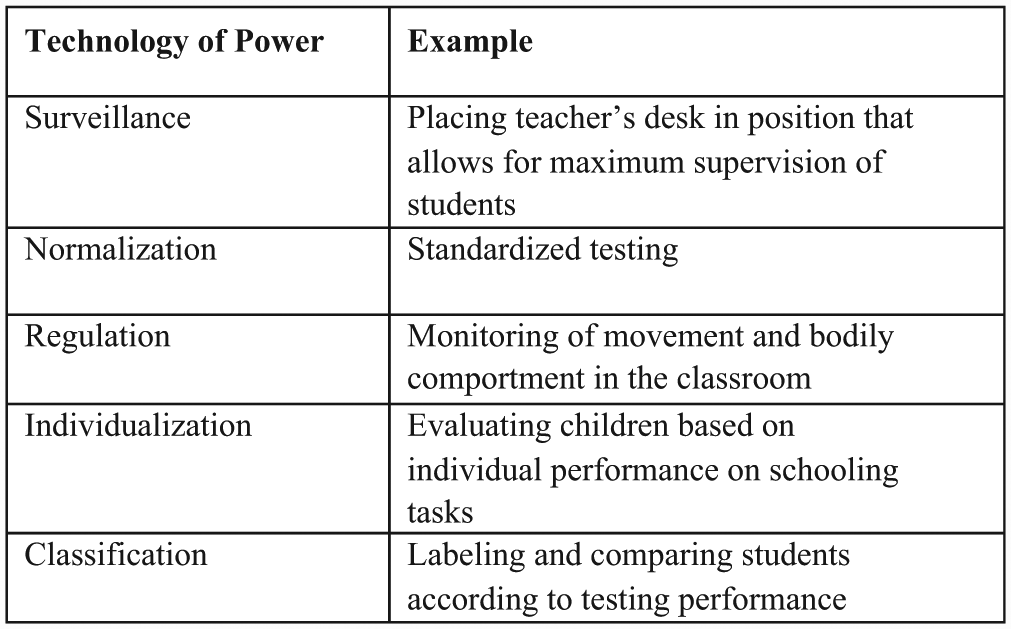
Foucauldian technologies of power in the classroom.
To illustrate how technologies of power intersected and built on one another at Grant, we return to the field note that we began with. This case illustrates several intersecting technologies of power. By third grade, the most explicit technologies of power used to discipline and regulate students revolved around standardized testing. As Jones (1990) discusses, normalization through testing is a central technology of power (see also, Foucault, 1977, 1977).
The examination combines the techniques of an observing hierarchy and those of a normalizing judgment. It is a normalizing gaze, a surveillance that makes it possible to qualify, to classify, and to punish. It establishes over individuals a visibility through which one differentiates and judges them. (Foucault, 1977, p. 184)
Frequent assessment geared toward preparation for standardized testing was a common normalizing technique at Grant Elementary. Beginning in third grade, children were continually and publicly classified according to their performance on these assessments. They were also individualized, with each deemed responsible for his or her test performance. Preparation for testing required constant surveillance and regulation of children’s behavior in the classroom. These intersecting, interwoven technologies of power formed a grid of pedagogic discipline that not only regulated children’s bodies and behaviors but also taught them to monitor and regulate themselves. The opening field note also shows how normalization can occur through comparison, which fostered competition among students—as seen in Gregorio’s question about his classmates’ scores. In this article, we describe the educational pathways Gregorio and his classmate Abi took over the course of elementary school, showing how most of these technologies of power were only occasionally present in kindergarten but became pervasive by third and fourth grades.
While the notion of disciplinary power is useful for analyzing how schools employ a variety of strategies for classifying, monitoring, and controlling students, we follow Gallagher (2008) and other neo-Foucauldians (e.g., Rose, 1999; Simons, 1995) in rejecting a wholly deterministic reading of power relationships in schooling. We also use Foucault’s (2007) work on governmentality, a concept of power that involves not “a top-down centralized approach, but in a much broader sense in which knowledge produced through a variety of institutions coalesces in the creation of governable subjects and governable populations” (Flores, 2013, p. 3). This concept helps illustrate “complementarity and conflicts between techniques which impose coercion and processes through which the self is constructed or modified by himself” (Foucault, 1997, p. 182). In this article, we explore both how different technologies of power were drawn on and assembled in the classroom and how children came to play a role in their own progress toward the ideal schooled subject. In particular, we focus on how our two focal students responded to these technologies of power and learned to regulate themselves and others over the course of elementary school. We show how Gregorio and Abi came to be constituted and constituted themselves in strikingly different ways. In our closing discussion, we question the value of teaching and learning practices that mold children into autonomous, rational individuals and penalize those who don’t fit the standard model.
Research Setting and Background
Marshall, Pennsylvania
The data come from a 5-year ethnographic study of the educational experiences of one cohort of Mexican immigrant children, their families, their classmates, and their teachers that we conducted between 2008 and 2013 in the town of Marshall, Pennsylvania. Marshall is a town of approximately 35,000 people that has become home to thousands of Latinx immigrants over the past two decades (over 80% of them Mexican). From 1990 to 2010, the Latinx population increased from 3% to 28%, approximately a 900% increase. During this same time, African American residents increased from 26% to 35%, while the White population decreased from 71% to 32%. School district enrollments showed similar changes.
The focal school for this study, Grant Elementary, was located in Marshall’s economically depressed downtown. A Title I school with approximately 95% of its students receiving free or reduced lunch, Grant served over 400 students in Grades K–4, with relatively equal numbers of African American and Latinx students. Our focal students came from the cohort that began kindergarten in 2008. In this year, about 65% of Grant kindergartners came from Spanish-speaking households. Most of these children were born in the United States to Mexican immigrant parents. Approximately 30% of students in this cohort came from African American households, and fewer than 5% of students came from other backgrounds. Reflecting national trends (Ingersoll & Merrill, 2012), Grant teachers were primarily White, middle-class women who spoke only English. This article focuses on routine classroom practices across these students’ five years of elementary school, examining the kind of subject that was produced and how students took up and responded to the models of personhood called for by school.
Research Background
Our data come from an ethnographic study that investigated the ways students from Mexican immigrant families deployed learning resources across home and school contexts. In this larger study, Link and Gallo followed a cohort of students from kindergarten through fourth grade in school and at home. We have data on five focal students from kindergarten through fourth grade as well as data on classmates who moved into or out of their classrooms across the five years. The larger study examined three key issues: (a) how students’, parents’, and teachers’ ideas and capacities were recognized and built on for learning; (b) how participants came to be positioned as social types across time (e.g., “good student/teacher/parent”); and (c) how students, teachers, and parents enacted notions of school success.
Data collection involved intensive ethnographic fieldwork and video recording of routine activities across the 2008–2013 school years at school and in homes. Starting with the kindergarten classrooms in 2008, school-based participant observations and video recordings occurred weekly in two or three focal classrooms per grade. The 13 teachers whose classrooms we observed were welcoming and open to our presence in their classrooms. While in this article we discuss the ways in which teachers drew on technologies of power in daily classroom instruction, we do not judge individual teachers’ actions. Instead, we point out how the requirements of standardized testing led them to draw more heavily on certain disciplinary and regulatory technologies of power in the upper elementary grades.
During each classroom visit, we focused on a single student from the study, observing him or her across activities and interactions. We would sit near the student to observe and understand the school day from his or her perspective, including academic and recreational activities. When videotaping, which occurred during approximately half of our school observations, the focal student would wear a lavalier microphone, and the camera would be placed near him or her. Observations and recordings included educators’ pedagogical practices and students’ interactions with peers. Thus, although the original study focused on students from Mexican immigrant families, it captured routine teaching and learning for many students. Interviews were conducted with focal teachers, administrators, and focal students in each grade. Parent-teacher conferences with focal participants were also recorded each year. School data reveal the overt and subtle ways that teachers and students produced or resisted the Enlightenment model of an ideal student subject over the course of elementary school. As our focal cohort of students moved to each subsequent grade, we followed them to their new classrooms. Home-based data collection involved participant observation of routine interactions, interviews with parents and children, video recordings, and playback sessions of these recordings. Although not the primary data sources for this article, home-based data show us the range of ways that students learned—ways that were not always recognized as valuable by the school.
As non-Latinx English-Spanish bilinguals who had spent our careers teaching or conducting research with educators and Latinx immigrant students, our research is shaped by our own roles, relationships, and subjectivities. Wortham began conducting research in Marshall in 2005, exploring how Mexican newcomers navigate a community in which longstanding residents have fewer entrenched ideas about Latinx than in areas of longstanding Latinx presence. Gallo first met families in Marshall in 2006 when she began volunteering as an interpreter at Grant Elementary and a local bilingual service agency and conducted research studies there through 2013. Link has worked with families and teachers since 2008 and is currently director of educational programming and research at a nonprofit community center serving Latinx families. In 2008, Gallo and Link began this study, which continued for five years. The study yielded a large corpus of data: 530 field notes (from participant observations), 203 video logs (from classrooms, homes, and parent-teacher conferences), and 141 audio logs with extensive transcription (from interviews with students, teachers, and families).
This article grew from our interest in better understanding how students were positioned as certain kinds of people by the end of fourth grade, the final grade of elementary school in Marshall. We were particularly struck by a conversation with Abi’s mother in fourth grade in which she described the importance of Abi herself deciding if she was capaz (capable) of moving on to middle school or if Abi preferred to repeat the year to feel better prepared. Although Abi had been positioned as an unsuccessful student through the technologies of power embedded in the testing that was pervasive in third and fourth grades, the teachers had not suggested that Abi should be held back. Yet her mother emphasized the importance of Abi authentically learning, not just passing through the processes of schooling (see Bloome, Puro, & Theodouro, 1989). Abi’s mother involved her daughter in these larger educational decisions, thus expecting a type of independence and self-monitoring that were not dependent on teachers’ instructions or approval and were not valued at Grant Elementary. As we thought back to the day we met Abi at her kindergarten orientation five years beforehand, we became interested in exploring how the institution of elementary schooling played a role in the constitution of certain social types and how this institution may not serve students like Abi well.
Students varied in how they came to be ontologically positioned over the course of elementary school. Of the five focal students who participated across their entire elementary school careers, we selected Gregorio to contrast with Abi because he most successfully enacted the model of an Enlightenment subject. These two cases illustrate how educational practices in elementary school constrain the types of people that students can become. Gregorio was born in the United States to parents from Mexico, had attended English-medium preschool in Marshall, and self-identified as English-dominant by the beginning of elementary school. Although he was positioned in various ways over the course of his elementary schooling, he ultimately came to be identified as a model student by fourth grade. Abi was born in Mexico, attended Spanish-medium preschool there, and arrived in the United States a few months before she began kindergarten at Grant Elementary. She strongly identified with her Mexican heritage, developed Spanish to speak with family members across geopolitical borders, and questioned the focus of mainstream U.S. schooling. Although she demonstrated enthusiasm for learning, strong leadership skills, and linguistic dexterity, by fourth grade, she was seen as deficient by her teachers and considered a struggling student. By the end of fourth grade, Gregorio and Abi were positioned as prototypical successful and struggling students.
Our ethnographic analyses of these two cases follow Emerson, Fretz, and Shaw (2011), iteratively drawing patterns from our hundreds of field notes, video logs, and transcribed interviews. Link and Gallo collaboratively collected and coded data during students’ kindergarten and first-grade years. Gallo was the sole researcher and analyst for students’ second-grade year, as was Link when students were in third and fourth grades. After each year of data collection, our analyses involved open coding using the qualitative data software programs Atlas.Ti and HyperRESEARCH. During this phase of analysis, we adjusted our coding schemes to reflect central themes, and we wrote additional memos highlighting connections and inconsistencies in the data (Heath & Street, 2008). The larger project yielded over 80 codes, including themes such as “academic routines” and “classroom management,” which were analyzed in depth for the purposes of this article.
The findings presented here are the result of multiple additional cycles of coding and analysis (Saldaña, 2015). During the first cycle, we re-read our school-based field notes, video logs, and interview transcripts to draw out patterns about what was considered a successful student in each grade. For example, the kindergarten data during this cycle were organized into codes such as “embodying model student” and “peer conflict management,” and by second grade, codes such as “testing” began to emerge. To better understand grade-based schooling practices, we then used these data to write portraits of each grade. The second cycle of coding focused on the ways that themes reflective of the Enlightenment model of an ideal schooled subject were expected, enacted, and resisted by Gregorio and Abi. We then narrowed our findings to specific instances when Abi or Gregorio engaged in routine educational practices that reflected central codes. The findings in this article come from a subset of categories around successful schooling, such as such as “self-regulation,” “positioning,” and “independence.”
Findings
Phase 1: Limited Technologies of Power and Flexible, Heterogeneous Teaching and Learning in Kindergarten and First Grade
Mrs. McIntosh told the kindergartners to show that they were ready to come to the rug by putting their bellies against the table, their hands on top of the table, and bubbles in their mouths. Gregorio raised his hand and kept it up when his table was called to the rug. Once there, he sat “like a pretzel” (legs crossed) with his hand in the air. (Video log, January 13, 2009)
The first phase of formal schooling, kindergarten and first grade, was minimally oriented to the Enlightenment subject. Competitiveness and independence were not encouraged much, though the development of self-regulation was central to early educational routines. Both Gregorio and Abi spent their kindergarten year in Mrs. McIntosh’s class, a room with circular tables labeled with student names and alphabet strips and a large rug used as a central meeting area flanked by a classroom library on one side and a math center on the other. The kindergarten classroom layouts at Grant were similar to those of the first-grade classrooms down the hall, and in both grades, children spent the majority of the day engaged in peer-based collaborative learning. A typical day included literacy activities, sitting on the rug for mini-lessons, and table work on assigned tasks or rotating through what the teachers referred to as “workstations.”
The large amount of small group and pair work during these first two years of elementary school allowed children to learn through peer interaction, and they also developed a sense of self through their interactions with others (cf. Wiseman, 2011). Teaching and learning practices were flexible and heterogeneous, with short whole group lessons and longer periods of small group instruction where teachers monitored the remaining students as they rotated through learning centers with their peers. Overall, children’s work was not graded or publicly classified or ranked, and most activities were process rather than product oriented. While children were learning to complete academic tasks, such as writing their names on their own, there was little explicit emphasis on “independent” work, and students were often praised for helping a classmate sound out a word or figure out a math problem. For example, there was a rewards system in place in which a student was publicly awarded a “blue jay card” (the blue jay was the school mascot) and accumulated cards could be used to purchase school supplies from the school store. In the early grades, blue jay cards were primarily distributed when a student helped a peer, which discouraged competitiveness and isolation.
Yet, during this two-year period, regulation and surveillance pervaded classroom routines. As shown in the previous excerpt, children were shown how to sit on the rug (“like a pretzel”) and at their tables (“hands on the table”). They were also taught how to get their teachers’ attention (“raise your hand”), walk silently in line with closed mouths holding an imaginary bubble (“catch a bubble in your mouth”), and manage peer conflict (“say ‘no thank you’”). Regulation and surveillance were salient technologies of power that governed classroom learning as well as the ways that students were positioned as types of people. These practices were enforced by teachers with frequent “body checks,” which were conducted in three ways: through (a) a name card system in which students who were not following directions had their name card moved from green to yellow (warning) to red (which meant missing time from recess or a call to a parent), (b) table-group points where students could win prizes for sitting at the table, and (c) the blue jay card system mentioned previously, in which students were rewarded for modeling desirable self-regulation. Such systems relied on panoptic punishment, or soft control through preventive measures, which created a “conscious and permanent state of visibility” for students (Pongrantz, 2007, p. 37; see also Foucault, 1977). Learning to regulate one’s body in this enduring state of visibility was an early part of becoming a student at Grant. In this respect, kindergarten involved learning to embody some aspects of the ideal schooled subject—largely through bodily self-regulation and not through competitiveness or independence. As shown in the previous vignette, Gregorio learned in kindergarten how to do this, offering frequent demonstrations of correct body positioning as called for by his teacher, whereas Abi did not always comply with these regulatory practices.
Kindergarten
In kindergarten, each day children rotated through literacy workstations in small groups. One of their favorite stations involved choosing books from the classroom library and reading them on the rug. This allowed for a great deal of interaction among children as well as opportunities for them to try on the role of teacher, as illustrated in the following vignette.
As Gregorio and his tablemates rotated to the classroom library station, he spoke in Spanish with Angel as they chose books. Carrying their books to the rug, Gregorio sat in the teacher’s chair and Angel at his feet. While Gregorio turned the pages in his book, he listened to and chatted with Angel, who was using both Spanish and English to narrate what was happening in his own book, Bunnycakes. (Video log, January 13, 2009)
In this instance, the children enacted a familiar educational scenario of teacher-led read-alouds, and by claiming the teacher’s chair, Gregorio positioned himself as the educator. Students did this in fluid ways: In some interactions, the student in the teacher’s chair tried on familiar technologies of power—such as demanding that her faux pupils sit like pretzels and raise their hands. Here, Gregorio, in the teacher’s position, collaboratively read picture books alongside his peer and engaged in school-based literacy practices that positioned him as a good reader and student. Similar kinds of peer learning and teaching—which did not emphasize competitiveness and independence—took place on a regular basis in kindergarten. Children not only learned with and from each other, but they also experimented with different classroom roles as they were socialized into the routines of schooling. In addition, students were able to draw on their range of collective knowledge, such as language and literacy practices in English and Spanish (Escamilla et al., 2014; Moll, Amanti, Neff, & González, 1992), to engage in learning and the development of a self connected to others.
Unlike Gregorio, Abi did not regularly adhere to the expectations for self-regulation in the classroom. As Abi had only recently arrived in the United States from Mexico, kindergarten whole group instructional time, which was conducted in English, was challenging for her.
When Abi was called to the Smart Board to point out the letter “o” in the morning message written by her teacher, she spoke softly and pointed slowly, with Mrs. McIntosh gently prompting her. When she returned to the rug for the read-aloud she folded her legs “like a pretzel,” as children were told to do. While Mrs. McIntosh read a Halloween story to the class, Abi stared off to the side of the room, moving out of her pretzel pose as she rocked forward on her knees and yawned from time to time. When Mrs. McIntosh paused and asked children to predict what would happen next in the story, Abi was one of the few not to raise her hand. (Field note, October 20, 2008)
Nonetheless, Abi’s participation during small group interactions, such as peer-based work where she could draw on Spanish or English as a Second Language (ESL) time when children sat at a table outside of their classroom, was markedly different. As we discuss in the following section, in these activities, she was able to showcase her leadership skills and knowledge.
First Grade
Most days during the 90-minute literacy block in first grade, Abi joined 13 of her grade-level peers upstairs in the ESL classroom. The peer interaction and learning in this classroom mirrored the literacy work being done in her primary classroom downstairs. Mrs. Fowler, her ESL teacher, collaborated with Abi’s classroom teacher and used the same literacy materials while teaching English language development. After working with Mrs. Fowler, Abi and her peers would return to their mainstream classrooms toward the end of the 90-minute literacy block. The following field note illustrates a typical day in ESL and her return to her classroom.
Early in the day Abi left for ESL class upstairs. Once there she listened to a read-aloud of a book about hurtful words, with the words “caring” and “responsible” as focal vocabulary. As Mrs. Fowler read, Abi sat like a pretzel with limited verbal response, even when most of her classmates were responding. After making a list of her favorite things, she completed an activity at the letter center and then taught her classmate Elisa how to do so. Using both Spanish and English she pointed to sight words and asked Elisa “¿qué dice?” (“what does it say?”), providing clues to help her classmate move toward the right answer and clapping her hands with enthusiasm when Elisa got an answer. Abi then played a letter recognition game on the computer. When she returned to her classroom, she worked on her “All About Me” book, chatting with others in English and Spanish and using environmental print to write different words in the book such as her friends’ names and her favorite color. During the read-aloud she selected a seat in the very front row, right next to her first grade teacher, Ms. Cummins, as she sat like a pretzel and kept her eyes fixed on the storybook. (Field note, September 10, 2009)
As this vignette illustrates, in first grade, Abi participated more fully in whole group settings, taking on many of the expected self-regulatory body positionings, but she still hesitated to speak during English-medium lessons. Small group time continued to provide her an opportunity to draw on her range of resources in Spanish and English and take on leadership and teaching roles that were less available when she was seated with the whole class. We want to emphasize that Abi’s motivations for stepping into the teacher’s role appeared to stem from an authentic desire to help a classmate learn, not to show off her expertise or exercise power over others. Her orientation to collaborative work (during workstations and peer work) and tendency toward collaboration rather than competition (through book choices about avoiding hurtful words and focusing on vocabulary that promoted kindness) fit with the overall orientation in the early grades—toward mutuality and not yet focused on the independent, ideal schooled subject.
Although Gregorio and Abi had different first-grade teachers, teaching and learning practices were similar across classrooms. As in kindergarten, the multiple opportunities children had to interact with and learn from each other in first grade facilitated collaborative peer relationships. Such exploration often took place while children played math games.
During math, Gregorio played Top It with Jessie and Oliver, a game in which, after calculating the sum of two numbers, the player with the highest sum won the cards. When it was Oliver’s turn to pass out the cards he began flipping each one over to look at before dealing them out to Jessie and Gregorio. Jessie, with tears in his eyes, claimed that Oliver was cheating. Gregorio remained calm and continued playing the game. In the end, Gregorio lost by a wide margin, but he did not express frustration. Instead he commented enthusiastically about the many cards that Oliver had accumulated. (Field note, January 13, 2010)
The sense of competition evident in Gregorio’s comment as a fourth grader, presented at the beginning of the article, had not yet developed in first grade. Early elementary math games emphasized having fun while practicing skills, not winning. In contrast, fourth-grade test scores, even on practice tests, were the central means through which fourth graders were positioned as “good” or “bad” students. In first grade, children didn’t take tests, and teachers rarely mentioned their performance in public. Instead, public positioning by teachers revolved around how well they were able to regulate their bodies and help others rather than compete.
There were nonetheless a few ways in which aspects of competition and peer regulation appeared in first-grade classroom routines. As in kindergarten, regulation was guided by first-grade teachers through a tightly run behavior management system that relied on panoptic punishment. Children who were “misbehaving” or not following directions had their name card moved from green to yellow to red. This was done publicly, with teachers pausing dramatically in the middle of a lesson and children watching wide-eyed and gasping as a child had to publicly move his or her own name from one color to another. At the end of the day, children had to record on their personal calendars (which were taken home to their families) whether their names had been moved to yellow or red, thus enlisting children themselves in technologies of power and self-regulation. There was also a team-based management system that led to students governing each other. Table groups of four to five children could gain points for following directives from the teacher as quickly as possible. Students would sometimes harshly chide tablemates who were not regulating themselves since their team would lose points if one teammate did not cooperate. Although children varied in how much they valued team points, many children compared their own team to others. From early on in the elementary grades, then, surveillance and regulation were the primary technologies of power employed by the children as well as their teachers.
Gregorio and Abi differed in how they oriented to these technologies of power within their classrooms. While Gregorio and Abi rarely had their name cards placed on yellow or red, Gregorio particularly prided himself on keeping his name on green. In an interview, when asked if he fought with his friends, he talked about how he told his friends not to “do the finger or bad words.” These comments illustrate how he readily engaged in self- and peer regulation to ensure that he and his friends were positioned as good students. He also said that sometimes his friends told on him, adding, “it’s not true, but sometimes it is, and Mrs. Lowe says to do an I-message, and I never get [my name] on yellow . . . I tell my mom I never get on yellow” (December 9, 2009). The fact that he mentioned his name card twice in his reply shows its salience for him, even in his interactions with friends.
For Abi, this was not important. In an interview at the end of the fall semester, she discussed situations of peer conflict at great length, but she never once mentioned classroom rules or the name card system. For her, friendships and peer relationships were most important. Midway through the school year, when asked for a self-description, she talked about wanting to return to Mexico to be with her extended family and worrying about losing her ability to speak Spanish (Interview, November 24, 2009). Her positive experiences with Mexican schooling and close ties to monolingual Spanish-speaking family members suggest that while she integrated herself into schooling in the United States to some degree, she also had some critical distance on idealizations about “good” students at Grant. She did not embrace the model of the ideal schooled subject, probably in part because her experiences with family in Mexico led her to appreciate other ways of being and knowing.
In this section, we have described how activities in kindergarten and first grade placed little emphasis on independent work and thus fostered collaborative learning and mutual engagement in knowledge construction. These activities allowed children to experiment with different ways of being and doing in the classroom. At the same time, classroom management systems introduced normalizing discourses that regulated students’ bodies and behaviors. These introduced the Enlightenment subject to young children. The dramatic transition that occurred in third grade had not begun, and students’ academic experiences were not yet organized as autonomous, independent activities. But the first elements of the ideal schooled subject were put in place through the bodily regulation of self and others and surveillance.
During this two-year period, Gregorio spent some energy following classroom rules and regulating his behavior, while Abi showed more interest in exploring peer relationships and less concern for behavior management. This may have happened because Gregorio was seen by teachers as “spirited” and “energetic”—euphemisms for hyperactive—and thus required close monitoring, which in turn led to his own focus on controlling his actions in the classroom. This sort of discipline was less evident in Abi’s actions and the ways teachers communicated with her. The following sections describe the further solidification of differences in how Abi and Gregorio responded to teaching and learning practices and the technologies of power embedded in them, in how they positioned themselves and were positioned by their teachers, and in how they came to be certain kinds of students over the course of elementary school.
Phase 2: Second Grade, a Year of Transition
Second grade was a transitional year in which teaching and learning practices began to shift and the ideal school subject began to appear more robustly. During this year, Gregorio and Abi were in separate classrooms. Gregorio’s classroom was bright and cheerful, with student writing, number lines, and other educational materials lining the walls. Students’ tables formed a U that faced a Smart Board. Whole group teacher-fronted lessons by his teacher, Ms. Vega, were often brief presentations from the newly adopted packaged literacy, math, or social studies curricula, often with technology-based supports. Brief mini-lessons related to literacy took place in the large carpeted area lined by their class library. Yet much of their day was still dedicated to group work in learning centers, including math and science activities, guided reading, readers’ theatre, and computer-mediated learning programs. His classroom often buzzed with activity as students worked in pairs or small groups. In a typical student-directed reading center, it was common for Gregorio to read and discuss literature with his peers. For example, one afternoon he drew on information from the nonfiction shark text at his center and excitedly told his friends “in the computer there’s a shark who swallowed a guy” before making connections to different things he had seen on the Discovery Channel in Spanish about sharks. He and a classmate then read a book about Mrs. Grumps in unison, which led to a heated debate about the existence of the book Mrs. Grumps 2 (Field note, November 8, 2010). In cooperative learning opportunities like these, children co-constructed knowledge through conversation, drawing on a wide range of knowledges (e.g., those gained from the Spanish Discovery Channel) to learn and develop a sense of self alongside their peers (cf. Wiseman, 2011).
In Abi’s classroom, on the other hand, collaborative peer work was less common, and teacher-fronted lessons predominated. Each student had an individual desk, organized in an outside U with interior rows, all of which faced the whiteboard. Like all classrooms at Grant Elementary, the walls were adorned with exemplary student work and educational resources such as posters of coins, a word wall, and a behavior management chart with each child’s name on a clothespin that the child would move if he or she misbehaved. In contrast to the earlier grades and Gregorio’s second-grade class, the majority of the school day was spent in whole class, teacher-fronted lessons with some independent work at their desks. Abi’s teacher, Ms. Drescher, occasionally taught using learning centers, paired student work, and group science experiments, but these activities were less typical than in the other three second-grade classrooms. When smaller group work opportunities emerged, Abi continued to take on active roles in cooperative teaching and learning. For example, one day Abi and Emily decided to help their classmate Roberto with his reading:
Te voy a enseñar cómo se lee éste, ¿ok? (Addressing Roberto)
I’m going to teach you how to read this one, ok? (Addressing Roberto)
(Abi nods head in approval)
Dice, “Before and after Martin Luther King.” Dice—
It says “Before and after Martin Luther King.” It says—
¡No, no, no, no! Qué él lo lea por favor.
No, no, no, no! Let him read it, please.
“There . . . ” (reading)
There . . .
“were . . . ” (reading)
was . . .
Oh my, do him a test again. Haha. (Video log, January 14, 2011)
In this event, Abi joined her classmate in taking on the familiar role of teacher, co-directing the group. At the same time, Abi experimented with the new expectations for independent work in Mrs. Drescher’s class. She asked Roberto to enact the independent learner role, which seems more like the ideal schooled subject. Her enactment of the teacher role contrasted her classmate’s efforts to help Roberto. Her comment about giving Roberto a test (“do him a test again”) reflected the largest shift in second grade—an introduction to state-mandated testing practices.
Second grade played an important role in the transition to testing practices that involved normalizing judgment as one of the primary technologies of power and through which the ideal schooled subject was constituted and maintained during the latter years of elementary school. During our data collection in 2011, second-grade testing had limited consequences and was considered preparation for the first round of formal standardized testing that students would have in third grade. Most of the testing in second grade included benchmark math assessments. Ms. Drescher emphasized to students, “This is an assessment, so I am looking to see what you have learned, and what I still need to teach. That is what this is all about” (Video log, January 14, 2011). As the following field note illustrates, the second-grade teachers also tended to characterize standardized testing as a collective rather than an individual endeavor: On our way out to recess all four second grade classes gathered in a large circle outside. Ms. Hilbert (one of the second-grade teachers) stood in the middle and explained the cheer that they were all going to perform for the third- and fourth-grade test takers during the Pep Rally on Monday. She modeled the cheer, set to the tune of Raffi’s “Brush Your Teeth.” When asked what the standardized tests were, she explained that “they compare Grant with every third and fourth grader in Pennsylvania . . . so we want our team Grant to win and do the best they can.” (Field note, March 7, 2011)
This framing of testing as a collective endeavor emphasized group responsibility for overall school performance instead of emphasizing individual performance on tests—as the teachers typically did in third and (especially) fourth grades.
New expectations for self-regulation also emerged with the testing practices in second grade. For the first time in their schooling, students were exposed to what Ms. Drescher called “the testing way to sit in your desk” (Field note, January 14, 2011). This included separating their desks, shielding their papers from one another, not looking at each other’s answers, remaining silent, and sticking with the exact pacing of teacher instruction as she read aloud, question by question, from sample tests. During the first practice assessment in second grade, students kept looking over at each other’s papers when they were unsure of what to do. This was the first time they were experiencing individualized testing as a whole class, and the idea of not working together was unfamiliar. Understanding this, Ms. Drescher kept reminding them to focus on their own papers, and in private, she disclosed her frustration that students had not been exposed to testing practices before the second grade. Individualization, another technology of power embedded in testing, was drawn on more explicitly as testing became a focus, and teachers commented on the need for children to be more independent in this context. Over time, this undermined cooperative learning among children and promoted increased surveillance and regulation of self and others.
Such regulation became increasingly important the second semester of second grade during test preparation activities. For example, as the following excerpt illustrates, students were implicitly and explicitly instructed on how to develop a testing physique:
Alright, there’s only three more. And you know what boys and girls, this is 10 problems. Not one of you should be tired. Not one of you. I can see who’s got the stamina, who cares, who’s trying. I can see by how you’re sitting and how you’re acting. This is 10 questions. Next year, the following year, you’re going to take tests that have 50 questions or more.
Oooohhhhh!
(Abi’s eyes get wide with astonishment and disbelief)
Please stop. Now you have to get used to this. You have to get ready to put forth effort the whole time you’re taking a test. Not sitting there going (moaning sound), looking through the test at other answers. And I’m not trying to be funny, ’cause it’s really not a joke. We need to learn how to take tests. (Video log, January 14, 2011)
In second grade, Abi adopted the self-regulation practices of the testing physique: She would listen intently as her teacher read each question, work quietly, and shield her answers from her classmates. During testing practice and teacher-fronted instruction in second grade, she was often positioned as a model student, one who embodied the appropriate bodily positions for learning.
Gregorio, in contrast, was not positioned in this way. Throughout the school day, he was often reprimanded for not paying attention because he did not display the expected characteristics of an attentive student. While his teacher was giving directions, he would often read a book under the table, respond to a tablemate’s inquiry, or engage in some other activity. Moreover, he resisted the bodily regulation, discipline, and surveillance that took place as testing was introduced. The following example illustrates his resistance.
As Ms. Vega passed out the math assessment she reminded students not to move ahead and tapped Gregorio on the shoulder, as he was indeed moving ahead. Later she reminded him again not to go ahead, which both he and his friend appeared to be doing. Students had out their folders, and after they completed a problem they covered up their work and answers. Several times Gregorio said, “This is easy,” and some other kids were saying this too. . . . As he raced ahead of her instruction yet again, Ms. Vega reprimanded him for not listening and reminded him not to rush. (Field note, March 20, 2011)
In second grade, Gregorio was resisting the newly intensified expectations for self-regulation. But these excerpts also show how he had begun to orient to discourses of competition, racing to be the first individual (rather than school team) to complete the test. We also began to hear him brag about how “easy” things were for him. His resistance to following the many regulations imposed by Ms. Vega suggests that he may have been asserting his independence and also competing with peers. These changes in Gregorio’s way of acting illustrate his evolving responses to the different technologies of power employed in second grade. These changes also demonstrate how ontogenetic development toward the ideal schooled subject does not always follow a neat unidirectional path—because, as we will see, Gregorio and Abi moved in opposite directions in third grade and beyond.
Gregorio was also different than Abi in his emerging competitiveness as she rarely talked about winning or being the best but instead openly discussed her academic shortcomings. For example, when engaging in the mock reading lesson with Emily and Roberto described previously, Abi questioned the difficulty of the text selected and admitted that it was too challenging for her: “¿Como que ése está muy difícil, no Emily? Para mi sí” (That one seems hard, right Emily? For me it is) (Video log, January 14, 2011). Unlike most other students who began to share their individual accomplishments or feign understanding to look like good students, Abi often openly discussed her learning challenges. At the same time, her efforts to shield her work from her peers showed compliance with the requirements for “independent” work that were valued by teachers. In both cases—Gregorio’s resistance to and Abi’s compliance with new forms of discipline and demands for self-regulation—the two children were responding to changes in how they were expected to act in the classroom, expectations that were tied to standardized testing.
When given the opportunity to engage in cooperative learning in second grade, both children participated fully and actively. Abi was most engaged when she had an opportunity to guide others. Gregorio also continued to engage in cooperative peer teaching and learning. These more collective ways of interacting remained consistent for each of them throughout second grade. But more of their classroom time was occupied with test preparation. Teachers employed new technologies of power to ensure not just that children were academically ready for tests but also, as Ms. Drescher said, that they had developed enough “stamina” to be able to sit and focus on test questions for long periods of time. These technologies of power embedded in testing practices intensified the pressure on students to develop into ideal schooled subjects. Once students reached third grade, this process accelerated.
Phase 3: Normalization Through Testing in Third and Fourth Grades
During the last two years at Grant, normalization moved to the foreground and became the primary technology of power due to the heavy emphasis on standardized testing and test preparation. The testing led to heightened surveillance, discipline, and regulation of how children were expected to behave, work, and learn. Abi’s comments in the following interview excerpt summarize the major changes third and fourth graders experienced during their last two years of elementary school. 3
Can you compare second grade with third grade?
Um, read the whole time, staying quiet the whole time.
In third grade you have to be quieter and read more?
Ah-hah.
What did you like about second grade?
Being with my friends, sharing with teachers . . . not having such difficult things like now. (Interview, April 11, 2012)
These comments echo our observations of the main differences between second and third grades: increased levels of surveillance, discipline, and regulation of self and others and a focus on silent and independent work. Another important difference was the public labeling of students based on test scores. Classification became an important part of the evolving technologies of power brought by testing. While third- and fourth-grade classroom layouts were similar to those in second grade, in the upper grades, children spent most of the day facing the front of the room, listening to teacher-fronted lessons, and working silently and independently.
Both third- and fourth-grade teachers emphasized the need for children to “be more independent” and “complete assignments independently.” Classroom management systems reflected this emphasis, and Link observed high levels of surveillance throughout the day. Teachers talked frequently to students about developing “independence” for middle school, and they primarily talked about independent work in relation to individual performance on tests. Classroom teaching and learning revolved around preparation and developing “stamina” for the State Standardized Assessment (SSA), which children took for the first time in the spring of their third-grade year. In the last two years of elementary school, we observed far fewer opportunities for peer interaction or cooperative learning than in the earlier grades. Teachers also continually reminded students that everything they learned in the classroom “counted” for the SSA. Such reminders, along with the frequent public labeling of students based on test scores, created an environment of comparison and competition among children.
Third Grade
In third grade, Gregorio and Abi were in different classes. During this year, Gregorio’s class followed a computer-based, individualized literacy program that—although designed and marketed as an intervention for struggling readers—was used for the whole class. Unlike collaborative whole class and peer-based literacy practices that were prevalent in earlier grades, literacy became a silent, self-regulated practice with individualized, computerized work. Each day during literacy time, Ms. Rowan led Gregorio and his peers down the hall to another room where the program was set up on computers. During the literacy hour, children worked independently based on their fluency, comprehension, and decoding skills, as assessed by the computer, and had little interaction with each other except for weekly meetings with Ms. Rowan. Due to the individualized program and Ms. Rowan’s requirement that children work silently outside of the weekly small group work with her, peer interaction was infrequent and tended to take place at the computer monitors when children compared scores on the many assessments and quizzes in the reading program.
On days Link was present, Gregorio frequently called her over for help with his work. For example, one morning in January he asked for her help in answering comprehension questions for a biography of pop star Selena Quintanilla-Pérez that he had just read.
During the last 30 minutes of reading time, Gregorio showed me a list of writing prompts he could choose from to write a “constructed response” paragraph [a short, formulaic paragraph that children needed to know how to write for the SSA] about the book. To respond to a question about Selena’s attributes, I suggested he find an example from the book that would illustrate this. He flipped through the book for a few minutes, deciding to respond to a different question, which was to design a talk show based on the facts of her life. He wrote two sentences before the literacy period ended. (Field note, January 18, 2012)
Unlike earlier grades, in which Gregorio was able to discuss and work collaboratively during literacy time, in third grade he had to work alone. The emphasis on independent work was monitored through surveillance not just by his teacher but also by the computerized system, which motivated Gregorio to read quickly through the texts selected for him. This computerized system of classification and comparison also promoted competition among Gregorio and his peers as their scores and reading levels flashed regularly on the computer monitors. Gregorio tended to struggle with more-open ended literacy tasks, like writing constructed responses, that were part of the program. In Gregorio’s class, the few opportunities third graders had for sustained and sanctioned peer interaction took place during subjects that were not tested, like social studies and art. During these times, Gregorio usually finished his work quickly and then chatted with friends as he helped them complete tasks or projects. This tendency to finish work quickly was related to his growing competitiveness. He liked to announce when he had finished an assignment, often rushing through it to finish first.
During literacy time, Abi continued to leave her third-grade classroom for ESL support, and in that small group setting, she excelled and continued to help her peers with reading and writing. Her tendency to socialize with and help her peers, despite the emphasis on independent work, made her popular among new students, especially those who were just learning English. She also continued to shine in math and was one of the first students to memorize her multiplication tables. One afternoon after a period of math test prep on the Smart Board, her teacher allowed students to practice their multiplication tables. Abi quickly moved over to Elisa and began coaching her on how to memorize the tables and quizzing her the way Abi’s mother had done with her (Field note, December 5, 2012). While these instances were rare in third grade, Abi still made the most of moments when she could act as leader and teacher, looking for ways to help her classmates rather than show off her knowledge in a competitive way. Her confidence in these settings did not transfer to tests, however, and as the SSA approached, she expressed anxiety about how she would do. After the tests were completed, she commented that the hardest thing about third grade for her had been the reading portion of the SSA. In this way, Abi echoed the teachers’ positioning of her as “struggling” with reading—a self-identification that paralleled the public labeling of students based on test scores that became routine in third grade.
Abi also told us that she had trouble staying quiet in her classroom, which was a key component of the ideal schooled subject in later elementary school. This was a frequent complaint from many students. But teachers claimed that working quietly and independently at this point in elementary school was crucial to preparing students for testing and middle school. To regulate behavior, teachers again gave points to table teams and to the class as a whole, which led to special treats like ice cream or parties when they had earned a certain number of points. As in earlier grades, this encouraged students to regulate themselves and others. Because so much of the daily routine revolved around quiet, independent work with close surveillance and because of the highly prized incentives that led students to regulate each other’s behavior, in both Abi and Gregorio’s classrooms, very few students failed to follow classroom rules. By the end of third grade, although both children were at times positioned by their teachers as overly talkative and energetic, they successfully engaged in self-regulation. On the other hand, while Gregorio was able to quickly and successfully finish his work, Abi’s success in math was overshadowed by her struggles with reading. The differences in how teachers viewed the two students became increasingly pronounced in fourth grade.
Fourth Grade
By the time children at Grant reached fourth grade, the last year of elementary school, they were well versed in the procedures associated with standardized testing. They were used to weekly classroom visits by the school math specialist, Mrs. Cole, who led mini-lessons on material the students had struggled with on the tests and quizzes that predicted performance on the SSA. Starting in December, Mrs. Cole’s weekly visits had evolved into “study sessions” based on class performance on the benchmark assessments. One afternoon shortly before the SSA, Mrs. Cole visited Ms. Klein’s class and engaged in a routine practice in which students were classified and compared based on their testing performance: As Mrs. Cole passed out a pile of math tests, Gregorio asked who had scored a three (i.e., proficient level). Mrs. Cole named three students, then mentioned that Melani was the only student who had scored a four. She then read aloud Melani’s “constructed response” [short answer] to a word problem on the test. She also said they didn’t have a lot of time before the SSA. Ms. Klein added, “Now we have the countdown. Now we have 13 school days.” Mrs. Cole gasped dramatically. Then she went over sample test questions on the Smart Board, with students using mini- whiteboards to solve the problems. Before Mrs. Cole left the room, she handed out a math word problem which students needed to solve and then write a constructed response explaining how they solved it. As Mrs. Cole approached Gregorio’s row, she said to Ms. Klein, in a voice audible to the class, that she knew Gregorio was one of the few students who would score a three on the problem. Then she left the room, telling the class that she wanted to see a lot of fours (advanced score). Ms. Klein had the students take out their “SSA Constructed Response Math Rubrics,” and then said, “you
In this instance, Mrs. Cole publicly classified students who had performed at the advanced or proficient level, effectively separating the high performers from the rest of the class, without having to name those who fell into the latter category. As shown in Gregorio’s comment, children wanted to know how they compared to their classmates. As Gore (1998) points out, normalization often occurs through comparison, and this example shows how students had learned to compare themselves to and compete with others. Publicly classifying those who had performed well ended up excluding those who did not meet the standard and encouraged competition among children. At the same time as children were classified into groups based on performance level, they were also individualized, with each responsible for his or her test performance. Those who performed at proficient or advanced levels fit the model of the ideal schooled subject and were held up as examples of successful students. As a student who tended to score at the “proficient” level, Gregorio was typically one of these individuals.
In fourth grade, Gregorio continued to focus on finishing his work quickly, often competing with classmates by comparing test scores. At the same time, he had become adept at regulating himself, sitting up straight when his teachers were watching, getting quiet and holding a bubble in his mouth (keeping his mouth closed around a bubble of air) when it was time to dole out team points, and folding his hands on his desk at appropriate moments. While in earlier grades he had been positioned by his teachers as overly energetic and sometimes too talkative, by his last year at Grant, he had learned to embody the model student. His teachers took note of this and held him up as a model for his peers, much like Mrs. Drescher had done for Abi with respect to her self-regulation in second grade.
In fourth grade, however, Abi did not fare well. Along with a more intense focus on individual work and testing and with extensive reading and writing tasks that were challenging for her and many of her peers, Abi struggled through her last year at Grant. The daily routines allowed for very little peer interaction, and her teacher, Ms. Johnson, monitored children from her desk in the back of the room. During independent work time, Abi often attempted to talk to peers, who tended to ignore her. These failed attempts to engage other children led to social exclusion and reinforced her public position as a struggling student. For example, one afternoon during silent reading time, Abi tried to get Briana’s attention by leaning over her desk and whispering her name over and over. Briana finally looked over at her, and Abi pointed to something in the book she was reading. Briana whispered to Abi, glaring at her, and then quickly turned back to her own book (Field note, February 27, 2013). These unsuccessful bids for peer interaction were seen as problematic rather than attempts to learn cooperatively.
Throughout fourth grade, Abi was anxious about conflicts with her peers and frequently tried to communicate with Ms. Johnson about it. In the winter, she also began to tell certain peers and teachers that she was going to be transferring to a new school as she no longer liked Grant. The one time of day when she participated eagerly and enthusiastically was math time. She also continued to help her peers when the opportunity arose. Because of Abi’s difficulties with fourth-grade reading and writing activities, she began to talk about not liking to read anymore. These struggles were compounded by the fact that the ESL teacher with whom she worked for the first half of the year went on medical leave after the winter break. As a result, Abi received limited extra support in the classroom, where there was little differentiated literacy instruction.
It is important to see that Abi was developing independence during her final years of elementary school but not in ways that were celebrated in the classroom. The type of independence valued in her classroom was more reflective of teacher-sanctioned “noninterdependence,” in which children performed assignments alone. The “independence” fostered in fourth grade entailed a great deal of reliance on teachers’ approval, instructions, and permission. This contrasted with the autonomy that Abi often exhibited in other contexts. As described previously, during a meeting between Abi, her mother, and Ms. Johnson in the spring of fourth grade, Abi’s mother told Ms. Johnson that the family was considering whether it made sense for her to repeat fourth grade rather than go on to middle school but that it would be up to Abi to decide (Interview, March 17, 2013). Ms. Johnson had never suggested that Abi should repeat the grade, and she felt that such decisions should be made by adults. Abi’s maturity and autonomy were not recognized at school, where individual learning and high levels of regulation allowed little opportunity for children to voice concerns, knowledge, or skills not found in textbooks. But her mother noticed and respected Abi’s maturity. Although Abi ultimately decided she was ready for middle school, she finished fourth grade positioned as a low performer and continued to experience exclusion and rejection from many of the children she had played, taught, and learned with in earlier grades. She did not conform to the norm of the ideal schooled subject, and as a result, she was positioned as a struggling student in comparison to her peers.
Abi and Gregorio in Fifth Grade
After Abi and Gregorio moved on to middle school, Link continued to see them on a monthly basis during their fifth-grade school year at the local public library. During this year, she observed the continued salience of competitiveness, independence, and self-regulation in the ways children talked about school. One afternoon, Abi mentioned that she didn’t like the fifth-grade teachers because “all they did was make you work and never talk to you” (Interview, March 21, 2014). Abi pointed out that she did have one teacher she liked, who talked to her “as a friend, a mom and a teacher.” In fifth grade, Abi was still focused on social relationships, and she had found one teacher who inspired her to work by making a personal connection (see Link, Gallo, & Wortham, 2017). When asked whether she would like to check out library books, as some of the students did, she replied that she didn’t really like reading that much. In contrast, at the monthly library meetings, Gregorio liked to brag about the number of books he had read for a Reading Olympics Club at his school and how his team was “undefeatable” (Field note, March 14, 2014). Still oriented toward competition, Gregorio had found ways to engage with school and thought of himself as an important member of his reading team. Although Link was not able to observe students in middle school classrooms, when she saw Gregorio each month, he continued to position himself as an ideal schooled subject.
Discussion
In this article, we have described how the ideal schooled subject is constituted over the course of elementary school, examining routine teaching and learning practices at a Title I elementary school. We investigated the disciplinary and regulatory techniques, or technologies of power, through which children are constituted as certain kinds of people across their early years of schooling. More specifically, we explored how the desired outcome of formal education was envisioned as the ideal schooled subject—centrally involving regulation, independence, and competition. Rather than characteristics students grew into naturally, these ideals were naturalized and embedded in sociohistorically particular requirements for testing and test preparation, among other school activities. Investigating how these ideals were imposed on children over time shows the complexities of being and becoming a student in a context of high-stakes testing.
We traced this process of constitution by following the same cohort of Mexican immigrant children, their classmates, and their teachers across their first five years of school, examining how teaching and learning practices change across the grades. As we followed Gregorio and Abi from kindergarten through fourth grade, we observed how teaching and learning practices change across three phases of their elementary school experience. We focused on the evolving technologies of power that were drawn on as children progressed through the grades. The first phase included kindergarten and first grade, a period during which children participated in flexible, heterogeneous activities that allowed for frequent peer interaction and learning and in which young children, while learning how to regulate themselves, were treated as collaborative, cooperative learners. During this phase, the primary technology of power was regulation through panoptic punishment. The second phase covered second grade, a transition period from the more flexible and heterogeneous activities seen in kindergarten and first grade to teacher-fronted lessons and deliberate socialization into test-taking practices, although with limited focus on grades or test scores. In this phase, children started to become independent learners, with some new forms of regulation, normalization, and surveillance around testing. The final phase, third and fourth grades, involved significant change. The majority of the school day was spent on whole class instruction followed by periods of individual, independent work. In this phase, there was a heavy emphasis on individual achievement and competition based on grades, test preparation, and test scores. New and intensified technologies of power coalesced to promote the ideal schooled subject, an independent, self-regulating, competitive student.
In our descriptions of these phases, we drew on field notes, interviews, and video logs to illustrate how Gregorio and Abi became very different types of people by the end of elementary school. Although Gregorio was positioned in various ways over the years, he ultimately came to be identified as a model student by his fourth-grade teachers, embodying the ideal schooled subject. Although Abi demonstrated tremendous enthusiasm for learning, strong leadership skills, and linguistic dexterity, by fourth grade, she was seen as deficient by her teachers and considered a struggling student. The types of selves that emerged for these two students across their elementary school years were produced both through contingent, heterogeneous processes and recurring, organized educational practices in which children were disciplined and regulated and learned to discipline and regulate themselves. The contrast between these cases shows how educational practices in elementary school shape the types of people that students become. This matters for all students but most importantly for those who orient to other ways of learning and being that are not recognized within this narrow model of schooling.
Over time, children’s self-perceptions and ways of being in the classroom changed in response to technologies of power associated with testing performance. For example, by fourth grade, while children like Gregorio who conformed to these controls were held up as model students, they tended to rush through their work to finish first and showed little deep engagement in reading and writing. At the same time, children like Abi who did not adhere to these controls tended to be labeled as struggling students, and they often developed oppositional stances toward schooling and their teachers. Thus, we demonstrate some of the negative consequences of schooling practices centered on standardized testing in public schools. We argue that by adhering to these practices and taking for granted the Enlightenment subject, we limit our understanding of how best to work with all students, especially those who may resist, challenge, or reject the normative practices of schooling. We question the value of these practices that focus on testing performance and mold children into autonomous, rational individuals, often further marginalizing those who do not fit this model.
Implications
By showing how schooling produces Enlightenment subjects, we join others in establishing that commonsense ways of understanding learning, knowing, and being are not natural but are instead constructed ontogenetically as well as historically (Ball, 1990; Besley & Peters, 2007; Popkewitz & Brennan, 1998; Wong, 2007). Particularly for Title I schools where funding is dependent on acceptance of scripted curricula and programming geared toward testing readiness, a nuanced look at the production of schooled subjects in the early years of schooling provides insight into ways of being that are further solidified in middle and high school. While we do not contend that the production of the Enlightenment subject only takes place in Title I schools or contexts of high-stakes testing, we argue that focusing on these processes in such schools offers a new perspective on how children from minoritized backgrounds, who are more often framed as underachievers, come to embody ways of being that do not conform to the ideal schooled subject. For these children, the stakes of nonconformity are high. Students like Abi have limited access to financial and other resources that would allow them to choose their own educational and life pathways. Our close look at Abi and Gregorio’s elementary school trajectories is an attempt to document “what causes us to be what we are in schools, and hence, to potentially change what we are” (Gore, 1998, p. 249).
At the same time, we recognize that high-stakes testing, now reimagined through the lens of Common Core, continues to guide instruction in many public schools across the United States. Furthermore, technologies of power less prevalent in our kindergarten and first-grade data collected in 2008–2010 have since been incorporated into teaching and learning practices in earlier grades. For example, during Abi and Greogorio’s last year of elementary school in 2012–2013, as Link accompanied fourth graders to lunch, she began to note small tables set out in the hallways at which first graders sat with teacher aides. At these tables, teacher aides would help children set up privacy folders to block their work from each other and administer end of reading unit assessments that required students to answer multiple choice comprehension questions by filling in bubbles. In our subsequent work in schools, we have seen this kind of practice even in kindergarten. We believe that without a critical analysis of such processes and the kinds of students that schooling is structured to produce, new reform efforts will do little to ameliorate schooling inequities.
While we as education researchers have access to resources and other supports to develop critical analyses of high-stakes testing, we recognize that many preservice and classroom teachers do not. We call for teacher educators to help teachers develop what Stillman (2011) refers to as critical professional practice, which involves both a stance toward one’s work and a set of strategies that teachers can use “to adapt standards-based policies to be consistent with their equity-minded preparation and professional knowledge” (p. 146). This work should be predicated on teacher education and professional development programs with explicit orientations to educational equity and work with underserved and minoritized students. Such work would also involve supporting teachers in finding ways to make prescribed curricula and prepackaged programs that emphasize test preparation more relevant to students’ knowledge and experiences as well as ways to navigate their schools’ and districts’ political climate more effectively on behalf of students. But, as Stillman points out, teachers also need balanced leadership in which administrators “strike a balance between pressuring teachers to implement unilateral top-down reforms and relinquishing their decision-making power to teachers” (p. 170). To foster balanced leadership, we suggest that education researchers and teacher educators find new ways to work with administrators at the school, state, and district levels. This is particularly important in a climate of high-stakes testing where individualized performance on standardized testing and its accompanying technologies of power that discipline and regulate children into certain ways of being continue to be the axis around which schools like Grant Elementary operate. Working with teachers and administrators to develop critical professional practice and balanced leadership has the potential to interrupt the business-as-usual processes of constitution that are assumed to be natural.
Footnotes
Notes
H
S
S