



Abstract
Immediately after President Obama’s successful campaign, many hypothesized that the United States had entered a post-racial era. This study uses critical race theory to examine how high-achieving Black and Latinx college students make meaning of and navigate affirmative action policy discourses in an era of colorblind racial politics. Semi-structured interviews with 46 alumni of two race-conscious college access programs illustrate how participants employ a race-conscious framework that affirms the reality of race-conscious policies. Their discourse addressing race, intersectionality, and equity disrupts colorblind ideology. Connecting our analysis to the current social landscape, we argue intersectionality offers a framework for engaging politics of accountability. In the conclusion, we conceptually distinguish between post-racial era conditions and post-race (or post-racist) aspirations.
After President Barack Obama’s successful campaign, many hypothesized that the United States had entered a post-racial era (Canason, 2009). Among other implications, adherents argue that race-conscious policies, particularly affirmative action policies that consider race as one of many factors in college admissions, are antiquated. Theorists, as well as subsequent events (e.g., #blacklivesmatter, Trump’s election), have largely debunked the arrival of a post-racial condition (Bonilla-Silva, 2013; Lopez, 2007; Omi & Winant, 2015; Wise, 2010, 2013). However, a related concept, colorblindness, continues to be posited as an ideal for public policy (Ledesma, 2013; Wise, 2010) and discourse (Bonilla-Silva, 2013). While colorblindness has been argued most vociferously by those considered to be on the radical fringes, Omi and Winant (2015) contended that colorblind ideology is dominant in shaping racial meaning in U.S. society. Indeed, the question of whether race matters continues to be posited and debated in both public and private spheres, as does the question of what approach is most appropriate to achieve a just and equitable society where race no longer determines life chances.
In this context of uncertainty, it is tempting to embrace colorblindness as an organizing worldview and the impartiality it purportedly provides in social policy. However, colorblindness is far from neutral or a panacea, as is evident when we examine how it operates and is deployed. Colorblindness functions as a silencing mechanism; it mutes racialized experiences because there is no space for these “lived experiences” within the framework. Thus, we see “Black Lives Matter” transmuted into “all lives matter,” a shift that robs the phrase of meaning, context, and power. The context for policy is often similarly veiled, to grave effect. As Alemán, Salazar, Rorrer, and Parker (2011) explained, “this framing has resulted in the solidification of a de-contextualized and de-raced analysis of some of the most important economic and social issues and policies of the last several generations” (p. 479).
Previous research argued colorblindness is an enduring (Wise, 2010), core feature of American educational culture (Gusa, 2010; Lewis, 2003). The literature has documented how colorblindness shapes intergroup relations (Lewis, Chesler, & Forman, 2000) and manifests in educational policy decisions around recruitment and retention of students of color (Castro, 2014). Colorblindness also encourages individual rather than institutional explanations for inequality and racism (Alemán et al., 2011; Bonilla-Silva, 2013; Doane, 2006) and consequently is adopted and deployed by White Americans, who in turn benefit from colorblind discourse (Bonilla-Silva, 2013; Doane, 2006; Warikoo & de Novais, 2015).
This study contributes to the literature by examining how Black and Latinx students make meaning of and navigate affirmative action policy discourses in an era of colorblind racial politics. These students draw on their racialized educational experiences to challenge policies that dismiss or attack their worldviews. Black and Latinx participants’ educational trajectories and raced experiences underscore a U.S. society where opportunity is shaped by race and its intersections with other systems of oppression. Nonetheless, participants demonstrate keen awareness of dominant discourses and frequently engage them in relatively accessible ways.
To highlight the potential for the voices of students of color to influence education policy, we understand students’ narratives as counterstories (Delgado, 2000; Solórzano & Yosso, 2002), which operate as a dissenting force amid colorblind discourses. A discourse that foregrounds intersectionality not only disrupts colorblind ideology, it also offers a framework for engaging politics of accountability. Drawing on Guinier and Torres’s (2014) understanding of the role of stories in social movements, we argue that participants’ discourse provides opportunities for mobilization among institutional leaders to act on behalf of students of color. We conclude by conceptually distinguishing between post-race conditions and post-race (or post-racist) aspirations and subsequent implications for race-conscious policy in education.
Critical Race Theory
Critical race theory (CRT) is an evolving paradigm and method that began in the legal field in the 1970s and was formalized in the 1980s (Delgado & Stefancic, 1993). Crenshaw, Gotanda, Peller, and Thomas (1995) explained that CRT emerged as a race-conscious response to the retrenching of Civil Rights gains, like affirmative action policy, made in the 1960s as well as colorblind racial politics and legal discourse. Evolving from a movement in legal scholarship called critical legal studies (CLS), CRT addressed dissatisfaction with the perceived failure of CLS to account for White supremacy and racism; CRT therefore advanced an emancipatory agenda foregrounding race as an analytical tool. CRT’s lineage is interdisciplinary and draws from thinkers like Du Bois, Martin Luther King, and Malcolm X, who provided the foundations for theorizing race in U.S. society and interdisciplinary perspectives (Delgado & Stefancic, 1993). Since Ladson-Billing and Tate’s (1995) seminal article applying CRT to the field of education, CRT has become significant for understanding and disrupting educational inequity.
A CRT framework suggests race has permanence and explanatory power because of the continued atmospheric, everyday, and systemic nature of racism (Bell, 2004; Crenshaw, 1988; Delgado & Stefancic, 1993; Feagin, 2006; Ladson-Billings & Tate, 1995). Central to CRT is a critique of liberalism—individual notions of fairness and equality that inform a colorblind logic, which denies the link between racial disparities and a legacy of racial discrimination in public policy. As Katznelson (2005) poignantly noted, “Ordinarily, chronicles of affirmative action begin in the early 1960s. . . . Such approaches obscure important features of public policy in earlier decades when affirmative action was white. Without this record, the history of affirmative action is incomplete” (p. II). Tracing this history, Katznelson demonstrated how New Deal era policies regarding Social Security, labor law, the armed services, federal housing, and the GI Bill effectively served as affirmative action for White Americans while dispossessing Black Americans. Takaki (1979) similarly chronicled the United States’s legacy of systemic dispossession for Indigenous communities, Latinx Americans, and Asian Americans. Through such policies, the U.S. federal government dramatically shaped the social structure, strengthening the ties between race and class (Katznelson, 2005). Alternatively, affirmative action policy in the 1960s was designed to take affirmative steps, beyond just nondiscrimination, to make progress in dismantling the legacies of systemic and institutional racism (Eisaguirre, 1999).
Critical race theorists argue colorblind discourse privileges Whiteness under the guise of merit, thereby inhibiting our ability to name and deconstruct the normalization of Whiteness as a standard by which all else is measured (Delgado & Stefancic, 1993). Therefore, CRT cautions against the uncritical acceptance of characterizations of this era as post-racial. The myth of a colorblind society operates as a masternarrative that undermines the need for race-conscious policy. According to Solórzano and Yosso (2002), majoritarian stories function to maintain the power and privilege of White people, men, the middle/and or upper class, and heterosexuals “by naming these social locations as natural or normative points of reference” (p. 28). In the case of affirmative action, masternarratives not only shape the terms of the debate on race-conscious policy (Ledesma, 2013; Moses & Chang, 2006) but also place limits on the range of possibilities available to people of color. Masternarratives also distort and silence people of color with negative stereotypes or “stock” stories that uphold the status quo (Delgado, 2000; Solórzano & Yosso, 2002). For example, depictions of students of color as unqualified reinforce systems of rewards that provide advantages largely based on both income and race. As such, colorblind ideology and the deficit stories they advance about students of color take on political, cultural, and social significance in part by how they shape the terms and substance of contemporary debates and education policy. To expose and challenge the persistence of dominant narratives of race and opportunity, CRT scholars highlight the conceptual and methodological utility of counterstories.
Colorblind Ideology and Race-Conscious Admissions
We focus on literature about the discourses that shape and inform the affirmative action debate, particularly the dominance of colorblindness, as well as where these discourses come from and how they inform policy outcomes. Two conflicting ideological frames in American society define the nature of racism as either individual or institutional (Bonilla-Silva, 2013; Doane, 2006; Feagin, 2006). These frames offer different interpretations of equal opportunity (Paguyo & Moses, 2011); for example, colorblindness addresses a vision of racism as individual, whereas policy solutions, such as affirmative action, respond to a definition of racism that is systemic and institutional (Bonilla-Silva, 2013; Doane, 2006). Thus, the tension between individual and systemic understandings of racism undergirds disagreements about affirmative action policy (Moses, 2004; Paguyo & Moses, 2011). In an era dominated by colorblind racial politics and discourse, a systemic racism frame is persistently delegitimized, censured, and even mischaracterized as dangerous to democracy (Guinier, 2015). This makes it difficult to defend race-egalitarian policies (Moses, 2004) aimed at addressing racial inequity—like affirmative action—even when such disparities remain a national reality.
The elimination of affirmative action policies can have devastating effects on campus climate (Allen & Solórzano, 2000) and campus structural diversity (Kidder, 2013) while creating challenges for institutional actors who seek to increase or maintain racial diversity in the student body (Garces & Cogburn, 2015). We argue that an additional negative effect of affirmative action bans may be the reinforcement of colorblind discourse and that the fate of race-conscious policy is grim in an era where race is viewed as immaterial. Attacks on affirmative action and the entrenchment of colorblind ideology are therefore mutually reinforcing. Conversely, the rise of race-consciousness in the vein of the “alt-right” (i.e., White supremacy) may further legitimize colorblindness by making it seem egalitarian in comparison to the alt-right.
Currently there are eight states with affirmative action bans, which Hartlep, Ecker, Miller, and Whitmore (2013) accurately described as “colorblind states” (p. 2). Challenges to affirmative action at the federal (e.g., U.S. Supreme Court cases Fisher v. University of Texas, 2013; Gratz v. Bollinger etal., 2003; Grutter v. Bollinger et al., 2003; Regents of the University of California v. Bakke, 1978) and state levels (citizens’ initiatives and legislation) have limited the ways institutions can use race, even where its use is not already banned (Jayakumar & Garces, 2015). Legal challenges to race-conscious admissions practices are unlikely to end in the near future (Jayakumar & Garces, 2015). Meanwhile, the threat of legal recourse creates a climate of fear for higher education institutions considering race-conscious policy and programming (Miksch, 2008). This politics of fear is conjured in media (Miksch, 2008) and coupled with the racial privileging of White people in legal jurisprudence (Bell, 1979; Ledesma, 2015), thus enabling colorblindness to facilitate a hostile climate for race-conscious policy (Garces & Cogburn, 2015; Pierce, 2013).
Colorblindness purports that race is no longer socially significant, which is a core assumption embedded in legal arguments against affirmative action. Following this logic, opponents of affirmative action have argued that policies considering race in higher education admissions are a form of reverse discrimination. Affirmative action is said to provide preferential treatment for Black and Latinx students at the expense of White and Asian students. Further, these policies are judged to be unmeritocratic as they unfairly advantage “undeserving” students and harmful to intended beneficiaries who are both “stigmatized” and “underprepared” to meet academic demands (McWhorter, 2000; Sander, 2004; Steele, 1990; Thernstrom & Thernstrom, 1999).
Bonilla Silva (2013) outlined four frames of colorblindness: abstract liberalism, naturalization, cultural racism, and minimization of racism. Abstract liberalism involves divorcing ideas like equal opportunity, choice, and individualism from sociohistorical context. Naturalization suggests that racial phenomena, like segregation, are naturally occurring in society. Cultural racism centers explanations for inequality of racial groups on cultural attributes. Finally, the minimization of racism frame purports that racial discrimination is no longer central in the lives and outcomes of people of color. Accordingly, these frames enable White Americans to justify racial inequity (Bonilla-Silva, 2013).
The destabilization of race-conscious policy can be understood as a consequence of liberalism (Wise, 2010). Abstract notions of fairness and equality inform colorblind logic, which denies the link between racial disparities and a legacy of racial discrimination. Economic competitiveness often persuades us to let “market forces” decide who has access to higher education. This cloaking of economic competition in the language of equality mirrors and is a consequence of free-market ideals, where unrestricted competition is prized and any resulting inequality is seen as indicative of merit rather than structural forces. This framing is deeply ironic given the historical inequity in access to the American “free” market—from policies that effectively served as affirmative action for Whites (Katznelson, 2005) to the original sin of slavery (Takaki, 1979).
Ledesma’s (2013) discourse analysis of the amicus briefs and majority opinions in Gratz v. Bollinger et al. (2003) and Grutter v. Bollinger et al. (2003) U.S. Supreme Court cases documented the dominance and influence of these anti–affirmative action narratives in the court. She found the majority opinion striking down the defense of affirmative action in Grutter v. Bollinger mirrored the narratives found in briefs opposing affirmative action. In Gratz v. Bollinger, the court’s ruling in favor of the use of race in admissions was influenced by the diversity rationale championed by the amicus briefs submitted on behalf of the University of Michigan. Unlike the remedial and social justice arguments that had already been banned from the legal debate, a diversity rationale could safeguard affirmative action only temporarily. This limitation was evident in Justice O’Connor’s 25-year limit, suggesting race’s significance would diminish with time.
Indeed, legal arguments in favor of the use of race in college admissions have been limited by colorblind ideology. Moses and Chang (2006) chronicled the shift in legal rationales, from remedying the country’s legacies of racism to one of educational benefits for all students. The latter, legally permissible, argument disconnects race-conscious policy from the historical and ongoing injuries that necessitate it (Moses & Chang, 2006). As a result, the dominant contemporary rationale centered on diversity, while informed by a robust and important body of research (e.g., Hurtado, 2005), centers the competencies of White people in a neoliberal marketplace to the neglect of equity. This refocusing is evident in diversity rhetoric, which capitalizes on people of color as a commodity that enhances an institution’s reputation and prestige (Iverson, 2008). Furthermore, this reframing makes racial equity efforts vulnerable to White Americans and elites’ changing interests and priorities (Bell, 1979) as well as the distractions of “diversity” (Bell, 2003). Thus, the continuation of race-conscious policy requires engaging the national public consciousness of race.
Ideology and discourse are important because they shape not only policymaking but also public perception. Legal discourse is constrained by prior rulings, but media discourses are not constrained by the same forces. Paguyo and Moses (2011) analyzed media coverage (i.e., editorials, guest commentaries, endorsements, and broadcast transcripts) and rhetoric surrounding an anti–affirmative action ballot initiative in Colorado. They found that the public received conflicting meanings and interpretations of race, statistics, and equality. Additionally, media depictions of race tended to be overgeneralizations that neglected more nuanced, complicated, and dynamic ideas. They concluded, “Public discussions too often lack substantive consideration of the relevant policy issues, but there are still significant possibilities for members of the public, the media, and researchers to introduce more substance into the debates” (p. 571). Moses and Saenz (2012) argued that citizens’ initiatives concerning education are corrupted by powerful individuals and interest groups and the easy neglect of minority groups and that more meaningful public dialogue can lead to greater support of affirmative action.
Although we say public discourse, it is important to be clear about whose opinions and voices are likely to be privileged in policy decision making: those with power. Ledesma’s (2013) findings underscored the power and influence of elites’ narratives in particular. In addition to the lawyers who argued the cases and the academics who provided social science evidence, corporate leaders’ narratives were privileged in the court. Those in power also include public leaders and figures who shape a national narrative of race (Wise, 2010) as well as media personnel who can filter and frame the discussions of affirmative action (Paguyo & Moses, 2011). As such, these narratives shape public policy.
While elite narratives are often privileged when forming policy (Cookson, 1994), people of color and others most affected by policy are largely ignored (Collins, 2005; Freeman, 1997). Yet, it is ordinary people who shift ideological and political winds and expand definitions of justice (Guinier & Torres, 2014), which holds promise for those excluded. Where well-intentioned elites are constrained by commitments to multiple interests (others in power and the affluent) in order to preserve their own status, ordinary people can offer an interpretation of representation that shifts authority to those who are marginalized (Guinier & Torres, 2014). In particular, their collective action gives substance to law and policy and can produce a politics of accountability where those in power are compelled to act on behalf of the people and fulfill institutional ideals. We highlight the narratives of students of color in hopes their stories will resonate with educators and policymakers but also because we believe their understandings of contemporary racial politics shed light into the current cultural landscape.
Unlike masternarratives that operate to maintain the current hierarchies of power and privilege, counterstories unveil conditions of marginality and inequity by channeling the voices and experiences of people of color. Counterstories can disrupt the ideology that makes current social arrangements seem fair and natural (Delgado, 2000). While Solórzano and Yosso (2002) outlined three forms of counterstories—personal (own experiences), others (experiences of others), and composite (from various sources of data)—this article focuses primarily on personal counterstories and, to a lesser extent, others’ counterstories insofar as they are included in participants’ own narratives and meaning-making. Individuals and communities draw on the contours of their lives to understand educational (in)opportunities available to people of color, and specifically for this article, Black and Latinx students, who are often the fulcrum of deficit educational discourses.
Student Experiences
Our review of literature finds limited research capturing the ways that students of color make meaning of and engage debates about affirmative action. Nonetheless, colorblind ideology influences the college experiences of all students. Warikoo and de Novais (2015) tracked the pervasiveness of White Ivy League students’ adoption of colorblind ideology, while Jayakumar (2015) documented White colorblind beliefs and values as an outcome of residential and school segregation. For White students, colorblind ideology may warp their understanding of racialized events. For example, Worthington, Navarro, Loewy, and Hart’s (2008) “findings suggest that a color-blind approach is likely to result in perceptions of climate that are potentially more positive than is warranted, and is likely to be at odds with the perceptions of students of color” (p. 17). This difference in perception has been underscored in previous literature (Ancis, Sedlacek, & Mohr, 2000; Rankin & Reason, 2005).
Further, White college students adhere to many of the same fallacies and false equivalencies as other groups who subscribe to colorblind ideology, which can have profound effects on the experiences of their peers of color. Research has shown how colorblind discourse frequently limits Whites’ understanding of affirmative action policies (Bonilla-Silva, 2013; Lewis et al., 2000), but little is known about how students of color then negotiate those narrow worldviews. At predominantly or historically White institutions (PWIs or HWIs) that overwhelmingly present themselves to students of color as isolating, alienating, and hostile environments (Allen, 1992; Feagin, Vera, & Imani, 1996; Hurtado, 1992; Loo & Rolison, 1986; Smedly, Myers, & Harrell, 1993; Solórzano, Ceja, & Yosso, 2000; Yosso, Smith, Ceja, & Solórzano, 2009), this is a question of significant consequence, affecting both campus racial climate for students of color and whether Whites’ unexamined assumptions are ever challenged.
For Black and Latinx students, debates about racial frames and affirmative action can be inescapable on college campuses. Lewis and colleagues (2000) found White resentment and hostility regarding affirmative action a common experience students of color encounter in college settings. In particular, students of color encounter White entitlement and accusations that Black students are intellectually inferior and “tokens” taking (White) individuals’ spots. Other studies (e.g., Allen & Solórzano, 2000; Fries-Britt & Turner, 2001) have also documented the salience of such stereotypes in the education of Black and Latinx students.
Negative intergroup experiences around the issue of affirmative action are a condition of the larger organizational environment that harbors colorblindness as a dominant ideological framework (Gusa, 2010; Lewis et al., 2000). In such an environment, Whiteness is normalized and shapes physical space, curriculum, activities, and thought (Gusa, 2010; Harper & Hurtado, 2007). Iverson’s (2008, 2012) examinations of diversity action plans at U.S. universities revealed consequences of institutional Whiteness, which include the construction of students of color as “outsiders” and the exploitation of diverse individuals. These examples highlight the nuanced ways racial equity is undermined by institutional policies, even those intended to improve campus racial climate, when Whiteness is at the center. Gusa (2010) described this as “White blindness” to account for the ways colorblindness operates within “institutional policy decisions where minority races are noticed, but White racial behavior is not considered” (p. 478). These decisions ultimately contour student experiences as they leave unexamined and in place the source of negative campus climates, which includes “the meaning, nature and social relations of PWIs, or White behavior, which generated the harassment, discrimination, and acts of hate” (Gusa, 2010, p. 478). Thus, the increased attention to policies that address racial diversity on college campuses is largely framed through colorblind logics. Given the prevailing colorblind ideology, students of color’s intergroup interactions require contending with race. However, students and faculty report that the topic of race is often avoided or rarely meaningfully engaged on college campuses, which they indicate mirrors the larger political climate (Harper & Hurtado, 2007).
One of the effects of affirmative action’s ongoing debate on students of color is that there is often a high cost for confronting racism (Zou & Dickter, 2013). Given this shift toward understanding racism as individual rather than institutional (Bonilla-Silva, 2013), “what emerges is a social world in which it is difficult to challenge or even envision institutional racism” (Doane, 2006, p. 267). Furthermore, White fragility (DiAngelo, 2011) compounds the difficulty in addressing institutional racism by recentering White individuals’ feelings rather than structural issues. In this context, the ways in which individual students of color can combat racism are circumscribed by the limits of the discourse; so how do they fare in college? Our findings suggest participants find balance between confrontation and being palatable enough to be heard and understood by those who subscribe to colorblind ideology.
Racial Realism and Intersectionality
Two specific tenets of CRT are helpful for understanding critiques of colorblindness. The first is racial realism, which is an appraisal of the state of racism that is grounded in the social conditions and status of people of color (Bell, 1992b). For example, persistent racial disparities and retrenchment of civil rights gains are evidence that racism is a contemporary reality and indeed an endemic feature of U.S. society. These conditions persist despite the formal absence of explicitly racist public policies. Therefore, the implementation of racial realism counteracts the ways that ideals of equality and justice are regularly espoused and abstracted in law, policy, media, and dominant public discourse to falsely suggest a post-racial social condition regardless of actual inequity. Bell (1992b) argued “planning within the context of reality, rather than idealism” was important in a racial justice project (p. 377).
We also find utility in the concept of intersectionality, which describes the marginality of women of color by allowing for the simultaneity of multiple belongings and oppressions including but not limited to race (Anzaldúa, 1987; Collins, 1995; Crenshaw, 1991; King, 1995). Intersectionality involves a critique of essentialism and highlights the ways multiple social categories work in conjunction with one another to define particular experiences (Crenshaw, 1991; Delgado & Stefancic, 1993). For example, the way a Black woman experiences sexism is often also racialized and/or tied to class, demonstrating how multiple identities interact to create experiences qualitatively different than the sum of each identity (Collins, 2005).
While intersectionality is a critique of essentialism, it rejects blanket attempts to qualify all forms of difference, individual and social, as having equal treatment in society. This can occur under the guise of intergroup diversity when individual traits such as personality types, hobbies, and cultural taste (e.g., food, music, clothing preferences) are equated with socially significant categories such as race and gender. This uncritical understanding of diversity neglects the historical and contemporary patterns of subordination based on categories like race and gender that make them socially significant (Herring & Henderson, 2012; Smith, Mustaffa, Jones, Curry, & Allen, 2016). Instead, diversity that is critical and dynamic includes a contextual understanding and examines issues of parity and equity (Garces & Jayakumar, 2014; Herring & Henderson, 2012). Therefore, diversity discourses that focus on the educational benefits—that is, benefits primarily for White Americans—gloss over such systemic and structural features of intergroup difference, thereby undermining equity.
According to Crenshaw (1991), oppression is dynamic and maintained by a constellation of social, political, and cultural conditions. These include structural intersectionality, the marginalization that occurs from the convergence of different social structures (e.g., race, class, gender); political intersectionality, the neglect of belonging to different groups that frequently pursue conflicting political agendas; and representational intersectionality, which underscores how the production and contestation of oppressive images evades attending to the interests of those at the intersections of oppressive forces. As such, intersectionality highlights the concrete manifestations of multiple categories of difference. Therefore, intersectionality provides an analytical tool to examine the complexity of racial discourse and illuminate how structural, political, and cultural arrangements converge in the educational experiences of participants. Although there is a body of research on college students who are located in the intersections, their intersectional identities, and their college experiences (e.g., Huber, 2010; Malcolm & Mendoza, 2014), this research literature does not address students using intersectional frameworks to analyze higher education. In contrast, this study explores how students foreground the theory of intersectionality to problematize anti–affirmative action arguments.
Purpose
The literature and theory presented underscore colorblindness as the dominant racial ideology and discourse in U.S. society (Bonilla-Silva, 2013; Omi & Winant, 2015; Wise, 2010), which makes for a hostile climate for race consciousness. Colorblindness defines racism as individual rather than institutional and espouses abstract notions of fairness and equality that neglect the conditions that necessitate race-conscious policy and practice. In terms of affirmative action, colorblindness largely frames the legal debate (Ledesma, 2015; Moses & Chang, 2006), and media present conflicting narratives and simplistic understanding of race (Paguyo & Moses, 2011). Both examples illustrate contentious terrain shaped largely by elites, while students of color’s voices are underrepresented. This absence has severe consequences given the ways colorblindness pervades higher education institutions (Gusa, 2010; Lewis et al., 2000) and manifests in maneuvers of power and privilege for White students (Bonilla-Silva, 2013; Worthington et al., 2008) and hostile interactions for students of color (Lewis et al., 2000). Where colorblind racism undermines the value of diversity, intersectionality offers students of color a way to address the complexity of racialized experiences. In the context of affirmative action debates, intersectionality can disrupt colorblindness by giving credence to a racial reality in U.S. society. The purpose of this study is to uncover Black and Latinx students’ experiences and perspectives around affirmative action, which are needed for a more nuanced understanding of the ways public discourses are engaged and contested. The research questions guiding this study are as follows:
Research Question1: How do participants navigate narratives about race-conscious admissions practices and affirmative action policies?
Research Question 2: In what ways do they challenge dominant narratives of race?
Methods
Data
The data for this article are drawn from the qualitative portion of a mixed-methods study of successful transitions to college, involving the experiences of 46 alumni of two race-conscious intervention programs: Young Black Scholars (YBS) and A Better Chance (ABC). Both programs respond to the challenge of increasing access and opportunities for higher education among Black students (for a more detailed description of the programs, see Jayakumar, Vue, & Allen, 2013; Vue, Haslerig, Allen, & Jayakumar, 2012).
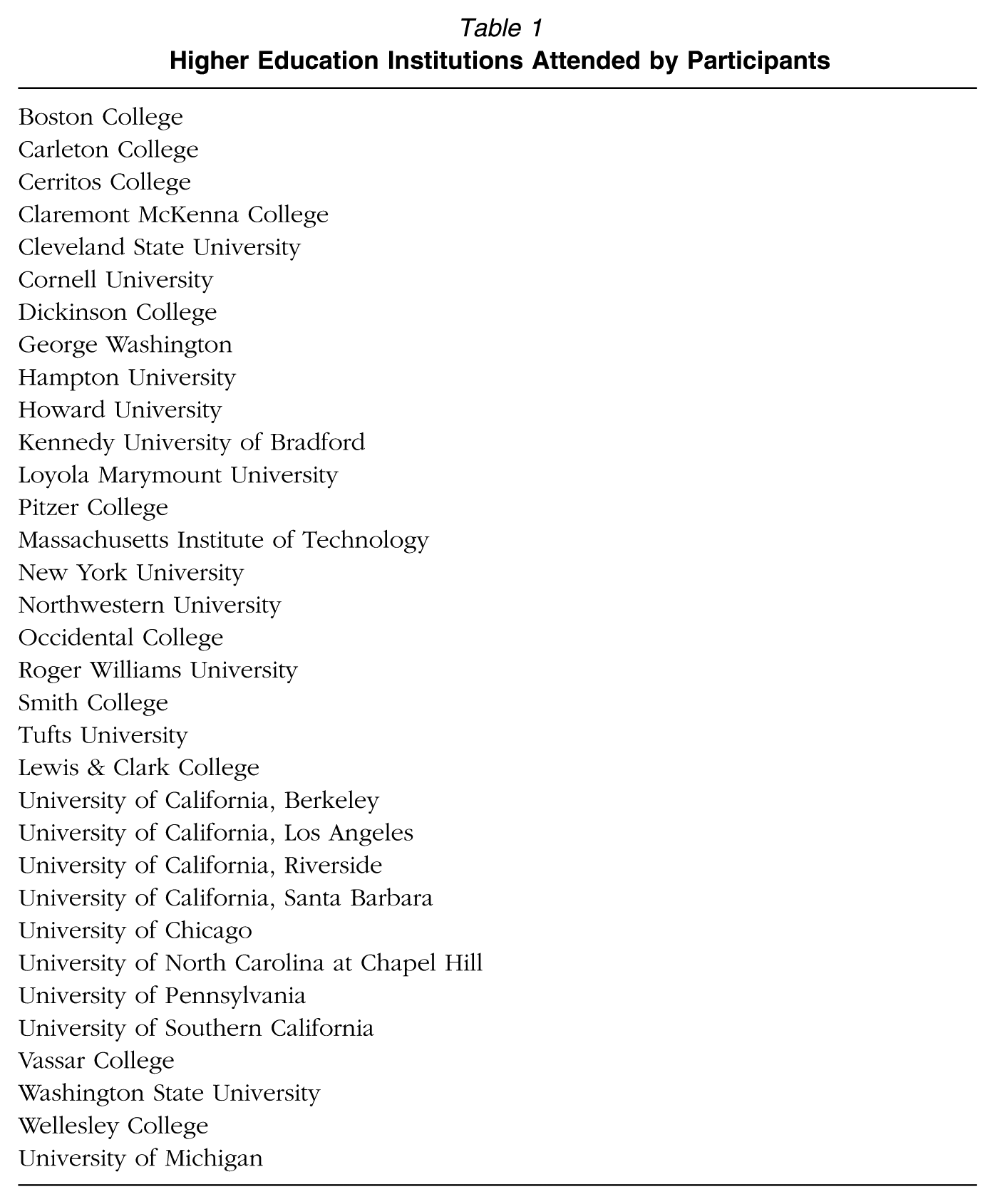
Participants (see Tables 1 and 2) were recruited (with assistance from each program) using purposeful sampling (Miles & Huberman, 1994; Patton, 1990) of program alums expected to have entered college between the fall of 2003 and the fall of 2007. In total, 46 program alums participated in the study. YBS (25) alums were involved in YBS for at least one year during high school. Participants from ABC (21) were students who matriculated at an ABC affiliate school, regardless of if they graduated from that high school. Participants’ high schools varied widely, though these trends are partially due to the structure of the programs (Vue et al., 2012). The majority of YBS participants went to public high schools (12 comprehensive and 8 charter schools, i.e., 80% public); on the other hand, nearly three-fourths of ABC participants attended private schools. Study participants were high achievers. Both programs have entrance requirements to select students who demonstrate high achievement. Finally, the majority of participants matriculated to highly selective institutions.
Higher Education Institutions Attended by Participants
Participant Sex, Race, and Program

Note. YBS = Young Black Scholars; ABC = A Better Chance.
On the whole, YBS participants had higher socioeconomic status (SES) than ABC participants on indicators such as parent education and income. Half of participants’ (23) mothers had earned a bachelor’s degree or higher. Of the 41 participants who reported their parents’ annual income, 12 (29%) earned less than $50,000, 16 (39%) earned between $50,000 and $100,000, and 13 (32%) earned over $100,000. Thus, the majority of our participants had access and exposure to elite opportunities prior to college, either through the elite high schools ABC students were much more likely to attend or through the more affluent family backgrounds of YBS alumni.
Over 30% of participants were male, and 87% were Black (we use Black as an umbrella term for anyone of African descent); of the other participants, one was Asian American, and five were Latinx, with six self-identified multiracial students included (these students were double counted when applicable). Importantly, the analysis for this article does not include the data from the single Asian American participant (who expressed support for affirmative action). We regret that our sample does not allow us to satisfactorily attend to the nuances of Asian Americans’ experiences, especially considering both the socioeconomic marginalization of Asian American subgroups (Teranishi, 2010) and Asian Americans’ complicated racial positioning in such debates (Park & Liu, 2014). Previous work (Inkelas, 2003a, 2003b; Iverson, 2012; Kang, 1996; Omi & Takagi, 1996; Park, 2009; Suzuki, 2002; Wu & Wang, 1996) underscores the need for thoroughly attending to Asian American experiences, which our data do not allow us to address. Consequently, students of color exclusively refers to Black and Latinx students in this article due to the limitations of our data despite our awareness that doing so, though unintended, may reify notions that Asian Americans have no place in the debate or, alternatively, position them alongside White Americans. Our intention here is to be precise in our language given the article’s limitations as noted previously.
Participants completed a demographic questionnaire and participated in semi-structured interviews (45–90 minutes). Participants were assigned pseudonyms, and all interviews were audio recorded and later transcribed. Interview questions addressed four key areas: participants’ college application and choice processes, experiences with mainstream representations and perceptions of their race and gender, their views on race and affirmative action, and campus climate and racial issues on their college campus. All data were coded; however, data for this analysis come primarily from the subset of questions regarding affirmative action.
As students of color with access to elite opportunities, our population of participants was particularly likely to have experience navigating race and affirmative action topics around White peers. These participants might have been especially adept at navigating HWIs, so looking at how they did so may offer insight. By including those who were most affected by racism and subsequent shifts to post-racial ideology in the dialogue, this study adds to previous research while recognizing they are often silenced (Freeman, 1997; McLeod, 2011). Not only does this voicelessness perpetuate their invisibility, it is often read as agreement with dominant frameworks. We relied on students’ experiences and examined the ways students made meaning, discussed race, and in essence transformed colorblind ideology. Our findings reveal that these students did not in fact see or experience the world through colorblind lenses; they did, however, engage with colorblind discourse to further their agendas. As Loseke (2012) articulated, “formula stories obtain their recognizability and predictability by deploying symbolic codes and emotion codes in ways that reflect how audience members understand the world” (p. 253). Further, people use formula stories that have recognizable codes in order to create understanding “in a world of strangers” (p. 265). This is particularly applicable to our study because participants frequently used the codes and language of colorblindness to instead assert more radical defenses of affirmative action.
Analytic Approach
Several steps were taken to ensure the accurate representation of students’ experiences and beliefs. This process entailed an iterative analysis of transcripts to identify meaning, emerging themes, and insightful vignettes (Denzin, 1989; Lincoln & Guba, 1986; Maxwell, 2005; Strauss & Corbin, 1990). The research team began with analytic memos (Maxwell, 2005) written after each interview, which provided a preliminary observation of the emerging themes. Upon completion of all interviews, researchers constructed summaries of interview content, and each transcript was reviewed by two researchers to limit bias (Denzin, 1989; Lincoln & Guba, 1986). The interview summaries enabled the research team to determine domains or topics of cultural significance (Spradley, 1980). Once determined, the domains were used to map out each description, comparatively examine responses for themes, and identify discrepant data (Lincoln & Guba, 1986; Maxwell, 2005). Throughout this process, we revisited analytic memos to assist in identifying the relationships between domains. We then created final codes for analysis of transcripts in ATLAS.ti.
The primary codes of interest to this article fall under the parent code affirmative action. Child codes (subcodes) divided participants’ responses according to valence (e.g., a good thing, negative feelings, and mixed feelings) and particular analytic themes (e.g., discouraged by elimination and not negatively affected by elimination). Although there certainly were participants who expressed mixed or negative feelings regarding affirmative action, these statements were almost uniformly in response to the perceived stigma affirmative action caused, not opposition to the policy. In fact, all participants who expressed negative feelings about affirmative action also expressed positive or ambivalent attitudes at other points during their interview. The one exception was Tyrone, who declined to comment on affirmative action.
Although data are from semi-structured interviews that illuminated the perceptions of participants, their responses fit broadly into thematic narratives that were striking in their consistency. Narratives are defined as responses that feature “emplotment” and are “storied” (Holt, 2010), in other words, responses that take the form of a coherent narrative arc. The beginning and end of narratives are often signaled by entrance and exit talk (Riessman, 1993, 2001), and narratives are distinct from other kinds of talk (like question-and-answer or other turn-taking exchanges). In fact, the effect of the thematic narratives we found is that of a counterstory (Solórzano & Yosso, 2002), despite using the logic of the dominant story as a “critical resource for navigating this world [of strangers]” (Loseke, 2012, p. 265). By focusing on these narrative arcs that functioned as counterstories (Solórzano & Yosso, 2002), we utilized CRT to analyze our data.
Researcher Positionality
As an Asian American woman, a Black biracial woman, and a Black man from multiple generations, we are beneficiaries of affirmative action; our own educational trajectories were shaped by intentional policies that sought to engender equal opportunity for traditionally underrepresented groups. Our identities were influential at every stage of this research, such as during interviews, analysis, and as we made interpretations. This positioning ultimately affects our sensibilities as scholars and researchers, including our use of critical race theory and intersectionality to leverage the voices of marginalized students to inform educational policy and practice. We embrace this positioning because we do not subscribe to understandings of inquiry and knowledge as objective or post-positivist, which is in line with feminists and critical race scholars (Crenshaw, 1988; Delgado & Stefancic, 1993; Solórzano & Yosso, 2002). Instead, our positioning(s) are points of self-reflection from which we reengage our personal and professional journeys and that deepen our understanding of the link between theory and practice.
Findings
Interviews with students of color yielded the emergence of several themes relating to participants’ understanding of race (racial ideology/meaning) and race-conscious policy. This section describes the following themes: hostile discourses, contextualizing affirmative action, the confluence of race and class, and endgame. The first theme highlights participants’ experiences in a hostile political climate for race-conscious policy and their awareness of anti–affirmative action discourses, which they then engaged in justifying the policy. The latter three themes capture the contours of their discursive strategies in defense of race-conscious policy.
Our analysis reveals that participants frequently used the concept of intersectionality to legitimize their pro–affirmative action perspectives and articulate that such programs are just. Intersectionality as a central feature of their discourse adds complexity and nuance to the use of race-conscious practices, helps to justify their continuing necessity, and substantively contributes to debates about affirmative action. In other words, participants foregrounded intersectionality as a tool to dismantle colorblind masternarratives.
Hostile Discourses
Most participants expressed a keen awareness of anti–affirmative action arguments and attitudes. They were especially sensitive to accusations that students of color were undeserving and only admitted due to the policy. These participants collectively described the negative views and arguments against affirmative action that they frequently encountered during their educational journeys as high school students navigating college admissions decisions and as college students, especially at HWIs. Markus explained the pervasiveness of hostility facing students of color in college preparatory schools: “There’s always affirmative action talk, about in junior year. You know where it’s about, oh, he got into that school because he was Black.” He elaborated on one such experience:
Two days before I found out about my decision, I had this White kid . . . talk to me in the hallway, and say, Oh you’re getting into Penn, you’re a Black male, ha, ha, ha, ha. And they’d like pat me on the back in this very condescending fashion.
These negative narratives ranged from sweeping statements like the one Mia recounted, “Blacks should be able to get up and stand up on their own two feet and pull themselves up by their bootstraps. There’s no such thing as institutional racism,” to more pointed and personal accusations such as “‘Oh, the colleges need diversity, so they picked you . . . they picked you because you’re Black’” (Larry). Both types of statements are representative of the types of statements participants encountered, which served as clear warnings that expressing pro–-affirmative action views may reaffirm bigots’ stereotypes or implicate them personally. Further, such statements subscribe to a colorblind ideology (Bonilla-Silva, 2013) by simultaneously advancing abstract notions of equal opportunity, minimizing racism, and naturalizing Black (and Latinx) underrepresentation.
As a result, some participants expressed conflicted feelings regarding affirmative action. Melvin explained reasons for his mixed reviews, beginning with a personalized example to highlight affirmative action’s role in creating opportunity: “My mom, she got into [college] through affirmative action. But you know, she excelled and then went on to graduate school.” In describing his dislike for affirmative action, he discussed the stigma that White people attached to the policy: “At the same time, I don’t like affirmative action for the fact that people can use that against Blacks, like, ‘Oh, you got into the school on an unfair basis.’ Another stereotype of Black people and affirmative action.” Like Melvin, many participants who expressed mixed feelings about affirmative action shared that the primary negative of the policy was its use as a confirmation of deficit stereotypes of Black and Latinx students.
Other participants added nuance to understandings of affirmative action’s race-specific stigma. For example, Casey did so by positioning the stigma as evidence of societal racism rather than a consequence of the policy itself:
People will bash affirmative action, but they don’t bash the system of people getting into schools because their parents are alums, you know, which is another form of assistance. It’s not based on merit, but it’s based on family history but no one [calls attention to that]. And you know, I go to a private school no one ever says “you got in here because of your money”; or that’s not looked down upon. . . . So, why are the things that really matter, like your race, and your gender, and your history; why is that frowned upon; it’s just another reflection of racism? (Casey)
Casey not only challenged the notion that admissions decisions are merit based but directly problematized anti-affirmative arguments that highlight the policy’s stigmatizing impact as a reason for elimination. Likewise, Larry commented, “I think that they’re going to think that way anyway though, about the stigmatism. . . . There’s always going to be that, this should be an all White kind of thing.” Both comments disrupt the causal relationship often made between the policy and stigma—that is, the policy creates stigma and/or deficit thinking. Rather, participants called attention to the ways that deficit thinking, which is steeped in American culture and society, is attached to the policy to stigmatize racial minorities. In other words, if deficit thinking is a priori to affirmative action, eliminating the policy is unlikely to end racial stereotypes of students of color but would certainly diminish efforts made toward racial equity.
The deficit narratives participants encountered underscore the hostile climate for race-conscious policy and thought. Although participants acknowledged anti–affirmative action discourses, the vast majority articulated strong support for the policy and provided explanations for its importance. The following sections examine the contours of their rationales.
Contextualizing Affirmative Action
Participants highlighted how public debates distort affirmative action policy. In particular, dominant anti–affirmative action narratives obscure social benefits and divorce the policy from the historical legacy that made it necessary. Participants countered the idea that affirmative action enacts preferential treatment, a common distortion in the public discourse (Paguyo & Moses, 2011). Instead, participants asserted that those against affirmative action misunderstood the policy.
It doesn’t actually let people who are not qualified in; it just gives people who are qualified a chance to pursue their education and go on with their education and it gives them an awesome opportunity to do it. I think that’s what most people get confused on because they think that unqualified individuals will actually go. (Leslie)
Leslie emphasized equal opportunity as a longstanding interest of affirmative action policy, disputing the notion that it operates as a form of preferential treatment. In doing so, Leslie, like other participants, implicitly acknowledged the legions of qualified individuals whose opportunities would be diminished by discrimination without such a public policy.
Participants also described race-conscious policies as necessary interventions that have resulted in more opportunities and therefore open the possibility for a more just society. For example, Lauren expressed, “Without these programs for, like, social adjustment, you won’t really get anywhere in terms of achieving social equality at all. So you need a system like that in place.” Another participant pointed more specifically to racism as a reason for policy interventions aimed at increasing opportunities:
We need affirmative action because honestly, racism is still an issue in this country, maybe not as big of an issue as during the Civil Rights Movement, but it’s an issue. And honestly, if we take away affirmative action … , you know, where does the diversity go? People are not going to want to take in students because oh, he’s of a certain background. And, I only want this certain amount of type in my school. At the end of the day . . . especially for our people, I think we need it. (Lacey)
While this participant acknowledged progress has been made toward improved race relations in the United States compared to the era that sparked civil rights activism, she credited affirmative action for moving the nation to its current state. Still, she noted that the policy remains necessary given the pervasiveness of racism. Moreover, both participants underscored that White racial privilege has never been relinquished voluntarily or without struggle. Instead, history has demonstrated that White privilege has been actively cultivated and vehemently guarded (Katznelson, 2005). Therefore, participants positioned affirmative action policy as a necessary remedial action.
Critiquing One-Sided Representation
All the negative things about affirmative action programs or programs to help people who are economically disadvantaged were portrayed but there wasn’t any of the positives to those programs. (David)
A salient point discussed among participants is the one-sided representation of affirmative action policy, including ways that contemporary debates have racialized the policy while disregarding how it broadened opportunity more generally. Karen explained, “It was more of an equal opportunity kind of law, so it was not necessarily a Black law like most people made it out to be.” Another participant, Maggie, elaborated on this point, stating, “When you think of ‘affirmative action’ they automatically think African Americans, instead of thinking disabled people, instead of thinking, you know, other minorities . . . it’s a connotation that just pops in your head. That’s one problem.” As both comments illustrate, the dominant narratives tend to obscure the expansive opportunities affirmative action has historically given many groups. In neglecting the opportunities afforded to communities other than Black (and Latinx) Americans, the racialization of affirmative action in dominant discourses serves to further stigmatize it as preferential treatment.
In response to this stigmatizing racialization, several participants, mostly female, noted that White women benefited disproportionately from affirmative action, while others also elaborated on different categories of beneficiaries that are forgotten or less contested. Karen explained, “White women benefited most from affirmative action, and I thought that was a fact that was very commonly overlooked by everyone.” She recounted one incident with her roommate to highlight this omission:
She was White and we were having a discussion about it [affirmative action], and she was like, “I just don’t think it’s fair that if I’m qualified for the position and a Black man is qualified they’re going to automatically get it.” And I was like, are you kidding me on that?
Participants like Karen pointed to the convenient dismissal, whether intentional or unintentional, of White women who as a group have largely benefited from the policy. In this way, participants were able to contest the idea that affirmative action is inherently stigmatizing and harmful.
Another student, May, described telling a disgruntled White male high school peer, “It’s not just for people of color; it’s for women, it’s for people from different locations across the country and backgrounds” when he was rejected from a selective institution that accepted her. Introducing gender and geography into their analyses functioned to disrupt the dominant framing that the policy benefits Black and Latinx students specifically or even exclusively. As such, participants highlighted affirmative action as an effective and necessary means of working toward equity while correcting and rebuking the historical amnesia that often frames challenges to the policy.
Confluence of SES and Race
Participants evoked their experiences navigating the educational pipeline to challenge both reverse-racism arguments that they were undeserving beneficiaries and post-race arguments questioning the necessity of affirmative action. Discussing her own experience, Stacey enumerated ways the elimination of affirmative action has affected California:
It’s taken away a lot of opportunities for a lot of students who probably didn’t get the same advantages as going, as the other schools. I know in L.A., like the L.A. Unified School system, it’s really segregated based on race and the income level as to the quality of the school. So it’s probably short-changing most students that don’t go to as wealthy schools.
Participants frequently inserted SES into their narratives while asserting that race consciousness is a prerequisite to understanding the nuances of school equity and opportunity. For example, Lauren explained,
I don’t think it’s fair for someone who’s not as qualified to receive an opportunity just because they are a person of color, but in these cases, it’s usually not that the person isn’t qualified, it’s just that they don’t have the same resources.
Another participant, Jason, disputed the argument that affirmative action was unfair by referencing the confluence of race and SES: “You can also say it’s an unfair advantage when the tax district [of] your school can afford better things to help prepare you for the schools that you’re going to get into.” Like Stacey and Lauren, Jason discussed affirmative action as leveling the playing field for students of color whose educational disadvantage is often structured by residential segregation and consequently, lower resourced schools. Each called attention to the greater likelihood of Black and Latinx students growing up in high-poverty neighborhoods and attending high-poverty schools (Kozol, 2012). Articulating the interconnections of race and socioeconomic status highlighted the complexity of social inequality and its operation through multiple and overlapping oppressive conditions. Lastly, participants’ insistence on discussing the demographic intersections of race and SES served as an implicit rebuke of arguments for class-based rather than race-based affirmative action plans (Kahlenberg, 1996). They positioned these two systems of oppression as inherently entangled.
Representation and Intraracial Diversity
Even as they argued that intersectional disadvantage was part of the reason that affirmative action was necessary, participants acknowledged that theses demographic realities were complex. In many cases, participants aligned themselves with Black people of different (less privileged) SES or educational backgrounds, even as they contested stereotypes that suggest all Black people are low SES. Kay acknowledged this tension, calling herself “hypocritical” in her efforts to combat racial essentialism and stereotypes while also recognizing demographic realities. She expounded,
[I] don’t like that people do group students of color into those categories, but in the same token, because of history and other factors, some of that stuff is true, in terms of statistics. Not every student of color experiences the same exact thing, but a lot of them do experience these things . . . on the one hand you don’t want to be grouped into this group that you may not belong to, but a lot of times we do belong to those groups.
Similarly, several participants expressed concern that the Black student bodyon their campus did not reflect the socioeconomic diversity (and distribution) of the U.S. Black population. One student shared an observation regarding her predominantly White campus,
You meet a lot of people who have gone to boarding school or day schools, who have gone to public schools in good neighborhoods and things like that. The proportion of Black students who have come from that inner-city public school . . . you don’t hear those stories as much . . . or there aren’t that many of them, basically. (Lilly)
If the people of color present in elite spaces are not representative of the larger population, that might explain the belief the U.S. has achieved equal opportunity and be used as anecdotal evidence of shrinking racial gaps despite demographic and statistical trends that indicate otherwise (Bonilla-Silva, 2013).
In contrast, participants used these facts that are often raised to argue that race-conscious policies are not necessary—that is, that all Black people are not the same and that the most privileged are overrepresented on college campuses—to bolster the case for race-conscious affirmative action. Participants cited the unrepresentative Black populations on their campuses as perhaps evidence that race-based affirmative action had more work to do, not an argument that class ought to trump race. Certainly, the metanarrative of a meritocracy continues to minimize the intersection of economic and racial barriers to college access. In expressing their concerns, participants worked to bring this intersection into focus even as they countered racial essentialism.
Endgame
In addition to discussing the continuing significance of race, participants refuted arguments against affirmative action by discussing racism’s relationship to other systems of oppression. In response to Justice O’Connor’s hypothetical expiration date for affirmative action, Markus exclaimed,
If you’re going to do away with affirmative action, then I encourage you to do away with White supremacy, with White hegemony, with racism, with gender bias, with xenophobia, with the fact that the poorest people in America are Black and Brown Women . . . then we can have a conversation about whether we need to end it.
In this declaration, Markus introduced an intersectional analysis of race and gender in American society. Such an analysis largely departs from mainstream discussions of affirmative action that either focus on race and/or gender (Padilla, 1997). The metanarrative formed by the collective voices of participants disputes the idea of affirmative action as solely a “racial” policy and instead asserts that it is needed to overcome the consequences of intersectional marginalization.
Although a majority of participants emphasized the importance of race-conscious practices and affirmative action, one participant offered a particularly critical assessment. Melissa interrogated the pervasiveness and efficacy of the program by recounting the ways it benefited her family:
my parents; they benefitted from affirmative action because they were poor kids who went to public schools their whole life, and my dad was able to get into [University], you know, [University] Law School, because of it . . . he was among very few students of Color there. So it shows that even when affirmative action did work, it still was only raising the bar to make things equal a bit.
First, Melissa’s comments implicitly challenge the perception that race-conscious admissions practices are widespread and even rampant. Second, in discussing her parents’ educational experiences, she simultaneously highlights the benefits and limitations of the policy. Specifically, while the policy created higher education access opportunities for her father, it did not greatly expand the racial diversity of the institution’s student body, thereby leaving him as one of the few students of color. The critique offered by this sole participant speaks to the concerns of scholars (Bell, 2004) who argue that affirmative action programs are an incomplete though still important solution. Despite opening the doors to many, it offers partial, incremental institutional change (Bell, 2004). Nonetheless, our participants indicated that it remains important especially in the absence of comprehensive societal reforms, like many scholars (Jayakumar & Garces, 2015).
Indeed, several participants described affirmative action as “necessary” given the historical and contemporary forms of systematic racism. One participant, May, asserted its significance in addressing social inequality:
I just don’t see how a country like this, where it has such a past scene with lots of inequities and inequalities, it can’t get much farther without actually making amends with that and the only way that I see they could do that is to actually have laws like affirmative action.
Like the majority of our participants, May discussed the instrumental significance of the policy in addressing the nation’s legacy of systemic racism and discrimination. She also pointed to the significance of such a policy for racial reconciliation in a country continuing to be wounded by its past. Affirmative action policy and race-conscious approaches are formal recognitions of racism’s societal impact.
Discussion
Affirmative action discourse is a contentious terrain marked by contradictory narratives of race and opportunity (Paguyo & Moses, 2011). In this context, students of color are exposed to stock stories of racial and individual deficit, which function to maintain the masternarrative of a colorblind society (Solórzano & Yosso, 2002). In response to confrontations with hostile discourses, our participants worked to disrupt colorblindness by challenging the currency of its narratives in order to affirm race consciousness in theory and practice. By leveraging experiential knowledge, they shared counterstories that (a) offer an alternative interpretive framework, (b) provide substance to public debates, and (c) provide insights on how to engage in a politics of accountability. This section discusses each of these aspects, which are mutually reinforcing.
We begin by discussing how participants provided an alternate interpretative framework of opportunity that centers race consciousness. Acknowledging the significance of race is consistent with a racial realism perspective (Bell, 1992b), which situates equality in a racialized societal context rather than an imaginary colorblind societal ideal. While our participants discussed a diversity of lived experiences within race, which might be mistakenly read as colorblind diversity (Herring & Henderson, 2012), they situated these accounts within the history of racial discrimination and its connection to material conditions/consequences of race. Specifically, participants contextualized affirmative action, which has the potential to bring about a deeper, more complete rendering of the role of race in national public policy.
In foregrounding the material and historical, they refocused the affirmative action debate on social justice and articulated the policy as a necessary lever for equity. As such, participants’ narratives resemble pro–affirmative action discourses in the media (Paguyo & Moses, 2011), which employ a race-egalitarian frame to emphasize a compensatory or participatory interpretation of opportunity. Paguyo and Moses (2011) explained that these interpretations of opportunity emphasize outcomes or accentuate the democratizing role of education. This public discourse is increasingly important because social justice arguments have been ruled irrelevant by the courts (Moses & Chang, 2006). Even so, social justice and poverty have been neglected in media accounts of affirmative action (Katznelson, 2005).
Participants’ narratives also challenged overgeneralizations of race in public debates (Paguyo & Moses, 2011). As our findings demonstrate, participants’ narratives presented nuanced understandings of race that highlight intersections with class and gender in American society. Their analyses underscore the structural intersectionality of people of color. An example cited by participants (see findings section on confluence of SES and race) and scholars (Kozol, 2012; Orfield & Lee, 2005) is residential (and school) segregation or geographical racialization, which almost always results in educational disadvantage and further economic disadvantage for people of color (Wilson, 2009). Here, race and class also operate to shape representational intersectionality, which is inextricably tied to geographical racialization as evident in the ways urban and inner city are often read in conjunction with poor people of color. Racial meanings and their connection to the construction of an underclass ultimately reify what is understood as “good” versus “bad” students, schools, and neighborhoods (Lewis, 2003) and their worth/worthiness to society. The consequences of students of color’s representational intersectionality are plainly visible through the economic and social neglect of urban schools and neighborhoods across the nation (Kozol, 2012; Noguera, 2003).
To a more limited degree, participants (e.g., Markus) also account for the political marginalization of women of color (Crenshaw, 1991) whose experiences and interests are largely disregarded when affirmative action narratives focus on race and gender separately (Padilla, 1997). Crenshaw (1991) explained that the conditions of women of color and their marginalization in politics have much to do with society’s devaluation of them. This marginalization differs from the representational and political privileging of White women in anti-affirmative narratives as White racial victims, a narrative our participants (e.g., Karen, May) readily rectify in their own discourse. In particular, they highlight how White women, who are oppressed by heteropatriarchy, may momentarily gain status and escape affirmative action’s “stigma” through their Whiteness—despite benefiting from it. Participants’ discourse points to the irony of challenges to race-conscious policies by White women (e.g., Fisher, Gratz, Grutter, and Hopwood—Hopwood v. University of Texas, 1996, in their eponymous cases), which relied on erasing the instrumental impact of affirmative action on their landscape of higher education access and opportunity. The juxtaposition of women of color and White women in relation to affirmative action exposes the significance and dynamism of racial oppression where conversely women of color are politically marginalized. For example, Padilla (1997) has posited affirmative action should remain until women of color gain parity with White upper-class men. Therefore, discussing intersections of race, gender, and class serves the dual function of addressing racialized (in)opportunity’s connection to other systems of oppression while also highlighting intraracial diversity.
In sum, intersectional understandings of race substantially contribute to affirmative action discourses by allowing for multiplicity and difference in the lives of individuals while underscoring the dynamic nature of race in structuring social inequities. These complex ideas of race provide much needed context and analysis for policy solutions for racial disparities in higher education admissions. For example, the uncertainty around race-conscious practices brings attention to alternative policy proposals that encourage the use of class (Kahlenberg, 1996) and, more recently, place/geography (Cashin, 2014) as proxies for race. Both have been proposed as more effective and politically viable policies, however Moses (2002) has cautioned against race-neutral policies as they are unlikely to adequately address racial inequality.
Finally, we argue that participants’ narratives provide insight into how to forge opportunities for mobilization among institutional leaders and other elites to act on behalf of students of color. We draw on Guinier and Torres’s (2014) understanding of constituencies of accountability and examples of dynamic storytelling within the civil rights movement as valuable in considering the importance of ordinary people. According to them,
The meta story is . . . the story that lays out a conception of justice and translates into one that others can hear and join. It invites their individual stories into a broader story. The micro story, by contrast, allows trust and provides motivation for action as well as a willingness to assume agency. The resonant story frame . . . gives ordinary people, as well as sympathetic but non-movement listeners, a conceptual frame that can become the vernacular understanding of justice. (Guinier & Torres, 2014, p. 2775)
Although Guinier and Torres’s (2014) focus was on social movements and ours is on ideology and discourse, we find this example useful for considering the ways students of color’s narratives can inform educational policies. We discuss how meta, micro, and resonant stories apply to our participants’ narratives. The meta story of our participants is one of equity and social justice. Specifically, they make visible the distance between reality and ideals of American society to provide possibility and guidance to educators and policymakers. The micro stories invite listeners into the lives of students of color and the complex web of inequality that differentially organizes and structures racial groups. Although their stories offer an interpretation of race and equality in America that employed race consciousness, their discourse sometimes worked within the boundaries of colorblindness; for example, using language that did not always explicitly foreground race and/or exemplify race in isolation. As discourse around race continually shifts, students of color may adopt (and adapt) the new language as a strategy to being heard, especially given White fragility (DiAngelo, 2011) on racial issues. In particular, the language of diversity could be understood as colorblind given the ways it has been appropriated to represent any and all forms of difference (Herring & Henderson, 2012). However, participants’ discourse, which connects diversity, intersectionality, and equity, is race conscious while perhaps also making counternarratives more appealing and compelling to White Americans. As we transition to a Trump presidential era where virulent racism is emboldened, we anticipate that future studies will find students of color engaging in more radical discourses, like Black Lives Matter, which unapologetically place racial justice at the fore. Nonetheless, colorblindness will continue to be an operating force alongside more overt racism.
This study’s findings point to the significance of creating institutional climates conducive to engaging in intergroup dialogue, if not deliberate dialogues regarding educational policy specifically (Moses & Seanz, 2012). While positive for students of color to engage with those with different perspectives, many of these discursive moves appear in reaction to very real experiences with negative campus climates, which institutions would dowell to try to ameliorate. The democracy-enhancing effects of cross-racial interactions (Gurin, Dey, Hurtado, & Gurin, 2002; Hurtado, 2007; Jayakumar, 2008) and the potential for improved understanding of meaningful dialogues (Moses & Seanz, 2012) are compelling reasons for remedying institutional climate. This involves both the presence of structural diversity and interventions aimed at enhancing the quality of interactions. Thus, continual reinvestments in such initiatives are important for affirming the democratic functions of higher education.
Diversity discourse is ingrained in rationales for race-conscious practices, which are centrally targeted. While diversity can become a distraction (Bell, 2004) to issues of justice and equity, it can offer a tool and device, perhaps a resonant story. Still, diversity must also be used in conjunction with discourses that foreground equity. Intersectionality is one way to connect the two since it not only allows for diversity and difference but also precisely locates allocations of power that vary among forms of diversity and difference. Ultimately, ideology and social movements are inextricably connected, as is evident in the rise and destabilization of affirmative action, which can be understood as its own social movement (Rhoads, Saenz, & Carducci, 2005). Ordinary people inherently shape social change, as Guinier and Torres (2014) explained, “The leaders of political institutions get their courage to act from the people themselves” (p. 2799).
Conclusion
With the conclusion of President Obama’s two terms in office, the nation is left to grapple with the unfulfilled promise of a post-racial society that his ascent signaled. The question of whether race still mattered that was widely debated at Obama’s initial election has largely abated with the recent election of Donald J. Trump, whose overtly racist, nativist, and sexist rhetoric appealed to White working-class and White nationalist constituencies. This outcome highlights the continuing significance of White racism, which has historically undermined class (and gender) movements in U.S. society (Roediger, 1999, 2006). Specifically, the electoral support of the majority of White working-class people and White women underscores Bell’s (1992a) argument that White Americans and political elites view Black people and people of color, generally, as expendable. This political compromise ultimately diverges from the interests of lower-class White people and White women (Bell, 1992a; Guinier, 2004) except insofar as they have a vested interest in preserving Whiteness.
While the political landscape underscores the significance of race, it also demonstrates that colorblindness has always been in service of preserving racial hierarchy and specifically the subordination of people of color. In particular, White resentment toward racialized minorities in U.S. society is connected to (though not fully explained by) White resistance to the operationalization of racism as systemic and institutional. In addition to outright fear of and disdain for people of color that has become evident, widespread and persistent inequities continue to be explained as resulting from the cultures of people color. Therefore, it is likely that policies will continue to be rationalized using both colorblind-racist and simply racist logic.
The ongoing Black Lives Matter movement rejects notions of colorblind society, and its deep resonance with Millennials is revealing. We find it necessary to conceptually distinguish colorblindness from post-race (both an aspiration and condition). Hollinger (2011) argued the quick dismissal of the post-racial concept obscured the conceptual utility it could offer in imagining such a society. Our participants do not claim a post-racial “condition” or state of being unstructured by racism; however, they do hold post-race “aspirations” that at some point society will no longer be organized by systemic racism that privileges White people and disadvantages people of color.
Drawing attention to the post in post-racial, Hollinger (2011) contended the “practice of posting” race “is a determination to keep track of the past, to register its legacy without denying the reality of change” (p. 176). In this vein, the post-racial analytic project complicates simplistic understandings of race rather than serving as an erasure. Addressing critical or progressive scholars’ ambivalence about the term, Leonardo (2013) clarified that post-race thought “is a race-conscious, as opposed to a race-neutral, proposition.” He argued that “[post-race thought] not only requires acknowledging the fact of race, but also necessitates entering the field of racial contestation in order to end, rather than to perpetuate, it” (pp. 148–149). Both Hollinger and Leonardo effectively have distinguished post-race from colorblindness, arguing that colorblindness is primarily associated with White lived experiences and thought (Bonilla-Silva, 2013; Leonardo, 2013) and consequently inadequate for addressing issues of race. Moreover, while colorblindness enables White people to be optimistic about race by evading the reality of race, a post-racial thought is pessimistic yet hopeful as it embodies tenuous dynamics of (re)making and being made of race (Leonardo, 2013). Likewise, Bell (1992b) described the psychological and practical necessity of racial realism for people of color, arguing: “Acknowledgement enables us to avoid despair, and frees us to imagine and implement racial strategies that can bring fulfillment and even triumph” (p. 363). The narratives of participants in this study register with a post-race project or, what we prefer to call, a post-racism project, which seeks to problematize how race is understood even as it works to affirm race consciousness.
Race-conscious strategies are especially important in light of race-neutral education policies’ limitations in closing opportunity gaps (Kidder, 2013). Yet, the social commitments made toward eliminating racial inequity during the 1960s Civil Rights Movement have slowly eroded along with formal recognition of racism’s impact. Indeed, across the nation, other race-conscious education policies such as ethnic studies, multicultural education, and bilingual education have also been scrutinized. Like the consideration of race in higher education admission, these policies offer greater possibilities for self-determination—a fundamental educational aim that should inspire educators and policymakers to embrace racial equity (Moses, 2002). Of course, as important as it is to the project of social justice, race-conscious education policies only enable the nation to enter a conversation of (in)opportunity. As Guinier (2003) wrote, “racial literacy, or the ability to read race in conjunction with institutional and democratic structures, may enable the building of a coalition that starts a larger conversation at the point where educational selection and democratic values meet” (p. 120). Only then will it be possible to publicly engage in meaningful dialogue regarding the social, civic, and moral responsibilities of higher education institutions to help transform the landscape of opportunity.
Footnotes
Notes
R
S
W