



Abstract
Disciplinary literacy scholars promote text-based instruction in the service of disciplinary inquiry, and scholars of teacher education promote practice-based preparation for teachers. This study brings these scholarly communities into conversation by investigating how practice orientations in teacher education influence novice teachers’ literacy teaching. We conducted video analyses of teacher education coursework and novice teachers’ classroom instruction in secondary English language arts. Data were collected during a summer institute for novice teachers designed through a partnership between a university and an alternative teacher education program. Analyses revealed that when learning targets for novice teacher participants were explicitly connected to teaching practice through the use of representations, decompositions, and approximations, those targets were more frequently observed in novices’ subsequent classroom instruction.
Keywords
Adolescents need ongoing literacy instruction in order to support their learning with texts (Carnegie Council on Advancing Adolescent Literacy, 2010; Moore, Bean, Birdyshaw, & Rycik, 1999). This is not because most adolescents cannot read. Instead, it is because as students move through the grade levels the concepts under study become more abstract, the purposes for reading and writing become more specialized, and the texts themselves become more complex (Snow & Moje, 2010). Adolescent literacy instruction requires deliberate text selection, careful planning for the specific literacy challenges that students may face as they read and write, and explicit introduction to specialized ways of reading, writing, and reasoning of the academic disciplines (Lee & Spratley, 2010). Yet millions of adolescents across the nation—especially those in poverty-impacted schools—are receiving steady diets of “remedial” instruction solely focused on comprehension and test preparation in the absence of intellectual purpose and without clear pathways for developing advanced and critical literacies (e.g., Greenleaf, Schoenbach, Cziko, & Mueller, 2001).
Ensuring rich literacy instruction for all young people is a challenge because it requires sophisticated instructional practice on the part of teachers. Although many experienced teachers are capable of such sophistication, our nation’s schools are increasingly served by inexperienced teachers. Rates of teacher retention vary regionally, but some research indicates that a quarter of U.S. teachers leave the classroom after just 1 year and almost half leave within 5 years (Henke, Chen, & Geis, 2000). Because early career teachers are teaching the majority of students in our country, there is a need to ensure that those teachers are immediately capable of contextually sensitive, skillful teaching practice. Nowhere is the need more urgent than in high-poverty schools where teachers are significantly more likely to leave than their counterparts teaching in low-poverty schools (Ingersoll, 2003). Teacher education programs must develop innovative ways to ensure that even the most novice teachers can support students’ advanced and critical literacy learning.
To date, the field has not developed clear understandings about how novice teachers are best prepared to provide adolescents with rich, meaningful literacy learning opportunities that advance goals of equity and access. More fundamentally, there remain questions about the value of teacher education to promote ambitious outcomes, however they are defined (Cochran-Smith, 2004). We draw on sociocultural theories of learning along with disciplinary literacy scholarship and teacher education scholarship to conceptualize our study, which was a two-phased qualitative case study designed to explore the relationship between the instructional practice of a teacher educator, Sarah (one of this article’s authors), and the subsequent classroom practice of the secondary English language arts (ELA) novice teachers she supported within a 6-week alternative teacher preparation program. Primary data included videos of methods classes taught by Sarah and videos of her novice teachers’ subsequent teaching of high school students. We sought to understand how Sarah taught two fundamental aspects of literacy instruction (described below) and how, if at all, novice secondary teachers took up those aspects of literacy instruction in their work with students. Our two focal aspects of literacy instruction were promoting students’ text-based discussion and explicitly supporting students’ literary reading and reasoning; we understood these aspects of literacy instruction as interrelated and necessary components for adolescents’ literacy learning in secondary ELA. Our research questions were: (1) To what extent and in what ways did Sarah prepare novice teachers to facilitate text-based discussions and teach students to use shared literacy practices of literary studies? (2) To what extent and in what ways did novice teachers support students in having text-based discussions and learning to use shared literacy practices of literary studies? (3) How, if at all, did Sarah’s instruction influence novice teachers’ classroom instruction relating to supporting text-based discussion and literary literacy practices? Our investigation contributes to efforts of those seeking to prepare a new generation of middle and high school teachers to enact ambitious teaching.
Theoretical and Empirical Perspectives
We work from sociocultural understandings of practice as socially and culturally mediated ways of knowing, being, and doing (Scribner & Cole, 1981). We ground our conception of practice in the work of Cultural Historical Activity theorists such as Engeström, Miettinen, and Punamäki (1999) and Cole (1999) who examine the agentive nature of humans and material in acting upon and within social structure. Rooted in this theoretical perspective, we understand individuals not as passive reproducers of social norms but as agents in the production and negotiation of the social systems they inhabit (Latour, 1993). Our work focuses specifically on the social practices of particular communities. In particular, we focus on professional practice (the practice of teaching) and disciplinary practice (the practice of literary studies). We understand these practices as processes not only of cultural reproduction but also of cultural negotiation—processes through which individuals and groups exercise their agency upon the larger social structures in which they live (Reckwitz, 2002). Because we situate our research within broader goals for educational transformation, we are particularly drawn to the transformative possibilities of work grounded in sociocultural theories of social practice. In what follows, we trace current conversations about practice—disciplinary literacy practice and teaching practice—and we argue that bridging these relatively separate conversations is a necessary direction for new research in teacher education and literacy education.
Disciplinary Literacy Practice
In recent years there have been multiple calls for disciplinary literacy teaching (e.g., Lee & Spratley, 2010; Shanahan & Shanahan, 2012). Disciplinary literacy scholars understand academic disciplines (e.g., chemistry, history) as separate cultural discourse communities, each with their own ways of generating questions, pursuing investigations, and communicating and evaluating claims (Moje, 2015). Disciplinary literacy practices are tools that participants use within specific discourse communities in order to construct and share knowledge. For instance, historians’ work involves exploring artifacts of the past to construct knowledge about events or relationships between events, and historical literacy practices such as sourcing documents (i.e., seeking information about who created an artifact) and corroborating accounts (i.e., comparing multiple accounts to assess trustworthiness) are essential tools for engaging in historical inquiry (Wineburg, 1991). One cannot engage in the construction or critique of historical claims without using these and other historical literacy practices.
All students deserve opportunities to be invited into inquiry-based, text-based disciplinary practice insofar as the knowledge and ways of constructing knowledge of the disciplines are valuable for understanding the world. Such a vision for learning promotes adolescents’ multiple ways of participating in—and ultimately shaping, critiquing, and remaking—cultures of power and knowledge production (Moje, 2007). To accomplish such goals in secondary classrooms requires a deliberate and complex approach to teaching that involves (a) engaging students in pursuing and investigating discipline-aligned questions with texts using the shared literacy practices of the discipline, (b) engineering or scaffolding students’ opportunities to learn (e.g., supporting their comprehension, activating their prior knowledge, facilitating text-based discussions), and (c) encouraging students’ examination and evaluation of words and ways with words (Moje, 2015). Helping students study and critique the culturally mediated practices, discourses, norms, and assumptions of various disciplines is essential for teaching them to flexibly and deliberately use practices and to be able to identify when the practices, discourses, norms, and assumptions of a given community are ineffective or unjust. Teaching of this type requires deeply understanding and valuing students’ existing discourses, practices, knowledge, and identities (Moje, 2015).
Literary literacy practice
Disciplinary literacy teaching in ELA involves teaching students how those in literary studies—one of the parent disciplines of the school domain ELA—construct interpretive knowledge with literary texts (Lee, 2007; Levine, 2014). Interpretive work with literary fiction is a particular way of knowing the world; it offers insights into the human condition through careful analysis of language and craft. In a recent empirical study of university-based literary scholars, Rainey (2017) generated a set of shared literacy practices that are commonly used to engage in inquiry with literary fiction, including seeking patterns, strangeness, and surprise with texts in order to articulate interpretive puzzles; recursively considering interpretive possibilities with texts; and making original literary claims. These practices are based on a shared set of norms, assumptions, and values about what counts as knowledge in literary studies and how knowledge is collectively produced.
Scholar-teacher Carol Lee (2007) offers a detailed depiction of literary literacy teaching in an urban and poverty-impacted Chicago high school. Her study of the “cultural nature of face-to-face interactions [that] support complex, discipline-specific forms of reasoning” (p. 6) revealed specific ways of honoring students’ home cultures, discourses, knowledge, identities, and practices while also leveraging them for learning interpretive literary practice. Based on her Cultural Modeling Framework, Lee designed units of instruction around interpretive problems like symbolism in literary texts. Throughout the symbolism unit, students engaged in literary reading, writing, and reasoning in order to learn to make interpretive claims. Lee and her co-teachers deliberately built on their students’ familiarity with using symbolism in African American English, and they used familiar texts like hip hop song lyrics that contained symbols. The teachers then helped students apply these ways of reading and reasoning to unfamiliar literary texts, leaving space for students to construct interpretive meaning. In this way, Lee’s focal unit represents explicit disciplinary teaching with complex texts in the service of shared problems; it also represents careful scaffolding to support students’ interests, prior knowledge, comprehension, discourse, and practices.
A prominent feature of Lee’s (2007) Cultural Modeling classrooms was the high quality of students’ literary reasoning with complex texts. A related feature was the teachers’ skillful facilitation of student discussion. Mrs. Hayes, one of the teachers involved in the study, was “especially skillful at being explicit about turning responsibility for student thinking over to students,” and “most of [her] turns [were] directed toward students’ articulating their reasoning” (p. 67). Students’ talk about literary texts did not follow the problematic I-R-E (Initiation-Response-Evaluation) pattern in which the teacher controls what is said and by whom (Cazden, 2001); instead, students were supported to co-construct literary interpretations that were meaningful to them through extended conversation with one another.
Teaching Practice
Disciplinary literacy scholarship offers an ambitious vision of adolescent literacy learning and some images of exceptionally skillful teaching, but scholars have not tended to study how novice teachers may be supported to learn disciplinary literacy teaching practice (for notable exceptions, see Bain, 2012; Bain & Moje, 2012). Given the high rates of teacher turnover and attrition in schools (Henke et al., 2000; Ingersoll, 2003), many young people will never receive rich literacy learning opportunities without concerted effort in teacher education to prepare novices to enact this type of instruction early in their careers. To address this problem, we draw on teacher education scholarship, and because we understand professional practice as a lever for instructional change, we focus in particular on practice-based teacher education scholarship.
Although our theoretical perspective orients us to focus on the practice of teachers as a pivotal lever in the transformation of learning outcomes for K–12 students, we do not seek to downplay the fraught history of work on practice in teacher education (Zeichner, 2012). Early instantiations of focusing on practice in teacher education trace back to the Commonwealth Teacher Training Study of the 1920s, which identified 1,001 activities central to the work of teaching (Charters & Waples, 1929; Saylor, 1976). In the 1960s and 1970s, with the birth of competency-based teacher education (CBTE), teacher educators turned once again to preparing teachers by gauging their competency in a long list of actions (Gage & Winne, 1974). A largely behaviorist movement, CBTE focused on specifying discrete and isolated teaching tasks, creating protocols to train teachers in performing these tasks, and developing assessments of how well a teacher could enact the tasks. Along with resulting in unmanageably long lists of competencies, the theoretical underpinnings of this approach assumed that the job of a teacher was to reproduce predetermined and unchanging behaviors across any and all contexts (Zeichner, 2012). From this perspective, practice was not flexible or contextually constructed, and teachers were not agents of instructional and social change.
We wish to differentiate our focus on teaching practice and practice-based teacher education from these historical efforts. Our theoretical grounding presses us to understand practices as inherently dynamic, enacted processes that are made and remade in situ (Bourdieu, 1977; Latour, 1993). Therefore, although some principles of teaching practice may be universally applied across contexts (e.g., students are sensemakers, learning is social), sophisticated teaching practice is neither culture free nor context free. Rather, classrooms are sites of multiple intersecting cultures and contexts; classrooms bring together individual students and teachers—each with their own identities, practices, beliefs, and knowledge—within specific, nested school and community contexts.
So what does it take to support novices in learning sophisticated, situated teaching practice? Scholars and practitioners involved in contemporary efforts in practice-based teacher education have approached this question in a variety of ways, including mediated fieldwork (Zeichner, 2010), practice-based pedagogies (McDonald, Kazemi, & Kavanagh, 2013), instructional activities (IAs; Lampert & Graziani, 2009), and core practices (Grossman, Hammerness, & McDonald, 2009). Each of these practice-based approaches is grounded in an assumption that learning to teach is a process of learning to enact a practice that, while dynamic and contextually contingent, is also of common professional value. Contemporary approaches to practice-based teacher education also share a grounding assumption that promoting sophisticated professional learning involves mediating learners’ opportunities to see, parse, and try on aspects of professional practice; for teacher educators, this means offering novices representations of what they are learning to do, supporting novices in decomposing what they are learning to do into discrete parts, and facilitating novices’ attempts to approximate what they are learning to do (Grossman, Compton et al., 2009). We align ourselves with those versions of practice-based teacher education that take seriously the need for teacher educators to mediate novice teachers’ learning of contextually sensitive practice.
Many current practice-based efforts also share in common a focus on supporting novices to develop their ability to make instructional decisions in the moment in response to what students bring. Novices, in particular, struggle to be responsive and flexible in the moment (Moos & Pitton, 2014). More often, novices do not seek out students’ thinking at all or, if they do, are not sure what to do if a student shares an idea that they did not expect. In addition, novices frequently struggle to connect students’ ideas together, resulting in interactions that follow an I-R-E pattern (Nystrand, 1990). These instructional patterns do not tend to position students as competent sense makers or support a true exchange of ideas and therefore are antithetical to discipline-aligned pursuits to collectively construct knowledge.
Lampert and Graziani’s (2009) work on IAs in mathematics education offer a promising direction for teacher educators facing this challenge. IAs are instructional routines designed to scaffold a novice teacher’s improvisational instructional decision making. IAs offer novices a predictable structure for interacting with students, allowing novices to attend to the complex work of eliciting and responding to students’ ideas about content. This reduces the cognitive load of novice teachers while simultaneously supporting the rigor of learning opportunities for students. Scaffolds like IAs are a response to the tension between efficiency and innovation presented in Schwartz, Bransford, and Sears’s (2005) Model of Adaptive Expertise. According to this model, supporting novices on their pathway to expertise in any field, including teaching, requires a balance between innovation and efficiency.
Accompanying the development of IAs, researchers have begun investigating productive pedagogical approaches for teacher educators who use IAs. For instance, McDonald et al. (2013) recently advanced a pedagogical approach to using IAs within a larger professional learning cycle, whereby a teacher educator may systematically move novices through a set of experiences that support them in becoming both practiced and flexible in their instruction. In this approach, novices are offered opportunities to (1) see the IAs enacted by more experienced teachers in video or live models and watch for ways that experienced teachers manage in-the-moment complexity, (2) plan together and rehearse prioritized parts of the IA, (3) enact the IA with students, and (4) watch video of their enactment and reflect on their practice.
Along with helping to make ambitious content instruction manageable for novices without reducing its complexity, IAs can also provide novice teachers a common professional activity around which they can collaborate for the purpose of learning (Lampert et al., 2013). Organizing teacher preparation around the enactment of a select set of routines allows novices to collaboratively engage in similar trajectories of learning with similar problems of practice. Of course, even as IAs are a promising tool for supporting novice teacher learning, they are of limited usefulness in and of themselves. Without a skillful teacher educator, instructional routines can inadvertently promote formulaic instruction by suggesting that teaching is a technocratic set of behaviors instead of a socially and culturally mediated practice.
Perspectives, in Sum
For sophisticated approaches to adolescent literacy instruction to reach the millions of students who are taught by novice teachers, teacher education will need to be leveraged. To date, however, practice-based teacher education efforts have not specifically sought to develop novices’ abilities to support adolescents’ disciplinary literacy learning. We posit that a practice-based approach to teacher education that is grounded in sociocultural theories of practice could support novice teachers as they (1) learn to participate within the professional community of educators and (2) learn to teach adolescents to participate within the communities of the academic disciplines, including literary studies.
Context for the Study
In 2014, a team from the University of Washington (UW) partnered with a national education non-profit organization, to redesign and implement a 6-week alternative teacher preparation institute. This institute redesign project was born out of a desire on the part of UW faculty to better prepare newly accepted teacher candidates for participation in the UW’s year-long alternative teacher education program, the University Accelerated Certification for Teachers program (U-ACT). The summer institute redesign was organized around four central principles about learning to teach: (1) Content is central to both the practice of teaching and the process of learning to teach, (2) coherence between fieldwork and coursework facilitates novice teacher learning, (3) professional learning is a social and collective endeavor, and (4) specifying core practices of teaching supports professional learning (see Table 1). Building off of the fourth principle, the redesigned summer institute was organized around seven core practices, which were taken directly from the UW’s U-ACT program (see Table 1 for U-ACT’s core practices).
Design Principles of the Institute Redesign
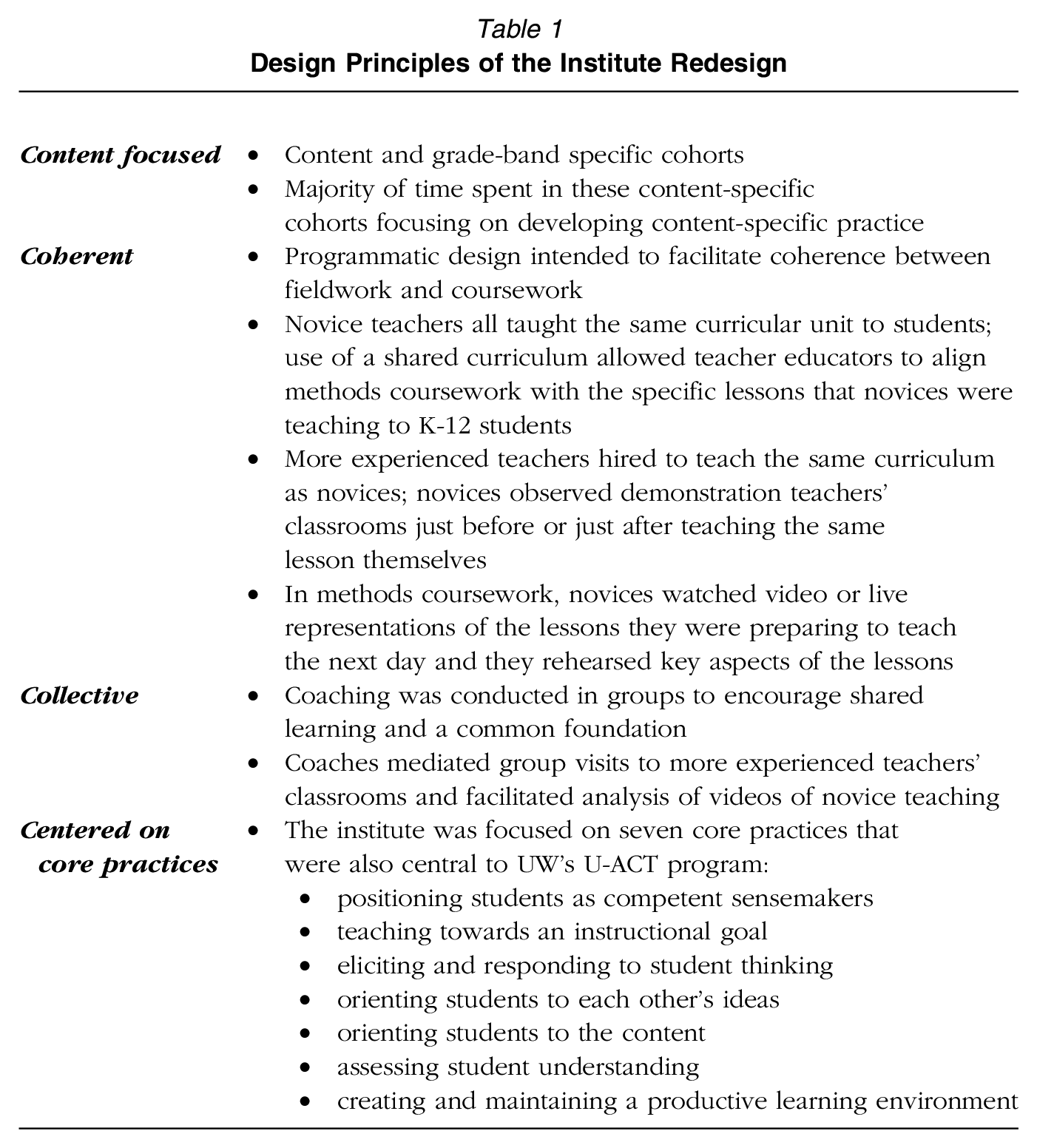
In 2014, the redesigned summer institute prepared close to 400 novices to begin their first year as teachers. The institute’s lead teacher educators were primarily clinical faculty and advanced doctoral students from the UW. For 4 of the 6 weeks of the institute, novice teachers taught in summer school classrooms where they team-taught in groups of four. At the secondary level, every team of four novice teachers was assigned to collaboratively teach a 1–2-hour class of summer school students every morning. These 1–2 hours of daily teaching became the central focus for all of the institute’s structured teacher-learning opportunities. The instruction novices provided to students during these 1–2 hours was grounded in a curriculum that was collaboratively developed by the team of teacher educators that designed the summer institute.
Of the close to 400 novices at the institute, approximately 120 were preparing to teach secondary ELA. Because all novice ELA teachers taught from the same curriculum, the novices taught the same lessons as one another on any given day. This design feature allowed the institute’s ELA methods instructors to align their methods classes with the curricular materials that novice teachers were teaching the following morning. Methods classes took place for 3–4 hours every afternoon following novices’ morning teaching. During methods classes, novice teachers prepared to teach their upcoming lessons by analyzing their students’ work, watching a methods instructor model lessons, planning their own lessons, and rehearsing upcoming lessons.
The student-facing ELA curriculum was written entirely inside of a predictable series of IAs. The curriculum centered on short coming-of-age stories selected for their potential to promote rich conversations among adolescents about race, class, community, culture, and identity. The focal texts were “Indian Education,” by Sherman Alexie; “The Lesson,” by Toni Cade Bambara; “Butter,” by Akhil Sharma; and excerpted vignettes from The House on Mango Street, by Sandra Cisneros, including “My Name.” Typically for each story the discussion portions of the curriculum included two Interactive First Reads (a routine for reading and discussing a new short story), two Interactive Close Reads (a routine for rereading and discussing a portion of a short story with an interpretive lens), and two Four Corners Discussions (a routine for considering and discussing interpretive claims).
These IAs were the backbone of both the student-facing curriculum and the novice-teacher-facing curriculum. The institute’s teacher educators brought novices through a consistent and cyclical series of activities designed to support their development of embedded content and professional practice while working on the IAs (McDonald et al., 2013). While introducing the IAs using videos and live models, the methods instructors worked to decompose the IA, highlighting important ideas about content and teaching practice. Novices videoed themselves teaching and then watched each other’s videos, paying particular attention to the practices under study. As a part of their methods classes, novices also analyzed student work that had been produced that morning and used their analysis to plan for the next day’s lesson.
Method
Research Participants and Contexts
Our study is based largely on collected videos of novices’ secondary ELA classroom teaching within the redesigned summer institute. The approximately 120 secondary ELA novices were all college graduates. However, not all novices in the ELA program had majored in subjects closely associated with ELA; many novices held bachelor’s degrees in the social sciences or in romance languages. Most novices were in their early 20s and without prior teaching experience. The participants of this study (n = 12) were part of a cohort of 24 secondary ELA teachers. See Table A1 (in the online version of the journal) for sex and race/ethnicity of participants. During institute, all secondary ELA novices worked in one of two urban charter high schools. Both schools served predominantly African American (>90%) and low-income (>90%) students, who tended to be enrolled in summer school for remediation and credit recovery.
Participants all worked with Sarah throughout the summer. Sarah, a white woman in her 30s, came to her work in teacher education with an undergraduate degree in American Studies, 4 years of experience teaching secondary ELA and history, and 7 years of experience working as a curriculum designer. At the time of the study, she was an advanced doctoral student studying multicultural education and teacher education, and she had 5 years of experience working as a teacher educator teaching courses in multicultural education as well as social studies/history methods and ELA methods.
We focused only on those novices who worked with Sarah in order to hold constant the specific teaching and learning opportunities that the novices received. Within Sarah’s cohort, we selected all novices who consented for us to conduct research on videos of their teaching. We do not have reason to think that the 12 participants were atypical in relation to their cohort.
Data Sources
Our primary data are 24 videoed lessons that were taught by novices (classroom video) and 13 hours of video from the novices’ methods class, taught by Sarah (teacher education video). Because novice teachers were assigned to classrooms in teams of four, the 24 episodes of classroom video all captured episodes of co-teaching, not individual teaching. Co-teaching was structured thusly: In each team of four teachers, two teachers would co-teach for half of the class (approximately 1 hour) and then the other two teachers would co-teach for the second half of class. The 24 episodes of classroom video therefore involve six pairs of co-teachers. Novices recorded themselves routinely as part of their preparation at institute. Novices videoed instances of themselves teaching each of the IAs upon which their professional preparation was organized.
We analyzed videos of the two IAs that would give us the best chance of seeing attempts at facilitating text-based discussions and explicitly supporting students’ literary reading and reasoning: the Interactive Close Read and the Four Corners Discussion. Each pair of co-teachers videoed themselves enacting Interactive Close Reads and Four Corners Discussions between 3 and 6 times. Videos ranged in length from 3 minutes to 62 minutes, with an average length of 29 minutes each. See Table A2 (in the online version of the journal) for additional information. Supplemental data include novices’ lesson plans and related artifacts and transcribed semistructured interviews with Sarah.
Data Analysis
Our data analysis occurred in three stages. In Stage 1, we analyzed the video of novice teachers teaching high school students. In Stage 2, we analyzed the video of the methods coursework that those novice teachers received. In Stage 3, we did a crosswalk analysis of these two sets of video to better understand the relationship between the way that novice teachers enacted practice with students and the way they were taught to teach by their teacher educator.
Stage 1: Novice teacher pedagogy
Our interest in teaching practice led us to focus our analysis on moments when teachers had to use knowledge about content, students, and pedagogy in action. Thus, we were interested less in novices’ plans than in their utterances within the unpredictable classroom context. This focus on enacted improvisational and relational classroom practice was informed by our theoretical grounding. We coded each novice teacher utterance using a priori codes. We were specifically interested in student-centered and text-based teaching that would invite students into literary ways of knowing. So we developed five codes involving ways that the teacher could promote students’ consideration of and talk about texts. These codes were related to but not the same as the core practices that had governed the institute and the ELA curriculum development. See Table 2 for video coding scheme and exemplars.
Codes and Data Exemplars
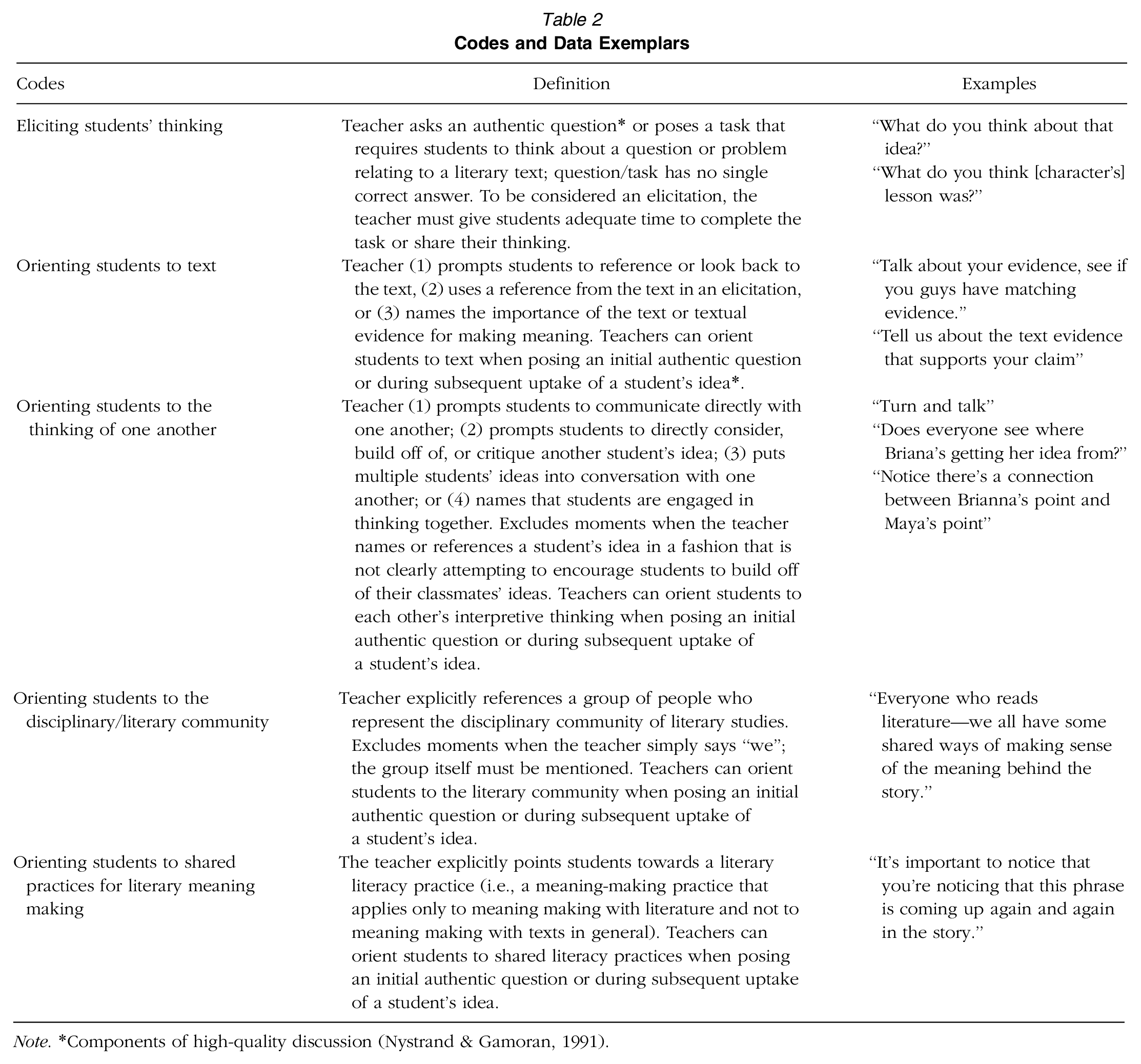
Note. *Components of high-quality discussion (Nystrand & Gamoran, 1991).
We used Studiocode© video analysis software to digitally code novices’ utterances and to analyze patterns within and across video files. Studiocode attaches codes directly to segments of videos as opposed to supplemental texts, like transcripts. Although Sarah participated in the development of the coding scheme, she did not code any of the data that were directly related to her methods teaching in order to ward against biases inherent in self-study (Hamilton, 1998). As the team coded, we met regularly to closely examine moments of disagreement in coding. Ultimately, all videos were at least double coded, and all points of disagreement were resolved.
Once novices’ teaching videos were coded, we analyzed the frequency with which each code appeared in novices’ teaching. The frequencies revealed patterns in the types of teaching practices that novices were and were not demonstrating in their classroom instruction. From there we moved to two additional threads in our analysis. The first was to further examine the nature of novices’ attempts to facilitate text-based discussion and support students’ use of literary literacy practices. As a team, we reviewed instances of each coding category to describe common and atypical features in novices’ teaching.
Stage 2: Teacher educator pedagogy
We were also interested in understanding the relationship between the learning opportunities afforded to novices by their methods instructor and novices’ patterns of instructional practice, so we then turned to the teacher education video we had collected of Sarah. To begin this thread of our analysis, we isolated segments of Sarah’s teacher education video that attended directly to each of the focal literacy teaching practices under study. Then, we applied three sets of codes derived from our theoretical frame. The first set of codes were the same five codes we had previously used to analyze the novice teacher video. With these codes, we determined what Sarah was working on with her novice teachers. The second set of codes helped us determine the activity in which Sarah was engaging her novices (e.g., rehearsing teaching, discussing scholarship). Finally, for the last set of codes, we drew on constructs from Grossman, Compton et al. (2009) and coded whether and when Sarah was representing, decomposing, and approximating each of the literacy teaching practices. See Table 3 for additional codes applied to the teacher educator video.
Additional Codes Applied to Teacher Educator Video
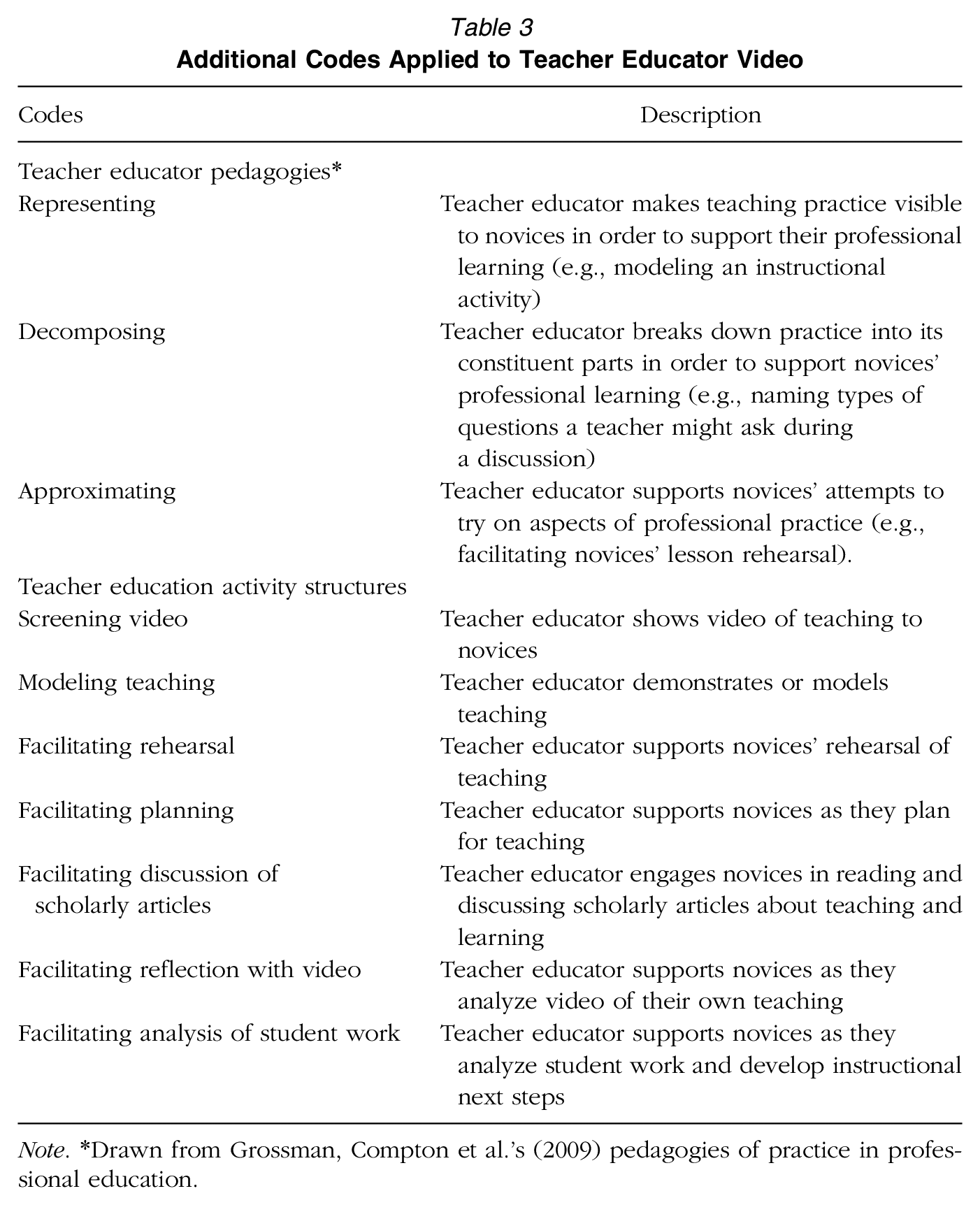
Note. *Drawn from Grossman, Compton et al.’s (2009) pedagogies of practice in professional education.
It was rare for Sarah to engage in multiple activity structures at once (e.g., she did not facilitate rehearsals of teaching at the same time that she screened the video of teaching). However, the codes we drew from the Grossman, Compton et al. (2009) framework were frequently applied simultaneously. For example, when screening a video of a teacher teaching an IA (a representation of teaching), Sarah would frame novices’ video viewing by naming a few parts of practice that she wanted them to pay particularly attention to (decomposition of teaching). In addition, she sometimes paused the video and had novices imagine that they were the teacher in the video and asked them to think of what they might say in response to a students’ comment (approximation of teaching).
Stage 3: Looking across the novice video and the teacher education video
Once both the novice video and the teacher education video were coded, we looked across both sets of coded video to identify trends. In this crosswalk analysis, we paid particular attention to potential relationships between practices that novice teachers enacted in their work with students and the ways that they were taught to enact those practices in their methods course. In this final stage, we also used supplementary data (i.e., interviews with the teacher educator, lesson plans, and methods course documents) to validate and verify our findings.
Findings
To better understand the relationship between how novice ELA teachers were taught to teach and how they subsequently taught high school students, we analyzed video data of both the methods instruction and novices’ teaching. We paid particular attention to teacher educator instruction and novice teacher instruction as it related to (1) approaches to supporting students’ text-based discussion and (2) approaches to supporting students to participate in a disciplinary community of literary studies.
Our findings are threefold. First, from analysis of data documenting how novices were taught to teach, we found that the ways that they were prepared to support students’ text-based discussion were very different than the ways they were prepared to attend to the discipline of literary studies. To support novices in facilitating text-based discussion, Sarah frequently represented, decomposed, and approximated practice. She accomplished this by employing many activity structures: She screened video, modeled teaching, facilitated rehearsals, facilitated lesson plan analysis, and led novices in analyzing video of their own practice. On the other hand, when Sarah worked with novices on attending to the discipline of literary studies, she rarely represented, decomposed, or approximated the practice of teaching. Instead, her primary activity was the discussion of scholarship.
Our second finding comes from our analysis of data documenting how novices taught high school students. We found that novices frequently supported students to engage in discussion with and about texts but rarely supported students to read or discuss literature in ways that were specific to a disciplinary community of readers of literature. Our findings about novice teacher learning mirror our findings about how the teachers were taught. This mirroring is significant to scholarly conversations about both practice-based teacher education and disciplinary literacy because it points to a possible relationship between a practice focus in teacher education pedagogy and subsequent novice teacher learning.
Our third finding emerged because we were surprised at the consistency with which novices took up practices aimed at supporting students’ text-based discussion. We were interested in understanding whether this take-up was simply mimicry or whether it was flexible and responsive to their classroom context. Our analysis revealed that even though novices did lean heavily on moves introduced by their teacher educator, they used these moves flexibly by (1) calling on different moves to respond to different situations and (2) adapting moves introduced by their teacher educator in response to their particular classroom context. In the section that follows, we use data to illustrate these findings. We attend first to our findings about how novices were supported to teach literacy within their teacher preparation.
How Teachers Were Taught to Teach
Our goal in this section is to illustrate how novices were taught about two particular aspects of ELA teaching: facilitating students in text-based discussion, and supporting students to engage in the kind of reading and reasoning valued within the academic discipline of literary studies. We draw on transcripts of videos of methods instruction, excerpts from Sarah’s lesson plans, and transcripts of interviews with Sarah.
Supporting students’ text-based discussion
On the first day of institute, Sarah introduced novices to the seven core practices of the institute (see Table 1). Three of the program’s core practices—eliciting and responding to student thinking, orienting students to one another, and orienting students to the content—became the primary vehicles through which Sarah supported novices to learn how to facilitate student discussion in the service of literacy learning. These core practices were referred to during every video of Sarah’s teaching during institute. She often used these practices to focus novices’ observations, analysis, and rehearsal of teaching. Below are two excerpted transcripts from a video of Sarah teaching novices on the first day of institute. The first transcript took place as Sarah was showing novices a video of a teacher teaching students the same IA they would be teaching students on the first day of summer school. The IA was an Interactive First Read of Cisneros’s vignette “My Name.” To introduce the video, Sarah said:
I want you to keep watching and what I want you to look for this time is, does [the focal teacher] use students’ ideas in any ways? … So some ways you might do that are, say, “does anybody agree with this idea?” Or you might take the idea and try to connect it to something else. What does she do with the ideas that get surfaced?
Then, Sarah played the clip. She paused the clip when the teacher and students were in the middle of a short discussion about whether or not the narrator likes her name.
I want us to stop here and think about what are some other types of things [the teacher] could have done in that moment. [The first student to speak] has just said “I think two things, I think kind of yes and no” and then she provides a couple of different reasons for why she thinks both yes and no, right? And then what [the teacher] does in this moment is she then goes to [another student] and she says “any other ideas?” Right? What’s something else [the teacher] could have done in that moment? Something else she could have said to use that [first] student’s idea?
She could have pressed, maybe, and asked the student to explain. She could have said “how is that possible for someone to be conflicted like that, can’t they just have made up their minds?” … and had the student explain for a bit. …
Yeah, she could have pressed her or … somebody else on the same idea [by saying] “can somebody give me more information about [this student’s] argument?”
She could ask if anyone disagrees that it’s both, maybe someone feels that [the narrator] doesn’t like her name 100 percent or likes it 100 percent. Getting students to challenge each other’s arguments.
Here, Sarah is using a video representation of teaching, and she has pointed novices’ attention to one component part of the focal teacher’s practice. This chunking of practice into component parts is what Grossman, Compton et al. (2009) call decomposition. In particular, Sarah calls novices’ attention to the teacher’s uptake moves (Nystrand, 2003) by asking how the teacher “uses the students’ ideas.” When she pauses the video, Sarah asks novices to take on the role of the teacher in the video (an approximation of teaching) by having them come up with possible responses to a student’s idea. Through engaging in this task, Sarah supported novices to generate a variety of possibilities for how a teacher might use a student’s idea in a particular moment within a text-based discussion. Novices suggested that the teacher could have asked students to build on a previously stated idea or the teacher could have highlighted a place of disagreement and asked students to weigh in. Importantly, the question driving novices’ video watching and discussion was how the teacher used students’ ideas. This provided an early opportunity for novices to move beyond noticing how the teacher simply collected students’ ideas or asked students to talk to one another—although such moves are important first steps in facilitating a discussion—and toward discussion moves that more directly promote students’ engagement with the text.
Also on the first day of novices’ preparation, Sarah offered another representation of teaching, this time by modeling the IA that novices would enact during their first day with students. After Sarah modeled the lesson (during which the novice teachers engaged as students), Sarah facilitated a discussion aimed at connecting the IA she had just modeled with her most frequent decomposition of practice, the core teaching practices of the program:
What are the things that we talked about earlier, our core practices, that you noticed me doing? Or what questions do you have related to these core practices?
You had Jason repeat Joe’s idea again.
So one of the reasons why someone might orient students to each other is to actually highlight ideas that are important for people to hear. So what was happening for me in that moment is Joe made this kind of great interpretation that I thought was [interesting] and we hadn’t made yet today … and I wanted to make sure everybody heard it and had an opportunity to engage with it, so my move in that moment was to ask somebody to revoice. Alright? What other things did you notice me doing?
Whenever we gave examples you asked us to go back. You asked us “where did you see it?” [skip one turn]
… Paraphrasing what students were saying and putting it in your own words to make sure you understood what they were saying and saying it back to them so someone else could carry it forward.
Yeah, did other people notice that too? That’s called revoicing. So you guys are all mentioning a lot of things which we’re about to talk about. You already have a sense of them … but I wanna give you some names for them, okay? Because these are things we’re gonna be talking about over and over and over again over the course of the next five weeks. So, these are talk moves. [Sarah passes out a list of talk moves] The first one is one that Jason was just talking about. … Revoicing is the first one. … So when I did that… I was trying to make your ideas available to one another. You had some really good interpretations. I wanted to make sure everybody heard them. What about [the second move listed], “connecting?” So connecting’s a slightly more complex idea. When we connect ideas, we’re actually prompting students to use each other’s ideas or we’re connecting students’ ideas ourselves. So I might say, “Leslie’s idea seems really connected to Jason’s idea” or “I wanna take Tina’s idea and relate it back to what we heard earlier from Samar.” It’s a way of helping people orient to one another.
Again in this moment, Sarah decomposed practice by drawing novices’ attention to the specific, concrete moves that they could employ to facilitate student talk alongside the purposes for generating student discussion in the service of student learning. In these excerpts, it is clear that Sarah supported novices to consider ways of promoting not just student discussion but student discussion with and about texts. In Excerpt 1, students were talking about a short story and Sarah was working with novices to help them imagine ways of facilitating conversation about that short story. In Excerpt 2, the group reflected on specific ways that Sarah made various literary interpretations available to everyone in the room. These excerpts are representative of the data that illustrate how Sarah taught novices to facilitate text-based discussions. She used many activity structures, including modeling teaching, screening video of teaching, facilitating rehearsals of teaching, and facilitating lesson plan analyses. Within these activity structures, she frequently offered novices representations and decompositions of teaching, and she frequently engaged novices in approximating the work involved in facilitating a text-based discussion. However, although Sarah deliberately focused on how to facilitate student talk about texts, there was very little in her instruction about the literary reading and reasoning that novices were ultimately being asked to teach students through interaction.
Supporting students’ literary literacy learning
Sarah’s approach to teaching novices to support students to participate in the larger disciplinary community of literary studies—including teaching literature-specific literacy practices like constructing interpretive puzzles for further pursuit—was quite different than her approach to supporting novices to promote students’ text-based discussion. When teaching about student discussion and students’ use of text, Sarah used video, her own modeling, and novice approximations of practice as the primary contexts for novice learning. When teaching about supporting students’ use of shared literacy practices of literary studies, though, Sarah framed the work as more of a theoretical and curricular consideration than an instructional consideration brought to life through in-the-moment decision making in response to student thinking.
For example, another part of Sarah’s instruction on the first day of institute involved asking novices to read the first text they would be reading with their students (“My Name,” by Cisneros). She then facilitated a discussion among the novice teachers about the vignette, concluding this discussion by having them write and share claims about the story’s figurative meaning. After novices shared their claims with one another, Sarah posed the following questions: “What does it mean that there are so many different interpretations? How do we know who is right? If what we just did as a group is develop all of these interpretations of text, then what is the purpose of reading in ELA classrooms?” After novices shared their responses to these questions, Sarah shared her own answer on a projected slide that read:
In ELA classrooms, we’re trying to prompt students to make divergent meaning out of texts. We aren’t fishing for answers, we’re not trying to guide everyone to the same interpretation. … This summer we are starting you on a journey … [of] learning how to craft an environment in which [divergent meaning making] happens.
At this point, Sarah passed out a three-page document to novices entitled “literary disciplinary literacy primer,” which served as an introduction to the concept of disciplinary discourse communities and disciplinary literacy instruction. Importantly, the primer framed disciplinary literacy as a curricular concern more than an instructional concern:
This curriculum is based on the premise that rigorous instruction for students means giving them lots of opportunities to learn how to participate in the various disciplinary discourse communities valued in secondary and post-secondary schooling. …The curriculum focuses on teaching students to participate in the discipline of literature. … This curriculum focuses on three disciplinary literacy practices that are at the core of “doing literature.” These are: 1) posing interpretive, literary problems, 2) developing interpretations through close reading, and 3) making and warranting claims with texts.
After introducing the concept of disciplinary literacy and discussing its implications for curricular design, Sarah asked novices to consider how the principles of disciplinary literacy as described in the primer related to quotes that novices had discussed earlier in the day. The quotes, from Delpit and Friere, were focused on the emancipatory purposes of education. In this way, Sarah framed disciplinary literacy as a concept that should also inform novices’ thinking about theoretical perspectives on the purposes of education. After this introduction of disciplinary literacy and disciplinary discourse communities, Sarah then pivoted to introduce the program’s core practices. She said:
If it is our goal to [teach in ways that support students to participate in disciplinary community, then] … we need some practices as teachers that will enable us to create the environment we experienced [when we just discussed literature together] and get kids engaging in a disciplinary literary community. We’re going to talk a lot about these core practices this summer. They are the way that we get kids to engage in disciplinary literacy practices.
On this first day of institute, Sarah positioned disciplinary discourse communities and disciplinary literacy as ideas that inform curriculum development and perspectives on teaching, learning, and the purpose of education. She then highlighted the program’s core practices as the instructional vehicles through which the ultimate goal of participation in disciplinary community could be achieved.
Two weeks later, Sarah returned to the idea of disciplinary literacy to provide rationale for why novices were engaging their students in close reading activities. Surrounding their first enactment of the Interactive Close Read IA, novices expressed fear and uncertainty. As Sarah began preparing novices for their second Interactive Close Read, she had novices read an article arguing that an important goal of ELA is to teach students to learn to participate in a larger community of readers of literature (Rainey & Moje, 2012). After reading the article together, Sarah facilitated a conversation by asking, “Why do we teach ELA?” As novice teachers discussed, Sarah recorded their ideas on the board. At one point, when novice teachers had agreed that the purpose of teaching ELA was to promote “critical thinking,” Sarah interjected and tried to push for clarity about what novices meant by “critical thinking” with literature:
So I’m kinda seeing two strands in [your ideas about “critical thinking”]. One is about the ability to see things that are not immediately visible in the world around you. And two, using that ability to then be able to do something, right? To be an author in your own life. To be a person who makes the world, not just a person who receives the world. Okay? … So now I want us to get even deeper into the world of literature. What does that mean when we are teachers of literature? … I want to make a claim … and I want you to think about to what extent you agree with this claim or whether it prompts your thinking in a different way. I think critical thinking has to do with not just what the answers are, but in fact how “the answers” [Sarah gestures to make air quotes] are constructed. Right? Being a real learner of science doesn’t mean knowing what a microorganism is, it means understanding how do scientists figure out things about microorganisms in the first place. … Learning history doesn’t mean just learning what happened in the past, it’s about learning how do I analyze the world in order to understand what happened in the past. And critical thinking in literature isn’t just … what this story means, it’s … how this story means. The reason for that is that if we’re preparing students to be authors of meaning in the world, authors of their own lives, not just receptacles for information, we have to actually teach them what is the work of making meaning inside literature. … If we are giving students the tools of the discipline, [then] we are giving students the tools of understanding how authors mean … that’s the rationale.
As Sarah prepared novices for their second round of teaching a close reading lesson, she used ideas from scholarship on disciplinary literacy to provide novices with a “rationale.” She framed disciplinary literacy as a reason to practice but not as a practice itself. This stands in stark contrast to how Sarah prepared novice teachers to facilitate text-based discussions. By continually embedding instruction on text-based discussion within representations and approximations of practice (Grossman, Compton et al., 2009), Sarah supported novice teachers in understanding the fine-grained work of promoting student discourse about complex texts. In contrast, Sarah’s instruction in disciplinary literacy was rarely based on representations or approximations of practice, and instructional moves that a teacher might make to orient students to the shared disciplinary practices of literary studies were never named. Instead, Sarah’s instruction in disciplinary literacy relied on discussions of articles and discussions of curricular resources. Although Sarah supported novice teachers in understanding how to craft arguments in support of enacting instruction that reflects authentic disciplinary inquiry, she did not support novice teachers in understanding this work as occurring within the minute-by-minute decision making of classroom instruction.
Novice Teacher Learning
Regarding novices’ early teaching practice, we found that they frequently supported students’ discussion with texts. However, novices rarely explicitly supported students to read or discuss literature in ways that were specific to a disciplinary literary community. In this section, we first quantify the frequency with which novices took up each of the practices in our coding scheme. Then, we offer representative instances of ways that novices tended to promote students’ text-based discussion. Finally, we offer a rare instance in which a novice oriented students to the discipline of literary studies.
Table 4 provides an overview of the frequency with which novices employed each of the following practices: eliciting students’ ideas, orienting students to each other’s ideas, orienting students to the text, orienting students to disciplinary literacy practices, and orienting students to a disciplinary community. On average, novices attempted to elicit student thinking almost once per minute in the 24 videos we coded. In order to be coded as an elicitation, the teacher utterance needed to be an open-ended question or statement that invited student thinking. We did not code fill-in-the-blank questions or questions with one right answer as elicitations. Novices oriented students to one another and oriented students to the text with slightly less frequency: about once every 3 minutes. And novices rarely attempted to orient students to disciplinary literacy practices (e.g., constructing an interpretive puzzle) or orient students to a disciplinary community (e.g., telling students that people who read literature for academic purposes care about figurative meaning). Novices attempted to orient students to disciplinary literacy practices about once every 33 minutes, and they attempted to orient students to the community of literary studies about every 50 minutes.
Frequency of Novices’ Attempts to Enact Practices (n = 12)
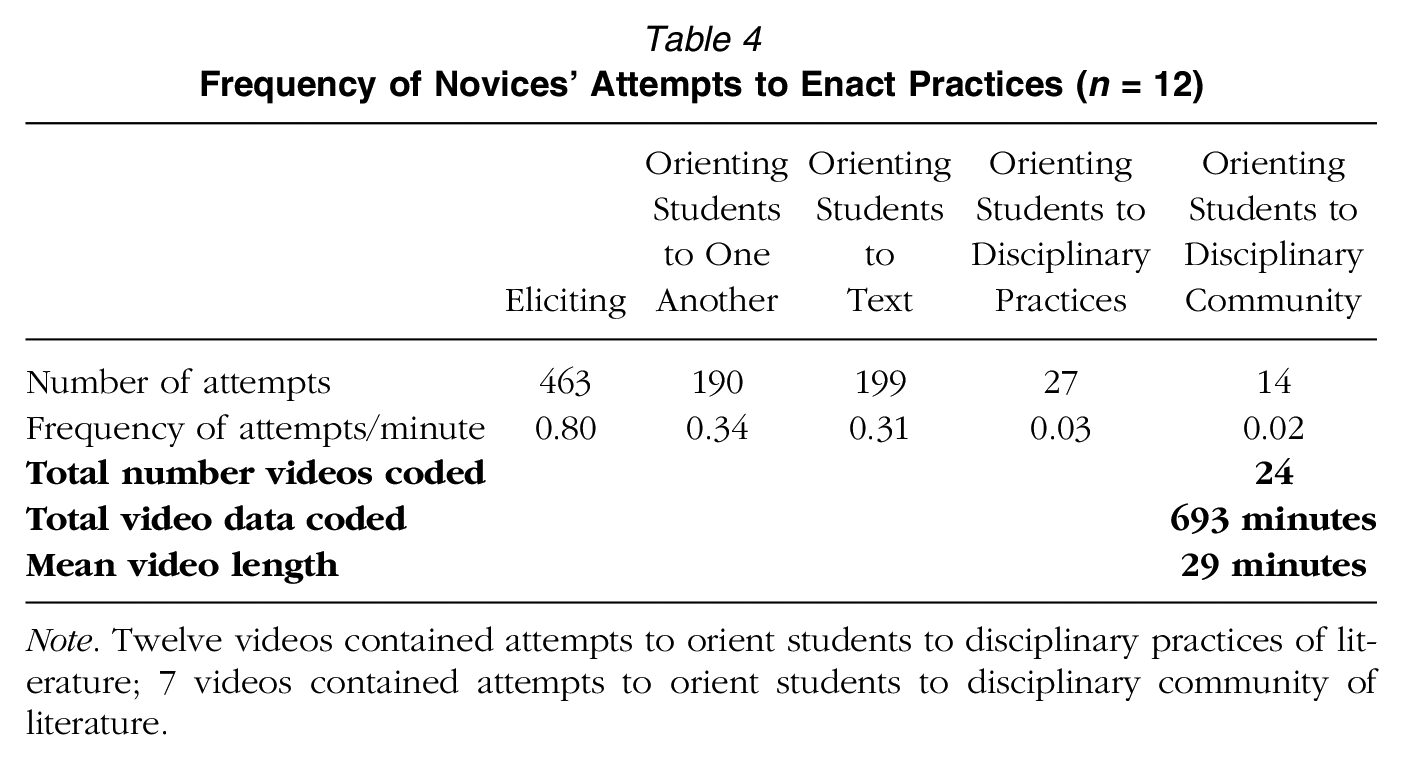
Note. Twelve videos contained attempts to orient students to disciplinary practices of literature; 7 videos contained attempts to orient students to disciplinary community of literature.
To characterize the nature of novices’ practice, we turn to excerpts from the video data.
Supporting students’ text-based discussion
Novices frequently engaged students in exploratory, multiparty talk in which they elicited students’ ideas without evaluating them and oriented students to the ideas of one another. Novices tended to ask students to talk to one another (“Talk to your group about your ideas”), to ask students to restate a previously stated idea (“Who can tell me what [Student] just said?”), and to ask students to build on a previously stated idea (“What do you think about that idea?”). Frequently, these moves happened in combination. For example: “Who can tell me what [Student] just said? Okay, [Student], can you repeat what you said?” [student repeats] “Alright, [Student 2] do you have something that you want to add about why you strongly agree with what [Student 1] said?”
Novices engaged students not just in discussion, but in text-based discussion, in almost every video that we coded. Although it did happen, it was relatively rare for novices to ask students questions with single answers or open ended questions about something other than the texts they were reading. The most frequent nonacademic or closed-ended questions that novices asked students were behavioral in nature (e.g., Teacher: “How are we going to move to our corners?” Students: “Silently”). Most often, novices supported students’ extended use of texts within discussion by employing combinations of the following moves: asking students to state the main idea of a text (i.e., summarizing), asking students to name the specific lines/paragraphs to which they were referring in the text (i.e., signposting), asking students to look into the text in order to develop an idea (i.e., searching), asking students to share textual evidence for a claim (i.e., substantiating), and directing students’ attention to a specific idea or place in the text for further consideration (i.e., steering). Below, we offer examples of each type of move that represent how novices facilitated text-based discussion in their classrooms.
Novices frequently prompted students to summarize a portion of the text. In some ways, these instances looked about as a reader might expect. Novices asked students to remind the class about what happened in a particular scene or in the passage that they read on a previous day. Typical requests for summaries sounded like, “Can we remind ourselves of what the lesson was [in Bambara’s “The Lesson”]?” As opposed to what might be expected in novice teaching practice, however, novices tended to use summary questions to launch discussions about texts or to establish common ground rather than simply asking a summary question and then moving on to a new activity.
In almost every video, teachers repeatedly prompted students to signpost, or to share with the class where they were looking in the text. Often, students would be in the middle of a statement and the teacher would interject to remind students to share the line number or page number with the group (“Show us where you are in the text.”). Along with prompting individual students to share where they were looking in the text, novices also prompted the other students to look to the same place in the text (“Did everybody get that?”). In this way, novices routinely oriented their class to the text and to the ideas of their classmates.
Novices pointed students back to the text in a variety of ways. Almost all of the coded videos included novices asking students to provide textual evidence to support claims that they were making. Novices said things such as “Turn and talk with your partner about why you [decided on your stance] and what evidence you pulled” and “[Consider] what’s the piece of evidence you’re going to cite [in our upcoming discussion].” Novices also praised students when they offered textual evidence on their own; in one instance, the novice said on the heels of a student comment, “We want to cite text evidence, like [Student] is doing right now.” In each of these instances, novices were attempting to support students by directing them to substantiate their claims with lines or patterns from the text. A related but distinct way that novices supported students’ text-based discussion was to prompt students to look back to the text in order to help them develop an idea. For example, in one moment when a student turned back to his text, the novice teacher said, “[Student] is really thinking about his point of view, which I appreciate. These are tough questions and they have complicated answers. So, if you’re going to support a claim, you should really think about it before jumping into it.”
A final pattern in novices’ support of students’ use of text in discussion was to direct students’ attention to a specific idea or place in the text for further consideration. An example of this pattern occurred when a novice teacher said:
Let’s go to paragraph 11 … where Ms. Moore said you should spare no expense … the microscope is described as a learning instrument … and this story is called “The Lesson.” Do we think there might be a connection between “The Lesson” and the microscope?
Such instances seem to represent novices’ attempts to steer students’ talk back into passages in the text that could be rich for discussion.
Mimicry or adaptive use?
Given the frequency and general quality of novices’ attempts to facilitate students’ text-based discussion, a reader might wonder about the extent to which novices were merely parroting the models they had received from their teacher educator. Our analysis revealed that whereas novices sometimes used the exact same lines they learned from their teacher educator, more often they demonstrated somewhat flexible use of moves that were responsive to students in the moment. For instance, in one episode, a novice asked students to decide the extent to which they agreed with the claim “Junior stands up for himself.”
I strongly disagree because in paragraph [long pause] four –
Alright, everybody go to the fourth paragraph.
Fifth.
The fifth paragraph. That’s okay. We’re looking all over the text for evidence. That’s right. Evidence is in every paragraph. Alright, go ahead, [student].
Okay, in that paragraph where he was gettin’ beat up and he beat the boy up and he got in trouble, I think he learned from that. And, instead of standing up to teachers he learned that standing up for himself got him way into trouble, so he just didn’t.
That’s a very interesting point. Who can restate what [student] just said?
What [Student 1] was saying is that even though he was a little kid, he didn’t know how to defend himself that well.
Right, except for [Student 1] made one small distinction and that’s why she disagrees with that [as being] an example of standing up for himself. Who can tell me—what else did [Student 1] add to that?
In this episode, the teacher asked students to restate Student 1’s idea and then pressed for students to fully demonstrate that they understood the depth of Student 1’s idea. When Student 2 did not fully represent Student 1’s position, the teacher could have simply filled in the rest, ignored the gap, or repeated a line from her teacher preparation, but instead she synthesized the students’ contributions and then posed the disagreement for the class to consider. Such flexible use of moves, although often associated with more expert teaching practice, occurred frequently.
Supporting students’ literary literacy learning
Although novices frequently attempted to support students’ discussion with and about classroom texts, they did not tend to explicitly support students’ understanding of or participation within literary studies. Novices talked at length with students about claim making and use of text evidence, but most of their instruction and support stayed at the level of generic academic argumentation as opposed to the specific ways of developing literary arguments aligned with the academic discipline of literary studies. Similarly, novices read only literary fiction with students, but their instruction and support of reading literature did not typically make explicit that there are specific ways of reading and reasoning with literature. Novices also did not make explicit to students the ways that participating within an academic community of literature differs from that of other academic communities. As can be seen in Table 4, novices oriented students to texts and to each other very frequently, approximately once every 3 minutes. Orienting students to text and to each other is essential when facilitating text-based discussion. It is, however, disciplinarily generic work. It is possible that a teacher could orient students to one another and to the text using the exact same language during a discussion of a science textbook as they would during a discussion of a newspaper article or even a poem (e.g., “Tell us where you’re seeing that in the text”). Whereas such instructional moves could be enough to prompt students to employ discipline-specific literacy practices if they already knew how, when, and why to use them, these generic instructional moves are not enough to explicitly teach students how to participate in literary ways of reading and reasoning. In contrast to the frequency with which teachers generically oriented students to one another and to the text, Table 4 illustrates that explicit and discipline-specific teaching occurred relatively rarely. Further, there were many novices who never enacted discipline-specific work in their videoed lessons.
To illustrate what we were looking for in novices’ practice that we considered explicit and discipline-specific, we offer one instance in which a novice did attend to specifically literary ways of reading short stories. The following excerpt occurred right before this teacher posed an interpretive question about a text to students:
[In “The Lesson,” the children] see a lot of fancy toys in this toy store. Now, what a good reader of literature notices is that Bambara could have chosen to make the students look at any toys in the toy store. … So, as good readers of literature, we need to ask ourselves, why did the author decide to make the students see a microscope and a clown and a sailboat and not a bumper car and a laser gun?
In this instance, the novice connected the question he posed about the possible symbolic meaning of the toys in the story to a larger academic community of readers of literature. It was not that he arbitrarily wished to discuss the question he posed. Instead, it was that the academic study of literature involves questions such as the one he posed. Through his brief explanation and then his launch of the discussion, he positioned students as capable of learning to engage with the short story as the broader literary community might. Further, through his explanation, he highlighted for students that a literacy practice of reading literature is constructing interpretive questions to consider with texts and with a community of other readers.
Discussion
Our investigation involved two major analytic threads. The first thread of our analysis was an investigation into how novices were taught to teach. This thread of our analysis uncovered a major difference between how novices were taught to engage students and text-based discussion and how novices were taught to support students’ literary literacy learning. When learning how to engage students in text-based discussion, novices were offered concrete instructional moves that might support them in getting students to share ideas about texts with one another. In addition, they were guided through representations and approximations of teaching, and they were asked to name, analyze, and try on in-the-moment decisions of instruction. In contrast, when learning how to support students’ literary participation, novices were asked reflect on the purpose of education and its relationship to curricular design through considering education scholarship. The second thread of our analysis was an investigation into how novices (a) facilitated students’ text-based discussion and (b) supported students’ literary literacy learning. Here we also uncovered a stark difference. In their work with high school students, novices’ improvised instructional talk was frequently focused on supporting students’ text-based discussion, but it was rarely focused on supporting students’ participation in disciplinary community.
Put differently, throughout the redesigned institute novices were supported to lead text-based discussion through an approach to professional preparation that was highly practice based, by which we mean two primary things. First, Sarah frequently represented, decomposed, and approximated aspects of teaching practice related to eliciting and developing students’ textual interpretations. Second, Sarah supported novices to learn to enact a set of named and prioritized practices that were easily applied in classrooms where text-based discussion was a primary goal. Although novices were exposed to the concept of disciplinary literacy through readings and discussions, Sarah did not typically represent, decompose, or approximate aspects of teaching practice related to disciplinary reading, writing, and reasoning. It is striking, then, that the concept of disciplinary practice was also relatively absent in novices’ teaching.
We cannot claim a causal relationship between methods of preparation and novice teacher take up in classrooms from this study. Further, given the limitations of the alternative program’s structures for preparing novices (e.g., time, amount of supervision offered to novices while they worked with children), we do not seek to imply that results would necessarily neatly map onto preparation programs of different designs. Still further, we do not believe that 6 weeks of training, no matter how rigorous, is sufficient for accomplishing professional standards. However, our findings raise interesting questions about the relationship between pedagogical approaches to teacher preparation and what teachers are able to attempt in their earliest work with students. If we were to revise the teacher education design for a future cohort of novices, how could we better provide support for novices’ enactment of literary literacy teaching? What would it look like to pair curricular tools and theoretical discussions with teacher education opportunities that support improvised, in-the-moment literacy instruction that is explicitly disciplinary? Simply naming core practices such as “orienting students to the disciplinary community” and “orienting students to disciplinary literacy practices”—codes that came out of our theoretical stances—could be a step in the right direction. This is because within a practice-based professional preparation program that names, represents, decomposes, rehearses, enacts, and is generally centered on a set of prioritized practices of instruction, the lack of deliberate connection between how teachers are learning to interact with students and discipline-based instructional goals may result in problematic disconnects in their practice. Further, it seems crucial to show novices representations of disciplinary literacy teaching practice that are accessible enough for them to attempt in the service of their professional learning. Developing and studying a video library of such representations could be an important step (Rainey, Maher, Coupland, Franchi, & Moje, in press; Rainey, Maher, & Moje, in preparation), as is developing and studying other tools like IAs designed to support novices’ disciplinary literacy teaching.
Implications and Conclusions
Our findings demonstrate that it is possible to meaningfully shape novice teacher practice even at the earliest stages of development. Whereas it may seem self-evident that rich and sustained professional learning opportunities can result in changed teaching practice and, in turn, improved opportunities for student learning, these relationships are not always acknowledged by stakeholders in education (Walsh & Jacobs, 2007). Further, within the field of teacher education, although there have been many efforts to specify what teachers need to learn (Darling-Hammond & Bransford, 2007), we have not yet built common understandings of what rich and sustained professional learning opportunities entail. Insofar as the findings of this study demonstrate the influence of carefully designed learning opportunities and the relationship between teacher education efforts and novice teacher practice, the findings contribute to ongoing work to justify and improve teacher education.
A second implication of this study speaks directly to efforts to specify practice in teacher education. Scholars have argued that specifying practices of teaching will, over time, help those in the field build and aggregate knowledge and simultaneously render complex professional work learnable for novices (Ball & Forzani, 2009; Grossman, Hammerness et al., 2009). Our study is an early indicator that it is possible to design, study, and refine specifications of practice and the resulting teacher education activities that would accomplish them.
Our study also suggests that efforts to refine how we specify core practices is meaningful work. It is meaningful because how we name and prioritize what matters to us as a field is of major consequence for what ends up happening in teacher education and in the classrooms of early career teachers. During the summer institute that we studied, those core practices that were named, represented, parsed, and approximated were subsequently enacted in novice teachers’ work with students. A next question for investigation is whether naming, representing, parsing, and approximating the practice of “orienting to the discipline” for novices will meaningfully influence the instruction that they subsequently provide to students. Further, if novice teachers were offered opportunities to see, parse, and approximate the practices of “eliciting students’ ideas” and “orienting students to text” in ways that also oriented students to the discipline of literary studies, would those opportunities translate into changes in novices’ instruction? If so, how? Had novice teachers experienced such opportunities, we hypothesize that we might have seen more regular attempts to promote students’ discussion in the service of supporting their literary reading and reasoning, although novices’ attempts would not likely be mistaken for the practice of skilled veterans such as Mrs. Hayes (Lee, 2007). Investigating these questions will be of great importance if we hope to influence the literacy instruction that K–12 students in poverty-impacted schools are receiving from their (often novice) teachers. In this way, the concept of “orienting students to the discipline” as a named instructional practice could be considered a tool for shaping and remaking the professional community of teaching, even as it offers possibilities for shaping and remaking the disciplinary community of literary studies by changing the nature of students’ literacy learning opportunities in classrooms.
Aside from the specific practices we name and seek to advance, how we conceptualize practice and the purposes for teaching through practice is also consequential for our field. Is it really “take up” that we are seeking, whether by students or by novice teachers? The discourse communities of particular interest in this study—the professional communities of educators and education researchers and those of the disciplines—have been influenced by racist, sexist, heterosexist, classist, colonialist, and nativist values and beliefs. Any attempt to teach practice must, therefore, include efforts to question and critique existing practice and to interrupt oppressive histories of those communities. Moje (2015) names this purpose in her conception of K–12 disciplinary literacy teaching for social justice. Similarly, Cochran-Smith (2004) describes the need to both “prepare teacher candidates who can demonstrate what some consider ‘best’ instructional practices, but also know how to challenge those practices when they exclude certain children or fail to serve particular groups of students” (p. 205) in her examination of social justice and the outcomes of teacher education. In keeping with sociocultural theories of practice, then, perhaps practice-based approaches to teacher education are better understood as cultivating critical take up of core practices by novices who are supported to gain awareness of ways that specific practices can be used to reproduce or recreate larger systems of power and to question whether and how specific practices are best employed. Further theorization of critical take up could offer real contributions to teacher education as we wrestle with how to prepare novices while maintaining a dynamic and contextually contingent perspective on teaching practice.
If we are to truly accomplish meaningful and lasting changes in the teaching and learning that happens in K-12 classrooms, then scholars of practice-based teacher education and scholars of disciplinary literacy need one another. Whereas some consider the approaches and commitments of practice-based teacher education scholars and disciplinary literacy scholars to be at odds with one another, our work suggests that the knowledge bases of the two communities are not only complementary but that they may be productively combined in order to more fully meet our shared goals for teacher practice and student learning. Building knowledge about pedagogical approaches to teacher education without a rich conceptualization of what constitutes meaningful disciplinary teaching and learning is like drawing a detailed map towards an unknown destination. Building knowledge about what constitutes meaningful teaching and learning in the disciplines without a rich conceptualization of what constitutes meaningful professional learning is like painting a picture of a beautiful destination without an accompanying map revealing the road from here to there. If novices are to become teachers who engage students as authentic producers of disciplinary knowledge with the goal of social transformation, then we must work together to attend to intersections of sociocultural theory, teacher education practice, K–12 classroom instructional practice, disciplinary practice, and literacy practice.
Footnotes
Notes
S
E