



Abstract
In this qualitative case study, we explore the political impulses behind suburban secession from the 2013 Memphis-Shelby County merger, the largest school district consolidation in recent history. Decades removed from the Civil Rights Movement, during a period of stark inequality, colorblind law and policymaking, and a diminished understanding of education as a societal benefit, the central suburban rationale for secession, local control, carries new weight. It gives already privileged communities a race-neutral, legally sanctioned, and politically persuasive way to discuss resource accumulation that maps onto existing racial and economic segregation. Memphis-area lessons offer insight into an increasing number of secession struggles and enrich our understanding of how educational advantage is consolidated in the 21st-century metropolis.
In August 2013, roughly 150,000 Tennessee schoolchildren began their 1st day of class in a greatly expanded Shelby County (Memphis area) school system, the product of the largest city-suburban school district merger in recent U.S. history. Just 1 year later, more than 30,000 students exited the merged district to enroll in six new racially and economically distinct suburban systems. What happened in that intervening year? Why did the Memphis area go from being a closely watched example of a city-county school district merger (Holme & Finnigan, 2013; Siegel-Hawley, 2013) to an emphatic case of what one observer has called a “new secessionist movement” occurring in communities across the nation (Eaton, 2014; EdBuild, 2017)?
The politics related to school district secession engage the hotly contested and freshly resurgent issue of how educational resources are distributed across metropolitan areas. When broader communities fragment into multiple school systems, the boundaries separating those systems become racial and socioeconomic fault lines—setting up markedly unequal opportunities and outcomes for students (Holme & Finnigan, 2013; Orfield, 2001; Ryan, 2010). Systemic school segregation further denies students and communities the chance to fully reap the societal benefits of education, which include fair access to social mobility through education and strong preparation for citizenship and employment in a multiracial democracy (Comfort v. Lynn, 2005; Mickelson & Nkomo, 2012; Orfield, Kuscera, & Siegel-Hawley, 2012). Given that the vast majority of school segregation occurs today because students are racially sorted across boundary lines (Clotfelter, 2004), exploring how new lines form in a place like Memphis grows ever more critical.
Increasing diversity and deepening inequality require a direct reckoning with the unfinished business of expanding educational opportunity. White students no longer make up a majority of the nation’s public school enrollment, wealth and income disparities by race remain grotesque, and student achievement gaps by income are rising (National Center for Education Statistics, 2017; Reardon, 2011; Shapiro, 2017). Yet, for decades, efforts to squarely confront these issues have been hampered by the ascension of colorblind law and policymaking (Anderson, 2015; Bonilla-Silva, 2004). As a result, many white residents believe that race no longer plays an important factor in determining access and opportunity, though deep-seated racial and economic divisions create patchwork inequality across U.S. metropolitan areas (Cashin, 2004; Cox, 2014; Dreier, Mollenkopf, & Swanson, 2004; Florida, 2017).
In the field of education, colorblind law and policy moved us away from expanding equity through school desegregation to an almost singular focus on standards, accountability, and unregulated school choice (Petrovich & Wells, 2005; Wells, 2014). Amid growing inequality, accountability and choice have heightened our focus on the individual benefits of education (i.e., success or advantage for one’s own child, or children in one’s local community, 1 relative to other children), which in turn breeds intense competition for what are perceived to be strong public schools. Families on the lower rungs of the social mobility ladder struggle to move up, while families on the upper rungs cling to their position and seek to secure it—in no small part by gaining or maintaining access to high quality education—for their children (Reeves, 2017). As the Memphis area secessions illustrate so clearly, political disputes over who gets access to the strongest schools then play out against a peculiar duality of colorblindness and segregation.
Based on a qualitative case study conducted over a 2-year period, this article explores the political impulses animating the 2014 secession of the six Shelby County municipalities. 2 Evidence strongly indicates that white suburban leaders centered the contemporary politics of school district secession on a colorblind desire for local control. In the early aftermath of the landmark Brown v. Board of Education (1954) decision, local control served as a thin veneer for racially exclusionary actions (Troutt, 2013). We argue that the local control justification for school district secession still carries with it harmful exclusion from key resources and opportunities. However, decades removed from the Civil Rights Movement, during a period of stark inequality, colorblind law and policymaking, and a diminished understanding of education as a collective benefit, the race-neutral rhetoric of local control carries new weight. It gives already advantaged communities a positive, legally sanctioned, and politically persuasive rationale for making choices that further cement advantage for their children.
Secessionist movements, fueled by the ideology of local control, are likely to spread. Judicial, legislative, and executive backstops are being swiftly removed in an era of conservative influence, newly empowered state and local education officials, market-based school choice, and receding court oversight for school desegregation (Frankenberg, Siegel-Hawley, & Diem, 2017). Indeed, since 2000, 71 communities have attempted school district secession—and 47 have succeeded thus far (EdBuild, 2017). By carefully unpacking the disintegration of the Memphis-Shelby County district, along with the central suburban rationale of local control, we illustrate the contemporary philosophy and tensions surrounding school district secession. In doing so, we hope to better inform a fast-growing number of secession movements, concentrated in the South but unfolding in diverse parts of the country (Brown, 2016; Buendía & Humbert-Fisk, 2015; EdBuild, 2017; Spencer, 2014; Wilson, 2016). Beyond the secession phenomenon, lessons from the Memphis area enrich our understanding of how educational advantage is consolidated in the 21st-century metropolis.
Literature Review
When our original plans to study the politics underlying the Memphis area school district merger were complicated by the de-merger, we turned to an interdisciplinary body of literature to better understand the contemporary phenomenon of school district secession—and the ideology of local control that surrounds and supports it. Several overlapping themes emerged: the prevalence of colorblind 3 attitudes and law despite deepening racial and economic inequality, the historical exercise of local control to avoid desegregation, and the shift toward seeing the benefits of education primarily in terms of the individual student rather than the collective society.
Colorblind Attitudes Despite the Racial Legacy of Law and Policy
Discriminatory law and policy at all levels of government assisted in heavily segregating U.S. metropolitan communities and, consequently, their schools (Rothstein, 2014). Laws, ordinances, and restrictive covenants prevented white homeowners from selling to racial minorities while widespread public and private mortgage lending practices stigmatized racially diverse, historic neighborhoods in cities and incentivized new, homogeneous localities in suburbs (Haynes, 2001; Massey & Denton, 1993). So, when 20th-century developers began building on peripheral land near cities, these new suburban homes and schools were almost completely closed off to buyers of color. Mid-century construction of federal interstate highways made white exodus to suburban communities practical and convenient, just as site selection for public housing confined low-income Black residents to increasingly segregated urban cores (Taylor, 1979). Amid these macro-level forces, discriminatory real estate tactics thrived as agents preyed on racial fears to flip neighborhoods and school districts near shifting color lines (Dougherty et al., 2015; Rothstein, 2014). These public and private forces meant that, by the early 1970s, virtually all U.S. metropolitan areas were defined by central cities with extreme concentrations of poverty and minority segregation and overwhelmingly white and more affluent suburbs.
Though this history continues to shape contemporary segregation and inequality, colorblindness has dominated the way that race has been discussed in the United States for the past several decades. Colorblind ideology “denies the salience of race, scorns those who talk about race, and increasingly proclaims that ‘we are all Americans’” (Bonilla-Silva, 2004, p. 934). Proponents of colorblind ideology believe that in order to create a more inclusive and just society, we should not accentuate racial differences. Under what Bonilla-Silva (2004) refers to as the “new racism,” colorblindness allows race-neutral policies and practices to operate in ways that at the surface seem nonracial, allowing white individuals to explain why inequality exists by “rationaliz[ing] minorities’ contemporary status as the product of market dynamics, naturally occurring phenomena, and blacks’ imputed cultural limitations” (Bonilla-Silva, 2014, p. 2). These policies and practices are framed as treating everyone “equally” yet actually work to maintain the racial caste system and perpetuate racial inequality (Bonilla-Silva, 2004). In a society that is as color conscious as ours, operating from a colorblind ideology is simply unrealistic (Pollock, 2004).
The ongoing segregation of white individuals contributes to colorblind ideology. DiAngelo (2011) suggested that “because whites live primarily segregated lives in a white-dominated society, they receive little or no authentic information about racism and are thus unprepared to think about it critically or with complexity” (p. 58). Today, the average white student attends a school that is almost 72.5% white even though white students no longer account for a majority of the nation’s school enrollment (Orfield & Frankenberg, 2014). People’s meanings of race are heavily influenced by their local context, including where they live and attend school, which is still determined by the inequitable laws and policies implemented decades ago (powell, 1997).
Isolation from racialized concentrations of poverty helps shape views held by many Americans, particularly white individuals, who believe that race should no longer be factored into public policies like affirmative action or school desegregation (Hochschild & Scott, 1998; Siegel-Hawley & Frankenberg, 2011). Recent survey findings indicate that black respondents overwhelmingly (88%) feel that changes in the United States still need to be made in order for black individuals to obtain rights equal to those of white individuals, while only a bare majority (53%) of white respondents feels the same. Moreover, 38% of white adults say that enough has already been done to achieve equal rights between black and white individuals (Pew Research Center, 2016). White Americans’ belief that discrimination is a thing of the past and policies should be enacted that treat everyone equally are maintained and legitimized by colorblind ideology (Bonilla-Silva, 2004).
It is also true that U.S. society has made progress against discrimination. Research and opinion poll data show that beliefs around racial inferiority have declined since the 1970s (Bobo, Kluegel, & Smith, 1997), and the Fair Housing Act of 1968 began to open up the suburbs to minority homebuyers after decades of the aforementioned discrimination. Yet, inconsistent enforcement, exclusionary zoning, and ongoing discrimination in the mortgage and real estate markets still help to maintain high residential segregation across U.S. metropolitan areas. Meanwhile, rapid demographic shifts have been unevenly distributed, creating a “patchwork metropolis” defined by small enclaves of racialized affluence and much broader areas of distress and decline that no longer fall neatly along traditional urban/suburban boundary lines (Florida, 2017).
In the aftermath of the housing crisis and the Great Recession, many distressed expanses now are found in our suburbs. The spread of decline has strengthened competition for resources across metropolitan areas—between cities and suburbs to be sure, but also between suburbs and other suburbs. In the middle of that competition, advantaged enclaves often exercise power through the colorblind language of local control.
Local Control: A Colorblind Rationale for Resisting Desegregation
Almost immediately following the landmark 1954 decision in Brown, school districts asserted “local control” to prevent compliance with even token desegregation. During this period, local control—and the related argument for “states’ rights”—meant turning power away from a federal government intent upon expanding constitutional rights to a level of government that would preserve the segregationist status quo (Lassiter, 2007; MacLean, 2017). The 1955 Brown II decision buttressed assertions of local control as the justices remanded school desegregation back to district court judges to fashion remedies based on local conditions. Local control quickly became an ideological driver of the political effort to delay and disrupt the implementation of school desegregation across the southern states.
One of the more prominent and creative methods for undermining Brown in the South, home to numerous school districts that shared the same boundaries with county governments, was municipal secessions from larger counties. Those secessions were cloaked in the colorblind language of local control, with rationales ranging from the desire to determine the direction of the smaller school system by excluding those outside of the municipality, to better funding for the system, to improving the quality of education (Wilson, 2016). The U.S. Supreme Court eventually rejected this assertion of colorblindness in Wright v. Council of City of Emporia (1972), ruling that district secessions could not go forward if they interfered with school desegregation.
In the late 1960s and early 1970s, after several years of belated but rapid progress on southern school desegregation, politicians took up local control as part of a comprehensive scheme to politically realign the South toward Republicans. This “southern strategy” built a powerful coalition of working class, white voters in both the rapidly growing Sun Belt and the industrial northeast. The largely race-neutral rhetoric accompanying it hinged on white fear and resentment of new federal civil rights laws (Lassiter, 2007). Like initial resistance to Brown, southern strategy adherents found that calling for local control was an appealing way to talk about desire for governance closer to home. For schools in particular, it reflected the local roots of education in this country. Yet, just beneath the surface lay the fact that states and local communities were intent on preserving segregation against the will of the federal government (Kluger, 1976; Orfield, 1969).
Nixon’s anti-busing, neighborhood schools platform served as a race-neutral euphemism for halting federal desegregation efforts and helped reframe the struggle against desegregation (Delmont, 2016; Lassiter, 2007). It became a race-neutral battle about how busing impacted the individual rights of white students to attend schools near their homes rather than about the state-sponsored discrimination that required busing to ensure equal protection under the law for black students (Delmont, 2016). The politics associated with Nixon’s southern strategy worked. His election in 1968 signaled the beginning of the end for the still-nascent federal implementation of Brown, in part because Nixon’s four conservative appointments to the Supreme Court realigned it for decades (Grant, 2009).
The 1974 Milliken v. Bradley decision, involving Detroit and surrounding areas, effectively sealed off most suburban school districts from school desegregation efforts in central cities (Ryan, 2010). Milliken became one of a string of 1970s-era decisions that walled off cities from their overwhelmingly white, resource-rich, and progressively more powerful suburbs (see Village of Arlington Heights v. Metropolitan Housing Development Corp, 1977; Village of Belle Terre v. Boraas, 1974; San Antonio Independent School District v. Rodriguez, 1973; Warth v. Seldin, 1975). In Troutt (2013), one scholar of law termed these cases “legal localism,” asserting that the rulings erected a jurisdictional edifice . . . that would define insiders from outsiders, draw economic meaning from jurisdictional lines, empower suburbs against the cities from which they came, and limit their responsibilities even to their regional neighbors—for the first time, none of it on the basis of race. (p. 109)
In another set of early 1990s cases, the Supreme Court again deferred to the importance of returning districts to local control by relaxing what was required to remedy school segregation (Orfield & Eaton, 1996). Taken together, the legal localism rulings sanctioned deference to the race-neutral principle of local control rather than to the Fourteenth Amendment’s promise of equal protection under the law.
For decades, legal localism in the form of decisions like Milliken has shaped racial and economic segregation in U.S. metros. In Atlanta, a comprehensive study of white flight to the suburbs found that large numbers of white residents who had migrated from the central city in order to avoid desegregation were joined in the 1990s by numerous white residents from suburban locales both near and far (Kruse, 2005). Like the reframing of school desegregation into a battle over busing, the rationale for those later waves of white suburban settlement centered on a race-neutral desire to protect white families’ individual rights to choose neighbors and classmates without the interference of the federal government (Kruse, 2005).
Education as an Individual Versus a Collective Benefit
Alongside the race-neutral revision of constitutional battles for equality into constitutional battles for individual rights, public education has come to be seen largely as an individual instead of a societal benefit. Beginning with the 1966 Coleman Report examining inequality in students’ access to educational opportunity, stakeholders have increasingly assessed public schools in terms of their outputs, often narrowly measured by student achievement on standardized tests. This has helped fuel an understanding of schools as institutions that more or less effectively produce measurable student outcomes— without regard to the variety of unequal circumstances that students experience. The constricted focus on test scores has, as we demonstrate below, also constricted our understanding of what schools should do. We used to perceive schools as organizations that worked both to foster absolute success, or some collective level of well-being higher than where we started, and relative success, or allowing individual students to attain more than others (Hochschild & Scovronick, 2003). We now see them more as organizations that foster relative success, measured by achievement, for individuals.
A range of recent educational reforms like school accountability illustrates the increasing prevalence of education as an individual benefit. These popular reforms have a theory of action informed by the market, claiming that education outputs will improve as a result of actions taken by a parent/consumer. Accountability restricts educational goals to whether or not students have mastered basic academic skills versus broader aims like producing citizens for our democracy or an appreciation of arts and literature (Rose, 2013; Wilder, Jacobsen, & Rothstein, 2008). Public school ranking systems based on student outcomes like test scores help reinforce the notion that schools are an individual good that can be measured solely based on student performance.
Similarly, school choice supporters argue that by permitting families to choose the best school for their child, they will create competition among schools, ultimately improving the quality of all schools. This represents a fairly significant swing toward believing that parents, not educational leaders, have the most expertise for determining a student’s appropriate educational setting (Orfield & Frankenberg, 2013). It may also reflect an extension of the perception that policies adopted as a result of the Civil Rights Movement required too much governmental involvement (Wells, 2014). Parallel politics flow through contemporary Tea Party ideology that prioritizes individual rights and freedom from government. School choice moves the goal of student assignment from balancing the needs of all children in the district to focusing on individual children. This stands in contrast to school desegregation, which required students’ school assignments to ensure that all schools were racially diverse, benefiting the collective. At the same time, legal arguments for desegregation historically rested on the premise that access to white schools would expand opportunities for black students. Politically, that framing, otherwise understood as the idea that desegregated education was an individual good benefiting black students, fostered white resistance to relinquishing control of that good (Labaree, 2012).
By conceptualizing education as an individual good rather than a collective good, and in concert with colorblindness, political leaders can effectively ignore the legacy of public policies that resulted in inequality—and families that seek separate schools for their children and/or those who can afford to live in relatively homogeneous neighborhoods can easily justify such moves without regard to race. Yet, whether it is through school or housing choice or seeking local control of schools, such decisions often exacerbate segregation. Those segregating outcomes are often overlooked or rejected as a result of this contemporary framing. In other words, the choices of affluent families are made within a larger structure of reconceptualizing education as an individual good that allows individuals seeking local control for their communities to make decisions that impact many other communities beyond their own.
Significance of Educational Boundaries in an Individualized Era
As public schools become more of a means to ensure the relative success of individuals, acquiring educational resources can appear to be a zero-sum game. This amplifies the importance of school boundaries and spurs the rise of enclaves, or select sets of schools with heavy parental investment in improving their child’s school instead of more systemic investment geared toward improving the district (Henig, Hula, Orr, & Pedescleaux, 1999). Educational boundary lines contribute to these inequalities because they outline the geographic scope of a school or system, define its student population, and label it with a name. When those units are narrowly defined, it can limit the development of a more collective perspective (Weiher, 1991).
People are deeply attuned to the racial signals that school and district names send according to a number of studies exploring how highly resourced, white families make decisions about where to move and enroll their children in school (Dougherty et al., 2015; Holme, 2002; Lareau & Goyette, 2014). In their study on school choice in New York, Roda and Wells (2013) highlighted the “colorblind-diversity contradiction” (Wells, 2014) that exists between what white, advantaged parents say they value in a school and what schools they actually end up choosing for their children. They found parents who were aware of their racial, economic, and educational privilege and who wanted to send their children to diverse schools. Yet, in a high-stakes, competitive, market-based system that lacked diverse options, they ended up sending their children to what they believed were the “best” schools, which were racially isolated (Roda & Wells, 2013; see also Wells, Holme, Revilla, & Atanda, 2009). Advantaged white families tend to associate school district names with simplistic reputations like “good” and “bad” that are closely related to the demographic makeup of the student population (Holme, 2002; Johnson, 2006; Pearce, 1980). The race-neutrality embedded in those labels helps perpetuate isolation.
The housing market rewards segregating moves, as property values tend to be higher in districts and catchment areas with more white students relative to surrounding areas (Kane, Riegg, & Steger, 2010). At the same time, advantaged families make school and housing choices in the context of existing segregation and inequality, often with the result of protecting white privilege and providing resource-rich educational opportunities. And those individual choices have a more collective impact: leaving other communities within the same metropolitan area with fewer resources with which to educate those left behind (Frankenberg, 2009).
Since education is a key commodity, political leaders of homogeneous suburban communities work to maintain exclusionary boundaries in the hopes of attracting new residents (Buendía & Humbert-Fisk, 2015). While comprehensive school desegregation plans that de-emphasize urban-suburban boundaries can mitigate white flight (Green, 1985; Orfield, 2001; Orfield & Frankenberg, 2014), a recent causal study of Charlotte-Mecklenburg, North Carolina, found that once such plans end, white families are considerably more inclined to move to a neighborhood (and school) with higher shares of other whites (Liebowitz & Page, 2014). In fragmented metropolitan areas with numerous school districts, the boundary lines that separate central city districts from multiple suburban ones partly explain high levels of school segregation between districts (Bischoff, 2008; Fiel, 2013, 2015; Frankenberg, 2009; Reardon, Yun, & Eitle, 2000). Through residential decisions, households with school-aged children have exploited growing inequality to move to school districts in a manner that produces much higher racial and income segregation than households without children (Owens, 2016, 2017).
Given the racial and economic significance of school district boundaries— and the hardening perception of education as an individual rather than a collective benefit—it is not surprising that communities have waged fierce political and legal battles over how boundaries are created and maintained (EdBuild, 2017). Yet, while evidence shows that race plays a central role in choosing homes and schools and that school segregation remains tightly connected to myriad educational disadvantages, discourse around these fundamental realities has been clouded by colorblind politics, policymaking, and jurisprudence (Pollock, 2004). Colorblind attitudes and the persisting isolation of white Americans gives renewed resonance to the concept of local control as a race-neutral rationale framing the enactment of exclusionary new school district boundaries today.
Local Control and Contemporary Educational Inequality
As the literature discussed here demonstrates, the principle of local control often subverts the principle of equality given the unequal nature of our society. Still, one of the much-touted benefits of local control is the election of community representatives well positioned to make critical decisions about how to fund and what to teach in public schools. It is important to acknowledge here that calls for local control of schools have not been limited to white communities. Black and Latino leaders, for instance, have supported community-controlled schools to protect students of color from systemic discrimination (Goldstein, 2014). Public opinion polls also routinely cite overwhelming support for local control of schools (Hochschild & Scott, 1998; Jacobsen & Saultz, 2012). Yet, voter and parent complacency, as measured by turnout and involvement, is actually quite high (Viteritti, 2005). This is particularly true in homogeneous suburban and rural districts where school board elections are less often contested than in more diverse urban districts (Cistone, 1974; Oliver, 2001). An important disconnect emerges between the democratic values and ideals embedded in local control and, as we will see, how it often works in practice.
Today, echoes of the earlier resistance to desegregation are reverberating through a school district secession effort in metropolitan Birmingham. A suburb, seeking to break off from the countywide school district that remains under court order to desegregate, offered as its rationale a desire to (a) provide an excellent educational experience for its students, (b) decrease classroom sizes, and (c) exercise local control over its system (Brief for U.S. Department of Justice, 2016). After pointed questioning of suburban Gardendale school board members and employees, the U.S. Department of Justice concluded in its brief opposing the secession, “The testimony fails to explain how the proposed separation will accomplish most of these objectives. . . . [It] shows only that the separation will provide Gardendale with control over the composition of its schools” (pp. 35–36). The Justice Department also highlighted the negative consequences of Gardendale’s attempted secession for ongoing school desegregation efforts in the entire county.
While the judge in the Gardendale case agreed that racial exclusion was a motivating factor for secession, local control won out. Quoting a federal appeals court, the judge wrote, “Complete return to local control of school systems is the ultimate goal of all judicial supervision because from the very first, federal supervision of local school systems was intended as a temporary measure to remedy past discrimination” (Faulk, 2017). The judge ordered a process—including a desegregation plan and an interdistrict transfer provision—by which the new district could be created. The case is currently on appeal to the Eleventh Circuit.
A recent EdBuild (2017) policy report notwithstanding, many contemporary appraisals of school district secession have played out in popular media. In these news stories, a key theme emerges: White residents of suburban areas wishing to secede from larger, more diverse school districts regularly express the race-neutral desire for local control (Brown, 2016; Eaton, 2014; Spencer, 2014; Wilson, 2016). When a simplistic narrative like local control hardens around a complex phenomenon like segregation (Erickson, 2016)—and endures—it becomes increasingly important to understand what lies beneath it.
Through extensive interviews with political leaders and educational stakeholders in the Memphis area, we sought to systematically explore the rationale for the secessions. We came to understand that leaders rationalized secession through local control, which, as this framing illustrates, has strong resonance today due to a combination of colorblindness and a focus on education as an individual rather than collective benefit.
Research Design & Methodology
The findings presented are part of a larger mixed-methods case study design focusing on the merger and de-merger of schools in Memphis-Shelby County, Tennessee (Diem, Siegel-Hawley, Frankenberg, & Cleary, 2015; Frankenberg et al., 2017). Case studies allow for the examination of a bounded phenomenon in context, which lends itself to intensive analyses, descriptions, and comprehensive understandings of its complexity (Majchrzak, 1984). We utilized an in-depth single case study design as it allowed us to focus specifically on the events unfolding in Memphis in relationship to its surrounding sociopolitical context. Moreover, the merger and de-merger of the Memphis City Schools (MCS) and Shelby County Schools (SCS) districts represented a unique opportunity to explore phenomena that until recently did not exist in the metropolitan area. As such, we felt that we could provide a more descriptive and theoretical analysis through a single case study design. In this article, we draw primarily from our qualitative data to examine why the secession of six suburban school districts occurred and how stakeholders made sense of it (Denzin & Lincoln, 2011; Merriam, 1998).
Our collective research interests surrounding the impact of geography and school district boundaries on segregation and educational opportunity, particularly in the southern region of the United States, led us to examine the events unfolding in the Memphis-Shelby County metropolitan area. We began by analyzing historical data, U.S. Census data, and the National Center for Education Statistics Common Core of Data in order to understand the demographics in Memphis-Shelby County and, more specifically, how segregation and the racial, economic, and educational characteristics of the population changed over time (see Diem et al., 2015). We also systematically tracked news articles dealing with the school district merger and de-merger. Familiarizing ourselves with these data, as we describe in more detail below, assisted us in developing our interview questions and who we sought to interview.
Qualitative fieldwork took place between fall 2014 and summer 2015. We gathered data using a common, flexible interview protocol, which helped us establish the focus of each interview and allowed room for follow-up questions as necessary (Seidman, 2013). The main goal of interviewing is to understand “the lived experience of other people and the meaning they make of that experience” (Seidman, 2013, p. 9), as well as to obtain information from a person who cannot be directly observed (Patton, 1990). We conducted 32 in-depth, semistructured qualitative interviews with stakeholders to explore the political processes related to the splintering of the six suburban districts in Shelby County. We interviewed members of the Shelby County Transition Planning Commission (TPC); school board members from the current and previous SCS districts, the former MCS district, and the newly established suburban school districts; an administrator from the state-run Achievement School District; a member of the media; educators from local universities; civil rights activists; and local policymakers. Some of our interviewees played dual roles on the TPC as well as in the districts and community (see Table 1).
Interviewees by Role (Former or Current), Locale, Race, and Membership in the Transition Planning Commission (TPC)

Our interviewees were selected based on their involvement with the merger and de-merger as indicated through policy documents, media articles, key informants, and positions assumed within the newly created suburban districts. A colleague from the Memphis area familiar with the events surrounding the merger and de-merger of the districts helped us gain initial access to key individuals involved in the processes. Upon meeting with the initial group of stakeholders, we sought additional recommendations for people to talk with during our site visits. All interviewees were asked questions about political processes related to the merger and de-merger, perceptions of the former city and county school districts, the merged Memphis-Shelby County school district and the newly formed suburban districts, how students and resources are distributed across the districts, and challenges and opportunities related to the merger and de-merger. Each interview lasted between 30 and 95 minutes. All interviews were audio recorded and transcribed verbatim.
In order to develop a better understanding of the case, we reviewed documents, including articles from major newspapers in Memphis and Shelby County. We monitored these daily through Google Alerts created using Memphis City Schools and Shelby County Schools as keywords. We also examined legal cases and policies related to the districts and other governmental bodies.
The analysis of our data occurred throughout the interview process and was ongoing. We took extensive notes during the interviews to capture key insights gained from the participants and questions that arose to further explore in our research. We also met as a research team at the end of each day of interviews to discuss emerging themes, which were further developed at the conclusion of all interviews. We established our initial list of codes after our first site visit to Memphis-Shelby County based on patterns that emerged through the interview transcripts (Saldaña, 2016). Codes were also derived from history, law, political science, sociology, and education literature that addressed colorblindness and the effects of school district boundary lines and local control in metropolitan areas. We anticipated some of this literature (e.g., boundary lines research) as framing the study before we began interviewing stakeholders but broadened the scope of the review as topics like local control and education as a relative advantage emerged. We grouped these codes into six subcategories aligned to our research questions and manually coded each interview transcript. These initial six subcategories included (a) politics of recruitment, (b) identity/membership, (c) political significance of boundary lines, (d) fiscal concerns, (e) white privilege/race-neutral/colorblind, and (f) local control/autonomy. Although we established these subcategories before our second site visit, we were careful to remain open to the possibility of needing to recode our data after we completed additional interviews. During our first site visit, the local control/autonomy subcategory emerged from all suburban political leader interviewees. We subsequently included a question to ask our interviewees during our second site visit that focused specifically on local control so we could further unpack its significance to the merger and de-merger processes. After our second site visit, we added two subcategories to our coding list—ideal of local control and becoming a special school district—and went through our interview transcripts again to code for these new categories. We also coded additional documents collected to triangulate our data, including newspaper articles and school district legal cases and policies. During additional rounds of coding, we collapsed the eight subcategories into two overarching themes: (a) local control as a means to preserve and accumulate relative advantage, and (b) push for local control driven by suburban resentment and racial fear of Memphis. Findings were checked and rechecked to ensure that interpretations of data were consistent with the data and that the conclusions were authentic (Miles & Huberman, 1994). This iterative process of data analysis allowed us to engage in a reflexive process that is inductive and open ended (Miles & Huberman, 1994).
In conducting any type of research, we recognize that our epistemologies and positionalities play an integral role in our processes and we must be cognizant of the “seen, unseen, and unforeseen dangers” that can arise in such inquiry (Milner, 2007, p. 388). It is particularly important that we, as three white southern university-affiliated women who study issues of race, recognize and reflect on our own racialized positionalities and how the decisions we make throughout our research may result in unanticipated outcomes. Because we are researchers and non-residents of the Memphis-Shelby County metropolitan area interested in understanding an intensely debated political issue, some of our interviewees may have felt less inclined to disclose information to us because of their positions in the community. Further, varying degrees of information may have been shared with us by interviewees given our racial and gender identities. We sought to overcome some of these barriers by offering different levels of anonymity and interviewing participants from diverse racial and geographic backgrounds and with diverse perspectives. As mentioned, we also relied on a prior relationship with a central figure in the merger and de-merger processes to connect us with key participants and to help establish trust.
Context for the Study
Memphis, the second largest city in Tennessee, is located in Shelby County, the most populous and largest county by area in the state. Seven incorporated municipalities exist within Shelby County, including Memphis and six suburban cities/towns. Dating back to 1960, the suburban municipalities historically have been home to majority white populations, while the percentage of black residents has steadily increased in Memphis. For example, in 2012, black residents accounted for just 4.5% of the Germantown population, a close-in suburban municipality that borders Memphis, a city with a 63% black population. In the same year, median family income in Germantown was nearly 3 times that of Memphis (see Diem et al., 2015).
Schools in the Memphis-Shelby County metro reflect these population differences. MCS and SCS previously were under different court desegregation orders, meaning that desegregation occurred within those separate districts. 4 Prior to their merger, over 80% of MCS students were black and 84% of students were low income. By contrast, SCS (then encompassing both incorporated and unincorporated areas outside of Memphis proper) had a white population just over 50% and about 37% of its students were low income (see Table 2).
School District Enrollment by Race and Free or Reduced-Price Lunch Status, 2013–2015
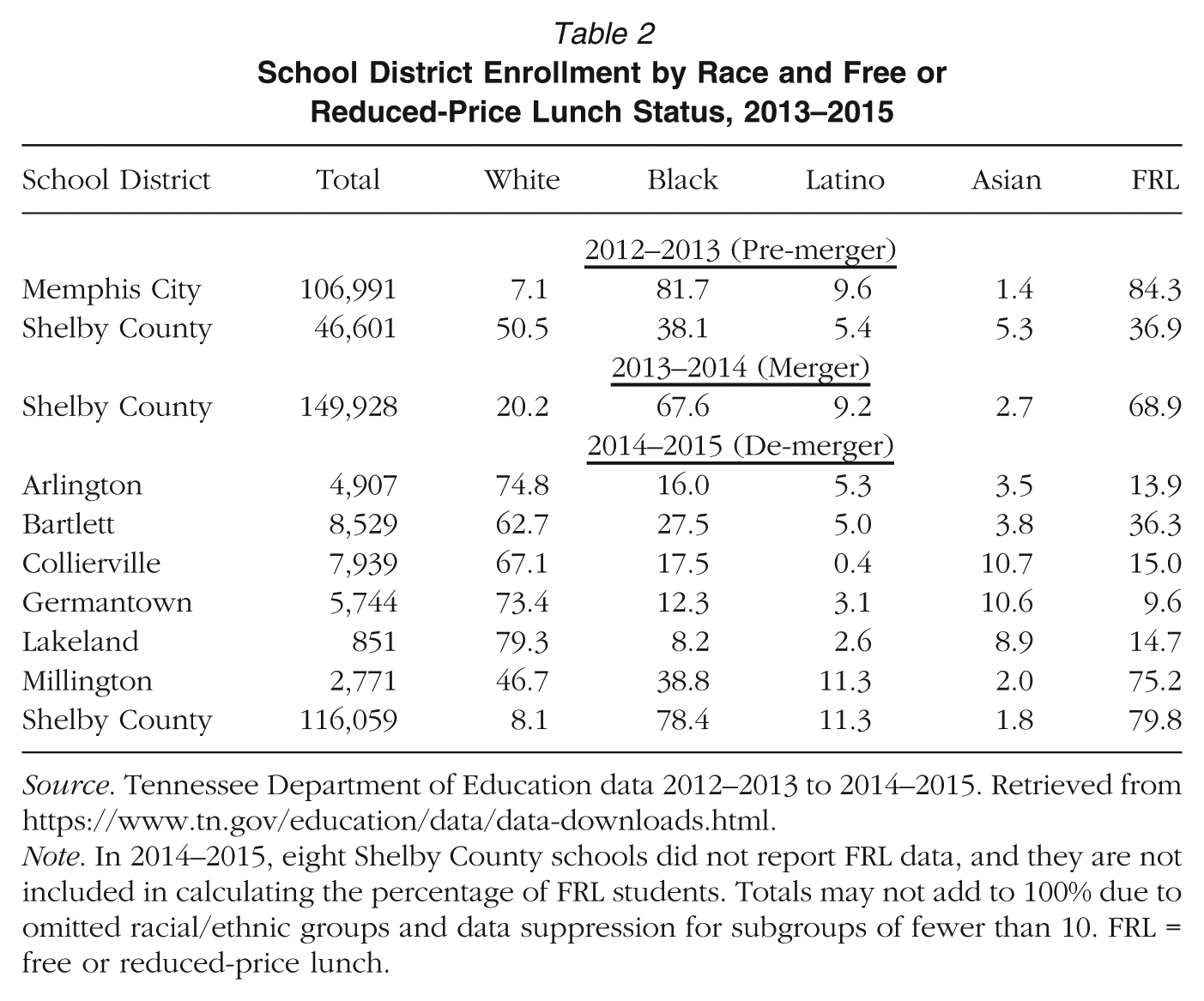
Source. Tennessee Department of Education data 2012–2013 to 2014–2015. Retrieved from https://www.tn.gov/education/data/data-downloads.html.
Note. In 2014–2015, eight Shelby County schools did not report FRL data, and they are not included in calculating the percentage of FRL students. Totals may not add to 100% due to omitted racial/ethnic groups and data suppression for subgroups of fewer than 10. FRL = free or reduced-price lunch.
Historical tensions surrounding urban and suburban boundary battles in Memphis-Shelby County are an important backdrop for the more contemporary struggle that began unfolding in 2010. Urban annexation played a major role in the politics surrounding the school district merger and de-merger processes. The city of Memphis grew as a result of numerous annexation efforts to address urban isolation and fiscal distress and to recapture a long-dwindling property tax base 5 (Raymond & Menifield, 2011). Yet, as Memphis annexed land, the city’s white population, along with their taxable revenue, often fled to nearby incorporated suburban municipalities, resulting in large population growth in the suburbs and increased minority isolation in the city (Diem et al., 2015; Raymond & Menifield, 2011). Participants in our study highlighted the confusion and fallout from the former county school system after each urban annexation process. As an organizer for municipal schools in Germantown explained, “When Memphis annexed, they would take the kids and the schools they happened to annex. . . . The county schools always had to scramble. Did they have students or did they have schools? They usually had one, but not both.” Annexations left the county district to deal with school capacity issues and reassignment near contested urban-suburban boundaries.
In 2005, stakeholders unsuccessfully sought to surrender MCS’s charter so that the city and county districts would become one. Three years later, city-county funding consolidation was proposed, but it was quickly rejected by SCS (Anderson, 2012). Many black residents stated that race was a factor in the failure of these consolidation efforts (Raymond & Menifield, 2011). Race was also considered—by some participants—to be a key reason for the 2014 secession of suburban towns from the merged Memphis and Shelby County school systems.
As part of the Tea Party-fueled wave, Tennessee Republicans gained control of the state legislature and the governorship in November 2010 for the first time since Reconstruction. Just 1 month later, in December 2010, the school district merger process began when a divided MCS School Board voted 5 to 4 to surrender its charter in order to address its financial status and, relatedly, ability to deliver educational quality (Anderson, 2012; Rushing, 2017). While five of the seven black school board members (there were also two white members) voted for the dissolution of the district, two voted against it. Kenneth Whalum, a black school board member who voted against the charter surrender, worried, as did other residents of Memphis, that Memphians would lose their power as a result of the merger, according to an interviewee. Whalum argued that the surrender of the charter meant the abandonment of Memphis children (Tri-State Defender, 2011). Yet, those who voted in favor of the merger stated the exact opposite: A consolidation meant that the county could no longer ignore the children in the city.
By relinquishing its charter, the Memphis School Board sought to stop SCS from being granted “special school district status” by the state legislature, which would have allowed SCS to accomplish its goal of freezing its boundaries indefinitely, thus cutting Memphis off from a tax base that funded both the city and county districts. Efforts to win special district status had been consistently thwarted by a 1982 statewide ban on the creation of special school districts—specifically designed to prevent Tennessee counties from drawing boundaries to impede or prevent school desegregation under the guise of local control (Kiel, 2011; Rushing, 2017). With the conservative shift of the Tennessee legislature in 2010, a renewed possibility of lifting the ban on special school districts was on the horizon.
The political response to the Memphis School Board’s vote to relinquish its charter was heated (Kiel, 2011). On March 8, 2011, the majority of Memphis voters approved the school district merger referendum, transferring administrative authority to the Shelby County Board of Education. Lawsuits ensued and suburban state representatives introduced legislation to terminate the merger, which was ultimately allowed by a federal judge to proceed in August 2011. The new city-county district began operating in July 2013. A Transition Planning Commission (TPC) was created to oversee the merger. It declared that, among the TPC’s many decisions, student assignment in the unified district would not be altered during its first 3 years of operation; students would still attend their neighborhood schools or have the ability to attend a school outside of their neighborhood pending space availability.
The seeds of the eventual de-merger were sown in the same bill that established the TPC. The legislature removed the statewide ban on the creation of special school districts and later allowed Shelby County’s municipalities to establish their own school systems. While only four of the municipalities sought to form separate districts in early 2012, Lakeland and Millington eventually joined the larger and more homogeneous suburban towns in seceding. Before the newly created merged district had opened its doors, the municipalities’ referendums passed with overwhelming support. Six new municipal school systems began enrolling students in August 2014, 1 year after the consolidation, leaving behind only the city of Memphis and unincorporated areas of Shelby County.
After the 2014 secession of the six suburban municipalities, what remained of the new SCS district served an overwhelmingly black (78.4%) and low-income (79.8%) student population. All of the new suburban school districts, with the exception of Millington, home to a naval base, were majority white (62% or higher) and minority low income (36% or lower) (see Table 2). The proliferation of new school district boundary lines, illustrated in Figure 1, thus had serious racial and socioeconomic consequences for Memphis area school systems, forestalling the possibility of future integration efforts (Frankenberg et al., 2017). 6
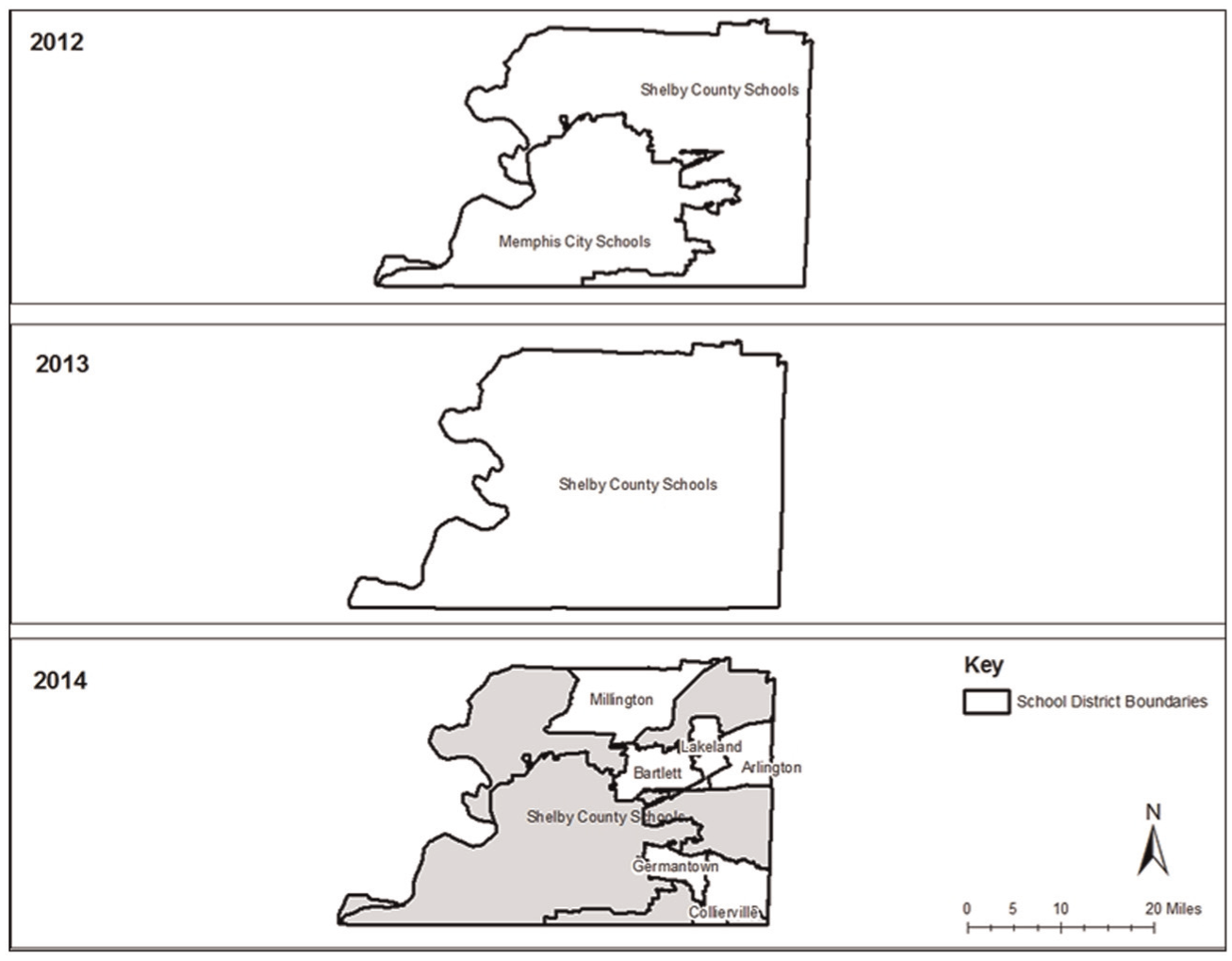
School district boundary lines, Shelby County, 2012–2014.
Findings
Every white political leader representing the new municipal districts mentioned local control of public schools as the central rationale for secession. In the words of one, “I think, most communities, their dream is to have control of their school system. . . . It’s a rallying cry you hear all over America.” A white mayor of one of the suburban municipalities concurred, saying, “I’m convinced that no matter where you go, people like local control.” To reinforce the point, a grassroots group called My Germantown Schools that organized to support the breakaway of one of the municipalities used the tagline “local control of public education.” These statements typified a white suburban perspective that saw local control of schools as a deeply desirable, almost unquestionable, ideal. It was imbued with powerfully resonant themes of close-knit relationships and communities, with children near the adults making decisions for them. For white suburbanites, the local control ideal also represented a colorblind way to discuss issues that the demographics of the new districts suggested were racially and economically patterned. And though black study participants were more likely than their white counterparts to point to racial and economic differences between the city and suburban school systems as key drivers of secession, nearly all parties agreed that a desire to maintain and build relative educational and community advantage animated the battle for control of the schools.
Local Control as a Means to Preserve and Accumulate Relative Advantage
Suburban stakeholders saw secession as a means of preserving and accumulating resources, broadly defined, for their individual children and communities. They did not hesitate to acknowledge that secession may contribute to inequality when the interests of “their” children won out over the interests of all children. Said one white suburban leader, I certainly, selfishly, want Bartlett schools, whoever’s running them, to have the very best opportunity for our children. I want Memphis children to have a good education, but I’m elected to make sure [my] 57,000 people have a high quality of life. So that’s my primary responsibility.
This perspective crystallizes the shift toward thinking about education as a relative advantage, or a competitive benefit, rather than a collective good—and played out across the various positive attributes linked to local control.
Small Size, Accountability, and Close-knit Communities as Relative Advantages
Suburban stakeholders equated local control of schools with smaller school districts, which, in turn, they considered more economically efficient. A white suburban mayor explained, Bigger is harder to manage, and manage costs. You get savings based on scale up to a point and then it starts trending the other way . . . so local control is keeping the cost down, having the ability to keep the costs and expectations both reasonable.
There was a sense that smaller school districts meant fewer layers of bureaucracy, prompting comparisons to the consolidated district. As one white municipal suburban stakeholder explained, “We [the municipalities] all had the same vision . . . to leave with that bureaucracy off our shoulders.”
We found similar statements regarding the importance of small districts and manageable bureaucracies in the feasibility reports commissioned by the suburban municipalities. A consulting group that worked with the seceding municipalities,
7
called Southern Education Strategies, noted in their 2012 report to Germantown, Clearly, educational excellence is central to our democratic form of government and can lead to prosperity and opportunity. Proponents of local governance, especially through smaller district organization, believe that education is enhanced through a reduction in the bureaucracy associated with larger districts. A smaller district makes it easier to consider the unique needs of local students especially as related to the curriculum that is offered. (p. 3)
Still, suburbanites’ emphasis on bureaucracy reduction related to each of their individual systems—ignoring the explosion of bureaucracy across the county. Secession created six additional central offices and associated personnel, causing one black, urban interviewee to remark that the perception around administration in MCS was always that we were paying [administrators] too much and it was just top heavy. We had two superintendents in the whole county; now we have about seven, don’t we? Who’s top heavy now? You see what I’m saying? But it’s not an important issue anymore. It was just when [MCS] was doing it.
Connected to the issues of smaller size and reduced bureaucracy was the belief that local control enabled municipal residents to hold school officials more accountable, reflecting the increasing articulation of education as an individual good. Said one white suburban policymaker, “The smaller you are, the more accountable you can be held by your community.” The accessibility that local control offered yielded a sense that school officials would be more attuned to the needs of their constituents. In the minds of white suburban stakeholders, local control and the accountability with which it was associated created a new, higher standard for schools to be judged by, which some claimed was already benefiting the schooling experience during the 1st year of operation for the six municipal systems. A white suburban board member explained that fewer schools meant that “all eyes in this community were focused on you, so your level of accountability went through the roof. . . . I mean, you see immediate differences from that.”
Suburban respondents additionally emphasized the advantages of tightly knit community when discussing local control. For instance, participants spoke of knowing and approaching school and district leaders while out and about in a municipality. According to a white TPC member, People want to be able to go directly to their school principal; they want to feel comfortable going to the principal. They want to feel comfortable going to see the teacher. They want to be able to reach out to their school board members. They go to church with them. They go out to the cafeteria and have Sunday dinner with them. They’re in the community with them. There’s that familiarity and that closeness that comes with it.
A white school board member in one of the new municipal districts said that town residents appreciated that they could call board members whenever they liked, emphasizing the responsiveness that smaller size—through their exercise of local control—permitted. A white suburban superintendent seconded these feelings of connectivity, saying, “I know every one of my principals. We meet monthly. They pick the phone up and can walk down to this office and get in front of the superintendent.” Close connections seemed especially easy to foster in the smaller suburban districts that had just a handful of schools.
Real Estate and Economic Development as Relative Advantages
Several white suburban interviewees cited the reciprocal relationship between schools and housing as a resource consideration—and ultimately, advantage—in the secession. For some, this meant that the municipal districts would attract new students, economic development, and homebuyers, while for others it meant that home values would increase—thereby justifying any temporary raise in taxes needed to fund their new school district. The school-housing relationship was also defined by colorblind comparisons to the former two-system dichotomy. Prior annexation processes created perceptions about what came with the power transfer from SCS to MCS. As the white mayor of one of the smaller municipalities stated, If you look at a lot of the areas where Memphis had annexed, they were nice, newer county schools that were built and then the city would come in, and within a matter of 5 years, just the problems associated with some of them. . . . You’d see schools deteriorate, not necessarily just crumbling walls or just going from an A to an F, but you would see this steady decline start to come, so people would start moving out. And as that happened, home values would start dropping; then everybody started moving.
The school-housing cycle that white suburbanites associated with previous shifts from county to city territory was one of gradual decline and increasing white avoidance, all of which amplified their desire for secession.
Alongside those negative perceptions, white suburban municipal leaders spoke affirmatively about the relationship between the establishment of the new districts and an uptick in enrollment from students who previously attended private or home schools. One white interviewee commented that one of the suburban mayors saw “local control of schools as really being a catalyst to revitalizing their community.” A white member of the TPC offered, “It’s the pride of smaller communities with their own school districts. It’s economic development for them.”
In Germantown, the school-housing connection played out in the heated battle for control of its three namesake schools. Shelby County refused to hand over the three Germantown schools after the secession because Germantown would not agree to educate the large numbers of students enrolled in them from unincorporated areas. Germantown stakeholders pointed to the confusion that realtors dealt with in explaining to new residents that the Germantown-named schools were not part of the new municipal district. The “loss” of Germantown elementary, middle, and high schools, which Germantown is still trying to acquire, was consistently described in terms of property rights of Germantown residents, without recognition of the fact that the cost of constructing those schools was supported by the entire county district. These sentiments dovetail with prior research on secession in suburban Utah, which found that leaders were apt to tout local control of communities as a way to recruit residents and tax dollars (Buendía & Humbert-Fisk, 2015). Thus, local control was also a means to preserve or expand the wealth of the community’s homeowners (Frankenberg, 2009).
Feelings around the positive relationship between the creation of new municipal districts and growth were on display in interviews with other suburban leaders. In response to the question, “Where do you see the community in 5 years?” one white suburban leader explained,
We had a lot of houses that were bought up by investors out of New York and California that were just investment groups. They were buying a lot of our houses for rentals, you know, as investment properties.
Because they saw the demand coming with the new school district?
Well, probably, maybe, maybe. I guess they were counting on that, and there’s a company that’s still doing it, and it clearly is counting on that.
In response to the same question, another white suburban leader said that in the aftermath of secession, development had exploded in some of the smaller municipal districts. He noted that, “[Municipal schools] helps the town, you know; people are tied to property values and economic growth and, I just have to say, a good school. I moved out here for the schools.”
However, this suburban leader went on to lament the artificial divisions created by local control, acknowledging that increasingly narrow self-interest and competition got in the way of cooperating with the small, neighboring municipal district. He continued, Lakeland . . . they’re already talking about they want more control of their own moor; everybody now wants—I hate to say now the greed kind of gets in to where everybody was working together. . . . They’re our next door neighbors; there’s an imaginary line that divides us, but everybody wants their own control of the moor.
8
The comment underscores the sense of competition that local control fostered among suburban municipalities.
Funding and Student Enrollment as Relative Advantages
Secession and local control also meant the fulfillment of a longstanding suburban desire to contribute more money to local schools, a desire previously thwarted by the countywide district. A white suburban municipal leader explained, “As a county district, [we] couldn’t just say, we want to give, for the students of Bartlett, we want to add, you know, we want to pay the equivalent of $200 per student more to help out.” A white Germantown stakeholder cited similar concerns, State law said that if the city of Germantown gave money to the SCS with the idea that it was going to be in our schools in Germantown, it had to go into a pool and it could be spent any place in the district— which, for us, we said, we’re not happy with that.
Though the leader went on to say that, prior to secession, the community used Parent–Teacher Association resources and in-kind contributions from the municipality to supplement funding, she felt strongly that local control of the new Germantown district gave residents the option to spend as much money as they wanted on their locally controlled schools. In her words, This becomes very local in that we can decide in [this municipality] if we want to put more money into our schools. Or we can decide not to. But it’s a community decision. . . . We live in these communities because we want to have choices.
In the aftermath of suburban secession, competition for students—and the funding that goes with them—became an additional way in which schools and children were described as relative advantages. As one white suburban municipal leader noted, We will still prosper because . . . it’s expensive for Shelby County to transport everybody out there because they have to go through municipalities; some of these [county schools] have become like islands out here. So, I have a feeling those schools are going to deteriorate. People will start leaving. They’ll come to us or [another municipal district] through stuff like open enrollment.
Open enrollment, whereby students living outside a municipal district were allowed to attend school within it, was discussed as a way for the new systems to stay afloat financially—and as a way to further their standing as high-performing districts.
Restrictions on students participating in open enrollment abounded even as virtually all of the new suburban districts offered the promise of it. Each of the municipal leaders we spoke with mentioned academic thresholds and attendance and behavioral standards, “so you have good kids who show up for school. Who doesn’t want those kids in your system?” In other words, the new suburban districts were seeking only students who would preserve or increase their status relative to other districts. That framing failed to account for the further concentration of less academically or behaviorally thriving children in the exited school or system.
At the same time, open enrollment guarantees can initially make secession appear less segregative. And, in the case of several districts, open enrollment also helped with capacity concerns. Arlington, for example, was fortunate to obtain school buildings that were large and recently built by the county, but which were not filled when unincorporated students were rezoned to SCS. The new Arlington school system thus had a good deal of space for out-of-district students. By contrast, the highly affluent Germantown school system had closed off open enrollment by 2015. In all cases, open enrollment promises relied on capacity and the school district’s assessment of students who sought to attend. District boundary lines were selectively permeable when crossing them benefited the suburban districts.
Push for Local Control Driven by Suburban Resentment and Racial Fear of Memphis
Accompanying the affirmative rationale for asserting local control was simmering suburban resentment and fear of what a merger with Memphis schools represented. As one white suburban mayor said, “They [Memphis] weren’t giving up anything. What they were doing was accessing a larger pool of resources. And a growing tax base.” The resentment and fear related to resources, political power, and increased interracial contact.
Suburbs Resented Perceived Loss of Resources
On the one hand, as we saw above, suburban leaders sought to contribute additional resources to their newly formed schools. A white Germantown school leader spoke, for instance, of wanting to go out . . . bring strings to the elementary schools and we want to bring, you know, we want to bring back SAT and ACT prep in the high school. And we want to do the things that we haven’t been able to do for a really long time.
On the other hand, as the word back suggests in the preceding quotation, those same leaders saw secession as a means to reassert control over a perceived—and resented—loss of resources. Prompted by the follow-up question, “Why couldn’t Germantown do those things before?” the same interviewee responded, “Because they were all taken away.”
We heard a similar refrain around a perceived diminishment of county resources post-merger from a number of additional interviewees. These participants pointed to the forfeiture of aides and secretarial positions, as well as an increase in class sizes. Said one white suburban leader, A contributing factor to the success of the Shelby County Schools . . . we went for smaller class size. And I can’t remember the exact numbers, but in Shelby County Schools, at all levels, we had no more and usually less numbers of students [than what was required by the state] per teacher. . . . Memphis . . . they actually ran much larger classes and sometimes exceeded the state; I don’t know how much or how often. . . . So what happened during the merger year, to come up with money, they upsized classes.
We were unable to substantiate larger class sizes from our interviews, but other stakeholders did speak of an effort to equalize educational opportunity across the merged district. One black suburban stakeholder said, I am confident beyond a reasonable doubt that all boats would have risen had the instructional plan been used. I’ll give you one example and I’m using these figures arbitrarily. There’s probably 20-25 [advanced] courses at White Station, Germantown, and the county had a large number [too]. [But] there was a school in the very southwest point—I was told they had 1 [advanced] course, so if our plan had been implemented, we envisioned all schools having access to all [advanced] courses. You know how we were going to do it? Through a distance learning model.
The statement above validates suburban awareness of attempts to distribute access to resources like advanced placement (AP) courses more evenly after the merger, but it does not suggest that the suburban schools that provided high numbers of AP courses would have lost out. Distance learning would have meant that more students could opt in. It also was true that, during the merger, some staff positions were eliminated in the name of fiscal efficiency—though this was one of the ideals that our suburban interviewees linked to local control. Suburban perceptions of a zero-sum game—and education defined exclusively as an individual benefit—during the merger process contributed to talking about secession as a rational decision to withdraw and protect their own resources.
Suburbs Resented Perceived Loss of Political Power
In addition to concerns over the loss of resources, some of the suburban resistance to the merger related to fear of the loss of political power. One white member of the TPC told us that since Memphis was the much larger school district, they would have more representation on the school board and thus a stronger voice when it came to policy decisions. The TPC member said, “They [residents of suburban municipalities] were afraid of the [consolidated] school board because they knew that the city of Memphis would have more members on it.” Another white suburban interviewee echoed these concerns about a merged district, stating, “What kind of representation will you get for your community and how influential will that be in the decisions made that affect the schools in your community? And it gets even more diluted.” In reality, by dint of state legislation crafted with heightened suburban political power, the TPC contained more county and state representatives than Memphis city ones to monitor the merger. The county representation on the TPC showed just how little control the city would have when it came to the implementation of the merger, illustrating unfounded suburban perceptions about their loss of control in a merged district (Anderson, 2012). 9
Still, it is important to acknowledge that the urban-suburban battle for political power had complex historical roots. Shelby County stakeholders had engaged in a long-lasting effort to halt urban annexations (Raymond & Menifield, 2011), as well as the broader threat of the city school system relinquishing control altogether to merge with the county. White suburban study participants spoke of efforts to “freeze the boundaries so that annexation would not happen any longer” as well as becoming their own special school district so “they would never have to worry about [consolidation].” In 2011, when consolidation did happen, the suburban reaction was visceral. In the words of one white suburban political leader, It was not a welcome merger, takeover, and because I’m sure you’ll hear these words: hostile takeover, because Shelby County Schools did not want to be merged. And so it was an acquisition. And so, I guess that was the lay of the land.
Given these sentiments, one could argue that the push for local educational control in the suburbs was a push to regain control over what was increasingly an attempt to define the “public” in public education much more narrowly in order to retain relative advantage after the merger (Weiher, 1991).
Indeed, residents of Germantown, one of the wealthier and whiter municipalities, saw the merger and subsequent secession as a battle for their choices as an individual community. According to one white municipal leader, “It’s like we were being dumped on, all over again.”
All over again from . . . when was the last time?
Well, I mean, it’s, number one, we didn’t get to vote. Number two, you know, we’re the ones that have the resources and therefore we have to bail the city out. We’re always having to bail the city out. So it’s just like, here we go again. But we love the city. I mean, if it wasn’t for the city, we would not be here. I mean, Memphis is a gem.
This comment illustrates how this Germantown leader argued that their community had to unfairly “save” Memphis schools even as she acknowledged ways in which Germantown residents benefit from the city.
Suburban fear of depleted political power also contained racial overtones. Memphis is a majority-minority metropolitan area, as a white TPC member noted: In a place like Louisville [Kentucky], if you’re the community in power, the white community, assuming at the end of the day people only vote for white interests or black interests, which I think is obviously not true, but the way this thing gets discussed, the white community wins. Here, it’s flipped.
He went on to highlight raw suburban fear of Memphis: “The quote the next day or within a day from [the merger vote]—a state rep, I think—was, ‘We’ve got to do everything we can to save or protect these [suburban] kids.’” Similarly, a white stakeholder, Mr. Clayton, age 79, observed in an interview with The New York Times (Dillon, 2011), “There’s the same element of fear. In the 1970s, it was a physical, personal fear. Today the fear is about the academic decline of the Shelby schools.” One of the plaintiffs in the federal court case related to the merger, one of the myriad routes of suburban resistance to it, further commented, There’s an awful lot of people in suburban Shelby County that were just scared to death of that because they say, hey, we moved outside of the city of Memphis; we wanted to be able to have our autonomy, our own control.
Participants did highlight inconsistencies regarding the autonomy aspect of local control, however. As one black board member of the unified SCS said with a chuckle, How can you have local control when Nashville dictates what you do? . . . They do have local control because their [suburban] political base controls everything in the state. So, I guess they do have local control because they can talk to their legislators and they can make it happen. They can get what they want.
Another participant, a black resident of the suburbs and former MCS employee, highlighted the connection of the suburban desire for local control to earlier desegregation-era rhetoric around states’ rights. She offered, “It’s the same argument that the folks who argue about states’ rights make. However, the interesting thing about those people that make that local control argument is that they went immediately to the state legislature to get what they wanted.” Implicit in these statements is the way in which local control was available to suburban municipalities with strong access to state legislators, legal counsel, and lobbyists but perhaps not as available to those in other parts of the county. Indeed, some respondents from Memphis noted that it was impossible for them to fully rely on local control because of the lack of resources for their schools 10 —therefore, it was a reality that they could not even consider. The privilege of asserting local control went unacknowledged by suburban stakeholders we interviewed, even as they talked about local control as an important benefit to living in the suburbs.
The Explicit Role of Race in the Midst of Colorblindness
Though race and racism were implicit issues throughout our interviews, many participants explicitly acknowledged both as part of the conversation. For instance, some white suburban political leaders took great pains to assure us that the secession was not motivated by a desire for racial separation even as they said that other suburbanites felt differently. A white leader of a suburban community told us that while she believed that “local control and the belief that smaller works better” were the community’s reasons for wanting its own district, “I would be not telling the whole story if I did not indicate that, yes, we had people in this community who wanted separate schools for all the wrong reasons. They were not a huge number. They were vocal.”
Still, in using the colorblind language of local control, many white suburban participants ignored the racial and economic consequences of carving out smaller municipal districts. A black suburban resident, and former MCS employee, focused squarely on the omission: Local control means exactly what they’re saying, that people who look like me get to run the school district for the kids who belong to us. And so whether you parse that down and look at it in terms of race or income or education level or whatever it is, it is this idea that I want the folks who look like me and who live near me to make decisions about where our kids go to school. And the reality is that Memphis is largely black and largely poor.
As we saw above, the creation of separate districts helped cement the inability to redistribute resources for the good of the larger community while spatially concentrating low-income and black residents, which had both direct and indirect ways of exacerbating inequality (Wilson, 2016).
Other suburban stakeholders believed race to be a central factor in the breakaway. One black suburban school leader thought “the underlying tension” about the merger had everything to do with race. He said, I think, at the end of the day, there’s a fundamental fear that those kids were going to come out here en masse with our kids. . . . But then people would be quick to say, “Well, no, it’s not about that. Because we have black folks out here, too, in the suburbs.” But if all of those kids are poor black kids, then you can’t ignore the fact that race is at least a latent issue.
He further noted that “zealots” in the comments section of the newspaper would refer to the city schools as the “Memphrica Public Schools,” combining Memphis and Africa.
The stigmatization of schools with children from Memphis reminded one of our black interviewees of the initial days of desegregation in Memphis. She said, It’s the same thing that in the ‘70s, when desegregation was taking place, there was this proliferation of private schools, parochial schools here in Shelby County, within the broader Shelby County. And people moving outside of the city of Memphis so that their kids didn’t have to sit by those kids. It’s the same thing.
This participant drew explicit connections between past and present attempts to thwart efforts to redistribute resources or children.
On the whole, black suburban and urban study participants were more likely than white participants from the suburban municipalities to indicate that race and class were overt drivers of the secession. A former black Memphis leader regretfully told us that a de-merger was almost inevitable as “there was never interest in” having that sustained, collective conversation about a system to reach every child. One white observer from the city noted, If you ask anybody if [the de-merger] has to do with race, in the city they are going to say yes and in the county they are going to say no. . . . A statement like, I don’t want the people who run the Memphis City Schools to be running my schools isn’t the same as I don’t want black people running my schools, but it is the same. I don’t want the kids in the Memphis City Schools because they are a different kind of student, well that’s not saying the Memphis city students are black, but it is saying that, right?
The incongruities between perceptions of the racial underpinnings of the de-merger reinforced the boundaries created to divide students in Memphis and her surrounding, largely black unincorporated areas from students in the suburban municipalities.
Discussion
To justify the explosion of multiple, small school districts just 1 year after the creation of a single, unified urban-suburban one, Memphis-area municipalities latched onto the ideology of local control. Given suburban powerlessness to prevent prior urban annexations and, ultimately, school district consolidation, local control via secession was offered as a response to a perceived lack of control. However, the suburban motivation for secession went beyond resentment. It also embraced a powerfully appealing vision of fostering relative success in small, efficient, accountable, and well-resourced school districts. In the aftermath of the Great Recession, and in the midst of anti-government sentiment that helped give rise to the Tea Party wave, suburban leaders pointed to local control as a way of cementing the relationships between strong economic development, controlled and responsive bureaucracy, quality school systems, and robust housing prices—all in a race-neutral manner. Local control, in short, became a favorable way to discuss the preservation and accumulation of resource advantages that mapped onto existing racial cleavages.
Secession in the Memphis area meant that urban concerns over unequal resources—the impetus for the merger—were subsumed under the guise of establishing the suburbs’ right to local control. This colorblind reframing is reminiscent of the anti-busing rhetoric surrounding Nixon’s “southern strategy.” That rhetoric focused attention on white families’ rights to choose schools and neighbors versus black students’ rights to equal educational opportunity (Delmont, 2016). Indeed, some stakeholders in Memphis drew comparisons to earlier resistance to desegregation as they reflected on the language and ideology animating the de-merger. Given the dogged suburban pursuit of secession in the state legislature and in the courts, did local control mask what was really an effort to secure separation through whichever level or branch of government was most amenable (MacLean, 2017)?
By using colorblind language that reconceptualized the public in “public school” by focusing on defining local community at the municipal rather than county level, suburbanites effectively created exclusionary school systems. The new municipal districts were largely unavailable to low-income residents of color in Shelby County who faced a very different set of choices from affluent white residents about where they lived and what types of public services and resources were provided. Those choices were constricted in large part because wealth accumulation and racial segregation are deeply related (Rothstein, 2017; Shapiro, 2017).
Prior research, as well as early evidence from Memphis itself, tells us that the proliferation of new school district boundaries sharply exacerbates school and residential segregation (Bischoff, 2008; Frankenberg, 2009; Frankenberg et al., 2017). Even with these realities, most municipal leaders in Shelby County were quick to either attribute racial motivations for secession to a small minority of constituents not reflective of their community or, more typically, offer the race-neutral justification of local control. Glossing over the serious racial and economic implications of school district secession occurred despite the fact that the de-merger process had to overcome a legislative ban designed to prevent Tennessee counties from drawing district boundaries to impede school desegregation. The removal of that legislative barrier has opened the door for secession across the state. As other suburban communities in Tennessee consider secession, advice from Shelby County political leaders suggests that they were aware of the need to combat perceptions of racial and economic exclusion. Use open enrollment to avoid the perception of “walling yourselves off,” they told recent fact-finders from a wealthy suburban community near Chattanooga, and “control your message. . . . If you lose your message, it will kill you” (Bauman, 2017). That message, Shelby County speakers implied, should be local control.
The ascension of colorblind law and policymaking in the years since the civil rights era provides a backdrop for the reemergence of local control as an embodiment of core American values. This framework requires an ahistorical view of our long and troubled history of racial discrimination. As Justice Sotomayor stated in her dissent in the U.S. Supreme Court’s decision to uphold Michigan’s affirmative action ban, “The way to stop discrimination on the basis of race is to speak openly and candidly on the subject of race, and to apply the Constitution with eyes open to the unfortunate effects of centuries of racial discrimination” (Schuette v. Coalition to Defend Affirmative Action, 2014). She was responding to Chief Justice John Roberts, whose 2007 statement in the Parents Involved in Community Schools v. Seattle School District No. 1 (2007) ruling, “the way to stop discriminating on the basis of race is to stop discriminating on the basis of race,” represents a legal apex of sorts for colorblindness in the federal courts.
Colorblindness notwithstanding, the accumulation of prior discriminatory policies against people of color has created an uneven playing field when it comes to educational opportunity. The current focus on colorblind education policies such as school choice, standards, and accountability will continue to be unsuccessful in addressing racial inequalities so long as it ignores the larger, historical reasons why these inequalities persist (López, 2006; Wells, 2014). In other words, a race-neutral agenda simply perpetuates racial inequities (Bonilla-Silva, 2014)—particularly when it is enacted with a deep focus on individual (or a circumscribed understanding of “public”) rather than collective educational benefits.
The growing perception of education as a relative benefit to a local community is one of the key differences between the two eras that have given rise to local control as a means of preserving racial and/or resource advantage. The Brown decision laid out broad societal goals for public education, including its fundamental importance for democracy and citizenship (Brown v. Board of Education, 1954). Even as local control became part of the resistance to Brown’s desegregation decree, the decision’s detractors did not dispute those general educational goals. Today, a sharply constricted vision of the purpose of education has rationalized the pursuit and accumulation of advantage through local control. The contemporary strength of local control thus is related to both an increasing acceptance of colorblindness—by the courts and by society—and a competitive, individualistic framing of public education.
Another distinguishing feature of the contemporary era is the intensity of economic inequality. Resistance to Brown, as massive as it was, came during a period of widely shared and expanding prosperity for whites. Economic anxiety now flows easily across racial and geographic lines (Florida, 2017; Reeves, 2017). Indeed, the explosive growth of suburban poverty in the past decade and a half likely heightened the Memphis area competition for resources, helping redefine local to mean the smaller municipal communities rather than the broader Shelby County landscape. Though history suggests that it is difficult to protect and expand civil rights during periods of deep economic inequality (Rothstein, 2017), the dangers of not confronting the growing wave of secessions—and the colorblind, individualistic ideology that lies beneath them—are all too real. Without careful attention to their racial and economic impact on more broadly defined local communities, already alarming segregation in our public schools will only intensify.
Recommendations for Research and Policy
The secession of suburban municipalities in the Memphis area raises important areas of further research. Exploring how the political process around the de-merger evolved in Memphis-Shelby County is obviously connected to how the merger came about. More research is needed to understand the motivations and implications of that initial merger. Did some in the community view it with hope and possibility? How did members of the TPC envision the merger playing out? Future qualitative research should also more fully engage the parental and urban perspective, seeking to understand how families and residents of the city, as well as teachers and principals in the former MCS and current unified SCS, viewed the merger and de-merger. We further need a stronger understanding of the racial, economic, and opportunity implications of the merger and de-merger over a longer time period.
Research should explore the policies and practices taking root in what remains of the merged school system, along with the role of policy actors in achieving the de-merger. Understanding how local suburban actors worked the machinery of government at all levels to advance an agenda that ultimately fractured a two-school system county into seven distinct systems—in spite of the Memphis board’s initial effort to become one—offers crucial insight into the contemporary state of urban-suburban politics and the interplay between local, state, and federal government.
Then there is the question of whether or not the six, smaller suburban school systems will be able to survive—in terms of both financial costs and student enrollment. Will some of the smaller municipalities be forced to share numerous services or consolidate altogether? It will also be important to monitor and analyze whether other municipalities in the state—and elsewhere—follow the secessionist example of the Shelby County suburbs.
More broadly, given the racial and economic consequences of school district fragmentation, strong policy incentives for consolidation or cooperation are sorely needed. So, too, are policies and practices that confront the underlying framework of local control to better illustrate how it can exacerbate inequality. Though the current political environment is daunting, stakeholders concerned with the expansion rather than constriction of equal educational opportunity should consider the following framing and policies to help shift politics in local communities.
Reemphasizing Education as a Societal Benefit
To confront a central tenet of the local control framework, educational stakeholders must begin to reemphasize education as a societal benefit for the broader community. In other words, communities must come to see diverse public schools as essential to participatory democracy and a high-quality workforce (McDermott, 1999a). Conversations about schools and resources can then include a focus on how to best serve all children rather than how to advantage a select few. Relatedly, we must work to create an affirmative understanding of the benefits of school diversity—including the benefits for isolated white families—rather than the harms of segregation (Wells, 2014). The Every Student Succeeds Act (ESSA), for instance, represents an opportunity to retool the accountability framework to include school diversity and other broader goals.
Openly Confronting a History of Segregation and Discrimination
Our fieldwork illustrated the lack of cross-racial trust or understanding that flowed from decades of separation in the Memphis area. It was hard to work together amid the fear and “othering” (powell & Menendian, 2016). Because there was no multiracial, urban-suburban political coalition with shared goals or understanding, the TPC’s work never had a chance. Communities and schools have a central role to play in honestly confronting the history of racial discrimination through educational curricula and community programming that allows people to see race and racial segregation as central drivers and inhibitors of opportunity. For example, Rothstein’s (2017) powerful examination of how governmental policy created today’s “de facto” segregation noted that none of our high school textbooks talk about government-backed discrimination.
Cross-Sector Collaboration and New Political Coalitions
Suburban stakeholders saw the creation of separate districts as a means for community economic development, which, in turn, would improve their own wealth through increased housing demand and prices. Given the reciprocal relationship between school and housing segregation, inclusionary zoning policies and/or fair share affordable housing initiatives on a regional scale are critical. This would provide at least some lower- to middle-class families access to exclusive communities—and their schools—and help offset the ways in which secession confers advantage upon those who already have it.
Given the current political context and its hyper commitment to education as an individual benefit, stakeholders will need to reach across sectors—for example, education, housing, public health—to find and work with those committed to the collective good. We need new political coalitions more generally—ones that recognize that many of the challenges of the city are now the challenges of the suburbs and that only small, privileged swaths of metropolitan communities are benefiting under the current paradigm (Orfield, 2002).
Diversity Impact Assessments
In Memphis and elsewhere, suburban proponents of secession are generally not required to provide an assessment of its broader influences: Only 6 of the 30 states that have laws around dividing up school districts require attention to the impact that secession would have on racial and socioeconomic diversity and opportunity (EdBuild, 2017). Wilson (2016) argued that state legislatures, through their authority to establish rules for secession, must consider how secession would impact the quality of the communities formed, particularly racial and socioeconomic demographics. States could also require a diversity impact statement before approval of new districts, similar to the idea that the federal government should consider the integration effect of any new education policy (Siegel-Hawley, 2016). With the Supreme Court’s recent decision sustaining the disparate impact standard in housing integration efforts (see Texas Department of Housing and Community Affairs v. Inclusive Communities Project, Inc., 2015), the Office of Civil Rights in the U.S. Department of Education could also investigate complaints that proposed district secessions would violate students’ civil rights.
Regional Educational Equity Initiatives
Constructive leadership from state and federal governments on region-wide equity initiatives is also important. Higher levels of government are best positioned to help overcome the narrow interests of local communities (McDermott, 1999a). At the federal level, two Obama-era federal initiatives, “Stronger Together” and “Opening Doors, Expanding Opportunities,” offered competitive planning and implementation dollars to communities interested in voluntarily promoting integration, either within or across district boundary lines. Though neither was funded in the current political environment, both represent the kind of future leadership needed to promote regional integration efforts.
At the state level, New York has demonstrated significant interest in incorporating school diversity into several provisions of its ESSA plan, both as part of its accountability metrics and as a turnaround option for struggling, high poverty schools. The ESSA initiatives in New York build on prior state efforts that used federal School Improvement Grants to diversify struggling schools. In the Midwest, Nebraska’s state legislature crafted a regional governance system, called the Learning Community, to address racial and economic isolation across two Omaha area counties. The legislature established a common levy on property across the 11 districts in the two-county system. That levy was then redistributed based on the state funding formula. Wealthier districts were allowed to preserve some of the advantages of their local property tax wealth by setting a levy above the one established by the Learning Community (Holme & Diem, 2015). The regional agreement also included an inter-district student transfer plan that sought to foster diversity within all of the districts’ schools.
If more ambitious educational equity efforts are out of reach, at a minimum, more protections should be built into existing open enrollment policies (Holme & Wells, 2008). This would include the provision of free transportation, the presence of diversity goals, easy to access information and strong outreach, and enrollment policy based on student and family rather than district interest (Orfield & Frankenberg, 2013; Siegel-Hawley, 2016).
Conclusion
Our exploration of the largest American school district consolidation in recent history and its subsequent breakdown suggests that colorblind resistance to the redistribution of opportunities and resources has resurfaced in a 21st-century form of local control. The new version of local control continues to conceal its racial and economic impacts, this time beneath an affirmative vision of promoting relative advantage in close-knit communities and school districts. Local control’s reemergence so many decades removed from its similar use as a framework to resist Brown makes it easy to ignore or dismiss those historical roots, and its contemporary rise has been accompanied by a strengthening preoccupation with colorblindness and competition in education. Opening up an honest dialogue about the negative racial and economic implications of suburban school district secession, including the long-term educational consequences for students and communities, will require us to lift the veil of colorblindness that has become so pervasive in our society. It will also require us to find a new understanding of the collective goals of education. Taking action to redress the harms of suburban secession will almost certainly require race-conscious law and policymaking toward the collective good. In a country that is rapidly growing more diverse and more stratified, we ignore the harmful consequences of creating newly segregated schools and communities at our peril.
Footnotes
Notes
G
S
E