



Abstract
In this study, I investigated how student publications portrayed whiteness as the dominant feature of the campus environment between 1945 and 1965 among the member institutions of a consortium of elite U.S. Midwestern liberal arts colleges located in rural and industrial towns across Indiana, Michigan, Ohio, and western Pennsylvania. These colleges’ yearbooks and student newspapers informed this analysis of whiteness as property. Through these findings, I demonstrate the ways in which White student publications recorded whiteness as property, entitling White students to the use and enjoyment of their college years. The invisibility of Black students’ structural exclusion rendered whiteness unmarked and offers a new model for understanding and analyzing desegregation and integration in historically White institutions.
Higher education scholarship needs to include a more nuanced and critical conversation about the so-called golden age (Thelin, 2011) of postsecondary education in the United States. Scholars generally have regarded the period between 1945 and 1965 as positive for U.S. higher education: Student enrollments ballooned, fueled in large measure by the entrance of several new student populations, representing greater social class, gender, and racial diversity within and among U.S. colleges and universities (Gumport, Iannozzi, Shaman, & Zemsky, 1997; Thelin, 2011). However, such rhetoric fails to situate this postsecondary growth within the capitalist and White supremacist history of the United States advanced by settler colonialism and Indigenous genocide 1 (Kendi, 2016; Tuck & Yang, 2012; Wilder, 2013). In this article, I offer a critical-realist historiography of the interaction between whiteness, student publications, and (de)segregation to challenge popular notions of northern U.S. racial benevolence. In this retelling, I revisit and revise the interaction of theory and educational history by blending historiography with a critical-realist theoretical framework. By doing so, I was better able to identify and analyze the role of whiteness in college student publications and offer a more nuanced model of segregation, desegregation, and integration in postsecondary educational institutions.
Dubious Progress
The institutional and legislative efforts that resulted in U.S. higher education’s mid-20th century advances, heralded as progressive and populist, were not focused on equity and justice (Alridge, 2007). Educational opportunity for Black people was sparse and persisted in the North, where private schooling supported by missionary and philanthropic societies could not accommodate the demand by Black families (Franklin, 1979; Harding, 1981; Waite, 2001). In addition, lauded legislative achievements, such as the “GI Bill,” actually had far more muted benefits for Black veterans than they did for White veterans (Katznelson & Mettler, 2008; Onkst, 1998; Serow, 2004; Turner & Bound, 2003). In general, higher education’s enrollment boom did not necessarily result in equitable or consistent diversification of the student body within or across institutions. For most of the period following the Civil War and into the 20th century, Black 2 students remained heavily concentrated in institutions with a specialized mission to educate Black people (Anderson, 1988; Williamson, 1999). Private philanthropy (Donohue, Heckman, & Todd, 2002) or public legislation (i.e., Morrill Act of 1890; Thelin, 2011) established these institutions, known as historically Black colleges and universities (HBCUs), mostly in the decades before the Civil War and during the Reconstruction period (Anderson, 1988). Prior to the passage of the Civil Rights Act of 1964, more than 80% of Black college graduates were educated at HBCUs; 75,000 Black students were enrolled in either public or private Black colleges by 1953 (Office for Civil Rights, 1991).
Educational historians have traced the matriculation to northern, predominantly White colleges and universities of the other 20% of Black collegians back to the early 19th century (Evans, 2007; Harding, 1981; Thelin, 2011; Waite, 2001; Woodson, 1933/2006). Post-Reconstruction and into the 20th century, these historians typically have portrayed northern educational and local environments and curricula as racially isolating, segregated, and doubtful of Black people’s intellectual abilities (Anderson, 1993; Evans, 2007; Grover, 1994; Harding, 1981; Perkins, 1993; Waite, 2001). Although there was a sustained boon of Black enrollment at some institutions (Waite, 2001), Black students generally became increasingly segregated on northern campuses throughout the 20th century (Harding, 1981; Little, 2002; Waite, 2001; Wechsler, 1981; Wilkerson, 2010; Zimbardo, 1966). Those aware of White supremacy’s legacy and material effects may suspect that the racial climate and campus experiences of these students would be hostile as most facets of Black people’s lives were lived apart from Whites (Wilkerson, 2010). However, a critical-realist analysis as discussed by Stewart (2017d) serves to push such interpretations further by foregrounding the settler-colonialism that enabled the development of these institutions (e.g., Wilder, 2013). Furthermore, the settler-colonial infrastructure portrays a deep investment in whiteness as an ontological and epistemic orientation (Smith, 2012) that centers White cultural norms and expectations in its definitions of reality and what counts as knowledge. This necessitates an institutional climate analysis beyond evidence of individual or collective perceptions of bias, hostility, or disenfranchisement.
Documenting Ontological Whiteness as a Historical Project
It would be difficult for researchers to obtain evidence of such ontological and epistemic whiteness and its effects on Black students’ experiences through reliance on student perspectives alone, as would be the case in constructivist methodologies. Constructivism centers participants’ awareness and perceptions of environments that may not be critically oriented or sensitized to manifestations of structural whiteness (Jones & Stewart, 2016). Neither White students nor racially minoritized students may be critically conscious of how whiteness is working through institutional structures and systems. A critical assessment of the institutional environment requires the researcher’s critically grounded analysis of student narratives and interpretive constructions.
In addition, institutional chronicles may fail to tell a complete story of an institution’s experience with segregation and racial exclusion. Such chronicles, which are typically positivist in orientation and intended to present a triumphant, victorious narrative of institutional development (Goodchild & Huk, 1990), will likely fail to capture the unsavory reflections of campus life and student experiences resultant from racial segregation on campus, much less document structural reifications of whiteness and White supremacy. Yearbooks and student newspapers, however, present a largely unrealized opportunity (Greene, 1989) to study not only student campus life but also the possible structural enforcement of racial exclusion and segregation.
This study employs a critical-realist historiographic paradigm to explore how student publications reflected whiteness as the dominant character of the student body between 1945 and 1965 at a set of elite, private, northern liberal arts colleges (see Table 1). Whiteness as property (Harris, 1993), rooted in critical race theory, is used as the theoretical perspective through which I understood the ontological and epistemic manifestations of whiteness underlying the content (inclusion, exclusion, and nature) in student publications. These findings demonstrate that these colleges enforced an ontological and epistemic whiteness through student publications. These publications served both to insulate students from the world around them, to erase counternarratives that would authentically reflect Black collegians’ experiences, and to render invisible the dissonance between institutional espoused and enacted values.
Great Lakes Colleges Association Colleges and Black Student Enrollment, 1945–1965
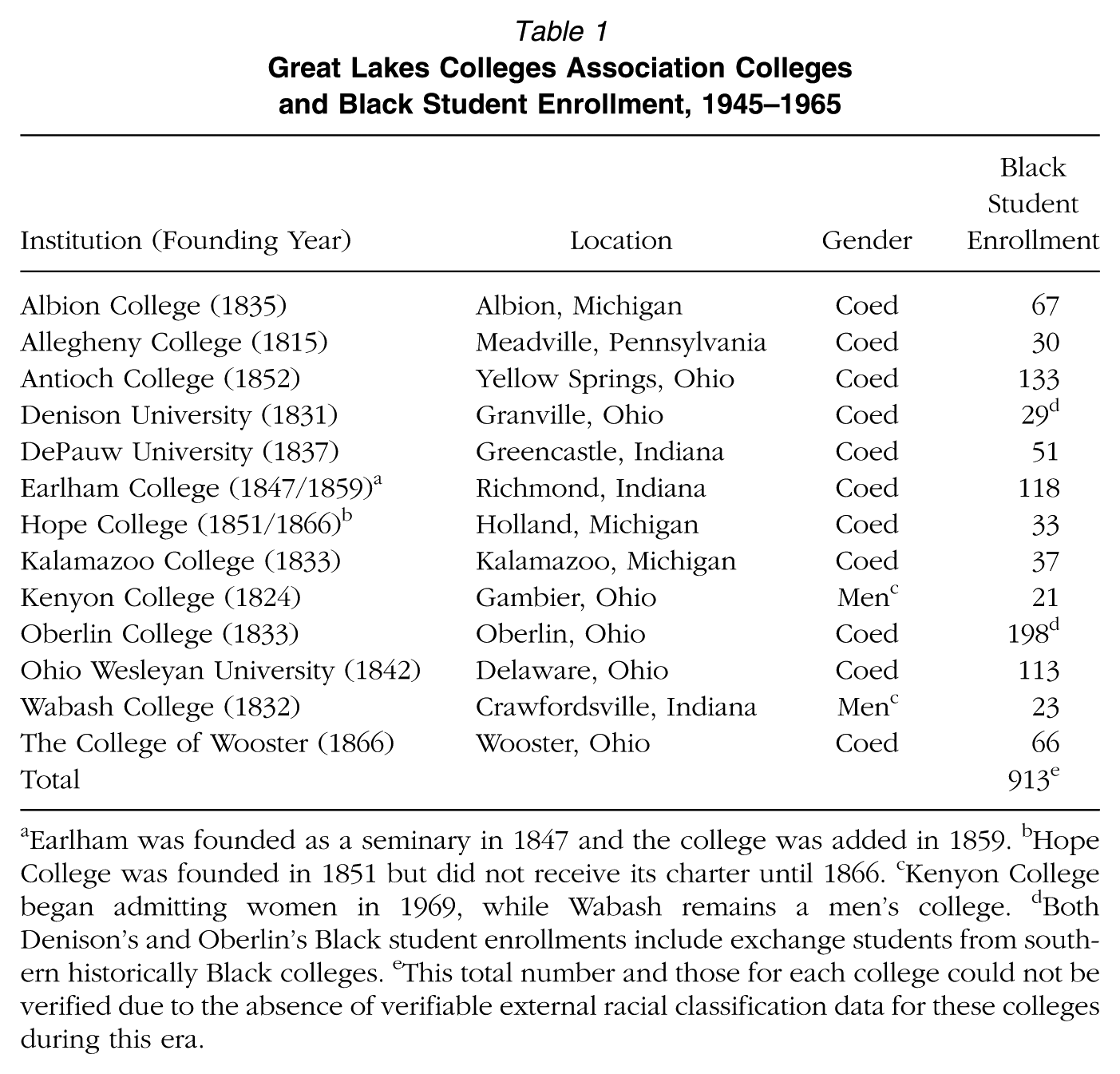
Earlham was founded as a seminary in 1847 and the college was added in 1859. bHope College was founded in 1851 but did not receive its charter until 1866. cKenyon College began admitting women in 1969, while Wabash remains a men’s college. dBoth Denison’s and Oberlin’s Black student enrollments include exchange students from southern historically Black colleges. eThis total number and those for each college could not be verified due to the absence of verifiable external racial classification data for these colleges during this era.
Significance of the Study
Studying these institutions in this place and time matters for several reasons. First, the relative lack of historical scholarship on private colleges has produced an incomplete portrait of U.S. higher education (Thelin, 2011). Unknown about these institutions, beyond their typically denominational character, is how non–research-extensive, private colleges interacted with their local communities, managed legislative pressures, and engaged desegregation as a process of institutional cultural change. Scholarship in this area, for example, Kean’s (2013) research on desegregation at five research-extensive southern colleges, focuses on how these colleges negotiated resistance to governmental pressure and loss of autonomy with recognition of their dependence of federal research grant monies to survive. Although studies of what critical race scholars would call interest convergence (Bell, 1980) are useful, they fall short of analyzing the persistence of whiteness as determinant of the institution’s character or the material effects of such ontological and epistemic whiteness. Moreover, private colleges whose curriculum centered the liberal arts and whose faculty focused more on teaching than extramurally funded research agendas remain largely invisible in educational historical scholarship.
Second, albeit prior to this time period, liberal arts colleges and universities alike grappled with the roles of research, utilitarianism, and religion in the mission of their institutions (Eisenmann, 1999; Horowitz, 2005). As evidenced by this study, the role of religious values continued to play a role in these colleges’ engagement with racial desegregation and countering racial prejudice. The colleges’ involvement in mission work, both within the United States and abroad, was a vehicle for Black student recruitment. The colleges in this study were similar in size and scope and had evolved by the mid-20th century in their commitment to educate any student regardless of race, usually bolstered by liberal religious rhetoric. At Oberlin, for example, modern, secular arguments, which bolstered the segregationist social attitudes taking hold after Reconstruction, subsumed sectarian dogma advocating racial equality (Waite, 2001). This situation was not unique to Oberlin, and so, collectively, this consortium of institutions presents a unique opportunity to investigate how social attitudes contravened religious equality rhetoric at these campuses. Christianity was used by White people in the United States to advance both ideals for race relations and the participation of Black Americans in society that centered White people as superior regardless of their specific stance regarding Black people (Fletcher, 2016).
Third, despite the greater access and diversity achieved in the postwar era, Black collegians’ access, participation, and outcomes remained uneven nationally (Plaut, 1954; Thelin, 2011), largely due to White resistance to desegregation (Alridge, 2007; Franklin, 1979; Perkins, 1993; Waite, 2001; Wechsler, 1981; Wilkerson, 2010; Williamson, 2003; Zimbardo, 1966). Therefore, rigorous study of these institutions in the North between 1945 and 1965 provides a richer, more complete understanding of the nuances of access and diversity as enacted by these colleges and reflected by their students.
Finally, scholars have focused mostly on other elements of Black higher education: the history, present, and future of HBCUs (see Allen & Jewell, 2002; Brown & Davis, 2001); differences between Black collegians’ experiences in predominantly White and historically Black colleges (Allen, 1992; Fleming, 1984); and Black enrollment and experiences post–civil rights legislation (Allen, 1988; Feagin, Vera, & Imani, 1996; Willie & Cunnigen, 1981). By comparison to this much larger body of scholarship, historical scholars have understudied the experiences of Black students in northern postsecondary institutions. For these reasons, this investigation into the nature of student publications as depictions of ontological and epistemic whiteness in this geographic (Midwest, Great Lakes region), institutional (private, liberal arts colleges), and chronological (1945 to 1965) location is supported.
Ultimately, this project seeks to document the ways in which whiteness is instantiated as a facet of the ontological and epistemic infrastructure in postsecondary education as discussed by Patton (2016). When juxtaposed with the purported integration of racially minoritized populations in colleges and universities, this critical-realist analysis can serve to reframe our interpretations of later institutional efforts in the next two decades to recruit and retain Black students, while resisting the deep institutional change demanded by Black student activists (Stewart, 2017c; Williamson, 1999, 2003). Scholars of campus racial climates (Chang, antonio, & Milem, 2010; Harper & Hurtado, 2007; Hurtado, Milem, Clayton-Pedersen, & Allen, 1998) have consistently asserted the need to look past compositional diversity and perceptions of the campus racial climate to understand more fully the role of institutional racial legacies (Hurtado et al., 1998), as well as policies and practices (Chang et al., 2015) in shaping racial climates. Recognizing the ways that student publications both communicate and reify whiteness as ontological and epistemic property claims supports this scholarship. Moreover, this analysis also reframes post–World War II and later 20th-century Black enrollment gains as mere covers for the maintenance of anti-Black settler colonial postsecondary institutional economies that require the elimination of Indigenous peoples and the fungibility of Black bodies (T. King, 2014).
Race in the GLCA Colleges
Discussion of race in the Great Lakes Colleges Association (GLCA) colleges must begin with acknowledgment that these colleges would not have come into existence without the genocide and removal of Indigenous peoples who occupied the land (Stewart, 2017b). In this way, the U.S. settler colonial project and westward expansion from the eastern seaboard directly implicate these colleges. Whiteness exerted property rights to Indigenous land as its first act (Harris, 1993). The founding years of the GLCA colleges (see Table 1) follow federal legislation that authorized the genocidal removal of Indigenous people from the Northwest Territory where these colleges are located, including the 1830 Indian Removal Act and the 1833 Treaty of Chicago (Stewart, 2017b).
Regarding Black people, prior to the Civil War, few colleges in the North and none in the South admitted Black students (Anderson, 1988; Perkins, 1993; Waite, 2001). Oberlin was the first college to make the admission of students irrespective of race an explicit policy, inspired by the abolitionist, evangelical fervor of its founders with support from the local community (Waite, 2001). Other private colleges would also come to admit students irrespective of race prior to Reconstruction. Among these colleges were a set of small, mostly sectarian, liberal arts colleges in the Great Lakes region that would come together as the Great Lakes Colleges Association. It is unclear whether the five colleges founded prior to Oberlin or contemporaneous with it (i.e., Allegheny, Denison, Kenyon, Wabash, and Kalamazoo) ever restricted admission to only White students as a matter of policy or whether the absence of Black students was due to the limited reach of the colleges’ recruitment efforts. For example, prior to the Civil War, Kalamazoo mostly drew its enrollment from the local Kalamazoo Baptist community, and the size of the Black community in Kalamazoo was miniscule (Francis, 2008). However, the first Black student to enroll at Kalamazoo College, Rufus Lewis Perry, who aspired to be a Baptist minister, did so in 1860 (Francis, 2008; Simmons, 2000). Antioch also was founded as coeducational but gave no consideration to race, yet gender inequalities were evident (Rury & Harper, 1986) and a controversy involving the admission of two Black girls to an affiliated preparatory school in the mid-1850s moved the board to set a specific policy to not reject a student on the basis of race in 1863 (Louima, Anderl, & Davis, 2013). For the remaining six colleges, I could not discern when or whether administrators revised college admission policies to allow specifically for the admission of students irrespective of race. However, there were Black students who had enrolled at each of these colleges, except for Allegheny and Wabash, prior to the 1940s. Wabash officials admitted its first Black student, James Perry, in 1942, while Allegheny admitted its first Black student, Clyde Francis, in 1950.
In 1962, Presidents Bolling, Gould, and Trippet—of Earlham, Antioch, and Wabash, respectively—selected institutions to form a 12-college consortium that would successfully apply for funding from the Ford Foundation for international education through this institutional cooperation (Elkin, 1982). Elkin (1982) reported eight criteria that the initial three presidents used to identify colleges “which were strongly academic, squarely Christian while independent of congregational control, committed to the liberal arts, open to new ideas, and distinguished from public institutions by the small size of their student bodies and the sources of their income” (p. 16). This consortium, the GLCA, prioritized institutional cooperation, strengthening each of its member colleges, and using their collective voice on behalf of liberal arts education (Elkin, 1982). Allegheny College was selected to join in 2008 because “[the college] demonstrates the same high quality, character and liberal arts mission as those of the founding members: Albion, Antioch, Denison, DePauw, Earlham, Hope, Kalamazoo, Kenyon, Oberlin, Ohio Wesleyan, Wabash and Wooster” (“Allegheny Joins Great Lakes Colleges Association,” 2008). Bound by shared religious fervor (Elkin, 1982), the approach of each sponsoring denomination of the GLCA colleges toward social issues was publically in support of charity and mission work in the U.S. South, Africa, and other parts of the globe. This missionary zeal was yet a reflection of whiteness as property in that it reserved the right to use such platforms to center White benevolence and superiority. As a result, the largely conservative social policies on each campus that were resistant to the social integration of Black and White people were still in alignment. Antioch stands as an exception in the 1940s, when it formed a committee to intentionally encourage interracial socializing among students (Treichler, 1969).
These colleges did not exist in a bubble. Student interactions with the local community were common and expected as they ventured off-campus to go to the movies, eat at a local soda shop, or engage in community service. Also, the colleges themselves relied on the local community to provide internships for students and men unaffiliated with a fraternity would rent apartments from local residents. As such, it is important to consider the racial climate in the local communities that were home to the GLCA institutions.
Black Americans more heavily populated some local communities surrounding the colleges during the postwar era based on participant recollections and listings in the Negro Motorist Green Book (1949). The Green Book was a popular and essential travel guide for Black motorists traveling through a racially segregated and potentially hostile country. The existence of sundown towns throughout the country and this region (240 in Indiana, 78 in Michigan, 145 in Ohio, and 48 in Pennsylvania; Loewen, 2017) made the possibility of violence and intimidation an everyday reality for Black people during this era (Loewen, 2005). These sources were useful in determining whether the Black community in those cities was sizeable enough to support Black-owned businesses related to travel, such as boarding houses, diners, and gas stations. Albion and Kalamazoo in Michigan had larger Black populations than Holland during this era, but the Green Book listed none of these cities. In Ohio, Oberlin had a critical mass of Black residents and was the only town with a GLCA college the Green Book listed. Though Yellow Springs also had a racially diverse local community, while Granville, Delaware, Gambier, and Wooster did not, the motorists’ guide listed none of these cities as friendly places for Black motorists to stop. Black residents in Crawfordsville, Indiana, were small in number; several worked as cooks and groundskeepers at Wabash, but there was no recognizable Black community to speak of in Greencastle. Richmond, Indiana, was a major thoroughfare even before the federal government built the interstate highway system and had a sizeable Black community. Observers could say the same for Meadville, Pennsylvania. The Green Book included none of these cities.
Many of the colleges in towns with sizeable numbers of local Black residents saw most of their Black student enrollment come from those towns and surrounding areas, such as Albion, Earlham, and Kalamazoo. Each of these colleges was close enough to a major metropolitan center (Detroit and Indianapolis) from which they could recruit Black students. Oberlin’s already established reputation for educating Black people allowed it to continue to recruit nationally for Black students in a way that was unmatched by other colleges. However, some institutions that were not near a sizeable Black population engaged in extensive missionary work to recruit students who had attended denominational secondary schools, such as Hope College’s pipeline from Alabama. The coeducational colleges also had somewhat similarly sized student bodies of approximately 1,100 to 1,300 students, though Hope College and Ohio Wesleyan were the largest with an average of over 2,000 students each during this period. Kenyon and Wabash, the only single-sex men’s colleges at the time, were the smallest of the 13 colleges with enrollments under 500 students.
Archival research, institutional chronicles, and alumni biographies confirm that Black students did not constitute a critical mass of the student body at any of these institutions (Ballard, 1973; Baumann, 2010; Moerdyk, 1983; Hamm, 1997; C. S. King, 1993; Lester, 2003; Warren, 1990). Although there were 198 Black students enrolled at Oberlin between 1945 and 1965, this represents a significant decline, from 7% just after the Civil War to 3% to 5% in the 1880s to less than 1% at the time of this study (Baumann, 2010). Meanwhile, the numbers at other institutions were much less: Denison University had only 15 full-time Black students enrolled over the course of these 20 years. The total Black student enrollment at Earlham, Oberlin, Ohio Wesleyan, and Antioch constituted 61.5% (n = 562) of the total Black enrollment of all 13 colleges. Furthermore, these institutions were also commonly located in relatively isolated, rural areas that were not necessarily favorable to racial integration or civil rights for Black people. Reflecting the retrenchment in racial bias and prejudice in the North (Waite, 2001; Wechsler, 1981; Zimbardo, 1966) rationalized by academic research (Wilder, 2013), these colleges did not actively resist the encroachment of segregationist attitudes.
Theoretical Framework
In keeping with Jackson and Mazzei’s (2012) recommendation to approach data analysis differently, I read the data through a critical race theoretical lens, specifically mobilized in Harris’s (1993) whiteness as property. Although other scholars have advanced theories of whiteness as capital (see Lipsitz, 1998), this later work draws the same assertions as Harris despite not citing her germinal work in this area. Moreover, my use of Harris is an intentional citation practice (Ahmed, 2013) through which I center the work of Black scholars to frame and understand the effects of whiteness on Black collegiate experiences.
In Harris’s (1993) view, whiteness stands as a form of property that defines social relations and expectations and has certain attributes. Without requiring tangibility, Harris explained that modern property doctrine focuses on how property functions and the social relations that it sets in motion. Whiteness, therefore, is a form of property that defined one’s legal status and thereby conferred or withheld tangible, material benefits.
Harris (1993) denoted four attributes of whiteness as property: disposition, use and enjoyment, reputation and status, and right to exclusion. First, although, people cannot transfer whiteness to others, it accrues both material and intangible benefits to the owner. Second, whiteness can “be both experienced and deployed as a resource” (p. 1734). White privilege is the exercise of this attribute of whiteness as property. Third, to have someone regard you as White conferred reputational property interest that realized financial gains over others. Loss of one’s reputation as White, for light-skinned biracial Americans judged to have African ancestry, resulted in a tangible loss of market value in terms of lost wages, access to property, and other monetized legal rights. Fourth, whiteness as property confers the “absolute right to exclude” (p. 1736). Society defines whiteness mainly through the exclusion of others determined to be “not White” (p. 1736). The courts, as Harris pointed out, actively enforced individuals’ rights to exclude other people from access to whiteness. The Supreme Court employed this logic in Plessy v. Ferguson in 1896 (Harris, 1993).
As applied to higher education, other scholars have recognized the predominantly White campus as a sanctuary for White students, while being a hostile environment for Black students and other racially minoritized student populations (Feagin et al., 1996). Citing findings from their interviews with Black students attending a Southern public university, Feagin et al. (1996) reported that students described the campus as overwhelmingly White, down to the artwork, names of buildings, and racial demographics of most faculty and administrators on campus. Scholars of campus racial climates (Chang, Milem, & antonio, 2011; Harper & Hurtado, 2007; Hurtado et al., 1998) have also discussed the necessity of linking campus historical legacies of racial exclusion with current reflections of continued racial dominance and White supremacy on campus. Although not directly applying Harris’s (1993) whiteness as property framework, the tenets of her theory are still illustrated through this literature in the multiple ways on historically White campuses that whiteness confers material benefits to certain students, is unconsciously enjoyed by those students, is associated with higher status and reputation on campus, and propagates the attitude that those who are not White do not belong and should be excluded from the institution. Therefore, it provides a useful lens through which to understand the role of student publications in this set of private, liberal arts colleges in deploying whiteness to control and limit representations of the campus.
Methodology
Using a critical-realist historiographical analysis, I conducted an instrumental, collective case study of the ways in which yearbooks and student newspapers, from the 13 GLCA colleges between 1945 and 1965, reflected whiteness as the dominant character of the student body, a socially isolationist stance that generally erased Black visibility. Specifically, I asked how these student publications illustrated who and what belonged to an institution through Harris’s (1993) lens of whiteness as property? The larger project of which this study is a part incorporates oral histories of the experiences of 68 Black collegians at the GLCA institutions between 1945 and 1965 to describe their experiences and the institutional climate of these colleges. In that book, also using a critical framework, I interweave the participants’ oral histories and the archival data to produce a collective narrative of the experiences of these Black collegians (Stewart, 2017b).
Historiography
I deemed an objectivist historiographic approach to be insufficient to sufficiently explore these issues. Though hotly debated in the 1990s, objectivity had been the ideal of professional historical scholarship (Novick, 1998), and historians of this ilk relied on the idea that the past existed as a discernably true, fixed, and consistent reality. Furthermore, objectivism sought detachment from theoretical frameworks and ideologies in order to adhere to the universalism required of historical objectivity (Novick, 1998). However, historiographic approaches also have emphasized the importance of social and cultural context when interpreting and analyzing primary source materials (Goodchild & Huk, 1990; Kaestle, 1992). A social and cultural historiographic approach, following the revisionist turn of the 1960s and 1970s, has also been discussed by Reese and Rury (2008), and this traditionalist to revisionist to postrevisionist evolution as applied to higher education historical scholarship is discussed by Ogren’s (2008) chapter in the same volume. Another strong example of postrevisionist historiography, which centers race and segregation, is Walker’s (1996) Their Highest Potential.
Collective Case Study
To apply a critical theoretical framework and situate student publications as constructed products, I decided to blend historical methods with social constructionism through the deployment of an instrumental, collective case study methodology (Baxter & Jack, 2008; Creswell, 2013; Stake, 1995; Yin, 1984). As noted by case study methodologists, an instrumental case study portends that the study of a case can provide unique insight into a particular issue, challenge extant interpretations, and build theory (Baxter & Jack, 2008; Creswell, 2013; Stake, 1995; Yin, 1984). In this study, I assert that the student publications produced by these institutions can shed light on the production of collective memories for a student body. In particular, whiteness produced a socially isolated student body until late in the period under study and an incomplete and inaccurate reflection of the experiences of Black collegians attending these colleges. Moreover, my study of these colleges challenges overly simplistic understandings of the ways that students experienced segregation, desegregation, and integration as acts, processes, and instances of the college environment.
A collective case study is simply the examination of multiple cases (Baxter & Jack, 2008; Creswell, 2013; Stake, 1995; Yin, 1984). Here, instead of studying one college, I am studying all 13 member institutions of the GLCA. When using multiple cases, the selection of cases is important and either typical cases or breadth and difference among the cases can guide selection (Stake, 1995; Yin, 1984). This study features both typicality and difference in this sample of institutions. These 13 colleges, differing in size and character of the student body, geographic location, and sectarian character yet reflecting similarities in academic status, espoused values for racial integration and nondiscrimination, and local community climates. As such, these institutions are typical of small, private liberal arts Midwestern colleges and reflect a variety compelling for the examination of possible patterns. The coexistence of such strong similarities and differences among this group of institutions makes for a compelling and information-rich instrumental, collective case study of how whiteness as property informed the production of student publications.
Bricolage Research
This combination of historiography and theoretically driven qualitative methodology reflects a “critical, multi-perspectival, multi-theoretical, and multi-methodological approach” (Rogers, 2012, p. 1) known as bricolage research. To be a bricoleur reflects my perspective that researchers are never free from their subjective standpoints; no one correct telling of an event exists but each retelling reflects a different perspective (Denzin & Lincoln, 2000). As Kincheloe (2001) asserted, bricoleurs do not merely engage in boundary-crossing interdisciplinarity but are deeply aware of the tools available through application of diverse disciplinary approaches and the power inherent in selecting among those tools. This “deep interdisciplinarity” (Kincheloe, 2001, p. 686) allows researchers to transcend formulaic applications of the methodological constraints of one discipline, “creating unique possibilities for knowledge construction [and] informed political action” (Rogers, 2012, p. 2).
By weaving together a critical race theoretical framework, postrevisionist historiography, and case study methods this study represents a methodological bricolage (Denzin & Lincoln, 2000; Kincheloe, 2001; Rogers; 2012). Doing so allowed me to consider the story in these data beyond the methodological constraints of any single disciplinary tradition. The bricolage I have employed here reflects three primary influences: (1) the postrevisionist historian’s attention to the social and cultural contexts and settings that produced these documents (Kaestle, 1992; Ogren, 2008; Reese & Rury, 2008), (2) the case study researcher’s ability to perceive patterns across a collection of idiosyncratic institutions as instrumental of a larger theme or issue (Creswell, 2013; Stake, 1995; Yin, 1984), and (3) the critical race theorist’s ontological assertion of the pervasive permanence of racism and epistemic relevance of distilling counter-narratives (Delgado & Stefancic, 2012; Solorzano & Yosso, 2002).
Data Collection
Consideration of the genesis and authorship of archival documents (Humphrey, 2010) led me in this study to consider student publications as most representative of (1) the pervasiveness of institutional espoused values, (2) White student attitudes and consciousness, and (3) media that were relatively beyond institutional scripts. I conducted archival research at each of the member institutions of the GLCA. Each college had primary documents that addressed questions about the presence of Black students, and whether and how students on campus discussed issues of race and the events taking place around the country, particularly in the South. To collect such data, I contacted the college archivists at each college and arranged to visit the archives for a period of 2 to 3 days.
Using Yearbooks and Newspapers
Yearbooks and newspapers represent two different types of documents serving different purposes. Whereas yearbooks depict the highlights and influential moments of an academic year as a memorial, newspapers document significant events, issues, and people affecting the student body as a tool to inform student beliefs and attitudes even as they document them. Furthermore, examination of both types of documents across a span of 20 years avoids the idiosyncratic influence of just one or two individual students and editorial teams at each college.
Campus newspapers provide practical experience with journalistic methods and ethics, as well as provide news and information about the institution and the broader society to the campus community through student voices and perspectives. Though referencing high school newspapers specifically, LoMonte’s (2011) description of newspapers as a “portal” through which students connect to the outside world is applicable to the college press. LoMonte also noted the empowerment provided to student journalists who are able to speak to the issues that most concern them and their peers, despite the image-consciousness of school officials. Moreover, as collegiate journalist Elliot Goldstein (2012) explained, student newspapers help students become informed consumers of information. In this way, college newspapers give insight to the scope and depth of student concerns about their college and the world around them.
Begun in the late 19th century by students (Johnson, 2010), yearbooks “capture an academic year and preserve it for future generations” (para. 13). Beyond this, there has not been a focused analysis on the role of the yearbook for students or other members of the college community. In this study, the college yearbooks served an important role in depicting the major components of student life at a campus across the student body (e.g., faculty and staff, students, academic departments, sports, social clubs, highlights of notable activities), not just for individual students. In this analysis, the portrayal (or not) of racial diversity in the college yearbooks yielded important insights into the extent of integration of Black collegians into the life of the colleges.
Procedures
I reviewed yearbooks from 12 of the GLCA colleges (Antioch did not have a yearbook during this period) and student newspapers from all 13 colleges (see Table 2). Following is a discussion of how the newspapers and yearbooks were organized and the procedures used to collect and analyze data from them.
Great Lakes Colleges Association Student Publications

Antioch College did not publish a yearbook during this era.
Student Newspapers
At these colleges, the student newspapers were typically the oldest student organizations on campus, staffed entirely by student volunteers from a variety of majors. None of these colleges had a journalism-specific degree program during this era. As shown in Table 2, 11 of the 13 colleges published their newspapers weekly. The two exceptions were Hope and Albion colleges, where students published issues twice a month and three times a week, respectively. The newspapers generally included five sections: news features written by staff reporters, covering campus, local, and national news; opinion, including articles written by the editorial staff and letters to the editor; sports news written by staff reporters; comic strips, drawn by newspaper staff; and classified ads.
I searched the newspapers to identify articles that may be relevant to the focus of this investigation using the following keywords: Negro and colored (consistent with the common parlance of the period to reference Black people), desegregation, segregation, racism, civil rights, integration, race relations, and protest. Hundreds of articles were collected, read, and organized according to the following categories reflected in the content of the articles: White students’ attitudes about race relations, Black students featured as subjects of articles, Black students’ attitudes about race relations, editorials about campus policies regarding race relations and integration, campus events featuring topics concerning race, and campus events featuring Black performers.
Yearbooks
Editorial staffs generally organized the yearbooks similarly across the GLCA colleges: Each year’s volume generally began with a dedication or theme for the issue and photos of the college leadership and faculty. Following this introductory section, editorial staffs focused the rest of the yearbooks on students and their activities. Every college included individual pictures of each member of the senior class and included information about the student’s hometown, academic emphases, student organization and fraternal involvement, and athletic involvement, if relevant. Most of the colleges also included pictures of the first-year, sophomore, and junior classes, although generally as group shots and sometimes with the names of those pictured underneath the photo. In the layout, staffs used notable events and happenings of the year as dividers between the major sections of the yearbook. These major sections included the college administration and faculty, class listings, social societies or fraternal organizations, other student organizations, and athletics. At some institutions, like Hope and DePauw, staffs pictured members of the fraternity and sorority chapters individually along with a group shot of the entire chapter.
I read the yearbooks for each year available at all the colleges, making extensive notes recording the names of Black students, faculty, and staff, as well as any instances of engagement with Black culture (including parody and mimicry) or discussions of racial issues. These notes reflect the following categories informed by the content of the pictures: Black students pictured alone, with other Black students, or in groups with White students and whether the pictures were of academic activities, social activities, or sporting events and athletic teams. I was limited to making racial classifications to identify Black students’ presence in the yearbooks based on admittedly imperfect visual identifications from pictures.
In concert with other historians, I define race as an ideological construction, which has material effects (Campbell & Oakes, 1993; Davis, 1997; Fields, 1982; Holt, 1998). Used in this way, race and its classifications are not transhistorical (Fields, 1982) but bound to the social setting and context in which they are operating. Nevertheless, as Fields (1982) has asserted, people make determinations of race within an ideological context that has dutifully “taught [people] which details to consider significant in classifying people” (p. 146). Consequently, racial classifications are not so dubious as to be completely untrustworthy. Nevertheless, such an identification method as used in this study is vulnerable to biological essentialism, especially by failing to include fair-skinned and mixed-race students who would have been classified as Black due to the one-drop rule created during the chattel slavery period in the United States Despite race not being rooted in biology, chattel slavery in the United States used genetic traits and heredity to create racial classifications based on phenotypical details such as the hair texture, melanin content in the skin, and the shape and width of the nose to maintain a fiction of White racial purity and, at the same time, keep the slave economy supplied with its labor force (Alexander, 2010; Lee, 1993; Kendi, 2016). However, the absence of alumni data categorized by race for matriculates of this era at most of these colleges necessitated this approach (see also Stewart, 2017d). For Denison, Earlham, Oberlin, Kalamazoo, Ohio Wesleyan, and Wabash, I was able to mitigate this vulnerability by cross-referencing my lists culled from the yearbooks with the alumni offices’ lists of Black alumni. With Earlham’s graduates, I had failed to include one Black alumna, who appeared very fair-skinned in the black-and-white photos, as well as others who were not included in the yearbooks. With Denison’s and Wabash’s matriculates, this yearbook-based visual identification method allowed me to find additional matriculating students, who had not been included on the colleges’ lists because they were nongraduates or visiting students. In the cases of the other seven colleges, I have likely made some errors and have knowledge of one: I identified an Albion alumnus as Black, who identified himself as White when I arrived to interview him. Given this inexactitude, the total number of Black student enrollment reported in Table 1 is an estimate that may be either over or undercounted.
Data Analysis
Earlier I referenced Jackson and Mazzei’s (2012) strategy of using theoretical perspectives as lenses through which to interpret and analyze data. I felt that coding would be particularly inappropriate to apply to student publications because one should see yearbook pages and their organization as well as newspaper articles and letters to the editor as whole documents to see as wholes. Therefore, beyond categorizing the representation of Black students and issues related to racial justice as discussed above, I did not employ coding as a data analysis strategy. Rather, I used the tenets of whiteness as property (Harris, 1993) as a lens through which I looked for “stumble data” (Brinkman, 2014). Stumble data are instances of the phenomenon that researchers collect as reflections of a set of cultural understandings (Brinkman, 2014). In this study, categorizing the yearbook and newspaper data as I described above was mostly likely to lead me to those “stumble data” about how whiteness functioned as property in these GLCA colleges from 1945 to 1965. This abductive approach (Brinkman, 2014), as opposed to inductive or deductive, best fit the purposes of this research study and the nature of the data I analyzed.
Discussed more thoroughly above, whiteness as property entails four tenets: disposition, right to use and enjoyment, reputation and status, and right to exclusion. Although each of these tenets aptly describes the general place of White students in U.S. colleges and universities, they are not all accessible to students to shape their lives and collective memories. The dispositional and reputational effects of whiteness as material benefits require support by societal and institutional structures, such as laws and policies. Therefore, their indirect effects show up as outgrowths of the direct effects discussed next. Yearbook and newspaper staffs can restrict or expand use and enjoyment and exclusion within the campus social strata. Therefore, I analyzed the images, photo captions, and articles from the GLCA colleges’ newspapers and yearbooks for the effects of whiteness as use and enjoyment in social life and peer engagement, as well as exclusion through the representational absence of Black students.
Student Publications as Racialized Cultural Texts
The college yearbook is a cultural artifact of the campus environment. In the GLCA colleges, the yearbook committee was a small group of students, usually seniors either elected by their peers or appointed by the college administration. The college yearbook staff constructs a particular story of the institution, their experiences within it, and their attitudes toward it. It seems reasonable that what events, activities, and people the editorial staff deemed most significant and noteworthy made it to print, while those deemed less significant and meaningful were left out. These constructed stories are partial, yet yield important insights as to how influential groups of students told the story of their institutions. Consistent with the data analysis process I described above, I present my direct interpretation of these data and center my analysis of three layers in the data: Black visibility, racialized imagery, and civil rights and social issues.
Black Visibility
This first layer, Black visibility, focuses on how visible Black people and issues related to Black social and political life in the United States were in student publications. The colleges included in this study did not address uniformly the representation of the student body’s racial diversity. Some institutions’ publications featured active discussions of race and racism among White majority students. Also, on these campuses the college yearbooks reflected larger numbers of Black collegians in far more diverse representations. Oberlin was a strong example of this approach due to the organizational structure of Oberlin’s yearbook, called Hi-O-Hi. In addition to senior profiles, yearbook staffs grouped all first-years, sophomores, and juniors by residence (whether on- or off-campus) for photographs to be included in the yearbook. This allowed for every student living on campus to be represented in the yearbook without regard to the extent or nature of their campus involvement. Each of the yearbooks I reviewed included between 30 and 47 visibly identifiable Black students. Furthermore, the 1950 Hi-O-Hi included a picture of the Oberlin Interracial Committee. The focus of this group, as described in the photo caption, was on altering admissions policies to allow for more social class diversity among entering students and on ending rooming racial segregation within the first-year class. Also in 1950, the drama group, The Mummers, included Black women; other colleges in this study rarely reflected this level of racial integration in drama societies. Pictures of casual, social interactions also reflected racial integration in the Hi-O-Hi. The 1955 edition featured a picture of the snack bar in the Men’s Building of a Black male student playing pool with a White campus security officer.
At most other campuses, there was little evidence in student publications of campus discussion about issues of race and racism in the United States or abroad, or it was limited until the 1960s. Albion’s newspaper, for example, was completely devoid of any discussion of race relations or announcements of visits by notable Black scholars, clerics, or entertainers until the 1960s. At other campuses, there were examples of articles and series that focused on specific visiting exchange students from historically Black colleges or international students at the college. For example, at Denison, the Denisonian included features of visiting domestic exchange students from Hampton during the 1950s. Yet, at Wabash, after the president of Tau Kappa Epsilon Fraternity—the only racially integrated fraternity at the college—became the editor of The Bachelor in 1962, there was noticeably greater representation of Black men in the newspaper than there had been in years past. That year’s yearbook also featured news stories about national social and political issues related to race relations.
Some college yearbooks featured Black student-athletes more prominently than others dependending on the year and the institution. Much of this was due to the organization of the yearbooks to focus on social life. At Oberlin, there were no fraternities or sororities and first-year students were required to live on campus. As a result, residential living was the center of social life and was the organizing scheme for the yearbooks. Yet, at campuses with national or local fraternities and sororities, editorial staffs typically organized the yearbooks around those groups. These social groups and athletics commanded the most number of yearbook pages. For example, at Hope, there were several years when no Black students appeared anywhere in the yearbook and there was little involvement of Black students in student organizations and none in fraternities or sororities because of the racial exclusion clauses in the fraternal system. There was also little involvement of Black men in athletics until later in the period. This was also the case at Wooster, where both the Index and the Voice featured no more than single digit numbers of Black students in any given year and only 10 articles across these 20 years about race, including announcements of speakers, conferences, editorials, and features.
However, at Kenyon College, Black students at this all-men’s college were visibly apparent in The Reveille, despite having only 21 Black men enrolled across this 20-year span. The vast majority of these men were student-athletes, so although Kenyon’s fraternities banned them, they were included in team pictures. The first year that Black students appear is in 1950, and pictures of three Black men are included. The yearbooks included pictures with two of these three as members of athletic teams (football, track, and lacrosse); the third was a member of the Archons, a campus social (nonfraternal) society. In many cases, the only pictures of Black students were of Black men with their athletic squads in either yearbooks or newspapers for a noted athletic accomplishment. Since these campuses did not have intercollegiate athletics for women at this time and none of the sororities ever racially integrated during this period, Black women even on coeducational campuses were rarely visible in the yearbooks and nonexistent in the campus newspapers.
With the exception of Antioch and Oberlin, whose students were involved in barbershop segregation issues in the towns of Yellow Springs and Oberlin, respectively, there was little to no coverage across the colleges of national, local, or campus events related to issues of race, racial integration in particular, and of groups with a focus on racial issues from 1945 to 1960. Yearbooks also included events that the newspapers had reported. Kenyon’s Reveille included a comment with a photograph in the 1947 edition, which otherwise did not picture any Black students on campus (available records do not indicate there were any that year), describing the literary society, Philomathesians, as “race conscious,” and noted that the group had “put the Negro [sic] problem into intellectual moth balls long enough to hear the ‘Story of Buddha.’” The 1959 edition of Denison University’s The Adytum included a picture of the speaker for their Christian Emphasis Days, the Reverend Charles Bodie, a Black man. At The College of Wooster, the 1948 Index included a picture with the following caption and description: “Stage Negro Church Program: Westminster Fellowship group sponsored a Racial Fellowship theme of student service and musical program at 2 Negro [sic] churches.”
The yearbooks would also include the headliner at a dance or other speaking engagement. As such, even in years when no Black students appeared in the yearbook, there would at times be Black people featured who came to the campus as entertainers or speakers. For instance, at Hope College, the 1945 edition of The Milestone includes a picture of Mr. Edward Simms, a Black man, “who spoke on racial prejudices and was a source of real interest to all”; the Women’s Activities League sponsored his visit. The yearbook for 1945 depicted no other identified or visible Black people on campus as students, faculty, or staff. Also, in 1948’s Reveille at Kenyon, there are no Black men featured on campus as students, faculty, or staff, except for “Tiny” Bradshaw, a Black man, who performed at the fall dance. Black performers were not routine occurrences; there were not such guests every year. Far more common were yearbooks that were composed nearly entirely of White people as students, faculty, staff, and guests.
Racialized Imagery
Photographs and stories about Black students, performers, and speakers were not the only racial images that appeared, however. The second layer in my findings was the representation of blackface and other racial caricatures in student publications at the GLCA colleges. Although rarely included in student newspapers, the yearbooks did feature, to varying degrees, images of White students in blackface, racialized motifs used as decor (humanized caricatures of monkeys), and language with racial overtones (“slaves” and “master” to refer to sorority pledges and initiated members) typically associated with fraternity and sorority life. Except at Antioch (which had no yearbook at the time), Oberlin, and Earlham, yearbooks from each of the other 10 GLCA colleges included such imagery mostly during the 1950s. Racialized imagery at these institutions also extended beyond blackness to include Indigenous caricatures.
At Hope College, between 1948 and 1958, there were seven editions of The Milestone that included photographs of White students in blackface; one of those also included a photograph of a student in “redface” mimicking a Native American. In Kalamazoo’s Boiling Pot, for 4 years from 1952 through 1955, the editors included photographs of the Century society’s minstrel show that featured an entire choir of White men in top hats and blackface. The 1956 edition of Allegheny’s Kaldron includes a picture of two White students with their faces painted black and dressed as dice. The Adytum also included pictures of blackface performances in its 1950, 1956, and 1957 editions.
Beyond blackface, the yearbooks featured more explicitly terrorizing images as well. At DePauw University, there is a picture in the 1952 edition of The Mirage of a cross burning on the front lawn of a women’s sorority house and White women on the upper patio perhaps being serenaded by fraternity men. This was not a Ku Klux Klan rally, however. A cross on fire is the symbol of the United Methodist Church, which was the college’s sponsoring denomination. Nevertheless, observers and researchers cannot ignore the social context of the time. The Ku Klux Klan routinely used cross burnings as a means of racial intimidation (Gordon, 2017). That a Christian denomination would use such a symbol is emblematic of the very concordance of White supremacy with Christianity that Fletcher (2016) discussed. The lack of any acknowledgement of the troubled contemporary and historical meaning of these symbols and performances illustrates how the property rights to use and enjoyment were acceded to whiteness.
Such rights to the use and enjoyment of racially charged imagery by White students at the GLCA colleges were not reserved to blackness. At Denison University, the yearbook staff regularly featured redface imagery regularly because the university’s mascot was “Big Red Captain,” who was typically portrayed as a Native American caricature, “Chief Ady-tum-tum” or “Little Chiefs” and with a tomahawk. This image and other cultural appropriations of peace pipes and teepees sometimes appeared on every page of Denison’s yearbooks in the campus life section.
The preponderance of such images reflects a racially charged atmosphere with a prevalence of what would now be identified as racial microaggressions (McCabe, 2009; Sue, 2010), mainly targeting Black students though extending to Native Americans at some colleges as well. Microaggressions occur during personal interactions. The following contemporary examples illustrate the three different kinds of microaggressions Sue (2010) defined. A parent in a college tour group regards students of color arriving late suspiciously and doubts their legitimacy as prospective students (microinvalidation). An acquaintance tells her roommate, a dark-skinned Black woman, that she is “pretty for a Black girl” (microinsult). A resident hangs a noose outside the room of the only Black resident assistant in the building (microassault). Microaggressions are named as such not because they are minor or trivial but to contrast them from the material effects of systemic and structural oppression (Sue, 2010).
Sue (2010) acknowledged that a lack of hostile intent often accompanies the enactment of racial microaggressions. For instance, in the GLCA newspapers and yearbooks, students did not display these images—microassaults, such as the cross on fire at DePauw—in an explicitly hostile manner. Moreover, racialized meaning of certain images went unacknowledged despite the social context of the time. Joyful, smiling faces were committing microassaults, donning blackface as characters in campus minstrel shows sponsored by campus fraternities and sororities. Sorority “slaves” grinned broadly for photos with their “masters” during initiation hazing rituals. There was no indication that anything troubling was going on, despite the fact that blackface and minstrel shows had fallen out of popular use after the 1920s (Lott, 1993/2013).
Hope’s student newspaper and yearbooks shows the unconsciousness regarding the problematic nature of these images. There were discussions about European colonialism in Africa and op-eds about ending prejudice at the same time as there were blackface performances on campus. Black Americans understood the performance of blackface by White performers as no less than a display of racial dominance in a critical tradition that stretched back to Frederick Douglass (Lott, 1993/2013). Regardless, such microassaults also served as microinvalidations, sending clear signals that Black students were unwelcome and not included in the enjoyment of White students’ social spaces. The inclusion of such microaggressions in the newspapers and yearbooks extends the propertied nature of whiteness in the colleges to be able to use and enjoy these publications themselves during and after one’s collegiate years. As these images and motifs were being used, it was clear that White students being able to enjoy the products of the ways White people imagine blackness was prioritized over and above the inherent racial violence communicated by these performances. Morrison’s (1993) discussion of “disturbing nurses and the kindness of sharks” persuasively conveys a similar analysis.
Civil Rights and Social Issues
The final layer in the data considered the breadth and depth of social issues related to civil rights, including voting rights and racial integration, which varied across the 13 GLCA colleges. In this layer, the content of the discussion is the focus. At Ohio Wesleyan, DePauw, Kalamazoo, and Kenyon, the student yearbooks and newspapers featured some discussion of these issues usually as they intersected with college forums and events reported in the newspaper. For example, these sectarian institutions sponsored some version of a “Religious Life” week every year that brought in a denominational speaker. Among the invited speakers were clerics and social activists, including Black clergy such as Howard Thurman and Martin Luther King Jr. as well as White ministers. Generally, these speakers asserted that the tangible outgrowth of Christian brotherhood was support for human rights in all forms, including racial integration and the right to vote. These events were the headline articles on the front page of the newspaper each spring they occurred, and yearbook staffs pictorialized them as well. The coexistence of religious rhetoric in support of racial integration with the reality of largely segregated student social lives perhaps reflects the extension of Waite’s (2001) observations of Oberlin at the turn of the century, where secularized social attitudes won out over evangelical racial progressivism. It is also reflective of Fletcher’s (2016) analysis of Christianity in the United States as an institution that is incapable of substantively resisting White supremacy and its effects.
Through newspaper articles and yearbook photos, student editorial staffs also covered student-led demonstrations for civil rights; however, I typically found these occurrences after 1960. In one instance, Wabash’s student newspaper, The Bachelor, ran a series of articles sent in by a White student who had traveled to Mississippi to join the Freedom Rides in 1964 and subsequently arrested by local police. Kenyon’s paper, The Collegian, included similar articles with different perspectives on “Bloody Sunday,” the march for voting rights from Selma to Montgomery, Alabama, in 1965. These stories and situations, however, were not included in the yearbooks for those years. Albion and Earlham students became much more socially involved after 1960, and editors of the newspaper and yearbooks featured stories that covered these events, ran editorials in support of desegregation, and printed letters to the editor with varying views from students and faculty. At other institutions, like Allegheny and Kenyon, newspaper conversations focused mostly on the fraternities and their racial exclusion clauses: in 1955 at Allegheny but not until after 1960 at Kenyon. Wabash’s students were also engaged in these discussions in the pages of the newspaper in mid-1950s: From February to March 1955, The Bachelor printed reports, editorials, and letters debating racial discrimination.
Other institutions seemed to take a deliberate stance not to feature national social and political issues. For instance, The Anchor, Hope College’s student newspaper, had periodic coverage of racial issues both national and global from 1945 through 1949 but then did not have an article related to domestic or global political or social issues again until October 1956. However, The Anchor remained silent on issues of segregation and discrimination, on campus, locally, and nationally for an entire decade. Whether campus administrators dictated this silence or students chose it is unknown. Other student publications were more explicit about their inward turn. For example, the editor of The Denisonian in 1950 used his first editorial column to explain a change in the editorial policy to publish no further commentary on national issues (J. Richards, January 13, 1950). I could not confirm whether Richards made this decision on his own or under advice by college administrators. The Adytum yearbook was also absent any such coverage, despite the presence of a chapter of Students for Democratic Action. First appearing in 1954, there were likely some discussions taking place on campus sponsored by Students for Democratic Action. Yet it is unknown whether the absence in The Adytum was due to administrative directives or by student choice. Although not explicitly announced, there was little engagement by any of the college newspapers with national and local community issues related to racial justice other than at Allegheny, where the editor in 1956 wrote multiple editorials about the duties of students as citizens to support desegregation.
Discussion and Implications
This collective, instrumental case study of whiteness as illustrated through the yearbooks and student newspapers published by the GLCA colleges between 1945 and 1965 has theoretical and methodological implications and import. These findings reveal the role and function of whiteness, and through this revelation, they also disclose what it means to be desegregated or integrated. These findings also have import for educational historiography and methodology.
Function of Whiteness as Property
Whiteness came to characterize the collective memory of the GLCA colleges between 1945 and 1965 as characterized in these student publications. As applied to the yearbooks and newspapers of the GLCA colleges, whiteness as property (Harris, 1993) is also visible. The four attributes of whiteness as property defined by Harris (1993) are identifiable in the GLCA student publications over this 20-year period: inalienable rights to whiteness, use and enjoyment, reputation and status, and right to exclude. Recognition of these attributes has implications for historiography of this period.
Inalienable Rights to Whiteness
First, whiteness operates as an inalienable right that reaps benefits. As an artifact of one’s time in college, the yearbook especially can pictorialize one’s presence and involvement. It serves as a memento for future generations, thus enabling yearbooks to trace the past. This benefit is not material, but it is no less real despite its intangibility. The intentional disruption of the lineages of many Black Americans through slavery accorded a property right to White people in the United States, making it challenging or impossible for Black Americans to leave behind records of the past. The production of yearbooks and newspaper archives with limited visibility of Black students renders it a benefit reserved for White students.
As such, it is important for those studying the past to take into account that whiteness may greatly skew how race relations and racial visibility are evident through documents and literature produced by White people and published by institutions and organizations that are controlled by White-owned and White-operated mechanisms. The need to contextualize such material goes beyond Kaestle’s (1992) advice to historians to consider cultural and social context as they interpret archival material. Beyond such contextual and situational awareness, historians may do well to intentionally seek out data that can triangulate racially minoritized people’s presence and involvement in historically White institutional spaces.
Right to Use and Enjoyment
Second, the right to use and enjoyment as an attribute of whiteness as property is evident, more so in the yearbooks collectively than in the newspapers. Yearbook editorial teams executed decisions to foreground sanitized images of studious collegians and youthful fun and exuberance, even in the midst of displays of racial microaggressions. Editorial inclusion of images and stories of racial equity and collegiate diversity were a backdrop for White student entertainment (via Black performers) or tools for their education or activism (Black speakers on social issues). This featured whiteness the property rights to use and enjoyment. The yearbook functioned as a repository of memories, but White student editors meant these memories to be of fun times and celebrations. By excluding images that would contradict interpretations of the college years as anything other than a time to be fondly remembered, the yearbook representations preserved the ability of White students to forget and ignore conflict, challenge, or discord. Even at Oberlin, where editors organized the yearbook in a way that allowed for the greater visible representation of Black students, this visibility portrayed an incomplete picture of racial integration at the college. Not apparent was the college’s policy of asking White students if they would be willing to room with Black and international students that administrators did not end until the mid-1950s after Black students protested the practice (Baumann, 2010).
The right to use and enjoyment may have been less apparent in the newspapers because of the different purpose of those student publications. Whereas yearbooks may pictorialize and preserve the college year (Johnson, 2010), newspapers connect students to the outside world and enable student journalists to write about the issues that concern them and their peers (LoMonte, 2011). Nevertheless, during the 1950s especially, campus newspapers across the GLCA colleges chose not to engage national and local racial issues, focusing mainly on campus issues (or not at all in the case of Hope College). In this way, the newspapers were also sanitized, and debates about Black student membership in fraternities happened without the consultation or input of Black students.
Student newspapers did not include discussion by White students of local and national racial issues until the 1960s, usually around voter enrollment campaigns in the South. However, editors did not accompany the views of these White students with publication of the perspectives of Black students at the college. As such, this practice maintained the right to use of the campus newspaper as a space for White students to discuss social issues in the absence of Black perspectives.
This finding challenges the ability of these publications to portray campus life or student concerns authentically. Researchers must collect other materials if whiteness obscures the trustworthiness of archival documents. Lack of access to printing and distribution of literature may render invisible the involvement of Black and other racially minoritized students and their White accomplices in the archival record. As a result, an exclusively archival data collection method may produce a historiography that is inherently limited and hampered in its ability to identify and critique the functions of whiteness.
Reputation and Status
Third, the right to reputation and status as an attribute of whiteness as property also appears in these data. At colleges with them, yearbooks and newspapers prominently featured fraternities and sororities, often taking up more pages in the yearbooks than academics and overshadowed only by athletics. Campus newspapers regularly featured the activities of fraternities and sororities on campus. These student groups dominated campus social life and therefore carried with them high status and reputational wealth. At some institutions, like Hope College, the only way that individual student pictures would appear in the yearbook prior to one’s senior year was through fraternity or sorority membership. The fact that nearly all these groups uniformly excluded Black students (as well as other non-White students, Jews, and Catholics) meant that whiteness exercised property rights to reputation and status as well.
Scholars of educational historiography have undertheorized the ways in which fraternal membership has conferred status and prestige on White students within a White supremacist and capitalist society. These teams and social groups not only metaphorically dominated campus life, they literally dominated pages in the campus yearbooks, and student newspapers prominently featured them as well. Fraternal membership was the gateway for leadership opportunities beyond the social group to the campus. This training for leadership harkens not only to the ways that whiteness advantaged White students in college by extending them exclusive membership in these groups but also to their lives postcollege within a Jim Crow capitalist economy extending both their economic and political influence. Analyses of race relations and the economic and political condition of Black people and other racially minoritized groups in the United States at the mid-20th century must consider the multiple ways that schooling granted White citizens opportunities not only to practice leadership but to also view White leadership and dominance as inherently normative and preferential.
Right to Exclude
Fourth and most apparent, whiteness as property showed up in yearbooks and newspapers as the right to exclude Black students and relevant social issues on campus and in the nation. Possession was manipulated and redefined “to include only the cultural practices of Whites” (Harris, 1993, p. 1721). Similarly, White yearbook editors at the GLCA colleges also used the cultural practices of White students as determinative of what activities, and therefore whose bodies, should appear in the yearbooks. These editors privileged organized intercollegiate athletics, fraternities and sororities, homecoming courts, and other activities reflective of White student involvement to the exclusion of all others. To the extent that these organized student involvement spaces practiced formal or informal racial segregation, Black students were absent from these iconic campus scenes. The yearbooks were representations of the collective exercise, on the part of either White student editors and/or White administrators, of the right to exclude Black students to the degree that they failed to be eligible for inclusion in White cultural norms and activities.
This finding reinforces earlier discussion that these publications cannot be taken at face value for their ability to authentically or even accurately depict race and racism in college. It also manifests the need to look beyond official institutional statements of nondiscrimination and inclusion. None of these colleges had official policies that admitted to the likely racial exclusion and isolation that Black matriculates would encounter on campus. Evidence of this was only apparent through the use of a critical-realist racial lens (Stewart, 2017d) that took into account both the social construction of race and its material effects as an epistemic reality.
Nuancing College Desegregation and Integration
Pictorial evidence of White and Black collegians socializing together or engaged in athletics at the GLCA colleges did exist in these yearbooks. Newspaper articles across the period at all 13 campuses never featured campus-based hostility between Black and White students. All racial tension was reported as occurring off-campus via protests of segregated local soda shops or barbershops or even further away in the South. Student publications usually depicted this tension as occurring between interracial groups of relatively small numbers of students alongside community members. Using these data alone, one might conclude that these campuses were limited, yet idyllic settings of interracial harmony. Those images, though, did not disrupt the normative centering of Whiteness as representative and generalizable. Moreover, such a conclusion fractures when told in company with the oral histories from Black alumni included in the larger project from which this study is extracted (Stewart, 2017b). Read alongside Black collegians’ oral histories, multiple, sometimes contradictory, narratives emerge (Stewart, 2017a, 2017b). These alternative narratives, counterstories (Solorzano & Yosso, 2002) if you will, remain invisible in the pages of the college yearbooks and newspapers, the primary conveyor of memories for a graduating class. These publications transmit and protect whiteness as property (Harris, 1993) as the collective memory of the campus.
These findings complicate considerations of what counts as integration versus what spaces scholars and laypeople should consider to be integrated. I argue that this is not a matter of just semantics, nor do these terms represent mutually exclusive poles on a continuum. Segregation, desegregation, and integration manifest through particular acts, processes, and instances within institutional settings. According to denotative meanings, while de/segregation points to official policies and laws that separate groups by racial category, integration speaks to the extent to which a society or institution incorporates different groups as equals. However, a college’s official rules and practices also do not regulate students’ experiences in college; the college’s unwritten customs and traditions, as well as external groups’ rules and practices (e.g., local communities and fraternal groups), regulate them as well. Thus acts, processes, and instances of segregation, desegregation, and integration may coexist in the same college through students’ encounters with official campus policy, campus traditions, and external rules and customs as they move through the college environment. The college environment is a multifaceted structure, including its enrollment policies and practices (i.e., admission and financial aid), campus housing policies, organized campus involvement (e.g., student organizations, fraternal groups, and athletic teams), academic engagement (e.g., access to majors, departmental clubs and activities), internships and career development, as well as peer-to-peer and intergroup relationships (e.g., friendships, dating, study groups). A three-dimensional cube best illustrates this matrix of influences (see Figure 1).
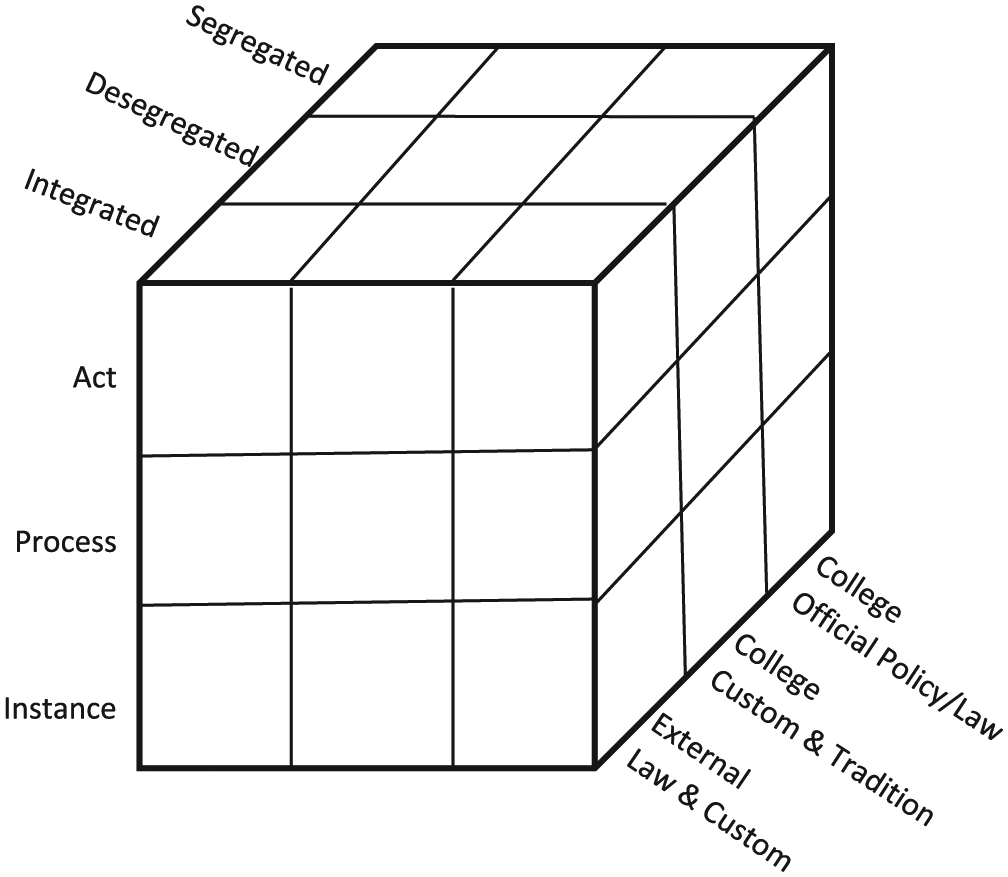
Cubic model of segregation, desegregation, and integration in the Great Lakes Colleges Association colleges.
By considering the x, y, and z axes in this model, the findings in this study reveal a more nuanced picture of campus segregation, integration, and desegregation in the GLCA colleges at mid-century. For example, at some institutions, although official enrollment policies were desegregated (an act), other structures in the campus environment were segregated either by college customs (e.g., campus housing; an instance) or by external groups’ policies (e.g., fraternal organizations; an act), while individual student experiences within academic departments and clubs were typically integrated (instances) and students sometimes cultivated deep interracial friendships (processes; Stewart, 2017a, 2017c). Understood in this way, scholars cannot classify the GLCA colleges at this time simply as segregated, desegregated, or integrated. Rather, Black collegians navigated microsystems and structures throughout their campus that exemplified all three conditions.
Revisiting and Revising an Educational Historiography of Race in College
Three implications emerge from this study of student publications as representations of the collective memory of a campus student body. First, whiteness need not be terrorizing to be all-encompassing. As noted, the yearbooks did not include evidence of hate speech or racist graffiti. The newspapers did not include coverage of racial hostilities between White and Black students. In fact, White students donned racial caricatures and blackface as good fun from the perspectives of the White students who performed in them and attended these shows. Despite this outward positivity, the whiteness of these campuses was no less totalizing than that named by the students in Feagin et al.’s (1996) study. Racism is not racism because it is mean and hurtful. Microaggressions are not trivial to those experiencing them. Racism is racism because of the totalizing effect of racial subordination. A researcher looking for open hostility as the only reliable evidence of racism’s effects at these colleges would miss the insights gained by considering the benign faces of racism as demonstrated through application of Harris’s (1993) whiteness as property framework.
Relatedly, the innocuous and uninterrupted depiction of whiteness noted above is the second implication of this study as it served to erase the effects of systemic racial exclusion operating on these college campuses. The pervasiveness of the whiteness of these colleges rendered itself effectively invisible and inevitable. Consequently, whether these colleges were truly integrated or even desegregated is questionable. How many non-White students does it take to be considered integrated? To what extent do campus acts, instances, and processes need to thoroughly integrate those non-White students in the social life of a college for the college to proclaim itself as integrated? What is the proper evidence of integration in college? Compositional diversity is important, and I would agree with Baumann (2010) that inadequate numbers of minoritized students makes full integration impossible. Nevertheless, aligned with Wechsler’s (1981) argument, policies that allow or ignore structural exclusion will never lead to meaningful campus integration. It was impossible for Black and White students at these colleges during this era to coexist as an integrated student body—and be represented as such—when both formal and informal policies kept them apart outside the classroom. Moreover, such systemic segregation failed to disrupt the property functions of whiteness on these campuses through student publications. White administrators allowed White students to be inward-facing, be isolationist, and center their own experiences as normative and optimal.
Finally, preparation for democratic citizenship through a liberal education had been an outcome of college prior to this period (Horowitz, 2005). The pervasive silence on these campuses belies that students effectively realized this objective especially before 1960. When young people are not encouraged to debate, discuss, and consider local and national events, they are not being effectively prepared for participation in a democratic republic. When today’s campus protests (Wong & Green, 2016) are considered, what will the campus newspaper and yearbook records contain in 10, 20, or 50 years? The archival evidence will reflect those students and institutions (not) concerned about these issues. The ability to ignore or turn away from racism and other forms of oppression is a privilege and another way that whiteness enacts a property interest in being carefree and unburdened. These findings challenge institutional leaders, particularly those faculty and staff who work with student newspaper and yearbook staffs, to engage these students actively in discussions about their roles and the power of representation they wield.
Conclusion
The predominantly White student bodies at the GLCA colleges between 1945 and 1965 were active in the construction of race, segregation, and desegregation at each campus. Although an active wrestling and debate about civil rights and their responsibilities as college students regarding them was evident in student publications at colleges like Antioch and Oberlin, the others buffered their fellow students from the increasingly emotional tenor of these debates. Instead, these publications almost uniformly offered fun times and lighthearted merriment as the central story of their college years. Power, privilege, and oppression function in the production of yearbooks and campus newspapers as the containers of collective memory; they are not neutral repositories of information and photographs. Whiteness as isolationist, self-involved, and inward-facing emerged as the dominant character of these student bodies erasing the presence and contributions of Black students and overriding institutional espoused values for reconciliation, brotherhood, and equality.
Footnotes
Notes

D