



Abstract
Social capital research has demonstrated the value of relationships and networks to enhance college opportunity for first-generation students. While most work has focused on individual students and their ties, high schools play a critical role in social capital processes by connecting students to external college access organizations and resources. This case study employs Mario Small’s organizational brokerage theory to investigate social capital formation among college-bound first-generation youth in an urban high school. Specifically, we explore how the school itself brokered college-going resources through its partner organizations. Findings illustrate a range of passive and active brokerage strategies that influenced the quantity and quality of available resources, and in turn, the amount of student agency required to secure social capital gains.
Despite increases in college enrollment among students from all backgrounds, completion rates remain stratified by race/ethnicity and class (Y. M. Kim, 2011). Underrepresented students—defined here as low-income, of color, and first-generation—face the greatest barriers. On average, low-income students of color are less likely to obtain a postsecondary degree than their higher income White peers (Kena et al., 2016). Students who are first in their families to pursue higher education also experience a lower likelihood of completion (27% in 4 years) relative to those with college-educated parents (42% in 4 years; DeAngelo, Franke, Hurtado, Pryor, & Tran, 2011).
Preparing underrepresented students for college success has therefore become a central policy concern (Venezia & Jaeger, 2013). Though much research has focused on college-ready skills and knowledge (Conley, 2014) and curricular standards (Porter, McMaken, Hwang, & Yang, 2011), students also need support systems to navigate the college-going process (St. John, Fisher, & Hu, 2011). Social capital, or the resources embedded in relationships and networks, can help first-generation students prepare for and transition to college (Arnold, Lu, & Armstrong, 2012; Farmer-Hinton, 2008).
While the majority of studies in education have examined how students accrue college-going support through their ties to adults or peers (Bettinger & Baker, 2011; Stephan, 2013), recent work in sociology has focused on the role organizations play in social capital acquisition (Hsung, Lin, & Breiger, 2009; Small, 2009). This emergent line of inquiry identifies the institutional structures in which people are embedded—not just their human relationships—as sources of social capital. By connecting individuals to resources through organizational partnerships, educational institutions function as resource brokers.
This study contributes an organizational perspective to the current literature on social capital and college preparation; we suggest the utility of using the high school—as opposed to the student—as the unit of analysis. The concept of organizational brokerage usefully shifts college access reform discussions away from students and staff members toward schools and their organizational networks (Small, 2009). Relative to their well-resourced, suburban counterparts, for example, urban districts—which serve high proportions of low-income students of color—confront high rates of poverty, unemployment, and crime, and offer few college preparatory opportunities (Anyon, 2014). To enhance postsecondary access, numerous initiatives have sought to bring college-going social capital to underresourced high schools via outreach programs that provide mentorship (Gershenfeld, 2014), early assessment (Kurlaender, 2014), and even games (Corwin, Danielson, Ragusa, & Tierney, 2016). While research implies that such programs hold promise, an organizational perspective suggests that whether students can access and use social capital depends largely on their campus context. As a broker of college access opportunities, the high school plays a critical role in shaping students’ educational futures.
The present study employs Mario Small’s (2009) organizational brokerage theory to investigate social capital formation and use among college-bound seniors at Jackson Magnet (a pseudonym), a high-poverty urban high school that serves a student population of first-generation, low-income students of color. Drawing on data collected during the 2014–2015 school year, we pursue two research questions: (a) How does the high school broker social capital through its college access partners? (b) How does the brokering process shape students’ access to and use of social capital? The answers to these questions may be helpful to support improved college access research and policy development.
Social Capital Perspectives on College Access and Completion
Social capital theory is useful to explain patterns of inequality (Bourdieu, 1986). Its basic premise is that an individual’s social ties and the resources they contain have intrinsic value (Coleman, 1988; Lin, 2001). The theory assumes people use their social ties—that is, relationships within families, communities, schools, and the workplace—to acquire information and other forms of support. While members of the upper class have access to resource-rich networks that are connected to mainstream institutions, low-income networks are dislocated from dominant forces (Bourdieu, 1973). This tendency for individuals to develop relationships within their proximal networks constrains social mobility and, in turn, contributes to social reproduction.
In the field of education, social capital theory suggests that the resources students accrue through their relationships can support their educational attainment. College outcomes, in particular, reflect not just academic ability, but also the extent to which one’s home community imparts accurate knowledge of postsecondary institutions (Bourdieu, 1986). Upper-class networks typically include individuals who have experienced higher education firsthand. In contrast, the networks accessible to low-income students are less likely to include college graduates (Hill, Begman, & Andrade, 2015). Most low-income families value and cultivate their children’s postsecondary aspirations, but they may not have insider knowledge about how the system works (Arnold, Fleming, DeAnda, Castleman, & Wartman, 2009; Bell, Rowan-Kenyon, & Perna, 2009; Smith, 2008; Tornatzky, Cutler, & Lee, 2002). To offset these access barriers, social capital theory suggests that students may cultivate ties with adults and peers at school to supplement the information reaped via household and community networks (Farmer-Hinton, 2008). Theorists such as Mario Small (2009), however, have argued that social capital processes are more complex because organizational context mediates how individuals encounter, access, and use social capital, and by extension, what they gain from it. Below we discuss two perspectives in social capital research: the traditional view, which emphasizes the individual, and a more nascent view, which foregrounds the organization.
A Student Perspective
Research from the student perspective considers how individuals access and use social capital to support educational attainment (Holland, 2010). Across this body of work, the unit of analysis is the individual student, and the key questions asked are “To whom is the student tied? How strong are the ties? And, what does the student gain from them?” Accordingly, this research has examined the nature and value of student relationships across various networks, including family, community, and school (Coleman, 1988). Studies have investigated students’ ties to parents, older siblings, relatives, peers, mentors, teachers, counselors, and college coaches, to name a few (Gándara, 1995; Hayward, Brandes, Kirst, & Mazzeo, 1997; Nùñez & Oliva, 2009; Stephan, 2013; Tierney & Venegas, 2006; Wimberly & Noeth, 2004; Woods & Domina, 2014). The overall finding is that students who have cultivated relationships with members of dominant networks—particularly those affiliated with formal educational institutions—tend to benefit, as measured by a range of educational outcomes.
This finding holds true across secondary and postsecondary settings. For example, White and Kaufman (1997) showed that immigrant youth with higher levels of social capital were more likely to graduate high school. Explicit to college access, a study by González, Stoner, and Jovel (2003) found that Latina students who were admitted to an elite university “accumulated high volumes of social capital beginning in elementary school and continuing through their high school careers” (p. 166). With regard to higher education, Pascarella, Pierson, Wolniak, and Terenzini (2004) found that first-generation college students who engaged in social networks on campus were more likely to persist than their peers who did not. In addition, coaching and advising relationships can improve academic outcomes for first-generation youth (Bettinger & Baker, 2011), and mentoring can assist with college adjustment (Torres Campos et al., 2009). Developing relationships with faculty supports campus engagement and success for community college students (Cejda & Hoover, 2011) and greater academic self-concept and sense of belonging for students of color (Barnett, 2011a, 2011b; Cole, 2008; Nùñez, 2009). The importance of a student’s relationships is further evidenced by studies of faculty and administrator race/ethnicity, which demonstrate that identifying ethnically similar role models correlates with increased postsecondary access and persistence for students of color (Arellano & Padilla, 1996; Reyes & Ríos, 2005).
Common across these studies is the assumption that agency, or a person’s willingness to act, mediates how students access and use social capital to productive ends (Musoba & Baez, 2009). For instance, procuring social capital from a school-based agent or peer often requires a student to seek advice about college. In turn, reaping benefits from that connection requires a student to interpret the reliability of the advice and act accordingly. This notion that students “have a degree of agency to shape their own realities” (Tierney & Venegas, 2006, p. 1690) is important because it counters Bourdieu’s (1973) overly deterministic viewpoint that static class structures prevent social mobility.
Another contingency on social capital outcomes rests on the issue of trust. Whether students invest in a relationship after an initial connection depends, in part, on their level of trust in the agent (Coleman, 1988). Studies find students are more likely to act on college-related information if they trust the person providing it (MacLeod, 1987; Stanton-Sálazar & Dornbusch, 1995). Latinx students, for example, have been shown to rely on the advice of trusted peers and family—even those who did not attend college—when choosing an institution (D. Kim, 2004; Pérez & McDonough, 2008; Person & Rosenbaum, 2006) or navigating postsecondary demands (E. Kim & Díaz, 2013; Stanton-Sálazar, 2004; Torres, Reiser, LePeau, Davis, & Ruder, 2006). Trust is also inferred by the influence of peer networks on high school students’ educational choices, such as what courses to take, whether to aspire to college, and how to behave in class (Wimberly & Noeth, 2004).
In summary, research from the student perspective supports the logic of college access initiatives that encourage students from nondominant networks to develop relationships with individuals who can provide college-going support. In particular, the finding that students can convert school-based social capital into postsecondary attainment is useful to theorize more equitable educational outcomes. At the same time, the assumption that underrepresented students will exercise agency to accrue social capital can be problematic because it potentially reinforces deficit views about those students who do not, for one reason or another, actively work to form ties (Musoba & Baez, 2009). Another limitation of this perspective is that its focus on how students use their relationships conceptually ignores the ways in which institutions support or constrain social capital outcomes (Tacon, 2016; Völkner, Flap, & Mollenhorst, 2009). An organizational perspective addresses these limitations by foregrounding the school’s role in students’ social capital access and use.
An Organizational Perspective
A complement to the student perspective is a more recent line of inquiry that foregrounds the role of the organization in social capital processes (Small, 2009). This view expands the scope of social capital research through greater emphasis on context in general and organizational context in particular (Hsung, Lin, & Brieger, 2009). As elaborated by sociologist Mario Small (2009), an organizational perspective posits that an individual’s capacity to access and use social capital depends fundamentally on the organizations in which he or she routinely participates. Here, the unit of analysis shifts from the student to the school, and the key question becomes “How do students form ties in organizational contexts?” Small is not the first to suggest the importance of school context for social capital attainment. Education scholars such as Stanton-Sálazar (2011) and McDonough (1997) have explored how high school agents “transmit directly or . . . negotiate the transmission of institutional resources and opportunities” (Stanton-Sálazar & Dornbusch, 1995, p. 117). Small’s (2009) work, however, increases the explanatory power of social capital theory by proposing new assumptions about where social capital comes from and how students acquire it.
Departing from prior social capital research, Small argued that organizations themselves—as opposed to individuals—constitute a source of social capital. Small (2009) defined an organization not as an isolated entity, but “a loosely coupled set of people and institutional practices, organized around a global purpose, and connected, both formally and informally, to other organizations” (p. 15). This definition emphasizes how organizations are part of broader organizational networks, implying a larger pool of social capital available to students through their high schools; in addition to resources internal to the school, students may benefit from the information, services, and material goods embedded in the school’s partner organizations. If a high school partners with social work services, community health partners, and college access programs (Miller, Pavlakis, Samartino, & Bourgeois, 2015), a student may be connected to those organizations and their formal representatives. Small (2009) referred to these connections as organizational ties, distinguishing them from social ties to individuals such as counselors or peers. These organizational ties, he contends, represent “an important component of a [student’s] repertoire of connections, given the vast array of resources . . . potentially available through them” (p. 178).
To explain how a student becomes tied to the school’s partner organizations and their resources, Small (2009) described organizational brokerage as “the process by which an organization connects an individual to . . . another organization, or to the resources they contain” (p. 19). According to Small, brokerage is implemented at the individual level, through the behaviors of school personnel, and at the institutional level, through administrative policies, infrastructure, and even culture. As examples, a counselor might connect a student to a college representative, while a school might bring college support services to campus through a TRIO program. Thus, both the school personnel and the institution itself are engaged in brokering activities, which together comprise the organization’s contribution to students’ social capital acquisition. In this way, Small’s organizational lens conceptualizes the labor of personnel as part of the school’s overall investment in brokerage, as opposed to prior inquiry, which has used agent behaviors as proxies for organizational processes.
Small also disaggregated organizational brokerage by a heuristic of four mechanisms: storage, validation, referral, and collaboration. This heuristic is used to frame the current study, so here we provide brief definitions that we elaborate, as needed, in the findings section. Storage is used to broadcast information about social capital opportunities to members, often through visual displays such as posters or fliers that are “stored” on walls or bulletin boards. Validation confirms a member’s right to receive a resource—usually a free or discounted service or good—through an organizational partner. Referral directly links a member to a partner organization, personalizing the fit between a resource and its recipient. Collaboration occurs when an organization “cooperate[s] with others to provide access to goods” (Small, 2009, p. 152), such as hosting an information session presented by an external partner. Small proposed that storage and validation tend to be more passive mechanisms than referral and collaboration, suggesting different levels of organizational investment in brokerage.
In summary, an organizational perspective shifts the analytic focus away from individual relationships and toward the organizational processes that mediate social capital opportunities (Völkner et al., 2009). This shift is important because it challenges the dominant assumption that student agency is the primary mediator of social capital access and use. Through organizational brokerage, Small (2009) argued, a school mobilizes social capital on its students’ behalf, independent of their ability or willingness to act. This central premise “introduces the possibility of [students] acquiring resources while exercising little agency in the process” (p. 155). The notion that brokerage mediates agency is relevant to college access given that first-generation students often rely on the high school’s guidance to navigate college going (McDonough, 2005). The present study employs Small’s (2009) heuristic to describe how Jackson Magnet High School brokered social capital opportunities through its college access partners, and the implications for students. To our knowledge, very few college access studies have utilized Small’s framework to date (Hopson, Miller, & Lovelace, 2016; Miller, Pavlakis, Samartino, & Bourgeois, 2015). Accordingly, this research contributes information that may be useful to appraise policies and programs designed to improve higher educational attainment for underrepresented youth.
Methods
This study emerged from a larger research project on college preparation in an urban high school, conducted from August 2014 to June 2015. We employ a descriptive (Yin, 2009) and instrumental (Stake, 2005) case study design to describe how organizational brokerage at Jackson Magnet High School shaped college access for first-generation youth. To highlight the school as the unit of analysis, we focus straightforwardly on one school. This single case design simplified how we differentiate our empiricism from the majority of social capital research that focuses on students or school personnel. The case is instrumental insofar as the descriptive information gleaned from the study may be transferable to other schooling situations (Tierney & Clemens, 2011). Jackson Magnet was deemed instrumental based on two related criteria: First, it had a large network of partnerships, which is a contingency for organizational brokerage. Second, its high-needs student population relied on the school as a primary source of college-going opportunities. These conditions were optimal to study organizational brokerage in a school context with high stakes for student outcomes.
Site
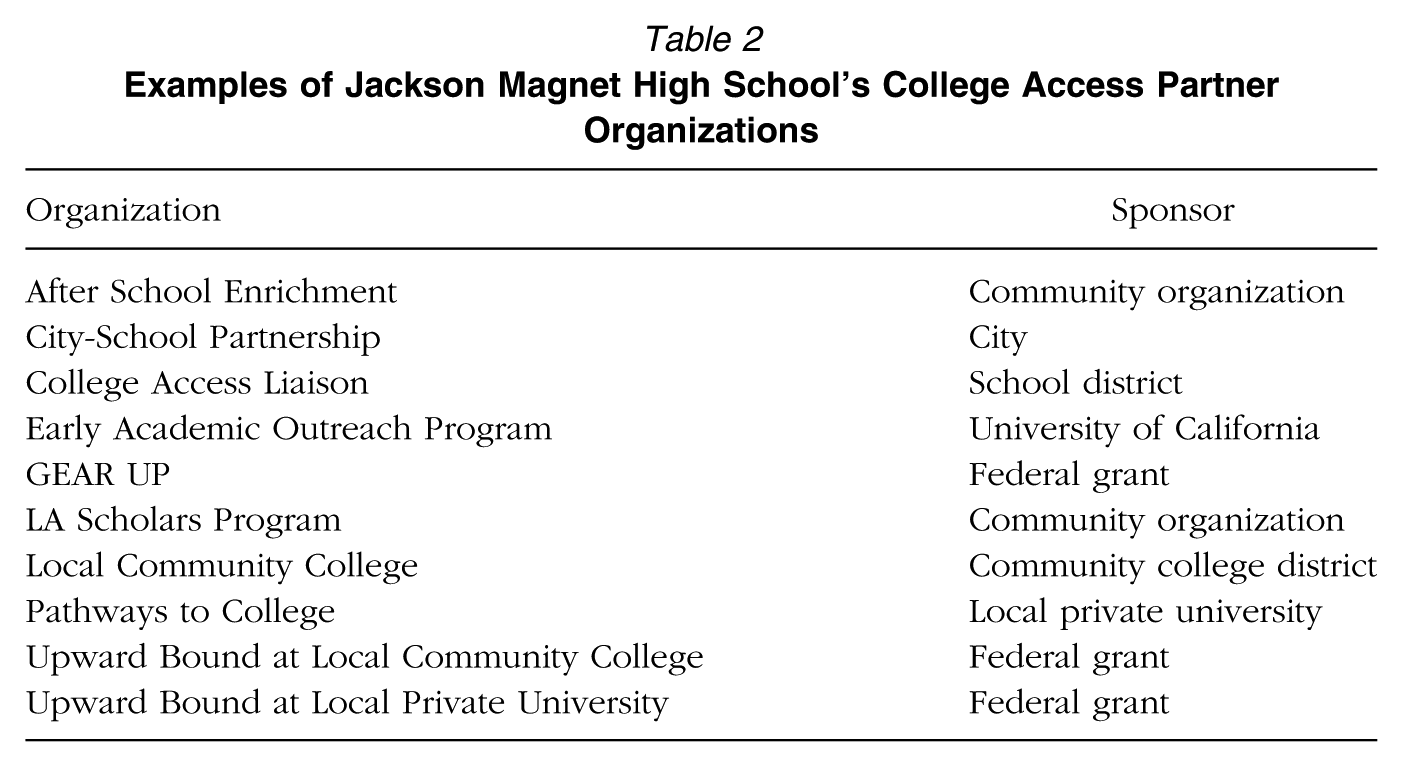
Jackson High School (all names of schools, programs, and people are pseudonyms) met the criterion of underresourced based on both geography and academic standards. Jackson is located in one of the poorest neighborhoods in Los Angeles, characterized by high rates of unemployment, racial segregation, and gang violence, and low levels of educational attainment. As such, the campus serves students who will be underrepresented in higher education and who have the greatest need with respect to college preparation and success. Though the school had demonstrated improvement over several years, it nevertheless trailed behind the district and state averages with respect to 4-year graduation, college-readiness curriculum completion, and proficiency in English and math (see Table 1). Jackson maintained more than 20 external partnerships designed to increase college access (see Table 2 for examples).
Jackson High School’s Performance Relative to District and State Averages

The figures in this column have been rounded slightly to mask the identity of the school.
As measured by Smarter Balanced Assessments. Source. California Assessment of Student Performance and Progress (n.d.): https://caaspp.cde.ca.gov/sb2016/Search
As reported in the Condition of Education. Source. NCES (2017): https://nces.ed.gov/programs/coe/indicator_coi.asp
Examples of Jackson Magnet High School’s College Access Partner Organizations
We focused on the magnet program, in part, for manageability, but with the qualitative understanding that a smaller organization would strengthen our ability to deliver thick description. Approximately 300 of the 2,000 students on Jackson’s campus were enrolled in the magnet. 1 Billed as a college preparatory program with a “math-science” emphasis, the magnet required an application but did not have specific admission requirements. The program promoted 4-year college attendance, although students also considered other options such as community college. The district and state did not disaggregate Jackson Magnet’s data from that of its host campus, but internal reports indicate that while the magnet program was higher performing on basic proficiency metrics, 2 it produced roughly equal passing rates on Advanced Placement exams (35%).
The selection of Jackson Magnet as the unit of analysis (as opposed to the whole campus) was intentional to support the specific goals of the study. Because of its college preparatory mission, the magnet school tended to attract university-bound students. Thus, as an instrumental case, the magnet provided a concentrated environment in which social capital was being brokered to a highly receptive and motivated student body. Magnet students were reasoned likely to exert the minimal agency required to yield social capital gains as described in the literature. This assumption of agency was practical to ensure the collection of data that reflected how resource opportunities were brokered from access to outcomes.
Jackson Magnet had its own office, administration, and faculty, which helped organizationally differentiate the program from its host campus. However, the magnet and the regular school shared certain college-going resources (e.g., workshops, program partners, computer labs), as both were underresourced and relied on external organizations to provide college assistance. For example, the year prior to data collection, Jackson’s designated college counselor was shifted to a school counselor role in order to reduce counselor caseloads from 700 to about 400. This in-house vacancy meant that the only formal sources of college-relevant social capital were the external partnerships, raising the stakes of organizational brokerage for students. Although the former college counselor still unofficially wrangled college-related matters, the implications of her new job description were important to the context of this study: “College is done, it’s being done. But students might have to wait.”
Sample
Of the 300 students in the magnet program, approximately 95% were Latinx and 5% were Black, a reflection of the surrounding community. More than 90% of Jackson Magnet students lived below the poverty line and were first-generation college goers. The sample for the study included 15 adults (10 school personnel and 5 delegates of external partnerships) and 25 college-bound seniors. School personnel were selected based on their participation in the organizational brokerage mechanisms that are the target of study. Specifically, they (a) worked with seniors in the magnet program, (b) supported college-going efforts campus-wide, and/or (c) provided services through a college access partner. The adults included the administrator in charge of the magnet program, the magnet counselor, the former campus-wide college counselor who now worked as a school counselor for the regular campus, seven of the nine total teachers in the magnet program, including all five senior teachers, and five external college access liaisons who regularly spent time on campus. These liaisons represented two TRIO organizations, the district’s college access division, After School Enrichment (ASE), and the Early Academic Outreach Program (see Table 2).
The 25 student participants represented one third of the magnet senior class, all of whom were of color, low-income, and first-generation. Students were recruited through a university-based college mentoring program with which the first author was affiliated. Fourteen of the students attended an information session about the study, and 11 others subsequently volunteered. Those remaining students were identified through snowball sampling, as recommended by the counselor or one of their classmates. In addition to their shared sociodemographic backgrounds, all students who participated in the study did so not only while applying to and eligible for the state’s universities but also while actively participating in college access program(s) and/or school-sponsored college events. For example, of the 12 magnet seniors served by a local Upward Bound program, 9 participated in the study.
Data Collection
Methods of data collection included observations, interviews, focus groups, and document analysis. Primary data were collected using a participant-observation protocol. More than 200 hours of observations were conducted at the school site, before, during, and after school. Observations took place in the Magnet Office where the counselor was housed and the computer lab, spaces where students typically encountered college-relevant information, worked on college-related tasks, and met with program representatives. Students were also observed attending college-related presentations, workshops, and after-school activities sponsored by external partners (e.g., SAT tutoring).
Interview and focus group data were collected to triangulate, supplement, and clarify insights gained during fieldwork. Formal semistructured interviews lasted an average of 60 minutes, and these were conducted using different protocols for the 10 personnel and 25 students. The Jackson personnel were asked about their experiences connecting students to partner organizations and interacting with delegates from these organizations. Students were asked to recount how they had learned about college-going resource opportunities and the extent to which they found these opportunities to be beneficial. In addition to their individual interviews, students participated in focus groups, which lasted an average of 1 to 2 hours and were conducted after school in the computer lab. These allowed for an interchange of perspectives on program experiences, revealing new insights that had not emerged in the one-on-one situations. Focus groups also enabled students to build toward a consensus about the problems and outcomes they perceived. All formal interviews and focus groups were audio recorded and transcribed. The five partnership delegates participated in informal interviews, which were used to triangulate findings.
A range of physical and digital document data were collected. Data summary sheets, internal evaluations, school report cards, and the magnet program website offered insight into organizational context. We also collected information pertinent to college advising and college recruitment, including fliers announcing on-site presentations, brochures for specific institutions, financial aid handouts, and applications for both college access programs and the colleges themselves. Pictures were taken of the school’s interior brokerage mechanisms such as hallways and bulletin boards. To triangulate information about programs as reported by students and school personnel, we reviewed the websites of the school’s partner organizations.
Data Analysis
Data analysis was an iterative process that began during the data collection process. As data were collected, they were read, coded, and accompanied by memoing. We used a combination of deductive and inductive strategies to code. We first coded using Small’s (2009) heuristic to organize the data into brokerage categories and to identify allied organizational mechanisms such as policies, infrastructures, and culture. Based on the social capital literature, we also coded for expressions of agency and trust as demonstrated either by students or Jackson personnel. Grounded coding allowed for descriptive themes to emerge organically from the data. In this study, for example, we noticed and coded to differentiate between instances of minimal versus maximal effort demonstrated on the part of personnel. We also noticed and coded to track how brokerage mechanisms variably constrained the menu of resource opportunities from which students made personal choices.
To identify patterns and build findings from our codes, we used a tiered questioning approach recommended by Neumann (2006). In a first level of questioning, we focused on the organizational perspective: How does the school use brokerage mechanisms to connect students to college-going information? In the second level of questioning we shifted to the targets of brokerage: What does the student say the school did to help him or her access college-going information? A third level of questioning interrogated the answers from the first two levels: How and why does the school enhance or impede students’ access to college-going information?
Four primary strategies were used to ensure trustworthiness: triangulation by data and method (Mathison, 1988), the constant comparative method (Glaser & Strauss, 1967), member checks, and reflexive journaling. Data from the student focus groups and informal interviews with partner delegates were triangulated and compared during the analysis of observations and one-on-one interviews. In addition, informal conversations with office personnel occurred daily and enabled ongoing reflection on the study and its emergent findings. Member checks were conducted during fieldwork through methods such as clarifying meaning during interviews and checking in after to gain feedback on interpretation. In addition, all participants were invited to review their interview transcripts, although only one student chose to do so. Finally, as White, middle-class women studying a predominantly low-income Latinx school, we engaged in reflexive memoing and bracketing to address our positionality and subjectivity with the intention to diminish bias. To support transferability of findings, we acknowledge the study’s limitations with respect to time and sampling. First, college access requires intervention prior to 12th grade (Conley, 2014), but we were only able to track brokerage processes as they affected Jackson Magnet’s graduating seniors. Second, our sample reflects a self-selected subgroup of college-bound, university-eligible students, and should be interpreted in that light.
Findings
Jackson’s organizational partnerships totaled almost two dozen and, consistent with Small’s (2009) formulation, varied in “complexity, stability, authority, and formality” (p. 16; see Table 2). In the words of the assistant principal, “Numerous programs partner up with us in a lot of ways and provide a lot of resources to assist students with the whole college process.” Some of the partnerships, such as those with TRIO programs, were made available through federal grants and approved by the principal. Others were initiated more informally with local community- or university-based programs. As the former college counselor explained, “Some of [our partners], they just . . . I don’t know how they all got in here, but we’re grateful.” She paused before elaborating: When people think [of the inner city], we’re in the middle of it. So they want to rescue and they want to help, and so we’re here, and we’ll take it. You know what I’m saying? We’ll take it. But it’s not like we, you know go out and get them. They just come.
In what follows, we illustrate the process of organizational brokerage theorized by Small. Specifically, we track how Jackson Magnet used storage, validation, referral, and collaboration to broker the social capital embedded in its organizational partnerships. To magnify nuances, we describe each mechanism in isolation, orienting the reader with a review of Small’s definition. Data are presented to illustrate not only how brokerage was practiced at Jackson but also how students accessed and used the social capital that was made available to them.
Storage
Small (2009) characterized storage as a “distinctly organizational form of brokerage” (p. 138) because the information is communicated through the organization’s physical space—in this case, a school’s campus. Storage enables organizations to passively communicate information for students to “come across or look over during the daily routine” (p. 138). At Jackson Magnet, the bulk of college-related information was prominently stored in the Magnet Office, a central location that students passed while walking between classes. As one student observed, “You go to the Magnet Office and there’s all these fliers!” Colorful pennants and posters of postsecondary institutions—from large public state universities to small liberal arts colleges—enveloped the Magnet Office and the adjacent computer lab where students often gathered to fill out college applications. The bulletin boards teemed with fliers, advertising everything from college-related support programs and application workshops to services such as academic tutoring and college advising. Classrooms also served as spaces for storing information about college deadlines and programs.
While stored materials varied in size, shape, and reproduction quality from professional to xeroxed, the majority were produced by external partners and sent to the school for student distribution. Some materials solicited enrollment in particular programs. For example, two Upward Bound cohorts—one run through a private university, the other through a local community college—advertised to Jackson students. Other materials were procedural in nature, providing checklist information such as when to register for the SAT, where to obtain a scholarship application, or how to receive help writing a personal statement. An entire paper stand in the Magnet Office was stocked with financial aid information and preparation packets for college admission and placement tests.
Students appreciated the quantity of posted information and the wealth of resources these postings implied. Juan reflected, “Magnet gives us all this information that you don’t even know you need, but you have in hand just in case, like college field trips, college application seminars, programs outside of school, stuff like this.” According to Daniel, “Even though Jackson is not as good as other schools, they have a lot of support here, a lot of programs that help you out.” Another student concurred, “Everything this year came to us through the school. They make sure that we get that information, because a lot of people don’t know where to start.” The effectiveness of storage was evident to Analucia, who noted, “You need to read your walls! Because you know there might be an opportunity on there.”
Students accessed and used the information stored at Jackson in various ways. Some students paid less attention to posted information, such as Sofia who rhetorically asked, “Who reads the wall?” Others credited storage with increasing their awareness of resources, even if they did not pursue them. Referring to an enrichment program held after school, Cindy shared, “I don’t really get involved, but I see that they do post a lot of posters, so I know they offer cooking classes, SAT prep, a lot of programs after school.” Mario recalled learning about a mentoring program through storage, but confessed, “Sometimes I don’t take the opportunities that are given to me.” He elaborated, “So like, Pathways to College. I had the flier and I was like, ‘Oh, I should apply to it.’ But then I didn’t.’” Francisco expressed interest in another mentoring program advertised at Jackson Magnet and never submitted an application. Yet for many students, storage functioned as a call to action. Paz explained, “When I see a flier that they’re talking about, I go, ‘What is that?’ I get interested and I look for it.” Stored information was often the first point of contact for students to develop a connection. Analucia, for example, joined her Upward Bound program after noticing that “Mr. Anderson had a little sign on his [classroom] wall.” Emi, who aspired to attend a private college, joined every program she found promoted on a flier, though later expressed frustration that “different mentors say different things.”
Although Jackson primarily served as a warehouse for externally produced information, some of the materials were generated in-house. For instance, Ms. Garcia, the former college counselor, created a handout with step-by-step instructions for navigating the daunting Free Application for Federal Student Aid (FAFSA) website. The FAFSA handout not only helped students fill out their applications in the computer lab but also raised financial aid awareness across the community. One senior confessed, “Before I got that [handout] from Ms. Garcia, I thought, ‘I’m just going to go [to college] somewhere and hopefully somebody’s going to give me money.’” The Magnet counselor, Ms. Velasquez, similarly tailored how college information was stored for student use. She strategically placed a whiteboard on an easel in the hallway outside the Magnet Office, which was updated daily with reminders for college-related events and deadlines (see Figure 1). On back-to-school night, five college-bound seniors were manning a concessions table outside the Magnet Office. Written on the hallway whiteboard behind them were the details of an event: “CSU/UC Application Assistance: Friday, Oct. 17, Rm. 102, 12:40-2:00pm.” Toward the end of the evening, one student glanced over at the board and her eyes perked open: “You guys! We have to go to the CSU [California State University] application workshop tomorrow!” “Oh, I almost forgot about that!” another replied. The seniors agreed to attend together, and to text one another reminders in the morning.
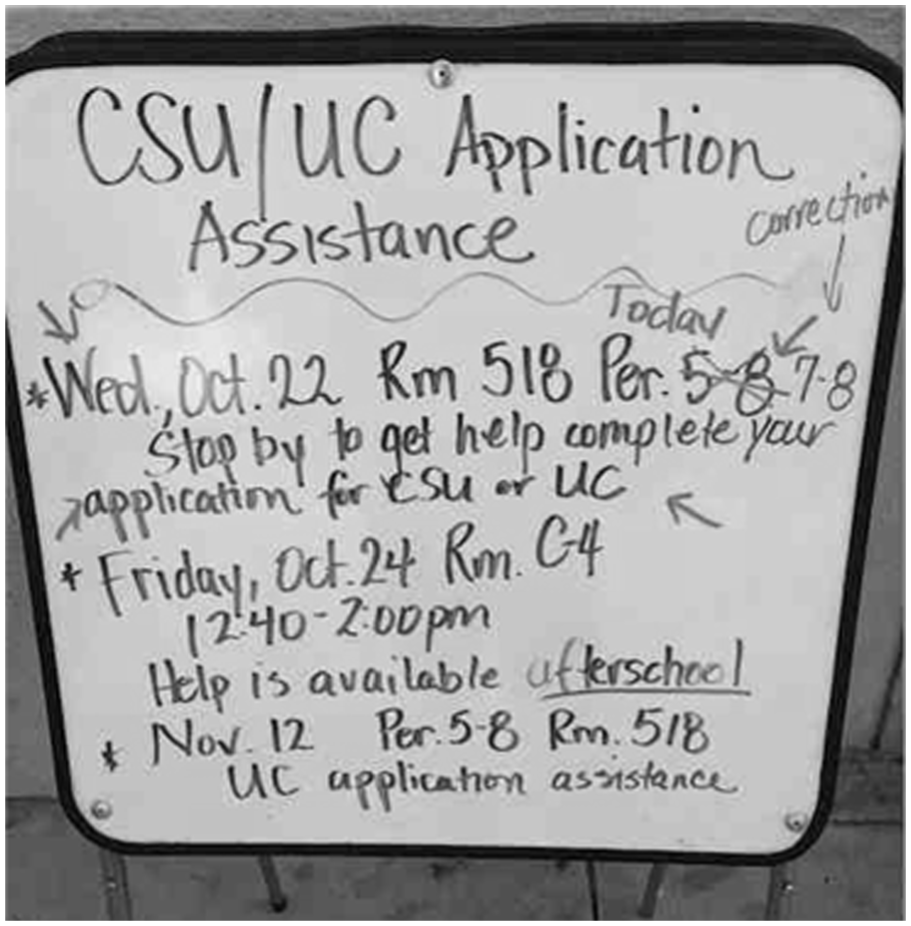
Announcements on Ms. Velasquez’s whiteboard.
Validation
While storage exposed students to resources via public sightlines, validation confirmed their eligibility to receive a resource from an external partner. Small (2009) described validation as an institutionalized process that sanctions a member’s access to “material goods, including cash substitutes, from other organizations” (p. 151). The most common validation practice at Jackson was distributing fee waivers for college admission tests. The College Board allows students whose households fall below a specific income threshold—essentially all students enrolled at Jackson—to take the SAT and SAT Subject tests for free. Waivers were official slips of paper that featured a 12-digit access code redeemable through the SAT registration website. These slips were kept in the top drawer of Ms. Garcia’s desk in the counseling office and handed out upon request by a student. Fee waiver eligibility was advertised on SAT fliers and transmitted by word of mouth. Announcements at college-related events reminded students to obtain their waiver through Ms. Garcia. Throughout the fall, Ms. Velasquez herded seniors in the Magnet Office to “Go next door and get your waiver!” In addition to SAT test registration, the school validated fee waivers for applications to private institutions, which were distributed through Ms. Garcia using the same process.
Throughout the fall, SAT fee waivers were a common topic of discussion among seniors as they worked on their college applications. Students could often be heard deliberating upcoming SAT test registration dates: “Have you registered yet?” “Did you get your waiver?” Sometimes students reminded each other about the opportunity. Hector explained, “I first thought that since I couldn’t afford the SAT, I’ll just go to community [college]. But then Juan told me that Ms. Garcia had fee waivers, which I didn’t even know.” Some students were especially proactive about obtaining waivers. Emi, one of the few seniors who sought admission at a liberal arts college, frequented the counseling office: “I applied to seven private colleges, but each one cost like 50 bucks or more, so I went to Ms. Garcia every time for a waiver.”
In addition to the formal validation of fee waivers, the school implicitly validated access to exclusive conferences, programs, or scholarships. In these situations, validation meant that the school distributed applications, without which students could not be considered for certain opportunities. Applications typically came to the counselors through the district or directly from a partner organization. Sometimes homeroom announcements directed students to procure an application in the Magnet Office. Other times Ms. Velasquez handed the application directly to a student. When Carmen and Paz happened to be eating lunch in the Magnet Office one day in October, for example, Ms. Velasquez handed each of them an application with the explanation, “This scholarship is open to Los Angeles high school students. It’s worth applying!” She left the remaining stack of applications on the desk at the entrance to the office.
In some instances, restrictive or adverse distribution conditions undermined Jackson Magnet’s standard validation procedures. The College Board, for example, allocated only two fee waivers per low-income student for the SAT I test. After Lydia scored poorly twice, she was devastated to learn she could not receive another waiver. Because of the College Board’s mandates, the school could not validate her right to retake the test for free. In other instances, outside organizations did not allot sufficient time for Jackson personnel to validate opportunities. For instance, one Thursday afternoon during passing period Ms. Velasquez was pacing back and forth outside the Magnet Office. Motioning toward a stack of papers in her hand, she explained, “This is an application for a district-run leadership conference for Chicano youth, a fabulous opportunity. But when did I receive it? Today. When is it due? Tomorrow.” She pointed out that students needed an essay and recommendation letters. “How am I supposed to distribute the application, and how are students supposed to complete it, in only 24 hours? They can’t do that.” In both of these situations, organizational brokerage occurred through contingencies enacted by school personnel. In Lydia’s case, her drawing teacher paid for her third SAT registration. “I didn’t even ask her,” Lydia explained. “I told her that the last time [to take the test] is December 6th and she’s like, ‘I’ll pay for it.’ I couldn’t believe it.” With respect to the leadership conference, Ms. Velasquez tracked down two students whom she thought might be able to complete the application last minute.
Referral
Whereas validation confirmed students’ eligibility for a resource available to Jackson’s population, referrals connected specific students to specific partner organizations. Small (2009) pointed out that, unlike validation, referral does not require a member to “purposely pursue the resource” (p. 155). Jackson’s primary referral mechanism used a basic administrative routine known school-wide as a summons. A summons was a generic dispatch issued by administrative personnel that directed a student to go to a certain place at a certain time, either during lunch or during class. The counselors used summons to send seniors to a college access partner-sponsored event or meet with program liaisons. When an admissions representative from a private women’s college gave a presentation in September, Ms. Velasquez sent a summons to a handful of female seniors with potential interest in an all-women’s school. When a competitive program opportunity was presented on campus, students who met the application criteria were summoned to attend. For instance, the senior class president, who held a GPA of 3.9, was referred to an information session for an elite scholarship program for students of color. Similarly, Edward’s participation in Community Scholars, a highly selective community-based program, began with “. . . a referral from the counselor we had that year. I went to his office and he sent me to meet with the [program] director.”
Many students credited a summons with introducing them to an external organization. Edward, for example, confessed that he “didn’t even know Community Scholars existed!” before his referral. By consensus, students in the community college-sponsored Upward Bound program suggested a summons had prompted their enrollment:
I got a summons about it.
Yeah we got a summons from the old counselor.
Because that was the first year they had started up that program.
A referral was a starting point from which a student could develop a connection. The Upward Bound students explained how their participation escalated after the referral:
So they gave us all the information of what the program was, and then they would give us the packet that we had to fill out, the essay.
Yeah we had to fill out an application.
Ms. Garcia pointed out that while a summons created awareness of a program opportunity, “the students kind of self-select[ed]” when it came to actually joining. After Analucia was referred to an elite engineering camp, for example, she worried that “I’m never going to get in!” but decided to apply anyway: “It was worth it. But I didn’t hear of anyone else applying.”
Students who pursued an opportunity based on a referral had varied experiences. Jesus praised a local university’s mentorship program, explaining that “without [my mentor], I would never have finished my personal statement. She was helping me edit right up until it was due.” Edward similarly held a program in high esteem based on its liaisons, who “helped me figure out which schools to apply to based on my interests.” Others gave their programs mixed reviews, questioning the expertise of certain delegates. Emi explained, “When I asked this one lady for help with my application, she would look it up on her cellphone to answer my questions.” Cindy recalled how a mentor from another program relayed misinformation about the components of the CSU application. “I mean she’s [a current student] at a CSU!” exclaimed Daisy. “Shouldn’t she know what it takes to get in?” Ms. Velasquez echoed these students’ concerns when she confided that, while partnering organizations were well intentioned, “some of these [program representatives] are just plain lazy.” The assistant principal commented that some programs might be “more effective” if they “learned a bit more about how high schools work.” One challenge, according to Ms. Velasquez, was that the responsibility to monitor outside organizations fell unofficially on a few different Jackson personnel, who “could just be as loosey goosey as the providers that they’re trying to keep in check.”
On rare occasions, potential problems with college access partners were averted when referrals were appended by a follow-up. In early November, for example, Carmen—who was close to failing two classes—received a summons to meet with the district’s college access liaison. When Ms. Velasquez checked in with her a day later, Carmen reported that she was “not that worried anymore” about her grades because “[the liaison] said, it’s okay that [my SAT and GPA] aren’t high because [my] extracurricular activities are excellent.” She remembered the liaison explaining that, “[Extracurricular participation] shows that you work well with others, you’re very independent, stuff like that.” Carmen summarized her takeaway: “So I am pretty sure there are students who have a 4.0 and they don’t get accepted [to college] because extracurricular activities are a huge part of your acceptance.” Ms. Velasquez’s response to Carmen was direct: “Failing classes could prevent you from being accepted.” She instructed Carmen to improve her grades and to “meet with [your teachers] by the end of the week.” In another instance, students who had been referred to a GEAR UP program were encouraged by the liaison to make up a failed history course at community college. When Ms. Velasquez followed up with the students and learned of this advice, she redirected them to retake the class at Jackson. Based on her years of experience, she explained why: You send the kids to community college for enrichment, not to retake a class. Because if they don’t have the skills, you’re gonna set them up to fail again. Community college is [only] if you think you can handle college work.
Collaboration
Collaboration involved joint investments on the part of the school and its partners to bring social capital opportunities to its student body. This mechanism differed from referral in that Jackson Magnet “provid[ed] logistical support for the externally provided good” (Small, 2009, p. 151). The most basic form of collaboration at Jackson Magnet was sponsoring college access events such as presentations, fieldtrips, and workshops. In these cases, the school provided time, space, or transportation, and the partner furnished the students with an opportunity. For example, hosting events required school personnel to schedule time slots and reserve campus facilities. In September, a representative from the mentoring program Pathways to College presented at lunch in the computer lab to a group of fifteen seniors. College fairs spanned half a day and were held in Jackson’s gym, where students could gather brochures or chat with delegates from numerous postsecondary institutions. Paz selected her top choice UC when “they had a little college fair on campus that day.” In addition, Jackson Magnet provided staff and transportation so that students could visit college campuses. Ms. Velasquez took students to her alma mater, a small private school about an hour away, which motivated Emi to apply.
Jackson Magnet also sponsored workshops that brought together representatives from local universities, the school district, and college access programs to provide application support. These events spanned several hours after school or on weekends so that students could receive concrete guidance on college admission tasks. Mr. Ruiz explained the purpose of workshops: “to keep students very informed as far as the difference between the various colleges, UCs vs. CSUs, community colleges, [and] privates, the application process, deadlines, [and] FAFSA.” In the spring, workshops termed “Cash for College” provided comprehensive financial aid information in English and Spanish to students and their families. Fliers and daily announcements reminded Magnet students that attending at least one Cash for College workshop was mandatory, and daily whiteboard updates featured a countdown to the FAFSA deadline. By March, 97% of Magnet seniors had submitted their FAFSA or Dream Act forms.
Students often cited these cosponsored events as sources of college-going support, explaining that “Magnet brings people in to help us with college” and “the school brings in groups to help us with our applications.” How they responded to these opportunities, however, varied depending on the type of event and students’ personal circumstances. In the view of one teacher, outsiders “do a good job speaking or presenting but then, it motivates our students for a couple of days but it wears off after a couple weeks.” Analucia joined Tech Camp, a summer engineering program, after “the counselor invited the director and he made a presentation about it.” Yet for others, making a long-term commitment to a program after an information session was prohibitive. Jesus, for instance, did not apply to Upward Bound because he traveled to visit family in Guatemala every summer and was unable to attend mandatory summer courses. Alex also did not apply because he picked up his little brother after school and thus could not attend weekly tutoring sessions. He did, however, rely on “the FAFSA workshop here” for help completing his financial aid forms.
The school’s most extensive collaborations involved housing external partners on campus long term. Through a federal grant, for example, a GEAR UP representative was assigned to Jackson Magnet to monitor select students and help them stay on track for graduation and college admission. Although this representative was the one who counseled students to make up history credits at community college, Ms. Velasquez recognized the value of an on-site person: “[the GEAR UP liaison] is very green, but she is learning. And she has developed good rapport with the students because they see her everyday.” Jackson also housed ASE, a nonprofit organization, in an office on campus. The program’s liaison, Matt, attended Jackson Magnet’s faculty meetings, gained insight into student needs, and tailored after school support accordingly. Matt described some of his responsibilities: “making sure the computer lab is accessible [to students] for college applications and FAFSA, sponsoring student clubs, and offering SAT tutoring.” One senior shared, “We kept going to ASE, because they reviewed all the [SAT] vocabulary.” Being housed on-site meant Matt sometimes acted as an unofficial Jackson Magnet employee, referring students to other organizations based on matching college or career interests. Jimena, who hoped to pursue public health, cited Matt as the biggest influence on her postsecondary plans: “It’s thanks to him I joined [a community health care organization] and that’s one of the best programs I’ve been in.” The assistant principal praised organizations such as ASE “that are consistent and that can stay for a long period of time, versus programs that sometimes are cut midway because of budget issues.”
Another long-term collaboration gave students the opportunity to earn college-level credits on Jackson Magnet’s campus through a partnership with a local community college. Ms. Garcia explained, “the school paid for a couple of college classes to be taught here at Jackson so that’s big because the students are not really exposed to [college academics].” Investment was mutual: the college hired the instructors to teach satellite sections of Criminal Justice and Psychology, and the school allocated classroom space and populated the courses. The enrollment process involved joint efforts from Jackson’s counselors and the district’s college access liaison to identify juniors and seniors with an open period, summon those students into the office, explain the opportunity, and finalize the registration. Hector, who was enrolled in the Criminal Justice course, reflected, “The school already gave us college classes to let us see what college is. So it’s like, that’s a very good plus.”
Discussion
Data in the previous section demonstrate how Jackson Magnet High School brokered college-going resources available through its organizational partners. While segregating the data into Small’s (2009) categories supported descriptive nuance, in this section, we consider the data set as a whole, highlighting implications for theory, practice, and future research. When the data are viewed in aggregate, several observations emerge.
First, the distinctions amid the frames of the heuristic were not always clear-cut. For instance, validation overlapped with storage when the counselor left a stack of scholarship applications on a desk in the Magnet Office. Warehousing the information is a form of storage, but granting students the right to apply for the opportunity is a form of validation. Some examples of validation also resembled referral, such as when Ms. Velasquez sought out two students to complete the Chicano Leadership Conference application. On the one hand, her actions demonstrate simple referral insofar as she paired students directly with the application. On the other hand, her actions validated the conference opportunity under a deadline that otherwise reduced student access. Thus, despite conceptual distinctions among the four mechanisms, in practice, brokerage processes sometimes blurred.
Second, any given resource was typically brokered across more than one mechanism. Storage invited students to take advantage of opportunities also brokered through other mechanisms and sometimes all. Fliers displaying SAT registration information reminded students to get their fee waivers validated. Whiteboard announcements and posters around campus directed students to attend workshops representing collaboration. Referral also supported collaboration when, for example, students were summoned to attend an external presentation, or selected to enroll in courses taught by community college instructors. In short, the school orchestrated brokerage across all mechanisms simultaneously, which intersected with and reinforced one another.
Third, although Small characterized storage and validation as relatively passive compared with referral and collaboration, our data demonstrate passive and active nuances within each category. These nuances reflect the extent to which the school invested its own assets—building facilities, administrative infrastructure, policies, labor, and even culture—to carry out brokerage tasks. For example, while most storage entailed passively displaying materials from external organizations, sometimes materials were actively curated in-house, reflecting a greater investment of labor. Often validation merely confirmed students’ resource eligibility, though occasionally school personnel sought workarounds when standard procedures failed. Referral was passive when the school simply issued a summons, and active when personnel followed up with students about their ties. Collaboration to sponsor a one-off event was a minimal school investment compared with housing external partners for the long term. (Table 3 itemizes active and passive versions of each mechanism with examples from the data set.) In what follows, we elaborate on these passive and active nuances and their implications for students’ social capital.
Passive and Active Versions of Brokerage at Jackson Magnet High School
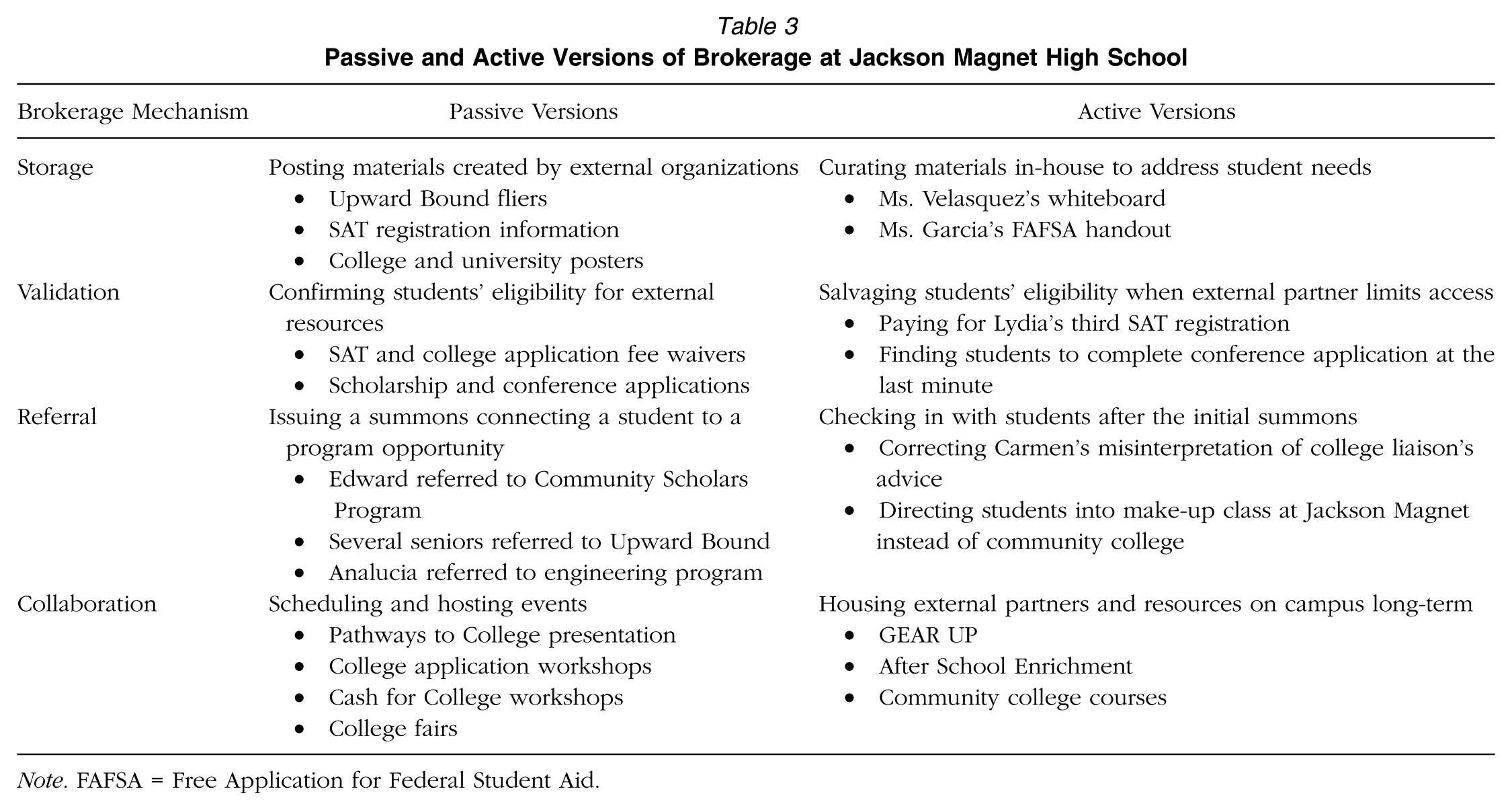
Note. FAFSA = Free Application for Federal Student Aid.
Passive Brokerage Prioritized Quantity
Passive versions of brokerage reflected minimal investments on the part of the school and generated a higher quantity of social capital opportunities. Storage that relied on vacant wall space passively brokered information without mediation by school personnel. Labor demands were also minimal as it took only thumbtacks or masking tape to store a poster on a bulletin board or wall. With respect to validation, idle room in Ms. Garcia’s desk drawer and a moment of the office staff’s time were the only school assets needed to broker a fee waiver. Referrals issued by summons required a marginal investment, as they tapped the school’s existing infrastructure and took only a minute for personnel to execute. Collaboration by hosting a one-off event simply meant scheduling a time slot and reserving an unoccupied space such as the school’s computer lab in which to hold it.
With regard to outcomes, passive brokerage increased the number of resources to which the most students were exposed. Because pedestrian traffic outside the Magnet Office was high, passive storage provided the most students with access to a constant cache of college-related opportunities. Waivers stockpiled in Ms. Garcia’s desk or applications stacked at the office entrance were readily available to inquiring seniors. Given most students attributed their program participation to receipt of a summons, this version of referral brokered the most introductions that progressed into organizational ties. Volume was also underwritten by hosting which connected any student who attended an event to a viable resource opportunity. High rates of access translated to high rates of success when 97% of Magnet’s seniors, with the help of the Cash for College workshops, completed their financial aid forms.
Despite supporting a high quantity of opportunities for the most students, passive brokerage was inattentive to resource quality. Facilities such as walls and whiteboards alone did not help students interpret stored information. Unmediated access, in turn, sometimes meant unintended consequences for students. Recall how Emi joined every program advertised at Jackson Magnet, only to become confused by contradictory feedback from different mentors. Passive validation enabled all eligible students to obtain an SAT fee waiver, but stopped short of helping students not only prepare for the test but also retake it if they scored poorly multiple times. Although passive referral and collaboration brokered maximal access to social capital, the school’s minimal investment underwrote an indifference to what, if anything, students gained (or lost) through their use of organizational ties. Given that students and personnel alike expressed concerns about the competence of certain partner liaisons, the data suggest that initial connections did not always translate to long-term or high-quality social capital gains.
Active Brokerage Prioritized Quality
Active versions of brokerage represented a greater overall investment by the school and enhanced the quality of students’ social capital access and use. For example, tailoring stored materials such as the FAFSA handout or updating the whiteboard required personnel to exert more time and effort than was needed to tape fliers to a wall. The school likewise invested more labor in validation when, for instance, Lydia’s art teacher paid for her to take the SAT, or Ms. Velasquez tracked down two students to confirm a last-minute conference opportunity. While these examples may seem like random decisions by school personnel, the art teacher’s generosity and the counselor’s diligence were, from an organizational perspective, brokered by a school culture that tangibly prioritized college access. Referral postscripted with a check-in also required personnel to expend more effort when, for instance, Ms. Velasquez followed up with Carmen after her meeting with a college access liaison. The school’s most substantial investments were its long-term collaborations. To house a program on campus required allocating office space. Offering community college courses involved not only prolonged use of classroom facilities but also personnel time to register students.
In terms of outcomes, active brokerage prioritized quality by encouraging productive access to and use of resources. Ms. Garcia’s FAFSA handout minimized the odds that a student would misinterpret the financial aid website, and Ms. Velasquez’s whiteboard distilled an overabundance of college-related information into a practical daily agenda. Active validation salvaged access to a partner’s resources that the school could not otherwise broker. Without her art teacher, Lydia could not have afforded to retake the SAT, reducing the competitiveness of her college application. Informal check-ins maximized the potential benefits of referral by minimizing its liabilities. For instance, Ms. Velasquez’s follow-up helped Carmen stay on track academically by correcting how she had interpreted the district liaison’s advice. Active versions of collaboration increased the stability and availability of external resources. Because ASE was housed on campus, the liaison was able to offer personalized college and career guidance to students like Jimena. Through the community college courses, the school brokered experiential knowledge of professor expectations and college curriculum.
Despite better quality management of resource access and use, active brokerage tended to serve fewer students as well as limit the range of available opportunities. By curating stored information, for example, the whiteboard tacitly deterred students from considering other possibilities. More labor-intensive validation reached fewer students; the art teacher could not have covered the cost of test registration for the whole senior class. Similarly, only select students benefited when referral was followed by a check-in. Multiple students described receiving misinformation about college admission from external liaisons, but the school did not systematically monitor students’ ties, hindering the ability of personnel to identify, let alone intervene in, each case. Similarly, finite campus space necessarily limited the number of long-term collaborations in which the school could invest. The allocation of campus space to GEAR UP and ASE reduced student exposure to other options. The community college courses, meanwhile, only had spaces for a limited number of students.
Ultimately, these themes of quantity and quality provide answers to the study’s research questions. First, Jackson Magnet brokered resource opportunities for its students by investing its own in-house assets in the brokerage process. Second, the extent of the school’s investment shaped the quantity and quality of resource access and use by students. Passive brokerage obliged a minimal investment on the part of the school and produced a high quantity of opportunities, sometimes at the expense of quality. In contrast, active brokerage expended more school assets to shepherd resource use, but it meant serving fewer students with fewer options.
Theoretical Relevance
Several implications for theory emerge from the data. The main takeaway is that our findings confirm Small’s (2009) contention that organizational brokerage mediates student agency. In particular, our data demonstrate that student agency was inversely proportional to the school’s brokerage investment, with active requiring less agency of students than passive. When brokerage was passive, students had to exert more effort to access and mobilize resources, which sometimes caused problems. Consider that passive storage left Emi vulnerable to the assumption that joining more programs would improve her college prospects, or passive referral left students susceptible to misinformation about college admission. When brokerage was active, the school reduced room for student error. Ms. Velasquez’s whiteboard, for example, prompted students who would otherwise have forgotten to attend the CSU workshop. Active brokerage—such as when Ms. Velasquez repealed the GEAR UP liaison’s advice—proved auspicious when inconsistent resource quality actually jeopardized student outcomes. Active collaboration brokered the benefits of a college class without requiring students to find a course, register, and secure transportation to and from a community college campus.
To be sure, some level of student agency was always implicit in reaping social capital gains, as research from the student perspective has shown (Musoba & Baez, 2009); students had to “read their walls,” respond to summons, attend presentations, and so on. Moreover, students exercised agency in different ways, choosing among available opportunities based on their personal circumstances. Recall, for example, how Alex could not commit to a program, but he did attend workshops. Yet while organizational brokerage did not completely eliminate the need for student agency, it reduced the amount of agency that would otherwise have been required by creating social capital opportunities students “would not have thought to ask for” (Small, 2009, p. 139). In short, students had to act, but only enough to respond to the school’s brokered prompts, affirming Small’s (2009) claim that “organizational brokerage introduces the possibility of acquiring resources while exercising little agency in the process” (p. 155).
In addition, our data theoretically augment prior research that suggests trust is a precondition of student agency (MacLeod, 1987; Stanton-Sálazar & Dornbusch, 1995). While social capital research from the student perspective (Coleman, 1988) and even Small’s (2009) work have focused on how trust mediates social ties to individuals, our data indicate that students placed trust in their school. Whether it was a flier on the wall, an organization to which they were referred, or a program presentation, the students believed that “Magnet brings people in to help us.” Emi, for example, trusted that all the programs advertised at Jackson Magnet were worth joining. Thus, trust offers a possible explanation for the cases where passive brokerage negatively impacted students. Even in the face of questionable or contradictory advice, students trusted the resource opportunity because the school—through brokerage—had tacitly endorsed it. These data directly contradict research showing that historically marginalized students often feel alienated from their schools (Stanton-Salazar, 1997), or may be more inclined to trust their family networks (Pérez & McDonough, 2008; Person & Rosenbaum, 2006). At the same time, the inference of organizational trust is consistent with the finding that first-generation students tend to rely on their high schools for postsecondary guidance (Duncheon & Relles, in press; Holland, 2010), but with the major stipulation that the school did not always deserve to be trusted.
Last, our findings caveat Small’s (2009) implicit assumption that organizational partnerships are inexorably beneficial. Small’s work suggests that maintaining connections to other resource-rich organizations is a precondition for brokerage, and that the more partnerships maintained by an organization, the more social capital opportunities will be available for its members. Our data, however, reveal the potential liabilities of welcoming organizational partners indiscriminately, as Jackson Magnet seemed to do. Recall Ms. Garcia’s comment: “I don’t know how [our college access partners] all got in here, but . . . we’ll take it.” Yet because the school’s in-house assets were limited to begin with, its capacity to invest in brokerage mechanisms was also limited, leading to what Ms. Velasquez termed a “loose-goosey” approach. There were too many partnerships for school personnel to broker resources in ways that ensured student gains. As a result, brokerage was unsystematic and inequitably dispersed. In short, seemingly innocuous partnership choices—such as which materials to store or which presentations to host—were consequential for students’ social capital outcomes. Our data raise questions about the theoretical bias that social capital is always advantageous for schools to broker and for students to acquire.
Implications
The importance of brokerage at Jackson Magnet High School derived, in part, from the underlying paradox that students with limited access to college-relevant social capital at home are largely expected to have the agency to acquire it at school (Farmer-Hinton, 2008; Holland, 2010). Brokering resources was a double-edged sword for students because, in Juan’s words, “[You get] all this information that you don’t even know you need.” Jackson Magnet’s overall approach to organizational brokerage implied a “more the merrier” viewpoint, and in theory, exposing students to as many resources as possible would seem beneficial. But in practice, students benefited from more organizational support. Unfortunately, the same resource constraints that led the school to rely on college access partnerships in the first place also limited the school’s ability to broker actively. Certainly, conscientious choices about partnerships, whether made at the school or district level, may be more productive than expending school labor to police the quality of organizational ties once they have been brokered. Yet while it is tempting to deduce that a “less is more” approach would be more effective, we propose the need for comprehensive and systematic brokerage processes in urban schools. To this end, schools might benefit from collaboration with researchers to develop coherent brokerage plans, both active and passive, with attention to the benefits and tradeoffs of each.
This study highlights several avenues for future research. Studies that investigate how schools initially develop partnerships—how and why these decisions are made, and by whom—would be useful to understand the nature of a school’s network and its potential influence on students’ social capital. Research to further understand the unanticipated gains and losses of both active and passive brokerage is also recommended. Case studies of effective organizational partnerships may illuminate how resources are transferred productively from external partners to students in schools. Further research on trust, specifically the notion of organizational trust, may help explain why students pursue resource opportunities, which could inform institutional support options. Beyond these data-based options, we believe it is prudent to consider organizational brokerage in broader contexts than the subset of students served at Jackson Magnet. Research to understand the influence of organizational brokerage on students who do not have college-going aspirations is warranted. We also recommend studying digital forms of college-going support, such as text messaging or virtual advising, which represent a departure from traditional organizational partnerships. Whether and how digital tools benefit students may depend, in part, on how they are brokered and managed through a school’s website.
In closing, though we wish to make clear that all Jackson Magnet personnel were committed to increasing college access for students, the data demonstrate the difficulty of best intentions in educational contexts where systemic inequalities are rampant. On the one hand, passive brokerage democratized awareness of available resources, but with little to no consideration regarding how a first-generation student might interpret and respond. On the other hand, active brokerage improved resource acquisition on a case-by-case basis, but these practices did not always serve the student body writ large. It is our parting contention that education researchers, policymakers, and practitioners consider the extent to which college access policies and practices assume not only that students in need of social capital possess sufficient agency to acquire it but also that schools in need of external resources possess sufficient organizational capital to broker it.
Footnotes
Notes
J
S