



Abstract
Professional development [PD] providers can shape how teachers understand and implement new policies. Yet we have a limited understanding of how providers develop the ideas they promote. We explore this by examining social capital among mathematics PD providers. Using social network and interview data, we identified providers in brokerage positions and analyze their interactions. We found that broker behavior varied by organizational setting. Brokers in school districts typically discussed logistical issues related to PD delivery, while brokers outside of districts often discussed substantive mathematical topics. When district brokers did access substantive information, they rarely shared it. We conclude that (1) the disconnect between accessing and sharing diminished district brokers’ ability to support PD in their districts and (2) the lack of substance diminished their ability to influence ideas about mathematics.
Keywords
Introduction
The widespread adoption of the Common Core State Standards brings new ideas about instructional content, teaching and learning, and curriculum organization to classrooms across the United States. The standards differ notably from previous state standards, particularly in mathematics (Cobb & Jackson, 2011; Porter, McMaken, Hwang, & Yang, 2011; Schmidt & Houang, 2012). During times of reform, schools and districts often turn to professional development (PD) providers to support teacher learning (Little, 1993). PD providers comprise a wide variety of practitioners, all focused on offering teachers learning opportunities to improve their professional practice. As districts implement new standards, it is likely that they will rely on PD providers to help teachers as they learn the expectations of the new policy and begin to implement them in the classroom.
PD providers play an important, although often underacknowledged, role in the policy implementation process (Coburn, 2005a; Knapp, 2003; Little, 1993). The policy messages that teachers are exposed to, and how those messages are framed, matter for the implementation process (Spillane, Reiser, & Reimer, 2002). PD providers can actively filter, frame, and interpret the meaning of reforms as they present them to teachers and influence implementation in the classroom (Anagnostopoulos & Rutledge, 2007; Coburn, 2004, 2006; Woulfin, Donaldson, & Gonzales, 2015).
PD providers occupy a unique space in the educational sector. The educational sector consists of “system” actors—schools, districts, teachers, administrators, state educational offices—and “nonsystem” actors—nonprofits, universities, textbook publishers, commercial enterprises (Coburn, 2005a; Honig, 2004; Rowan, 2002). While researchers have often explored the role played by system actors, they have paid increasing attention to the role of nonsystem actors and intermediary organizations. Nonsystem actors can shape school-based actors understanding policy expectations (Coburn, 2004, 2005a, 2006), and intermediary organizations can provide schools with resources, expertise, and administrative support (Honig, 2004; Honig, Venkateswaran, & McNeil, 2017). For-profit enterprises have influenced the content and practice of teaching since the common school movement (Burch, 2006; Clifford, 1984), and philanthropic organizations are increasingly influential in creating educational policy (Reckhow & Snyder, 2014).
Providers of PD span this divide between system and nonsystem settings, which may influence the policy ideas that they promote in PD sessions. While PD providers often come from nonsystem settings (e.g., universities, nonprofits, for-profits), it is not uncommon for districts to develop the capacity to provide in-house PD. PD providers from many different settings participate in translating policy into practice. Aspects of an organization, such as roles, routines, and dominant norms and beliefs, can shape how actors understand policies (Spillane et al., 2002). It is likely that these aspects vary across PD providers by their organizational setting. This may lead to the development of different understandings of policy demands, based on the organizational setting of the providers. Since teachers often experience PD from multiple providers, they may receive incoherent or mixed messages about policies (Newmann, King, & Youngs, 2000; Penuel, Fishman, Yamaguchi, & Gallagher, 2007).
Despite the unique position of PD providers in the educational sector, there has been little sustained attention on how providers develop the policy messages they promote in PD opportunities. New policies, especially ambitious ones like the Common Core State Standards, abound with ideas about teaching and learning (Cohen & Moffitt, 2009). Which ideas get promoted has consequences for the implementation of policy. Ideas are shaped by social interactions. In conversations, people promote, frame, and interpret information about new policies. This process shapes the content, availability, and flow of information (Beckert, 2010). This is critical for the implementation of policies, since the available ideas in the environment can influence which practices are adopted (Coburn, 2004, 2005b; Rao, Monin, & Durand, 2003; Spillane, 1998). As PD providers interact, they develop shared understandings about new policies, which they present to teachers in PD opportunities.
Social capital theory provides a theoretical lens to explore how social relationships among PD providers affects the flow of information and ideas. Social capital consists of material and informational resources that actors have access to through social ties (Coleman, 1988; Lin, 2002; Portes, 1998). Scholars distinguished between social capital access, on the one hand, and mobilization or activation, on the other (Lin, 2002; Smith, 2000, 2005). Social ties enable actors to access information and resources. Actors encounter ideas and information that influence how they understand social phenomena (Beckert, 2010; Burt, 1999). However, actors must capitalize on this access by using the information and resources they access to achieve goals and advance their interests (Granovetter, 1973; Smith, 2005). Not all actors are equally positioned to access and activate social capital. A class of actors called brokers have unique social capital advantages, conferred by their position in a social network, that enable them to influence the content and flow of information (Burt, Kilduff, & Tasselli, 2013).
Using a social capital frame, this study explores the role of brokers in a regional social network of mathematics PD providers. Drawing on social network and interview data, we analyzed how PD providers who occupy informal broker roles interact with others, focusing on how they accessed and shared information and resources. The combination of network and interview data allowed us to, first, identify providers in influential positions and, second, to analyze the nature of their interactions. We found that while brokers were located both within and outside of school district settings, brokers from these settings engaged with their networks in contrasting fashions. While brokers based in both district and nondistrict used their network connections to access substantive information about mathematics PD, district-based brokers much more often interacted around technical and logistical information about the planning and delivery of PD, particularly when they shared information. The content of the information they shared mostly involved such logistical details rather than substantive topics related to mathematics PD. Brokers from nondistrict settings, on the other hand, both actively accessed and shared substantive information. We characterize this as a failure among district brokers to activate their social capital. From these findings, we draw two key conclusions. First, at the local level, nondistrict brokers had greater potential to support the complex work of planning and delivering PD opportunities. By failing to activate their social capital, the information accessed by district brokers was not relayed to other PD providers within districts, preventing access to outside expertise. Second, at the network level, outside actors were more likely to shape ideas about the Common Core in the mathematics PD network. Those nearest to the teaching and learning occurring inside of schools were less likely to influence the information teachers would receive about the Common Core mathematics standards.
Social Capital Access and Activation
To understand how interactions among PD providers shape social capital in a social network, we draw on the concept of brokerage (Burt, 1992). Social capital is a critical resource for individuals in organizations, especially for those engaged in complex work requiring knowledge from multiple domains. Individuals can use social connections to access expertise in areas relevant to their work, enabling them to be more effective at their job (Burt, 1992). Individuals can also use social capital to benefit organizational goals. By accessing information and expertise that are not available locally, individuals help support organizational work by sharing information with colleagues or making connections between them. This is particularly important for organizations that develop innovations (Hargadon & Sutton, 1997; Obstfeld, 2005), whose work depends on expertise from different knowledge domains (Hansen, 2002; Reagans & McEvily, 2003; Tortoriello, Reagans, & McEvily, 2012) or who work in emerging fields (Owen-Smith & Powell, 2004; Powell, Koput, & Smith-Doeer, 1996; Powell, White, Koput, & Owen-Smith, 2005).
Providing PD requires knowledge from multiple domains, including pedagogy, curriculum content and development, adult learning, and the needs and desires of schools and districts. The adoption of the Common Core introduces new curricular content and sequencing, along with new ideas about teaching and learning (Coburn, Hill, & Spillane, 2016; Hill, Beisiegel, & Jacob, 2013; Porter et al., 2011). Access to diverse expertise, which is often distributed over different organizations in a region (Owen-Smith & Powell, 2004), makes social capital a key resource for PD providers as they develop the capacity to plan and deliver PD opportunities to teachers in response to the Common Core.
The Social Capital Advantages of Brokerage Positions
Whether used as a resource for individual or collective purposes, social capital emerges from the social ties of individuals. The network position, composition, and range of ties affect an individual’s access to social capital. Of interest in the literature on social capital is the role of brokers, defined as individuals who span gaps in networks and mediate between other actors (Burt, 1992, 2007; Gould & Fernandez, 1989). By bridging gaps, brokers have ties to areas of a network that their peers do not. This confers two distinct advantages for brokers. First, they have access advantages—the ability to gather information and resources unavailable to others (Burt, 1992). This often means that they have boundary-spanning ties to individuals in other departments or organizations. For example, a PD provider working in a school district who has a tie to a university researcher with expertise in mathematics learning may have access to ideas about mathematics instructions that are unavailable to her colleagues. From the perspective of others in the school district, the PD provider has privileged information that could support the development and delivery of PD opportunities for teachers.
Second, thanks to their position of mediation, brokers have control advantages—the potential to influence the flow of information and resources through a network (Burt, 1992). Since information must flow through a broker to reach other areas of a network, a broker can manage information by selectively sharing, hoarding, filtering, or translating information (Burt, 1999; Fernandez & Gould, 1994; Kellogg, 2014; Stovel & Shaw, 2012). For this reason, brokerage positions can confer greater autonomy of action to individuals compared with others (Burt, 1992). Returning to the previous example, the PD provider can choose to share her information with others in her district or hoard it. Or she can—intentionally or not—interpret that information as she shares it, exerting a powerful influence on the information teachers receive (Coburn, 2005a). She may translate information to make it palatable to colleagues or to dissuade them from it. In any case, her privileged access gives her a range of actions not available to her colleagues. Such control advantages allow brokers to shape both the flow and the content of information across a network.
Brokers can use social capital advantages to advance personal or collective goals (Burt, 1992; Obstfeld, 2005; Stovel & Shaw, 2012). Because of their access to privileged information and resources, they can provide valuable resources to an organization. But through control advantages, brokers have discretion over how to activate social capital. Through access and activation of social capital, brokers can benefit organizational work. But they need not. A critical question for brokers is not just whether they access information but also how they activate it. A PD provider who gathers information from outside experts, but does not share this information with her colleagues, is not capitalizing on her privileged access to support PD development and delivery.
Brokerage Position and Process
Answering such a question requires not only knowing who the brokers are—that is, knowing the structural arrangements of networks—but also how they interact with the people to whom they are connected. Much of the empirical research on brokers focuses on the advantages of the structural position of brokers, with comparatively little attention to how brokers enact their social capital advantages (Burt et al., 2013; Obstfeld, Borgatti, & Davis, 2014). Yet it is the process of accessing and sharing information in social interactions that shapes the content of information available in a network (Beckert, 2010). Merely occupying a brokerage position does not ensure influence over the content and flow of ideas. That depends on how brokers interact with others. While position provides access to social capital, processes are ways that individuals activate that social capital (Smith, 2005). PD providers with access may talk to experts about the Common Core math standards, gathering valuable information. They may activate this access by using these ideas to develop PD sessions or by sharing them with colleagues and collaborators. Or they may behave in very different ways, gathering unnecessary information or not sharing critical expertise. Strictly structural measures of brokerage may mask such on-the-ground differences that could matter for the kinds of messages teachers receive in PD sessions.
Few studies have used both network structural measures of brokerage and detailed qualitative data to explore how brokers act (Obstfeld, 2005, is an exception). No studies that we are aware of explicitly link network measures and qualitative data to identify brokers and explore their interactions. To understand how PD providers shape ideas that will reach teachers in PD sessions, it is critical to link position and process. In this way, we can identify who potentially influential providers are and how they may influence policy messages.
Data Collection
To investigate how PD providers in brokerage positions shaped social capital, we drew on data from a larger study of mathematics and science PD in a major metropolitan region in the western United States. The study intended to capture the range of PD opportunities available to teachers within the region. The region in the study consisted of four counties, the metropolitan area itself and its three contiguous counties. We considered PD providers to include anyone involved in the planning or delivery of PD opportunities to teachers in any of the four counties. We did not require that the PD providers were based in region, so long as they provided PD in one of the four counties.
The larger study used interviews and surveys to map the advice and collaboration networks of PD providers in the two subjects. For the current study, we used data on the advice network of PD providers in mathematics. 1 We chose the mathematics network because the state in which the study was conducted had already adopted and begun implementing the Common Core standards in mathematics. The second author, along with a team of research assistants, collected the interview data for the study. Interviews were conducted between March 2013 and June 2014. The first and the second author, along with research assistants, collected the survey data in January of the following year.
Since the network under investigation spanned a variety of organizations in a region, we did not know the population of PD providers in advance of data collection. There was no available roster listing all the providers in the region. Therefore, we used a three-wave snowball sampling design (summarized in Figure 1). Snowball methods allow researchers to collect network data when population boundaries are ill-defined (Doreian & Woodard, 1994). We began the snowball by conducting exploratory interviews with PD providers selected to represent the geographic areas and the range of actors and organizations providing PD (Wave 0, n = 10). We identified individuals in key PD organizations in each of the four counties, including providers from school districts, charter management organizations (CMOs), nonprofit organizations, for-profit organizations, and local universities. The purpose of the exploratory interviews was to solicit the names of individuals involved with providing PD in the region. We used this information to create an initial list of names that formed the seeds of the snowball. We defined three criteria for inclusion in the sample: (1) participants had helped plan or provide mathematics PD for teachers, (2) the PD occurred in at least one of the four counties in the region, and (3) the PD occurred within the past year. Our initial seed list consisted of the names of 23 providers and their home organizations. With this list, we began the main part of the snowball sample.
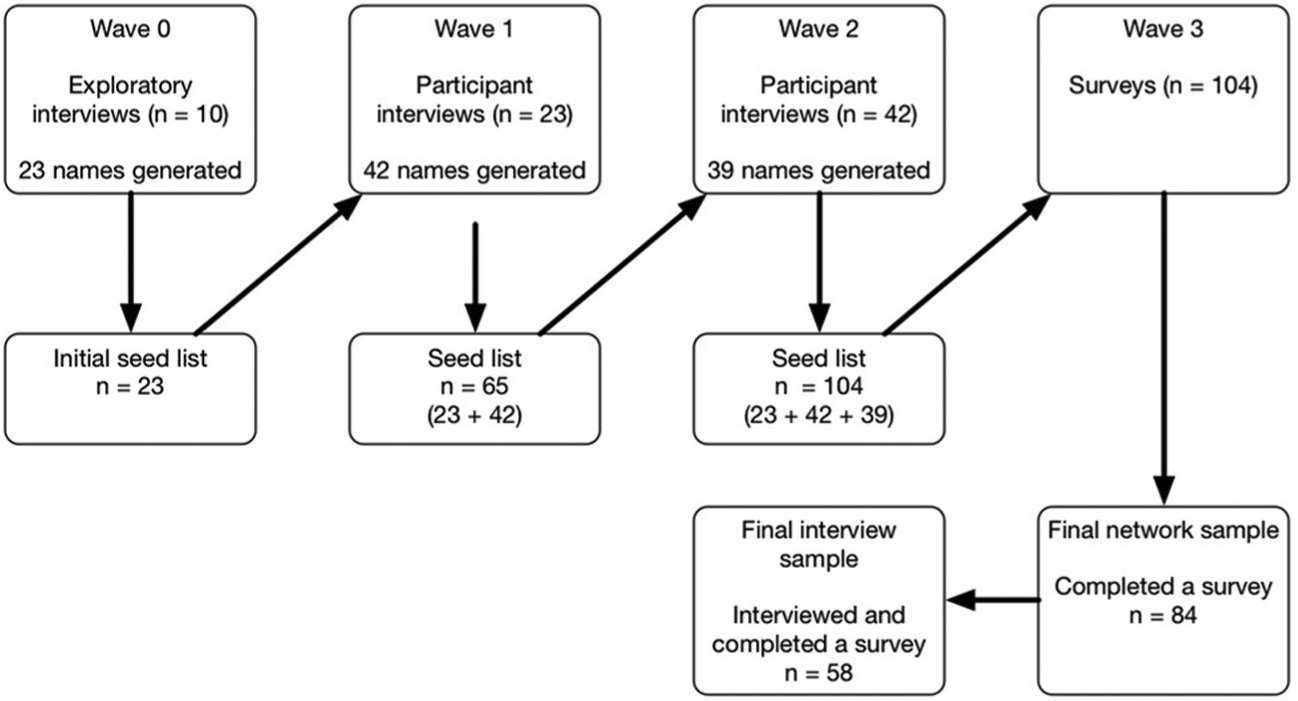
Flowchart of snowball sample design.
We conducted two waves of interviews and one wave of surveys. For each interview wave, we followed the same protocol (Figure 1). Interviews covered four main topics: (1) beliefs about the qualities of effective PD, (2) beliefs about the qualities of good mathematics instruction, (3) descriptions of the mathematics practices they were promoting in their PD, and (4) their collaboration and advice networks (see Appendix A, available in the online version of the journal, for the interview protocol). This article draws from the fourth section of the interviews. For this section, interviewers provided participants with the list of names. Going through each name on the list, they asked participants if they went to that individual for collaboration or advice about PD. If the participant said yes, interviewers then asked what they talked about and why they reached out to that person. After the names on the list were exhausted, interviewers asked participants to name anyone they went to for collaboration or advice related to PD who was not included in the list. We did not restrict the number of names individuals could offer, nor did we restrict their answers to include only other PD providers. After completing the interviews in each wave, we evaluated the additional names provided by the participants for inclusion in the study. If they met our three criteria, we appended the names to the list for the subsequent wave of data collection.
Wave 1 consisted of interviews with the 23 participants on our initial seed list. Based on these interviews, we added an additional 42 providers. We interviewed these newly added providers in Wave 2, providing them with the appended list of 65 names. Wave 2 generated an additional 39 names that met our criteria. For Wave 3, we opted to conduct a survey rather than interviews. We chose to do this due to time and resource constraints.
The survey was sent to all 104 participants generated in our snowball sampling (i.e., all the participants from Wave 1, Wave 2, and Wave 3). This gave all participants an opportunity to see the fully appended list. The survey mirrored the fourth part of the interview. Participants saw a list of names and indicated to whom they went for collaboration or advice. As before, the survey solicited additional names from participants, which were added for a hypothetical fourth round. At this point, we conclude the snowball process. The overall response rate for the survey was 80.8%. Critical to this study is the multi-organizational nature of the network. PD providers were in school districts, CMOs, and an array of nonprofit and university-based organizations. To alleviate concerns about selection bias due to differential response rates by subgroups, we conducted an analysis of the response rate. We found no systematic differences in response rate by organizational sector (Table 1).
Survey Response Rate by Sector
Note. Fisher’s exact = 0.2507; N = 52 (district), 9 (charter), 43 (other).
To form our final sample for the study, we included only those participants who completed a survey. We excluded participants who were interviewed but did not complete a survey. We reasoned that these individuals did not have an opportunity to see the entire list of PD providers and, thus, did not represent complete observations. Only seven interviewees did not complete a survey. This resulted in a final sample size of 84 providers. 2
In addition, we collected attribute data on each participant in the study, including gender, organization, organizational sector, and organizational position. We defined organizational sector as a collection of organizations subject to similar regulations with similar organizational structures, funding sources, and nature of work. We defined six sectors: (1) nonprofit, (2) school district, (3) CMO, (4) state or county government, (5) university, and (6) other organizations that did not fit into the previous categories, including for-profits and independent consultants. For organizational position, we collected each provider’s formal position name in the organization and grouped these into categories based on shared characteristics. We defined five positions: (1) direct PD provider, (2) middle manager, (3) leader, (4) academic, and (5) other. Table 2 provides definitions of our constructs.
Key Constructs Used in the Study

Note. PD = professional development.
Data Analysis
Analysis of the data occurred in three steps. We first analyzed interviews to determine people that interviewees went to for advice. We used this information to construct the advice network of PD providers. Second, using this network data, we identified brokers in the network using a simulation-based statistical test of brokerage position. To do this, we specified an exponential random graph model (ERGM) of the network, checked its goodness of fit, and used the estimated parameters to simulate networks. We derived a distribution of brokerage statistics from those simulated networks and identified providers whose observed brokerage scores fell above the 95th percentile of the distribution. Third, we analyzed the content of broker interactions by coding interviews with the brokers we identified and the providers to whom those brokers were connected. We used an iterative coding process, beginning with a theory-based codebook, which we iterated through open coding of the interviews. Below, we detail the three steps of our analysis.
Constructing the Advice Networks
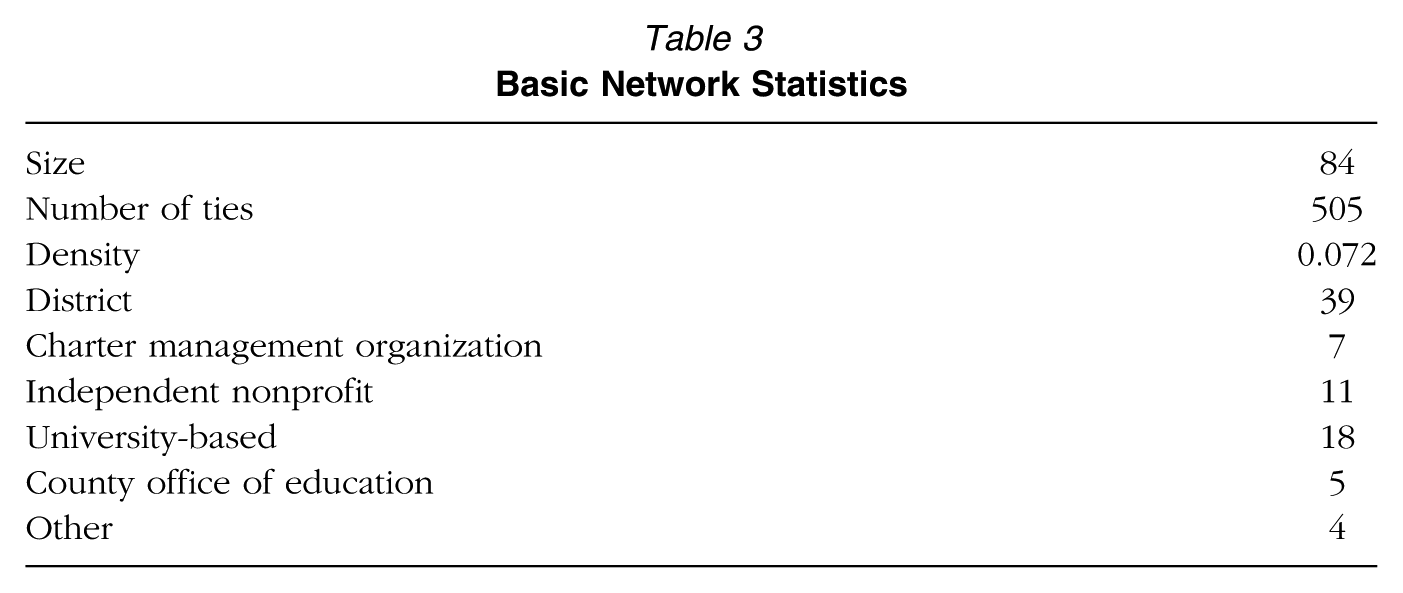
We first analyzed interviews for instances of advice seeking. If a participant said that he or she went to someone for advice about mathematics PD, we coded this as advice seeking. From that coding and the surveys, we generated a sociomatrix representing advice seeking among the PD providers in the study. A sociomatrix is an n×n matrix with the names of participants forming the rows and columns of the matrix. In each cell, we entered a 1 if the row individual sought advice from the column individual, and a 0 otherwise. Rows, therefore, indicate instances of advice seeking among providers; columns represent instances where providers were sought out for advice by others. We only included those individuals who met our criteria and completed a survey (n = 84). To analyze the network, we imported the sociomatrix and attributed data into R, using the “statnet” suite of packages (Handcock, Hunter, Butts, Goodreau, & Morris, 2008). We ran ERGMs in R using the “ergm” package (Hunter, Handcock, Butts, Goodreau, & Morris, 2008), a part of “statnet.” Basic network statistics are shown in Table 3.
Basic Network Statistics

The network contained 84 PD providers located in six sectors. District-based providers comprised the plurality of the network (46%), followed by providers in university settings (21%), nonprofit settings (13%), CMOs (8%), and state or county offices of education (6%). Four providers in “other” sectors (5%) included independent consultants and for-profit providers. The network density is a measure of the ratio of observed ties to potential ties. A density of 1 means that every actor in a network is connected to every other actor, while 0 means that there are no ties among any of the actors. Sparse networks, with densities near 0, have many potential brokerage opportunities, since there are many gaps between individuals in the network (Burt, 1992). The advice network of PD providers was sparse, with a density of 0.07, giving providers many opportunities for brokering.
Identifying Brokers in the Advice Network
To identify brokers, we employed a measure developed by Gould and Fernandez (1989). This method exploits group membership, important for our multi-organizational network. For this study, we define group membership as belonging to the same organizational sector, as defined in Table 2. Ideally, we would use organization as the grouping category, but in the case of this study, approximately half of organizations had only one or two individuals represented in the network. By grouping at the sector level, we obtain better estimates of brokering for the models we use for our networks. “Within-group” brokerage in this case indicates when an individual mediates between two others in the same sector, but not necessarily the same organization. For example, a provider based in a school district mediating between two providers in other school districts would qualify as within-group brokering. We believe this is a reasonable grouping method, for two reasons. First, expertise is often distributed across sectors, with sectors tending to specialize in different areas of expertise (Powell et al., 1996). Second, in the case of the present network, sector acted as a reasonable proxy for within-organization brokering. The majority (81%) of within-sector ties were also within-organization ties. For school districts, this is even more pronounced, with 91% of within-sector ties comprising within-organization ties.
In multisector, interorganizational networks such as ours, sector affiliation may have important implications for brokerage. Within- and between-group brokers can play substantially different roles in supporting collective work (Obstfeld et al., 2014). Actors who broker between groups can act as boundary spanners, bringing in new ideas, or as gatekeepers, managing the flow of information. Ties to diverse groups and the ability to span structural holes between groups are associated with the production of novel ideas and products (Reagans & McEvily, 2003; Ruef, 2002). Within-group brokerage may support work by connecting people across departments within organizations or organizations within a sector (Obstfeld et al., 2014).
Gould and Fernandez’s (1989) approach counts the number of times an actor is connected to two other actors who are not themselves connected. If
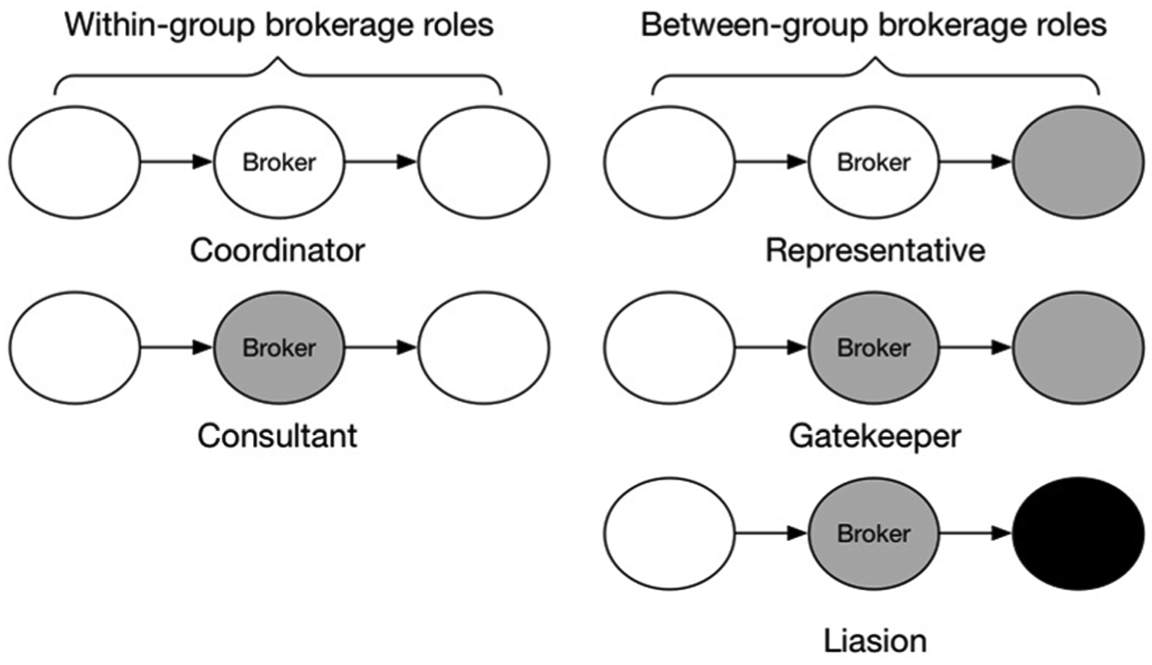
Possible brokerage roles according to Gould and Fernandez’s (1989) typology.
To determine if an actor’s brokerage score in any role was greater than what is expected due to random variation, we developed a nonparametric test using a baseline model drawn from the exponential family of random graph models (Goodreau, 2007; Jasny & Lubell, 2015; Lubbers & Snijders, 2007; Robins, Pattison, Kalish, & Lusher, 2007). Since observations in network data are inherently interdependent, the standard assumptions of inferential statistics are violated. The purpose of the baseline model is to construct a distribution of network statistics via simulation from which to make inferences. ERGMs estimate the probability of tie formation for any given pair of actors based on specified parameters.
The general form of an ERGM is

The probability of realizing the observed network
We specified five parameters
Reciprocity indicates the number of ties that are mutual—that is, in which every two providers access information from each other.
Intransitivity indicates the number of triads in the network where i seeks advice from j, and j seeks advice from k, but i does not seek advice from k—in other words, the tendency for a provider to not seek advice from the partners of the people they seek advice from. This creates a brokerage opportunity for j, who mediates between i and k. Intransitivity therefore captures potential brokerage opportunities in the network.
Triadic openness also captures brokerage tendencies in the network. It indicates the number of different partners that two providers who do not seek advice from each other have in common. The term is geometrically weighted so that each subsequently shared partner has a decreasing impact. In other words, the first shared partner has a greater impact than the second, the second than the third, and so on. The term not only captures brokerage tendencies in the network, it helps avoid the well-documented problem of degeneracy— when the model fails to find the sample space that would contain the observed network (Hunter, 2007). 3
Triadic closure indicates the number of shared advice partners that two providers who seek advice from each other have in common. If i and j seek advice from each other, and from k, l, m, and n, then they have four shared partners. This captures how much closure there is in the network. With a great deal of closure, there are often fewer chances for brokering within groups, but potentially more opportunities between groups. This term is also geometrically weighted, helping avoid degeneracy.
Effect of organizational setting on advice seeking and giving is an exogenous term that captures whether there is an association between a provider’s organizational setting and the number of advice seeking or giving ties they have. The term is a dummy variable indicating if the provider works in a school district or CMO. We collapsed the district and CMO sectors into a “district-based” variable. The remaining sectors (nonprofit, university, county educational agencies, and others) form the “nondistrict” reference group. Since the network is directed, this adds two terms to the model, one for advice giving ties and one for advice seeking ties.
After specifying and estimating our model, we conducted goodness-of-fit tests to assess how well the model fit the data. We evaluated goodness-of-fit by comparing statistics of our observed network to the distribution of network statistics produced by simulating random networks based on the model (Hunter, Goodreau, & Handcock, 2008). Ideally, simulations should produce normally distributed network statistics, and the observed network should fall near the mean. Our model fit the data nicely, with most network statistics near the mean. Given that our identification of brokers depends on the model specified, we also conducted sensitivity tests comparing the model fit with results of several models. We describe this in detail in Appendix B (available in the online version of the journal).
Our test proceeded in the following manner. Using specified model, we estimated the parameters for the model using Markov chain Monte Carlo maximum likelihood estimation. We used the estimated model parameters to generate 1,000 simulated networks. For each actor in each simulated network, we calculated brokerage scores. Given differences in sizes of each sector in the network, we constructed conditional distributions of brokerage scores based on organizational sector by taking random draws of 1,000 scores per role per sector. At this point, each sector had a distribution of brokerage scores for each brokerage role. We compared the observed brokerage scores for each actor with the condition distribution of brokerage scores for their sector. We obtained p values by taking 100 minus the percentile of the observed brokerage score. A provider with a p value of .05 or less in any brokerage role was considered a broker.
Analysis of Broker Activities
To analyze how brokers interacted with others to access and activate social capital, we first extracted each broker’s ego network from the main network to identify her alters. An ego network is defined as the focal actor (the “ego”) and her network ties (her “alters”). We collected interviews with brokers and their alters and organized these into groups in ATLAS.ti. Since not all actors in the network were interviewed (i.e., anyone added for the third wave of data collection), we were unable to analyze data from some actors. This yielded a total of 51 interviews to code—14 broker interviews and 37 alter interviews. One provider identified as a broker was not interviewed, since she was added in Wave 3. She is included in any quantitative analysis of brokers but is not included in the qualitative analysis.
To code the broker and alter interviews, we used an iteratively developed codebook. We first deductively defined two major categories of broker activity based on brokerage theory—accessing activities and sharing activities. We used these broad categories to code interviews and then inductively refined subcategories to capture the content of those activities. Table 4 shows the codes and examples from the interviews to illustrate them. Accessing activities are those in which a broker gathers information or resources from her network (Burt, 1992; Monge & Contractor, 2003). Accessing codes were used for interviews with brokers, since in those interviews, brokers described seeking advice from others. We coded for the content of the information brokers accessed, including information on a specific topic, information on the activities of others, logistical information, the perspective of others, and material resources. Sharing activities are those in which a broker transfers information or resources to others in their network (Hansen, 2002; Kellogg, 2014; Obstfeld, 2005). Through sharing, brokers shape the content and flow of information and activate their social capital access. We captured sharing by coding interviews with each broker’s alters. Sharing occurred when an alter described going to a broker for information or resources.
Description of Codes Used to Analyze Broker and Alter Interviews
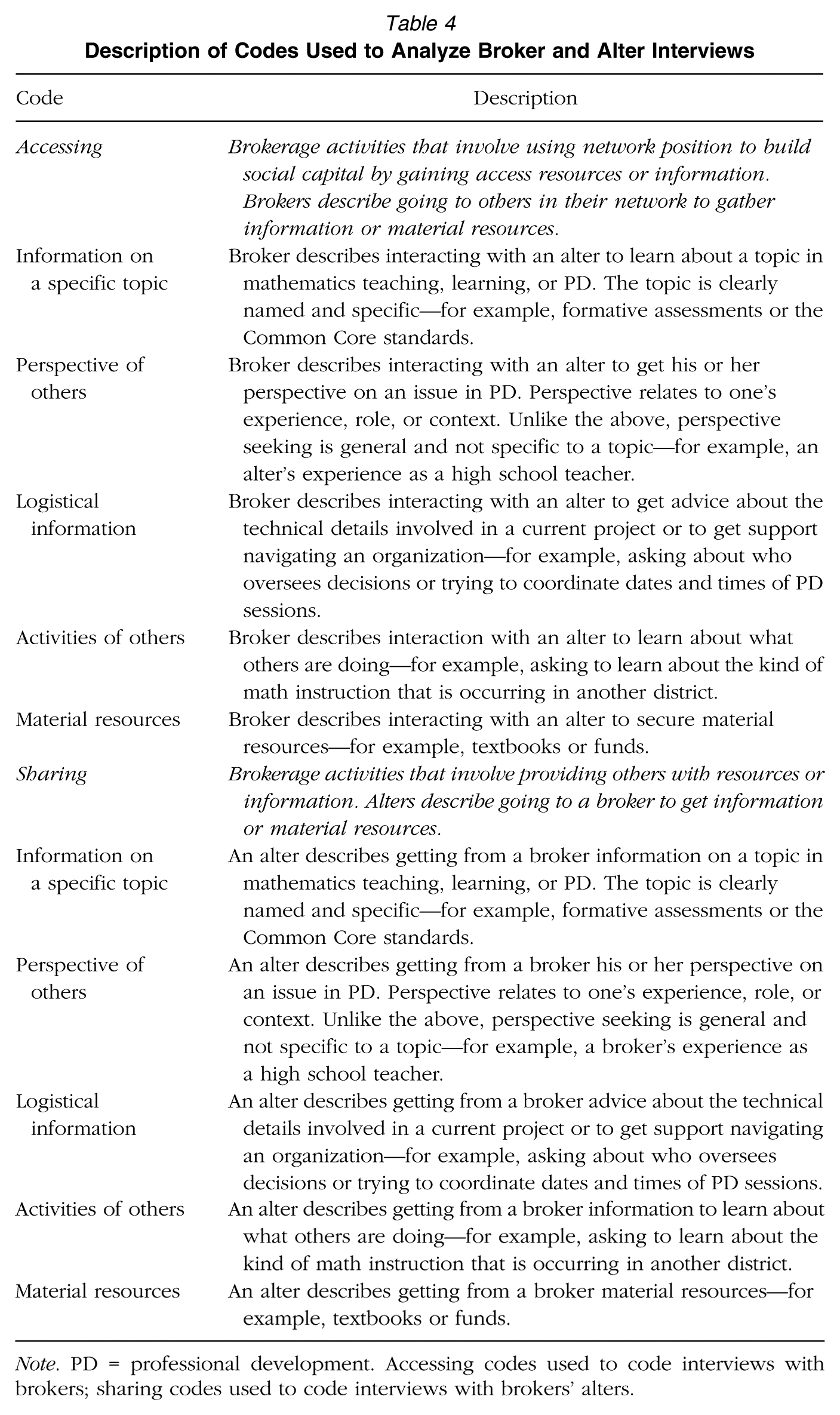
Note. PD = professional development. Accessing codes used to code interviews with brokers; sharing codes used to code interviews with brokers’ alters.
We coded interviews in groups. First, we coded an interview with a broker, using the accessing codes. We analyzed the interview for instances where a broker described interacting with an alter, applying a code to capture the activity. Next, we coded interviews with each of the broker’s alters, using the sharing codes. For these interviews, we looked for instances where the alter described interacting with the broker in question. We applied sharing codes that captured the nature of the activity when applicable.
After coding each group of interviews, we tallied instances of each code, recording it on a spreadsheet. We created a series of matrix data displays (Miles, Huberman, & Saldaña, 2013) showing the range of content of interaction by coding category. First, we created a display of counts of each code for each broker. We then synthesized the data by finding the proportion of each interaction type per broker. We arranged the data into a two-way table showing the mean proportion of each interaction type by organizational setting. Since some of the sectors had only a few actors, we grouped sectors by whether it was embedded within a school district (school district and CMOs) or not (universities, nonprofits, county education agencies, and others). Finally, we created network maps for each broker showing their ego network. For each network tie, we displayed the content of the interaction. Together, these analyses helped us uncover patterns of interaction.
Findings
To explore the role of brokers in the advice network of PD providers, we present two sets of findings. First, we describe the brokers identified using the simulation-based test of brokerage position. We found brokers distributed throughout the network, with no association between organizational setting and brokerage status. This suggests that each organizational sector in the network had similar access to social capital through brokers. Second, we draw on our analysis of interviews to show how these brokers interacted with their network ties to access and activate social capital. We found that organizational setting influenced both the kinds of interactions brokers engaged in and the content of those interactions. This occurred in two ways. First, brokers based in organizations outside of school districts more actively shaped the flow and content of information about mathematics PD in the network than brokers based in school districts. Second, there was a disconnect between social capital access and activation among district brokers, suggesting that these brokers did not mobilize their social capital resources to support organizational work.
Overall, these findings suggest that brokers’ organizational setting influenced how they engaged with social capital resources. While brokers from both district and nondistrict settings provided similar access to social capital for their home organization, brokers from districts did not take advantage of their position in the same way that nondistrict brokers did. This diminished their potential to (1) shape the content and flow of information in the network and (2) support organizational work through activation of social capital.
The existing literature on brokerage has often ignored the role of context in shaping brokerage activities. It is almost exclusively concerned with structural position, independent of the context in which brokers are embedded (Obstfeld et al., 2014). Brokerage positions are assumed to provide uniform advantages, regardless of context. Yet, in this case, the findings show that context had a profound impact on the type and content of interactions among the brokers.
Our findings focus on two categories of information accessing and sharing: (1) information on a specific topic in mathematics PD and (2) information related to logistics of planning and delivering PD. We characterize the first as substantive information, since it deals with important topics related to mathematics, the Common Core, and best practices for PD. As shown in Table 4, we identified and coded three other content categories for accessing and sharing. We present the results for these categories to put the percentages in the larger context of the study; however, we do not discuss them in our substance of our findings.
Locating Brokers in the PD Network
Using our simulation-based test, we found 15 of 84 PD providers occupied at least one of the Gould and Fernandez brokerage roles, as defined in Figure 2. These providers occupied network positions where the number of times they mediated between two unconnected providers was greater than expected, according to the ERGM-based simulation. Table 5 shows observed brokerage scores for each category, along with simulation-based p values. Brokerage positions are not mutually exclusive, so a single broker may have more than one significant brokerage score. For the purposes of this article, we define as a broker any provider who had a significant score in at least one category.
Observed and Expected Brokerage Scores of Providers Identified as Brokers in the Network
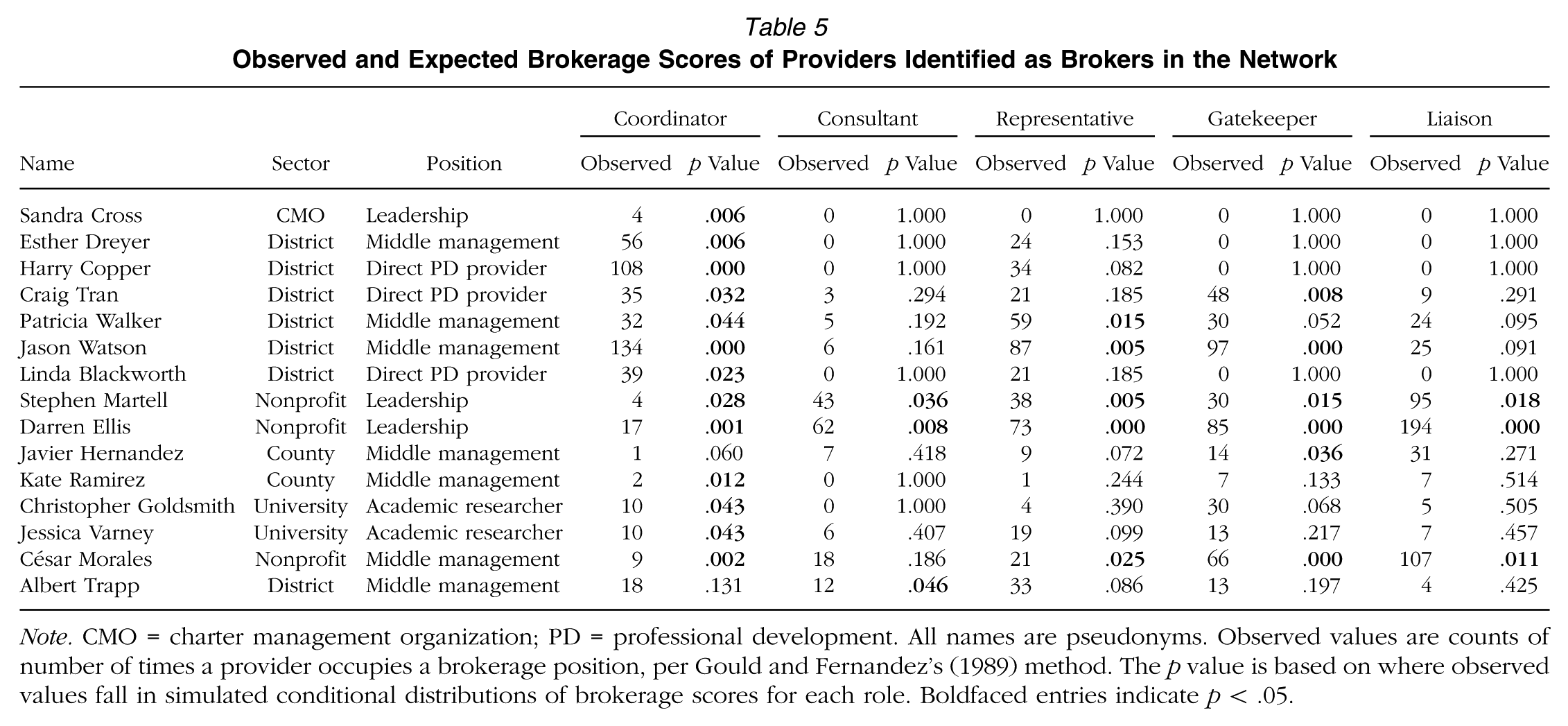
Note. CMO = charter management organization; PD = professional development. All names are pseudonyms. Observed values are counts of number of times a provider occupies a brokerage position, per Gould and Fernandez’s (1989) method. The p value is based on where observed values fall in simulated conditional distributions of brokerage scores for each role. Boldfaced entries indicate p < .05.
The brokers reflected the range of organizational sectors and positions in the network, suggesting that organizations had access to internal and external social capital. Brokers were almost evenly split between district and nondistrict settings. Eight brokers worked in school district settings (including CMOs), serving in a variety of organizational positions. These brokers worked in the central district offices to plan and deliver PD for teachers in the district. Four of the brokers served in middle management positions, serving as directors or leaders of district departments or subunits. These providers were often responsible for planning, rather than delivering, PD sessions and units. Esther Dreyer, for example, worked in her district’s mathematics department, responsible for mathematics programming throughout the district. She helped organize and plan PD units for teachers throughout the district. Sandra Cross served as the head of human resources and PD for a local CMO. Sandra was also the only broker from a CMO. The remaining three district brokers were direct PD providers, meaning that they were responsible for delivering PD sessions to teachers. These brokers were also occasionally involved in planning PD sessions as well.
The seven brokers based outside of school districts were in three sectors: (1) universities, (2) nonprofits, and (3) county educational agencies. Two were academic researchers involved in planning or delivering PD. Jessica Varney was a doctoral student from a local university who worked with local school districts to support the delivery of mathematics PD. Two others, Stephen Martell and Darren Ellis, served as executive directors of educational nonprofit organizations that frequently collaborated with districts in the region. Javier Hernandez and Kate Ramirez both worked in a county-level educational agency in middle management positions coordinating mathematics PD for instruction in the county. Finally, César Morales worked in a middle management position at a university-based nonprofit directing the nonprofit’s mathematics PD center.
Importantly, organizational sector did not matter for whether a provider occupied a brokerage position. Organizations in each of the major sectors therefore had similar access to social capital through the brokers. This access is critical for gathering information and expertise to support the complex work of delivering PD (Reagans & McEvily, 2003). Each of the five major sectors represented had at least one provider in a brokerage position (Table 6). There was no statistical association between organizational sector and brokerage status (Fisher’s exact = 0.6007), nor between organizational position and brokerage status (Fisher’s exact = 0.2271). Only the catch-all category Other did not have any brokers, but this was not surprising as this category only had four individuals in it.
Brokerage Status by Sector and Organization
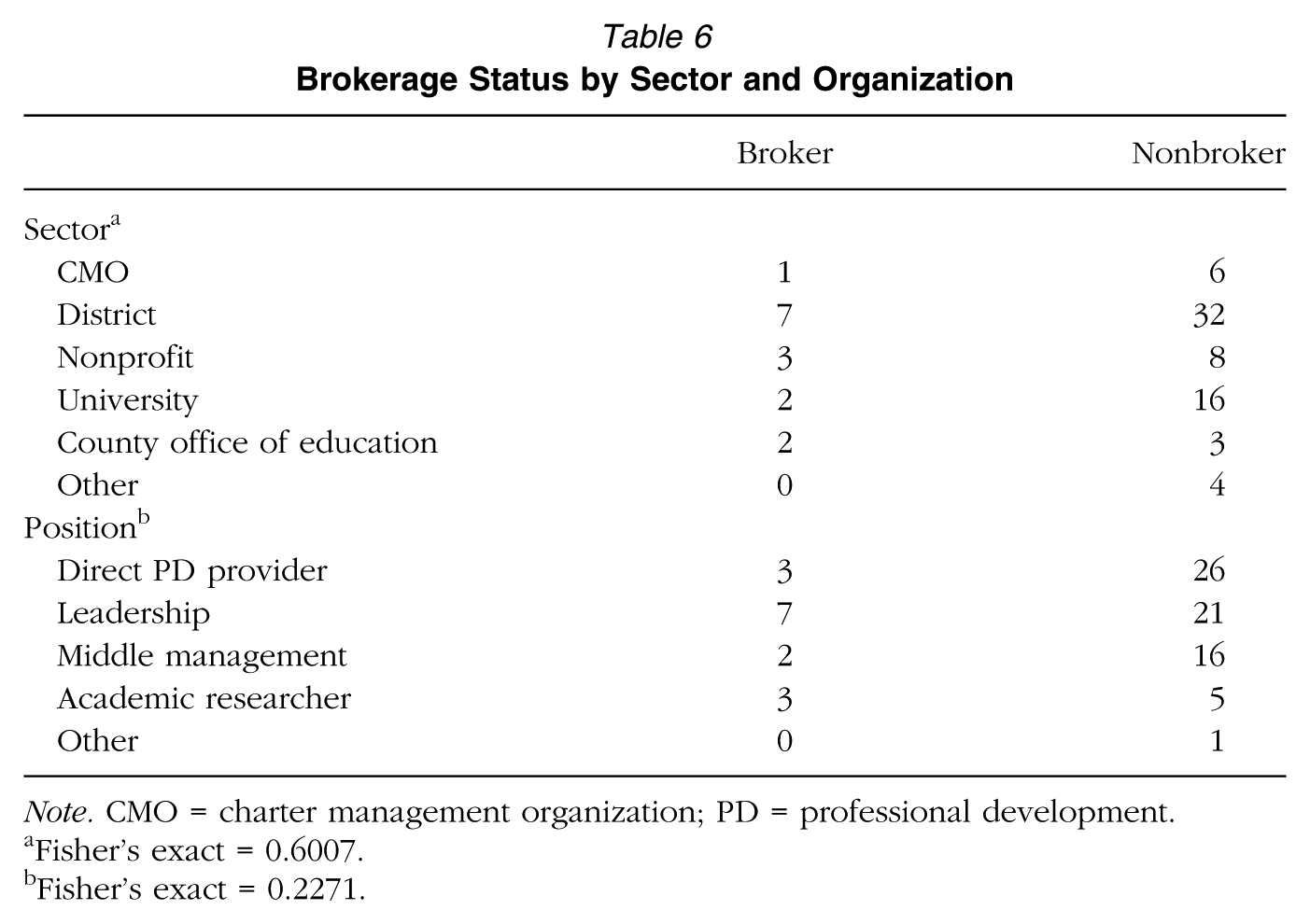
Note. CMO = charter management organization; PD = professional development.
Fisher’s exact = 0.6007.
Fisher’s exact = 0.2271.
Activating and Influencing Social Capital
Brokerage scholars argue that network position enables brokers to access privileged information and influence its flow and content. While the presence of brokers in each of the major sectors in the network suggests that brokers from both district and nondistrict settings occupied similar positions of social capital advantage, we found that brokers based in school districts accessed and shared different kinds of information compared with those based outside of school districts. Compared with brokers in organizations like universities and nonprofits, brokers based in school districts more often sought or shared logistical information dealing with the technical details of planning and delivering PD—details like budgets, planning for teacher release days, and support navigating district bureaucracy. Brokers from nondistrict settings, on the other hand, primarily interacted around substantive topics in mathematics PD—topics like the Common Core mathematics standards, the teaching of English language learners, and the planning and pacing of PD units.
While brokers from CMOs and conventional school districts did frequently access substantive information about mathematics, they did not often share it. Rather, they demonstrated a disconnect between the information they accessed and the information they shared. This had important consequences locally, for the information available to organizations engaged in PD, and globally, for the flow and content of information in the network. To illustrate this, we draw on interviews and network data for four of the brokers in the network—two from district settings and two from nondistrict settings. We chose these four brokers to streamline and clarify our reporting of the findings. They provide clear examples of the broader patterns in the data. While our analysis included several categories detailing the content of interactions, we focus on the contrast between the accessing and sharing of logistical and substantive information.
Brokers based in school districts routinely used their network connections to gather a variety of information, both substantive and logistical. On average, 54% of district-based broker interactions involved accessing information or resources from others (Figure 3, Panel A). Often, these interactions involved specific, substantive topics, which comprised an average 38% of a district brokers accessing interactions (Figure 3, Panel B). For example, Patricia Walker, a district broker who served as the mathematics and science director for middle schools in the district, described why she reached out to another provider: His expertise on performance assessment, his expertise on the standards and the practices and then the units of study, so how do we actually group these standards, because they just come to us as a list in no particular order.
Patricia sought out specific, substantive information on assessments and standards to support the planning and delivery of PD. Almost as often, district brokers like Patricia sought out logistical information. Conversations about logistics made up an average of 35% of district brokers accessing interactions (Figure 3, Panel B). Logistical interactions covered a range of topics, from planning the release of teachers to attend PD session to budgeting and scheduling issues. Harry Copper, a district broker and direct PD provider, described seeking out information from a coworker to help navigate his organization: I went to her quite a bit this year for institutional advice, not so much about how to do a workshop or what needed to be done, but more like, who do we have to contact? What paperwork do we have to fill out? How do we make this clean and legitimate? I’m newer in this position than another person, and I wouldn’t know all that. I would ask her that.
Accessing logistical information can serve a necessary and an important role, supporting the coordination and execution of PD opportunities. The balance of substantive to logistical accessing interactions suggests that district brokers could support PD planning and delivery by providing both substantive and practical information.
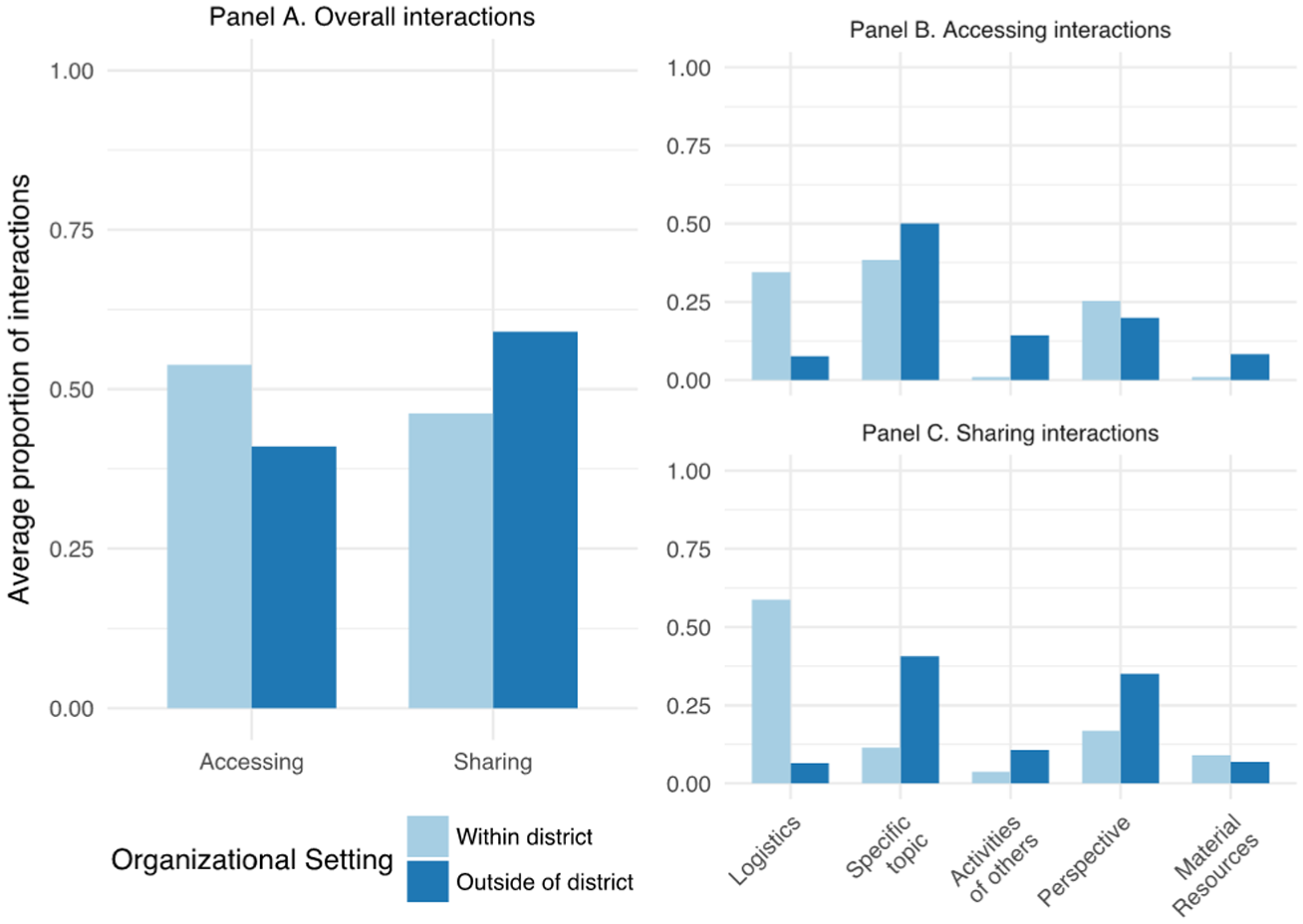
Average proportion of brokerage interactions and content of interactions by organizational sector.
However, while district brokers accessed both substantive and logistical information, they almost exclusively shared logistical information. By focusing on sharing logistical information, district brokers had few opportunities to shape information about Common Core mathematics in the network as a whole, since sharing information gives brokers the opportunity to translate and filter it (Kellogg, 2014). On average, 59% of sharing interactions involved logistical information, while only 10% involved substantive information (Figure 3, Panel C). The ratio of substantive ideas accessed to those shared was merely 0.38. 4 District brokers gathered much more substantive information than they shared.
Patricia, for example, often sought out information on specific topics related to mathematics PD, comprising 31% of her accessing interactions. But she almost exclusively shared information on logistics. A colleague described going to Patricia to get support navigating the district: She knows a lot about math, math education, PD, and I would say that mostly what I turn to her for is knowledge of our district, who’s who, who does what . . . it’s very practical. If we have some idea of, “We’ll send all the teacher leaders such-and-such information. Let’s run that by Patricia and see what she thinks.”
Here, Patricia’s colleague acknowledged that she has expertise in key areas but described going to her instead for logistical support. In fact, 70% of Patricia’s sharing interactions involved logistics. She did not have any interactions that involved sharing substantive information.
Such a pattern was similar for all the district brokers in the study. District brokers were often approached to share such information. Jason Watson, a district broker who was the director of STEM education, actively sought out substantive information, with 29% of his interactions involving topics in mathematics or PD. But he most often shared logistical information—like Patricia. For example, a provider described why he went to Jason for advice: A lot of what I would ask Jason about is advice about navigating the different parts of the organization, making sure there’s alignment. Right now, for example, there has been a technology initiative in middle schools as well as teacher leaders in middle school and we’re working to stitch those things together, so that it’s not a subset of teachers who have six release days with one and six with another. That’s a good example of where I’m getting his advice to think about that.
Another provider echoed this, explicitly stating that he sought logistical information from Jason: Jason. He’s my boss [laughs]. You go to Jason when you need money [laughs]. Or when you’ve already spent the money, and he figures out where it’s going to come from . . . Our interactions tend to be about logistics.
Again, Jason, despite having substantive information to share, was sought out to share logistical information. Sixty percent of the information he shared dealt with logistics compared with only 10% that dealt with substance. Overall, these patterns suggest that district brokers did not serve as conduits of information from outside organizations. While they accessed critical information, they did not activate it to support the planning and delivery of PD by sharing it with others. They also suggest that district brokers were unable to influence how others understood critical information regarding mathematics and the Common Core standards.
The disconnect between access and activation becomes clear when visually examining interactions. Figure 4, Panel A shows Patricia’s ego network, showing her accessing ties (represented by outgoing arrows) and sharing ties (represented by incoming arrows). Patricia is represented by the node in the middle of the network. Each tie label shows the content of the interaction. For clarity and ease of reading, ties with no interaction data are omitted from the network. Blue colored ties represent instances where Patricia accessed or shared information about logistics. Orange colored ties represent instances where she accessed or shared substantive information. Circles and squares represent district and nondistrict nodes, respectively. Following a path backward, such as from Node 12 through Patricia to Node 9, shows an instance where Patricia accessed information on a topic and shared logistical information. As is clear from the graph, in none of Patricia’s boundary-spanning ties, where she connects a district and a nondistrict, did she access and then share substantive information. She sought out specific information from many nondistrict providers. But her interactions with district providers dealt with logistical issues.
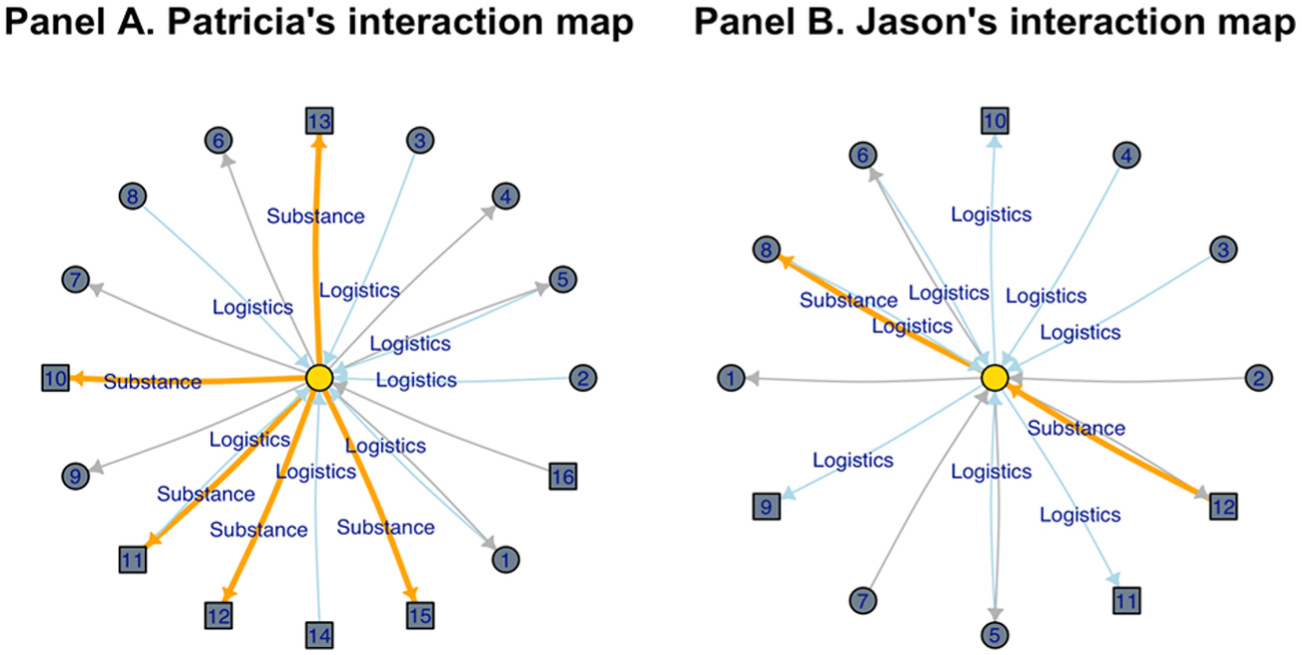
Interaction network maps of two district brokers.
Jason’s map reflects this disconnect as well (Figure 4, Panel B). Jason less frequently accessed substantive information compared with Patricia, but he often shared logistical information, particularly with providers from districts. District brokers overall fulfilled a critical brokerage task by accessing relevant information across gaps in the network. However, by failing to share substantive information, they did not complete this task by failing to activate their social capital.
In contrast, nondistrict brokers demonstrated a pattern of interactions that suggests they both influenced the content of information in the network and activated their social capital to support the planning and delivery of mathematics PD. In contrast to district brokers, brokers based in other sectors most often shared information and resources, comprising an average of 59% of their interactions (Figure 3, Panel A). Critically, when accessing or sharing information, nondistrict brokers discussed substantive topics related to mathematics and the Common Core. On average, the plurality of accessing interactions (49%) and sharing interactions (41%) involved information on a specific topic (Figure 3, Panels B and C). For logistical information, those averages were 8% and 9%, respectively (Figure 3, Panels B and C). These differences in the type of advice accessed and shared between district and nondistrict brokers were significant. 5
Stephen Martell, the executive director of a regional nonprofit PD organization, often accessed information on specific topics. Stephen described going to a researcher at a state university for mathematical help related to changes brought on by the Common Core: One of the shifts in the Common Core at the secondary level is the relationship between expressions, equations, and functions. It’s always been a big mess and a big time waste. We try to sort it out and clean it up, but people aren’t noticing. ’Cause when you say equation, they assume they know what it means. It’s three things. They assume they know everything there is to know so it’s hard to disturb the peace. I brought that problem to Peter. You need a mathematician’s confidence in their understanding to play with stuff like that. We came up with something that actually works pretty well.
Stephen also sought out specific information from another broker, César Morales, responding to whether he seeks advice from him: “Yes. Other than the ordinary strategic planning sort of stuff, he has a great deal of depth and expertise in English-learner learning mathematics.”
The information nondistrict brokers shared dealt with substantive topics, especially those related to the Common Core math standards. César, for example, was frequently approached to share information on the Common Core. César served as the director of a mathematics center in a university-based nonprofit. A provider described why she went to him for advice: Because in Valley County we have quite a range of languages, and one of the concerns that’s coming up often as we continue to work with teachers around Common Core is language. César has done some wonderful work with that and his colleagues in his network. That’s one of the reasons why I reached out to César.
Other providers echoed this:
César has quite a bit of expertise and some very specific expertise around language and mathematics. We use strategies that he introduced to us, so he’s the one to turn to when we want to go deeper about something or have a question about it.
Oh, yeah. César’s math content, his understanding of standards, his understanding of working with large groups of people, thinking systematically but also as a learning community, and also his contacts. He’s been a huge resource for us.
The plurality of César’s accessing and sharing interactions involved substantive information, at 44% and 48%, respectively. Stephen also shared a great deal of substantive information. Nearly 70% of his accessing interactions and 53% of his sharing interactions involved substantive information. Like César, Stephen often shared with others about the Common Core. One provider stated, I had questions with him directly about interpreting some of the Common Core standards, especially in the sixth grade around ratio and proportion, what those looked like. It was perfect because our tasks had to do with that at that convening, but I also had my own questions and separately I approached him during the breaks to get his understanding on where the architecture of the document was really heading.
This pattern was common across nondistrict brokers. Overall, the nondistrict brokers demonstrated a parity between the accessing and sharing of substantive information, which we did not observe among the district brokers. The ratio of substantive ideas accessed to those shared was 1.24. Just about for each substantive idea accessed, nondistrict brokers shared a substantive idea.
The maps of nondistrict brokers visually show the parity between access and activation, in contrast to disconnect observed among district brokers. For example, Stephen’s map (Figure 5, Panel A) shows that most of his interactions involved specific topics in mathematics PD. There are also many paths where Stephen accessed and shared specific information—for example, from Node 7 to Node 8 or from Node 9 to Node 2. Most of Stephan’s boundary-spanning ties, where he connects a district and a nondistrict provider, involved specific information. Javier Hernandez’s map (Figure 5, Panel B) shows a similar pattern. Javier directed the curriculum and instruction department at a county department of education. While he was less active in the network than Stephen, his interactions mostly involved specific topics. Again, there are several boundary-spanning paths where Javier accessed and shared specific information.
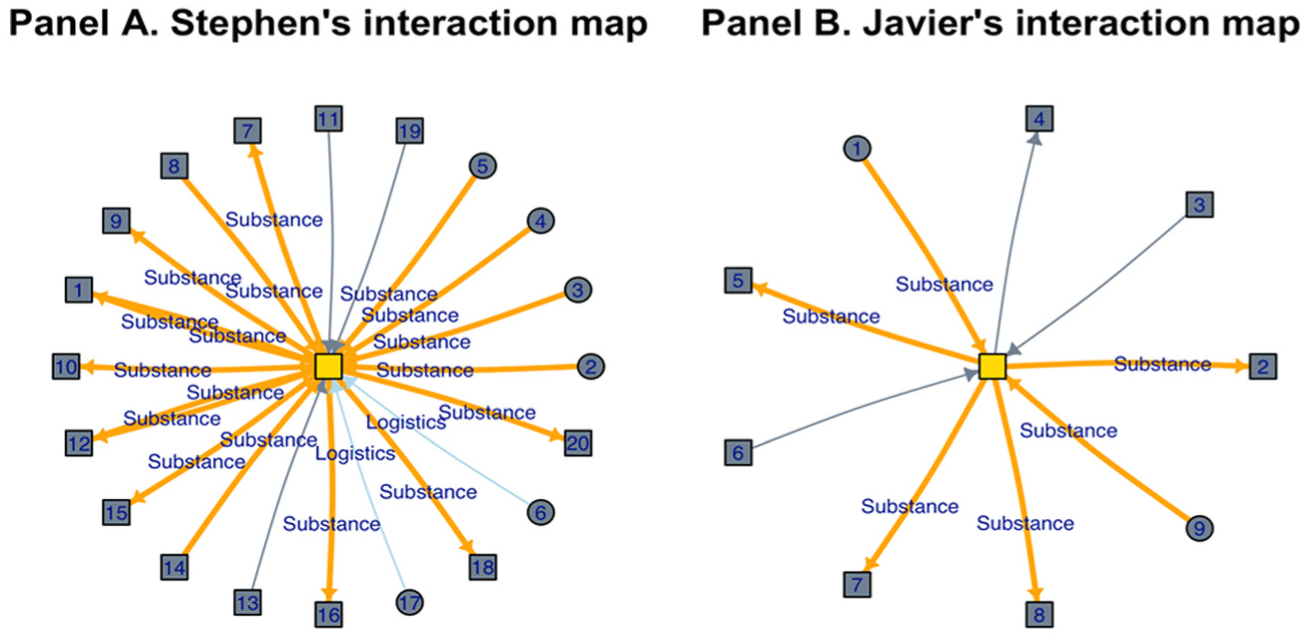
Interaction network maps of two nondistrict brokers.
The consequences of these patterns are twofold. First, at the network level, by frequently sharing information, especially substantive information related to the Common Core standards and other topics in mathematics PD, brokers from nondistrict settings had greater potential to shape the content and flow of information in the network (Burt, 1999; Kellogg, 2014). Actively mediating the information in the network can be especially important in times of reform, such as the case with the adoption of the Common Core. The ideas that become prominent in a network can shape the shared understanding people hold of a policy (Beckert, 2010). Second, at the local level, nondistrict brokers activated their social capital by accessing and sharing substantive information. Through activation, individuals put their social capital resources to use (Smith, 2005). In this case, that means supporting the collective work of planning and delivering mathematics PD by distributing critical information.
Despite occupying similar positions of influence in the network, district brokers did not enact their network advantages as nondistrict brokers did. While they often sought out substantive information, they did not share it, diminishing their potential to shape how others understood the Common Core math standards. Locally, district brokers did not appear to relay the substantive information they gathered to others in their organization, failing to act as bridges across network gaps. 6 The ability to bring in nonlocal expertise and information is a critical brokerage role supporting organizational work. This failure to activate social capital had the potential to diminish the capacity of districts to provide effective PD.
Discussion
PD providers play a key role in the policy implementation process by supporting teachers as they learn about and enact new policies. The adoption of the Common Core standards in many states has placed new demands on teachers and school leaders. By mediating between policy and the classroom, PD providers are in a unique position to influence how teachers understand and ultimately implement new policies. Using social network analysis and the theory of brokerage, this study explored how PD providers access and activate social capital to support PD planning and delivery. Brokers have the potential to play a critical role in shaping the flow and content of information based on how they access and share information. These actions can affect the social capital available to PD providers as they develop, plan, and deliver PD sessions to teachers.
The findings here draw attention to the influence of organizational setting on how brokers enact their privileged network position. While previous research on networks has highlighted the influence of setting and context on social interactions in networks (Coburn, Mata, & Choi, 2013; Small, 2010), less attention has been paid to how social context can shape the ways that individuals interact with their social networks. This is especially true of research on brokers (Burt et al., 2013; Obstfeld et al., 2014), which has tended to assume that brokerage positions uniformly confer autonomy of action on individuals occupying those positions. Some have explored how aspects of social setting, such as culture (Xiao & Tsui, 2007), organizational type (Fernandez & Gould, 1994; Lind, Tirado, Butts, & Prahova, 2008), or organizational position (Rider, 2009), influence social capital outcomes, but few have explored how social setting may influence brokerage processes themselves.
We show how both the type of interaction and the content of those interactions varied by organizational setting, with nondistrict brokers participating in conversations about important issues in mathematics PD while district brokers interacting primarily around issues not related to mathematics but to technical and logistical issues. This difference means that nondistrict brokers were more likely to advance ideas about mathematics teaching and learning and the Common Core standards that teachers would encounter in PD sessions. Nondistrict brokers achieved this through a process of social capital access and activation. These brokers accessed substantive information about mathematics teaching and learning from their social ties and then activated this information by sharing it with others. The ability to manage information is a key advantage of brokerage positions in social networks. Our evidence suggests that nondistrict brokers used this advantage to gather and share information, giving them the ability to influence the nature of social capital in the network.
Brokers are also important because they enable organizations to access nonlocal information and expertise to support organizational work (Hansen, 2002; Obstfeld, 2005; Reagans & McEvily, 2003). Again, we found critical differences between how brokers in the two settings access and activated social capital. District brokers did not activate information they accessed by sharing it with others in their organization, preventing their home organization from capitalizing on the access the brokers enabled. Organizations often rely on information and expertise accessed by members from across organizational boundaries. The district brokers in this study did cross organizational boundaries to gather much needed information, but we found no evidence that they distributed this information within their organization. A key resource that districts had access to through brokers was not capitalized on. In other words, the social capital of these brokers was not activated (Smith, 2005).
One possible explanation for the differences we observed between district and nondistrict brokers is that different organizational types exert varying constraints that influence how individuals behave. Scholars of structure-agency dynamics in sociology argue that agency—the ability of individuals to shape their preferences, beliefs, and actions—varies by social context (Emirbayer & Mische, 1998; Sewell, 1992). While network scholars have recognized the role of organizational conditions in shaping social relationships (e.g., Coburn et al., 2013; Small, 2010), less attention has been paid to how they shape the content of those relationships. Organization-specific norms, beliefs, understandings, and role expectations help shape behavior by defining appropriate and inappropriate behaviors. According to this view, then, PD providers in brokerage roles do not have unfettered access to social capital through their social ties; rather, the way they interact with others is shaped by the specific demands and expectations of their organizational setting.
In fields that span multiple sectors and professions, such as education, this can become visible through the different actions and expectations of individuals from different organizational contexts. Heimer (1999), for example, found that individuals from different professional backgrounds used different models of action when dealing with the legal requirements of neonates in intensive care units. Our finding that district brokers focused primarily on logistical details of PD may reflect the greater need to individuals in districts to manage the complex bureaucratic needs of the district. The demands of working in a school district, with distinct budgetary and personnel requirements, could constrain how providers viewed district brokers. Delivering PD within budgets or releasing teachers to attend PD require planning and coordination across the district. We found that district brokers often discussed these topics. It is not surprising that they took precedence in the conversations between district brokers and district providers. Thus, the particular demands of working in a school district shape how brokers access and enact social capital.
On the other hand, the substance-focused interactions of the nondistrict brokers may reflect that organizational settings like nonprofits and universities place a greater emphasis on expertise—these organizations need to attract districts and schools for PD opportunities. Brokers in nonprofits or universities demonstrate their value to school districts by providing access to expertise. Therefore, a broker in these settings is likely to reach out and share that expertise with others.
In each case, brokers face constraints and affordances based on their organizational setting that shapes how they interact with their social ties. Research on brokerage has not made structure-agency dynamics salient, save for assumption that network position can expand or constrict agency. Further research is needed to link organizational characteristics, social networks, and network processes to show the influence of social setting on network action.
A potential alternative explanation is that the differences we observed between district and nondistrict brokers is the result of personality differences between the brokers rather than institutional conditions of the brokers’ home organizations. Indeed, previous research has suggested that personality differences can lead individuals to structure their personal networks differently, with people with individualistic tendency and high levels of neuroticism preferring networks with structural holes (Kalish & Robins, 2006). Moreover, we might expect that individuals with different personality traits differentially select into organizations, so that the brokers in districts have systematically different personality types than those outside of districts. We may reasonably believe that such personality differences can lead to differences in the content of interactions.
While we do not have direct measures of personality, we do have measures that may proxy aspect of personality. During interviews, participants were asked why they went to contacts for advice. We inductively coded these explanations and derived several distinct reasons. Most relevant, we derived a category we called “Good to work with.” This category included statements like “She is nice” or “She is easy to talk to.” If personality mattered for the content of interactions, we might expect to see differences in this category between district and nondistrict brokers. However, we found no notable difference. Among district brokers, an average of 5.4 providers said they went to the broker because they were good to work with. This was 6.7 among nondistrict brokers, a nonsignificant difference (t = −0.64, p = .538). Likewise, we detected no difference in the average number of times a broker said they went to someone because they were good to work with. District brokers went to an average 8.3 providers because they were good to work with, while nondistrict brokers went to an average of 5.1. Again, this difference was not significant (t = 1.09, p = 0.297). This evidence, along with our two-level model, which found a significant difference in the content of interactions between brokers in the two organizational sectors, 5 suggests that this alternative explanation is less likely than the one we offer.
Limitations
There are several important limitations to this study. First, this study relies on reports of interactions rather than direct observations of interactions. While this approach allowed us to collect qualitative data on a large network disbursed across many organizations in a geographic region, it is possible that participants under- or overreported the type and content of interactions. By gathering data from both brokers and their alters, we mitigate this limitation to an extent. Nonetheless, observing interactions would have provided more direct evidence.
Second, this study focuses on a single region. It is not clear how representative the network is of other regional PD networks across the country. Two of the districts in the study had very well-developed internal PD infrastructures. Because of this, the network may have had an overrepresentation of district-based actors compared with other regions. Since little is known about social networks among PD providers, especially the composition of actors, we are unsure whether the network in this study is reflective of other PD networks. Thus, the study is exploratory in nature.
Third, we used a coarse measure of organizational setting, distinguishing between district and nondistrict settings. However, a variety of different sectors were represented, from districts to CMOs to universities. There may exist nuances between these sectors that influence how brokers engage social capital. A network with large within-sector samples may be able to detect such subtle differences. However, in this case, the broad district/nondistrict distinction was the finest we could make due to our small sample size within each organizational sector. Future research can explore the rich number of organizational sectors represented among PD providers and sample a larger number of each organizational type to see if there is more systematic evidence of differences by organizational sector.
Fourth, while we addressed a potential alternative explanation regarding the role of personality types, we relied on a proxy measure of personality that was available to us in our data. Clearly, these are not validated measures of personality. With more exact measures, we could more definitively reject the alternative. Given the data we have, we present a strong case in favor of our argument. Nonetheless, we are limited in completely ruling out the alternative.
Finally, while we feel assured that our findings are unbiased by missing data, it is likely that our sample was not entirely complete. While we argued and presented evidence that any missing providers would not change our result, we are making an inference and cannot definitively make this conclusion. The evidence supports our contention that our results are unbiased by missing data.
Implications and Conclusion
Social capital is a critical resource for organizations, and educational researchers are increasingly using the concept to study implementation in schools (Coburn & Russell, 2008; Spillane, Hopkins, & Sweet, 2015). The ability to access social capital is particularly important for organizations engaged in work that requires expertise from multiple knowledge domains. Developing, planning, and providing PD requires expertise in education policies and standard, teaching and learning, content areas, and adult learning. Brokers who span the boundaries of organizations and sectors can enable access to this diverse expertise. Indeed, in this study, we found that brokers accessed information on a variety of topics across the network. However, the lack of participation in substantive conversations and activation of social capital among brokers based in school districts suggests that the potential benefits brokers offer organizations were not realized for the districts in this study.
Accessing and activating social capital also affect how ideas are shaped in social networks (Beckert, 2010; Burt, 1999). Occupying privileged positions in networks gives brokers pronounced influence over the flow and content of ideas. Again, the lack of participation in substantive conversation about mathematics, particularly when sharing information, diminished the ability of district brokers to shape ideas about the Common Core mathematics standards and mathematics PD more generally. These results have implications for the role of PD providers and the study of brokerage.
Implications for Policy Implementation, Districts, and PD Providers
This study extends previous research that highlights the important role of actors outside the school system in the policy implementation process. These outside actors can shape the message teachers receive about policies, influencing how policies are implemented (Coburn, 2005a). This study adds another layer of complexity to this picture. Even in the case where district actors had the same potential influence as nondistrict actors, nondistrict actors appeared to play a more important role in shaping the available information in the network. Moreover, our study distinguished between district and nondistrict settings. Some of the nondistrict settings (e.g., county offices of education) are part of the formal educational system but are removed from the day-to-day workings of school districts. The brokers based in offices of education acted more like brokers in universities and nonprofit settings than district brokers. This suggests that school districts place unique demands on providers, potentially influencing their behavior.
District-based actors, those closest to the classroom, acted mainly as receivers and not shapers of information about the Common Core mathematics standards. Yet, with knowledge of on-the-ground conditions in school districts, district-based providers could have valuable information to contribute related to the implementation of the standards, information that may not diffuse across the network of PD providers. Moreover, contributing to the conversation on the Common Core could increase educators’ sense of ownership over the reform, a factor that is important to successful implementation (Coburn, 2003; Peurach, 2011). By not shaping the conversation on the Common Core, there is potential for educators to view the standards as top-down impositions, potentially increasing resistance to the reform (Achinstein & Ogawa, 2006; Coburn, 2003).
Ideas matter in the implementation process (Spillane et al., 2002). Our study suggests that nonsystem providers were more likely to shape the available information in the network. District providers, many of whom were teachers or former teachers, were much closer to the teaching and learning occurring in schools. While they had the structural potential as brokers to shape the content of information in the network, our analysis suggested that they did not. While further research is needed to track the diffusion of ideas and policy message through networks and into PD sessions, our findings offer suggestive evidence that those ideas are largely shaped by nonsystem actors. It remains to be seen if such messages resonate with teachers.
Second, this study offers new evidence on an underresearched area of policy implementation by exploring PD providers as a group. Prior research has explored the ways that PD affects teaching and learning (Coburn, 2005a; Garet, Porter, Desimone, Birman, & Yoon, 2001; Hill et al., 2013; Kennedy, 2016; Newmann et al., 2000; Penuel et al., 2007), but none have explored PD providers as a group. This study looks at how PD providers interact to gather and share information to support providing PD opportunities for teachers. While prior research suggests that PD providers can influence how teachers understand policies (Coburn, 2005a), apart from the current study, no one has explored how PD providers generate their own understandings of policy. This study adds another layer to the complex process by which policies are translated into classrooms. It also suggests many directions for future research to build on this study. Our findings suggest that nondistrict brokers exerted greater influence than district brokers over the flow and content of information. Future studies can use longitudinal analysis to map the actual diffusion of information to confirm this suggestion, especially to explore how and which ideas end up promoted to teachers in PD opportunities.
We know from previous research that district offices can play a key role in shaping the information that schools receive about policies (Daly, Finnigan, Jordan, Moolenaar, & Che, 2014; Honig, 2004). Our findings show that nonsystem actors served as an important source of information for individuals in districts. Thus, a key way that ideas about the Common Core mathematics standards are shaped occurs through interactions between individuals in district offices and those outside of the school system.
PD organizations, particularly those within school districts, may have untapped resources in the form of social capital. It is worth pointing out that none of the brokers in this study were formally assigned to brokerage roles or tasked with gathering information. Access to social capital often arises through informal social relationships (Daly et al., 2014; Spillane et al., 2015). It is likely that many PD organizations have members who are actively seeking information from a variety of sources, both internal and external to the organization. The district-based brokers in our study often sought out substantive information about mathematics PD and the Common Core mathematics standards. PD organizations and departments may have untapped social capital resources that could support the development and delivery of effective PD opportunities.
A critical direction for future research on PD is to link diffusion of ideas within advice networks to the actual PD teachers’ experience. While we show how brokers shaped social capital access within a network of PD providers, we are not able to show if these brokers influenced the actual ideas presented to teachers in PD. The ideas teachers are exposed to can shape how implementation plays out in schools. To what extent do the ideas shared by influential providers in PD network make it into PD sessions? This is a crucial dimension of PD that future research should investigate.
Implications for Brokerage Theory
This study has two key implications for brokerage research. First, it provides evidence on brokerage processes. Research on brokerage has tended to rely solely on structural measures, focusing on position and outcomes rather than processes (Obstfeld et al., 2014). Structurally, the district brokers appeared to fulfill a bridging function. Indeed, without qualitative evidence, we might assume that they did. However, the findings show that district brokers largely did not relay information gathered from outside to others in their district. We provide evidence that network-level measures have the potential to mask important variations in how brokers act. This suggests that caution is necessary when relying on structural measures of brokerage alone.
Second, this study supports and extends existing research that shows how context can mitigate the advantages of brokerage positions (Ahuja, 2000; Rider, 2009; Xiao & Tsui, 2007). It extends these findings by demonstrating that organizational context may shape both the behavior and content of interactions among brokers. This stands in contrast to the picture of brokers as “structurally autonomous,” thanks to their network position (Burt, 1992). In this picture, brokerage positions uniformly confer advantages across actors in those positions. Researchers acknowledge that this is probably not the case and that context probably plays an important role in how brokers behave (Burt et al., 2013; Obstfeld et al., 2014). However, no studies have linked social network data on brokerage positions to qualitative data that explore in-depth processes, as this study has. The content of social interactions matters, in addition to network position. Explored together, we can uncover a more nuanced picture of brokerage processes.
Supplemental Material
DS_10.3102_0002831218788528 – Supplemental material for Access, Activation, and Influence: How Brokers Mediate Social Capital Among Professional Development Providers
Supplemental material, DS_10.3102_0002831218788528 for Access, Activation, and Influence: How Brokers Mediate Social Capital Among Professional Development Providers by Richard Paquin Morel and Cynthia Coburn in American Educational Research Journal
Footnotes
Notes
R
C
References
Supplementary Material
Please find the following supplemental material available below.
For Open Access articles published under a Creative Commons License, all supplemental material carries the same license as the article it is associated with.
For non-Open Access articles published, all supplemental material carries a non-exclusive license, and permission requests for re-use of supplemental material or any part of supplemental material shall be sent directly to the copyright owner as specified in the copyright notice associated with the article.
