



Abstract
Guided by perspectives on the sociopolitical contexts of schooling, control of teachers’ curriculum and instruction, and teaching of elections, we use findings from a national questionnaire to explore the contexts that shaped teachers’ pedagogical decision making following the 2016 U.S. presidential election. Our findings reveal that classroom, school, district, state, and national contexts often manifested in pressure from colleagues, parents, the administration, the district, and the public. This pressure is reflective of the lack of trust, autonomy, and professionalism for teachers in our current climate. The days immediately following the election revealed new understandings about teachers’ views on neutrality, opportunities for agency within control of teachers’ work, and a call for justice-oriented pedagogy. Implications for teacher education, practice, and research are discussed.
We are living in polarized times. People in the United States exhibit more ideologically consistent beliefs than at any time in the past 20 years; that is, fewer people hold a “mix” of both conservative and liberal views (Pew Research Center, 2014). Differentials in gender, age, and educational attainment by political party have widened, and opinions between political parties are more divided than at any time in the previous two decades (Pew Research Center, 2017, 2018). Even before the 2016 U.S. presidential election brought such polarization into stark relief, politically affiliated individuals (i.e., those who call themselves Republicans or Democrats) “believe[d] the opposing party’s policies ‘are so misguided that they threaten the nation’s well-being’” more than ever before (Pew Research Center, 2014). In a 2018 survey, people expressed similar concern about the danger of the opposing party’s policies, with 71% of Republicans and 63% of Democrats citing this reason for affiliating with their current party (Pew Research Center, 2018). These polarized beliefs often translate into opinions about how students should be educated. Research suggests, for example, that adults who endorse conservative attitudes are more likely to value teaching children qualities like “faith” and “obedience,” whereas adults with liberal attitudes are more likely to prioritize teaching “tolerance” (Pew Research Center, 2014).
Given this polarization, teachers found themselves in a complicated position in the days and weeks leading up to and immediately after the 2016 presidential campaign and election. Everyday and mundane decisions were accompanied by choices that seemed more serious. Teachers had to decide, for example, how to respond to a lunchtime incident in which middle school students chanted “Build the wall!” in the school cafeteria (Durr, 2016). In Georgia, a teacher had to decide whether “Make America Great Again” tee shirts should be allowed in school (Sinclair, 2017). (She told the students to remove them but was later reprimanded for violating their right to free speech). In Michigan, an elementary school teacher had to decide whether to show the inauguration ceremony in class (Wolcott, 2017). (He refused, receiving both praise and condemnation from the public on both sides of the political aisle.) In California, a high school history teacher of 40 years was placed on administrative leave and pressured to retire after discussing the rhetorical similarities between Donald Trump and Adolf Hitler (Branson-Potts, 2016).
It is not surprising that teachers’ responses to the 2016 election were prevalent in public discourse, like the stories above which garnered national media attention. There has always been public attention on teachers’ practice as it relates to current events and perceived controversial issues (Biser, 2008; Hess, 2004, 2009). Yet focusing solely on teachers’ practice fails to acknowledge the multiple factors that shape teachers’ work. Their responses to political events do not occur in a vacuum given that, depending on who you ask, teachers should be held accountable to their students, their students’ parents, the district, and other local or federal stakeholders. As state employees, teachers might find themselves in a tenuous position if they were to challenge the actions of the government. In addition, over the past two decades, accountability policies have sharpened the focus on teachers’ practice and limited their agency (Ravitch, 2016).
To that end, in this article, we analyze the ways in which teachers’ contexts—both local and not so local—shaped their pedagogical decision making in the wake of the 2016 presidential election. We draw on data collected in a questionnaire-based study of teachers from across the United States. Previously, we used these data to investigate teachers’ reports of students’ sadness, anger, and fear after the election (Sondel, Baggett, & Dunn, 2018). We explored how teachers attended to students’ emotions, emphasized civic knowledge, and developed students’ critical consciousness and skills of activism and resistance, conceptualizing teachers’ work as a pedagogy of political trauma. In this article, we turn from practice itself to the rationales for and intentions behind the practice, exploring the contextual elements that teachers reported as shaping their choices about what and how to teach. These contextual factors ranged from logistical concerns, such as the time of the school year or the assigned curriculum, to more political concerns, such as local and national policies and ideologies.
During the period after the election, teachers were acutely aware of the expectations placed on them, but they also had agency in terms of their response to these contexts. For example, even as teachers reportedly received the message to remain “neutral” in their treatment of the election, many decided not to acquiesce to these pressures. In this article, we suggest that only by anchoring pedagogy to a justice and equity framework can teachers determine how best to respond to contextual pressures and meet the needs of all students given the multiple forms of oppression our students currently experience. Additionally, we argue that making justice-oriented pedagogical choices is not about partisanship or controversy but, rather, is reflective of an overarching commitment to equity.
Yet moments of political upheaval and polarization did not begin, nor did they end, with the election of Trump. In subsequent months, we have seen the mass murder of high school students in Parkland, the ongoing murder of unarmed Black students by the police, the deportation and separation of youth and their families, and the consequent political movements around gun violence and students’ rights. By outlining how teachers contend with their sociopolitical context following the 2016 presidential election, we hope to contribute to the preparation of teachers for moments such as these. In the following sections, we give an overview of the perspectives that guided our work, followed by our methodology, findings, and discussion.
Guiding Perspectives
This work is informed by several theoretical and empirical perspectives. Here, we outline existing knowledge on the sociopolitical contexts of teaching, including a review of the literature on curricular control and how, given this context, the teaching of elections is usually approached.
Perspectives on the Sociopolitical Context
In this study, we highlight the sociopolitical contexts in which teachers’ postelection pedagogical decisions were manifested. By “sociopolitical context,” we mean that which takes into account the larger societal and political forces in a particular society and the impact they may have on student learning. A sociopolitical context considers issues of power and includes discussions of structural inequality based on stratification due to race, social class, gender, ethnicity, and other differences. (Nieto & Bode, 1998, p. 142)
We reinforce a key perspective underlying Nieto and Bode’s (1998) work, also discussed below: that “education decisions . . . are also political decisions” and that “even seemingly innocent decisions carry an enormous amount of ideological and philosophical weight” (p. 142). To teach within a particular sociopolitical context, then, means that teachers’ decisions are shaped by “the larger societal and political forces” operating at any given moment, at the national, state, district, or classroom level. The various contexts in which teachers work may support or challenge the ideologies of other contexts or of the teachers themselves. Yet it is impossible to “escape” these contexts or claim that one is simply going to “just teach” without regard to the sociopolitical world inside and outside the classroom.
In utilizing the sociopolitical as a guiding perspective, we also draw from the work of Gutiérrez (2013). Though writing primarily about what she terms the sociopolitical turn in mathematics education, her overarching framing of the sociopolitical as a construct is useful for us to consider in this work, which moves beyond one content area. According to Gutiérrez, analyzing sociopolitical contexts requires that one “foreground the political and engage in the tensions that surround that work” (p. 40). It means to “see knowledge, power, and identity as interwoven and arising from (and constituted within) social discourses . . . uncovering the taken-for-granted rules and ways of operating that privilege some individuals and exclude others” (p. 40). Gutiérrez asks us to examine agency/voice in light of sociopolitical contexts, whereby classrooms are “more than a site for enculturation or social reproduction” (p. 51) and where, instead, individual actors such as teachers and students autonomously act and interact within the sociopolitical moments they experience together.
Control of Curriculum and Instruction
While we recognize that teachers have individual agency, we also acknowledge that their agency is challenged within the sociopolitical context that seeks to control curriculum and instruction. There has long been argument over whose values, ideas, and stories should be taught in our public schools (Apple, 2004; Evans, 2004). Often framed as a call for patriotism (Apple, 2011), curricular control can take the form of nationalized standards, scripted curricula, and pacing guides that dictate what, when, and how content should be taught (Au, 2011).
In what is often referred to as the “culture wars,” states, districts, and schools debate the teaching of what are often perceived as politically controversial issues, including global warming and evolution (Hess, 2009)—although Zimmerman and Robertson (2017) would argue that those are not truly controversial because scientific consensus has illustrated that they are more “fake controversies” than “real” ones (pp. 3–4). Zimmerman and Robertson’s text makes the “case for contention,” arguing that any issues that are not truly controversial should be excluded from schools. They argue that “to merit discussion in the classroom, . . . an issue must be the subject of conflict among knowledgeable persons and it must matter, deeply, to members of the general public” (p. 2). One example of the relationship between curriculum and ideology is when the Heartland Institute, funded by politically motivated financiers, planned to send a textbook to every science teacher in the country about the ways in which “scientists disagree about global warming” (Worth, 2017). And since 2004, legislative debates on at least 67 bills (Jaffe, 2015) have introduced and positioned “biological evolution” as a “controversial issue” about which teachers were to help facilitate students’ critical thinking (see Matzke, 2016, for a chronology of anti-evolution policies, including “creationism” and “intelligent design,” over the past 90 years).
Controlling the curriculum is linked to the control of instruction and of teachers themselves, Apple (2013) contends, arguing that this “regime of control is based not on trust, but on a deep suspicion of the motives and competence of teachers” (p. 43). Accountability reforms are one way in which teachers’ work and pedagogy are monitored. In 2001, No Child Left Behind, initially a bipartisan effort with broad support from traditional Democrats and Republicans, codified a focus on accountability, wherein rewards and sanctions became attached to student, teacher, and school performance as a reform strategy. Although it has been argued that these policies have contributed to the narrowed gap between performances by students of color and their White peers by holding educators accountable for all students, a robust body of research has also consistently found that policies that attach consequences to assessment data de-professionalize the teaching profession (i.e., Barrett, 2009; Weiner & Compton, 2008) and create incentives for schools to “game the system” and for teachers to teach to the test (Berliner, 2011; Jennings & Bearak, 2014). In addition, teachers’ fears that low test scores will lead to punishment for themselves and their students has created anxiety for teachers and limited their autonomy. It has also resulted in prescriptive teaching, teacher-centered instruction, and a fragmented and narrow curriculum that limits the inclusion of cultural and linguistic diversity in the classroom (Ari & Kavanagh, 2018; Au, 2007; Milner, 2010).
Throughout this ongoing battle, the perspectives of marginalized individuals and groups have been consistently excluded. People of color, religious minorities, women, immigrant groups, and members of LGBTQIQA (lesbian, gay, bisexual, trans, queer, intersex, questioning, asexual) communities have long fought for the inclusion of their perspectives; yet even as this resistance has led to a widening of the curriculum, content is still generally taught from the perspective of those in power, without any critical analysis of the ways in which systemic oppression operates (Brown & Brown, 2010; Spring, 2016). Instead, research shows that those in power have led efforts to ensure that any curricular changes still adhere to White supremacist, Christian visions of the United States (Bindewald, 2015; Venzant-Chambers, 2009).
Teaching Elections
Much has been written about how to teach about elections, particularly in social studies classrooms, where the overall aims include cultivating civic dispositions and educating students to participate in a democratic system. Elections are often viewed as current events and/or controversial issues, and social studies scholars have articulated a number of approaches to conceptualizing and implementing structured controversies and debates (Hess, 2004, 2009; Hess & McAvoy, 2014; Journell, 2011; Noddings & Brooks, 2016; Parker, 2003). Research illustrates that some teachers, like the scholars cited above, see elections as connected to their discipline, such as those in Journell’s (2011) study who taught about Barack Obama and Sarah Palin in the 2008 election, though they did not explicitly address race and gender as components of the election process. Others, like some participants in Hass and Laughlin’s (2002) earlier work, did not plan to teach the 2000 election because these topics were either inappropriate for a specific grade level, did not match the local or mandated curriculum, would not impact positively the state assessment, required teaching resources not available, or were too time consuming to include in their instructional program. (p. 23)
Standardization and the perceived pressure to prepare students for the end-of-year assessments also limited the time and attention teachers gave to discussing the 2008 election (Journell, 2011). As Hess and McAvoy (2014) point out, the current political polarization, in addition to the racial segregation of our nation’s schools (Orfield, Frankenberg, & Siegel-Hawley, 2016), means that students are less likely to learn alongside and in direct discussion with those from politically diverse backgrounds, even as schools are the exact place where young people should learn how to engage in political discourse in ideologically heterogeneous environments.
However, politics and partisan issues show up in all teachers’ classrooms, whether they teach social studies or not. Challenging teachers to acknowledge both the sociocultural and the sociopolitical world of their students has been, for decades, a major goal of teacher preparation, yet educators are still struggling to determine which elements to include, and how, in their teaching. Even with the rise in problem-based and project-based learning, in which “real-world” activities and problems are introduced in K–12 classrooms, some educators staunchly advocate that election-related issues do not merit inclusion as a problem or a project.
Methods
This study is part of a larger research project wherein we explored how educators responded after the 2016 presidential election. In this section, we detail how we explored our central research question for this paper: How did the contexts of the local and not so local shape teachers’ pedagogical decision making after the election?
Data Collection
In the days following the presidential election in November 2016, using social media platforms and e-mail, we distributed an online Qualtrics questionnaire targeted at practicing teachers. Snowball sampling was used to gather responses from K–12 teachers across a range of experiences, fields, locations, and other demographic characteristics. For example, we e-mailed the questionnaire link to our current and former institutions of higher education for distribution among alumni listservs; we sent direct messages and e-mails to practicing teachers and administrators at varying school systems who we knew personally (our individual personal and professional contacts); we sent questionnaire links to our affiliated professional organizations (i.e., National Council for the Social Studies, and divisions and special-interest groups within the American Educational Research Association); we posted the link on various social media pages, including those that served primarily Hillary Clinton supporters and those that served primarily Trump supporters; and we posted public links to our personal Twitter feeds and Facebook pages. These links were subsequently forwarded and shared by others online, including people we knew and those we did not, in keeping with practices in online research methods to obtain “‘true-volunteer’ samples by placing adverts in public spaces for potential participants to view and respond to if they wish” (Hewson, 2017, p. 66). The questionnaire remained open for 2 weeks.
The questionnaire included all open-ended items. These questions asked teachers to describe their students, their own vote in the recent election, and their responses in the days after the election. We also asked, “What factors, if any, have influenced how you have responded to the election results with your students?” We specifically chose open-ended questions, in lieu of self-reported survey data, scales, or multiple-choice questions, in an attempt to capture teachers’ own words and descriptions of their classroom activities as related to the election outcome. (See Appendix A for the full questionnaire.)
Participants
After deleting the incomplete responses, we had questionnaire data from 724 teachers who lived in 43 U.S. states, taught varying content areas at different types of schools, and had entered the profession from varying preparation and licensure pathways. In our questionnaire, we included two screening questions: (1) What is your job title? (2) How long have you been teaching? As we worked through the responses, we cross-referenced with these screening questions to validate that all the respondents had indicated that they were teaching in schools (as indicated by their job title) at the time of the study, and we used the question about how long they had been teaching to corroborate our assumption that the participants were practicing teachers. Though we provide an overview of the teachers’ demographic information in Appendix B, our aim in this study was to explore the range of the teachers’ responses and the possibilities for teaching postelection, not how the teachers’ demographic characteristics, subject areas, or grade levels may have correlated with the decisions they made in their classrooms.
We acknowledge that our questionnaire was only available to those teachers who had access to e-mail and various social networking sites in the weeks following the election. In addition, our participants reported voting more heavily for Clinton (78%) over Trump (10%), which differs from data gathered in an Education Week poll, showing that 50% voted for Clinton and 29% voted for Trump (Klein, 2017). Our participants’ votes, however, align more closely with data gathered via teachers by the National Education Association, where almost two of three teachers reported voting for Clinton (Toppo, 2016). Finally, we recognize that the teachers who completed our questionnaire may have been motivated to do so because they had experienced silencing, anger, frustration, and/or disconnect in their teaching contexts.
Data Analysis
As a research team, we began our data analysis using a constructivist grounded theory approach (Charmaz, 1995, 2008), which allows for attempts at “learning how, when, and to what extent the studied experience is embedded in larger and, often, hidden positions, networks, situations, and relationships” (Charmaz, 2006, p. 131). We undertook multiple rounds of individual and collective coding. We moved from individually coding small amounts of data (10 cases), to help make initial sense of the data, to collective debriefing and analysis across cases (Lincoln & Guba, 1985) and then to individual analysis of larger amounts of data; these phases included individual and collective memoing and thematic writing. As is often done in constructivist grounded theory approaches, we made use of gerunds in our coding schemes, to “see implicit processes, to make connections between codes, to keep . . . analyses active and emergent” (Charmaz, 2008, p. 164) and to emphasize teachers’ emerging understandings and actions as a process. We came to understand that the contexts teachers reported as having informed their pedagogy pointed to the sociopolitical nature of schooling and teaching, including the ways schools and teachers operate within the classroom, the school/district, and the state/nation. Thus, this became the axis around which we began to focus as we adopted a sociopolitical approach to frame our data and to analyze deductively through two additional rounds of coding until we reached saturation. Throughout the data analysis process, we probed the data through open coding, axial coding, and selective coding, attending to constant comparison and theoretical sensitivity (Charmaz, 1995). In total, we undertook six rounds of coding (three individually and three as a group). We then discussed and wrote about how the overarching patterns and themes were connected to the existing literature and theories.
Our analysis focused on what and how things were happening, according to the teachers, in the wake of the election, not on quantifying how often such things were happening; the presence of such contexts in some cases or many cases is worthy of exploration and analysis, regardless of the specific frequency of those factors across all cases. As such, the data presented below illustrate the range of contextual elements that the teachers reported as having affected their pedagogical choices. Not generalizing across these contexts—and, as Patel (2016a) encourages us, not apologizing for the lack of generalizing—and recognizing the specificity of each local and not so local space is important to us as scholars. As Hess (2018) writes, we should aim for specificity rather than generalizability in qualitative research: “When we, as researchers, validate specificity as an important facet of ‘findings’ or implications, we simultaneously honour the uniqueness of each context and acknowledge that research participants can only implement strategies that pertain to their specific place and time” (p. 14).
Trustworthiness and Credibility
We worked toward trustworthiness and credibility in multiple ways and across multiple paradigmatic perspectives. We engaged in regular peer-debriefing sessions and shared our findings with outside readers (Lincoln & Guba, 1985). We also regularly revisited the broad literature on pedagogical decision making and sociopolitical perspectives in education to make sense of the data and triangulate emerging interpretations. Further, we acknowledge that it is important for us to identify and articulate our subjectivities and the ways in which our positionality and social location continually shape the research process. Inasmuch as our participants were navigating sociopolitical contexts in their work as teachers, we too navigate those contexts in our work as researchers. Thus, we first position ourselves as interested in inquiry as a means to social justice ends, and we adopt constructivist grounded theory here for “advancing social justice studies” (Charmaz, 2006, p. 507). All the members of our research team—three White women in assistant professor positions around the United States—have experience teaching in public schools, though those experiences differ across grade levels, content areas, geographies, and sociopolitical contexts. We each view ourselves and our work as grounded in justice and equity perspectives, and we seek to develop students’ critical consciousness around intersectional issues related to race, class, gender, sexuality, disability, and oppression. Next, we acknowledge that our own raced, classed, and gendered positionalities influence data collection, analysis, and writing and that we embody privileges by virtue of those positionalities. To that end, we work to use our privilege to cultivate advocacy and allyship in scholarly (and personal) contexts. Finally, we also acknowledge our positionality as politically progressive and posit that our multiple identities as teachers, researchers, and citizens are bound up as we work in service of efforts toward justice and equity in this research context (Denzin, 2007).
Findings
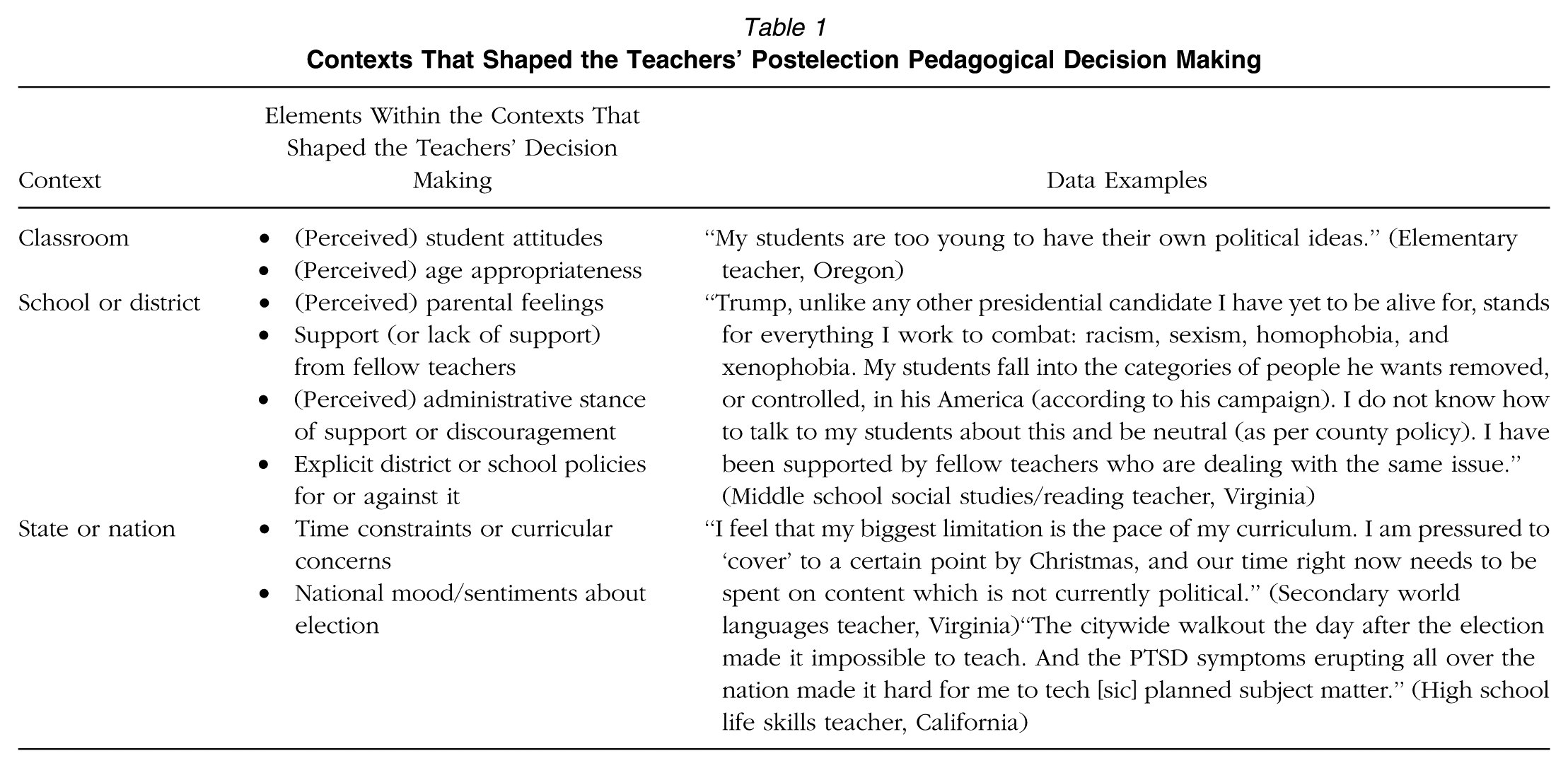
In this study, teachers reported myriad contexts of the local and the not so local that shaped their pedagogical decisions. That is, some of what they described occurred at the classroom level, while other elements were reflective of the school or district, and still others were produced by the state and the nation (see Table 1). Contexts that were constraining or limiting for some individuals were delimiting and supportive for others, such as how the school administration responded to the election cycle and outcome. These findings support our understanding of the way schools and teachers operate in context and how sociopolitical perspectives have explanatory power for the ways in which we view teachers’ decision making (Nieto & Bode, 1998). In addition, the teachers reported how contexts existed in tension with one another and, ultimately, how they navigated those tensions. It is important to note that the contexts that kept teachers from doing what they felt they needed or wanted to do were not always aligned with what we advocate for teachers to do in their classrooms as justice- and equity-oriented scholar-practitioners.
Contexts That Shaped the Teachers’ Postelection Pedagogical Decision Making
“Some of Them Are So Naive Still”: Classroom Contexts
The classroom contexts that shaped the teachers’ decisions were related to their perceptions of (a) students’ attitudes and (b) the age appropriateness of the topic. The teachers’ pedagogical choices were particularly shaped by their perceptions of how students were feeling about and after the election, whether those feelings were positive or negative. Teachers of students from racially and socioeconomically marginalized communities were particularly attuned to their students’ reactions, yet how this shaped their response was complicated by their perceptions of what students needed. For example, in a school where the student population was “all Muslim,” a teacher noted, I knew I had to absolutely address the election results with them, . . . [but] I worry that by talking too much about the election, they will become extremely anxious and emotional to the point of hysteria since Trump’s Islamophobic and xenophobic campaign promises deal directly with my students’ lives and their community’s lives. (Elementary teacher, New Jersey)
Similarly, a teacher of immigrant elementary students in the South explained that her lessons were shaped by her belief that “no one, especially children, should be afraid that they will be forced back to a place that was unsafe for them in the beginning.”
The perceived lack of student interest in the election shaped some teachers’ pedagogical decisions. For example, an elementary teacher from Missouri stated, I worry that my staff and my students are privileged enough to “check out” of the conversation, that we are not discussing it enough. . . . I just feel a strong loss of social consciousness because of the ease of “living in a bubble.”
Related to this notion of a “bubble,” a middle school social studies teacher in North Carolina wrote, “If anything, interest from students has died down. They’ve gone back to their normal lives, and if the election is still weighing on them, it’s not noticed in the classroom.”
Closely linked with perceptions about students’ attitudes was the perceived age appropriateness of the topic. This issue came up in many of the responses from elementary teachers, though it led to different pedagogical choices. Some teachers believed that their students were “too young to have their own political ideas” (elementary teacher, Oregon); one stated, “I would love to discuss the results with them, but I don’t think they are aware” (elementary teacher, New York City). Others believed that, even if their students did know about the election, the debates and issues were too advanced to be included in class discussions. “I teach a young grade,” wrote a teacher from Connecticut. “After stating this was an adult thing, they haven’t brought it up.” The discourse and rhetoric of this particular election were also manifest in the teachers’ responses, as a middle school language arts teacher from Virginia explained: The biggest factor is the fact that they are so young. Usually, I teach about civics in English class but this political season was so aggressive and nasty, I didn’t ask these 11-year-olds to dive in, because I didn’t need them reading about grabbing pussy, to tell the truth. Some of them are so naive still.
In each of the cases above, because of their perceptions about the topic not being age appropriate, the teachers chose not to discuss the election in class. Though fewer, other participants made pedagogical decisions in which they saw classrooms as sites to cultivate youth empowerment and engagement specifically because of the students’ age, as one elementary teacher explained: “More than ever, I wanted to stress the importance of civic activism, duties of a citizen and political connections to my students. . . . I want to look for examples of how students in their age-group can influence change.”
“I Have to Stay Politically Neutral When I Want to Speak Out About Injustice”: School/District Contexts
The teachers in this study also felt that their pedagogical choices were affected by the contexts of their school and/or district, including (a) parental stances on the election, (b) support (or lack of support) from fellow teachers, (c) their perceptions of the administrative stance (support, discouragement, or uncertainty), and (d) direct administrative communication or explicit policies (for or against). Responses here varied widely, depending on whether the teachers felt that their own personal and pedagogical beliefs aligned with those of their school and district administrators. Teachers who described an alignment of beliefs responded with feelings of satisfaction, even if they were generally dissatisfied with the election results; teachers who did not describe an alignment responded with feelings of anger and stress. Perceived alignment led to more reports of confidence in pedagogical decision making. Additionally, if teachers themselves were upset about the election, and if they reported that parents, colleagues, and administrators supported this stance, we saw more evidence of critical dialogue with students, or what we have described elsewhere as the pedagogy of political trauma. What was not observed in our data was any strong pattern based on district, state, region, or union presence. This shows the incredible nuances in local and state policies, as well as the nuances in teachers’ pedagogical decisions (and feelings of agency), even within contexts that seem similar on the surface.
Parental Stances
Teachers’ perceptions of parental feelings were closely linked to the age of their students and the political climate of the district in which they worked. Some teachers argued that it was the “parents’ job” to teach about political matters. For instance, one teacher stated, “I respect the rights of their families to influence their [students’] viewpoints, so they do not know mine” (fifth-grade science and social studies teacher, Connecticut). Teachers also described the potential for reprisal or retribution and reported being “fearful,” “anxious,” “unsure,” and “scared.” Teachers’ perceptions of parents’ political affiliations also shaped their pedagogical decisions. For example, in contexts where teachers felt that the parents’ politics were aligned with their own, they expressed much more confidence in their decisions. As a high school social studies teacher wrote, “I’m in Berkeley. I can go as far as I want in terms of politics. The students, community, and school see Trump as a threat. So do I.” In contrast, a high school teacher in Wisconsin said, The community I teach is in Paul Ryan’s district, so it’s fairly red. I don’t want to come off as pushing an agenda toward my students. I tried to keep any criticism toward Trump based on his character flaws not his policies.
Parental pressure and expectations were particularly complicated for those teachers working in politically polarized schools. One Nebraskan high school teacher expressed concern over “some very powerful parents who are looking for teachers who may be ‘leading their kids away from family values’.”
Fear of parental backlash prompted some teachers to consider ways to integrate equity-focused perspectives in more implicit than explicit ways. For example, an elementary teacher from a predominantly White school in Michigan explained, I always feel nervous explicitly discussing politics in my classroom due to the variety of views of my students’ parents and my own fear that parents will be upset or complain about me if my own views come up explicitly in classroom lessons/discussions. I know I have students whose parents supported both candidates passionately and I do sort of feel a responsibility to respect their parents’ views (no matter how much I may disagree).
“Instead of talking too directly about the election,” this teacher made implicit curricular changes—not just after the election but throughout the year. She explained, “I try to share my values with my students in other ways through the books I choose to read and the values I choose to focus on during our morning meetings (fairness, equality, kindness, inclusion, etc.).” In this example, we see an educator working to enact equity-focused perspectives in a way that protects both her job and her students.
Collegial Relationships
When teachers did not feel supported by the administration or were not sure which pedagogical choices to make, some described a refuge of like-minded colleagues. One teacher, “the youngest and Whitest” of the staff at her “Title I elementary school,” described how she “find[s] strength with [her] coworkers who are strong women of color who are familiar with being represented by a bigot” (elementary math and science teacher, Washington, D.C.). She further explained that the election opened up new spaces for her to talk with colleagues about critical issues, learning from them how to respond to students. For example, on the morning after the election, students ask[ed] me if I had one wish what would it be. I said for a new president elect. I asked if I was too bold or if my answer made them uncomfortable. They smiled, reassured and said no. . . . Students’ knowledge of electoral college, term limits (hell yeah Obama), and president elect increased. I watched students become careful with their language, church, policies, sexism, and race. I am more comfortable with sharing that I am an ally with them and they trust me more.
In contrast, a few teachers described being like a “fish out of water”—a Clinton supporter among teachers for Trump, or vice versa. A high school physical education teacher and Trump supporter described her feelings of alienation: I don’t feel comfortable AT ALL telling anyone who I voted for and why. I don’t feel my opinion would be heard or understood by colleagues. I have been in very awkward settings with other teachers bashing those who voted for Trump. They did not know I voted for him and was not going to try and explain myself. I just kept silent.
This silence also replicated itself in the teacher’s classroom. Though she heard many students commenting about how they were upset about the election outcome, she told the students they would not talk about the election because “it’s private.”
The “fish out of water” feeling was also experienced by Clinton supporters in schools where the community had supported Trump. One high school language arts teacher in a majority-conservative school in rural Missouri explained that she felt her pedagogical decisions were limited by “fear”: “I do not know of one other teacher who realizes that Trump is a demagogue. They might not even know the word.” She was concerned because “most of the school is very happy and it does not occur to them that they are promoting prejudiced attitudes.” She did offer a writing assignment for students to reflect on the outcome; but “I would not let them talk about it because admin and all the other teachers (all White) were celebrating with them and I do not want to lose my job.” In the writing assignment, most wrote how happy they were about Trump, and how now America can be White again, we are going to finally get rid of the “ugly, brown, filthy” people. It was very sad. Some wrote about now needing to buy assault rifles and other paranoid, xenophobic, echos of their parents’ views.
Administrative Stances
Another contextual element was school- and district-level administrators’ encouragement or discouragement of discussions about the election. Again, this appeared to be particularly salient for those participants whose political orientation seemed to match that of their students and the community. As an instance of support, a Wisconsin teacher wrote, Our superintendent and administration have expressed support and empathy for those hurt by or frightened by the election results, . . . [after] our students, in an election-day mock election, voted ~75% for Hillary Clinton. Their votes matched our city results.
Addressing the intersections of his identity and position in a liberal school district, another teacher explained, [I] felt totally empowered to address the political environment. . . . I am also a confident, White, 45 year-old-man with over 20 years of teaching experience who has the privilege to say what I think without fear of recourse from parents or my other colleagues. I am sure that not everyone has all of these advantages. (High school social studies teacher, Washington)
We did not see, however, any educators who felt empowered to speak in support of the new president because of district or administrative stances.
In other contexts, however, the administration discouraged teachers from addressing the election, and the teachers thus feared for their jobs if they did not follow “marching orders.” This was particularly influential on the pedagogical decisions of those who believed that their political orientations differed from those of their students and/or community. One teacher working in a highly conservative area where students were known to make racist and prejudiced remarks argued, “[The biggest challenge was] that my school will often let go teachers who go outside the box. . . . My administration doesn’t disagree with students’ remarks” (high school STEM [science, technology, engineering, and mathematics] teacher, Michigan). Or as a secondary social studies teacher in Georgia explained, I was told directly that I can’t criticize the candidates because a parent might complain, and there is a lot of Trump support up here and a lot of animosity toward Clinton. The administration here pretty much runs scared of the parents and seeks only to keep them happy. So it’s a bit dicey sometimes.
Despite the administrative stance to ignore the election results, some teachers in this study chose not to heed such directives. “I don’t care what my school administration says, we’ve talked about it,” a middle school teacher explained. “My loyalty is to my students and their lives, . . . not to administrator requests to avoid conversations that are uncomfortable.” In part because this teacher’s students, “given their ethnic and racial background, were worried about deportation and the subsequent impacts that a Trump presidency would have on their family lives,” he chose to ignore his administrator’s edicts: “My school, tied by a never-ending desire to remain ‘unbiased,’ did nothing and told teachers to limit conversations about the elections because such conversations were not included [in the standards].” Instead, this teacher had the students watch and respond to news coverage and engage in a group discussion about their concerns and thoughts. Overall, for teachers who went outside of administrative demands, their rationale rested on “protecting” or “prioritizing” their students’ needs over what they viewed as ill-informed or limited administrative views.
In still other cases, teachers were uncertain about how their administrators felt. In the absence of stated beliefs or explicit policies, the teachers were left to surmise what to do—and what would or would not be supported—based on prior administrative actions and their general sense of the school and district climate. As a high school science teacher in Pennsylvania explained, [I did not want] my administration to come back to me and tell me I have no “reason” to be discussing the election with my students if I have a parent complain. Even though I think I have the trust of my principal and assistant principal, I do not have faith in my superintendent. I believe my school district has always had a strong undercurrent of racial division, and this election brought it a little more to the surface.
This “undercurrent” may have surfaced after the election, however, as the teacher described an incident the day after the election when a White male student came into her room and chanted “Trump, baby!” in front of her students, some of whom were students of color. The chanting student was the son of the school board president.
For teachers who identified as Clinton supporters in Trump-supporting schools, this “not knowing” if they would be supported led to both fear of action and guilt about inaction. A high school science teacher in a “predominantly White, rural, lower-middle to lower-class, ‘blue-collar’ district” (state not disclosed) offers a powerful example: I would like to be able to let my students, especially those of non-White ethnicity, those with disabilities, or LGBTQ identifiers, know that I am here to love and support them. I don’t know how to let that be known because I fear backlash from my administration. I am uncertain about whether my fears are unfounded. I’ve thought about asking if it’s okay to wear a safety pin on my lapel but am afraid to ask and also afraid that some of our more radical students might lash out toward me. It is well known that most of our students and families are gun carrying, very conservative, and judgmental. A few years ago, two students ran around the school with a confederate flag, and one of my students had a swastika on his jacket sleeve last year.
In a more recent incident, the teacher noted, three Jewish teachers were sent hateful messages from a former student, via Twitter, on the day after the election. One of these was a swastika. When this was reported to the administration, “the response was ‘And . . .?’” When the teacher brought up school shootings and her fears, “they were basically taken with a grain of salt.”
Explicit Policies
Rather than mentioning policies that supported election-related discussions, there were far more teachers who revealed direct communication or explicit policies that strictly limited their pedagogical choices. Some of this direct communication came before Election Day, as in a Virginia teacher’s case where there was an official “county memo sent throughout [the] campaigns to keep an unbiased view when discussing anything in reference to the election.” As a teacher in a middle school in Los Angeles reported, “The district and my principal put all teachers on notice to stay nonpartisan, by e-mail. I wish they would trust their teachers.” Many teachers interpreted this order to remain neutral as an order to avoid discussion of the election altogether.
Some of this direct communication referenced existing policies about controversial issues or political views in the classroom. In some cases, the teachers agreed with and followed such policies. “Our school district has strict rules on how to communicate with students regarding elections,” explained an elementary teacher in Florida: “Deflect back to the home for family discussions.” In her classroom, the teacher’s pedagogical decisions were shaped by the policy: “Not one comment regarding the election had been spoken. . . . This topic for elementary school students is best left for family. They have no real concept of the ramifications of an election.” Relatedly, a middle school literacy teacher explained, “District policy discourages teachers from sharing personal political views, and I agree with this policy.”
At the same time, other teachers who worked in districts with similar policies on the books chose not to follow them, either openly or more subversively. As a middle school teacher in the Pacific Northwest wrote, “The district ‘civility policy’ stresses that educators are supposed to remain neutral in political discussions.” However, when students came into class and wrote “RIP America” on the whiteboard, she told them, “I don’t have a good poker face (which they already know), and [that] I won’t remain neutral on people attacking each other.” Instead, she began a discussion about the need to support marginalized groups and move from disappointment to action. A North Carolina elementary teacher explained, “I honestly haven’t exactly been following the school rules when it comes to this subject. If the kids bring it up, I don’t hesitate to discuss it.”
“I Certainly Do Not Promote Fear or Promote Protests”: State and National Contexts
Teachers who wrote about not so local contexts beyond their school or district described challenges related to (a) time and curricular constraints and (b) the prevailing national sentiments. Regarding curriculum, some teachers felt limited by a lack of time to divert from the curriculum, while others saw the election as deeply connected to the curricular content they were already teaching, or were willing to divert from the previous objectives in order to discuss what was happening. We include this perspective in this section because, while the pressures of these time and curricular constraints were felt most acutely at the classroom level, the policies and politics that informed such pressures were reflective of those at the state and national levels. As an elementary math teacher from New Orleans expressed, Everything in my day-to-day routine was still moving so fast that I could not slow down to process the reality of the election. Some things felt distinct, but most things felt like a blur. I wonder if the students felt the same way and if they are still pondering everything that is happening.
One teacher wrote that “unfortunately, tests and quizzes were given on the day of the election and day after, so students . . . were not given time to reflect” (high school art teacher, Georgia).
In contrast, other teachers felt that the election did align with what they were teaching. As a secondary language arts educator argued, The current unit has been extremely helpful as it focuses on an American of Chinese descent experiencing racism, bullying, and stereotyping. The parallels drawn between book and life make it easier for students to put the situation in context and realize how real the themes and events in the book are.
Another teacher wrote, “[Teaching social studies] has definitely helped me with how I responded. It allowed me to shift my lessons and curriculum to match the current events and teach the students what they are interested in.” Even when teachers did not perceive connections between the current curriculum and the election, some raised implications for future pedagogy: “I am now rewriting the social studies curriculum and am working to plan units and lessons to teach students about how the government works, how laws are made, and the powers of each branch of government” (elementary teacher, New York).
Additionally, participants described how their pedagogical choices were shaped by what they viewed as the prevailing national mood or sentiment about the election. Teachers explained that they were aware of incidents of bullying across the country and potentially even expected it to happen in their locales. As a high school teacher in Nebraska explained, I think everyone is waiting for shoes to fall, so to speak. We are waiting for moments of hate to emerge and considering how we will deal with it. I think we are seeing headlines from around the country and internalize what that would mean if it happened in our school.
These contexts appeared to have teachers on edge, poised to react and anxious about how they would do so.
Others who wrote about broader sociopolitical contexts described themselves as supporters of Trump, and their answers were critical of colleagues who they viewed as too political and of “hype” in the media. Some felt that parents were contributing to the difficulty and were not using “calm logic,” with one teacher writing, “I have conducted myself in a way to not try to speak poorly of the people who were spreading the hysteria” or bringing “sensationalized” messages from the media to school (elementary teacher, Nevada). She stated that “it would be nice to work with people who could conduct themselves as adults, not children” and that, unlike her colleagues who were responding personally and emotionally, she was “there to help students learn to think for themselves, increase their skills in reading, writing, and math, not to proselytize about politics or [her] personal views.” More directly, an ESL (English as a second language) teacher explained, “Hopefully parents will stop letting young children watch the liberal media, which continues to fuel the hate in America.” To counteract this, when questioned by her students about immigration and racism, the teacher “explained that a lot of what [students were] hearing from others was not based on any specific facts. Also, our government is a democracy with three branches, so the president cannot make decisions on his own.” Even in Berkeley, California, where other participants described this community as a supportive contextual factor, a Trump-supporting teacher emphasized how they taught about the political process as a response to how “many students puppeted liberal media and their own parents’ and family members’ highly liberal opinions and extreme fears about a Trump presidency.”
Discussion
As the findings above illustrate, multiple aspects of teachers’ sociopolitical contexts shaped their pedagogical decisions in the days and weeks after the 2016 presidential election. The sociopolitical is a powerful lens through which to view their decisions because it offers a way to “foreground the political and engage in the tensions that surround that work” (Gutiérrez, 2013, p. 40). In particular, taking this stance helps us analyze (a) the complicated nature of teachers’ understanding of neutrality, especially during and after the election, and (b) how teachers’ decision making and agency are situated in contexts that attempt to control their work.
Considering Neutrality
Many teachers in this study responded to their sociopolitical contexts by attempting to remain, in their words, “neutral.” Based on the teachers’ reports in this study, we understand neutrality as “the idea that teachers should not express their views to their students or weigh in on any particular side during class discussions or debates of social issues” (Kelly & Brandes, 2001, p. 452). The responses illustrated that some teachers felt pressured to strive for neutrality because of parental pressures or school policies, for example. Others positioned the postelection outcome as a “current event” or a “controversial issue” and used this perception to justify ignoring it or only addressing it briefly. That is, we saw teachers arguing, “I just teach science,” or that curricular content is somehow separate and independent from the “real world” of the election. These findings also support previous research that teachers continue to espouse a myth of curricular objectivity and/or neutrality (e.g., Apple, 2004; Giroux, 1981). The ability to position the election in one of these ways reveals a level of privilege and distance from the election outcome that many students may not have had. Yet others viewed the election outcome as a threat to their students’ (or their own) safety and livelihood and subsequently felt compelled to respond with in-depth and sustained support, both via the curriculum and interpersonally. These teachers wanted to avoid neutrality and looked to colleagues with similar beliefs to help enact their pedagogical decisions.
Data from this study illustrate that, despite what some administrative policies call for and some teachers attempt to enact, education as a whole—be it curriculum, instruction, or the interaction between the two—is not a neutral endeavor. That is, all education endeavors are informed, shaped, and perpetuated based on certain social, cultural, historical, and political ideologies (Apple, 2004). There is nothing neutral about what is taught or how it is taught. When teachers “choose a textbook, . . . decide what knowledge to teach,” and choose which “ideological constructions [to] encourage . . . or discourage,” they are making political, nonneutral choices (Kincheloe & Steinberg, 1997, p. 12). Thus, teachers may find themselves struggling with issues of professional neutrality in a profession that is, at its core, already not neutral. This is especially challenging because many teachers enter the profession (or at least enter teacher preparation) believing teaching to be a neutral and apolitical act, and they experience conflict when professional responsibilities appear to be in tension with their personal ideologies (i.e., Andrzejewski, Baggett, & Askia, 2018). They may “insist that teaching is a politically and ideologically neutral activity and that classrooms are, and should be, isolated from the politics of the school, district, state, country, and world” (Bartolomé, 2008, p. 40). Too often, as we see in teachers’ reports about the stances of various stakeholders within their sociopolitical contexts, administrators and systems reinforce this ideology through policies that charge teachers with remaining “neutral” in their practice.
Neutrality, as discussed above with literature on teaching about the election, has been primarily investigated within social studies education. However, even though social studies scholarship represents a majority of the existing literature on this concept, our data illustrate that teachers in all content areas and at all grade levels wrestle with issues of neutrality. Bartolomé (2008) sees neutrality as a “trap” that allows educators to hide harmful ideologies and practices. Like other critical scholars, we assert that remaining (or striving to remain) neutral is also a political choice. In an attempt to remain neutral, teachers are, in fact, enacting the opposite of neutrality—choosing to maintain the status quo and further marginalizing members of certain groups. Thus, we extend Howard’s (2003) call to social studies teachers as it relates to all content area teachers, who must realize that “where issues of racism and inequity are concerned, neutrality, silence, and inaction all serve as ringing endorsements for racial oppression and inequity” (p. 38), especially in times of political polarization.
Considering Agency and Autonomy
Many teachers in this study expressed feelings of limited autonomy. In public discourse, there is little trust in teachers, and in policy, there is an increasing amount of oversight and attempted control of teachers’ labor (Apple, 2011). Thus, when moments like the election arise, teachers feel pressure from so many different directions that many of them have difficulty determining how to respond and what to do, if anything at all. Given such strong ongoing efforts to standardize curriculum (Au, 2007), and the threats to teacher autonomy, one might expect, then, a large overlap in how teachers actually responded.
Yet our findings also point to a disconnect between standardized policies and teachers’ actual pedagogical decision making. These data show just how idiosyncratic the teachers’ pedagogical practices and decision-making processes were after the election, depending, in part, on their local and not so local sociopolitical contexts. Certainly, there were patterns of responses, as we have discussed, but the wide variation was interesting to us. To that end, there appeared to be a certain level of agency that the teachers were capable of enacting, such as those who went against perceived or stated policies that prohibited discussion of the election or those who made independent decisions about whether such discussions were appropriate for the age-group and content they were teaching. Thus, even within contexts that may be constraining, teachers have the capacity to resist and subvert. As Anderson and Cohen (2015) argue, while much of teachers’ work is controlled by these top-down reforms, they still have the capacity to enact bottom-up policy, as “four decades of research have shown that practitioners become policy-makers at the point of implementation” (p.15).
Neutrality, Agency, and Justice in a Polarized World
Given the polarization discussed earlier, and given the multiple contextual elements advocating for a neutral stance on teaching about the election and its aftermath, it might be easier for educators to distance themselves from these debates and maintain, as much as possible, the guise of neutrality. Yet now is the time for different pedagogical moves. Teachers and schools have the opportunity—and, we would argue, the responsibility—to challenge White supremacy and racism, misogyny and the patriarchal system, and homophobia and heteronormativity (i.e., Ahmed, 2012; King & Chandler, 2016; Sensoy & DiAngelo, 2017). We see these issues as related to justice, not controversy or partisanship, and as teachers’ data revealed, such social issues are deeply embedded in students’ experiences and understandings of the candidates and the election outcome. This work is of particular relevance since the documentation of the “Trump effect,” wherein 90% of more than 10,000 teachers surveyed nationwide claimed that Trump’s campaign and election have had a negative effect on school climate, including a rise in verbal harassment, the use of derogatory language, physical abuse (SPLC, 2017), and the presence of neo-Nazi symbolism on campuses (Costello, 2016).
With such intensive pressures in these politically polarized times, we argue that teachers must anchor their practice in a theoretical framework that helps them capitalize on the agency they do have in their pedagogical decision making. That is, even as public schools are sites of reproduction of cultural and economic norms, statuses, and hierarchies (e.g., Bowles & Gintis, 1976; Fasching-Varner, Mitchell, Martin, & Bennett-Haron, 2014; Stovall, 2016), they can also operate as sites of resistance and critical pedagogy (Giroux, 1983, 1997; hooks, 1994; Patel, 2016b). Many educators, scholars, and activists have illustrated how schools and individual teachers have the potential to empower students of color and those who have been historically marginalized (Howard, 2008; Ladson-Billings, 1994). For those teachers whose practice is anchored in understandings of justice and equity, making pedagogical choices becomes not about partisanship but rather an ongoing commitment to advance the liberatory possibilities of schooling for the good of all students.
Practicing through a lens of social justice can offer teachers a way forward in this political climate, as we saw from the example of some teachers in our study. Ayers, Quinn, and Stovall (2009) explain that this pedagogical decision involves several key practices: reflecting on one’s own identity and how it intersects with oppression, privilege, and equity issues; advocating for student participation and agency in addressing the inequities faced in and out of school; and supporting students’ development of critical thinking about systems of oppression and historical and contemporary marginalization. Quite clearly, many of these tenets are at odds with the current political forces shaping education, which are focused on commodification and standardization of knowledge and preparing students to take their place in the workforce. Further, the task of tearing down systems of oppression enacted by the state is a complex one for teachers who themselves are employed by the state (Apple, 2012).
Implications
The findings from this study have implications for teacher preparation, teacher practice, and future research and policy. First, findings that the teachers in this study did not feel prepared to address or respond to student concerns in the wake of the election. Interestingly, while scholars continue to argue that teacher education is a vital component of teachers’ future practice (and we agree), none of the participants in this study identified teacher preparation as having an influence on their postelection decision making. This raises interesting implications when we consider that, despite what happens within teacher preparation programs, we cannot control what happens upon graduation, when teachers may work in schools where they are not supported in their social justice efforts or where they exist as ideological outsiders who face professional disconnection, doubt, and dissatisfaction based on their pedagogical decisions. For teacher educators, this should act as a renewed call for preparing preservice teachers to (a) consider the “ethics” of neutrality and of framing justice and equity issues as “polarizing” or “controversial”; (b) learn how to adapt curriculum to respond to, and create space for reflection about, current events and national crises or traumas (Simmons, Baggett, & Eggleton, 2014); and (c) work within and around policies that may limit their creativity, agency, and collaboration. Furthermore, teacher educators and colleges of education should work to adopt programming that is integrative and works against a technocratic orientation to teaching (Cross, Dunn, & Dotson, 2018; Dunn, 2016; Giroux, 1997; Mehta, 2013). That is, teacher preparation programs that focus solely on “strategies,” lesson planning, and classroom management, and that divorce pedagogical methods courses from foundations, educational history, and justice and equity courses, serve to reinforce and perpetuate a perspective that there is such a thing as “apolitical” teaching or “neutral” content.
Next, this study illustrates the importance of practicing teachers feeling that they are part of a positive school climate with supportive colleagues and administrators. We encourage practicing teachers, especially those who do not have support within their schools, to find networks across schools and districts that can act as restorative and supportive communities (Picower, 2013; Sondel, 2017). It is clear that policies that limit teachers’ ability to make their own pedagogical decisions are harmful to teachers and to students. As our other research has also shown, we recommend involving teachers and students in the policy creation and implementation process and recognizing the importance of teacher autonomy (Dunn, 2018; Dunn, Farver, Guenther, & Wexler, 2017).
Future research may consider the individual and demographic factors that shaped teachers’ pedagogical decision making in the wake of the 2016 presidential election. Specifically, how did their prior experiences, beliefs, and values inform what and how they chose to teach? Further, how do the demographics of students intersect with teachers’ own identities to inform their teaching decisions and rationales? Future research may also consider how teachers in different types of schools respond to political polarization. Do teachers in public, private, or charter schools have more or less fear, doubt, and support in the wake of polarizing events? Other scholarship may focus on the long-term impact of the election and how teachers and students continue to work together to make sense of learning in this new political climate. Examining the alignment or disconnect between stakeholders’ views—including those of administrators, teachers, parents, and students—on teaching about the election and related polarizing issues would also be useful in helping to better understand if and how different perspectives become policy and pedagogy.
A Coda: Our Dissonance as Researchers
In this study, we have highlighted how teachers perceived myriad contexts as influential of the ways they approached their teaching and their students. Indeed, the findings from this study indicate, by virtue of the many responses in the data, that teachers are empowered beings, capable of both reproduction of an inequitable system and of subversion and resistance, but that this empowerment is complicated by the ideology to which teachers ascribe and the contexts within which they work. We are cautious in admitting that we want teachers to be autonomous and agentic—insofar as they are working in service of justice and equity. We emphasize that teaching is an intensely personal profession in which identity and politics are bound up but that, ultimately, teachers are charged with the preparation of young people to work toward a more just, equitable, and democratic society. Thus, we emphasize that it is important to consider how the role of a public school teacher is defined, and that our current sociopolitical context of schooling constantly challenges the role of a teacher as an activist for equity and justice. Teachers (and colleges of education) alone are not responsible for societal transformation; instead, “[our] work has the potential to contribute to those movements in essential ways by being part of collective projects and larger communities for social justice” (Cochran-Smith, 2004, p. 19).
We feel it important to acknowledge that the process of completing the data analysis and writing for this manuscript was, for us, a dissonant experience. We found ourselves considering, individually and collectively, broad questions about the purposes of schooling, the balance between autonomy and control, and the difference between being partisan and being political. Like the teachers in our study, we were also struggling with feelings of dissonance in the context of our increasingly polarized nation. We empathize with teachers who are trying to reconcile what they believe with the challenges of working in public institutions and with those who are struggling amid the new contexts they are facing and will continue to face. Yet we also struggled to understand teachers who espouse neutrality (or the facade of neutrality) in the midst of political and social upheaval and while surrounded by agendas that challenge basic human rights. We wrestled with what it means for supporters of these harmful ideologies to be responsible for the education of our young people. One problem, as we see it, is that the basic demand for human rights, let alone equity and justice, is currently perceived as a partisan or “controversial” issue. So while we do not believe that arguing for rights for people of color, immigrants, women, gay and trans people, and the disabled is a political issue, it is currently understood in public discourse to be that way. And when this discourse equates political issues with partisan issues, we understand why teachers might find it challenging to negotiate their pedagogical decisions.
Ultimately, although we have written about political and partisan polarization in the abstract, we feel this sense of polarization and isolation in our own lives. Indeed, many of the issues we grapple with in this article are the very things that drove us out of the K–12 classroom and into academia to better understand the sociopolitical contexts of teaching and our roles and responsibilities within those contexts. Yet we find academia to be mired in many of the same issues. What does it mean for teachers’ work that people on both political and partisan sides are convinced that they are right? What does it mean to work for justice and equity in a context where basic human rights are increasingly framed not just as political but also as partisan? Finally, what does it mean to advocate for teacher empowerment and agency in some cases where we agree with the teachers’ work and not in others, while at the same time advocating for multiple perspectives? We find ourselves left with these tensions to navigate, and so we leave them here in the hope of using this work as a vehicle for conversation about what it means to be scholars, teacher educators, and practitioners in this increasingly polarized climate.
Footnotes
Appendix A
Appendix B
Teacher Demographics

| Characteristics of the Teachers | Composition of the Sample |
|---|---|
| Race/ethnicity (self-reported categories) | 75% White, 4% Latinx, 3% Black; fewer than 3% identified as multiracial, Native American, Asian, Asian American, Indian, Jewish, or Middle Eastern |
| Years of experience | 18% had 0–3 years of experience; 10%, 4–5 years; 30%, 6–10 years; 27%, 11–20 years; 14%, 20+ years |
| Pathways to licensure | 45% attended traditional, 4-year undergraduate teacher preparation programs; 34%, master’s/MAT (master of arts in teaching) programs; 26%, alternative licensing |
| Content areas | 26%, elementary; 14%, social studies; 13%, English/language arts; 8%, science; 6%, mathematics; 5%, world languages; 5%, English as a second language; 4%, special education; 1% each for physical education, art, theater, band, and journalism. <1% of teachers taught in International Baccalaureate, Advanced Placement, or other Gifted and Talented programs within these content areas |
| Grade levels | 10%, early elementary (K–2); 11%, upper elementary (3–5); 5%, all elementary grades (K–5); 27%, middle grades (6–8); 37%, secondary grades (9–12). The remaining teachers in the sample reported teaching some range of grades across the above bands, such as 4–8 or K–12 |
Note. Total number of teachers = 724.
Notes
A
B
H