



Abstract
This article investigates the interaction between the Common Core State Standards and curricular tracking by examining instructional decision making across tracks in a large metropolitan district. This study draws on institutional logics as a framework to analyze 106 instructional decisions from 24 participants involved in middle school literacy instruction. In lower-track classes, participants often adapted the curriculum and adopted a more teacher-centered approach. About half of the rationales for those decisions reflected a logic of tracking, less than a fifth reflected a logic of differentiation, and almost a third reflected elements of both logics. These findings demonstrate that despite common standards, a tracked school structure continues to serve as a powerful signal about the curriculum and instruction seen as appropriate for different groups of students.
Keywords
Over the past few decades, standards-based reform has been the dominant education policy paradigm in the United States. Proponents believe that standards-based reform creates greater educational equity by establishing clear, common expectations for student achievement and linking those expectations to other elements of the educational system, such as assessments, curriculum, and instruction (Smith & O’Day, 1990). The most recent iteration of standards-based reform in the United States, the Common Core State Standards (CCSS), replaces the previous patchwork of individual state standards with a common set of “fewer, clearer, and higher” standards in English/language arts (ELA) and mathematics (Rothman, 2011).
Those who promoted the CCSS framed them as leading to greater equity and excellence by facilitating equal learning opportunities across “zip code” (Achieve, 2012; Kornhaber, Griffith, & Tyler, 2014; McDonnell & Weatherford, 2013). However, despite the potential for addressing between-school inequalities, the CCSS is also implemented in secondary classrooms that remain, for the most part, tracked into different “levels” of coursework, raising questions about the standards’ potential for enhancing the equitable distribution of high-quality learning opportunities. In theory, tracking is designed to allow teachers to better meet students’ needs by grouping students according to one or more assessments of ability and/or previous performance (Hallinan, 1994). In practice, students in higher tracks often experience rich, authentic curriculum and instruction, while those in lower tracks encounter superficial, inauthentic tasks and low expectations (Domina, Penner, & Penner, 2017; Donaldson, LeChasseur, & Mayer, 2017; Gamoran, 2009; Oakes, 1985; Page, 1991). Furthermore, schools that appear integrated from the outside, with demographics similar to an inclusive metropolitan area, are often segregated inside, due to magnet or gifted and talented programs (Roda, 2015) or because of tracking (Mickelson, 2001; Welner, 2001). In other words, students of color, as well as English language learners, are often concentrated in lower-track classes, where instruction may not support their development (Thompson, 2017; Umansky, 2016).
Although the type and degree of organizational differentiation within schools varies (Domina et al., 2016), evidence suggests that most secondary schools in the United States still practice some form of curricular tracking (Loveless, 2013). Further, since most states have replaced previous standards with the CCSS, this provides an opportunity to study instruction across tracks in the context of common standards. Therefore, I examine the interaction between two policies—the CCSS and curricular tracking—by investigating ELA teachers’ instructional decision making across tracks in a large metropolitan district. This district, “Palmetto County Public Schools” (PCPS), is ideal for exploring tensions between tracking and the CCSS. 1 The district was considered a leader in CCSS implementation and used a common curriculum across all levels of secondary ELA courses. This curriculum, “SpringBoard,” is designed to prepare students for Advanced Placement and college coursework (The College Board, 2010). However, while PCPS had common standards and a common, college preparatory curriculum, the district used students’ state assessment scores to group students into levels of secondary ELA.
To understand decision making across tracks, I interviewed middle school teachers, instructional coaches, and district-level employees responsible for middle school writing and literacy instruction, and I conducted observations of instruction across tracks. I draw on ideas of co-construction to examine teachers’ agency as individuals who actively make meaning of policy yet work within constraining contexts and power dynamics (Datnow, Hubbard, & Mehan, 2002). I also draw on the idea of institutional logics, sets of underlying beliefs that structure an individual’s actions (Thornton, Ocasio, & Lounsbury, 2012). Specifically, I explore the roles of two contrasting logics related to student ability present in teachers’ decisions about curriculum and instruction: the logic of tracking and ability grouping and the logic of differentiated instruction (Park & Datnow, 2017). For example, a teacher guided by the logic of tracking might invoke hierarchical, fixed views of student ability in explaining why she chose a simpler reading for the lower-track class, whereas a teacher guided by the logic of differentiation might express a more mutable view of ability in explaining how she provided additional scaffolding for students in the lower-track class to read a challenging text.
Taken together, the ideas of co-construction and institutional logics allow me to analyze the ways middle school literacy teachers in this study modified aspects of their curriculum and instruction within a stratified curricular structure, as well as to identify the extent to which those decisions reflected a logic of tracking or a logic of differentiation. Despite common standards and a common curriculum, I found that some teachers modified aspects of the curriculum and/or their instruction across tracks, while others did not, but often expected less of students in lower-track classes. When teachers were making decisions for different classes, their rationales for those decisions signaled the logic of tracking about half of the time, and a hybrid logic with at least some aspects of the logic of tracking almost a third of the time. While such findings could be interpreted as criticizing PCPS teachers for deficit views of students and/or instructional decisions that may have reduced opportunity to learn, I view all PCPS teachers with whom I interacted as deeply caring and hardworking. Here, my intention is simply to illustrate the influence of structure on belief and action. Given the durability of tracking as an organizational structure, these findings raise questions about the potential of common standards and a common, college preparatory curriculum to result in high-quality learning experiences in lower-track classes.
Literature Review
Below, I first review research on tracking, particularly in ELA, and then look at the few studies that examine standards-based reform and tracking together. Next, I assess research on CCSS implementation that suggests teachers’ views of students play a key role in high-quality instruction. I describe how teachers’ views of students shape their expectations and instructional decisions. Then, I outline a theoretical framework of co-construction and institutional logics that allows me to explore whether and how teachers’ expectations for students and their instructional decisions may be shaped by organizational structures.
Tracking and Standards-Based Reform
Many studies of tracking identify its negative consequences. Academically, tracking can increase the achievement gap, depressing achievement for students in a lower track and enhancing achievement for students in a higher track (Gamoran, 2009). There are many contributing factors: some research has found that teachers hold lower expectations for students in lower tracks (Oakes, Wells, Jones, & Datnow, 1997; Page, 1991; Rubin, 2008), and the least experienced teachers are often assigned to teach students, including English language learners, placed in the lower track (Dabach, 2015; Kelly, 2004). However, one major factor associated with differences in achievement across tracks is the difference in curriculum and instruction (Gamoran, 2009). Whereas curriculum in the advanced levels tends to focus on higher-order skills, taught through authentic and collaborative learning experiences, curriculum in the regular or remedial levels tends to cover less content while emphasizing memorization and comprehension (Oakes, 1985; Page, 1991). In addition to having negative consequences for individual students, tracking often exacerbates social inequalities, concentrating minority students in lower-track classes in what is sometimes called “second-generation segregation” (Mickelson, 2001; Tyson, 2011; Welner, 2001). English language learners are also disproportionately represented in lower-track classes (Umansky, 2016), not only in ELA but in math as well (Thompson, 2017). Researchers report similar findings in ELA specifically. Students in higher-track ELA classes read and write more prolifically, engage in more literature-based discussion, and have more voice in the classroom than students in lower-track classes (Gamoran & Carbonaro, 2002). Students in the lower-track experience fewer and less-challenging reading and writing opportunities (Caughlan & Kelly, 2004; Watanabe, 2008). The ELA curriculum in lower-track classes is less coherent, with fewer opportunities to engage in peer discussions or group work, but with more test preparation (Applebee, Langer, Nystrand, & Gamoran, 2003; Watanabe, 2008).
There are many strategies for increasing the equitable distribution of learning opportunities and reducing disparities in outcomes (e.g., school finance reform, desegregation, reducing opportunity gaps). One common solution to inequities across tracks has been eliminating the track structure (detracking). Though detracking and standards-based reform both emphasize access to challenging curriculum for all students (Wells & Oakes, 1996), scholars who study tracking often promote detracking as the proper strategy for educational equity (Oakes et al., 1997; Rubin, 2008; Wells & Serna, 1996). Given the inequalities enmeshed throughout society and the educational system, standards-based reforms by themselves are not likely to provide students across tracks with equal learning opportunities; yet, little is known about the extent to which track structures may subvert standards-based reforms’ equity-oriented goals. Some evidence suggests that tracking can undermine standards implementation. Sandholtz, Ogawa, and Scribner (2004) found that teachers in a low-performing, high-poverty district in California interpreted standards in ways that provided a richer curriculum in the higher track, while another study documented the rise of a slowly paced, self-contained class focused on essential content for students with disabilities in response to standards-based reform (Bacon, Rood, & Ferri, 2016). Similarly, both Watanabe’s (2008) study of standards-based reform across tracks in North Carolina and Harris’s (2011) study of comprehensive school reform across tracks found that standards-based reforms do little to improve the quality of curriculum and instruction in lower-track classes. However, little is known about how a new standards policy, the CCSS, may intersect with school structure.
Tracking and Teachers’ Views of Students
Earlier tracking literature has pointed out the importance of teachers’ views of student ability in shaping their instructional decisions (Oakes et al., 1997; Rubin, 2008; Watanabe, 2008). The categories used to describe students within schools shape teachers’ perceptions of students, naturalizing descriptions of these groups as varying according to perceptions of intelligence, track placement, or a specific classification. For example, Stein (2001) flagged the phrase “Title 1 students” as part of school personnel’s decision making about student services. Similarly, Horn’s (2007) analysis of teacher conversations demonstrates how teachers contrasted the performance of “fast learners” and “slow learners” (p. 50) when describing their pedagogical reasoning. Teachers’ perceptions of particular groups influence their expectations for the performance of students within these groups. Though evidence is mixed, teacher expectations influence student outcomes most strongly for students of color and those with lower prior achievement (Jussim & Harber, 2005; Oates, 2003)—precisely the groups likely to be in lower-track classes. Further, track placement is a strong predictor of teacher expectations, independent of prior performance and student engagement (Kelly & Carbonaro, 2012).
When accountability policies categorically define students and schools, related designations may emerge as socially meaningful (Domina et al., 2017, p. 7). Booher-Jennings (2005) documented the use of the term bubble kids to describe students on the cusp of passing a state test, demonstrating a link between assessment and teachers’ conceptualizations of students. Similarly, Bertrand and Marsh (2015) found that teachers seldom attributed students’ test scores to their instruction or the characteristics of the assessment, but more often explained students’ scores as a function of their membership in a group such as English language learners or students receiving special education services.
In contrast to conceiving of students as part of particular groups, teachers also view and make decisions about students in ways that support students’ development and access to advanced content. Differentiated instruction—“as much a philosophical orientation as it is a best teaching practice” (Santamaria, 2012)—is one model for recognizing categories of difference as socially constructed (McDermott & Varenne, 1998). Teachers taking a differentiated approach to instruction assess students’ needs according to multiple measures and frame their decisions around a student’s “readiness level” (Tomlinson, 2001) for particular content rather than “ability.” Differentiation can also imply a series of flexible groups within classes, driven by student interest, readiness level, or learning style, rather than the fixed, between-class groupings of a tracked structure. Intertwined with disability studies, the logic of differentiation emphasizes that individual differences should be normalized and that inclusion means meeting students’ individual needs, regardless of classification category (Baglieri & Knopf, 2004).
Existing Research on the CCSS
Some evidence suggests that teachers’ views of students matter in the context of the CCSS, but there has been relatively little school-level research focused on teachers’ decisions or the role of track structure in those decisions under the CCSS. One major strand of CCSS-related research focuses on the political process of standards adoption and implementation (McDonnell & Weatherford, 2013), including the discourse around the standards on social media (Supovitz, Daly, & del Fresno, 2015). Another strand has focused on CCSS implementation at a more macro-level through surveys of state officials (Kober & Rentner, 2011) and studies of curriculum or professional development texts (Hodge & Benko, 2014; Hodge, Salloum, & Benko, 2016; Polikoff, 2015). However, survey data are limited in that they rely on teachers’ self-reported practices, and similarly, studies of curriculum or professional development materials only speak to the content of those materials, not to implementation.
Research on CCSS implementation has not yet looked directly at the importance of school structure in shaping teachers’ views. Stosich’s (2016) examination of CCSS implementation in high-poverty elementary schools found that teachers’ beliefs about student ability influenced their decision making; teachers’ descriptions of students as “low functioning” led them to reduce the rigor of questions and texts used in the classroom. As part of a set of studies on CCSS implementation among “odds-beating” and “typically performing” elementary schools in New York state, Wilcox, Lawson, and Angelis (2015) found that odds-beating schools had higher levels of instructional differentiation, which may point to the importance of a mutable view of ability. Other evidence suggests that aspects of the CCSS or associated curriculum materials may serve to introduce more mutable views of ability. Stosich (2016) documents CCSS curriculum materials, including a thematic unit on child labor, serving to educate teachers about students’ abilities, noting that teachers were surprised at students’ ability to write from sources. Similarly, Datnow, Choi, Park, and St. John (2018) found that multiple ways of problem solving within the math CCSS helped teachers recognize a broader set of students as capable, though teachers struggled to make complex tasks accessible and commonly used hierarchical language to describe student ability. Importantly, however, these studies were all conducted in elementary schools where classes are likely to be mixed-ability or to have some within-class ability grouping, rather than the between-class tracking common at the secondary level. Because the majority of secondary teachers in tested subjects work daily in tracked school environments, an investigation of how organizational structure may influence standards implementation is warranted.
In PCPS, the district at the center of this study, students were supposed to experience the same college preparatory curriculum across tracks. Yet PCPS students were grouped for instruction by their state assessment scores. In a national policy context emphasizing common standards and a district policy context that emphasizes common learning experiences, it is critical to understand teacher decision making for instruction across tracks.
Theoretical Framework: Co-construction and Logics of Ability
With the goal of revealing guiding principles in pedagogical decision making, I frame this study using principles of co-construction and institutional logics (Datnow et al., 2002; Park & Datnow, 2017). Co-construction emphasizes the larger structures shaping individual decision making, and institutional logics make taken-for-granted beliefs and norms explicit. These conceptual tools guide this investigation of how beliefs about ability in a tracked school structure shape teachers’ decisions in the CCSS era.
Policy Implementation and Co-construction
An earlier generation of research on education policy implementation emphasized the importance of local adaptation for long-lasting change (McLaughlin, 1987, 1990). How local actors respond to a policy is more important to its outcomes than inputs such as funding or resources. This line of research, sparked by the RAND Change Agent study (Berman & McLaughlin, 1978), led to a focus on teachers as key “street-level bureaucrats” (Weatherley & Lipsky, 1977), emphasizing local will and capacity as critical to policy implementation.
Continuing this focus on the local level, researchers applying a cognitive perspective to education policy implementation argue that “the problem with policy implementation is, at least in part, a problem of teacher learning” (Coburn, 2005, p. 499). A set of studies examining the implementation of standards designed to support “ambitious instruction” in Michigan, California, and elsewhere features examples of teachers or other local actors misunderstanding policy—using manipulatives, for example, to implement procedural rather than conceptual mathematics and science instruction (Cohen, 1990; Spillane, 2004). In response, some have proposed a sense-making perspective, examining policy messages in conjunction with teachers’ prior knowledge and beliefs (Coburn, 2001; Spillane, Reiser, & Reimer, 2002). However, research taking a sense-making perspective tends to emphasize an individual’s cognitive processes, and thus, sometimes pays less attention to larger structural forces (Park & Datnow, 2017). The theoretical framework for this study, co-construction, emphasizes the cognitive and structural aspects of instructional reform (Datnow et al., 2002). In other words, I investigate how teachers actively make meaning in specific environments, as well as how power structures influence available policy messages and shape individual understanding. I build on studies using co-construction that have examined the ways that structures like ability grouping influence how teachers use data for instructional decisions (Park & Datnow, 2017).
In conjunction with co-construction, institutional theory helps to explain how tracking may constrain teachers’ decision making about instruction. As Weber and Glynn (2006) describe, Institutions function to contextualize sensemaking by imposing cognitive constraints on the actors who do the sensemaking . . . people internalize scripts for action early on their working life, through socialization on the job, the school system, and the media. When such scripts are strongly institutionalized, both employer and employees take them for granted, form normative expectations, and defend their deep notions of what behaviors are appropriate. (pp. 1642–1643)
Tracking may serve as an “institutional script” internalized by teachers, in which it would seem expected and appropriate for some aspects of curriculum and/or instruction to vary across tracks. As revealed in this study, such a script would constitute a cognitive constraint on teachers’ decisions.
Logics of Ability
Tracking also invokes particular logics about student ability and these logics, taken-for-granted in the institutional structure, can inform teachers’ decision making. The idea of logics evolves from neoinstitutional theory and balances the debate between structure and agency—individuals have agency, but their decisions are influenced by an institution’s material structures and the symbolic meaning attached to those structures (Friedland & Alford, 1991; Thornton et al., 2012). According to Rigby (2016), logics are “bundles of ideas and associated beliefs and practices that come together at particular periods of time that enable certain kinds of actions and not others” (p. 435). To identify the logics underlying particular events is to make explicit how an actor’s daily decisions are related to social structures.
I examine here the logics undergirding teachers’ decision making, drawing specifically on the logic of tracking and ability grouping and the logic of differentiated instruction (Park & Datnow, 2017). The logic of tracking implies a fixed view of student ability and a view of learning as rigidly sequential. Educators guided by the logic of tracking often use state assessment data to make decisions about how to group students into distinct classes/tracks for the following school year, with the underlying rationale that narrowing the range of student abilities in the classroom allows teachers to better meet the needs of those students (Park & Datnow, 2017). In contrast, the logic of differentiated instruction implies a more mutable view of student ability and that students may be exposed to advanced ideas before mastering basic skills.
Teachers guided by these logics implement instruction with different rationales and to different ends. A teacher who expresses the belief that students in a lower-track class can complete the same task as the higher-track class and then plans a learning sequence with additional scaffolding signals the logic of differentiation; a teacher selecting a different, substantially less difficult task for a lower-track class while assuming limited abilities for students would signal the logic of tracking. Both teachers engage in pedagogical reasoning, modifying instruction to meet their perception of students’ needs, but their rationales and instructional decisions reflect contrasting logics.
Method
This study uses case study methods to investigate the questions, “In the context of the CCSS and a standardized curriculum, how, if at all, do a sample of teachers and others involved in middle school literacy instruction in a metropolitan district modify their curriculum and/or instruction across curricular tracks?” and “What logics of ability do the rationales for these decisions reflect?” Qualitative case study methods are appropriate for investigating curricular and instructional decision making because the case study approach allows the researcher to interact with participants and learn about their perspectives before, during, and after observations of classroom instruction (Yin, 2009). Because this study takes as its overall case CCSS implementation within one metropolitan district, this investigation of individuals’ decision making uses an embedded, single-case design (Yin, 2009) to select participants within schools representing a range of demographic contexts within the district. The unit of analysis for this manuscript is participants’ decisions and rationales across tracks. Data were collected between August 2013 and January 2014.
District Context
PCPS is a racially and linguistically diverse, large metropolitan district in the South. During the period of data collection, PCPS’s demographics were composed of roughly 20% African American students, 40% White students, and about a third Latino students. More than half of PCPS students qualified for free or reduced-price lunch (FRPL). From the 1970s through the early 2000s, PCPS was under a court-ordered desegregation plan; the district’s level of between-school segregation has increased in recent years.
The district’s strategy for CCSS implementation consisted of partnering with a national organization considered knowledgeable on the CCSS and using organization staff to train a select group of PCPS teachers to facilitate CCSS professional development for the district’s thousands of teachers. The introductory training emphasized that the standards would reduce college remediation rates and increase economic competitiveness. In ELA, teachers were asked to complete additional trainings, in which they examined how the standards changed over grades K-12 and learned about two components of the standards that the CCSS lead authors have framed as important: text complexity and text-dependent questions (Coleman & Pimentel, 2012). In general, messages to ELA teachers about the CCSS framed the standards as a series of technical changes in instruction. While equity was mentioned as a goal several times, the professional development materials described equity as the natural result of teachers asking “all students” text-dependent questions about complex texts. This rationale is consistent with that expressed by at least one national CCSS policy entrepreneur, who said that when the CCSS is interpreted as text-focused instruction, “. . . you neutralize the effect of family background variables in ways that have not been done before. It doesn’t mean that it eliminates it. Conceptually it creates a more level playing field” (as quoted in Kornhaber et al., 2014, p. 15).
Sampling Criteria
I used a purposeful sampling logic to select teachers embedded in three types of middle school contexts within the district: (a) schools with minority student enrollment of over 80% and more than 80% of students qualifying for FRPL, (b) schools whose racial and socioeconomic demographics were similar to PCPS as a whole, and (c) schools with more than 70% white students and fewer than 20% of students qualifying for FRPL (see Table 1). Selecting teachers working in different contexts allowed me to ask whether patterns in instructional decisions across tracks were consistent across different types of schools.
District and School Demographics

Note. FRPL = free- or reduced-price lunch; SES = socioeconomic status.
Data Sources and Analysis
I relied on interviews with 17 middle school ELA and reading teachers, 5 school-based coaches, and 2 interviews with district employees, including a writing coach who worked with schools identified as in need of intervention and the administrator responsible for middle school ELA across the district. I also drew on subsequent observations of instruction from 12 of the 17 teachers I interviewed, who were located in six different middle schools (see Table 2 for a list of participants).
Participant Information

Note. ELA = English/language arts; ESL = English as a second language; SPED = special education; F = female; M = male; FRPL = free or reduced-price lunch; SES = socioeconomic status.
As a first step, I conducted semistructured interviews with participants for about 40 minutes, asking about their backgrounds, daily schedules, experiences with the CCSS, and their approaches to instruction with different classes. For teachers who were willing to be observed, I observed between 2 and 12 class periods, making sure that observed classes represented differing tracks. During observations, I used ethnographic field notes to record as many of teachers’ words and actions as possible (Emerson, Fretz, & Shaw, 2011). Field notes were also used to record the substance of informal conversations with teachers between classes, before school, and after school—conversations in which I asked teachers about rationales for instructional decisions.
Interviews were recorded and transcribed, and then both interview transcripts and field notes were coded using NVivo data analysis software for any episodes of pedagogical reasoning (EPRs). I adapted the concept of EPRs from Horn (2007), who studied teachers’ professional conversations and defined EPRs as “moments in teachers’ interaction in which they describe issues in or raise questions about teaching practice that are accompanied by some elaboration of reasons, explanations, or justifications” (p. 46). As applied to this study, EPRs are units of talk between teacher and researcher in which the teacher discussed a decision and provided a rationale for that decision. In an interview, EPRs consisted of units of text in which a teacher described both decision and rationale. In an observation, EPRs consisted of the researcher’s direct observation of an instructional decision and the teacher’s description of their reasoning via a postlesson conversation with the researcher.
To categorize EPRs, I first read through all interview transcripts and field notes, applying a general code of “EPR” to any instance of an instructional decision combined with a rationale, flagging it for secondary analysis (N = 152). Next, I examined whether the teacher’s reasoning in each EPR was related to conceptions of student ability, or displayed some other rationale (e.g., a teacher describing how, in general, he calls on students who have not raised their hands because he wants to make sure that students are all paying attention). EPRs that did not relate to student ability were removed from the sample; a total of 106 EPRs met the criteria for this study. Almost a third of EPRs (27.4%) were documented in observation field notes, and over two thirds (72.6%) of EPRs came from interview transcripts.
I then transferred each EPR to a matrix, in which I recorded the participant’s pseudonym, level of teaching experience and school context, the data source (interview vs. field notes), and the text from the transcript or field note representing the EPR (Miles & Huberman, 1994). Next, I applied several codes to each EPR: a broad categorization of the type of decision, a more specific description of the modification, a summary of the teacher’s rationale, and the logic expressed in the rationale. Table 3 provides an example of the coding categories for each EPR.
An Example of Coding an Episode of Pedagogical Reasoning

Table 4 displays how the logics of tracking and differentiation were operationalized for coding purposes. The logic of tracking reflected instances when teachers’ reasoning for an instructional decision relied on descriptions of their students as sorted into hierarchical groups (“high” or “low”) or used the categories of the state assessment (on the ELA assessment, Levels 1 through 5) to personify groups of students. Teachers also displayed a logic of tracking when they expressed a sequential view of knowledge in explaining a decision, in which teachers believe that students must fully master basic content before engaging in more complex ideas (Watanabe, 2007). In contrast, teachers displayed the logic of differentiation when they rationalized their decisions by describing students as individuals or otherwise refrained from using hierarchical language or essentializing groups of students. Teachers also demonstrated a logic of differentiation when they described a belief that students in the lower-track class were capable of engaging in reading, writing, or discussion related to sophisticated texts and/or concepts, and provided support for students to do so. A “hybrid” logic represented aspects of both categories.
Elements of the Logic of Tracking Versus the Logic of Differentiation
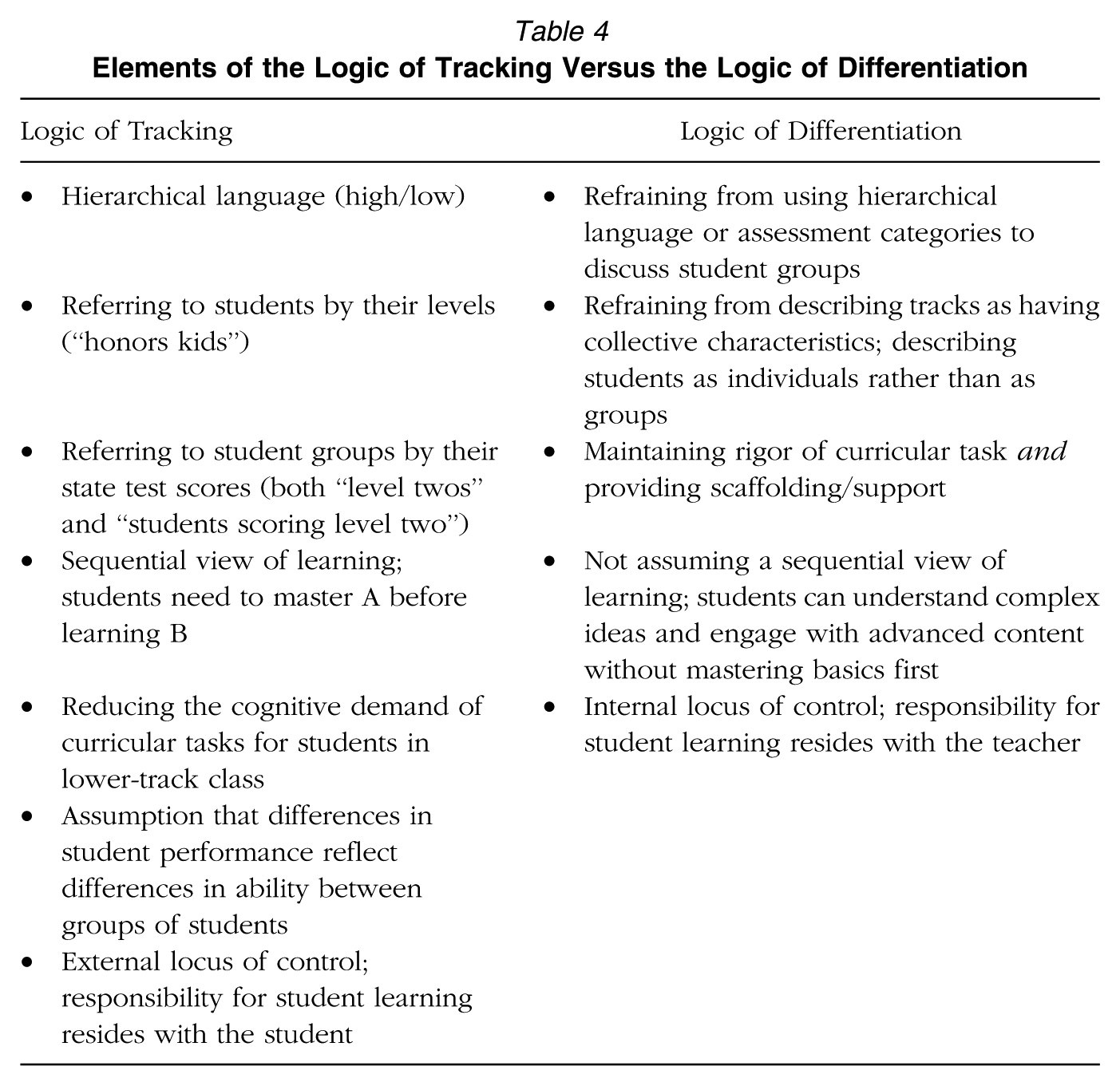
I also examined the distribution of logics across school type, from teachers in low-income, mixed-income, and high-income schools, and from teachers across three levels of experience (0–5 years; 6–15 years; 16+ years), seeking patterns in logics expressed within those groups. However, because the dataset contained multiple EPRs from some teachers, the distribution of logics within each group could be influenced by particular individuals being overrepresented in the sample. To account for this, I created a composite index for each individual teacher. The composite index treated logics as ordinal data, with a logic of tracking coded as one, hybrid as two, and differentiation as three. Then, I created a weighted average for each teacher, taking into account the number of times a teacher expressed a particular logic. Creating a measure that provided one condensed data point per teacher, then looking at average logics from the teachers that fell within each group (both school type and experience level), provided alternate ways of assessing the distribution of logics.
I used several strategies to increase the trustworthiness of my findings. First, I triangulated findings across multiple informants and multiple school settings (Maxwell, 2013). To the degree possible, I had sustained engagement in school sites, and my analysis attended to “negative cases” and “discrepant evidence” (Maxwell, 2013; Miles & Huberman, 1994). For instance, teachers who described students as “ones” and “twos” sometimes displayed a mutable view of student ability and a logic of differentiation through their instructional choices and rationales. I included these fine-grained distinctions in my coding and they are represented in the “Findings” section.
District Policy Context: Curriculum and Student Placement in Curricular Tracks
The PCPS District required that teachers in all tracks/levels of middle school ELA use the SpringBoard curriculum, published by The College Board. The superintendent saw SpringBoard as a tool to promote greater college readiness, saying about the curriculum, “I expect all students who graduate from high schools in [Palmetto County] to be college ready. I do not expect all students to necessarily go on to college, but it is my vision that all will have that choice.” In other words, SpringBoard’s theory of action is similar to the CCSS, in that both have the goal of ensuring that curricular experiences leading to college readiness are more evenly distributed (Achieve, 2012; The College Board, 2012).
Although the majority of students experience the same curriculum, the district grouped students into a number of different levels of ELA using their state assessment score as the primary data point. The term curricular tracks in this study is defined as the class-by-class instructional groupings mandated by PCPS, in which students with similar state test scores are placed in the same “level” of ELA: advanced honors, advanced, or regular. The district also considered co-taught inclusion classes as “regular”-level classes. In this article, “higher track” refers to the advanced honors class unless otherwise specified. I made the distinction in this way because, according to a district placement document, the advanced honors class was intended for students who passed the state reading assessment, while the advanced and regular level courses were for students who had not.
Findings: ELA Teachers’ Pedagogical Reasoning and Logics of Ability
In the sections below, I describe the results of analyzing 106 episodes of participants’ pedagogical reasoning for their category, rationale, and logic. A total of 50.9% (54) of EPRs reflected a logic of tracking, 19.8% (21) reflected a logic of differentiation, and 29.2% (31) reflected a hybrid logic with elements of both (Table 5). Teachers’ decisions fell into the following categories: the pacing of instruction in each track (10.4%), the decision not to modify curriculum and/or instruction across tracks (16%), general decisions about curriculum and/or instruction (11.3%), curriculum and/or instruction related to texts (19.8%) and tasks (10.4%), expectations and grading across tracks (5.7%), the degree of student-centered versus teacher-centered instruction (8.5%), and instructional scaffolding (17.9%) (Table 6). Decisions to have a more teacher-centered approach and to not modify curriculum or instruction generally reflected the logic of tracking (see Table 7). Other decision categories were represented across all three logics.
Episodes of Pedagogical Reasoning by Logic
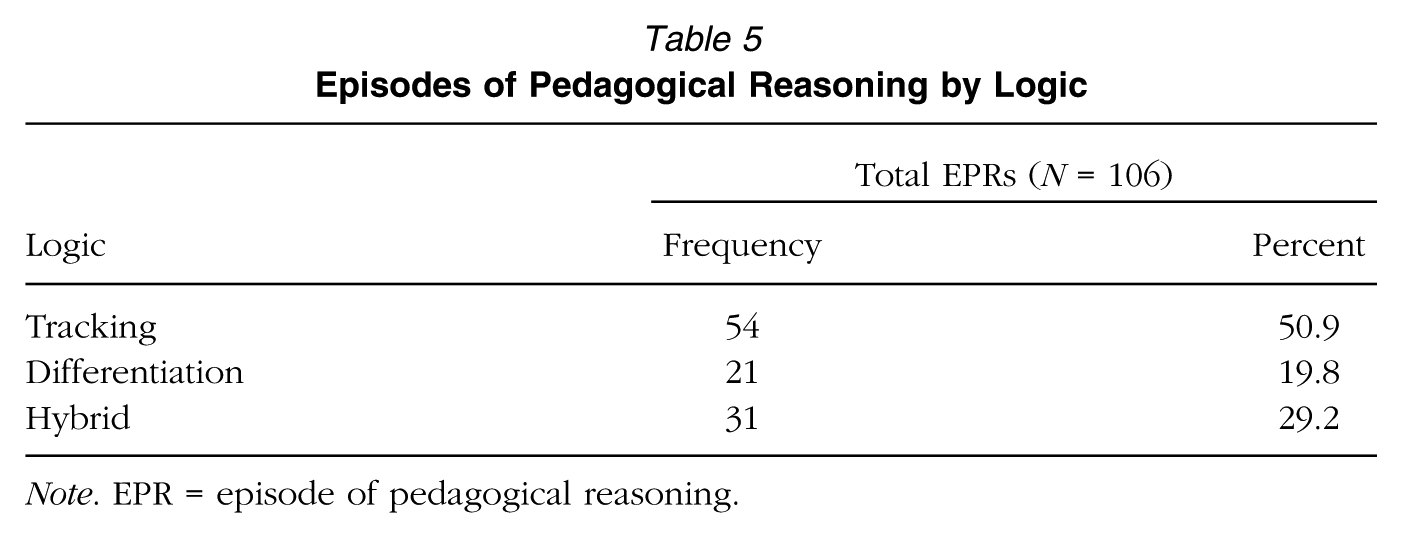
Note. EPR = episode of pedagogical reasoning.
Frequency and Percentage of Episodes of Pedagogical Reasoning by Category
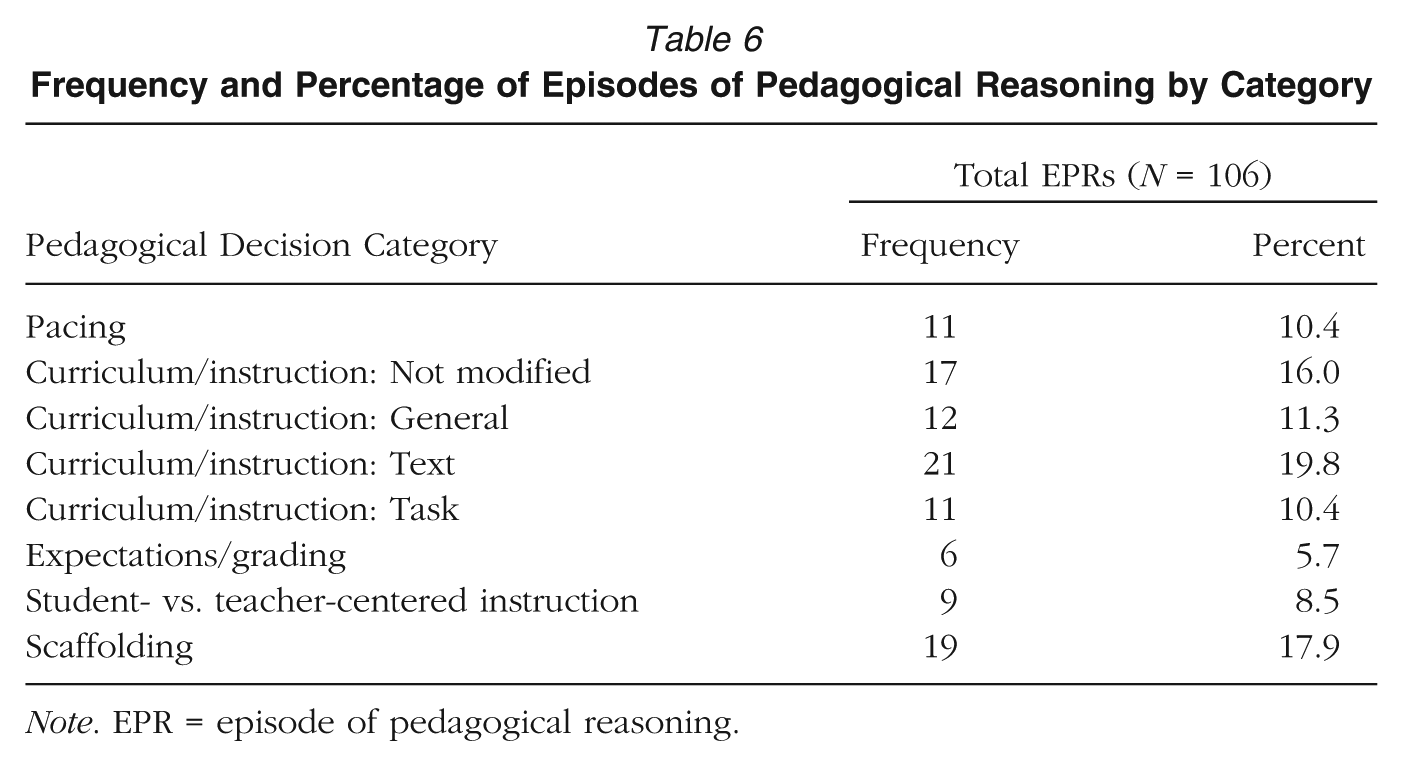
Note. EPR = episode of pedagogical reasoning.
Frequency and Percentage of Episodes of Pedagogical Reasoning by Category and Logic
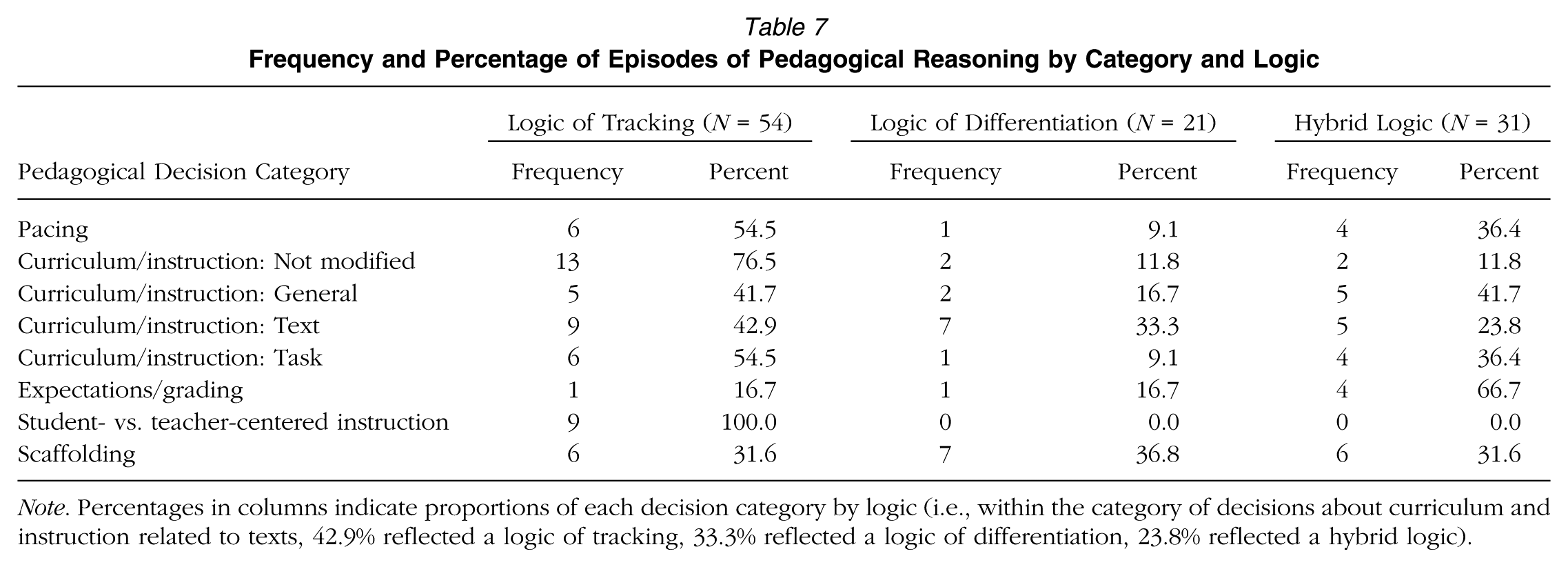
Note. Percentages in columns indicate proportions of each decision category by logic (i.e., within the category of decisions about curriculum and instruction related to texts, 42.9% reflected a logic of tracking, 33.3% reflected a logic of differentiation, 23.8% reflected a hybrid logic).
Pacing
There were 11 EPRs related to the pacing of instruction from eight participants. Six EPRs signaled a logic of tracking. For instance, Deborah, a relatively new ELA and world history teacher in a high-income school described her daily schedule by referring to the numerical categories on the state ELA assessment (1 through 5), saying: I start out with period one, and they are my lower class. They’re considered an advanced language arts class; however, they’re like the ones and twos [students who scored at a level of one or two on the state ELA assessment] . . . And then I go and jump up to an advanced honors class after them, which is language arts as well. They’re better writers, better readers. They’re my threes, fours, a couple of fives in that class . . . And then I jump to sixth grade world history. That is an advanced honors class as well, so they are good readers . . . so we can get through the material easily, because it’s a lot of terminology and a lot of difficult things to understand [italics added].
This example was coded as displaying the logic of tracking because Deborah referred to the students in advanced honors collectively as “good readers” who understand “terminology and a lot of difficult things,” and thus, can move more quickly through content. In addition, Deborah uses students’ state assessment scores as shorthand for the capabilities of her different classes, also reflecting the logic of tracking.
There were four cases in which teachers drew on a hybrid logic as they described their reasoning about differences in pacing. For example, Marcia, an experienced seventh-grade teacher in an affluent school, remarked on her approach to her co-taught inclusion class, “You just have to go slower. You have to give them a little more support. But they can do the work. They just don’t realize they can do the work.” This statement indicates a hybrid logic because even though the group of students in the inclusion class is essentialized, they are also described as being capable of the SpringBoard tasks if given more support.
Curriculum or Instruction Not Modified
Logic of Tracking
In another category of instructional decisions (representing 17 of 106 EPRs from 8 participants), teachers described their decisions to not vary curriculum or instruction across tracks.
2
Most examples of teachers describing constant curriculum and/or instruction across tracks reflected a logic of tracking (76.5% of EPRs in this category). For instance, Jessica, an eighth-grade ELA teacher in her fourth year at a high-income suburban school in PCPS, spoke with me after experiencing a peer evaluation earlier that day. While Jessica kept her lesson plan consistent throughout the day, she chose her sixth period class for the observation because she believed they were her highest-performing group. The peer evaluation was less successful than Jessica had hoped, and at first, she thought she had misremembered students’ state test scores in the sixth period class: I was looking at my test scores just recently, just today, because I was like, “OK, maybe I was wrong. Maybe sixth period really doesn’t have high-level readers. Maybe I mixed up the classes . . .” I have a bunch of fives and fours, but there were a couple of twos, maybe two or three, a couple threes, and then you’ve got fours and fives.
Jessica first describes students in terms of their test scores, displaying the logic of tracking in how she assumes that different categories of student performance on the state assessment suggest distinct differences in reading ability. She goes on to say that her class is more heterogeneous than it might seem from the “honors” label, and that she thinks her evaluation would have gone well if students were what she calls “a true honors class” rather than a mix of ability as defined via state test scores: I don’t really feel like I have a true honors class, so I really can’t push them, but let’s say I had a higher-performing class, I probably—like, this literature circle thing that I did and that synthesis . . . it probably would have turned out really well, because the higher-level, the concepts thinking-wise would have worked.
Jessica did not modify her instructional approach across tracks, but instead, attributed students’ lack of understanding of the lesson—a lack of understanding that she believes reflected poorly on her performance during her high-stakes peer evaluation—to the abilities of the students, rather than to her instruction, demonstrating the logic of tracking.
Several other examples of the logic of tracking came from observing John, an experienced teacher in a mixed-income suburban school, who frequently displayed a tracking logic (across categories, 9 of 10 EPRs from John were coded as tracking). John described his instruction across tracks as “the same show,” and he frequently used hierarchical language to compare his classes, referring to fourth period as “higher but with more behavior issues” and third period as “lower but more quiet and hard-working.” John pointed out the difference between the less enthusiastic participation of students in the regular-level class and the vigorous conversation in the honors class in response to a think-pair-share activity, which he ascribed to the idea that honors students have more confidence. These examples display the logic of tracking in how groups of students are described in hierarchical and essentialized terms.
Differentiation and Hybrid Logics
There were a few examples of hybrid (two) and differentiation (two) logics from two of the eight teachers who did not modify their instruction. As an example of the logic of differentiation, Amy, a coach who moved from a high-income to a low-income school, explained how she explicitly discussed the unchanged rigor of a lesson with students in a lower-level class to convey positive messages about intelligence: I told the kids, “This lesson that you just did is the same lesson I used to do with the honors kids in my other school. Is this an honors class?” And they went, “Oh, no, no. We’re regular.” I said, “That can’t be true, because what you just did is an honors lesson. What does that mean?” “That we’re smart.” “Mm-hmm.”
Amy explicitly pushed back against students’ internalized ideas about their own intelligence and track placement. Additionally, she did not change the rigor of the task or assume a sequential view of learning, so this example was coded as expressing a logic of differentiation. The two examples of hybrid logics came from Lisa, an experienced teacher and former coach in a low-income school who generally displayed hybrid and differentiation logics in her decisions. Lisa described how she dealt with the results from a benchmark assessment early in the school year on which only a few “gifted kids” scored highly, emphasizing to students that they all would build knowledge throughout the year to do better. While this demonstrates some essentialization of students, Lisa also expressed an overall mutable view of ability.
General Decisions About Curriculum
Another category of EPRs (12 across seven participants) describes instances when teachers made general decisions about curriculum. EPRs in this category were relatively evenly split between the logic of tracking and a hybrid logic. A few teachers displayed a logic of tracking in their use of terms like truly advanced when describing their general approach to SpringBoard. For example, Lisa (experienced teacher, low-income school), said of SpringBoard, “I think it’s geared more for the mainstream regular child as far as the rigor and for the truly advanced and honors kids, you need to up it up a little bit.”
Suggesting a hybrid logic related to decisions about curriculum, one affluent suburban school developed its own curriculum for “bubble kids” (Booher-Jennings, 2005)—students on the cusp of passing the state test—to supplement SpringBoard. Jim, a veteran teacher who teaches this class and developed its curriculum, described the rationale for its creation, saying: These are kids who have a three, and we found, God love our principal, she’s a brilliant lady, she saw that a lot of those kids were not getting over the hump, because there’s a really fine line the way the scale slides when they become eighth graders. A lot of the kids were going to twos. And so they said, “Let’s get these kids together and put them through a year of rigor and improve,” and that’s why we have them in here. That way they don’t backslide. And of course we have our level ones and twos. . . . They go to more of a remedial reading situation. The class is taught differently. Different things are done.
On one hand, even though students were in danger of not passing the state test and might have been put into a scripted reading remediation program in another school, Jim designed this reading curriculum with complex texts and ideas—reflecting the logic of differentiation. On the other hand, Jim uses numerical language to describe students, reflecting the ubiquity of the state assessment categories as constructs to describe students in PCPS, so this quote was coded as displaying a hybrid logic.
Curriculum and Instruction: Texts
Teachers made decisions about modifying SpringBoard to match their assessments of students’ needs (21 EPRs from 10 participants), such as which texts to use with different students and how to lead students through those texts. Teachers’ rationales ranged across all three logics.
Logic of Tracking
Eight text-based modifications from four teachers invoked the logic of tracking, as when teachers expressed the feeling that some texts in SpringBoard are not comprehensible for students in the lower track and modified accordingly. Three of these instances came from Suzanne, a veteran teacher close to the end of her career in an affluent suburban school, who described her approach to leading students in discussion about a text as different across tracks. Her students were reading Walt Whitman’s “O Captain! My Captain!” and she told me that in her regular-level, inclusion class: I will really lead them through and help them . . . And for my honors kids, I ask a question, I throw it out there, and they maneuver around, and if they’re right, we go on. If they’re not, I facilitate further discussion for them to come to the right decision . . . And this morning [in the honors class], they pretty much got it. They understood that the Captain was really Lincoln and the ship was really the Union and the country. My next period class [a co-taught inclusion class] won’t get that.
When I followed up to ask how she planned to work with the inclusion class, she said, A lot of it will be feeding. I really feed them. Most of them except for two people are level one readers, so they’re not going to get that insight and that comparison. I’ll really have to lead them through it.
Here, for both classes, Suzanne displays a view of class discussion as less a dialogic process of meaning-making and more one in which the teacher lobs a series of questions to a group of students to elicit a correct answer. In the lower-track class, however, Suzanne is far more explicit, “feeding” students information until they come to an understanding of the extended metaphor. Further, she feels it is unlikely that students with a state-assessed reading level of “one” would understand the metaphor without significant help.
Similarly, John (experienced teacher in a mixed-income school, 90% of EPRs coded as tracking) told me that he feels that students in the honors class can be trusted to watch brief videos on everyday heroes and respond to questions on the content. John said this is because students in the honors class will independently change their responses to the correct ones during a whole-class discussion, whereas students in the regular class cannot be trusted to take accurate notes or correct their responses. Therefore, John tells students in the regular class to not take notes during each video and instead write down exactly what he writes down on the projector in response to each question. Because John generalized about each group in ways that close off opportunities to engage in text-based discussion in the lower-track class, this EPR was coded as indicating a tracking logic.
Differentiation and Hybrid Logics
Nine participants displayed the logic of differentiation (seven EPRs from five teachers) or a hybrid logic (six EPRs from four teachers) in their decisions about texts. One type of text-based instructional decision is supplementing a text with other resources that help students understand the plot. Experienced teacher Lisa used this approach frequently in her ELA class for English language learners in a low-income school with predominantly Latino enrollment, with three EPRs describing differentiation-oriented, text-based decisions. For example, Lisa chose to supplement a SpringBoard excerpt of The Odyssey with a video from the History Channel dramatizing the events of the encounter between Odysseus and the Cyclops. Such instructional moves were generally coded with a logic of differentiation, as Lisa found ways to modify her instruction to make a text accessible to students with a variety of language skills. However, some of her language suggested a hybrid logic, when she made comparisons about groups of students such as, “You saw these kids [students in the ESL class] actually do a lot better with non-print text [video] than regular kids. It’s interesting, because SpringBoard is riddled with non-print text.”
Skipping the more difficult SpringBoard texts was another strategy that teachers used to meet their perception of students’ needs. Echoing Suzanne’s concern about the difficulty of “O Captain! My Captain!”, Diane, a veteran teacher in a mixed-income, racially diverse school, signaled a hybrid logic in how she felt the poem’s extended metaphor, along with the historical background knowledge necessary to understand Abraham Lincoln’s role in the Civil War, was too complicated for students in the lower track. “I might do it [talk about Abraham Lincoln and read the poem] with my higher-level kids,” she described, “because they might get it,” but with students in the lower track she made a calculated choice to focus on a more literal poem by Robert Hayden in the SpringBoard book, “Frederick Douglass,” and to supplement it with quotes from Douglass’s autobiography, which she put into Power Point slides. Diane described her rationale, saying that in the lower-track class: We talk about reading, how empowering it is and it’s so important that you learn how to read . . . I said, “It’s not a matter of making you a reader; it’s a matter of power.” And power is something especially low-income kids understand. “Don’t give away your power. You need to keep that.” And so I use that . . . we have a Frederick Douglass poem, and after we do the PowerPoint, we do the Frederick Douglass poem, and then I have them write—we work a lot on tone, so “How does the tone of this prove he’s heroic?” A lot of them get that. I kind of double up on Frederick Douglass, because I think he’s so important, especially for minority kids and especially for low readers, to see that reading is that important . . .
Here, Diane modifies the curriculum in an effort to increase students’ motivation for reading. She makes the observation that many of the students in her lower-track class (who were also predominantly students of color) are from low-income backgrounds and that a message about the power of reading and education could be a critical one for them to hear; yet she also assumes that students will not be able to understand the extended metaphor in “Oh Captain! My Captain!,” invoking a hybrid logic.
Curriculum and Instruction: Tasks
Teachers sometimes felt the SpringBoard tasks and associated instruction needed to be modified for different groups of students (11 EPRs from seven participants). Teachers’ rationales for task-related decisions reflected a tracking logic (54.5%) and hybrid logic (36.4%), with only one example of a differentiation logic.
Logic of Tracking
Though large assignments in SpringBoard like the unit assessments remained constant across tracks, teachers changed their approach across tracks by modifying the smaller tasks they asked students to complete. Students in higher tracks might be given supplementary materials. For example, Garrett, a seasoned educator working in a diverse school who was also involved in a national teacher leadership initiative, shared with me, “I supplement vocabulary. It’s old-school. They tell me every year, ‘Don’t do that. Just find the vocabulary in the story.’ I go, ‘These are high-level, advanced honors kids. I need to give them more.’”
Teachers might vary the length of a task by track placement, signaling the logic of tracking in that students in a higher-track class are assumed to work at a faster rate. For example, Diane (experienced teacher, mixed-income school) came up with a task to extend the SpringBoard curriculum’s unit on heroes. She asked students to read a recently published article from CNN.com on a teenager who created a program to supply new shoes to homeless children, so that students could see heroes as everyday people who solve a problem. Students across all of her classes were asked to read the article and use textual evidence in their responses to three questions. However, students in the advanced honors class were expected to complete all three questions, students in the advanced class completed two, and students in the inclusion class were asked to complete the first question. Although this variation was mostly a difference of task quantity, it meant that only students in the advanced honors class were asked to make a direct link between the article and the unit theme, as only the third question asked students about the teenager’s heroic qualities.
Hybrid and Differentiation Logics
Another type of decision that teachers made was to modify some aspect of their instruction around the SpringBoard tasks, rather than modifying the tasks themselves. Describing her experience using a new note-taking matrix with students, Monica (a reading coach in a low-income school), says: It’s funny, because when they introduced this model as a teacher, I had advanced-level kids, so I wasn’t afraid to try it. As a coach this year, it’s been introduced in more and more curriculum, including in some of our lower-level classes. And the teachers are like, “Oh, my goodness, I don’t think my kids are going to do this,” and I said, “You watch them! You’re going to be surprised.”
Monica now encourages teachers across all tracks to use this note-taking tool, but when she first learned about it, she was only comfortable experimenting with it in her class with the “advanced-level kids,” suggesting a hybrid logic.
The single example of a logic of differentiation around curricular tasks comes from Anna, the district administrator for middle school ELA, in which she described how writing conferences can serve as a way to increase student engagement in lower-track classes: And we tried to incorporate conferencing while writing this year, where you’re letting students work through the process but you’re guiding and catch them while they’re writing, as opposed to, “Here’s your paper back, here’s your score, be sure to read my comments.” And then I file it away . . . Teachers will often say they don’t do it because they’re afraid the kids will get out of control. I know they’re afraid that kids will misbehave . . . but the classrooms I go into, it’s not an issue . . . they are more engaged. If you entrust that to them, I think they will rise to that occasion.
Because Anna expresses a belief that writing conferences should be used with students in all levels of ELA, and that students in a lower-track class will “rise to that occasion” of a less teacher-centered mode of instruction, this EPR was coded with a logic of differentiation.
Grading and/or Expectations
Most examples of pedagogical reasoning around how to grade students reflected a hybrid logic (four out of six EPRs from six teachers). Teachers generally felt that it was not fair to hold students to the same expectations across tracks and made decisions at the classroom level about how to grade students differently. However, teachers made these choices in an attempt to meet students’ needs and prevent them from becoming discouraged, indicating aspects of both tracking and differentiation logics.
For example, John (experienced teacher, mixed-income school) applied different standards for grading a large assignment in the honors and regular-level classes, allowing students to miss more questions in the lower-track class for the same grade and using a low-grade threshold of 60% as a strategy to prevent students from being discouraged. Similarly, Diane, also working in a mixed-income school, told me that she thinks you have to celebrate students’ accomplishments where they are. If you grade all students according to one standard, students who fall far below that standard will further internalize a sense of failure.
In contrast, when I asked Marcia, an experienced teacher in a high-income, high-status middle school, “Would you say that the expectation for the quality of work [across tracks] is pretty similar?” she responds, “No, I’m letting them [students in the inclusion class] off a little bit easier, definitely. Definitely.” Here, Marcia demonstrates different expectations for students in the inclusion class consistent with a logic of tracking (in that they are “let off easier”). Finally, one reading coach drew on a logic of differentiation, in terms of students being held to the same expectations across tracks. Monica, the reading coach from a low-income school, said that using the same rubric to grade students across tracks on SpringBoard’s culminating unit assessments “is good” because “. . . just like in the Common Core. The rubric in the writing is the same for anybody.” Because the state assessment aligned with the CCSS uses one rubric to evaluate all students, it makes sense to Monica to use the same rubric across tracks for SpringBoard’s unit assessments.
Student-Centered Versus Teacher-Centered Instruction
Another common way that teachers shifted their instructional approach across tracks was along the axis of student- versus teacher-centered instruction. All nine of these episodes across seven teachers were coded as reflecting the logic of tracking, as teachers’ instruction became more teacher-centered in lower-track classes as a strategy to keep instruction moving forward and minimize disruptions. For instance, when I observed experienced teacher Sarah in an affluent suburban school, students were working on a unit about the media’s influence on teenagers. In the honors class, Sarah let students sit on top of their desks for a class discussion. In the regular-level class, she had students remain in their desks and raise their hands to speak. When I asked her what she thought would have happened if she had let the lower-track class sit on their desks to discuss, she said that sitting on the desks would have turned into “Hey, look at my crotch.” This rationale, that students in the lower-track class are immature and would not be able to stay focused if their bodies were less regulated, signals a logic of tracking.
Similarly, Lisa (experienced teacher, low-income school), modified her instruction in her inclusion class to a more teacher-centered approach to maintain control and order. In her other classes, Lisa designated students to pass out the SpringBoard workbooks at the beginning of class and stack them neatly at the end of class, but in the inclusion class, Lisa told me that students throw the workbooks if a student passes them out, so she does the task before students come in. After the inclusion class entered, Lisa had students use index cards to answer an opening question because they “. . . have an issue with paper,” she explained, in which students would tear it or throw it, whereas index cards are harder to tear into little pieces. Another day, Lisa led a literature activity in which students rotated between stations and completed different tasks related to vocabulary, point of view, and literary elements in a short story. In the inclusion class, Lisa chose to run the stations as whole-class activities, rather than as small-group activities where frequent transitions were required, feeling that there would be too many opportunities for student misbehavior. Lisa often made decisions signaling a logic of differentiation; however she too felt that the best way to keep instruction moving forward in her inclusion classes was by keeping students in their seats with fewer exchanges between them. This invokes a tracking logic because Lisa describes the needs of students collectively and chooses strategies resulting in less student interaction in the lower-track class.
Scaffolding
Almost a fifth of all EPRs (19 from 10 participants) were coded under the category of “scaffolding,” meaning that there was a specific reference to modifying some aspect of curriculum and instruction across groups in a way designed to help students read a text or complete a task. One might think that most examples of instructional scaffolding would be coded under a logic of differentiation, as scaffolding is normally described as a set of supportive practices designed to be removed over time, such as reducing degrees of freedom, modeling, and marking critical features (Benko, 2013; Wood, Bruner, & Ross, 1976). Yet teachers used language that reflected all three logics, and only Lisa had examples of scaffolding displaying a differentiation logic.
Logic of Tracking
One representative instance of the six EPRs from five teachers displaying a logic of tracking comes from Deborah, who had moved from a low-income to a high-income school, and used a fill-in-the-blank graphic organizer for an extended writing task. The organizer had a stop sign image at regular intervals, at which point students were to go up to the teacher for a “writing conference,” where their work would be checked for correctness. Deborah described using this organizer with students in the low-income school, as well as “with my lower-level kids here [at the high-income school].” Deborah goes on to describe, . . . however, the higher-level kids, they already know a lot of that [structure], so we work more on style, on voice, on word choice, on things that really will increase their writing . . . you don’t want to take away their voice, their creativity, what they can do. With the higher-level students, I don’t want to do that. The lower-level students need structure, or they don’t know what to do.
This example demonstrates the logic of tracking because Deborah used the organizer to reduce the degrees of freedom (Wood et al., 1976) for the lower-track class to almost zero (e.g., students could make only one set of choices about the pieces of evidence). While writing conferences can allow teachers provide individualized coaching, in this case, writing conferences were used to closely monitor students’ completion of the graphic organizer. In contrast, higher-track students were allowed to focus on stylistic elements and worked from a less regimented list of the essay’s required components rather than the graphic organizer.
Hybrid and Differentiation Logics
Other instances of scaffolding indicated a hybrid logic (six EPRs from five teachers). PCPS encouraged ELA teachers to have students use a note-taking matrix during reading. The matrix allows students to record evidence as they read, thereby scaffolding the process of answering a question using textual evidence. For example, John, an experienced teacher in a diverse school, used this matrix to help students respond to the question, “What makes Odysseus a hero—his physical, mental, social, or moral characteristics?” As students read, they recorded quotes from the text that provided evidence of Odysseus’ heroism and labeled the evidence as representing a physical, mental, social, or moral characteristic. Then, students can see which argument makes the most sense based on the preponderance of evidence in a particular category and have the evidence easily accessible. Reading coach Monica described how teachers might use this kind of a note-taking system with all of their classes, but that teachers would lead different groups through this process in different ways: In advanced classes, they’re given a blank page where they fill it all out. In the lower level, we may provide some of the comments [quotes]. They’re still responsible for finding what paragraph it’s in and checking off the characteristic that matches. It’s a little bit more scaffolded to help them out. Eventually the goal is to release them to where they can do it on their own.
This example was coded as hybrid because the decision about how to modify the process was made according to students’ track placement, but gradual release of responsibility is a goal.
All seven examples of scaffolding reflecting the logic of differentiation come from Lisa (experienced educator, low-income school). Lisa taught an ESL class using the SpringBoard curriculum and described a number of adaptations she made to make texts and tasks accessible. She described her thought process for an ESL class, saying: I can look at “O Captain! My Captain!” and that would intimidate me if I was an ESL student. How can I make it so that my kids are understanding this? Doing little things like, “Every time you see “Captain,” it equals Abe Lincoln. We actually built the background knowledge first. “Who was Lincoln? What do you know about him?” . . . I can make this accessible to kids where English is not their first language. And let me tell you something. People don’t want to hear that. What they want to hear is, ESL kids should not be using that curriculum.
This statement, and others like it, were coded with the logic of differentiation because the teacher does not exhibit a sequential view of knowledge, and she describes supplementing instruction to enhance accessibility, rather than altering a text or task itself.
Logics and Teacher/School Characteristics
I also examined differences in the logics that teachers expressed by experience level and school type. Experience level did not seem to be a strong indication of differences in logics, at least not for this sample of teachers from PCPS. Consistent with the full dataset of EPRs, most of the teachers in the sample expressed a combination of tracking and hybrid logics. New teachers tended to express the logic of tracking more often (63.6% of EPRs from teachers with less than 5 years of experience were coded with the logic of tracking vs. 50% for teachers with 6 to 15 years of experience and 51% for teachers with more than 16 years of experience). However, new teachers were underrepresented in the sample, so this difference may not be meaningful. Using the weighted average, veteran teachers, with 16 or more years of experience, tended to express hybrid logics more often than mid-career and newer teachers, who expressed more tracking logics, but again, it is unclear if this difference is meaningful.
A more interesting finding emerges from the breakdown of EPRs across school type. A relatively even proportion of EPRs came from each of the three school types, yet the distribution of logics across school types was uneven. When looking at the distribution of logics by school type as summarized in Table 8, logics were the most evenly distributed in low-income schools, with 42.1% of EPRs expressing the logic of differentiation, a much higher percentage than in mixed-income schools (3.2%) or high-income schools (6.5%). However, three of the four teachers of color in this sample taught in low-income schools, and research has demonstrated that teachers of color are more likely than White teachers to see students of color as capable and refer them to gifted programs (Grissom, Rodriguez, & Kern, 2017). EPRs from high-income schools tended to fall in line with either tracking or hybrid logics. However, EPRs from mixed-income schools predominantly expressed the logic of tracking (80.6%). These data remain consistent when using a weighted average measure that provided each teacher with a composite index of average logics. Teachers in low-income schools expressed mostly hybrid and differentiation logics; teachers in high-income schools expressed mostly tracked and hybrid logics; teachers in mixed-income schools expressed mostly the logic of tracking.
Logics by School Type

Discussion
In this study, I focused on the ways in which teachers modified their instruction across curricular tracks in the context of the CCSS and a standardized curriculum, their rationales for doing so, and the logics of ability invoked in those rationales. In lower-track classes, teachers might substitute or shorten texts and tasks, change grading strategies, slow the pace of instruction, adopt a more teacher-centered approach, and sometimes, increase scaffolding. Teachers might enact the curriculum as written with students in the lower-track class but did not usually expect full comprehension of texts or completion of tasks. About half of the instances of teachers’ pedagogical reasoning reflected the logic of tracking, and over a quarter reflected a hybrid logic, which included aspects of the logic of tracking. Teachers’ decisions reflected the logic of differentiation in less than a fifth of EPRs.
These findings demonstrate that in a new policy context focused on common standards, and in a district context where a common curriculum was used across tracks, a tracked school structure composed of different groups of students, hierarchically sorted by their state assessment scores, serves as a powerful signal to teachers about what types of curriculum and instruction are appropriate for those different groups. Consistent with co-construction’s balance of structure and agency, teachers in this study did actively make meaning of policy messages related to the CCSS and a common curriculum, but those messages of “rigor for all” were tempered by a hierarchical track structure. While the differences in curriculum and instruction presented here are not as severe as the vocational vs. academic tracks from earlier in the 20th century and instead represent today’s more typical subject-by-subject tracking (Lucas, 1999), students in lower-track ELA classes in PCPS had fewer opportunities to work in groups (Applebee et al., 2003; Watanabe, 2008) and experienced instruction that proceeded at a slower pace and emphasized comprehension before engaging with complex ideas (Oakes, 1985; Page, 1991).
However, this study does not simply identify what decisions teachers made across tracks, but also why they made those choices. Teachers in PCPS were generally caring and experienced, making decisions that fit into their schemas about the best way to meet students’ needs in a hierarchical system. Yet, similar to other studies, the deeply embedded and normative logic of tracking led to teachers enacting their concern for different groups of students in ways that sometimes limited students’ opportunities to learn advanced content and skills (Jaffe-Walter, 2016). In categorizing teachers’ rationales by the logics of ability, this study illuminates taken-for-granted beliefs about ability and student grouping embedded within teachers’ decisions, extending the tracking literature with insights derived from the use of institutional theory.
Implications for Policy and Practice
This study suggests several implications for policymakers and practitioners concerned with increasing the equitable distribution of learning opportunities. The federal government has shied away from explicit support for desegregation initiatives for decades (Hodge, 2018b); instead, standards-based reform has now become a deeply embedded, normative idea in national policy debates about how to construct policy designed to improve schools. The failure of standards-based reform to produce significant improvement is sometimes framed as a problem of alignment between loosely coupled components of the education policy system at the federal, state, district, and classroom levels (Cohen & Moffitt, 2009; Weick, 1976). The CCSS were intended to create tighter coupling through a common set of standards used across states. Common standards may create some degree of greater opportunity to learn, but they do not, by themselves, address other opportunity gaps, such as tracked school structure and uneven school funding (Carter & Welner, 2013; McDonnell, 1995; Smith & O’Day, 1990). Policymakers can encourage districts and schools to close opportunity gaps in several ways. State education agencies might consider incentivizing schools’ participation in the National Education Policy Center’s Schools of Opportunity project, in which schools are recognized for nurturing a positive school climate and decreasing curricular stratification.
For practitioners, these findings suggest that school and district leaders must attend to school organization and teacher beliefs, as well as curriculum. A common curriculum may ensure a basic level of instructional consistency, but this study demonstrates that a common, college preparatory curriculum does not ensure all students will have a college preparatory experience. For practical advice on how to reduce the number of curricular tracks offered, educational leaders can look to the examples of schools that have received the Schools of Opportunity recognition or the regional networks of districts committed to reducing achievement gaps (e.g., the University of Pennsylvania Excellence & Equity Consortia). Finally, professional development around standards should include attention to views of student ability, not just technical changes to curriculum and instruction. Much prior research suggests that teachers’ views of student ability as mutable or fixed influence the types of instruction they provide (Oakes et al., 1997; Park & Datnow, 2017; Rubin, 2008; Watanabe, 2008). Several recent books designed for use in professional learning communities may help cultivate a more expansive view of student ability in the face of signals from testing and tracking that might suggest otherwise (e.g., Pollock, 2017).
Limitations and Future Research
This study has several limitations. First, PCPS only allows researchers to collect data during the fall semester. While I had sustained engagement in the research site to the degree possible, this policy precluded the depth of data necessary for an ethnographic approach to a district case study. Although this study analyzes a large sample of more than a hundred EPRs, there may have been instances in which teachers invoked what appeared to be the logic of tracking in how they described groups of students, but a long-term, ethnographic study might have revealed teachers acting in ways that indicated a more mutable view of ability.
An additional limitation comes from my focus on the interaction between two policies: tracking and the CCSS. However, PCPS, like most large districts, was a complex policy context with multiple policies unfolding concurrently, including changes to teacher evaluation that incorporated peer observation and value-added measurements. Because districts have increasingly been seen as powerful sites for instructional reform in recent years (Gamson & Hodge, 2016), a study that explores how those policies, and others, complement or conflict with each other would be a valuable addition to the literature. It would also be helpful to conduct additional research around the role that teachers’ racial and ethnic backgrounds play in decisions they feel are most appropriate for particular students and why. Some research has demonstrated that White teachers are less likely than Black teachers to identify Black students for gifted programs (Grissom & Redding, 2016), perhaps because of implicit biases and messages sent from school structure. To the extent that lower-track classes in racially diverse schools are composed of students of color taught by White teachers, this may help to explain why the logic of tracking was so prevalent in mixed-income schools.
Finally, I do not claim that the modifications described here are representative of instruction in PCPS as a whole. However, that these modifications occurred across multiple teachers in multiple schools in a curricular context that was otherwise fairly standardized raises critical questions about the influence of school organization on teachers’ beliefs and decisions. While other work examines how assessments have reified particular groups of students, such as bubble kids (Booher-Jennings, 2005), studies of accountability and instruction have not previously identified the use of numerical descriptors like ones and twos. Future work might look at the relationship between teachers’ construction of assessment categories such as basic kids or ones and twos and how such constructions may be related to instructional decisions and students’ opportunities to learn.
This study also does not speak to whether particular types of pedagogical decisions reflect particular logics. Some indication of how decision types and logics cohere is visible in Table 3 in categories of pedagogical decisions dominated by a particular logic (e.g., the logic of tracking predominated when teachers took a teacher-centered approach in the lower-track class or did not modify their instruction across tracks). While outside the scope of this study, a qualitative comparative analysis would help to define the conditions under which particular decisions and logics are clustered together (Trujillo & Woulfin, 2014).
This study suggests that a tracked curricular system, consistent with previous research, remains a powerful signal and cognitive constraint on teachers’ decisions, suggesting to them that the most appropriate way to meet the needs of different tracks is by modifying their curriculum and instruction to make texts and tasks easier, rather than increasing the level of support provided for challenging material. Furthermore, that the logics of tracking were dominant in schools that had the most racial, ethnic, and socioeconomic diversity confirms other research on the degree to which stratification increases as diversity increases, and tracking can result in second-generation segregation even in the absence of magnet schools or formal gifted programs (Hodge, 2018a; Mickelson, 2001; Welner, 2001).
In conclusion, this study describes the ways that teachers made decisions about curriculum and instruction for different groups of students, finding that many of those decisions displayed the logic of tracking. In a national policy context that emphasizes common standards and a district context that emphasized a common, college-preparatory curriculum, teachers continued to adapt their instruction in ways that, overall, diminished the instructional rigor in the lower-track classes. While the CCSS’s “rigor for all” rhetoric implies more even exposure to challenging learning opportunities, the structure of tracking within schools in the United States continues to contribute to different learning experiences across tracks.
Footnotes
Notes

E