



Abstract
This investigation considered the short-term benefits of early childhood education participation at age 3 for 1,213 children from low-income families living in a large and linguistically diverse county. Although no benefits emerged for executive functioning, children who participated in formal early childhood programs at the age of 3 entered prekindergarten the following year demonstrating stronger academic skills and less optimal social behavior than their peers with no earlier educational experience. However, these academic benefits were short-lived and did not persist through the end of prekindergarten, in large part because children who did not attend these programs at age 3 caught up with their classmates who did. Roughly a quarter of this convergence in academics was attributed to children’s subsequent classroom experiences.
With mounting evidence that high quality early childhood education (ECE) programs help prepare children for school (Phillips, Lipsey, et al., 2017; Yoshikawa et al., 2013), public funding for ECE has seen a rapid increase, with most state programs providing 1 year of public ECE for 4-year-olds (Friedman-Krauss et al., 2018). In many locations, increased access to public ECE programs has not been limited to 4-year-olds, with programs enrolling younger children also. As a result, there has been a rise in ECE enrollment rates among 3-year-olds, such that many children today participate in ECE for multiple years before entering kindergarten (e.g., Aikens, Klein, Tarullo, & West, 2013; Jenkins, Farkas, Duncan, Burchinal, & Vandell, 2016). Indeed, national statistics reveal that between birth and 2 years of age, roughly 16% of children experience ECE, but the percentage enrolled increases to 35% of 3-year-olds and 60% of 4-year-olds (National Survey of Early Care and Education Project Team, 2015) and the median age of ECE entry is 3 years of age (authors’ calculations from the Early Childhood Longitudinal Study, Kindergarten Class of 2010-11). Given the widespread utilization of ECE as an educational and developmental resource for children from low-income communities, there is a growing need to understand the extent to which earlier exposure to these programs serving our nation’s youngest and most at-risk children provides them with developmental benefits, and whether detected benefits persist over time.
In the present study, we add to the research base on the encouraging findings regarding the short-term benefits of contemporary ECE programs serving 4-year-olds, by examining the benefits of ECE participation for children of economic disadvantage who enroll in these programs at the age of 3, within a large, culturally and linguistically diverse county. It is important to note that at this age (and in the participating state), the primary programs serving 3-year-olds are Head Start and other community-based programs that span across local and national chains (Friedman-Krauss et al., 2018). Moreover, we extend the contributions to the literature by considering the extent to which there is convergence in the benefits of ECE by the end of children’s 4-year-old prekindergarten year (from here forth referred to as the pre-K year), and if so, why convergence occurs and whether it occurs as a result of catch-up (i.e., children without prior ECE experience making ground) or fade-out (i.e., children with prior ECE experience losing ground). In doing so, this investigation is poised to add to the limited literature that has considered children’s ECE experiences at age 3 and, thus, can provide greater insight into the implications of program participation and the conditions under which large, diverse communities construct and implement early education systems that promote learning and, ultimately, reduce achievement and opportunity gaps. At the same time, this research may also inform the debates surrounding the nature of convergence by providing new insight into the factors that contribute to (or inhibit) the persistence of early benefits.
Short-Term Effects of ECE
Numerous studies have now demonstrated that the effects of contemporary and large-scale ECE programs on children’s short-term academic development is quite positive (for reviews, see G. J. Duncan & Magnuson, 2013; Phillips, Lipsey, et al., 2017; Yoshikawa et al., 2013). Children of all backgrounds—and especially those from low-income and disadvantaged homes—who attended high-quality early childhood programs at age 4 enter kindergarten more ready academically, with an average treatment effect of approximately 0.25 standard deviation units (Bailey, Duncan, Odgers, & Yu, 2017). Despite these promising findings, there remain far fewer studies of program participation at age 3, which is concerning because, as noted above, there is now a substantial proportion of 3-year-olds enrolled in ECE, and there is considerable variation in these benefits as a function of program design, populations and ages served, and the broader community context (G. J. Duncan & Magnuson, 2013; Phillips, Lipsey, et al., 2017). As has been argued, the consistency and variation in the short-term academic benefits of contemporary ECE programs serving diverse populations across different locations require attention and clarification (Phillips, Johnson, Weiland, & Hutchison, 2017).
In contrast to the short-term academic outcomes of ECE, the findings for children’s socioemotional development and their executive functioning, which are recognized as two key skills for lifelong learning (Heckman & Kautz, 2012; Masten et al., 2012; McClelland, Acock, Piccinin, Rhea, & Stallings, 2013), remain far more mixed (Phillips, Lipsey, et al., 2017; Yoshikawa et al., 2013). Indeed, some educational scholars have documented negative effects of ECE enrollment for children’s behavior (e.g., Ansari, 2018; Bassok, Gibbs, & Latham, 2018; Magnuson, Ruhm, & Waldfogel, 2007; National Institute of Child Health and Human Development [NICHD] Early Child Care Research Network, 2003), and others have documented positive or null effects (e.g., Forry, Davis, & Welti, 2013; Puma et al., 2012; Weiland & Yoshikawa, 2013; Zachrisson, Dearing, Lekhal, & Toppelberg, 2013) for these dimensions of children’s development.
Additionally, when considering explanations for variation in the immediate benefits (or drawbacks) of ECE, one point of discussion is children’s age of entry. For example, in some studies children who enter ECE programs by 2½ to 3 years of age and who remain in ECE through age 4 display stronger academic skills (but weaker social behavior skills in the short term) as compared with children entering ECE at a later age or with nonattenders (Burchinal, Zaslow, & Tarullo, 2016; Loeb, Bridges, Bassok, Fuller, & Rumberger, 2007; Loeb, Fuller, Kagan, & Carrol, 2004; Puma et al., 2012). On the other hand, others report that children who have more years of ECE experience benefit less from these arrangements over time (Jenkins et al., 2016; Yoshikawa et al., 2013). However, studies of the benefits of attending pre-K programs at age 4 greatly outnumber evaluations of programs serving 3-year-olds, which significantly limits our understanding of the effects of ECE programs given enrollment trends and the fact that more children today experience multiple years of ECE before entering kindergarten (Aikens et al., 2013; Friedman-Krauss et al., 2018; Jenkins et al., 2016).
Persistence and Convergence of ECE Effects
A common finding across studies that have had the advantage of following preschool-enrolled children for multiple years is that program benefits diminish (Camilli, Vargas, Ryan & Barnett, 2010; Clements, Sarama, Wolfe, & Spitler, 2013; Lipsey, Farran, & Durkin, 2018; Puma et al., 2012), a phenomenon known as convergence. Indeed, prior studies have found that convergence is most rapid during the year or two after program completion (Ansari, 2018; Li et al., 2016). Contemporary ECE programs, on average, confer immediate academic benefits of roughly 0.25 standard deviation units; after 12 to 24 months from program completion, these benefits are only 0.10 standard deviation units (Bailey et al., 2017). Whether contemporary programs have persisting benefits for children’s social-behavior development and their executive function skills is unclear. However, studies that have tracked children over time report that immediate negative behavioral effects of ECE enrollment converge fairly rapidly after program completion, such that there are only small differences in children’s social-behavior as a function of earlier ECE participation (Dearing, Zachrisson & Nærrde, 2015; Pingault et al., 2015). For example, using data from the Early Childhood Longitudinal Study Kindergarten Cohort of 1998, Ansari (2018) found that preschool graduates entered kindergarten demonstrating elevated levels of behavior problems, with effect sizes of approximately 0.20 standard deviation units; after 24 months from program completion, these differences were only 0.10 standard deviation units.
This convergence in the short-term effects of program participation has been found to occur for one of two reasons (Bailey et al., 2017; Barnett, 2011; Yoshikawa et al., 2013): (a) catch-up or (b) fade-out. When considering the academic outcomes of ECE, catch-up results from non–ECE attendees making ground on their classmates with prior ECE experience, whereas fade-out occurs when ECE attendees demonstrate slowed progress over time. In contrast, when unpacking the immediate negative social-behavioral effects of ECE, catch-up occurs when non–ECE attendees demonstrate increased social-behavioral difficulties over time, whereas fade-out would occur when ECE graduates display reductions in problem behavior. Several hypotheses have been put forth as potential explanations for the convergence in program impacts: theories of sustaining environments, models of skill building, and the social group adaptation hypothesis (Bailey et al., 2017; Pingault et al., 2015). We touch on these arguments below to frame an analysis of the multiyear benefits of children enrolling in ECE programs as early as age 3. It is important to note that theories of sustaining environments and models of skill building are generally concerned with children’s academic achievement, whereas the social group adaptation hypothesis addresses children’s social-behavioral development.
Sustaining Environments
Children from different backgrounds enter school with wide-ranging differences in personal, experiential, and social psychological factors that affect their transition to (and subsequent experiences in) school (Entwisle & Alexander, 1988). One of these experiential differences includes enrollment in ECE programs even before entering pre-K as a 4-year-old. Presumably, educational experiences in ECE as a 3-year-old (and earlier ages as well) could provide a basis for further educational progressions as a 4-year-old or could serve as a lost opportunity if subsequent educational opportunities fail to build on prior gains (Claessens, Engel, & Curran, 2014; Magnuson et al., 2007). This alignment of educational systems (or lack thereof), which is described as “sustaining environments,” is of interest because the benefits of ECE persist only if graduates of these programs continue to learn new skills at the same or a faster rate as compared with their peers who did not attend ECE at age 3. Accordingly, misalignment across children’s early educational experiences can be one of the primary reasons for convergence as described earlier.
Models of Skill Building
A second argument surrounding the convergence of early ECE effects stems from theories of skill building. Although early investments are thought to shape children’s long-term development by providing foundational skills necessary to succeed in school (Cunha, et al., 2006; G. J. Duncan et al., 2007), Bailey et al. (2017) argue that for long-term benefits to emerge, the skills children learn in ECE must matter in relation to learning subsequent skills and not otherwise develop among children not enrolled in these programs. In support of these very points, mastery of more constrained skills, such as letter-word identification and counting, occurs within a short time span given their fixed endpoints (Paris, 2005). Such constrained skills may be both responsive to instruction and fundamental for later learning, and as a result, exposure to early education programming may produce a noticeable positive effect in the short term. However, convergence, for those skills, is also probable if children not exposed to ECE acquire such skills shortly after school entry.
Social Group Adaptation
The final point of consideration underlying convergence—and in particular, for the diminishing negative behavioral effects of ECE—stems from process related to social group adaptation (Pingault et al., 2015). Within this framework, it is argued that the vast majority of children enter school-based settings at some point in their life (some earlier and some later) and therefore all children must adapt to and integrate into social groups. When children enter ECE for the first time, they must adapt to social and school-based settings, often resulting in heightened behavior problems (e.g., Ansari, 2018; Bassok et al., 2018; Dearing et al., 2015; NICHD Early Child Care Research Network, 2003; Pingault et al., 2015). Because this same adaptation process unfolds for all children, any initial differences that stem from ECE enrollment are hypothesized to diminish as non–ECE-enrolled children enter school and adapt to their social settings at a future point in time (Pingault et al., 2015). Under this frame, any immediate negative social-behavioral effects of ECE participation may have more to do with children adapting to new social groups, which is inevitable for all children, rather than with a specific effect of ECE. However, several studies find lingering—albeit small—persisting negative associations between ECE enrollment and children’s social-behavioral functioning through the early elementary school years (e.g., Ansari, 2018; Bassok et al., 2018; Belsky et al., 2007).
The Current Study
In light of interest in the benefits of ECE programs and increased numbers of children entering ECE at an earlier age, as well as increasing importance of identifying conditions that sustain program benefits, the current investigation addresses the following research questions:
Research Question 1: Do children who attended ECE at the age of 3 demonstrate stronger academic, socioemotional, and executive function skills at the start of the following school year (i.e., their 4-year-old pre-K year) as compared with children without prior ECE experience as 3-year-olds?
Research Question 2: To what extent do benefits of ECE participation at age 3 persist through the end of the following school year, and is there evidence for convergence?
In addition, if there is empirical evidence of convergence, then the following questions emerge:
Research Question 3: To what extent is convergence attributed to catch-up among children who did not participate in ECE at age 3 as compared with fade-out among those who did?
Research Question 4: What share of this convergence is attributed to child-, family-, and classroom-wide factors?
We hypothesized that children who attended ECE at age 3 would demonstrate stronger academic skills at school entry in the following year, but we did not make directional hypotheses about the possible associations between ECE participation and children’s social-behavioral development or their executive functioning given the conflicting evidence in the existing literature (Phillips, Lipsey, et al., 2017). Additionally, given the ambiguities surrounding the persistence of ECE effects outlined above, we left the remainder of our study aims as largely exploratory. But based on prior theory and other work in the literature, we (a) expected that if convergence were to occur, then it would be larger for more constrained skills (e.g., letter-word identification) than unconstrained skills (e.g., vocabulary knowledge; Bailey et al., 2017; Paris, 2005), and (b) if there were any negative social-behavioral effects of ECE, then they would converge—at least partially—by the end of the pre-K year (Pingault et al., 2015).
Method
Recruitment and Participants
Data for the current investigation were drawn from a sample of children from low-income families who lived in a large, culturally and linguistically diverse county that served roughly 200,000 students from pre-K through 12th grade in the 2016–2017 school year. Within this county, teachers were recruited in the fall of 2016 from the entire population of school- and community-based pre-K programs that served children from low-income families. As part of the recruitment procedures, all pre-K teachers in public schools were considered eligible for participation, but in community-based programs, teachers were eligible only if they taught at a center in which more than five publicly funded pre-K children were enrolled. Of the 155 preschool teachers, 138 teachers in 83 schools/centers consented to participate (89% participation rate; range of classrooms per school = 1–9; roughly 1.64 classrooms per school). Participating teachers sent all parents or guardians of their students a consent form and a short family demographic questionnaire. Children were considered eligible to participate in the larger study if they turned 4 years old by September 30 and were not receiving special education services (except for speech). On average, 7 out of every 10 parents who received the recruitment packets at the beginning of the school year in each classroom consented to allow their children to participate in the study (five classrooms had low parental consent and ranged from 5% to 22%; the remainder ranged from 25% to 100%). Of the 1,500 children with consent, approximately 71% attended full-day pre-K classrooms within schools, whereas the remainder attended a Head Start classroom (18%) or full-day community-based pre-K (11%), which consisted of subsidized slots in private child care centers.
The analytic sample for the current investigation includes 1,213 children and families of the original recruitment sample who had valid reports of age 3 ECE participation (more details provided below). Two-hundred and eighty-seven children were excluded from our study because their parents did not return the demographic questionnaire at the beginning of the year (n = 236) or did not answer the question on the demographic questionnaire regarding age 3 ECE experiences (n = 51). But for data on child gender, child race/ethnicity, and home language, which were provided by the school and, therefore, available for the majority of study participants, we found no significant differences between our study sample and those children who were excluded. Children who were included in our sample, nevertheless, were roughly half a month older (p < .05), more likely to have attended a Head Start classroom (19% vs. 14%, p < .05), and less likely to have attended a community-based classroom (9% vs. 18%, p < .001) at the age of 4. On the other hand, children who were included in our sample were no more or less likely to have attended a school-based classroom at the age of 4 as compared with children who were excluded from our analytic sample.
At the aggregate level, the 1,213 children who were included in our final analytic sample were racially and ethnically diverse (61% Latino, 17% Black, 12% Asian/other, and 10% White), came from households with an income-to-needs ratio of 0.87 (SD = 0.54), had mothers who were 34 years of age (SD = 7.20), and had mothers who averaged a little over a high school education (M = 12.66, SD = 1.81). There were an equal number of males (50%) and females (50%), and children were 4.41 years of age (SD = 0.29) at pre-K entry (or 3.31 year of age at entry into ECE). Eighty percent of study children spoke a language other than English in the home. For other sample descriptive information stratified by age 3 ECE arrangement, see Table 1.
Descriptive Statistics for the Focal Variables of Interest, Separated by Type of Care at Age 3
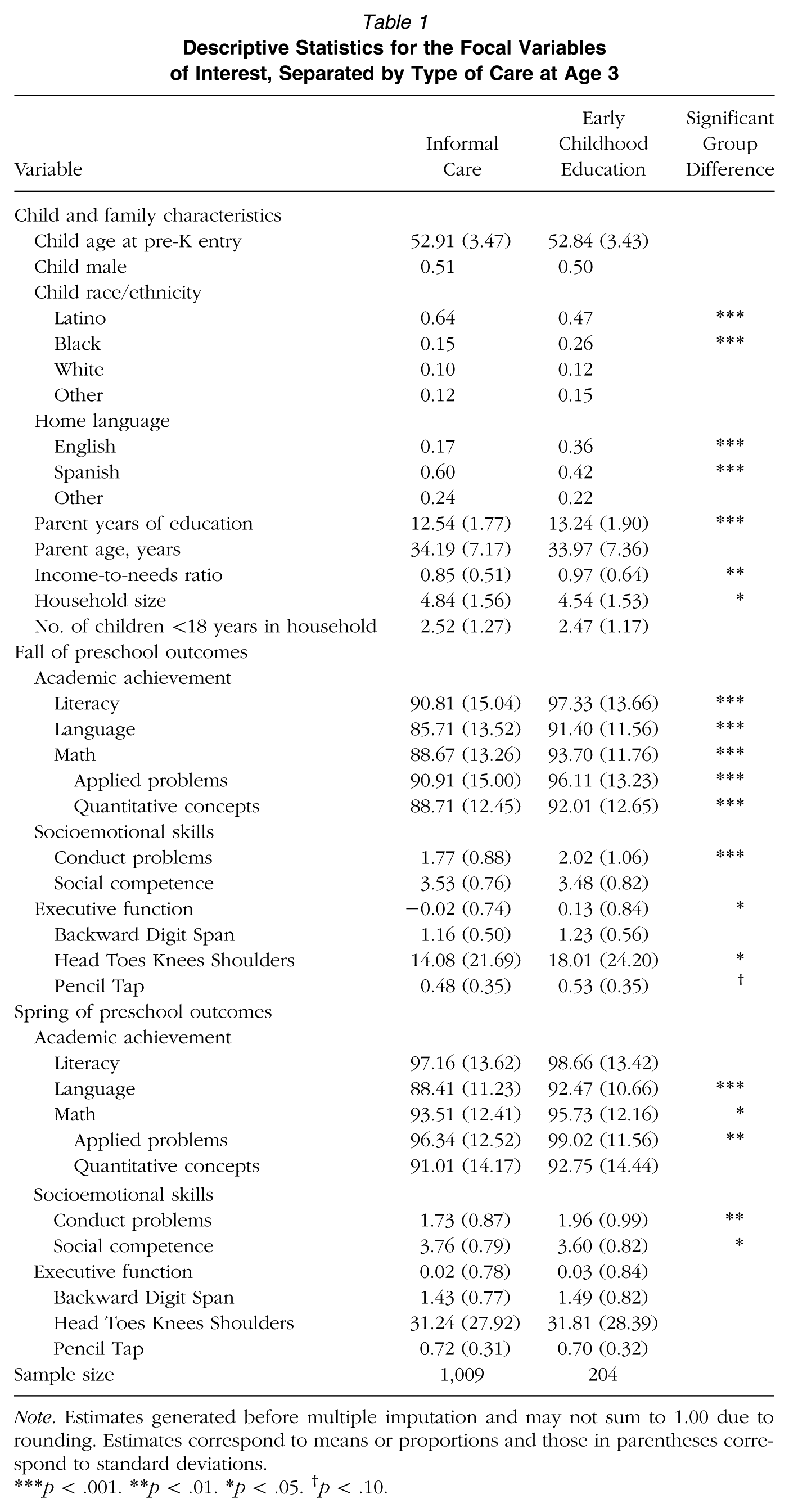
Note. Estimates generated before multiple imputation and may not sum to 1.00 due to rounding. Estimates correspond to means or proportions and those in parentheses correspond to standard deviations.
p < .001. **p < .01. *p < .05. †p < .10.
Measures
Early Childhood Education Enrollment
During the beginning of children’s 4-year-old pre-K year, parents were asked about their children’s primary (and if applicable, secondary) caregiving arrangement during the prior school year when children were 3 years of age. Similar to prior studies (e.g., Crosnoe, Purtell, Davis-Kean, Ansari, & Benner, 2016), we categorized children as having attended ECE if they had any exposure to “a child care center or preschool classroom” at the age of 3, which included private child care centers, church-based programs, school-based programs, and Head Start. Children who were cared for only by their parents, relatives, babysitters, or family child care providers were categorized as having attended informal care. Based on this classification strategy, 204 children were considered to have attended a formal ECE program at the age of 3, and the remainder, and majority, had no formal ECE experience during the year before pre-K (n = 1,009, roughly 75% of whom were cared for by their parents at home). Of the children who attended a formal ECE program at age 3, 54% subsequently attended a school-based program, 16% attended Head Start, and 30% attended a community-based program at age 4. As a precaution, we also considered whether the benefits of ECE enrollment at age 3 reported below varied as a function of the subsequent type of classroom children attended at age 4 and found no differences (results available from authors).
Academic Achievement
Children’s academic achievement was directly assessed during the fall and spring of the pre-K year with four subtests from the Woodcock-Johnson III Psychoeducational Battery (Woodcock, McGrew, & Mather, 2001). First, the Letter Word Identification subscale was used to measure children’s literacy skills (α = .94). As part of this assessment, children were required to identify printed letters and words. Next, the Picture Vocabulary subtest (α = .81) was used to measure children’s language skills and required that children identify objects that were depicted in a series of pictures. Finally, two subscales of the Woodcock-Johnson III were administered to measure children’s math skills: Applied Problems (α = .93) and Quantitative Concepts (α = .91). The Applied Problems subscale required that children perform basic math calculations in response to orally presented problems, whereas the Quantitative Concepts battery required children to identify number patterns. These two subscales were composited to create an indicator of math achievement (within time rs = .69–.71). For the purposes of the present study, we used standard scores for these assessments, which were externally benchmarked and describe children’s academic performance relative to the average performance of their same-age peers. The test developers benchmarked these test scores such that the average standard score was 100 with a standard deviation of 15.
It is important to note that children were assessed in English unless they failed the language screener (PreLAS; S. E. Duncan & De Avila, 1998); if this was the case, and they spoke Spanish, then they were assessed with Woodcock-Muñoz (Woodcock & Sandoval, 1996), in the fall of pre-K (25%) in addition to the English assessments. In the spring, however, all children were assessed only in English. For the purposes of the present study, we used children’s scores from the English version of these assessments during the fall of pre-K.
Socioemotional Skills
In the fall (November–December) and spring (April–May) of the pre-K year, children’s teachers were asked to rate a series of items according to how well they described the study child. These items were derived from the Teacher Child Rating Scale (Hightower, 1986) and were based on a 5-point Likert-type scale (1 = not at all, 3 = moderately well, 5 = very well). Overall, these survey items from the Teacher Child Rating Scale tap into two different dimensions of children’s socioemotional skills: social competence (15 items, α =. .94; e.g., tolerates frustration, a self-starter, accepts imposed limits) and conduct problems (6 items, α = .89; e.g., disruptive in class, defiant, and overly aggressive with their peers).
Executive Function
Children’s executive function skills were measured with three direct assessments in the fall and spring of the pre-K year, namely, the Backward Digit Span Task (Carlson, 2005), the Head, Toes, Knees, Shoulders Task (McClelland et al., 2007), and the Pencil Tap Task (Smith-Donald, Raver, Hayes, & Richardson, 2007). As part of the Backward Digit Span assessment, a trained data collector read a string of numbers to the child and the child then had to repeat back the reverse string of numbers. The Head, Toes, Knees, Shoulders Task battery required children to do the opposite of what the data collector asked of them (e.g., touch their head when told to touch their toes). And, finally, as part of the Pencil Tap Task, children were instructed to tap their pencil once when the assessor tapped twice (and vice versa). Each of these measures has been extensively used and validated with preschool-aged children (Carlson, 2005; McClelland & Cameron, 2012; McClelland et al., 2013; Smith-Donald, et al., 2007). Because the associations between ECE participation and all three subscales were the same, we standardized children’s scores on each of the assessment batteries and created an overall composite of executive function (see Willoughby, Blair, & The Family Life Project Investigators, 2016, for a discussion of conceptual, pragmatic, and statistical evidence for compositing measures of executive functioning).
Analytic Strategy
One of the main concerns with studies on ECE (and educational research more generally) is that children’s enrollment in these programs is not exogenous, which can undermine causal inference as factors that select children into ECE might also influence their success in school (G. J. Duncan & Magnuson, 2013; G. J. Duncan & NICHD Early Child Care Research Network, 2003). To address this issue of selection, all models in this study adjust for factors that capture children’s own characteristics (age, gender, race/ethnicity), their parents’ capacity and resources (years of education, home language, income-to-needs ratio), and other household characteristics (parent age, household size, number of children in the home). Each of these covariates was informed by prior studies, including a number of conceptual studies done on parents’ ECE selection behaviors (e.g., Bassok et al., 2018; Chaudry, Henly, & Meyers, 2010; Coley, Votruba-Drzal, Collins, & Miller, 2014; Crosnoe et al., 2016; Early & Burchinal, 2001; Gordon, Fujimoto, Kaestner, Korenman, & Abner, 2013; Magnuson et al., 2007; Winsler et al., 2008). These variables were either derived from the parent survey at the start of the pre-K year or reported on by the school or center. All models also (a) address missing data (mean of 8%, range = 0% to 21%) via the imputation of 50 data sets with chained equations and (b) account for dependence in child outcomes with robust standard errors clustered at the classroom level. Additionally, because not all of our outcomes were externally benchmarked (e.g., socioemotional development and executive functioning), we calculate and report effect sizes based on the standard deviation of the overall study sample after imputation (i.e., Bpredictor/SDoutcome).
With the above analytic framework in mind, our first set of analyses examined the benefits of children’s participation in ECE at the age of 3 for their academic, socioemotional, and executive functioning in the fall and spring of their pre-K year. To address this research question, we estimated six regression models in Stata (StataCorp, 2009) that considered the associations between ECE enrollment at age 3 with each of the fall of pre-K outcomes. These same models were then re-estimated with the spring of pre-K outcomes substituted in.
Then, as a means of capturing whether there was evidence of convergence in the benefits of ECE across the pre-K year, we created a difference score (spring of pre-K outcomes − fall of pre-K outcomes) that captured the regression slopes of children’s enrollment in ECE (vs. informal care) for their early learning and development (for a similar approach, see Ansari, 2018; Magnuson et al., 2007). To illustrate the meaning of this variable, consider the following example. If we found a positive and statistically significant association between ECE enrollment and academic achievement in the fall of pre-K and a negative and statistically significant association for the difference score, this would suggest that enrollment in ECE at age 3 is associated with more optimal academic performance at the start of pre-K, but these associations diminish by the end of the pre-K year. And because our academic measures were externally benchmarked, this allowed us to decompose the convergence estimates to gauge the extent to which ECE attendees lost ground (i.e., fade-out) as compared with non-ECE attendees who made up ground (i.e., catch-up). To do so, we estimated the marginal effects based on a model where the difference score was the outcome for children with and without prior ECE experiences (holding all covariates constant at their mean).
Finally, we took two approaches to explore the underlying reasons for convergence. The first was to compare a bivariate model that only regressed the difference scores on ECE enrollment with a model that included the characteristics of children and their families. In doing so, this model illustrates the degree of convergence that is attributable to our demographic controls. Second, to determine the extent to which the remaining share of convergence was attributed to classroom-level processes, we added classroom fixed effects (i.e., dummy variables for all classrooms except one), which allowed us to hold constant all classroom-wide characteristics (e.g., teachers’ qualifications, dosage and quality of instruction, individualization, classroom resources and materials, peer characteristics) that were the same for students in the same classroom.
Results
Beginning and End of Pre-K Year Outcomes
As can be seen in Table 2, after adjusting for child, family, and household factors, participation in ECE programs at the age of 3 (relative to nonparticipation) was associated with stronger language, literacy, and math achievement upon school entry during the following year (ps < .01). Effect sizes (ESs) were as follows: 0.28 for language, 0.26 for literacy, and 0.20 for math. Results for executive functioning were not significant, but ECE attendees did demonstrate elevated levels of teacher-reported conduct problems at the start of the pre-K year (ES = 0.27, p < .01). Taken together, these results indicate that participation in ECE at age 3 was related to more advanced academic skills at pre-K entry but less positive behavioral adjustment.
Associations Between Early Childhood Education Enrollment at Age 3 and Children’s Early Learning and Development During the Fall and Spring of the Pre-K Year
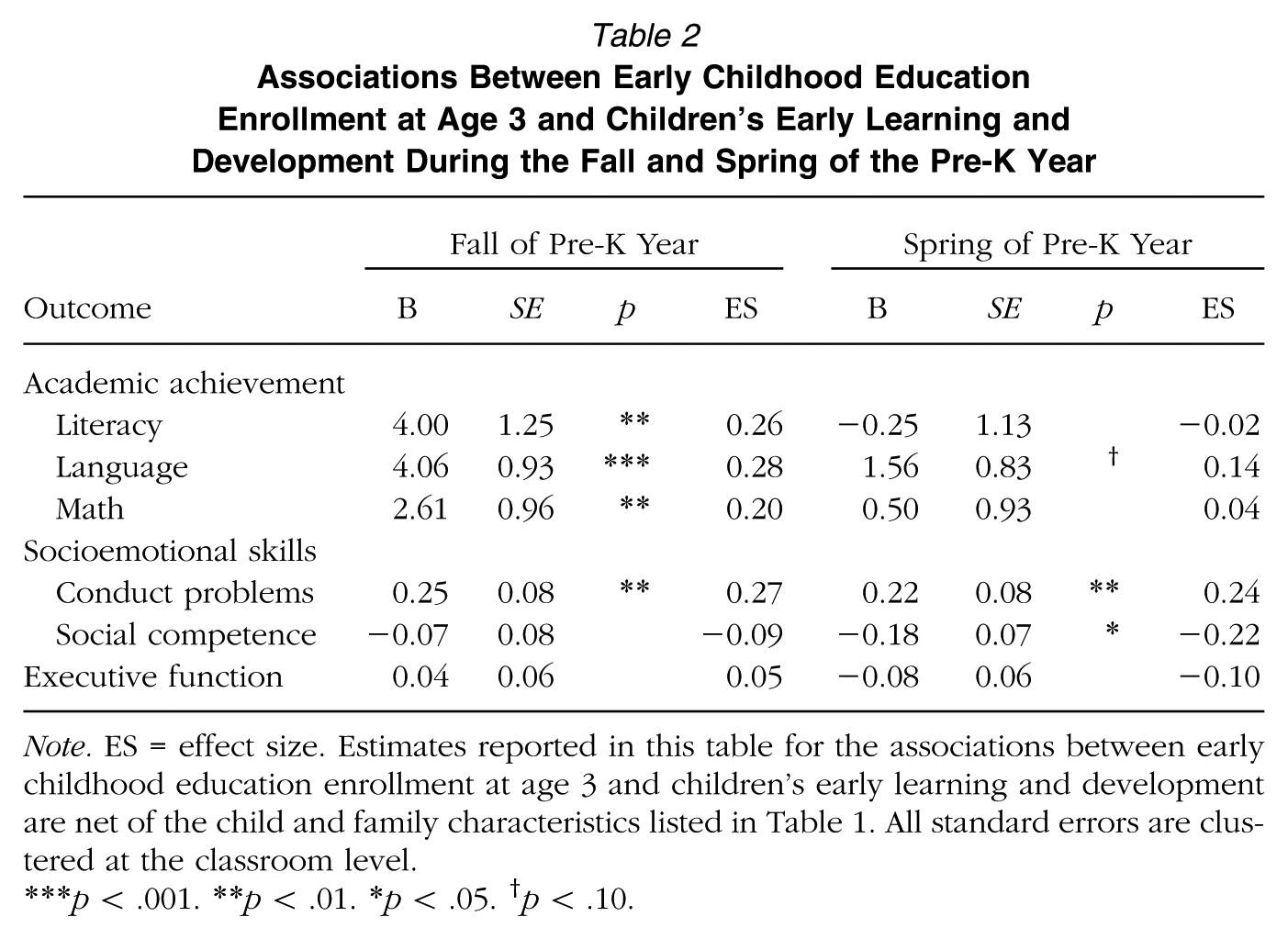
Note. ES = effect size. Estimates reported in this table for the associations between early childhood education enrollment at age 3 and children’s early learning and development are net of the child and family characteristics listed in Table 1. All standard errors are clustered at the classroom level.
p < .001. **p < .01. *p < .05. †p < .10.
When assessing these students at the end of the pre-K year, we found that these academic associations did not persist over time (see Table 2). On the other hand, ECE attendees continued to demonstrate higher levels of conduct problems (ES = 0.24, p < .01), and at the end of the pre-K year, they exhibited less optimal social competence (ES = −0.22, p < .05) as compared with children who attended informal care during the year prior.
Significance and Source of Convergence
We followed up these end-of-pre-K models with a series of convergence analyses, which confirmed that for each of the academic outcomes there was empirical evidence of convergence (ps < .001; see Table 3). That is, the associations between ECE enrollment at age 3 were significantly smaller by the end of the following pre-K year. Although the associations with literacy and math shrank by roughly 80% to 100%, the links between ECE enrollment and children’s language skills shrank by only 60%. When decomposing these estimates, we find that this convergence largely stemmed from “catch-up” among informal care participants (see Figure 1), whose gains were considerably larger than the 3-year-old enrollees. Although age 3 ECE attendees also gained in skills significantly from fall to spring of their 4-year-old pre-K year, their gains were significantly smaller throughout the year. Similar patterns emerged for children’s social competence: According to teachers, all children demonstrated improvement in social behavior across the school year; however, these improvements were significantly greater among informal care participants. And, finally, even though ECE participants did not demonstrate stronger (or weaker) executive function skills at the beginning or end of the pre-K year, there was evidence to suggest that the difference across time was significant (see Table 3). This difference over time was attributed to the fact that children without prior ECE experiences at age 3 made larger executive function gains throughout the year than ECE graduates.
Convergence in the Benefits of Early Childhood Education Enrollment at Age 3 Across the Pre-K Year
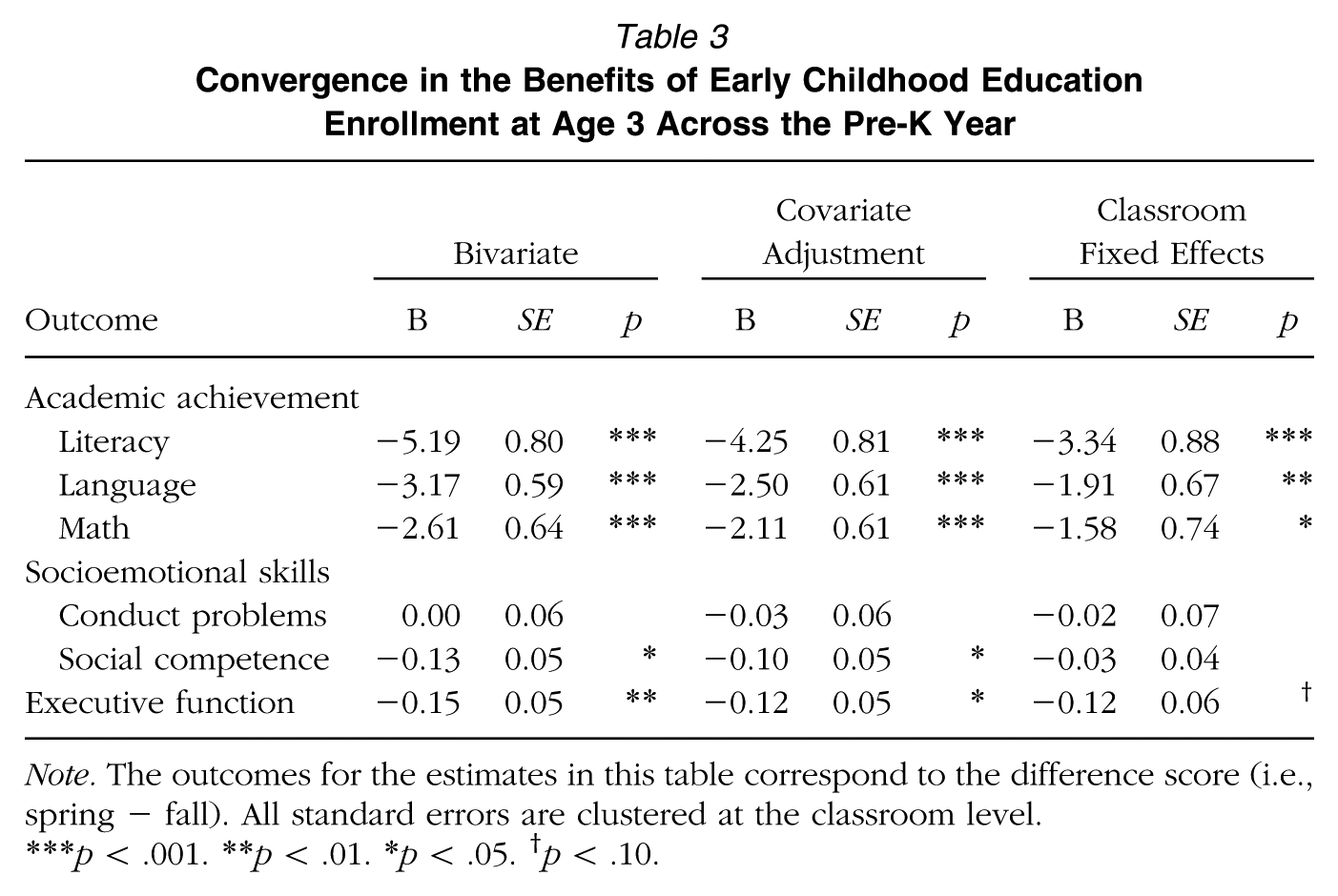
Note. The outcomes for the estimates in this table correspond to the difference score (i.e., spring − fall). All standard errors are clustered at the classroom level.
p < .001. **p < .01. *p < .05. †p < .10.
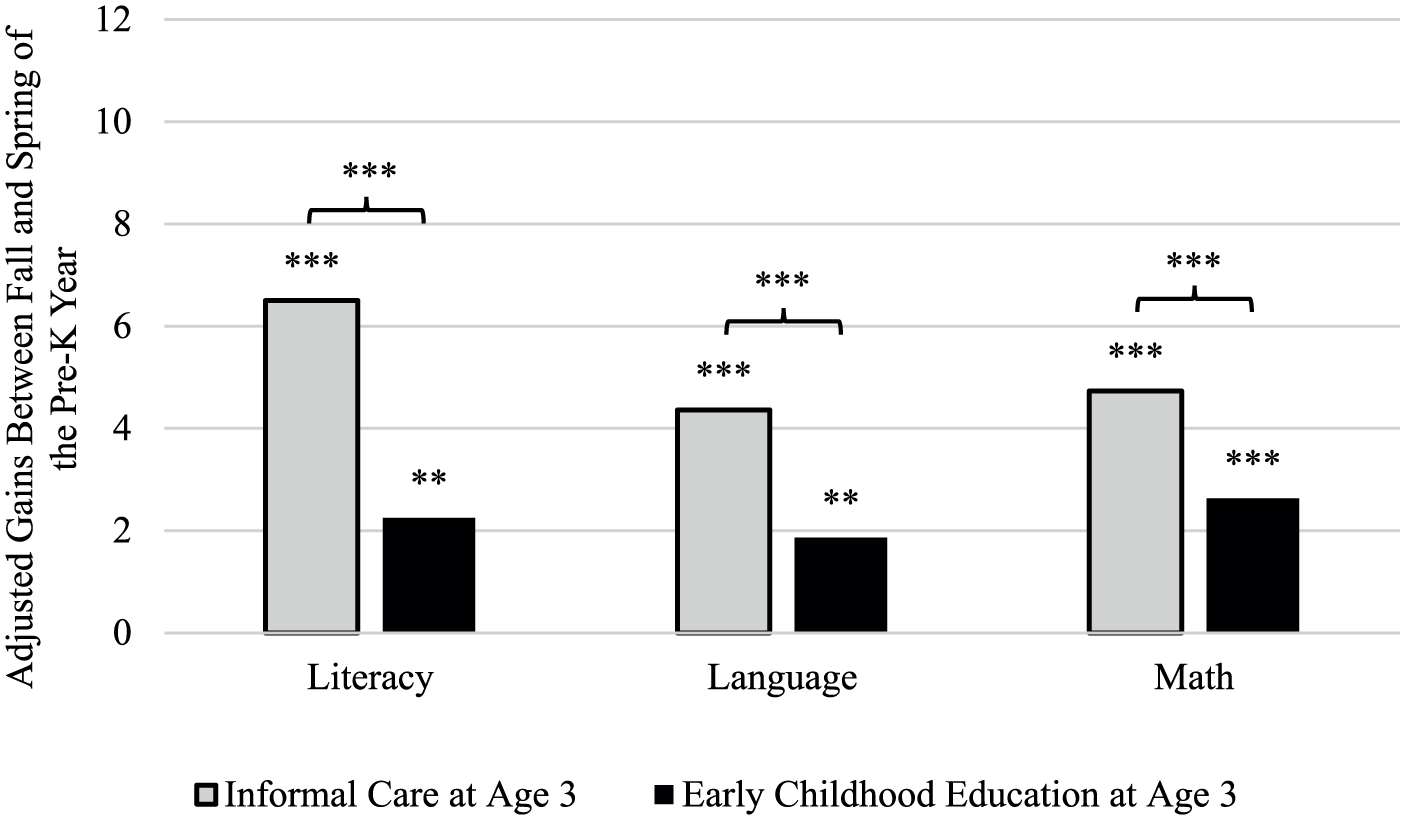
Model estimated differences in children’s academic skill gains across the pre-K year for children who attended informal care at age 3 versus children who attended an early childhood program at age 3.
Having established that there was empirical evidence of convergence that largely stemmed from “catch-up,” we next explored the portion of this convergence that was attributed to children’s individual and family characteristics and classroom characteristics. As can be seen in Table 3, roughly 20% of the catch-up effect in academic outcomes was attributed to the child and family covariates (i.e., column 2 vs. column 1) and approximately 25% was attributed to classroom-wide factors (i.e., column 3 vs. column 2). The inclusion of both the child and family demographic controls and classroom fixed effects accounted for approximately 40% of the total “catch-up” documented in this study (i.e., column 3 vs. column 1). Moreover, approximately 20% of the reversal in children’s executive functioning was attributed to our child and family demographic covariates, but none of the reversal was explained by the classroom-wide factors. However, it is important to note that in using measurable covariates of child and family demographics there is an imbalance between how much variation we can capture at the family versus classroom level.
Finally, because existing studies have found that children’s social behavior is predictive of their future academic achievement (e.g., Arnold, Kupersmidt, Voegler-Lee, & Marshall, 2012; Hartman, Winsler, & Manfra, 2017) and we found that ECE attendees entered the pre-K year demonstrating elevated levels of behavior problems, we also considered the extent to which these negative social-behavioral effects might account for some of the aforementioned convergence in children’s academic achievement. Results from this exploratory analysis revealed that approximately 10% of the remaining convergence (net of demographics and classroom-wide factors) was attributed to the age 3 ECE enrollees less optimal social-behavior at pre-K entry. Overall, the inclusion of children’s social behavior in addition to the demographic controls and classroom fixed effects accounted for roughly half of the total documented convergence.
Robustness Check
Given the nonexperimental design of the present study, there are threats to inference regarding the associations between ECE enrollment at age 3 and children’s early learning, even with our demographic controls. To address the possibilities of both measured and unmeasured confounds, we took several additional precautions to ensure that our findings are robust.
Propensity Score Matching
First, we employed propensity score matching methods, which are recognized as one of the strongest means of addressing issues of selection on observables (Rosenbaum & Rubin, 1983). Although propensity scores do not change the causal identification strategy, propensity scores consider whether there is overlap in the unmatched sample and the functional form assumptions are driving our findings. For these reasons, we matched children who were in an informal care arrangement at the age of 3 with those who attended ECE. We used the nearest neighbor method (with up to four matches) with a caliper of 0.05, ensuring a sufficient overlap between the two groups on their propensity scores. With these specifications, we matched roughly 98% to 99% of children who experienced ECE at age 3 with 44% to 51% of children in informal care (sample sizes vary across the 50 imputed data sets). To ensure that these propensity scores were successful, we assessed the quality of the matches by (a) examining whether there were significant differences between groups after matching and (b) checking the standardized mean difference between the groups to ensure that they were less than 10% of a standard deviation, a benchmark used to indicate negligible differences (Austin, 2011). Before matching, roughly 50% of the indicators were significantly different across groups, but after matching, there were no longer any significant differences (see Appendix Table 1 in the online version of the journal). Likewise, after matching, none of the differences across conditions exceeded 10% of a standard deviation, suggesting that balance was achieved. Having successfully achieved balance, we replicated all models from Table 2 within the matched samples, and these models confirmed our general conclusions discussed above (see Appendix Table 2 in the online version of the journal). In fact, the average difference in the reported effect sizes between our OLS specification and the propensity scores models was less than 0.01, and there continued to be evidence of convergence across the pre-K year (see Appendix Table 3 in the online version of the journal).
Classroom Fixed Effects
In our primary models discussed above, we estimated classroom fixed effects to explore the underlying reasons for convergence. But similar fixed effects models can also be estimated when examining the benefits of children’s participation in ECE at the age of 3 for their early learning outcomes in the fall and spring of their pre-K year. In doing so, the variance occurs within (rather than between) classrooms and, thus, this analytic strategy addresses potential issues of selection on both observed and unobserved variables. Results from these classroom fixed effects models were also similar to our ordinary least squares models outlined above (see Appendix Table 2 in the online version of the journal). In this instance, the average difference in our reported effect sizes between our ordinary least squares specification and the classroom fixed effects models was roughly 0.04, which lends confidence to our general conclusions.
Impact Threshold for Confounding Variables
Finally, we assessed the potential confounding role of unmeasured confounds through impact threshold for confounding variables analyses (ITCV; Frank, 2000) for all significant associations between ECE enrollment and children’s outcome scores during the fall and spring of pre-K. In short, ITCV measures the degree to which an unknown variable would have to be correlated with both the predictor and outcome variables to negate the observed associations. The equation takes the following form:

where

where g is the set of covariates,
As can be seen in Appendix Table 4 (in the online version of the journal), results from these analyses revealed that an unknown confound would, conditional on the other covariates in our models, negate our findings reported in Table 2 only if the unmeasured variable correlated with both the predictor and our academic outcomes at roughly 0.20 (range 0.15–0.27). Similarly, an unknown confound would wash out our socioemotional findings reported in Table 2 only if the unmeasured variable correlated with both the predictor and the outcomes at roughly 0.15 (range 0.13–0.19). To put things in perspective, the only covariate that approached these thresholds was parent education, which correlated with ECE enrollment at 0.12 and with our academic outcomes at 0.19 (range = 0.18–0.20). None of the other covariates, conditional on maternal education, approached these thresholds, suggesting that our findings are likely robust to unmeasured variables.
We ran similar ITCV analyses for our convergence analyses from the covariate-adjusted models reported in Table 3 and found that these results were even more robust: The average correlation required to negate the observed convergence in academic achievement was 0.26 (range 0.21–0.32; see Appendix Table 4 in the online version of the journal). On the other hand, the differential improvement in children’s social competence across the pre-K year as a function of ECE enrollment was more susceptible to omitted variables and required only an average correlation of 0.05 with both the predictor and outcome to negate the observed associations across time.
Discussion
With the growing investments in ECE programs for 3- and 4-year-old children in the United States (G. J. Duncan & Magnuson, 2013; Phillips, Lipsey, et al., 2017; Yoshikawa et al., 2013), there has been increasing research and policy interest in understanding the extent of program benefits and whether these effects persist over time. The purpose of the current investigation was to add to this growing literature by (a) examining the benefits of ECE participation for children from low-income families who enroll in these programs at the age of 3 in a large, culturally, and linguistically diverse county, which reflects many of the demographic trends of the future, and (b) analyzing the nature and source of convergence, which is a topic that remains far less well understood. A number of relevant findings emerged from this effort, which we discuss in more detail below.
To begin, the present investigation contributes to the relatively small number of studies that have looked specifically at enrollment in ECE during the third year of life and how that enrollment correlates with children’s early learning and development throughout the 4-year-old pre-K year. What our results reveal is that children who attended Head Start and other community- and school-based programs at the age of 3 (Friedman-Krauss et al., 2018) entered pre-K the following year demonstrating stronger language, literacy, and math skills. These effect sizes ranged from approximately 0.20 to 0.30, which is on par with the few other existing evaluations of ECE programs serving 3-year-olds (e.g., 0.15–0.35; Puma et al., 2012) and meta-analytic averages reported by Bailey et al. (2017) regarding ECE programs more broadly. In fact, the ethnically diverse children in our study sample who came from low-income homes and experienced ECE at age 3 entered the pre-K year demonstrating academic skills that were not too far off from national averages. In this regard, there is reason for optimism.
Even though the above results are consistent with both experimental and quasi-experimental findings in the existing literature, the other pattern of results reported in this investigation are potentially more concerning. More specifically, the estimated associations between ECE enrollment as 3-year-olds and children’s executive functioning at school entry during the following pre-K year were close to zero, and children with earlier ECE experiences demonstrated elevated levels of behavior problems at the beginning and end of their 4-year-old pre-K year and demonstrated less optimal social competence by the end of the year. It is of course possible that parents place more behaviorally challenging children in ECE at younger ages, which we unfortunately could not consider. However, two recent studies found that net of the covariates included in our models, there was little evidence of such child effects: Worse behaved children (or higher functioning children) were not more likely to experience ECE (Coley et al., 2014; Crosnoe et al., 2016). Thus, the negative behavioral outcomes of ECE that have been documented elsewhere with children from middle-class families (Ansari, 2018; Bassok et al., 2018; Belsky et al., 2007; Magnuson et al., 2007; NICHD Early Child Care Research Network, 2003) are also apparent, in this study, for children from low-income homes.
There is likely no single explanation for these negative social-behavioral patterns. Indeed, some education scholars have argued that these associations may result from disruptions in parent-child relationships or by way of exposure to new high-stress contexts and peers (Huston, Bobbitt, & Bentley, 2015). But if this were the sole explanation, then our findings run counter to the social group adaptation hypothesis (Pingault et al., 2015), which contends that the negative behavioral effects of ECE are likely to rapidly converge because children who experience informal care must adapt to social group settings after the transition to school, which ECE attendees have already experienced beforehand. There is of course still a long window for these negative behavioral associations to converge throughout children’s educational careers, but one would presume that this adaptation process would occur immediately after the counterfactual condition enters school (Dearing et al., 2015; Pingault et al., 2015). Given these conflicting findings, future studies in this area should more carefully consider why these negative associations emerge, as they are likely to have downstream consequences. Notably, similar to (Ansari, 2018), we also found that roughly 10% of the convergence in academic achievement was attributed to the fact that graduates of ECE entered the pre-K year with less optimal social behavior, indicating these behavioral shortcomings may have interfered with classroom adjustment in ways that resulted in fewer gains in areas of math, language, and literacy throughout the school year.
Our results also support some of the arguments put forth by Bailey et al. (2017), who suggest that targeting malleable skills that would develop absent of intervention is insufficient for generating long-term impacts, in part because many of these skills are likely to develop rapidly among children in the counterfactual condition. Put another way, although children with an ECE experience at age 3 entered the pre-K year with early academic “advantages,” these advantages might disappear when children not exposed to ECE at age 3 are exposed to instruction in pre-K that is better aligned to lower level skills. In terms of basic counting skills and letter-word identification, which represent some of the skills that all children might be expected to develop before the transition to kindergarten (Paris, 2005), we documented 80% to 100% convergence by the end of the pre-K year. Children with earlier ECE experiences entered the pre-K year with a modest advantage in these domains, but these advantages shrunk between the two groups because those in the comparison condition made large strides during the pre-K year and, as a result, caught up with their more advanced classmates. In contrast, for higher order skills, such as children’s vocabulary knowledge, which is more open to ongoing development and improvement (Paris, 2005), convergence appeared less steep (roughly 60%). To put these estimates in context, consider the work of Bailey et al. (2017) who found that the cognitive impacts of ECE decreased by roughly 60% in the year after program completion. Likewise, results from the Head Start Impact Study suggested that for academic outcomes, program impacts for 3-year-olds diminished by approximately 75% through the following school year (Puma et al., 2012). Thus, the estimates of convergence reported herein are not too dissimilar from those reported in the extant literature.
In light of the above patterns of convergence, what our results make clear is that we must carefully think about the distinction between skills that would and would not develop in the early elementary years (or in pre-K) in the absence of ECE (Bailey et al., 2017), which has important implications for the ways in which we structure children’s early school experiences. For example, when children are exposed to academic activities in ECE programs, it is most often targeted at basic literacy skills (Chien et al., 2010; Pianta, Whittaker, Vitiello, Ansari, & Ruzek, 2018), and therefore, children have fewer opportunities to develop other, more unconstrained abilities, such as language skills, which represent skills that many preschool programs actually fail to affect (National Early Literacy Panel, 2008). For these reasons, the pattern of findings reported herein provide some suggestive evidence that ECE programs may need to increase attention to unconstrained skills. At the same time, however, it is also possible that the documented associations—regardless of the learning domain—were simply not large enough to persist over time. Accordingly, in addition to paying careful attention to the development of unconstrained skills, to optimize the immediate benefits of ECE, there is likely a need to enrich these programs by providing supports for learning and teaching, including with validated curriculum and professional development.
Beyond the malleability and development of skills, our results also contribute to the extant literature by highlighting the role of children’s subsequent experiences in the classroom that help preserve (or erase) some of the early academic advantages of ECE seen at the start of school. It seems somewhat promising that a quarter of the convergence documented in this study was attributed to classroom-wide factors during the pre-K year, suggesting that convergence is—at least partially—addressable at the classroom level. These findings are, thus, both similar to research suggesting that children’s subsequent classroom and school experiences matter for the maintenance of the early ECE boost (Ansari & Pianta, 2018; Currie & Thomas, 2000; Johnson & Jackson, 2017; Swain, Springer, & Hofer, 2015; Zhai, Raver, & Jones, 2012) and different from existing work suggesting that classroom processes account for little to no amount of convergence (Bassok et al., 2018; Claessens et al., 2014; Jenkins et al., 2018).
One likely explanation for these differences is the way in which we addressed this question. In the current study, we used classroom fixed effects, which accounted for all classroom-wide factors that contribute to convergence, whereas the vast majority of the existing literature has tested individual classroom factors. And even though the specific mechanisms driving these findings at the classroom level may be unclear and beyond the scope of our study, our findings do indicate that the subsequent classroom experiences matter. Thus, what our results make clear is that as the next-wave pre-K and ECE evaluations unfold, the research community needs to pay much closer attention to the specific aspects of the classroom that contribute to (or prevent) convergence. Areas that require attention include (but are not limited to) the alignment of instructional content across school years, teachers’ use of differentiation, teachers’ grouping strategies, classroom quality, the role of children’s peers, and children’s individual experiences in the classroom (Ansari & Purtell, 2018; Phillips, Johnson, et al., 2017; Phillips, Lipsey, et al., 2017). This effort is especially important given the growing number of 3-year-olds who experience a year of ECE before their pre-K year (Friedman-Krauss et al., 2018). To the extent that these experiences are not aligned, then the impacts of ECE and pre-K will not be optimized.
Finally, even though our models explained roughly half of the convergence documented in the associations between ECE enrollment and children’s early academic achievement, the other half remains unexplained. Consequently, one might wonder what other factors may contribute to these findings. As noted above, by using measurable covariates to tap into the convergence attributed to child and family characteristics and classroom fixed effects to tap into convergence attributed to classroom-wide factors, there is an imbalance between how much variation we can capture at these two levels. Whereas our classroom fixed effects capture all differences across classrooms, we could not account for all differences between children. Accordingly, there are other child- and family-level factors that are likely to contribute to the convergence documented in this study. For example, one important source of convergence that we could not consider includes parental efforts in the home to prepare children for school. To the extent that parents of non-ECE participants place greater effort in the home to prepare children for school, especially in terms of teaching their children more constrained skills such as counting and letter knowledge, then that is likely to account for some of the unexplained convergence. For these reasons, studies with more in-depth data on children and families are needed to more carefully consider the role of children’s home experiences and the interplay between the home and school in the dissipating academic benefits of ECE.
Taken together, the results from this investigation provide important insight into the potential benefits of ECE enrollment at age 3 for children from low-income homes, but they need to be interpreted in light of a few key limitations. Primarily, the current sample distribution of ECE attenders and nonattenders provided us 0.80 power to detect a 0.22 effect size of ECE enrollment on the child outcomes of interest, but we were limited in that we did not have enough statistical power to examine heterogeneity in these associations. Consequently, we could conclude that roughly a quarter of the convergence in the links between ECE and children’s academic learning was attributed to classroom-wide factors, but we could not test for moderation by specific aspects of the classroom, which would have provided us with more specific information about malleable classroom factors that could be targets for intervention.
Moreover, consistent with other studies in the early childhood literature (e.g., Bassok et al., 2018; Curenton, Dong, & Shen, 2015; Magnuson et al., 2007), all of the covariates used in our models (including our propensity score models) were assessed after ECE attendance. Some of these variables were time invariant, but even so, the best implementation of these longitudinal models is with the use of pretreatment covariates. In addition, the design of our study was nonexperimental, and even though our findings were comparable across various analytic specifications and we were able to gauge the role of unmeasured variables—all of which lend greater confidence to our general conclusions—these results should be interpreted with caution. For example, without having assessment of outcomes at the beginning and end of the age 3 year, we cannot know for certain if the trends observed are continuations of trends during the age 3 year or if children lost ground between the end of the age 3 year and the start of pre-K. Thus, it is possible that our estimates of the benefits of ECE at age 3 are over- or underestimated. But it is important to note that that our effect sizes are on par with the existing literature and that the pattern of convergence reported herein has been demonstrated in both experimental and nonexperimental studies (e.g., Ansari, 2018; Bailey et al., 2017; Bassok et al., 2018; Lipsey et al., 2018; Puma et al., 2012). The main difference between our investigation and these other studies is that we demonstrate these patterns of convergence for a younger group of children.
It was also unfortunate that we could not determine what type of ECE programs children attended at age 3, which were based on parent report and not verified to ensure that children did in fact attend these programs nor could we determine whether children attended the same school or center at ages 3 and 4. And given our study design, we do not know whether pre-K teachers knew what type of program children attended at age 3. But these limitations are true for most studies of pre-K and ECE more generally (e.g., Bassok et al., 2018; Crosnoe, 2007; Loeb et al., 2007; Magnuson et al., 2007). In addition, even though we measured a representative sample of children’s skills, our assessment batteries by no means cover all potential malleable skills that might be affected by school exposure. Finally, our results are also not generalizable to ECE programs beyond the participating county; nonetheless, because our study provides further insight into the experiences of children in a large, culturally and linguistically diverse community, this limitation is somewhat mitigated. As states move forward with the expansion of ECE for younger children, attempts at replication across different communities are of growing importance. However, even with the potential limitations of focusing on one community, our analyses have greater external validity as our approach to assessing the source and nature of convergence can be widely applied when studying the persistence of ECE effects. Indeed, although many long-term pre-K and ECE evaluations do not have observable data on children’s subsequent classroom and school experiences, fixed effects can be implemented to understand the source of convergence, which to our knowledge has rarely been done in the extant literature.
With these limitations and future directions in mind, the present study provides new insight into the efficacy of contemporary ECE programs serving 3-year-olds from low-income and ethnic homes. Our findings add to the existing knowledge base by revealing that these children from low-income homes display heightened behavior problems as a result of ECE participation and that these negative “effects” persist at least for 12 months from program completion and have downstream implications for convergence. Our results also provide further evidence that children who attended ECE at age 3 entered the pre-K year more ready academically, but these advantages were short-lived. When taken together, these findings corroborate some of the evidence from Tennessee (Lipsey et al., 2018) and the national evaluation of Head Start (Puma et al., 2012), in addition to mathematics interventions for preschool-aged children (Clements et al., 2013), each of which also documented only short-term academic benefits of program participation. At the same time, however, having explored the source and nature of convergence, the present study pushes this discussion forward by revealing that (a) convergence in the academic benefits of ECE was largely attributed to catch-up (not fade-out) and (b) approximately a quarter of this convergence was attributed to classroom-wide factors during the following year. Accordingly, convergence—at least in the short term—can be partially mitigated, and teachers and classrooms play an important role in this effort.
Supplemental Material
10.3102_0002831218817737 – Supplemental material for Starting Early: The Benefits of Attending Early Childhood Education Programs at Age 3
Supplemental material, 10.3102_0002831218817737 for Starting Early: The Benefits of Attending Early Childhood Education Programs at Age 3 by Arya Ansari, Robert C. Pianta, Jessica V. Whittaker, Virginia E. Vitiello and Erik A. Ruzek in American Educational Research Journal
Footnotes

Notes
Supplemental material is available for this article in the online version of the journal.
We gratefully acknowledge the support of our many partners: school district leaders, community programs, teachers, parents, and children. Their enthusiastic cooperation and participation made much of this work possible. We also extend appreciation and recognition to Marcia Kraft-Sayer, Marianna Lyulchenko, Laura Helferstay, and Brittany Kerr, who each made valuable contributions to the project. The research reported here was supported by the Institute of Education Sciences, U.S. Department of Education, through Grant No. R305N160021 to the University of Virginia. The opinions expressed are those of the authors and do not represent views of the Institute of Education Sciences or the U.S. Department of Education.
A
R
J
V
E
References
Supplementary Material
Please find the following supplemental material available below.
For Open Access articles published under a Creative Commons License, all supplemental material carries the same license as the article it is associated with.
For non-Open Access articles published, all supplemental material carries a non-exclusive license, and permission requests for re-use of supplemental material or any part of supplemental material shall be sent directly to the copyright owner as specified in the copyright notice associated with the article.
