



Abstract
The proliferation of urban “no-excuses” charter schools has been justified by arguing that Black and Latinx parents want strict discipline. In this article, we examine what discipline means to Black and Latinx families at two popular choice options: a no-excuses charter and two public Montessori magnets. We found that parents viewed discipline as more than rule-following, valuing also self-discipline and academic discipline. While no-excuses parents supported an orderly environment, many found the discipline restrictive. Parents in the Montessori schools, by contrast, praised student autonomy but questioned whether the freedom was preparing their students academically. Our findings reveal a gap between what Black and Latinx parents want and what choice schools and local school choice markets have on offer.
Introduction
One of the central arguments for school choice is that urban Black and Latinx 1 parents should be able to choose schools just as wealthy suburban families do, enabling them to find a better match between the school and their child (Chubb & Moe, 1990; Teske, Fitzpatrick, & Kaplan, 2007) and to escape “failing” district schools (C. E. Finn, Manno, & Vanourek, 2001; Fuller, 2005). Although charter schools started as spaces to experiment and innovate, the growth over the past two decades of charter management organizations (CMOs)—networks of charter schools—has narrowed the charter school field (Farrell, Wohlstetter, & Smith, 2012; Lake, Dusseault, Bowen, Demeritt, & Hill, 2010). More Black and Latinx families are thus finding their way into what are commonly termed “no-excuses” charter schools: schools with rigorous academic demands and a highly structured disciplinary system (Golann, 2015; Whitman, 2008). Some of these prominent no-excuses schools include national CMO chains like KIPP (Knowledge Is Power Program), Success Academies, Uncommon Schools, and Achievement First.
Alongside their many accolades, no-excuses schools have faced growing criticism (Decker, Darville, & Snyder, 2015; Golann, 2015; Goodman, 2013; K. Taylor, 2016; White, 2015) and even student protest (Bass & Swaby, 2016; Carr, 2014) against their disciplinary practices in light of increased awareness of racially disproportionate discipline and the school-to-prison pipeline (Losen, 2014; Nolan, 2011; Shedd, 2015). In response, supporters argue that these schools are giving Black and Latinx parents what they want. Eva Moskowitz, founder and CEO of Success Academies, for example, explained that her charters were in high demand because the families applying “believe in stricter discipline” (Decker et al., 2015).
While researchers studying school choice have shown that some Black and Latinx parents do value discipline when choosing schools (Calvo, 2007; Schneider, Marschall, Teske, & Roch, 1998), relatively little research examines what this preference means in practice, particularly once parents and students experience it firsthand. Our article therefore asks, How do Black and Latinx parents at two different types of choice schools evaluate discipline in their children’s schools? And what implications does this have for the school choices they have available? To answer these questions, we use ethnographic observation and interviews at two distinct and popular theme schools in two Northeastern cities: a “no-excuses” charter middle school and two public Montessori magnet elementary schools. These two models represent a recent education innovation alongside one of the most enduring experiments in alternative education, two poles of the debate around structure and freedom within the classroom. In selecting these two models for study, we purposely contrasted notably different school sites, anticipating that parents in each of these schools would have different disciplinary preferences. We intentionally interviewed parents after they had enrolled their children, when they understood the school model and how it fit with their preferences.
While we found variation among Black and Latinx parents at each school, parents across school type had surprisingly similar preferences. Countering the idea that discipline should be a system of rules and punishments alone, parents we interviewed at all schools saw the importance of discipline to accomplish a variety of outcomes: to create order and safety in the school and to foster self-discipline and academic rigor. While the Black and Latinx parents we interviewed at the no-excuses school interpreted school strictness as pushing their students academically but obstructing their ability to develop autonomy and self-advocacy, Black and Latinx Montessori parents appreciated their children’s development of autonomy and social skills but questioned whether Montessori’s student-directed learning experience could deliver academic results.
These findings suggest that Black and Latinx parents’ preference for discipline does not equate to behavioral discipline focused on rules, rewards, and punishment, and it is not an end in itself. Rather, parental preferences for discipline should be viewed as a means to deliver on a range of important educational goals, both academic and developmental. In this way, the disciplinary preferences of middle-class and working-class Black and Latinx parents may not be so dramatically different from White middle-class parental preferences, as has been previously suggested (Calvo, 2007; Schneider et al., 1998) but do diverge significantly from the current regimented instruction practiced in many urban charter and district schools.
Our findings therefore suggest a gap between what Black and Latinx parents want and what choice schools and local school choice markets have on offer. As several no-excuses charter leaders publicly move to reform the no-excuses model toward more progressive, student-centered learning and restorative justice models (Bailey, 2014; Fine, 2017; Tough, 2013; Whitmire, 2016), this research suggests support among Black and Latinx parents for public school choices that increase student independence and reduce school punishment. Ultimately, these parents view discipline not as a solution in itself but as a vehicle to deliver a focused space to learn and develop independence.
Theorizing Discipline as a Factor in School Choice Decisions
In discussing the experiences of Black and Latinx parents, we recognize first that these racial and ethnic categories are socially constructed and represent diverse groups with varying cultural, immigrant, and socioeconomic backgrounds (Kendi, 2016). Yet, given links between these groups and histories of discrimination and current patterns of inequality, it can also be beneficial to examine group-level patterns. In trying to understand why school choice results in greater segregation, a number of studies have found that Black and Latinx parents prioritize different criteria than White parents in the school selection process, namely, a greater focus on academic basics and strict discipline (Bauch, 1993; Calvo, 2007; Schneider et al., 1998; Pattillo, 2015), while in the same urban districts, many White parents prefer progressive schools (E. Brown & Makris, 2018; Makris, 2015; Posey-Maddox, 2014). Yet the majority of this research examines parents at the point of choice before they develop a deeper understanding of their choices after enrollment, with a few notable exceptions (Makris, 2015; Posey-Maddox 2014). In addition, many of the studies rely on survey data, and few interrogate in depth what concepts like discipline mean to parents. As a result, there is a significant gap in the research on parents of color and their interpretation of school discipline.
There have been a variety of explanations for racial differences in parental preferences for school discipline. First, some have argued that Black and Latinx parents show greater concern for school safety (Friedman, Bobrowski, & Geraci, 2006; Lake, Jochim, & DeArmond, 2015; Wolf & Stewart, 2012), reflecting the empirical reality of a “safety gap” where Black and Latinx students report feeling less safe than their White and Asian counterparts in school and en route to school (Lacoe, 2015). Second, Black and Latinx parents’ preferences for discipline have been linked to racial differences in parenting styles. According to this research, Black parents are often more directive or authoritarian with their children compared with the more permissive and egalitarian parenting styles of many White families (Baumrind, 1972; Brooks-Gunn & Markman, 2005; Julian, McKenry, & McKelvey, 1994; see Lareau, 2003, for an exception). Black parents, for example, are almost twice as likely to use corporal punishment with their children as White or Latinx parents (Brooks-Gunn & Markman, 2005; Pew Research Center, 2015). Psychologists have categorized Latinx parents as protective rather than strict (Domènech Rodriguez, Donovick, & Crowley, 2009) but have also observed a strong hierarchy in Latinx families focused on respect and obedience to elders (Calzada, Fernandez, & Cortes, 2010). A third explanation for Black and Latinx parents’ emphasis on discipline and hierarchical authority is that parents view strictness as a protective mechanism to prepare their children to respond to anticipated societal racism (R. J. Taylor, Chatters, Tucker, & Lewis, 1990; Tyson, 2003).
One limitation of these studies, however, is that they conceptualize discipline narrowly as strict rules and hierarchical structures. In contrast, we define discipline here as a multifaceted system of structures to support a variety of student outcomes, including social and emotional skills and academic achievement. We thus propose a more expansive way of theorizing discipline: as behavioral discipline, self-discipline, and academic discipline.
Behavioral discipline refers to efforts to train students to follow rules and defer to authority. Teaching children to follow instructions, sit in their seats, and not fight in the hallways are examples of this form of discipline. Racial disparities in school discipline refer to behavioral discipline, where Black and Latinx students are more frequently targeted and punished than White and Asian students for not complying with school rules (Lewis & Diamond 2015; Losen, 2014).
Durkheim (1961), one of the earliest sociologists of education, saw the central purpose of schooling as socializing students into habits and dispositions for functioning in society. Chief among these was self-discipline, the ability to restrain oneself. Self-discipline, as distinguished from behavioral discipline, requires controlling impulses in the absence of rules and consequences (Duckworth, Gendler, & Gross, 2014). Though a separate concept, self-advocacy is related to self-discipline. Sociologists have observed how part of classroom competence is being able to interpret different social and institutional contexts to know how and when to deploy certain tools (Calarco, 2011, 2014; Mehan, 1980; Streib, 2011). For example, knowing when to speak up and interrupt the teacher (self-advocacy) can be as valuable as knowing when to wait quietly and hold back (self-discipline).
Finally, we define academic discipline as the structures that support students’ academic achievement. School environments play a role in shaping student attitudes toward learning: For instance, classrooms that incorporate achievement goals positively influence students’ academic efficacy (Ames, 1992; Roeser, Eccles, & Sameroff, 2000), which in turn makes them less susceptible to negative peer pressure (Bandura, Barbaranelli, Caprara, & Pastorelli, 1996) and more likely to graduate with academic success (J. D. Finn & Rock, 1997). From this perspective, school rules are seen as foundational to effective learning but also can support academic rigor.
To better understand the types of disciplinary structures that some Black and Latinx families may want from their children’s schools, we argue that it is important to consider and distinguish between these different conceptualizations of discipline.
Case Selection of Two Distinct Theme Schools: No-Excuses and Montessori
To examine how a socioeconomically diverse sample of Black and Latinx parents interpreted and prioritized discipline in their children’s education, we brought together two school cases with very different disciplinary practices: no-excuses charter schools and urban Montessori magnet schools. We purposely contrasted these school sites to maximize the variation in parent perspectives of discipline. In this way, the comparison between these “unique cases” (Small, 2004; Van Velsen, 1978), rather than being generalizable or typical of urban public schools, more broadly represents two poles of structure and freedom available in urban choice schools. Examining two cases at either extreme can also demonstrate phenomena subtler in other educational contexts.
In recent years, no-excuses charter schools like KIPP, Achievement First, Uncommon Schools, Success Academies, Mastery, Aspire, and YES Prep have become the dominant choice option in many urban communities (Angrist, Pathak, & Walters, 2011; Sondel, 2016; Stitt, 2016). No-excuses schools aim for students to demonstrate outstanding academic proficiency through high test scores and college acceptance using a system of highly structured lessons, an extended school day and school year, a strict disciplinary code, data-driven instruction, intensive teacher coaching, and a belief that poverty is “no excuse” for low student achievement (Dobbie & Fryer, 2011; Thernstrom & Thernstrom, 2003; Whitman, 2008). Because of their success in raising the standardized test scores of low-income children of color (Cheng, Hitt, Kisida, & Mills, 2017), no-excuses schools have received significant philanthropic and governmental support, facilitating their rapid expansion over the past decade (Farrell et al., 2012; Scott, 2009). Researchers have estimated that no-excuses schools comprise nearly three quarters of Boston charter schools (Angrist et al., 2011), predominate in New Orleans’ charter-only district (Sondel, 2016), and make up an estimated one quarter of all urban charter schools (Stitt, 2016).
One of the most controversial features of no-excuses schools is their “sweating the small stuff” behavioral approach (Whitman, 2008). Teachers in these schools constantly monitor minor behaviors and administer consequences (Golann, 2015, 2018; Goodman, 2013). Because minor infractions often result in detentions and suspensions, concerns have been raised about both the level and the appropriateness of consequences in no-excuses schools (Advocates for Children of New York, 2015; Decker et al., 2015). As a result, several prominent no-excuses networks have made efforts to shift toward less punitive disciplinary models, like restorative justice. Still, many no-excuses schools continue to rely heavily on rewards and consequences to motivate student behavior (Golann & Torres, 2018; Goodman, 2013). Instruction in no-excuses schools also tends to be highly structured and teacher-directed with classes following a similar sequence: a Do Now (a short handout or question to get students working right away), direct instruction, guided instruction, independent practice, and an exit ticket (Ross, McDonald, Alberg, & McSparrin-Gallagher, 2007; Woodworth, David, Guha, Wang, & Lopez-Torkos, 2008).
Although the public Montessori sector is small, with 500 schools around the country enrolling approximately 125,000 students, it is the largest alternative pedagogy in the public sector, and it is rapidly growing, having roughly doubled in size since 2000 (Debs, 2016). The Montessori method entered American public education as part of magnet school desegregation initiatives in the 1970s and 1980s, and charter school expansion beginning in the 1990s (Debs, 2019). In contrast to no-excuses schools that predominantly enroll students of color, public Montessori schools are more racially diverse than the national average, and critically, both Black and Latinx public Montessori students are more likely to attend a racially diverse school than their traditional school counterparts (Debs, 2016). Recent studies on academic outcomes in public Montessori settings have demonstrated benefits for Black and low-income students (K. Brown & Lewis, 2017; Lillard et al., 2017; Riley Institute, 2017), although other studies have shown more mixed results (Ansari & Winsler, 2014)
While public Montessori schools also “sweat the small stuff,” teaching children reading, math, and practical life skills through a series of hands-on exercises in prescribed sequences that gradually increase in difficulty, the goal is to develop student independence and bring each child to his or her full potential. Children in 3-year age ranges work in classrooms where they are allowed to choose where they work (on the floor or at a table), whom they work with, and how long they work over the course of 2- and 3-hour open-ended work blocks. Teachers take a peripheral role, leading individual and small group lessons but rarely leading the entire class. Instead of giving demerits and detentions, Montessori teachers model prosocial behaviors through explicit lessons, praising good behavior while ignoring bad behavior until it goes away, or relying on classroom peers to maintain the classroom learning environment. While public Montessori schools have lower rates of racially disproportionate discipline than traditional public schools (K. Brown & Steele, 2015) and even other magnet schools (Smrekar & Honey, 2015), Black students still have higher discipline rates than White students in public Montessori schools (K. Brown & Steele, 2015).
As theme schools like Montessori and no-excuses have expanded in urban districts, few researchers have examined how parents perceive these different school types. Controversies over harsh disciplinary practices at no-excuses schools have highlighted some initial parental dissatisfaction with the disciplinary culture at a number of these schools (K. Taylor, 2015, 2016). Advocates respond by arguing that parents are “voting with their feet” and, in doing so, endorsing a particular method of schooling. To our knowledge, no studies have focused explicitly on parents’ perceptions of discipline in no-excuses schools (for a review of research on disciplinary practices in no-excuses schools, see Golann & Torres, 2018). With the exception of Debs (2019), studies of the public Montessori parent experience have focused on comprehension of the pedagogy (Murray, 2008; Zarybnisky, 2010) without discussing the specific experiences of Black and Latinx parents and school discipline. Although many no-excuses and public Montessori schools have long waiting lists, suggesting that they are a popular choice among parents, few studies examine parent perceptions after enrollment.
Method
We take an interpretivist approach to our study because we are interested in how parents make meaning of school disciplinary structures. One of the strengths of qualitative research is its ability to show the “participant’s perspective” (Maxwell, 2005), the meanings that individuals ascribe to their experiences. This perspective sees meanings as varied and multiple, and aims to reveal the complexity of these meanings (Creswell & Poth, 2017). In this article, we aim to understand the varied ways in which Black and Latinx parents view discipline and strictness. These interpretations, while individual, are rooted in broader social and historical contexts to which we also attend.
In order to examine Black and Latinx parents’ perceptions of discipline, we combined data from two studies conducted separately in two different Northeastern cities. We use qualitative methods to capture the lived experience and perceptions of families, and our study includes 53 interviews with Black and Latinx parents conducted through two school-based ethnographic observations ranging from 12 to 15 months.
School Sites
During the 2012–2013 school year, the first author conducted fieldwork at Dream Academy, 2 a high-performing no-excuses charter school in a medium-sized, deindustrialized Northeastern city. The city at the time had limited school choice options: Only three other charter schools existed, including one that had been placed on probation. The year before, three charter schools in the city had been closed for disciplinary problems, low attendance, and poor student performance. As such, Dream Academy was an oversubscribed charter option; it served roughly 250 students in Grades 5 to 8 and had a waiting list with roughly the same number of students. Two thirds of Dream Academy students were Black and one third were Latinx; 84% qualified for free or reduced school lunch. The school staff, by contrast, was predominantly White, middle-class, female, and relatively new to teaching, including seven Teach for America teachers and alumni. The previous year, Dream Academy retained less than 50% of its teachers, its lowest retention rate since the school started, reflecting the demanding work culture and high teacher turnover rates found in other no-excuses schools (Torres, 2014).
As a self-proclaimed no-excuses school, Dream Academy closely followed no-excuses practices, including an extended school day and year, data-driven instruction, intensive teacher coaching, and a highly structured disciplinary system. From the moment students entered the school, they were greeted by a handshake and then required to walk on a specific tiled square in the hallways in silent, straight, forward-facing lines. They were escorted in and out of their classrooms; forbidden from wearing bracelets, necklaces, and patterned socks; and given special hand signals to request tissues, pencils, water, and bathroom privileges. Reflecting the school’s sweating-the-small-stuff approach, school behavioral records from the 2012–2013 school year indicated that teachers assigned over 15,000 infractions; on average, students received approximately one infraction every 3 days. The most common infractions during the 2012–2013 school year were for not submitting homework (N = 5,399), not following directions (N = 2,653), and talking at inappropriate times (N = 1,687; Golann, 2016). Nearly three quarters of these infractions resulted in a detention. Out-of-school suspensions were much less common. In Dream Academy’s second and third years, 15% and 17% of students were suspended, respectively, but in 2012–2013, Dream Academy reduced these suspensions to 8%. The student attrition rate (i.e., the number of students who left the school prior to the end of the school year) in 2012–2013 was 3%.
The second author conducted a year of fieldwork in 2013–2014 at two public Montessori magnet schools in another medium-sized, deindustrialized Northeastern city with follow-up visits at the second school in 2014–2015. While she had no prior connections to her research site, a collaboration with Birch’s principal on a school project in another city facilitated permission to conduct research at both school sites. The two schools were part of a system of 48 interdistrict magnet schools, a handful of charter schools and roughly a dozen neighborhood schools, and were among the most sought-after choices in the district, maintaining long waiting lists. Birch Montessori enrolled roughly 250 students, approximately a third Black, one fifth Latinx, 30% White, 10% Asian, and 5% multiracial or other; a third qualified for free or reduced school lunch. At Vine Montessori, approximately one quarter of students were Black and one third were Latinx, one quarter were White, 10% were Asian, and 5% were multiracial or other; nearly half of the students qualified for free or reduced school lunch. 3 Though both schools were more racially diverse than Dream Academy, they still enrolled a majority of students of color. At the time, Birch went from preschool to sixth grade while Vine went from preschool to fourth grade. The school administrators and staff were racially diverse, but there were only three teachers of color across the two school campuses.
Like the no-excuses school, and in contrast to the popular perception that Montessori enables children to do whatever they want, Birch and Vine followed Montessori practices in order to create highly structured learning spaces. Teachers delivered Montessori lessons that each repeated a series of prescribed movements in sequence. Even the smallest behaviors were taught in this way such as pushing in a chair and putting work away. Children practiced the silence game to learn to move quietly through the classroom without disturbing their classmates’ work. In contrast to Dream Academy’s use of infractions, however, Vine and Birch Montessori relied on proactive approaches to maintain this system of order including explicit lessons on behavior, peer modeling, and natural consequences. Such classroom practices were supported by a pull-out positive-behavior intervention specialist supplied by the district, though few students spent time in his office. This system paid off in a relatively small number of serious disciplinary incidents, although parents sometimes still expressed concern about disruptive children. Birch Montessori had six suspensions that year (all were Black students) for a suspension rate of 3.2%, which was one sixth the overall rate of the district. Vine Montessori Magnet had zero suspensions. While student attrition data were not included on state reports, Birch lost 20 elementary students the previous year (approximately 9% of the student body) after many years of low attrition, and school staff were trying to understand the cause.
Data Collection
In order to connect with parents, both authors attended a number of parent association meetings and observed formal and informal gatherings, including parent-teacher conferences, drop-off and pickup, and school events. To supplement our ethnographic observation, we interviewed 25 Black and Latinx parents from Dream Academy and 28 Black and Latinx parents at Vine and Birch Montessori schools. To sample parents, the second author used a random number generator linked to the roster of families and selected 50 families to interview. She interviewed 43 parents from 31 families, plus an additional 7 interviews purposively sampled by selecting parents who were parent association volunteers or spent a significant amount of time at school. For this article, she analyzed the responses of the 28 Black and Latinx parents interviewed. The first author recruited parent interviewees through letters sent home with students in the two fifth- and eighth-grade classes she regularly observed as well as through in-person solicitations during parent-teacher conferences. Although the parents we interviewed cannot generalize to represent the parents in the school population, both authors observed that parents had a range of perspectives around discipline and expressed varying levels of satisfaction with the schools overall.
Our article is one of the first to examine how a socioeconomically diverse group of urban Black and Latinx parents perceive school choice options after enrollment. Because many working-class and low-income parents are often faced with constraints in choosing schools (Rhodes & DeLuca, 2014; Smrekar, 1996), we suggest that more can be learned about parental preferences by shifting focus to the postenrollment period.
As Table 1 shows, the no-excuses sample included 18 working-class and 7 middle-class parents, while the Montessori sample included 16 working-class and 12 middle-class parents. 4 In terms of race and ethnicity, the no-excuses sample had 22 Black and 3 Latinx parents while the Montessori sample had 19 Black and 9 Latinx parents. By interviewing both middle-class and working-class Black and Latinx parents, we include a broader sample of parents than previous studies of parenting and school choice, which have focused largely on working-class Black and Latinx families. In our analysis, however, we did not observe significant differences in how parents’ social class affected their disciplinary preferences, nor did we note significant differences between Black and Latinx parents, although our small sample size for each group limited this analysis.
Parent Interview Sample

Interviews were semistructured and covered topics such as school choice, perception of school practices, and parents’ participation, satisfaction, and connectedness to other parents. 5 All interviews were audio-recorded and transcribed and ranged from 20 minutes to over 2 hours with follow-up conversations with several interviewees to check emerging findings. As an Asian middle-class female and a White middle-class female, the first and second authors both were of different racial backgrounds than the parent sample interviewed for this study. This difference may have limited rapport and candor around topics relating to race, although our frequent school presence and the fact that we were known to their children helped them to feel more comfortable with us. In the majority of interviews, parents were forthcoming about both school discipline and discipline at home. Throughout the research, we reflected individually and together about the way in which our interviewees’ comfort and discomfort with us may have influenced that data we collected.
Analysis
Because we treated our data as two separate case studies, we first separately analyzed our data, each taking an inductive approach to coding and analysis to understand participants’ views. We then each generated an extensive list of focused codes through several rounds of iterative coding, which was subsequently refined and grouped into thematic categories. Through several rounds of discussion, we agreed upon three thematic categories that incorporated the majority of the codes related to how parents’ perceived school discipline: behavioral discipline, self-discipline (where we included self-advocacy), and academic discipline.
There are a few differences in our samples that we wanted to highlight. First, Dream Academy was a middle school while Birch and Vine included a preschool and elementary school. The age differences between the children might influence how parents evaluate forms of discipline, for example, they might prefer more structure when children are younger. Second, Dream Academy was a charter school while Birch and Vine were interdistrict magnet schools. For some parents, these school types figured in their selection process, although this distinction was not salient in their discussion of school discipline. Third, Birch and Vine as magnets were required to draw a racially diverse set of parents from a city and surrounding suburbs, and as a result, they had more White families as well as lower levels of poverty among families than Dream Academy. This led us to carefully examine whether the patterns we were seeing were related to racial and social class differences.
Like Cucchiara and Horvat (2009), we see opportunities alongside the challenges of combining two case studies, in the ability to expand our theoretical understanding of discipline across a broader set of families and sites. We used the differences in our cases to both highlight variation in parents’ understandings of school structures and to identify common patterns found across schools. In the findings, we sought out and represented discrepant cases to address threats to theoretical validity, attending to possible variation by parents’ social class and race/ethnicity, as well as students’ grade level and type of school attended. We triangulated what parents told us about school disciplinary practices and structures with what we observed during our school visits. Finally, we engaged in a process of review and reflection with colleagues and each other (Patton, 2005; Rubin & Babbie, 2016).
Findings
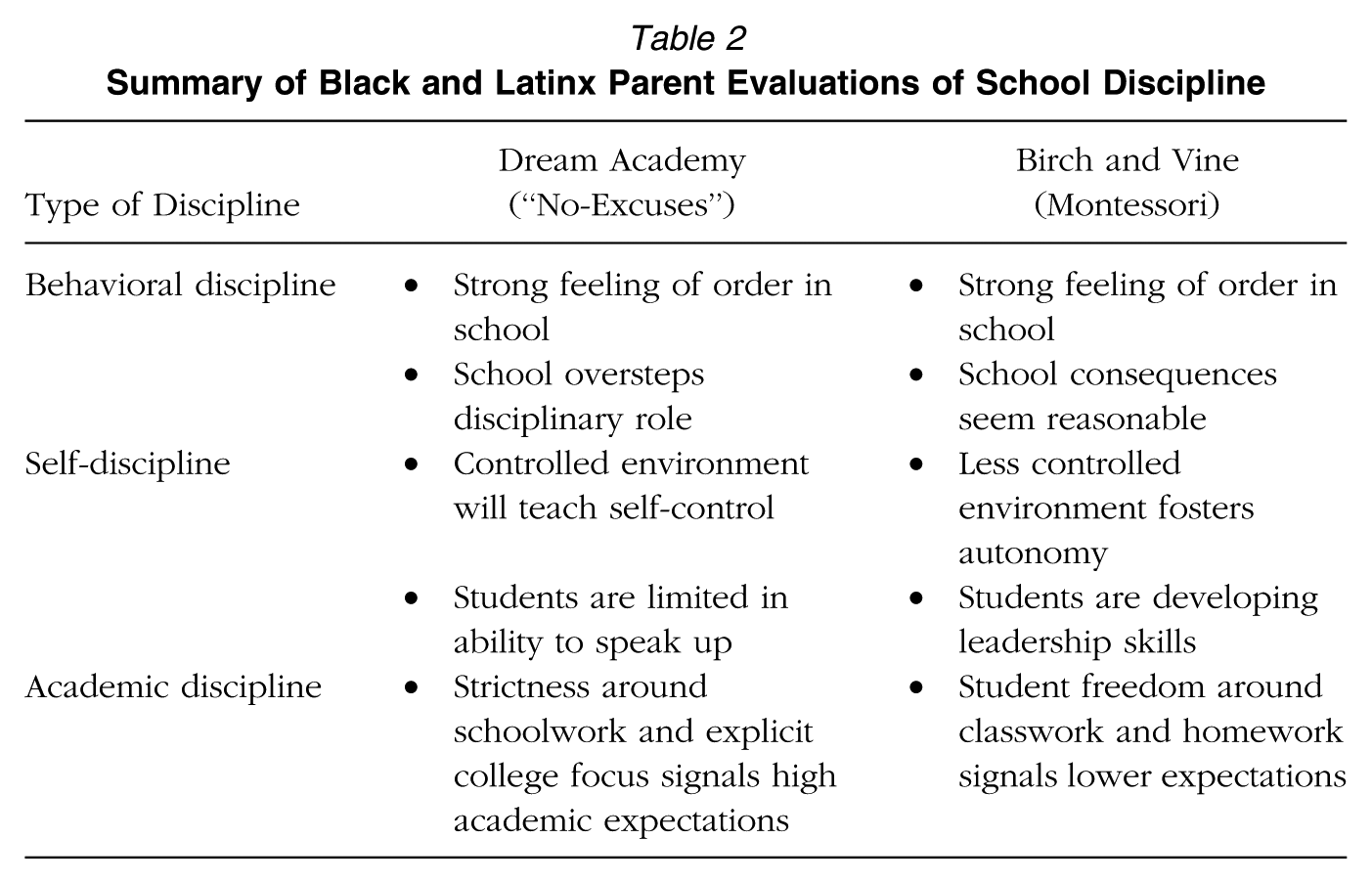
We found that while parents at both the no-excuses and Montessori schools valued all three types of discipline—behavioral, self, and academic—their satisfaction with the systems available at each type of school varied (see Table 2). Parents at both schools felt the schools created a strong sense of order through behavioral discipline, but while parents felt consequences were reasonable at the Montessori schools, a majority of parents at Dream Academy felt that the school overstepped its disciplinary role. Parents at all schools saw the importance of their children developing self-discipline and self-advocacy skills. While Montessori parents saw how a less controlled environment fostered autonomy and leadership skills, parents at Dream Academy hoped that strict behavioral systems would yield self-discipline in the long run yet also worried that their children were not learning to speak up for themselves. Finally, at Dream Academy, the strict expectations around academics and the school’s explicit college focus signaled to parents that their children would have strong academic outcomes, while the freedom granted to students around coursework and the absence of conversations around academic performance and long-term outcomes at the two Montessori schools were worrisome to parents. Ultimately, the findings from the parents across the schools suggest that both groups valued a structure of discipline that balanced a system for behavior and academic rigor with the development of students’ self-discipline and self-advocacy skills.
Summary of Black and Latinx Parent Evaluations of School Discipline
Behavioral Discipline
Parents at both the no-excuses and Montessori schools saw one important aspect of discipline as teaching students to follow rules. They viewed this both in terms of creating a safe and orderly environment for learning within the school as well as preparing their children to follow societal rules outside of school. We saw similar preferences articulated among the Black and Latinx parents we interviewed in both types of schools despite differences in the ages of students at each school, and the varying school racial and socioeconomic compositions.
As described earlier, both the no-excuses and Montessori schools had elaborately structured behavioral expectations. These systems of rules were praised by parents as providing their children with an orderly environment that was a welcome change from the relative lack of safety and order many of their children had experienced in neighborhood schools. Sharae, a working-class Black single mother, heavily researched her choice prior to enrolling her children at Dream Academy. “I was looking . . . into Dream Academy and I said, how was it organized, how was it structured, why is it structured?” Having been through boot camp herself as an adult, she felt that Dream Academy’s “boot camp” structure would be beneficial for her sixth-grade son.
Parents at Birch and Vine Montessori also noticed the order in their schools, commenting on the quiet that pervaded the schools and the number of students on task. Oliver, a middle-class, Black parent with a preschool-age daughter, noted how “they’re able to learn more because there really isn’t an interruption” in contrast to his own experience as a child in the district where “you’re just waiting for that interruption.” Several working-class Latinx parents admiringly described Montessori students as “little working machines” in the classrooms and “little soldiers” as they lined up to go to the lunch room. They valued a behavioral system that taught their children to be quiet and follow the rules.
Beside providing order in school, parents also recognized that learning to follow rules and learning to defer to authority were important skills in the workplace, especially for the working-class jobs that many of these parents held (Bernstein, 1971; Bowles & Gintis, 1976). Laquana, a working-class Black single mother of three boys, had no problem with Dream Academy’s strict rules because she felt that “there’s rules everywhere.” Unlike some other parents, she accepted that children should comply with rules at school just as adults have to follow rules at work. “I mean, like if they don’t bring their homework in, they get detention. You have to do your homework,” she commented. “You have to show up to work when you get older. You have to clock in at a certain time or whatever.” Other parents related school rules to having to wear work uniforms or having to restrain oneself in a meeting. Steph, a middle-class Black Dream Academy mother who worked as a client services manager, understood that even if students disliked or disagreed with the school’s expectations, rules were part of the reality they would need to learn to accept. “Wherever you go, there’s always going to be rules that you’re going to have to follow that you may not agree with 100% of the time,” she said. “But even as adults we deal with it and we go from there.”
However, while parents were supportive of the schools having clear behavioral expectations and teaching children to follow rules, they also felt that there should be reasonable limits to the rules. In this regard, Black and Latinx parents were satisfied with the ordered environment combined with student autonomy at the public Montessori school, particularly in contrast to the zero-tolerance policies used by other urban schools (Losen, 2014). It was striking that Black and Latinx parents at the two public Montessori magnet schools made few comments about disciplinary interventions, except to note their absence in the Montessori setting. Rita, a middle-class Black mother whose daughter attended Birch until fifth grade, favorably observed the disciplinary contrast between Birch Montessori and the urban public school where she worked where “our first response typically appears to be ‘okay, you’re suspended.’” Birch, in her view was “more child–appropriate,” and she wished that these types of school environments were the norm rather than the exception. Recalling a conversation with a fellow educator on the disciplinary practices of the local no-excuses charter in the city, her colleagues argued that a military-style model worked for African American children because it reflected what they experience at home. Rita felt that her child’s Montessori experience had allowed her to question this assumption, one she otherwise might have agreed with: Why is it that a certain population have to have so much structure in order to be successful compared to another population? And then why is it that the school, or, it’s almost like the government, has to be the ones kind of like dictating and saying what that structure needs to look like?
Experiencing the environment of a public Montessori school led Rita to question a strict disciplinary model for children of color and its implementation by schools and local and state governments.
While we expected parents in the no-excuses schools to show stronger support for strict behavioral discipline, especially as they had selected into this model, we found that more than three quarters (N = 19/25) of parents we interviewed at the no-excuses school expressed uneasiness over the school’s sweating-the-small-stuff behavioral approach and the assigning of consequences for minor misbehaviors. While researchers have found that schools that enroll predominantly students of color are more likely to have strict disciplinary codes and high levels of security (J. D. Finn & Servoss, 2014; Losen, 2014; Servoss & Finn, 2014), our findings of parental dissatisfaction complicate earlier studies that suggest that parents deliberately choose these schools for their strict structure (Calvo, 2007; Schneider et al., 1998). By interviewing parents after their children enrolled, our study reveals a more nuanced understanding of parental preferences regarding discipline that parents were better able to articulate as they became more familiar with the school’s practices.
Esmeralda, a middle-class Latinx mother who had enrolled her daughter in Dream Academy upon a teacher’s recommendation, grew frustrated with the constant calls she received from the school about her daughter’s behavior. One time, she was told that her sixth-grade daughter was being benched (a form of in-school suspension where students wear a yellow shirt and lose privileges like talking with other students) for laughing during a fire drill. Another time it was for humming. She recounted a phone conversation she had with the school over the incident: I said, “Wait, did she”—I said, “Did she curse?” No. I said, “Did she disrespect another student?” No. I said, “Did she disrespect you?” No. She was humming. I said, “Okay, what did she do all day?” She was working all day. I said, “She hummed. She was happy. Don’t call me again.” I did not feel bad when I hung up.
Although she went on to tell her daughter to comply with school rules, in her phone conversation, she demonstrated resistance to school practices, feeling that the school went too far in imposing such a rule-bound culture. In a highly structured context, parents sought a balance for the right amount of rules, and readily perceived when rule-following became excessive and beyond what was required for order.
In cases where rules seemed racially weighted, parents came to view the system of behavioral discipline as an intrusion rather than a necessity. Lanita, a Black mother who worked as a secretary, bristled at what she saw as the school trying to take over as in loco parentis in disciplining children. Invoking metaphors of White do-gooders, Lanita recounted a lunchtime incident in which the principal, a White man, yelled in her eighth-grade son’s face for refusing to pick up an Oreo
6
, which her son insisted was not his. Lanita criticized the principal for treating her son as though he controlled him: My child is not your slave. [The principal] just thinks—I always say he think he’s the “great White hope” to come save the Black folks, that’s what I think he thinks about himself. It’s just his arrogance that I don’t like . . . Don’t feel like you doing me a favor, ‘cause I appreciate what the school is doing, but it’s not just you.
While supportive overall of the school’s behavioral efforts, Lanita saw a racial power dynamic in play when White teachers and administrators treated Black children as though they were “saving” them. Rayna, another working-class Black mother, expected her sixth-grade son to be respectful and follow rules, and saw the school as overstepping its place in trying to regulate her son’s behaviors. “Don’t just act like they’re, like you raising—I don’t know how to say it—I can’t even, I don’t even know what they’re trying to do,” she began. “I’m not sending him to get babysit, for you to tell him to do this and do that.” Parents like these interpreted the school’s disciplinary practices as going beyond maintaining order to encroaching on what they saw as the parents’ primary responsibility to teach their children how to behave.
Despite the pedagogical differences of the Montessori and no-excuses schools, and their differences of student age and socioeconomic and racial composition, across schools, the Black and Latinx parents we interviewed wanted the same thing. They appreciated how behavioral systems of rules resulted in a safe and quiet learning environment for their children; they also wanted rules and consequences that were logical and not punitive. The parents in the Montessori setting were satisfied, but the no-excuses parents felt uncomfortable when the school seemed overly focused on behavior management.
Self-Discipline
Researchers have observed that Montessori and other progressive pedagogies offering higher levels of student freedom are popular urban options for middle-class White families (E. Brown & Makris, 2018; Debs, 2019) while no-excuses schools primarily serve Black and Latinx low-income students (Furgeson et al., 2012). In our school sites, the enrollment of between 25% and 30% White students in the Montessori magnet schools and the near-complete absence of White students at Dream Academy confirmed the first part of this pattern, but in contrast to previous research, the Black and Latinx parents we interviewed at the no-excuses school also valued structures that developed self-reliance in their children. Parental preference for discipline thus was not simply a matter of wanting their kids to learn to conform to rules; it was also about helping them make their own responsible choices that would help them to be strong self-advocates out in the world. While cultivating children’s self-advocacy skills has been associated with middle-class parenting styles (Lareau, 2003), and therefore we might have expected it to be prioritized more by parents in the socioeconomically diverse Montessori magnet schools, we found that both middle-class and working-class Black and Latinx families at both sets of schools saw benefits to their children developing their own agency. With respect to self-control and self-advocacy, parents at the Montessori schools expressed satisfaction with the school approach, while a number of the Dream Academy parents were critical.
At the two public Montessori schools, children were given frequent opportunities to build their self-control through long 3-hour work blocks during which children from the youngest ages chose their own work from a series of lessons that they had previously been given, chose how long they spent on each project, and chose when they took breaks. The morning snack was even put out family style, and children were expected to regulate their portion size so that everyone would have enough food. At older ages, children could go work in small groups in the hallways or outside. Simone, a middle-class Black mother whose children attended the Montessori magnet from preschool through the middle of elementary school, remembered being struck by her first time observing in a Montessori classroom. “They were so quiet, and they were so busy,” she noted.
And I saw them moving around the classroom, every now and again being guided by a teacher, but more often like they knew what they were supposed to do and they just did it . . . so I was in awe that children at that age could manage themselves.
Even though none of these parents described seeking out Birch and Vine specifically to cultivate self-control, their experiences in Montessori magnet schools helped them to recognize its value.
In addition to self-regulation, Montessori parents also praised the freedom and autonomy granted to their students that allowed them to work independently, learning skills that they felt would be valuable in the long term. Just as the children learned to initiate their lessons at school as well as complete practical life activities in class (e.g., cutting an apple, putting on their own coat, sweeping, and washing dishes), children also wanted to practice these skills at home. Shawn, a single Black father who was not employed, noticed how his 7-year-old son insisted on making his own sandwiches, observing that he had “done gained that independence where he want to do everything on his own. He don’t really want you to help him.” In response to frequent skepticism by friends and family, Kayla, a Black single mother with two daughters in preschool and third grade at Birch observed that “some people were just a little put off by the fact that they had so much freedom . . . ’cause some people don’t equate freedom with structure. And sometimes it works. In this setting, it works.” In her view, the Montessori classroom could be a structured space of explicit behavioral and academic expectations while still giving children a significant amount of freedom.
As a result of such autonomy, parents in the public Montessori schools noted their children’s level of confidence, even at very young ages. Kayla noticed how comfortable her daughters were speaking to other adults: “People have conversations with them and won’t even realize that [she’s] 5 years old . . . because of the stuff they talk about and how well they speak.” Similarly, Asuncion, a Latinx mother who worked as a nursing home assistant, observed her daughters’ academic self-assurance: She teaches me also, she corrects me. And then I come and I confirm with the teacher and she says, “No, she was right, this is how we do it in school.” And I still learn along with my 5-year old.
Parents felt such self-assurance and the increasing freedom granted to students paid off in the long term, as students learned to speak up and initiate conversations and activities, echoing research on the link between Montessori, executive functioning skills, and long-term academic success (Diamond & Lee, 2011; Lillard & Else-Quest, 2006; Rathunde & Csikszentmihalyi, 2005). In one elementary classroom, students planned, cooked, and decorated for a surprise bridal shower for their teacher without any parent assistance. Fourth-, fifth-, and sixth-grade students planned their own field trips several times a year based on interests they had developed in the classroom.
Although Dream Academy served older students in the fifth through eighth grades, the school gave students far fewer opportunities to exercise self-discipline. In the classroom, for example, teachers dictated when students could talk, leave their seats, raise their hand to participate, or ask questions during the lesson. This tight monitoring of student behavior was particularly frustrating to parents like Wesley, who pointed out that this might discourage students seeking help: “When [my seventh grader] finds out she can’t raise her hand or get the attention or the help she gets very frustrated and so she clams up.” As a middle-class Black father who had attended a New York City private school, he believed always being quiet was counterproductive to student learning. This is consistent with research: Students’ help-seeking behaviors result in more attention from teachers and greater learning opportunities (Calarco, 2011; Streib, 2011). Similarly, Lanisha, a working-class Black mother of an eighth-grade girl at Dream Academy, noticed that the students seemed withdrawn from their learning. As someone who regularly mentored a group of female students in the school, she was more enmeshed in the school community than the typical parent. “Even in the class that they’re cut off, you know, and that’s kind of embarrassing,” she remarked. “That’s kind of like, ‘I don’t have a voice, I don’t matter’ type of thing that the kids could be feeling.” Although she professed to otherwise liking the school and its staff, she thought it was important for students to have opportunities to speak up.
This absence of opportunities for self-advocacy led Dream Academy parents to be apprehensive that their children would grow up to become what some Black parents called “robots” or “little mindless minion[s], just going by what somebody says.” It made them concerned that their children were being trained with the wrong skills for their ultimate educational goal. As Tiffany, a working-class Black parent of an eighth-grader, explained, “The kids aren’t trying to go to the Army. They’re trying to go to college. And there’s a difference.” Tiffany recognized that colleges expect students to show more initiative, as they need to independently manage their work, approach their professors during office hours, and participate in class discussions (Collier & Morgan, 2008; Karp & Bork, 2012). She expressed concerns that disciplinary structures never changed for her daughter throughout her time at Dream Academy. “Maybe when they get older you can, like, loosen up on some of the rules,” she suggested. “They’re going to high school next year—make these rules have a purpose. [By seventh grade], it’s kind of hard to accept rules that you kind of see as dumb, and why do they have it?” For this parent, the persistence of rules throughout Dream Academy’s middle school felt like an increasing mismatch with the preparation necessary for high school and college.
The lack of opportunities for self-advocacy also made parents concerned that their children were missing out on skills they would need to learn in order to be active, engaged citizens. Cherisse, a middle-class Black parent and an elementary school teacher, sought to raise her fifth-grade daughter with the same principles of self-representation and solidarity that guided her own choice to participate in her teachers’ union: “I don’t want anybody to dictate. I want my child to feel like she’s in a democracy,” she declared.
Did you use your voice? That’s what I’m trying to teach her. Will it always come out the way want it? No. But you can’t say too much if you don’t get up and be a part of it and don’t let anybody silence you. Not even your teacher.
Consistent with Cherisse’s perspective, educational scholars have questioned whether the highly regulated environment of no-excuses schools prepares students to express their opinions, challenge authority, or collaborate with others, skills needed to participate in a democratic society (Ben-Porath, 2013; Lamboy & Lu, 2017).
Just over half (N = 13/25) of Dream Academy parents expressed reservations that the school’s tight controls did not afford their children sufficient opportunity to develop independence, have a voice, or learn to advocate for themselves. Others, however, felt that it was less important that children at this age learn to speak up, like Itsairis, a working-class Black mother: You don’t need any freedom [in fifth grade]. Freedom in the wrong hands at that age is dangerous, so no . . . The way it is for . . . elementary and middle school is fine, because I feel like it can discipline them enough to be able to handle high school without getting caught up in the fun of it, you know?
These parents instead hoped that a structured school environment would put their child on what one parent termed “that structured path”—in other words, their child would develop the kind of habits early in life that would help them be self-reliant and self-disciplined later on when those structures were no longer present. Zakia, a middle-class Black mother of an eighth-grade student, felt that trying to impose such structure on older children would have adverse effects: “They would probably all lose their minds and drop out of school.” Rather, by “spoon-feeding [the younger students], little by little” and showing students that their actions had consequences, Dream Academy could teach them the foundations they needed later to be able “to be strict on your own . . . be self-sufficient and you know, set rules and standards for themselves.” At the Montessori schools, parents saw their children exercising self-discipline on a daily basis at a young age. At Dream Academy, parents had to trust that the behavioral discipline exercised on their preadolescent and adolescent children would someday yield internal control.
Academic Discipline
In addition to teaching students how to follow rules and how to become self-reliant, parents viewed discipline in relation to academic preparation and rigor. At a basic level, parents saw both sets of schools as providing an orderly environment for learning that contrasted with children’s experiences in other schools. However, at Dream Academy, a demanding and strict school environment coupled with the school’s explicit focus on college signaled strict academic discipline and translated to parents as high academic expectations, whereas at the two Montessori schools, greater academic freedom along with the absence of explicit discussion of academic outcomes were worrisome to some Black and Latinx parents.
Dream Academy’s pervasive college pendants and college-themed murals made the school’s academic discipline highly visible. Each classroom was named after a college, and each grade was labeled by the year of their college graduation (e.g., Class of 2024). While Dream Academy parents might have had some conflicts with the school’s disciplinary regulation, they were also reassured that the intense academic discipline, as demonstrated by strict homework and academic expectations, led directly to the school’s clear promise of a college education and upward mobility, a promise that was far more explicit than at the public Montessori schools. During the first open house for families, Ciani, one working-class Black mother, recalled how the school director at Dream Academy told her, “It’s not my job to get your [seventh grader] to the next grade. It’s my job to get him to college.” She thought this perspective was “good thinking” in the sense that “that’s your end goal and that’s what you want.”
Dream Academy staff also explicitly linked school behavioral rules and practices to academic discipline and college preparation, reminding students that “self-control will get you to college” or defending the school’s lateness policy by explaining that college applications would not be accepted if they were a minute late. Even parents articulated these connections. The school, for example, had a homework rule of “neat, complete, on-time, and best effort” where students who turned in assignments with a missing header, a problem left blank, or crinkled pages received no homework credit and a same-day detention. Echoing what teachers told students, Tikia, a Black single mother of four, said of these rules, It’s teaching them that little things do count. If you go to college, when you go to college . . . if your professor has told you this is how I want it done and you don’t do it that way, they’re not gonna accept it. So I feel like everything is to prepare them for their future.
She approved of the school’s strict policies and practices as keeping children accountable and responsible, preparing them for what she took to be the expectations of a college professor, even if colleges in reality have more flexible expectations than secondary schools (Collier & Morgan, 2008; Karp & Bork, 2012).
For parents who themselves had not attended college, they trusted that these college-educated teachers knew how to get their children there. As Itsairis, a working-class Black parent of a fifth-grade girl, explained, “I’m not a teacher; I didn’t go to school for that. I’m just kind of trusting their way.” Echoing this sentiment, Laquana, the working-class Black mother who recognized that rules were everywhere, defended the teachers to her son as “all hav[ing] their diplomas and college degrees. They’re helping you get there.” Consequently, in these parents’ view, the drawbacks of Dream Academy’s disciplinary practices were far outweighed by both promised future benefits and immediate benefits that they saw in their own children’s academic growth. For example, Esmeralda, the mother who had asked the school to stop calling her, felt responsible for her daughter’s suffering from the stress of school, but she acknowledged that her daughter’s reading abilities had increased dramatically as had her self-discipline in doing her homework each day immediately upon arriving home. The academic rigor of the no-excuses school was perceived as so valuable that many parents deprioritized their child’s discomfort—and at times their own—in favor of persisting.
Similarly, at the Montessori elementary schools, we found that parents were concerned about academic progress, as well as preparing their children for the next level of education. At Birch and Vine Montessori, roughly half of parents positively assessed their child’s academic discipline and progress, particularly in contrast to their peers at neighboring schools. For example, Jacqueline, a middle-class Black mother, appreciated that the teachers knew that the children are limitless as far as their learning potential is concerned. They don’t hold them back, they will push them as hard as they need to go. So my daughter was counting to a hundred at 3 and a thousand by 4. By 5, she was doing square roots and some division.
For Alejandro, a working-class Latinx father, the comparison was made explicit by looking at the academic progress of relatives, for example, My nephew don’t know how . . . to read that much. I mean my son can read a book, a 100 pages book in no time. And my nephew, I can give him a 10 pages book and he can be there for 3, 4 hours reading a book.
For these parents, their children were excelling academically, and exceeding their own educational expectations.
But the other half of Black and Latinx parents interviewed at Birch and Vine Montessori magnet had a different take. The remaining parents, from a variety of social class backgrounds, but many with children in the later elementary grades rather than preschool grades, felt their children were not mastering the necessary academic discipline. Both Birch and Vine followed a common Montessori practice of not assigning homework beyond nightly reading throughout elementary school. Yet four parents from a variety of class backgrounds requested homework, in violation of the schools’ no-homework policies.
Working at the student’s pace, which Montessori teachers heralded as a benefit of the approach, could be viewed by the Black and Latinx parents we interviewed as not pushing their children to a high standard (Delpit, 1988). Natalie, a single Latinx mother whose parents took care of her children while she worked as a medical technician, worried that “learning at their own pace . . . might end up not letting her [daughter] go as far as she can.” Natalie was concerned that the school put too much burden on children to motivate themselves: “The [Montessori] teacher would say ‘oh, I wish you would try to challenge yourself a little more’ whereas [at] another school, they would be challenging her more.” Christopher, a middle-class Latinx father who wanted his children to be directed toward significant career goals, also worried that Montessori offered too much freedom of choice. “I just really hope they choose well,” he noted. These comments were notable given that both Montessori schools had significant racial test score gaps beginning with state testing in third grade, though in interviews, no administrators or parents explicitly referenced these “opportunity gaps” (Carter & Welner, 2013) between White and Black/Latinx children and instead focused on efforts to improve parent understanding of Montessori in order to help them better support their children academically.
Interviews and observations, however, revealed that parents had attended numerous education sessions on the Montessori pedagogy but remained concerned. Many of the Black and Latinx parents interviewed considered their own success in traditional school as the reason for their economic advancement, and wanted the school to directly support their children in reaching these same goals. While it is a common desire for parents to hope their children will match their success, for some Black and Latinx parents, this ambition was rooted in their racial experience and identity. Rita, the middle-class Black mother who learned to appreciate the more flexible Montessori structures, aspired to give her daughter “opportunity that we weren’t afforded” and viewed extracurricular activities like piano, violin, softball, and basketball part of what she termed, “trying to make up for history.” In this context, academic achievement carried the additional baggage of past discrimination. A sense that academic discipline was too relaxed was perceived as risky, giving too much power to the child to make the right decisions instead of holding the adults responsible for ensuring that their children were pushed to a consistent high standard.
These parents needed reassurance that their children would be prepared for middle school and on track for college. In contrast to the pervasiveness of college culture at Dream Academy, there was, by intention, little mention of college or even middle school preparedness at Birch or Vine, in part because of the preschool and elementary age-group and also the Montessori philosophy of learning for its own sake rather than for external rewards and punishments. Yet the lack of explicit school discourse around academic success in the school created additional uncertainty for some Black and Latinx parents. Simone, who had marveled at the self-controlled students she observed in a Montessori classroom, ultimately pulled her children out of Birch midway through elementary school because she was concerned that her children were “leveling out behind their peers.” She found silence from the school regarding outcomes after Montessori. “I want to see the graduates. I want to hear what the graduates are doing. What they, where life took them? Where their careers took them?” Similarly, Christopher, the Latinx father who was focused on career goals, worried that the school’s emphasis on gardening was coming at the expense of skills that his daughter needed for long-term success: I’m trying to prepare her for like modern day stuff like technology, computers and all these advances and medicine, and they’re planting peas! . . . I know it’s important, but like can she read, can she add, can she do computer-based stuff?
Because it was uncommon for Montessori staff to directly address the long-term benefits of Montessori, if parents harbored doubts about the school, they could not fall back on a narrative that the school was preparing their children for middle school or college. For this reason, despite their perception that their children had positive attitudes about school and were learning autonomy, Black and Latinx parents at Birch and Vine were uncertain as to whether these skills would translate into long-term academic success.
Discussion
Despite a considerable amount of public controversy, expanding school choice has become a central education policy to improve urban schools. While school choice was originally seen as a way to expand options for families, the diversity of school choice options is narrowing with the expansion of CMOs and no-excuses schools (Farrell et al., 2012; Scott, 2009). As locally based, home-grown or “mom and pop” charters find it difficult to compete in this new field, there is concern that choice schools will no longer reflect the preferences of local communities (Fabricant & Fine, 2012; Henry & Dixson, 2016; Kretchmar, Sondel, & Ferrare, 2014; Scott, 2009). Controversies around the strict disciplinary codes used by no-excuses schools are one such example (Golann, 2015). Proponents have pushed back, arguing that parents of color are voting with their feet, hence endorsing such practices (Decker et al., 2015).
Through using ethnographic observation and interview data from two case studies of a no-excuses charter school and two urban Montessori magnet schools, our article is one of the first to examine how a socioeconomically diverse group of urban Black and Latinx parents interpret the meaning of school discipline structure. Consistent with previous literature, we found that Black and Latinx parents appreciated the safety and orderly school environment provided by an explicit behavioral system of discipline. We extend this literature, however, to show that Black and Latinx parents saw discipline as being not only about rule-following but also about self-discipline—knowing how to make good decisions in the absence of rules and consequences—and academic discipline: structures that pushed their children to achieve.
Although we anticipated that parents from no-excuses and Montessori schools would have different views of discipline on the basis of their school choice, we found shared parental preferences across schools that had different pedagogical models, different age ranges, and differing socioeconomic and racial compositions. In all schools, the Black and Latinx parents we interviewed expressed a desire for a balance between structure and autonomy for their children, and an academically rigorous learning environment. We found that both working-class and middle-class Black and Latinx parents wanted their children to have greater freedom and expression in school, what previous scholars have characterized as mainly middle-class aspirations (Calvo, 2007; Lareau, 2001). One reason for this difference may be that our sample had a high proportion of middle-class and stable, two-parent working-class Black and Latinx parents who may be more accustomed to more flexible middle-class environments and thus more desirous of such a school setting. Another explanation could be that previous researchers did not study schools with such distinct disciplinary models where the benefits of independence, in the Montessori model, and the drawbacks of strictness, in the no-excuses model, are made salient.
The contrasting target audiences of the no-excuses and Montessori models in the public sector have also contributed to assumptions that the parent populations in these two schools want entirely different things. The no-excuses model was designed to serve a relatively homogenous population of low-income students of color, providing additional support structures for students in these schools. One take on these schools is that they need to be so prescriptive because they are resocializing low-income, minority students into White, middle-class norms (Whitman, 2008). By contrast, Montessori has historically been used in the public sector to attract a more diverse student body (Debs, 2019). It assumes that higher income and White parents will be more willing to enroll their student at a school with a more flexible, student-directed Montessori model, outweighing parental preferences for student body racial composition. With these mission differences in mind, it was striking therefore how similarly Black and Latinx parents in both schools articulated their preferences. This suggests that the substantial research showing differences in pedagogic and disciplinary practices across schools of varying racial and socioeconomic composition (e.g., Anyon, 1980; Losen, 2014) may reflect not so much the desire of parents as the preferences of school administrators and teachers.
Our findings contribute to research on charter schools, magnet schools, and their pedagogical theme. The experience of Black and Latinx parents in theme schools has been understudied, and an initial examination of Black and Latinx parents at no-excuses and public Montessori magnet schools reveals that parents do express preferences regarding the academic and disciplinary structures of these schools and face internal conflicts regarding their choices. One of the rationales for school choice policy is that families are finding a better match between the child and school. Adding Black and Latinx parents’ voices to these discussions has the benefit of providing a balanced perspective, one that acknowledges parents’ reasons for choosing these schools but also recognizes the conflicts they may face with their choices.
Although this study makes important contributions to research on school choice and discipline, we want to note its limitations. First, we interviewed a small sample of parents at each school in semistructured interviews, which gave us in-depth access to parents’ opinions but made it hard to quantify certain perspectives. A follow-up study surveying a larger sample could help to validate these initial findings. We acknowledge as well that the viewpoints of these parents may not reflect those of the broader Black and Latinx parent population at the schools. Some of the parents we interviewed, for example, were from higher socioeconomic backgrounds than the typical Black or Latinx parent at these schools, and a handful of the Montessori Black and Latinx parents lived in nearby suburbs although they chose to send their children to an urban magnet school. Second, selection effects for families attending choice schools, whether charter or magnet, suggest an additional dimension by which these parents might not be representative of the broader district, a common problem with studies of school choice. Third, while we emphasized the continuity of preferences across social class backgrounds, our small sample size made it difficult to separate out preferences that might have differed by both race and class, something that future research with a larger sample might better elucidate. Finally, in addition to their thematic differences, the no-excuses school differed from the Montessori schools in the grades it served and in the higher concentration of students of color and low-income students. While we argue that these differences appeared not to be salient in the common preferences expressed by parents across schools, a better comparison would have been between school sites in which these differences were minimal. Future studies, such as those using survey experimental methods, should explore how parents’ preferences for school discipline are shaped by the racial and socioeconomic composition of the school as well as the age of the child. Despite these limitations, we think the comparison of the two school themes highlights worthwhile similarities between Black and Latinx parents making two very different school choices, and addresses a gap in the literature around the meaning of discipline for this population.
For practitioners, we offer recommendations to continue educating parents about the school model alongside being responsive to alternative perspectives. While both schools had an onboarding process for parents and students alike, the experiences of the parents we interviewed suggest that this transition period extends well beyond the first school year. At Dream Academy, parents communicated how the disciplinary structure— taking teacher phone calls, making school visits, attending administrator meetings—interfered with their day and felt dismissive of their other responsibilities as a parent. While Montessori schools had parent education about the Montessori method, parents wanted additional information about their students’ academic progress and expected long-term academic outcomes. We urge these schools to provide a variety of entry points for parent engagement beyond the standard parent association meeting as well as more opportunities for authentic dialogue around school practices and policies.
Last, these findings suggest several policy implications. For no-excuses schools, our findings build off existing research showing that these schools’ disciplinary practices may not be conducive to developing a variety of academic and non-academic skills in students (Golann & Torres, 2018). While longer term outcomes for students who attend no-excuses schools are not yet available as these schools are only beginning to send and graduate their first college cohorts, early results have disappointed some no-excuses leaders. The KIPP schools, for example, boasted nearly universal college acceptances but found that only one third of their students graduated college in 6 years (KIPP Foundation, 2011). School leaders attributed these low rates to students’ nonacademic skills, prompting the school to put more emphasis on teaching character. Studies also have found that no-excuses schools have little to no impact—and in some cases, negative impacts—on a variety of skills and behaviors related to college success, including self-control, grit, school engagement, effort/persistence in school, academic confidence, educational aspirations, and conscientiousness (Tuttle et al., 2013; Tuttle et al., 2015; Dobbie & Fryer 2015; West et al., 2016). In response, some no-excuses school leaders are working to increase self-control and self-advocacy in their schools, what some have begun calling “no-excuses 2.0” (Bailey, 2014; Tough, 2013; Whitmire, 2016). The perspective of Black and Latinx no-excuses parents demonstrates strong support for these changes.
For public Montessori schools, recent academic studies of Black, Latinx and low-income students suggest promising academic results, but there are few peer-reviewed longitudinal studies examining the long-term academic impact of public Montessori (Dohrmann, Nishida, Gartner, Lipsky, & Grimm, 2007). In the interim, public school leaders can collect their own data following their students into middle school, high school, and college and share the findings with their current parents.
More broadly, parents’ desire for their children to have greater self-discipline and self-advocacy suggests a need to more closely examine how all schools are developing this skill alongside an evaluation of the range of choice options in each city. While no-excuses schools still serve a tiny fraction of public school students, they are the dominant charter school model in some cities (Stitt, 2016). Expanding choice options like Montessori that prioritize student autonomy and personal growth is one way to ensure a range of options, yet such progressive options should ensure that all students achieve at high levels. Finally, the experiences of parents suggest the continued need for policymakers to engage families in designing and modifying school choice policies that are responsive to parents’ needs.
Supplemental Material
Jun_18_AERJ_online_appendix – Supplemental material for “To Be Strict on Your Own”: Black and Latinx Parents Evaluate Discipline in Urban Choice Schools
Supplemental material, Jun_18_AERJ_online_appendix for “To Be Strict on Your Own”: Black and Latinx Parents Evaluate Discipline in Urban Choice Schools by Joanne W. Golann, Mira Debs and Anna Lisa Weiss in American Educational Research Journal
Footnotes
Notes

J
M
A
References
Supplementary Material
Please find the following supplemental material available below.
For Open Access articles published under a Creative Commons License, all supplemental material carries the same license as the article it is associated with.
For non-Open Access articles published, all supplemental material carries a non-exclusive license, and permission requests for re-use of supplemental material or any part of supplemental material shall be sent directly to the copyright owner as specified in the copyright notice associated with the article.
