



Abstract
This study draws from World Englishes and a raciolinguistic perspective to examine how seven Black educators used standardized Englishes after their migration to the United States. Findings reflected sources of English (il)legitimacy to which educators were subjected based on negative reactions to their accents, race, communication, and vocabulary. In turn, cultural incongruence and confusion led educators to (re)claim their English legitimacy and to leverage pedagogical approaches regarding tone, expectation, delivery, and linguistic content and context. Through metalinguistic, metaracial, and metacultural understanding, educators reflected ‘a transraciolinguistic approach,’ (re)establishing legitimacy of their standardized Englishes as Black speakers in the U.S. academy. Implications for addressing challenges to the legitimacy of certain standardized Englishes used by racialized speakers in the academy are discussed.
The use of standardized Englishes, 1 and specifically, “Standard American English” (SAE) 2 in U.S. academia, has long been central to the work of preparing teachers, educators, 3 and administrators for diversity (Wiley, 2014). Despite the extensive body of work that has sanctioned nonstandardized Englishes both in the United States and across the globe (see Labov, 1969; Siegel, 2012; Smitherman, 1977), there remains an insistence that the design of curriculum, delivery of instruction, and development of assessments across K–12, college, and societal contexts in the United States be premised on what Flores (2013) describes as monoglossic language ideology. This ideology is based on a monolingual norm that sanctions the actual, and sometimes imaginary, use of SAE. The centrality of an actualized or perceived SAE to the process and practice of U.S. education is reflected in the inadvertent focus of educators on ensuring that their use of English conforms to certain formalized SAE expectations (see Smith, Warrican, & Kumi-Yeboah, 2016). In doing so, educators inadvertently relegate other standardized Englishes, their corresponding nonstandardized Englishes, as well as the speakers of these Englishes (e.g., African American Vernacular English speakers) to the sidelines of the academy, often rendering them “languageless” (Willis, 2017).
As Bourdieu (1998) has observed, “Cultural and linguistic domination is accompanied by the imposition of the dominant language and culture as legitimate, and the rejection of other languages into indignity” (p. 46). As such, even those who speak English in supposedly formal and standardized ways that are slightly different from, but very similar to, SAE tend to undergo perceptions of inferiority, incapacity, illegibility, and illegitimacy (Rosa, 2016). Paradoxically, this covert response occurs very often in spaces where there is an overt commitment to addressing diversity on the part of institutions and employees of higher education—culturally, linguistically, and otherwise (Smith, Warrican, Kumi-Yeboah, & Richards, 2018). In turn, a disconnect occurs between what we wish to do and what we actually do in addressing linguistic diversity 4 in education.
I argue in this study that the disconnect between what we wish to do and what we do is perhaps based largely on our lack of intentionality about naming as acceptable the linguistic practices that extend beyond SAE and that include other standardized Englishes. Moreover, this disconnect may persist because of the hesitance to identify, understand, and acknowledge when other standardized Englishes are present and to provide opportunities for enlightening those in education about how we may better address this linguistic variation in education. In the absence of an intentional approach, I assert that standardized Englishes (e.g., African American Standard English, Ghanaian English, Trinidadian Standard English [TSE]) that extend beyond SAE, as well as their corresponding nonstandardized Englishes (e.g., Caribbean English Vernaculars, Ghanaian Pidgin English), will continue to remain largely peripheral to efforts for addressing linguistic diversity that we so relentlessly pursue in academia. When we hesitate to name explicitly how multiple standardized Englishes and the persons who use them function legitimately in academia alongside their peers who use normative SAE forms, we unwittingly reinforce the disillusionment faced by already disenfranchised individuals in our educational system, many of whom are people of color, immigrants, bi-/multilingual, and bi-/multidialectal. As a result, the daily linguistic lives of these marginalized populations continue to be affected by the perception that their Englishes, and by extension, who they are as individuals, are somehow not enough (Mitchell, 2013; Rosa & Flores, 2017).
To this end, the purpose of this study is to examine the ways in which seven Caribbean and West African Black immigrant educators (i.e., foreign-born faculty who teach undergraduate and graduate students) used standardized Englishes in their Colleges of Education after their migration to the United States. A secondary focus of the study was to explore the ways in which the educators addressed challenges based on their uses of standardized Englishes in their Colleges of Education. The study is focused on immigrant educators because they originate from a different social and geographic context, bring with them distinct standardized Englishes from their home countries that represent novelty in the U.S. context, and, unlike their Black American faculty counterparts, are largely unfamiliar with the linguistic and cultural biases toward using certain variations of English in the U.S. context upon their migration to the United States.
The educators were chosen from Colleges of Education because these colleges represent the key locale in academia where teachers, educators, administrators, and others intentionally prepare teachers as well as those who address numerous forms of diversity across subject areas, academic arenas, and industrial contexts. Colleges of Education, which find themselves central to increasingly addressing linguistic and other forms of diversity on university campuses, often miss key opportunities despite being the sites where “higher education internationalization policies have the greatest potential to expand the perspectives of public-school students” (Haar, 2016, p. 1; Stevick & Brown, 2016). It is also the case that little research is present that reflects specific attempts to identify and address the linguistic challenges faced by Black immigrant faculty (see Smith et al., 2018). Such a situation is exacerbated in cases where the majority of Black faculty in certain colleges are immigrants and grapple not only with the (novel) burden of negative perceptions based on being Black, but also, simultaneously, with what is perceived as a non-American English accent that signals their immigrant status (Nero, 2006; Orelus, 2012; Smith et al., 2018).
This study is thus both timely and relevant, considering the debates surrounding immigration, both nationally and globally and given the national movements dedicated to the opposition of Blackness in the United States (Sexton, 2018; Sherkat & Lehman, 2018). The study’s relevance is also justified by the fact that Black faculty within academia recently constituted 4% of the total full-time instructional faculty as compared with 79% of their White counterparts in 2014, a decline from the 6% of total full-time instructional faculty whom they represented when compared with 84% of White full-time professors in 2011 (U.S. Department of Education, 2014). Given that immigrant faculty account for approximately 9% of those who prepare teachers for English-dominated K–12 schools (Kim, Twombly, & Wolf-Wendel, 2012), recent research increasingly calls for scholarship that allows the field of education to better understand how educators across locales learn from their experiences in ways that allow them to leverage linguistic diversity in classrooms (Louis, Thompson, Smith, Williams, & Watson, 2017; Smith, 2018). The intended goal is to become aware of how educators use language in ways that help them effectively influence those whom they prepare for linguistic diversity in spaces different from their own.
To facilitate this goal in the current study, I first discuss how Black immigrants, and by extension Black immigrant faculty, relate to Englishes across their home countries and the United States. In tandem, I describe the way in which the World Englishes model, integrated with a raciolinguistic perspective, serves as a framework for examining the experiences of these educators with standardized Englishes. Following this, I outline methodological premises for the study. Findings are then presented, and finally, a conclusion along with insights for intentionally addressing the standardized Englishes of Black immigrant educators in academia.
Black Immigrants, Faculty, and Language Discrimination
It is projected that four million Black immigrants currently live in the United States, a fourfold increase compared with the number of immigrants in 1980 (Zong & Batalova, 2016). Black immigrants currently account for about 9% of America’s 42.4 million immigrants (Zong & Batalova, 2016) and the U.S. Census Bureau (2014) projects that by 2060, 16.5% of U.S. Blacks will be immigrants. Together, Black Caribbean and African immigrants account for the largest number of immigrant Blacks to the United States. Most Black Caribbean immigrants come from English-speaking Jamaica and Trinidad and Tobago, French-speaking Haiti, and Spanish-speaking Cuba and the Dominican Republic, with those from English-speaking countries reflecting strong English language skills (Zong & Batalova, 2016). The majority of Black African immigrants come from West, East, North, South, and Central Africa (Capps, McCabe, & Fix, 2011). Unlike many of their African American counterparts who were taken from their homelands and forced into slavery in the United States, the majority of Black Caribbean and Black African populations voluntarily migrated to the United States (Ogbu, 1987). Even within the Black immigrant population, Black African immigrants differ from Black Caribbean immigrants because much of the latter are themselves descendants of slaves.
Black Immigrants and Language Discrimination
On migrating to the United States, many Black Caribbean immigrants experience language difference that becomes crucial to their adjustment. The challenges they face with their Caribbean Englishes (CEs) and accents arise because these Englishes do not always receive formal acceptance in the United States (Winer, 2006). These Black Caribbean immigrants soon learn, often for the first time, that there are ways of thinking about their use of English that portray them as “nonnative” speakers of English in the United States (Winer, 2006). They eventually understand that their nonstandardized English “dialects” (e.g., Jamaican Creole) as well as standardized Englishes (e.g., Jamaican Standard English), though used formally in their home countries, do not seem to have the same level of acceptance given to the SAE in the United States (Pratt-Johnson, 2006). Similar findings have also been observed with a large number of Black African immigrants who face “linguicism” (Skutnabb-Kangas, 1988, p. 13) that assigns power and privilege to a version of the English language that they do not speak (Awokoya, 2009). As a result, and much like their African American counterparts, many immigrants may undergo discrimination and experience shame in response to their use of English that causes them to try to change their accents and avoid their home languages (Agyepong, 2013). Others are placed in English-as-a-second-language classes despite the official language in their country being English (Obeng & Obeng, 2006). In turn, Black Caribbean and African immigrants are forced to reconsider their sense of self and negotiate their status as speakers of English in the United States. These patterns of adjustment have been shown to be more representative of Black immigrants who migrated to the United States (i.e., first generation) and vary to some degree for their offspring (i.e., second generation), many of whom develop unique ethnic, racial, and other identities (Waters, 1994).
Black Caribbean Immigrant Faculty and Language Discrimination
An understudied group of Black immigrants known to undergo such challenges with language and thus, whom I chose to examine as a basis for this work, is the population of Black Caribbean immigrant educators in the United States. These educators, after they migrate to the United States, immediately become part of the underrepresented Black faculty in U.S. academia. A recent study conducted to distinguish the experiences of Black Caribbean immigrant faculty from their Black American counterparts indicated that certain immigrant Black faculty experienced microaggressions based on societal beliefs, stereotypes, and feelings of being isolated from colleagues beyond the academic workplace, while at the same time recognizing affinity with African Americans (Louis et al., 2017). In another instance, describing his experiences as a Black educator migrating from Haiti to the United States, Orelus (2012) provided a compelling narrative that depicted the ways in which challenges of language, race, socioeconomic, states, and social class intersected in his experiences with discrimination across a myriad of academic and nonacademic contexts. Speaking more specifically of his experience in academia, Orelus stated, Not only have I been racially profiled as a doctoral student, but also as an instructor. For example, while teaching an undergraduate course called Foundations of Critical Thinking at a small liberal arts college in western Massachusetts, I was followed by one of the college security guards as if I was a criminal. As I was returning to the computer laboratory . . . to show my class a short documentary on the intersection of race, gender, and social class, this security guard kept following me. When I asked him if there was anything wrong, he merely replied, “Sir, I am just doing my job.” Doing his job evidently meant keeping an eye on every step that I made as the only Black instructor at that college. (p. 28)
Orelus concluded that the message he received in the United States was “If you do not look like us and do not sound like us, therefore you cannot be a part of us” (p. 29).
Though limited, recent studies confirm the opposition faced by some Black Caribbean faculty to their ways of using standardized and nonstandardized Englishes, much of which has been attributed to their communication and interaction styles based on Caribbean culture, language varieties, accents, positioning, and English ideologies in the United States (Smith, 2018; Smith et al., 2018). This subtle form of discrimination against their ways of using Englishes despite the power and privilege typically associated with standardized English—“linguicism”—often takes the form of microaggression as it did with Pierre Orelus (2012), occurring verbally, nonverbally, behaviorally, and environmentally, resulting in negative experiences for these faculty in academia in ways that affect their physical and psychological well-being. Such responses stem from perceptions and stereotypes of the dominant culture about foreign-born Blacks, from the new cultural identity imposed on them as “Black persons” and “African Americans” in the American society, and from cultural invisibility, where they appear not to be seen, all of which create a sense of confusion as they migrate and settle in their new home (Louis et al., 2017; Mas Giralt, 2015; Rong & Brown, 2001; Ukpokodu & Ojiambo, 2017).
From these studies, it is clear that many Black immigrants struggle with stereotypes and with cultural challenges that affect perceptions about their linguistic proficiency with English on their arrival to the United States. Certain Black Caribbean immigrant faculty also experience challenges with English in the context of academia that may marginalize, exclude, or invalidate these individuals. What remains unclear is the way in which immigrant educators’ uses of standardized Englishes manifest themselves in the context of the United States where SAE is the norm. Also unclear is how the practices of these educators are affected by and responded to within and beyond their Colleges of Education.
World Englishes and a Raciolinguistic Perspective
World Englishes
World Englishes is based on the idea that three concentric circles—“inner,”“outer,” and “expanding”—explain the ways in which Englishes are used across the globe (Kachru, 1992). The “inner circle” of Englishes involves those Englishes that are predominantly spoken in Anglo-Saxon countries such as the United States, Australia, and Canada; the “outer circle” describes Englishes often seen in countries colonized by Britain such as Bangladesh, India, and those in the Caribbean; and the “expanding circle” represents Englishes learned as a foreign language in countries such as China, Indonesia, and Nepal (Kachru, 1992). In this “three-circle” model, Englishes are said to be based on national identity. Those who have critiqued the model in more recent times observe that it does not take into account the use of Englishes that extend beyond geography and national identity (Canagarajah & Said, 2011), which is often the case with online spaces where numerous Englishes are used fluidly across national and geographical contexts.
As part of the World Englishes model, CEs function as “outer circle” Englishes and may be standardized (e.g., Bahamian Standardized English) or nonstandardized (e.g., Trinidadian English Creole). Standardized CEs, defined as the closest to standardized Englishes (i.e., similar to Standardized American Englishes), are often referred to as “The Queen’s English,” or simply, as “English.” Nonstandardized CEs, on the other hand, commonly referred to as dialects of English, are denoted as “Creoles,” or “patois,” but also sometimes, as “English,” particularly when used in comparison to dialects based on languages other than English (e.g., French Creole; Carrington, 1992). Caribbean multilingual teachers themselves, typically speakers of both standardized and nonstandardized CEs, sometimes engage in self-marginalization by privileging standardized over nonstandardized Englishes (Milson-Whyte, 2014). And West African English speakers from countries such as Ghana, Nigeria, Liberia, and Sierra Leone often reflect similar differences in standardized versus nonstandardized Englishes that interfere with their communication in the United States (de Kleine, 2006; Ukpokodu & Ojiambo, 2017).
The World Englishes framework has been recently used to demonstrate how Black immigrant educators are repositioned and use their nonstandardized and standardized Englishes recursively when they migrate from their outer circle contexts to the inner circle of the United States (Smith et al., 2018). The perspective of language ideologies (Razfar, 2012) has also been used in conjunction with this framework as a basis for examining how these educators’ ways of thinking about these Englishes are arrested, causing them to shift back and forth between ideologies—bidirectionality—as they think about how to leverage their Englishes (De Costa, 2010; Smith et al., 2018). It is therefore useful to consider this framework as a lens for not only examining the language ideologies of Black immigrant educators but also exploring how racial ideologies intersect with language to frame speakers of English whose experiences regarding being Black represent a certain degree of novelty.
A Raciolinguistic Perspective
By its very nature, raciolinguistic ideology refers to the dominant practice of racializing language and framing racialized speakers in negative ways (Rosa & Flores, 2017). These perceptions of thinking—raciolinguistic ideologies—are such that the “linguistic practices of racialized populations are systematically stigmatized regardless of the extent to which these practices might seem to correspond to standardized norms” (Rosa & Flores, 2017, p. 3). A raciolinguistic perspective, on the other hand, explains how raciolinguistic ideologies function across race and language for various ethnic and racial groups in academia (Rosa & Flores, 2017). This perspective challenges the idea that conceptions of Englishes—whether World, Caribbean, or West African—operate in a vacuum independent of the racial categorization of their speakers. Flores and Rosa (2015), in their description of how such ideologies affect perceptions of those who use these Englishes (as is the case with African American English speakers), explain that Standard English is incorrectly perceived as an “objective linguistic category” such that when it is spoken by various racial populations, it naturally affords them access to mainstream educational opportunities and the advantages that its curriculum provides. What is not acknowledged, however, they assert, is that this appropriation of imagined (or idealized) as well as actualized linguistic practices by racial populations based on a supposed Standard English that is premised on a monoglossic language ideology does not constitute the sole basis used by others to determine the advancement of racial groups in our dominant system. In adopting this stance, Flores and Rosa (2015) observe that a raciolinguistic ideology such as this represents failure to acknowledge the “White gaze”—that is, the privileging of “dominant white perspectives on the linguistic and cultural practices of racialized communities” regardless of the efforts of persons of color to approximate the accepted language forms (pp. 150–151). This positioning in turn, is used by Whites to construct racialized populations such as Latinos and Blacks in ways that are inferior and illegitimate, regardless of whether they use or attempt to use standardized linguistic (and English) practices. Challenging the notion of advancement based on the appropriation of standardized language practices, Flores and Rosa use a raciolinguistic perspective to dismantle the meritocratic myth that “access to codes of power and the ability to use these codes will somehow enable racialized populations to overcome the white supremacy that permeates U.S. society” (p. 166).
In this study, I use a raciolinguistic perspective to examine both the racial and linguistic positioning of Black immigrants based on a heteroglossic language perspective, one that views multilingualism (instead of monolingualism) as the norm (Garcia, 2009). This heteroglossic lens allowed me to examine Black educators’ uses of standardized Englishes in a predominantly SAE context by serving as a necessary interrogation of the objective linguistic approach promoted by the World Englishes framework that, in turn, advocates an imperial (Phillipson, 1992) and corresponding monoglossic ideological norm.
Method
Considering the previous discussion, I asked the question, “In what ways do Caribbean and West African Black immigrant educators from four Colleges of Education describe their uses of standardized Englishes upon migrating to the United States?” A secondary question guiding the study was “In what ways do educators address challenges based on their uses of standardized Englishes in their Colleges of Education?”
Context
The study, which took place over a period of 6 years (2012–2017), was conducted at a large southwestern public university in the United States. Seven educators participated, four female and three male: Ashley, Candice, Dana, Devon, Kofi, Shannon, and Skye [pseudonyms applied]. Participants were between the ages of 30 and 55 years and belonged to four different colleges across four universities in the Northeast, Southeast, Midwest, and Southwest of the United States. Colleges of Education from which each participant originated were identified as Carnegie Classified Research I universities as well as predominantly White institutions (Christopher Brown & Elon Dancy, 2010).
Purposeful selection occurred based on participants’ status as Black foreign-born nationals (i.e., first generation) from the Bahamas, Ghana, Jamaica, St. Lucia, and Trinidad. The educators were also selected based on their experiences visiting, living, and teaching in Colleges of Education in the United States for at least 2 years and given their use of at least one standardized (e.g., Jamaican Standard English) and one nonstandardized English (e.g., Jamaican Creolized English [JCE]). Participants had each completed bachelor’s and master’s degrees by the time of the study. They were also either enrolled in or had completed doctoral degrees in the areas of mathematics, early childhood, counseling, higher education, social studies, and literacy education. Each participant had taught at the primary (i.e., elementary), high school, and/or university level before assuming positions as educators in their colleges within U.S. higher education. Overall, the participants had each taught for a total of at least 10 years, and at the time of the study, three of them served as Graduate Teaching Associates, three others as Assistant Professors, and one as a newly tenured Associate Professor. Selecting participants from a range of countries with varied standardized and nonstandardized Englishes, across areas of expertise, and who functioned at multiple levels (i.e., Graduate Teaching Associate, Assistant Professor, Associate Professor) in higher education, allowed for a representation of results that took into account myriad factors.
Design
This study was guided by an interpretive qualitative design (Ritchie & Lewis, 2003) that proved useful given the ontological conception of reality as subjectively constructed by participants. Rather than a preoccupation with “accuracy” based on how events actually happened at the actual time of their occurrence, I was concerned with how participants constructed their memory of their past experiences in ways that reflected the current lenses about their uses of Englishes based on their former experience as teachers, as doctoral students and educators, as well as their current and previous roles as faculty educators in academia. Thus, I honored the interviews as discursive practices co-constructed with participants based on the interpretive nature of the study and based on my shared academic, racial, ethnic, and cultural background with participants.
Data and Procedures
To obtain an in-depth understanding from the stories of the educators, data were drawn from a questionnaire, focus group interview (Krueger & Casey, 2009), individual in-depth semistructured interviews (Seidman, 2012), and educator artifacts. The questionnaire contained 19 questions about the educators’ demographic and background experiences in English, language, and education in their home countries and in the United States and was completed by educators prior to conducting the individual interviews. The focus group interview that followed was conducted online via Ning over a 6-week period and contained four major questions and accompanying prompts. For instance, one of the questions asked participants to discuss linguistic differences with English that stood out most across their personal and professional lives when they moved from their home countries to the United States, while another asked them to discuss how they previously viewed their various Englishes before they moved from their home countries compared with their current perceptions as immigrant educators.
Individual in-depth semistructured interviews, conducted with each participant face-to-face, by phone conference, or by Zoom conference, were based on an interview protocol of 21 questions that ranged from broad educational experiences in the home country to specific experiences with language and Englishes across home and U.S. contexts and classrooms. Artifacts enabled the participants to remember certain events and were thus encouraged for their interviews. Questions guiding these interviews were developed carefully based on findings from previous research concerning the standardized and nonstandardized Englishes of immigrant educators with an intent to understand how these educators used their standardized Englishes as well as challenges faced. Examples of questions posed were “What was the first time (if any) that you noticed a unique difference in the way you spoke English and the way Americans speak English in the United States? Describe an experience of this kind,”“Describe the challenges you faced with English as well as the parts of your experience that you have enjoyed (if any),” and “How important is it for you to sound like a British or American speaker of English? In interactions with colleagues/students/others?”
Relying on these data allowed for a holistic understanding of participants’ experiences as steeped in their backgrounds as individuals, teachers, students, scholars, and educators. Since participants served as educators in their colleges while enrolled as doctoral students in the United States before eventually obtaining their doctoral degrees, several referred, in their interviews, to experiences that they had while being doctoral students, but which also coincided with their then roles as educators. Moreover, given that discussions in their interviews sometimes focused on the experience of being an immigrant in general, in some cases, participants made reference to their uses of Englishes prior to becoming educators in their colleges that were central to how they constructed their understandings about the overall experience of being an immigrant educator in the United States. In such instances, these data were also incorporated into the findings.
Analyses
Following transcription of the interviews, I engaged in initial member-checking to be sure that transcripts were representative of participants’ intended meanings. Inductive analyses via open coding (Charmaz, 2006) of these data were then carefully conducted in conjunction with my research assistant. Using a Microsoft Excel spreadsheet, my research assistant first engaged in the iterative process of identifying codes and aligning them with excerpts and corresponding categories. As an international doctoral student herself and emerging scholar, she brought an etic (Charmaz, 2006) perspective to these analyses given her absence from the data collection process prior to analysis. She also worked from an emic (Charmaz, 2006) approach because she was able to identify with the immigrant educators. Second, through another round of open coding, I carefully and iteratively engaged in recursive examination of the data compiled in the excel spreadsheet, returning to raw data to identify additional codes. On reaching saturation and agreeing on the initial list of codes and categories, I designated 22 codes related to participants’ uses of Englishes, some of which were “cultural incongruence,”“responses to misunderstanding by participants,”“misunderstanding based on connotation,”“negative reactions based on race and racial expectation,” and “disrespect based on interplay of accent, race, and foreignness.”
Third, I searched across all codes to identify categories based on similarities across codes. For example, the codes “responses to misunderstanding by others,”“responses to misunderstanding by participants,”“responses to racial classification,” and “consolidation of difference through writing” reflected similarities that all pointed to the educators’ attempts to establish their legitimacy and were therefore collapsed to be represented by the category, “(re)establishing English legitimacy.” Altogether, five categories and eight subcategories were identified. In addition to the previous, the five additional categories identified were “recognition of English linguistic difference,”“sources of English ‘illegitimacy,’”“(re)establishing English legitimacy,”“mediators of English legitimacy,” and “English language as tool.” The subcategories, in turn, were “vocabulary and pronunciation”; “‘proper’ English language”; “misunderstandings and negative reactions”; “cultural incongruence and confusion about identity”; “the challenge for legitimacy”; “responding to (il)legitimacy”; “tone, expectations, linguistic content and context”; and “instructional delivery.” Fourth, I reviewed categories and subcategories to identify broader conceptual understandings reflected across categories and subcategories in these data, which allowed me to collapse the categories into three broad themes, “Grappling With Standardized Monolingual English Norms,”“Consolidating Claims to (Standardized) English,” and “Leveraging Linguistic Difference.” I use these themes as headings to present the findings (see Supplementary Table S1 in the online version of the journal for detailed analytical process).
Positionality
As an immigrant (“foreign-born”/”international”) scholar and educator of literacy, I brought to the study and to these analyses my thoughts about diversity, language, and race based on the ways in which I understood these concepts to first work in isolation and, later, in tandem. For instance, much like the literature that points to Black immigrants’ recognition of their Blackness only on arrival to the United States (Nero, 2006), I too was initially oblivious to the idea of what it meant to be Black and to dare to have such a skin color in a White world until I migrated to America. In contrast, I had previously been well aware of the ways in which (standardized) English as well as English and French dialects (e.g., nonstandardized Englishes) were positioned alongside each other as they wrestled for power and privilege in my home country (see Milson-Whyte, 2014). Yet this did not change the fact that I was startled and continue to grapple with the ways in which others respond to my standardized English in the United States. Moreover, it has taken me a while, “and I mean, years,” to realize that much of the negative reaction that I faced during my initial stay in the United States, as well as much of what I continue to battle with in terms of a questioning of my capacity to be productive as a Black scholar, had and continues to have a lot to do with the color of my Black skin. In doing so, I acknowledge too that the challenges I have faced in learning about how the “White gaze” (Rosa, 2016) is used to construct me despite my clear legitimacy as a Black speaker, educator, and scholar are perspectives from which I can never completely detach. I will admit that I have faced some disillusionment, at times, because I realize that I cannot somehow return to the days before I “ate the fruit,” as it were, when I was but a “mere” educator (whatever this means). I have come to terms with the fact that what others will always see and hear first when they encounter me in the United States is this: “a Black immigrant.”
Given my background and potential bias in this study as a Black immigrant educator whose work in literacy draws heavily from the field of linguistic and cultural diversity, and considering the clear need to maintain trustworthiness as well as credibility of analyses in this overall work (Charmaz, 2006), I solicited the feedback of three external reviewers who also functioned as scholars and educators at Carnegie Ranked Tier I universities in the United States, as well as a fourth who functioned at a non-American university. One of these colleagues was a White American scholar in Curriculum Studies and Teacher Education, and another was a Black American scholar in Mathematics Education. The third, a Black immigrant and foreign-born scholar, held expertise in Educational Studies, and the fourth, a Black international scholar, was an expert in Language and Literacy. These reviewers examined my process of data analysis from an etic as well as an emic perspective to determine whether they agreed with my designations in analysis as I transitioned from raw data to themes. They also provided feedback concerning coherence of the overall manuscript based on their understanding of the research questions. I used insights from these reviewers to iteratively revise the analyses so they were more representative of the data and also to significantly revise and refine the manuscript.
To foster representativeness (Charmaz, 2006), I engaged in a second round of member-checking after this process, opening up the manuscript for review by participants in the study to determine whether I had contextualized excerpts from the raw data in ways that appropriately represented their meanings and intentions. I examined feedback from participants and used the corrections about their excerpts to finalize the work. Additionally, as I narrated the findings, I used feedback from the reviewers and from my insights to recategorize certain elements in parts of my already completed narration. To make my process visible to those who may wish to gauge transferability or replicate the study, I then finalized the chart (see Supplementary Table S1 in the online version of the journal), developed from the inception of analysis, and iteratively revised until it reflected my comprehensive analytical process. This chart reflects the final codes, examples of corresponding excerpts, as well as final categories and broader themes identified on completion of my analyses of the data. I now present the findings from this study based on these analyses.
Findings
The purpose of this study was to examine seven Caribbean and West African Black immigrant educators’ uses of standardized Englishes in their instruction and interaction in their Colleges of Education on their migration to the United States. The study was also designed to examine the ways in which educators addressed challenges based on their uses of standardized Englishes in their Colleges of Education. Below, I begin by providing a brief overview of the educators’ unique backgrounds and contexts. I continue by presenting the themes related to the primary research question guiding the study that relates to the educators’ uses of Englishes. I complete the findings by describing how the language ideologies that influenced the educators’ uses of Englishes affected how they addressed challenges based on their uses of standardized Englishes in their Colleges of Education.
Understanding the Background of the Educators
The participants in this study—Ashley, Candice, Dana, Devon, Kofi, Shannon, and Skye—all originated from countries previously colonized by Britain. The Caribbean countries in particular—the Bahamas, Jamaica, St. Lucia, and Trinidad—have also been considered similar as a basis for research given their interconnectedness based on shared political, linguistic, economic, national, historical, social, and cultural backgrounds (Armstrong & Campos, 2002; Warrican, 2015). As observed earlier, each participant spoke standardized English(es) (e.g., TSE, Standard Jamaican English [SJE]) as well as other nonstandardized English(es) (e.g., St. Lucian English Vernacular, Bahamian Creolized English) used in their countries of origin. Having undertaken schooling, taught in the educational systems of, and socialized ideologically in previously colonized British territories where the use of standardized Englishes was encouraged for formalized contexts such as church, business places, and schools, and being familiar with nonstandardized Englishes (e.g., dialects) for less formal contexts such as the home (Warrican, 2005), the participants brought these ideologies about the English language to their approaches to education in the United States. It is in light of these highly cherished ideological approaches toward standardized Englishes for formal academic contexts over which they believed they had sufficient mastery (Winer, 2006) that the challenge to legitimacy of these educators’ standardized Englishes is now presented. But first, brief participant descriptions that follow help to contextualize the findings.
Ashley
Ashley, a Trinidadian male between the age of 30 and 40 years, was a mathematician and functioned as a doctoral student in a Midwestern College of Education. Prior to migrating to the United States, he had worked as a K–12 teacher and as an educator in Trinidad for approximately 14 years. Ashley spoke Trinidadian English-lexicon Creole, a nonstandardized English, as well as TSE. He possessed a love for helping students with mathematics and was always ready to introduce his undergraduate students to his way of understanding the world.
Candice
Candice, a Jamaican woman and mother between the age of 50 and 60 years, was an expert in physical education enrolled in an early childhood educational doctoral program in a Southeastern College of Education. Prior to migrating to the United States, she had worked as both a teacher of young children and an educator in her home country for more than 20 years. She spoke SJE as well as the nonstandardized JCE and was well aware of her Jamaican accent as well as proud of what she called her “Jamaican Creole,” often sharing Jamaican phrases as she spoke in conversation with others.
Dana
Dana, a Bahamian woman between the age of 40 and 50 years, was enrolled in a counseling education doctoral program in a Southeastern College of Education and reported being an avid church goer. Prior to migrating to the United States, she had worked as both a K–12 teacher and educator in her home country for approximately 10 years. Dana spoke Bahamian Creole—a nonstandardized English—and Bahamian Standard English. She believed strongly in “proper” English and had required it of her Bahamian students as a former teacher.
Devon
Devon, a Trinidadian male and father between the age of 40 and 50 years, and who possessed a passion for higher education, was an associate professor in a Southwestern College of Education. Prior to migrating to the United States, he had worked as a K–12 teacher in his home country for approximately 5 years. Devon spoke Trinidadian English-lexicon Creole, a nonstandardized English, as well as TSE. He believed strongly in using English in ways that showed respect, but “ever so often,” he would lapse comfortably into his “Trinidadian dialect,” as he called it.
Kofi
Kofi, a Ghanaian male and father between the age of 40 and 50 years, demonstrated a love for social studies and was an assistant professor in a Northeastern College of Education. Before and after migrating to the United States, he had worked as a K–12 teacher for approximately 10 years. Kofi spoke Ghanaian English as well as Ghanaian Pidgin English—a nonstandardized English. He believed strongly in social justice and in preserving his linguistic heritage by failing to adopt the ways of speaking English that he encountered in the United States.
Shannon
Shannon, a Jamaican woman between the age of 30 and 40 years, enjoyed early childhood and technology education and was a doctoral student in a Southeastern College of Education. Prior to migrating to the United States, she had worked as a K–12 teacher and as an educator in Jamaica for approximately 15 years. Shannon spoke Standard Jamaican English as well as the nonstandardized JCE. She was passionate about understanding the differing norms in language across Jamaica and the United States and was always ready to share how her perspective had changed.
Skye
Skye, a St. Lucian woman and mother between the age of 30 and 40 years, was an emerging literacy scholar, working as an assistant professor in a Southwestern College of Education. Prior to migrating to the United States, she had worked as a K–12 teacher in her home country for approximately 5 years. Skye spoke St. Lucian Standard English as well as nonstandardized St. Lucian English Vernacular and St. Lucian French Creole. She reflected a passion for language and literacy as well as for social justice.
Grappling With Standardized Monolingual English Norms
Standardized monolingual English norms form the basis through which educators engage with their work in U.S. academia (Smith et al., 2016). However, based on this study, even within these norms, there appears to be a privileging of certain standardized English discourses and of the speakers of these discourses (i.e., inner circle) such that those who do not meet the ideological expectations (i.e., outer circle) seem unworthy. The findings indicated that participants grappled with the English norms presented in the United States despite the belief in their abilities as legitimate standardized speakers of English and, in doing so, came to terms with the differences they presented regarding English. They were constantly assailed by interactions with others that pointed to the supposed illegitimacy of their ways of using standardized English in the United States.
Recognition of English Linguistic Difference
Participants became aware of their English linguistic difference by recognizing that they apparently demonstrated ways of using English in their vocabulary and pronunciation that were influenced by conflicting notions of what it meant to speak the “proper” English language based on their interactions with others.
Vocabulary and pronunciation
Participants described their recognition of linguistic difference through their vocabulary. For instance, Devon, from the country of Trinidad, recognized his “English” by noticing the differences between his vocabulary and that used by the average American. He stated, I think I have a vocabulary that is above average for the typical American. I think that’s part of my Caribbean upbringing. I think part of that [involves] also integrating the vocabulary from [America]. So now, I have two sets of vocabulary. At the same time, I am also very aware that from my perspective, Americans use the same 500 words. And if you step out of that, folks look at you strange[ly]. So, if I use the 503rd word plus my accent, they will really look at me strange[ly]. They prefer maybe a sentence of that 500 words.
Similarly, Kofi, an immigrant from Ghana, described his background with vocabulary and how it compared with that used in America, explaining, “I learned my vocabulary back home in Ghana, Africa [where we placed] more emphasis on vocabulary . . . so when I came here, my vocabulary was very high as compared to—and I’m using the word, ‘so-called American English.’”
Ashley, a Trinidadian, noted that he held on to his ways of pronunciation from the Caribbean, sharing that his family described his pronunciation as “sounding American” the first few days when he arrived in the country.
Participants also described how they observed differences in their English pronunciation. For Skye, a national of St. Lucia, there were observations about vocabulary and pronunciation: A lot of the ways that I speak English at first when I came to the U.S. were ways that created a very difficult communication mechanism for students because I was using a lot of British jargon, a lot of British formality. It was very British, and Americans tend to be very informal. I think, for me, it’s very important to sound like I can pronounce words correctly, but not correctly based on an American standard.
Mirroring this notion, Devon shared, “But I think in my own life, I continue to use my own accent. And I know after living here 26 years now, I think in my head, I’m a Trinidadian [and so] I’m going to pronounce it [the Trinidadian] way.”
“Proper” English language
Most participants referred to the realization that their standardized Englishes and the “proper American English” seemed at odds. They described how they negotiated this difference. For instance, Skye explained, I came over here to this American context and I’ve been operating in most of that [standardized] mode as opposed to being in the Caribbean in St. Lucia where I would have operated—for the majority of the time, more in this dialect speaking mode that I think I associate with relaxation and comfort as opposed to me speaking like this [standardized English], which is just not the normal way to speak back home in an informal setting. I recall trying to speak standard English at all times whenever I spoke to a White person. And I don’t think it was a conscious decision. So, there was always that responsibility I felt to sound like I commanded English in a certain way that would not create the impression that I didn’t know what I was talking about. I began to be very intentional about sounding proficient in English without sounding American.
Ashley, a participant from the country of Trinidad, described trying to use the English that he thought would work, saying, I would use the proper—the Queen’s English—as they would say, but then based on who I’m talking to, I usually wait on their cues. I would speak the proper English for them. [But] Not even the Queen’s English would work. I had to resort [to an] American accent typically here to be able to communicate with people effectively.
Similarly, Candice, from the country of Jamaica, explained, “I have to ensure that everything I say is explained very exquisitely.” Shannon described her conundrum, sharing, . . . and I notice too that the average American doesn’t really speak English. They have all these slangs that they get mixed up in their talk and you will hear it repeatedly, things like, “I know right?” And I find that they really don’t complete their sentences and for me sometimes, that can be annoying because I cannot follow what they’re saying.
In response, Shannon, as well as Dana shared how they simply “just use[d] straight-up Standard English.” Speaking of using what he believed to be proper English in his writing, Kofi commented on the difference between what legitimate writing meant in the United States and what it meant in his home country, saying, We write multiple sentences. We don’t write short sentences. I think it’s because of the way we speak our native language. We try to extend the sentences. And I think it’s also a British thing. But here [in America], it’s like short sentences [are used] to make your point. It is a challenge.
Sources of English “(Il)legitimacy.”
Extending previous research (Smith et al., 2018), participants reflected that several elements presented a challenge to their legitimate use of standardized English that compromised their ability to feel confident about these Englishes across their Caribbean contexts and the United States. Among these sources were misunderstandings based on connotation, vocabulary, racial expectation, their accents, negative reactions based on their race, connections between racial expectations and their accents, and disrespect based on an interplay of their race, accents, and foreignness. These responses to participants were partially influenced by cultural incongruence between participants and those with whom they interacted as well as a confusion of others regarding the race and corresponding English accents presented by participants. In turn, participants experienced disconnection from students and others, fueled by the illegitimacy ascribed to their English dialectal differences and accents.
Misunderstandings and negative reactions
Participants’ descriptions about misunderstandings faced provided insights about how their legitimacy as English speakers became challenged. For instance, recalling an interaction with an instructor as a recently immigrated student to the United States prior to assuming his role as immigrant educator, Devon, a Trinidadian participant, explained the response toward him, sharing, “Damn”—[the word] “d-a-m-n”—is not really a huge curse, but you would hear parliamentarians using it to be forceful [in the Caribbean], and I ended up doing a debate class in my freshman year, and I used the word “damn” in my first debate. I used it four times in a forceful, British way. And I remember seeing the African American, female first-year professor kind of slink[ing] to the back of the class and I remember watching all my other African American classmates look[ing] at me like I was crazy. [Eventually, the instructor said] “You know you can’t curse in class.” And I said, “But I didn’t curse.” And she kept saying, “Well, you did curse.” And I’m like, “I didn’t curse.” And we went on for probably about five minutes saying, “Yes, no, yes, no.” And it was an African American gentleman in the class who was listening, and he said to me, “In America ‘damn’ is a curse.” And so, the translation was done by him, not even [the instructor].
Candice, a Jamaican participant, also shared a similar experience from her role as instructor in her U.S. classroom, where she used the word “hush” and it was interpreted by her preservice students to mean, “shut up.” Speaking of her experience with misunderstandings with communication and how she was constructed as a result, Shannon shared the difference between what she referred to as the acceptable practice of “overtalking” by cutting across discussions in Jamaica, which was considered “rude” in the United States. Describing misunderstandings based on accent, Ashley explained, “There was just this barrier. From the time you opened your mouth and they realize[d] it’s not like the traditional accents, they [were] not going to go with it.” Kofi described a similar experience: Even though I speak English, people will say you are speaking English with [a] thick accent. So that itself is like a deficit for you, [even to students] it’s like a deficit. People assume. They still talk to you based on your [status but] you are being judged by your accent. So, if you don’t speak “right” American, that means you are not intelligent.
Dana observed that this negative response to her accent was more pronounced beyond the academic setting, sharing, “My accent in and of itself creates a barrier . . . I’ve had persons tell me all the time, ‘I don’t understand you.’”
Illegitimacy with English also tended to be reflected in the association of foreignness with lack of knowledgeability and proficiency. For instance, Candice noted, “When we first enter the [undergraduate] classroom, the students I think they believe because we are foreigners, we may not know as much as they do.” Speaking of a similar instance in her very first month after migrating to the United States, Skye shared, “I remember taking my daughter to the elementary school to enroll her and being asked, why do I speak English and why do I speak it so well.” Skye further observed that even when her accent was acknowledged in positive terms, this had more to do with its exotic nature as opposed to its legitimacy, explaining that responses to her accent were “always more of that celebratory kind of approach as opposed to just thinking of it as a legitimate way of [her] speaking English.” Other participants reflected how this challenge to legitimacy with English was seen in negative reactions based on their race. For instance, Skye shared that she did not realize when she first began her career in the United States that a lot of the responses she experienced were based on race: I felt this racial undertone, that I [also] felt last night with a course that I teach, but I [also remember having] that experience with undergraduate students at the very beginning of my career where they seemed to think that it was okay to be unprofessional simply because I was Black and that I didn’t deserve their respect. There were those who were just upset that they had to listen to this accent for a whole hour and a half. They didn’t want to do it and you could clearly see that they were just upset by it. They would not make eye-contact. I remember not even thinking about the fact that [these things were happening because] I was Black because, at the time [when I first migrated to the U.S.], I was coming from the Caribbean, we just never placed any emphasis on the colors of our skins and so that entire year, I spent [in America] in that first year, a lot of things were happening. But I wasn’t aware of what was actually going on because I was looking at the American response to me through my lens of the Caribbean. . . . So you don’t really think about, “Is this person being racist?”
Kofi’s responses confirmed the notion of the negative response to race. He shared how his very dark skin and being from Africa created a stereotypical response, “There’s that stereotype so when you speak, they are not even hearing you because they have that preconceived stereotype that, ‘Oh, he looks different.’ And I [do] look different. I look more African because of my face.”
Cultural incongruence and confusion about identity
Many of the misunderstandings and negative reactions that delegitimized participants’ uses of the standardized Englishes brought to the United States stemmed from the cultural incongruence and confusion about identity. By cultural incongruence here, I mean a disconnect between the culture that the participants brought from their home countries and that with which they interacted in the United States (see Smith, 2018). For instance, Kofi explained his position as an immigrant that tended to deviate from the [immigrant] norm, “I speak my mind so I didn’t fit into the normal bracket of immigrants [who would be subservient]. I talk a lot so I would tell you straight in your face, ‘This is wrong.’”
Similarly, Devon shared about how the confusion resulting from cultural incongruence related to linguistic expectations of him in the United States as a Black immigrant pursuing undergraduate studies prior to assuming a position in higher education: Atlanta was not very internationally diverse. And especially not Caribbean-diverse. It was predominantly White or African American. So that was difficult. It was [also] difficult in school. Atlanta was evolving, but it still was not really Caribbean or immigrant friendly. It was difficult in public, and I think it might’ve been even more difficult dealing with African Americans because there was an expectation by them because I looked Black, that I would understand when they would say something that may be of a social nuance specifically to African Americans, and I would look lost, or I would use a word that they had no clue about. It was almost like [they gave me] that, “He looking Black but he ain’t really Black, kind of look . . .” But I think there’s [also] this sort of [fascination like], “Where you from? What do you do here?”
In the same way, Ashley explained being mistaken for an African and Frenchman as an educator: People never made an effort to find out where you are from. They assumed that because you look a certain way, obviously you’re from the greater continent [Africa] and that English is not your first language. And that was the misconception I had with my colleagues. They assumed that because I looked a certain way, I was from Africa and that I spoke French so people tried to greet me initially in French.
He explained that people stayed away and were scared because “there [were] a lot of social dynamics in terms of” him being “a Black male” and speaking “strangely” in a place with few Black people. Skye also described the confusion of the colleagues at her college and others based on the interplay between her Blackness, foreignness, and the accent that accompanied her English use, sharing, A lot of it had to do with people being conflicted about someone with my [skin] color commanding the kind of language that I did in English. And so I think a lot of it came from that expectation of: “How does a Black person speak English? They speak it like this [how African Americans speak English]. But here’s this Black person. She doesn’t fit in the category of people that I know that speak English or the people that are Black who speak English. And she, of course, doesn’t sound white, so where does she fit?” In most people’s minds, there’s already a schema that allows a white person to sound the way that I sound [commanding English], and they can immediately put that [white] person into the bracket of, okay, yes, “This is a brilliant person.” The fact that [this person is] white just explains it. [As a matter of fact] It just makes it even more acceptable. And [to them] the opposite was true for me. So their brain now has to develop a new schema to place me into that box in their minds as to where I fit, right?
Consolidating Claims to (Standardized) English
The participants’ challenges with legitimacy of their standardized English use presented a unique conundrum. Whereas they had valued the ideological positioning of standardized Englishes for formal contexts in their home country while reserving their nonstandardized Englishes for informal contexts, they seemed to be awakened to others’ marginalization of their standardized Englishes in much the same way that they had marginalized their own nonstandardized Englishes in certain contexts (Nero, 2006; Smith et al., 2018). In response, they reflected numerous efforts to consolidate claims to their legitimate use of standardized Englishes.
(Re)establishing English Legitimacy
In the process of consolidating claims to standardized Englishes in the new context of the United States, participants first reflected that a recognition of students’ and others’ responses to the misunderstandings they faced as they grappled with standardized English norms posed a challenge to their sense of legitimacy as users of English.
The challenge for legitimacy
Participants spoke of the powerful ways in which others’ responses to the misunderstandings they faced in communication in the United States created significant doubts about the legitimate use of their standardized Englishes. For instance, Devon stated, I think the biggest responses I used to get were weird looks. I get a lot of people going, “Uh-huh,” and then kind of [kept] going, whether they understood what I said or not. There is this lack of understanding and/or empathy that there are people with different accents, from different places who coexist with us, who are our professors, who are our students, who are our administrators.
Skye described the silence and disregard that resulted from the supposed misunderstanding when she communicated in her role as doctoral student while also functioning as an undergraduate educator, sharing, I also recall at the doctoral level that there was a lot of silence when I spoke about topics, when I explained my ideas and my responses, and people just didn’t quite know what to say. Or I would make a very legitimate comment and somebody else would speak but their comments had nothing to do with what I had just said.
Also relating her experience with this form of silence as an undergraduate educator, Shannon shared, It is annoying because I feel like people are disinterested in what I have to say. And if [they] value my voice, then [they] will let me finish or let me explain or at least make an attempt to say what do you mean by that. So it [was] annoying and it [didn’t] encourage me to even try to continue. Then I avoid[ed] talking to those people in future situations because I [didn’t] want to have that experience again.
Kofi shared that students in his courses rated him poorly as an instructor because they did not understand him, stating, Sometimes [I] see very low evaluations based on [the fact that students can’t understand me]. Students think because you don’t speak like them it means you are not smart. So they have that stereotype and they are going to give you [a] low evaluation.
Psychological, social, emotional, educational
There were instances where participants underwent psychological and emotional trauma. For instance, Devon explained, I finally understood what homesick meant, and it wasn’t about wanting to be back in my old home. Homesick meant that people would understand me and I would understand them. And I didn’t always have to be thinking about, “Let me see what I’m saying. Let me see what I’m doing.”
For Kofi, it was the negative perception associated with his language that affected his emotions, “I still meet educated people who ask me questions about Africa and I was like, ‘I thought you were educated.’ So, they still have that negative perception. The biggest challenge is the emotional part. It hurts.” Devon described how he thought at times, “I can’t do this anymore, culturally.’” Speaking of her emotions, Skye observed, “I remember being in shock, of course, not knowing what to say because I never really had anyone question my linguistic capacity or my English proficiency.” And socially, Devon shared, That first year was the hardest. The basic stuff became a problem. I think I’m a social person but in a lot of ways, I’m an introvert. I just kind of drew into myself and I didn’t really care anymore. I just stopped expressing myself. I expressed myself when I needed to.
Responding to Illegitimacy
In response to the challenges to English legitimacy that extended beyond cultural mechanisms deployed by other immigrant educators in previous studies (Louis et al., 2017; Smith, 2018; Smith et al., 2018), participants described the ways in which they were affected, how they coped, and how they developed mechanisms for consolidating the doubts about their legitimate use of their standardized Englishes as they maintained the use of these Englishes in the United States.
Communication, linguistic variety, rapport, learning
Participants engaged in mechanisms regarding communication and vocabulary to establish their legitimacy as speakers of standardized Englishes in the U.S. setting. In a sense, it could be said that they (re)established their legitimacy with these Englishes given that they had previously possessed this legitimacy in their outer circle Caribbean contexts (Milson-Whyte, 2014). For instance, Devon explained, regarding his rate of speech, “I learned to slow down my speech. People would say I speak too [quickly].” Similarly, Shannon shared, “I started to make attempts to talk, to speak slowly . . . I realize that I would start on a high pitch and finally lower my voice toward the end of my sentences.” Candice described the change in her use of vocabulary, explaining, “But the words, language, I use with my Jamaican friends and with my professors, and even with colleagues from the U.S., have changed. I think about how I say certain things. I try to show that I’ve learned something.” Devon also demonstrated a change in his use of vocabulary, sharing, I think because I lived here [in the U.S.], I had to pick up American vocabulary that I probably wouldn’t have picked up in Trinidad or even in Britain. And so I accepted some of my language acculturation because if I wanted to get into education, I would have to speak to mostly Americans because I wasn’t going to teach in Trinidad. So I maybe had to really realize I need to learn to speak so they understand. I probably became very cognizant and calculated in my word choice.
And Shannon relayed how she developed “code switching” for survival, sharing that she “switched back and forth” between her standardized and nonstandardized Englishes when speaking with her Jamaican friends and American colleagues to “survive”. For her, the challenge with language became one where she needed to switch “from the language of academia ‘scholar league’ kind of talking to just talking about the sun, the rain and everyday things.” Similarly, Ashley described how his multilingualism was enhanced, sharing the complexity of this process, I think I became more skilled at being multilingual because I had to go into American jargons, British jargons when needed and then I had to go into my vernacular and there was something strange I think happened. You become a little more conscious of things you took for granted because I don’t [normally] pronounce my “t’s” and now I really have to work on pronouncing it. It helped [me] to be more conscious of the words [I] used and how [I] communicate. Because I think in the Caribbean, we [use] vernacular but we communicate a lot with body and our hands and so on. You can’t [here] . . . it’s a bit inappropriate in different context out of the Caribbean. So it made [me] wiser and it made [me] understand how powerful [a] device language can [be] . . .
Skye’s strategy involved redirecting individuals regarding English vocabulary. She shared, And I do make a very intentional effort to redirect people to the fact that I’m actually using a specific word and explaining it. So if I say, “dustbin,” which is the word we use for “trashcan” back home, and I say “dustbin,” and somebody says, “trashcan,” I will say, “Yes, can you place this in the dustbin?” And if they ask me what do I mean by dustbin, I’ll explain. And if they don’t, well then, they’ve just learned another word for “trashcan,” in my opinion.
Skye also added that she began to use her English to affect rapport, being “very intentional” about how she used English to “create a comfortable environment and tone, whether in writing or speaking.” Candice used the English language for learning with students, stating, “I have the opportunity to learn with my students and that we both grow and that there is some form of trust form between us so that we can always work things out.”
Consolidating academic writing expectations
The educators’ ideologies about Englishes also affected the ways in which they leveraged their understandings about addressing challenges in response to their standardized Englishes for academic writing. As scholars and educators who were either emerging into the academy, were on the tenure track, or had obtained tenure as associate professors, the participants described the ways in which their Englishes affected their writing. Kofi described the difference in writing at the sentence level, saying, The context was a little bit different in terms of writing. Where we use “s,” here they use “z.” So, it took a while, maybe months, a year, to really figure out that when I’m writing . . . how to use “z” instead of “s.”
Candice also shared questions she asked herself when writing, saying, I think about, “What is it my professor will want to see me say here and how would she want me to say it?” And that is a form of speech but [I was] thinking about it and reflecting before [I wrote] it and before [I vocalized] it.
For Devon, he took the opportunity in writing to extend his language despite the challenges, sharing, “I usually try to bring a little more language . . . [to] my writing. And I’ve heard from a couple [of] reviewers [of manuscripts], ‘You could use more simple language here,’ and I’m like, ‘Sure’ [sarcastically].” Shannon confirmed this complexity with writing, saying, The thing I realize [is] that here in the U.S., . . . even in my writing I’ve had to switch from writing British English to writing American English because the rules don’t always transfer. Their use of quotation marks like the comma, semi-colon, it just doesn’t. What I was taught in primary school and high school in Jamaica is way different from how people use commas and quotation, and quotation marks, commas and semi-colon here in the U.S. So I’ve had to re-learn some things and I don’t, I shouldn’t even call it re-learn . . . just kind of adapt.
Mediators of English Legitimacy
Participants reflected that certain mechanisms functioned as a form of social support and served to mediate their feelings of legitimacy with Englishes. Participants depended on social support of other families, friends, contextual understanding, and interactions with K–12 students as they wrestled with this recognition of English difference and regained their sense of legitimacy. For example, Dana, an immigrant from the Bahamas, explained that she felt comfortable using “standardized English at church.” Devon added that he found solace “be[ing] completely Trinidadian” by visiting his “mom’s best friend,” a Trinidadian who lived in Atlanta, and her family once a month on weekends during his junior year at the undergraduate level. Shannon and Skye too found freedom in using familiar language with their Jamaican and Trinidadian friends. For Kofi, it was teaching in the K–12 context while at the same time functioning as an undergraduate educator during his doctoral program that served as a social mechanism of support. He explained, Teaching in the school district at the K–12 [level], really helped me. After one year, I [found] it a little bit more different just for the students so that they [understood what I said]. I still speak with an accent, no doubt about that. But then I think that once [K–12] students were able to hear what I [said], then it kind of gave me some confidence as well [because I thought], “Okay, they hear [and understand] what I say. So why should I get outside or speak differently at a graduate school?” I care less about it because I teach [even at a] preschool, and they do [italics added] understand everything that I say. So, [why] is it that you, an adult, can’t figure out what I’m saying? That gave me some confidence.
In describing the role of contextual understanding as a form of social support, Skye shared, For anybody moving to the United States, some kind of understanding about which context you’re going into, whether it’s north, south, east, west—getting that contextual understanding in some way before you get into the place is important because it teaches before you get there, to conceptualize how people are going to think about your language use.
In this way, she explained, there was a better chance of operating based on that expectation, not necessarily to meet others’ expectations, but to know what others were thinking in her interactions with them. She shared, And so [upon migrating] I didn’t have that contextual understanding, and the reason why I was able to look back in retrospect and see all these things from these [additional] lenses was because I got that contextual understanding much later. And so, let’s say you were in a space and you’re like, talking about it later, but people are looking at you like, “What were you doing there as a Black person?” but they don’t say it out loud. And in your mind, it’s like, “It was just a restaurant,” but it wasn’t just a restaurant [to them]. Still, it doesn’t hold that historical connation for you.
Speaking of translation as a mediator for establishing English legitimacy, Devon noted, My [fraternity] brothers took the time and the patience, which other people in the general community didn’t take, to help translate for me. So it was a safe place, a place where you could say, “Dude, what are you talking about when you say, ‘so-and-so’?” And I would say, “Well, this is what I’m saying.” [And they would say], “Oh, that’s not what I heard.” And so it was a good place for me to finally make sense of language and behavior in America and for them to feel comfortable enough to ask me, rather than just make a face.
Devon also used self-talk as a form of reassuring himself that his social support mechanisms would help him persist regardless of the challenges to his English, sharing that his support system with the Trinidadian family and his fraternity brothers were the reasons he persisted in the United States.
Leveraging Linguistic Difference
Despite grappling with standardized monolingual English norms, like other Black immigrant educators (Smith et al., 2018), the participants also used numerous mechanisms to consolidate and (re)establish claims to their standardized Englishes in the United States. In doing so, they used their ideologies about Englishes about how they had been responded to in the inner circle of the United States to adopt certain practices where they worked in academia.
English Language as Tool
Based on the experiences that the educators faced with Englishes, the English language functioned as a tool for the participants as they worked with preservice, in-service, and others whom they prepared to work in educational contexts. They used language to set the tone and expectations, to establish the linguistic content and context useful for these classrooms, and to intentionally guide their instructional delivery.
Tone, expectations, and linguistic content and context
Speaking of setting the tone at the beginning of the course in his role as educator, Kofi explained, I address [the language difference] by telling them in the beginning of the class about who I am and how I’m going to speak different[ly]. So if they have issues, they should email me and I will be happy to address their concerns or the issue that they are raising. And I think that has been helping.
Ashley shared that he used a similar approach in his role as an educator of preservice teachers, telling the students from day one that he was “from a British background,” would “pronounce words differently” and would need their help with pronunciation. Skye’s process, though similar, revealed her connection of language to race complexities as a teacher educator.
The undergraduate students [pre-service teachers], when I first began, I would explain . . . “I’m from the Caribbean. I sound like this. This is how I sound. You may not understand certain things I say. Sometimes I speak very quickly. Here’s some just ways that you can stop me or provide feedback about how I can improve with my communication with you and all of that.” But I noticed at the beginning that there were those, as I had said earlier, who would be very fascinated with my accent, and overlook the fact that I had an accent, while others wouldn’t. I remember explicitly addressing [the weird responses to my accent] at the beginning of my course, indicating to them the level of professionalism expected, and that if they felt that they could not sit down and listen to a Black professor that they should take another class. Because I felt (but didn’t say this to them, of course) that I could not possibly change the color of my skin or my accent, to suit their preferences.
In much the same way as Skye, Devon was direct about his approach to using language to set the tone as a teacher educator in the classroom, indicating that he did not accept the use of greetings such as “Hey, what’s up?” from his students but, rather, required them to use formal greetings such as “Good morning, good afternoon.” He attributed this to his expectations for language as part of “classroom decorum” that “sets that tone,” which he believed was based on his “Trinidadian classroom.”
The use of English as tool extended to the determination of linguistic content and context in the educators’ practice. Shannon described her approach, explaining that when she used nonstandardized Jamaican English poems in the class “to help pre-service teachers experience taking the place of a student who spoke another language [that was] not English,” there was a mixed response with some open to “hearing this poem” and others who “couldn’t care less.” She “never attempted to do that again.” Devon used the English language difference “to bring a little more language to the class” and when students understood who he was, he “finally had that platform of connectivity with the students” where he was “able to throw something in and then talk about . . . [during] those cultural moments.” Skye too drew sometimes from her nonstandardized Englishes while instructing preservice teachers “to explain linguistic diversity and how it played a role in [teachers] being open to students from different dialects and cultures.” She described being “more comfortable drawing from the [English] vernacular even just to communicate with students like in a joke or to create humor in a face-to-face setting as opposed to an online context” where there could be a “communication barrier” because of modality. Dana also took liberties to rely on her nonstandardized Englishes when making presentations, saying, Now when I’m presenting professionally, I use the Standard English, but I use the dialect to highlight my culture because I typically talk about diversity when I’m presenting professionally.
Instructional delivery
The participants were intentional about using multiple standardized Englishes to guide their instructional delivery. Ashley shared about his role as a teacher educator, and how he infused the various linguistic elements into his pedagogical process: [Being able to move between] the standard English and the vernacular [English], it gives my students a sort of a global view of education in a sense that I say this is how we say this and so on and they appreciate it. I [have] them repeat stuff and they repeat it like me. And also, [being able to use both varieties of English] could be a very useful device to just keep students interested when you say certain things. In particular, now that I’m teaching in the U.S. system, I would usually say phrases how I would say it. Then I would say, “In American, how would you [pre-service teachers] say it?” I would let the class say it and then we come to an understanding this is what I would mean when I say this in class. And, for example, we would say, when we are doing “sets,” people might say “curly brackets” or they might say, “. . . the thing it goes inside,” and then I would tell them, “No, what do we say?” I said in my system [in Trinidad] we usually call this “brackets” but I know here, you all would say “parentheses.” And so, it’s like building from their common [English] language, whatever we could talk [about] and then we go into the more appropriate [standardized English] language and [the] jargons.
Speaking of leveraging vocabulary, Devon shared that he found himself “staying in lane” with “pronunciation and word choice [remaining] very in-line with the American English language.” He described differentiating for graduate students where he took “a little more libert[y] because it’s generally much more adult individuals.” But for undergraduate students, he remained within the 500-word frame [of vocabulary] and “was more cognizant” of words used. Devon observed that overall, his delivery and examples used in class were different from those in his home country. Describing how her linguistic variation was leveraged pedagogically with linguistically diverse K–12 learners in schools, Skye commented, They seemed to pay more attention to the form, the way that I was using the language, and not to my content. And I realized at that point in time that even if I was talking to African-American students who were the same color as me, that this was not as important as creating a communicative bridge between myself and them where I did not necessarily sound so formal so that they couldn’t focus on my content.
Discussion
The purpose of this study was to examine seven Caribbean and West African Black immigrant educators’ uses of standardized Englishes in their instruction and interaction within their Colleges of Education on migrating to the United States. Findings revealed that the educators’ recognition of their standardized Englishes in relation to the SAE in the United States served as a basis for identifying the sources of English (il)legitimacy to which they were subjected based on the negative reactions to their accents, communication, vocabulary, and race. These sources of illegitimacy, coupled with the cultural incongruence and confusion about the educators’ identities, resulted in their consolidation of claims to their English legitimacy. Despite social, psychological, emotional, and educational barriers, the educators laid claim to their legitimate uses of standardized Englishes by (re)establishing their confidence in using these Englishes through a number of mechanisms. In turn, they relied on various mediators to legitimacy and drew from their experiences to leverage pedagogical approaches regarding tone, expectation, delivery, and linguistic content and context as they worked as educators.
The educators in this study were forced to recognize that others’ perceptions of their English were important based on the degree to which they were seen to speak “differently” when they arrive in the United States. Though previous research concerning Black immigrants reflects that their Englishes are not recognized as legitimate as when they were in the Caribbean (Nero, 2006; Smith et al., 2018; Winer, 2006) and that these immigrants recognize that they are Black when they arrive to the United States (Louis et al., 2017; Orelus, 2012; Rong & Brown, 2001), there is evidence in this study that the interplay between the educators’ ideologies and the English monolingual norms to which others subscribed was based on the isolated as well as integrated influence of the educators’ foreignness, their English accents, and the color of their skin as Black immigrants. For instance, the participants repeatedly referred to the racial categories in which they were placed that seemed to undermine their sense of knowledgeability, proficiency, and, in turn, challenged their legitimacy as standardized English speakers. This recognition, a reflection of the raciolinguistic perspective (Rosa, 2016), confirmed the centrality of race in participants’ English positioning. In turn, this finding mirrors results from previous research that point to microaggressions faced by Black immigrant faculty based on societal beliefs and stereotypes as well as concurrent feelings of being isolated from colleagues within and beyond the academic workplace (Louis et al., 2017).
Educators described the ways in which they responded to reactions to their uses of standardized Englishes by consolidating their approaches. This was visible across all participants in relation to vocabulary, pronunciation, delivery, communication, cultural interaction, and so on. Notwithstanding, as purported by the raciolinguistic perspective (Rosa, 2016), the individuals with whom the educators interacted in the United States remained focused on questioning their sense of legitimacy with standardized Englishes as Black speakers. As educators whose linguistic practices were racialized, attempts to leverage their own standardized Englishes or to appropriate the standardized American English linguistic code designated to be the dominant code in United States in ways that they felt would be accepted did not protect the educators from the “White gaze” (Rosa, 2016). They learned that understandings regarding their legitimacy with standardized English, which they had adopted as a result of British rule, required renegotiation if this legitimacy were to be (re)established in the new context of America. This was extremely poignant in the responses of others to Kofi, Skye, Ashley, and Devon, whose grappling with the SAE norms presented in the United States further intensified, rather than averted, the “White gaze.”
The continued response and resistance to the Blackness of the educators surrounding their use of English despite their extended time spent in the United States suggests that this variable of time was insufficient to change the responses of others to educators’ standardized Englishes in relation to certain elements and within certain contexts. Previous studies have shown that many Black immigrants learn for the first time when migrating to the United States that they are “Black” (Louis et al., 2017). In this study, participants’ Blackness and its interrelation to their standardized English use highlighted the impact on the educators based on this novel sense of inferiority associated with their “newfound” Blackness, a novelty that seemed shocking given that they had never thought of self as illegitimate and had already completed a significantly large part of their education. Extending the previous research about how educators reflected binaries in coping with Englishes (Smith et al., 2018), the educators in this study experienced shock, loneliness, emotional trauma, despair, and confusion about their standardized English identities. In turn, they relied on social mechanisms, such as self-talk, reassurance, and the translation of others to cope with the racialized approaches to their standardized Englishes across myriad contexts.
Based on these findings, and in keeping with previous research, participants’ uses of outer circle Englishes as speakers from West Africa and the Caribbean were clearly challenged by speakers of inner circle SAE(s) in the United States (Kachru, 1992; Smith et al., 2018). Despite leveraging what the educators believed to be their standardized Englishes based on their national identities as legitimate speakers and educators, they were positioned to see the linguicism that operated across these inner and outer circle English contexts. They recognized, much like other linguistically diverse (non-Black immigrant/American Black) faculty who also find resistance to their ways of using English in the academy (Habibie & Hyland, 2019), that the national identity of SAE speakers positioned these dominant speakers’ Englishes in ways that were more privileged and more powerful than that of their own standardized Englishes—linguicism (Skutnabb-Kangas, 1988). This, in turn, led the educators to respond in ways that suggested that the burden was on them to fit and to adjust to the national identity accompanying inner circle SAE speakers in the United States. Previous research has highlighted the ways in which immigrant educators are (re)positioned when they use both standardized and nonstandardized Englishes after migrating to the United States (Smith et al., 2018). This study confirms the (re)positioning that occurs by highlighting the shifts in the educators’ ideologies about standardized Englishes after realizing how their linguistic repertoires became subject to marginalization in their process of assuming academic positions in the United States. This (re)positioning was evident in the educators’ eventual willingness to draw from nonstandardized Englishes and to ultimately sanction their own standardized Englishes in their practice. In part, this finding aligns with that from previous research which indicates that the linguicism experienced by educators such as these is similar to the linguicism that they too tend to attach to their own nonstandardized (Caribbean and African) Englishes when operating in certain contexts within and beyond their home countries (Smith et al., 2018).
In spite of the foregoing challenges, the educators did not entirely abandon their ways of using standardized Englishes that they brought from their outer circle home countries to the inner circle U.S. context. In much the same way that they had relegated their nonstandardized Englishes to certain spaces within their home countries, they undertook a form of negotiation with self, determining which elements of their standardized Englishes would remain central to certain spaces in their work and lives in the United States. For instance, while Devon and Skye decided to maintain their patterns of pronunciation as well as vocabulary use, these two educators, in addition to Kofi, decided to modify their ways of writing to meet academic expectations for tenure. Similarly, most educators slowed down their speech to some degree and modified their accents. Kofi never did change the way he spoke in the United States when he migrated from Ghana. Previous research about the language ideologies used by Black immigrant educators from outer circle countries in the inner circle context of the United States confirms the bidirectional nature of the ideologies that the educators adopted in this study as they grappled with challenges to their ability to use standardized Englishes legitimately (Smith et al., 2018). Alternatively, the critique of the World English model for its focus on national identity and geography (Canagarajah & Said, 2011) based on the construction of Englishes held some merit in the case of the educators in this study because they demonstrated that they were constantly shifting back and forth in their responses with their standardized Englishes depending on the context in which they were immersed at a given time. In doing so, the educators confirmed the indications of recursivity highlighted by previous research where educators shifted back and forth in their uses of standardized Englishes based on their negotiation of these Englishes in relation to the United States after migration (Smith et al., 2018).
There is much to be said about the ways in which the findings from this study demonstrate the capacity of immigrant educators to draw from their experiences in challenging monolingual SAE norms in academia. Extending the research that demonstrates how immigrant educators change their expectations, adjust their body language, develop sensitivity, and modify their communication when instructing preservice teachers in their practice (Smith, 2018), this study indicates that educators also used English as a tool to establish a certain tone and expectation, to determine the linguistic content and context, and to mediate instructional delivery based on experiences in their practice with standardized Englishes within Colleges of Education in academia.
In light of this discussion, the World Englishes model (Kachru, 1992) can be expanded to show that “inner circle” speakers in the United States now increasingly include “outer circle” speakers of standardized Englishes as well as nonstandardized Englishes spoken in this outer circle—a dynamic that I refer to as “cross-circle Englishes.” Initially, the Englishes spoken by some of the outer circle educators in this study when operating in the inner circle were mediated by raciolinguistic perspectives based on monoglossic ideological norms to which they subscribed that caused them to believe that they could transform the “White gaze” and somehow work to “earn” a positive response from those who spoke SAE(es) in the U.S. context. However, educators such as Shannon and Skye (eventually) consolidated monoglossic language perspectives held about their standardized Englishes in their home countries with heteroglossic language perspectives useful for accepting and leveraging their standardized Englishes in the American context. Others such as Ashley, Candice, and Devon maintained their use of standardized Englishes for “formal” academic contexts such as the classroom but remained aware of how they would resist raciolinguistic ideologies through their use of their Englishes for certain purposes in this process. Kofi, who appeared to have always adhered to a heteroglossic language perspective in both theory and practice, placed a priority on maintaining his standardized English and accent as is within the new inner-circle context as well as an insistence on actively resisting raciolinguistic ideologies that attempted to define his legitimacy. And Dana retained a belief in the monoglossic ideological norm that sanctioned the use of standardized English despite experiencing disillusionment with others and linguicism through the denigration of her own standardized linguistic repertoires. As such, all educators, with the exception of Dana, reflected an understanding of elements of a raciolinguistic perspective about Englishes to determine how they would transcend the limitations of others’ negative constructions of them based on intersections between their Englishes and their race in their development of agency. I have labeled this a “transraciolinguistic” approach (see Figure 1).
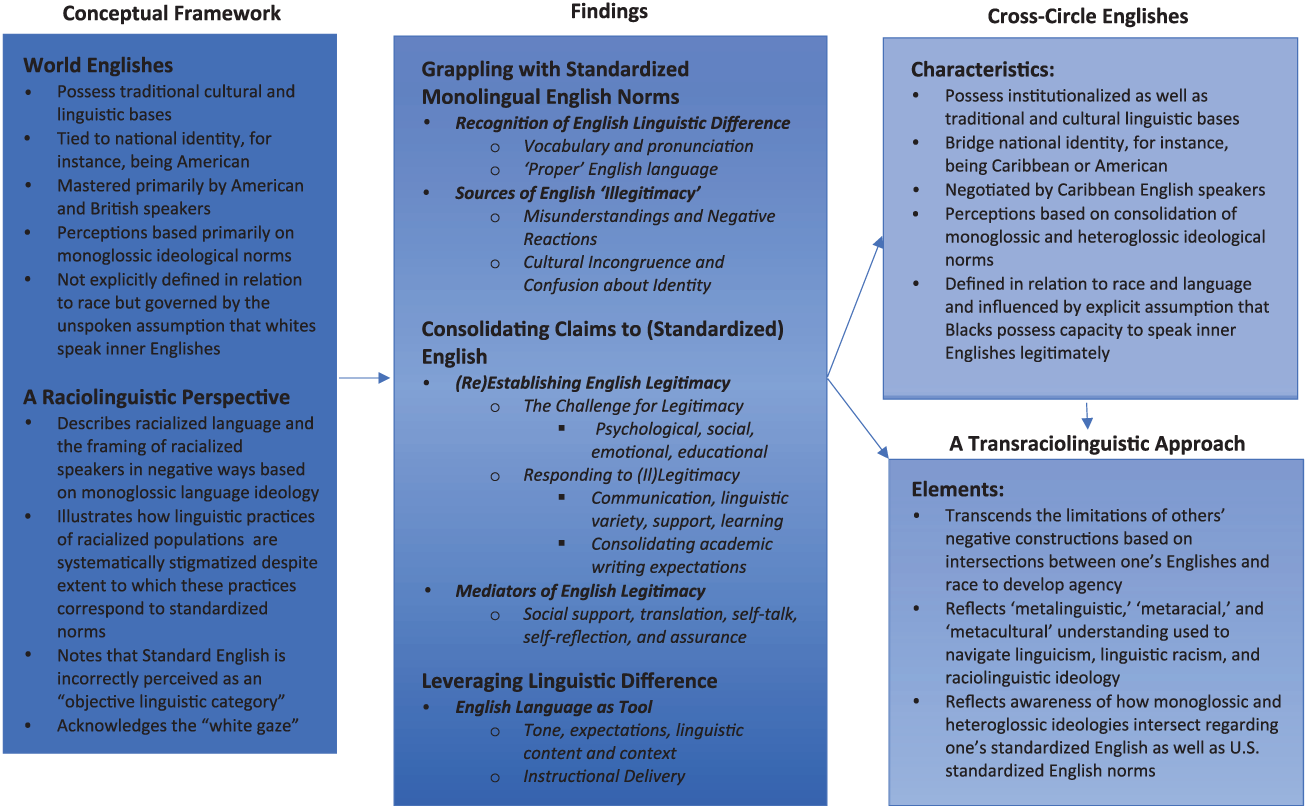
Interrelationships between conceptual framework and findings.
A transraciolinguistic approach, which reflects the “metalinguistic” (Herdina & Jessner, 2002), “metaracial” (Martinot, 2003), and “metacultural” (Sharifian, 2013) understanding used by a majority of the educators in this study, helped them consolidate opposing views about Englishes and novel understandings about how others’ perceptions were influenced by views about intersections between race and language to construct them in the United States. Through “metalinguistic” understanding, the educators demonstrated awareness and control of linguistic elements (Herdina & Jessner, 2002) in their uses of standardized Englishes within the novel context of the United States that allowed them to be flexible in their negotiation of these Englishes for different purposes. Through “metaracial” understanding, the educators noted how standardized English is racialized and largely socially constituted (Martinot, 2003). Therefore, in many cases, they decided how they would individually oppose this racialization. Through “metacultural” understanding, the educators each acknowledged the ways in which their race and standardized Englishes are associated with and transcend typical notions of these constructs within the cultural context of America (Sharifian, 2013).
A transraciolinguistic approach, premised on a raciolinguistic perspective, allowed the educators to use the metaracial, metacultural, and metalingual understanding developed as they navigated linguistic racism (Baker-Bell, 2017), linguicism (Skutnabb-Kangas, 1988), and raciolinguistic ideology (Rosa & Flores, 2017). Through this navigation, they noted how monoglossic and heteroglossic ideologies intersected regarding their own standardized as well as U.S. standardized English norms, which enabled them to develop and maintain a sense of agency about where and how they would use these, as well as their nonstandardized Englishes. Figure 1 depicts the interactions among these entities.
Overall, the findings from this study suggest that a disconnect does exist between what we wish to do and what we actually do in addressing diversity, and specifically, linguistic diversity as administrators, employees, and as faculty within the specific Colleges of Education to which the educators belonged. By focusing so fearlessly on the need for teachers to address linguistic diversity in these Colleges of Education, we seem, as educators, to have missed opportunities to also hold ourselves accountable when sanctioning ideologies that promote SAE but inadvertently omit other standardized Englishes, as occurred with the educators in this situation. Our hesitance to do so did not only leave wide open the doors for linguicism and raciolinguistic ideologies to persist, as has been shown in instances from the experiences from the Black immigrant faculty in this study, but it also caused us to overlook what was increasingly highlighted as the racialization of these educators’ standardized English practices, responses with which they contended because of the co-naturalization of their language use and Black race. In leaving this situation up to chance, as it were, hoping that it would resolve itself, we inadvertently said to these Black immigrant educators, and continue to say to Black American teachers, educators, and youth, that we are not to be held accountable for how our actions manifest in what we have long since acknowledged to be a pervasive resistance to the racialized (standardized) Englishes of the overall Black population (Rosa & Flores, 2017). But such situations do not resolve themselves, as we are repeatedly reminded, often enough, of the inequities that Black immigrants and Blacks in general face with integration, teaching, learning, assessment, and advancement within an educational system based on SAE norms that present repeated instances of implicit or explicit bias against their standardized (and nonstandardized) Englishes (Baker-Bell, 2017; Johnson, 2017; Johnson & Bryan, 2017; Smith et al., 2018; Willis, 2017). We must now ask ourselves, in thinking about the rich descriptions from educators in this context, about the degree to which these insights may be representative of higher education and of other organizational systems beyond academia. Given the privileged position of university instructors and educators and, thus, the possibility that they may be better positioned than others to challenge monoglossic understandings of SAE, there is usefulness in using future research to explore the experiences of Black persons with standardized Englishes both within higher education and elsewhere. With the increasing rhetoric that supports the opposition of Blackness in U.S. media, this study also asks us to be more intentional about explicitly naming as acceptable the linguistic practices that go beyond one form of standardized English. We are also urged to explicate our intentions to identify, understand, and acknowledge when these linguistic practices are present and to provide opportunities for enlightening others about their legitimate use.
The educators in this study, and others like themselves, stand to benefit from being better understood by their students in general, the teachers whom they train, as well as those who wish to better understand the complexities that they bring as Black persons from other contexts to the U.S. academy. Opening up spaces in the academy for teachers, educational workers, administrators, and others to identify instances where the racialization of Black immigrants’ standardized Englishes occurs, as well as strategies for legitimizing these Englishes, can be central to also addressing similar concerns that have for so long persisted with the standardized (and nonstandardized) Englishes of Black American speakers (Rickford, 2006; Rickford & Rickford, 1995). Beyond this, seeking to intentionally legitimize the standardized Englishes of Black immigrant populations remains critical given the continued rise of Black immigrants in the United States, in the U.S. academy, and in schools (Kumi-Yeboah, 2018; Ukpokodu & Ojiambo, 2017).
Conclusion
This study has showed that the Black immigrant educators’ uses of their standardized Englishes present a stark contrast to the SAE typically used in the United States and in U.S. academia, an English that remains central to the work of preparing teachers, educators, and others in U.S. Colleges of Education for diversity. Based on the findings from this work, it is clear that even in the context of monoglossic language ideology (Rosa, 2016) and linguistic imperialism (Wiley, 2014), both of which sanction monolingualism and its corresponding SAE as the norm, immigrant educators’ uses of their standardized Englishes served as a basis for linguicism, construction of the educators in negative ways, racial discrimination, and delegitimization. In light of this, findings from the current study raise questions about the supposed assumption that any version of standardized English is acceptable in U.S. Colleges of Education and, perhaps, in and beyond academia, especially when it is used by speakers who are of the Black race. More specifically, it highlights the degree to which Colleges of Education as well as the U.S. academy, may be unknowingly shaped by such hegemonic SAE practices that reinforce and privilege speakers of these Englishes at the expense and to the detriment, of other equally legitimate standardized English-speaking educators. Determining the degree to which Black American educators, and by the same token White immigrant educators who use standardized Englishes, undergo linguicism (or not) in the academy can clarify distinctions about how the issue of standardized English racialization occurs and how it can be best addressed.
As seen, the immigrant educators’ ways of leveraging their legitimate standardized Englishes proved unacceptable in these Colleges of Education in the United States. If the underlying ideology is that the U.S. academy subscribes to SAE as the dominant medium for imparting knowledge, then it is expected that any form of standardized English should be accepted and encouraged in this and other educational settings. By extension, if the goal of linguistic diversity and diversity in general in academia is to open up spaces for difference to be accepted and encouraged, it is problematic that there remains such a deeply entrenched negative response to the Black immigrant educators’ use of standardized Englishes and that this response remains significantly unnoticed and unaddressed. To fail to address these concerns through a lack of intentionality around affirming those who speak even the English we supposedly sanction in ways that deviate from our expected norm(s) is to unwittingly promote the denigration of linguistic diversity that is so often touted as critical to our work. Moreover, since Black immigrant educators, many of whom are bi-/multilingual (e.g., bi-/multidialectal), rely heavily on their standardized Englishes for writing purposes that largely influence decisions about tenure and promotion, it is highly likely that they may encounter similar linguistic bias toward these Englishes in manuscripts, grants, their teaching, and other academic products that can possibly jeopardize this process (Esnard & Cobb-Roberts, 2018; Habibie & Hyland, 2019).
Educators worldwide will continue to interact with increasingly international, immigrant, and multilingual populations who speak a myriad of Englishes in the 21st century. Being able to engage with additional standardized (and nonstandardized) Englishes, with those who speak them, and with the ideologies that they present based on an intersection of race and language will prove critical. The compelling, rich, and in-depth evidence presented here confirms that our Colleges of Education and academia overall, cannot continue to simply theorize about the role of detrimental ideologies concerning language in the absence of concrete mechanisms and policies for addressing the ways in which our very practices around SAE contribute to discriminatory processes across educational contexts. Much like the fields of health, business, and counseling, where responses to diversity are concrete and practical, those who oversee and train educators and teachers in Colleges of Education are in need of tools that can identify the Englishes and ideologies that “Others” bring. By practically seeking to understand and highlight how the educators engaged in a transraciolinguistic approach (Figure 1) and allowing for transferability to other participants and contexts, this study provides a reasonable premise to do so.
Supplemental Material
Table_1_Online_Data_Analysis_Process – Supplemental material for “How Does a Black Person Speak English?” Beyond American Language Norms
Supplemental material, Table_1_Online_Data_Analysis_Process for “How Does a Black Person Speak English?” Beyond American Language Norms by Patriann Smith in American Educational Research Journal
Footnotes
Notes

P
References
Supplementary Material
Please find the following supplemental material available below.
For Open Access articles published under a Creative Commons License, all supplemental material carries the same license as the article it is associated with.
For non-Open Access articles published, all supplemental material carries a non-exclusive license, and permission requests for re-use of supplemental material or any part of supplemental material shall be sent directly to the copyright owner as specified in the copyright notice associated with the article.
