




Abstract
Social emotional learning (SEL) is an increasingly important area of study that aims to develop skills critical for healthy social functioning. Despite SEL’s growing ubiquity, little attention has been paid to how to achieve SEL knowledge transfer. One promising approach is to teach a model of the emotion system. A randomized control study was conducted with a sample of U.S. high school graduates (n = 303) to test this SEL methodology. The impact of a 1-hour online intervention involving learning a simple model of appraisal was tested. As predicted, the experimental groups rated their own and others’ emotional reactions as significantly less blameworthy than the control group did, signaling emotion knowledge transfer and greater empathy and emotion acceptance. These results are discussed.
Evidence continues to mount showing that enhanced social and emotional competence (SEC; Saarni, 1999) can have a significant positive impact on psychological well-being as well as academic and professional performance (Osher et al., 2016; Weissberg, Durlak, Domitrovich, & Gullotta, 2015; Zins, Weissberg, Wang, & Walberg, 2004). By now, researchers have offered a number of guidelines for the development of effective social emotional learning (SEL) programs, such as developmentally appropriate content, sequenced learning, theoretical grounding, and others (Durlak, Weissberg, Dymnicki, Taylor, & Schellinger, 2011; Osher et al., 2016; Zeidner, Roberts, & Matthews, 2002). Yet many questions regarding SEL instruction remain unanswered or are only starting to be explored, including (1) how SEL can be carried out to facilitate knowledge transfer (Yeager, 2017b; Zeidner et al., 2002), (2) which specific content and learning activities produce which SEL outcomes (Greenberg et al., 2003; Weissberg et al., 2015), and (3) how technology can be effectively utilized for SEL instruction (Osher et al., 2016; Weissberg et al., 2015). Research is particularly scant when it comes to older learners, such as those of high school age and above, as the bulk of past SEL research has focused on the pre-K and K–8 populations (Weissberg et al., 2015). Furthermore, existing research points to the frequent failure of SEL interventions aimed at adolescents (Yeager, 2017b). The purpose of the present study is to contribute to our understanding in the above three areas, with a focus on late adolescent and young adult learners.
Transfer in the Social Emotional Learning Context
The literature on cognition and education has consistently singled out transfer as one of the most important concepts when gauging the depth and quality of learning (Barnett & Ceci, 2002; National Research Council, 2012; Salomon & Perkins, 1989; Schwartz, Chase, Oppezzo, & Chin, 2011). Transfer refers to the ability to use prior knowledge to solve novel problems (Cormier & Hagman, 1987; Perkins & Salomon, 1992). The SEL literature is unambiguous on the need for social emotional skills to transfer across different situations (Durlak, Domitrovich, Weissberg, & Gullotta, 2015; Durlak et al., 2011; Zins et al., 2004), and researchers and practitioners have expressly advocated for SEL programs to be designed with deep learning and transfer in mind (Kam, Greenberg & Kusché, 2004; Osher et al., 2016; Zeidner et al., 2002). As is the case with other subjects, in the absence of significant transfer of knowledge and skills to new situations and contexts, SEL programming would be of limited utility. However, the majority of SEL programs have been evaluated in the same context in which they were implemented, usually in school or in after-school programs, and few studies have expressly focused on the transfer of acquired social emotional knowledge as an outcome measure or a design criterion (Durlak et al., 2011; Durlak, Weissberg, & Pachan, 2010; Sklad, Diekstra, Ritter, Ben, & Gravesteijn, 2012). Consequently, at present there is relatively little concrete evidence of SEL knowledge transfer beyond the school or classroom, or even across different problems and situations within the school or classroom, despite there being ample evidence that SEL programs can produce positive results (Durlak et al., 2015; Osher et al., 2016; Taylor, Oberle, Durlak, & Weissberg, 2017). Furthermore, research has shown time and again that transfer is far from guaranteed (Barnett & Ceci, 2002; Lave, 1988; Reed, Ernst, & Banerji, 1974; Schliemann & Nunes, 1990; Woodworth & Thorndike, 1901) and that for students to be reliably capable of transfer, instruction should be deliberately designed to “teach for transfer” (Chase, Shemwell, & Schwartz, 2010; Chen & Klahr, 1999; Perkins & Salomon, 2012; Salomon & Perkins, 1989). In the absence of such deliberate curriculum design, one would expect transfer to be lower than it might otherwise be. Indeed, it has been shown that SEL programs that focus on specific skill development (rather than, e.g., changing students’ perceptions of psychological concepts like personality) tend to be ineffective for adolescents (Yeager, 2017b), implying a failure of knowledge transfer. It is therefore important to understand how to design SEL programming “for transfer” (National Research Council, 2012), particularly for adolescents and young adults.
Past research has offered evidence that deep learning is critical to successful transfer (Bransford, Brown, Cocking, & National Research Council, 1999; Brown, 1989; Bruner, 1960; Gentner & Schumacher, 1986; Schwartz et al., 2011)—that is, learning that goes beyond the surface to grasp the deep structure that underlies a concept or problem (Chi & VanLehn, 2012). In the problem-solving literature, the term deep structure may refer to a problem-solving procedure, such as a probability principle (Ross, 1987), as opposed to the problem cover story, which would contain surface features like descriptions of moving cars or trains (Chi & VanLehn, 2012). In the psychological realm, deep structure has been used to refer to psychology concepts such as stereotypical recall and ordered recall (Schwartz & Bransford, 1998), as well as to ethics principles such as unfair discrimination (Fialkov, Jackson, & Rabinowitz, 2014). The central idea is that a deep structure is an underlying principle of a problem or situation and that it may be shared by many possible problems or situations with different surface features. Grasping a deep structure is thought to entail representing and storing it in the mind as a schema or mental model (Chi & VanLehn, 2012; Gick & Holyoak, 1983; Johnson-Laird, 1995). Doing so is believed to enable transfer by allowing learners to map that structure onto new problems while getting past their surface attributes (Brown & Kane, 1988; Chi & VanLehn, 2012; Reed et al., 1974), and using it to reason about the problem (Chan & Black, 2006; R. E. Mayer, 1989). While deep structure and transfer research has focused primarily on problem solving in academic domains, such as math and science, problem solving in the social context involves similar information processing and inferential steps (Crick & Dodge, 1994; Stegge & Terwogt, 2007). To determine how best to respond to a given situation, “one has to analyze the situation to establish the nature of the problem” and its possible solutions (Stegge & Terwogt, 2007, p. 278). By the same token, social and emotional problems and their solutions can be said to possess a deep structure (Fialkov et al., 2014; Gentner, Rattermann, & Forbus, 1993). It has been argued that this deep structure may be represented by the principles and processes of the human emotion system (HES; Lyashevsky, 2018; Lyashevsky, Cesarano, & Black, 2019).
The Emotion System as the Deep Structure of SEL
Considerable evidence exists that greater emotion knowledge (EK) is associated with benefits like decreased social anxiety and higher social competence (Barrett, Gross, Christensen, & Benvenuto, 2001; O’Toole, Hougaard, & Mennin, 2013; Trentacosta & Fine, 2010). In the psychological literature, the term emotion knowledge may refer to relatively basic, perceptual (e.g., facial expression, posture, tone of voice) and linguistic (e.g., emotion labels) emotion markers (Izard et al., 2011; Trentacosta & Fine, 2010), as well as more advanced emotion understanding, such as the causes and consequences of emotion (O’Toole et al., 2013). However, most assessments and interventions that have involved measures of EK have focused on the relatively more “shallow” EK, in part because such efforts have primarily targeted younger populations (Durlak et al., 2010; Durlak et al., 2011; Izard et al., 2011; O’Toole et al., 2013; Yeager, 2017b). The emotional intelligence literature (e.g., J. D. Mayer & Salovey, 1997) as well as the SEL literature (e.g., Durlak et al., 2015) both acknowledge the need for more sophisticated EK and understanding. However, the term deep structure is generally not used to refer to such knowledge. Until now, such language has been almost exclusively the province of more traditional subjects such as science, technology, and math. By the same token, even those interventions that have attempted to provide learners with more advanced EK have rarely incorporated the teaching of emotion principles drawn from the scientific literature (Durlak et al., 2011; Dulak et al., 2015), the so-called mind-set interventions by Yeager (2017b; Yeager, Dweck, & Trzesniewski, 2013) being a prominent exception. It is our contention, however, that such emotion principles represent the deep structure of SEL and that they can be meaningfully encapsulated by a model of the emotion system.
The concept of the emotion system has previously been discussed in various contexts, including SEL (e.g., Berking & Schwarz, 2014; Boekaerts, 2006; Cicchetti, Ackerman, & Izard, 1995; Levenson, 1999; Stegge & Terwogt, 2007). While it is not proposed that there is a unitary neurological emotion system, emotional functioning fits the definition of a system in that it involves certain elements and processes working together in a coordinated and interconnected manner (Cicchetti et al., 1995), and we believe there is value in conceptualizing it as such, particularly when it comes to education. Doing so allows for teaching about emotion in a more cohesive manner, which highlights the relationships between the various concepts involved (e.g., goals, values, beliefs, emotions, and actions) and can facilitate the development of a more accurate mental model (Johnson-Laird, 1995; R. E. Mayer, 1987, 1989) of emotions (Lyashevsky, 2018). To account for the emotion system’s dual need for speed as well as flexibility, Levenson (1999) proposed the two-system emotion model, in which a core emotion system or “engine” generates rapid, stereotypical responses that can be adjusted by a context-aware, more deliberative control system. This echoes the two-system cognitive model advanced by researchers like Kahneman (2003) and Stanovich and West (2000). In this model, System 1 (the core system) operates rapidly, automatically, and intuitively, producing swift emotional impressions, which offers the advantage of speed but tends to lack flexibility and nuance, whereas System 2 (the control system) allows for purposeful deliberation and functions as a monitor of the output of System 1, adjusting that output when necessary (Kahneman, 2003). When the emotion system is discussed in the literature, however, the term most often refers to the core system (i.e., System 1) rather than the larger, two-level version of the system. Similarly, in the present study, our focus was on teaching the principles of the core emotion system, to which we at times refer simply as the emotion system.
Stegge and Terwogt (2007) offered a succinct definition of the core emotion system as “a kind of radar and response facility that enables us to quickly appraise and respond to situations that are relevant to our well-being” (p. 270). This appraisal involves the evaluation of situations in relation to one’s goals and needs to determine whether they are good or bad for us and what to do about them (Frijda, 1988; Scherer, Schorr, & Johnstone, 2001). The idea of developing an understanding of the emotion system as a means of fostering SEC has previously been put forth by a number of researchers. Boekaerts (2011) argued that self-regulation is influenced by knowledge and beliefs about the emotion system. Similarly, Wranik, Barrett, and Salovey (2007), building on Salovey and Mayer’s (1990) emotional intelligence theory, suggested that EK is instrumental for effective self-regulation, and in particular that an understanding of the appraisal process (i.e., the evaluation of events in relation to one’s concerns) that is central to emotion generation could facilitate more effective regulatory strategy selection. Expanding on these and similar arguments (e.g., Stegge & Terwogt, 2007), Lyashevsky and colleagues (Lyashevsky, 2018; Lyashevsky et al., 2019) posited a direct relationship between HES knowledge and key SEL skills and suggested that in this relationship the HES model represents the deep structure of SEL, an argument we summarize briefly below.
The five key skills (sometimes also referred to as competencies) targeted by SEL as defined by the CASEL (Collaborative for Academic, Social, and Emotional Learning, 2008) framework are self-awareness, social awareness, self-management, relationship management, and responsible decision making. It is generally recognized that these skills are underpinned by knowledge about emotions and how they function (Barrett, 2006; Barrett, Wilson-Mendenhall, & Barsalou, 2014; Berking & Schwartz, 2014; Boekaerts, 2011; Durlak et al., 2015; Izard et al., 2011; Wranik et al., 2007). Consistent with this idea, in the present article we define EK (including deep structure, emotion system knowledge) as being distinct from social emotional competencies such as self-awareness, social awareness, and self-regulation, while providing support for those competencies, a position adopted by past researchers (e.g., Barrett et al., 2001; Izard et al., 2011; O’Toole et al., 2013). For instance, it has been suggested that self-awareness calls for an understanding of the interconnections between beliefs, thoughts, feelings, and actions (Weissberg et al., 2015), which would be described as EK. But self-awareness would also go beyond mere understanding to include the capacity to recognize and monitor the interaction of these elements in something like real time (Wranik et al., 2007), with the relevant EK supporting these processes. Meanwhile, as mentioned above, the core of the emotion system is an “engine” that combines stimuli, personal goals, values, and beliefs to produce emotional responses that drive behavior (Levenson, 1999; Roseman & Smith, 2001). That is, the emotion system automatically factors one’s goals, values, and beliefs in its evaluation of and response to a given stimulus. Thus, developing the EK necessary for self-awareness would involve the development of an understanding of the emotion system (Stegge & Terwogt, 2007). From a learning theory perspective, developing such an understanding would depend on the formation of a mental model, or deep structure representation (Chi & VanLehn, 2012), of the emotion system’s functioning, which could then be employed to help interpret and manage emotional situations (Stegge & Terwogt, 2007; Wranik et al., 2007). Furthermore, because emotional self-awareness is thought to be closely related to social awareness, such that there is considerable functional and neurological overlap between the two (Gallagher & Frith, 2003; Lane & Schwartz, 1987; Ochsner et al., 2004; Wondra & Ellsworth, 2015), and is also believed to be critical to self-regulation (Bonanno & Burton, 2013; Crick & Dodge, 1994; Levenson, 1999; Smith, Killgore, & Lane, 2018; Wranik et al., 2007), understanding of the HES would be expected to support all three of these core SEL skills (i.e., self-awareness, social awareness, and self-regulation; Lyashevsky, 2018). Critically, understanding the underlying processes and principles of the system should enable a learner to transfer that knowledge across contexts, mapping the emotion system model onto new situations, as well as to new people, to facilitate social emotional problem solving. This view was recently bolstered by a pilot study (Lyashevsky, Cesarano, & Black, 2017) we ran in our lab, which demonstrated that learning a model of the core emotion system would transfer to novel problems and positively affect other-awareness and empathy, on which the present research is largely based. The pilot is more fully described below.
Several recent studies have featured aspects or versions of an emotion system model as part of larger interventions to enhance SEC (e.g., Berking & Schwartz, 2014; Broderick & Metz, 2014; Kemeny et al., 2012; Mennin & Fresco, 2014). Furthermore, so-called mind-set interventions (Yeager, 2017b), such as those that emphasize the incremental theory of personality (e.g., Yeager, 2017a; Yeager et al., 2013), have provided evidence for the effectiveness of targeting students’ beliefs about aspects of their social and emotional functioning by teaching them about neurological principles like brain plasticity. Additionally, Jamieson and colleagues (Jamieson, Hangen, Lee, & Yeager, 2018; Jamieson, Mendes, & Nock, 2013) showed that self-regulation through reappraisal can be improved, leading to better test performance and stress coping, by improving people’s scientific understanding of certain aspects of emotion—specifically by informing people of the beneficial aspects of emotional arousal and enabling a reappraisal of the meaning of such arousal (e.g., physiological preparedness rather than merely anxiety). Nevertheless, research focusing on the effects of teaching emotional deep structures, such as the concept and principles of appraisal, on social emotional functioning remains exceedingly scant. Indeed, we are not aware of previous studies that examined the effects of teaching the concept of appraisal with regard to knowledge transfer or changes in social and emotional competencies.
The content taught to participants in the present study encompassed at least two types of emotional deep structure: a basic model of the core emotion system and the principles that factor into that system. Central aspects of the model included a stimulus that sets off the emotion generation process; the appraisal process, which interprets the stimulus and gives rise to the emotion; and the resulting emotional response (Frijda, 2007; Scherer et al., 2001; see Figure 2). Additionally, it included the individual’s desires, goals, and needs that factor into the appraisal, with either a positive or a negative appraisal arising due to the congruence or incongruence of the stimulus with the individual’s motives, respectively (Scherer et al., 2001). The key HES principles taught were the automaticity and speed of the primary appraisal process (i.e., that it happens quickly and automatically), such that it is largely outside of conscious control (Scherer et al., 2001). For instance, if we receive some piece of news, such as the result of a sports match, the personal significance of this information is rapidly and automatically interpreted in the mind without conscious effort (my team won = aligns with my desires, my team lost = goes counter to my desires) and leads to a corresponding initial emotional response. While appraisals can also be initiated deliberately, for example, as part of an effort to self-regulate (Ochsner & Gross, 2007), the present study did not focus on this capacity.
We now turn to an instructional technique known as preparation for future learning (PFL), which has been shown to increase deep learning and transfer by facilitating the acquisition of deep structure.
Preparation for Future Learning and Social Emotional Knowledge Transfer
Bransford and colleagues (1999) offered evidence that before explicit instruction occurs, learners ought to experience the problems that render the taught material useful. Building on this, Schwartz and colleagues (Schwartz & Bransford, 1998; Schwartz et al., 2011) showed that specific activities, such as analyzing contrasting cases, done before undertaking direct teaching of a topic create an optimal “time for telling” and lead to deeper learning and better transfer of knowledge. Contrasting cases involves comparing sets of cases that help draw learners’ attention to the cases’ distinguishing features, which often correspond to the deep structure(s) of the concept to be learned. Such PFL activities readied students to more fully appreciate the expert solutions and deep structures when they were later explained (Bransford & Schwartz, 1999; Schwartz et al., 2011). Thus, given the goal of facilitating social emotional knowledge transfer, PFL activities may represent a fruitful instructional strategy. However, to date, little or no effort has been made to evaluate the potential for PFL activities in the SEL context.
The Present Research
Given the above theory and findings, we designed and ran a study to test the hypothesis that teaching a basic, appraisal-focused model of the HES, presented via an online platform, would result in EK transfer to a novel set of social problems and influence aspects of emotional awareness. Specifically, we expected the transfer of deep structure EK (appraisal) to positively impact cognitive empathy (other-awareness) as well as emotion acceptance in the self (self-awareness)—changes that would be measured by reductions in the blame assigned to undesirable emotional reactions in oneself and others. Participants in the experimental groups were taught a simple model of emotion focused on the appraisal process (Scherer et al., 2001). While appraisals can be initiated deliberately, for example, as part of self-regulation (Ochsner & Gross, 2007), the model taught in the present study emphasized the automatic nature of primary appraisals and their central role in emotion generation (Scherer et al., 2001). Appraisal was chosen as the centerpiece of the model because it is considered to be a core process of emotion generation (Frijda, 1988, 2007; Gross & Barrett, 2011; Scherer et al., 2001). At the same time, appraisal is something most people who are not emotion researchers are unlikely to be familiar with, as was confirmed in preceding pilots (Lyashevsky et al., 2017). Additionally, Wranik et al. (2007) have suggested that a better understanding of the process may support SEC.
Focusing on the largely uncontrollable nature of appraisal was also of interest because of the research on teaching adolescents the incremental theory of personality and the positive effects this seems to have on social functioning (Yeager, 2017a; Yeager et al., 2013). Specifically, learning about the changeable nature of personality (including emotions and behavior) led high school students to be less retributive toward peers following social rejection (Yeager et al., 2013) and improved students’ overall ability to cope with daily stress (Yeager, 2017a). Demonstrating the value of teaching the uncontrollable aspects of emotion (and by extension personality) would introduce an important consideration when teaching the concepts of incremental theories and the ability to change and control one’s social functioning.
The study had three conditions: model learning (ML), model + PFL activity (ML + PFL), and control. Both experimental groups were taught the emotion model. The ML + PFL group also engaged in a PFL activity, designed to prime the participants to more readily assimilate the EK being taught. Previous studies have shown “explanation” PFL activities to produce better learning outcomes compared with thinking aloud or simply describing what was learned (Williams & Lombrozo, 2010). Therefore, for the PFL activity in the present study, we asked participants to come up with a general explanation of how emotions are generated.
We predicted that teaching the emotion model would result in the transfer of the learned EK to novel problems and reduce the perceived blameworthiness of others’ emotional reactions as well as of one’s own hypothetical emotional reactions. These reductions were expected to come as a consequence of the change in participants’ perceptions of emotion control (after learning that such control is largely absent when it comes to appraisal) and their attributions of responsibility when considering emotional responding (Cushman & Young, 2010; Knobe, 2006; Weiner, 1995). In other words, participants were expected to spontaneously transfer the deep structure of appraisal to new social situations, and to use it to reason about them, with the result of assigning less responsibility and blame for emotional responses in oneself and others. Thus, acquiring knowledge about the automatic aspects of emotion generation was expected to lead to an increase in participants’ understanding of and tolerance for others’ emotions, that is, their cognitive empathy (Decety & Jackson, 2004), as well as their acceptance of their own emotions, which is seen as an important factor in self-regulation and psychological well-being (Hayes, Strosahl, & Wilson, 1999). The study would therefore represent a test of the idea expressed by the famous French proverb that to understand is to forgive.
It was further expected that the use of a PFL activity in conjunction with model learning would strengthen the resulting effects, that is, produce greater transfer and further reductions in blame. Figure 1 demonstrates the intervention’s hypothesized pathway of change. Importantly, the taught material did not directly address the issue of blame: Altered attributions of blame were expected to occur as a result of the transfer and application of HES knowledge to novel situations.
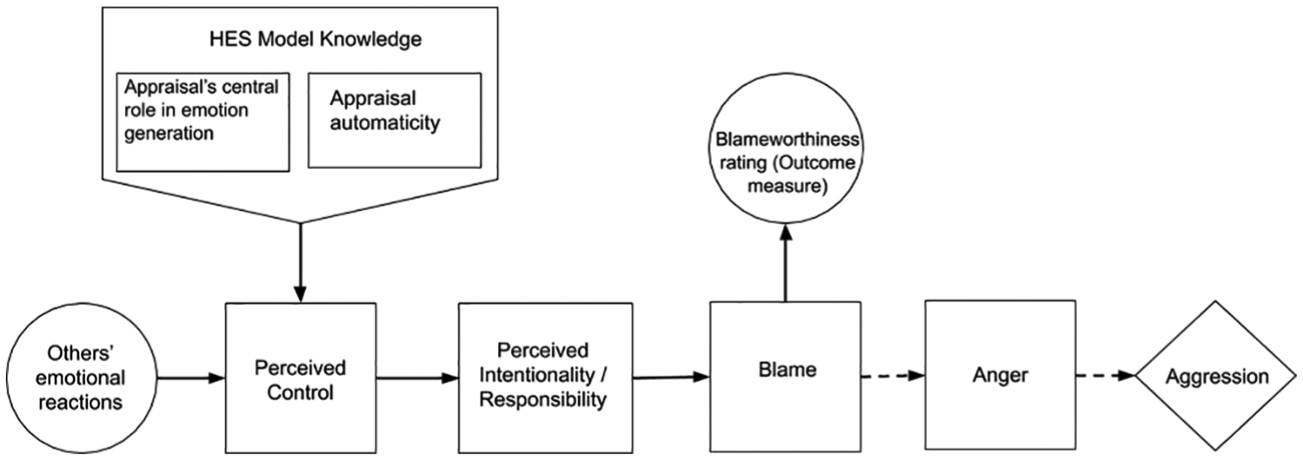
Learning about appraisal was expected to influence perceptions of control and responsibility and, consequently, blame. Dashed lines represent effects not evaluated in the study.
The control group read literary fiction. We made this choice because Kidd and Castano (2013) had demonstrated that reading high-quality literary fiction, such as that published in the Best American Short Stories anthologies, led to short-term improvements in theory of mind (ToM), which is closely related to empathy, as compared with reading “popular” or “pulp” fiction. ToM refers to our understanding of mental states and processes, such as thought, emotions, beliefs, attitudes, and so on, in the self as well as in others (Flavell, 2004). Empathy, which is often defined as the capacity to feel and understand the emotions of others (Decety & Jackson, 2004), is thus a ToM skill. Kidd and Castano’s (2013) experiments showed that reading high-quality literary fiction produced short-term improvements in affective and cognitive other-directed ToM, which the authors explicitly linked to empathy. Having control group participants read a piece of literary fiction was thus considered to be a more meaningful comparison activity than something that would not be expected to positively impact ToM. In other words, this was not a “do nothing” control but one where we might expect to see a boost to relevant ToM capacities (like empathy), which would make the effects of the intervention (if any) more compelling.
The present study was based on an earlier pilot (Lyashevsky et al., 2017), which featured very similar procedures and materials, with the following differences. The pilot sample was much smaller (N = 20), and the participants were graduate students at a large northeastern academic institution. The pilot was conducted in the lab rather than online. Additionally, there were only two conditions: ML + PFL and control. Moreover, the transfer test only considered other-blame; self-blame effects were not measured. Finally, some of the scenarios on the transfer test have been updated in the present study to improve reliability. The pilot results aligned with the prediction that model learning would lead to EK transfer and to lower attributions of blame for others’ undesirable emotional reactions. The present study builds on these results by targeting a different population (high school graduates, aged 18–25 years), using a larger sample, evaluating treatment effects on other-blame as well as self-blame, and adding an ML-only group in order to compare its performance with that of the ML + PFL group. Also, it was conducted online rather than in the lab.
Method
Recruitment
Participants were recruited online via Amazon Mechanical Turk (MTurk). MTurk is an online platform that allows people to perform small online tasks for compensation. The platform has been used to recruit subjects for numerous studies in recent years, and MTurk workers have been found to be “relatively representative of the population of U.S. Internet users” (Paolacci, Chandler, & Ipeirotis, 2010, p. 412). Participants were paid $3.25 for participating.
Participants
The participants were adolescents and young adults aged 18 to 25 years, all of whom were U.S. high school graduates. This population was chosen for several reasons. First, this is an age at which significant and often stressful life transitions occur, such as leaving home and starting college or a job, making SEC and the protective factors that it provides especially important (Durlak et al., 2015; Walton & Cohen, 2011). At the same time, past research has indicated that adolescents tend to be a difficult population with respect to SEL, such that many programs fail to produce significant results (Yeager, 2017b). Additionally, teaching an HES model such as the one used in the present study, which focuses on internal cognitive processes like appraisal, was expected to be most readily accomplished with older learners who already had a fairly sophisticated theory of emotions, such as those of high school age and older (Harris, Olthof, & Terwogt, 1981).
A power analysis based on an observed effect size f of .31 in the previously run pilot study (Lyashevsky et al., 2017) indicated that a total of 263 participants would have been required to achieve a power of .95 for three groups and an analysis of covariance. However, previous MTurk pilot studies suggested that a large proportion of participants would need to be excluded based on noncompletion, previous exposure to the content, and other factors. Given this, a total of 556 participants were recruited, or roughly twice the number required. A total of 144 participants were excluded for failing to complete the study. Of these, only one got so far as to complete the transfer test, and none finished the exit demographic questionnaire, which prevented us from determining how they might compare with the rest of the participants or from making a meaningful attempt to include them in the analysis. However, a chi-square analysis of the completion rate for the three groups was not significant (N = 556, χ2 = 4.55, p = .1), indicating that the resulting groups were not statistically imbalanced. An additional 94 participants indicated that they had previously been exposed to some of the content (through several preceding pilot studies), and so they were also excluded, since their presence would have introduced a significant confound in the analysis, undermining our ability to determine the true effects of the intervention. No chi-square analysis was performed for this type of exclusion because previous exposure to study content would be random in relation to group placement and considering an underlying selection bias would not be meaningful. The gender balance of the participants excluded on the basis of past exposure was consistent with the overall sample (32% male, 68% female).
Participants were further culled based on their performance on a quiz assessing their understanding of the HES model (in the two experimental conditions). A total of 13 (5%) participants were excluded (8 from the ML group and 5 from the ML + PFL group) for scoring 5 out of 9 or less (≤56%) on the quiz, since knowledge transfer could not be expected to occur if the material wasn’t sufficiently well learned in the first place. As this decision may come across as unorthodox, it warrants further discussion. The critical point is that in the present study we were not trying to demonstrate that one instructional methodology produces better learning of the same content than another. We were trying to demonstrate that if learning of certain content (i.e., the appraisal-based emotion model) occurs, it will result in the transfer of that knowledge to novel problems. In other words, the learning was a prerequisite for conducting an evaluation of the outcome, but it was not the outcome itself. The central focus was the occurrence of transfer of deep structure, but the deep structure itself first had to be grasped. This argument might seem to be undermined by the fact that we were also attempting to compare a condition with a PFL activity with a condition without one. However, here again the question is one of successful transfer rather than successful content learning. That is, we are not comparing these two conditions based on which led to better learning of the emotion model (according to the quiz) but based on which of them led to better transfer given that learning of the model has occurred.
Exclusion was also considered on the basis of a suspicion probe, which sought to determine if participants had correctly guessed the purpose of the study and thus might be influenced in their responses by social desirability (Reynolds, 1982). Two participants were excluded on this basis. The final sample size was 303 (control = 116, ML = 100, and ML+PFL = 87). Of these, 101 (33%) were males and 202 (67%) were females. All the participants were U.S. high school graduates. The participants’ highest level of academic achievement was as follows: high school = 32 (10.6%), some college = 151 (49.8%), college graduate = 91 (30%), some graduate school = 21 (6.9%), graduate degree (e.g., master’s) = 5 (1.7%), and doctoral degree (PhD, EdD, JD, MD, etc.) = 3 (1%). Virtually all of the participants (300, or 99%) were between 18 and 25 years of age (M = 22.3), with 3 (1%) participants aged 26, 28, and 35 years. We did not gather data on the participants’ EK, but we considered their trait empathy scores and education as possible proxies. Furthermore, previous pilots (Lyashevsky et al., 2017) have demonstrated that even graduate students in psychology often do not know about the concept of appraisal, which the present study focused on.
Procedure
Overview
The participants were randomly assigned to one of the 3 groups: ML, ML + PFL, or control (Table 1). All the groups completed a transfer test in which they rated the blameworthiness of the reactions of characters in fictional scenarios. The participants were given a cover story to create the impression that the transfer test was unrelated to the preceding activities in order to test for spontaneous transfer of the model and reduce the possible impact of social desirability. As previously shown, spontaneous transfer is difficult to achieve without providing learners with hints or other scaffolding (Gick & Holyoak, 1983), which was not provided in this case. A suspicion probe was included in the exit questionnaire to determine if any of them had correctly guessed the study’s purpose. Effects were measured immediately following the intervention. Prior to participating in the main study activities, all the groups completed the Empathic Concern and Perspective-Taking subscales of the Interpersonal Reactivity Index (Davis & Oathout, 1987). Their scores on these scales were intended to be used as covariates in the analysis, with the expectation that higher empathy would be associated with lower attributions of blame. The participants could take as much time as they needed on all the study activities, with the exception of the PFL activity, which was capped at 10 minutes. The full study took an average of 22.5 minutes to complete.
A 1 × 3 Study Design
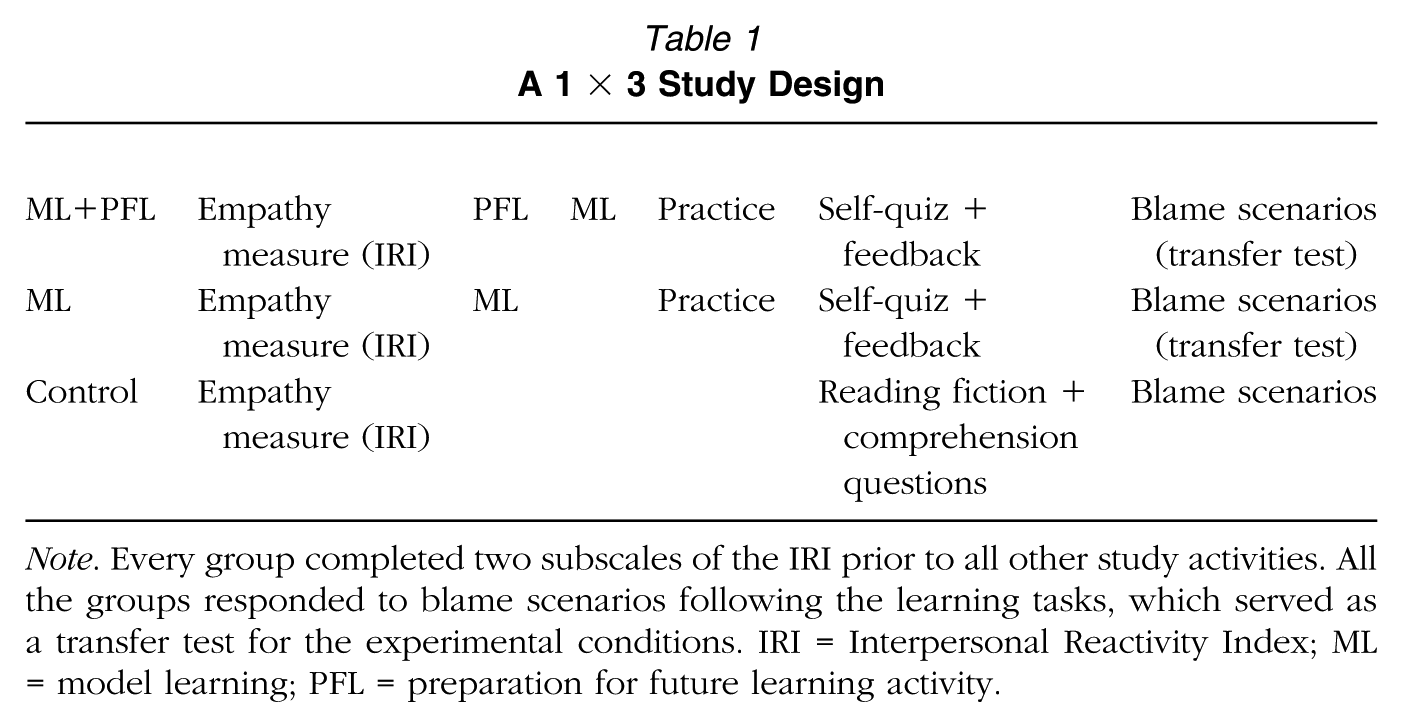
Note. Every group completed two subscales of the IRI prior to all other study activities. All the groups responded to blame scenarios following the learning tasks, which served as a transfer test for the experimental conditions. IRI = Interpersonal Reactivity Index; ML = model learning; PFL = preparation for future learning activity.
Content of Model Learning (ML) Group
HES Model Learning
Three components, which are commonly featured in the scientific literature in the context of emotion generation, formed the basic HES model taught in the study: (1) the stimulus that triggers the emotion generation process (Frijda, 1988, 2007; Scherer, 2000), (2) the appraisal process that gives rise to an emotion by evaluating the stimulus in relation to a person’s goals and needs (Frijda, 1988, 2007; Gross & Barrett, 2011; Scherer, 2000), and (3) the resulting emotional response, including its valence (i.e., whether it’s positive or negative; Barrett, 2006) (see Figure 2).
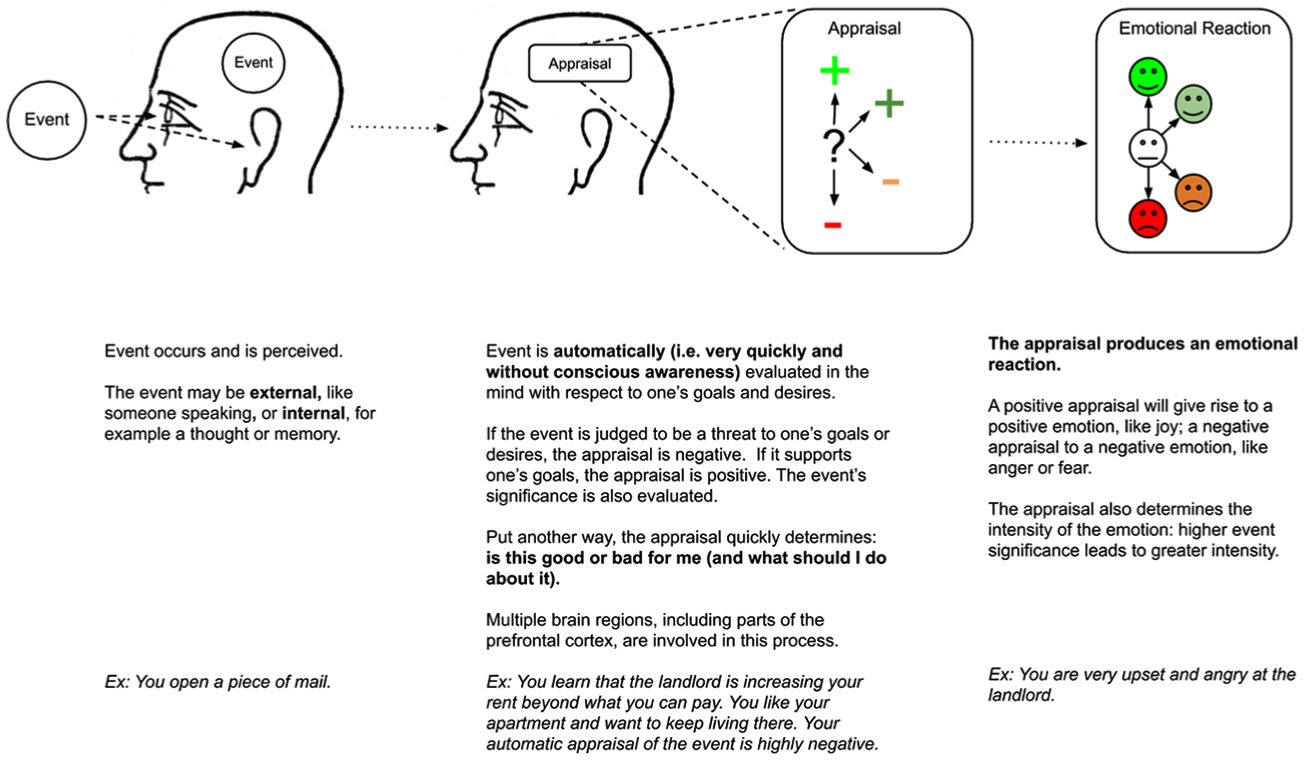
The main diagram used as part of the human emotion system (HES) model-learning activity.
The HES model was presented on several sequential screens. Participants were told to go through the screens at their own pace. The model itself was presented using diagrams (see Figure 2 for the main diagram). Diagrams, also known as conceptual models, have been shown to help students build more accurate mental models of a system, and subsequently perform better on transfer problems (R. E. Mayer, 1987, 1989). The diagrams included simple textual vignettes to illustrate how aspects of the model map to concrete human experiences. The full model-learning presentation can be found in the supplemental materials (in the online version of the journal).
Practice Exercises
The participants were asked to complete a number of practice exercises to help solidify their understanding of the emotion model. SEL content must be grounded in concrete human behavior (Brackett, Elbertson, & Rivers, 2015; Durlak et al., 2011), and such grounding often takes the form of narrative (Brackett, Rivers, Reyes & Salovey, 2012; Greenberg, Kusché, & Mihalic, 1998; Maurer & Brackett, 2004). The practice exercises, therefore, took the form of narrative scenarios. They were based on scenarios we had developed for the previous pilot study (Lyashevsky et al., 2017). The exercises emphasized inference making on the basis of the core HES model, focusing in particular on the causal role appraisal plays in emotion generation. For instance, a learner would be given the following scenario: “You go to move your brand new car.” Then this question was asked: “Given the above, suggest an event that is likely to produce a ‘negative’ appraisal.” The exercises had two parts—the first part focusing on the appraisal and the second part on the resulting emotion, tying the two together. In the ML condition, there were 16 exercise scenarios for a total of 32 questions.
At the end of the practice session, the participants were prompted to reflect on the experience of answering the questions. They were asked to notice how given a hypothetical scenario they were able to effortlessly assess the valence of their emotional response (positive or negative), highlighting the automatic nature of appraisal. The full set of practice exercises can be found in the supplemental materials.
Self-Quiz
Following the practice exercises, the participants completed a self-quiz based on the HES model they had learned earlier. The quiz had nine questions. It was intended to assess the participants’ grasp of the main ideas—that is, the key causal relations and principles of the HES—that the model was meant to communicate. They then received feedback on their answers. That is, they got feedback on whether they had got the answer right or wrong. If they had got it wrong, they were told which answer was considered correct. For example, the participants were asked to choose a response to complete the following statement: “Before an emotion is experienced, (a) a person has to become sensitive, (b) a person must learn what emotions are, (c) an event must be evaluated in the mind to determine if it’s good or bad for the person, (d) a person should begin leading a dramatic life, or (e) a person must consciously decide what emotion he or she wants to feel.” If they answered incorrectly, they saw the following message: “Sorry, the suggested answer is (c) an event must be evaluated in the mind to determine if it’s good or bad for the person.” Thus, apart from being a way to establish the level of model learning that occurred, the quiz provided an opportunity to correct misperceptions. The complete quiz can be found in the supplemental materials.
Content of Model + Preparation for Future Learning (ML + PFL) Group
The ML+PFL group followed the same procedure as the ML group, with two exceptions: the group began by doing a PFL activity and the number of exercises following the model learning was smaller than for the ML group (10 rather than 16, for a total of 20 questions), to account for the time spent on the PFL activity.
PFL Activity
A PFL activity was designed in which the participants were asked to come up with a generalized explanation for how emotions arise based on a set of contrasting cases of comics-like scenarios. The scenarios depicted three characters, each of whom experienced two different emotional reactions, one negative and one positive (Figure 3). In essence, the participants were being asked to try to generate the concept of appraisal. This was an opportunity for them to wrestle with the relevant deep structures, which was expected to prepare them to better assimilate the emotion model. The ML + PFL group began by engaging in this PFL activity. They were given 10 minutes to complete the explanation but were free to take less time. The full PFL activity can be found in the supplemental materials.
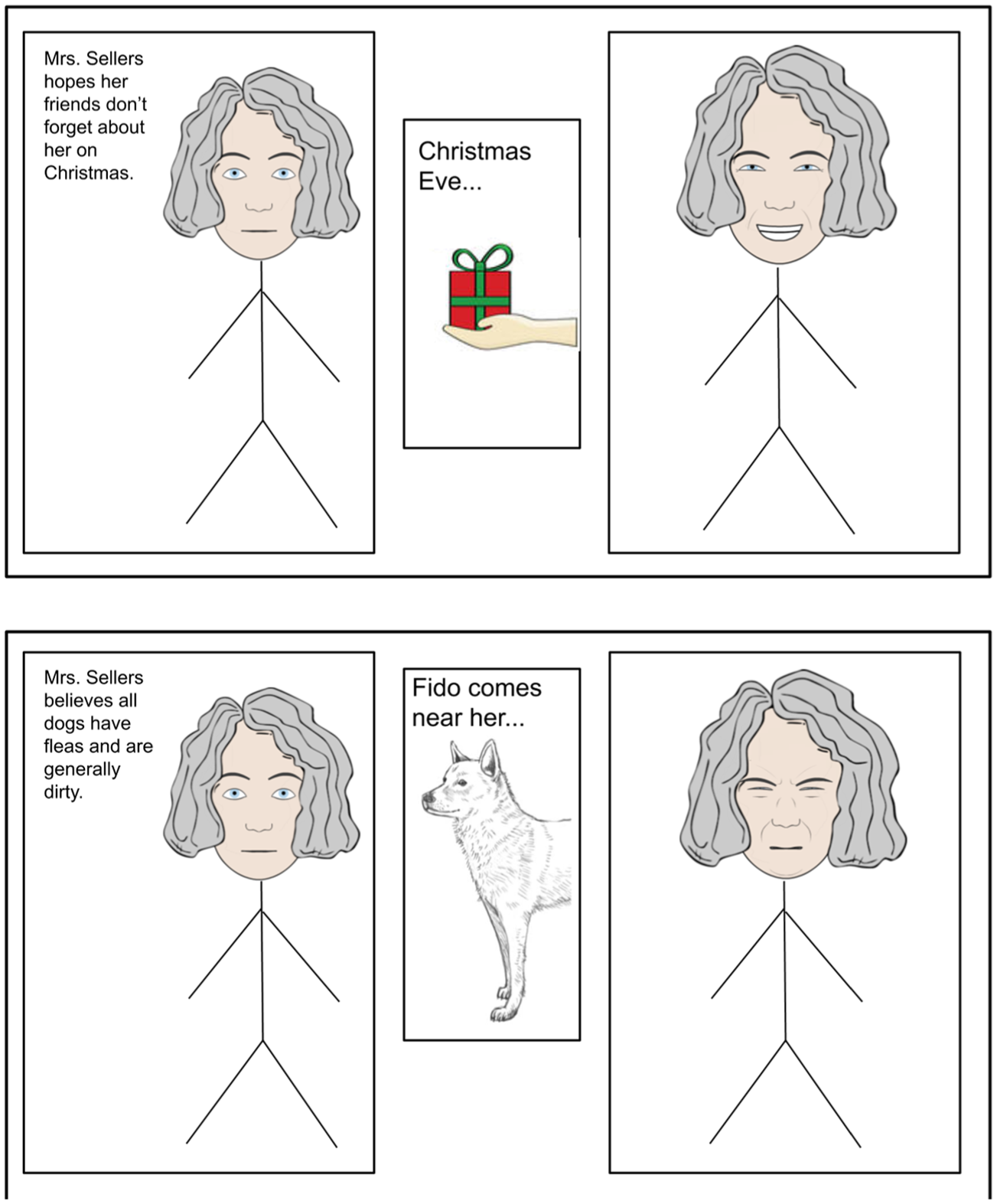
An example set of contrasting case scenarios used in the preparation for future learning (PFL) activity. In total there were three sets of scenarios, each of which featured a different character experiencing two different emotional reactions.
Fiction Content
The control group read a literary fiction selection and answered reading comprehension questions. The fiction selection was a short story called “The Big Cat” by Louise Erdrich, originally published in The New Yorker and selected from the Best American Short Stories 2015. This story was selected because its length was expected to require control group participants to spend about as much time reading and answering questions as the experimental group participants spent on the model-learning activities. The reading comprehension questions did not focus on the emotional aspects of the story but on the basic story content. The control group was not taught any explicit emotion-related information.
Measures
Trait Empathy
All the participants completed the Empathic Concern and Perspective-Taking subscales of the Interpersonal Reactivity Index (Davis, 1980, 1983; Davis & Oathout, 1987). These subscales are often used to measure empathic disposition (McCullough, Emmons, & Tsang, 2002). Past internal reliability measures of these scales were adequate (Cronbach’s α of .73 and .71, respectively; Davis & Oathout, 1987), and they were good for the present sample (Cronbach’s α of .87 and .82 for the Empathic Concern and Perspective-Taking subscales, respectively). The two subscales consist of 7 items each, for a total of 14 items. Example item: “Before criticizing somebody, I try to imagine how I would feel if I were in their place.” Respondents use a 5-point Likert-type scale to indicate to what extent the statements in the subscales describe them. The subscale scores were used to approximate the respondents’ baseline, trait-empathic tendencies. The scores on the two subscales were combined for a single measure of trait empathy. We expected that this score would covary with the participants’ responses to the other-blame and self-blame scenarios on the transfer test.
Transfer Test
The primary outcome measure was the level of blame assigned by the participants to themselves and to others for the emotional reactions described in the fictional scenarios. Fictional scenarios have previously been used as an outcome measure in a variety of SEL interventions (e.g., Crick & Dodge, 1994; Graham, 1996, 1997; Kam et al., 2004). There were four “other-blame” scenarios, that is, where blame was assigned to a fictional character’s reactions. These were meant to capture a change in social awareness, and more specifically in what has been called cognitive empathy (Decety & Jackson, 2004), that is, the capacity to understand what someone else is feeling and why. The internal consistency of these scenarios was acceptable (Cronbach’s α = .74). Additionally, there were four “self-blame” scenarios, in which the participants were asked to rate how blameworthy they would find emotional reactions they themselves may experience in hypothetical situations. These were intended to measure the intervention’s effects on self-awareness, specifically emotional acceptance. The internal consistency of the self-blame scenarios was good (Cronbach’s α = .82). Finally, there were an equal number of nonemotional “filler” scenarios, which were designed to have no explicit or salient reference to emotional reactions. These scenarios were primarily meant to help maintain the plausibility of the cover story. We expected that because there were no overt references to emotions in these scenarios the intervention would have no significant impact on people’s responses to the fillers. The internal consistency of the filler scenarios was excellent (Cronbach’s α = .92). See Table 2 for sample scenarios. The complete transfer test can be found in the supplemental materials.
Sample Blame Scenarios
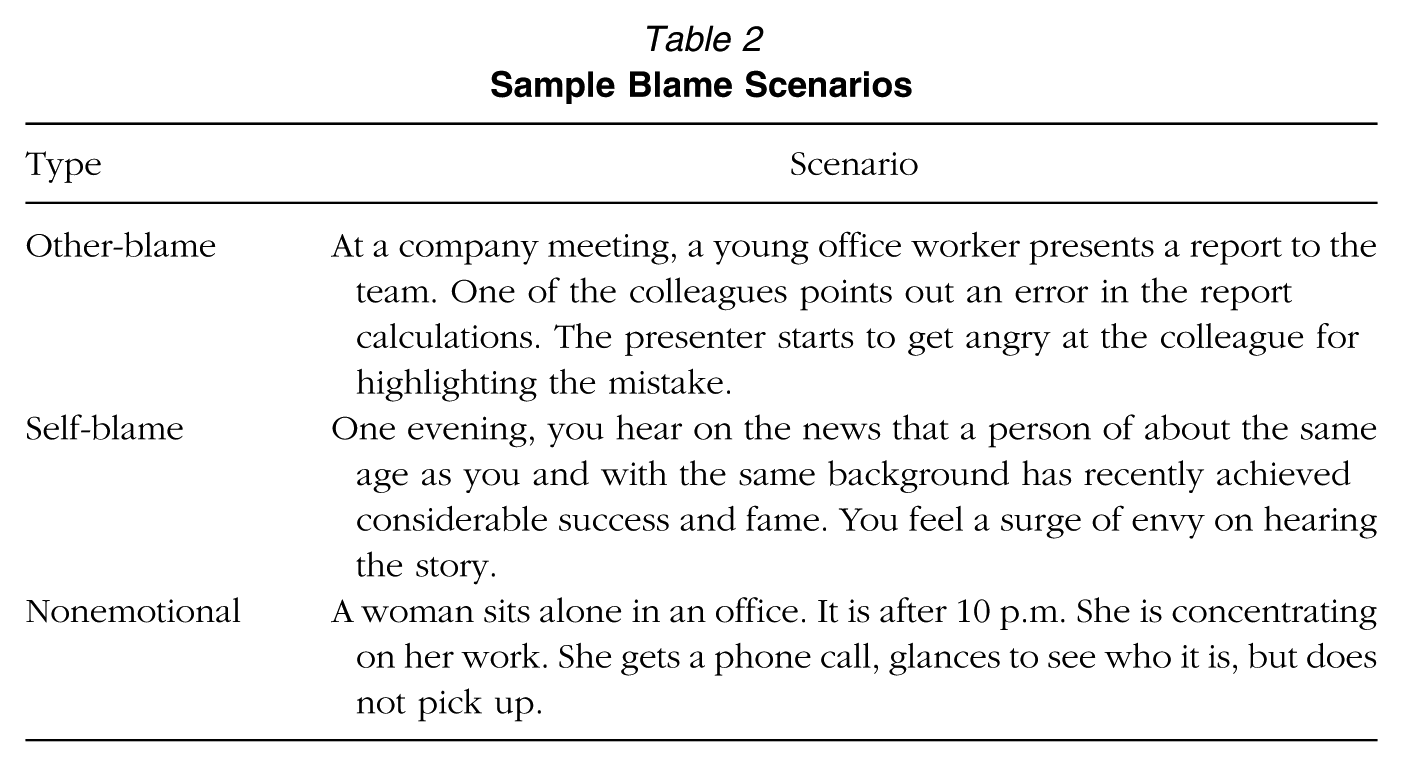
Blameworthiness has been used in past studies evaluating judgments of moral responsibility (Woolfolk, Doris, & Darley, 2006). And we have used the same approach to measure EK transfer in the preceding pilot study (Lyashevsky et al., 2017). Blame level was chosen as the preferred outcome measure because attributions of blame are thought to be instrumental in the generation of anger (Scherer et al., 2001) and subsequent aggression (Crick & Dodge, 1994; Weiner, 1995). Altered attributions of responsibility and reductions in blame have been previously linked to reductions in aggressive tendencies (Gasser, Malti, & Gutzwiller-Helfenfinger, 2012; Graham, 1997; Yeager et al., 2013). Thus, reductions in blame have a meaningful association with other positive emotional and social outcomes. Furthermore, we suggest that reductions in blame with respect to others’ and one’s own emotions would be demonstrating that greater knowledge of the emotion system, in particular the automaticity of the appraisal process and its integral role in emotion generation, is able to positively impact cognitive empathy (Decety & Jackson, 2004), that is, the ability to understand someone’s emotional state and its causes, as well as emotion acceptance in the self. Put another way, if greater emotion system knowledge is able to positively impact cognitive empathy for others and emotion acceptance in the self, we would expect to see less blame assigned for emotional reactions exhibited by oneself and others.
The scenarios were designed to depict “socially undesirable” emotional responses. That is, they were designed to depict emotional responses that would likely be met with social disapproval or censure yet that are fairly plausible, such as an instructor getting impatient with a student asking a lot of questions. The expectation was that the scenarios’ social undesirability would push the participants to rate them as having relatively high blameworthiness (Cushman & Young, 2010; Knobe, 2006).
This activity was considered to be a test of transfer. Transfer is defined as the ability to use prior knowledge to solve or “deal with” (Chi & VanLehn, 2012) new tasks or problems (this may include doing so in new contexts). In this study, the tasks on the transfer test were meaningfully different from the activities involved in learning and practice in a number of respects. During learning, the participants were asked to complete partial scenarios based on the logic of the emotion model and to suggest the emotional reactions that would arise in the given scenarios. There was no mention of blame. On the transfer test, the participants were asked to evaluate longer, complete, novel scenarios on the basis of an 11-point Likert scale of blameworthiness, with no mention of appraisal. This represents a difference in task content (Barnett & Ceci, 2002; Klahr & Chen, 2011). Furthermore, the purpose of the activities as explained to the participants, that is, the task’s functional context (Barnett & Ceci, 2002) or how it was framed (Nokes & Belenky, 2011), was different for practice and transfer test (emotion model learning and scenario database creation, respectively). Nevertheless, this should likely be seen as an example of “near transfer,” since in both cases the domain was one of emotion and involved textual scenarios, and there was little or no lag time between learning and transfer assessment. Learning and practice content, as well as the full transfer task, can be found in the supplemental materials.
As stated previously, the expectation was that the deep structure of appraisal, its role in emotion generation and its automatic nature, would transfer to the novel scenarios the participants were asked to evaluate for blameworthiness. It was then expected to factor into the participants’ reasoning and cause reductions in blame assignment by way of a reduction in their attribution of responsibility for emotional responding.
Blameworthiness for all the scenarios was rated on an 11-point Likert scale. A higher score corresponded to a higher level of blame. The other-focused scenarios were written to ensure gender balance, such that there were approximately the same number of male and female protagonists, with some characters’ gender being left deliberately ambiguous. Similarly, self-focused scenarios were written to allow universal gender identification. The order of the scenarios was randomized.
Exit Questionnaire
The participants responded to an exit questionnaire, which included questions about demographic information, such as age, gender, and highest achieved level of education. The participants were also asked to describe their understanding of the purpose of the study activities they had participated in. This served as a suspicion probe (Shariff et al., 2014).
Results
Between-Group Differences
Demographic Variables, Empathy, Participation Duration
The groups did not differ significantly based on age, empathy scores, or participation duration (p > .05 for all). The control group did differ significantly from the M+PFL group in level of education (Mcontrol = 1.27 vs. MML+PFL = 1.61; p = .007). However, correlation analysis showed no significant association between education level and the outcome measures (all ps > .05). Descriptive statistics for the three groups can be found in Table 3.
Means and Standard Deviations for Age, Education, Empathy, and Duration for Each Condition
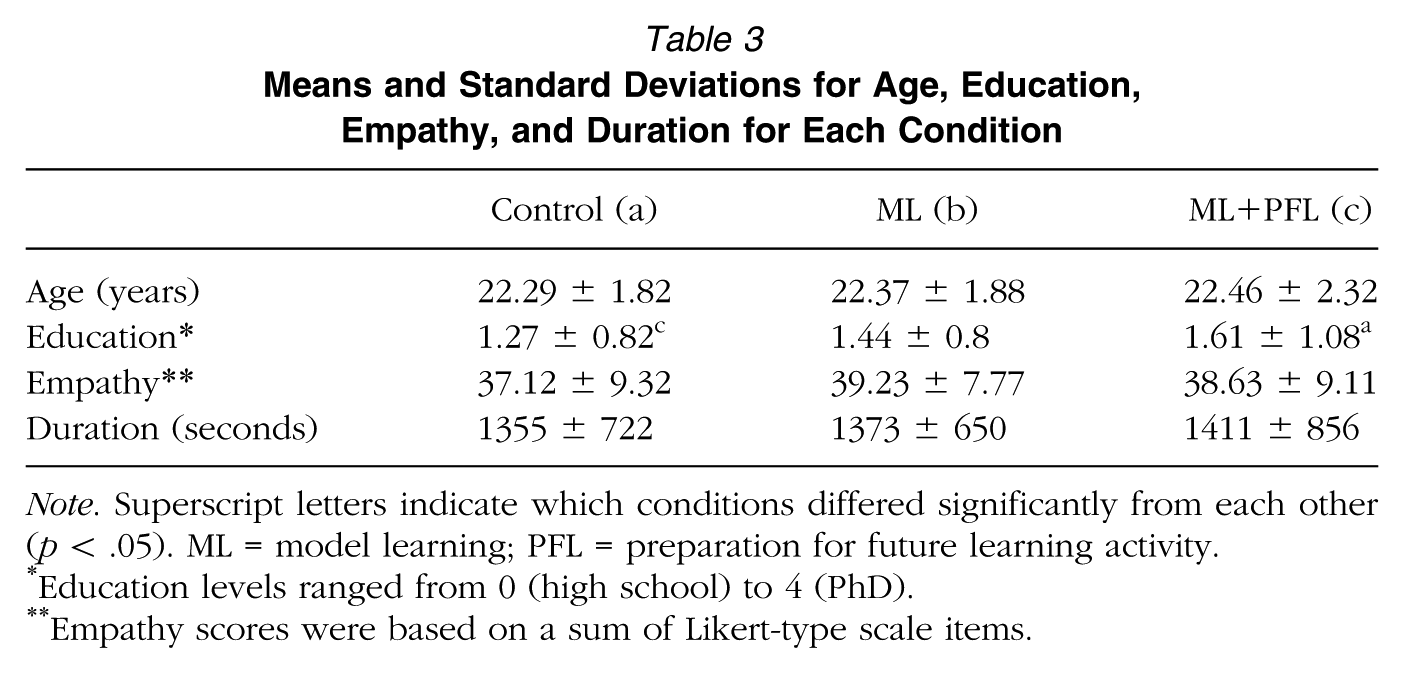
Note. Superscript letters indicate which conditions differed significantly from each other (p < .05). ML = model learning; PFL = preparation for future learning activity.
Education levels ranged from 0 (high school) to 4 (PhD).
Empathy scores were based on a sum of Likert-type scale items.
Blame Scores
We found that the participants in both experimental groups blamed others significantly less harshly than the participants in the control group. Similarly, the ML group blamed themselves significantly less harshly than the control, whereas the ML+PFL group did not.
A one-way multivariate analysis of covariance was run with condition (ML, ML + PFL, and control) as a factor, three dependent variables (self-blame scores, other-blame scores, and nonemotional scenario blame scores), and two covariates (empathy and duration). Covariates were included based on the fact that empathy had a significant positive correlation with other-blame (Spearman’s ρ = .156, p = .007) and duration had a marginally significant negative correlation with self-blame (r = −.11, p = .07). It is worth noting that the observed correlation between empathy and the blame scores was positive, counter to expectations (it was expected that higher empathy would lead to lower blame scores, and hence a negative correlation). Neither of the other potential covariates—age and education—was correlated with any of the blame scores (ps > .05) and thus was not included in the analysis.
Multivariate tests for the two covariates, empathy, Wilks Λ = .96, F(3, 296) = 4, p = .009,
Multivariate tests for condition were significant, Wilks Λ = .94, F(6, 592) = 3.4, p = .003,
Pairwise comparisons revealed that for other-blame, both the experimental groups produced significantly lower blame scores than the control (Mcontrol = 6.32 vs. MML = 5.48, p = .003, SE [standard error] = .28, d = .42; Mcontrol = 6.32 vs. MML+PFL = 5.69, p = .03, SE = .29, d = .31), as predicted. However, counter to expectations, the ML+PFL blame scores were descriptively higher than the ML scores (MML = 5.48 vs. MML+PFL = 5.69; see Figure 4), though this difference was not significant (p = .57, SE = .3, d = .1).
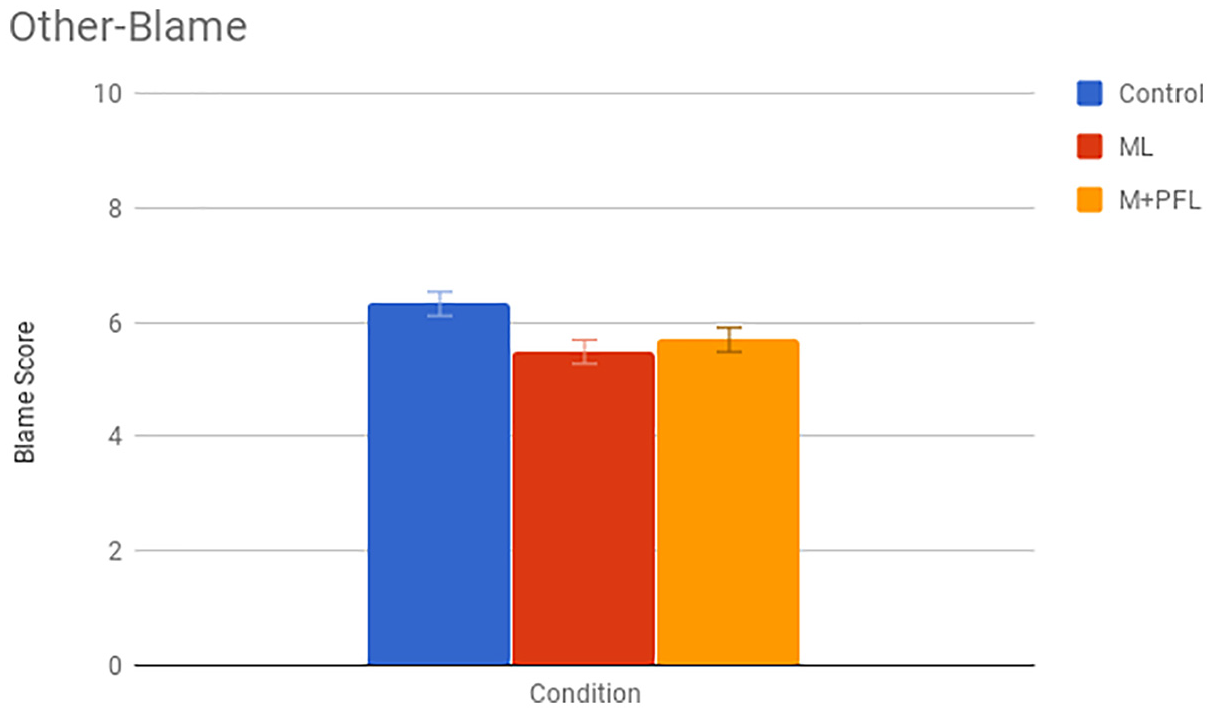
Mean other-blame scores. Error bars represent standard error. Both experimental groups scored significantly lower than the control.
For self-blame, the scores in the ML condition were significantly lower than in the control (Mcontrol = 5.28 vs. MML = 4.49, p = .005, SE = .28, d = .39), but the scores in the ML + PFL condition were not (Mcontrol = 5.28 vs. MML+PFL = 5.15, p = .65, SE = .29, d = .06). Indeed, the ML + PFL group scores were only slightly lower than the control scores, such that they were still significantly higher than the ML group scores (MML+PFL = 5.15 vs. MML = 4.49, p = .026, SE = .3, d = .33). See Figure 5 for the self-blame score estimated marginal means.
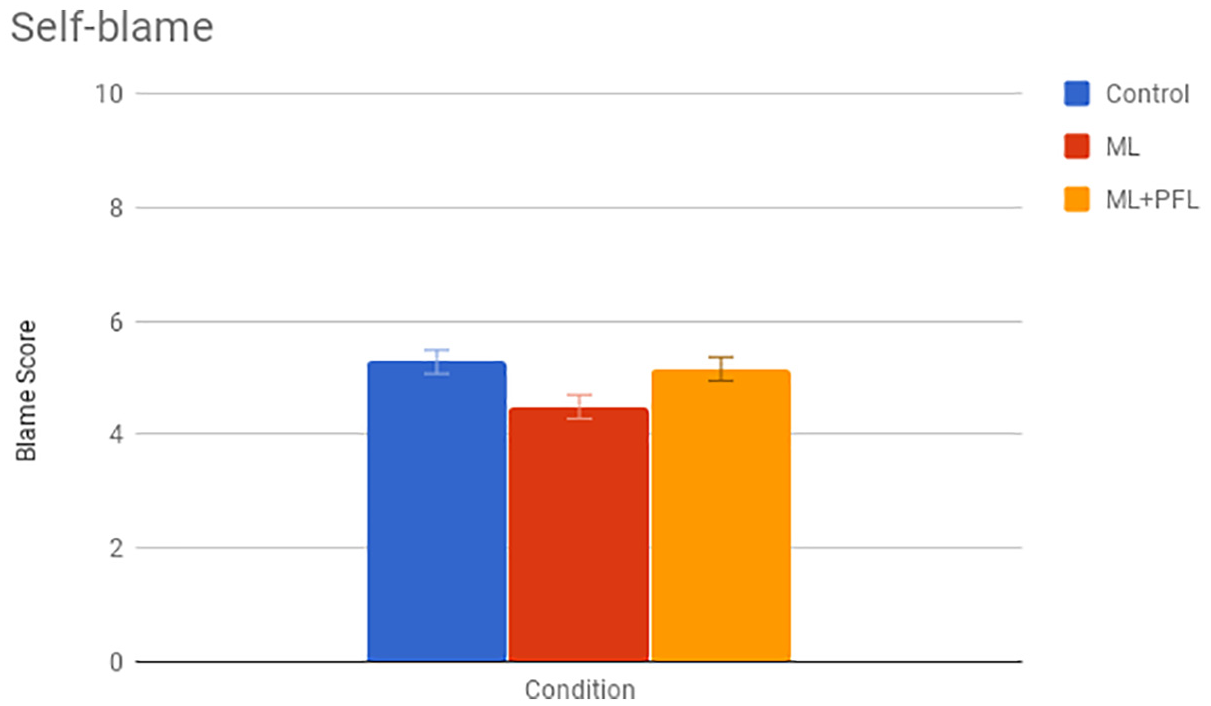
Mean self-blame scores. The ML group scored significantly lower than the control. The ML + PFL group scores were not significantly lower than the control scores.
Note that a multivariate analysis of variance was also run without the covariates, and the multivariate tests for condition were significant, Wilks Λ = .94, F(6, 596) = 2.96, p = .008,
Discussion
In the present study, we asked whether the knowledge acquired in learning a basic, appraisal-based model of the emotion system would spontaneously transfer to a novel set of problems and affect aspects of emotional awareness. The participants in the experimental groups learned about the role of appraisal in emotion generation and the largely automatic nature of that process. This knowledge was expected to influence their perceptions of the level of control one has over emotional reactions. This, in turn, was expected to affect how blameworthy one judges others and oneself to be for exhibiting such reactions. Reductions in blame for undesirable emotional reactions in oneself and others were considered to be an indicator of greater acceptance of emotions in the self (an aspect of self-awareness) and greater cognitive empathy for others (an aspect of social awareness).
With regard to other-blame, we expected to reproduce the results of the preceding pilot (Lyashevsky et al., 2017), such that there were reduced blameworthiness scores in the experimental groups compared with the control group. More specifically, we expected socially undesirable emotional reactions to be rated as significantly less blameworthy by the ML groups than the control group. That is, the experimental groups could be said to be more tolerant and empathic—as a result of a change in their EK (Barrett, 2006) and consequently in their cognitive empathy (Decety & Jackson, 2004; Dziobek et al., 2008)—when they perceived someone “reacting badly.” The results were largely in line with expectations. Both experimental groups rated others’ socially undesirable emotional reactions as significantly less blameworthy than did the control group. The ML group’s blame scores were more than 13% lower than the control group’s, and the ML + PFL group’s scores were more than 12% lower. These results supported the hypothesis that deep structure EK in the form of an emotion model would transfer to novel problems and impact social awareness and cognitive empathy. However, they went counter to the expectation that the ML+PFL group would show the strongest transfer and the lowest blameworthiness scores, as this group’s scores were not significantly different from the ML group’s scores and were in fact slightly higher.
Similar results were observed for self-blame. The ML group’s self-blame scores were significantly lower than the control’s, with a reduction of nearly 15%, indicating that learning the emotion model also had an impact on self-awareness by way of increased emotional acceptance, as expected. On the other hand, the ML+PFL group’s scores, while somewhat lower than the control’s, were not significantly different. They were, however, significantly higher than the ML group’s scores.
As expected, the blame scores associated with nonemotional scenarios were not affected by the intervention.
Overall, these results bolstered the proposition that teaching a core model of the emotion system would result in the transfer of the acquired EK to a novel set of problems, influencing aspects of self- and other-awareness in a positive way. Specifically, learning about the appraisal process and its automatic nature resulted in decreased attribution of blame for others’ undesirable emotional reactions, signaling greater cognitive empathy in response to others’ emotions and decreased blame for one’s own undesirable emotional reactions, reflecting greater acceptance of one’s own emotions. Emotional acceptance is thought to facilitate self-regulation and psychological well-being (Hayes et al., 1999), while cognitive empathy supports effective social functioning (Decety & Jackson, 2004). Consequently, improvements in these areas would be of value in the effort to enhance SEC. These treatment effects were believed to occur as a consequence of spontaneous transfer of the deep structure of appraisal to new social problems. In other words, the participants recognized the scenarios on the transfer test as featuring emotional reactions, and they applied their updated mental model of emotion generation—now featuring appraisal—to the task of assessing the blameworthiness of the given reactions. Knowing that initial emotional impulses are largely automatic owing to the automatic nature of appraisal, they assigned less responsibility, and consequently less blame, for the undesirable emotional reactions depicted in the scenarios. It is worth noting that past studies have shown spontaneous transfer to be difficult to achieve without providing learners with hints or other guidance (e.g., Gick & Holyoak, 1983), which was not given in this case.
The results are arguably made more compelling by the fact that the control group read literary fiction, which would be expected to have a short-term positive impact on the empathy-related aspects of ToM (Kidd & Castano, 2013). Moreover, given that the intervention was run online, the results are an indication that this SEL methodology can be delivered using modern technologies, increasing its potential scalability and accessibility. Importantly, the results were achieved with a population of adolescents and young adults (18–25 years of age), an age-group that has proven itself resistant to many past SEL interventions yet can benefit significantly from enhanced SEC (Yeager, 2017b).
At the same time, the results largely failed to back the hypothesis that engaging in a PFL activity as part of the model-learning process would produce better outcomes. The ML+PFL condition performed essentially the same as the ML condition in the case of other-blame, while producing significantly higher self-blame scores than the ML condition. One possible explanation for this is that the PFL activity primed the participants with respect to their existing theory of emotions, bringing it to the fore. This, in turn, may have made them resistant to the “expert” explanation of emotion generation provided as part of the intervention. Alternatively, this might have had to do with the fact that the PFL activity targeted an aspect of appraisal—the evaluation of events in relation to one’s concerns—that wasn’t central to producing the effect of blame reduction. Another possibility was that the ML group benefited from practice effects, having had the opportunity to complete more practice exercises than the ML + PFL group. Finally, it should be noted that there was no lag time between the PFL activity and model learning, which might have also factored into the outcome, since some past successful PFL studies have featured such a gap between the PFL activity and direct instruction (e.g., Schwartz, Chase, & Bransford, 2012).
Follow-up studies will be needed to determine the relative impact of the PFL activity and practice exercises on EK transfer. Nevertheless, the results do point to a potentially important consideration in the way PFL activities might be used for SEL. Namely, because even relatively young people already possess sophisticated (albeit usually implicit) theories and models of emotion—whereas they may not have such models for more specialized concepts like, for example, density in the case of middle-schoolers—PFL activities might cause the activation of these extant models, which may result in some detrimental interference or resistance effects. One possible way to mitigate this problem would be to design the activity in such a way as to avoid touching on emotions explicitly and, instead, deal with something structurally analogous but superficially different (e.g., programming a robot exploring an alien planet). A similar approach was taken by Schwartz et al. (2011) when they asked students to come up with a “crowdedness index” for clown cars in preparation for learning about density. Furthermore, any PFL activities used in SEL (or elsewhere) should be designed to precisely target the deep structures that will be taught following the activity. It should also be noted that the present intervention was quite brief, and only its short-term effects were measured. It’s possible that the given PFL activity would produce different results as part of a longer intervention.
Another unexpected finding of the present study was the relationship between the participants’ trait empathy scores and their blame scores. Instead of being associated with lower blame scores, higher empathy was correlated with higher blame. While this seems counterintuitive, evidence from recent studies on empathy provides a plausible explanation for such results, namely that when people feel empathy for someone, they are likely to also feel greater animosity toward the person’s perceived antagonist (Buffone & Poulin, 2014). In this case, nearly all of the blame scenarios (three of the four other-blame and three of the four self-blame) contained what could be perceived as “victims” of the person experiencing the undesirable emotional response, and thus the latter might have been more strongly blamed by participants with greater empathy.
Overall, while the above results are promising, they should be seen as preliminary and the study considered a proof of concept due to the fact that the intervention was quite brief, there was no follow-up to determine its longer-term effects, and the outcome measures assessed responses to hypothetical scenarios rather than real-world situations. Nevertheless, the study was able to demonstrate the basic viability of using a model of the emotion system to teach to transfer in the SEL context, which has not been demonstrated before and which can serve as a basis for further work in this line of research. It also provides a clear connection between specific learning content and outcomes (even if short-term), something that tends to be lacking in SEL research due to the “shotgun” approach of many SEL programs and interventions (i.e., lots of program content and lots of outcome measures, with no clear mapping between the two). It is also worth noting that other recent studies examining an intervention’s impact on social competencies or related constructs like retributive punishment have looked exclusively at the short-term effects of the treatment (e.g., Kidd & Castano, 2013; Shariff et al., 2014), providing a meaningful proof-of-concept demonstration of their methodology. Of particular relevance are the ToM effects observed immediately after reading literary fiction, as described by Kidd & Castano (2013), which inspired our use of literary fiction for the control in the present study.
Significance and Implications
The present study provides some preliminary evidence for the efficacy of a particular approach to facilitating transfer in the context of SEL: the direct teaching of the emotion system model. The study demonstrates that teaching a simple model of emotion generation to adolescents and young adults aged between 18 and 25 years, a population that has often proven resistant to traditional SEL approaches (Yeager, 2017b), results in the transfer of the EK to new problems and leads to a more empathetic and tolerant view of others’ emotional reactions as well as greater acceptance of one’s own emotions, at least in the short term. Furthermore, these results were achieved in an online study, providing evidence of the viability of the present SEL methodology when carried out as an Internet-based intervention, and of the promise of online SEL programming more generally, which is a topic of ongoing research and debate (Osher et al., 2016).
The findings have implications for SEL research and practice. To begin with, the findings highlight the importance of a more nuanced and comprehensive approach to teaching students about emotions than, for example, simply communicating the idea that personality (and its associated emotions) can change, as has been done in interventions focusing on incremental theories (e.g., Yeager, 2017a; Yeager et al., 2013). Instead, the study results support the argument, previously made by Stegge and Terwogt (2007), that there is value in developing a two-level theory of emotions, recognizing that some aspects of the emotion system cannot be readily controlled (Flavell & Green, 1999; Frijda, 1988) while also learning that some emotion regulation (i.e., deliberate emotion change) is both possible and desirable.
A similar implication can be drawn from the finding that higher trait empathy scores were correlated with higher (rather than lower) blame scores, which aligns with past research showing that greater empathy for a victim can lead to excessively harsh retribution aimed at the perceived perpetrator (Bloom, 2016). The results of the present study suggest that a more elaborate and nuanced understanding of emotion could serve to moderate overly retributive responses toward transgressors, such as bullies, while also potentially enabling healthier coping on the part of victims, as was previously demonstrated by Yeager et al. (2013). Put another way, empathy alone is not enough: It works best when informed by an understanding of our emotional functioning. Thus we can add a corollary to the proverb we started with: Without understanding, there is no forgiveness.
At the same time, it is notable that with a few exceptions (e.g., Jamieson et al., 2013; Jamieson et al., 2018; Lyashevsky et al., 2017; Yeager et al., 2013), it is still largely unknown which specific aspects of the HES are, when learned, particularly impactful with regard to building social emotional competencies. Thus, a future research goal would be to identify these system principles and components through additional experimental studies. We hope such future research will add to the empirical support offered by the present study for HES model learning as a viable approach to SEL, and serve as a springboard for further work, including longitudinal evaluations of the method’s effectiveness, featuring a broader range of outcome measures. On the basis of the available early evidence, we are hopeful that this approach may eventually offer a blueprint for developing SEL content and interventions that would be expected to lead to more robust learning and a greater capacity for applying social emotional skills in novel situations, particularly among adolescent and young adult learners.
Limitations
One limitation of the present study is that the sample participants were 18 to 25 years of age, and thus the study results do not necessarily generalize to younger or older age-groups. Additionally, there were considerably fewer males than females in all three conditions (approximately a 2:1 ratio), so that, for example, in the ML+PFL group, the total number of males (28) was relatively small. Moreover, the elimination of participants who scored poorly on the quiz means that the observed results can only be generalized to those who successfully learn the model, with the possibility that some groups or individuals may not benefit from the present instructional approach.
An additional limitation is that the outcome measures are based on scenario ratings, so that they only capture judgments of emotional reactions depicted in narrative form, rather than changes in behavioral responses to real-world (i.e., not narrative based) events. This might arguably render the results less compelling. Future studies could include behavioral measures such as allocating hot sauce to a peer (Yeager et al., 2013) or having partners try to resolve a relationship problem (Gottman, 1995) to assess the effects on competencies like empathy.
Finally, only short-term effects of the intervention were measured, and thus the findings cannot tell us anything about the long-term effects of teaching the emotion model on awareness, empathy, or other aspects of SEC, or about the use of PFL activities as part of such instruction. Similarly, the intervention itself was quite short (under an hour), whereas many SEL interventions last weeks if not months. Therefore, the results can’t speak to the effects of a longer intervention based on teaching a model of the HES.
Conclusion
The past two decades have seen an explosion in SEL research, yet numerous questions remain with regard to the optimal way to develop and deliver SEL programming, particularly to older learners. These questions include how best to ensure social emotional knowledge transfer, which specific SEL content and activities produce which outcomes, and to what extent technology can be leveraged for SEL instruction. The present study expands our knowledge in relation to these questions by offering evidence that teaching a model of the emotion system can (1) facilitate emotional knowledge transfer, (2) enhance self- and other-awareness (3) that the methodology works with adolescents and young adults, a population for whom SEL interventions have often proven ineffective; and (4) that it can be delivered via an online platform. The findings have implications for SEL theory and practice. They bolster the argument that teaching the emotion system model can become a useful addition to the repertoire of SEL instruction methodologies. More specifically, they suggest that there is value to teaching a more nuanced model of emotions than one that simply highlights emotions’ ability to be changed and controlled, and they suggest that a focus on teaching the underlying principles of the emotion system may indeed represent a way to develop deep social emotional knowledge, making it more likely to be utilized in novel situations and ultimately to produce greater positive psychological effects.
Supplemental Material
AERJ865220_Supplemental_Material – Supplemental material for To Understand Is to Forgive: Learning a Simple Model of Appraisal Leads to Emotion Knowledge Transfer and Enhances Emotional Acceptance and Empathy
Supplemental material, AERJ865220_Supplemental_Material for To Understand Is to Forgive: Learning a Simple Model of Appraisal Leads to Emotion Knowledge Transfer and Enhances Emotional Acceptance and Empathy by Ilya Lyashevsky, Melissa Cesarano and John Black in American Educational Research Journal
Footnotes
Notes
I
M
J
References
Supplementary Material
Please find the following supplemental material available below.
For Open Access articles published under a Creative Commons License, all supplemental material carries the same license as the article it is associated with.
For non-Open Access articles published, all supplemental material carries a non-exclusive license, and permission requests for re-use of supplemental material or any part of supplemental material shall be sent directly to the copyright owner as specified in the copyright notice associated with the article.
