




Abstract
This article focuses on the teacher community as an agent of school development, and in the context of teacher engagement in new educational practices, it discusses how school change can be analyzed as a process of creating and transforming professional knowledge (orientation pattern). The qualitative research was conducted in 2015–2016 at 12 schools participating in an innovative tutoring program in Wrocław (Poland). A total of 12 group discussions and 52 individual interviews were interpreted using Mannheim’s documentary method. As a result, a typology of the four forms of new professional orientation patterns—niche, instrumental, apparent, and synergic activities—was elaborated, and in a case study, they were applied as a theoretical model to the sociogenetic analysis of the school development process.
Introduction
Professional learning communities have been thoroughly examined in the past two decades not only in the context of teacher professional development but also as a significant space in which to develop and test new pedagogical practices (Stoll, Bolam, McMahon, Wallace, & Thomas, 2006; Vangrieken, Meredith, Packer, & Kyndt, 2017) and to empower teachers as agents of school development (Watson, 2014). These expectations are strengthened by the belief that the teachers’ cooperation is predominantly supportive, has pro-developmental potential, and focuses attention and commitment on shared values, visions, and goals (Gallagher, Griffin, Ciuffetelli Parker, Kitchen, & Figg, 2011; Hord & Sommers, 2008; Parker, Patton, & Tannehill, 2012). In the examination of the teachers’ learning communities, a significance is assigned to reflexivity, reflexive practices (Hofer, 2017; Pultorak, 2010; Schön, 1983), and the collective building of professional knowledge (Parker et al., 2012; Popp & Goldman, 2016). However, the meta-studies show that in the studies of professional communities, higher attention is paid to maintaining and improving cooperation within the teaching team than to the process of constructing new professional knowledge (Camburn & Han, 2017; Vangrieken, Dochy, Raes, & Kyndt, 2015; Vangrieken et al., 2017). In the context of teacher engagement in initiating and extending new educational practices at school, this article discusses how the scope and sustainability of teacher-driven school development can be examined by reconstructing the process of creating and transforming professional knowledge.
Systematic reviews reveal that studies on school improvement embedded in the teachers’ participation are dominated by the examination of short-term activities in situationally limited contexts of team meetings or classroom lessons (Gallagher et al., 2011; Parker et al., 2012; Tam, 2015; Vangrieken, Dochy, Raes, & Kyndt, 2013, 2015). The explanation for this state of the research may be partly based on the idea that teachers themselves prefer cooperation that is oriented toward lesson preparation, teaching effectiveness, and problem-solving issues that arise on an ongoing basis rather than toward new didactic frameworks and the critical review of a school’s organizational culture (Vangrieken et al., 2015; Zhang & Yin, 2017). Wells and Feun (2007), as well as Camburn and Han (2017), argue that deeper collaboration going beyond sharing teaching scenarios and discussing particular lessons and student results appears to be challenging. Along similar lines, Vangrieken et al. (2017) find that the research on teacher communities as a context for professional learning is dominated by analyses of the teacher’s reporting about situationally limited cooperation, and they postulate that studying the sociocultural aspects of development and the impact of different formations of the teachers’ involvement could fill a gap in the current empirical studies.
The studies on institutional change from the cultural-historical (Beatty & Feldman, 2012; Engeström, Kajamaa, Lahtinen, & Sannino, 2015) and sociogenetic perspectives (Amling & Vogd, 2017; Bohnsack, Pfaff, & Weller, 2010) indicate key methodological issues that may extend more critical and differential insight into the process of introducing new practices in the teachers’ communities:
The sociocultural and institutional changes can be examined as a process of creating and reproducing pragmatic knowledge immersed in the flow of practice at two levels of knowledge: knowledge about action and knowledge in action (Schön, 1983).
The sociogenetic (Bohnsack, 2017a) and cultural-historical (Engeström, 2015) research perspectives accentuate observed or reported episodes not as a separate unit of analysis but as interconnected stages within the process of change.
A study on the process of change should remain sensitive to nonlinear and not always progressive development. The experience of crisis, contradictions, and helplessness can potentially represent not only a stage of failure but also an opportunity to question an established practice and a germ of critical developmental prospects (Beatty & Feldman, 2012; Rajala, Kumpulainen, Rainio, Hilppö, & Lipponen, 2016).
A reconstruction of the development of new practices should cover the whole spectrum of experience, not only the episodes of collaborative engagement based on shared visions, values, and goals. The process of creating new pragmatic knowledge involves a wide range of both individual and collective experiences (Vogd & Amling, 2017), which not only complement one another but also relate to contradictions and asynchrony (Desimone & Garet, 2015; Skott & Møller, 2017).
This article contributes to the research conducted from a sociocultural perspective, on teacher communities as agents of school development. I propose a theoretical data-based model for interpreting the teachers’ responses to new pedagogical practices as a sociohistorical/sociogenetic process of transforming the teacher’s professional knowledge embedded in the flow of school activity. As a primary analytical formula, I apply the praxeological approach of Karl Mannheim’s (1952a, 1952b) sociology of knowledge (Bohnsack, 2017a, 2017b). In this perspective, the knowledge—including the teachers’ professional knowledge—is empirically reconstructed as a pragmatic orientation pattern that reflects the manner (modus operandi) in which this knowledge “is leading or orientating practical action” (Bohnsack, 2017a, p. 200). Almost analogously, as in Schön’s (1983) proposal, two levels of orientation patterns are distinguished: orientation schemes and orientation frameworks (Bohnsack, 2017a). Orientation schemes include the teachers’ knowledge about action mediated in linguistic and symbolic communication means, which are used to comment on and coordinate activities. The orientation framework exceeds the teachers’ declarations and reporting on practice and includes the habitual and atheoretic knowledge-in-action resources, mediated directly in the practice itself (Bohnsack, 2017a; Krzychała, 2019).
In the praxeological perspective, I focus on a new practice as a turning point in the professional learning process. The teachers—as a collective and multi-individual agent of change—launch change as a chain of practice transformations: The initiated alteration is to be considered in the context of existing pedagogical practice and, above all, as an opening of a further development sequence. The way teachers respond to the new practice reflects the understanding and the pragmatic meaning of the undertaken improvements. The central research question concerns how the teachers’ knowledge about and in action is transformed by the involvement in the new pedagogical practices and how the teacher experience designates the course of school development.
An exploration of the change process in pedagogical practice was carried out as a study of a school tutoring program implemented in 29 public schools in Wrocław, Poland, from 2008 to 2016. The institutional and strategic objective of the program was to implement an individualized pedagogical counseling/advising model supplementing the work with students in classroom settings (Drozd & Zembrzuska, 2013; Krzychała, 2018). The teachers became tutors and were individually chosen by the students. The tutor-tutee cooperation lasted for 3 years of the student’s school attendance and included regular monthly meetings (tutorials). The tutoring as a new school practice was planned as a bottom-up initiative, and except for the concept of tutoring and the general outline of the tutorials presented in the initial training, the teachers did not receive a ready-made scheme for tutoring. None of the public schools in Poland had previously conducted such activities. During the first years of the program, the teacher-tutors were expected to develop a detailed organizational model suited to a specific school. This task naturally prompted the teachers to individual experimentation with the new professional role. They shared their know-how and engaged in joint coordination of school development. This process of change took 5 to 7 years and included the improvement of both individual tutoring skills and institutional arrangements.
At the turn of 2015 and 2016, teachers from 12 junior high schools participated in registered semistructured group discussions in every school, and then these same four to six teachers were invited to individual interviews. The analysis of this multidimensional process of change embraced complex and long-term processes of pedagogical transformation beyond the initial phase of implementation of the new practice by a small group of pioneers and enthusiasts. In this way, the analysis took into account different variants of practice transformation, problems related to the growing scale of change, the contradictions and failures experiences, and the relationships between the individual and collective learning processes of the teacher-tutors. The analysis of narratives by using the documentary method was the basis for the elaboration of a theoretical model that showed four forms of new pedagogical orientation patterns, such as niche, instrumental, apparent, or synergic change at school. This general model—as it will be presented in the case study of one of Wrocław’s schools—can then be used for the sociogenetic reconstruction of the process of both individual and collective professional development.
Theoretical Framework: Pragmatic Orientation Pattern
In the inquiry into the process of constructing the teachers’ pragmatic knowledge development in the course of responding to the new pedagogical practice, the analytical distinction between the two levels of knowledge, that is, the level of knowledge about action and that of knowledge in action (Schön, 1983), is of crucial relevance. This differentiation can be thoroughly demonstrated within the praxeological sociology of knowledge developed by Karl Mannheim in his papers from 1921 to 1924 (Mannheim, 1964, 1980; also Bohnsack, 2017a, 2017b).
Mannheim (1952a) describes two layers of knowledge immersed in practice: (1) an immanent (explicit) meaning/understanding and (2) a documentary (implicit) meaning/understanding:
An immanent understanding is intentionally assigned by subjects to the activity in which they participate and which they shape. It includes a goal, intention, and motive of action. Mannheim also defines this meaning as communicative knowledge. The observers or researchers can perceive it to the extent that participants in social practices share their experiences with linguistic and symbolic means at the commonsense level (Bohnsack, 2017a).
Documentary understanding connects the present activity with broader sociocultural contexts of experience, such as personal and professional biographies, and informal and institutional spaces of involvement. Mannheim also identifies this meaning as conjunctive knowledge. Observers or researchers can perceive it only as an integral part of an activity, as an atheoretical outline incorporated into the style and proficiency of the practice, as the experience sense mediated directly in the flow of engagement (Krzychała, 2019). It is reflected independently of the subject’s intention and declarations, in the modus operandi of the performance (Bohnsack, 2017a, 2017b).
In the analysis of narratives, communicative knowledge can first be reconstructed, as it encompasses the description of the organization, methods, both formal and informal rules, and justifications employed in practice. This level of professional knowledge can be defined as an orientation scheme (Bohnsack, 2017a).
However, not all activities entirely overlap with the orientation scheme. In addition to the goals, intention, and motive underlying the described activities, a practical sense can be detected. This dimension is referred to as an orientation framework, which can be considered the product of the experiential processes and knowledge experienced in the modus operandi of this practice (Bohnsack, 2017b, p. 104). In other words, the manner and proficiency in which subjects carry out tasks reveal visible, but not necessarily explicitly formulated, sense and understanding of the activity.
A certain cautiousness is recommended when interpreting activities in an institution by using only the orientation scheme (Amling & Vogd, 2017; Bohnsack, 2014). Even in strongly hierarchical organizations, “lived hierarchies” function parallel to formal ones (Mensching, 2008). Similarly, in the research on schools as organizations, significant attention should be paid to the generation of meanings beyond the orientation scheme (Asbrand & Martens, 2018; Welling, Breiter, & Schulz, 2015). An analysis of orientation frameworks reveals many contradictions in the practice that the participants sometimes seem not to recognize or to justify on the level of the orientation scheme (Vogd & Amling, 2017). Professionals note some such inconsistencies, justifying them when faced with given conditions, by the need for flexibility and as a way to reconcile contradictory obligations or as personal or group variants of the interpretation of rules. Such habits and practices are perceived “as if” they were compliant with the rules (Ortmann, 2004).
The analytical reconstruction of the orientation framework poses a particular challenge for researchers. This level of professional knowledge can be understood only “in the totality of experience” (Mannheim, 1980, p. 218) through the integral reconstruction of both (1) the practice in which the modus operandi of the activity is performed and activated and (2) the practice in which the experience sense is developed as well as the sociocultural history of the constructing orientation framework. Mannheim (1952a) defined this methodological strategy as a genetic explanation, and it became a fundamental element of the documentary reconstruction of pragmatic knowledge. As long as individual biography and development are embedded in multidimensional references to sociocultural spaces of experience, such as belonging to a particular generation, social and economic stratification, or cultural and political determinants, the sociogenetic approach combines an individual and collective perspective. Analyzing the category of the generation as a collective space of experience, Mannheim (1952b) shows that collective relationships do not necessarily follow from direct interactions but rather from an anchoring in identical or similar sociohistorical and cultural structures.
Despite the analytical distinction, the orientation scheme and the orientation framework are immersed in the same practice and form an integral orientation pattern, regardless of whether they are in a relationship of homologation, supplementation, or contradistinction (Bohnsack, 2014). In this sociogenetic perspective, the teachers’ pragmatic response to the new pedagogical practice can be reconstructed as a process of constructing and reconstructing a new orientation pattern on the interconnected levels of the orientation scheme (procedures, categories, instructions, declarations) and the orientation framework (atheoretical knowledge, professional habitus, and a sense of practice). In the presented research, the interpretation aims to consider the processual reconstruction of school praxis changes caused by including new praxis (tutoring) into the school system and by confronting the challenges that result from the perceived contradictions between the school curriculum and the tutoring program.
Study
School Tutoring Program
The Wrocław school tutoring program—intended as a bottom-up initiative for changing public schools in Wrocław—was introduced to 29 junior high schools (gymnasia) in the period from 2008 to 2016 (Drozd & Zembrzuska, 2013; Krzychała, 2018). The program introduced a new pedagogical practice of individualized tutor-tutee meetings (tutorials), and this seemingly simple intervention involved teachers in the broader cycle of school development.
School tutoring can be considered as a form of personalized education. The tutoring method was developed at the Universities of Oxford and Cambridge and was based on an individualized tutor-tutee relationship and peer-tutoring in small groups (Ashwin, 2005; Moore, 1968; Palfreyman, 2008). In afterschool learning and tutoring centers, the tutoring method was also adapted to the needs of elementary and secondary programs of general education (K–12) to enhance school achievements and literacy (Dawson, 2010; Ehri, Dreyer, Flugman, & Gross, 2007; Smith, Cobb, Farran, Cordray, & Munter, 2013). In a different form, the Wrocław school tutoring program was developed as an integral part of the schools’ curriculum (Drozd & Zembrzuska, 2013; Krzychała, 2018). Each student chose a teacher at the school as a tutor, with whom they met at least once a month at a 30- to 40-minute meeting; the meetings were usually conducted on an individual basis and sometimes in a small group of several tutees cooperating with the teacher-tutor. The tutoring involved advising students not only in relation to their school achievements but also concerning their well-being at school, social and learning skills, and independent out-of-school activities in the areas of art, sports, and volunteering. The strategic goal of the program was to empower each student, not only those with special needs or exceptional talents but also those “invisible” students with “average” achievement who pass almost unnoticed through subsequent stages of education. In the first school year, the tutors assisted students in understanding their talents and learning styles. In the second year, the tutors encouraged students to set their interests, and they accompanied the students in achieving their personal learning goals. In the third year, the objectives were extended to the choice of further educational and vocational career.
In 2008, based on the general guidelines prepared by consultants from the Tutors’ Collegium established in Wrocław for the project, the first three Wrocław schools began the tutoring program (a total of 14 teacher-tutors in 6 classes/students groups; Budzyński, Traczyński, & Czekierda, 2009). The teacher-tutors participated in initial training during which they became familiar with the general idea and the goals of tutorials. However, they did not receive a ready-made model for organizing tutoring at school. From the beginning, it was assumed that in each school, the teachers would autonomously develop individualized tutorial care models corresponding to the resources and needs of a particular school. Counseling based on an individual tutor-tutee relationship and a free choice of goals was a new challenge for teachers and differed from the school’s dominant modus operandi of the classroom-based and subject-oriented work. The new pedagogical practice opened up space for the development of new orientation patterns in the teacher community.
In 2014, as many as 29 schools (among them 21 junior high schools) and 442 teacher-tutors participated in the school tutoring program. The tutorial program was run until 2016, when the Polish Parliament passed an act reforming the Polish school system of general education and replaced the three-level model K–6, 7–9, and 10–12 with two levels K–8, 9–12 (European Commission/EACEA/Eurydice, 2018, p. 23). As a result, the junior high schools were successively closed. This systemic reform finally stifled the Wrocław tutoring program. However, in the study, which was conducted at the turn of 2015 and 2016—almost at the last moment before the termination of the junior high schools—12 group and 52 individual interviews were recorded. The narratives document the process of tutoring development both at the level of the organizational change created by the tutors’ teams as well as at the level of becoming a tutor represented by the actions of the individual teachers. The variety of organizational forms worked out and the diversity of the individual and collective experiences allowed us to develop a theoretical model of four types of teacher responses to the new pedagogical practice.
Participants and Research Design
Teachers from 12 public junior high schools were invited to participate in the research (10 with tutoring, 2 control schools). The study was financed and conducted independently of the school tutoring program. As the sample was composed contrastively, the schools differed in size, student achievements, and the scope of implementation of the tutoring program (Table 1).
For the Schools Participating in the Study, Basic Information and the Scope of the Implementation of the School Tutoring Program.
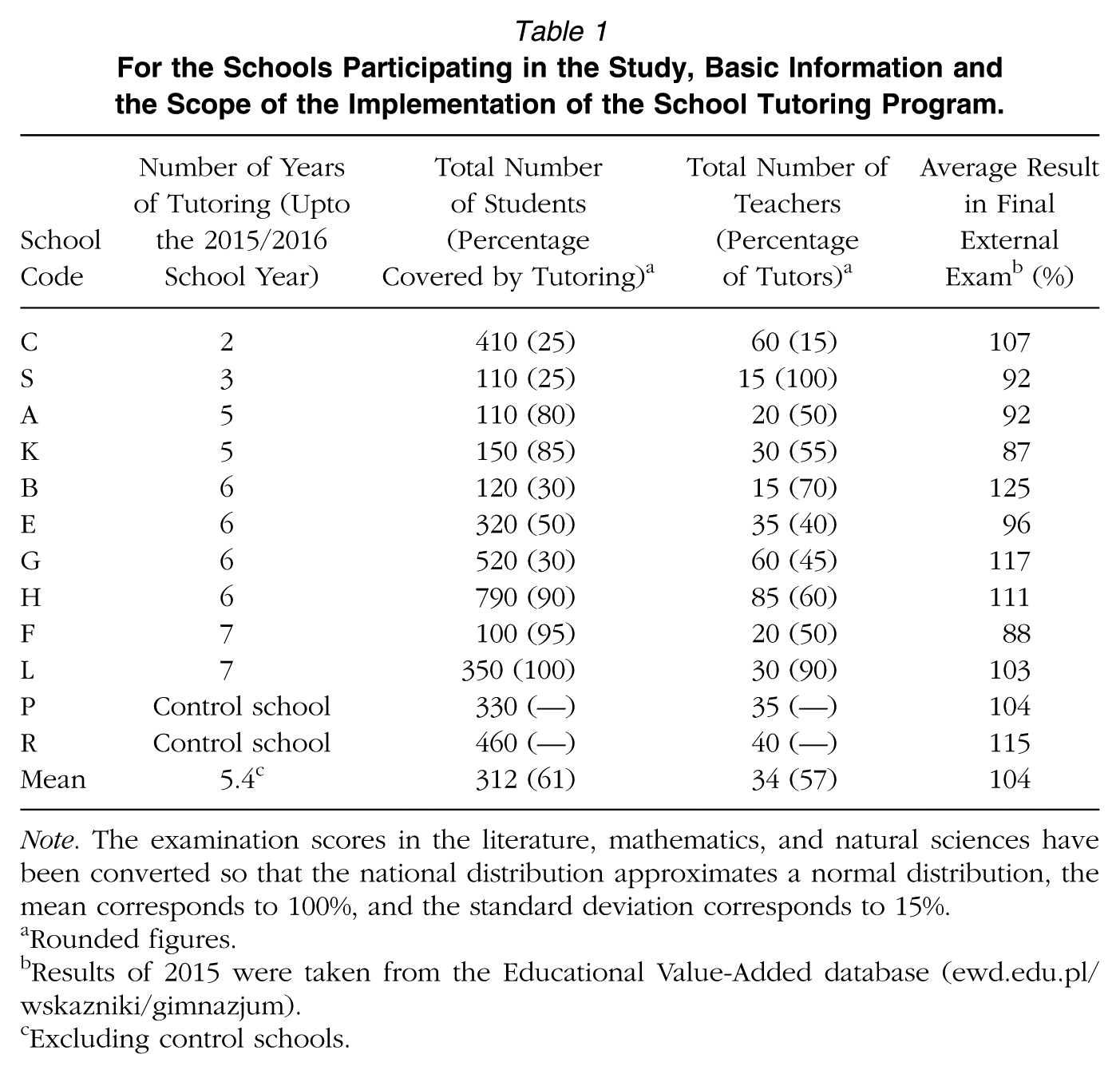
Note. The examination scores in the literature, mathematics, and natural sciences have been converted so that the national distribution approximates a normal distribution, the mean corresponds to 100%, and the standard deviation corresponds to 15%.
Rounded figures.
Results of 2015 were taken from the Educational Value-Added database (ewd.edu.pl/wskazniki/gimnazjum).
Excluding control schools.
The research materials were collected in three stages. First, together with the teachers, the research team prepared ethnographic descriptions of the school, including information on the socioeconomic status of the students and the organization of teaching, tutoring, and other school activities. Next, in each school, a 60-minute unstructured teacher group discussion on tutoring experiences was recorded. Afterward, 52 individual in-depth interviews (at least four at each school) were conducted with teachers who had previously participated in the group discussion: Teachers with differing experiences of teaching and tutoring were invited. The interviews were transcribed, 1 and the institutional and the interviewees’ personal information was anonymized. 2
The triangulation of individual interviews and group discussions proved to be particularly inspiring for the analysis. The narratives of the teachers in the interviews and group discussions were not identical. The comparison of differences allowed for the reconstruction of the relationships between (1) the individual experiences of tutor-tutee relations and becoming a tutor and (2) the collective processes of introducing into the teacher-tutors’ community organizational and cultural changes in the pedagogical practice of the school and learning. Thus, having a sociogenetic character, the fundamental research question is how tutoring—as a new pedagogical praxis—is developed by the teacher-tutors; that is, in what practices are the professional orientation patterns transformed and by what teacher experiences are the sociocultural paths of school development marked?
The Documentary Method
The material was subsequently analyzed in compliance with the principle of Mannheim’s documentary method (1952a, 1980), which has been currently developed by R. Bohnsack (2014, 2017a, 2017b) and other researchers (Amling & Vogd, 2017; Asbrand & Martens, 2018; Bohnsack et al., 2010; Krzychała, 2019; Loos, Nohl, Przyborski, & Schäffer, 2013).
The documentary method includes the formulating (also formulative) of an interpretation, then the reflecting (also reflective) of the interpretation of the empirical material, and, finally, the generating of theory as a multidimensional typology (Bohnsack, 2014, 2017a). The five primary data processing steps in the documentary interpretation are as follows (Krzychała, 2019):
Formulating analysis I comprises the thematic division and identification of the structure of text passages constituting the basic units for subsequent analysis.
Formulating analysis II aims to determine the species and forms of expression used by the narrators in particular passages—for example, the use of description, telling, argumentation, metaphors, and gestures. The formulating of the interpretation allows for the description of the orientation schemes to be expressed at the level of the communicative knowledge.
Reflecting analysis I focuses on capturing the meanings that extend beyond the literal content of speech and reveals orientation frameworks evident to narrators and that are anchored in atheoretical knowledge. Analogously as in the conversation analysis (Rapley, 2007, p. 72), researchers take into account the sequence of passages, the order in which the topics emerge, and references to the statements of the previous speaker or the topic mentioned above. The first statement is treated as a proposal, followed by a reaction. However, in addition, in the documentary analysis (Bohnsack, 2017a, p. 211), the researchers also take into account the third turn of a reaction to the reaction (called also a conclusion), in which the author of the proposal can address whether and how the proposal was understood in a reaction. The primary utterance chain in the reflecting analysis I contains a proposal-reaction-conclusion, and the attention is focused on the conclusion in which the researchers can observe the confirmation of habitual understanding or the need to draw a difference or misunderstanding of the reaction if it was anchored in a different experience sense.
Reflecting analysis II introduces to the analysis a comparison with other nonadjacent passages from discussions or with statements recorded in other interviews (comparison inside the case and between cases). In particular, the researchers identify different ways of presenting similar topics and tasks depending on the various biographical, social, and institutional conditions in which the orientation frameworks are created and reproduced. In the presented study, the comparison takes into account differences in the individual experience of teachers within a specific school and related not only to different factors—for example, differences in work experience, position in school, and the tasks undertaken—but also to the biographical and sociocultural background. It also considers the differences between teacher teams in different schools; due to the diversity of the organizational culture or the community of students attending school, these teacher teams are confronted with various challenges in their space of experience.
In formulating the interpretation, the collected narratives are read as a description of activity at the school. In reflecting the interpretation, the narratives are also seen as a document of the teacher’s understanding reflected in the way in which the themes emerge and from which perspective they are addressed. In the pilot research, I participated in two peer meetings of teacher-tutors from several schools; in these peer meetings, the participants spontaneously shared their experiences and discussed current problems to be solved. The comparative analysis showed that the same dynamics were documented in the group discussions recorded during the study. These discussions were also moderated spontaneously by the teachers themselves and only partially by the interviewers. In Mannheim’s (1952a) perspective, we can treat group discussions as a document of collectively shared or differed experiences to the extent that the teachers’ orientation patterns are reflective of the content and dynamics of the discussed activity.
The interpretations resulting from the formulating and reflecting analyses become the basis for a theoretical generalization:
The creation of a typology as a theoretical model aims to define based on reconstructed sociogenetic differences in the history of their emergence in practice and their inclusion in new contexts of practice, multidimensional types of orientation patterns. The researchers generate a typology in accordance with the principle of theoretical saturation until the introduction to the analysis of subsequent cases does not change the key types but only increases the set of situational examples and allows for the understanding of nuances in the empirical variants of the orientation patterns.
As a result, four key types of teachers’ responses to the new pedagogical practice were identified: synergic, niche, instrumental, and apparent activities. These types were reconstructed based on the analysis of the processes of the creation of the orientation patterns. In line with the sociogenetic strategy, the exploratory significance of the typology does not reduce to the assignment of individual schools to ideal types but functions to facilitate the understanding of the processes of school development spearheaded by the teachers introducing a new pedagogical practice into the school activity system. This analytical potential of typology is demonstrated by applying it to a detailed sociogenetic reconstruction of a teacher-driven change process in one of the Wrocław schools.
Findings
New Orientation Patterns in the Teacher Activity
In the idea of school tutoring, the implicit challenges to overcoming contradictory expectations include (1) a classroom system that focuses on school achievements and meeting the curriculum requirements and (2) a tutoring program that presupposes individualized cooperation is adjusted to the potential and interests of the students and is conducted within an informal relationship between the tutor and the tutee. Implementing the individualized model of tutoring in the “traditional” model of a school requires the teachers’ learning community to effectuate a change in the school system and adapt it to the new pedagogical tasks.
Based on the research data, four change variations were identified that specify the new orientation pattern’s inclusion—both as a tutoring scheme and as a framework—into the school practice (Figure 1). Schools in which the tutoring orientation scheme has been integrated into the school program and has become a key and almost indispensable element characterizing a proficient style of work at school (central change) can be distinguished. In contrast, there are schools in which tutoring is not perceived as a strategic element of the school work organization but rather as one of many additional activities, which, at best, makes the school’s offerings more attractive (peripheral change).

Typology of integrating the new orientation pattern in the teacher activity.
The development of the orientation framework results from a different understanding of the meaning and significance of tutoring experiences. The teachers have a different sense of the nature and extent of the changes that the tutoring practice contributes to school development. On one hand, the tutoring experience generates a new quality and a new pedagogical perspective in thinking about the student, the teacher, their relationship, commitment, and even about learning and teaching. It provides the teacher’s community with a critical perspective for the self-evaluation of activities at school, not only tutoring activities (autonomous change). On the other hand, tutoring is admittedly perceived as a new method of organizing individual activities with the student; however, it does not result in a new quality of work at school. It remains subordinate to the already dominant goals and strategies of work in a specific school (heteronomous change). In such cases, tutoring does not become a critical impulse to think about school in a different way, and it does not provide a new voice in the discussion and reflection on the school performance.
The analytical distinction between the changes in the orientation scheme (program and organization) and the orientation framework (style and sense) underlays a model that describes four ways of incorporating the new orientation in the school practice (Figure 1). Correspondingly, tutoring constituted as an innovative pedagogical practice can be categorized in four forms: synergic, niche, instrumental, and apparent activities. In the retail analysis, particular attention is focused on schools with a developed and tested synergistic tutoring model. However, this was not observed in a pure and isolated form. In everyday school activities, synergistic tutoring coexists with elements of other forms of tutoring activity. The pragmatic form of synergic activity, observed in schools E, F, G, H, K, and L (Table 1), was identified as a pragmatic change integrated into the school. The four theoretical types can be treated as ideal types, which—although derived from historical and empirical observations—do not finally describe social phenomena but can be used as heuristic propositions and analytical categories to understand specific forms of experience (Weber, 1978). Following this analytical strategy, the typology of integrating the new pedagogical practice into the school activity system is described, and then—by using the example of school H—the way in which a specific teacher team develops through a dynamic and complex process a new pragmatic orientation pattern of synergistic tutoring is demonstrated.
Niche Activity
Niche activity describes tutoring that was not yet fully integrated into the school curriculum. In the peripheral form, the tutoring program only involves some students and classes. In the initial phase of introducing the tutoring program in most schools, niche tutoring was observed when a small group of highly motivated teachers became involved in tutorials with students. With full conviction, they realized the scenarios and methods learned during the tutors’ initial training. At the same time, the experience of tutoring relations is so qualitatively different from the experience associated with previous activities at school that it begins to be perceived by teachers as an experience that has autonomously changed their thinking about the essence of the educational impact. The pioneers of change and informal leaders of change begin to emerge. A characteristic feature of niche tutoring is the simultaneous learning of tutoring methods, trying them out, and searching for original modifications. This search results from the need to gain experience, on one hand, and from the lack of verified organization, on the other hand. Teachers remember this time as especially inspiring for their individual development and as a period of intensive cooperation in their tutors’ team. Even after a long period of time had passed, the story of the beginnings of tutoring was also told by the teachers, who did not originally directly participate in it and joined the team of tutors after a few years. From the sociogenetic perspective, referring to this phase, often by contrasting it with the tutoring model developed later, helps understand the direction of further development.
Niche tutoring, as an initial stage, constitutes a transitional form (schools E, H, G, F, K, L, and S; Table 1). In one of the schools (E), niche tutoring took a permanent form. Initially, it was performed by a large team of teachers and comprised approximately half of the students. After the school management changed, it ceased to be considered a strategic activity. Teachers did not receive further financial or organizational support. They had to organize time on their own to meet the students in tutorials after the lesson, and over time, this activity was limited to a small group of enthusiasts.
Apparent Activity
An apparent activity describes situations in which tutoring is officially run as a program; however, teachers, despite their organizational and personal effort, do not experience the benefit of tutoring activities. From the heteronomous perspective, tutoring is seen as an additional burden. Two general forms of apparent tutoring are documented. The first is related to the marginalization of tutoring from the very beginning and constitutes a permanent form of apparent activities (schools A and B). The second results from the incompatibility between work methods and the students’ needs and abilities. In this form, the teachers later notice that tutoring is not effective (school H). In this case, it becomes a transitional form since it initiates an intense discussion on the sense of further engagement. It also poses a new challenge for teachers to develop their new model of tutoring at school.
Even after the tutoring program had been running for several years (school A for 5 years and school B for 6 years), the permanent form of apparent tutoring was identified. Interestingly, whereas only one in three junior high school students participated in the tutoring activities at school B (30%), at school A, as many as 80% of the students were officially involved in tutoring activities with a designated tutor. However, in a high-performing school A and a discipline-oriented school B, supporting the students’ individualized objectives seemed contradictory to the unquestionable school routine. In both the schools, the tutoring program was maintained because it could be presented in the school’s advertising as a concern for the individual talents or particular needs of the students. The tutoring—as can be observed in the narrative of the teachers at school A—turned out to be a reproductive model of the apparent activity: Af1: At the beginning, when we were starting all this work as tutors,
I remember we ran after some of them all over the place (.) to
make an appointment. ⌊ Af3: We even had to put together the timetable. Af1: Yes. We used to set up the timetable so that it suited them; we would
catch the children (y) before they left school (y), right? Remember?
You were making arrangements with me. None of us is doing it anymore,
are we?
Agr: No. Af1: To force the child to do so, (.) to organize such meetings and-. They know that we are at their disposal. If they want to talk to us, they,
we are (.) ready to talk, but (.) we don’t force them, and we also don’t catch them
(hm) so that the schedule is honored, you know, because we have to
meet with them a few times per week or per month(.). We do not (m)
chase after them as it has been up to now. At least, I am not doing
it anymore.
In the quoted excerpt, the sociogenesis of the apparent change is documented in the experience of both a potential tutoring leader (Af1) and the teachers’ team. Teacher Af1 had high hopes for tutoring; however, her enthusiasm dwindled. Additionally, this change in attitude did not result only from being overloaded with too many tasks or difficulties in reconciling tutoring with other school responsibilities. The tutor does not see any qualitative difference when working with tutoring. Tutors experience chaos in tutorial activities, including chasing after children, catching them, and the impossibility of implementing the timetable they devised. In their opinion, this “chase” was children oriented “so that it suited them”; however, there was no building of relationships or meeting with the children. This personal experience of Af1 is reinforced by the group experience, as evidenced by the linguistic change from “me” to “us” and confirmation by the group that no one is “catching” children anymore. This withdrawal occurred as the teachers felt they were at the students’ disposal; this resulted in the students having a sense of freedom and left them with the responsibility for taking the initiative in tutoring activities. From a theoretical point of view, these experiences are consistent with tutoring activities; however, the experience of the teachers at school A is quite different from that of teachers in a niche or synergic tutoring situation. The illusion of the teachers from school A that they have “really” worked hard in using the tutoring method and that tutoring “really” does not work is authentic because the teachers have no other point of reference. The abandonment of “chasing after them” seems to be a rational action from their collective point of view to avoid further confrontation with failure. At the same time, it is a trap that protects them from the aspect of the tutoring experience that might call their convictions into question. In this situation, apparent tutoring occurs on a minimal scale as an additional peripheral activity. It is evaluated from the perspective of the dominant heteronomous activity strategies operating at the school and on the same level as the other activities in the school. Thus, in the long run, it turns out to be superfluous.
Instrumental Activity
Tutoring as an instrumental activity is introduced as one of the appreciated methods, and it is perceived as an effective and efficient way of motivating students. Most often, its value results from the warming up of the teacher’s image and the appreciation of the student’s strengths, which facilitates the interventional and disciplining work of the class tutor. Over time, the teachers have found that the students can still be allowed a wide margin of freedom during tutorials, while working systematically to solve problems that are in line with school objectives. The teacher-tutors report that tutoring helps them “manage their classes” to even out differences among students and to truly “model” them:
Lf6: So, I also think that the tutor’s role is that of a guardian.
And this is what I like in tutoring that(.) that well, children have (m)
this closer contact with the teacher, but well, that simply, well (.)
two teachers manage a class of thirty and not just one teacher, right?
And, for example, then (y) one worked as a head of the class,
and that is the one (.) without these proper relations, and then
that tutor did his job. Basically, (.) it was not exactly clear
what it was all about, right? I didn’t get it at that time.
In tutoring, it is crucial to focus on the students’ strengths and support them in their autonomy. In instrumental tutoring, this orientation has been overshadowed by the need to respond to educational deficits and difficulties and to strive to unify the group of students. In the course of the tutorials they run, the teacher-tutors notice the differences in how the students work; however, such differences are not interpreted from the personalistic and dialogical perspective. They are used to develop the students’ scheme of modeling consistent with the mission of the school and the educational program. The main driving force behind instrumental tutoring is, as the teacher Lf6 puts it, “closer contact with the teacher.” The purpose of the intervention is masked by a caring face and techniques of subtle disciplining (Foucault, 2001). In instrumental tutoring, the care for a person has a hidden program of a good guardian who knows what is suitable for the tutees. Tutoring becomes a technique of controlling the freedom and subjectivity of the student. “These are techniques which allow individuals to work on themselves to become different kinds of subjects. Such technologies, however, could also bind us to categories in which individuals are subjected to social control” (Wong, 2013, p. 6).
Instrumental tutoring as a transitional form could be observed in schools E, F, and H. Tutors, who worked with students who were in the group at risk of social exclusion, were looking for effective methods. When they became convinced that tutoring could serve as a potentially useful method, they became involved in a direct relationship with the students whom they had previously avoided due to fear of manipulation and abuse of trust by the students. However, the tutoring meetings changed the tutors’ attitudes toward the students in the course of school tutoring development:
Ef8: For me, tutoring gives the school sort of a human face, so that I am a human being, and I think it also gives a lot to kids, and makes them think I am not a teacher, but a human being, and he is not just a student but also a human being. I think that is it.
At first, the significant effect of the tutoring was an image of a “human face” of the school. Over time, however, a critical discussion developed among the teachers who began to see increasingly that the student “is not just a student but also a human being.” Experiencing the contradiction between the idea of a personalized pedagogy and the form of tutoring that had been developed thus far was no longer accepted, and the tutors have begun to learn new patterns of the teacher-student relationship.
In one school (L), instrumental tutoring remained in a permanent form and coexisted with activities that can be identified as synergic tutoring. The teachers in this school combined tutoring with tests, diagnosis, and devising work schedules with the students, all of which were subsequently included in the student’s personal records. The cooperation with the tutees within the framework of tutoring has been strongly formalized; however, the individual teachers within this bureaucratic framework have developed space for open and deeper relationships with the pupils. Although the group discussion did not include a critical reflection on this tutoring practice, during the individual interviews, two teachers began to review this form of tutoring critically. For the time being, concealing instrumental tutoring by emphasizing its effectiveness allows the group of tutors in school L to maintain the illusion of an individualized educational process.
Synergic Activity
Synergic activity refers to tutoring that is adopted as one of the central elements of the school activity. Tutoring inspires and influences the development of the entire school curriculum, and in a school, educational performance stimulates and promotes further development of tutoring beyond the boundaries set by the first tutoring experiences and methods acquired during training. Synergic tutoring can be observed in schools with a more extended period—that is, from 5 to 7 years—for developing a new orientation pattern. In the research, these schools are marked with the symbols E, F, G, H, K, and L.
In synergic tutoring, even when they experience difficulties and a chronic lack of time for all tasks, the teacher-tutors’ attention is no longer focused on organizing work and combining it with other responsibilities. The essential point of reference is the orientation framework—that is, the individual and team experience gained in tutoring with students and in cooperation with other tutors. Tutoring is seen as an autonomous understanding and for pedagogical activity, a central concept that covers the entire learning period students spend at school. The tutors recognize the potential of the students and the students’ diverse needs, including extracurricular ones beyond school achievements. The tutors are much more comfortable in dealing with difficult situations such as conversations with hyperactive or taciturn students who adopt a passive or confrontational attitude in their relationship with the tutor. The tutors adhere less strictly to the tutorial scenarios and methods learned from their initial training:
Ff2: Later on. For example, (yy) (.) just after such integration classes
and these, and now I want to do exactly this (yy) in my class
in the second semester, even though it is the first grade.
Still, I would like to set such goals now, that is, agree with the children
on the goals to achieve. Normally, I would do it in the second grade,
and most often, in the third grade, when we have got to know
each other better. But, for example, when I am looking at my children,
it seems to me that I should do it right now. Especially because
they themselves are saying: “At the end of the year I would like to,
for example, have an average of four point-something, right?”
And that’s with, that’s how I did it. Actually, these were the children’s
decisions, and they signed next to that note to confirm. And at the end
of the year, we checked whether they made it or not or in which
areas they were successful and in which ones, not.
The teacher Ff2 does not perceive her current work with the tutees as a simple repetition of the good practices elaborated in the initial phase of a tutoring project. She can modify her approach flexibly in response to her interactions with the students. While planning tutorial activities, the teachers fuse and mediate several perspectives: (1) the recognition of the tutees’ perspectives and expectations (“especially because they themselves are saying”), (2) the teacher’s own professional overview of the students’ needs and development potential (“when I am looking at my children”), (3) the timing of the intervention in the broader process of tutoring and the cycle of the students development at school (“I should do it right now”), and (3) the flexible application of tutorial methods (“Normally, I would do it in the second grade”, “And at the end of the year, we checked whether they made it or not”).
In reality, however, the examined cases do not represent pure synergic tutoring. Thus, they can be considered to be pragmatic forms of synergic tutoring. The pragmatic form of synergic change integrated into schools has been developed and tested in at least one full 3-year cycle of work with the students (from the first grade to the end of junior high school attendance). In the subsequent cycle, the teachers refer not only to the ideas of tutoring but also to their own experiences. They do not focus on the current organization of meetings. They perceive the tutor-educated relationship as a long-term process of counseling and broadening the scope of cooperation. The pragmatic form of synergic tutoring emerges as a result of compromises and the arrangement and expanding of new forms. The pragmatic form of tutoring moves more or less away from the theoretical school tutoring model, with which teachers become acquainted during the initial training and which is described in the tutoring program. Understanding the essence of activity in the schools with synergic tutoring requires not only observing the activity itself but also analyzing the ways of developing a new orientation pattern.
School in the Process of Change: A Case Study
The process of creating a new orientation pattern can be presented by using the sociogenetic reconstruction of the changes experienced by the teachers implementing tutoring at schools. Initially, the school tutoring program (Budzyński et al., 2009) assumed that the implementation of the new orientation pattern would be carried out in two model stages (Figure 2). In the first stage (Figure 2; Pathway ①), selected teachers were supposed to introduce tutoring ideas in a small number of classes and test organizational solutions adequate to the needs of the school. In the second stage (Figure 2; Pathway ②), additional teachers and students would be involved in the tutoring until this pragmatic change became an integral part of the school’s system of activity. No contradictions in the implementation of the program were foreseen.

The expected model process of school tutoring implementation.
However, such a model change process was not observed in any of the 12 schools participating in the study. The paths for developing a pragmatic model of school tutoring not only differed from the model expectations but also differed from each other. One universal process of change in teacher activity cannot be identified. Nevertheless, even if the process differs significantly from the model assumptions, the proposed model can be applied to reconstruct the process of change in a particular school, such as in school H. It is the largest school participating in the study (Table 1). The tutoring program was enacted for 7 years in this school. The process of change in school H is presented graphically in Figure 3. At first, the process seems complicated. This is because it, in fact, is. The teachers did not describe the process in an orderly manner or as a step-by-step process with subsequent stages. During the interviews, all the elements of social history appeared simultaneously in the narrative. Nevertheless, enabling the understanding of the pragmatic form of the orientation pattern developed in this school, the five stages of change experienced in this teacher team were identified. The purpose of sociogenetic reconstruction is neither to chronologically reconstruct particular stages nor to recognize how tutoring was perceived in the past. The interpretation focuses on the pragmatic knowledge that teachers document here and now in their narratives. The references to individual and collective experiences, including those of the past or those to which the interviewees have already distanced themselves or barely remembered, are narrated—according to the perspective documented in the interviews— from the present point of the experience sense. The sociogenic perspective is reflected in the founding stories about the beginnings of tutoring at the school and about turning points, which were reported in interviews also by teachers who did not directly participate in these events but currently identify themselves with them. The primary question in the analysis is not how precisely the specific stages looked in the past (which could be an adequate task for a longitudinal study) but how their meaning is reflected in the present point of view. Figure 3 should, therefore, be read as the overall representation of a current pragmatic orientation pattern with its retrospective and anticipative links. In interviews, however, this total and simultaneous character of the experience sense is translated into a sequential narrative, (Bohnsack, 2014), and only the reflecting analyses I and II reveal the connection between the temporally distant components of the experience.
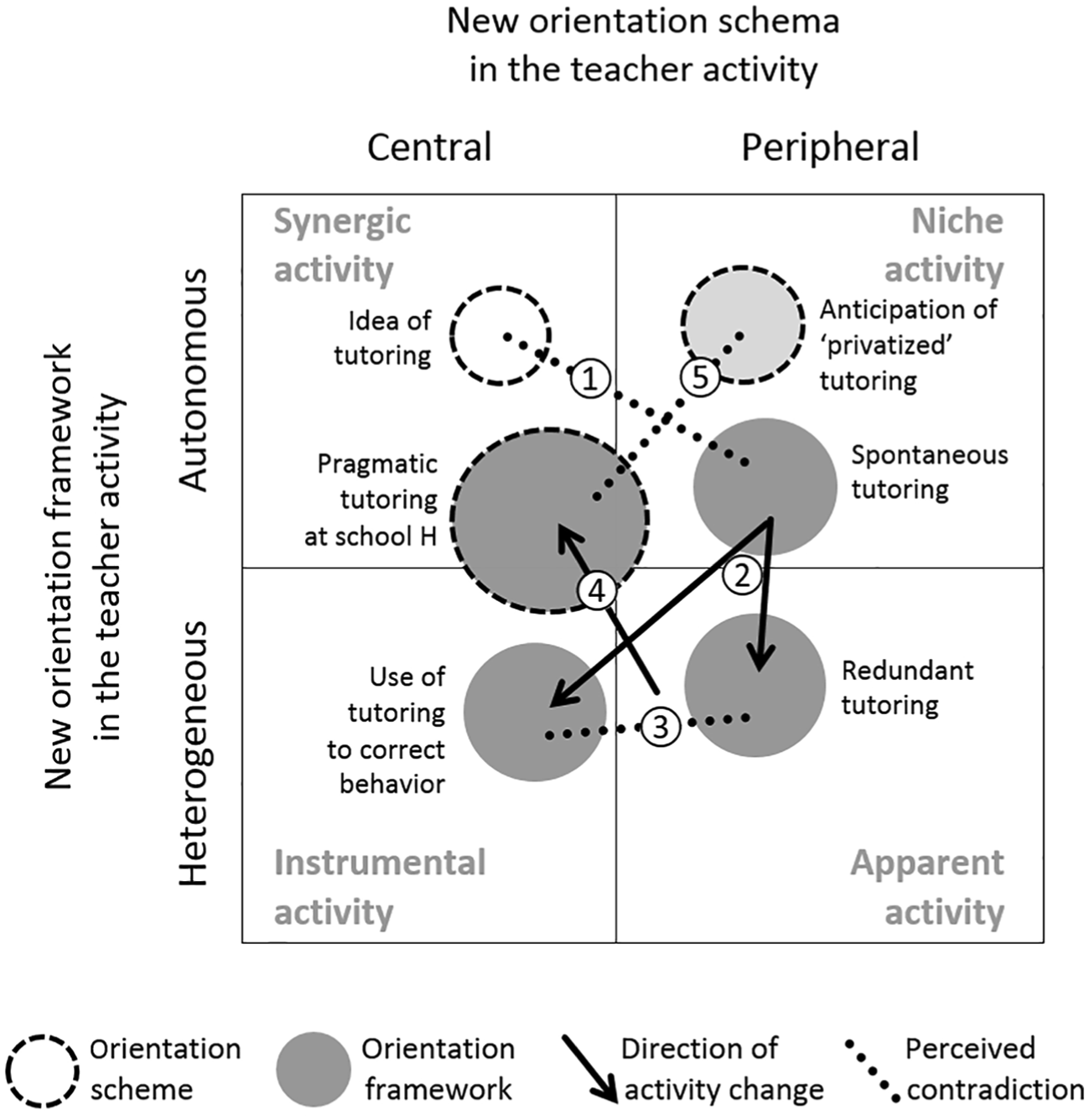
The process of changing the teacher-tutors’ orientation pattern at school H.
Becoming a Tutor and a Tutoring School: A Sociogenetic Reconstruction
The first stage of change in school H involved the experience of conflict between the tutoring based on a goal-setting strategy concept, which the teachers knew from the training, and the tutoring practice undertaken by six teacher-tutors in the first two classes (Figure 3: Pathway ①). “The beginnings were tragic. The children did not know what it was all about” (Hf2, GRD-H 232–233). The tutors did not see any opportunity to adapt the method to the students’ needs. The students were not able to set their own goals that could be discussed in the tutorials. However, the tutees took the initiative because they saw a new area of activity for themselves that was different from school education: “They became very much involved” (Hf2, GRD-H 235). They proposed their own areas of activity. When remembering that time, the tutors emphasized that they were learning to tutor from their students. The tutors and tutees formed an informal learning community. From the present perspective, the dichotomy between the adopted model knowledge about action (orientation scheme) and the spontaneously shaped understanding in practice (orientation framework) is highlighted. The tutor Hf2 remembers how the students thanked her after 3 years for their spontaneous meetings, which were quite different from what the tutors had expected:
Hf2: They brought me such a nice bouquet of red roses and thanked me for the fact that they could show me their card tricks,
which they did not show in other classes because they did not have
satisfactory results. And that they could go with me to the park.
That on Saturday, I was not ashamed to have ice cream with them
in the mall. So, these are such trivial things for us, and to them, they simply must have seemed very, very important.
At that time, through interactions with the students, the first tutors developed a pragmatic orientation framework in which it was essential to leave space for the students’ free activity, accept their interests, and build relaxed tutor-tutee relationships. The tutorials were held only partially at school. However, the teachers considered the change to be vital because the students felt much better at school. They intended to extend the activity to all classes.
In the second stage, after 2 years, other tutors and the next classes joined the program (Figure 3: Pathway ②). The experience of spontaneous tutoring gained by their colleagues provided the point of reference for the next tutors. The new tutors tried to repeat the pattern of spontaneous tutoring. For some of the tutors, this turned out to be an opportunity for an informal and subtle influence on the students. Several tutors set a goal for themselves of making at-risk students take responsibility for their learning and maintaining safety at school. They shaped tutoring according to these goals:
Hf3: From the beginning, at all times, such modeling. Someone from the outside might call it something negative, but it seems to me that modeling in this manner should come first, and only afterward, teaching openness to the world.
Another group of tutors began working with students who had good learning outcomes. Tutoring proved unnecessary when offered to students who seemed not to need it:
Hf2: They do not show any behavioral problems, but neither do these children see such kind of need (.) to come and talk, to establish any different bond.
As the school tutoring program expanded, various bottom-up initiatives of the niche, instrumental and apparent tutoring models were developed. The tutors met regularly and discussed their diverse experiences. Over time, during these conversations, critical discussions began to occur about the sense of conducting the instrumental and apparent tutoring, which visibly differed from the working style of the classes that initiated niche tutoring. Additionally, organizational problems became more apparent, as the teachers had to combine spontaneous tutoring with the numerous tasks they performed at school.
These discussions initiated the third stage of change (Figure 3; Pathway ③). Tutors Hf1 and Hf2, who were considered to be the group leaders in the tutor team, played a decisive role. Both tutors began tutorials in new classes; however, they shared the opinion that these students “did not need tutoring.” The students did not see the need to enter into a new tutor relationship exceeding the established relationship with the teacher in the lesson. The perceived contradiction represented by the different reception of tutoring by the students became a call for rethinking the sense of tutoring at the school and devising a new model. The tutors critically discussed their experience and developed a new understanding of the tutor’s role, which they described in interviews as becoming a “significant adult.” In the group discussion, the tutors reproduced their thoughts on why they had developed a new pedagogical point of view and what they wanted to keep in school tutoring:
Hf2: What gives me satisfaction in tutoring is the conversation
with young people. Of course, when they open up, when they start
talking about their problems and, and, and they are waiting
for some advice, for what you will say. It is often the case, even I have noticed that, that they perceive me That I am for them, as if, such a (y), they do realize I am older, so as if I were who is not necessarily the one that will tell them this, this, this, and that is bad. Hf3: The greatest satisfaction for me is listening because they just like speaking. And I just listen, (yy) yes, I just listen. At some point,
when it is necessary, of course, I interrupt with a question. But I like
most to listen. When they, I see that the they say, the less tense and more relaxed they become, as simple as that. Hm8: When a child comes with a problem, it means that he or she
trusts us. That is (.) as a proof of the greatest trust for me, i.e., so they
don’t go to, let’s say, their parent, but they come to me. Well, problems
can be different, different kinds, right?
This reflection began the fourth stage of change, which the teachers place at the third and fourth years of the tutoring project at the school (Figure 3; Pathway ④). On one hand, they refer to their rich and varied experiences (orientation framework); on the other hand, they developed a new tutoring discourse defined as a meeting of an adolescent and a significant adult (orientation scheme). In the interviews, regarding the tutoring program at the school, the tutors spoke about a “second” and “new” start, which addresses the experienced contradiction resulting from attempts to continue the “first” model of tutoring. The tutors introduced regular 2-hour tutorials into the school timetable. This made it possible to organize regular meetings in a large school and to freely choose a tutor not only from their class teachers but also from among all the teachers in the school. They initiated tripartite tutor-tutee-parent meetings, where together they discussed the student’s strengths and plans. The parents were initially skeptical about coming to these meetings “because, also based on their own experience from the school years, being called to school usually meant that (.) there was a problem” (Hf2, GRD-H 796–797). These meetings facilitated the development of a new model of goal-oriented work that was also applicable for talented students.
The school has already trained more teachers than the number of tutors needed. Therefore, not all tutors run tutorial meetings; however, they are familiar with the principles and goals of the tutoring method. The teachers as a whole group, not only the tutors themselves, have reorganized the activities already undertaken at the school, giving them new meaning in the context of the tutoring organization. City trips and slumber parties organized at the beginning of the school year have ceased to be just a way of spending leisure time. They have gained meaning as a place for teachers and students to meet in extracurricular situations, thereby allowing the tutees to choose their tutor more consciously. The launching of a self-service kitchen—although not directly related to tutoring—has facilitated the transfer and—as the teachers call it—the dispersal of the tutorial style to other meetings in the school. In interviews, the tutors emphasized that this was their original idea for school tutoring, which they had been testing over the past 3 years.
The sharing and the affirmation of the tutorial orientation pattern are documented in the way teachers talk about initiating tutor-tutees meetings at school:
Hf5: Yes, a, (y)- so everything is such that very often, it is . . . ⌊ Hf1: (yay)
. . . such contact during a break, please, because I have to tell you
something. I say, well, well, let’s us go to the classroom, or (.) (y)
I say, maybe, there is
or something else, isn’t it? We just have a kitchen at school, and this is
a very good place to do everything. Because you can talk ⌊ Hf1: Yes, yes.
. . . ⌊ Hf3: Sometimes, you need to make a reservation. . . . for tutoring, and this (.) arrangement is very nice, because it is very, very, very, so to speak, it facilitates the whole process. ⌊ Hf1: The kitchen is on the ground floor, yes. ⌊ Hf2: And children like it. ⌊ Hf3: They like it very much @.@
This excerpt was initiated by the moderator’s question: “How do you organize these tutorial meetings?” (Mf1, GDR-H 380). The first answers were quite casual, including responses containing phrases such as “it is, so that much depends on what my students expect” (Hf1), “very different, because” (Hf5), and “however, it depends on” (Hf3, GRD-H 381–389). The teachers did not give a simple answer, although it would probably not have been difficult for them to describe an organizational tutorial scheme. For them, however, a different perspective is important: the presentation of the principle that characterizes the developed tutoring formula. The moderator’s question was transformed into a proposal, and the above fragment is a reaction in which the proposed perspective of understanding the topic of the tutorial organization is confirmed and specified. Tutor Hf5 describes the principle by recalling examples of situations in which a tutor-tutee contact is initiated. The organization of tutorials is a response to the students’ initiative and a flexible use of opportunities by the teacher; therefore, the organization of the tutorials “depends on” other factors. The tutor emphasizes the importance of “
However, a motif of a new crisis appears in these interviews. In 2016, the city council withdrew funding from the tutoring program and undertook preparations to close the junior high schools. The program was terminated. The teachers know that they will not be able to continue this form of tutoring. In the interviews, the teachers consistently mentioned the issue of the new fifth stage that they have entered and the challenge of how to maintain the tutoring experience in the new schools.
Hf8: This year, we have already had the information that there will be no tutoring because there is no money. A colleague, who used to work with us said she liked her tutoring very much.
And now she will still come up to join her tutored class during
my lessons, and she will continue to help somehow because she likes it
so much. That is why my impression is that this tutoring, it will survive. It will be carried out in a slightly different formula.
This fifth stage was anticipated by the teachers (Figure 3; Pathway ⑤). If it happens soon, everyday practice will verify the speculations mentioned above. The teacher Hf8 and her colleague are planning how they can continue their tutors’ cooperation on the official completion of the tutoring project. They assume that their engagement can “be carried out in a slightly different formula.” This “different formula” already includes activities undertaken on one’s own. For the time being, “privatized” tutoring appears to be an imagined solution. This challenge was not yet addressed in the group discussion. The problem came to light in individual interviews, not spontaneously but in response to an additional question about the expected future of tutoring. These images are still vague. The germ of the anticipated change is already addressed as the fear of whether it will be possible to keep the tutoring experience outside of the team and outside the school that has already integrated a new pedagogical orientation pattern.
Embedding Synergic Change at School: A Comparative Analysis
In the analyzed 12 schools, especially in the course of Reflective Analysis I of group discussions and Reflective Analysis II, in which individual interviews of the teachers participating in the discussion were included in the comparative analysis, different sociogenetic paths for creating patterns of pedagogical orientation can be reconstructed. In this way, in the presented case of school H, the second stage, in which the individual attempts to reproduce the orientation scheme worked out by the pioneers played a decisive role, was reconstructed in more detail. Guidance from the training and the pioneers’ suggestions/tips proved to be insufficient and inadequate preparation for work in the more diverse classes. As the first to begin the tutoring project, the teachers designated two classes in which they had already seen the need to improve relations with the students. In the following years, the tutoring included classes in which the students—as the teachers expressed it—”did not need tutoring” in the form that had already been developed.
In Reflective Analysis II, the strategy of comparing various schools was applied to identify different approaches in which similar issues were addressed. This comparison verifies, on one hand, the orientation patterns developed in the course of Reflective Analysis I, and on the other hand, it allows for the further specification of the sociogenetic determinants of the development of the teachers’ orientation patterns. Introducing the case of school F into the comparative analysis highlights the specificity of school H. School F is the smallest school in the research, and it is attended by students at risk of social exclusion and with low educational achievement (Table 1). In school F, only two primary stages of change in the school activity were reconstructed (Krzychała, 2019): one within a niche activity, the second as a transition to a synergistic activity that spread a tutorial orientation pattern across the whole school. The form of instrumental or apparent tutoring did not appear. Even before the beginning of the tutorial program, the teachers formed a harmonious team and took many initiatives to develop an individual approach to the students with numerous problems in learning and social relationships. The teachers assessed the idea of school tutoring as directly addressing their pedagogical needs. This process of change is very similar to the model assumption (Figure 2) but differs from the first stage, which is marked by an experience of contradiction. The teachers began to carry out tutorial meetings with accuracy. However, they were soon confronted with the problem of regularity and punctuality as well as the setting of personal goals, which turned out to be a challenge for the students. After a series of informal discussions, the tutor-teachers began to turn tutorial meetings with small groups of students into social projects, such as preparation for homework, training for sports street competitions, or a project to renovate a neglected courtyard in a housing estate. This change in the orientation pattern is documented in one of the teacher’s statements:
Ff4: I gave up on some high-flying, big goals for only small tasks;
(.) small, if they do not come out, (.) there is no punishing finger;
yes, we are only trying, we are looking further. It doesn’t go out
with every child, but (.) in general, if there is a good relationship, you can go further.
The teachers saw the effects of work based on building “small tasks.” Teacher Ff4 expressed it: “I have engaged them
A comparative analysis among the schools that developed a synergic form of tutoring (H and F as well as E, G, K, and L) revealed that depending on the social structure of the students, there were different forms of tutorial work. In working with students who achieve good learning outcomes, the tutoring has retained the form of individualized meetings focused on the setting and achievement of objectives not related to the school curriculum. However, in work with average or low achievers, the initial formulas for regular meetings was replaced by work in small groups, with a focus on identifying deficits and needs and supporting social and learning competence—as in school F and partly in school H. In all schools with a pragmatic form of synergistic tutoring, although in different variants, a change in the teaching in classes was observed.
The teacher-tutors transformed the modus operandi of the tutoring—the orientation of dialogical and personalized cooperation with the tutees—into other areas of school activity. This change occurred at the level of the orientation framework, not the orientation scheme. The teachers did not design new strategies for teaching; however, they did notice a qualitative change in their classroom work. The tutors describe this influence as “scattered tutoring” as “acting without naming this tutoring” (IDI-Ef9 1500). This change in the way in which lessons are taught is to some extent similar to the changes that were observed in other studies on improving dialogue practices in the classroom (Snell & Lefstein, 2017) and on the influence of the teacher’s knowledge about students in the teaching process (Hill & Chin, 2018; Sadler, Sonnert, Coyle, Cook-Smith, & Miller, 2013). Snell and Lefstein (2017) examined the impact of a professional development program (“Towards Dialogue”) designed to promote the teachers’ interactional awareness and sensitivity. They observed the classroom interactional patterns’ change in the wake of that intervention; however, the change could still be considered as a niche change in teaching. The effect of differentiated interactions was particularly noticeable in relation to students who were perceived as academically able; in relation to other learners, with whom interactions were more sporadic and less challenging, the change was only marginal. A different effect was noted in the Wrocław tutoring program. The teacher-tutors considered students from a broader perspective than merely the context of the subject being taught, and they set tasks that also involved the weaker students. The difference can be attributed to the orientation on individualized understanding and support of the student in the tutoring, while in the project Towards Dialogue, the focus was on the organization of the lesson. This explanation can also be supported by Hill and Chin’s (2018) study. The authors prove that teachers with more knowledge of the students engaged in more remediation of student misconceptions and more often used student thinking in instruction, while teachers with less knowledge about the students limit interventions to regroup students and reteach content.
Discussion
In this study, a theoretical model for reconstructing the process of transformation of professional orientation patterns was designed based on the inquiry into the school tutoring program expanding the class- and lesson-based curriculum. Analytically identified both as an orientation scheme and as an orientation framework, the praxeological concept of orientation patterns enables an analysis of the school development not only at the level of the description of institutional solutions but also as tacit agreements and a habitual understanding. In a long-term change in educational practice, elements of synergic, niche, instrumental, and apparent activities can swap, intertwine, or coexist as transitional or permanent forms of incorporating new pedagogical practices in schools.
The study of the school tutoring program covered 12 schools, including 8 schools developing tutoring from 5 to 7 years. In six schools, various pragmatic forms of integrating synergistic tutoring into the school’s system were reconstructed. In these schools, the pedagogical innovation does not cover a selected group of students but becomes an integral part of the school’s curriculum. The analysis showed that although the tutoring process lasted up to 7 years, the process of changing schools was still open. However, due to the dissolving of junior high schools in the results of the school system reform initiated in Poland in 2016 (European Commission/EACEA/Eurydice, 2018), it was not possible to further investigate these teams of teachers. The study was designed in such a way that the object of analysis was the teachers’ experiences. It took into account neither the interviews with students nor the direct observation of the tutorial meetings or classroom teaching. Further study on the sociogenetic process of teacher knowledge transformation could benefit by merging data from different sources to reconstruct the professional learning community experience and school improvement from multidimensional perspectives.
School development may not be linear and homogeneous; furthermore, based on specific experiential spaces in a school, it can vary in numerous forms. Presumably, if the research could be extended to other schools, we would be able to obtain an even more diverse picture of the possible trajectories of changes. The proposed general model of theoretical typology—ideal types in Webber’s sense—is designed as an analytical tool that can help in the reconstruction of particular cases. Moreover, it allows for the interpretation of critical and contradictory moments in the process of emerging new orientation patterns. From this perspective, apparent and instrumental activities can also be an essential element of the experience, as they inspire critical reflection and open new challenges for school development. For those who support teams of teachers, both at the level of school administration and at the level of counseling and supervising, this observation sets an essential objective to be attentive to the conflicts and challenges that have been experienced, while at the same time not closing the space for experience by arbitrarily accelerating decisions and setting preestablished goals. Sharing ideas and goals—as in the case of apparent change—can only turn out to be an illusion of change.
Concerning far-reaching changes, the teacher community can constitute itself by learning how to overcome contradictions within the school practice. Engeström (2015) argues that the creation of new forms of activity can just be initiated when solving problems and challenges turn out to be impossible on the basis of orientation patterns shared by the community. Significant changes in practice are opened up through confrontation with double-bind situations that are often experienced as “personal crises,”“breaking away,”“turning points,” or “moments of revelation” (Engeström, 2015, p. 122). This conclusion is in line with the reconstruction of the school development process, which led to pragmatic forms of synergistic tutoring (schools E, F, G, H, K, and L). Initially, the first phase of school changing was marked in part by the experience of contradiction between the idea and practice of tutoring and in part by the subsequent experience of contradiction between the niche tutoring and extending tutoring when successive teacher-tutors and student-tutees were included. The practice becomes a space for expansive learning if it comprises “a social, societally essential dilemma that cannot be resolved through separate individual actions alone—but in which joint cooperative actions can push a historically new form of activity into emergence” (Engeström, 2015, p. 131). These “joint cooperative actions” seem particularly crucial when after the enthusiastic niche change stage, the new practice cannot simply be multiplied in the institution.
The strategy of triangulation of group and individual interviews applied in the study indicates the potential for further research on the relationships between the individual and collective experiences of teachers. In the analyzed interviews, we observed, as in the cases of school H and F, the desynchronization of individual and collective changes. Among other individual characteristics (e.g., related to the subject taught and the profile of pedagogical preparation as well as personal and educational biography, social experience of exclusion or advancement), differences in the teachers’ careers and in their range of levels of experience and proficiency can vary significantly in the way in which they influence how teachers within the same school incorporate new orientation patterns.
Further studies should take into account the differences in the experience of change encountered by teachers who begin working at a school and include the new orientation pattern in their professional development from the very beginning. On the other hand, further analysis may involve experienced teachers whose professional development is connected with the already acquired and the new orientation patterns’ integration and coordination based on a critical and pragmatic revision of both. In the Wrocław schools, leaders of the change emerged from both groups of teachers (Krzychała, 2018). From this perspective, the professional praxis community can be examined from the perspective of a multi-individual experience environment in which educational change creates a knot of activity (Engeström, 2007) that focuses on different points of view and a sense of practice.
The proposed model of interpreting the teachers’ responses to the new educational practice may be used in a further study on educational change, regardless of whether this change is situated in the area of individualized teaching/tutoring or democratic, multicultural, and inclusive education. The continuation of research on institutional changes from the praxeological perspective in diverse cultural and educational contexts, taking into account the long-term and multidimensional process of transforming professional knowledge, has the potential not only to verify the proposed model but also to spark new methodological and practical inspirations in advancing the research on the professional learning communities.
Footnotes

Notes
S