



Abstract
We present findings from a randomized controlled trial of Descubriendo la Lectura (DLL), an intervention designed to improve the literacy skills of Spanish-speaking first graders, who are struggling with reading. DLL offers one-on-one native language literacy instruction for 12 to 20 weeks to each school’s lowest performing first-graders. Examining literacy outcomes for 187 students, hierarchical linear model analyses revealed statistically significant effects of student-level assignment to DLL on all 9 outcomes evaluated. Impacts were as large as 1.24 standard deviations, or a learning advantage relative to controls exceeding a full school year of achievement growth. The mean effect size of d = 0.66 across the nine literacy measures is equal to approximately two thirds of the overall literacy growth that occurs across the first-grade year.
As the Latino population continues to grow rapidly in the United States, establishing educational programs that meet the needs of Latino students is imperative. As of 2016, the estimated Latino population of the United States reached 57.5 million—or 18% of the nation’s total population—making people of Hispanic origin the nation’s largest racial/ethnic minority (U.S. Census Bureau, 2017). By 2060, projections suggest that the Latino population in the United States will double to 119 million or 28.6% of the total population (U.S. Census Bureau, 2017). Within U.S. schools, 24.7% of kindergarten through 12th-grade students were Latino in 2016 (U.S. Census Bureau, 2017). As of 2014, approximately 4.7 million public school students participated in English language learner (ELL) programs, with 3.6 million or over 78%, of this group composed of children of Hispanic background (Musu-Gillette et al., 2017). Despite the growing representation of Latino students in U.S. schools, the education system continues to fail to identify reliable and replicable programs to serve Spanish-speaking English learners (ELs), and their general educational needs and specific first- and second-language needs often remain unmet.
Results from longitudinal studies suggest that sustained use of native language instruction can accelerate learning and empower youth by maintaining their cultural identity and enabling literacy in students’ home language (Cummins, 2005; Lindholm-Leary & Block, 2010; Ramírez, Yuen, Ramey, & Pasta, 1991; Thomas & Collier, 2002). Prior syntheses of research on bilingual education programs (August & Shanahan, 2008; Genesee, Lindholm-Leary, Saunders, & Christian, 2006; Goldenberg, 2008) also suggest that early reading proficiency in one’s native language is one of the strongest predictors of later English language performance. More recent studies comparing bilingual and English-only programs have offered further evidence to support the findings from these earlier reviews, suggesting that bilingual literacy instruction produces stronger long-term English proficiency and English/language arts achievement (National Academies of Sciences, Engineering, and Medicine, 2017; Umansky & Reardon, 2014; Valentino & Reardon, 2015). Indeed, six syntheses of the literature have concluded that, compared with immersing students in English, teaching students in their native language as well as in English produces superior literacy results overall (Francis, Lesaux, & August, 2006; Greene, 1997; McField & McField, 2014; Rolstad, Mahoney, & Glass, 2005; Slavin & Cheung, 2004; Willig, 1985). And bilingualism has other potential benefits, including cognitive flexibility (Bialystock, 2001; Galambos & Hakuta, 1988; Nagy, Berninger, Abbott, Vaughan, & Vermeulen, 2003), improved family cohesion, and higher self-esteem (Portes & Hao, 2002; Vom Dorp, 2000).
A robust literature suggests that Spanish-speaking ELLs benefit from early literacy instruction offered in their native language. Nevertheless, some children afforded this opportunity will continue to struggle to acquire essential early literacy skills—even in their native or first language. In these cases, children need interventions to help them develop Spanish literacy skills so that they can become successful readers in their first language and can then, over time, apply and transfer these skills to their English literacy development. With 80% of ELs claiming Spanish as their home language (Calderon, Slavin, & Sanchez, 2011) and with the continued growth of bilingual programs across the United States, the number of students receiving their initial literacy instruction in Spanish will increase, as will the need for a Spanish-language early intervention program for students at risk of literacy failure. One such program is the Spanish reconstruction of Reading Recovery known as Descubriendo la Lectura (DLL; Reading Recovery Council of North America, 2014c).
The DLL Theory of Change
DLL is guided by evidence-based principles and practices that promote ELs’ literacy development, including instruction aligned with the National Reading Panel’s five essential components of reading; the importance of self-directed student learning; high-quality individualized teaching, support, and oversight from trained teacher leaders; the importance of early intervention; and intensive first-language support to help struggling readers succeed in classrooms that provide literacy instruction in Spanish.
DLL incorporates the National Reading Panel’s five essential components of reading instruction: phonemic awareness, phonics, vocabulary, fluency, and comprehension (Reading Recovery Council of North America, 2014e). These components are derived from decades of research on literacy learning (National Institute of Child Health and Human Development, 2000) and are addressed throughout student lessons. For example, because research suggests that fluency requires grouping words quickly to help create meaning, that it impacts comprehension, and that it is enhanced by monitored oral reading, DLL teachers attend to the role of oral language, encourage fast recognition in reading, provide opportunities for multiple readings of familiar texts, and demonstrate phrasing on texts in a variety of ways (Reading Recovery Council of North America, 2014d).
Individualized Instruction
DLL reading instruction also is based on the principles of Marie Clay’s research on literacy processing. For example, the program’s distinctive individualized instructional component spawns from Clay’s assertion that children’s processing systems are ever-changing, and thus, careful teacher observation is essential to directing effective instructional decisions. Furthermore, understanding children’s strengths allows teachers to maximize students’ reading skill set. Clay suggested that literacy learning includes more than isolated instruction on letters, sounds, and words; rather, quality learning involves reading continuous text (Reading Recovery Council of North America, 2014a). This principle is reflected in DLL lessons that move beyond such isolated instruction into fluent reading practice. Clay’s (2001) assertion that children must actively construct their own understandings aligns with the program’s emphasis on independent learning.
Self-Directed Learning
DLL focuses on sustainable literacy success by offering opportunities for self-directed learning through writing, motivation, and independence strategies (May et al., 2013). As opposed to passive activities, DLL facilitates “active construction” learning based on the notion that carrying out activities, such as reading books and writing messages, bolsters self-monitoring and problem-solving abilities (DeFord, 2007). Teachers foster these skills by allowing students to work independently while offering guidance as needed.
High-Quality Instruction
The DLL model is also based on the assumption that high-quality instruction is central to improving the literacy of low-achieving students (May et al., 2013). The program model supports quality instruction through stringent teacher selection standards, extensive training, and job-embedded ongoing professional development. University-trained teacher leaders provide a year of intensive training in Spanish or a year of English training and a second year of “bridging” to Spanish. Following this training, teacher leaders provide close supervision during the teacher’s field year and, in future years, multiple professional development sessions and continuous technical assistance including one-on-one coaching. These high standards and continuous, supportive mentoring opportunities combine to produce teacher expertise, and ultimately reflect the underlying principle that instructional quality is paramount (May et al., 2013).
Systemic Support for Reform
Moreover, the program is guided by the assumption that interventions and reforms must be supported by school systems and, therefore, implementation oversight is required (May et al., 2013). As Bryk, Gomez, and Grunow (2010, p. 130) contended, “The history of educational innovation is replete with stories that show how innovations work in the hands of a few, but lose effectiveness in the hands of the many.” DLL strives for a sustainable and scalable system that values implementation fidelity. It accomplishes this fidelity of implementation through continuous, district-level monitoring, national standards and guidelines, and feedback provided by teacher leaders to key DLL staff (e.g., administrators, teachers; May et al., 2013).
Early Intervention
While much research supports DLL’s specific approach to reading instruction, it is also clear that intervening early is essential to future academic achievement. Many studies have shown that students who fall behind in reading in first grade fail to catch up to their peers (Juel, 1988; Lyon & Fletcher, 2001; Shaywitz et al., 1999). An exploration of research in economics, developmental psychology, and neurobiology suggests that these early deficits have lasting consequences, as early learning has a particularly strong influence on cognitive skills and brain architecture (Knudsen, Heckman, Cameron, & Shonkoff, 2006). The authors assert that skill development is a “hierarchical process in which higher level functions depend on, and build on, lower level functions, and that the capacity for change in the foundations of human skill development and neural circuitry is highest early in life and decreases over time” (Knudsen et al., 2006, p. 10155). Thus, early learning programs, like DLL, represent the highest potential return on investment.
Native Language Learning
Finally, DLL is predicated on the notion that learning in one’s native language can accelerate literacy development in both the short term and, even more important, in the long term. From a practical standpoint, DLL provides a coordinated approach to supplement and support the development of quality literacy programs, in Spanish, for Spanish-speaking children. While there is evidence that ELs in programs offering varying amounts of English instruction perform equally well initially, there is substantial evidence to suggest that literacy programs offering more initial learning in the students’ native language lead to larger academic gains in the long term (Ashdown & Simic, 2000; Richards-Tutor, Baker, Gersten, Baker, & Smith, 2016). In fact, a meta-analysis on EL literacy development from the National Research Council concludes that literacy programs taught in a student’s second language heighten the risk of later reading difficulties, which “may compound the risks associated with poverty, low levels of parental education, poor schooling, and other such factors” (National Research Council, 1998, p. 234). DLL is specifically designed to support high-quality programs that emphasize early instruction in students’ first language of Spanish.
The Prior DLL Evidence Base
Despite the potential promise of the DLL approach, few rigorous evaluations have assessed its impacts on EL’s literacy outcomes. Several quasi-experimental studies have shown that DLL moves the bottom 20% of first-grade readers to that of the classroom average (Escamilla, 1994; Escamilla, Loera, Ruiz, & Rodríguez, 1998; Neal & Kelly, 1999). In addition, there is nonexperimental, descriptive evidence suggesting that DLL students, after successfully completing the program in first grade, maintain their status as average to high-performing readers and writers through the upper-elementary grades (Escamilla et al., 1998; Neal & Kelly, 1999). Though the evidence base for DLL’s sister program, Reading Recovery, is quite strong and positive (D’Agostino & Murphy, 2004; May et al., 2015; Sirinides, Gray, & May, 2018), and the nonexperimental evidence for DLL appears promising, a more rigorous randomized controlled trial (RCT) evaluation of the achievement impacts of DLL is needed to help understand the program’s potential. In this article, we report the results of the first RCT of DLL, which provides evidence to respond to the question: What is the impact of assignment to DLL services on students’ Spanish-language literacy outcomes, as measured by the Instrumento de Observación (IdO) and Logramos assessments?
Method
Sample
Two school districts, one in the Southwest and one in the Rocky Mountain region of the United States, were included in this study. These two districts had schools participating in the i3 grant program with trained or in-training DLL teachers participating in a scale-up study of Reading Recovery. From these two districts, 15 schools, 27 teachers, and 187 (89 control and 98 treatment) first-grade students participated in the study. All sampled schools offered transitional bilingual programs, which provided Spanish language regular-classroom reading and language arts instruction to their first-grade ELs. DLL teachers provided supplemental one-on-one Spanish-language literacy tutoring to four students each semester and each child progressed through the program at an individualized pace, generally lasting 12 to 20 weeks. All students were native Spanish speakers, and all but one of the participating students were free-lunch program participants.
The teachers participating in this study were previously trained DLL teachers or educators who had qualified to participate in training under the strict requirements of the i3 Grant, “Reading Recovery: Scaling Up What Works.” Newly selected teachers were undergoing training (graduate level coursework during the fall and spring semesters) while concurrently teaching students. Overall, 92% of the participating teachers were female, 81% were of Hispanic ethnicity, 85% spoke languages other than English at their homes, 56% had beyond a bachelor’s degree, and on average, the teachers had 16 years of teaching experience.
Study Design
For this study, we employed an RCT design in which the lowest performing first-grade native Spanish-speaking students were randomly assigned to immediate treatment or a delayed, poststudy treatment condition. Our study focuses on the fall semester outcomes for the students and contrasts the pre-post outcomes for the immediately treated students to those of the students whose treatment was delayed until after the study was completed. Following typical DLL practices, during the fall of 2011, DLL teachers administered a Spanish literacy assessment, IdO (described below), to all at-risk Spanish-speaking students who were identified by their classroom teachers as performing below grade level in literacy in their school. Based on the results of the IdO, the lowest performing students at each campus were identified and randomized to an immediate or a poststudy, delayed DLL treatment condition.
Six campuses had one DLL teacher available, six had two DLL teachers, and three had three DLL teachers available. If the school had one DLL teacher, then eight students were randomized. If the school had two or three DLL teachers, then a two-stage randomization process first randomized students to teachers and then randomized students to immediate or delayed treatment. Those students randomized to the immediately treated condition received DLL services at the beginning of the fall of the 2011–2012 academic year, and those in the delayed condition received services 12–20 weeks later—as the immediately served students exited the program.
The researchers achieved this randomized design by generating a random number for each eligible child (i.e., the lowest performing EL students) at the beginning of the school year. Teachers served those with lower randomly assigned numbers with first priority, and those students with higher numbers remained on a waiting list and were served later, after the conclusion of the study period. As each of the immediately treated students completed DLL, the teachers served the next child on the waiting list with the lowest randomly assigned number. As students assigned to immediate service during the fall completed DLL, they were tested using two instruments, the IdO and Logramos, which we describe below. At the same time, prior to entry into DLL, the next child on the randomly determined waiting list also was administered the two instruments. Because the priority of service was randomly determined, a comparison of the exiting and entering students’ test scores provides an unbiased estimate of the differential achievement impacts between, respectively, immediate assignment to DLL services and assignment to “business as usual” literacy instruction in the absence of DLL services. The time line for program delivery and testing for the immediate- and delayed-treatment students is summarized in Figure 1.

Time line of Descubriendo la Lectura (DLL) program delivery and administration of tests.
Measures
The two student assessments that were used were the IdO (Escamilla, Andrade, Basurto, & Ruiz, 1996) and the Logramos (2006) reading achievement test. The IdO is the Spanish-language version of the Observation Survey of Early Literacy Achievement (OS; Clay, 1993). The OS and the IdO measure student performance on the following six subtests: Letter Identification, Ohio Word Test, Concepts about Print, Writing Vocabulary, Dictation, and Text Reading (Clay, 2005). Both the OS, for English-language students, and IdO, for Spanish-language students, are administered as a regular component of the, respectively, Reading Recovery and DLL programs. The OS and the IdO tests are administered at the beginning of the first-grade school year as a screener to determine eligibility for, respectively, Reading Recovery and DLL services and after students complete services in order to measure academic progress. The IdO also has been used to examine student outcomes in prior research studies, including Escamilla et al. (1996).
IdO is not a literal translation of the English OS but rather a conceptual recreation, which measures literacy skill acquisition for young native Spanish speakers. Both the OS and IdO are tools designed for the systematic observation of young children’s early literacy competencies. The National Center on Response to Intervention reviewed OS, giving it its highest rating of “convincing evidence” in each category (see http://www.rti4success.org/observation-survey-early-literacy-achievement-reading). Construct validity for the IdO was established, using data from approximately 500 first-grade students, yielding Cronbach’s alphas ranging from α = .51 to α = .82 (Escamilla et al., 1996). Concurrent validity was established by comparing the six subtests of IdO with a norm-referenced test, Aprenda: La Prueba de Logros en Español (Pearson, 3rd ed., see http://www.pearsonassessments.com/learningassessments/products/100000585/aprenda-3-aprenda-la-prueba-de-logros-en-espanol-tercera-edicion.html). Content validity was established through a series of translations and back translations (Escamilla et al., 1996). Furthermore, as described by Escamilla et al. (1996), IdO was assessed to determine whether it performed equally as well with individuals from a variety of Spanish-speaking backgrounds. This study included 60 first-grade students from three different cultural backgrounds: Mexican American, Puerto Rican, and Cuban American. The results suggested no differential understanding of the survey questions across the three groups.
The Logramos, second edition, is the Spanish-language version of the Iowa Test of Basic Skills achievement test battery (Logramos, 2006). The items in Logramos follow the scope and sequence of Form E of the English-language Iowa Assessments and have been translated, when appropriate, from the original English items in Form E of the Iowa Assessments. Though the vast majority of items were direct translations of the English test into Spanish, some items required adaptation and replacement of English items in the Spanish version in order to target the same skills and maintain the underlying psychometrics of the test items.
For this study, the following sections of Logramos Level 7 were administered: Vocabulary (Vocabulario), Word Analysis (Análisis de Palabras), and Reading (Lectura). The Logramos is a standardized, norm-referenced test that was administered as an additional assessment for the purposes of the study and is not typically given to DLL students under routine, nonstudy conditions. Both the individually administered IdO and group-administered Logramos posttests were proctored by a DLL teacher leader or by another teacher who did not provide DLL or classroom instruction to the tested students.
During the fall of 2011, the IdO was administered to first-grade Spanish-speaking ELs performing below grade level in literacy who were identified by their teachers as most in need of supplemental literacy support. Based on the empirical results of the IdO, the lowest scoring students at each campus were identified and randomized to the immediate or delayed DLL treatment conditions. On completion of the DLL program (after 12–20 weeks), each immediate-treatment student was given the IdO test again along with the Logramos battery. At the same time, the next delayed-treatment child on the waiting list with the lowest randomly assigned number was also given the IdO and the Logramos prior to beginning their series of DLL lessons. Thus, all students—both immediate and delayed treatment—were administered a fall IdO baseline test during August or September, prior to being assigned to DLL, and all students were again tested, using the IdO and Logramos instruments, after 12 to 20 weeks during November 2011 through February of 2012. For the purposes of the study, the IdO fall test serves as our preintervention baseline pretest, and the later IdO and Logramos assessments served as our posttests. We use the fall pretest IdO score as a covariate in analyses of both the IdO and Logramos outcomes.
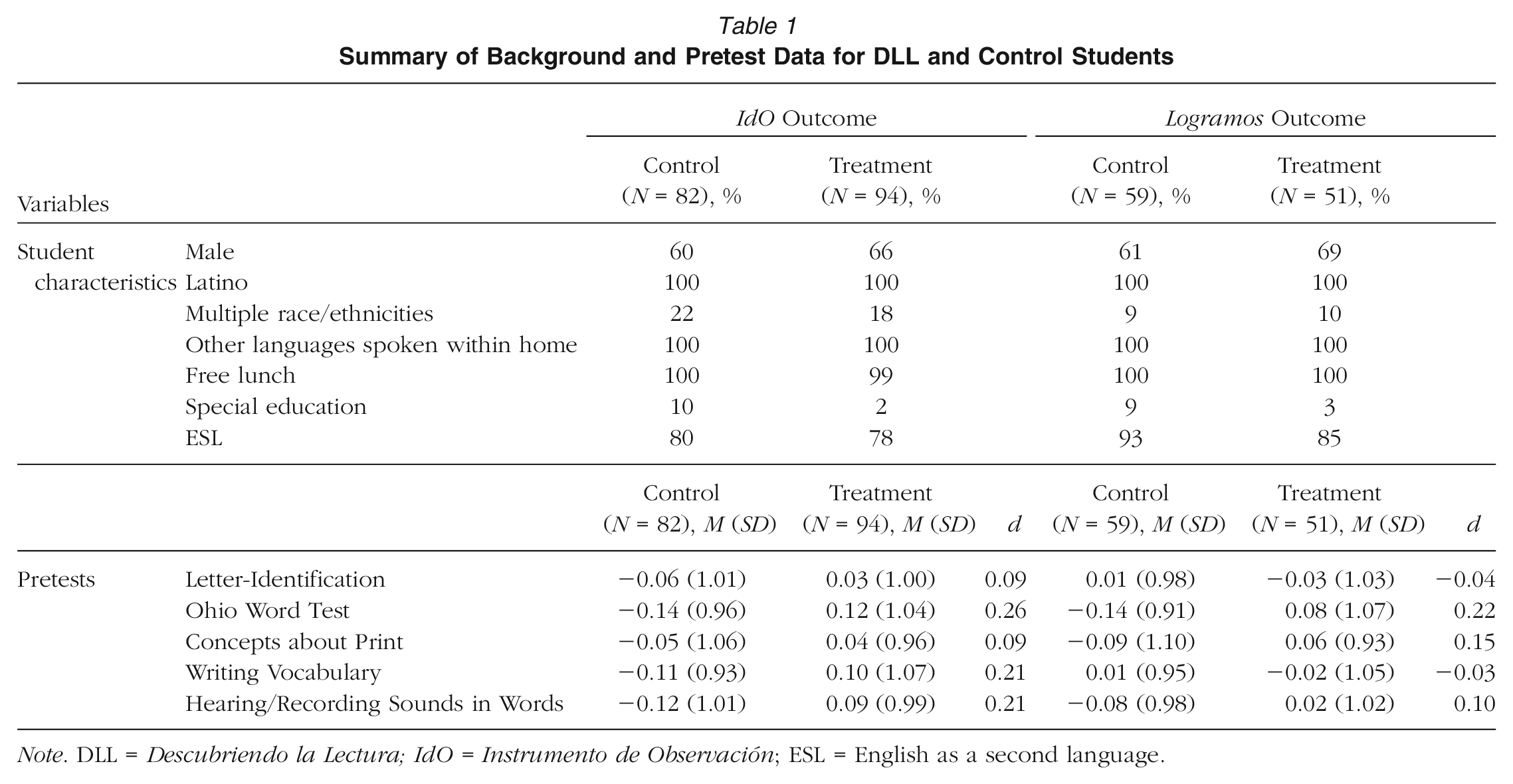
Beyond the test scores, we collected demographic data for each teacher and student through the International Data Evaluation Center (2012) at the Ohio State University, which gathers data on all Reading Recovery and DLL sites and students each year. The teacher characteristics are summarized in the previous Sample section, and the student background information is presented in Table 1, which appears in the Results section.
Summary of Background and Pretest Data for DLL and Control Students
Note. DLL = Descubriendo la Lectura; IdO = Instrumento de Observación; ESL = English as a second language.
Program Implementation
For this study, the program was implemented under routine conditions that would support any typical DLL implementation. The services provided one-on-one tutoring in Spanish for first-grade Spanish-speaking students receiving regular classroom literacy instruction in Spanish and experiencing substantial challenges with reading and writing. The program offered daily 30-minute instruction for 12 to 20 weeks for students performing in the bottom 20% to 25% of their class, as specified by DLL protocol (Reading Recovery Council of North America, 2014f). Trained literacy teachers provided intensive, individualized support as a complement to students’ regular-classroom instruction, with the goal of raising their literacy skills to the level of their peers (Reading Recovery Council of North America, 2014e). DLL teachers worked with the classroom teachers to avoid providing this supplemental literacy instruction during the regular classroom literacy block. Typically, DLL services were offered at times that did not interrupt students’ core academic instruction, during a time when recess or physical education was scheduled, for instance.
As the delayed-treatment students awaited DLL services, they experienced “business as usual” literacy instruction, which consisted of Spanish language regular classroom literacy instruction and, in many cases, small-group, supplemental reading instruction or, in a smaller number of cases, special education services. The DLL teachers monitored the academic progress of all of their assigned delayed- and immediate-treatment students throughout the school year, often providing supplemental small-group instruction to their delayed-treatment students, but only immediate-treatment students received the one-on-one DLL programming during the first 12–20 weeks of the school year.
There are several defining features of the DLL program, which we describe below, which were implemented as part of this study and are implemented under any circumstance in which schools or districts adopt the DLL model. Specifically, these program components include the following: daily lessons tailored to students’ specific literacy needs, a rigorous program of teacher training, ongoing professional development and support for participating DLL teachers, and a collaborative infrastructure of teacher leaders, district-site coordinators, and University Training Centers to oversee high-quality implementation of the program in the study sites. Though this was strictly an impact evaluation, and we conducted no formal implementation study, anecdotal information collected from the DLL teacher leaders and University trainers suggested that fidelity to these program components was adequate to high. Given the structured and “manualized” nature of the DLL program, this general observation concerning the quality of implementation is not surprising.
Daily Lessons
While teachers had flexibility to adapt lessons based on individual student needs, the program required that several activities occur during each student’s daily 30-minute lesson. These activities included rereading familiar books, reading a recently assigned book while teachers took a running record, working with letters or words using magnetic letters, writing a story, assembling the child’s cut-up story, and reading a new, strategically selected book (Reading Recovery Council of North America, 2014e). Lessons provided teaching on letter and sound relationships, spelling patterns, comprehension, producing oral language, and increasing vocabularies (Clay, 2001; Reading Recovery Council of North America, 2014e). Rather than a prescribed curriculum, however, teachers had the flexibility to adjust lessons based on each child’s strengths and needs, offering support and strategic guidance as needed. Furthermore, teachers provided extensive opportunities for student problem solving and self-correction with limited interruption (Clay, 2001).
Individualized Instruction
Individually tailored instruction is one of the defining features of the program. The training provided to teachers who participated in the study offered moment-to-moment responses to student behaviors and to diagnose and respond to individual student needs (Reading Recovery Council of North America, 2014b). As is the case with typical implementations of DLL, the teaching decisions were dependent on careful observation and an understanding of student progress, and thus, program implementation relied on and demanded extensive record keeping. Teachers maintained records of each student—using data to inform their practice—by employing a tool that captures literacy progress before entering the program, on leaving the program, and on completion of the school year (the IdO; Reading Recovery Council of North America, 2014a). Teachers also were required to use a variety of tools to routinely assess student progress, including a planning report, daily monitoring tools, and daily assessment forms. The running records form is an example of a crucial assessment tool that allows for responsive instruction. Using this form, DLL teachers calculated error ratios, accuracy rates and self-correction ratios, and determined which sources of information (meaning, syntax, visual) children used when they made errors or self-corrections. They also made notes about fluency, observed strategic processing, and high frequency words. DLL teachers used the running record analysis to determine the focus of the next day’s lesson.
Teacher Training
In order to provide this high-quality, individualized instruction, the program is designed around rigorous teacher training and standards. To be eligible to become a DLL instructor, teachers must hold state-required certification, have at least 3 years of overall teaching experience, and have demonstrated, through teacher evaluation, successful bilingual teaching (Reading Recovery Council of North America, 2012, p. 9). On entry to the program, teachers are trained by teacher leaders in a yearlong master’s level Reading Recovery class and then “bridge” to DLL in the second year, during which they must teach lessons and implement all aspects of DLL. Alternatively, if there are enough teachers training in DLL at once, a teacher leader may choose to train teachers directly in DLL. The present study evaluates the program as run by already trained teachers, who must teach at least four students per day, keep complete records on each student as a basis for instruction, use the Spanish version (IdO) of the OS, communicate with parents and teachers, submit data to the DLL teacher leader, and monitor the progress of students who have exited the program (Reading Recovery Council of North America, 2012).
Ongoing Support
Ongoing professional development and support is another cornerstone of the program—a requirement that ensures the infrastructure and expertise needed to provide high-quality instruction (Reading Recovery Council of North America, 2012). Teachers must regularly consult with teacher leaders about those students who are not making satisfactory progress, participate in a minimum of four professional development sessions each year, receive at least one school visit from a teacher leader annually, and make and receive school visits from colleagues annually (Reading Recovery Council of North America, 2012). This annual professional development regimen is required for as long as a teacher is implementing DLL. The teacher experience is, therefore, one of continuous collaboration among colleagues, classroom teachers, administrators, and mentors.
Collaborative Infrastructure
In addition to their training role, teacher leaders provide program implementation oversight in schools by monitoring the progress of teachers and students. Teacher leaders accomplish this oversight by regularly collecting program data on student achievement, providing professional development to teachers (at least four sessions per year, serving as specialists to support teachers facing struggling readers, supporting the development of school teams, and creating annual site reports for the university training center; Reading Recovery Council of North America, 2012). Teacher leaders themselves receive continuous support through professional development activities, attending three sessions throughout the year: once in the fall and once in the spring at their respective university training centers, and once in the summer at an annual program–sponsored summer institute.
Teacher leaders also work with district-site coordinators to establish policies and procedures that promote quality districtwide implementation, especially with regard to program structure, budgeting, and personnel processes. Finally, to complete the collaborative approach to program implementation, University trainers connect national DLL organizations to district services, provide ongoing professional development for teacher leaders, and offer technical assistance and networks of communication (Reading Recovery Council of North America, 2012, p. 29). They also monitor and evaluate the implementation of the program in affiliated sites and conduct research on DLL (Reading Recovery Council of North America, 2012). This collaborative infrastructure strives to produce well-trained, supported teachers who can effectively teach students using real-time data to implement literacy instruction that is responsive to individual student needs.
Ultimately, DLL extends the successful Reading Recovery approach to ELs struggling with English literacy by first addressing literacy in their native, Spanish language. The program aims to improve early reading and writing outcomes for the lowest achieving ELs through a focused, short-term approach that offers the needed boost to catch up to their classmates and that, ultimately, aims to improve long-term academic achievement (Reading Recovery Council of North America, 2014e).
Analytical Methods
We estimated impacts for students randomized to immediate DLL services (hereinafter called “treatment” students) relative to students randomly assigned to the delayed-treatment condition (hereinafter called “control” students). Specifically, using the lmer function of the R package lme4 we estimated the impact of being assigned to receive DLL services, or the “intent to treat,” on students’ performance on the various literacy outcomes using the following two-level—students nested within teachers—regression model:

In this model,
Results
Attrition Analysis
Attrition in a RCT occurs when the final analytical sample is different from the initial sample that was randomly assigned at baseline. Both the overall attrition and the differential attrition, between treatment and control groups, can affect the statistical equivalence of the initial randomized sample and can potentially create bias in outcome estimates (What Works Clearinghouse [WWC], 2017). In this section, we report our observed attrition outcomes relative to attrition standards developed by the WWC which describe guidelines for determining low, moderate, and high attrition, based on a combination of overall and differential attrition rates. Attrition was calculated for both standardized tests: IdO and Logramos. Examining attrition for both tests at the teacher level shows no teachers attrited from the IdO sample; however, for the Logramos sample, six teachers attrited by way of missing posttest data. Below, we document the teacher and student attrition from our analytical sample.
Instrumento de Observacion
Of the 187 students, who were tested on IdO, 6% (11 students) did not take the pre- or post-IdO assessments. For the treatment group, 4% (4 of 98 students) had missing values for pre- or posttest outcomes. For the control group, 8% (7 of 89 students) were missing pre- or posttest measurements. The difference between the attrition rates of the treatment and the control groups was 4 percentage points. With an overall attrition rate of 6% and a differential attrition rate of 4 percentage points, the IdO sample falls in the low attrition category, as defined by WWC standards. When attrition falls into the low attrition category, the WWC assigns the highest rating of the corresponding study results, or “Meets WWC Group Design Standards without Reservations” (WWC, 2017).
Logramos
Of the 26 teachers in the study, 6 teachers did not have Logramos posttest data for any students. As a result, 21 treatment and 17 control students, who comprise 20% of the total student sample (38 out of 187 students), were excluded from the student-level analysis.
Of the remaining 149 students, 26% (39 students) were excluded due to missing pre- or posttest measurements. For the treatment group, 34% (26 of 77 students) had missing values for the pre- or posttest outcomes. For the control group, 18% (13 of 72 students) were missing either pre- or posttest outcome measurements. The difference between the overall attrition rates of the treatment and the control groups was 14 percentage points. With an overall attrition rate of 41% and a differential attrition rate of 14 percentage points, the Logramos sample falls in the WWC’s high attrition category. When the sample attrition is moderate or high, the equivalence of the treatment and control groups at baseline is central to determining whether the study “Meets WWC Group Design Standards with Reservations” (WWC, 2017).
Baseline Equivalence
Our preliminary analyses assessed the extent to which data attrition may have compromised the baseline equivalence of the treatment and control groups. Guidance from the WWC’s most recent English Language Learners Evidence Review Protocol indicates: “. . . for the groups to be considered equivalent, the groups must be similar for each outcome on a pretest or a reasonable predictor of posttest performance” (WWC, 2013, p. 5). Thus, we assessed the equivalence of the final analytical samples in terms of the treatment and control students’IdO and Logramos pretest scores. Table 1 shows the results of these analyses for both the IdO and Logramos outcomes. In addition, Table 1 provides descriptive data for the treatment and control samples, including information such as gender, race/ethnicity, and other student background data. For the pretest scores, we report the standardized differences between treatment and control groups as an effect size difference, d. The results suggest that, for the IdO outcomes, with the exception of the Ohio Word Test, the differences between the treatment and control groups’ baseline characteristics were less than 0.25 standard deviation units. Since the IdO sample is categorized as having low attrition, it meets WWC group design standards regardless of the differences between the treatment and control groups. For the Logramos sample, all pretest differences between the treatment and control groups were less than 0.25. That is, the Logramos sample meets WWC group design standards with statistical adjustment for the pretest.
Regarding the student background characteristics, the overall sample was highly homogeneous with regard to race/ethnicity, free lunch participation (a proxy for poverty), and whether languages other than English were spoken in the students’ homes, and no notable treatment-control differences were found. The control students did participate in special education services at a somewhat higher rate than treatment students and a slightly higher percentage of male students were found in the treatment than control group, but these differences were limited to 6 to 8 percentage points. In summary, both the IdO and Logramos samples meet the WWC Group Design Standards, respectively, without and with pretest covariate adjustment.
Impact Estimates
The analyses of DLL effects on both IdO and Logramos outcomes include pre- and posttest scores, which we standardized to a mean of 0 and a standard deviation of 1. Thus, each of the coefficients can be interpreted as an effect size, which is expressed in standard deviation units. We included no student background characteristics, such as race/ethnicity, as additional covariates because there was little variability found for these measures and their inclusion did not improve the precision of our impact estimates.
Instrumento de Observacion
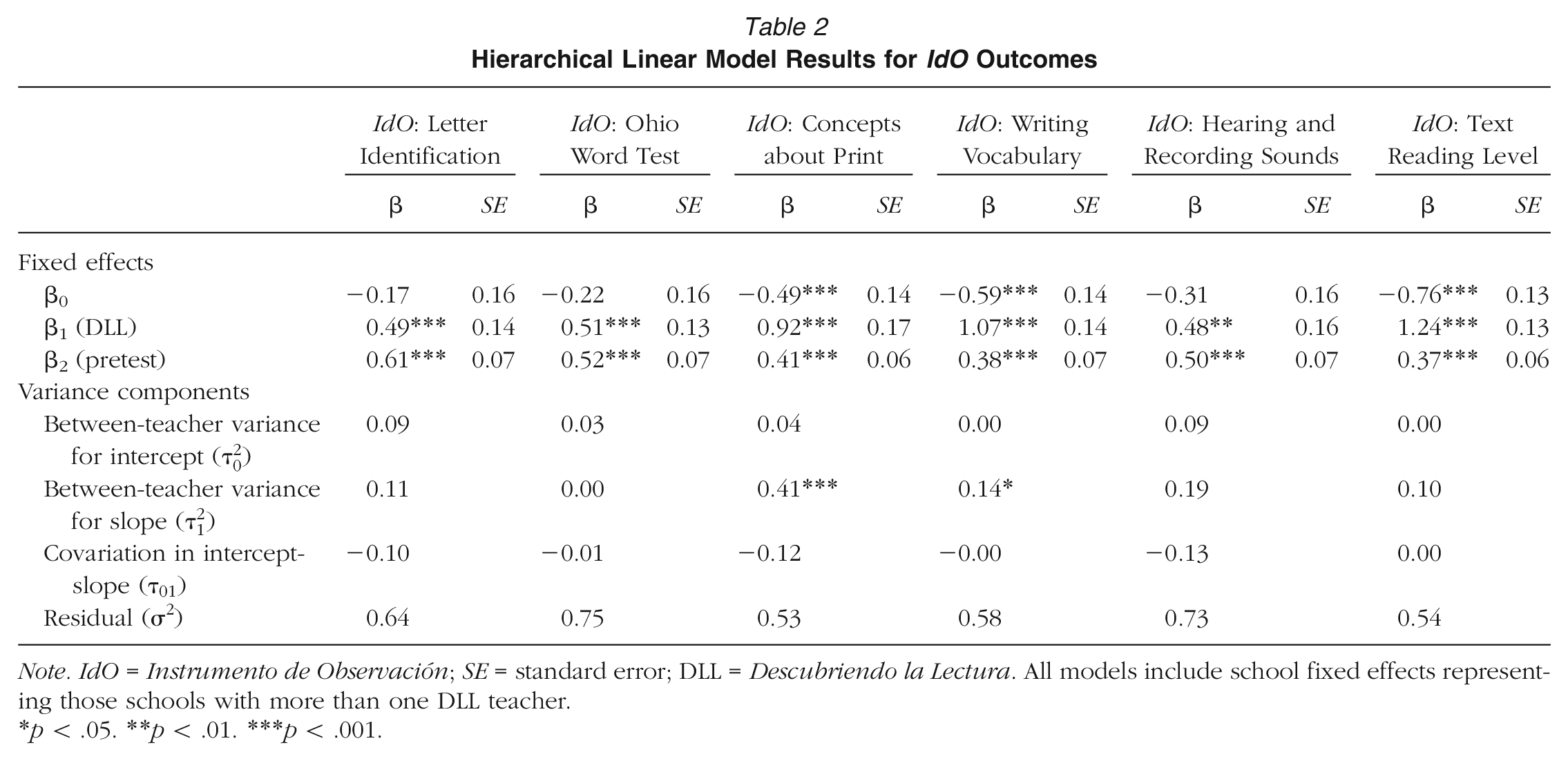
Table 2 shows the average DLL effects on six IdO outcomes: Letter Identification; Ohio Word Test; Concepts about Print; Writing Vocabulary; Hearing and Recording Sounds and Text Reading Sounds; and Text Reading Level. We found statistically significant student-level impacts of assignment to DLL services on all IdO posttest outcomes, ranging from an effect size of 0.49 for the Letter Identification outcome to d = 1.24 for the Text Reading Level subtest. Because we tested the statistical significance of six outcomes within the literacy domain tested by the IdO, we used the Benjamini-Hochberg method to adjust for multiple comparisons by controlling the false discovery rate. Specifically, we rank ordered the six statistically significant findings within the domain in ascending order of the p values, such that p1≤p2≤p3…≤p6. For each p value, p1–6, we computed,

where i is the rank for pi, with i = 1, 2, …6; M is the total number of findings, M = 6, within the domain; and α is the target level of statistical significance, α = .05. Even after adjusting for multiple comparisons across the six IdO tests, by using the Benjamini-Hochberg correction, these statistically significant results held. In other words, our analyses indicated that the treated students served by DLL outperformed the control students on all IdO measures.
Hierarchical Linear Model Results for IdO Outcomes
Note. IdO = Instrumento de Observación; SE = standard error; DLL = Descubriendo la Lectura. All models include school fixed effects representing those schools with more than one DLL teacher.
p < .05. **p < .01. ***p < .001.
In addition to examining the student-level effects of DLL, we tested whether there were random teacher-level effects, as indicated by between-teacher variability in the outcomes, using a random intercepts and slopes model at the teacher-level. First, using a random intercept (u0j), we tested whether the intercepts varied across teachers. Table 2 shows that the between-teacher variation for the intercept (
In sum, assignment to the DLL program produced impacts across all six IdO posttest measures, and these effects were relatively consistent from teacher to teacher (with the exception of one outcome, Concepts about Print).
Logramos
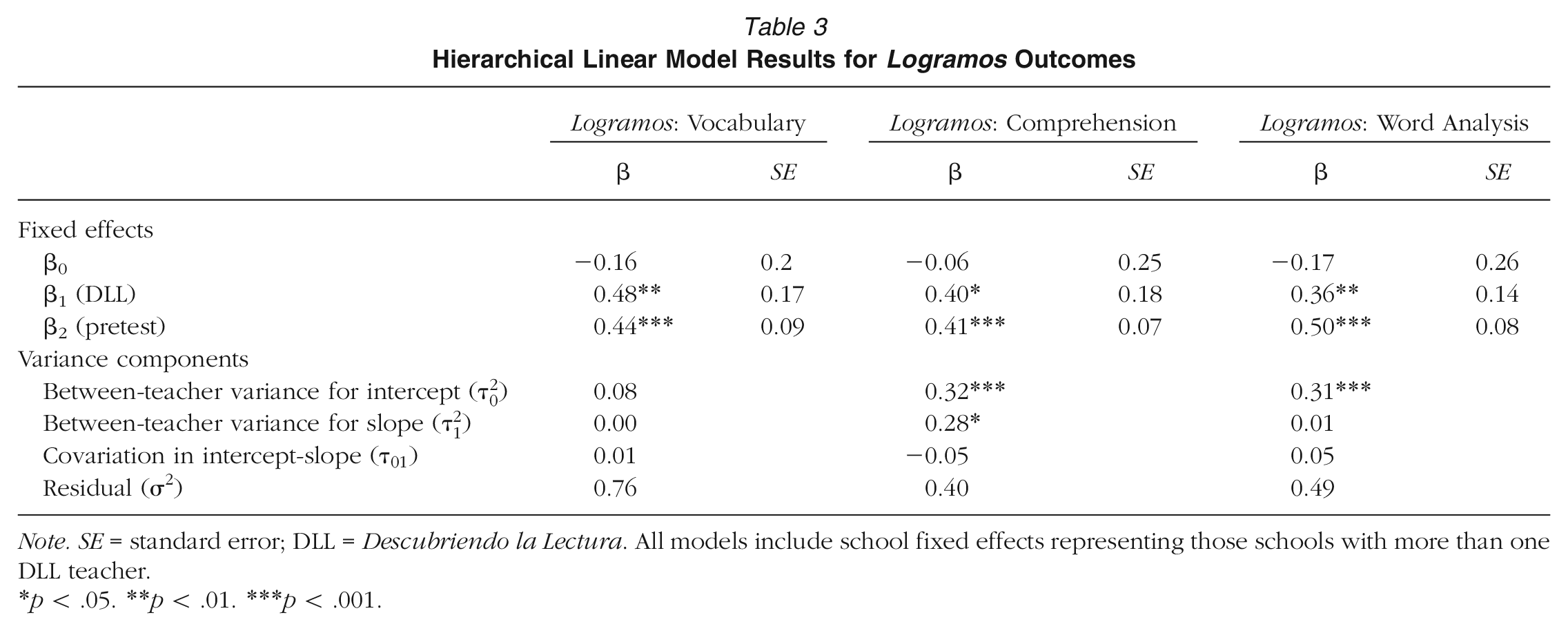
Table 3 shows the average DLL effects for the three Logramos outcomes: Vocabulary, Comprehension, and Word Analysis. The DLL effect sizes for the Logramos posttests ranged from d = 0.36 for the Word Analysis subtest to d = 0.48 for Vocabulary. All three Logramos outcomes, including Vocabulary (β = 0.8, p < 0.01), Comprehension (β = 0.40, p < .05), and Word Analysis (β = 0.36, p < .01), revealed the statistically significant impacts of DLL. After applying the Benjamini-Hochberg correction for multiple hypothesis tests, using the same procedure as outlined above for the three Logramos outcomes, these impacts remained statistically significant at their respective adjusted critical p values.
Hierarchical Linear Model Results for Logramos Outcomes
Note. SE = standard error; DLL = Descubriendo la Lectura. All models include school fixed effects representing those schools with more than one DLL teacher.
p < .05. **p < .01. ***p < .001.
Additionally, we tested whether there was between-teacher variability for the outcomes. Using a random intercepts model, we tested whether the intercept varied across teachers. The results suggested that across the three Logramos outcomes, two of the random intercepts were statistically significant for Comprehension (
Discussion
Our analyses indicate that treatment students served by DLL outperformed waiting-list control students on all IdO and Logramos measures. We found statistically significant student-level impacts of assignment to DLL services on all IdO posttest outcomes, ranging from an effect size of d = 0.48 on Hearing and Recording Sounds to d = 1.24 on the Text Reading Level subtest. The DLL effect sizes for the Logramos posttests ranged from d = 0.36 for the Word Analysis subtest to d = 0.48 for Vocabulary. Though relatively underpowered, only three of the nine analyses of random teacher effects for the outcomes—the IdO Concepts about Print and Writing Vocabulary subtests and the Logramos Comprehension subtest—revealed that the effectiveness of DLL varied across our sample of teachers.
This study represents the first experimental impact analysis of the DLL program. Similar to the sister English-language version of the program, Reading Recovery, DLL demonstrates strong impacts for the sampled students across many dimensions of literacy in reliable ways that are replicated from teacher to teacher. Moreover, these observed effects are, in general, of considerable magnitude. For instance, when comparing the largest impact of 1.24 standard deviation units to other more intuitive benchmarks provided by Hill, Bloom, Black, and Lipsey (2008), we observe that the DLL effect is equivalent to a learning advantage relative to controls that exceeds the amount of reading achievement growth experienced by the typical first-grade student over a full school year. The mean effect size of d = 0.66 across the nine literacy measures is equal to approximately two thirds of the overall literacy growth that occurs across the first-grade year. Indeed, as a supplemental intervention spanning only 12 to 20 weeks, DLL appears to produce impressive impacts of a magnitude rarely seen for educational programs of any type.
Conclusion
DLL is predicated on the notion that responsive, high-quality Spanish-language literacy programs require coordinated supports for students who are struggling with early literacy learning. DLL provides the supplemental resources that are needed for Spanish-speaking students to participate, and potentially thrive, in their school’s Spanish-language literacy program. Also, furthering the development of learning in one’s native language can transfer to learning a second language; DLL is taught in Spanish and, as students progress through elementary school, they ultimately acquire both English and Spanish literacy skills. Indeed, much research indicates that teaching reading in a student’s native language may be the optimal approach to improving reading in English. Research from a number of studies on a variety of languages supports the notion that learning literacy in one’s first language augments literacy in the second (Richards-Tutor et al., 2016; Roberts, 1994).
Though our sample is relatively small, and more research is needed to document the generalizability of these favorable results across other districts, schools, teachers, and students, these initial experimental outcomes are very promising. The literacy outcomes evaluated revealed little evidence of variability across teachers, suggesting the reliability and replicability of DLL’s impacts. Future research should also investigate the extent to which these effects are sustained across multiple years, and whether these early advantages in students’ native language of Spanish translate, as past evidence suggests, into later advantages in English literacy.
In addition, future work should systematically measure and evaluate the quality and variability of implementation across sites and teachers. Again, the lack of variation in impacts in the current study may suggest relatively uniform, high-quality implementation of DLL. Clearly, key strengths of the DLL program are its well-specified guidelines and practices, and ongoing oversight, support, and training by teacher leaders and university-based trainers. However, much may be learned by measuring things such as variability in the contexts in which DLL is implemented, the quality and quantity of DLL instruction and how it may vary, and how such contextual and programmatic variations may be associated with differences in student outcomes.
Finally, future longitudinal studies could help inform how the program may prevent the need for other potentially more costly interventions, including special education, continuing specialized services for ELs, and retentions in grade. Prior quasi-experimental evidence suggests that DLL students maintain average to high literacy performance through elementary school (Escamilla et al., 1998; Neal & Kelly, 1999), and studies of early literacy programs emphasizing native language instruction suggest similar long-term benefits (Ashdown & Simic, 2000; Richards-Tutor et al., 2016). Therefore, though DLL targets intensive resources to struggling first-grade readers, it is quite possible that these early investments have long-term benefits that may, ultimately, save schools and districts valuable resources and prevent future remediation efforts.
Footnotes
G
T
S
S