




Abstract
This cluster randomized controlled trial investigated the impact of project-based learning with professional development supports on social studies and literacy achievement and motivation of second-grade students from low–socioeconomic status school districts. At random in within-school pairs, 48 teachers were assigned to the experimental or comparison group. Experimental group teachers were asked to teach four project-based learning units designed to address nearly all social studies and some literacy standards. Comparison group teachers were asked to teach social studies as they normally would except to teach a target number of lessons. The experimental group showed higher growth in social studies and informational reading but not writing or motivation. Greater consistency with project-based learning session plans was associated with higher growth in writing, motivation, and reading.
Keywords
The ideas driving project-based learning (PjBL) have a long history in American education dating back to the early 20th century during the Progressive Era (Kliebard, 2004). The progressive educator John Dewey helped popularize, at least in theory, approaches to education that were student-centered, had practical meaning and application, and, in his view, promoted democracy by providing students with more educational opportunities and by teaching citizenship (Dewey, 1902)—all characteristics associated with PjBL. Another progressive educator, sociologist David Snedden, advocated the use of practical projects to engage students in learning by doing in the field of vocational education (Snedden, 1916). William Kilpatrick (1918) encouraged the use of projects, such as designing a kite or presenting a play, in which students developed knowledge and skills and engaged in activities that, he argued, prepared them for life. Progressive educators disagreed on essential aspects of a project-based approach, but they all viewed projects as a compelling alternative to traditional instructional approaches they considered to be dry, fact-based, disconnected from students’ lives, and teacher-centered.
Throughout the 20th and into the 21st century, PjBL has been a presence in the educational literature. Much of the existing research on PjBL shows promise for the approach, yet there has been relatively little research testing its impact, particularly at the elementary level. Reviews of research on PjBL reveal that the majority of studies have taken place in middle and high school classrooms and have not been designed in such a way as to draw clear causal conclusions about the impact of PjBL—although they have certainly made other important contributions to our understanding of the approach (Condliffe, 2016; Holm, 2011; Kokotsaki et al., 2016; Thomas, 2000).
There is a particular need to study the effects of PjBL on social studies and informational reading and writing achievement and for students from underrepresented racial-ethnic groups and students living in economic poverty. In the United States, social studies and informational reading and writing are neglected in the primary-grade school settings, particularly in low-socioeconomic status (SES) classrooms (Duke, 2000b; Fitchett & Heafner, 2010; Jeong et al., 2010; McGuire, 2007; Pace, 2012; VanFossen, 2005; Vogler et. al, 2007). Although there is no research on the degree to which students in low- versus high-SES settings experience PjBL, as detailed later, research has found that some key practices related to PjBL are less likely to occur in low-SES school settings.
Given the longevity of PjBL, the promise of the approach, the lack of efficacy studies with young learners, and the need to investigate strategies for addressing inequity in certain educational opportunities, we set out to study the impact of PjBL for second graders in low-SES schools in the United States. We did so by conducting a cluster randomized controlled trial comparing social studies and literacy (in particular, informational reading and writing) achievement and motivation of students engaged in PjBL to that of students whose teachers taught social studies and literacy as they normally would except with a promise to teach a target number of social studies lessons.
Theoretical Framework
This study is grounded in a view of learning as driven by the desire for human connection. We learn largely in order to understand the social world, to enable our interactions with others, and to show others that we have learned. As such, the social and cultural context around our learning is paramount to whether and how learning occurs (National Academies of Sciences, Engineering, and Medicine, 2018). As would be expected, a wide-ranging body of research points to the impact of teacher-student relationships on student learning (Howard et al., 2020). Instructional approaches that endeavor to capitalize on the need for human connection are often found to be more effective than instruction that is less intentional in that regard. For example, research continues, as it has for decades, to document the benefits of cooperative structures for learning (Kyndt et al., 2013).
Learners do not rest passively as the social context washes over them, taking them where it may. Rather, they are actively constructing understandings within their social contexts (Vygotsky, 1978). Indeed, our approach to social studies and literacy education is, in part, consistent with traditional premises of constructivism. However, like Fitzgerald and Palincsar (2019), we ascribe a much greater role of the social and cultural context of learning than is traditionally the case in constructivist theory. These scholars’ concept of sensemaking captures our thinking well: “Sensemaking entails being active, self-conscious, motivated, and purposeful in the world. It is an activity that is always situated within the cultural and historical contexts in which we interact with others and with the aid of tools” (p. 227). They document that a common implication of instructional studies on individuals’ sensemaking is the need to create the social conditions in which sensemaking is fostered, including opportunities for students to inquire, interpret, elaborate, and link new learning to their prior knowledge and experiences.
Put another way, our view of learning involves elements of both sociocultural and cognitive theoretical perspectives (e.g., Danish & Gresalfi, 2018; Purcell-Gates et al., 2004). It is not simply constructivism in context, however. We are compelled by the common finding in research regarding the central role that more knowledgeable others play in fostering learners’ sensemaking. For example, in a meta-analysis of 37 studies examining the impact of inquiry-based science education, Furtak et al. (2012) found that although inquiry-based pedagogy is effective in general, with an overall mean effect size (ES) of 0.50, approaches that included teacher-led activities had mean ESs approximately 0.40 higher. Similarly, in our approach to social studies and literacy education, each session includes a teacher-led component, often with explicit teaching of concepts and/or skills, in addition to a substantial block of time for primarily student-led activity, with the teacher serving as a “guide on the side.”
Project-Based Learning
Project-based learning is an instructional approach designed to capitalize on students’ drive for sensemaking (National Academies of Sciences, Engineering, and Medicine, 2018). Educational researchers have defined PjBL in varying ways (e.g., Barron et al., 1998; Krajcik et al., 1998; Thomas, 2000). 1 In recent years, a large international consortium of education leaders and stakeholders, including researchers, have sought to define high-quality PjBL using a consensus process. They have identified six characteristics of high-quality PjBL: intellectual challenge and accomplishment, authenticity, a public product, collaboration, project management, and reflection (HQPBL, 2018).
There is considerable overlap between these characteristics of high-quality PjBL and the conceptualization of learning presented earlier. Intellectual challenge and reflection foster sensemaking, and collaboration and a public product capitalize on the drive for human connection. Authenticity calls for establishing the relevance of school learning by reflecting what happens in the social world outside of school and by connecting to that world through the project’s impact on other people and communities.
Our conceptualization of PjBL foregrounds authenticity in PjBL because it both invites active and purposeful sensemaking and allows human connection not only within but also beyond the classroom, into other social and cultural worlds of the learner (e.g., Newmann et al., 1996; Purcell-Gates et al., 2007). We designed each of the project-based units tested in this study to have an overarching authentic purpose, such as to improve a local park or to raise money for a valued cause. Students’ work then has a purpose beyond satisfying school requirements or expectations: addressing an authentic problem, need, or opportunity in their community or the larger world. We also viewed PjBL as requiring that the project be developed over an extended period of time and be the primary driver of learning throughout a unit. These features increase the likelihood that the social purpose of the project will drive learning throughout the unit and that there will be sufficient time and space for students to engage with the learning. Each activity in which students engaged during each of our project-based units is carried out not for its own sake, or because the teacher told them to do it, but rather to contribute to meeting the project’s goals either directly or indirectly by developing knowledge and skills needed to carry out the project.
Although we foreground authenticity in our conceptualization of PjBL, we do address other elements of high-quality PjBL (HQPBL, 2018): intellectual challenge and accomplishment, collaboration, reflection, and a public product. We seek to incorporate intellectual challenge and accomplishment through our attention to grade-level standards and complex tasks in our projects (e.g., learning about the history of a site in the community by examining photographs and conducting interviews). The structure of our daily sessions sets aside a time for collaboration as well as a time for reflection. Each of our projects involves development of one or more public products (see the Experimental Group section for further explanation). The only element from HQPBL that we do not address is project management, which did not occur to us as a priority for students this age, although it is possible that it could be.
To illustrate how students learn within the project-based approach we have outlined, take the case of students learning about the map key. (As we describe this case, we use parentheses to point out the five elements of high-quality PjBL and key aspects of the view of learning we presented earlier.) In one of our project-based units, students are engaged in writing brochures about their local community to try to persuade people to move to or visit their community (authenticity). The class shares their brochures with prospective visitors to or residents of their community, for example, via a local realtor (public product, human connection). Each student’s brochure persuades in part by including descriptions of the student’s favorite natural and human characteristics in the community (cultural context) and is to include a map and map key (cultural and historical tools) showing where those sites are located. The teacher provides explicit instruction in what a map key is and how it works (teacher-led activity, more knowledgeable other). Students then reread an informational text about map keys in small groups. They answer questions on a handout asking them to identify particular symbols used in the maps in the text and interpret maps in the text using the map keys (collaboration, social conditions for sensemaking). They then use this experience to imagine a characteristic they might include on their own map and draw the symbol they might use for that characteristic. That process launches students in working individually or with a small group to make a full map key for their brochure and to place the key symbols in the appropriate locations on their brochure’s map (collaboration, student-led activity). Students also engage in whole-group review and reflection, which can include the sharing of student work on their map keys and discussion about the progress the students have made toward the public product (reflection). At the end of this series of experiences, the second-grade students have a strong grasp of how to not only use but also create map keys (intellectual challenge and accomplishment).
Curriculum Materials
Fitzgerald and Palincsar (2019) pointed to the particular role that curriculum materials can play in fostering sensemaking, provided those materials are “rich enough to support this complex work” (p. 244), and curriculum materials are implicated throughout accounts of effective contexts for student learning (National Academy of Sciences, Engineering, and Medicine, 2018). In many contemporary implementations of PjBL, there is detailed guidance for teachers available, including unit descriptions and individual lesson plans. For example, Learning Reviews (2018) recommended 18 resources for “Project Based Learning Lesson Plans and Examples,” such as the Buck Institute for Education (now PjBLWorks) and Edutopia. PjBL may also involve use of curriculum materials not originally designed for a PjBL context, such as textbooks in Parker et al.’s (2018) PjBL model or children’s trade and school market books in ours.
Scholars have long established that there is a complicated relationship between what is written in curriculum materials and what actually happens in the classroom. In a review of research, Remillard (2005) presents a framework in which a participatory relationship between curriculum materials and the teacher (e.g., teacher knowledge, teacher identity), influenced by context, leads to a planned curriculum. Context exerts its influence again, as do the students themselves, to lead to the enacted curriculum. Davis et al. (2017) identified several factors that influence how teachers enact curriculum, including the strengths and limitations of the materials, their relevant content knowledge (in their case, science knowledge), the students in the classroom, and time. Teachers adapt curriculum materials to meet their needs. Indeed, in the present study we focus on teachers’ consistency with the primary ideas within lesson plans, rather than a rigid notion of “fidelity” to a lesson script, in recognition of the reality that quality instruction involves curricular adaptation.
In sum, students engage in sensemaking both driven and shaped by the social and cultural context around them. PjBL seems well-suited to capitalizing on these forces in learning. Curriculum materials have the potential to support teachers in fostering students’ sensemaking through PjBL, but there is a complex relationship between curriculum materials and teachers’ actual enactment of curriculum, suggesting that scholars should consider the degree to which curriculum materials are taken up when examining the impact of providing project-based curriculum materials and professional development (PD).
Review of Literature
In the following section, we discuss the degree to which opportunities to learn in the ways described in the Theoretical Framework section are equally available to students across SES groups. We then discuss efforts to institute such instruction through project-based approaches, in particular in the domain of social studies education. Finally, we turn to the question of what the field currently knows about the impact of PjBL approaches on young children.
Curricular Opportunities for Students in Low-SES School Settings
Like any approach to enacting curriculum, PjBL positions teachers and learners in specific ways and conveys particular cultural values (e.g., valuing inquiry and local contexts, constraining transmission and passivity; Au, 2012; Eisner, 1985). There is no research to indicate whether this approach is more, less, or equally common in low- as compared to high-SES settings. However, there are practices associated with PjBL that have been shown to be less common in primary-grade classrooms in low-SES school settings. In over 10,000 minutes of observation in second-grade classrooms, Billman (2008) found 0 minutes devoted to inquiry in social studies in low-SES classrooms but 82 minutes of inquiry activities observed in high-SES classrooms. Similarly, Anyon’s (1981) classic work found fewer opportunities for inquiry in lower SES schools. Additionally, she found that those schools positioned social studies more as a matter of facts to be remembered than conceptual understandings to be built. Strachan (2016) found that during social studies instruction, students in primary-grade classrooms in low-SES settings were less likely than those in high-SES settings to engage in student-led activities, to read or write extended text, or to write for an audience other than the teacher.
As in social studies education, in literacy education there is evidence of less frequent use of practices consistent with PjBL. For example, Duke (2000a) found that first-grade students in low-SES school districts were less likely than students in high-SES districts to have opportunities to engage in literacy in the content areas, to make choices in their reading, to exert a high degree of authorship in their writing, or to read or write for audiences beyond the teacher alone. Research on teachers who are unusually effective at fostering literacy achievement in students of poverty and students of color often find that such teachers emphasize meaning making, higher order questioning, and higher order discussion to a greater extent than typical teachers (e.g., Taylor et al., 2000; Turner, 2005). Teale et al. (2007) argue that there is a literacy curriculum gap by SES such that students in low-SES settings experience more emphasis on basic reading and math skills and less attention to content building, conceptual understanding, comprehension, and writing. Like others (e.g., Center on Education Policy, 2006), they attribute this gap in part to the policies of the No Child Left Behind Act.
Opportunity gaps observed in social studies and literacy curriculum and instruction are set in the context of larger opportunity gaps by race and SES. These gaps are evident not only in the practices but also in the systems, processes, structures, and policies that shape U.S. schooling (Milner, 2012). For example, research has also long indicated that educators have, on average, lower expectations for students of lower SES and students of color (Dusek & Joseph, 1983). Those lower expectations likely explain, at least in part, the relatively less intellectually ambitious instruction in school settings with high proportions of students of low-SES and students from underrepresented racial and ethnic groups.
Project-Based Learning in Social Studies Education
Social studies is a multidisciplinary field comprising many disciplines from the social sciences and the arts and humanities. The disciplines in the projects tested in this study, which are the disciplines most frequently taught at the elementary and secondary level (National Council for the Social Studies [NCSS], 2013), are economics, geography, history, and political science (which is called civics and government, or civics, at the school level).
Collectively, social studies as a school subject is highly compatible with PjBL because of the subject’s foci on helping students (1) recognize and work to address societal problems, needs, or opportunities; (2) conduct inquiry, in particular, asking and exploring complex questions about the world around us; (3) use critical thinking, problem solving, and collaborative skills; (4) explore authentic issues and problems; and (5) take informed action (NCSS, 2013).
Each social studies discipline, as described in the C3 Framework (NCSS, 2013), is also compatible with PjBL. The central goals of civics and government are helping students develop (1) knowledge about government and (2) civic efficacy, or the capacity and willingness to take on the roles of citizenship. PjBL, with its attention to authentic issues and concerns, is a natural fit with civics and government. Economics deals with people’s choices and reasoning regarding resources and how to make informed decisions. Projects entail complex decision making, often with limited resources such as time and materials; thus, economic decision making is often used in the process of PjBL. Geography focuses on knowledge of the Earth’s human and natural characteristics—both the local and the global. Geographic thinking involves understanding the Earth’s many interdependent relationships. PjBL’s focus on societal problems and needs is compatible with geography, as many of today’s most pressing needs are geographic (e.g., climate change; food and water security). History, with its focus on events, developments, movements, and individuals from the past (and not from students’ daily lives), may seem an unlikely fit with PjBL’s focus on addressing societal needs and opportunities, which tend to be contemporary in nature. However, these contemporary problems are deeply rooted in events of the past: History education provides contextual understanding. PjBL, with its focus on sustained inquiry or exploration, when used in history education, allows students to develop their skills in perspective taking, cause and effect, chronology, contextualization, and evaluation of sources, among others, to understand the causes and conditions of current issues (e.g., MacArthur et al., 2002).
Each of these disciplines cannot be enacted without literacy skills, most notably informational text reading and writing. The dominant national framework for social studies education (NCSS, 2013) asks teachers to engage students in developing disciplinary literacy skills along with content knowledge via an inquiry arc. The PjBL approach that is the subject of this study involves informational text reading and writing as well as attention social studies content.
Research with older students has demonstrated the suitability and promise of project-based approaches for social studies disciplines. For example, Parker et al. (2011) found, in their mixed-methods design experiment with 314 students across 12 classrooms in three high schools (eight classrooms used an alternative approach to Advanced Placement (AP) U.S. Government and Politics and four classes used a traditionally taught AP approach), that students in the alternative approach classes earned the same or higher scores on the AP exam and performed better on a complex-scenario test of deep conceptual learning, compared to students in a traditionally taught AP course. Parker et al. (2013) found, in their mixed-methods design experiment with 289 students in 12 classrooms across four schools, that students in the classrooms using an alternative approach to AP U.S. Government and Politics were more likely to earn a high pass on the AP exam than students in classrooms using traditionally taught AP approaches, and they also scored higher on a complex-scenario test, an open-ended assessment designed to assess students’ abilities to apply knowledge from the course to investigating real-world problems in politics and government.
The approach to PjBL employed by Parker et al. (2011; Parker et al., 2013; Parker et al., 2018) had five key principles: “rigorous projects as the spine of the course, quasi-repetitive project cycles (looping), engagement first, teachers as co-designers, and an eye for scalability” (Parker et al., 2011, p. 538). The projects included in their PjBL curriculum also followed an inquiry-based learning approach; a “master question” unified all the projects, and as students progressed through the projects, they revisited and attempted to answer the master question (Parker et al., 2013). As in our approach to PjBL, students worked both collaboratively and independently through an extended engagement with authentic issues.
Problem-based learning, an approach related to though distinct from PjBL, has also been applied to social studies disciplines. For example, Saye and Brush (2007) describe the results of their 9-year research program on problem-based historical inquiry, used with a series of small samples of high school students. Across studies, the researchers concluded that their approach to problem-based learning increased engagement, empathy, and attention to sources of knowledge but did not always improve deep knowledge or critical reasoning. They attributed the success of their work to “authenticity of tasks and deliberate support for active learning” in addition to the digital tools they built to support inquiry (p. 210). Economics has also been addressed through a problem-based approach, yielding positive results (Mergendoller et al., 2006).
Although these and other studies have focused on older students, there is no evidence to suggest that younger students are incapable of engaging with the real-world problems, needs, or opportunities that drive learning within a project-based framework. For example, in a justice-oriented economics unit (although not one best characterized as project-based), Sylvester (1994) found that a third-grade class could grapple with authentic social and economic issues: homelessness, entrepreneurship, economic competition, and unemployment. Mitra and Serriere (2012) found that fifth graders in a socioeconomically diverse school who learned the ABCDEs of youth development—agency, belonging, competence, discourse, and (civic) efficacy—could engage successfully in school life and civic life by identifying and addressing a local issue. Indeed, as Chi et al. (2006) argue, “In many ways, the elementary level is an ideal time to create a strong and meaningful foundation for the civic knowledge, skills, and dispositions needed to prepare and engage students as active citizens . . .” (p. 24). We provide further evidence that even young children are able to engage with authentic problems, needs, or opportunities that drive PjBL in the following section.
The Impact of Project-Based Learning in the Primary Grades
Although a number of studies have examined the causal impact of PjBL in middle, high school, and postsecondary contexts (e.g., Boaler, 1997; Geier et al., 2008; Harris et al., 2014; Parker et al., 2011; Parker et al., 2013), finding positive impacts on learning and motivation, few studies have been conducted with younger students, particularly those in the preprimary and primary grades.
Some studies of PjBL with young children have focused on effects on overall development (e.g., Habok, 2015), but most have focused on PjBL in relation to specific domains. Aral et al. (2010) examined Turkish children’s acquisition of basic concepts (e.g., colors, shapes) in one classroom that used the typical preschool curriculum and another classroom in the same school in which teachers taught the concepts using PjBL (SES unspecified). PjBL was employed once per week for 12 weeks. Few other details were provided. In contrast to the other studies reviewed in this section, in this study there was no evidence of an advantage for a project-based approach.
Focusing on science content knowledge, Robinson et al. (2014) randomly assigned teachers in 70 classrooms in low-income schools in the United States, Grades 2 through 5, to an experimental group who experienced a PjBL curriculum along with more than 100 hours of PD over 2 years (including a summer institute and weekly coaching) or to a comparison group who taught science as usual for the year. Although results for the full sample have not been published, Robinson et al. compared the learning gains of students labeled as gifted in both groups, concluding that those students who participated in the PjBL condition made statistically significantly greater learning gains in science process, concepts, and content knowledge than the comparison group. The randomized design allowed a strong causal inference regarding the relative efficacy of the experimental and control conditions; however, within the experimental condition it is difficult to parse out the effects of PjBL as compared to the large number of hours focused on PD that sometimes dealt with science content, technology, and differentiation as opposed to only PjBL.
Also focused on science learning was a study by Dresden and Lee (2007) involving first-grade students in a low-SES school in the United States. Science learning was examined in one classroom before and after participating in a teacher-directed unit on different types of animals and then again after participating in a PjBL unit on chicks. Assessments asked students to discuss an animal of their choice—or specifically a chick following the PjBL unit—and to provide facts about that animal, as well as draw and label a picture of the animal. The researchers found that students used statistically significantly more words to describe their animal following the PjBL unit and had higher levels of detail and accuracy in their writing at that point. However, the improvements might have stemmed from the fact that the PjBL unit on chicks followed a unit on different types of animals in which important conceptual groundwork may have been set. Chicks is also a narrower topic than animals, which may have contributed to the findings.
Motivation, as well as science content learning, was the focus of the Kaldi et al. (2011) study, involving students in ethnically diverse classrooms (SES unspecified) in Greece just above the primary grades (Year 4; ages 9 and 10). Using a single-group pretest-posttest design, the researchers examined students’ knowledge of sea animals as well as motivation and attitude toward environmental studies following participation in a PjBL intervention lasting between 2 and 3 months in six classrooms. Interviews with teachers and students showed statistically significant pre- and posttest differences for science content learning as well as motivation in this learning domain. They concluded that the students in the study “found [PjBL] amusing and more motivational in comparison to traditional teaching methods (direct instruction, teacher talk, studying from their own textbooks)” (p. 43).
Also focused on science motivation as well as learning was the Karaçalli and Korur (2014) study. In this study, which the researchers identified as quasi-experimental, 143 fourth-grade students in Turkey (SES unspecified) experienced 4 weeks of 1-hour daily experience learning about electricity in daily life. The experimental and comparison groups experienced the same presentation materials and explanations. The experimental group applied their learning in the form of an ongoing project, whereas the control group answered questions about material and prepared questions to ask of their friends. Students in the PjBL group had better achievement and retention of the material taught, but unlike in the Kaldi et al. (2011) study, did not display effects on motivation (a measure of attitudes toward science and technology).
We were able to locate only two studies examining the effects of PjBL in relation to social studies learning in the primary grades. In one study, seven students ages 6 to 7 from a special education class in Turkey (SES unspecified) participated in a project-based unit for 1 to 2 weeks (Guven & Duman, 2007). Students improved in their understanding of bakeries (which could be considered social studies content) following the unit and field trip. In a second study, second-grade students in low-SES schools in the United States made statistically significant gains in social studies knowledge and informational reading and writing following engagement in two project-based units, one focused on economics and the other on civics and government (Halvorsen et al., 2012). In addition, students’ postscores were statistically the same as postscores of students in high-SES schools who had not experienced the units, suggesting that PjBL may help to narrow the achievement gap. However, as in nearly all of the studies discussed in this review, this study did not use a randomized controlled trial (RCT) design that would afford a strong causal inference.
Some additional studies of PjBL in the preprimary or primary grades examine teacher, student, and/or parent perceptions of the approach (e.g., Beneke & Ostrosky, 2009; Chu et al., 2011; Tretten & Zachariou, 1995) or teacher implementation. For example, Chu et al. (2011) examined teachers’, parents’, and students’ perceptions of the impact of PjBL in science and social studies over 19 weeks on students’ information technology or informational literacy (e.g., internet searching) skills on four classes of P4 (9- to 10-year olds, just outside of the primary-grade age range) students in Hong Kong. All groups thought that students’ skills were improved, and students expressed that the skills were important to their work.
The relatively small number of studies that have examined effects of PjBL in the primary grades have, with one exception, found evidence of promise of the approach for general development and content learning and mixed evidence of promise with respect to motivation. However, only one of the studies, focused on science, has employed an RCT design, which is best suited to drawing causal conclusions. Four reviews of research on PjBL (Condliffe, 2016; Holm, 2011; Kokotsaki, et al., 2016; Thomas, 2000) have also noted the dearth of studies with an RCT design.
Summary
Our theoretical framework calls for opportunities for students to engage in sensemaking driven by their social contexts, particularly by extended engagement with authentic problems, needs, or opportunities in their community or the larger world. Our review of literature documents that such opportunities are less common in school settings with high proportions of students of color and students of low SES. PjBL can, at least theoretically, provide such opportunities and is well suited to social studies education. Studies with older students engaged in PjBL in social studies have had promising results, as have studies involving young children in PjBL largely within other domains. A causal study of PjBL in social studies in the primary grades would provide insights into whether PjBL can fulfill this promise.
Research Questions
The present study addressed these gaps by examining the impact of PjBL on social studies and literacy achievement and motivation in the primary grades in low-SES school settings using a cluster randomized controlled trial design. The study was carried out with a sample of teachers during their first and only year of implementation who had, except for one, never carried out PjBL—among the most challenging contexts in which PjBL has ever been tested. The research questions were the following:
Method
Study Design
This study was a cluster randomized experiment in which 48 teachers were assigned randomly to an experimental (n = 24) or a comparison (n = 24) group within second grade in each school. Teachers in the experimental group were provided with one initial professional learning workshop, three follow-up recorded webinars, coaching, and detailed session plans for 80 sessions within four project-based units, one each for economics, geography, history, and civics and government. Comparison teachers were asked to teach their regular social studies curriculum (which in no case involved PjBL). They were asked, and agreed, to teach 80 lessons over the course of the year so that the amount of social studies instruction could be held constant across conditions. Teachers in both groups were systematically observed. To measure student growth, near the beginning and end of the school year, we administered pre and post standards-aligned measures of social studies, informational reading, and informational writing, and a Likert-type scale motivation survey about social studies, literacy, and integrated instruction.
Participants
Participants were second-grade teachers (N = 48) and their students (N = 684; comparison group = 289, experimental group = 395) from 20 elementary schools (16 schools with two participating second-grade classrooms and 4 schools with 4 participating second-grade classrooms) in 11 school districts. Classrooms were drawn from schools that met the following criteria: (1) at least 65% of the student population qualified for free or reduced-priced lunch; (2) below state average student performance on state exams in social studies (assessed in Grade 6 in this state), reading (assessed in Grade 3), and writing (assessed in Grade 4); and (3) location within an hour’s drive of either of the university sites where the principal investigators were located. The reported free or reduced-priced lunch rates of participating schools ranged from 65% to 100%, with a mean of 80.350%.
All second-grade teachers within qualifying schools were invited to participate; at least two teachers in each school needed to agree to participate in order to be included in the study. Teachers were paired within second grade in each school; one member of each pair was randomly assigned to implement four units of our integrated, PjBL approach to teaching social studies and informational reading and writing (the experimental [E] group) whereas the other was asked to teach social studies using the approach they normally would during any other school year (the comparison [C] group). As detailed later in this section, for 15 of the 24 comparison group teachers, this involved using a (non–project-based) curriculum developed by two state education organizations, and for nine of the 24 comparison group teachers, this involved using a national social studies textbook series. The remaining two comparison group teachers used self-designed (non–project-based) lessons. Comparison group teachers were asked to promise to teach at least 80 social studies lessons over the course of the year, considerably more than they likely would normally have taught. In that sense, they too were participating in an intervention—to increase the amount of social studies instruction provided in schools.
Table 1 provides information for evaluating initial experimental versus comparison group comparability. There were no statistically significant differences between experimental and comparison group teachers in years of teaching experience or having received PD in PjBL. Even among those reporting having received prior PD in PjBL, there was no indication from observations and questionnaires that comparison group teachers actually used a PjBL approach to teach social studies, nor, from interviews, that any but one experimental group teacher did so prior to the study year.
Demographic Information About Teachers and Students at the Teacher/Class Level and Raw Premeasure Results

Note. Mother’s/guardian’s education, female, underrepresented racial-ethnic group, and PD in PjBL are dummy variables. Mother’s education = 1 if a student’s mother or guardian has higher than high school diploma. Mother’s education alone was used because 25% of father’s education data were missing. Mother’s education is more highly correlated with achievement (e.g., Murnane et al., 1981). Female = 1 if a student is female and 0 if a student is male. Underrepresented racial-ethnic group = 1 if a student is from a racial group underrepresented in U.S. higher education (not White or Asian) and 0 otherwise. In the sample, 40.337 % of the students were White, 32.975% were Black or African American; 15.491% were multiracial; 5.368% were Asian; and 4.448% were Hispanic or Latino. Pre-and postmeasures are expressed as percentage scores that each student achieved compared to the highest possible scores. Student characteristics and preassessments are aggregated at the teacher level, and t tests were conducted at the teacher level, as that is the unit of random assignment. Measures are after attrition took place. E = experimental; C = control; PD = professional development; PjBL = project-based learning.
All students within participating classrooms were invited to participate through a parent/guardian consent form. The two whole class–administered assessments were collected from all students whose parents provided consent. The two individually administered assessments were given to only a randomly selected subset of students due to budgetary and thus personnel constraints. Despite this, sample sizes at posttest for each assessment were adequate: social studies: E = 305, C = 257; reading: E = 307, C = 252; writing: E = 358, C = 270; motivation: E = 343, C = 265. A total of 47.937% percent of students had a mother or guardian with higher than a high school education. Among these students, 17.120% of students had a mother or guardian with an associate’s degree. The majority of participating students, 57.048%, were from underrepresented racial-ethnic groups. Additional demographic information about students and participating teachers, as well as students’ baseline/preassessment scores, can be found in Table 1. As this is a cluster randomized experiment, with teachers randomly assigned to condition, data reported in Table 1 are all aggregated and t tests conducted at the teacher level (the unit of random assignment). Measures are after attrition took place. As the independent samples t tests show in the last column of Table 1, the experimental and comparison groups were comparable on average in terms of demographic variables and preassessments. Variances on preassessments in the two groups were also statistically equivalent for all measures as determined by F tests. Thus, we can assume that the randomization of our study was realized as intended.
It is noteworthy that there was no attrition at the teacher level. In terms of student attrition rate, the overall attrition rate was 7.895%. The differential attrition rate for the experimental group was 9.367%, and 5.882% for comparison group—a difference of less than 4 percentage points. Although the attrition rate for the experimental group was higher than that of the comparison group, the descriptive analysis and baseline equivalence of covariates from before attrition were very similar to those reported in Table 1. That is, overall the sample of participating students was similar to the sample of students initially assigned to experimental or comparison conditions. Combined with the low overall and differential attrition, we find no evidence that attrition had any influence on our estimation of the treatment effect.
Experimental Group Condition
The four project-based units used in this study were designed to involve students in PjBL as described earlier in this article. We used a design-based research approach to develop the units, field testing and obtaining feedback from teachers (not involved in the present study) throughout the process (see Halvorsen et al., 2012; Halvorsen et al., 2018, for a description of the methodology). The four PjBL units, taught in the following order, were (1) Producers and Producing in Our Community (economics), (2) Brochure About the Local Community (geography), (3) Postcards About the Community’s Past (history), and (4) The Park/Public Space Proposal Project (civics and government).
Each unit involved a project that had an authentic purpose with a public product developed in part through collaboration on intellectually challenging tasks with regular opportunities for reflection—all characteristics of high-quality PjBL discussed earlier in the article (HQPBL, 2018). Although the unit and session plans were premade and the same for all classrooms, they were unlike traditional lesson plans in that they were written to embed opportunities for connections to the local community in which the unit was taught and for teacher and student voice and choice. Every project involved teacher and student voice and choice and opportunities for extended informational text reading and writing. The project for the economics unit involved creating an informational flier about a local business for that business’ use and creating and selling their own good or service to raise money for a cause. The business chosen, the good or service created and sold, and the cause were all decided by each class. The geography project involved developing a brochure to persuade people visiting or considering settling in the local community that it has compelling natural and human characteristics. The local community varied by district, and the natural and human characteristics were chosen by each child—for example, one child might choose to feature the local athletic center, whereas another might choose to feature the local public library. In the history unit, the project involved students developing postcards about the history of the local community to display or sell in a local institution, such as a library or historical society, with the teacher and/or students deciding which historical sites to feature, whether to sell or display their postcards, and the location(s) where postcards were shared. The civics and government project involved developing a proposal, conveyed in letters and in a group presentation, to persuade the local city government to make improvements to a local park or other public space selected by the teacher and/or teacher and students collectively. See Supplemental Appendix A for abstracts of each project (in the online version of the journal).
In addition to characteristics of PjBL described earlier in the article, projects included explicit instruction threaded throughout the units but always presented in the service of the project rather than as material to be learned for the sake of satisfying school requirements. Projects also involved domain-specific, research-supported instructional practices and were closely aligned to standards. Specifically, units addressed nearly all social studies standards for the state, which were largely aligned with national standards (the C3 Framework; NCSS, 2013) and a subset of standards from a national English Language Arts and Literacy standards document (National Governors Association Center for Best Practices & Council of Chief State School Officers [CCSSO], 2010), particularly those involving informational reading and writing. However, it was understood that, unlike the social studies standards, the literacy standards should also be addressed in other parts of the day/outside our units, including in reading, writing, and science instruction.
Each of the four units comprised 20 sessions designed to take approximately 45 minutes of instructional time each. (We use the term sessions rather than lessons because only a portion of each session is what might traditionally be considered a lesson, much of the session time involved small-group and individual work on the projects.) We designed session plans to clearly indicate learning objective(s) and standards addressed, any materials required, key vocabulary terms and definitions critical to the sessions, instructional steps of the session, and additional notes for the teacher (e.g., potential pitfalls to avoid). With few exceptions, each session followed a similar format: (1) whole-group instruction and discussion to generate and sustain student interest and excitement about the project as well as to provide explicit instruction (~10 minutes); (2) guided small-group or individual instruction in which students have opportunities to work individually, in pairs, or in small groups (~20–30 minutes); and (3) whole-class review and reflection, which included clarifying any confusions and reviewing key terms (~10 minutes). For example, a session might involve the teacher reading aloud a text related to the unit project, with instruction in social studies content as well as literacy skills, such as how to use an index. In small groups, students might then use information learned from the text and other materials to complete portions of a graphic organizer that would guide their writing of the unit’s final product. Then students might then come back together to share their graphic organizers and review with the teacher key content from the beginning of the session. In addition to unit plans, teachers were provided with any texts, artifacts, or other materials, beyond typical school supplies, that were needed to carry out each unit.
Although we recognize that PjBL is initially challenging to implement (e.g., Marx et al., 2004), we were cognizant of the limited amount of support many districts or schools are likely to provide when introducing a new curriculum when a research team and grants are not involved. In an attempt to maintain a high level of ecological validity, we were relatively austere about the amount of outside-the-classroom PD provided with the PjBL units: (1) 3 hours of initial PD that introduced participants to PjBL, to our research initiative, and to the first project-based unit; (2) three recorded webinars ranging between 22 and 40 minutes introducing the next three units; and (3) added for a subset of the classrooms, a brief five-minute video of several experimental teachers discussing strategies for addressing some common challenges with units. In contrast, inside the classroom we did provide substantial support in the form of, on average, 11 visits from research assistants (RAs) who provided coaching for unit implementation after the session they observed, with additional communications, as necessary, by phone and/or e-mail. We believed that coaching support had a high degree of ecological validity given the prevalence of instructional coaches in high-poverty school districts. Coaches interacted with teachers only after sessions (during sessions they were taking observation notes, as explained later in this section) and were instructed to restrict their interaction with teachers to implementation of what was in the unit or session plans, rather than larger issues of instruction or classroom management that may affect PjBL implementation. Finally, the project unit and session plans that we developed had a high degree of detail regarding the structure and content of the project sessions and included educative curriculum features, such as child-friendly definitions of key terms. Scholarship has demonstrated that curriculum materials have the potential to serve as a form of PD in their own right (Davis & Krajcik, 2005; Drake, et al., 2014).
Teachers signed a letter of consent in which they committed to teaching 80 lessons over the course of the year, but the mean number of lessons/sessions taught by experimental group teachers was 65.917, with a standard deviation of 9.184 and a range of 48 to 86. Four teachers, two in the experimental group and two in the control group, taught the full 80 lessons/sessions. In general, experimental group teachers who did not teach a full 80 lessons/sessions did not teach the civics and government unit (n = 6), taught an abbreviated version of that unit (n = 13), or taught an abbreviated version of the history unit (n = 13), but did teach up to four review sessions we provided.
Comparison Group Condition
As indicated previously, teachers in the comparison group were asked to teach social studies as they normally would during any other school year except to increase their instruction to a goal of teaching 80 social studies lessons over the course of the year. Of the 24 total teachers in the comparison group, 15 teachers taught social studies using a curriculum developed through two state education organizations by educators from school districts and subject area consultants and aligned to the state social studies standards. Typical units in this curriculum comprised several open-ended questions to guide inquiry during the course of study, key vocabulary concepts, and a series of one to nine lesson plans. Common activities included reading aloud children’s literature, writing anchor charts, class discussion, small-group activities, analyzing maps or timelines, video clips, vocabulary work, worksheets, and assessments. None of the units was project-based. Two teachers using these units supplemented them with magazines (Social Studies Weekly; Scholastic News), two teachers added an extended teacher-created unit at one point in the year, and two other teachers improvised all text-based lessons because they were not provided the texts called for in the unit plans.
Seven of the remaining nine teachers not using the curriculum described in the previous paragraph utilized district-created lessons or social studies textbooks as the primary mode of instruction, including TCI (Social Studies Alive!), MacMillan/McGraw Hill, and Scott Foresman. The social studies textbooks were not specifically aligned with this state’s standards, but there appeared to be considerable overlap with state expectations. Lessons consisted of discussing content vocabulary, reading the textbook, watching videos, completing worksheets or written assignments, whole-class discussion, and small-group work. The remaining two comparison teachers taught self-designed lessons as their schools did not provide any social studies curriculum or materials. Much like the lessons designed by the two state organizations, teacher-created lessons typically consisted of vocabulary instruction, whole-class discussion, read-alouds, independent reading, graphic organizers, visual aids, group work, and written activities. Neither the textbook-based instruction nor the teacher-designed instruction was project-based.
Teachers signed a letter of consent in which they committed to teaching 80 social studies lessons over the course of the year. As noted earlier, two experimental group teachers and two comparison group teachers actually taught that number of lessons. The mean number of lessons taught by comparison group teachers was 51.375, with a standard deviation of 17.118 and a range of 30 to 85. This is statistically significantly fewer lessons than taught by the experimental group teachers (M = 65.917 lessons, t = −15.217, p < .001). However, as explained in the Discussion section, dosage analyses indicate that the 14.5-lesson difference in mean number of lessons taught is not sufficient to explain the advantage of the experimental group over the comparison group in study results.
Assessments
Our four outcome measures were (1) a standards-aligned social studies assessment administered one-on-one, (2) a standards-aligned informational reading assessment administered one-on-one, (3) a writing assessment comprised of a group-administered paper-and-pencil persuasive-writing assessment and informative/explanatory writing assessment; and (4) a group-administered paper-and-pencil motivation survey. All measures were developed by our team due to the lack of social studies or informational reading and writing assessments aligned with state standards and the lack of a motivation measure that addressed social studies, informational reading and writing, or integrated instruction. Sample items from each assessment are provided in the paragraphs that follow (space limitations preclude appending the instruments, but they are available upon request from the first author). Validity and reliability of each assessment are reported in the paragraphs that follow. Students were assessed near the beginning and end of the school year. Items from all assessments were piloted and refined before administration.
Social Studies Assessment
The social studies assessment was aligned with state content expectations and the C3 Framework (NCSS, 2013). Ten items with multiple subparts measured student achievement in economics, geography, history, civics and government, and public discourse, decision making, and citizen involvement. Some questions were open-ended, such as “What services does the local government provide?” and “Why do we use time lines?” Others were close-ended, such as showing a map with a key and asking, “Tell me which direction you would go to get from the child’s house to the park?” and a question that required students to sort pictures of items involved in the production of pizza into the categories of natural, human, and capital resources. Each item corresponded to all or part of a state standard for social studies for second grade. Without knowledge of whether a given assessment came from a child in the experimental or comparison classrooms (i.e., blind to condition), we scored the responses of the 11 questions on scale of 0 to 3, with a score of 3 indicating fully meeting the standard, for a total possible score of 30 (two questions measured the same standard and were thus averaged for one score for the standard, for a total of 10 items).
To examine assessment validity, five reviewers with expertise in social studies were asked to identify the question(s) that best aligned with each content expectation; they had 96% agreement with our determination of the alignment of standards and assessment questions. With regard to reliability, project members established a high inter-rater reliability at Fleiss’s kappa = 0.883 for scoring the assessment, and the 10 social studies items had an acceptable internal consistency (α = .715).
Informational Reading Assessment
This assessment comprised a total of 31 items that measured student achievement of six of the 10 second-grade CCSS for Reading Informational Text (Standards 4–9). Sample questions included “What are reasons the author gives to support her point?” (CCSS for Reading Informational Text 8) and “What is the writing under a picture called?” (CCSS for Reading Informational Text 5). The research team scored questions blind to condition on a scale of 0 to 3 with a score of 3 meaning fully meeting that CCSS expectation. This provided a total possible score of 87 (not 93 because one trio of questions all dealt with one text feature and therefore were scored together on the 0–3 scale).
To examine validity, five experts in the field of early literacy reviewed the assessment and were asked to identify which CCSS in Reading Informational Texts corresponded with each assessment item. There was 95.5% agreement between these experts’ reviews and our own identification of which CCSS best addressed each assessment item. With regard to reliability, research team members established a high interrater reliability of Fleiss’s kappa = 0.874 when scoring this assessment, and items had high internal consistency (α = .863).
Informational Writing Assessment
This assessment measured student achievement of writing for two distinct purposes detailed in the CCSS: to opine or persuade (Writing Standard 1) and to inform or explain (Writing Standard 2).
Persuasive writing
This prompt asked students to write independently for 30 minutes about “something you think people should change and why.” Students were given a purpose and audience for the writing: “My friends and I will read what you write to get ideas about things we should try to change” and were provided with a list of potential areas of change. Responses were scored blind to condition using a rubric aligned to expectations in CCSS Writing Standard 1 for second grade as follows: introduction (on a scale of 0–2), opinion (0–2), reasons (0–3), linking words (0–1), and concluding statement (0–2), for a total possible score of 10.
Informative/explanatory writing
This prompt asked students to write an article for up to 30 minutes about a community job (e.g., firefighter) for a class magazine. This topic was chosen because it was not addressed in the project-based units so would not inappropriately advantage students in the experimental group and because students would likely to be able to draw on considerable background knowledge/information in responding (thus it would serve as a test of informational writing skill, not knowledge/information). Students were provided with a list of potential jobs. Their responses were scored blind to condition using a rubric aligned to expectations in CCSS Writing Standard 2 for second grade: introduction (0–2), information (0–3), definition (0–1), and concluding statement (0–2), for a total possible score of 8.
An overall informational writing achievement score was created by combining scores for responses to the persuasive and informative/explanatory prompts for a total score of 18. With regard to validity, an interrater reliability of Fleiss’s kappa = 0.734, which is considered high, was established by project members for scoring of this assessment. Internal consistency reliability was borderline (not surprising in prompted writing assessment) at .661.
Motivation Surveys
To investigate motivation, we developed a survey modeled after, but distinct in all items from, a validated reading motivation survey (e.g., McKenna & Kear, 1990). We surveyed students about their attitudes toward engaging and participating in (1) social studies learning, (2) literacy learning, and (3) integrated social studies and literacy learning (there were also items on PjBL, but those were not included in analyses given that students in the comparison group did not participate in PjBL). Students were read 24 statements such as, “When I use maps to learn new things, I feel . . .” and “When our class learns about social studies and reading at the same time, I feel . . .” After each statement, they were asked to circle one of four images of a character, depicting an emotional state ranging from “very happy” to “very upset.” Responses were scored on a scale of 1 (very happy) to 4 (very upset). Cronbach’s alpha reliability for the assessment was .884.
Other Data
Other data collected include students’ demographic/background information (underrepresented racial-ethnic group, gender, and mothers’/guardians’ education level), teacher background characteristics (years of teaching experience and whether they received PD in PjBL), and interviews with experimental group teachers (with the interviews not included in this article except with respect to teachers’ responses regarding their experience with PjBL prior to the data collection year and number of sessions taught; see Revelle, 2019).
Observational Data
In order to most meaningfully address the first research question, we needed to ascertain that the experimental group was using a project-based approach and the comparison group was not. Thus, classrooms in both conditions were observed with a protocol that included the item “Degree to which the lesson appears to be set in project-based context” on a scale of 1 to 3 (from does not appear to be set in project-based context to appears to be set in project-based context).
To address the second research question, we needed to know the degree to which experimental group classrooms were implementing PjBL as intended. For that purpose, our observation protocol had three items for observations in experimental classrooms requiring “Ratings for consistency with session plans,” one each for whole-group instruction and discussion, guided small-group or individual instruction, and whole-group review and reflection. Each item was rated on a scale of 1 to 3, with 1 = follows fewer than 50% of the steps in the session plan for that section of the session, 2 = follows 50% to 80% of the steps, and 3 = follows 80% or more of the steps for that section of the session. “Follows” meant that the teacher engaged in the primary action identified in the step (e.g., explaining a concept, providing information about or communication from the target audience; allocating time for students to carry out research). Raters were directed to count steps as partially followed if part of a complex step was followed and not to give a lower rating for an altered order or addition of steps but only for steps being missed entirely during that session (e.g., not inviting students to reflect on the process of producing the good or service). The raters did not take into account the degree to which teachers adhered to specific suggested wordings in the plans or the like. As explained earlier, our session plans were unlike traditional lesson plans in that they were written to embed opportunities for teacher and student voice and choice and connections to the local community in which the unit was taught. For example, one session plan calls for giving students an opportunity to generate questions they want to include in their survey about the park or other public space that is the focus of the project. Given that the park or other public space will vary and the questions students want to ask in the survey will vary, it makes sense for our ratings to focus on consistency with the general instructional move called for rather than wording or other details of enactment of that move.
The observation protocol was used by RAs, who observed full sessions (their coaching conversations with teachers occurred after the sessions; teachers perceived them as having the dual roles of observing instruction and providing [only] project-related coaching support as needed). RAs were trained in using the observation protocol using videos. Live observations of sessions by two raters achieved a mean interrater reliability of .658 in Fleiss’ Kappa, which indicates substantial agreement. In total, RAs carried out an average of 11.208 and 5.458 visits to experimental and comparison classrooms respectively.
Data Analysis
Descriptive Statistics
We used descriptive statistics to examine student achievement and motivation in the experimental and comparison groups and inferential statistics (t tests) to determine any significant differences in raw scores on preassessments of student achievement and motivation between students in the experimental and comparison groups. We also generated descriptive statistics regarding consistency with unit session plans in the experimental group.
Hierarchical Linear Modeling
To take into account the nested relationships in the study (i.e., students nested within teachers), we used hierarchical linear models (Bryk & Raudenbush, 1992). Using a two-level hierarchical linear model (Level 1: student and Level 2: teacher), we explored the effects of the intervention (controlling for female status, underrepresented racial-ethnic group, mother’s/guardian’s education, and preassessment) on social studies achievement, informational reading, informational writing, and motivation and, for the experimental teachers, the relationship between consistency with unit session plans and social studies achievement, informational reading, informational writing, and motivation. The two-level model matches the research design and is appropriate for the data. This analytic strategy and the detailed data we collected about instruction in the experimental classrooms meant that analyses could examine not only the impact of the project-based units by condition but also whether students showed greater gains in social studies achievement in classrooms in which the teacher implemented project sessions with a higher degree of consistency with unit session plans.
First, we examined the treatment on treated effects of the intervention (i.e., using the analytic sample of students). The first-level model for student i of teacher j is

where Y ij represents four outcomes of interest (i.e., social studies learning, informational reading, informational writing, and motivation) for student i of teacher j. FEMALEij is a dummy variable for gender, and UNDERREP is a dummy variable for underrepresented racial-ethnic group status. MOTHER EDU ij is equal to 1 if a student’s mother/guardian has higher than a high school diploma. PRE_Y ij is the preassessments of the outcome. A student-specific residual is ε ij . At the second level the teacher-specific intercepts are modeled as β0j = γ00+γ01(EXPERIMENTAL) j +µ0j in which γ00 is the average outcome of students in the comparison group and µ0j is a teacher-specific random effect. The variance of µ captures the nesting of students within teachers. EXPERIMENTAL is a dummy variable equal to 1 if a student was in the experimental group. The coefficient γ01 represents the average difference in the outcome between the two groups (adjusted for covariates).
Second, we examined the relationship between consistency with unit session plans and the outcomes. As explained earlier, each major component of each session observed was rated on a scale of 1 to 3, for a total score of 9 for a session that was quite consistent with key components of the session plan and a total score of 3 for a session that was not. The model used for the analysis was the same as the previous one shown in the previous section except that (1) we dropped the EXPERIMENTAL variable, (2) included only experimental group students for the analysis, and (3) added the CONSISTENCY variable at the teacher level (i.e., the second level).
Results
Our report of results is organized into two sections. The first addresses the first research question (about impact) and the second addresses the second research question (about relationship between consistency with session plans and student growth).
Comparing Achievement
All experimental group teachers attended initial PD, received the project unit and lesson plans, and accepted coaching. All teachers implemented at least three out of four of our project-based units; all but six teachers implemented all four units to at least some degree. As intended, none of comparison group teachers did any of these things. Observation data indicated that teachers randomly assigned to the comparison group did not implement project-based-learning (mean score of 1.1 on the 1–3 scale described earlier). Collectively, these data reflect several types of fidelity identified by Hill and Erickson (2019). Put another way, the experiment tested what it was designed to test.
Descriptive statistics for experimental and comparison group students for all variables used in the multilevel analysis are reported in Table 2 at student level. Results of the multilevel analyses are reported in the paragraphs that follow.
Descriptive Statistics for Variables of Interest at the Student Level: Entire Sample
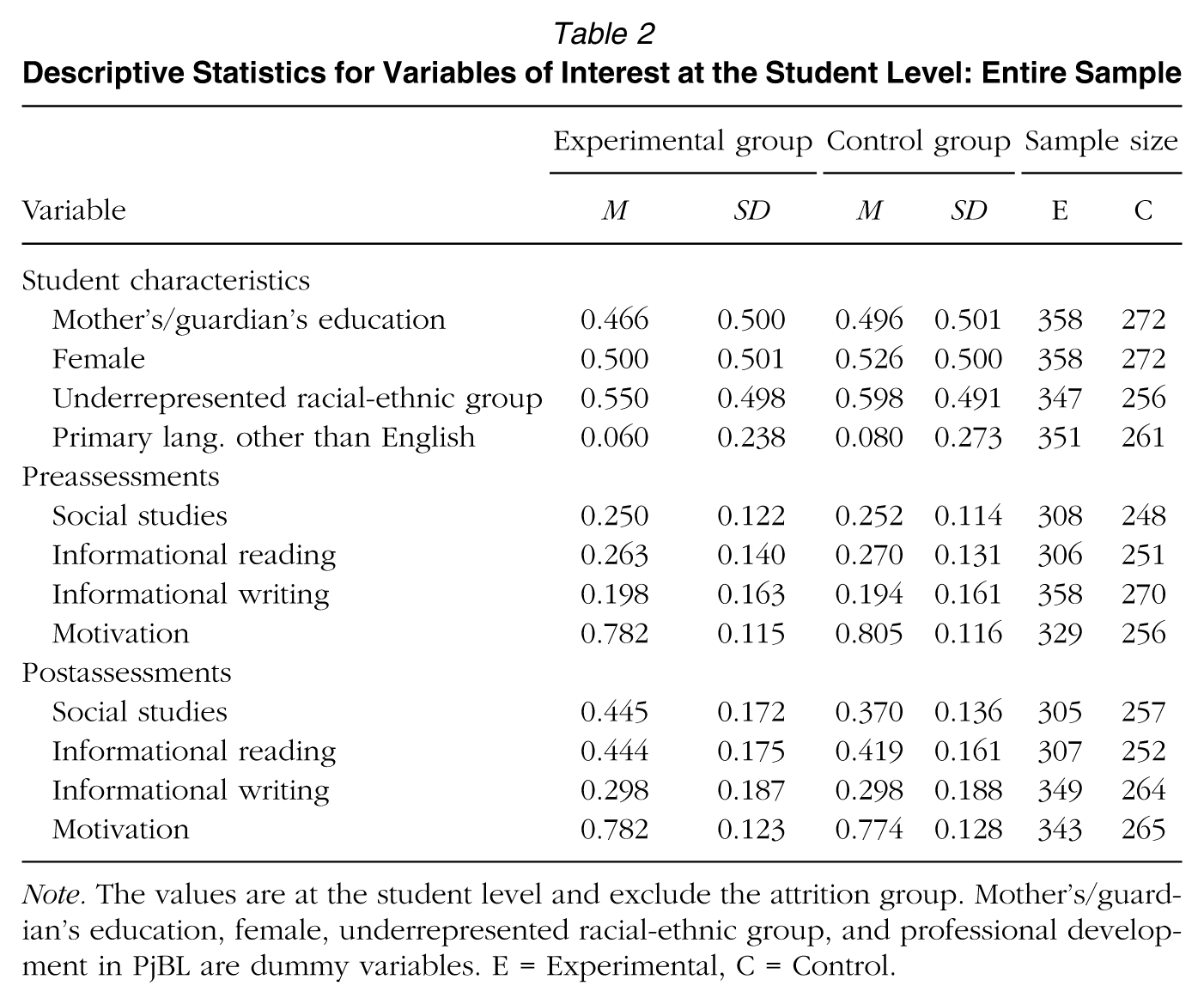
Note. The values are at the student level and exclude the attrition group. Mother’s/guardian’s education, female, underrepresented racial-ethnic group, and professional development in PjBL are dummy variables. E = Experimental, C = Control.
Social Studies
Controlling for female status, underrepresented racial-ethnic group status, mother’s/guardian’s education, and preassessment, the experimental group scored statistically significantly higher than the comparison group on the social studies measure (ES = 0. 482, p < .001, two-tailed here and throughout). That is, the mean difference between experimental and comparison groups in social studies was 0.482 standard deviations even after controlling for baseline scores. In line with relevant methodological research (e.g., Ho et al., 2007), the Institute of Education Sciences What Works Clearinghouse (2014) considers an ES of 0.25 or higher to be “substantively important” (p. 23). See Table 3.
Intervention Effects on Children’s Achievement

p < .10. ***p < .001, (All tests are two-tailed.)
Informational Reading
Controlling for female status, underrepresented racial-ethnic group status, mother’s/guardian’s education, and preassessment, the experimental group scored statistically significantly higher than the comparison group on the informational reading measure (ES = 0.182, p = .083). That is, the mean difference between experimental and comparison groups in informational reading was 0.182 standard deviations even after controlling for their baseline scores. By itself (without considering potential cumulative effects of PjBL also being used for informational reading in other parts of the school day), this ES is lower than the 0.25 threshold. See Table 3.
Informational Writing
Controlling for female status, underrepresented racial-ethnic group status, mother’s/guardian’s education, and preassessment, the experimental group did not score statistically significantly higher than the comparison group on the writing measure (ES = −0.047, p = .571). See Table 3.
Motivation
Controlling for female status, underrepresented racial-ethnic group status, mother’s/guardian’s education, and preassessment, differences between the experimental group and the comparison group did not reach a level of statistical significance (ES = 0.135, p = .193). See Table 3.
Relationship to Consistency With Unit Session Plans
Descriptive statistics for teachers’ consistency with unit session plans are provided in Table 5. Higher ratings mean that instruction was more consistent with key components of the session plans. In classrooms with the lowest average consistency with unit session plans, there was significant reduction or elimination of one or more session components (and recall that each session contributed to students’ enactment of the project), sometimes because of consistent disruptions to instruction due to off-task classroom behavior. Whole-class teaching was often substituted for the requested guided small-group or partner instruction, perhaps in part due to struggles with classroom management. There was often little to no time at the close of a session for whole-group review and reflection. In contrast, in classrooms with the highest average consistency with unit session plans, instruction was well paced and offered students time with whole-group instruction, regular participation in collaborative work with partners and small groups, and time for collective review and reflection as suggested in the session plans. Higher consistency with unit session plans was associated with higher scores on all measures (see Table 4), with the following p values and ESs—all above the previously cited Institute of Education Sciences 0.25 threshold for substantive importance: social studies (ES = 0.270, p = .301), reading (ES = 0.583, p = .030), writing (ES = 0.239, p = .065), and motivation (ES = 0.287, p = .016).
The Relationship Between Consistency With Unit Session Plans and Students’ Achievement
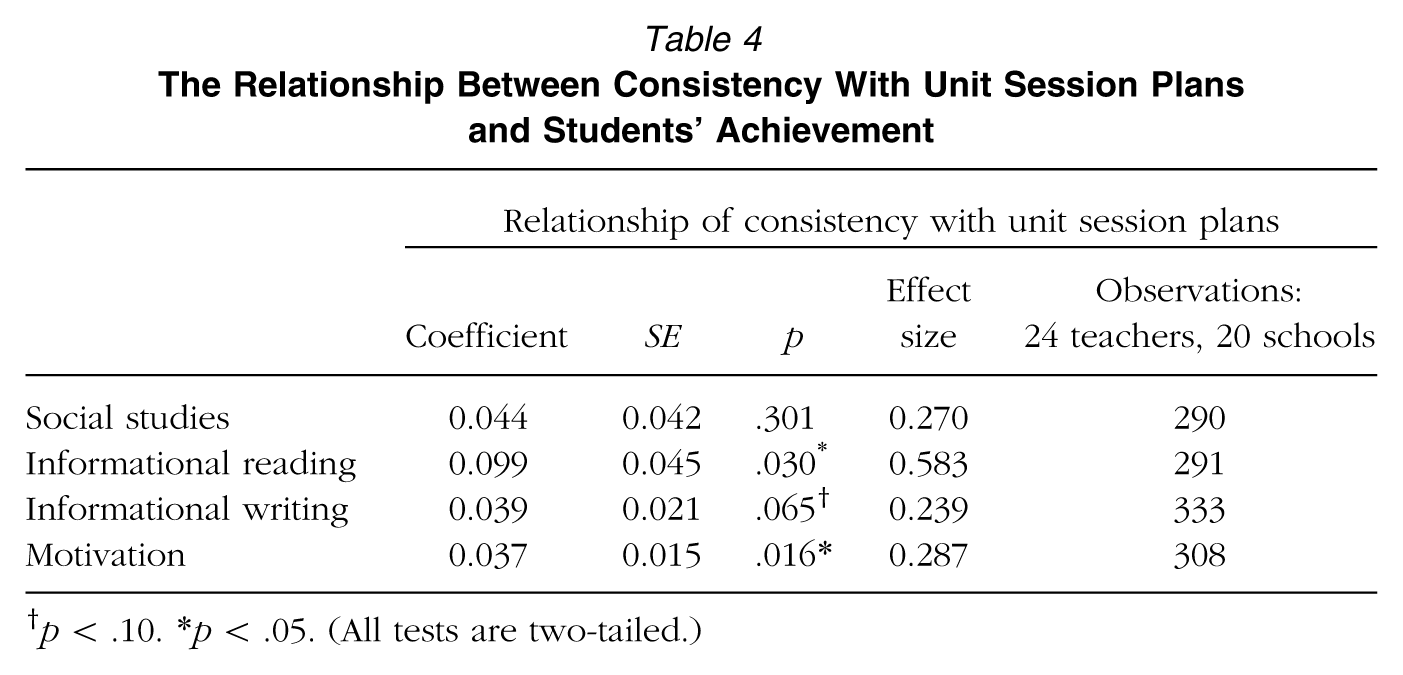
p < .10. *p < .05. (All tests are two-tailed.)
Experimental Group Teachers’ Consistency With Unit Session Plans, as Scored by Observers, for the Three Parts of the Lesson
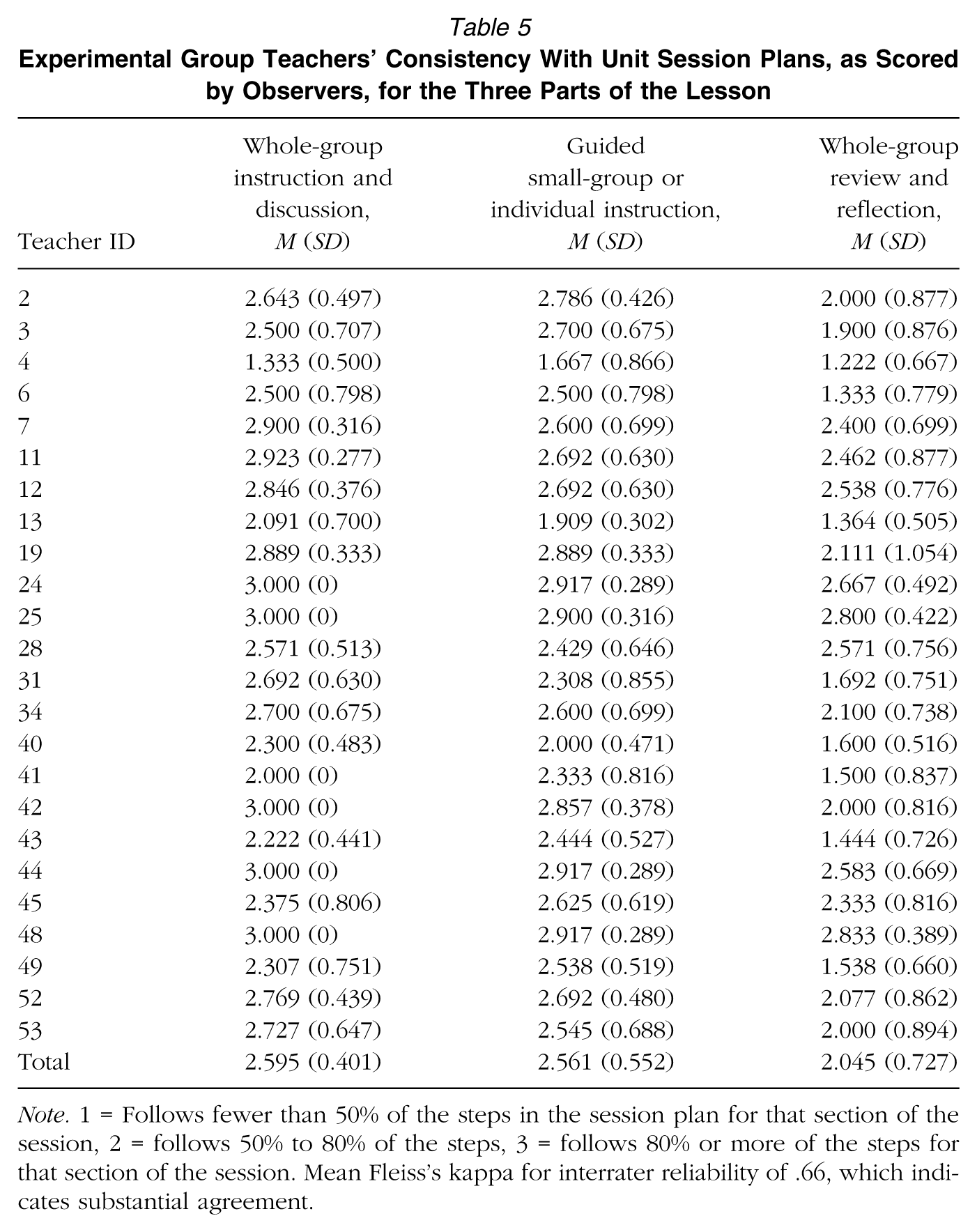
Note. 1 = Follows fewer than 50% of the steps in the session plan for that section of the session, 2 = follows 50% to 80% of the steps, 3 = follows 80% or more of the steps for that section of the session. Mean Fleiss’s kappa for interrater reliability of .66, which indicates substantial agreement.
Discussion
Results of this study suggest that PjBL can be an effective way to bolster student achievement in social studies and informational reading. PjBL as tested in this study led to a 63% gain in social studies as compared to the comparison group. Translated into months of a school year (63% multiplied by a 9-month school year), that represents 5 to 6 months of greater learning. PjBL also led to a 23% gain in informational reading, representing approximately 2 months of greater learning (this smaller impact for informational reading was expected given that, as compared to social studies, informational reading and writing were addressed in fewer sessions and should be addressed in other parts of the day as well). An important implication of the study is that curriculum developers and practitioners should not shy away from using a project-based approach, at least as enacted in this study. There were benefits of using the approach even in teachers’ first year of implementation and even as compared to comparison classrooms using either state-developed or national curriculum materials.
The efficacy of PjBL in this study is consistent with theoretical perspectives reviewed earlier in this article. Learning is driven by a desire for human connection (National Academies of Sciences, Engineering, and Medicine, 2018), so we can catalyze learning through a curricular approach characterized by attention to social problems, needs, and opportunities; frequent collaboration with peers and others; and development of products with a public audience. Children are active and purposeful sensemakers but not in a vacuum; their sensemaking is shaped by the social and cultural context and by interactions with more knowledgeable others, particularly the teacher (Fitzgerald & Palincsar, 2019; Vygotsky, 1978). As in the example of learning about map keys, presented early in this article, the teacher provides teacher-led activities, including explicit instruction, to support student learning. The teacher also creates considerable space for student-led experiences and collaboration and ensures that there is an authentic purpose and resulting public product of students’ intellectual work. The teacher also facilitates students’ whole-group reflection about both their progress toward the public product and the ways in which the skills they are learning are relevant in achieving their goal. In other words, young children learned in our approach to PjBL through a combination of teacher-led and student-led activities all driven by an authentic purpose.
Much empirical research would also lead us to expect positive effects of PjBL. As detailed earlier in the article, most studies of PjBL have shown promising effects, including in both science and social studies (e.g., Marx et al., 2004; Parker et al., 2011; Parker et al., 2013) and with young children (e.g., Robinson et al., 2014). As explained earlier in the article, conceptualization of the specific disciplines within social studies reveals their affinity with PjBL. Even history, although not as obviously suited to PjBL, provides opportunities to consider the historical roots of contemporary life and engage in sustained inquiry with a range of social artifacts (e.g., MacArthur et al., 2002). A subset of studies of the impact of PjBL has involved students in low-SES school settings with a high proportion of students from underrepresented racial and ethnic groups (e.g., Geier et al., 2008). Nonetheless, our study makes an important contribution to the literature in several respects. First, our study examines the effects of PjBL at the intersection of social studies and primary-grade education, which only two prior studies have done. The first of those studies examined only learning related to bakeries (Guven & Duman, 2007), and the second addressed only two of the four core social studies disciplines for the elementary years (Halvorsen et al., 2012). Neither study used a strong causal design, which points to a second contribution of our study: the degree to which it enables causal inference. Our study employed a cluster randomized controlled design using a large sample of classrooms. There was no attrition at the cluster level, and attrition at the student level was low. Our post hoc tests for baseline equivalence of observed covariates using the analytic sample suggested that random assignment was successful by and large and in agreement with the intention of the research design. In addition, attrition was not a threat to the internal validity of the results because its rate was low and because the students, teachers, and schools that eventually participated in the experiment in either the treatment group or the comparison group were very similar to those who initially participated in the random assignment process.
The ecological validity of our study enhances its methodological contribution. As would be true in many school settings, participating teachers had little to no experience with PjBL. Teachers received limited amount of outside-of-classroom support, with a 3-hour initial PD workshop and minimal subsequent webinar-based PD (~100 minutes total). This is ecologically valid as group PD time is relatively limited in high-poverty districts, and social studies is likely to be a low PD priority. Teachers were provided with more in-classroom support, with an average of 11 visits from a coach. This support is also ecologically valid in that high-poverty districts often have a cadre of instructional coaches. However, in order to ensure that we were testing implementation of PjBL and not a general effect of coaching support, coaches played a limited role. They did not coach (e.g., model instructional practices) during sessions and were instructed to restrict their postobservation conversations with teachers to implementation of what was in the session-by-session unit plans, rather than larger issues of instruction or classroom management. In other words, we aimed to maximize ecological validity and minimize confounding factors. Still, it is important to recognize that what we tested was PjBL with PD supports and not simply providing PjBL unit or session plans alone.
A fourth contribution of our study is that it was carried out in high-poverty, low-performing school districts with a sample that included many students whose mother or guardian had no more than a high school education and in which the majority of students were from underrepresented racial-ethnic groups. Gaps—or chasms—in educational opportunities (Milner, 2012) for students living in economic poverty and students from underrepresented racial and ethnic groups extend to many practices consistent with a PjBL approach. Studies discussed earlier in the article suggest that students in low-SES settings have fewer opportunities to engage in inquiry, to engage in student-led activities, to experience higher ordering questioning or discussion, to read or write extended text, to make choices in their reading, to exert a high degree of authorship in their writing, or to write for an audience other than the teacher (e.g., Anyon, 1981; Billman, 2008; Taylor et al., 2000; Turner, 2005). In fact, they are less likely to experience content area instruction or reading and writing therein (e.g., Center on Education Policy, 2006; Duke, 2000a; Pace, 2012). We have demonstrated, in a causal design, that when students in low-SES school settings do have the opportunity to engage in such practices, significant learning in multiple domains occurs. The study adds to the work drawing into serious question the No Child Left Behind Era emphasis on basic reading and math skills at the expense of content building, conceptual understanding, comprehension, and writing (Center on Education Policy, 2006; Teale et al., 2007). Policymakers and practitioners have further reason to address the discrepancies in educational practices in low- versus high-SES settings documented in previous studies.
Our study also speaks to the complexity of the relationship between curriculum materials and teacher practice (Remillard, 2005). As in some past PjBL research, such as that of Geier et al. (2008) in science, we predetermined the focus of each unit (in that study, e.g., one unit was, “What Is the Quality of Air in My Community?) and provided considerable teacher support via detailed curriculum materials. We also made use of materials aimed directly at students, such as books for a school market, as in some past PjBL research (Parker et al., 2018). Although curriculum materials provided considerable scaffolding, we were able to design them such that they allowed practitioners to tailor aspects of projects to their local community and to teacher and student interests. An implication of the study is that curriculum designers and researchers could emulate this approach to curriculum materials. 2
Although all teachers in the study were provided with the same curriculum materials, we documented that the consistency of their practice with those materials varied considerably. For example, the plans might call for the teacher to provide information about or communication from the target audience (though what that audience was would vary by classroom), but some teachers might skip that part of the session. Or the plans might call for the teacher to engage students in reviewing key points from an earlier session, but the teacher chose not to do so. Curriculum research discussed earlier would lead us to expect this, as many factors influence the enacted curriculum (e.g., Davis et al., 2017).
In our research, the degree of consistency between teachers’ practice and the curriculum materials turned out to be consequential for students’ learning and motivation, as has been found in many past studies (see Hill & Erickson, 2019, for a review). Overall, our intervention did not have a statistically significant impact on students’ informational writing. However, implementing more of the steps in the project-based unit session plans was associated with higher year end informational writing achievement, controlling for preassessments and other factors. Similarly, although we did not find a statistically significant overall effect on the study’s motivation survey—a result that may be seen as surprising in light of claims and some prior evidence about the positive motivational benefits of PjBL—the more consistent implementation was with unit session plans, the more positive the associated change in students’ motivation, at a level of statistical significance. Further research should investigate factors that enable implementation of PjBL curriculum materials in a manner that best fosters informational writing and motivation development. Given the findings in this study regarding consistency with unit session plans, future research might examine factors that enable and constrain teachers to greater or lesser enactment of key features of the design of project-based units or, more broadly, factors that characterize the practice of teachers whose students experience higher and lower growth within a project-based approach. Qualitative data collected as part of the project reported in this article are analyzed in relation to these issues in Toledo et al. (2018) and Revelle (2019).
A related implication of this research is that policymakers and administrators should consider how to provide appropriate PD support around PjBL. This test of PjBL occurred with limited workshop-based PD: just 3 hours of initial PD and ~100 minutes of subsequent webinar-based PD. However, it did involve an average of 11 visits from instructional coaches (although, as explained earlier, their coaching was considerably constrained compared to typical coaching support). We do not know whether PjBL would have been successful without these supports or whether it would have been more successful with additional supports; future research could examine these questions, as well as the impact of our approach to PjBL at other grade levels.
Limitations
Although internal validity of the study is strong in many respects (see previous section), a potential threat to the internal validity in the study was the fact that the comparison teachers taught, on average, 14.5 fewer social studies lessons/sessions than experimental group teachers despite requests from the researchers and promises by the teachers to teach the same number requested of the experimental group teachers. Although this difference is statistically significant, it does not appear that it could explain the results of the study. The relationship between the number of lessons/sessions taught and social studies growth was 0.011 and the relationship for reading was 0.008. In contrast, the ESs for achievement in each of these areas were 0.482 and 0.182, respectively. Within the range of number of social studies lessons/sessions taught in this study, it does not appear that the number of sessions is an influential variable.
The measures employed in the study might also be seen as a limitation in that they were researcher-developed. As noted, using researcher-developed measures for social studies and informational reading and writing was necessary at the time the study was conducted because no standardized tests were available that were aligned with standards we were using. For motivation, there were also no extant measures that addressed social studies, informational reading and writing, or integrated instruction. To help mitigate the use of researcher-developed measures, we employed a number of mechanisms to establish validity and reliability, described in the Measures section earlier in the article.
A potential limitation related to the external validity of our results regards the sample involved in the study. The 11 school districts and 20 elementary schools in our sample were selected using convenience sampling, which does not define a target population. That is, our data do not represent the entire population of schools, teachers, or students in our geographic area and thus our results may not indicate an accurate depiction of the total population of teachers and students in second grade. We did not sample randomly from among all districts and schools in the geographic area or even among the subset of districts and schools meeting our selection criteria (high levels of poverty and a history of low achievement on state assessments). For example, we did not consider small, rural school districts that may have had only one qualifying school. Schools, teachers, and students who participated in our experiment may be different from other schools in the same area. As a result, there is reason to be cautious about generalizing our results beyond the schools, teachers, and students who were part of our experiment.
Another limitation of the study is that we tested one specific version of PjBL, described in detail earlier in the article. This instantiation may differ in important ways from others’ visions of PjBL. For example, our projects involved addressing specific standards, including explicit instruction, and making use of domain-specific, research-supported instructional practices (Graham et al., 2012), all characteristics that are typically not emphasized in the PjBL literature. We also provided PD support directly related to the units and provided detailed unit and session plans, which is not the case in all enactments of PjBL. However, nearly all comparison group teachers also had the support of instructional materials—either a (non–project-based) curriculum developed by two state education organizations or a national social studies textbook series—and had experience in using them in previous years (which the experimental group teachers did not). Still, it is possible to conclude from this study not that PjBL is always an effective instructional approach but rather than it can be effective and was, with regard to social studies learning and informational reading, effective in the manner in which we operationalized it. Furthermore, we cannot be sure which aspects—or all aspects—of our version of PjBL were responsible for the positive effects found.
Finally, results of this study might have been different had we examined PjBL under less demanding conditions. We conducted the study in districts and schools facing many challenges, and we collected data in teachers’ first year of implementation (as compared to comparison classrooms in which teachers had prior experience with the instructional materials and approach that they were using). Teachers’ first year teaching any approach is likely to be less effective than subsequent years, and certainly in the case of an instructional approach as complex as PjBL. Indeed, Marx et al. (2004) found that the effects of a project-based approach to science education that was implemented over a 3-year period increased over time. Had we carried out random assignment when we did but waited a year, or two or three, to actually collect pre- and posttest data from students, we might have obtained larger effects.
Conclusion
Our project-based units centered curriculum on authentic social problems, needs, or opportunities; valued collaboration and reflection; and engaged students in challenging intellectual work toward a public product. Students of low SES less often experience curricular opportunities such as these. Yet when provided with such opportunities, as in this study, results are positive, even in the first year of teacher implementation and a rigorous randomized evaluation. Implementation more consistent with the project-based units as designed showed particular promise. There is sufficient evidence to continue implementation and investigation of PjBL in the primary grades in low-SES settings as a means to address the often-neglected domains of social studies and informational reading and writing and foster learning by tapping into students’ drive to connect with and make sense of their social world.
Footnotes
Notes
Supplemental Material
Supplemental material for this article is available in the online version of the journal.
N
A
S
J
S