




Abstract
To address local workforce needs and expand access to affordable bachelor’s degrees, some states allow community colleges to offer bachelor’s degree programs. Despite concerns that community college baccalaureate (CCB) programs will duplicate efforts and cut into the market share of nearby 4-year institutions, extant literature has yet to examine the impact of CCB adoption on bachelor’s degree program enrollment and bachelor’s degree production at 4-year institutions. Using program-level data, our findings show that local CCB degree programs have a negative effect on overall bachelor’s degree enrollment and bachelor’s degree production at 4-year institutions, but this effect is concentrated primarily within for-profit 4-year institutions. This study represents the first comprehensive evaluation of the impact of CCB degree programs on neighboring 4-year institutions.
Keywords
Competition within education has become a popular topic area for journalists, policymakers, and a host of stakeholders in both K–12 and higher education. Within the K–12 sector, proponents of market-based education reform typically suggest that the proliferation of school choice and alternative K–12 options will enhance competition and thereby increase institutional performance, particularly in low-performing school districts (e.g., Booker et al., 2008). In higher education, both public and private institutions have adopted market-oriented approaches in response to increased competition for students, faculty, and revenue in the form of tuition (Marginson, 2006). Although community colleges (2-year institutions) and 4-year institutions have significant differences in their student compositions and core curricular missions (Cohen & Brawer, 2008), a growing number of states have blurred the line between these institution types by allowing community colleges to offer bachelor’s degrees in high-demand and localized program areas (Russell, 2010; Walker, 2005).
Traditionally, public community colleges have been restricted by state laws from offering any credentials beyond the associate degree. However, a total of 23 states have adopted community college baccalaureate (CCB) degree programs (Fulton, 2020) in order to address local workforce needs, expand access to bachelor’s degrees, and provide affordable bachelor’s degree options for place-bound students who may have limited access to a 4-year college or university (Bemmel et al., 2008). Because community colleges provide access to higher education for a disproportionate number of historically underrepresented or nontraditional students, many students who graduate from community colleges do not have access to bachelor’s degree programs due to geographic, time, or financial constraints (Floyd & Skolnik, 2019).
Given the limited opportunities and significant gaps in bachelor’s degree completion for Black and Hispanic students when compared with their White peers (Shapiro et al., 2017), CCB degree programs can offer an alternative pathway to the bachelor’s degree for traditionally disadvantaged student types who may not be able to earn their bachelor’s degree otherwise. Due to the proliferation of CCB degree programs, the total number of bachelor’s degrees conferred at public community colleges increased from 525 in 2001 to 13,283 in 2018 (authors’ calculations using Integrated Postsecondary Education Data System [IPEDS] data). Despite the perceived benefits associated with community colleges addressing local workforce needs by offering affordable bachelor’s degrees in targeted program areas, some critics have expressed concerns that CCB degree programs detract from the core curricular mission of community colleges and may lead to unintended consequences, such as duplicating the efforts and harming the enrollment numbers of nearby 4-year institutions (e.g., Bailey & Morest, 2004).
The majority of CCB-adopting states only grant the authority to offer bachelor’s degrees to a small subset of 2-year institutions (Fulton, 2015), but the most robust CCB policies allow the majority of community colleges to confer bachelor’s degrees. As an example, 26 of 28 community colleges in Florida have adopted at least one baccalaureate degree program (Florida College System, 2017). While a large and growing number of community colleges now have the authority to award bachelor’s degrees, previous research has yet to explore the impact of CCB adoption on the bachelor’s degree program enrollment or bachelor’s degree production of nearby public, private, and for-profit 4-year institutions. To examine the potential presence of competition between CCB-adopting institutions and traditional 4-year institutions, we leverage detailed program-level data and address the following research questions:
Research Question 1: To what extent does CCB adoption affect bachelor’s degree program enrollment and bachelor’s degree production at nearby 4-year institutions?
In addition, over half of all Hispanic students and more than 40% of Black students enrolled in higher education attend community colleges (American Association of Community Colleges, 2017), and these results may be stratified according to students’ race/ethnicity.
Research Question 2: Does the impact of CCB adoption on bachelor’s degree production at nearby 4-year institutions vary according to students’ race/ethnicity?
In this study, we draw from a unique program-level panel data set to examine changes in bachelor’s degree program enrollment and bachelor’s degree production at 4-year institutions before and after the adoption of localized CCB degree programs. We employ a quasi-experimental variant of a difference-in-difference-in-differences (DDD) analytical approach to examine the effects of CCB adoption on bachelor’s degree production at nearby 1 4-year institutions. By using a DDD approach, we capitalize on program-level enrollment and degree completion data. This approach allows us to account for not only institutional and time factors but also program-level dynamics. In doing so, we make two meaningful contributions. First, we add to the limited body of evidence on the impact (and potentially unintended consequences) of CCB degree programs. Second, this study leverages a unique data set to estimate the competitive forces between institution types and across sectors of higher education.
Despite the growing demand for higher education, there is, in theory, a fixed number of students interested in earning their bachelor’s degree (Paulsen & Pogue, 1988). Competition for these students, and the resources they bring, drives institutional policies and plays a role in broader state and federal policy considerations. Our results illustrate that CCB adoption creates a competitive market for students that is concentrated primarily between community colleges and for-profit institutions.
Literature Review
Although community colleges face their share of limitations, such as a lack of resources relative to flagship research universities (Hendrick et al., 2006) and low transfer and completion rates (Mullin, 2010), they continue to play an essential role within the broader higher education landscape. For example, community colleges have been lauded for providing the necessary developmental education for academically underprepared students (Bemmel et al., 2008; Bragg et al., 2006; Cohen & Brawer, 2003; Walker & Pendleton, 2013; Witt et al., 1994) and offering mobility pathways for working or low-income students (Armstrong & Hamilton, 2013). While subbaccalaureate degree production has been, and continues to be, a major focus area of the community college mission, community colleges have multiple curricular missions and face unique pressures to be responsive to their local workforce. Given the political and fiscal pressures faced by community colleges to serve their local constituencies, the implementation of the curricular missions may vary across community colleges, leading to a growing number of community colleges offering bachelor’s degrees in high-demand and localized degree programs (Bahr & Gross, 2016).
The Context (and Controversy) of CCB Degree Programs
In 1989, West Virginia was the first state to authorize the adoption of a CCB degree program (Fulton, 2015). As of 2020, 23 states granted permission for community colleges to confer bachelor’s degrees, but 21 of those 23 states had four or fewer community colleges offering bachelor’s degrees, with the majority of participating community colleges administering fewer than seven baccalaureate degree programs (Fulton, 2020). The increasingly popular practice of offering CCB degree programs has been described previously as a mechanism to respond to local and state workforce demands (Russell, 2010; Walker, 2005), reduce costs for students and taxpayers (Bemmel et al., 2008), and expand access for place-bound students who do not live near a 4-year institution (Bemmel et al., 2008).
Although CCB policies are designed to prevent CCB-adopting institutions from harming the enrollment or completion outcomes of traditional public 4-year institutions, private 4-year institutions (both for-profit and not-for-profit) may be negatively affected by CCB adoption due, at least in part, to the affordability of CCB degree programs. The implementation of CCB degree programs has the potential to not only lower the prices paid by baccalaureate-seeking students but also reduce the costs borne by taxpayers. For example, the average published tuition and fees for full-time students in Florida during the 2016–2017 academic year was $2,890 for community colleges, $5,924 for public 4-year institutions, $20,954 for private (nonprofit) 4-year institutions, and $13,748 for for-profit 4-year institutions. In addition, the state of Florida provides average per–full-time equivalent subsidies (i.e., state appropriation) of $4,958 to community colleges as compared with $10,510 for public 4-year institutions during the 2016-2017 academic year (authors’ calculations using IPEDS data).
Despite the potential benefits associated with offering affordable and accessible bachelor’s degrees, critics of CCB adoption have suggested that CCBs may do more harm than good by creating an environment in which community colleges emulate 4-year institutions rather than fulfill their traditional role and purpose within higher education. Levin (2004) suggests that CCB degree programs are unnecessary and expensive duplications of content and services already provided by traditional 4-year institutions. By duplicating the efforts of 4-year institutions, community colleges that adopt bachelor’s degree programs have been accused of drifting from their intended curricular mission related to subbaccalaureate degree production in an effort to enter the market for 4-year students (Floyd & Walker, 2008; Labaree, 2010, 2017; Russell, 2010; Walker, 2005). The notion of mission drift has been defined previously as “a well-known phenomenon in American higher education in which one segment of higher education redefines its mission to include the responsibility already being performed by another” (Kerr, 2001, p. 3), but references to mission drift when critiquing the logic of CCB adoption often fail to acknowledge the multiple curricular missions of community colleges, including the need to offer credentials in alignment with local workforce needs.
Proponents of CCB adoption have argued that CCB degree programs provide an affordable, low-cost alternative to traditional baccalaureate degrees (Jacobs & Dougherty, 2006; Meyer, 2006; Russell 2010; Walker, 2005). Prior literature has shown that community colleges typically provide baccalaureate degree options that traditional 4-year colleges and universities are not able to provide, such as alternative scheduling, more affordable pathways to the bachelor’s degree (Bemmel et al., 2008; A. Cook, 2000), and better, more targeted student services (Skolnik & Floyd, 2005; Troumpoucis, 2004). Skolnik (2008) noted the clear distinctions between CCB-adopting community colleges and 4-year institutions, as factors related to the occupational foci, applied teaching methods, student populations, and faculty-teaching orientation differ considerably at community colleges versus 4-year colleges and universities.
Advocates of CCB adoption have also noted that CCB degree programs center the needs of the local constituency by responding directly to high-demand areas identified by local employers (Cohen, 2003; Floyd et al., 2005; Floyd & Walker 2008; Garmon, 2002; Walker, 2001, 2006). Projected shortages in high-demand fields, particularly occupational areas focused on public service, are problematic developments for economies at both the local and state level (Garmon, 2006). Ignash and Kotun (2005) described CCB adoption as a direct response to the unwillingness of traditional 4-year institutions to meet local workforce needs in applied, technical, and occupational fields, with other scholars noting that CCB adoption represents a response to unfilled workforce-related needs (Floyd & Walker, 2003; Furlong, 2003; Walker, 2001) and potentially a step to reduce overcrowding at selected 4-year universities (Lewin, 2009).
Prior Research on CCB Degree Programs
Numerous studies examining the influence of CCB adoption have utilized qualitative methods, focusing on policy antecedents and motivational forces surrounding CCB implementation (Hrabak, 2009). In a qualitative case study of three states, Gonzalez (2005) designed an instrument to allow community colleges to begin the process of determining whether to offer a bachelor’s degree. McKee (2001) also conducted a qualitative case study to identify issues surrounding the development of CCB degree programs. In addition, Petry (2006) found that administrators from five CCB-adopting institutions in the state of Florida developed CCB degree programs to increase access to bachelor’s degrees and improve workforce development in their local areas.
Much of the research related to the state policy decision to allow community colleges to offer bachelor’s degrees has focused on the relationship between CCB adoption and the community college mission. Floyd et al. (2008) conducted a qualitative study and found that CCB adoption created challenges for participating community colleges seeking to compete with 4-year institutions by adding CCB degree programs while continuing to maintain their focus on the traditional subbaccalaureate community college mission. Another study found that several community college presidents considered CCB adoption as a mechanism to gain affiliation with the nearby 4-year colleges and universities with higher status, noting that the sub-baccalaureate community college mission may be getting “pushed away” (Essink, 2013, p. 74).
Additional research has shown that CCB adoption has a positive influence on overall associate degree production (Ortagus et al., 2019). Recent work has also examined the financial implications of CCB degree programs, finding that CCB-adopting institutions increase their tuition and fees (Ortagus & Hu, 2019) and decrease their reliance on appropriations (Ortagus & Hu, 2020). Although the stated purpose of CCB adoption is to expand access to bachelor’s degrees to better serve the local community’s workforce needs, extant literature lacks any empirical study of the extent to which CCB adoption may cut into the market share of nearby 4-year institutions rather than expand access to bachelor’s degrees offered within a given state.
Case Study Context: CCB Degree Programs in Florida
In 2001, the Florida Education Governance Reorganization Implementation Act changed Florida’s K-20 educational system and provided community colleges with the ability to confer a limited number of baccalaureate degrees. Florida Senate Bill 1162 officially granted St. Petersburg Junior College the ability to confer baccalaureate degrees (Florida Senate, 2003a, 2003b). Florida ratified CCB adoption to help meet the “critical statewide need for trained teachers, nurses, and information technology employees” (Florida Department of Education, 2005, p. 1). The state of Florida later expanded the legislative authority of community colleges to offer CCB degree programs in areas of workforce development in 2008, targeting specific counties with nursing and education needs (Florida Department of Education, 2008).
Similar to other CCB-adopting states, CCB degree programs in Florida are designed to address local workforce shortages in high-demand fields (Bilsky et al., 2012; Floyd et al., 2008; Hanson, 2009; Walker, 2005), such as nursing, teacher education, and information technology (Daun-Barnett & Escalante, 2014). CCB degree programs in Florida, and across CCB-adopting states, are typically concentrated within applied fields with local workforce shortages in order to complement, rather than compete with, nearby 4-year institutions. The logic of the complementary role of CCB degree programs is that nearby 4-year institutions may not have the capacity to serve all students, particularly place-bound students, who would benefit from earning a bachelor’s degree in a high-demand field (Bilsky et al., 2012; Russell, 2010; Floyd & Walker, 2008).
Community colleges in the state of Florida are organized according to designated service areas based on county boundaries. Each community college in Florida has a specific county, or set of counties, in which it is authorized to actively recruit students to enroll. Given the open-access mission of community colleges in Florida, students outside of the designated service area(s) are not precluded from enrolling at any community college within the state; however, a Florida community college cannot actively promote programs or recruit students for enrollment in counties not included within their designated service area. Because of the well-defined service areas in Florida, community colleges have developed individual articulation agreements with their local 4-year institution that are stronger than the statewide articulation agreement in order to facilitate local student transfer.
Figure 1 provides a graphical representation of the Florida counties served by CCB degree programs, including a depiction of the distribution and density of CCB degree programs. Visual evidence of the distribution of CCB degree programs shows clusters of high-density CCB adoption in the southeastern region of the state and nonadoption in the northwestern region.
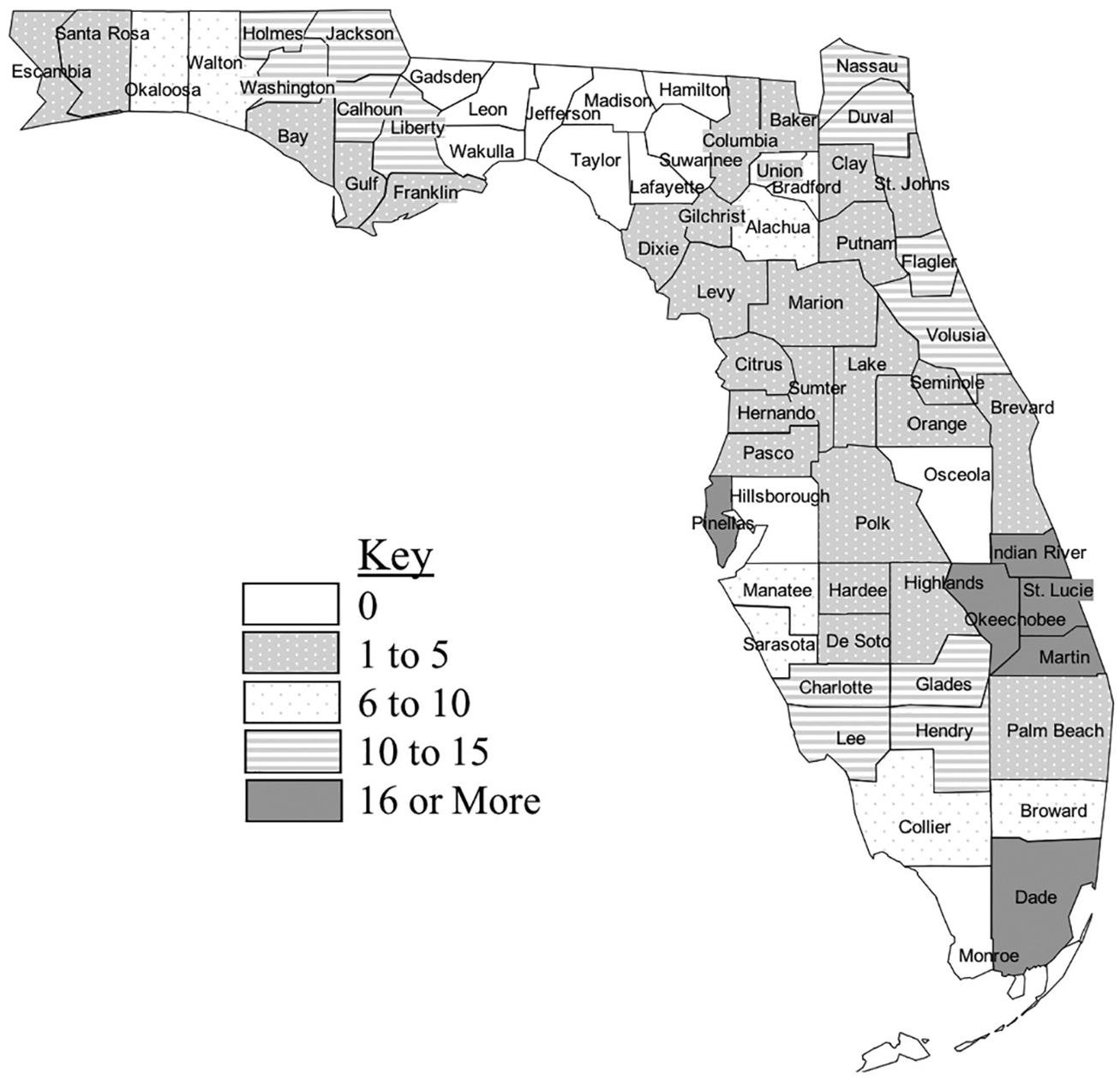
Distribution of community college baccalaureate (CCB) policies by county in Florida.
Figure 2 illustrates the statewide distribution of 4-year institutions granting bachelor’s degrees or higher, indicating clusters of 4-year institutions in community college service areas that are typically in close proximity to urban environments. In 2017, 8 of the 28 community college service areas do not include any 4-year institutions, while 18 of the 28 community college service areas do not include a publicly funded 4-year institution.
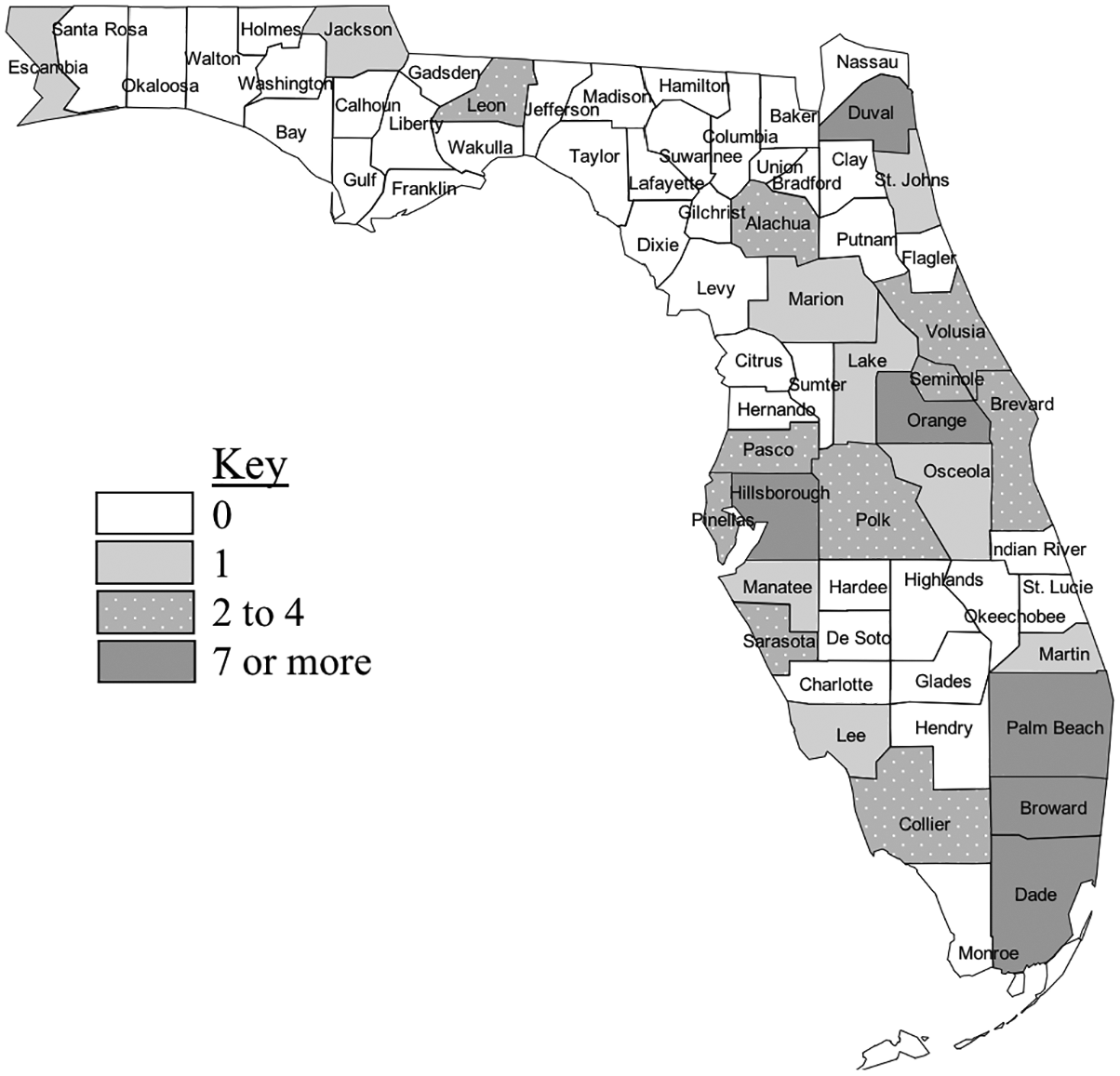
Distribution of all 4-year institutions in 2015.
CCB degree programs in Florida were stipulated to be concentrated in specific occupational fields that met proximate workforce needs (Floyd & Walker, 2008; Floyd et al., 2008) and did not duplicate the offerings of public 4-year universities (Floyd, 2006). The state of Florida has become a national leader for the CCB movement (Fulton, 2015). As of 2017, 24 of the 28 community colleges offer approximately 185 baccalaureate degree programs (Florida College System, 2017). In Table 1, we provide an overview of the number of total CCBs adopted, the number of total unique two-digit CCB programs adopted, and the year of first adoption by community college. The number of CCBs adopted range between one and 22—with Saint Petersburg College representing the largest and earliest adopter of CCB programs in the state.
Baccalaureate Degree Programs at Florida Community Colleges
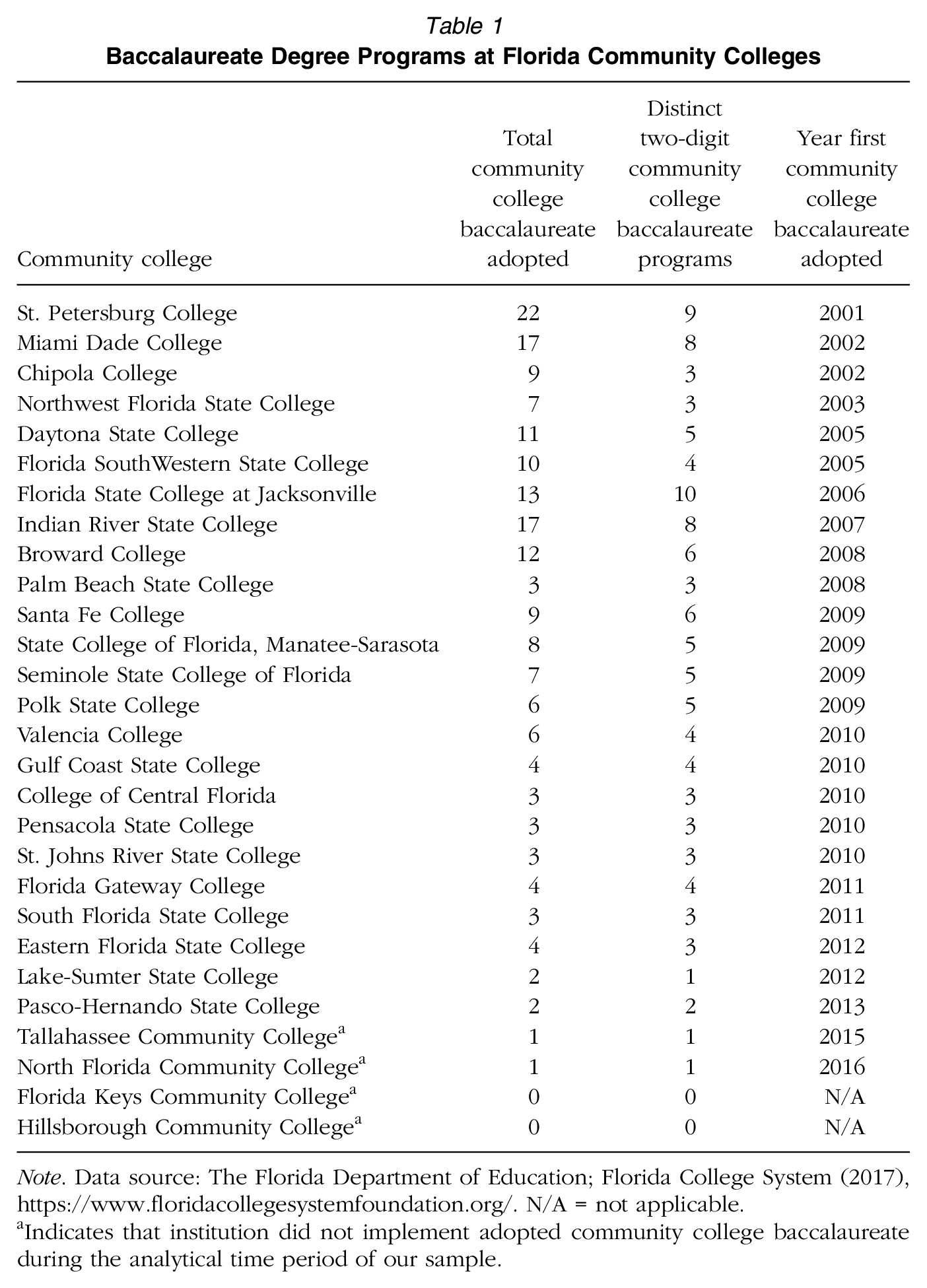
Note. Data source: The Florida Department of Education; Florida College System (2017), https://www.floridacollegesystemfoundation.org/. N/A = not applicable.
Indicates that institution did not implement adopted community college baccalaureate during the analytical time period of our sample.
In Table 2, we explore the adoption of CCBs by two-digit CIP (Classification of Instructional Programs) code as well as the overlap in 4-year institutions within the community college’s service area. We see that Education, Health Professions, and Business programs represent over 70% of all CCBs adopted across the state of Florida. Additionally, these three areas also have over 70% overlap with a 4-year institution within their service area. The majority of CCB degree programs overlap with at least one type of a 4-year institution, with most overlapping with private and for-profit 4-year institutions.
Community College Baccalaureate (CCB) Adoption and Service Area Overlap With 4-Year Institutions
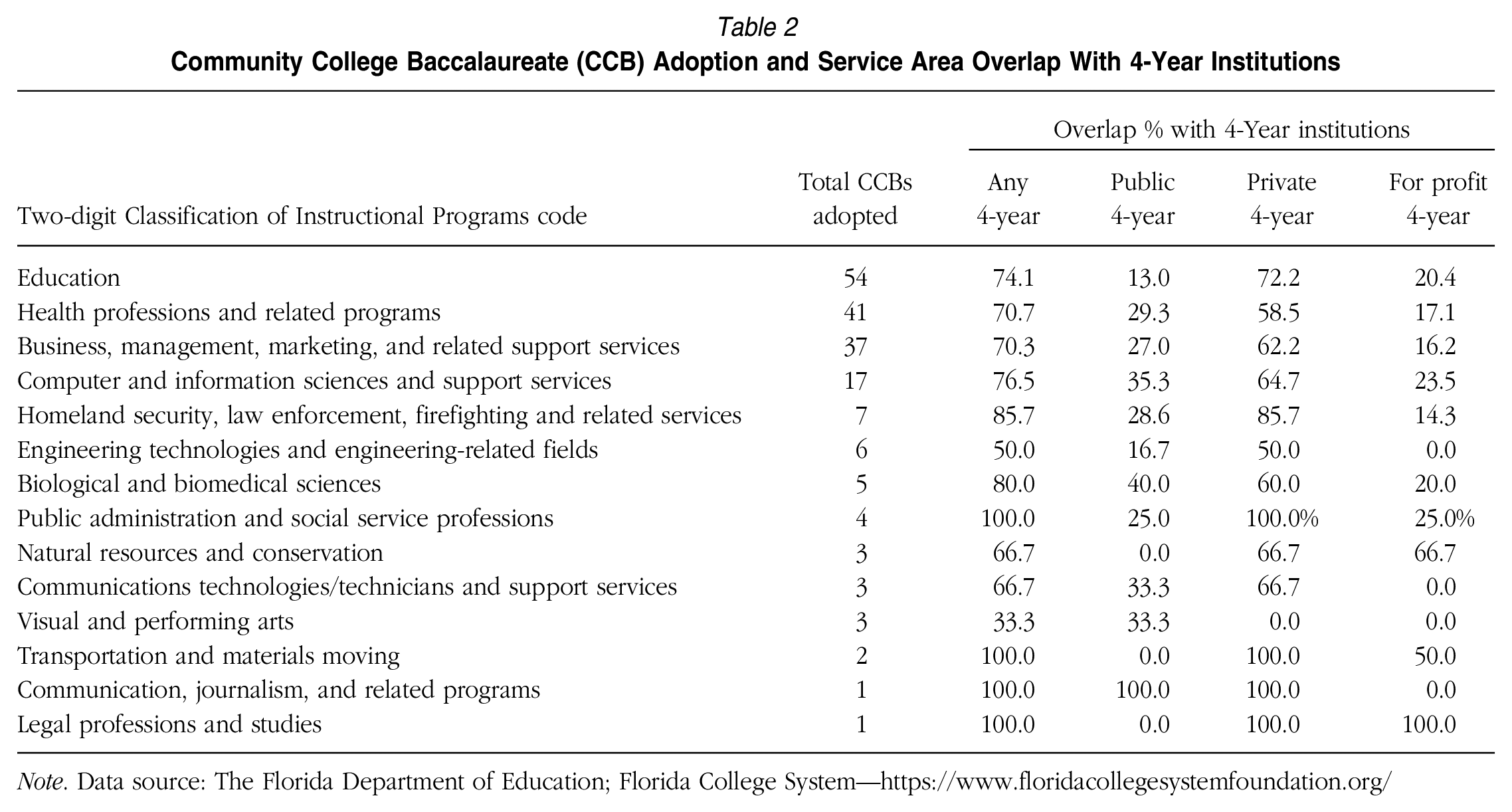
Note. Data source: The Florida Department of Education; Florida College System—https://www.floridacollegesystemfoundation.org/
Figure 3 illustrates the number of CCB degree programs adopted each year and the market share of statewide bachelor’s degree production by CCB-adopting institutions in Florida over time. Between 2001 and 2006, a small number of CCB degree programs were approved by the state of Florida. There was a significant increase in the number of CCB degree programs adopted in Florida between 2007 and 2013, with 72% of all CCB degree programs in the state being adopted during this time period. Due to the growth in the number of the CCB degree programs in Florida, the market share of bachelor’s degree recipients who attended community colleges has grown over time. By 2017, approximately 3% of all statewide bachelor’s degrees were offered via CCB degree programs.

Community college baccalaureate (CCB) adoptions overtime and market share of statewide BA (bachelor of arts) production.
Theoretical Framework
Higher education researchers have long sought to identify and analyze patterns of organizational responses to external pressures. According to institutional theory, colleges and universities engage in mission drift in order to improve their status and position relative to other postsecondary institutions (H. D. Meyer & Rowan, 2006; J. W. Meyer & Rowan, 1977; Morphew & Huisman, 2002; Scott, 1987, 2014). For community colleges, institutional theory can explain why they would adopt new programs rather than maximize the efficiency within their existing offerings (Morphew & Huisman, 2002), as CCB-adopting institutions are able to adopt the rituals, programs, processes, and structures viewed as legitimate by external actors, such as state policymakers or 4-year institutional leaders (H. D. Meyer & Rowan, 2006; J. W. Meyer & Rowan, 1977; Scott, 1987, 2014; Scott & Davis, 2007).
Although institutional theorists often view organizations as separate units engaging in behavior in response to external stimuli, organizations that respond to similar external forces tend to take on similar organizational structures; this phenomenon has been identified by sociologists as institutional isomorphism (e.g., DiMaggio & Powell, 1983). DiMaggio and Powell defined institutional isomorphism as a process of homogenization where organizations functioning within the same environment and under similar conditions come to resemble one another, arguing that increasing external pressures, combined with ambiguous environmental variables, have driven some colleges to converge their organizational structures by imitating high-status institutions. Traditionally, isomorphism explains the capacity of the external environment to stimulate similarities in structures and practices across organizations (DiMaggio, 1988; DiMaggio & Powell, 1983; H. D. Meyer & Rowan, 2006; J. W. Meyer & Rowan, 1977), but isomorphic change in the form of CCB adoption appears to be the result of voluntary imitation of 4-year institutions as motivated by an increase in the long-term stability of the organization and improved likelihood of survival (e.g., Bastedo, 2006; Scott & Davis, 2007).
Institutional theory also suggests that colleges represent apt examples of highly institutionalized organizations in which rationalized formal structures allow organizations to gain legitimacy, stability, and resources (H. D. Meyer & Rowan, 2006; J. W. Meyer & Rowan, 1977). Community colleges may seek to emulate the practices of 4-year institutions to improve their legitimacy and offer educational credentials (bachelor’s degrees) deemed more valuable to prospective students and employers (Person et al., 2006). This emulation of 4-year practices by community colleges creates an environment in which community colleges may be forced to compete with 4-year institutions for scarce resources. As community colleges enter the market for 4-year students, prior work by DiMaggio (1988) and Scott (2014) suggests that both institution types may struggle to gain influence as students may be forced to choose between new institutional forms (CCB-adopting institutions) or the preservation of existing institutional forms (traditional 4-year institutions).
Community college administrators have been described in previous work as constrained actors seeking to maximize the benefits that accrue to the institutions they manage (Dougherty, 1994). In line with the logic of a resource dependence perspective (Pfeffer & Salancik, 1978), community college administrators are constrained by the external environment due to their high level of reliance on external resources (e.g., local and state appropriations). External resource providers can constrain organizational actors’ behaviors when the resource being provided is both critical and not easily obtained from another source (Dougherty, 1994; Emerson, 1962). At public community colleges, administrators may alter or constrain their behavior in order to ensure that they maintain their share of a critical funding source in the form of government appropriations (e.g., Harnisch, 2011). In recent years, community college administrators have also been constrained by relatively consistent declines in the total number and relative share of public community college students (National Student Clearinghouse Research Center, 2019).
Community colleges continue to face financial challenges due to constrained resources caused, at least in part, by decreasing enrollment numbers and disproportionately low levels of state appropriations relative to 4-year institutions (Snyder, 2018; Zumeta et al., 2012). Even though CCB adoption could be considered a source of mission conflict that undercuts the community college’s traditional subbaccalaureate and transfer missions (Dougherty & Townsend, 2006), administrators at community colleges in CCB-adopting states may feel compelled to diversify their revenue streams by generating additional tuition and fees through the provision of high-demand bachelor’s degree programs.
Data
This study leverages secondary program-level data for baccalaureate-granting institutions to examine the impact of CCB degree programs on the enrollment and bachelor’s degree production of nearby 4-year institutions in the state of Florida. Given the available data at the program level, our analytical sample includes public, private nonprofit, and private for-profit 4-year institutions in existence between 1995 and 2017. Within our data set, we have 123 unique 4-year institutions, but we removed any institutions that had 70% or more of their awarded degrees at an associate degree level or less (i.e., certificate) as well as any institutions that were coded as a public 2-year institution within the IPEDS data. 2 The logic of this decision was due to the reclassification of community colleges (or 2-year institutions) as 4-year institutions after they began awarding bachelor’s degrees. Finally, we limited our sample to institutions in operation during the time period of our analytical sample to ensure that institutional openings and closures did not confound our estimates. 3
As mentioned previously, we define “nearby” 4-year institutions as those located in the same county-based service area as the CCB-adopting institution. The logic of this decision rests on the notion that community colleges in the state of Florida are unable to recruit prospective students outside of their county-based service area, suggesting that students outside of a community college’s service area are unlikely to decide between enrolling at that particular community college or its nearby 4-year institution. As a robustness check, we specify alternative models in which we define “nearby” 4-year institutions as those within a 100 or 150-mile radius of the CCB-adopting institution. Given that the mean distance between home and college is 52 miles and the median distance is 11 miles (U.S. Department of Education, 2014), our distance-based definition of a “nearby” institution represents a conservative measure. Our results are robust to either the county-based or distance-based definitions of “nearby” 4-year institutions, but we use the former definition in models reported below.
Table 3 provides the descriptive statistics of key institutional covariates used within our specified models. Specifically, this table compares 4-year institutions within a county served by a CCB degree program with 4-year institutions located in a county not served by a CCB degree program. On average, 4-year institutions with a closely located community college offering at least one CCB degree program showed lower undergraduate enrollment, but other key institutional factors were not significantly different across the two groups. County-level factors appear to differ significantly across CCB and non-CCB institutions to a greater extent. This result aligns with the state policy narrative that CCB degree programs were originally intended to support counties that have large labor market shortages and limited access to bachelor’s degree–granting institutions.
Means Differences on Key Institution- and County-Level Covariates
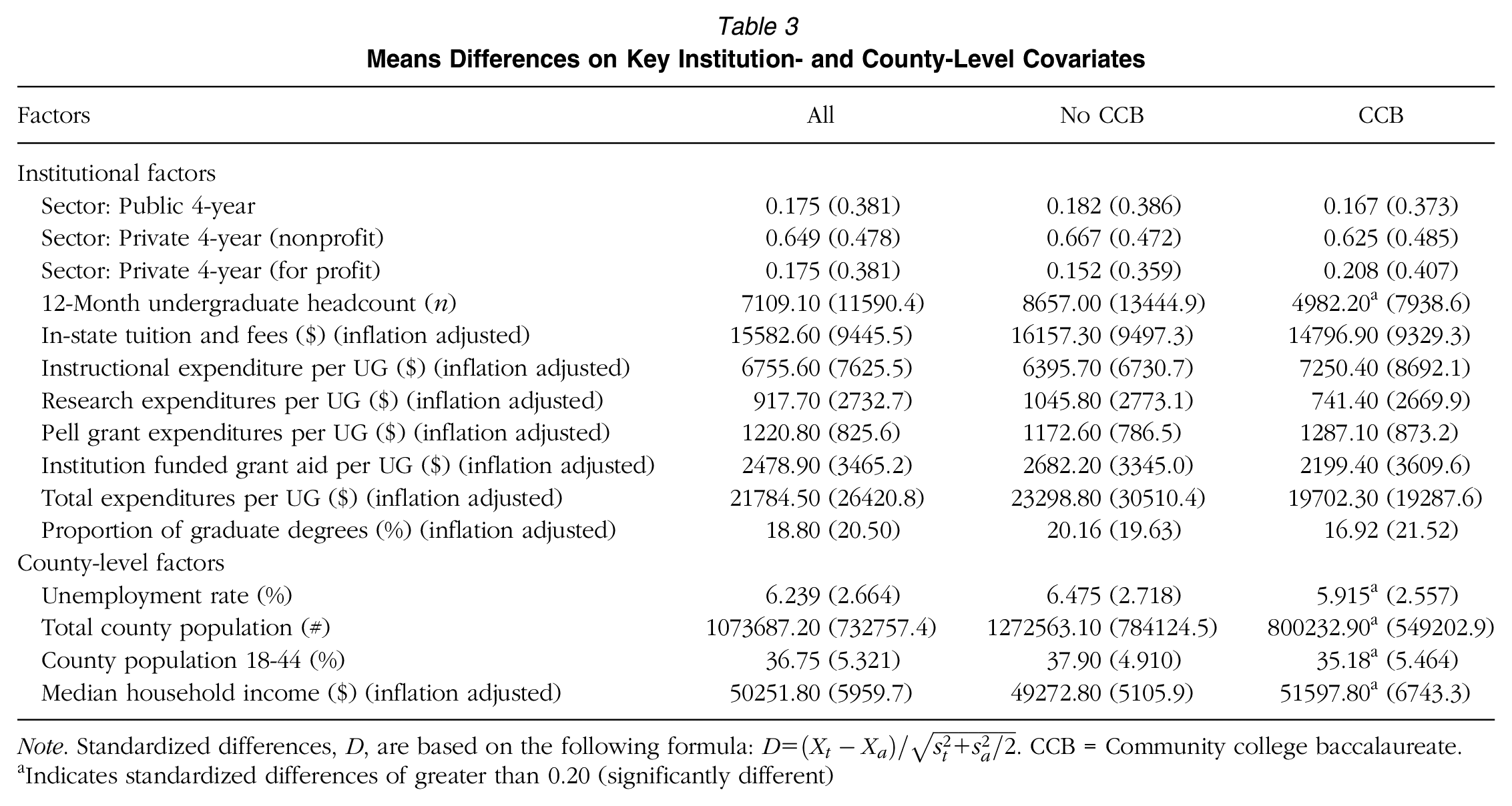
Note. Standardized differences, D, are based on the following formula:
Indicates standardized differences of greater than 0.20 (significantly different)
We operationalize our program-level data through the two-digit CIP classification. CIP is a standardized reporting taxonomy generated by the U.S. Department of Education’s National Center for Education Statistics to track and report fields of study and program completion activity. To this end, we created a dyadic panel data set where the unit of analysis shifts from the institution (College X) to the dyad of institution and two-digit CIP code (CollegeX_CIP). This approach allows for micro-level analyses while also accounting for trends at the individual program and institution levels.
Our two primary outcomes are (1) bachelor’s degree program enrollment and (2) bachelor’s degree production. By looking at both enrollment and completion outcomes, we can estimate the impact of CCB adoption on the short-term enrollment outcomes related to college access and long-term outcomes related to student success. For our short-term outcome of bachelor’s degree program enrollment, IPEDS collects program-level undergraduate enrollment data for six CIP codes—Education (13); Engineering (14); Biological Sciences/Life Sciences (26); Mathematics (27); Physical Sciences (40); and Business Management and Administrative Services (52). We use these CIP codes to analyze the impact of CCB adoption on bachelor’s degree program enrollment. Of the six enrollment CIP codes, three were subjected to CCB adoption and three were not, which allows for enough variation to estimate a policy effect over time. Due to data limitations, the undergraduate degree programs included within our program-level enrollment outcomes are limited to the six CIP codes highlighted above. Our second outcome of interest is captured by the number of program-level bachelor’s degrees produced. We focus on bachelor’s degree production in addition to our enrollment outcome primarily due to broad national interest in student success and bachelor’s degree production. In addition, CCB policies are often adopted as a mechanism to increase bachelor’s degree production while simultaneously responding to local labor market demand.
Table 4 examines changes in institution-level bachelor’s degree production outcomes for 4-year institutions in the year prior to the Florida CCB legislation (2000) and the final year of our analytical data set (2014). Across both bachelor’s degree program enrollment and bachelor’s degree production outcomes, there appears to be a widening gap in the number enrolled and degrees produced between 4-year institutions with a local CCB degree program and those without one. For example, between 1997 and 2017, total bachelor’s degree program enrollment increased by 44.8% for institutions without an active CCB policy in their county but increased 67.2% for those with an active CCB policy. A similar growth differential is seen in bachelor’s degree production, as 4-year institutions without an active CCB policy increased degree production by 61.6% relative to an increase of 85.1% for 4-year institutions with an active CCB policy. These are institution-level estimates and do not account for program-specific adoptions, which will be examined later.
Total Bachelor’s Program Enrollment and Bachelor’s Degree Production Pre– and Post–CCB Legislation
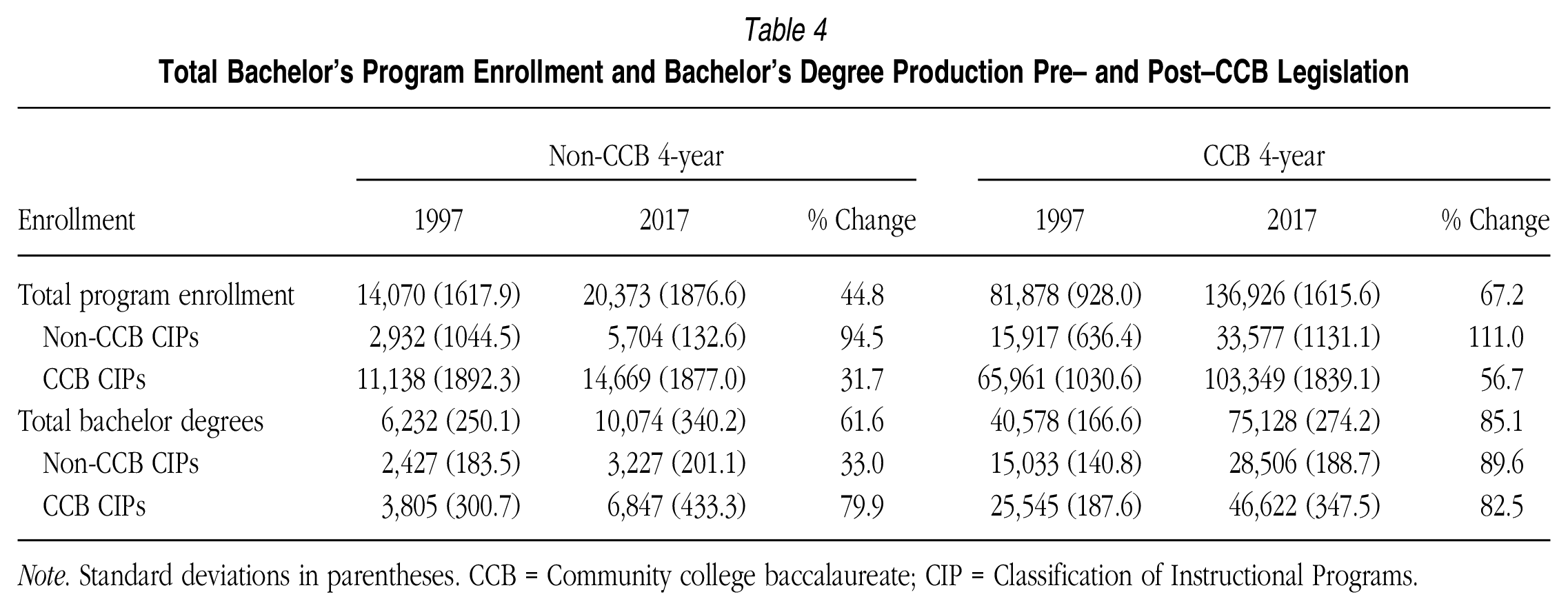
Note. Standard deviations in parentheses. CCB = Community college baccalaureate; CIP = Classification of Instructional Programs.
The data from the Florida Department of Education were then merged with data from National Center for Education Statistics’ IPEDS to gather institution-level factors. Factors, such as cost of attendance, institution-level student demographics, and institutional expenditure data, were included as control variables that may have influenced changes in enrollment and bachelor’s degree completion.
Policy/Treatment Indicator
Our primary independent variable is a binary indicator that signals if a 4-year institution’s two-digit CIP code was in a county served by a CCB degree program within the same two-digit CIP code. Within the state of Florida, community colleges have well-defined and distinct county-level service areas in which they can actively recruit students. While they are not prohibited from enrolling students from nonservice counties, the vast majority of students enrolled in a community college are from its surrounding area and they are restricted from actively marketing programs outside of their service area. All Florida counties are served by a single community college, but not all counties have a 4-year institution located within them. Our decision to designate 4-year institutions with two-digit CIP codes to “treat” them as if they were located in the service county of a 2-year institution in that corresponding CIP code is purposeful given the context described above.
Empirical Strategy
We use a DDD framework to identify the causal effects of the adoption of CCB degree programs on bachelor’s degree program enrollment and bachelor’s degree production at 4-year institutions. Florida allows for the identification of this naturally occurring experimental framework, as the state is one of the largest adopters of CCB degree programs. Community colleges, or 2-year institutions, are legislatively mandated to service and recruit from specified counties within the state. Additionally, CCBs are program-specific and allow us to capitalize on program-level degree production data to examine the micro-level effects of this policy change.
Triple Difference Approach
This study employs program-level data to estimate the impacts of local CCB adoption on bachelor’s degree program enrollment and bachelor’s degree production at nearby 4-year institutions. Drawing from prior work by Baker (2016) and Ortagus and Hu (2019), we use a DDD approach to estimate the effects of CCB adoption on our specified outcomes. Using the logic of difference-in-differences (DiD) parameters as our base, we can compare CCB-adopting institutions with nonadopters before and after CCB legislation (the decision to offer CCB degree programs is made by individual community colleges). Since CCB legislation targeted high-demand bachelor’s degree program areas in response to local workforce shortages (Moore et al., 2014), our DDD approach allows us to account for any potential bias in the types of degree programs selected for CCB adoption.
In a regression framework, the DDD estimation strategy can be expressed as

where Yipt, is the outcome of interest (bachelor’s degree program enrollment or bachelor’s degree production) for institution i, program p, in year t.
Despite legislative approval for CCBs in 2001, not all adopting institutions implemented their respective CCBs immediately. To this end, we have variations in the initial adoption year at both the institution and program levels. To account for these variations, we extend Equation (1) and implement a generalized difference-in-difference-in-differences (GDDD) model. Following the logic implemented by Ortagus and Hu (2019), we specified our GDDD model as Equation (2):

where
The benefit of this model specification is the full control of college-specific time effects common across academic programs combined with time-varying program effects. This specification models out any influence on the outcomes related to specific programs at individual institutions, specific programs across institutions for a particular year, and specific institutions in a particular year. The estimates on
To further test the differential effects of CCB adoption by institutional type and Carnegie classification, we incorporate interaction terms with our GDDD coefficient of interest:

where we extend our main effects GDDD specification to include a binary indicator for private institutions (
Limitations and Validation of Design Assumptions
The difficulty in any quasi-experimental design is identifying the counterfactual in the absence of policy adoption. Our GDDD design allows this study to approximate the impact of nonadoption in adopting programs using nonadopting programs and nonadopting institutions as controls. This approach produces estimates of what could have occurred within the outcomes if the CCB had not been adopted. This counterfactual approach assumes that treatment and control units following similar (or parallel) prepolicy patterns, and the resulting variations in the outcome can be attributed to policy adoption.
Although the parallel trends assumption is impossible to test in this context, our study employs two techniques to attempt to address potential concerns regarding the parallel trends assumption. First, this study introduces county-by-CIP time to guard against nonparallel trends at the county-by-CIP level. Our addition of a robust set of fixed-effects accounts for the potential that adopting programs within adopting institutions may have experienced differences in the outcomes of interest before adopting a CCB.
Second, we employ falsification tests to overcome a significant concern with quasi-experimental approaches by untangling the policy effect from a potential corresponding time effect (T. D. Cook & Campbell, 1986). To this end, we artificially created the adoption of CCB degree programs years prior to the actual adoption. This approach allows the results to be viewed in context. Significant results prior to the actual adoption signal that the estimated impact on bachelor’s degree production was not a product of CCB adoption but rather a time-related effect that coincides with the adoption of CCB degree programs.
Finally, our decision to focus on bachelor’s degree production as an outcome of interest may lead to additional threats to validity that arise when examining the effect of CCB adoption on a downstream outcome, such as bachelor’s degree completion. Because bachelor’s degree completion is a product of not only competition in enrollment but also additional downstream processes, such as student transfer and attrition, the effect of CCB adoption on bachelor’s degree production may be difficult to isolate and identify as causal. We argue that CCB adoption should not affect the mechanisms at play for traditional 4-year institutions to graduate students and attempt to account for these complexities and threats to validity through a host of robustness checks and falsification tests to be outlined in detail below.
Results
Table 5 presents estimates from our GDDD model for both our main effects and interacted models. 6 Each model is fully specified, including our previously discussed interacted fixed-effects specifications and county-by-program linear time trends. This approach is in line with prior work using the DDD approach (e.g., Baker, 2016). We present the 1-year lagged CCB adoption indicator for our bachelor’s degree program enrollment outcome, as we would expect a lag between CCB adoption and enrollment in one of the CCB degree programs. For the bachelor’s degree production variable, we show 4- and 6-year lagged CCB adoption indicators. Similar to the logic we employed when using a lagged enrollment outcome, we would expect a substantial lag between CCB adoption and the completion of a bachelor’s degree given the time required to enroll (or transfer) into a CCB program, complete required coursework and meet requirements to graduate. The decision to provide lags of 4 and 6 years when examining bachelor’s degree completion is aligned with a number of prior high-quality studies that specify models to capture both 100% and 150% graduation time (e.g., Goenner & Snaith, 2004; Smith & Stange, 2016).
Effect of CCB Implementation on Bachelor’s Degree Enrollment and Bachelor’s Degree Production (by Sector)
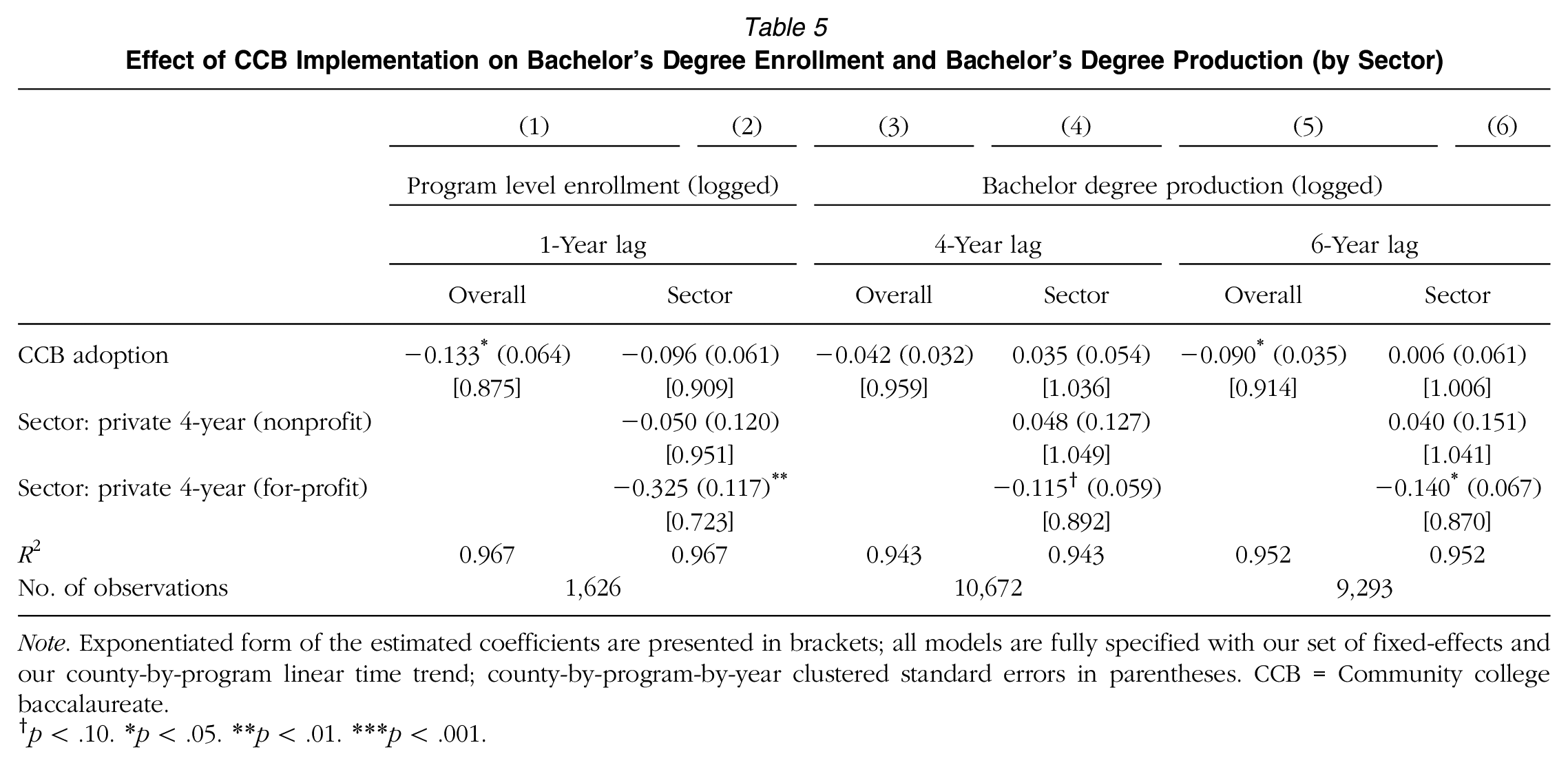
Note. Exponentiated form of the estimated coefficients are presented in brackets; all models are fully specified with our set of fixed-effects and our county-by-program linear time trend; county-by-program-by-year clustered standard errors in parentheses. CCB = Community college baccalaureate.
p < .10. *p < .05. **p < .01. ***p < .001.
Model (1) in Table 5 presents the overall effect of CCB adoption on bachelor’s degree program enrollment (1 year after implementing CCB degree programs) and bachelor’s degree production (4 and 6 years after implementing CCB degree programs). Overall, we find consistent evidence that the presence of CCB degree programs reduces bachelor’s degree program enrollment and bachelor’s degree production in the corresponding programs at 4-year institutions within that community college’s service area. For bachelor’s degree program enrollment 1 year after implementing CCB degree programs, we find that CCB adoption is associated with a 12.5% decrease in bachelor’s degree program enrollment within competing programs at all 4-year institutions within the CCB-adopting service area. We find similar evidence related to the impact of CCB adoption on bachelor’s degree production. After 6 years, the implementation of CCB degree programs is associated with an 8.6% decrease in bachelor’s degree production at nearby 4-year institutions.
Given the overall estimates suggesting that CCB adoption reduces bachelor’s degree program enrollment and bachelor’s degree production, we focused specifically on the role of institutional sector to determine whether a specific sector was driving our overall findings. Model (2) in Table 5 provides the interaction effects between institutional sector indicator and the CCB adoption indicator. Using the same lagged outcomes as described previously, we estimate the differential effects of CCB adoption for private (nonprofit) 4-year institutions, private (for-profit) 4-year institutions, and public 4-year institutions.
In general, we find statistically significant and consistent evidence of a differential effect of CCB adoption by institutional sector. For both public 4-year institutions and private (nonprofit) 4-year institutions, we do not find any evidence that CCB adoption is related to bachelor’s degree program enrollment or bachelor’s degree production. However, we find statistically significant and consistent evidence suggesting that CCB adoption has a negative impact on both bachelor’s degree program enrollment and bachelor’s degree production at private (for-profit) 4-year institutions. To contextualize our findings, we report the extent to which CCB degree programs draw from for-profit 4-year institutions. Specifically, the average program-level enrollment in CCB degree programs is approximately 642 students, and roughly one-third of those students are drawn from for-profit 4-year institutions.
For bachelor’s degree program enrollment at for-profit 4-year institutions, we find that CCB adoption significantly reduces bachelor’s degree program enrollment between 27.7% and 19.4% in the first and second year following CCB adoption, respectively. We find similar evidence of a reduction in bachelor’s degree production at for-profit 4-year institutions between 10.8% and 13% 4 and 6 years following CCB adoption.
Heterogeneous Effects
Table 6 offers further analyses of the impact of CCB adoption on 4-year institutions’ bachelor’s degree production by examining heterogeneous effects by race/ethnicity. 7 We find that the presence of a local CCB degree program has a negative impact on bachelor’s degree production at for-profit institutions for Hispanic and White. Specifically, Hispanic students’ bachelor’s degree production, within treated CIP codes, significantly decreased at for-profit institutions by 20.9%. Bachelor’s degree production for White students at for-profit institutions also decreased significantly by 11.5% (the overall negative impact of CCB adoption on bachelor’s degree production for White students was concentrated within for-profit institutions). While not significant, we find suggestive evidence that Black students are also substituting CCB programs for similar degree programs at for-profit institutions, although at a potentially much smaller magnitude.
Effects of CCB Adoption on BA Degree Production by Race/Ethnicity
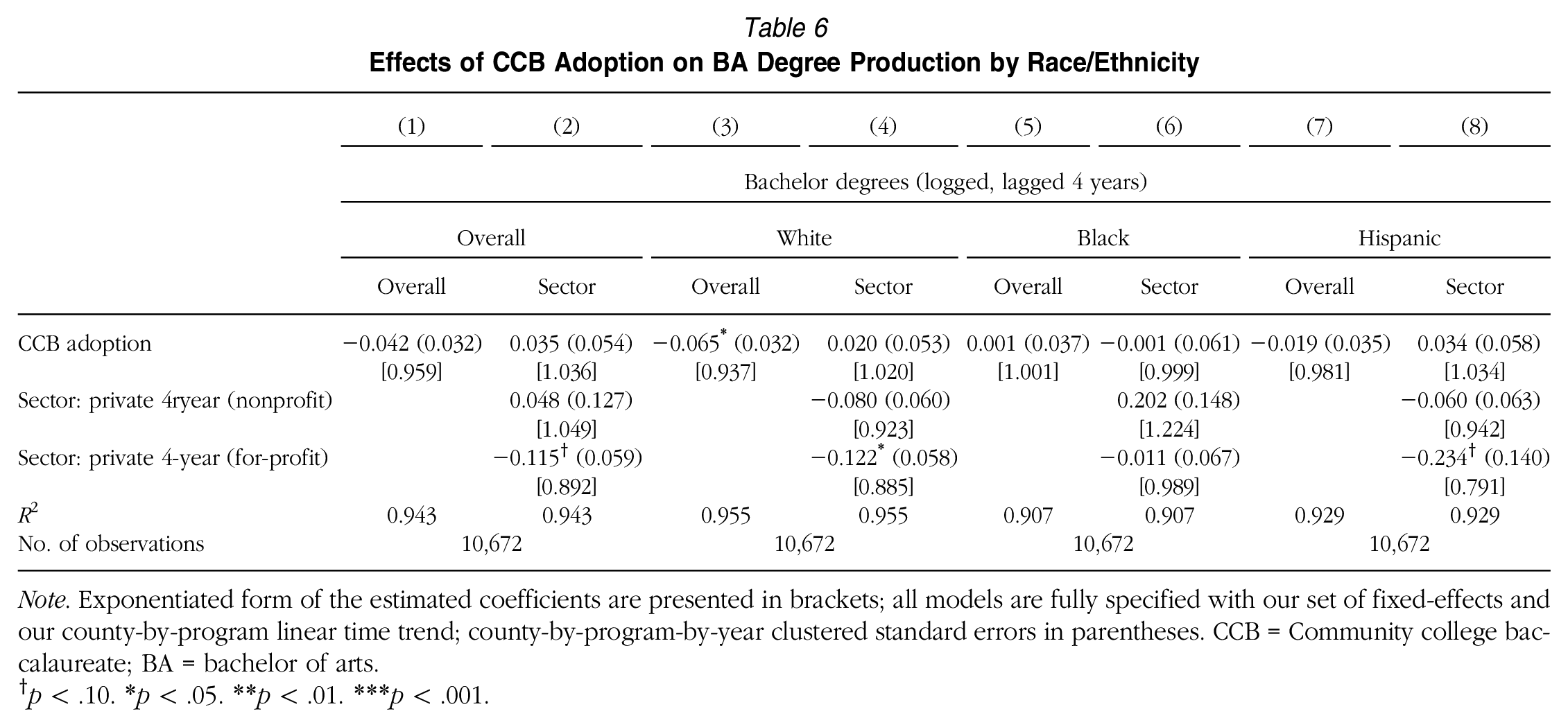
Note. Exponentiated form of the estimated coefficients are presented in brackets; all models are fully specified with our set of fixed-effects and our county-by-program linear time trend; county-by-program-by-year clustered standard errors in parentheses. CCB = Community college baccalaureate; BA = bachelor of arts.
p < .10. *p < .05. **p < .01. ***p < .001.
Falsification Tests
Given the time-varying nature of implementation of CCB degree programs after community colleges were granted legislative authority to confer bachelor’s degrees, we can trace the dynamic effects both before and after local CCB adoption. To complete our falsification tests, we examined whether our main effects were influenced by other exogenous factors or additional policies separate from the implementation of CCB degree programs. To do so, we tested for significant estimates of our treatment effect prior to implementing the time-varying CCB degree programs as well as after CCB adoption. Following prior work by Dee and Murphy (2019), we estimate our falsification tests using the fully specified Equation (2) but vary the lead and lag time of our program-level CCB adoption indicator.
We conduct two separate falsification tests—one on our bachelor’s degree program enrollment outcome and the other on our bachelor’s degree production outcome. In Figure 4, we show estimates of our treatment effect on bachelor’s degree program enrollment for the 3 years priors and 6 years after CCB adoption. We find consistent and relatively precisely estimated zero effects of CCB implementation on bachelor’s degree program enrollment in the 3 years prior to CCB adoption. We find suggestive evidence of negative effects beginning in the first year after CCB adoption and statistically significant negative effects that persist for 6 years following the implementation of local CCB degree programs. The results from our falsification tests align with our a priori assumptions that the effects should be close to zero and not statistically significant prior to local CCB adoption, with statistically significant effects on the enrollment outcomes after CCB adoption.
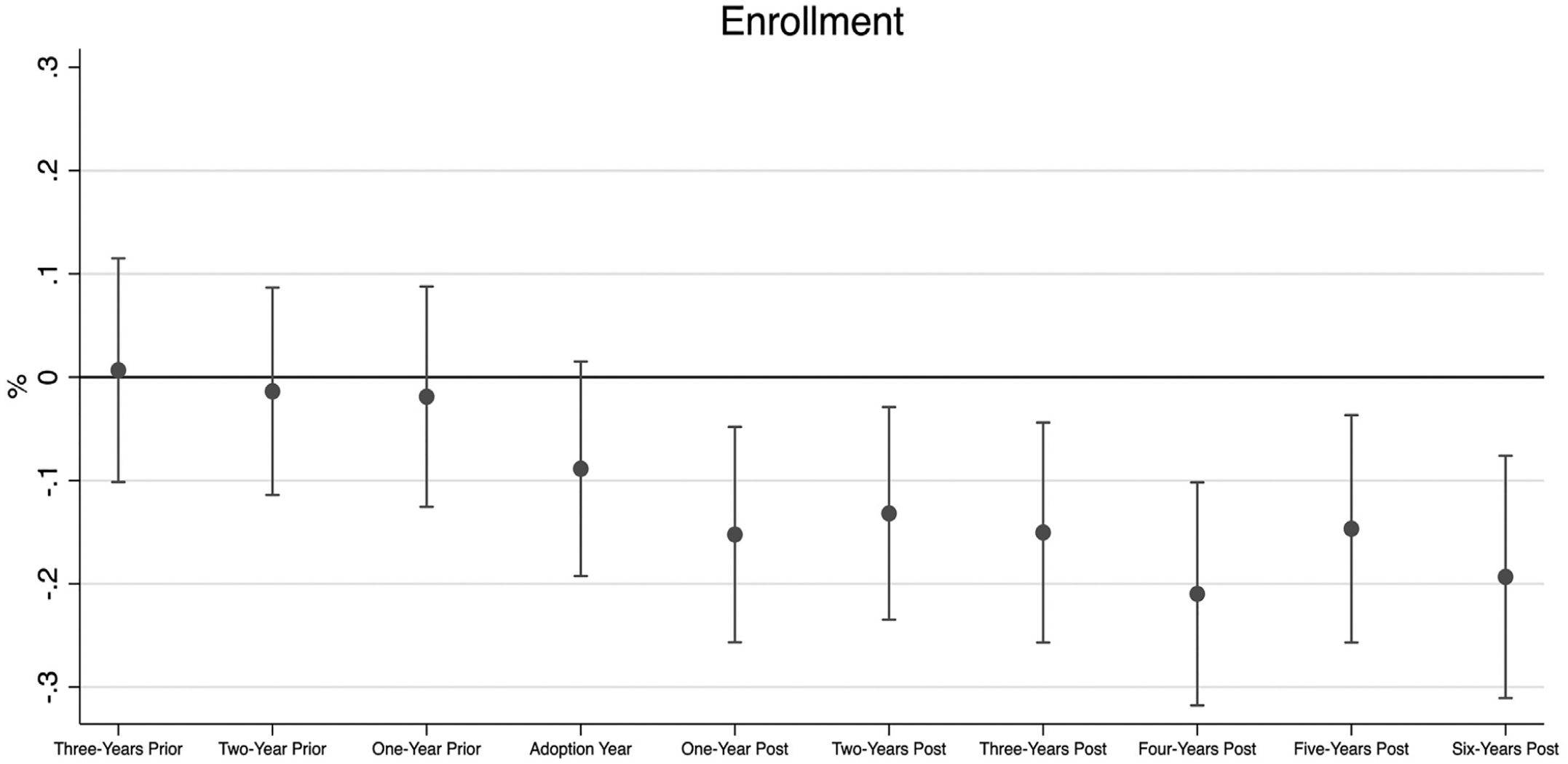
Event falsification test on the effects of community college baccalaureate (CCB) implementation on bachelor’s degree program enrollment.
We conducted another falsification test for the bachelor’s degree production outcome (Figure 5). Similar to our bachelor’s degree enrollment outcome, we would not expect to see a statistically significant treatment effect for the years prior to CCB adoption. Unlike the bachelor’s degree enrollment outcome, which should have a more immediate effect, we would not expect to see significant changes in bachelor’s degree production until at least the fourth year following CCB adoption. Figure 5 shows no significant effect prior to or through the third year following the implementation of a local CCB degree program, offers suggestive evidence of an effect in the fourth year following CCB adoption, and displays a larger and statistically significant effect beginning in the fifth year following CCB adoption. The pattern depicted in Figure 5 aligns with prior work suggesting that it takes the average undergraduate 5.1 years to complete their bachelor’s degree (Shapiro et al., 2016).

Event falsification test on the effects of community college baccalaureate (CCB) implementation on bachelor’s degree production.
Robustness Checks
Given the time-varying nature of program-level CCB adoption, our GDDD approach relaxes many of the concerns that might be present when looking at a single-year policy shock. However, to test the robustness of our results, we create a within-year program-level placebo assignment. For every given institution-by-year program-level adoption, we randomly assign another two-digit CIP code to receive the treatment and then test the effects. We find no statistically significant effects on degree production using the 4- or 6-year lags (Table 7). Additionally, we randomly assign implementation of a CCB degree program to another community college within the adopted year and find no statistically significant impact on our bachelor’s degree production outcomes. Without a program-by-institution-by-year fixed effect, we feel confident that our estimates project the actual impacts of CCB implementation rather than spurious or external factors.
Results From Placebo Test

Note. Exponentiated form of the estimated coefficients are presented in brackets; all models are fully specified with our set of fixed-effects and our county-by-program linear time trend; county-by-program-by-year standard errors in parentheses; to generate the placebo CCB adoption indicator, we create a within-year program-level placebo assignment. CCB = community college baccalaureate.
p < .10. *p < .05. **p < .01. ***p < .001
In addition to testing the placebo policy effects, we test our assumptions around the selected functional form. Our decision to log transform our outcome variables was made for ease of interpretation; however, we run alternative model specifications with total degree and total degree for every 100 students enrolled and find that our results are consistent with our selected specification in both magnitude and significance (see Appendix A). The results located in Appendix A illustrate that our findings do not appear to be dependent on functional form and, combined with other robustness checks, can be attributed to the implementation of CCB degree programs.
Finally, we provide additional specifications of our models to address potential concerns regarding our isolation of targeted variations in county-by-program-by-year effects. In Appendix D, we estimate Equations (2) and (3) to allow for the inclusion of additional variations. To this end, we find generally consistent effects of CCB adoption in both direction and magnitude for our three primary outcomes. We contend that despite isolating targeted variation in our fully specified model, our results are robust to the inclusion of additional variations.
Discussion and Conclusions
This study combines program- and institution-level data to examine the impact of CCB adoption on bachelor’s degree program enrollment and bachelor’s degree production at nearby 4-year colleges and universities. Our results provide the first known estimates of the effect of CCB adoption on 4-year institutions’ bachelor’s degree program enrollment and bachelor’s degree production, revealing that CCB adoption had a negative effect on bachelor’s degree program enrollment and bachelor’s degree production at for-profit 4-year institutions. Although critics have argued that the adoption of CCB degree programs would duplicate efforts and diminish the market share of 4-year colleges and universities, our findings suggest that the enrollment and bachelor’s degree production of similar programs at for-profit institutions, and not other types of 4-year institutions, may be harmed by community college entrance into the bachelor’s degree-granting market.
Similar to community colleges, for-profit institutions respond to local labor market demand (Gilpin et al., 2015) and enroll a disproportionately high share of students who are low income, minority, over the age of 25 years, and parents (Deming et al., 2012). However, for-profit institutions charge significantly higher tuition than public community colleges and typically provide worse outcomes for students when compared with other institution types (Deming et al., 2013; Lang & Weinstein, 2012). Previous work has suggested that enrolling at a low-cost community college would be a better overall choice for prospective students rather than enrolling at a for-profit institution (Cellini & Chaudhary, 2014). In this study, we show that CCB degree programs appear to draw students specifically from for-profit 4-year institutions. More specifically, the average program-level enrollment in CCB degree programs is approximately 642 students, and roughly one-third of those students are drawn from for-profit 4-year institutions. Additional research can explore whether price-conscious students who enroll in a CCB degree program also experience improved academic and labor market outcomes when compared with for-profit students in similar degree programs.
Given that a disproportionate number of Black and Hispanic students attend community college (American Association of Community Colleges, 2017), we also examine the heterogeneous effects of CCB adoption on bachelor’s degree production according to students’ race/ethnicity, finding that the presence of a nearby CCB degree program has a negative effect on bachelor’s degree production at for-profit 4-year institutions among Hispanic students. This particular heterogeneous finding suggests that Hispanic students, many of whom are place-bound and low-income students (Shields 2004), may be able to benefit from CCB adoption by earning their bachelor’s degree without paying the high tuition prices at for-profit colleges and universities.
From a policy perspective, our results indicate that CCB adoption has achieved its aim in increasing state-subsidized bachelor’s degree production without harming traditional public 4-year institutions in the state of Florida. Although institutional theory, particularly institutional isomorphism, can explain why community colleges would adopt new bachelor’s degree programs rather than maximize the efficiency of their sub-baccalaureate offerings (e.g., Morphew & Huisman, 2002), legislative concerns related to the negative impact of CCB adoption on public 4-year institutions’ bachelor’s degree production appear to be unfounded in light of the results described above. In spite of these well-documented concerns, this study shows that the presence of a CCB degree program only cuts into the market share of for-profit colleges and universities. Because both for-profit and CCB-adopting institutions enroll a disproportionate number of students facing time and location constraints, the presence of a local CCB degree program would allow these traditionally disadvantaged students to earn their bachelor’s degree in a high-demand field at a significantly lower price.
This study leverages a unique data set to investigate the effects of CCB adoption in Florida, but future research can explore whether these findings hold on a national level. If findings from this study prove to be generalizable based on future work examining the impact of CCB adoption across states, community colleges across the United States may consider adopting targeted, high-demand bachelor’s degree programs as a mechanism to increase overall bachelor’s degree production. Despite the outcomes associated with CCB adoption presented in this study, critics may continue to suggest that the implementation of bachelor’s degree programs at community colleges represents a form of mission drift that detracts from the purpose of community colleges; however, we urge those detractors to consider the evidence presented in this work and the multiple curricular missions of community colleges (e.g., responsiveness to local workforce demands) before disregarding the potential utility of CCB adoption within targeted, high-demand program areas.
Footnotes
Appendix A
Appendix B
Appendix C
Appendix D

Notes
D
J
J