



Abstract
Research shows that Early College high schools have a significant impact on high school and college outcomes for students from low income and racial/ethnic minority backgrounds, but how similar opportunities extend to English learners (ELs) remains unknown. We examine a program that offers Early College opportunities in high schools serving large EL populations in California. Leveraging an exogenous policy change and rich administrative records, we look at the outcomes of pre- and postprogram cohorts of ELs (N = 15,090) in treated and untreated high schools. We find large, significant estimated effects on college credits earned in 12th grade but no effect on immediate college attendance after high school. The probability of attending a 4-year college decreased.
English learners (ELs) are a growing student population, comprising 10% of students nationwide who come from a wide variety of cultural and linguistic backgrounds (National Center for Education Statistics, 2020; Santos et al., 2018). When it comes to college access and postsecondary attainment, ELs face multiple dimensions of disadvantage and lag significantly behind their English-monolingual peers. They drop out of high school at higher rates (Kanno & Cromley, 2013) and are less likely to have access to rigorous academic coursework while in high school (Callahan, 2005). Additionally, ELs are more likely to enroll in 2-year colleges or not go to college at all (Kanno & Cromley, 2013, 2015; Núñez & Sparks, 2012). Offering improved postsecondary opportunities for ELs is an increasingly pressing concern but figuring out how to best serve their diverse needs is complex. Few college interventions targeted at ELs have been documented or researched. With the rise of new federal accountability policies (U.S. Department of Education, 2015) and state guidance (California Department of Education, 2017) that place an increasing focus on the postsecondary trajectories of ELs, practitioners and policymakers are searching for college access solutions that may extend benefits to ELs.
Early College (EC), a special form of dual enrollment, has emerged as a possible response. Although EC models can vary in design, they tend to incorporate strategies specifically aimed at improving postsecondary outcomes for traditionally underrepresented students (Berger et al., 2010). For example, a key characteristic of EC is to enroll whole high schools of students in college courses. Additionally, EC models tend to provide intensive academic and social supports via advisories, mentoring, and tutoring (Born, 2006). Depending on the program model, EC can also offer students the opportunity to earn a certificate or AA (associate in arts) degree. Taken together, the key elements of EC aim to expose students to college-level coursework, while simultaneously integrating comprehensive support systems to help underrepresented students transition to college (Edmunds, 2016; Edmunds et al., 2017).
Although several quantitative and qualitative studies have investigated the ways in which EC programs affect students’ academic outcomes and experiences (Berger et al., 2013; Haxton et al., 2016; Kaniuka & Vickers, 2010; Ongaga, 2010; Song & Zeiser, 2019), none have examined whether effects are similar for ELs. EC’s approach to college access, with its additional supports and whole-cohort enrollment, is well-positioned to address such issues and presents an exciting possibility for improving EL postsecondary outcomes. ELs may benefit from this type of college exposure, or they may require more intensive or different types of support than those provided by EC programs designed for English-monolingual students.
This article investigates the effects of a program that provides EC opportunities in an urban district that serves a large EL population. Our research question is the following: What are the effects of a high school program that provides EC opportunities on EL students’ (1) college credits earned, (2) probability of immediate college attendance, (3) probability of attending a 4-year college, and (4) on-time high school graduation?
The EC program in the district offers opportunities to take community college courses in one of several pathways designed to be an on-ramp to a certificate or 2-year degree. Unlike other studies of EC, the majority of participants in this study are ELs; additionally, the program was designed with ELs in mind. Leveraging rich longitudinal administrative data from the district, we estimate the effects of EC opportunities on ELs’ high school and college outcomes. We use a difference-in-differences (DiD) design, which improves on propensity score matching methods employed by earlier dual enrollment studies that reported EL outcomes. In addition, this study contributes to the burgeoning literature on EL college access by providing the first EC effect estimates from California, which could inform policy and practice in other states and districts with high concentrations and growing rates of EL enrollment.
Literature Review
English Learner College Access and Attainment
Research on EL college access and attainment is only emerging, but it clearly showcases the opportunity disparities between ELs and non-ELs. Descriptive evidence, for example, has demonstrated that ELs are underrepresented in 4-year postsecondary institutions compared with English-proficient or English-monolingual students (Kanno & Cromley, 2013; Rodriguez & Cruz, 2009), and ELs are less likely to complete any college degree 8 years after high school than self-identified English-proficient or English-monolingual students (Kanno & Cromley, 2013). Even EL students who do reach major college access milestones, such as aspiring to attend a 4-year college, meeting college coursework prerequisites, and receiving a high school diploma, are less likely to enroll in college than self-identified English-proficient or English-monolingual students (Callahan & Humphries, 2016; Kanno & Cromley, 2015). ELs are also more likely to enroll in college on a part-time basis, delay their entrance to college, or complete only a small number of courses (Almon, 2014)—factors that put their postsecondary completion at risk.
The lack of detailed national and state data on ELs has limited the advancement of theory on how EL postsecondary transitions may be similar to or different from those of other disadvantaged youth (Núñez et al., 2016). Notably, EL status is a fluid category—when students reach English proficiency, they lose this label. This poses an issue for longitudinal analyses that use “current EL” status, as the more proficient students exit the category every year, leaving less proficient students in the current EL subgroup (Hopkins et al., 2013). Adding to this complexity, adolescent ELs are a distinctly heterogenous group in terms of national origin, immigration status, and a host of other district and state-level characteristics (Santos et al., 2018).
Without theoretical clarity about how EL postsecondary trajectories differ from those of other traditionally underrepresented youth, it has been difficult for practitioners and education policymakers to adequately prepare college access interventions that address students’ specific needs. In attempts to fill this gap, a handful of organizations, such as the Internationals Network, have focused on serving subgroups of ELs at the secondary level by establishing schools to service immigrant newcomers or long-term ELs. Building schools that only service ELs cannot address the needs of all ELs, however, since the distribution of ELs varies considerably between districts. In addition, the majority of existing reform efforts focus on improving K–12 pedagogical strategies, which may or may not include an emphasis on other types of college access supports for ELs, such as assistance with financial aid and information about colleges.
Given the characteristics ELs share with other traditionally underrepresented students, a viable option to improve EL postsecondary access and attainment is to extend existing college access intervention opportunities to ELs. The overwhelming majority of ELs are Hispanic/Latino (78%) or Asian (10%)—substantially larger percentages than the broader U.S. student population, which is only 25% Hispanic/Latino and 5% Asian (U.S. Department of Education, 2017). Furthermore, we know that ELs often come from lower socioeconomic status backgrounds—ELs have less educated parents (Kanno & Cromley, 2013), and a higher percentage of ELs are homeless, migrant, or low-income than non-EL students (U.S. Department of Education, 2017). ELs are also more likely than their English-monolingual peers to be the first in their family to attend college (Kanno & Cromley, 2013).
Since the majority of ELs are Hispanic/Latino, they may confront similar issues identified in the Hispanic/Latino college access literature, such as family obligations that make postsecondary participation and persistence challenging (Almon, 2014). Low-socioeconomic background may additionally reflect a lack of “college knowledge” necessary to succeed in college (Conley, 2005). And, although there is no definitive estimate on the number of undocumented adolescent ELs, existing research shows that immigration status affects students’ ability to obtain financial aid (Garcia & Tierney, 2011); presumably, undocumented ELs may face similar obstacles.
The vast body of research on other underrepresented student populations indicates that multiple factors influence college access and attainment: financial considerations and incentives (Brand & Xie, 2010), academic preparation and skills (Cabrera & La Nasa, 2001), parental guidance and support (Perna & Titus, 2005; Venezia et al., 2003), and friendship and school-based information networks (Holland, 2019; Perez & McDonough, 2008). Therefore, the conventional wisdom in higher education research is that college access programs should use a holistic approach to promote college access and attainment. Numerous college access interventions, including EC, have been designed to specifically address these challenges (Bial & Gandara, 2001; Perna, 2002). Given that ELs share similar demographic characteristics with students who have historically had limited access to higher education, we might hypothesize that existing college interventions may operate in similar ways for ELs. This is an especially enticing proposition given the lack of college access programs targeted to this student population.
However, the extent to which these lessons on college access may apply to ELs remains ambiguous (Núñez et al., 2016), and it is what we aim to investigate in this article. The complexity of EL social identities and demographic characteristics combined with the limited research on their postsecondary trajectories makes it challenging to definitively decipher which college access interventions may be particularly well-suited for their needs. Many adolescent ELs are also still developing English proficiency as they leave high school, and it is not clear if interventions designed for native or fluent English users would benefit ELs similarly without embedded language support. Given what we currently know about ELs—that they have lower college aspirations, limited college qualifications, and lower graduation rates (Kanno & Cromley, 2015)—a college access program like EC that specifically addresses these outcomes has the potential to help ELs reach key milestones toward postsecondary access and attainment.
We might expect the EC program to have a positive effect on college credits earned during high school and immediate college attendance by building momentum toward certificate or college degree completion (Wang et al., 2015), as it does for non-ELs. Yet the direction of any potential effect on the probability of enrolling in a 4-year college as opposed to a 2-year college is unclear. After earning college credits during high school, students may feel empowered to enroll directly in a 4-year college. Alternatively, they may decide to continue their education in the same 2-year college after high school graduation or to not enroll at all.
Early College Potential for English Learners
EC is a type of dual enrollment that allows students to complete college coursework while still in high school, sometimes resulting in an AA degree or other postsecondary credential before or simultaneously with high school graduation (Edmunds, 2016). It differs from other forms of dual enrollment in that EC is intentionally targeted at underrepresented student populations while also providing integrated student supports, such as counseling, advising, mentoring, or assistance with college applications. Some EC models are guided by a set of design principles, which have changed and evolved over the years (see An & Taylor, 2019; Berger et al., 2013). Across the country, however, EC program models vary in terms of partnership structures (e.g., 2-year vs. 4-year college experiences) as well as program features (e.g., located on a high school vs. college campus; offering academic vs. career and vocational pathways; or starting in 9th grade vs. 11th grade).
Nonetheless, existing studies have shown promising results. In an experimental study, for example, Berger et al. (2013) show that compared with students who do not participate in EC, participants are more likely to graduate from high school, enroll in college immediately after high school, and obtain a postsecondary degree; furthermore, the effect of EC on college degree completion is stronger for racial minorities, low-income students, women, and students with high middle school achievement. Meanwhile, researchers (Edmunds et al., 2010; Edmunds et al., 2012) find that 9th graders randomly assigned to participate in EC took and completed more college preparatory classes and had higher high school attendance and lower suspension rates than control students. In interviews, EC participants also report benefiting from higher academic and social expectations from the faculty, trusting relationships with caring adults, and accountability among peers (McDonald & Farrell, 2012; Thompson & Ongaga, 2011).
Given the similarities with other underrepresented students, EC may be beneficial for ELs in comparable ways. An intervention like EC that has been shown to improve graduation rates would potentially allow ELs to secure their high school diploma, helping to reduce the graduation rate gap between ELs and non-ELs. Furthermore, ECs tend to form partnerships with community colleges, which have been shown to “warm up” aspirations among some underrepresented students (Alexander et al., 2008). Indeed, even among dual enrollment students, those who take coursework on college campuses rather than on high school campuses tend to have higher educational aspirations, as reported in survey data (Smith, 2007). These EC program features, including exposure to community college coursework on a college campus, could similarly help raise levels of college aspirations among EL students (Kanno & Cromley, 2013).
EC also focuses on accelerating time to college completion for students. This potentially reduces the costs of a postsecondary degree or credential and expedites entry into the workforce, an attractive feature for students from low-income backgrounds. In fact, participation in other kinds of dual enrollment programs, which typically provide more limited student supports than ECs, has been shown to have stronger effects for low-income students than high-income students in increasing the likelihood of completing a BA degree, especially if the student enrolls in a community college directly after high school (Blankenberger, Lichtenberger, & Witt, 2017). College cost reduction and accelerated labor force entry could likewise be particularly relevant to ELs from low-income families and influence their decisions to continue their postsecondary education. Finally, EC may serve to smooth college transitions for ELs. ELs face unique challenges in navigating postsecondary institutional environments, often getting redirected to lengthy remedial or “developmental” pathways (Bunch & Endris, 2012; Razfar & Simon, 2011). A postsecondary head start provided by EC could potentially eliminate some of these issues.
On the other hand, EC may have unintended or weakened effects for ELs. Many ECs, including the one in this study, partner with 2-year colleges (Song & Zeiser, 2019). This program feature could end up funneling students into 2-year colleges and away from pathways that would lead to BA degrees. Existing research suggests that ECs push English-proficient students toward 4-year rather than 2-year institutions (Berger et al., 2013)—but we do not know if this pattern would apply to ELs. ELs are currently overrepresented in 2-year institutions (Núñez & Sparks, 2012) and less likely than non-ELs to transfer to a 4-year college (Razfar & Simon, 2011). Additionally, ECs have stronger effects for students who enter high school academically prepared (Berger et al., 2013); therefore, EL students who are lower achieving may not benefit from EC in similar ways.
Although quite a few experimental studies have examined the impact of EC on English-monolingual students, only one propensity score matching study, with a small EL subgroup in its sample, has explored the effect of EC on ELs. Haskell’s (2016) full sample consisted of 90,642 high school students in Utah, 1.1% of whom participated in EC. The 108 EL students in the study comprised 10.8% of the EC participants. The study found that for ELs, EC was associated with higher probability of enrollment in any higher education and degree completion, as well as shorter time to associate and bachelor’s degrees. These findings seem to indicate that EC is associated with positive postsecondary outcomes, but this needs to be interrogated using larger EL samples and most robust identification strategies. Propensity score matching can control for observed student characteristics but cannot account for unobserved factors that may be key to academic success. For instance, the only pretreatment covariates Haskell (2016) used in the study were gender, race, income, EL status, and 8th grade test scores in Language Arts, Algebra I, and Science. The limited information provided by the few covariates presents challenges to the validity of the treatment-control comparison. Haskell (2016) acknowledged that EL students who participated in EC had potentially higher English language literacy compared with other ELs students in the sample; but ELs in EC may also have been unique in other ways, such as parent education and years previously spent as EL. To produce robust estimates, studies need to take a richer set of baseline characteristics into account. The literature needs credible causal evidence from studies that apply more robust experimental or quasi-experimental designs to larger EL samples.
Current Study
We examine a case of EC implemented by a large, urban school district in California. Leveraging rich administrative data on seven cohorts of high school students, including National Student Clearinghouse (NSC) records, we look at the effects of whole-cohort EC participation on ELs’ (1) college credits earned; (2) immediate college enrollment; (3) attending a 4-year college; and (4) on-time high school graduation. As EC was rolled out in the district by cohort in three of the high schools, we use a (DiD) design to compare the post-EC outcomes of treated and control groups (i.e., the three high schools vs. other high schools in the district). This design recognizes that in the absence of random assignment to treatment, treated and control groups are likely to differ in many ways, including in their pre-treatment outcome levels. However, if the outcomes of the treated and control groups move in parallel in the absence of treatment, we may examine the two groups’ postperiod outcome trends and interpret the treated group’s divergence from the control group trend as the treatment effect (Angrist & Pischke, 2015). Enabled by this research design and unique data that include a large number of ELs, this study expands our knowledge of EC or dual-enrollment effects on historically underserved student populations and fills an important gap in the college access literature.
Study Context and Data
Data for this study come from a larger, mixed-methods investigation— composed of administrative data as well as student interviews and surveys— in a district in California that enrolls a substantial adolescent EL population. We focus on the results from the administrative data analysis in this article, but briefly reference student survey data to contextualize the interpretation of our findings in the Discussion section. In this district, ELs comprise between 12% and 20% of students in 9th to 12th grade across its 17 high schools, which is more than twice the national average (Bialik et al., 2018). The EC program was an initiative codesigned by district administrators and the leadership at a high school that enrolls a large number of recently arrived, newcomer EL students. The design of the program aims to improve high school graduation rates as well as college opportunities for ELs.
According to the district, their adolescent ELs drop out of high school or do not continue into college for a couple of reasons. First, these students tend to be older than their grade-level peers and therefore face more adult pressures to obtain a job that can financially support their families. Although teachers and staff repeatedly communicate the value of a high school diploma to the students, many still depart before obtaining their high school degree. A central aim of the EC program is to address this issue by offering adolescent ELs the opportunity to gain college credits while still enrolled in high school. The school and district leaders who designed the program hoped that it would incentivize students to stay in school by providing access to a set of more rigorous courses and an “on-ramp” to a certificate or a degree, which could lead to higher wages.
The district additionally noted that another goal of the EC program has been to provide all students, regardless of prior academic achievement, with access to postsecondary education that leads to employment. To this end, the program offers students the option to participate in several thematic course pathways, including media production, computer and information systems, and child development; as well as the opportunity to enroll in other college coursework. Although most of the EC coursework has a career and vocational focus, the EC program is not strictly a career or technical education program since students also have the option of developing their own pathways or taking other coursework. Each pathway includes a bundle of courses that lead to either a certificate or an associate degree.
To make the curriculum linguistically accessible to ELs, the district worked with the college to select courses that do not have English language proficiency requirements or prerequisites. Since all students in corresponding grades and schools were able to participate with program rollout, the effects of this program can be interpreted as the result of untracking and giving all students, including ELs, access to the same college-level course-taking opportunities. Upon completion of 12th grade courses, students earn up to half the credits required for a certificate, which is roughly equivalent to a quarter of an AA degree.
The program started in spring 2017 and has been implemented thus far in three high schools. Each of the three high schools enrolls between 300 and 500 students. Table 1 shows the rollout of the program by high school, year, and grade. In some schools, the program was offered in both 11th and 12th grade; however, our analysis focuses only on the 12th grade outcomes. In spring 2017, the first high school (HS1; 80% current EL), whose leadership played a seminal role in the program’s design, restructured its master schedule to offer all 12th grade high school classes in the morning. The 12th grade class was bused every afternoon to take college-level classes at a nearby community college. A second high school (HS2; 10% current EL) followed suit in fall 2017, after seeing the program implemented in HS1. The third high school (HS3; 53% current EL) implemented the program in fall 2018. At HS2 and HS3, 12th grade students were not always bused together and could choose their method of transportation. The EC program was designed and announced at each school just prior to the beginning of the academic year of implementation. Student selection into treated schools over control schools was very unlikely. Families in the district may choose high schools through a rank-and-assignment procedure, but the 12th graders affected by the program to date would not have known about the program when they made their school choices 3 years prior. 1
Early College Program Rollout
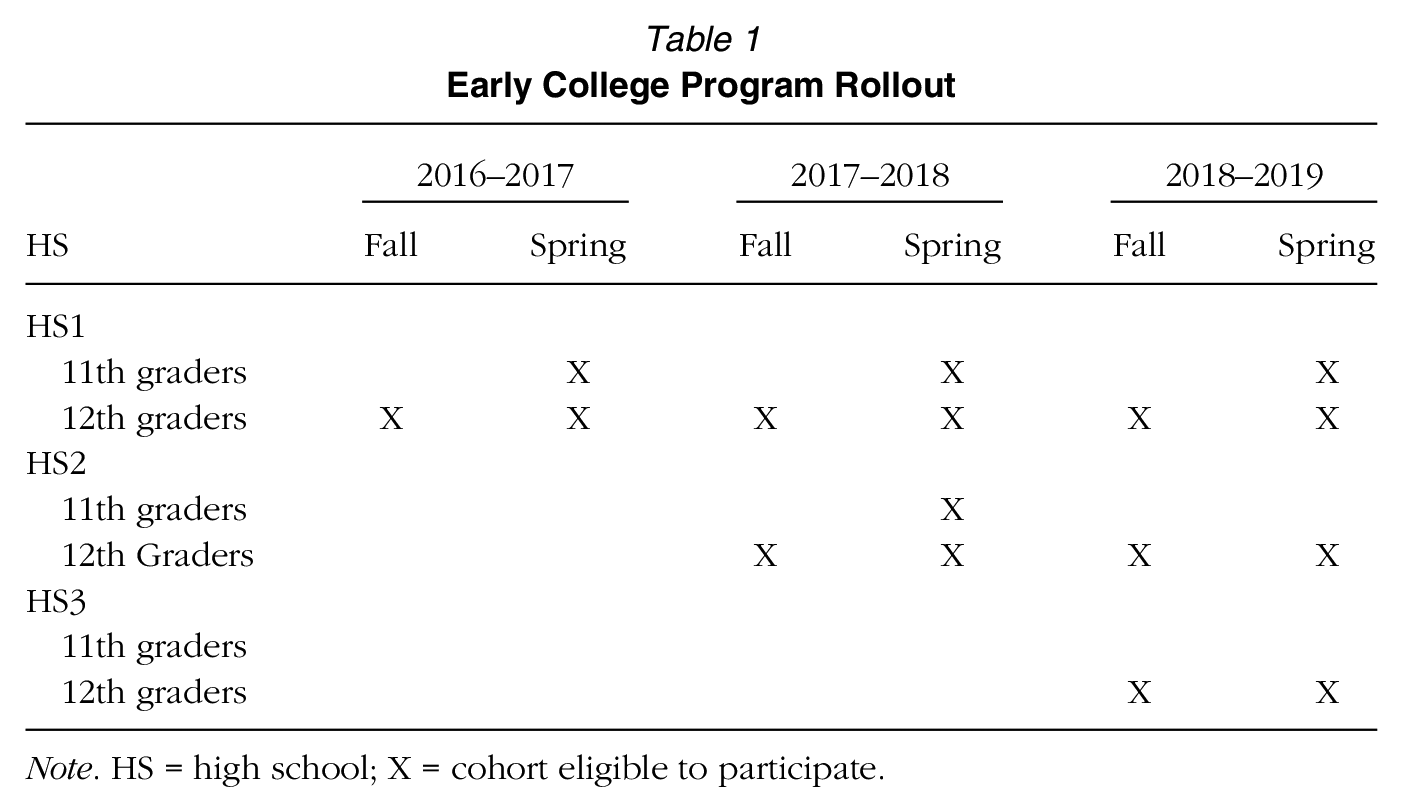
Note. HS = high school; X = cohort eligible to participate.
Data
District administrative records, including NSC college-going records, are available for graduation cohorts 2013–2019 for the 17 high schools in the district. For the remainder of the article, we refer to cohorts by the year students were expected to graduate (e.g., 2017 cohort = students who were expected to graduate in spring 2016–2017). Pooling all seven cohorts, we observe data for a total of 26,311 students across all high schools: 1,896 students at the treated schools and 24,415 students at the control schools. We retain 1,358 students at the treated schools and 13,732 students at the control schools who were ever identified as eligible for EL services, resulting in an analytic sample of 15,090 ever-ELs. As we explain in detail in the Research Design section, we use this ever-EL analytic sample for the main DiD analysis; for a supplemental difference-in-differences-in-differences (DDD) analysis, we use the full sample (N = 26,311), which includes never-EL and ever-EL students.
Demographic data observed include gender, ethnicity, home language, and parent education level. Table 2 shows the characteristics of students in the analytic sample by treated/control high school and by pre-/postprogram cohort. About 47% of the sample is female. Slightly more than half identified as ethnically Chinese and 28% as Hispanic. About a third of the students in the sample had parents who reported graduating from high school.
Sample Summary Statistics
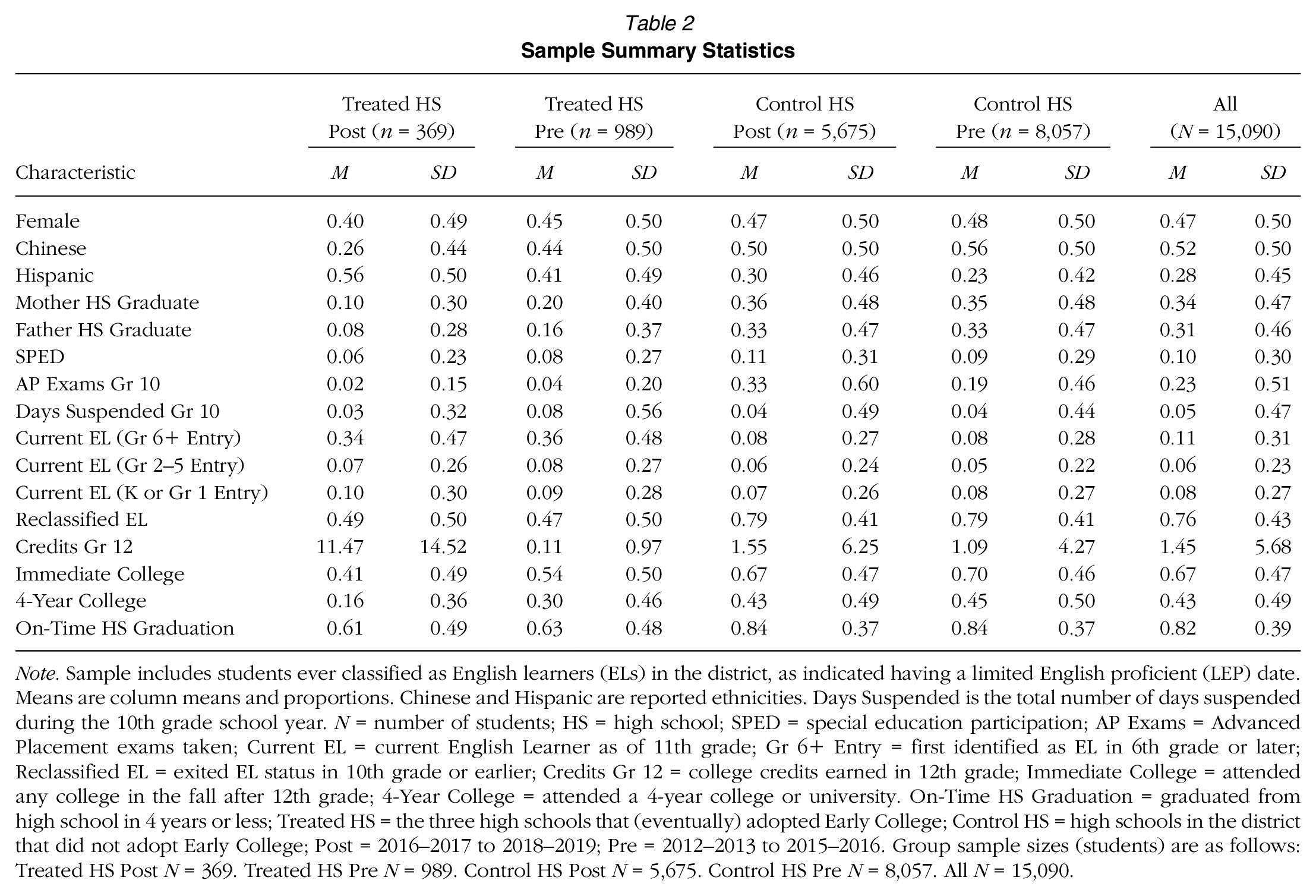
Note. Sample includes students ever classified as English learners (ELs) in the district, as indicated having a limited English proficient (LEP) date. Means are column means and proportions. Chinese and Hispanic are reported ethnicities. Days Suspended is the total number of days suspended during the 10th grade school year. N = number of students; HS = high school; SPED = special education participation; AP Exams = Advanced Placement exams taken; Current EL = current English Learner as of 11th grade; Gr 6+ Entry = first identified as EL in 6th grade or later; Reclassified EL = exited EL status in 10th grade or earlier; Credits Gr 12 = college credits earned in 12th grade; Immediate College = attended any college in the fall after 12th grade; 4-Year College = attended a 4-year college or university. On-Time HS Graduation = graduated from high school in 4 years or less; Treated HS = the three high schools that (eventually) adopted Early College; Control HS = high schools in the district that did not adopt Early College; Post = 2016–2017 to 2018–2019; Pre = 2012–2013 to 2015–2016. Group sample sizes (students) are as follows: Treated HS Post N = 369. Treated HS Pre N = 989. Control HS Post N = 5,675. Control HS Pre N = 8,057. All N = 15,090.
Approximately 76% of the sample had reclassified before 11th grade; 11% were current ELs first identified in 6th grade or later; 6% were current ELs first identified between 2nd and 5th grade, and 8% were current ELs first identified in kindergarten or 1st grade. We include all ever-ELs in this study because reclassified and current ELs likely share many characteristics that play a role in college access and success. For example, both reclassified and current ELs tend to come from families with low socioeconomic status, and the vast majority of both groups are Hispanic/Latino or Asian and students who would be the first in their family to attend college. In addition, the students’ high school experiences may be endogenous to earlier experiences in EL support services. Furthermore, many students in the district reclassify during high school, and multiple factors are considered in the reclassification decisions, so we cannot isolate factors that distinguish between reclassified and current ELs in 11th grade. For these reasons, we include all ever-ELs in the main analysis. However, recognizing that reclassified and current ELs might differ in some ways, we control for initial identification grade and reclassification in the models. Then, in supplemental analyses, we estimate the same models for each EL subgroup separately.
Our main outcomes of interest are college credits earned during high school and college enrollment (immediate enrollment and enrolling in a 4-year college). Since only 12th graders were treated across all three high schools, we use college credits earned in 12th grade as the measure for college credits. This measure only includes credits earned from enrolling in community college classes and does not consider participation in programs such as Advanced Placement that award credits after students enroll in college. In the full sample, 85% of students were assigned a State of California high school graduation code and matched NSC records. The other 15% were not assigned a graduation code at the end of 12th grade and are regarded by the district as not having graduated on time. This is not uncommon, as the high schools in the district serve a large population of new immigrants, many of whom are expected to graduate within 5 instead of 4 years. For immediate college enrollment, we construct a binary measure for having enrolled in any certificate, 2-year, or 4-year college in the fall following the cohort’s high school graduation. We impute a zero for immediate college enrollment for all students who are missing graduation because immediate college enrollment is very unlikely without an official record of high school completion. Four-year college enrollment is a binary outcome for having attended a 4-year institution after high school.
On-time high school graduation is an outcome of secondary interest. For EC programs, including the program offered by this district, raising high school graduation rates is an important goal. However, in the implementation of this particular EC program, treatment for most students in the sample did not start until 12th grade, which is likely too late to have an effect on on-time graduation. We therefore report on-time high school graduation as a secondary outcome.
Research Design
We use a DiD framework, which mimics an experiment. In a randomized experiment, subjects are randomly assigned to the treatment group or the control group; causal impact can be estimated by taking the difference between the outcomes of the two groups, as long as pretreatment characteristics were equivalent across the groups. The DiD approach allows the analysis of panel data in a way that is analogous to an experimental design by using treatment status and data from time periods prior to program implementation and after program implementation. By interacting treatment status with being observed in the postprogram period, we can interpret the interaction effect as the impact of the program based on the assumption that preprogram outcome trends are parallel between the eligible and ineligible groups (Angrist & Pischke, 2009, 2015). We estimate the program’s effect not by comparing the outcome levels of treated and control groups, but by comparing the pre–post program changes in the outcome levels of the two groups. This addresses any preexisting differences in the outcomes of the treated and control groups before the treatment started. In the absence of treatment, we expect the treated and control groups’ outcomes to move in parallel during what would have been the posttreatment period. In other words, we expect the outcome trend (and post–pre difference in levels) of the treated group to be parallel to that of the control group. Any deviation by the treated group from the control trend (or any difference in post–preoutcome level differences) can be interpreted as the treatment effect.
Ever-ELs in the district were eligible to participate if they attended 12th grade in one of the three high schools after their high school adopted the EC program. This means that students in other high schools and cohorts prior to program adoption were ineligible. The intersection of attending one of the three high schools (“Treated”) and postprogram graduating class (“Post”) identifies eligibility. 2 This allows us to compare outcomes using the DiD framework by applying the following model for our main analysis:

in which for student i in cohort c in high school s: Post = 1 if high school offered EC when cohort was in 12th grade; Treated = 1 if student attended HS1, HS2, or HS3;
We estimate ordinary least squares models for continuous outcomes and linear probability models for binary outcomes. We report the results from these models for ease of interpretation. We also estimate logistic regressions for the binary outcomes. Results are qualitatively similar and available on request.
However, this standard interaction approach to DiD has two shortcomings. First, if characteristics unique to postprogram cohorts in the three treated high schools had contributed to differential performance, the design would not properly identify these effects. Second, DiD requires that outcome trends for the treated and control schools in the years prior to EC implementation to be parallel. If this “common trends” assumption is violated, the resulting estimate would be prone to bias (Angrist & Pischke, 2009). We plot the outcome trends for the treated schools and the control schools in Figure 1. Visual inspection provides some reassurance for the validity of the design.
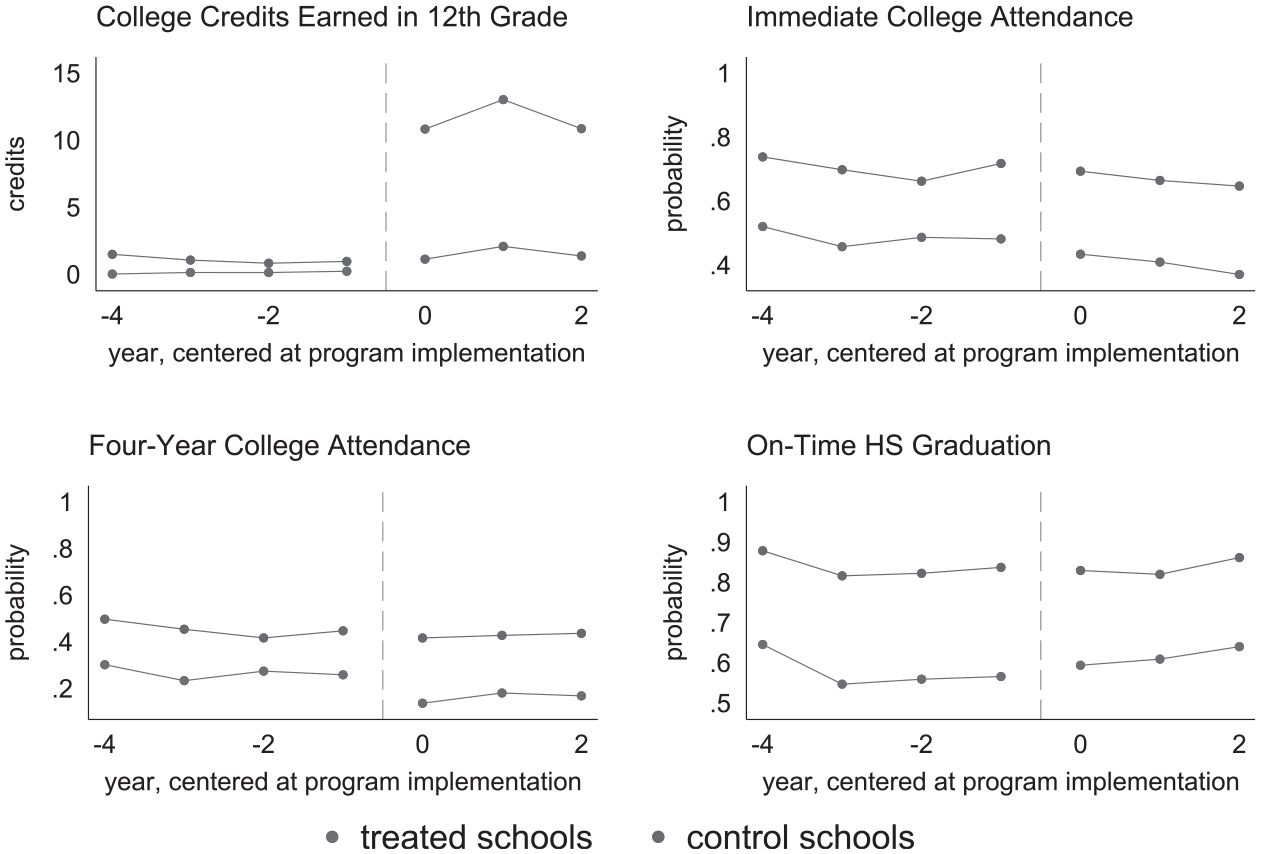
Unconditional outcome trends for treated and control high schools.
To further examine the validity of the control group as the counterfactual to the treated group, we perform several additional analyses. First, we perform an event-study analysis on the same ever-EL sample as the DiD analysis by running the following model, which includes a full set of dummy variables that identify pre- and posttreatment years of program implementation (Angrist & Pischke, 2009):

where
Second, we conduct analyses in the spirit of a DDD design, leveraging data on students in the same schools and cohorts who were never classified as ELs at any point during their time in the district. The EC program was designed to target ELs. Although non-ELs in the treated cohorts were ultimately offered the same course-taking opportunities, some of the targeted program features (e.g., college coursework and faculty that accommodate ELs) may have uniquely affected ELs. We construct a comparison DiD (Model 1) and event-study (Model 2) using non-EL data to explore the extent to which the effects on ELs were unique. Although these non-EL results may not fully constitute naïve DiD estimates in a DDD design, they provide suggestive evidence for the validity of the counterfactual group. In the same vein, we also report DDD estimates, the results of netting out the non-EL DiD. The triple difference approach has more relaxed assumptions than DiD and would help address concerns over the short pretrends.
We also conduct several sensitivity checks using different samples to check the robustness of our findings. Since the three high schools that have implemented the program all have enrollments of about 100 students per cohort, we restrict our analysis to smaller high schools in the district in two additional checks of our main DiD analysis. First, we run this supplementary analysis on a restricted sample of only schools with fewer than 1,000 students across the seven cohorts in the sample. Then, we repeat this analysis on a restricted sample that only includes schools with fewer than 700 EL students across the seven cohorts in the sample. These sensitivity checks provide an indication for the robustness of our findings to only including control schools that are similar to treated schools in enrollment. Another sensitivity check we perform involves using the 14 control schools in the sample to construct synthetic control units for the three treated high schools and conduct weighted DiD regressions in a synthetic control analysis (Abadie et al., 2010). Last, following Zimmer et al. (2017), we construct school-level demographic composition as placebo outcomes and run the DiD analyses on these outcomes.
Findings
Difference-in-Differences
Table 3 shows the DiD estimates for the effects of EC opportunities on college credits earned, the probability of immediately attending any (2- or 4-year) college, attending a 4-year college, and on-time high school graduation. The model controls for 11th grade EL status, with current ELs first identified in 6th grade or later as the omitted category. EC participation led to an increase of 10.9 college credits earned in the 12th grade, equivalent to about two semester-long courses (column 1). EC opportunities had a very small (0.7 percentage point) negative effect on immediate college attendance after high school, which is not statistically significant (column 2). The estimated effect on first attending a 4-year college after high school is −6.9 percentage points (column 3). The estimate for on-time graduation is positive and significant, 8.6 percentage points (column 4). As shown in Table 4, synthetic control estimates are similar to these DiD estimates.
DiD Estimates of Early College Program Effects on Ever-EL Academic Outcomes
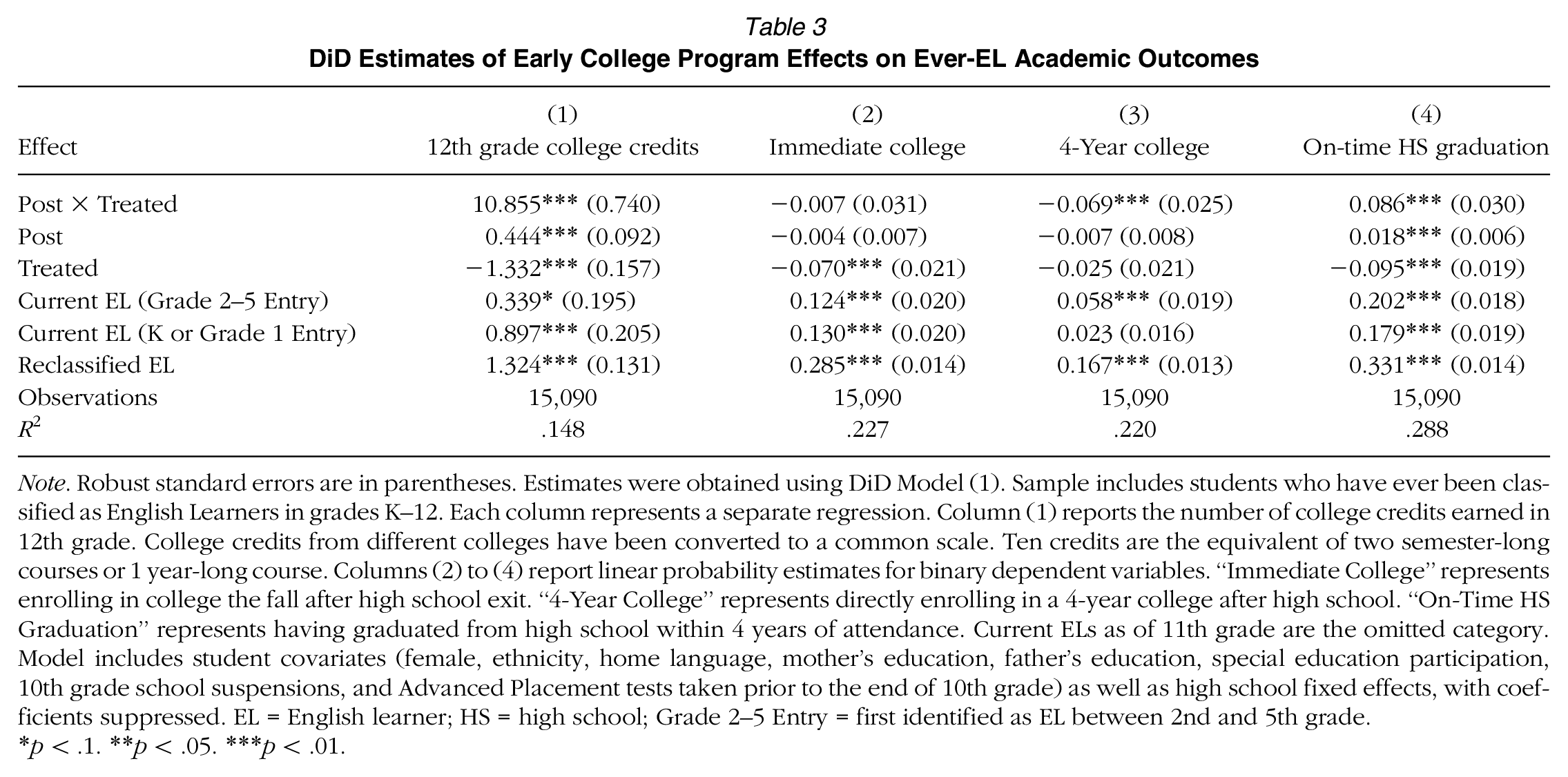
Note. Robust standard errors are in parentheses. Estimates were obtained using DiD Model (1). Sample includes students who have ever been classified as English Learners in grades K–12. Each column represents a separate regression. Column (1) reports the number of college credits earned in 12th grade. College credits from different colleges have been converted to a common scale. Ten credits are the equivalent of two semester-long courses or 1 year-long course. Columns (2) to (4) report linear probability estimates for binary dependent variables. “Immediate College” represents enrolling in college the fall after high school exit. “4-Year College” represents directly enrolling in a 4-year college after high school. “On-Time HS Graduation” represents having graduated from high school within 4 years of attendance. Current ELs as of 11th grade are the omitted category. Model includes student covariates (female, ethnicity, home language, mother’s education, father’s education, special education participation, 10th grade school suspensions, and Advanced Placement tests taken prior to the end of 10th grade) as well as high school fixed effects, with coefficients suppressed. EL = English learner; HS = high school; Grade 2–5 Entry = first identified as EL between 2nd and 5th grade.
p < .1. **p < .05. ***p < .01.
Synthetic Control Estimates of Early College Program Effects on Ever-EL Academic Outcomes
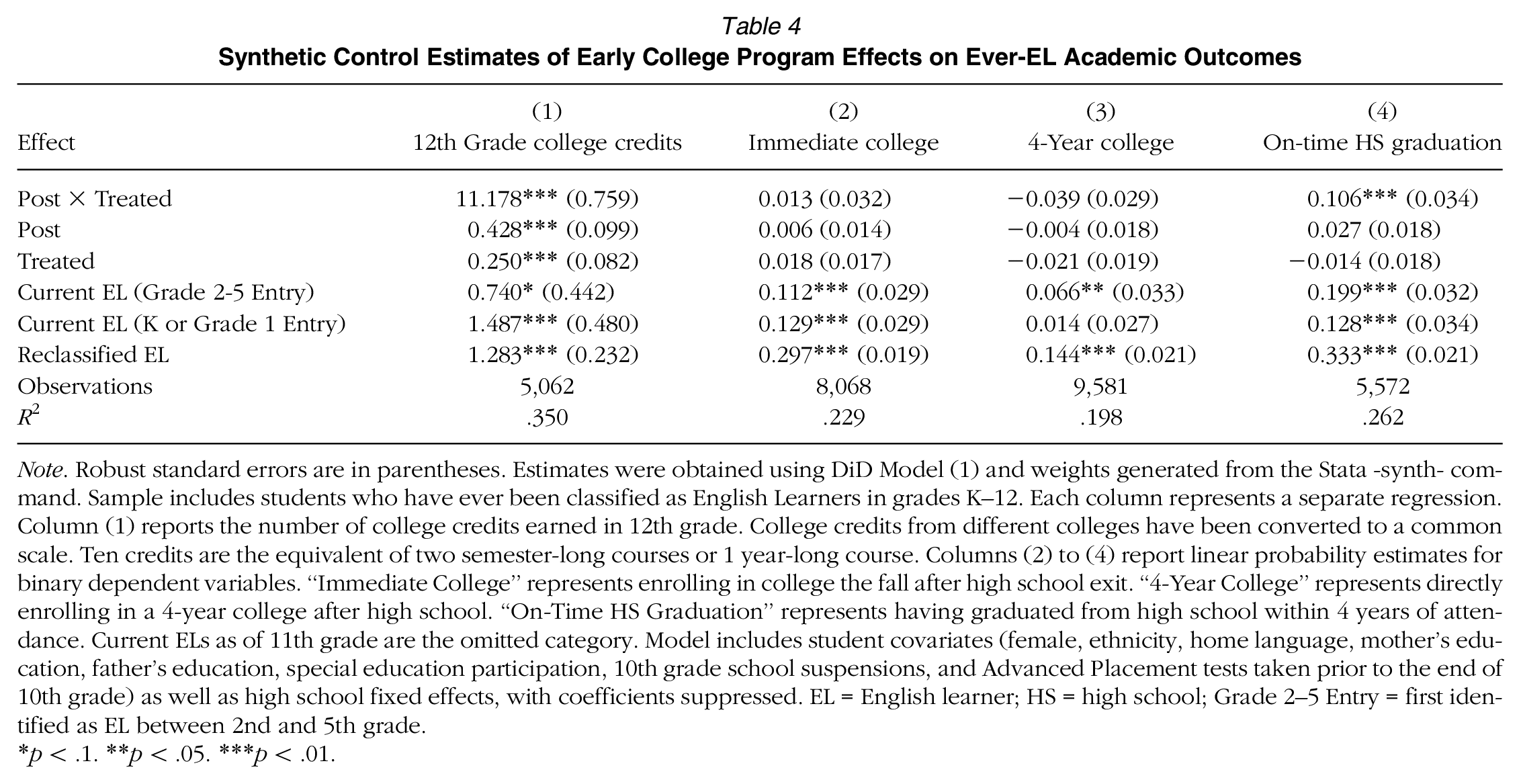
Note. Robust standard errors are in parentheses. Estimates were obtained using DiD Model (1) and weights generated from the Stata -synth- command. Sample includes students who have ever been classified as English Learners in grades K–12. Each column represents a separate regression. Column (1) reports the number of college credits earned in 12th grade. College credits from different colleges have been converted to a common scale. Ten credits are the equivalent of two semester-long courses or 1 year-long course. Columns (2) to (4) report linear probability estimates for binary dependent variables. “Immediate College” represents enrolling in college the fall after high school exit. “4-Year College” represents directly enrolling in a 4-year college after high school. “On-Time HS Graduation” represents having graduated from high school within 4 years of attendance. Current ELs as of 11th grade are the omitted category. Model includes student covariates (female, ethnicity, home language, mother’s education, father’s education, special education participation, 10th grade school suspensions, and Advanced Placement tests taken prior to the end of 10th grade) as well as high school fixed effects, with coefficients suppressed. EL = English learner; HS = high school; Grade 2–5 Entry = first identified as EL between 2nd and 5th grade.
p < .1. **p < .05. ***p < .01.
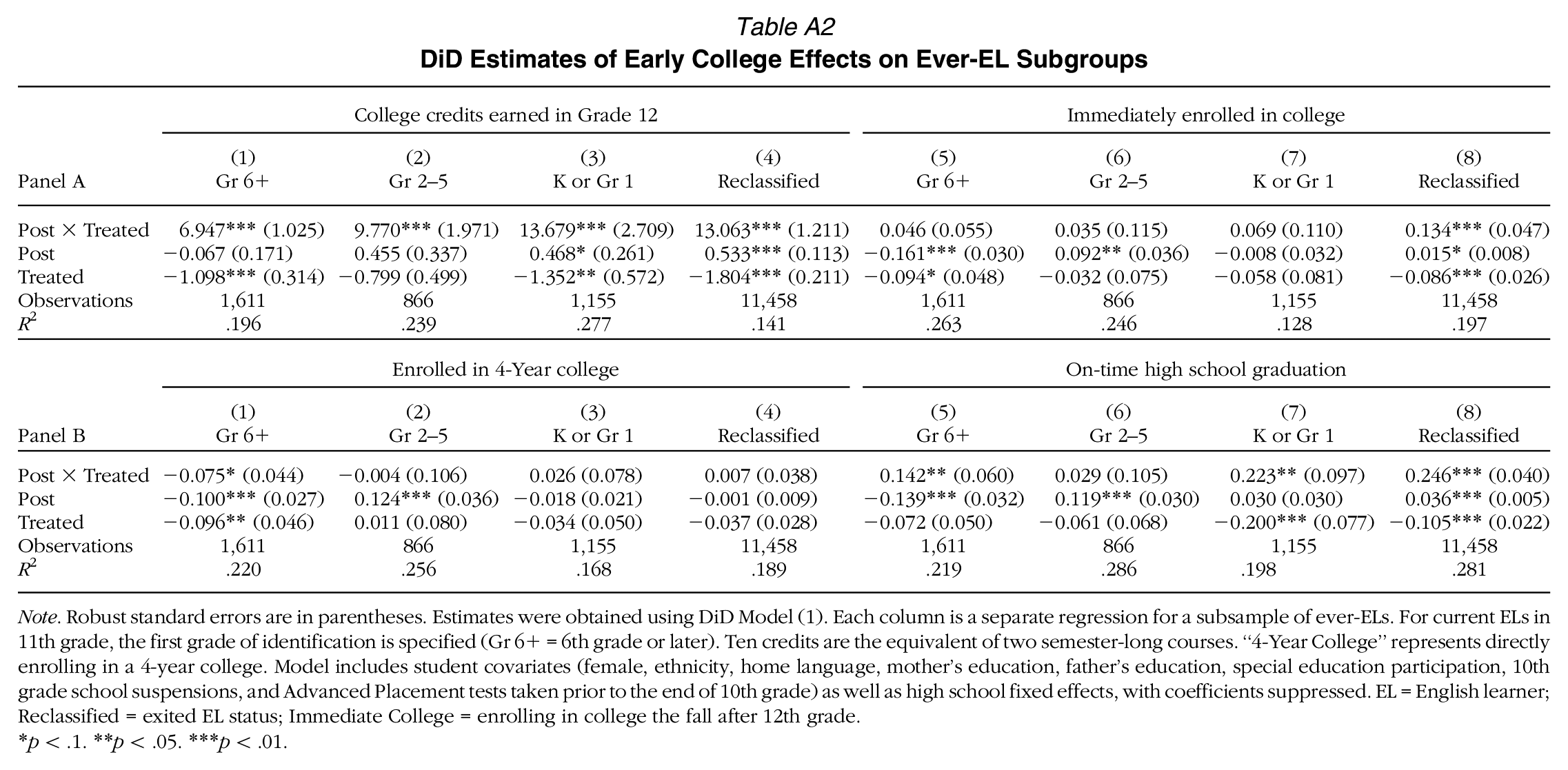
To explore effect heterogeneity, Appendix Table A2 reports DiD estimates for separate regressions by EL subgroup, since there may be differences within the ever-EL group. All four ever-EL subgroups had positive and significant DiD estimates for college credits earned in 12th grade, but the magnitudes of the estimates were larger for students who have been ELs since kindergarten or 1st grade and for reclassified ELs. For immediate college enrollment, all DiD estimates were positive, but only the estimate for reclassified ELs was significant. The estimated effects on enrolling in a 4-year college were negative and marginally significant for newcomer immigrants who were classified as ELs in 6th grade or later but small and nonsignificant for the other subgroups. Finally, estimates for on-time high school graduation were small and nonsignificant for current ELs classified initially between 2nd and 5th grade but large, positive, and significant for the other EL subgroups.
Table 5 presents the event-study estimates for ELs, which provide evidence about outcome trends. For college credits earned in 12th grade and attending a 4-year college, the null estimates in the preprogram (“lead”) years provide more reassurance that the outcome trends for treated and controls schools were parallel. For immediate college enrollment and on-time high school graduation, the significant estimates for lead Year 3 suggest some deviation from the common trends in that year. We consider this in our interpretation of the estimates on these two outcomes in the Discussion section.
Event Study of Early College Program Effects on Current EL Academic Outcomes
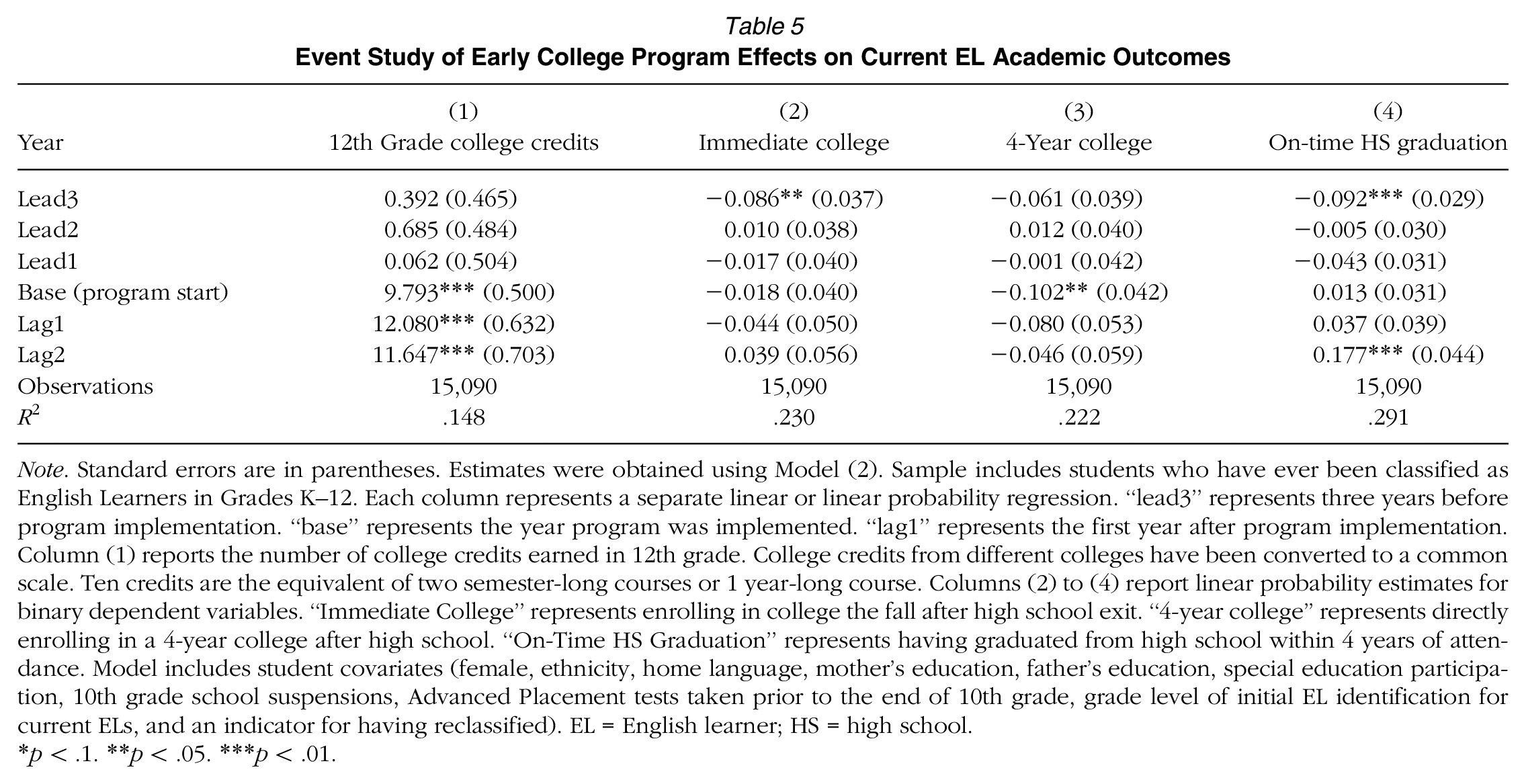
Note. Standard errors are in parentheses. Estimates were obtained using Model (2). Sample includes students who have ever been classified as English Learners in Grades K–12. Each column represents a separate linear or linear probability regression. “lead3” represents three years before program implementation. “base” represents the year program was implemented. “lag1” represents the first year after program implementation. Column (1) reports the number of college credits earned in 12th grade. College credits from different colleges have been converted to a common scale. Ten credits are the equivalent of two semester-long courses or 1 year-long course. Columns (2) to (4) report linear probability estimates for binary dependent variables. “Immediate College” represents enrolling in college the fall after high school exit. “4-year college” represents directly enrolling in a 4-year college after high school. “On-Time HS Graduation” represents having graduated from high school within 4 years of attendance. Model includes student covariates (female, ethnicity, home language, mother’s education, father’s education, special education participation, 10th grade school suspensions, Advanced Placement tests taken prior to the end of 10th grade, grade level of initial EL identification for current ELs, and an indicator for having reclassified). EL = English learner; HS = high school.
p < .1. **p < .05. ***p < .01.
To further probe the validity of our EL DiD results, we examine the event-study estimates for ELs in smaller schools and for non-ELs in the district. As reported in Supplemental Appendix Tables OA1 and OA2 (see the online version of the journal), similar significant estimates were found for lead Year 3 in the two restricted samples for immediate college enrollment and high school graduation. However, Table OA3 shows that with the exception of on-time high school graduation in lead Year 1, the other estimates provide some evidence in support of the parallel-trends assumption for non-ELs. This offers a basis for interpreting the DDD results.
DDD Results
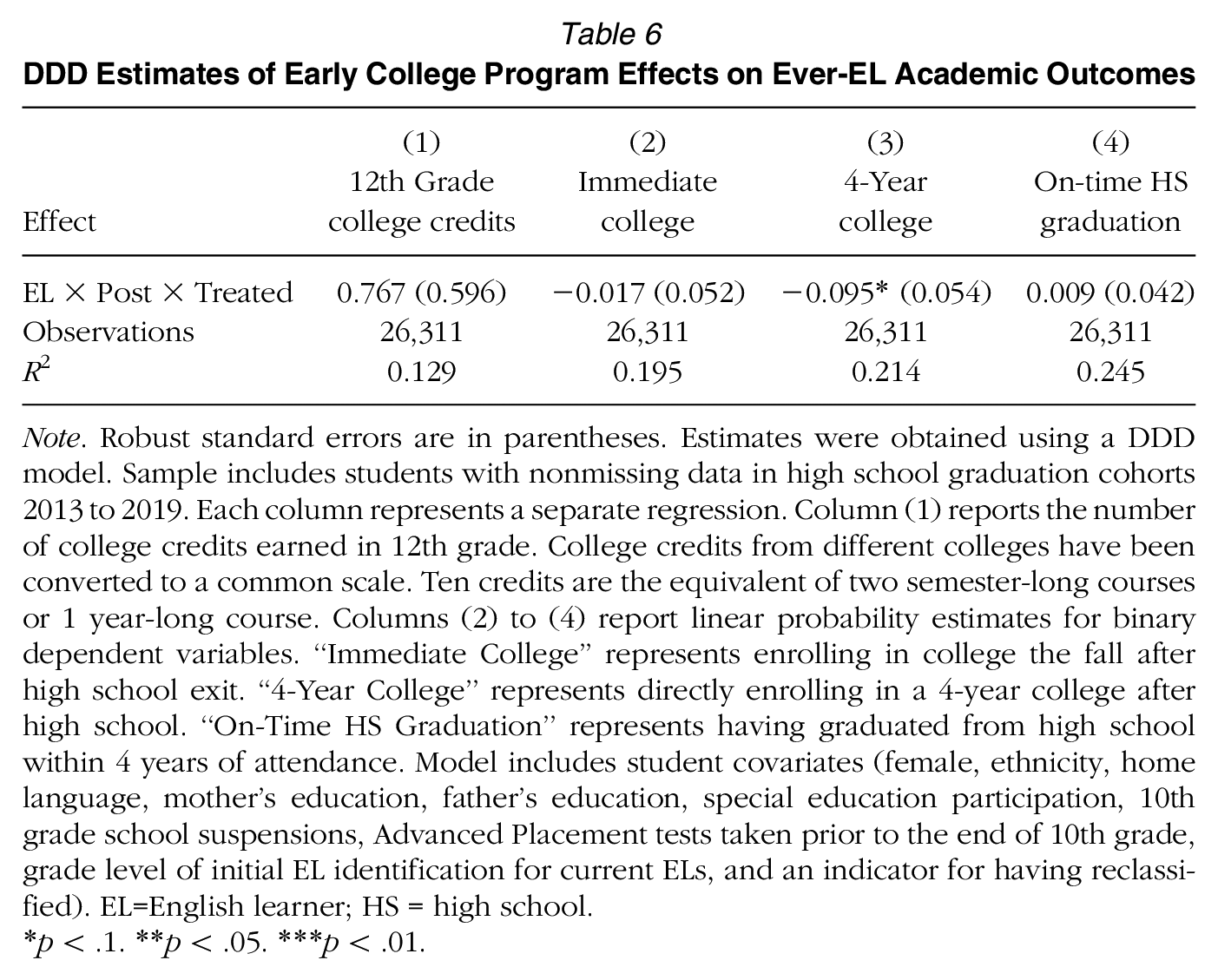
Table 6 presents DDD estimates, which provide an indication for EC’s effects on ELs net of the effects on non-ELs in the same school—a check on our main findings. With the event-study analysis for non-ELs (see Supplemental Table OA3 in the online version of the journal) providing some evidence in support of the parallel trends assumption for non-ELs, we have more reassurance for interpreting the DDD estimates for college credits, immediate college enrollment, and 4-year college attendance, though results for on-time high school graduation should be interpreted as suggestive.
DDD Estimates of Early College Program Effects on Ever-EL Academic Outcomes
Note. Robust standard errors are in parentheses. Estimates were obtained using a DDD model. Sample includes students with nonmissing data in high school graduation cohorts 2013 to 2019. Each column represents a separate regression. Column (1) reports the number of college credits earned in 12th grade. College credits from different colleges have been converted to a common scale. Ten credits are the equivalent of two semester-long courses or 1 year-long course. Columns (2) to (4) report linear probability estimates for binary dependent variables. “Immediate College” represents enrolling in college the fall after high school exit. “4-Year College” represents directly enrolling in a 4-year college after high school. “On-Time HS Graduation” represents having graduated from high school within 4 years of attendance. Model includes student covariates (female, ethnicity, home language, mother’s education, father’s education, special education participation, 10th grade school suspensions, Advanced Placement tests taken prior to the end of 10th grade, grade level of initial EL identification for current ELs, and an indicator for having reclassified). EL=English learner; HS = high school.
p < .1. **p < .05. ***p < .01.
Estimates for college credits earned, immediate college attendance, and on-time high school graduation are small and nonsignificant. But the reduction in the probability of attending a 4-year college remains large at 9.5 percentage points though marginally significant, perhaps due to larger standard errors associated with DDD estimation. Non-EL DiD results (see Supplemental Appendix Table OA4 in the online version of the journal) show that non-ELs did not change their college sector choice as a result of EC participation (estimate = 0.002). This suggests that ELs were the ones driving the reduction in four-year college attendance.
Discussion
This study presents the estimated effects of a developing program that offers EC opportunities based on 4 years of preprogram and 3 years of postprogram data. The estimated EC effect on the number of college credits earned during 12th grade was the equivalent of about two semester-long college courses. However, the program had no significant effect on the probability of enrolling in any college immediately after high school, and the estimated effect on the probability of attending a 4-year college was negative and significant. There is also suggestive evidence for a positive effect on high school graduation. We discuss each of these in detail below.
College Credits and Subsequent Attendance
Although participation in the EC program led to a large and significant increase in the number of college credits earned in 12th grade, we found no significant effect on immediate attendance at any college. Given the increase in earned college credits while in high school, we might expect students to have momentum to continue in postsecondary enrollment after high school graduation (Wang et al., 2015). The earned college credits may have motivated students to pursue the benefits of a postsecondary education. However, we do not observe this. The program succeeded in inducing students to start college coursework, but it did not induce students to continue after high school. Although we have no definitive explanation for these results, we explore three potential reasons for this finding.
First, it is possible that certain EC model features, such as extended opportunities for credit accumulation and acceleration, are of greater importance for ELs than non-ELs. Although prior research suggests that a “moderate dosage” consisting of one or two courses of dual enrollment yields the strongest results for short-term outcomes (e.g., immediate college enrollment) among non-ELs (Karp et al., 2007), the type of EC experience studied in this article, which did not extend to all 4 years of high school, may not have been sufficient for ELs—possibly due to limited cost reduction incentives or other academic characteristics of students in our sample. As opposed to receiving 2 years of college credit, an AA degree, or a certificate, EL students in our study received credits for approximately two semester courses. This may not have offered a significant reduction in college costs for ELs and therefore may not have provided enough of an incentive to continue their postsecondary education. Alternatively, despite limited evidence, it has been suggested that dual enrollment programs which have an earlier start or higher course intensity may be more effective toward students with lower- or middle-performing status (Bailey & Karp, 2003; Fink et al., 2017)—this may similarly be the case for some of the EL students in our sample. A more “classic” EC design for ELs that begins in 9th or 10th grade and provides more opportunities to earn a greater number of college credits or credentials may show more positive outcomes in this regard. Future studies could more closely examine the college credit thresholds or coursework intensity that push ELs to continue college or provide enough financial incentive to pursue a postsecondary degree, and how they may differ from or compare to other disadvantaged youth.
Second, the EC experience and earned college credits may have provided an unstable, diminished, or late boost in college aspirations for ELs that was not sufficient to induce continued college enrollment immediately after high school. Receiving a “taste of college” shapes student orientations toward pursuing a college degree in complex ways—aspirations can rise, fall, or change over time (Alexander et al., 2008). If the college course-taking experience sends negative signals that confirm lack of college readiness to low-performing EL students, then the null effect we see in immediate college-going might not be surprising. However, studies suggest that academic performance plays a more limited role in diminishing college aspirations for ELs than might be assumed (Kanno & Comley, 2013). Furthermore, existing research on similar dual enrollment programs suggests that college enrollment rates for students in the bottom quartile of academic achievement (as measured by high school grade point average) are greater than for those at the top quartile (Karp et al., 2007). Indeed, rather than revealing reduced aspirations, students in our survey indicated competing desires regarding their plans after high school: high aspirations for obtaining a college degree and securing a job to help their family. This suggests that EL students may face other obstacles that compel them to postpone or discontinue their postsecondary education (Razfar & Simon, 2011). Although it is possible that ELs in this sample could return to college in later years, further research could be conducted to investigate the factors that diminish immediate EL postsecondary enrollment, especially as they relate to college aspirations and academic performance.
Third, the effect of the EC program to boost immediate college attendance may have been limited because participating students enrolled in dual-credit college courses with a career or vocational focus. A key benefit of dual enrollment described in prior literature is advancement toward completion of general education requirements (e.g., An & Taylor, 2019; Blankenberger, Lichtenberger, Witt, & Franklin, 2017). Taking academic coursework via dual enrollment during high school can support students’ transition to higher education by strengthening academic skills and reducing the likelihood of testing into developmental education courses. Although students in our study had the option of choosing coursework with a more academic focus at the community college, the courses offered via the program pathways may not have served to reduce the number of general education credits that are often required to obtain an AA degree or 4-year transfer eligibility. For ELs, these general education requirements can be particularly lengthy. For example, at community colleges, language learners are often placed into noncredit English as a second language or remedial English coursework, which can create major roadblocks to postsecondary attainment (Raufman et al., 2019). Perhaps credits earned in vocational or career pathways matter less for immediate college enrollment among ELs when they may also face numerous general education requirements. Additional research is needed to investigate the effect of different types of course credit offered to ELs in EC programs.
Starting at a 4-Year College
The program’s negative effect on starting at a 4-year college after high school merits further attention. This is a finding that differs from the positive effects EC participation has on 4-year college enrollment observed for other underrepresented racial/ethnic minorities and first-generation college attendees (Berger et al., 2013). Given the benefits EC and dual enrollment provide for other traditionally underrepresented youth, we expected the program under study to have similar benefits for ELs. Instead, these results serve as a cautionary tale for researchers and policymakers interested in extending existing college access interventions to ELs, indicating that greater scrutiny of potential unintended effects is warranted along with increased awareness of the specific needs of this student population.
Encouraging disadvantaged students to begin their postsecondary careers at a 4-year as opposed to a 2-year college after high school is desirable because it increases the probability of degree attainment (Schudde & Brown, 2019). Furthermore, 4-year colleges are associated with better outcomes: they have higher average degree completion rates compared to 2-year colleges, and bachelor’s degree holders enjoy higher median salary ($15,300 difference at age 25) and lower unemployment rates (0.2 percentage point difference) than associate degree holders (Ma et al., 2019). Commencing a postsecondary career at a 4-year college is particularly relevant for ELs since degree completion remains a largely elusive outcome for many (Kanno & Cromley, 2015).
The negative estimate suggests a couple of unintended effects. First, EC appears to be inducing ELs to substitute out of the 4-year sector and attend 2-year colleges instead. It is unclear why we observe this pattern. Specific features of the EC model studied, such as the later start and the career and vocational pathways offered, may provide possible explanations. Past studies on related interventions with some similar program structures, such as Tech Prep, point to comparable results in this regard. Although Tech Prep programs can vary in structure, they similarly provide articulated pathways, with planned high school course sequences typically offered during the last 2 years of high school that extend into 2 years of postsecondary education in an occupation or apprenticeship program, resulting in an associate degree or certificate (An & Taylor, 2019; Lyons, 2014). Researchers have found that even though Tech Prep programs improve high school graduation rates and 2-year college enrollment among participants, they similarly reduce the probability of immediate enrollment in a 4-year college (Cellini, 2006). Case study research has noted that a key issue with the Tech Prep model has been that college-level coursework taken during high school does not always count toward college credit (Hughes et al., 2005). In response, more recent program models have incorporated dual enrollment opportunities with career and vocational pathways (An & Taylor, 2019; Karp et al., 2007). Findings from these newer types of dual enrollment programs in Florida and New York City indicate the opposite trends: career or technical education opportunities combined with dual enrollment increase the likelihood of enrolling in a 4-year institution by 8.6 percentage points for participating students (Karp et al., 2007). These patterns suggest that more research is needed to investigate the specific program features of EC interventions that affect the type of EL postsecondary enrollment, especially among models offering a vocational or career track. Unlike some Tech Prep programs, the EC model under study did provide students with both high school and college credit, so the program limitations that induce 2-year rather than 4-year enrollment remain ambiguous.
Another unintended consequence may have occurred among high-achieving EL students who would have attended college with or without the EC credits and who were choosing between a 2-year and 4-year college. These students may have undermatched by choosing a 2-year college as a result of their participation in EC. This may also be partly explained by the course offerings for the EC program, which primarily included pathways for career or technical education and relatively few courses that would transfer toward academic majors at 4-year colleges. Based on the differential degree completion rates and labor market outcomes between the two college sectors, we might be concerned about the long-run effects of the program.
High School Graduation
We find suggestive evidence for a positive effect on high school graduation. This is worth further inquiry. Compared with non-ELs, adolescent ELs graduate from high school on time at much lower rates (83% and 65%, respectively, ED Data Express, 2017). Data from the first year of our survey, which sampled 11th and 12th grade students in EC and control high schools, show that as many as one in three students reported having a close friend drop out of high school. This alarming figure is corroborated by administrative data from the district. More than 30% of students who enrolled in 9th grade had missing enrollment records for either 11th or 12th grade. According to school administrators, many ELs feel that after spending 1 or 2 years in U.S. schools they have developed sufficient competency in the English language for survival and employment; they subsequently lose interest in continuing their education because they perceive the high school diploma to provide minimal additional value.
The program features of EC are intended to address this type of disengagement. Although we do not currently have robust evidence for a positive impact on high school graduation, the suggestive evidence is encouraging. By offering engaging college opportunities with structured academic support, the program may provide an incentive for students who would have otherwise left high school before 12th grade to stay for the diploma and complete a major milestone necessary for college access. Indeed, existing research suggests that vocational or career oriented dual enrollment opportunities do not hinder the probability of students graduating from high school or attending college (Karp et al., 2007); and some programs with related structures, such as Tech Prep, similarly improve graduation rates (Cellini, 2006). To date, only 11th and 12th graders have participated in the EC program. However, younger students and their families in the district are becoming more familiar with the program as time passes. If they perceive EC participation as an onramp to better labor market opportunities, 9th and 10th graders could be enticed to stay in school longer.
Conclusion
In this article, we have looked at the effects of an EC program on high school graduation and subsequent college enrollment for EL students. Our study contributes to a literature that addresses the growing need to better understand the academic and postsecondary experiences of ELs. The results from our analysis suggest that the effects of EC may only partially extend to EL students, at least with regard to immediate and 4-year college enrollment. These results corroborate some descriptive case study research suggesting that removing institutional barriers to more rigorous coursework may be “necessary but not sufficient” for ELs (Thompson, 2017).
Given the limited number of college access interventions specifically targeted at ELs, it is discouraging to see limitations in extending an existing program to this student population. However, our work is informative in showcasing where EC may move the needle and where it may not— credits for two college courses may not be sufficient to push students toward continuing their college education, but the opportunity to earn more of these credits earlier in their high school career may have different results. EC may also have a dynamic effect on college aspirations and student performance that we were not able to explore in this article. Additionally, EC may not sufficiently address some of the other obstacles that affect EL students, such as financial and family obligations. Núñez et al. (2016), for example, have suggested exploring other approaches to improve access for ELs, such as more thoughtfully and intentionally integrating both academic and vocational education to provide multiple pathways to career and postsecondary success. This recommendation is corroborated by existing studies of dual enrollment with career or technical education options, which suggest that participants have an increased likelihood of enrolling a 4-year college as well as improved academic performance (as measured by GPA) once in college (Karp et al., 2007; Wang et al., 2015)—however, we know little about which specific program features of these interventions may best apply to the EL student population.
Only recently have a handful of descriptive, multivariate studies begun to examine how the plurality of EL identities, such as immigrant advantage and undocumented immigrant status, converge to shape postsecondary pathways in different ways than other disadvantaged youth (Callahan & Humphries, 2016; Kanno & Cromley, 2013, 2015; Rodriguez & Cruz, 2009). But researchers need to continue studying and theorizing the ways in which ELs’ intersecting demographic characteristics play into their postsecondary access and attainment using data from a variety of policy contexts. This study focuses on a large district in California with a long history of educating diverse immigrant student populations. The district’s extensive and unique experience serving ELs makes our results unlikely to generalize to smaller and new-destination districts. Researchers need to continue gathering more evidence across the nation, because we still know relatively little about how the overlapping features of the EL experience affect students’ trajectories after they leave high school. We plan to investigate some of these matters in future work that traces student experiences more closely through interviews.
A few other limitations for this study are worth noting. First, as with all designs that employ fixed effects, we are unable to account for unobserved time-varying school or cohort characteristics that are correlated with both EC implementation and the outcomes. We interpret our estimates with consideration for potential biases related to unobserved, omitted covariates. Second, our analysis on college credits only included credits earned from enrolling in community college classes while students were still in high school and did not consider Advanced Placement, International Baccalaureate, or similar programs that award students with credits once enrolled in college. Another limitation of this study is that we were not able to detail student performance or aspirations. Additional research is needed to tease out the dynamic role that EC may play in shifting EL aspirations and how this may interact with their overall academic performance in high school and in EC coursework. Our future research intends to examine the impact of EC on certificate and degree completion long term (e.g., 5–10 years after high school). The estimated positive effects on college credit accumulation while in high school signal the program was implemented as intended, and knowing these credits apply may incentivize EL students to enroll in college at later dates. Existing research examining the long-term effects of EC on student outcomes suggests that the effects of these types of programs continue for up to 6 years after high school graduation (Song & Zeiser, 2019). Perhaps the effects of EC will show in later years for the students in our sample.
Supplemental Material
sj-pdf-1-aer-10.3102_00028312221075068 – Supplemental material for The Effects of Early College Opportunities on English Learners
Supplemental material, sj-pdf-1-aer-10.3102_00028312221075068 for The Effects of Early College Opportunities on English Learners by Angela Johnson and Diana Mercado-Garcia in American Educational Research Journal
Footnotes
Appendix
DiD Estimates of Early College Effects on Ever-EL Subgroups
| College credits earned in Grade 12 | Immediately enrolled in college | |||||||
|---|---|---|---|---|---|---|---|---|
| (1) | (2) | (3) | (4) | (5) | (6) | (7) | (8) | |
| Panel A | Gr 6+ | Gr 2–5 | K or Gr 1 | Reclassified | Gr 6+ | Gr 2–5 | K or Gr 1 | Reclassified |
| Post × Treated | 6.947 *** (1.025) | 9.770 *** (1.971) | 13.679 *** (2.709) | 13.063 *** (1.211) | 0.046 (0.055) | 0.035 (0.115) | 0.069 (0.110) | 0.134 *** (0.047) |
| Post | −0.067 (0.171) | 0.455 (0.337) | 0.468 * (0.261) | 0.533 *** (0.113) | −0.161 *** (0.030) | 0.092 ** (0.036) | −0.008 (0.032) | 0.015 * (0.008) |
| Treated | −1.098 *** (0.314) | −0.799 (0.499) | −1.352 ** (0.572) | −1.804 *** (0.211) | −0.094 * (0.048) | −0.032 (0.075) | −0.058 (0.081) | −0.086 *** (0.026) |
| Observations | 1,611 | 866 | 1,155 | 11,458 | 1,611 | 866 | 1,155 | 11,458 |
| R 2 | .196 | .239 | .277 | .141 | .263 | .246 | .128 | .197 |
| Enrolled in 4-Year college | On-time high school graduation | |||||||
| (1) | (2) | (3) | (4) | (5) | (6) | (7) | (8) | |
| Panel B | Gr 6+ | Gr 2–5 | K or Gr 1 | Reclassified | Gr 6+ | Gr 2–5 | K or Gr 1 | Reclassified |
| Post × Treated | −0.075 * (0.044) | −0.004 (0.106) | 0.026 (0.078) | 0.007 (0.038) | 0.142 ** (0.060) | 0.029 (0.105) | 0.223 ** (0.097) | 0.246 *** (0.040) |
| Post | −0.100 *** (0.027) | 0.124 *** (0.036) | −0.018 (0.021) | −0.001 (0.009) | −0.139 *** (0.032) | 0.119 *** (0.030) | 0.030 (0.030) | 0.036 *** (0.005) |
| Treated | −0.096 ** (0.046) | 0.011 (0.080) | −0.034 (0.050) | −0.037 (0.028) | −0.072 (0.050) | −0.061 (0.068) | −0.200 *** (0.077) | −0.105 *** (0.022) |
| Observations | 1,611 | 866 | 1,155 | 11,458 | 1,611 | 866 | 1,155 | 11,458 |
| R 2 | .220 | .256 | .168 | .189 | .219 | .286 | .198 | .281 |
Note. Robust standard errors are in parentheses. Estimates were obtained using DiD Model (1). Each column is a separate regression for a subsample of ever-ELs. For current ELs in 11th grade, the first grade of identification is specified (Gr 6+ = 6th grade or later). Ten credits are the equivalent of two semester-long courses. “4-Year College” represents directly enrolling in a 4-year college. Model includes student covariates (female, ethnicity, home language, mother’s education, father’s education, special education participation, 10th grade school suspensions, and Advanced Placement tests taken prior to the end of 10th grade) as well as high school fixed effects, with coefficients suppressed. EL = English learner; Reclassified = exited EL status; Immediate College = enrolling in college the fall after 12th grade.
p < .1. **p < .05. ***p < .01.

Supplemental material for this article is available online.
Notes
A
D
References
Supplementary Material
Please find the following supplemental material available below.
For Open Access articles published under a Creative Commons License, all supplemental material carries the same license as the article it is associated with.
For non-Open Access articles published, all supplemental material carries a non-exclusive license, and permission requests for re-use of supplemental material or any part of supplemental material shall be sent directly to the copyright owner as specified in the copyright notice associated with the article.
