



Abstract
Teachers’ preference to remain close to where they grew up is recognized as a defining feature of the teacher labor market. Using a unique data set from a large school district in the southeastern United States, I apply a series of within–school and within–student comparisons to assess the effectiveness of homegrown teachers who returned to teach in their home district. Discrete time survival analysis is then used to examine differences in when early career teachers exit the district. Study results show that homegrown teachers make small but statistically meaningful improvements in student achievement in English language arts. They are also more likely to identify as Black compared with other beginning teachers and less likely to exit the district.
Keywords
Historically underserved urban school districts often struggle to recruit and maintain a high–quality, racially diverse teacher workforce (Ingersoll, 2001; Jacob, 2007; Papay et al., 2017; Simon & Johnson, 2015). The causes for these persistent staffing difficulties are varied, but include factors that shape both the supply of new teachers and retention of existing teachers (Guarino et al., 2006). The recruitment of homegrown teachers who graduated from district high schools has been proposed as a strategy to reduce teacher shortages, improve the racial/ethnic diversity within urban school districts, and perhaps even improve teacher effectiveness (Albert Shanker Institute, 2015; Boyd et al., 2005; Sutcher et al., 2016). Proponents of this approach highlight how community–driven teacher recruitment efforts can result not only in a teaching staff that is more representative of a district's student body, but teachers that bring community cultural wealth that forms the basis of links between students’ learning experiences at school and at home (Gist et al., 2019).
Despite these potential benefits associated with the recruitment of teachers from the local geographic community, no research has examined the extent to which district graduates are more effective teachers or more likely to remain in teaching than teachers from outside the district. Research on this topic is needed for two main reasons. First, renewed interest in the potential benefits of local teacher recruitment efforts and persistent shortages in hard–to–staff positions and schools have led an increasing number of districts to adopt local teacher preparation programs (Gist, 2022; Kaufman et al., 2020). Many of these programs are oriented around the recruitment of local teacher candidates, with some programs even designed to recruit high school students into teaching (Bianco et al., 2011; Noonoo, 2019; Simmons, 2018; Villagómez et al., 2016). Second, previous research has described a high degree of localism in the teacher labor market, with strong evidence of a preference among teachers to work close to their home (Boyd et al., 2005; Lankford et al., 2002; Reininger, 2012). When combined with lower educational attainment levels within historically underserved urban school districts, this literature has linked teachers’ preferences for working close to home with hiring difficulties in urban districts and the hiring of less qualified teachers than neighboring districts (Lankford et al., 2002; Reininger, 2012). Identifying the extent to which district graduates are more racially diverse, more effective, and have higher retention rates is a critical next step in this research area.
Given this study's focus on homegrown teachers who returned to teach in their home district, it is important to emphasize that the term homegrown teacher has been used to refer not only to district graduates but other prospective teacher pools (e.g., paraprofessionals, parents, and community activists; Gist, 2022; Gist et al., 2019; Irizarry, 2007). Thus, I emphasize that this study focuses specifically on homegrown teachers who graduated from district high schools. For this group of teachers, I explore the extent to which their demographic characteristics or qualifications are different from nondistrict graduates and whether they are more effective than other district teachers or are less likely to exit the district. To attend to these aims, I leverage a unique data set developed in collaboration with a large urban district in the southeastern United States. This data set link district graduates with teachers in the district. A series of within–school and within–student comparisons are used to assess the effectiveness of district graduates compared with other teachers in the district. Discrete time survival analysis is then used to examine differences in when early career teachers exit the district. This study is guided by the following research questions:
Research Question 1 : To what extent are the demographic characteristics, qualifications, or school characteristics of teachers who graduated from district high schools different from other beginning teachers in the district?
Research Question 2 : To what extent are teachers who are district graduates more or less effective than teachers who graduated from high schools outside the district? To what extent does the effectiveness of district graduates differ for students or teachers of color and by the characteristics of their schools?
Research Question 3 : To what extent are early career teachers who graduated from district high schools more likely to remain teaching in the district than nondistrict graduates? To what extent does the retention of district graduates differ for teachers of color and by the characteristics of their schools?
In the next sections, I review the evidence of localism in the teacher labor market before drawing on job embeddedness theory to motivate a series of hypotheses related to homegrown district graduates’ effectiveness and retention.
The Localized Teacher Labor Market
One of the most durable findings in research on the teacher labor market is teachers’ preference to work close to where they grew up (Boyd et al., 2005; Engel & Cannata, 2015; Lankford et al., 2002; Reininger, 2012). Reininger (2012) provides helpful descriptive evidence from the National Education Longitudinal Survey documenting the extent of this pattern. Roughly 8 years after graduating from high school, the median distance moved by teachers is only 13 miles, compared with 54 miles for other college graduates and 7 miles for high school graduates. For graduates of urban school districts, this so–called draw of home might even be stronger. Boyd et al. (2005) report that 92% of teachers in their sample who were from New York City began their teaching careers in New York City. This labor market sorting is likely not related to proximity alone, but other factors, such as familiarity with the school system or social networks that influence the job search process (Boyd et al., 2005; Jabbar et al., 2020).
These sorting patterns have been a concern among policymakers as urban school districts often face the greatest hiring difficulties, difficulties that often contribute to the hiring of less qualified applicants (Lankford et al., 2002; Reininger, 2012). Yet, researchers have not examined if district graduates are more effective than other teachers in the district, a concern given that most qualifications are weakly related to teacher effectiveness (Harris & Sass, 2011) and that common teacher qualifications (i.e., certification status, licensure exam scores, education level, and college selectivity) reflect not only “teacher quality” but also underlying differences in educational opportunities that are shaped by residential and school segregation. To this point, scholars have argued that community members in districts across the country would be interested in becoming teachers but that systemic barriers to entering the teaching profession have restricted access for many (Carter-Andrews et al., 2019; Gist et al., 2019).
An emerging approach for addressing staffing challenges in large urban school districts has been to develop local teacher preparation programs. Kaufman et al.’s (2020) evaluation of TNTP's TEACh program in three urban districts finds that these programs helped increase the overall supply of new teachers and recruit more teachers of color and teachers in hard–to–staff positions. Yet, with the exception of mathematics in program participants first year, teachers in the TEACh program were no more effective than comparison teachers in their respective districts. Teachers also remained in teaching at similar rates as other beginning teachers.
Grow Your Own (GYO) programs mark a related approach focused specifically on recruiting community members who may not have adequate opportunities to access the teaching profession (Gist, 2022; Gist et al., 2019). While the specific design of GYO programs is quite varied, Gist et al. (2019) emphasize that a distinguishing feature of GYO programs is the use of integrated supports to help teaching candidates fulfill the requirements for entry into teaching. These supports vary given the unique needs of different prospective teacher pools, which can include paraprofessionals, noninstructional school staff, community activists, parent mentors, and secondary students (Bianco et al., 2011; Gist et al., 2019; Villagómez et al., 2016). Most studies on GYO programs have been relatively small in scale but suggest that efforts to recruit teachers locally have the potential to improve teacher racial/ethnic diversity and possibly retention (Gist et al., 2019). While the teacher pools served by GYO programs are much broader than this study's exclusive focus on graduates from the school district, the anticipated benefits associated with recruiting teachers who live in the communities in which they teach have much overlap with these programs.
Theoretical Framework
In this section, I develop a series of hypotheses related to why homegrown teachers who graduate from district high schools might be more effective at improving student achievement and more likely to remain teaching in the district than other teachers. To do so, I draw on the theory of job embeddedness (JE) from industrial–organizational psychology. JE theory was initially developed to explain the suite of factors that shape why employees stay in a job (Lee et al., 2014; Mitchell & Lee, 2001). The primary corrective of JE theory, and one that makes it relevant to the study of teachers who return to teach in their home district, is the emphasis not only on the organizational factors that enmesh employees within their places of work but also the “cumulative forces of an individual's family, community, and nonwork activities which bind an individual to his or her current location” (Feldman et al., 2012, p. 215). This emphasis on both the organizational and community–based factors make JE theory salient to the study of teachers who graduated from district high schools, whose performance and retention are intimately linked to the decision to become a teacher in their home school district.
JE consists of three components that can be measured at both the organizational and community level: links, fit, and sacrifice (Mitchell & Lee, 2001). Links are defined as the formal and informal connections to people at work or in the community. Fit encompasses compatibility with one's job, workplace, or community. Sacrifice refers to benefits, whether psychological or material, that would be given up if an individual left their current workplace or community (Lee et al., 2014). The number or quality of links, the greater the fit, and the degree of sacrifice all serve to embed individuals within their workplace and community (Feldman & Ng, 2007). Initial research was geared toward documenting how both on- and off–the–job embeddedness were related to employee retention (Mitchell & Lee, 2001). More recent studies have also shown on–the–job embeddedness to be positively associated with job performance (Kiazad et al., 2015; Lee et al., 2004; T. W. H. Ng & Feldman, 2009), with less evidence that off–the–job embeddedness predicts job performance (Feldman et al., 2012). In the remainder of this section, I draw on explanatory concepts and analogous empirical findings from JE theory to motivate a series of hypotheses related to district graduates’ effectiveness and retention. Although the data used in this study do not permit the identification of the precise mechanisms responsible for the effectiveness or retention of homegrown teachers who graduated from district high schools, this section provides theoretical grounding for these relationships.
The Effectiveness of Teachers Who Return to Teach in Their Home District
Scholars have shown how links with colleagues and perceived fit with the organization are associated with job performance (Hoffman & Woehr, 2006; Kristof-Brown et al., 2005; T. W. H. Ng & Feldman, 2009). Because of the presence of preexisting professional and personal support networks, district graduates may be able identify schools with supportive professional networks or schools that would be most compatible with their values or professional goals. Such schools afford teachers the opportunity to develop more links with their colleagues, which can improve their instructional practice. Research documents the role of high–density teacher networks in the diffusion of instructional expertise (Daly et al., 2010; Spillane et al., 2017; Sun et al., 2013). Working in more supportive environments has also been shown to improve teachers’ effectiveness (Kraft & Papay, 2014; Ronfeldt et al., 2015; Sun et al., 2017).
District graduates’ effectiveness might also relate to how well their goals, work preferences, and values fit with the school (i.e., person–organization [P-O] fit). Research on P-O fit describes how job candidates work to match their values with the values and mission of their prospective employer (Chatman, 1989; Kristof, 1996; E. S. W. Ng & Burke, 2005). When this value congruence is achieved, employees are more likely to attain their professional goals, including those related to work performance (Chatman, 1989; Edwards & Cable, 2009; Kristof-Brown et al., 2005; T. W. H. Ng & Feldman, 2009; Youngs et al., 2015). In the context of this study, value congruence is related to both why an individual would want to become a teacher in their home district and how well they fit within schools in the district. While research on why people become teachers consistently finds that teachers enter the profession in effort to make a meaningful impact on their students’ academic and behavioral development (Fray & Gore, 2018; Guarino et al., 2006), this service orientation is likely elevated for graduates of an urban school district who opt to return to their school district as a way to give back to their community.
Compatibility is another domain of P-O fit that can shape teachers’ instructional practice (Youngs et al., 2015). Because of their own experiences as a student in the district, it is hypothesized that district graduates will experience higher levels of compatibility. That is, they have distinct knowledge, skills, and dispositions that allow them to better connect with students, parents/caregivers, and other school personnel. Their knowledge about the community can help foster connections between the knowledge students bring to the classroom and new skills and content to be learned (Villegas & Irvine, 2010). In summary, as teachers who return to teach in their home district are more able to access supportive occupational environments to which they perceive as compatible and matched with their values, they might be more effective at improving student test scores than nondistrict graduates (Hypothesis 1a).
In addition to the expectation that district graduates will be more effective than other teachers in the district, their effectiveness might vary based on the characteristics of the schools in which they work. Because of their commitment to teaching as an act of community service, district graduates may select into higher poverty or lower performing schools at higher rates than other teachers and be more effective in these schools (Hypothesis 1b).
The P-O fit model further asserts that teachers would thrive in school environments compatible with their background and values (Chatman, 1989). This attraction to a work environment perceived as being compatible implies that in a large urban school district with wide variation in the demographic characteristics across schools, district graduates will seek out and be more effective in schools with similar demographic characteristics to where they attended high school. Working in a school more dissimilar to their high school likely results in less perceived compatibility and less effectiveness among district graduates (Hypothesis 1c). Even for district graduates working in settings more dissimilar to their high school, on–the–job experiences likely improve compatibility in the early years of teachers’ careers—even for those working in schools most dissimilar from their own high school—suggesting that the relationship between school dissimilarity and effectiveness would be attenuated with experience. At the same time, selecting into a school environment similar to those they attended as a student is not only an option for district graduates. Teachers from outside the district could also seek out and be more effective in schools with similar characteristics to those they attended, a distinction I am unable to test in this study.
An additional element of P-O fit relevant to district graduates relates to relational demography (Cable & Judge, 1996; Elfenbein & O’Reilly, 2007). To the extent to which teachers who return to teach in their home district better reflect the racial/ethnic diversity of students, district graduates of color might bring additional benefits to their students. They might bring emotional attachments to their colleagues or students that result from their commitment to teaching as an act of community service, which might result in a stronger connection to their school's values. An extensive qualitative research base describes how people of color often become teachers with the goal of providing students of color a positive role model and combatting the entrenched marginalization and discrimination faced by students from nondominant racial groups (Achinstein et al., 2010). These anticipated benefits of a more representative teacher workforce are supported by the literature describing how assignment to a same–race teacher is often associated with positive role–modeling, higher expectations, more supportive relationships, and culturally relevant instruction (Easton-Brooks, 2019; Irvine, 1989; Ladson-Billings, 1995; McKinney de Royston et al., 2021; Milner, 2011; Redding, 2019). As a result, I expect the student achievement gains of students assigned to district graduates will be greater when either the teacher or student identifies as Black or Latino/a (Hypothesis 1d).
The Retention of Teachers Who Return to Teach in Their Home District
Unlike district graduate effectiveness that is envisioned as being influenced primarily by on–the–job factors related to JE, the retention of district graduates can be explained by off–of–job factors as well. Conventional models of employee turnover, both within and outside of education, have often neglected nonwork influences on turnover or focused narrowly on marital status and the number or age of children (Hom et al., 2017). While school conditions, including administrative support and teacher collegiality, are associated with reduced teacher turnover (Kraft et al., 2016; Nguyen et al., 2020; Simon & Johnson, 2015), off–the–job factors likely also have a strong bearing on turnover. This point is supported by meta–analyses and systematic reviews, which indicate that on- and off–the–job embeddedness are both associated with intent to leave a job and actual turnover (Holtom et al., 2008; Jiang et al., 2012; Lee et al., 2014). For early career teachers who are district graduates, links with colleagues, family, or other community members, the perceived fit with their school and community, and sacrifices play a role in embedding them within their workplace and community, increasing their likelihood of remaining a teacher in the district (Hypothesis 2a).
The links homegrown teachers who graduated from district high schools have with their coworkers, family, or other community members can promote staying through a few mechanisms (Feldman et al., 2012). District graduates might begin their teaching career in a context with which they are more familiar. This familiarity can promote stronger connections in their school and reduce some of the challenges faced by beginning teachers. Preexisting personal or professional support network could reduce the sense of isolation experienced by many beginning teachers (Kardos & Johnson, 2007). I hypothesize that these connections with other teachers in their school will deepen beginning district graduates’ commitment to teaching in their district, resulting in even higher retention rates among beginning teachers who are district graduates compared with nongraduates (Hypothesis 2b).
The embedding effects of district graduates’ social network extend beyond the schools in which they work. Nearby extended family ties, friend groups, and other community memberships resulting from growing up in the area can further embed graduates who return to teach in their home district, resulting in an increased likelihood of remaining a teacher in the district compared with other teachers (Hom et al., 2012; Maertz & Griffeth, 2004).
In the previous section, I outlined why district graduates likely have higher levels of P-O fit than other teachers in the district. An extensive research base documents the association between P-O fit and retention, with meta–analytic evidence from industrial–organizational psychology showing a moderate correlation between P-O fit and employee retention (Kristof-Brown et al., 2005). Recent studies confirm this finding among teachers, showing that teachers’ perceived match with their school is positively associated with retention (Miller et al., 2020; Miller & Youngs, 2021; Player et al., 2017).
For district graduates, the salience of fit extends beyond their school. Community fit has been shown to be strengthened through strong, high–quality ties to family and others in the community (Hom et al., 2017; Kiazad et al., 2015). Such ties can foster feelings of inclusion and belongingness, contribute to embeddedness within the community, and shape their decision to remain a teacher in the district.
Factors related to perceived fit can also help explain why beginning teachers who are district graduates might have differentially higher retention rates than nondistrict graduates depending on the schools in which they work. When discussing the effectiveness of district graduates, I argued that they might be more likely to seek out and thrive in higher poverty or lower performing schools than teachers who graduated from a district high school. I expect a similar pattern for teacher retention, namely, that district graduates’ retention rates will be higher in schools with more economically disadvantaged students and lower test scores than other beginning teachers (Hypothesis 2c).
Because beginning teachers’ retention rates are predicted to be higher in work environments compatible with their background and values, I expect to find that district graduates have lower retention rates when teaching in schools with more dissimilar demographic characteristics as the high school from which they graduated (Hypothesis 2d). The relationship between dissimilarity and retention may weaken in magnitude as district graduates gain teaching experience and familiarity with their school context—a pattern that would also be the case for nondistrict graduates. Unlike early career teachers from outside the district, however, district graduates’ social networks would continue to embed these teachers in the district, which would increase their retention compared with teachers who did not graduate from a district high school.
In the previous section, I also discussed how district graduates’ commitment to teaching was an act of community service that was likely elevated for teachers of color. This commitment helps to explain why teachers of color tend to have higher retention rates, despite working in schools that often have more challenging working conditions (Achinstein et al., 2010; Simon & Johnson, 2015; Sun, 2018; Williams et al., 2021). I hypothesize that Black and Latino/a district graduates will have higher retention rates than Black and Latino/a teachers who did not graduate from a district high school (Hypothesis 2e).
The final component of JE theory is sacrifice. The notion of sacrifice is grounded in turnover theories that suggest that perceived costs that are contingent on employment (e.g., salary, pension, and seniority) deter employee turnover (Kiazad et al., 2015; Meyer & Allen, 1991). While all teachers would experience similar material costs to leaving the district, the psychological costs would be greater for homegrown teachers if they have more supportive professional networks within their school, providing further support for the hypothesis that early career homegrown district graduates will be more likely to remain teaching in the district than other teachers (Hypothesis 2a).
Data and Measures
In this study, I draw on administrative data from a large urban district in the southeastern United States. This rapidly growing, racially diverse school district enrolls more than 150,000 students. 1 From the 2009–2010 to 2018–2019 academic years, enrollment increased by nearly 20%. While the district has historically been racially diverse, it has seen growth in the fraction of Latino/a students, and, to a lesser degree, Black students. Students of color comprise approximately three quarters of students in the district. Close to three quarters of students are eligible for free or reduced price lunch. Throughout this period, between 10% and 20% of students were identified as English language learners (ELL). There are approximately 160 schools in the district, including roughly 100 elementary schools, 40 middle schools, and 20 high schools.
There are approximately 15,000 teachers in the district, 10% of whom are in their first year of teaching. The gender composition of the teacher workforce in the district is comparable to that of the United State public school teacher workforce (i.e., 79%), but teachers are more racially diverse. Teachers of color comprise 40% of teachers in the district compared with 21% nationwide. The greater metropolitan area has six teacher preparation programs. Two analytic data sets are created from a panel covering the 2005–2006 to 2018–2019 academic years. Each data set is described in turn.
Student Achievement Analysis
The first analytic data set is at the student level and includes fourth- through eighth–grade students who took state end–of–grade exams in English language arts (ELA) and mathematics. State end–of–grade exams are criterion referenced and vertically equated to allow for the measurement of student progress on the state English and mathematics standards. Test scores were standardized by year, grade, and subject. In order to estimate test score gains, third–grade students are not included in the analysis. In elementary school, this sample includes 193,277 student–year observations for ELA and 184,691 observations in math. The middle school sample includes 273,667 student–year observations for ELA and 239,921 observations in math.
The independent variable for both sets of analyses is an indicator of whether or not a graduate returned to teach in the district. Direct matching using teachers’ first and last names and date of birth was used to identify individuals who were observed as graduating from the district between the 2005–2006 and 2013–2014 academic years and in any subsequent teacher personnel files. In total, 949 district graduates are identified who began teaching in the district between the 2009–2010 and 2018–2019 academic years. Throughout this period, these teachers represent 7.3% of the beginning teachers in the district. The fraction of beginning teachers who returned to teach in their home district is notably less than the rate found in Boyd et al.’s study of New York state, which was 34%. 2
Some models also control for a student- and school–level covariates. Student-level controls include student race/ethnicity (Black, Latino/a, Asian/Pacific Islander, American Indian, and multiracial in reference to White students), gender, economic disadvantage, ELL status, exceptionality status, and prior achievement in ELA and mathematics. School-level controls include the fraction of Black, Latino/a, Asian/Pacific Islander, American Indian, and multiracial students in the school, the fraction of economically disadvantaged students, the fraction of ELL students, and the fraction of exceptional students.
Teacher Attrition Analysis
The second data set includes beginning teachers from the 2009–2010 to 2018–2019 academic years. Between 688 and 1,692 teachers began teaching in the district throughout this period, resulting in an overall sample of 13,731 beginning teachers (see Supplemental Appendix Table A1 in the online version of the journal). When examining attrition, I follow cohorts who began teaching in the district from the 2009–2010 to 2016–2017 academic years. Cohorts are followed for their first 3 years teaching in the district. I focus on teachers in their first 3 years in efforts to include as many district graduates as possible and given that teacher attrition is generally highest during this period of teachers’ careers (Papay et al., 2017; Redding & Henry, 2018). As a sensitivity analyses described below in greater detail, I follow fewer cohorts of beginning teachers for longer periods of time.
The dependent variable for this analysis is whether or not a teacher left the district within a given year. This variable is coded as 1 if the teacher left the district in a particular year, given that they had not previously left and 0 if they did not turn over in that year. Models control for the school characteristics described in the previous section as well as the following teacher–level variables: race/ethnicity, gender, primary school role (i.e., prekindergarten, kindergarten, early elementary, late elementary, exceptional student education (ESE), support staff, media specialist, math or computer science, natural sciences, ELA, arts and music, social sciences, health education, foreign languages, career and technical education, English as a second language, and other subjects), and licensure status (i.e., standard, temporary, or other license). Beginning in the 2015–2016 academic year, teacher effectiveness data was available from the district's evaluation system. Teachers were ranked as unsatisfactory, needs improvement, effective, and highly effective. 3
Data Analysis
The goal of the first set of analyses is to estimate the effect teachers who are district graduates have on student achievement. First, a school–by–year fixed effects approach is designed to account for confounding school–level factors that influence teacher effectiveness and student achievement. There are reasons to expect that the characteristics of the schools in which district graduates work would be different from other teachers in the district. For instance, teachers who return to teach in their home district might leverage social networks to identify and apply to schools with supportive administrators or high levels of teacher collaboration. On the other hand, they might purposefully seek out high needs schools as part of a community service orientation. I control for this confounding variation using school–by–year fixed effects:

where
While the school–by–year fixed effects account for important time–invariant school characteristics that can affect teacher achievement (e.g., principal effectiveness; teacher collaboration), confounding student characteristics may introduce bias into

where
I extend this analysis by examining the extent to which district graduates’ effectiveness differs by characteristics of their students and schools, or the teachers themselves. I examine the extent to which the overall relationship is moderated by teacher race/ethnicity, student race/ethnicity, or student economic disadvantage. At the school level, I explore the extent to which district graduates’ effectiveness differs by terciles of prior school performance or the concentration of poverty in a school. For district graduates, I also consider whether their students’ achievement gains are greater when they are teaching in a school with similar demographic characteristics to where they attended high school. Following Ronfeldt (2015), I estimate an ordinary least squares model that uses the absolute value of the difference between select characteristics of district graduates’ high school and characteristics of their current school to predict student achievement.
In the second set of analyses, I use discrete time survival analysis to examine the probability of a teacher exiting the district during their first 3 years (Allison, 2014). This model can be expressed as follows:

where
The chief benefit of discrete time survival analysis is that it allows for a clear understanding of when early career teachers are exiting the district, and how these attrition rates differ between early career homegrown teachers who graduated from district high schools and teachers from outside the district (Singer & Willett, 2003). A limitation of this modeling strategy is that it does not allow for the inclusion of school–by–year fixed effects as a way to account for unobserved school characteristics, such as working conditions, that may bias estimates of the relationship between district graduates and attrition. To help contextualize the patterns of early career teacher attrition, I examine how the retention rates of early career teachers who returned to teach in their home district are moderated by teacher and school characteristics and, for district graduates, are explained by the dissimilarity in the characteristics of their current school and their high school.
Results
Comparing Teachers Who Are District Graduates to Nondistrict Graduates
There are few differences in the characteristics of beginning district graduates and teachers who went to high school outside the district (Table 1). Most notably, 53% of beginning teachers who graduated from district high schools identify as White compared with 60% of graduates from outside the district. A larger share of district graduates identify as Black compared with teachers from outside the district (23% vs. 18%, p < .001). District graduates are also less likely to identify as female compared with teachers from outside the district (73% vs. 76%, p < .05). District graduates are slightly less likely to teach ESE than teachers from outside the district (5% vs. 7%; p < .01). District graduates are nearly equally split in terms of holding a standard versus a temporary license. In contrast, 56% of beginning teachers from outside the district have a standard license and 40% have a temporary license. No observable differences are observed in terms of teachers’ effectiveness ratings, which is perhaps unsurprising when nearly 90% of teachers in the district are rated as “Effective.” No substantive differences are observed for the schools in which these different groups of beginning teachers teach.
Comparing Beginning Teachers Who Are District Graduates and Other Beginning Teachers

Note. ESE = exceptional student education; ELL = English language learner.
p < .10. *p < .05. **p < .01. ***p < .001.
These mean differences for all beginning teachers may overlook racial/ethnic differences in the characteristics of beginning teachers or where they teach. In Supplemental Appendix Table A2 (in the online version of the journal), I examine the extent to which there are racial/ethnic differences between the characteristics of district graduates and other beginning teachers. Among the school characteristics, I find that beginning Black and Latino/a teachers work in schools with a higher proportion of students of the same race/ethnicity. Black district graduates work in schools with a slightly higher fraction of Black students than other beginning Black teachers (52% vs. 48%, p < .08).
Homegrown teachers’ commitment to working in high needs schools within their community may also be manifest through differences in the characteristics of the high schools from which they graduated and their current school. Evidence consistent with this prediction is found in Supplemental Appendix Table A3 in the online version of the journal. District graduates who identify as White, Black, Latino/a, or another race/ethnicity have a smaller fraction of White students and a larger fraction of Black and Latino/a students in their first school compared with the school from which they graduated. District graduates also begin their careers working in schools with a much larger fraction of economically disadvantaged students than the schools from which they graduated.
When comparing demographic characteristics of students assigned to district graduates and other district teachers in Table 2, there are more notable differences. District graduates teach a larger fraction of Black (30% vs. 26%, p < .001), Latino/a (42% vs. 39%, p = .05), economically disadvantaged (78% vs. 69%, p < .001), and ELL students (15% vs. 14%, p = .06) compared with other teachers in the district. They also teach a slightly smaller fraction of ESE students (9% vs. 11%, p < .001). The ELA and mathematics achievement of students assigned to district graduates is approximately a tenth of standard deviation smaller than other teachers in the district. 4 To test the extent to which these observed differences are explained by the schools in which teachers work, I ran a basic model regressing student characteristics on district graduates, conditioning on school–by–year fixed effects. With the exception of the small fraction of ESE students assigned to district graduates, there are no longer significant differences in the students assigned to teachers who are district graduates and nondistrict graduates in the same school. This finding suggests that the differences in the characteristics of students taught by district graduates and nongraduates are explained by sorting across schools.
Characteristics of Students Assigned to District Graduates and Other Teachers
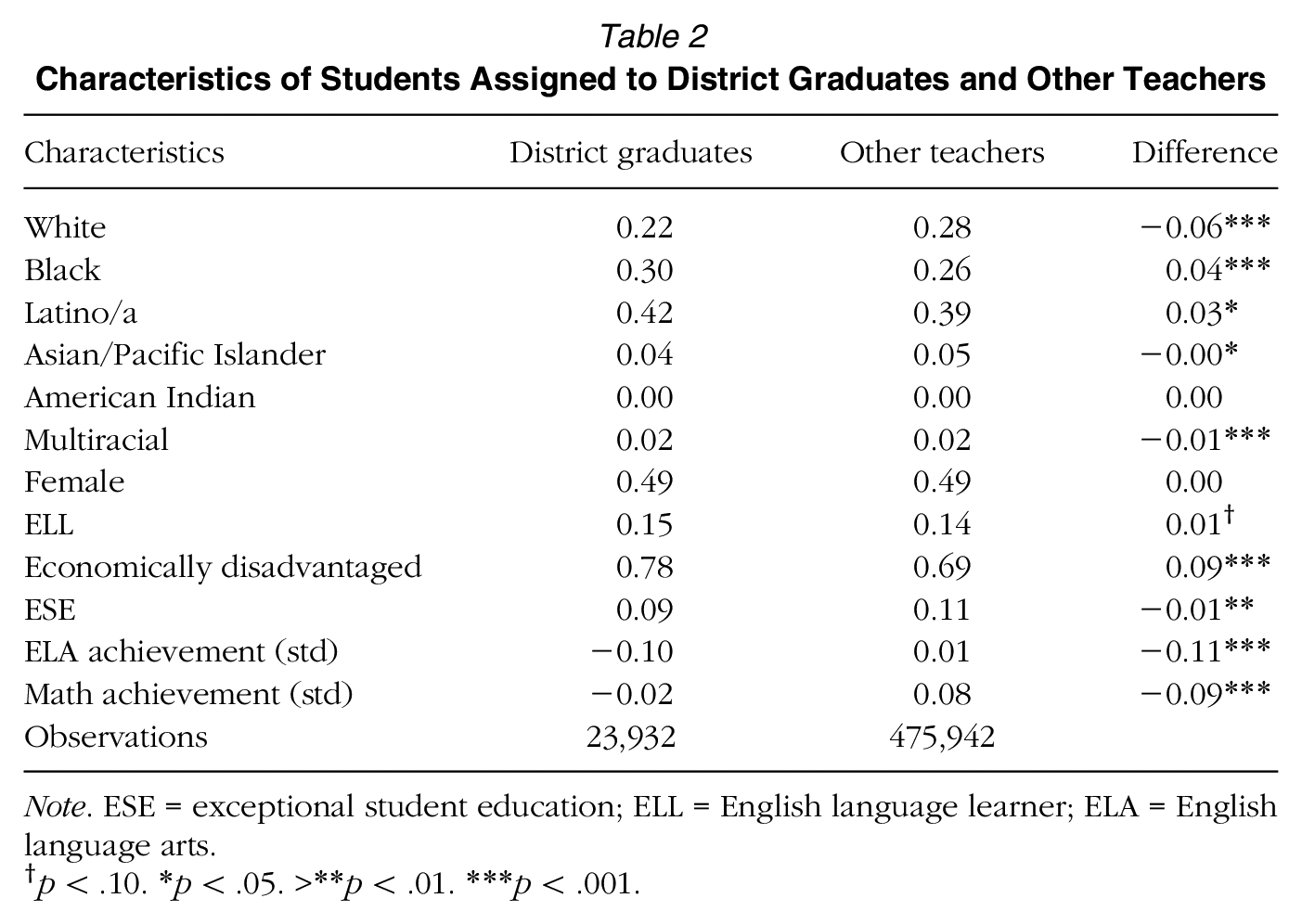
Note. ESE = exceptional student education; ELL = English language learner; ELA = English language arts.
p < .10. *p < .05. >**p < .01. ***p < .001.
The Effectiveness of Teachers Who Return to Teach in Their Home District
The estimates reported in Table 3 examine the extent to which district graduates are more or less effective at improving student test scores than other teachers (Hypothesis 1a). Consistent evidence is found of a positive relationship between assignment to a teacher who graduated from a district high school and student achievement in ELA, with less consistent evidence for mathematics. In elementary school, district graduates are predicted to improve ELA achievement by 0.025 to 0.037 standard deviation units (SDUs) more than teachers who did not graduate from a district high school. No evidence was found of a corresponding relationship for mathematics in elementary schools. In middle school, effect estimates for ELA achievement range from 0.018 (p = .08) to 0.026 SDUs. Effect estimates for mathematics achievement were marginally significant and ranged from 0.015 (p = .07) to 0.040 SDUs (p = .06).5,6
Estimates of the Effect of District Graduate on Student Achievement
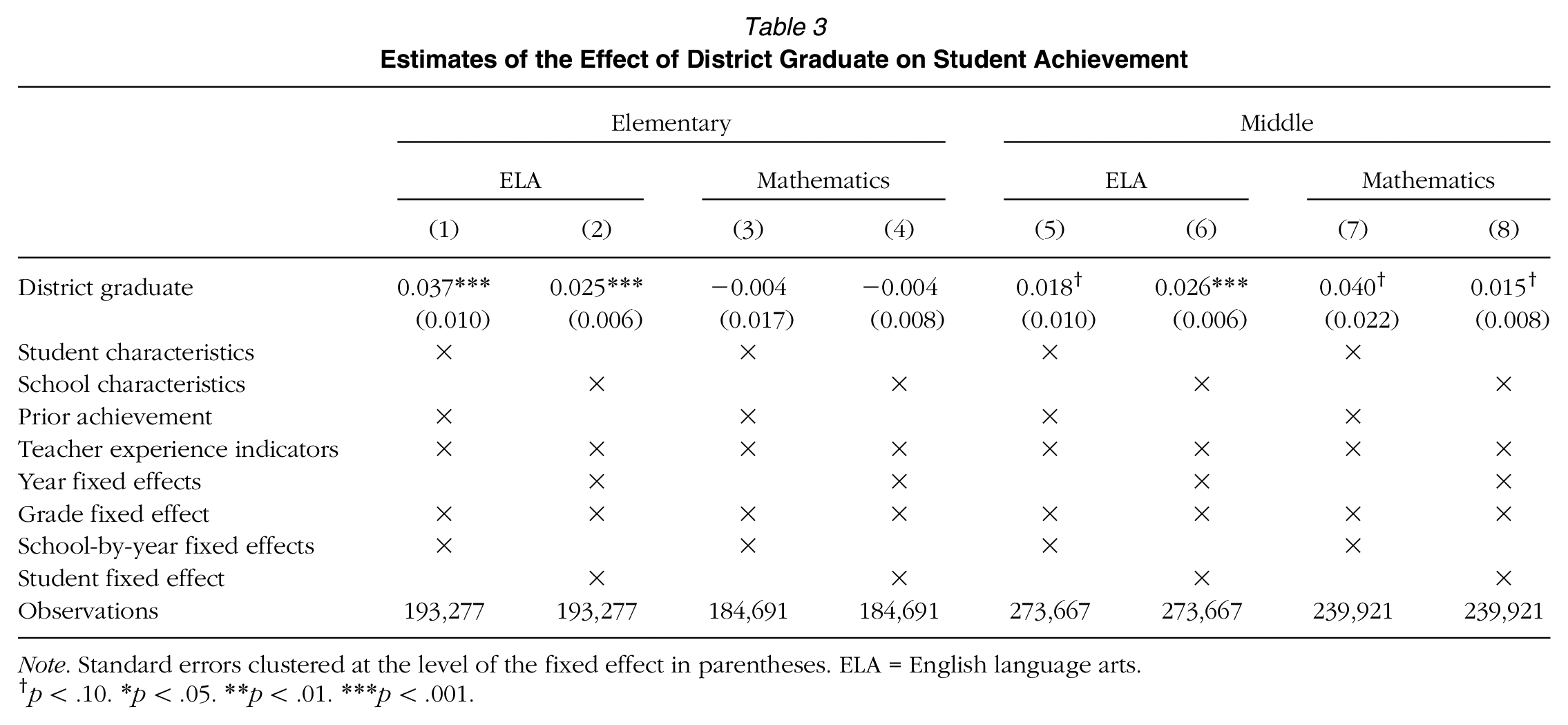
Note. Standard errors clustered at the level of the fixed effect in parentheses. ELA = English language arts.
p < .10. *p < .05. **p < .01. ***p < .001.
With evidence of slight differences in the effectiveness between district graduates and other teachers in the district in all subjects but elementary mathematics, I next explore the extent to which district graduates’ effectiveness is moderated by prior school performance or the concentration of poverty in a school (Hypothesis 1b) or is associated with the dissimilarity in the characteristics of a district graduates’ current school and their high school (Hypothesis 1c). When examining whether or not prior school performance or the concentration of poverty in a school moderate district graduates’ effectiveness in the Supplemental Appendix Table A6 and Figure A2 (in the online version of the journal), little evidence suggests that district graduates’ effectiveness varies based on the tercile of either of these school characteristics.
Next, I restrict the sample to students assigned to district graduates and estimate an ordinary least squares model that uses the absolute value of the difference between select characteristics of district graduates’ high school and characteristics of their current school. Supplemental Appendix Table A7 in the online version of the journal reports the results from this analysis, combining elementary and middle schools given the reduced sample size. Columns 1 and 3 report the estimates from separate models and columns 2 and 4 include all similarity measures in the same model. This analysis suggests that when district graduates work in schools that are less similar to their high school in terms of the proportion of economically disadvantaged students, their students’ net achievement gains in reading and mathematics are smaller. 7
In Supplemental Appendix Table A9 (in the online version of the journal), I probe for evidence of heterogeneity in the effect estimates in terms of teacher race/ethnicity, student race/ethnicity, and student economic disadvantage (Hypothesis 1d). Controlling for other variables in the model, there is little consistent evidence indicating a differential relationship in the effectiveness of district graduates based on teachers’ racial/ethnic identity, students’ racial/ethnic identity, or for economically disadvantaged students. The only significant positive interactions are not consistent across subject and grade level. For instance, in elementary ELA, the net gains of other race/ethnicity students (i.e., Asian/Pacific Islander, American Indian, and multiracial) and Latino/a students are slightly larger when assigned to a district graduate. Yet, in elementary school mathematics, the only significant interaction is between homegrown teachers and Black students. No evidence is found to indicate that the relationship between assignment to a district graduate and student achievement differs by teacher race/ethnicity in elementary or middle schools.
The Attrition of Teachers Who Return to Teach in Their Home District
To understand the extent to which teachers who graduated from district high schools leave the district at lower rates than nondistrict graduates, Supplemental Appendix Figure A3 (in the online version of the journal) reports Kaplan-Meier survival curves for teachers’ first 3 years in the profession across the eight cohorts of beginning teachers used in this analysis. Consistent with the literature on beginning teacher attrition, beginning teachers in this district leave at high rates. By the end of their first year, 20% of teachers had left the district. By the end of their third year, 43% of teachers had left the district. There are differences depending on whether a beginning teacher had graduated from a district high school. By the end of their first year, 16% of district graduates had left the district compared with 20% of other beginning teachers in the district. After the first year, the rates with which beginning teachers leave the district is consistent, regardless of whether or not they were district graduates. By the end of the third year, 60.2% of district graduates remained teaching in the district compared with 56.5% of nondistrict graduates.
Table 4 reports the results from the discrete time survival analysis. The odds that a district graduate leaves the district is 20% lower than other beginning teachers (column 1). As the survival probabilities depicted in Supplemental Appendix Figure A3 (in the online version of the journal) suggest that there might be differences in when teachers beginning teachers turn over during their first 3 years, in column 2, I add an interaction between district graduates and time in the teaching profession. Consistent with Hypothesis 2b, the significant district graduate coefficient indicates that the odds that a first–year district graduates are lower than other first–year teachers in the district (0.72, p < .01). Slight evidence is found of differentially higher rates of leaving for district graduates in their third year of teaching. Likelihood ratio tests indicate that the more parsimonious model in column 1 better fits the data (χ2 = 2.21; df = 2; p = .33). In response, models controlling for teacher characteristics (column 3), school characteristics (column 4), and teacher effectiveness (column 5) estimate the more parsimonious model, thereby making the assumption that the odds of attrition are constant across the first 3 years in teaching. Controlling for teacher and school characteristics does little to change the results observed in the unadjusted model; the odds of leaving the district are 23% lower for district graduates compared with nondistrict graduates. This difference in the risk of leaving the district translates to 3.8 percentage points, or approximately a fifth of the overall attrition rate for first–year teachers in the district. When controlling for teacher effectiveness (column 5), the sample is less than half the size but the direction and significance of the relationship between district graduates and leaving the district is consistent with the previous models.
Discrete Time Survival Analysis of Early Career Teacher Attrition
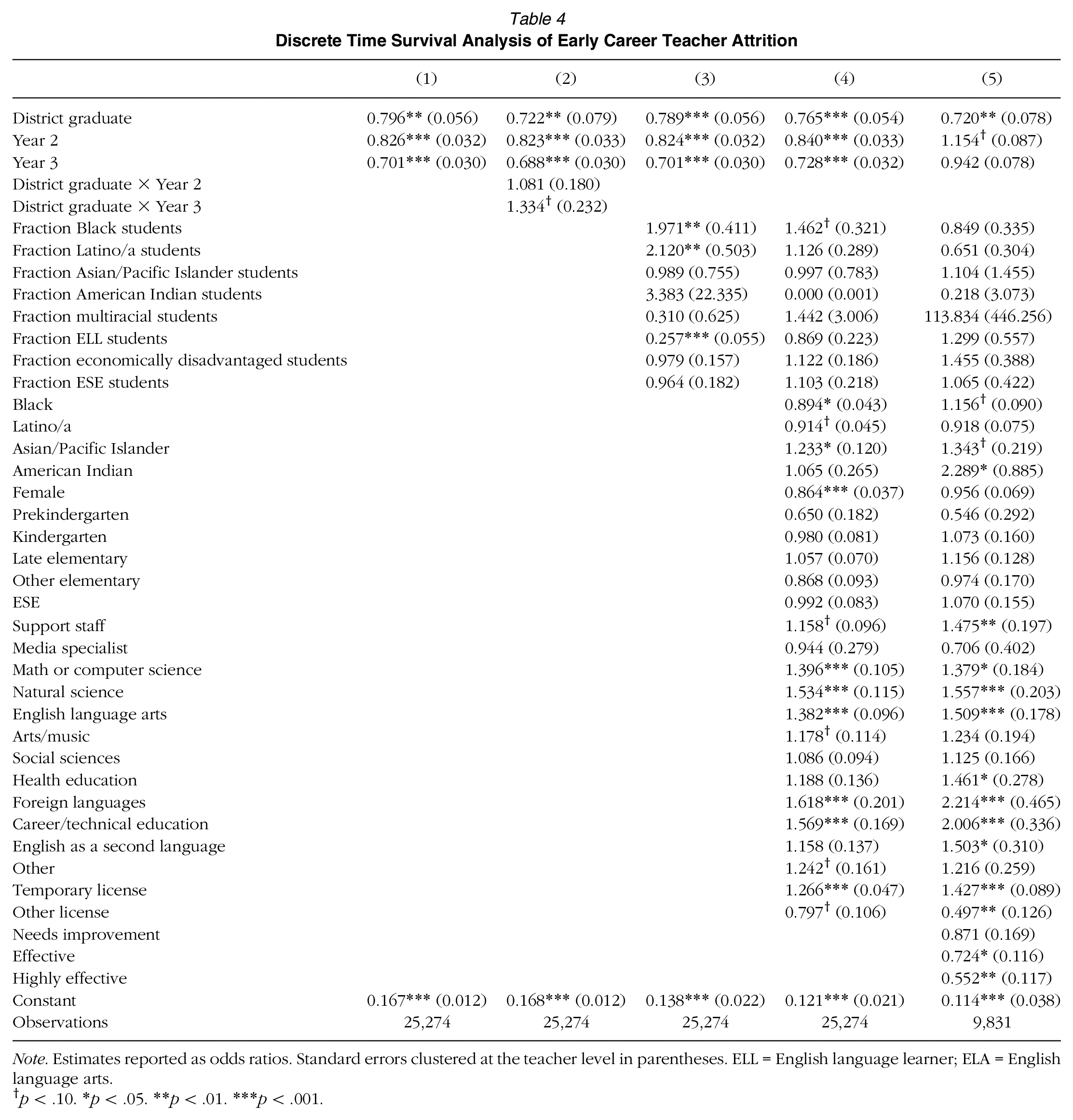
Note. Estimates reported as odds ratios. Standard errors clustered at the teacher level in parentheses. ELL = English language learner; ELA = English language arts.
p < .10. *p < .05. **p < .01. ***p < .001.
I conduct two analyses to test the robustness of these findings. First, I examine the extent to which findings are sensitive to the focus on teachers in their first 3 years in teaching. Supplemental Appendix Table A10 in the online version of the journal reports the main results from Table 4, following fewer cohorts of beginning teachers for longer periods of time. While the direction is consistent across these different specifications, district graduates are only predicted to leave the district at lower rates when they are followed for 4 years, not 5 or 6. Results in columns 4 and 6 from the interactive model show marginally significant evidence of district graduates’ lower odds of leaving the district in the first year, providing further evidence that district graduates’ lower odds of leaving the district are concentrated at the start of their career.
A second concern with the results in Table 4 is that unobserved school–level factors might explain why district graduates leave the district at lower rates. For instance, district graduates may select into schools with more supportive working conditions, thereby biasing the previous results. In response, I estimate a linear probability model predicting leaving the district for teachers in their first 3 years, conditioning on school–by–year fixed effects. Results in Supplemental Appendix Table A11 (in the online version of the journal) provide continued evidence that beginning district graduates leave the district at lower rates than other beginning teachers. The predicted probability of leaving teaching in the district is 3.3 percentage points lower than other beginning teachers.
In addition to the hypothesis that district graduates would remain teaching in the district for longer than other beginning teachers, I also hypothesized that early career district graduates’ attrition rates would be lower in schools with more economically disadvantaged students and lower test scores than other beginning teachers (Hypothesis 2c). To test this hypothesis, I estimate a series of discrete time survival analysis models that include interactions between district graduates and terciles of school characteristics. Supplemental Appendix Figure A4 (in the online version of the journal) displays the predicted probabilities from these models, with the full results reported in Supplemental Appendix Table A12 (in the online version of the journal). Early career district graduates have a similar probability of leaving the district as other early career teachers when working in the highest performing schools and schools with the smallest fraction of economically disadvantaged students and students of color. Notably, early career district graduates have a much lower probability of leaving the district when working in schools in the lowest achievement tercile and greater concentrations of economically disadvantage students and students of color. For instance, among schools in the highest tercile of students of color, the predicted probability of leaving the district is 12.2 percentage points for early career district graduates but 18.3 percentage points for early career nondistrict graduates.
I had also posited that attrition rates would be higher for district graduates teaching in schools more dissimilar to the high school from which they graduated (Hypothesis 2d). I estimate discrete time survival analysis models with the absolute value of the difference between select characteristics of district graduates’ high school and characteristics of their current school as predictors. Supplemental Appendix Table A13 in the online version of the journal indicates that there was no detectable relationship between these measures and early career district graduates’ attrition. That is, these teachers were no more or less likely to leave teaching in the district when they were working in a school with similar demographic characteristics as their high school (Hypothesis 2d). 8
When examining the extent to which early career district graduates of color are more likely to remain in the district than other teachers (Hypothesis 2e), no evidence of differential attrition rates by teacher race/ethnicity to support this hypothesis (see Supplemental Appendix Table A12, column 5, in the online version of the journal).
Discussion
This article contributes to research describing the highly localized teacher labor market (Boyd et al., 2005; Engel & Cannata, 2015; Lankford et al., 2002; Reininger, 2012). My main contribution is the study's evidence showing that, compared with other district teachers, teachers who graduated from a district high school are more representative of a district's student body, slightly more effective at improving student test scores, and more likely to remain in the district. I return to the research questions and associated hypotheses to elaborate on these overarching study findings.
The study's first research question asked about the demographic characteristics, qualifications, and school characteristics of beginning homegrown teachers who graduated from district high schools. These teachers were found to be more racially diverse than other beginning teachers in the district. This difference is largest for new Black teachers—23% of district graduates identified as Black compared with 18% of other beginning teachers—with no significant differences for new Latino/a, Asian/Pacific Islander, or American Indian teachers. This descriptive finding aligns with Reininger’s (2012) study, which found that Black high school graduates to have significantly greater odds of living within 20 miles of where they attended high school compared with White high school graduates. This preference for remaining close to home might be explained by greater embeddedness within their community or racialized barriers that limit geographic mobility.
Echoing prior research that finds teachers from urban school districts to have lower certification rates (Lankford et al., 2002), I find that district graduates are more likely to hold a temporary teaching license than other beginning teachers (48% vs. 40%). While beginning district graduates worked in schools with similar demographic characteristics than other new teachers, district graduates who identify as Black and Latino/a work in schools with a higher proportion of students of the same race/ethnicity, likely reflecting their commitment to serving as a positive role model in their home district (Achinstein et al., 2010).
I developed four hypotheses oriented around the second research question: the net achievement gains of students assigned to district graduates will be greater than students assigned to teachers from outside the district (Hypothesis 1a); the effectiveness of district graduates will be moderated by prior school performance or the concentration of poverty in a school (Hypothesis 1b); homegrown district graduates will be less effective when working in schools more dissimilar from their high school (Hypothesis 1c) and; student achievement gains of students assigned to district graduates will be greater when either the teacher or student identifies as Black or Latino/a (Hypothesis 1d). Study findings were generally consistent with the first hypothesis, failed to support the second and fourth hypotheses, and was mixed for the third hypothesis.
District graduates were predicted to improve elementary ELA achievement by 0.03 to 0.04 SDUs more than teachers who did not graduate from a district high school. Effect estimates for middle school ELA ranged from 0.02 to 0.03 SDUs. While no evidence of a relationship was found for elementary school mathematics, in middle school, a marginally significant relationship was found, with estimates ranging from 0.02 to 0.04 SDUs. These relationships can be characterized as small in magnitude, reflecting the shift from the 48th to 49th percentile in for the average fifth–grade student or the estimated improvements in first–year teachers’ ability to increase student achievement in ELA (Atteberry et al., 2015; Kraft, 2020). That homegrown teachers have a larger effect in ELA than mathematics is a noteworthy finding, given that other research on teacher effectiveness has tended to find that teacher effects on student achievement are larger for mathematics compared with ELA (e.g., Nye et al., 2004). Researchers have suggested that this difference is due to greater variation in how teachers teach mathematics compared with ELA (Nye et al., 2004), suggesting that in the current study, the larger teacher effects in ELA scores might be related to particular knowledge, skills, and dispositions that allow them to better connect with their students in ELA.
No evidence was found that the effectiveness of district graduates varied by teacher, school, or student characteristics (Hypotheses 1b and 1d), although the dissimilarity analysis showed that students’ achievement gains in reading and mathematics were smaller when assigned to a district graduate working in a school more dissimilar to their high school in terms of the enrollment of economically disadvantaged students (Hypothesis 1c). This latter finding is consistent with the P-O fit model, which predicted that working in a school that is dissimilar to where they attended high school would result in less compatibility and thus reduced levels of effectiveness. Yet, compared with research showing that teachers are more effective when working in schools that resemble where they conducted their student teaching (Goldhaber et al., 2017; Ronfeldt, 2015), this relationship is more muted. As a whole, these findings imply that district graduates can have a positive effect on student achievement, particularly in ELA, but that observable features of teachers themselves or the characteristics of their schools and students do little to clarify the mechanisms that drive this overall relationship.
The final research question asked about the extent to which early career district graduates were more likely to remain in the district than teachers from outside the district. The five hypotheses related to this research question were that early career district graduates would remain in the district at higher rates than teachers from outside the district (Hypothesis 2a); first–year district graduates would have higher retention rates than other teachers in the district (Hypothesis 2b); district graduates’ retention rates will be higher than other beginning teachers in schools with more economically disadvantaged students and lower test scores (Hypothesis 2c); district graduates’ retention rates would be lower when teaching in schools with more dissimilar demographic characteristics as the high school from which they graduated (Hypothesis 2d); and Black and Latino/a district graduates will have higher retention rates than Black and Latino/a teachers who did not graduate from a district high school (Hypothesis 2e).
In terms of Hypotheses 2a and 2b, early career district graduates were less likely to exit the district than other beginning teachers, with the differences most pronounced in teachers’ first year when 16% of district graduates left the district compared with 20% of other first–year teachers. To put this difference in context, it reflects a fifth of the overall attrition rate for first–year teachers in the district. This difference is also similar in magnitude to the predicted difference in leaving teaching between new teachers working in schools where the majority of students identify as a racial/ethnic minority compared with teachers working in schools with less racially diverse student bodies (Redding & Nguyen, 2020). Despite district graduates’ lower attrition rates than other beginning teachers, they still left the district at high rates; only 60% of district graduates remained in the district after their first 3 years of teaching. These findings suggest that on- and off–the–job embeddedness are related to the higher retention rates of district graduates compared with other beginning teachers in the district. Yet, preexisting professional and personal support networks and a connection to the district were not sufficient to promote high retention rates, further underscoring the need for comprehensive supports for new teachers working in demanding teaching environments (Simon & Johnson, 2015).
Strong evidence was found in support of Hypothesis 2c. Beginning district graduates working in the lowest performing schools and schools with the greatest concentrations of poverty and students of color left the district at significantly lower rates than beginning teachers from outside the district. This finding is supported by research showing that teachers committed to working in historically underserved schools often have higher retention rates, despite often facing more challenging working conditions (Achinstein et al., 2010; Simon & Johnson, 2015). No evidence was found in the dissimilarity analysis (Hypothesis 2d) or related to differentially lower attrition rates for district graduates of color (Hypothesis 2e). Scholars have suggested that beginning teachers of color often face a unique set of challenges when transitioning into teaching (e.g., social isolation; racial animus; Bristol, 2018; Gist, 2018), which might increase attrition rates, even among district graduates with a commitment to teaching was an act of community service.
Limitations
The first limitation relates to the generalizability of the study findings. While the hypothesized mechanisms related to district graduates’ effectiveness and retention would arguably be consistent across other school districts, their sociodemographic and institutional context might be markedly different from the setting for this study. For instance, while gentrification and the associated effects have brought significant changes to many central city neighborhoods, the effects have often been quite varied (Pearman, 2019). Most relevant to this study is the extent to which increased housing prices and loss of affordability displaces individuals who grew up attending district schools but have little potential of becoming teachers in the district because of a loss of affordability (Dizon-Ross et al., 2019).
A second limitation of this study comes from the identification of district graduates. There are likely other district graduates who I am unable to identify. Specifically, I do not observe teachers who graduated from district high schools before the 2005–2006 academic year. Although regression models control for differences in prior cohorts of teachers, it is important to emphasize that the district graduates in this study were in the early stages of their career and may not generalize to all district graduates. When studying district graduates in the future, researchers might consider using additional data sources that cover longer time periods than the data used in this study. As one example, Boyd et al. (2005) have better coverage of teachers’ high school by using college application data.
The focus on a single school district precludes a more complete understanding of the educational background of teachers from outside the district as well as teachers’ broader labor market trajectories. I was unable to test the extent to which teachers from outside the district who graduated from high schools with similar demographic characteristics to the schools in which they are currently working had similar effects on student achievement as district graduates. I am also unable to identify the extent to which graduates of this district became teachers in other districts in the state or continued teaching after leaving this district.
Finally, study data do not contain information on teachers’ baccalaureate institution or where they conducted student teaching. As a result, I am unable to identify whether or not district graduates attended local teacher preparation programs or completed their student teaching in the district at higher rates than other beginning teachers—plausible mediators of the relationships observed in this article. Individuals interested in becoming a teacher in their home community may enroll in the local university and conduct student teaching in district schools (Krieg et al., 2016). To better understand high school graduates’ opportunities to become teachers, researchers will need to further unpack the relationship between the proximity students’ high school, teacher preparation programs, the location of student teaching, and where they ultimately begin their careers (Goldhaber et al., 2019).
Implications and Future Research
This study speaks to the critical question of where teachers in large urban school districts should be recruited. The evidence that teachers who returned to teach in their home district are more racially diverse, slightly more effective, and less likely to exit the district than other teachers raises the question of the extent to which school districts might consider targeting district graduates in recruiting efforts. As districts already end up hiring many district graduates simply based on teachers’ preference to work close to home, a key question for district leaders is the extent to which the location of where an applicant went to high school is a meaningful attribute to focus during the hiring process. This decision is intertwined with local considerations around the nature and severity of teacher shortages as well as school district's internal benchmarks to diversify teaching demographically. In districts with sharp discrepancies in the relative share of students and teachers of color, incorporating information into hiring procedures on whether or not an applicant is a district graduate may be one strategy to increase racial diversity among the district's teacher workforce. While such a step may be relatively straightforward, more intensive recruitment and training efforts aimed at recruiting local community members may be cost prohibitive for many school districts (Kaufman et al., 2020). Future research can examine how changes in district policy and practice around the recruitment of district graduates result in meaningful changes in the diversity, quality, and stability of the teacher workforce.
The differences between district graduates and nongraduates also implies the need to better understand the mechanisms underlying these differences. The conceptual basis for district graduates’ effectiveness was that experiences as a student in the school district result in (1) the presence of preexisting professional and personal support networks; (2) strong value congruence resulting from growing up within, graduating from, and working in the same school system; and (3) knowledge about the community that can help foster connections with students and their families. Researchers can document the relative importance of these factors in shaping district graduates’ effectiveness and retention.
Future research can explore the ways in which the sociodemographic characteristics of the schools that teachers attended shape what type of school they seek out and their effectiveness or tenure once they begin teaching. It may be that teaching in schools similar to those a teacher attended is impactful, regardless of whether it is located in the same district, making this an important area of future study. Scholars can also probe the extent to which growing up in a community affords unique benefits to teachers or whether transplants to a city can also develop knowledge about the community, alignment of values, and supportive networks. In other words, while growing up in a community clearly has an embedding effect on homegrown teachers, how can teacher preparation programs or schools themselves embed teachers within their school and community?
Answering this question will help in understanding how best to recruit and prepare local teachers in urban school districts. If the effectiveness of district graduates is largely contingent on factors related to their long–standing residence in the community, GYO teacher pipeline programs that encourage middle and high school students of color to enter the teaching profession might be particularly promising (Bianco et al., 2011; Goings & Bianco, 2016; Villagómez et al., 2016). The viability of this approach, however, hinges on stronger evidence on how to transition high school students into teacher preparation programs (Gist et al., 2019; Herrera et al., 2011). At a more fundamental level, such efforts depend on the extent to which school systems can create a school environment whereby students historically marginalized by the educational system would consider returning to teach in their home district (McKinney de Royston et al., 2021).
Alternatively, GYO programs that build on the knowledge, skills, and abilities of school and community members may prove equally effective and better manage the recruitment, preparation, and classroom teaching than high school pipeline programs. As districts and states increase their support for GYO programs (Muñiz, 2018), the field would benefit from more systematic evaluation of their efficacy, including attention to the specific mechanisms associated with the success of recruiting teachers from different prospective teacher pools (i.e., secondary students, paraprofessionals, noninstructional school staff, and parent mentors) in different geographic locations. In addition, while district graduates in the study were more racially diverse than other teachers in the district, counter to expectation, few differences were observed in the effectiveness or retention of district graduates of color compared with White district graduates. Future research can investigate the varied backgrounds and preparation experiences of homegrown teachers of color and how they relate to differences in effectiveness and retention.
The GYO approach is notable for its explicit commitment to recruiting teachers with community cultural wealth (Gist et al., 2019). Other within–district entry pathways, including teacher residency programs and TNTP's Teaching Fellows or TEACh program, would likely benefit from explicit attention to a recruitment process that identifies candidates with connections to and knowledge about the local community. Preparation programs with the mission of providing customizable, local training can also work to develop formal and informal connections to school and community members in efforts to embed teacher prospective teachers within their workplace and community.
The salience of JE for homegrown teachers’ effectiveness and retention suggests that researchers might benefit from applying this theoretical framework more broadly in the study of the teaching profession. For instance, an emerging consensus describes the importance of positive working conditions in explaining why teachers remain working in schools (Nguyen et al., 2020; Simon & Johnson, 2015). While JE theory affirms that a supportive environment where teachers have many high–quality links with their colleagues helps improve retention, other within–school and out–of–school factors are likely also relevant. Researchers could measure the different components of JE theory that remained unmeasured in the current study—fit to the community, fit to school, links to community, links to school, community–related sacrifice, and organization–related sacrifice—to understand the extent to which other school- and community–based factors are related to teachers’ effectiveness and likelihood of remaining a teacher in their district. If applied to homegrown teachers, this research would help identify the precise mechanisms responsible for their effectiveness and retention rates. It could also explore how schools may more strongly embed teachers to the local community and how community embeddedness can buffer against challenging school conditions that could otherwise drive teachers to leave.
Supplemental Material
sj-pdf-1-aer-10.3102_00028312221078018 – Supplemental material for Are Homegrown Teachers Who Graduate From Urban Districts More Racially Diverse, More Effective, and Less Likely to Exit Teaching?
Supplemental material, sj-pdf-1-aer-10.3102_00028312221078018 for Are Homegrown Teachers Who Graduate From Urban Districts More Racially Diverse, More Effective, and Less Likely to Exit Teaching? by Christopher Redding in American Educational Research Journal
Footnotes

Supplemental Material
Supplemental material for this article is available online.
Notes
C
References
Supplementary Material
Please find the following supplemental material available below.
For Open Access articles published under a Creative Commons License, all supplemental material carries the same license as the article it is associated with.
For non-Open Access articles published, all supplemental material carries a non-exclusive license, and permission requests for re-use of supplemental material or any part of supplemental material shall be sent directly to the copyright owner as specified in the copyright notice associated with the article.
