



Abstract
Black students face hyper-disciplining and high levels of social control when they enter American schools. The cultural mismatch hypothesis attempts to explain this hyper-disciplining by arguing that the mostly White teaching force misinterprets the attitudes and behaviors of Black students, which leads to their hyper-disciplining. Utilizing a longitudinal, deeply iterative, participatory, and critical ethnographic research process, however, this article shows that traditional scholarship around the cultural mismatch hypothesis is insufficient. The analysis indicates that teachers’ misinterpretation of mismatched capital (the traditional cultural mismatch hypothesis) is actually a racialized interpretation of both matched and mismatched capital coming from Black students, and such racialized interpretations are guided by the logic of antiblackness endemic to American institutions. Hence, this research argues for the integration of antiblackness as a theoretical tool to expand upon cultural mismatch explanations and for the creation of educational spaces where Black students are recognized, valued, and treated with dignity and humanization.
Keywords
Introduction
I mean it’s just there’s a real lack of freedom here for everything. And I think, as a student, that would be really frustrating to me and it might make me want to act out more. … I mean it feels like you’re going to jail every day. (Teacher focus group, 2015, Local High School) Some of it [the teachers’ mentality for dealing with student behavior] is a cultural thing. … I think maybe some teachers don't know how to interact with students from different cultural backgrounds, and so what ends up happening is … students just end up kind of either getting ignored or just kicked out of class over and over again. And it’s just ’cause teachers don’t know how to—they don’t know what to do, I guess. (Teacher interview, 2015, Local High School)
A “lack of freedom” and forbearing sense of “going to jail” pervaded the halls of Local High School (LHS) in 2015, despite dedicated and caring families, students, and educators. This type of social control and disproportionate disciplining of students of color, particularly Black students, is a well-documented phenomenon. Some scholars have begun linking this “hyper-disciplining” (Marcucci, 2020a) to the wider structural phenomenon of the hyperpolicing and incarcerating of Black individuals and communities (Coles & Powell, 2020; Marcucci, 2020a; Wun, 2016). Despite these recent structural analyses, cultural arguments—“some teachers don’t know how to interact with students from different cultural backgrounds”—persist when scholars and practitioners attempt to explain the hyper-disciplining and high levels of social control that Black students experience (e.g., Gay, 1993; Kozlowski, 2015; Neal et al., 2003). Most notably, researchers have used the “cultural mismatch hypothesis” to argue that the mostly White teaching force misinterprets the attitudes and behaviors—or as Bourdieu (1986) described, the cultural capital—of Black students, which leads to their hyper-disciplining.
We suggest that cultural mismatch alone cannot effectively explain racialized differences in school discipline, specifically the hyper-disciplining of Black students. Specifically, this article argues that traditional scholarship around the cultural mismatch hypothesis (see Figure 1) prioritizes White sensibilities and ignores the structural presence of anti-Blackness in U.S. schools. Through the use of abductive analytical traditions that allow for the generation of “novel theoretical insights that reframe empirical findings in contrast to existing theories” (Timmermans & Tavory, 2012), our analysis indicates that the teacher misinterpretation of mismatched capital is actually a racialized interpretation of both matched and mismatched capital coming from Black students, following the logic of anti-Blackness endemic to American institutions. That is, this article explores and complicates the cultural mismatch hypothesis (see Figure 2), arguing for the integration of anti-Blackness as a theoretical tool (Bell, 1992; Dumas, 2016). Anti-Blackness is the phenomenon that Blackness and Black individuals are “marginalized, disregarded, and disdained” (Dumas & ross, 2016, p. 417). Its unique logic is pervasive and endemic to American society, visible in ideological forms (i.e., written policies; unspoken interactional norms) and reinforced through the mobilization of material and human resources (i.e., signage; teachers/administrators). Specifically, utilizing a longitudinal, deeply iterative, participatory, and critical research process—guided by an abductive analysis approach of an extensive database including focus groups, interviews, research reflection circles/cogenerative dialogues, restorative talking circles, participatory coteaching roles, and observations—this article contributes to the field by discussing the ways in which Black students were punished disproportionately and hypercontrolled, regardless of the forms of cultural capital being displayed, highlighting the presence of anti-Blackness in schools.

Original cultural mismatch hypothesis.
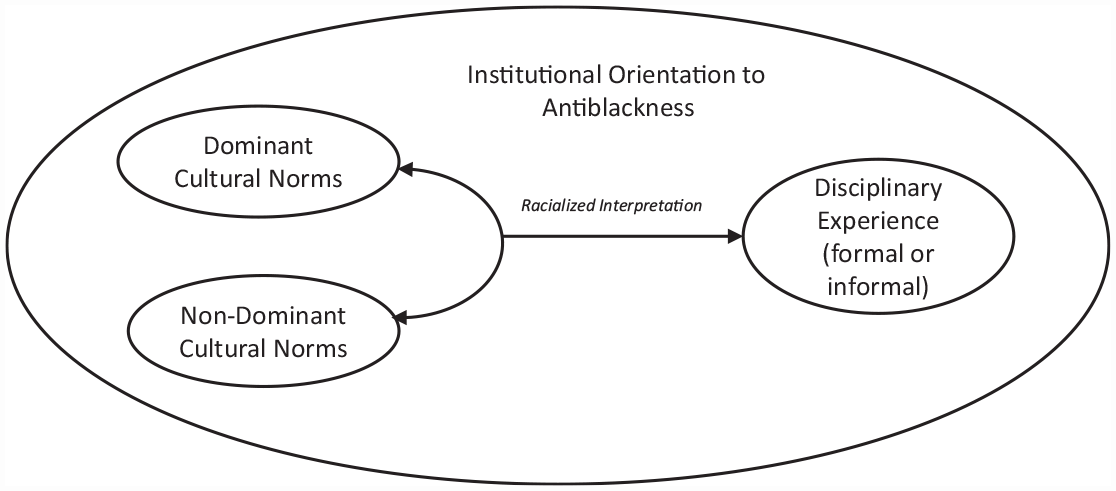
Cultural mismatch hypothesis 2.0.
The Disciplining and Controlling of Black Students
Since an early report by the Children’s Defense Fund (1975), researchers have documented how Black students are disproportionately disciplined in schools (Skiba et al., 2014). While other students of racially minoritized backgrounds are also inequitably disciplined, Black boys, girls, and nonbinary students are at the highest risk compared to their White counterparts (Morris & Perry, 2017; Nowicki, 2018; Rodriguez & Welsh, 2022). This so-called “discipline gap,” referred to in our scholarship as “hyper-disciplining” (Marcucci, 2020a), persists even when controlling for misbehavior, poverty, and academic achievement (Nowicki, 2018; Skiba et al., 2011). A more recent turn in the literature has pointed out that Black students are more likely to attend hypercontrolling schools (Irwin et al., 2022; Lee, 2022; Welch & Payne, 2010). This means that a student’s freedom to move, dress, and act in ways they deem appropriate are heavily policed. Regardless of whether they experience disciplinary sanctions, Black students who attend these hypercontrolling schools have worse academic outcomes (Jabbari & Johnson, 2020; Perry & Morris, 2014). While Black students and families have a long history of educational advocacy, the formal school system is structured in such a way that denies the livelihood of Black students.
Defining Cultural Mismatch Hypothesis
Some practitioners and scholars have pointed to the cultural mismatch hypothesis to explain the hyper-disciplining of Black students (e.g., Gay, 1993; Gregory et al., 2010; Kozlowski, 2015). In its most basic form, the cultural mismatch hypothesis refers to how a teacher’s cultural practices and/or the classroom culture as a whole do not align with students’ cultural embodiments (Gregory et al., 2010; Irvine, 2002; Townsend, 2000). In its origins, the cultural mismatch hypothesis suggested that a “sociocultural gap” (Gay, 1993, p. 285) between students and educators causes higher rates of cultural misunderstandings and, thus, results in various inequitable educational outcomes. The legacy of this idea has persisted in various areas of educational thought. In scholarship on higher education, for example, cultural mismatch has found recent popularity in explaining the success (or attrition) of first-generation college students (Covarrubias et al., 2018). Higher education scholars rely on class-based understandings of cultural mismatch (e.g., Nguyen & Nguyen, 2020; Stephens et al., 2012; Tibbetts et al., 2018), exploring cultural differences between students from lower socioeconomic classes and their alignment with dominant cultural expectations in settings that historically excluded students from lower socioeconomic backgrounds. Specifically, Nguyen and Nguyen (2020) argue that cultural mismatch: offers a valuable framework to identify the social psychological mechanisms that students themselves identify as moments that explain patterns of exclusion, while also identifying opportunities that can, instead, redress these moments of exclusion. Accordingly, institutional norms can be viewed as both organizational conditions and social rules of behavior that produce unequal pathways through higher education. (p. 225)
The authors additionally argue that the “social rules of behavior” are dictated by the “institutional norms” and that these norms are what create inequitable success for lower socioeconomic (SES) students in higher education contexts.
In addition to linking socioeconomic differences with inequitable outcomes, the cultural mismatch hypothesis entertains race as a related construct, specifically attributing particular practices as “Black culture” or “Black cultural capital” (Carter, 2003), and it acknowledges the associated conflicts emerging within educational settings. An example of cultural mismatch is highlighted by Townsend (2000), who writes, Many African American students are accustomed to engaging in multiple activities simultaneously in their homes and communities. … At school, teachers usually expect and reward students' individual engagement in one activity at a time, as opposed to managing multiple tasks and working with others. (p. 383)
Where cultural practices differ amongst individuals, judgment and evaluation may ensue. Neal and colleagues (2003), for example, found that teachers perceived students walking with stereotypically African American movement styles to be more aggressive, lower in achievement, and more likely to need special education placement. The literature further shows there are disciplinary implications when Black students’ practices are perceived as a form of cultural mismatch with their teachers. In their article on classroom management in diverse classrooms, Milner and Tenore (2010) argue that “conflicts are often couched in misinterpretations that seem to be shaped by the socioeconomic, cultural, racial, and ethnic inconsistencies that exist between teachers and students” (p. 565). Gregory et al. (2010), in their conceptual piece on the “discipline gap,” recognize cultural mismatch as one potential explanation for the oversanctioning of Black, Latinx, and Indigenous American students, while also citing “societal stereotypes” and “implicit bias” as areas that impact school discipline practices and require more research.
Furthermore, cultural mismatch is implied in the very important scholarship around culturally relevant pedagogy (Ladson-Billings, 1994/2009) and other similar endeavors. While originally not explicitly referring to how students are disciplined, scholarship around culturally relevant pedagogy implies that the American school system must be modernized to meet the unique cultural backgrounds of its students. In recent years, the cultural relevance movement has been applied to discipline. Weinstein et al. (2004) were some of the first to apply a culturally relevant lens to discipline; Gregory and Mosely (2004) and Lustick (2017) have also suggested similar ideas. In fact, in our own previous work (Marcucci & Elmesky, 2020), we have recognized the importance of culturally relevant discipline (CRD) and used ethnographic microanalysis to demonstrate the positive impact CRD has on interactions between students and teachers. The cultural relevance movement has even, at times, recognized the role of structural racism in the hyper-disciplining of Black students, showing how both cultural and structural explanations for discipline inequity can coexist (e.g., Lustick, 2017; Marcucci & Elmesky, 2020). The cultural relevance movement has been critical in moving teaching and discipline practices towards a more socially just orientation.
While many scholars recognize the structural influence of racism on the disciplinary process (e.g., Gregory et al., 2010; Johnson et al., 2019; Marcucci, 2020b; Okonofua & Eberhardt, 2015; Welch & Payne, 2010), cultural mismatch still persists among practitioners and some scholars as a legitimate explanation for the hyper-disciplining of Black students (e.g., Kozlowski, 2015; Marcucci & Elmesky, 2016, Monroe & Obidah, 2004; Oginga Siwatu et al., 2017; Skiba et al., 2011). The cultural mismatch hypothesis (and scholarship that implies cultural mismatch) is a critical lens to understand the American school system, as it highlights underlying and often invisible White cultural norms. This generation of scholarship has drawn attention to the fact that there is a cultural mismatch between American schools and Black students. While the hypothesis—correctly, for the most part—suggests that predominately the White teaching force has White-normed behavioral expectations for its minoritized and racialized student body, cultural mismatch alone cannot effectively explain racialized differences in school discipline, specifically the hyper-disciplining of Black students. Some scholars have used antiblack implicit bias, racial threat hypothesis, and other theories of antiblack racism more generally (e.g., Gregory et al. 2010; Okonofua & Eberhardt, 2015, Welch & Payne, 2010). However, many scholars, including ourselves in previous work, have not relied on deeper structural understanding of the specific heuristics of antiblackness to explain school discipline.
Defining Antiblackness in Schools
Antiblackness refers to a diverse intellectual tradition, stemming from Black intellectual leaders (e.g., Bell, 1992; Hartman, 1997). Often associated with the afro-pessimism lineage, antiblackness asserts that Blackness—and therefore all who are associated with it—is denied humanity, what Sharpe (2016) calls “the abjection from the realm of human” (p. 14). In this article, we use the term antiblackness to reference the structures and cultures that dehumanize Black people and position people who are Black and Blackness as those that are “marginalized, disregarded, and disdained” (Dumas & ross, 2016, p. 417). Antiblackness is not unique to the United States (Fanon, 1952). It has been a global phenomenon since the invention of the Black race at the beginning of the systematic kidnapping and enslavement of individuals from the African continent in the 15th century (Kendi, 2016).
Dumas & ross, in their 2016 article outlining Black critical theory, offer one specific operationalization within the larger antiblackness tradition. They argue that antiblackness is “endemic to, and is central to how all of us make sense of the social, economic, historical, and cultural dimensions of human life” (p. 429). Critical race theory, which developed in legal studies (Bell, 2004), invokes a number of central analytics, like storytelling, opposition to liberalism, and interest convergence (Ladson-Billings & Tate, 1995; Solórzano, 1997). Antiblackness generally, and the newer “BlackCrit” specifically, share the central idea of the endemism of racism to institutions but offer unique alternative heuristics to understand social life. Dumas and ross (2016) identify three central tenets to theoretical understandings of antiblackness: (a) that antiblackness is endemic to modern ways of life, (b) that Blackness rubs against the “neoliberal, multicultural imagination” (Martin et al., 2019, p. 34), and (c) that a Black liberatory fantasy pushes against dominant White narratives that exonerate White people and institutions from harm-doing. BlackCrit scholarship thus recognizes that the postracial, multicultural world, which many wish to believe we have achieved, is actually a “revisionist history that support majoritarian stories that disappear Whites from a history of racial dominance” (Martin et al., 2019, p. 34).
In addition to the central tenets described above, BlackCrit and related scholars have theorized how antiblackness is enacted through various forms of systemic violence (e.g., Coles, 2016; Hartman, 1997; Leonardo, 2004; Martin et al., 2019). Systematic violence refers to “any institutionalized practice or procedure that adversely impacts disadvantaged individuals or groups by burdening them psychologically, mentally, culturally, spiritually, economically, or physically” (Epp & Watkinson, 1997, p. 190). While violence can be physical or epistemological as well, the most relevant form of violence to this analysis is symbolic violence (Martin et al., 2019). Symbolic violence refers to the “wounds inflicted by the wielding of words, symbols, and standards” (Ferguson, 2000, p. 5). Love (2016) alternatively refers to the phenomenon as “spirit murdering.” In the context of this analysis, spirit murdering or symbolic violence are “gentle” (Bourdieu, 2001) acts against Black children and youth—specifically against their cognition and emotions—that are often virtually imperceptible but no less harmful to the individuals.
The logic of antiblackness—including the dehumanization of Black people, the use of symbolic violence, and the prioritization of White sensibilities and perpetrator-free multicultural narratives—unsurprisingly permeates schools in this national context. Dumas has applied a BlackCrit perspective to educational processes (Dumas, 2016; Dumas & ross, 2016). Other scholars have also begun to use the antiblackness as a framework—either instead of or in conjunction with critical race theory—to understand how schools in the United States function (e.g., Coles & Powell, 2020; Martin et al., 2019; Wun, 2016). For example, Coles and Powell (2020) use a BlackCrit framework to understand the formal and informal disciplinary and social control processes in American schools. Coles and Powell write, “We are not concerned with simply understanding school suspensions as a general racist practice against Black youth, but rather, to make sense of school suspensions of Black youth in the context of the specific violence enacted against Black bodies throughout U.S. history” (p. 118). Coles and Powell suggest that the historicization of the disciplining of Black students allows antiblackness to come more clearly into focus within the institutional setting. As a culture of systematic violence infiltrating American culture and institutions, antiblackness can be conceived as a fog that is difficult to pinpoint.
We push the existing cultural theoretical explanations forward by formally theorizing structural antiblackness into the cultural mismatch hypothesis and other cultural explanations of hyper-disciplining. That is, an abductive analysis presented within this article reveals that educators have racialized interpretations of students’ embodied cultural capital—regardless of whether it is matched or mismatched—that are shaped by larger systems of antiblackness and perpetuate symbolic violence against Black students. Further, one of the foundational tenets of BlackCrit theory specifically is that “neoliberal, multicultural imagination” often exonerates White institutions and individuals from the racialized harms they historically and contemporarily commit. Cultural mismatch theory falls into this “multicultural imagination” that allows racism (in this case, the hyper-disciplining of Black students) to be explained away without recognition of White wrongdoing. In doing so, cultural mismatch theory and related scholarship prioritizes “White sensitivities and sensibilities” (Martin et al., 2019, p. 36) over Black lives, joy, learning, and humanity.
Methodology and Methods
Critical Ethnography
Critical ethnography is a unique approach to research design that both highlights oppression and aims to change it. Barton (2001) writes of the benefits in embracing such a methodological framework to study discriminatory practices in schools: Solutions reside in documenting, critically analyzing, and acting on—indeed, changing—the discriminatory practices supported by urban schooling and society. Critical ethnography is a method in a logical framework useful for engaging in just this kind of work. (p. 914)
Within such a paradigm for research, there is a focus on both documenting oppression and facilitating empowerment (Barton, 2001), and the research process accelerates “the conscientization of the oppressed and the oppressors” (Trueba, 1999, p. 593). Accordingly, our longitudinal critical ethnography has been dedicated to uncovering and dismantling the dominant narratives at one predominantly Black high school, referred to as LHS, in a metropolitan area of the Midwest.
Study Context
This article highlights parts of a longitudinal critical ethnographic research study conducted at LHS. The study began in December 2014, when district and school officials asked the research team to perform a culture evaluation of the school, since the administrators had identified race, student-teacher relationships, and discipline as areas of concern inhibiting their goal of preparing students for college readiness. LHS is roughly 90% African American and has a predominately White teaching force. It is fully accredited by the state and offers a number of Advanced Placement courses and extracurricular activities, although students cite (and the administration confirms) that these advanced courses tend to be overpopulated with White students. LHS, at the time when the ethnographic work began, was a school that hyper-disciplined its Black students. Prior to beginning qualitative data collection for this longitudinal study in 2015, the authors obtained access to quantitative discipline data for the high school, that was collected over the 2012 to 2014 school years. This data documented 4,000 discipline referrals within a student body of approximately 800 students. While Black students made up 89% of the LHS student population at the time, they represented 97% of the reported disciplinary infractions. In contrast, White students, represented around 8% of LHS students but only received 1% of the disciplinary referrals. These statistics served as important indicators of the racialized discipline challenges that were facing LHS.
The research collaboration with LHS, by its nature of extending across years, had multiple entry points and a plethora of data sources that, when analyzed both independently and through triangulation, allowed for the deep understanding of the experiences of administrators, teachers, and students in the building. Through previous publications, the authors have highlighted many moments in the high school’s history that speak to the early and more punitive LHS context as well as to the school’s evolutionary journey to creating safer spaces for their Black student body. In the earliest analyses, physical signage around LHS revealed messaging that normalized and valued dominant White cultural capital while disesteeming and discrediting cultural capital associated with the local African American community (Marcucci & Elmesky, 2016). The authors discovered that beyond signage, teachers and staff were also utilizing stereotypic racialized discourse (both coded and explicit) when discussing their Black students—deficit language that resulted in increased educator bonding (Marcucci & Elmesky, 2022). As critical methods were enacted and LHS educators took on teacher-researcher roles with the authors, analyses from the 2016–2017 school year showed evidence of successful utilization of culturally relevant disciplinary practices (Marcucci & Elmesky, 2020). And, as the then-principal (2016–2018) decisively and holistically began to move LHS to embrace restorative practices, evidence of politicized caring began emerging within school spaces that had begun piloting such approaches (Marcucci & Elmesky, under review).
Building on these previous analyses from our ethnographic dataset, this article delves more deeply into understanding the oppression LHS Black students were experiencing and provides theoretical explanations for why this was occurring despite well-intentioned efforts to promote a humanizing culture at LHS. Here, we focus upon sharing the ways by which Black students were experiencing marginalization through centering three representative narratives that emerged from separately held teacher and student focus groups conducted in Spring 2015. We place these three vignettes into conversation with extensive data sources collected in the following years, which revealed similar (and contradictory) patterns of oppressive practice with LHS’ majority Black student body.
Data Collection and Analysis
While a wide variety of strategies have been utilized for eliciting an understanding of the interactions unfolding in LHS (e.g., photography, video recordings, artifact and documents, audio recordings, interviews, informal conversations, formal focus groups, researcher reflection circles/cogenerative dialogue, etc.), in 2015, focus group discussions served as the authors’ very first entry points for talking to stakeholders within the school and proved to be exceptional opportunities for listening to students, teachers, and administrators. Thirty-four teachers/staff and 13 students were invited by the then–assistant principal and grouped according to their free period (planning period for the teachers and staff or lunch period for the students; educators and students had separate focus groups). During each focus group, the authors first gave an overview of quantitative discipline data from the school, then participants responded to the data via a semistructured question protocol. The protocol included questions like, “Looking at the trends in the top 3 types of infractions, what are your reactions? Do these trends surprise you?” “Have you seen this trend within your own classroom?” and “How would you characterize the teacher-student relationships at LHS?” The focus groups typically lasted an hour. After most focus groups, the then–assistant principal returned to the room to discuss the authors’ initial reflections on the focus groups, and their conversations were recorded. This practice constituted early member checking in the analytical process (Tracy, 2010).
The focus groups were transcribed, and the transcripts were reviewed by one author using inductive, thematic coding (Terry et al., 2017). During this step in the analytic process, 18 different themes emerged, including themes like “misunderstandings,” “deficit-oriented view of students,” and “mistrust.” “Misunderstandings” was identified 18 times in the data, “deficit-oriented view” was identified 79 times, and “mistrust” was identified 15 times. Next, both of the authors collaboratively examined the transcribed data coded under these three themes, and the inductive process began to lead the authors to consider cultural mismatch explanations of the misunderstandings and mistrust. These codes were then brought back to three teachers who had participated in the spring focus groups, during the summer months immediately following; the authors began to work with these educators as co-researchers in a custom-designed “Teacher Researcher Residency Program” to gain additional insights with the data collected through the focus groups. The teachers engaged in an independent coding process of some anonymized focus group transcripts, and the authors were able to share and discuss their own emergent codes and themes, in relation to those analyses. Out of this joint analysis experience, it became clear that cultural explanations fell short as race-based tensions and deficit-oriented thinking among LHS staff emerged as additional themes.
From Cultural Mismatch to Antiblackness
In the months following the residency, the authors identified three vignettes from the focus group data that had racial undertones while also coded as “misunderstandings,” “deficit-oriented view of students,” and/or “mistrust.” As the cultural mismatch hypothesis failed to provide explanations for what was happening, additional theory was brought in to interrogate the data. While antiblackness was not initially used in the coding schema, the authors placed inductive findings into conversation with established cultural theories and latest advancements in the field, in accordance with an abductive tradition. Abductive analysis allows researchers to move between data and theory, iteratively. As explained by Timmermans and Tavory (2012), Abductive analysis constitutes a qualitative data analysis approach aimed at theory construction. This approach rests on the cultivation of anomalous and surprising empirical findings against a background of multiple existing sociological theories and through systematic methodological analysis. (p. 169)
As we studied the three representative accounts from an oppressed student body, we documented their experiential accounts and the cultural practices that emerged during these particular interactions with teachers and/or staff. In doing so, we were surprised that the cultural mismatch hypothesis was breaking down as an explanatory tool to understand the dynamics at LHS. As more data was collected and triangulated, our understandings of what was happening at the high school moved beyond a misunderstandings/cultural mismatch perspective to one that recognized the role that race and racialized interactions played in the students’ experiences.
Quality Checks
While prolonged engagement (Creswell & Miller, 2000) within the research context naturally added to the authenticity of this study, the collaborative and critical approach to developing shared consensus amongst and across stakeholder groups led to educative and transformative aspects of the research process (Lincoln & Guba, 1986)—and hence served to reinforce the authenticity of this research process.
Member Checking
The authors did not request follow-up interviews with individuals who partook in the focus groups; however, a broad member checking process occurred by sharing the anonymized quotes and the initial findings from the focus group data first with school-level and district-level administrators in small group settings, followed by a school-wide meeting with staff and teachers during time allocated for professional development. Additionally, because new data were collected in the spaces while working with teachers and students as co-researchers, the data collection and analysis processes continuously coincided and spiraled in a progressively sophisticated manner. These joint research activities led to the authors producing a report of findings and recommendations for the district. The report—highlighting patterns of systemic issues such as dehumanization, bias, and a culture of mistrust in the high school—then provided a mechanism for sharing the anonymized findings with the stakeholders, including building administrators, superintendent, and the school board. It subsequently served as a landmark reference point for both rewriting school policies as well as annual school improvement objectives. Because this is a longitudinal study and critical, by nature of the focus on change, the coresearcher model as well as member checking and research-sharing processes shifted the overall awareness of oppressive practices.
Positionality of the Researchers
In addition to the co-participatory research models, member-checking, triangulation, prolonged engagement, and shared consensus-building processes discussed above, understanding the authors’ positionality is crucial in determining the authenticity and validity of qualitative analysis (Creswell & Miller, 2000). As St. Louis and Barton (2002) write, positionality is “the relational place or value one has that influences and is influenced by varying contexts” (p. 3). Positionality statements may help uncover the researchers’ subjectivities in the data collection and analysis process (St. Louis & Barton, 2002). The first author is of a middle-class mixed racial background with one African American parent and another parent of North African origin. Her physical features present in lighter skin and some Middle Eastern features, allowing her to often be perceived as White and giving her what Bonilla-Silva (2010) describes as “honorary White” status. This has made her more cognizant of the role that skin color perception, rather than simply racial category selection, plays in racial bias and stereotyping within social interactions. The second author is a White, middle-class woman. She was raised in a White nuclear family in the suburban East Coast. Her family prescribed to the dominant “color-evasive” mentality in her younger years, and during her undergraduate education, she began the process of learning the subtilities of a White socialization within the United States (Annamma et al., 2017). These backgrounds shape the manner by which both authors understand antiblackness and their engagement with research that examines the role schools take in perpetuating social injustice. Additionally, their skin color, and hence the ability for both to be perceived as White, may have impacted the authors’ entry into the research context containing a majority White teaching staff. As such, it also likely influenced the willingness of White educators to candidly share their perspectives in ways that highlight how logics of antiblackness intersect with the cultural mismatch hypothesis.
Further, positionality also influences the abductive analysis process. As Timmermans and Tavory explain (2012) explain, Abduction thus depends on the researcher’s cultivated position. The disposition to perceive the world and its surprises—including the very reflection on one’s positions in this world—is predicated on the researcher’s biography as well as on an affinity and familiarity with broader theoretical fields. (p. 173)
The first author brought to this study extensive experience with sociological theories purporting cultural explanations for interactions in schools like LHS, while the second author carried strong understanding of psychological frameworks that explored implicit biases and racism. However, it was not until both authors became more educated in antiblackness and BlackCrit traditions, that the analytical aptitude for these vignettes increased manifold.
Overview of Vignettes
In this article, we ground our abductive analysis in three ethnographic vignettes, triangulated with data coming from participant observation, interviews, research reflection circles, and other artifacts in the years immediately following the focus groups. We refer to the three grounding ethnographic vignettes as the Movie Watching vignette, the Sickle Cell vignette, and the Grammar Coach vignette. Each vignette focuses on a teacher-student conflict. As teachers and students were in situations of conflict, analysis revealed that these were not simple cases of matched or mismatched cultural practices and beliefs. Rather, they also demonstrate the dehumanization of Black students; moments of symbolic violence; and the reliance on perpetrator-free, multicultural narratives. The first account given by teachers, the Movie Theater vignette, seems to be a straightforward example of mismatch between student behavior and teacher expectations, when students talk during a film, exhibiting “inappropriate” movie-watching habits. However, deeper and more critical analysis shows how Black students’ nondominant (mismatched) cultural habits are penalized because of their associations with Blackness. The second and third accounts, the Sickle Cell and the Grammar Coach vignettes, both highlight moments when Black students are exhibiting matched (dominant) cultural capital. However, this alignment is not sufficient in preventing conflict with their teachers, which results in the symbolically violent act of excessive bodily control of students.
Findings From the Movie Watching Vignette
Mismatched, Stereotyped, and Shunned Cultural Practices
In the first vignette, teachers in a focus group are discussing how they punished students for talking during a movie, while simultaneously and explicitly labeling this act of talking during a movie as an “African American” cultural trait. Interpreting it through the traditional cultural mismatch hypothesis, this vignette illuminates how Black students are penalized for utilizing a manner of speaking that is viewed to be at odds with cultural expectations of a school classroom. The practice of talking during a movie is not accepted by the predominantly White educators in the room. In this case, the students’ cultural practices were shunned as they “violated the discursive rules of classrooms that work to achieve compliance and acquiescence from students” (Vavrus & Cole, 2002, p. 108). However, our discussion of mismatched cultural capital adds a layer of complexity. Whereas this violation of norms could be explained through the cultural mismatch hypothesis, we argue that an antiblack orientation leads to a heightened shunning of any cultural capital coming from Black students:
… Like we were watching a movie and like this one kid, he just—I mean it is a dialogue with the movie for him; he must speak the entire time to the movie.
To the screen.
You know, every reaction is very gesticulated and dramatic.
OK, well, that is also—that’s also a cultural thing, though. I personally had to stop going to movies at the [local movie theater] because of a certain factor. What if that’s the only way you’ve ever gone to movies with your family—
Right. … I don’t explain [that] I don’t go to a certain movie theater because it’s loud, but … I just explain that it’s rude. You know, I think talking during the movie is rude.
The movie is supposed to be, yeah, a quiet experience to enjoy the movie…
Yeah, there are going to be moments where everybody laughs … but he’s just talking to the movie the whole time. … He just doesn’t, you know, doesn’t get it.
… in the African-American community, literally talking and having a dialogue with the screen has kind of become the norm. I’ve stopped going to movies at [a second local movie theater] back in the 90s for this same reason. And with some of our kids, they, you know, they’ve only gone to movies with certain members of their family their whole life, they don’t know to not shout at the screen the entire time you see a movie.
During this discussion, Mr. M, a White teacher, is expressing frustration that some of his Black students “must speak the entire time to the movie.” Ms. E, also a White teacher, expresses agreement with Mr. M. Initially, they use cultural terminology and family socialization patterns to explain their students’ behaviors, referring to the students’ commentary as a “cultural thing” or “the only way you’ve ever gone to movies with your family.” However, Ms. E goes on to attribute the practice of talking while attending movies to race. Using explicitly racial terms, she describes these cultural practices—which could be expressed by various racialized communities—to ones that belong only to African Americans, saying, “in the African-American community, literally talking and having a dialogue with the screen has kind of become the norm” From a traditional cultural mismatch perspective, this vignette would show how dominant and nondominant cultural practices come into conflict in a school setting. According to Carter (2003), cultural capital—a concept most commonly attributed to Bourdieu (1986)—can be understood as dominant or nondominant relative to the position of those who enact it. While dominant cultural capital refers to “Bourdieu’s conceptualization of powerful, high status cultural attributes, codes, and signals,” Carter explains that nondominant cultural capital refers to “resources used by lower status individuals to gain ‘authentic’ cultural status positions within their respective communities” (p. 138). In this case, the teachers describe the experience as “rude,” “supposed to be a quiet experience,” and “they don’t know to not shout.” The teachers’ use of this language indicates a normative understanding of cultural ways of being within a school. The inherent power differential between teacher and student in educational settings allows the students’ cultural capital to be sanctioned and interpreted as misbehavior.
This cultural mismatch interpretation, however, allows the perpetrator-free, multicultural narrative to stand, when, in fact, the teachers are actively engaging in racist behavior. The teachers’ racially explicit language gives unique insight. Speaking in such racially explicit ways is rare, given the deracialization of American discourse post–Civil Rights movement (Bonilla-Silva, 2010). Hence, this conversation—specifically the teachers’ usage of noncoded racial language—highlights the way that race interfaces with cultural mismatch. While this vignette indicates that nondominant cultural habits embodied by Black students are rejected because of their mismatch with the authority’s cultural ways of being, it also shows how cultures of antiblackness can be formulated and perpetuated by teacher discourse (Marcucci & Elmesky, 2022). In this case, the African American students are being penalized for using their cultural capital, which Ms. E explicitly labeled as a generalized African American cultural practice. Ms. E even claims that she stopped attending two different local movie theaters because “of a certain factor” that she interprets as an African American cultural practice. In her personal life, she specifically avoids spaces in which some Black individuals may be engaging in behaviors that she normatively views as inappropriate. In the end, both Ms. E and Mr. M “marginalized, disregarded, and disdained” (Dumas & ross, 2016, p. 417) these cultural behaviors coming from some of their Black students. Even if that disregard and disdain are not motivated by antiblack mentalities—which is difficult to empirically prove one way or the other—the teachers’ comments have implications for facilitating a larger culture of antiblackness in the school. While a cultural mismatch interpretation of this vignette allows for this perpetrator-free narrative, an antiblack interpretation changes the framing of the conflict.
Antiblack Logic in the Broader School Culture
Aspects of LHS had been found to espouse an antiblack institutional orientation that devalues the nondominant cultural capital coming from Black students and leads to problematic disciplinary functions (Marcucci & Elmesky, 2016). Arguably, antiblackness moves beyond the theoretical and into tangible symbols and practices at LHS. That is, an elusive logic of antiblackness becomes a palpable structure of antiblackness when there is explicit resource mobilization in support of the ideology—in this case, visual resources. At LHS, antiblackness is manifested through signage on building and classroom walls. As we argued in a previous analysis (Marcucci & Elmesky, 2016), in LHS at the time, Black students were reminded throughout the building that only particular ways of dressing were allowed, and that those more aligned with the dominant culture would be accepted. They were explicitly instructed not to “sag” their pants. Sagging pants, a dress style associated with Blacks, was featured in several signs. One sign was labeled “dress for success” with a variety of individuals from different races, all wearing suits (see Figure 3). A second sign featured a black-and-white photo of a Black boy with his pants pulled up to an abnormally high level and held in place with a belt; above him, in bold text, “No Sagging” is stated. The photo appears dated and shows the young boy holding a tea kettle, possibly to serve others (see Figure 4). In a third sign containing library rules, labeled “Things to know about Room 22,” again students receive the message that sagging their pants is not acceptable and to do so would be to break district rules (see Figure 5).
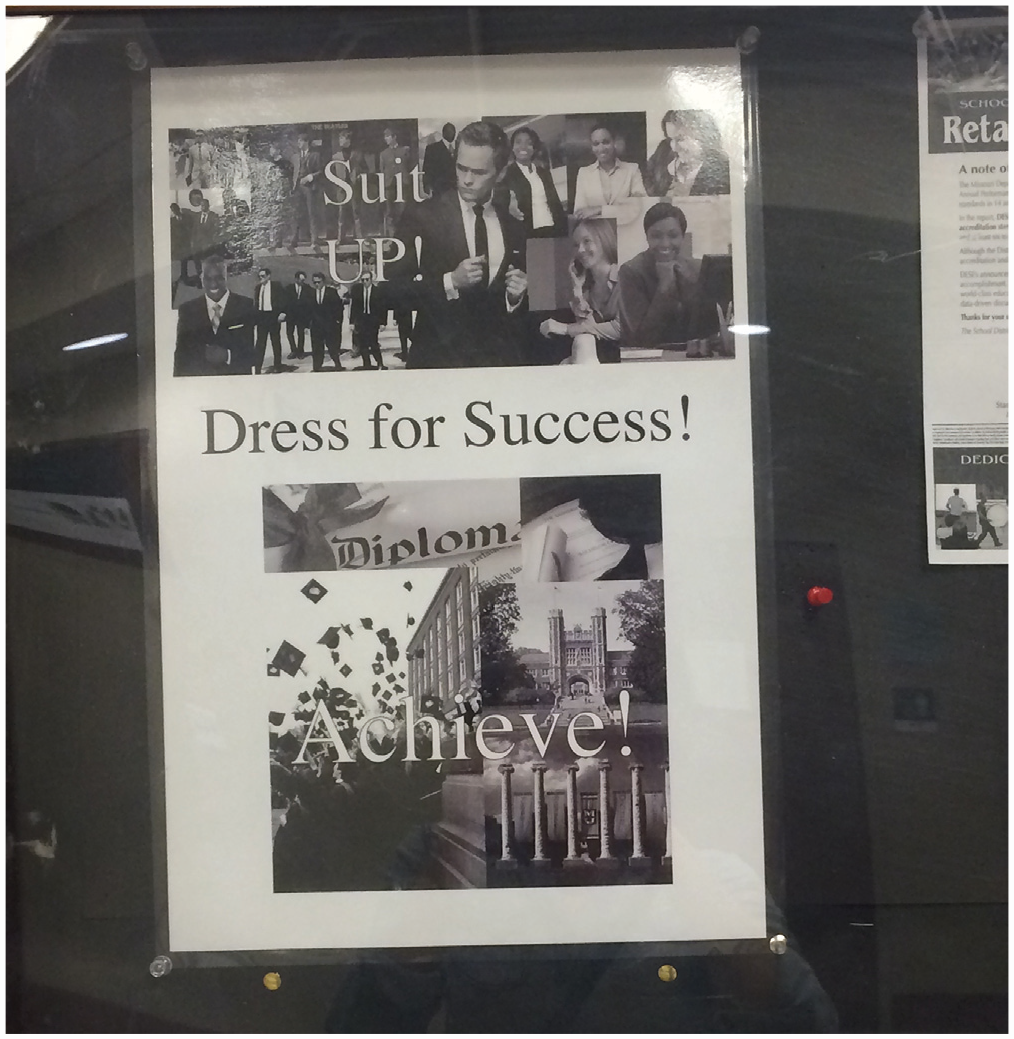
Professional dress expectation in school signage.
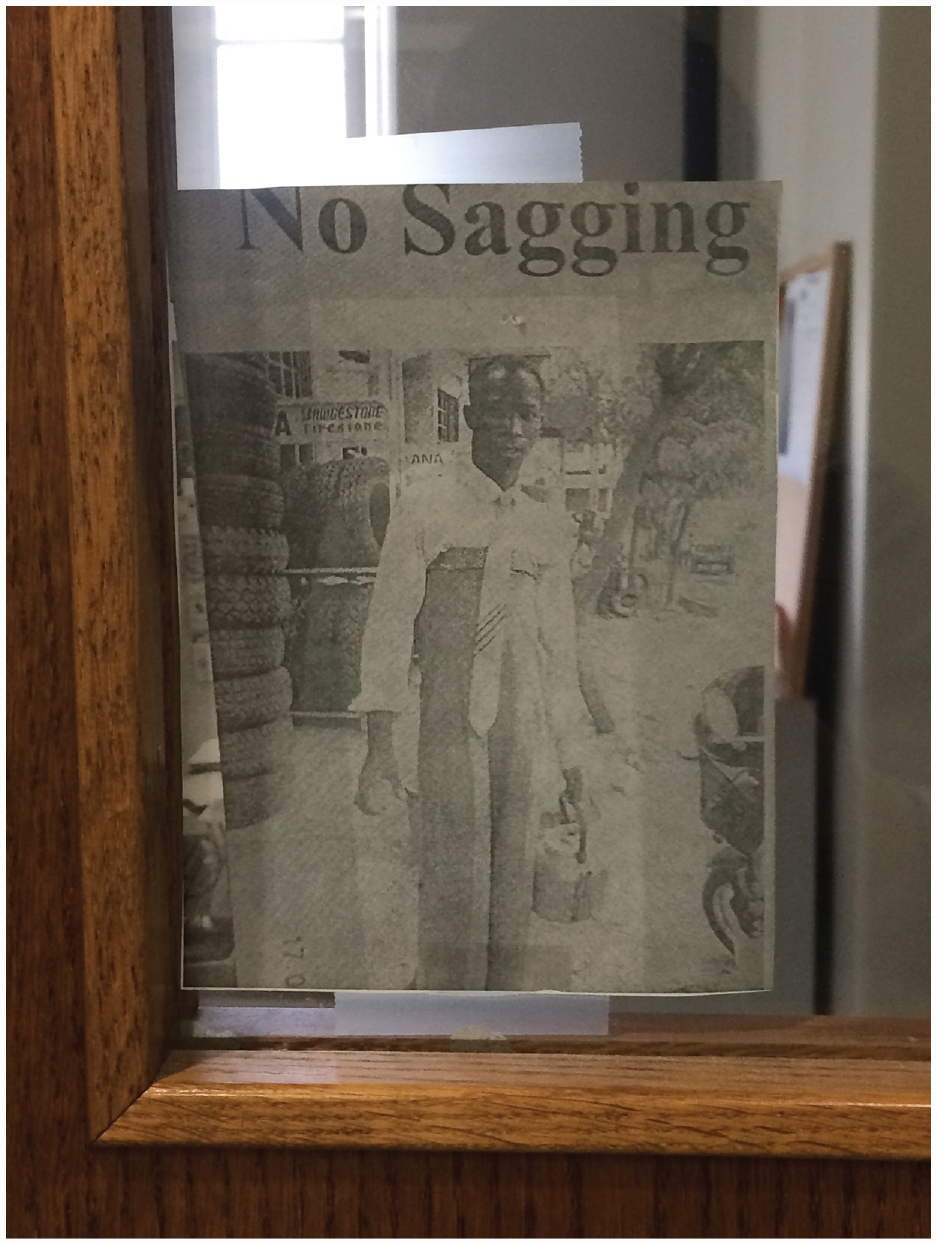
Antiblackness manifested in school signage.
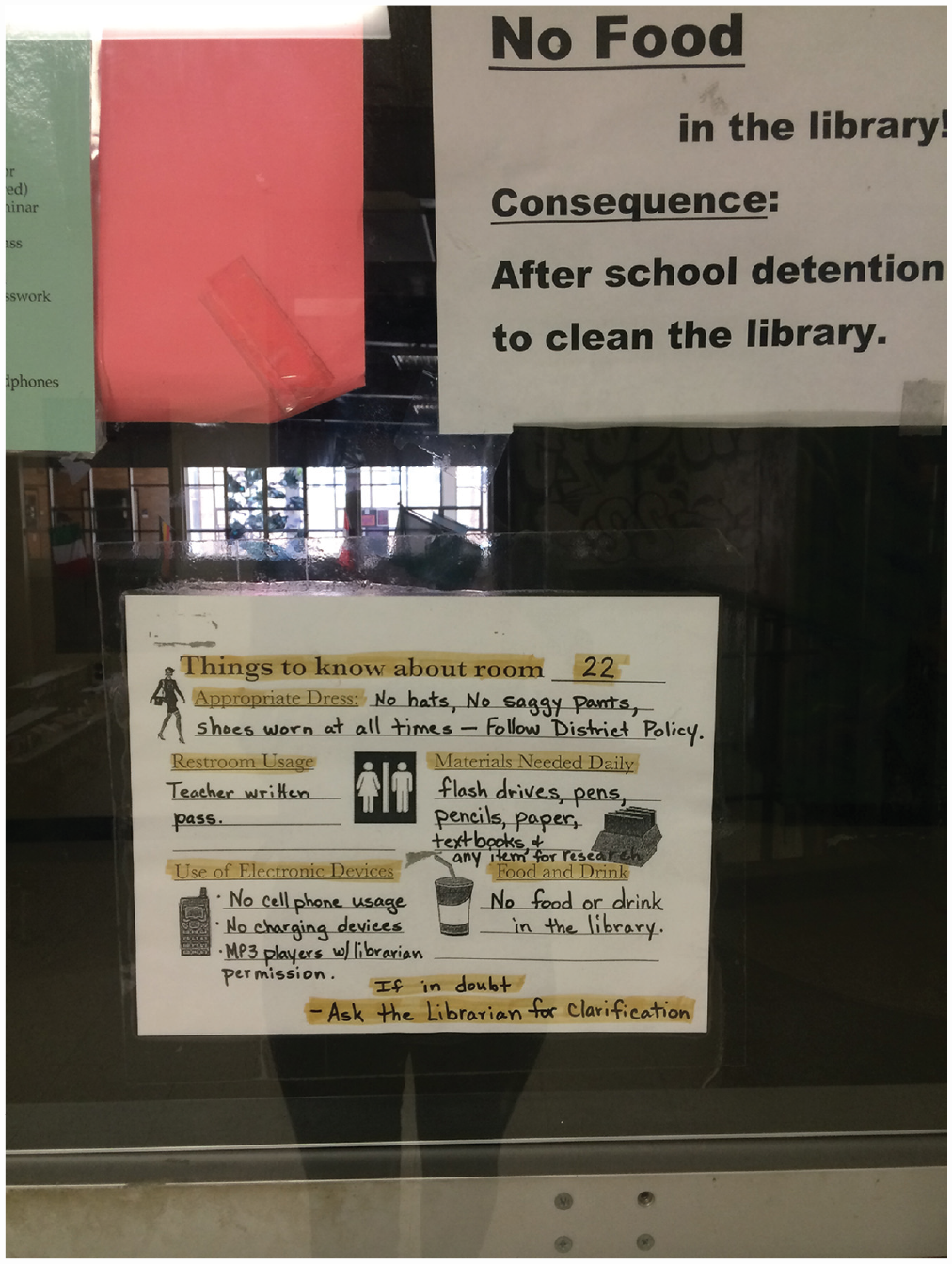
Dress code and restroom rules in school signage.
There are implications for a culture of antiblackness when teachers hold “disregard and disdain” for behavior they view to be associated with Blackness. Institutionally communicated antiblack orientations are further fueled by the use of disciplinary sanctions in response to what Ms. E and Mr. M describe as “African American” behavior. Even while recognizing that “talking during the movie” is a form of cultural capital found within some African American families, both teachers still ultimately intervene to punish and prevent it. Mr. M feels the need to impose disciplinary actions for the act of talking, evidenced in his description of changing the classroom seating chart. He reveals that he changed the seating chart to prevent these talking behaviors. While denying a student their preferred seat is not as dramatic as a suspension or expulsion, these “disciplinary routines”—the more mundane forms of social control, like punitive seat changes—“are influenced by broader cultural narratives that associate blackness with criminality” (Diamond & Lewis, 2019, p. 831). Pike (2008), in their Foucauldian analysis on monitoring of lunchtime cafeteria, found that “it is common for separation and segregation to be employed as spatial tactics of discipline” (p. 418). Mr. M offers an example of the use of separation as a disciplinary routine. That is, punitive seat changes, while seemingly harmless, represent a spatial tactic of discipline, contributing to the wider school culture of social control. Schools have historically been found to reflect the culture of prisons and innately embrace the ideology of social control; however, this plays out differently in schools across the nation (Hirschfield, 2008). For example, patterns of bodily autonomy are different depending upon the racial makeup of the school. Hirschfield (2008) argues that “the gated community may be a more apt metaphor to describe the security transformation of affluent schools, while the prison metaphor better suits that of inner-city schools” (p. 84). In other words, while affluence—which is often associated with Whiteness—is understood as a commodity to be protected, inner city—which is often associated with Blackness—is understood as a commodity to be controlled. Controlling Black students’ movement and taking away their bodily autonomy is a common expectation and introduces incarceration-like impulses and practices into the classroom (Diamond & Lewis, 2019; Hirschfield, 2008).
These mundane, spatial disciplinary routines—rooted in and supporting a school culture of antiblackness—also reinforce associations between Blackness and criminality, even as they are created by those same associations. It is a circular, self-reinforcing logic of antiblackness. Importantly, this spatial tactic of discipline is a manifestation of the symbolic violence that antiblackness scholars discuss (e.g., Coles, 2016; Leonardo, 2004; Martin et al., 2019). The “gentle” (Bourdieu, 2001) acts of discipline may seem harmless but ultimately contribute to an antiblack culture of spirit murdering.
Findings From the Sickle Cell Vignette
Matched yet Mistrusted Practices
In the second vignette, Ta’ron, a Black male student, reveals that he has sickle cell disease. Sickle cell disease (SCD) is a genetic blood disorder, associated with lifelong symptoms including pain episodes, swelling of hands and feet, and vision issues (Mayo Clinic, 2017). It is found most frequently in individuals with ancestry from sub-Saharan Africa, which means that in the United States there is a disproportionately high amount of SCD among African Americans. Medical professionals often recommend drinking sufficient water as a way to treat some of the symptoms of SCD (Centers for Disease Control and Prevention, 2016). Ta’ron describes how his teacher regulates his use of the restroom, which is related to his diagnosis: Ta’ron: I got caught in a hall sweep. In my eighth hour class—I have Sickle Cell, so my teacher always tells me to bring a water bottle because that’s the only way she’ll let me go to the restroom. So I try to go to the restroom before I go to class … and sometimes at lunch, I just don’t have to use the restroom at that moment. But after being in class, I might have to use the restroom, and she just doesn’t like us to go then because she feel like we should have went at lunch or in between the classroom times. But if we do that, and we get caught in a hall sweep then it's a detention. … So, she won’t let me use the restroom unless I have a water bottle because [if] I have the water bottle, then she sees that I’ve been drinking water. I feel like she just think that I just want to get out of her class, but that’s not really the truth, because here’s her classroom—right across from her classroom is the male’s restroom. So you can see me trying to walk away or go somewhere else because the restroom is right there. Author: And have you explained your reason for why you need to go to the restroom before? Have you tried talking with her? Ta’ron: Well, she knows I have Sickle Cell. That’s why she always tell me to bring a water bottle. Because sometimes, I just forget so I get water at the water fountain and that's not good enough.
Requesting permission to use the restroom in school may be perceived as a straightforward situation where students’ cultural practices should align with their teachers and with the norms of the building. Yet in Ta’ron’s account, a clash of cultural practices arises since students are expected to use the restroom during lunch or transition times, and if a student requests access during instructional time, then they must have a reason (proof) to use the bathroom (i.e., “she sees that I’ve been drinking water”). In this example, it appears that Ta’ron does not align with his teacher’s expectations of using the restroom during lunch time or bringing a water bottle. However, a closer analysis of his commentary reveals that Ta’ron is in fact attempting to align with dominant school norms. He is engaging with the teacher’s authority in four distinctly matched ways by (a) considering his teacher’s preferences regarding restroom use; (b) being proactive in trying to use the restroom during lunch, (c) requesting permission to use the restroom, and (d) respecting and following his teacher’s water bottle request. That is, Ta’ron recognizes that the teacher would prefer that he use the restroom during lunch, and he says, “I try to go the restroom before I go to class … I just don’t have to use the restroom at that moment.” He is proactively recognizing her preferences and trying to abide by them. He also implies that he asks the teacher before leaving to go to the restroom, as he mentions that she sometimes denies him permission (e.g., “she won’t let me go”). Finally, he normally tries to follow her rule for bringing a water bottle but says, “sometimes, I just forget.” While we do not have access to this specific teacher’s reflections, 1 these practices reveal that Ta’ron, from his perspective, sufficiently recognizes the authority of the teacher and therefore is actively acknowledging the normative power structures and expectations of the school. Ta’ron’s practices as a student match LHS’s institutional expectations that students will conform to their teachers’ rules, and hence, he should experience less tension around restroom usage.
That said, this analysis argues that Ta’ron’s experiences are complicated since the specific medical reason that requires an increase in his restroom access is also associated with his Blackness. SCD is widely considered a “Black disease” (Bediako & Moffitt, 2011). In fact, Wakefield et al. (2018) found that children with SCD do perceive racial bias in their healthcare treatment, which we argue could reasonably extend into their schooling experiences. Dyson et al. (2011), in their study of Black students in England with SCD, found that the strict procedural focus within schools can be particularly burdensome to students with SCD. Dyson et al. write, “teachers do not recognise the legitimacy of these children’s accounts and use their own power of definition to impose other interpretations on the child’s behaviour, such as laziness, and occasionally these dovetail with wider gendered and racist assumptions” (pp. 480–481). Their findings from English schools confirm that educational professionals’ interaction with students with SCD are influenced by racialized patterns of thinking. While Dyson et al. use the term “racist assumptions,” we argue that it is a uniquely antiblack cultural orientation that facilitates what appears to be a mistrust of Ta’ron’s medical and bodily needs. From Ta’ron’s perspective, the teacher assumes he is using the bathroom as an excuse to get out of class. He says, “I feel like she just think [sic] that I just want to get out of her class, but that’s not really the truth.” Despite Ta’ron’s deference to the teacher’s authority, he senses that the teacher distrusts him. Despite the fact that he has a medical condition that requires increased fluid intake, he still feels that the teacher speculates that he might be using the bathroom as an excuse to get out of class.
Interestingly, Ta’ron’s perceptions are not farfetched. Additional teacher focus group data highlighted that some LHS teachers associated restroom use with nondominant cultural practices enacted by “troubled kids”—viewing the act of going to the restroom as a mechanism to avoid instructional time. As one teacher said,
I want a GoPro (camera) to be mounted onto their head and to just see … the amount of time taken to get there and back, you know. And some of those same kids who are the troubled kids, they want to get out and they want to roam the halls. And I know, heck, I remember I would do that same similar type of thing every day in high school, but man, they take their sweet time about it.
In this quote, the reference to mounting a camera on “troubled” students’ heads indicates a need for surveillance and a close monitoring of their movement, and it also infers a level of mistrust of the intent for students’ use of the restroom. In fact, we observed that, over the course of many years in the school, restroom access was synonymous with misbehavior (mismatched cultural practices) and, thus, it was sometimes withheld or, at minimum, difficult to obtain. We learned that similar to Ta’ron, in some classrooms, students were denied permission to use the restroom, and a limited number of hallway passes were available for checkout.
The strict policing of Ta’ron and other students’ movement was supported by the institutional policies and normative values at LHS, at that time. This expectation for conformity is evident not only in student and teacher commentary but also in visual cues throughout the building. In the sign, “Things to know about Room 22,” previously discussed in the movie watching vignette (see Figure 5), students are not only told what to wear but also reminded that bathroom usage is only to occur with a bathroom pass. Additionally, broader examination of school signage reinforces the message that the students require strict rules and must be given specific step by step directions. For example, in order to receive a lunch pass to the library, a five-step procedure is delineated for students (see Figure 6). This tight control of movement of the majority Black student body by the majority White teaching staff—seemingly justified by students “taking their sweet time”—contributes to the incarceration-like climate (Diamond & Lewis, 2019; Hirschfield, 2008) within the building, succinctly described by one teacher in the opening quote: “I mean it’s just there's a real lack of freedom here for everything.”
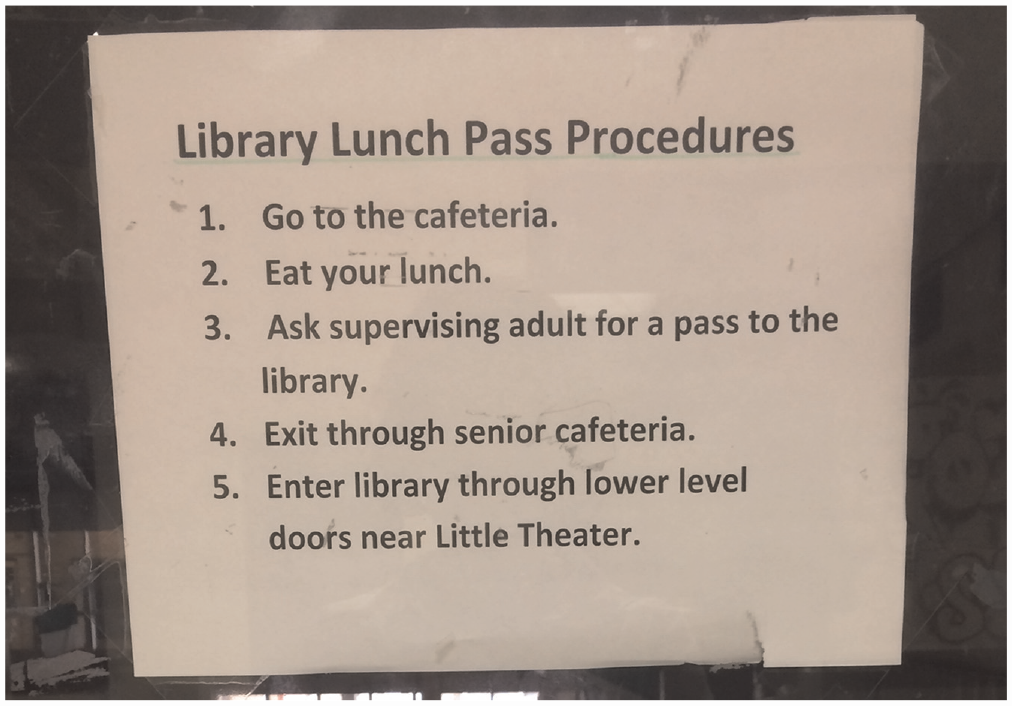
Institutional expectations for students to conform to school rules.
One specific schoolwide policy to control student movement is known as hall sweeps. This practice also influences bathroom access for students like Ta’ron at LHS. Ta’ron relays his experience by beginning with the fact that he was caught in a hall sweep (i.e., “I got caught in a hall sweep”). During hall sweeps, adult staff systematically lock doors to all of the classrooms, and any student in the hall without a pass is rounded up and given detention. In the focus groups, students communicated overwhelming negative opinions of the hall sweeps, while in contrast, many teachers viewed them as a necessity. While one teacher expressed, “for two weeks we stopped doing hall sweeps; the halls were chaos,” a student described the hall sweeps as a hunting experience, stating,
The administrators round up all the kids in the hall, and they give them a detention or something. But the way they do it—like, they are legitimately hunting. They’ll be on their walkie-talkies. They’ll be like, ‘I got a runner.’ And kids are hiding in the bathroom.
Despite his engagement with the dominant capital of recognizing and respecting teacher authority, Ta’ron was either being denied the restroom or being caught in a hall sweep. Similar to Mr. E’s punitive seating changes in the movie theater vignette, hallway sweeps became another spatial tactic of discipline that perpetuate antiblack systemic violence, reinforced by perpetrator-free narratives.
Utilizing hallway passes represents a way in which students are able to match their cultural practices to school policies and hence avoid hall sweeps, yet Black and White students relay discrepancies in their encounters in the hallways both with and without passes. That is, racialized patterns emerge in viewing the inconsistent consequences experienced by students who matched or mismatched the norms for walking in the halls. For instance, one White male student, in the student focus group including Ta’ron, spoke about an incident where he was clearly not following rules:
As a senior, I’ve become a little disillusioned with the process of getting passes all the time, so I almost never bothered to acquire a pass when I need to go somewhere else in the school. If I pass an FA [Facilities Assistant, a.k.a a hallway monitor] in the hall, I will just—if I acknowledge them at all, I will just wave at them and they’ll just wave me along. No real threat of punishment or anything like that. It’s a little inconsistent.
The lack of consequences for this student is noteworthy, seeing that he is not engaging with normative power dynamics (“if I acknowledge them at all”) or with the policy requiring hall passes for movement in the building (“never bothered to acquire a pass”). In contrast, a Black female student shared her experiences in the hallways as involving much more intrusive scrutiny and a receipt of consequences despite her matched practice of acquiring a hall pass:
I get stopped in the hallway a lot even when I have passes from my teacher. But they assume that I am just wandering the hallway. And even when I do show them the pass, they want—take me to the teacher’s room so they can get a verification. I just feel like that’s not necessary.
Immediately following her comment, two White students joined the conversation—a different female student saying that she has “never been stopped in the hallway” and the White male student who had spoken earlier saying, “I rarely get stopped in the hallway.” The Black student then reiterated her contrasting lived experience, saying, “I get stopped a lot, even when I have passes.” Similar to Ta’ron, this Black female student is being penalized despite following the rules. None of the students in this focus group explicitly mention race as an explanatory lens for the inconsistencies—they instead use coded language, to differentiate whose movement is monitored more closely. They describe “good kids” as those who attend AP and honors classes (majority White students) and the general education courses (majority Black students) as having “a different mix of students” and “bad kids.” The White female who said she has “never been stopped in the hallway” also describes herself as “one of the good kids who gets good grades.” On the other hand, she talks about the “trouble you get yourself in” if a student is from the group of “bad kids who misbehave a lot and refuse.” Hence, LHS students appear to be penalized based on assumptions about their “goodness” level (which happens to coincide with their race), regardless of whether they match or mismatch the dominant cultural expectations of carrying a hall pass. Here again, the cultural mismatch hypothesis cannot explain their differing disciplinary experiences.
While the Movie Theater vignette highlights that nondominant cultural habits embodied by Black students are rejected because of their associations with Blackness, not merely because of their mismatch with authority’s cultural ways of being, the Sickle Cell vignette highlights that dominant cultural capital is mistrusted, even when reinforced by an authority from another institution (i.e., a diagnosis from a healthcare professional). In the case of Ta’ron, he abides by the teacher’s rules frequently, and yet, from his perspective, the teacher does not offer proper accommodations for his medical diagnosis (one that is uniquely tied to his sub-Saharan ancestry). His account—triangulated with the experiences of his peers, additional ethnographic data such as signage, and our own observations—suggests that it is not sufficient for Black students to utilize dominant cultural capital that matches the teacher and the institution. In Ta’ron’s case, he is still being punished, at times, by being denied the restroom or by being caught in the school’s hall sweeps and given detention. This raises important questions about whether Black students’ dignity and humanity are overlooked when cultural explanations are exclusively utilized to understand disciplinary actions. His experience pushes for moving beyond understanding teacher-student interactions as a misalignment of cultural beliefs or practices. Ta’ron’s struggle is an indication of how humanity is usurped from Black students inside of educational settings. Ta’ron is being denied his humanity, experiencing “the abjection from the realm of human” (Sharpe, 2016, p. 14). His story complicates the cultural mismatch hypothesis by directly bringing to light the ways in which antiblack logic manifests and serves to dehumanize students even when cultural alignment exists.
Findings From the Grammar Coach Vignette
Matched—yet Again—Mistrusted Practices
A third vignette shares the experience of an African Caribbean student, Naila, who had recently immigrated to the United States. Although English was her first language, Naila had grammatical barriers that arose from being born in a country where English grammar rules differ from academic American English. She discusses how she was accused of plagiarism by a teacher:
Being from a different country … I have different grammar from everybody else, and I write different. I got a grammar coach a couple of months ago, and so I started writing differently in my English class, and … there’s this big thing in our class about plagiarism. And so [the teacher] came up to me and said I plagiarized this because my grammar is off. And I said I didn’t and she’s like, “I don't believe you.” She searched, and she couldn't find any evidence about it, and then I got a zero on it.
Academic American English is a particular style of English that has often been used to exclude students from the academy and other gated centers of learning (Scarcella, 2003). As Scarcella writes, academic English “involves mastery of a writing system and its particular academic conventions as well as proficiency in reading, speaking, and listening” (2003, p. 3). This form of English communication is highly valued by schools at all levels. Regardless of her proficiency in the academic English of her native country, Naila needed to adapt to the unique academic English in the United States, which is the dominant cultural capital in the LHS context and more broadly in American schools. Consequently, Naila reports that her family hired a grammar coach to assist in her development.
Naila’s efforts to develop and engage with American academic English additionally indicate her adherence to the achievement ideology—another institutionally sanctioned form of cultural capital perpetuated in American schools. MacLeod (2009) describes the achievement ideology as a pervasive orientation in society where the notion of individualized effort, in the forms of hard work and education, translates into success. In this vignette, Niala recognized an area of challenge (“I have different grammar from everyone else”), identified the source of her struggle (“being from a different country”), and then took steps to rectify the issue so as to find success in school (“I got a grammar coach”). Importantly, she reported that her family mobilized financial resources—hiring an outside tutor—to assist in this endeavor. These actions communicate a belief in the achievement ideology: that it is her responsibility to engage in a conscious process of building appropriate skillsets that would be valued in her school and lead to her academic achievement. Hence, Naila’s training with the grammar coach can be understood as the process of accepting and engaging with the achievement ideology. Her behavior and beliefs match the dominant cultural capital that was needed for her English classroom.
However, this match, arising from Naila’s work to acquire dominant cultural capital, did not only go unacknowledged but was actively penalized. Similar to Ta’ron’s story in the Sickle Cell vignette, Naila’s account in the focus group communicated her perspective that the teacher mistrusted her (“and she’s like, ‘I don’t believe you.’”). According to Naila, the teacher accused her of the unethical practice of plagiarizing and gave her zero points for the work. Naila attempted to stand up for herself (“I said I didn’t”). In doing so, Naila was attempting to “‘walk the walk’ and ‘talk the talk’ of the cultural power brokers in our society” (Carter, 2005, p. 138). Yet when Naila tried to “walk the walk” and “talk the talk” to navigate her new school system, she was not successful in the LHS setting where, as seen in Ta’ron’s narrative, deference to authority was being valued over self-advocacy.
Producing and Reinforcing an Antiblack Institutional Orientation
While cultural mismatch theory may have originally interpreted this interaction as a cultural misunderstanding between Naila and the teacher, an antiblack lens reveals different insights. Rather than exonerating the White educator from wrongdoing—as cultural mismatch prioritizes White sensibilities over justice—an antiblack lens shows us that this interaction resulted in racialized harm—intentional or not—committed by the White educator towards Naila, the Black student. The interpretation of Naila’s story through an antiblack lens is further supported by the variety of data sources spanning this study where many stakeholders noted a discrepancy in how Black and White students were treated in LHS. Stakeholders specifically spoke of a segregated “school-within-a-school” setup. Although the percentage of White students was only around 8% of the total student body, according to administrators, teachers and students, the honors and AP classes were predominantly White. Additionally, the disciplinary interactions and overall culture of those classes were described as significantly different from classrooms where the majority of Black students attended. As one White student expressed,
I feel like the whole school culture is very different for [White] kids who are in a lot of honors and AP classes and [Black] kids who aren’t. ’Cause I’m in a lot of those classes and … I don’t see students disrupting class very often or refusing staff requests. I don’t see a lot of the class cutting. And if this does happen, they don't get punished as much. It feels like a sort of separate LHS, when I compare those classes to my electives where I’m just with the general [Black] student body—just the way everyone reacts.
Although research evidence has shown that differential behavior does not explain the hyper-disciplining of Black students (Skiba & Williams, 2014), the White student articulates that perhaps Black students misbehave at higher rates than White students (“I don’t see students disrupting class very often or refusing staff requests”). At the same time, this student perceives White and Black students being penalized differently even when they engage in the same misbehavior (“if this does happen, they don’t get punished as much”). These racialized patterns are similar to those characterized in the student commentary around hallway pass usage, shared in the previous vignette. Here the student articulates, with great clarity, a school-within-a-school phenomenon: that White and Black students are treated differently by teachers and staff, regardless of if they are engaging in the same behavior (or cultural capital). In other words, there is evidence suggesting that teachers’ interpretations of students’ cultural capital—even when dominant—could be racialized. While we do not have a specific incident when a White student was accused of plagiarism, as Naila was, the “school-within-a-school” theme, along with the first two vignettes, suggests that an antiblack institutional orientation may have been permeating LHS at the time.
If Naila’s experience is understood to be one that is culturally aligned with school norms to excel academically yet still one that is degrading her basic right to be innocent (unless proven otherwise), we again see that there is an antiblack institutional orientation that dissolves students of their humanity. This experience was not isolated and is best reflected in an open letter circulated during the 2016–2017 school year by one Black female student, writing on behalf of “The Student Body.” It was addressed to the collective teaching staff at LHS. The letter states,
You belittle us in class and make us feel like we are stupid when we ask a question and yet you wonder why students are not coming to school or simply skipping your class. Whether it is known or unknown the fact still remains the same: TEACHERS HAVE THE POWER OVER THE STUDENTS. WHAT OUR TEACHERS SAY TO US ON A DAILY BASIS IMPACTS US MORE THAN YOU THINK. (original capitalization)
Although the letter does not directly mention race, these sentiments highlight the presence of antiblack influences, pointing attention to existing power differentials that allow for the degradation of a majority Black student population by a majority White teaching staff. The Student Body letter does not allow the normative perpetrator-free narrative to stand, specifically asking teachers to take responsibility for their impact on the predominantly Black student body. Moreover, the letter acknowledges the great impact of this belittling dynamic on students’ state of mind as well as its influence on their engagement in cultural practices that will mismatch school expectations (e.g., absence and skipping class). Race, although often the unnamed elephant in the room, did impact how teachers interact with their students at LHS. During the teacher researcher residency summer program, where some teachers reviewed the focus group data, one White male teacher acknowledged the presence of “issues of [racial] bias” while referring to the demographics of the students as “the identity of the building.” Racialized interpretations of Black students’ cultural capital have practical, social, emotional, and academic implications. Even though Naila hired a grammar coach and embraced the prevalent achievement ideology that hard work leads to success (both forms of dominant cultural capital that match school expectations), she still received a zero on her assignment. Ultimately, despite her engagement with dominant capital, the school as an institution did not facilitate her success as a student within the backdrop of antiblack logic. In a school where her teacher punished the cultural capital coming from her, as a Black individual—despite it being matched to dominant culture norms—an antiblack institutional orientation is produced and reinforced. Specifically, the perpetrator-free narrative, where Naila’s teacher did not admit wrongdoing, persisted.
“Thumbs Up” and Trusting Relationships
A counterexample where teachers engage with students in ways that humanize them is illuminated by data that emerged during researcher reflection circles, held in 2017 at LHS during noninstructional time, where students watched short video recordings of their classroom collectively with the authors and their teacher, Mr. Baines (see Figures 7 and 8). In one meeting, the students pointed out a videoed moment of their teacher looking up momentarily from his instructional interaction with another student in order to provide a different student with quiet permission to leave to the bathroom (see Figure 9). This interactional moment, of seemingly minimal consequence, received significant praise from the students. They expressed respect for their teacher, who they felt was respectful of their autonomy to go to the bathroom. One student explained, “In this class all of us has a relationship with Mr. Baines and then I feel like in a lot of my other classes we don’t have relationships with the teacher.” They additionally explained to the authors that Mr. Baines is different from other teachers in terms of his reactions to students who exhibited mismatched cultural practices. For example, when reflecting on a different video clip where a student walked into class late, one student said,
I thought it was cool when Tyson walked in. Instead of just ignoring him or getting mad as some teachers do—I have some teachers who get mad when someone comes in late—Mr. Baines just went over and showed him where we were and just went into class.
Additionally, Tyson himself also commented positively on the interaction in the video clip, saying,
I also think it was kind of nice, ’cause like a lot of people said, most teachers don’t have that reaction and that’s what makes the difference about this class. Mr. Baines reacts different to a certain situation and most teachers wouldn’t … and I think that affects the entire thought process in class.
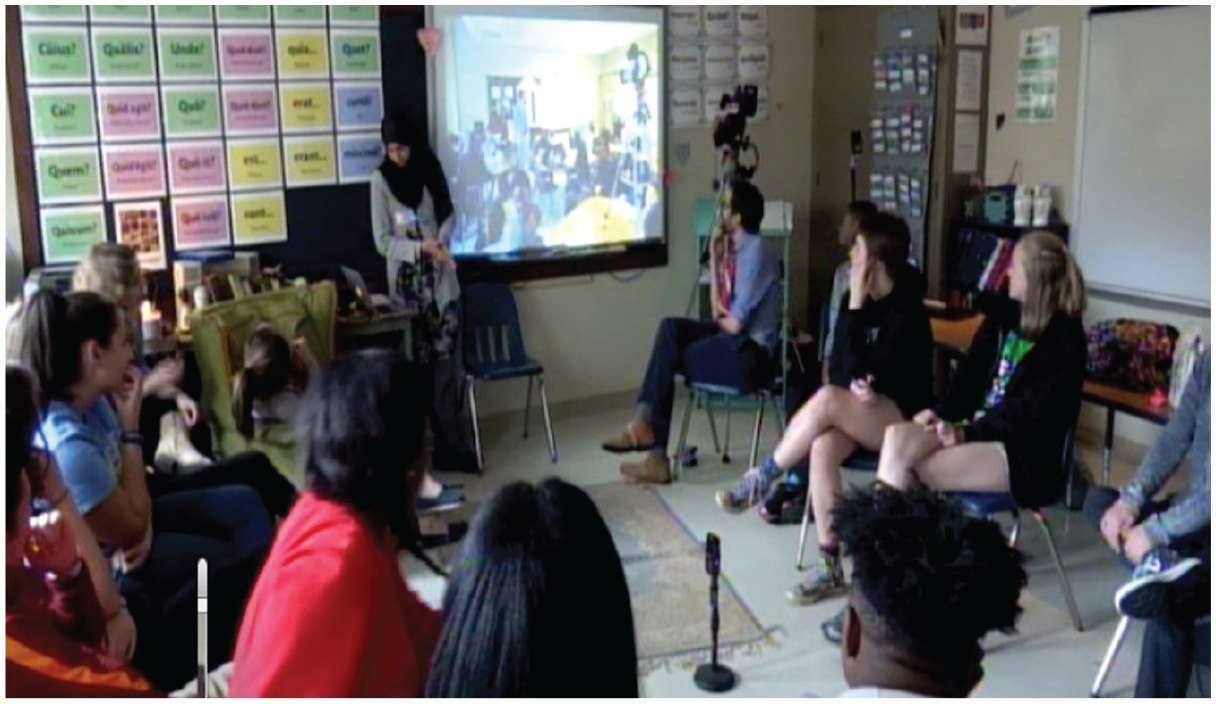
Students, teacher, and authors discuss video clips of class in researcher reflection circles.
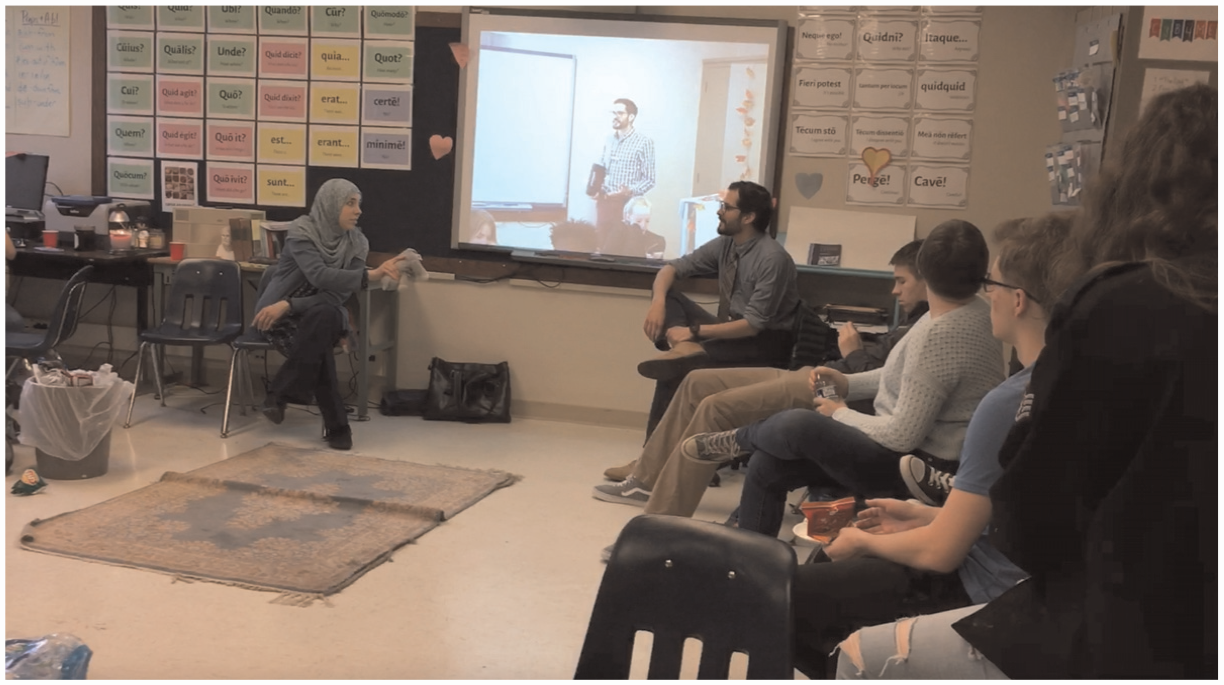
Students, teacher, and authors discuss video clips of class in researcher reflection circles.
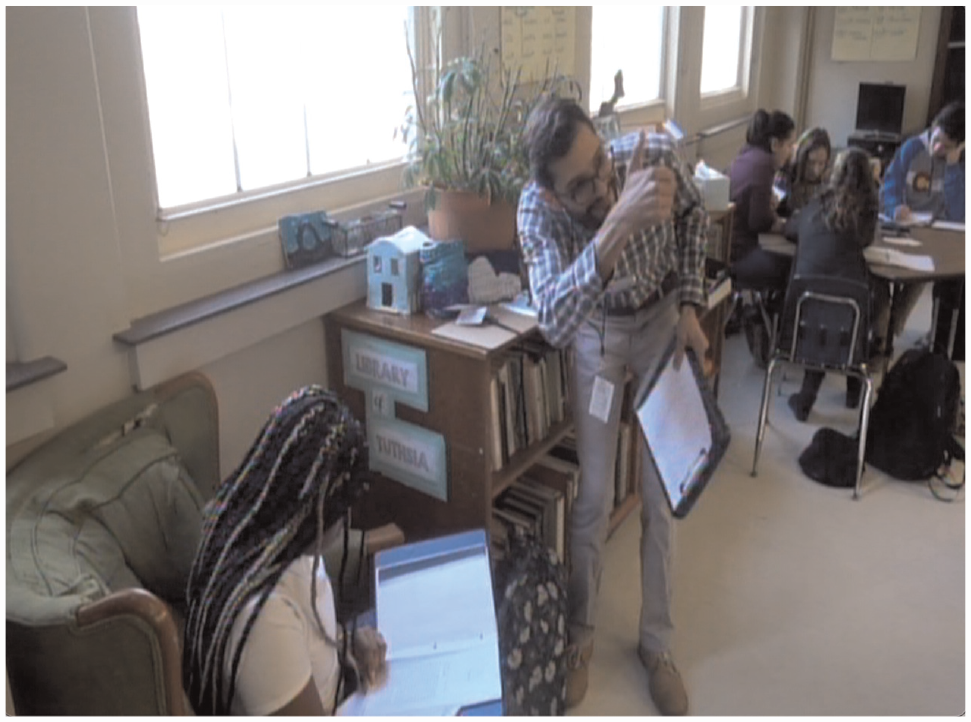
Teacher quietly and quickly nods while providing “thumbs up” signal for student to leave the classroom for bathroom usage.
It is important to note that Mr. Baines is White and Tyson is Black, yet their interaction around mismatched cultural practices (i.e., entering a class late without a pass) did not become an opportunity to strip Tyson of his dignity or dehumanize him for the simple act of walking into his classroom. Yet we argue that Mr. Baines was an anomaly at LHS. In reviewing the coding of teacher focus group data, where racial stereotypes were identified 79 times and coded across 32 teachers/staff, Mr. Baines was one of only two teachers who did not invoke a racial stereotype about their LHS students. Mr. Baines was also one of a handful of high school teachers and staff who chose to attend a three-part series of professional development workshops, provided by the authors, encouraging teachers to think critically about how sociocultural factors (race, gender, class, etc.) intersect with student behavior and teacher discipline. Moreover, our impromptu interfaces with students of Mr. Baines reinforce these data points; students tell us, “Mr. Baine’s for real!” and “Mr. Baines is one of the nicest teachers in the school!” They respond with candid respect and cooperation during his lessons, engage in authentic humorous exchanges, and a sense of sincere reciprocal caring is evident in the classroom.
In 2018, one of the authors interviewed Mr. Baines regarding his approaches to discipline as a teacher, and he shared his belief that effective discipline is responsive and differentiated to individual student needs while simultaneously communicating high expectations, explaining:
Discipline is not effective if kids are not responsive. … I think that it is important to hold students to high expectations and really reinforce the structures that you have in class but to do that in different ways for different students.
When pushed further and specifically asked about whether he thinks race-conscious disciplining is necessary (“Do you think that you
I would say maybe. Not consciously, but I definitely treat disciplinary interactions differently for
The significance of this counterexample is in the recognition that Mr. Baines, regardless of whether they exhibit matched or mismatched cultural practices, sees all his students, including his Black students, as individuals with great value; they are individuals with whom he builds relationships, engages in thoughtful interactions, and maintains high expectations with flexibility for implementation of rules. At the core, he humanizes his students. Mr. Baines provides a welcomed change from the more dominant and dehumanizing experiences being relayed by the students. That is, it shows the presence of trust and relationships between teacher and students within LHS at a time when there were strong patterns of coherence identified around the surveillance and demeaning control of the majority Black student population. In studying this contradiction, we see an alternative to the endemic cultures of antiblackness permeating the building, at that time, and an explicit example of how cultural mismatch can be alternatively addressed by teachers who reject an antiblack logic.
Discussion
This work adds to the field by highlighting the institutional manifestations of antiblackness in examples of Black students who were punished for utilizing their cultural capital, whether dominant/matched or nondominant/mismatched to institutional expectations. Furthermore, the findings indicate that the original cultural mismatch hypothesis—variants of which are found in literature on school discipline, classroom management, culturally relevant pedagogy, and other areas of study—does not sufficiently explain the culture of hyper-disciplining and social control that Black students experience at LHS. Instead, three specific antiblackness heuristics provide a new level of insight into the so-called “cultural mismatch hypothesis”: dehumanization, symbolic violence, and perpetrator-free, multicultural narratives. This discussion section places the three vignettes into conversation with each other. In doing so, we see two important points emerge: (a) the harm caused by these antiblack experiences and (b) the interactional nature of antiblackness. The remainder of the section outlines both the scholarly implications and the practical implications for the analysis.
Viewed in isolation, the narratives described here could be dismissed as simple misunderstandings. Yet important insights can be made when viewed collectively alongside a counterexample and viewed through the lens of antiblack symbolic violence within the broader school context. Systemic violence, when experienced by students, causes harm. Epp and Watkinson (1997) define systemic violence as “any institutionalized practice or procedure that adversely impacts on disadvantaged individuals or groups by burdening them psychologically, mentally, culturally, spiritually, economically, or physically” (p. 190). They additionally elaborate on the ways in which systematic violence induces harm on students: [Systemic violence] includes practices and procedures that prevent students from learning, thus harming them. This may take the form of conventional practices and policies that foster a climate of violence, or policies and practices that appear neutral but result in discriminatory effects. (Epp and Watkinson, 1997, p. 190)
The accounts of Ta’ron and Naila both show signs of systemic violence and the associated harm. Their teachers’ practices and schoolwide procedures placed distinct burdens upon their shoulders, and the onus of responsibility is on proving their innocence rather than on learning. Ta’ron must justify his need for the restroom, and he expresses concern that his teacher might think he has ill intentions of not attending class. In Naila’s case, she must push back against being positioned as a student who is dishonest rather than hardworking. These are experiences of systemic violence against the students, and we argue that the specific form of systemic violence being experienced in these cases is symbolic in nature—“wounds inflicted by the wielding of words, symbols, and standards” (Ferguson, 2000, p. 5). The cultural standards look different for the Black students at LHS, as evidenced in the words they hear, the signage they read, and the policies that shape their everyday school experiences. Hence, the “two school” metaphor noted by students is enforced through words, symbols, and standards; and it leads to the infliction of wounds on these Black students. Accordingly, these wounds are worthy of study and critical in understanding the experiences of Black youth in educational institutions that are silently contributing to “spirit murdering” (Love, 2016).
In addition to seeing the patterns of symbolic violence and harm, a broader view of these three vignettes highlights how antiblackness may be produced and reproduced through interactional dynamics. Antiblackness exists as a macrosystemic and institutional phenomenon. Understood exclusively as a macrosystemic force, antiblackness may be difficult to pinpoint. However, because it is a macrosystemic force, antiblackness permeates interactional patterns between students-teachers and teachers-teachers, as well as material resources in the school (i.e., signage). Ta’ron’s and Naila’s stories show us that teachers’ direct interactions with students can be spaces where antiblack ideologies manifest in everyday ways. Furthermore, in the Movie Theater vignette, Mr. M and Ms. E show how, even when removed from students, teachers’ interactional patterns can reverberate outward towards the students, specifically towards the “practices and procedures that prevent students from learning, thus harming them” (Epp & Watkinson, 1997, p. 190). This ecological understanding of antiblackness (Bronfenbrenner, 1977, 1999) helps identify points of potential change. Individuals may have the agency to undermine it through shifting how they interact with others or how artifacts are designed in their environment. Recognizing antiblackness as an ecological phenomenon—one with interactional levers—can help create paths forward for stakeholders to create more just, joyous, and humanizing educational experiences for Black children and youth.
The findings have major implications for both scholars and practitioners. For scholars, the analysis first shows teachers are not misinterpreting Black students’ cultural practices but rather following the logic of antiblackness endemic to schools, leading to the marginalization of Black students, regardless of their cultural practices. This logic of antiblackness includes dehumanization, symbolic violence, and perpetrator-free narratives prioritizing White sensibilities. Second, the analysis shows that, contrary to the traditional cultural mismatch hypothesis, Black students do not exclusively display mismatched capital. Instead, they frequently display school-sanctioned cultural capital, like requesting permission for use of a bathroom, using hallway passes or hiring an external tutor, but they are still systematically punished or controlled. Accordingly, there is a need for a new model of cultural mismatch hypothesis that integrates antiblackness when explaining the hyper-disciplining and social control of Black students. This new model urges researchers to consider how, when, and where cultural mismatch explanations may serve as a mask hiding the antiblack underpinnings pervading schools and society. Future research should investigate this proposed model in other schooling or educational contexts. The implications for this shift in cultural mismatch framing have profound potential to transform how scholars talk about and theorize about school discipline and practices.
Practically, this analysis can have pragmatic implications for how educators talk about discipline in schools. Racially conscious conversations with administrators, educators, and school staff must take place, specifically in relation to discipline (Irby, 2018). Within an educational culture marked by zero-tolerance rhetoric, disciplinary consequences are thought to be objective and race neutral. This perceived objectivity within school discipline is a myth, and racial discrepancies exist and persist (e.g., Gregory & Weinstein, 2008; Skiba et al., 2002). While the cultural mismatch lens facilitates a color-evasive orientation towards discipline, the antiblackness lens forces educators to bring race back into a deracialized conversation about cultural mismatch and discipline. BlackCrit theory specifically demands that White individuals and White communities take responsibilities for the racial harms they have caused (Dumas & ross, 2016; Martin et al., 2019). Without racially explicit conversations about discipline—where White educators and leaders feel the opportunity to take responsibility for contributing to cultures of antiblackness—it is unlikely that any meaningful racial justice work can occur in the area of school discipline.
This analysis also has pragmatic implications for how educators can push back against antiblack logic in schools, beyond having conversations. Accordingly, we see the integration of critical research methodologies as essential tools to creating schools where Black students can consistently have dignifying experiences that honor them as individuals. In this study, as part of the critical ethnographic approach, teachers and staff were provided with opportunities to share their experiences and then to reflect upon and analyze them. By engaging in co-researcher roles with the authors, these teachers spent hours coding commentary of colleagues and students, and reflecting on the possible role of racial bias within the school’s discipline patterns and in relation to classroom management practices. By engaging in analytical activities these teachers were able to acknowledge the difficulty of facing the presence of racial bias in the school, and they were then able to brainstorm ideas about how to help their colleagues, expressing the wish to “ease them into the process” and “give them that scaffolding and compassion to make that journey effectively.” One teacher recognized the sensitivity of the topic, explaining, “We need to do a lot of front loading. You can’t just start talking about racial bias otherwise people will react negatively.” Additionally, the teacher researchers shared their feelings that authentically involving teachers in a co-researcher capacity was invaluable, and they expressed a wish to effectively communicate with their colleagues that the “process [for change] is fueled by their voices.” In this spirit, the teacher researchers created a proposal for inviting schoolwide changes to the culture, in the form of a letter of recommendations for the upcoming school year that was addressed to the administration, and it subsequently informed the school improvement plan for the 2016–2017 school year. Hence, LHS leaders heard both teacher and student stakeholder voices and, in accordance with critical ethnographic methodologies, the pursuit for greater social justice ensued. This contributed to the dismantling of school- and district-level policies and practices that were hyperpunishing Black students. Perhaps the most profound of macro-level actions occurred in 2019, when the school board voted to adopt a resolution to create a “shift in school culture though an inclusive humanizing approach to discipline.” Many momentous transformations of the LHS policy and thus the school culture emerged, such as (a) training of 100% of all staff in restorative justice practices, (b) hiring of a restorative justice coordinator, and (c) scheduling formalized time in the school day for relationship building. The authors and district leaders consider these changes to be revolutionary. In order to substantially address antiblack logic in schools, we argue that all stakeholders need safe spaces with opportunities to first understand and then to become part of the change.
Findings from this study additionally call for the unconditional return of basic humanization as a fundamental right of Black children and foundational part of their schooling experiences. Such humanization is shaped by and shapes relationships that are authentic, and we found that it helps to have the involvement of both teachers and students in this process of understanding and changing school spaces. LHS students in researcher reflection circles appreciated being able to analyze classroom interactions with their teachers. As we engaged with stakeholders in co-participatory research roles, we asked students to reflect on how such research meetings “make school feel like a place where trust, respect, and shared responsibility are important.” One student spoke to the ways in which student-teacher relationships and student learning are both strengthened through this type of collective and reflective research process, saying, “It taught me that my teachers do respect me and care about giving me the best learning experience. It was great to be able to talk personally with my teacher and build a stronger bond.” From the teacher perspective, Mr. Baines shared an anticipated shift in his teaching practices through the critical activity of evaluating classroom video clips with student and university researchers:
It’s been good to watch the videos and to hear all the feedback from everyone and it’s given me a lot to think about over the summer and how I might want to run class and how I might want to plan things. … I really enjoy thinking about how class can be better and then making those changes to make class better.
As Barton (2001) writes, critical ethnographic methodologies require “searching out and using tools that enable the examination and transformation of inequalities from multiple perspectives” (p. 906), and this is most important for those who are in oppressed positions (Trueba, 1999). In doing so, critical ethnographic approaches allow for social justice, participatory critique, empowerment, and transformation to emerge. In this new anti-CRT era, where antiblackness and cultural mistrust may not always be popular or comfortable to address, this study shows us that the approach to research matters when trying to affect real change. Learning to recognize racial bias and a presence of antiblackness in schools is only the first step. We agree with Barton (2001) that “at its core critical ethnography must be about documenting the nature of oppression and the process of empowerment” (p. 907), and so district leaders, administrators, teachers, and students must be given opportunities to critically engage in a process that can affect broader policy transformation.
The Last Word
In exploring three specific narrations of students being disciplined at LHS, we argue that the theory of cultural mismatch is better informed by considering the role of antiblackness—particularly the dehumanization of Black people, the use of symbolic violence, and the prioritization of White sensibilities and perpetrator-free multicultural narratives. Given the hyperdivided racial politics of the current moment, the necessity of this research cannot be understated; this research helps us see how antiblackness plays a role in schools and provides relevant and helpful heuristics to addressing the hyper-disciplining culture.
While on the surface, antiblackness stems squarely from the afropessimist tradition and therefore may preclude ideas of hope, we and other scholars allow for recognizing the endemism of antiblackness in schools while also leaving space for real and meaningful reparation of antiblack logics (Grant et al., 2020). Certainly, in a society where antiblack orientations guide disciplinary cultures, the hyper-disciplining of Black students cannot and should not be limited to cultural explanations of matched or mismatched capital. Instead, schools must be committed to understanding the role that antiblackness plays and to creating spaces where all ways of being by Black students like Ta’ron and Naila can be recognized, valued, and treated with dignity and humanization. We believe that shifts within schools like LHS prove that movement can be made in this direction, even within this new anti-CRT era.
Footnotes

Notes
R
O