




Abstract
Residential stability matters to a young person’s educational development, and the present housing crisis has disrupted the residential stability of many families. This study uses latent growth-curve modeling to examine how changing residences affects math and reading achievement from third through eighth grade among a sample of urban elementary and middle-school students. Results show that residential moves in the early elementary years have a negative effect on math and reading achievement in third grade and a negative effect on the trajectory of reading scores thereafter. Further, there is a negative contemporaneous effect of mobility on math scores in third through eighth grade but no such contemporaneous effect on reading scores. Implications for research and practice are discussed.
What happens outside of school matters to a young person’s educational development. This is a fundamental premise for thinkers in the tradition of Bronfenbrenner’s (1979) ecological theory and the sociology of education. Theorists of teaching and learning use the metaphor of the instructional triangle to understand the educational process and depict the dynamic relationship between student, teacher, and subject matter. Ecological and social thinkers argue that this triangle is embedded in a complex web of environmental factors, including features of the school, the surrounding community, and students’ families, to name just a few. These factors condition how the instructional triangle functions and thus how students learn and grow.
One dimension of students’ ecologies that has taken on increased relevance in recent years is their living arrangements. The present housing crisis and economic recession have disrupted the residential stability of many families through a wave of foreclosures and unemployment, compounding a decade-long surge in residential moves that peaked in 2006 (U.S. Census Bureau, 2009). This phenomenon has been particularly severe in urban areas (U.S. Census Bureau, 2009), which makes the question of how residential mobility affects urban students all the more salient. The home is arguably the most influential setting in young people’s development, and the recent upward trend in residential mobility has made the effort to foster a positive, stable home environment more challenging.
This study explores the effect of changing residences on young people’s academic achievement. A review of previous research on residential mobility, summarized below, yielded a limited picture of the relationship between mobility and youth outcomes. Most of this research treats residential mobility as a cumulative variable, measured over a period of years, as a predictor of more distal academic outcomes. Although many studies control for eligibility for free and reduced-price lunch at the time the outcome is assessed, this is a weak proxy for the multiple forms of socioeconomic disadvantage that might cause both mobility and poor achievement. The present study applies a latent growth-curve modeling technique to longitudinal data from an urban school district to learn how associations of mobility with academic achievement may differ across levels of schooling. Specifically, we examine how changing residences is associated with math and reading achievement from third grade through eighth grade, both contemporaneously and residually. Because we examine not only the associations of cumulative early mobility with achievement but also the changes in individual trajectories associated with later moves, we can isolate the effects of moves from those of more enduring forms of disadvantage.
Residential Mobility and Youth Outcomes
Moving homes is not inherently bad. If a change of residence accompanies a parent’s promotion to a higher paying job, for example, it may lead to positive outcomes for a young person and her family. However, even positive moves for parents may be stressful for children, and when families are forced to move because of financial constraints—enduring poverty or an economic shock from a foreclosure or loss of a job, for example—the result is likely less favorable. In a context of relatively high poverty rates, characteristic of many urban settings, residential moves are often made for less than ideal reasons (Scanlon & Devine, 2001; Schachter, 2001). Indeed, most of the empirical work examining residential mobility has associated it with negative youth outcomes. We make the assumption that within a population of urban public school students, most residential moves are born more from necessity than from opportunity.
Residential Versus School Mobility
There is a correlation between changing residences and changing schools, but the one does not necessitate the other. Recent data from the U.S. Census Bureau (2011) indicate that the majority of residential moves made nationwide are by urban residents moving within the same metropolitan area. Further, previous research with a nationally representative sample of young people has shown that only about a quarter of all residential moves bring about a change of school (Swanson & Schneider, 1999). In our urban sample, we find that for all students who were in a study school in both the 2008–2009 and 2009–2010 school years, 42% of students who moved homes during that period also changed schools.
Thus, although residential mobility is the primary phenomenon of interest to the present study, it often prompts a school move, as well, even when the residential move is made within the same metropolitan area. The general conclusion of research on school mobility and achievement is that the two are negatively associated. A report by the National Research Council and Institute of Medicine (2010) and a meta-analysis by Mehana and Reynolds (2004) both concluded that in the elementary grades, changing schools has a negative effect on math and reading achievement equivalent to a 3- to 4-month disadvantage in learning.
Residential Mobility and Achievement
Compared to the literature on school mobility and achievement, there is relatively little research on how moving residences affects learning. Theoretically, change is in and of itself stressful, and moves have long figured in inventories of stressful life events. Moves imply changes in household routines, which can disrupt development (Evans & Wachs, 2010). Uprooting a child from her neighborhood deprives her of important social capital that may be parlayed into educational assets. Changing the network of families in one’s neighborhood may serve as a sort of reset button for community resources that have been empirically connected to student achievement, including webs of school-related information sharing between parents, parental monitoring, and learning opportunities (Coleman, 1988; Leventhal & Brooks-Gunn, 2000). Apart from the loss of social capital for youth, the effect of mobility on their parents may be indirectly detrimental to their achievement. Parents who struggle with financial issues around housing have been shown to suffer from depression, social withdrawal, and increased work hours with taking on second and third jobs (Kingsley, Smith, & Price, 2009; Libman, Saegert, & Fields, 2008). These burdens may detract from parents’ abilities to support the educational development of their children.
There is evidence to suggest that residential moves are associated with failure to complete high school. Haveman, Wolfe, and Spaulding (1991) found that residential mobility at all levels of schooling is associated with a lower probability of high school graduation. These authors treated mobility as three separate cumulative variables (moves between ages 4 to 7, 8 to 11, and 12 to 15) to predict the likelihood of high school graduation. The sample had a high proportion of low-income youth, and the findings suggested that mobility was as powerful or more powerful a predictor of dropout than persistent poverty. In another study that modeled each of residential and school mobility as two cumulative variables (moves in Grades 8 to 10 and 10 to 12), residential moves in high school were associated with a higher likelihood of dropping out, whereas school changes did not have this deleterious impact (Swanson & Schneider, 1999).
A number of studies have also found negative associations between residential mobility and academic achievement. Pribesh and Downey (1999) used the 1988 and 1992 waves of National Educational Longitudinal Study (NELS) and modeled residential mobility as a predictor of achievement for students in 12th grade in 1992. Treating residential mobility as a cumulative 1988–1992 variable, they found that residential mobility has a strong negative effect on math and reading achievement. Somewhat paradoxically, in the aforementioned Swanson and Schneider (1999) study, residential mobility between 8th and 10th grade was shown to predict improved math achievement, a finding understood by the authors to indicate that families often move for positive reasons that benefit their children’s education. This study also used the nationally representative NELS data set, and its conclusions may not be entirely transferable to a more urban, low-SES population.
In one of the few studies of residential mobility among elementary and middle school students, Obradovic and colleagues (2009) treated residential mobility as part of a more general risk index that included homelessness. Their sample included four different diverse cohorts of urban public-school students, each in second through fifth grade during the first of three annual waves of data collection. They found that being homeless and highly mobile at any point during the 3-year period was associated with a significant reduction in the intercept of math and reading achievement for all cohorts. The 3-year trajectory of achievement was significantly associated with being homeless and highly mobile in comparison with relatively advantaged students only in the second-grade cohort for reading and the second- and third-grade cohorts for math.
Overall, the research and theoretical literature indicates that residential mobility has detrimental associations with achievement and high school completion, especially among urban youth. Indirectly, it may hamper their parents’ ability to provide effective care and monitoring, and the social capital that more stable youth enjoy may dissipate as well. Residential moves are oftentimes associated with a change of school. The literature on school mobility is more extensive and suggests that early school changes are associated with poor achievement in the 1st years of school, and that this association may diminish as students age. The evidence on cumulative mobility is consistent with two rather different causal interpretations. Moves may have a direct detrimental impact on youth outcomes, or a third variable, plausibly unmeasured forms of family disadvantage, may lead to both mobility and poor achievement. An important advance in the present study is to examine the effects of year-by-year moves within the context of students’ own trajectories of achievement. We can thus examine the extent to which moves at different grade levels are associated with deviations from these trajectories, isolating the effect of moves from enduring forms of disadvantage that are known to be associated with academic achievement.
Research Questions
The primary questions driving this study are twofold: (a) how is residential mobility during the early elementary years (kindergarten through second grade) associated with the trajectory of urban students’ math and reading achievement during later elementary and middle school (third through eighth grade) and (b) how are later moves associated with deviations from students’ trajectories of math and reading achievement through elementary and middle school (third through eighth grade)?
Method
Sample and Measures
The study used school administrative data from 11 middle schools (Grades 5 through 8) in a large urban district in Tennessee. The schools are a sample of the 36 middle schools in the district and were participants in a larger study of youth violence prevention because of their relatively high rates of bullying. School enrollment ranged between 400 and 750, and all but one school was predominantly composed of minority and economically disadvantaged students, based on eligibility for the Free/Reduced-Price Lunch program (FRPL). Data were available annually from 2003 to 2009 for 8,337 students enrolled in the 11 middle schools in 2009. Thus, for a student in eighth grade in 2009, school records were available from second grade through eighth grade for all years for which she was enrolled in any district school. Likewise, for a student in sixth grade in 2009, administrative data from kindergarten through sixth grade were available. Descriptive statistics for the study sample are shown in Table 1.
Sample Descriptive Statistics
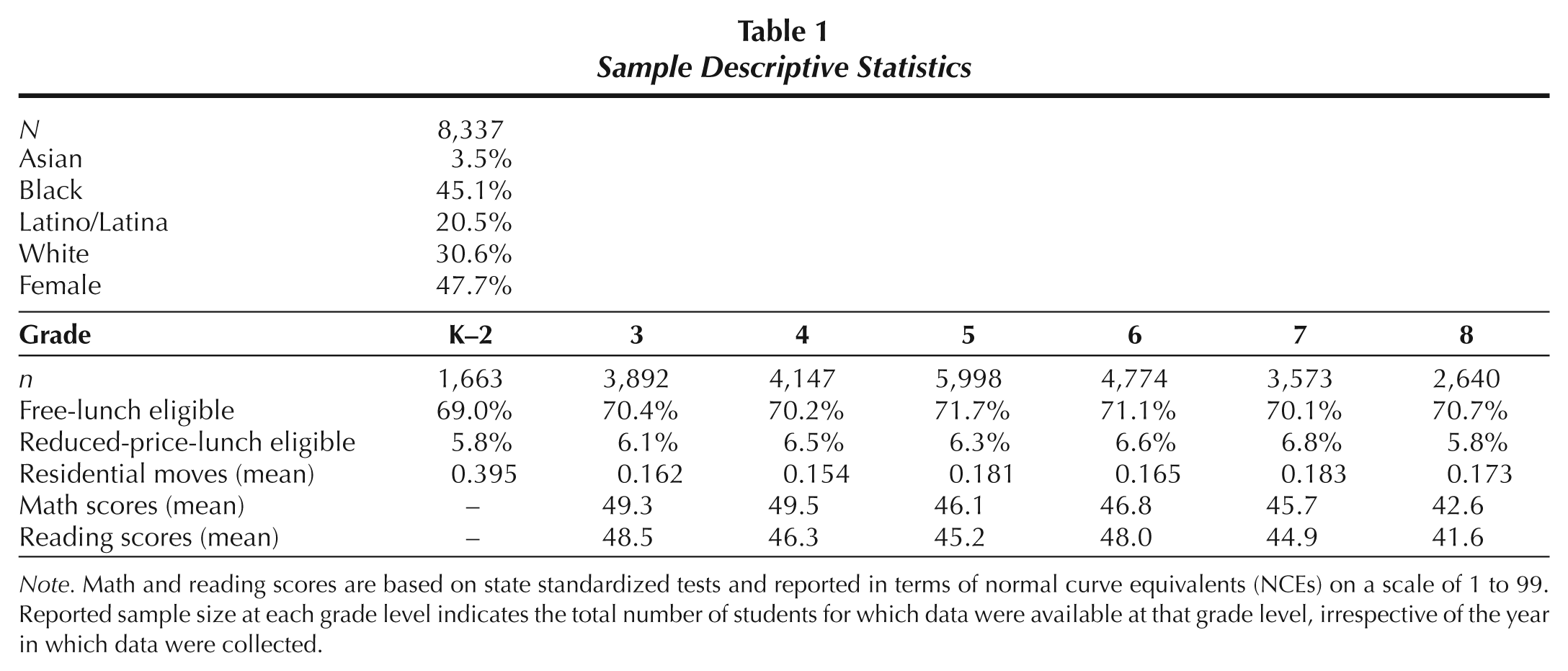
Note. Math and reading scores are based on state standardized tests and reported in terms of normal curve equivalents (NCEs) on a scale of 1 to 99. Reported sample size at each grade level indicates the total number of students for which data were available at that grade level, irrespective of the year in which data were collected.
Residential mobility
The primary variable of interest to this study is residential moves. In the study district, a change of address is documented in a student’s school records. A move during the summer months when school is not in session would be reflected in the subsequent year’s data. In any given year during the period for which data were available, most students did not move at all. The highest mobility rate in any year was 2008 when 16.5% of students moved. The most moves for a student in any year of data collection was five, but because so few students moved more than once per year (less than 3% in each year for which data were available) residential mobility in Grades 3 through 8 was treated as a binary variable (0 = did not move; 1 = moved at least once).
To examine the effect of early elementary mobility on achievement, a kindergarten-through-second-grade (K–2) mobility index was calculated by summing the number of moves on a student’s record in kindergarten, first, and second grade and dividing this sum by the number of years that the student was in the data during these grades. Further, an additional move was added to the sum—prior to division—if a student had missing data during kindergarten, first, or second grade when she otherwise would have been included. For example, if a sixth-grade student in 2009 has data on record for all grades except kindergarten, the assumption is that she moved into the district catchment area between kindergarten and first grade and an additional move is assumed. Kindergarten is universal, free, and full-day in the study district.
The data further indicate that poorer students are more likely to move relative to their higher-SES peers. This reinforces the importance of examining the associations of moves with changes in student trajectories of achievement over time, to avoid confounds with enduring disadvantage. A significantly greater proportion of movers than nonmovers were FRPL eligible across all 8 years of data. For example, in 2009, 21% of all sample students were not FRPL eligible, but only 11% of students who had moved at least once during that year were not FRPL eligible (χ = 72.93, p < .001). Over all 8 years of data, there were 99 instances of extreme mobility (three or more moves during the year); only 3 of these cases were students who were not eligible for FRPL.
The mobility rates for the sample during the span of data collection were congruous with the overall mobility rates in the Southern United States, according to U.S. Census (2011) figures. The effect of the national housing crisis may have been later to hit the sample district, as the peak mobility year was 2008 compared to the 2003 for the region. However, rates did not vary dramatically over this period. From 2005 to 2009, the sample mobility rate (students who moved at least once) was between 15.3% and 16.5%. Prior to 2005, the rates were consistently around 12%.
Achievement
State standardized test scores for both math and reading serve as the outcome variables in this study. The test is administered to all third- through eighth-grade students. Scores are reported in terms of normal curve equivalents (NCEs), measured on a scale of 1 to 99. NCEs are determined based on a student’s relative position vis-à-vis her grade-level peers statewide. Therefore, a score of 50 implies that a student is exactly average.
Socioeconomic status
In an effort to distinguish residential mobility from general socioeconomic status in this study, FRPL eligibility is included as a control variable. FRPL is an ordinal variable, with students being eligible for free lunch, reduced-priced lunch, or neither, depending on the family’s level of need. FRPL is an imperfect proxy for SES, but it helps to approximate a family’s economic situation. Like mobility, FRLP is assessed annually and included as a time-variant covariate. Students’ FRPL eligibility is relatively static from year to year, with no more than 13% of students changing statuses between any 2 years of data collection.
Analyses
Latent growth-curve modeling (LGM) was used to model the longitudinal effects of residential mobility on student achievement. LGM estimates latent intercepts and growth trajectories in an outcome variable for all participants, allowing for inclusion of time-invariant and time-varying covariates (Meredith & Tisak, 1990). Two separate LGMs were estimated in MPlus 6 for math achievement and reading achievement, respectively. The data were transformed to depict grade-level as the indicator of time (λ t in the equations below), rather than the year in which data were collected. Thus, there are six repeated measures in the models, representing the six grade levels (third through eighth) at which students were tested on math and reading. The trajectories of achievement scores over time were modeled as linear trends (β i ). Predictor variables included K–2 mobility, which was treated as a time-invariant covariate, which is to say that every student has a single K–2 mobility score (k2mobility i ) representing her residential moves during that period. Annual residential mobility from Grade 3 through 8 was also included in the model as a time-variant predictor variable, both contemporaneously with achievement and lagged 1 year behind achievement (moved it and movedit–1, respectively). The generic equations for both math and reading achievement outcome are as follows:



FRPL was included in models as a control, both as a time-invariant covariate (frpl2 i , representing a student’s FRPL in second grade) and a time-variant contemporaneous and lagged covariate (frpl it and frplit–1, respectively). Modeling FRPL helps to separate the effects of mobility and economic disadvantage, oftentimes confounded in mobility research (Burkam, Lee, & Dwyer, 2009; Mehana & Reynolds, 2004). The model results allow for an interpretation of the association of K–2 mobility with students’ third-grade achievement as well as with the linear trajectory of their achievement from Grades 3 through 8, accounting for variation in FRPL. Furthermore, the models estimate the association of residential mobility in Grades 3 through 8 on deviations from each student’s trajectory of achievement during the year of the move as well as the subsequent year, controlling for early achievement and changes in FRLP status.
The 1-year-lagged variables for mobility and FRPL (movedit–1 and frplit–1, respectively) are not included in the model as predictors of achievement in third grade. The intercept term in the Level 1 equation (α i ) represents students’ third-grade achievement, and the effect of K–2 mobility and second-grade FRPL eligibility are modeled as predictors of the intercept and slope in the Level 2 equation. The model specifications are also illustrated in Figure 1.
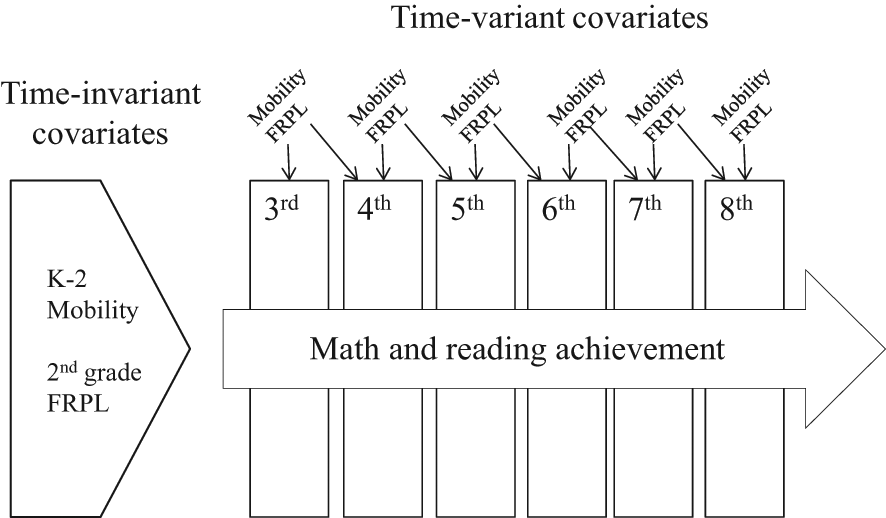
Modeled relationships between time-invariant covariates, time-variant covariates, and math and reading achievement.
There are some missing data as many students were not in one of the 11 sample schools at times throughout the 8-year range of data collection. LGM allows missing data to be treated as missing at random, employing a full maximum likelihood procedure that includes in the analysis any case (i.e., year nested within student) for which outcome data are available.
Results
Unconditional Trajectory of Math and Reading Achievement
A baseline model (i.e., absent any predictor variables aside from time) for both math and reading scores shows that there was a general downward trend in achievement from Grade 3 to 8 (shown in Figure 2). The model-implied mean math and reading scores in the third grade were 53.34 (p < .001) and 52.41 (p < .001) NCEs, respectively; the model-implied mean rate of change was −2.75 NCEs per year for math (p < .001) and −2.74 NCEs per year for reading (p < .001). This suggests that although sample students perform on par with their statewide peers in third grade, their relative achievement decreases as they progress through elementary and middle school.

Sample mean math and reading scores and model-implied mean math and reading scores, by grade.
Associations of Early Elementary Residential Mobility With Achievement
As Table 2 shows, the inclusion of the mobility predictor variables—and FRPL controls—in the model illustrates the import of changing residences across grade levels. First, the model implies that K–2 mobility had a significant negative association with math (p = −1.44, p < .05) and reading (p = −1.70, p < .01) achievement in third grade, the 1st year of testing. For every move during the period between kindergarten and second grade, there was an associated drop in test scores of approximately 1.5 NCEs in third grade. For example, a student eligible for free lunch who does not move during the K–2 period has a predicted math score of 48.41 NCEs in third grade; another student also eligible for free lunch who moved twice during the K–2 period (as was the case for 5% of the sample) is expected to have a math score of 45.54 NCEs.
Contemporaneous and Lagged Effects of Residential Mobility on Math and Reading Achievement
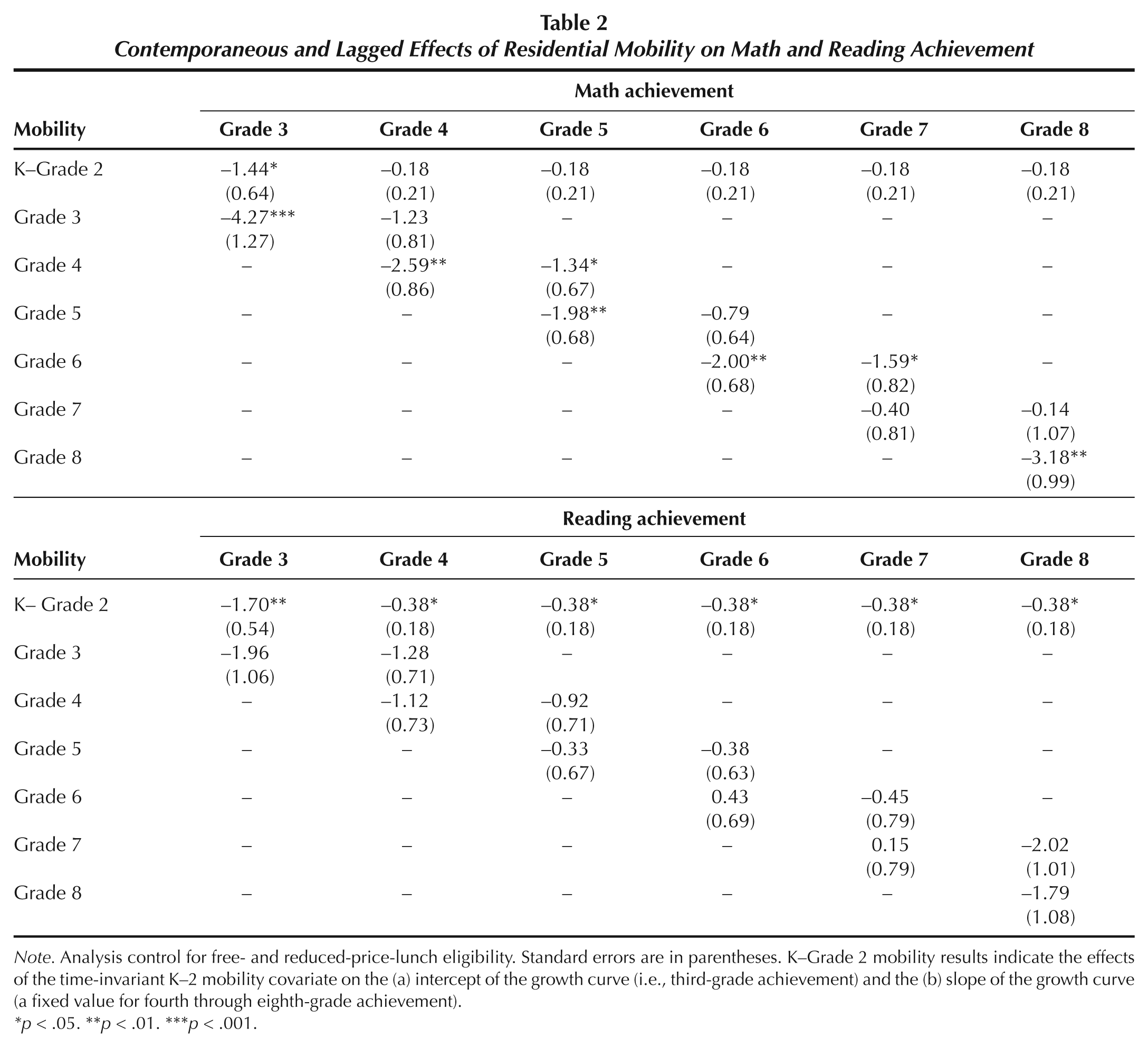
Note. Analysis control for free- and reduced-price-lunch eligibility. Standard errors are in parentheses. K–Grade 2 mobility results indicate the effects of the time-invariant K–2 mobility covariate on the (a) intercept of the growth curve (i.e., third-grade achievement) and the (b) slope of the growth curve (a fixed value for fourth through eighth-grade achievement).
p < .05. **p < .01. ***p < .001.
There was also a significant association of K–2 mobility with the linear trajectory of reading scores between third and eighth grade (p = −0.38, p < .05), implying that residential moves during one’s early schooling negatively relate to reading achievement through elementary and middle school. For example, a free-lunch-eligible student with no K–2 moves would have an expected reading score of 47.71 NCEs in third grade, whereas a free-lunch-eligible student with two K–2 moves would have an expected reading score of 44.30 NCEs in third grade, a three-NCE difference. However, because of the effect of K–2 mobility on the trajectory of reading achievement, these same two students would be expected to have respective reading scores of 32.60 and 27.29 NCEs by eighth grade (holding subsequent mobility constant, and assuming free-lunch eligibility in seventh and eighth grade), a difference of >5 NCEs. NCEs are preferred over percentile scores because of their equal-interval scale, but in terms of percentile scores the former student would be expected to score at the 21st percentile and the latter student at the 14th percentile. Early elementary mobility appears to widen the achievement gap between the urban students in our sample and their peers statewide. This enduring effect of K–2 mobility was not evidenced for math achievement.
Association of Year-by-Year Moves With Achievement During the Testing Years
Year-by-year moves were more highly associated with math than with reading achievement. For math achievement, changing residences during the testing years evinced a consistently significant negative association. The effect appears to be greatest during third grade (γ = −4.27, p < .001) and eighth grade (γ = −3.18, p < .01). There was also a significant negative effect in fourth, fifth, and sixth grade and a 1-year lagged effect in seventh grade. This implies that taking into consideration the expected decline in math scores over time, there is an additional expected temporary decrease in math scores of 1 to 4.5 NCEs for a residential move between third and eighth grade. The model suggests that a free-lunch-eligible student who did not move in eighth grade would have an expected math score of 39.28 NCEs, whereas a free-lunch-eligible student who does move during eighth grade would have an expected score of 36.093 NCEs, holding earlier achievement and moves constant. Somewhat unexpectedly, the results show that mobility does not have a contemporaneous or 1-year lagged effect on reading achievement at any grade level.
The 1-year-lagged association of mobility with test scores was largely insignificant. The only significant lagged association was between seventh-grade math achievement and sixth-grade mobility. The general absence of significant findings associated with 1-year-lagged mobility implies that contemporaneous mobility may be more salient to math achievement and that the modeling of more distantly lagged mobility predictors may be unnecessary. In additional analyses, not shown, inclusion of community-level mobility (to index macro-level economic circumstances) did not make any substantive contribution to the findings and worsened overall model fit.
In sum, early elementary mobility is associated with a downward trajectory in reading scores throughout the testing years, whereas math scores seem more sensitive to proximal mobility. For the sake of illustration, a free-lunch-eligible student from a sample school who does not move at all over the course of Kindergarten through eighth grade would have an expected math score of 39.28 NCEs, whereas a free-lunch-eligible student who moves once during the K–2 period and again in eighth grade would be expected to have a score of 34.66 NCEs. Highly mobile urban eighth-graders in our sample had expected math scores markedly further below the statewide norm of 50 NCEs compared to their more stable classmates. In terms of percentile scores, the two hypothetical students described here would be expected to score at the 30th and the 24th percentiles, respectively.
Discussion
Early elementary mobility (K–2) may set urban students back in terms of math and reading achievement at the earliest level of testing (third grade). Our results imply that this gap is not made up over time—the third-grade achievement starting point is lower for early movers in both reading and math. Their trajectory of math achievement over time runs roughly parallel to that of their less mobile peers, with temporary declines associated with subsequent moves, whereas for reading achievement their trajectory declines more steeply. This suggests that early elementary mobility is a source of inequality in academic achievement through primary school.
Disruption of routines and social ties during these formative years of schooling may have an enduring detrimental effect on children’s learning. The foundation of a child’s reading competency may be particularly affected by these early disruptions, as there is a negative residual effect of mobility through middle school. Neighborhood and household resources—such as the provision of books, educational toys, learning experiences and routines, and structure—have been shown to be important determinants of young children’s verbal ability, in particular (Leventhal & Brooks-Gunn, 2000). Tumult brought on by moving during this early period may unsettle children’s reading development in an enduring fashion.
In addition to early mobility, moves at any time during the “testing years” of elementary and middle school (i.e., third through eighth grade) are associated with reductions in math but not reading achievement. For reading achievement, once the long-term effect of K–2 mobility is taken into account, more proximal moves during the third-through-eighth-grade period appear to have little import. This may imply that if children are able to establish a foundation in reading during early elementary school without mobility disruptions, they may be insulated from the effects of subsequent moves—at least in terms of their reading achievement. Reading may be a refuge for children who have established sufficient skill to make it enjoyable.
The same is not true of math achievement, however. The contemporaneous and lagged associations of mobility from Grades 3 to 8 were highly significant, implying that a student can experience a drop of 2 to 4 NCEs in achievement for a move during the testing years. The association was relatively consistent across grades. For reference, a recent study found that math-focused comprehensive school reform explains an annual difference of approximately 1 NCE in the math scores of urban middle school students (Mac Iver & Mac Iver, 2010). Further, in Tennessee, the state in which the present research was conducted, it is considered “exceptional” by the state department of education in their value-added assessment for an elementary or middle school to increase its average math score by 1.5 NCEs and their average reading score by 1.2 NCEs from one year to the next (Tennessee Department of Education, 2009). Thus, for children who move, a decline of 2 to 4 NCEs is substantial enough to offset the benefits of other achievement-oriented reforms and to partially hinder their academic growth in school.
A central contribution of this study is to show that residential moves were associated with negative deviations from students’ own trajectories in math achievement. Because analyses control for prior achievement, early mobility, and economic circumstances that allowed eligibility for free and reduced-price lunches, the reductions in math performance do not simply reflect enduring social and economic disadvantage. Third variable causation is still plausible—it may be that circumstances such as parental job loss or severe illness that led to the move are the main culprits, but only contemporaneous events associated with mobility are plausible third variables. Although the analyses remain correlational, they have moved the field closer to understanding causality. In the case of reading, where early mobility was associated with both initial reading scores and subsequent poor trajectories, an explanation based on enduring social disadvantage remains plausible. It is also possible, in both cases, that residential mobility is a mediating mechanism that explains how more general family disruptions affect achievement, and this consideration could be taken into account in future research.
A weakness of the present study is that it does not model information on students’ school mobility. Our data show that in 2009, residential moves were accompanied by a change of school slightly less than half the time, but the school system did not make data on school moves in other years available. This fact makes it somewhat difficult to assert whether the demonstrated effects of residential mobility are due to stress and dislocation in the home environment or the school environment.
This uncertainty affects the practical implications of the study, to a degree, as well. For example, a common approach to managing a highly mobile student body is for districts to implement a standard curriculum to ensure that students who transfer school simply pick up where they left off in the sequencing of classroom instruction. This solution would not help highly mobile students who do not change schools.
Other interventions that focus more on the socioemotional aspects of mobility—for example, adjustment counseling and tutoring for mobile students and providing networking opportunities for the parents of mobile children—are just as relevant for residential movers as they are for school changers. Urban schools, in particular, can make efforts to monitor not only newly enrolled students (thus experiencing school mobility) but also students who change residences while maintaining enrollment in the school. The results of the present study suggest that supplemental resources may be best employed beginning in the early elementary years and continuing through middle school. Future analyses of this type could explore whether the contemporaneous effect of mobility on achievement persists into the high school years.
On a social policy level, this study implies that reducing residential mobility is in the interest of urban elementary and middle school students. Our findings suggest that on average, students from the sampled urban schools performed substantially below the statewide norm on achievement tests by eighth grade. They suggest further that residential stability during the elementary and middle school years may explain why that gap is smaller for some students than others. Policies that make it easier for low-income families to stay in their homes—including affordable housing and efforts to enforce fair housing laws and combat predatory lending—could be helpful in reducing mobility. A multipronged effort to reduce residential mobility could have important benefits. The present housing crisis makes initiatives such as these even more imperative. In the effort to improve educational outcomes for urban students, helping to make their homes more stable may be an important step.