



Abstract
In this article, we propose a theoretical connection between research on learning and research on teaching through recent research on students’ learning trajectories (LTs). We define learning trajectory based instruction (LTBI) as teaching that uses students’ LTs as the basis for instructional decisions. We use mathematics as the context for our argument, first examining current research on LTs and then examining emerging research on how mathematics teachers use LTs to support their teaching. We consider how LTs provide specificity to four highly used frameworks for examining mathematics teaching, namely mathematical knowledge for teaching, task analysis, discourse facilitation practices, and formative assessment. We contend that by unifying various teaching frameworks around the science of LTs, LTBI begins to define a theory of teaching organized around and grounded in research on student learning. Thus, moving from the accumulation of various frameworks into a reorganization of the frameworks, LTBI provides an integrated explanatory framework for teaching.
Keywords
Although learning and teaching are often seen as two sides of the same phenomenon, connections between research on each are usually underspecified (Romberg & Carpenter, 1986). Theories of learning can develop with no necessary connection to teaching, and theories of teaching are far less common than their learning counterparts. In this article, we propose a theoretical connection between research on learning and research on teaching through the concept of learning trajectory based instruction (LTBI). The National Research Council (2007) called attention to learning trajectories (LTs) when it indicated that research on learning was beginning to map the “successively more sophisticated ways of thinking about a topic that can follow and build on one another as children learn about and investigate a topic over a broad span of time” (p. 211). Building on the recent attention to LTs, we define LTBI as teaching that uses LTs as the basis for instructional decisions.
Using mathematics as the context for our argument, we first present recent progress made in developing LTs. Then, we examine emerging research on how these trajectories support instruction. Next, we consider the specificity LTs provide to four highly used frameworks for mathematics teaching, namely mathematical knowledge for teaching (Ball, Thames, & Phelps, 2008), task analysis (Stein, Grover, & Henningsen, 1996), discourse facilitation practices (Stein, Engle, Smith, & Hughes, 2008), and formative assessment (Heritage, 2008). Finally, we bring together the refined understandings LTs provide to these frameworks into a unique framework for LTBI. We contend that by unifying various teaching frameworks around the science of LTs, the proposed LTBI framework is an important step toward a theory of teaching grounded in research on student learning.
Learning Trajectories
Simon (1995) first used the expression hypothetical LT to represent the “paths by which learning might proceed” (p. 135) when students progress from their own starting points toward an intended learning goal. He named these trajectories hypothetical because each student’s learning path was not knowable in advance. More recently, Maloney and Confrey (2010) proposed that LTs represent a progression of cognition that, though not necessarily linear, is also not random. Trajectories, for them, represent ordered expected tendencies developed through empirical research designed to identify highly probable steps students follow as they develop their initial mathematical ideas into formal concepts, recognizing that each student’s path can be unique.
Corcoran, Mosher, and Rogat (2009) highlighted that the tendencies represented in LTs are based on “research about how students’ learning actually progresses” (p. 8), as opposed to the usual attention to knowledge of the discipline. They distinguished the logic of the learner from the logic of the discipline, what Confrey (2006) named students’ voice and disciplinary perspectives, respectively, and underscored the importance of the learner in guiding future work on instruction, curriculum, and assessment.
Clements and Sarama (2004) defined LTs as “descriptions of children’s thinking and learning in a specific mathematical domain, and a related conjectured route through a set of instructional tasks designed to engender those mental processes or actions hypothesized to move children through a developmental progression of levels of thinking” (p. 83). Confrey, Maloney, Nguyen, Mojica, and Myers (2009) specified that an LT is “a researcher-conjectured, empirically-supported description of the ordered network of constructs a student encounters through instruction (i.e., activities, tasks, tools, forms of interaction, and methods of evaluation), in order to move from informal ideas, through successive refinements of representation, articulation, and reflection, towards increasingly complex concepts over time” (p. 347).
Daro, Mosher, and Corcoran (2011) collected 18 different mathematics LTs for various content topics. For example, Clements and Sarama (2009) developed 10 related LTs in the areas of number, operations, and geometry, spanning ages 0 to 8. Instructional activities for these LTs were designed to move students from one level to the next. Battista’s (2006) LT was a component of his cognition-based assessment system and provided teachers with core mathematical ideas, a framework for understanding students’ conceptions, and related tasks designed to elicit student thinking in support of classroom assessment. Confrey and colleagues (2009) created a framework for the development of rational number reasoning. Their Equipartitioning LT consisted of 16 levels spanning grades K–8. Diagnostic assessment items were created for each level of proficiency in the LT.
In their analysis, Daro et al. (2011) indicated that the existing trajectories varied in span, grain size, use of misconceptions, and level of detail. They also noted that the role of tasks in LTs varied. In some LTs, specific tasks were designed to foster movement toward more sophisticated understanding. In others, tasks were created to elicit students’ mathematical thinking at various points. Thus, whereas tasks were embedded into some LTs making these LTs task dependent, other LTs used tasks to illustrate one possible means to elicit desired behaviors, with the LTs assumed to emerge across a variety of curricular options dependent on instructional moves. In both cases, LT researchers acknowledged the probabilistic nature of their progressions, but most important from an instructional perspective, all LT researchers recognized a critical role for instruction in student progress.
Daro et al. (2011) suggested that existing LTs still required further empirical examination, and despite existing differences among LTs, they called on researchers to “translate the available learning trajectories into usable tools for teachers” (p. 57). They asked that these tools be incorporated into professional development settings—a work toward which the LTBI framework contributes.
Learning Trajectories and Teachers
The relation between LTs and instruction creates the necessity of developing LTBI in tandem with the development of LTs. We contend that the development of LTBI can support further research on LTs. Nonetheless, despite progress made to empirically develop LTs in various domains, examinations of how teachers come to make sense, adapt, and implement LTs are only beginning to emerge.
In mathematics, connections between teaching and learning through the use of student thinking precede the development of LTs. With the strong presence of constructivism in mathematics education, researchers have long called for teachers to attend to students’ prior knowledge and build models of students’ understandings (e.g., Confrey & Kazak, 2006; Steffe & D’Ambrosio, 1995). However, research on instruction that followed these principles differed from current work on LTs in one important aspect. Previously, teachers learned general concepts about student learning and were asked to construct models of their students. With the current development of LTs, teachers are being asked to learn about research-based, content-specific levels of progression in students’ thinking and make sense of student learning in relation to this framework. Thus, although LT research provides the foundational framework for instructional decisions, the specific ways in which teachers incorporate this information into practices necessitates a shift to elaborate related research on teaching.
An important exception to the early constructivist work was Cognitively Guided Instruction. This project offered teachers a framework presenting levels of sophistication in the strategies children used to solve various addition and subtraction word problems—an early version of an LT. Carpenter, Fennema, Peterson, Chiang, and Loef (1989) set out to “investigate whether providing the teachers access to explicit knowledge derived from research on children’s thinking in a specific content domain would influence the teachers’ instruction” (p. 500). They found that teachers who learned about these strategies were more likely to listen to their students’ problem-solving processes and spend classroom time discussing multiple strategies. Later, Fennema et al. (1996) showed that teachers who had a “research-based model of children’s thinking” (p. 496) offered more opportunities for children to solve problems and elicited children to share their thinking.
Using the more recently developed LTs, Wilson (2009) conducted a 12-week study to investigate how teachers come to use LTs in instruction. He analyzed the practices of 10 second-grade teachers out of 33 K–2 teachers who learned about one particular LT through 20 hours of professional development. He found that the LT offered teachers a theoretical frame to select instructional tasks, interact with students in classroom discussions, and analyze students’ work. Similarly, Mojica (2010) studied how prospective teachers learned about and used an LT. Fifty-six teachers participated in a design study over an 8-week period where Mojica taught the teachers about an LT. She found that teachers used their understandings of the LT to deepen their knowledge of mathematics. Additionally, she found that knowledge of the LT assisted prospective teachers in taking students’ thinking into consideration when making instructional decisions.
Clements, Sarama, Spitler, Lange, and Wolfe (2011) used a randomized trial with 42 schools to evaluate the effectiveness of an intervention centered around LTs. They found that children in intervention schools had greater growth in their mathematical knowledge than those in control schools. Clements and colleagues also examined the classroom practices of participating teachers and found that intervention teachers were more responsive to students and better able to capitalize on spontaneous classroom situations to teach mathematics.
The emerging research on teachers’ use of LTs shows that as teachers make sense of trajectories, these trajectories can support growth in mathematical knowledge, selection of instructional tasks, interactions with students in classroom contexts, and use of students’ responses to further learning. Although much research is still needed to carefully examine how teachers come to make sense of the researcher-developed LTs, existing results already highlight the strength of having such a framework for understanding the progression of student thinking over time at the center of one’s teaching and the potential of theoretically defining LTBI as a framework for instruction.
Placing LTs at the Center of Frameworks for Teaching
In what follows, we theoretically place LTs at the center of four frameworks used to analyze important aspects of mathematics teaching. We examine how LTs necessitate the refinement of our understanding of these frameworks toward more specific definitions that use the trajectories as reference. We use the distinction between student voice and mathematical perspective to support our work, highlighting the importance of the logic of the learner and of the LT’s ordered expected levels of sophistication in defining LTBI.
Although we hypothesize that placing LTs at the center of instruction affects many facets of instruction, in this article we attend to four particular ones: mathematical knowledge for teaching, task analysis, discourse facilitation, and formative assessment. Two reasons support our focus. First, substantive research on instruction has been conducted within each of these areas, and we can build on existing, widely used frameworks that summarize such research. Second, the above-mentioned emerging research on teacher learning of LTs provides initial evidence that trajectories can indeed affect each of these aspects of instruction.
Mathematical Knowledge for Teaching
The importance of teachers’ knowledge for teaching has been long established in the research literature (e.g., Calderhead, 1996; Clark & Peterson, 1986). However, ever since Begle (1972) revealed that teachers’ advanced knowledge of mathematics did not necessarily affect student learning, researchers in mathematics education have turned to a nuanced examination of the kinds of knowledge teachers need for teaching. Ball et al. (2008) proposed a framework for examining teachers’ mathematical knowledge for teaching (MKT) (Figure 1).
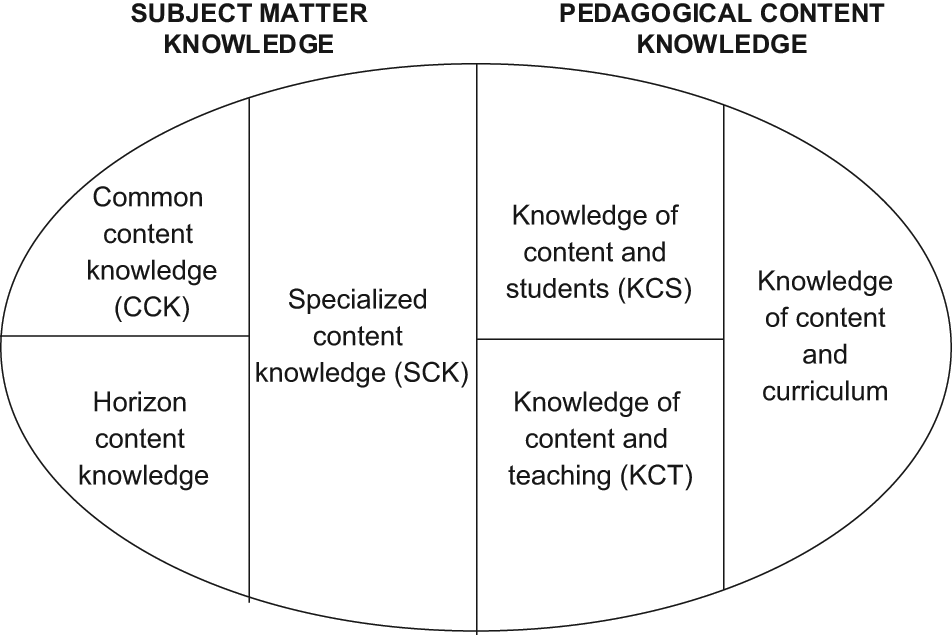
Framework for examining mathematical knowledge for teaching
Original definitions
Ball and colleagues (2008) defined six subcategories of teacher knowledge under subject matter knowledge (SMK) or pedagogical content knowledge (PCK). Within PCK, knowledge of content and students was defined as the knowledge that combines knowing about students and knowing about mathematics. Knowledge of content and teaching was knowledge about the design of instruction for a particular content. The authors placed knowledge of content and curriculum as part of PCK, but indicated they were still examining whether this was a category in itself.
Under SMK, common content knowledge was defined as knowledge of mathematics not specific to teaching whereas specialized content knowledge was the kind of mathematical knowledge that is specific to the work of teaching. Specialized content knowledge was exemplified as the knowledge teachers need to explain patterns in student errors or decide whether a nonstandard approach would work in general. The horizon content knowledge category represented “an awareness of how mathematical topics are related over the span of mathematics included in the curriculum” (p. 403).
LT- based interpretation
Considering PCK from the point of view of students’ voice, we define knowledge of content and students as knowledge of the various levels of the trajectories through which learners progress from less to more sophisticated ways of thinking. This includes knowledge of the cognitive steps that support such development and of the ways in which learners at different levels approach certain mathematical tasks. In this context, knowledge of content and teaching is knowledge of ways to support learners’ cognitive development through progressively more sophisticated levels of the trajectory as teachers help students’ voices develop into accepted mathematical perspectives. Knowledge of content and teaching includes knowledge of tasks at various levels within the trajectory and how to select and target tasks so that they can promote both individual movement along the trajectory and content-rich classroom discourse among all learners. Still within PCK, knowledge of content and curriculum, from an LT perspective, is knowledge of how to use student voice to choose and adapt curricula that are typically built based on mathematical disciplinary perspectives.
We understand common content knowledge in relation to LTs as knowledge of concepts and procedures represented at each level of the trajectory, allowing one to perform the tasks associated with that level, all the way to the overall mathematical goal indicated at the end of the trajectory. We interpret specialized content knowledge as knowledge of how to use one’s mathematical perspective to test the appropriateness of various solutions and representations learners propose in their own voice. This knowledge requires unpacking each level of the trajectory, explaining the mathematical issues behind the levels so that teachers can make sense of multiple mathematical explanations and representations for ideas within the trajectory. Finally, we consider horizon content knowledge as knowledge of the most sophisticated understanding of a particular concept described at the highest level of a particular trajectory, representing the ultimate mathematical goal of a learning trajectory and the powerful mathematical generalization that is subsumed by the whole trajectory.
Task Analysis
The importance of tasks in teaching has been considered since Doyle (1983) pointed to the fundamental role tasks play in interactions among teachers and students around content. In mathematics education, Stein et al. (1996) examined how instructional tasks served as “proximal causes of student learning from teaching” (p. 459). They proposed a model to represent how tasks transformed (Figure 2) and showed how the transition of tasks from curricular materials, to set up, to implementation was affected by factors such as teachers’ goals, knowledge, and classroom conditions.

Mathematics task analysis framework
Original definitions
Stein et al. (1996) indicated that important task features for the setup were those that supported student engagement and reasoning, including tasks’ propensity to foster multiple strategies, encourage multiple representations, and engender mathematical communication. They noted the importance of tasks’ cognitive demand, defining this demand as the thinking processes entailed in solving the task, from memorization and use of rote algorithms (low demand) to the use of algorithms with conceptual understanding and the use of complex strategies such as connecting, conjecturing, and interpreting (high demand). Directly influencing teachers’ decisions about task features and level of demand were teachers’ knowledge and goals for the lesson.
LT-based interpretation
When considering LTs, tasks’ features and demand become closer connected to students’ logic instead of guided by the logic of the discipline, mostly because LTs necessitate a shift in teachers’ goals: from a narrow focus on the mathematical objectives of a task to a broader examination of the relation between tasks and student learning within a desired path for cognitive development over longer periods of time. The shifts from attention to the discipline to attention to students and from local to longer-term goals support students’ progress toward the larger mathematical generalizations by recognizing students’ current conceptions and relating those to the concepts that the LT describes (disciplinary goals). Thus, tasks not only support student learning at a particular level during a particular lesson, but they have a role in fostering higher levels of sophistication over time.
Within the long-term frame that LTs bring to the setup of tasks, important task features are the task’s capacity to elicit and build on students’ present conceptions, shifting attention from a mostly disciplinary focus on strategies or representations to a focus on bringing forth students’ informal and previous instructional experiences in support of new conceptual developments along the trajectory. Further, to support engagement, instructional tasks should span multiple levels of cognitive proficiency described by the trajectory, anticipating multiple zones of proximal development among students in the classroom. This span allows all students to engage with the task despite differences in previous experiences.
Attending to the demand of a task, from an LT perspective, encompasses an examination of the relation between the disciplinary goals of the task and students’ proficiency. A task that addresses cognitive processes already developed by students will be of low demand to those students as they can engage in the task through the application of previously mastered ideas without requiring new connections or the development of new concepts. A task that addresses a cognitive process toward which students are working requires students to examine the new ideas proposed, make conjectures, and develop justifications as they work toward mastery of the particular level in the trajectory. We contend that by providing a cognitive development continuum, LTs suggest that teachers examine the demands of a task not solely in relation to content following the logic of the discipline but as relations between tasks and students, following the logic of the learner.
Pedagogical Practices for Orchestrating Discourse
Given the connections between discourse and learning (e.g., Barnes, 1974; Tharp & Gallimore, 1988), educational researchers have attended to instructional conversations (Goldenberg, 1993) as a way to support learning. In mathematics education, Lerman (2000) noted the field’s social turn when researchers shifted attention from individual learners to the social origins of knowledge. This turn led to changes in mathematics instruction from silent and individual to verbal and social (Moschkovich, 2002).
Stein et al. (2008) described the challenges of promoting classroom discourse that both respected students’ current thinking (the logic of the learner) and supported the development of important mathematical concepts (the logic of the discipline). To support teachers, they offered a framework of five instructional practices to facilitate discourse within student-centered learning environments: anticipating, monitoring, selecting, sequencing, and connecting. These practices strengthened teacher preparedness for building on student’s voice while attending to mathematical goals.
Original definitions
The practice of anticipating requires teachers to develop expectations for how students might interpret and solve a problem, considering how students’ possible strategies or mistakes related to the mathematics. In monitoring, teachers examine students’ approaches as they work on a problem and search for points of potential learning. Teachers carefully attend to the work students are doing and check to see whether anticipated strategies emerge in the classroom. Knowing what strategies are available in the classroom, teachers select particular ones to share, making decisions regarding how to sequence presentations for whole-group discussions. Smith and Stein (2011) noted that “by making purposeful choices about the order in which students’ work is shared, teachers can maximize the chances of achieving their mathematical goals for the discussion” (p. 10). As students present their ideas, teachers support connections among shared approaches to build toward the mathematical goal for the lesson.
LT-based interpretation
LTs provide teachers with an empirically developed and tested organization for how student thinking becomes more sophisticated over time, guiding teachers in cataloguing and ordering students’ approaches to certain tasks. Thus, from an LT perspective, anticipating means examining the variety of strategies and misconceptions that are associated with different levels of proficiency in the trajectory, taking into account what these strategies or misconceptions might reveal about students’ mathematical understanding in relation to particular learning goals. Through awareness of these documented and highly expected strategies and misconceptions, as well as of important landmarks and obstacles that define pathways through the mathematical terrain, monitoring means close listening for known multiple models of possible cognition, probing whether and how these models manifest in students’ own approaches or when students diverge from them.
As a basis for selecting and sequencing, LTs offer teachers an explanatory frame for understanding how conceptions evolve over time. Selecting and sequencing require teachers to consider students’ strategies based on known paths as a guide to organize the presentation of students’ work. Teachers select and sequence students’ ideas for whole class discussion based on increasing sophistication, providing for multiple zones of proximal development for students with more or less refined ideas. Teachers may choose to examine known misconceptions or specific barriers as they select and sequence particular pieces of student work for presentation in whole class discussions. Finally as the classroom conversation unfolds, teachers’ knowledge of trajectories allows them to make connections among students’ ideas, highlighting relationships and pointing to developing mathematical ideas.
Stein and colleagues (2008) claimed that the five practices allowed teachers to build on students’ ideas to shape class discussions that supported important mathematical ideas. We suggest that LTs provide the theoretical framework to these key pedagogical practices by offering teachers a map for interpreting students’ voice and the organization of this voice to promote goals that are progressively more sophisticated from a mathematical perspective.
Formative Assessment
Black and Wiliam (1998) defined formative assessment as all activities undertaken to “provide information to be used as feedback to modify the teaching and learning activities” (p. 2). These authors empirically showed that whereas the effective use of formative assessment is positively correlated with student achievement gains, the ways in which teachers incorporate formative assessment to their practices vary. Since then, researchers have identified effective formative assessment strategies such as setting and sharing clear learning goals and providing feedback (e.g., Heritage, Kim, Vendlinski, & Herman, 2009; Wiliam, 2007).
Building on the work of the Formative Assessment for Students and Teachers initiative (FAST, 2007), which identified LTs as a critical component of formative assessment, Heritage (2008) proposed a framework with three key elements for formative assessment: involving students in their own learning, eliciting evidence of student learning, and providing feedback to students. She began to define these elements in relation to LTs.
Original definitions
Involving students in their own learning revealed the need for students to monitor their own progress, requiring that teachers made their criteria for success explicit. Heritage (2008) claimed that LTs offered teachers smaller learning goals toward larger, generalized understanding. These smaller, more attainable goals better supported students in evaluating their own learning. Eliciting information from students referred to teachers’ need for a constant flow of information about student thinking to examine how learning progresses toward desired goals. Heritage noted that LTs’ clear progression of goals helped teachers not only be explicit with students but also supported teachers’ own interpretations of learning progress, allowing teachers to plan for when, what, how, and whom to assess. For formative assessment, appropriate feedback to students needs to be timely, specific, connected to preestablished criteria, and include suggestions for improvement. Heritage indicated that teachers who know the learning goals established in LTs also know what good performance looks like and can offer feedback that helps students identify how their performances compared to the one desired.
LT-based interpretation
Building on Heritage’s initial connections to LTs, we examined the role the logic of the learner plays in the ways in which evidence of student learning and provide feedback to students. We focused on these two elements of formative assessment because enacting them in the classroom is more strongly connected to student voice. Oftentimes, teachers elicit student thinking and provide feedback to students by comparing and contrasting students’ actual work to desired disciplinary goals; that is, as teachers engage in formative assessment, they make sense of and react to students’ voices from a disciplinary perspective. However, when teachers use LTs, they can instead be guided by the logic of the learner in their enactment of these two elements of formative assessment.
When teachers elicit evidence of student learning, they are engaged in asking students probing questions that elicit students’ own voices. By providing a framework for understanding the logic of the learner, LTs help teachers probe around more targeted concepts to understand the ways in which students’ cognitive processes align with the trajectory. Because individual students’ paths of cognitive development are not in a one-to-one correspondence with the LTs, trajectories both guide teachers’ probing questions and support teachers in examining the boundaries of what students do and do not understand. In providing feedback to students, LTs help teachers identify a priori common strategies and misconceptions around which to focus interactions with students through follow-up questions and scaffolding. This feedback is guided by the LT representation of the logic of the learner, supporting teachers’ closer attention to what students are learning versus what.
Conceptualizing LTBI
More than a decade ago, Schoenfeld (1998) observed that identifying central aspects of teaching was important to clarify the “pieces of the puzzle,” but missed an understanding of “how the pieces fit together” (p. 2) into an explanatory framework. Recently, Schoenfeld (2011) clarified that whereas a descriptive framework is needed to depict important facets of instruction, theory brings the pieces together into an explanatory framework that allows for justifications and predictions. In what follows, we define the LTBI descriptive framework, using research on LTs to refine and unify various frameworks from research on teaching (pieces of the puzzle). In our conclusion, we examine LTBI as a possible explanatory framework for instruction (theory of teaching).
Initially defining LTBI as instruction that uses students’ LTs as the basis for instructional decisions, we have examined the consequences of placing LTs at the center of four frameworks for teaching. We now argue that by interpreting the categories of these frameworks around the concept of LTs, we created a more integrated understanding of instruction based on how the logic of the learner becomes more sophisticated over time. We propose that, in doing so, our conceptualization of teaching changed from a compartmentalized approach built around aspects of instruction examined through research on teaching (Figure 3) to a more integrated approach centered around research on LTs (Figure 4). Whereas it was important to initially identify and define various aspects of instruction and make progress in obtaining empirical evidence to support each piece of the puzzle, interpreting them in light of the now available LTs allows for the integration of the various pieces into one framework for instruction. Thus, the time has come to move from the accumulation to the reorganization of the frameworks; we claim that LTBI represents this reorganization.

Conceptualizing teaching around different instructional frameworks
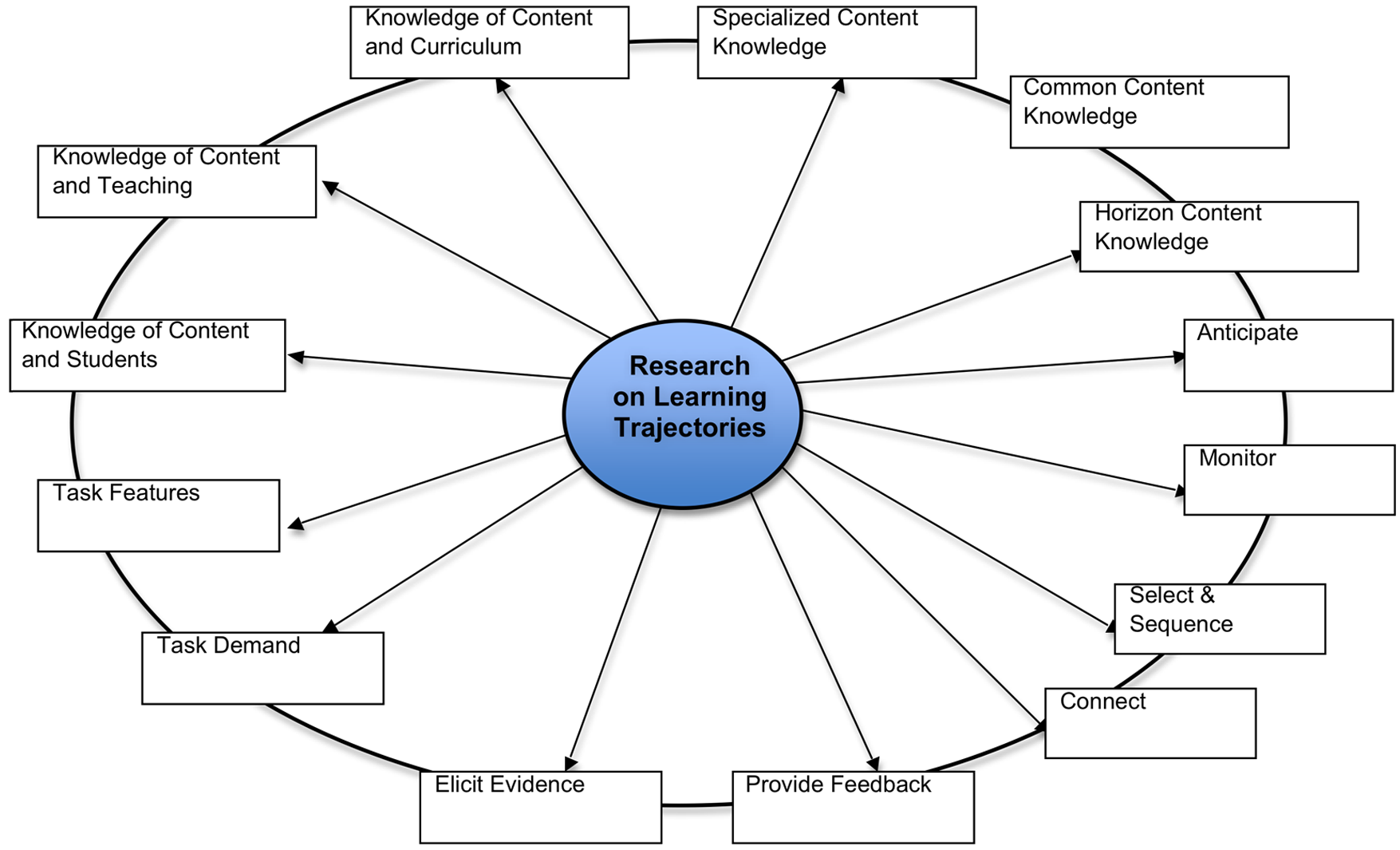
Conceptualizing teaching around learning trajectories
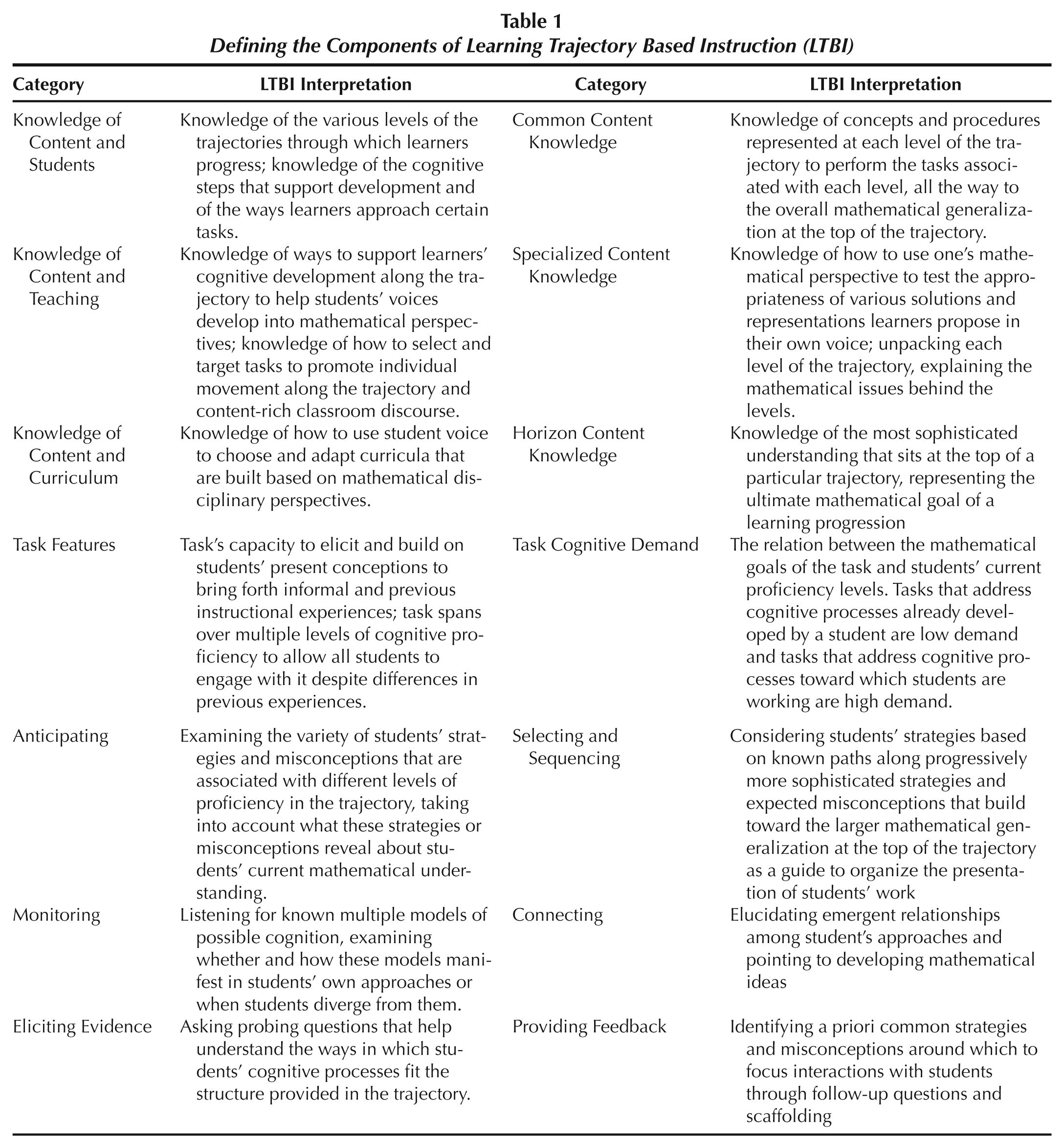
In the previous sections of this article, we reinterpreted important teaching categories around LTs. Table 1 organizes these important teaching categories into the new LTBI framework, specifying what it means to use LTs in instructional decisions. Though our examination was related to mathematics instruction, the reexaminations of similar teaching frameworks using progressions in science, developmental stages in language arts, or other discipline-specific trajectories may yield similar results as any of these reexaminations would result in more strongly connected conceptions of teaching that emphasize the logic of the learner.
Defining the Components of Learning Trajectory Based Instruction (LTBI)
Overall, we contend that, despite disciplines, when teachers organize teaching around learning from an LT perspective, the trajectory serves as the unifying element for their instruction. For us, the coherence of this vision is more than simply the bundling of topics and related learning opportunities. It is a matter of expressing priorities, sequences, and conceptual links among topics and instructional experiences, both within the content domain and perhaps more importantly across various domains.
Toward a Theory of Teaching
We suggest that research identifying students’ LTs in various disciplinary domains progresses in parallel with work toward conceptualizing LTBI as a framework for teaching. Other facets of instruction can be reinterpreted in light of LTs, adding to the LTBI framework. But most important, we contend that the resulting LTBI descriptive framework can come to serve an explanatory and predictive role as we attempt to understand the ways in which teachers’ knowledge of LTs guides the instructional decisions they make. For example, further development of LTBI can allow one to predict the tasks teachers might choose for a particular groups of students or what teachers might look for during small group interactions and what feedback they provide. In both cases, teachers’ understanding of how the logic of the learner progresses over time, combined with contextual factors, can serve as justification for their decisions.Attempts at explaining and predicting instruction based on teachers’ knowledge of LTs represent the initial steps toward a theory of teaching that is centered around research on learning. However, as with all theories, we consider that as the concept of LTBI becomes more clearly defined, it needs empirical examination to support or refute its strength as an explanatory framework for teaching. Thus, a next step in the development of a theory of teaching around LTs is to set up studies that can enhance or modify the effects we propose with the placement of LTs at the center of instruction.
Footnotes
Notes
Authors
PAOLA SZTAJN is a professor of Mathematics Education in the Department of Elementary Education at North Carolina State University, 317 Poe Hall, Campus Box 7801, Raleigh, NC, 27695-7801;
JERE CONFREY is the Joseph D. Moore Distinguished University Professor of Mathematics Education at North Carolina State University, Friday Institute for Educational Innovation, 1960 Main Campus Dr., Raleigh, NC 27606;
P. HOLT WILSON is an assistant professor at the University of North Carolina at Greensboro, P.O. Box 26170, Greensboro, NC 27402;
CYNTHIA EDGINGTON is a research associate at North Carolina State University, Raleigh, NC 27965;