




Abstract
This essay addresses the value of leveraging the unique learning, thinking, and knowledge students develop in home–community spaces for school curriculum. The author explores everyday resistance to highlight a particular set of enacted political actions and practices in which students, families, and communities participate to negotiate the demands of their politically charged contexts. She draws on cultural-historical theoretical perspectives and employs Engeström’s notion of the double bind. She argues that as Latina/o youth develop coordinated challenges to particular social and educational policies, they engage in joint sense making, problem solving, and social analyses. Thus, she analyzes the cultural resources that are generated in/though everyday resistance in order to elaborate how these cultural resources can be leveraged in curriculum practices.
Keywords
In this theoretical essay, I address the value of leveraging the unique learning, thinking, and knowledge students develop in home–community spaces in school curricula. In particular, I explore the notion of everyday resistance to illustrate a particular set of enacted political actions and practices that Latina/o students, for example, employ in home–community spaces to negotiate the demands of their politically charged contexts. As these students come together to develop coordinated and strategic challenges to particular social and educational policies, they engage in joint sense making, problem solving, and social analysis. This everyday resistance involves practices related to designing, planning, and carrying out collective actions and activities. Over time, these practices foment critical dispositions, social analyses, worldviews, and other sociocultural resources that can serve as thinking and analytic tools for learning in school contexts. In the course of strategizing, developing, and carrying out collective responses to promote more just social and educational policies, Latina/o youth are exposed to—and generate—cultural tools and artifacts that help them make sense of the social world as well as reimagine their place in it.
In many U.S. Latina/o communities, youth are engaged in deep learning and are appropriating powerful cultural resources that are highly responsive to their material circumstances. Practices of everyday resistance emerge in the course of learning how to address, make sense of, and counter inequities experienced both individually and collectively. Consider the recent abolishment of Chicano and Mexican American studies programs in Arizona schools that generated considerable political actions and mobilizations by Latina/o students who organized to demand the reinstatement of educational programs and curricula of particular significance to the U.S. Latina/o experience (Stevens & Stovall, 2011). The large-scale mobilizations and campaigns reported by various media outlets must have necessitated coordinated strategy meetings, mass communications on- and offline, and outreach efforts. Although Latina/o students’ collective actions and practices can serve as a means to contest inequitable and Eurocentric educational policies that attempt to erase their backgrounds, knowledge, and histories, these activities can also constitute a social context of development for learning and thinking. In this context, students have the opportunity to appropriate valuable sources of knowledge and develop critical and analytical tools that reflect forms of thinking valued in school-based learning across content areas.
Although much can be said about Latina/o students’ political involvement, this essay focuses on the horizontal expertise they develop through their engagement across individual and collective practices and activities that facilitates deep learning and knowledge. Scholars have argued that curricular approaches must account for the horizontal learning and expertise students develop across contexts, including out-of-school settings (Gutiérrez, 2008; Gutiérrez & Rogoff, 2003). Later in this essay, I analyze examples of everyday resistance to illustrate the specific practices, activities, thinking tools and artifacts, and discourses these actions and activities incite. I draw on examples from a Midwestern community with increasing numbers of migrant and (im)migrant Latinas/os to argue that education researchers and educators can leverage the cultural resources generated in/through Latinas/os’ responses to the dilemmas, contradictions, and conflicts that emerge in relation to potentially debilitating social and educational policies. Although educational discourses often construct students’ attempts to transform their social and educational circumstances as being peripheral to learning, forms of everyday resistance comprise fundamental sociocultural experiences on which Latina/o students draw to make sense of the social world. Everyday resistance, thus, reflects an untapped body of cultural resources—critical analyses of material artifacts (e.g., educational policies), intertexual analyses (e.g., connecting distinct policy discourses), and historical analyses (e.g., connecting current to former struggles).
To better theorize the potential significance of everyday resistance for schooling and curricula, I draw on cultural-historical activity theoretical (CH/AT) perspectives, as they conceptualize human learning and cognition as fundamentally mediated by the cultural tools and artifacts individuals utilize and appropriate in everyday cultural practices and activities (Cole, 1996; Engeström, 1999; Gutiérrez & Rogoff, 2003; Moll, 2003). CH/AT perspectives can help us theorize the relationship between everyday resistance—a particular type of cultural practice—and the valuable strategies, analytic tools, and knowledge that Latina/o youth acquire and appropriate in/through their participation in these practices. Specifically, I employ the double bind (Engeström, 1986) as an analytic tool to emphasize how dilemmas, contradictions, and conflicts can potentially rouse productive problem-solving practices and actions driven by individuals’ interest in collectively enhancing their life circumstances.
I appropriate and recontextualize the notion of the double bind to illustrate how the micropolitics that constitute Latina/os’ material experiences creates double binds that engender practices of everyday resistance. I argue that in these families’ and communities’ attempts to resolve these double binds, fundamental and mediational cultural resources are generated—resources that have affordances across contexts and practices. The cultural resources that become available and are generated in/though everyday resistance, for example, critical thinking and analytic skills, can be leveraged to design and implement curriculum practices and activities for Latina/o students. To expand the type of everyday knowledge and practices that “count” in schools, CH/AT perspectives provide analytic tools that help educators understand double binds not as debilitating but as the engine, potentially, of individual and social change.
Learning In/Through Double Binds: Inciting Individual and Social Change
In this section, I briefly overview CH/AT conceptualizations of the double bind, as this notion serves as a key analytic tool for understanding everyday resistance as a source for individual learning and development, as well as a potential source for societal change over time and across generations (Engeström, 1986). I then share examples of Latina/o everyday resistance to highlight the cultural resources made available in/through the actions and activities Latinas/os advanced to transform their social and educational circumstances. While I emphasize everyday resistance, I recontextualize the double bind to conceptualize these problem-solving attempts as powerful learning opportunities.
Based on the work of Vygotsky (1978) and his students (Leont’ev, 1978; Luria, 1976), CH/AT perspectives provide robust conceptualizations of human learning and development as mediated fundamentally by cultural artifacts, tools, and signs. These conceptualizations of learning and development challenge oversimplified, deficit-based views of cultural differences, particularly as they pertain to nondominant students, because culture—and its concomitant tools, artifacts, and signs—is viewed not as fixed and finite but as dynamic and processual. That is, individuals and groups do not possess culture but live culturally (Cole, 1996; Moll, 1990). In this regard, cultural differences reflect the varied cultural resources that particular individuals and groups create, develop, and transform over time as they adapt and respond to their particular circumstances. 1 Although schools too often minimize the culturally distinct discourses, knowledge, and family practices that nondominant students, in particular, bring to school, researchers have challenged difference-as-deficit models by documenting Latina/o students’ cultural (and linguistic) resources.
For example, Gutiérrez and her colleagues analyzed a teacher’s strategic use of Latina/o students’ diverse hybrid discourses and literacy practices to facilitate the emergence of third spaces for enhanced meaning making and conceptual understanding (Gutiérrez, Baquedano- López, & Tejeda, 1999). These scholars also developed innovative learning environments that employed Latina/o students’ unique sociocultural resources (e.g., lived experiences, hybrid languages) in the service of the development of sociocritical literacies (Gutiérrez, 2008; Gutiérrez, Baquedano-López, Alvarez, & Chiu, 1999; Gutiérrez, Hunter, & Arzubiaga, 2009; Pacheco & Nao, 2009). Orellana and her colleagues analyzed the academic affordance of employing Latina/o bilingual youths’ knowledge of translation in innovative language arts curricula (Martinez, Orellana, Pacheco, & Carbone, 2008; Orellana, 2009), as well as the political-historical knowledge these students demonstrated (Pacheco, 2009). In current research, I am theorizing bilingualism-as-participation in an ethnographic study of Latina/o bilingual youths’ varied participation across in-school, out-of-school, and online contexts where their sociocultural resources are valued in different ways that have consequences for their language use and learning (Pacheco, 2011). Lastly, González, Moll, and colleagues (González et al., 1995; Moll & González, 1997) analyzed the household funds of knowledge that networks of Latino families use to sustain themselves and that teachers have employed to design, develop, and implement innovative curricula (González, Moll, & Amanti, 2005; Moll, 1992).
In the same vein, this research accounts for the cultural resources Latina/o students and families transform across their sociocultural contexts of development. CH/AT perspectives emphasize that individuals and their sociocultural contexts of development reflect a mutually constitutive relationship. These contexts do not simply surround everyday activity but “weave together” (Cole, 1996, p. 135) the fundamental resources, tools, and artifacts that mediate individuals’ learning and development. Further, as individuals do not simply reproduce these cultural resources and their uses, CH/AT perspectives emphasize that learning is simultaneously a productive process of externalization (Engeström, 1999; Engeström & Miettinen, 1999; Engeström, Miettinen, & Punamaki, 1999; Roth & Lee, 2007), or individuals-acting-with-mediational-means (Wertsch, 1993). Engeström (1986) reminds us, however, that “human activity is always a contradictory unity of production and reproduction, invention and conservation” (p. 26). These contradictions emerge as individuals situated in particular activity systems reach a “need state” and become gradually dissatisfied with the societally and historically given tools, artifacts, and instruments that no longer resolve these tensions. These emerging and enduring dilemmas are conceptualized as double binds 2 —a central tenet of activity theory (Engeström, 1986, 1999; Engeström & Sannino, 2010; Roth & Lee, 2007).
Within a CH/AT framework, double binds incite individual and joint problem-solving activity through the creation and/or transformation of novel resources, artifacts, and tools, as well as innovative resolutions and reorganizations. Engeström (2001) elaborates the effects that double binds can come to have on individuals and collections of individuals: “As the contradictions of an activity system are aggravated, some individual participants begin to question and deviate from its established norms. In some cases, this escalates into collaborative envisioning and a deliberate collective change effort” (p. 137).
Even though double binds are historically accumulated, these contradictions may or may not provoke individual and collective change efforts. In particular, double binds impel learning, as “the subject becomes conscious and gains an imaginative and thus potentially also a practical mastery of whole systems of activity” (Engeström, 1987, p. 200) and hence gains a deeper awareness about the form, function, and purpose of activity systems. To this end, artifacts, tools, and resources are transformed, and conceptualizations of artifacts as primary, secondary, and tertiary become theoretically useful. Primary artifacts are used for their intended uses (e.g., a hammer), secondary artifacts reflect representations and models (e.g., laws), and tertiary artifacts engage imaginative praxes wherein actual constraints are transcended (e.g., worldviews; Wartofsky, 1979). These artifact types emerge as individuals begin to transform and reimagine the circumstances of an activity system, which affects the innovative problem solving that restructures individuals’ potential learning as well as the activity system itself. Reimagined artifacts, in particular, can come to affect how individuals perceive their actual material constraints. Of relevance, the examples of everyday resistance I share later in this essay highlight Latina/o youths’, families’, and communities’ attempts to transform the activity systems that shape Latina/o students’ educational trajectories (e.g., policies related to postsecondary access).
Across time, space, individuals, generations, and contexts, problem solving and the consequent artifact creation and transformation come to take hold on a societal scale because individual double binds cannot be resolved alone. Engeström (1986) defines the relationship between individual problem-solving activity and the potential for societal development in the following way: “the distance between the present everyday actions of the individuals and the historically new form of the societal activity that can be collectively generated as a solution to the double bind potentially embedded in the everyday actions” (p. 39).
As individuals attempt to resolve the inherent contradictions and dilemmas that emerge in their everyday activities, problem-solving actions and activities coincide with others’ practices and eventually generate a novel system of activity at the societal level. In other words, individuals and collections of individuals—in and out of school—(re)produce societal activity.
One example of the potential for individual learning to have a broader social effect is provided by Roth and Lee (2007). In this example, seventh graders’ in-school activities had a positive influence on out-of-school community attitudes and awareness about environmental issues. As students resolved double binds centered on the local environment and consequently engaged in collective problem solving (e.g., in-depth research, community forums), their mostly tacit, local, and small-scale contributions influenced community knowledge of environmental issues. Over time, these influences could generate new societal activity systems as other social actors take up similar causes and novel solutions (e.g., international environmental efforts).
Theorizing a dialectical relationship between individual and societal development—and the double binds that incite learning, change, and innovation—promotes a shift away from a dominant “paradigm of internalization” to a focus on productive forms of learning and development (Engeström, 1987, 2009; Engeström et al., 1999; Roth & Lee, 2007). In this view, individuals across time and space affect their own learning and development as they transform the social world. Thus, the double bind provides a key analytic tool for examining the fundamental cultural resources for learning that emerge in/through the sociocultural contexts Latina/o youth organize as they engage in productive problem solving, instrument creation, and artifact transformation in their communities.
The double bind and its consequences for individual learning and social change provoked my theorizing about the intellectual value and learning potential fundamental to the everyday resistance evidenced in Latina/o students’ out-of-school lives. These political actions and activities seem to extend education discourses that promote the leveraging of students’ cultural diversity, resources, practices, and strengths in curriculum practice. In my own ethnographic studies of language and literacy across in- and out-of-school contexts (Pacheco, 2009, 2010a, 2011, 2011a, 2011b; Pacheco & Nao, 2009), I have witnessed a particular set of cultural practices that are curiously absent in discussions about what counts as knowledge across learning contexts. Namely, my interest in everyday resistance illuminates the “productive” aspects of collective activity that emerges in response to the contradictions and ambiguities that constitute Latina/o students’ everyday lives. I demonstrate later in this essay that these productive activities can be leveraged in school contexts.
Researcher Positionality: Learning From/With Latina/o Communities
I provide a context for my theorizations of a particular set of political actions and practices by first discussing my own positionality in these community contexts as a Chicana scholar and educator. Specifically, I discuss the methodological considerations that informed my theorizing about the practices I observed among Latinas/os in Stillwater. 3 When I relocated to Stillwater, Wisconsin, from California in 2006, I strove to develop a deeper understanding of the social, cultural, political, historical, and ideological contexts of everyday life in the Midwest. These contexts were relevant to me personally, professionally, and politically. I sought to understand the ways I might fit into this community as a Chicana from California and wondered about the particular experiences of new (im)migrant Latinas/os to the Midwest, especially those of their school-age children learning English as an additional language. Understanding these broader contexts was fundamental to my ethnographic study of languages and literacies (Heath & Street, 2008).
As a newcomer, I deliberately sought to understand Wisconsin history and the histories of oppressed groups, especially given the state’s Euro-American majority. Although one urban municipality in the state has a large concentration of nondominant groups, Whites comprise the state’s majority (84%), and Blacks and Hispanics/Latinos comprise a minority—6% and 5%, respectively (U.S. Census Bureau, 2010). Across Midwestern states, rapid demographic shifts are evidenced in changing school populations. One distinction in Stillwater is that Hmong refugees and their children, as well as enclaves of international students, compose a significant percentage of English learners. Another distinction is that the percentage of Spanish speakers has grown from 3.4% to 10.5%, whereas speakers of other languages has declined overall (e.g., Hmong speakers had declined from 3.1% to 2.5%). Given these demographic shifts, I was interested in the region’s response to these newcomers, as well as the discourses around citizenship that constituted the sociohistorical and sociopolitical aspects of the Latina/o student experience.
I explored diverse views about the (im)migrant experience in the Midwest and interviewed educational practitioners, school leaders, and researchers, as well as members of community-based, nonprofit, and faith-based organizations whose work advanced equitable policies and practices for Latinas/os. I learned about specific issues that drove their work, focusing on those policies and practices that, in their view, jeopardized Latina/o youths’ life trajectories. I also searched through the websites of school districts, youth-based programs, and community-based organizations in and around Stillwater. I looked to local and state newspapers in English and Spanish with a specific focus on educational topics. I attended community meetings, met with school practitioners and leaders, joined listservs (e.g., Latino Council), attended school district parent meetings and training programs, and collected relevant documents, flyers, and notices. One emergent dominant discourse throughout participant observations, especially among educators, was that Latina/o (im)migrants constituted a “new” population (Poston, 2009). Moreover, these “new” students created unprecedented challenges regarding language policies, programs, and practices in schools. In Stillwater, media sources reported a sense that, “for generations, [Stillwater] has been a place where life is good. . . . That was then. This is now” (Mosiman, Newman, & Stein, 2006). In salient ways, then, the region’s changing face threatened a perceived quality of life.
At times, I participated in collective political actions and practices, which provided alternative discourses to the dominant one about the recent “waves” of (im)migrants to the Midwest. In 2007, for example, I participated in mobilizations against the federal Real ID, which requires official documentation to obtain a state driver’s license and further marginalizes undocumented (im)migrants (Komp, 2007). Of relevance, I documented that Latina/o youth and young children participated in these mobilizations as well (see Figure 1).
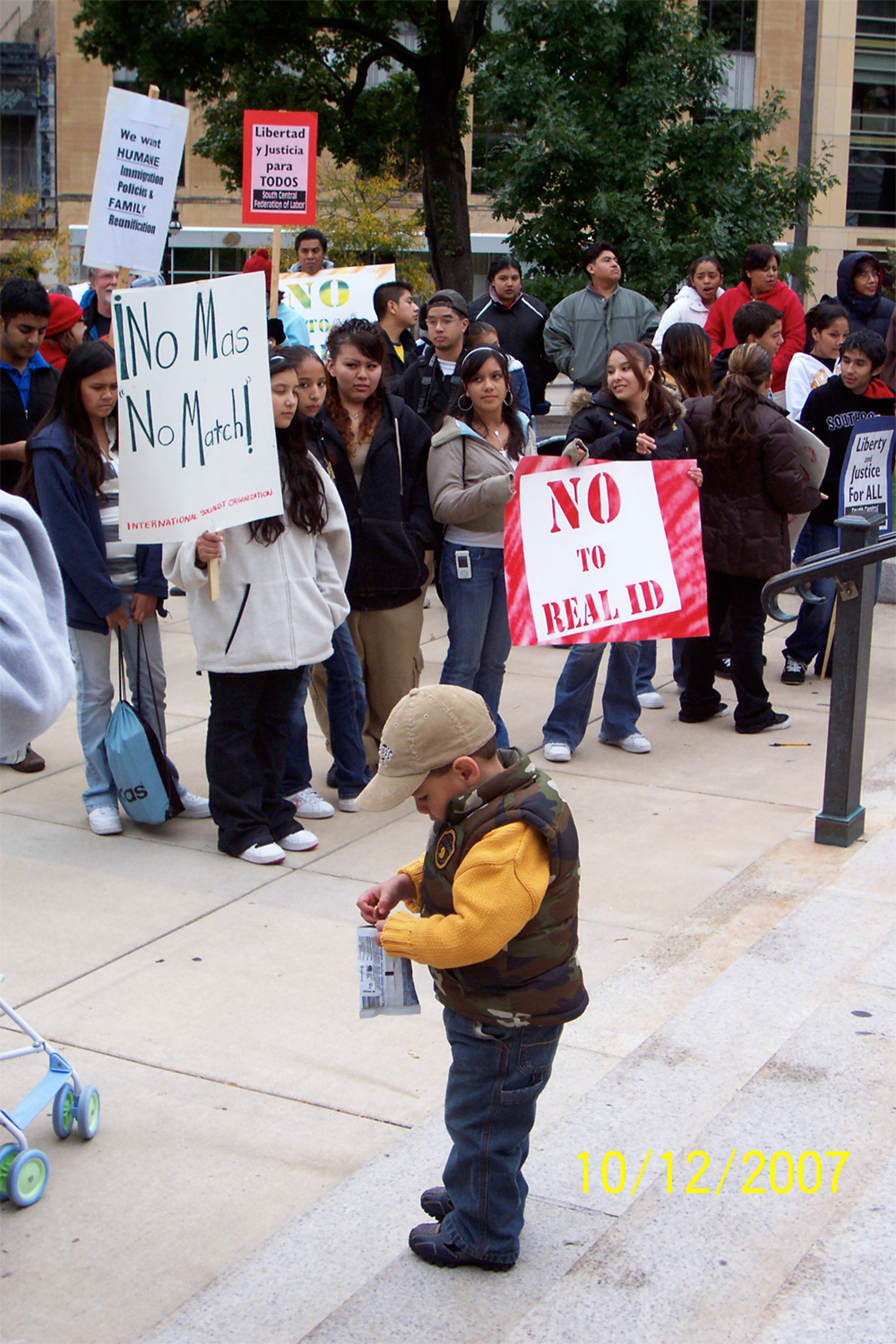
Multiple generations mobilizing against Real ID.
The participation and engagement of multiple generations of Latinas/os (i.e., adults, adolescents, young children) meant that adults were making available a particular set of cultural resources that younger generations might employ and appropriate over time for their own purposes. As I undertook ethnographic studies of language and literacy across learning environments, these mobilizations indexed the contradictions and double binds confronted by Latina/o families and communities. That is, in the course of carrying out ethnographic research across distinct communities, these enacted political actions and activities became evident once again in Stillwater as I sought to understand the social contexts of development for Midwest Latinas/os. Moreover, these attempts to understand this particular Latina/o community in depth reveal the varied cultural practices enacted across home–community spaces that represent children’s and youths’ distinct sociocultural contexts of learning and development.
Everyday Resistance as Cultural Resource: A Community Example
The examples of everyday resistance I share here are drawn from my observations of and participation in everyday resistance across Stillwater settings, as well as inquiries into media sources on- and offline (e.g., Latino-based listservs) regarding the coordination of these actions, strategies, and activities. I interpret these everyday practices as “resistance” because they tended to advance social justice in challenging the domination and oppression that they experienced as (im)migrant Latinas/os of Stillwater experienced (Solórzano & Delgado Bernal, 2001; Villenas & Deyhle, 1999). These practices also generated new ways of thinking about the affordances and constraints of Latinas/os’ everyday lives, including social and educational policies that could facilitate novel life trajectories. These examples of everyday resistance pertained to issues of postsecondary access and bilingual education and illustrated the distinct ways sociopolitical contexts come to shape—and be shaped by—families’ and communities’ cultural resources. These political actions and activities were spurred by youth-based and community-based groups. According to media sources and listserv exchanges, these groups regularly distributed detailed information about pending legislation and raised awareness about the potentially detrimental effects of this legislation on Latinas/os. In listserv exchanges, for example, individual members cited demographic data about recent influxes of Latinas/os to Stillwater, which affected the city’s growing school districts and workplaces. These exchanges spurred collective political actions and activities to challenge pending legislation, proposed social and educational policies, and emerging school district courses of action.
The first example of everyday resistance relates to mobilizations that emerged in support of the federal Development, Relief and Education for Alien Minors (DREAM) Act, which would allow undocumented (im)migrant youth to pay in-state tuition and obtain U.S. citizenship in the long term (CityTownInfo.com, 2009; Flores, 2009; Luse, 2009; Pabst, 2011b; Richard, 2009). Currently, regardless of time in the United States, academic achievement, and potential, many low-income undocumented youth are required to pay international tuition costs, which they are unable to do. To resolve this issue, the DREAM Act has been introduced, modified, and rejected for more than a decade at state and federal levels. Still, it invokes some deeply entrenched and long-standing contentions around (im)migrants and their place in U.S. society. This policy debate reveals an enduring double bind: In a country that espouses democratic ideals, meritocracy, justice for all, and equal education, this policy reveals the contradictory racialized xenophobic discourses that systematically exclude modest-income (im)migrant youth from socioeconomic mobility. Following Engeström (1986), enduring contradictions and dilemmas not only constitute everyday life for Latina/o youth but also are the seeds of productive learning and development. From a learning-as-instrument-creation perspective, then, schooling can facilitate the productive resolution of students’ double binds, which can potentially incite individual transformation and societal change in the long term.
The DREAM Act, which Wisconsin’s governor had already signed into law in 2009, 4 roused high school and college students as well as grassroots organizations in Stillwater to strongly advocate for enactment at the federal level. It allowed undocumented youth to pay in-state tuition at the state’s postsecondary institutions; a well-known grassroots organization constructed the issue the following way:
[Undocumented] children . . . must pay the same inflated college fees as international students [and] that price tag slams the door of learning shut. The DREAM Act is a bill that tries to right this wrong, but more pressure is needed to win this change.
5
This particular issue instigated collective actions among Latina/o youth of mixed legal status, such as traveling to Washington, D.C., to stage a mock graduation ceremony in front of the White House. Various media sources documented numerous mobilizations centered on this issue (Flores, 2009; Richard, 2009). These sources quoted undocumented youth who urged coparticipants to be leaders and advance a struggle that is specific to U.S. Latinas/os. By participating in these political actions and activities, Latina/o U.S. citizens and residents acquired and appropriated collectivist discourses about the common histories and obligations they share with their undocumented counterparts. One newspaper source quoted a U.S. resident youth who participated in these actions precisely because she felt compelled to fight for—and with—her undocumented peers. She stated, “If I were undocumented, I would like to have others stand up and fight with me” (Pabst, 2011a). These discourses impelled mixed-status Latina/o youth to undertake causes reflecting their shared social experience as current and former (im)migrants.
Collectivist discourses also recognized that across time, generations, and collections of individuals, deliberate types of educational change were imminent, which is in keeping with CH/AT perspectives. That is, activities related to “standing up and fighting” for educational policies that provide postsecondary access have societal consequences, as “true” learning occurs when current tools and artifacts no longer resolve contemporary double binds and enduring dilemmas (Engeström, 1986). The understanding that societal change requires consistent attempts to resolve double binds was expressed by a youth, quoted in a newspaper article, who explained, “A movement is a step-by-step process. Change is not made from morning to night. You have to make the base for it. And I think we will make the movement work. Perseverance is all we need” (Richard, 2009). Thus, participating in small-scale mobilizations entailed a degree of hope and persistence about the potential for change.
In Stillwater, middle school, high school, and college youth uploaded YouTube videos that documented hundreds of Latina/o youth dressed in graduation caps, gowns, and regalia marching to the state capitol and demanding passage of the DREAM Act at the federal level. Coordinated by high school, college, and community-based organizations, the demonstrations featured student speakers who spoke directly about their contradictory experiences as U.S. immigrants. They made links between their educational plight and broader immigrant reform, as exemplified by a female eighth-grade student who spoke via a megaphone:
I was brought to the United States without having a say and I know many kids with the same experience, that live with the fear of coming home one day to find that both their parents have been deported. So please help all those kids who fear their parents being deported and help us accomplish our goal of getting a better education. Help us support the DREAM Act and better the immigration system in this country.
This student invoked the contradictory status of undocumented students who have been raised in the United States for most of their lives and yet live in fear of deportation for themselves and/or their parents. Her plea for immigration reform was, however, linked directly to “getting a better education.” That is, comprehensive immigration reform was a desired outcome insofar as this reform could facilitate viable postsecondary access. Other speakers connected the plight of undocumented immigrants to the country’s well-being. A female college student explained, “As long as our immigration system is kept broken and outdated, our economy, American families, all American workers, and students will keep suffering and facing challenges as a nation.” Her analytic stance is that an inadequate federal immigration policy detrimentally affects all families, students, and workers, as well as the national economy. One important analytic point pertains to her conviction that the immigration system in the United States is “kept” faulty and insufficient, which simultaneously indexes the amenable nature of immigration policy.
As they participated in strategy meetings, interacted with peers to coordinate actions and activities, and engaged jointly in mobilizations, Latina/o youth appropriated various forms of social analyses to name, interrogate, trouble, and reconcile the contradictions and ambiguities salient to Latina/o (im)migrant youths’ education. These activities promoted equitable policies (e.g., comprehensive immigration reform) that would allow undocumented students viable access to postsecondary institutions. Latina/o middle school, high school, and college youth recommended equitable solutions that could mitigate undocumented youths’ trajectories by enabling their ability to access, complete, and finance a four-year college education. To substantiate these recommendations (e.g., the DREAM Act), participants circulated social analyses and discourses about ways particular social policies “slam the door shut” on education for an already vulnerable student population. They argued that undocumented youths’ opportunities for socioeconomic mobility are ostensibly constrained by current educational policies that bring into play their legal status to restrict their educational participation.
As emphasized in CH/AT perspectives, these youths’ everyday resistance practices were replete with acts of reproduction and production, re-creation and transformation in ways that sought to transform social and educational macropolicies (e.g., exclusionary educational policies). Although these activities had consequences for individual youths’ learning and development in and out of school contexts, processes of production and transformation can come to have societal repercussions as well and potentially incite more equitable policies and institutions (Engeström, 1986). Processes of production and transformation were evidenced in youths’ interrogation and appropriation of dominant discourses around meritocracy, democracy, and justice in U.S. capitalist society for new and pressing purposes—even as they realized that societal circumstances are historically determined. Regarding the plight of undocumented students in particular, reimagined artifacts that transcended actual constraints were in process and in the making as youth realized forms of imaginative praxis (Wartofsky, 1979). Moreover, Latina/o youth articulated reimagined visions for (im)migrant youths’ educational futures, which included postsecondary access.
This example of everyday resistance, therefore, is a reminder that human learning across everyday practices and contexts is inherently sociopolitical and has the potential to produce radically different social worlds. The analyses, knowledge, understandings, and insights youth employed in/through everyday resistances reveals the cultural resources researchers and educators could utilize in teaching, learning, and developing curricula. One strategy can include deepening students’ knowledge of these sociopolitical and equity issues from the perspective of community experts and grassroots activists.
I inquired into similar forms of everyday resistance that emerged in Stillwater when a smaller, nearby school district announced its plan to terminate—or at least significantly diminish—its bilingual programs, which maintained the use of Spanish from kindergarten through fifth grade. In highly publicized deliberations, the school board sought to reduce its K–5 program to a K–3 program. According to media reports, the school board invited several university researchers to provide expert testimony at the school board meetings to justify the proposed reduction. Their statements pertained to the lack of one “best” method for educating language minority students and the inevitable segregation of Spanish speakers from English speakers in many bilingual education programs. This latter statement acknowledged that the provision of primary language instruction for emergent bilingual students at times leads to de facto student segregation by language background depending on school demographics (Delgado Bernal, 1999). In addition to this expert testimony, Latina/o parents, teachers, youth, and community members delivered their own testimonies and observations. While the extent to which these individuals coordinated their actions is unclear, it was evident that communication and persuasion methods migh have been used to realize a large presence at school board meetings.
At standing-room-only school board meetings, Latina/o community members, parents, and educators engaged in persuasive argumentation and appropriated educational discourses to attempt to dissuade board members from approving the proposed bilingual program reduction. Specifically, media sources reported that Latina/o parents and Latina/o district staff appropriated educational discourses about the positive impact of parent involvement in students’ schooling, deliberative processes around district language policies and programs that must include parents, and discussions of the rights of parents to advocate on behalf of their children (Jovaag, 2008b). Collectively, they urged the school board to reconsider the diminishment of bilingual programs, especially since local schools were experiencing growing numbers of native Spanish speakers who relied on Spanish language instruction and support.
To participate in these cultural-political exchanges, parents, bilingual teachers, and community members utilized existing district data to highlight the overwhelming success of its K–5 bilingual education programs. They also appropriated dominant educational discourses to argue that bilingual programs and the substantive use of Spanish for school activities allowed Spanish-speaking parents opportunities to support their children’s schooling. Additionally, parents’ and youths’ participation at school board meetings suggests they understood that policy making required legally mandated procedures, including public hearings where parents and community members could voice their concerns—in English and Spanish—about specific issues, proposed policies, and policy changes. That is, they appeared to possess a relative degree of knowledge, insights, and understandings about the deliberative processes and procedures pertaining to educational programming for language minority children. Importantly, their cultural-political exchanges made their knowledge, insights, and appropriated discourses available to the Latina/o youth and children in attendance.
Eventually, the school board voted unanimously to reduce the district’s bilingual programs. Some parents viewed the board’s reduction as “blatantly and pervasively racist” (Ferolie, 2008). Media sources reported that many Latina/o parents in particular believed an injustice had occurred; one Latina parent stated, “I’m in shock right now. . . . I feel in my heart that . . . they didn’t take the parents into consideration. . . . I hope that they reconsider their position” (Jovaag, 2008a). These representative responses suggest that Latina/o parents were disappointed by the board’s decision and had developed keen analyses about the inherent sociopolitical and ideological dynamics surrounding this educational issue. Although it is difficult to interpret accurately the perceptions that undergirded these parents’ stances, it was clear that some parents linked the policy outcome to racist attitudes and to the marginalization of nondominant peoples (and their desire for equitable educational policies). Thus, the participation of Latina/o parents, youth, teachers, and community members in policy-making deliberations generated cultural resources related to persuasive data-driven argumentation, knowledge about policy-making procedures, social analyses, and discourses about the social processes (e.g., parent involvement) that affect bilingual students’ academic success.
My deeper inquiry into forms of everyday resistance in and around Stillwater revealed that Latina/o youth had participated in public exchanges about bilingual education. These youth shared their experiential knowledge and analytically derived stances about these programs in the media, which revealed some diversity in the ways community members responded to double binds. In a joint editorial titled “Problems With Bilingual Education” (Thao & Gonzalez, 2005), two bilingual youth—one Hmong and one Latina—articulated their insights and critiques in a column that resulted from their internship at a local newspaper. Having participated in both bilingual and English as a second language (ESL) programs across their academic careers, these youth utilized discourses about academically rigorous curriculum practices and de facto segregation in these programs.
They began their editorial with a description of a “typical” day in a bilingual classroom, which they perceived as slow and disconnected from academic content:
Imagine yourself in a bilingual class where everyone is talking about everything but the classroom subject—and in different languages. . . . Even worse, the teacher is telling you things you already know. Sometimes the teacher is going so slowly that you lose interest.
They perceived that, despite the linguistic diversity, bilingual classes were too easy, redundant, and simple. In the remainder of the editorial, they continued that bilingual programs were unnecessary for intermediate English speakers and that they segregated bilingual students from English-speaking peers. Based on their observations and analyses of their schooling experiences, these youth concluded that the segregation of bilingual students meant they had limited opportunities to acquire English. Since they were aware Hispanic/Latino students participated overwhelmingly in English–Spanish bilingual programs, they posited that these programs were particularly harmful for these students. They believed that bilingual students “could have learned [English] faster if they were in a classroom where English was mostly spoken.” The remainder of the editorial revealed that these youth seemed to understand that some language program “tracks” (i.e., ESL, bilingual, and mainstream) reproduced educational inequities, did not effectively differentiate among English learners and their language and academic competencies, and limited interactions between students from diverse backgrounds.
Although the Latina teen journalist stated that bilingual programs create “a sense of shared cultural understanding” among ethnic minorities, the joint editorial nonetheless promoted ESL and English mainstream programs. Because ESL programs hone English learning, the teen journalists concluded,
We think that this program worked better because everyone was mixed together, and ESL students could still talk with one another. . . . We hope by reading about our experience you might help change the law, so everyone is given the same chance to succeed.
In addition to making an ESL program policy recommendation, they suggested that integrating culturally and linguistically diverse peers would benefit all students. They also implied that given their own academically unchallenging experiences in bilingual programs, ESL and English mainstream programs might prove academically rigorous.
Further, these youths’ perspectives aligned with the concerns expressed years later by board members in 2008, but they also drew on their unique schooling histories to substantiate their political views and advocate a specific educational policy. As an artifact, these youths’ editorial revealed some problems and contradictions they perceived regarding bilingual education and made recommendations they believed would enhance the academic potential of English learner students. They also participated in cultural-political exchange, critically analyzed schooling experiences they deemed problematic, and appropriated circulating policy and educational discourses to articulate their stances to a broader audience. They joined other Latina/o parents and bilingual teachers who challenged publicly those potentially detrimental language-in-education policies and practices.
These examples of everyday resistance reveal that the Latina/o community in Stillwater made tacit and overt, local, and small-scale efforts to resolve their dilemmas even as the activity systems of state and federal legislatures (e.g., policy-making bodies) and educational bureaucracies (e.g., school boards) constrained their efforts. Although their political actions and activities did not affect equitable policy change, their collective efforts nevertheless generated historically “new” artifacts, instruments, and tools when the “old” ones no longer sufficed. Engeström (1986), following Bateson (1972), acknowledges that it is “indeed a rare event” for double binds to transform societal activity and that such changes occur across longer term cycles of stepwise change efforts. Regarding this long-term process, Engeström and Sannino (2010) emphasize that in dealing with the “challenge of creating something qualitatively new, not a task of adaptation and improvement . . . intermediate steps must be taken and experiments need to be made to open up and test the road toward an envisioned future” (p. 19).
In their creative experiments, Latinas/os mobilized large groups, used Spanish and English to deliver statements publicly, staged a mock graduation, and named (in)justice across social spaces (e.g., streets, board rooms, news media) to envision socially just policies and futures. These examples showed that they employed primary, secondary, and tertiary artifacts (Wartofsky, 1979) as they used tools and technologies (e.g., a mock graduation, mobilizations) to promote new social and educational policies that might realize the potential for a reimagined socially just future for Latina/o children and youth. Youth of color similarly appropriated available technologies (i.e., opinion editorial) to express their unique albeit critical stances regarding bilingual education, which contributed to ongoing local debates about effective schooling for English learners in the Stillwater area. As Latina/o youth, families, and communities engage in social and critical analyses, I content that we do these students a serious disservice when we ignore the valuable cultural resources, tools, and artifacts at their disposal.
Discussion
Recontextualizing the double bind illuminates the community resources that emerge because of the productive, potentially transformative activities individuals coordinated jointly, which created distinct learning opportunities for youth and children. The examples of everyday resistance provided here reveal the emergent, unanticipated double binds, contradictions, and dilemmas inherent to the material circumstances of Latinas/os in Stillwater—for example, undocumented legal status, different language backgrounds, and socioeconomic vulnerability. They advocated equitable social and educational policies that reconcile some contradictions undocumented youth experience in relation to U.S. public schooling and that disrupt systemic forms of disenfranchisement (i.e., the diminishment of non-English languages in schools). Specifically, by participating in strategy meetings, planning political actions and activities, coordinating on- and offline communications to mobilize Latinas/os, and engaging in cultural-political-ideological exchanges on the streets and in board meetings, Latina/o youth and their communities employed—and generated—cultural resources in/through everyday resistance that could be leveraged in school contexts.
As they mobilized the community around the DREAM Act, Latina/o parents, youth, and activists publicized information and raised awareness about pending social and educational policies, including analyses of how such policies might particularly affect Latina/o students of mixed legal statuses. One skill included the use of demographic and district data to substantiate claims about the potentially detrimental effects of these policies on growing Latina/o student populations. Further, Latina/o youth sought to influence public policy debates: for example, they staged mock graduation ceremonies and marched in graduation regalia to emphasize the finality of high school graduation for many undocumented (im)migrant students. These cultural practices involved participating in collectivist discourses that emphasized leadership skills; creating strategies for strengthening allegiances and solidarity (e.g., persuading others); developing social analyses of the contradictions and ambiguities Latina/o students experience; engaging in critical interrogations of dominant discourses about meritocracy, democracy, and justice; and promoting collective hope, reimagined visions, and persistence in the midst of everyday struggles.
Regarding bilingual education, Latina/o parents, community members, and youth engaged in persuasive argumentation to decry the proposed reduction in language-in-education programs for Latina/o language minority students, which required knowledge of the deliberative policy-making process. To develop these rationales, they employed analytical and argumentative skills about parents’ rights to advocate for educational policies, the positive effects of Spanish language instruction and support on student learning, the opportunities Spanish language schooling creates for enhanced parent involvement, and the effectiveness and success of bilingual programs through data analyses. Moreover, as reported across media sources, their responses to the board’s decision to reduce the district’s bilingual programs suggested that Latina/o parents, activists, and community members keenly acknowledged the sociopolitical dimensions and ideologies essential to the policy-making process (e.g., racist attitudes, English-only postures). In an opinion editorial, youth made use of their experiential knowledge and analytic skills to articulate their critiques about some language-in-education programs. They analyzed their and their language minority peers’ schooling histories to comment on the lack of academic rigor, de facto segregation, English language ability tracking, and the potentially negative cumulative effects of these program practices (e.g., tracking) on students’ long-term trajectories.
Everyday resistance around policies that potentially enhanced or constrained the academic and life trajectories of Latina/o (im)migrant students incited social analysis, critical thinking, problem solving, reimagined policies and social worlds, and the appropriation and transformation of circulating discourses about education, democracy, meritocracy, equity, and justice. Latina/o youth and communities circulated analytic discourses about the need to collectivize, the potential for long-term social change, the contradictions and ambiguities (im)migrants navigate, and the educational programs that enhance bilingual youths’ academic trajectories. This particular set of sociocultural resources employed and generated in/through everyday resistance illuminates the particular skills, practices, and discourses that researchers and practitioners can employ and expand in the service of teaching, learning, and developing curricula. These robust cultural resources complement the type of knowledge and epistemologies that count in dominant teaching, learning, and curriculum practices, and yet Latina/o youths’ and parents’ analytic thinking, legal and policy discourses, problem-solving strategies, and equity-oriented discourses remain invisible and marginal.
Connections to Curriculum and Schooling
These examples of everyday resistance illustrate the double binds that generate cultural resources to advance difference-as-resource curriculum approaches (Cole, 1998; Gutiérrez & Rogoff, 2003). However, I reemphasize that in the Stillwater examples of everyday resistance, social actors were not “given” or led to the double binds and contradictions. Instead, individuals reached a “need state” and identified these double binds from within—initiating their own problem-solving attempts. They experimented with their attempted albeit unique artifacts and resolutions to these double binds, neither of which could have been known in advance (Engeström, 1986; Engeström & Sannino, 2010). To resolve these emerging and evolving double binds, social actors engaged in productive learning as they transformed and created new artifacts and instruments. Thus, in making explicit connections to curriculum and schooling, I emphasize that leveraging the cultural resources generated in/through everyday resistance requires a significant recognition of Latina/o students’ problem-solving inclinations and solution-driven actions and activities. Amplifying these youths’ cognitive flexibility is an equally important aspect of these connections.
To organize practices that make use of Latina/o students’ cultural resources, researchers and educators could survey students, families, community members, and community-based organizations to identify urgent issues, plights, and contradictions. In this regard, the work of Moll and his colleagues in helping teachers learn and grow as social scientists is particularly instructive, even if this professional practice presents its own unique set of challenges (Moll & González, 1997). If there are forms of everyday resistance in which Latina/o students, families, and communities participate, educators can coordinate opportunities for a broader range of students to understand deeply the cultural, political, and historical circumstances that affect these dilemmas and how they have been resolved (or not) in the past or recent times. An in-depth examination might create opportunities for learning across the curriculum, as distinct content areas would be pertinent to these inquiries. Further, Latina/o students, parents, and community members who engage in everyday resistance can contribute as experts with unique insights and knowledge of the dilemmas realized in their communities. Such a survey might also include an inventory of previously instantiated forms of everyday resistance so that educators and students can reflect on the novelty and urgency of current and future problem-solving artifacts and efforts.
Moreover, primary sources and data (e.g., newspapers, websites, YouTube videos, etc.) can be used as classroom texts such that their constituent knowledge and worldviews might be questioned, applied to real-life circumstances, compared to other texts, and interrogated for discrepancies. That is, everyday resistance reveals particular discourses, critical perspectives, and texts that practitioners could used to compare and contrast with other readily available texts. For example, transcripts of the district board meeting might be compared analytically to the media’s representation of the debate around bilingual education, to interviews with individuals who participated in said political actions and activities, to editorial opinions, or to Internet-based texts (e.g., blogs, organization websites). These documents could be compared with the major state and federal legal cases and policies that affect bilingual education more broadly (Brisk, 1998). Such teaching and learning strategies provide educators opportunities to help students comprehend the institutional, political, and societal structures that shape and affect their lives and the processes that simultaneously sustain and threaten their viability—for example, policy-making processes, legal systems, the role of the media and popular culture, and so forth. Students could write in-depth analyses of these processes as they relate specifically to the everyday resistance in their homes and communities, incorporating sources, data, and their critical interpretations in articulating their own stances and critiques.
These curriculum strategies can further facilitate content area learning, depending on the nature of the everyday resistance. For example, students can write their own informed opinion editorials that they could submit to local newspapers, create informational newsletters that they could distribute in their neighborhoods, create Internet websites and write blogs about these dilemmas, create mini-documentaries that they could screen in their neighborhoods, or organize community informational meeting and workshops. With regard to teachers, González and her colleagues provide critical insights; in their research, teacher participants developed thematic units centered on household knowledge that spanned content areas—that is, literacy, mathematics, science, and so on (González et al., 2005; Moll, Amanti, Neff, & Gonzalez, 1992). The work of researchers in this regard is essential. With practitioners, we can document students’ problem-solving activities and the artifact creation already occurring across home–community spaces and continue to theorize what counts as learning.
A paramount distinction here is that researchers and educators cannot necessarily make these dilemmas apparent and visible to students. Instead, we can interrogate the sociopolitical dilemmas already of clear concern to some Latina/o students, families, and communities. Moreover, this approach requires an understanding of the social critiques that emerge dialogically and recursively in home-community spaces (Delgado Bernal, 1999; Mercado & Reyes, 2010; Pacheco, 2009), which contrasts dominant transmission modes of classroom learning. This approach aligns with some models of critical literacy that begin with sociopolitically informed notions of “the local”:
taking up questions of what kinds of local textual practices can and should be forged in relation to larger social forces and dynamics, and how community, technological, and global change can form the very bases and objects of study of a critical literacy curriculum. (Luke & Freebody, 1997, p. 3)
Thus Latina/o families’ and communities’ everyday resistance— and the cultural resources they use to respond to local and global change—can be the source of critical literacy approaches that view tool and artifact transformation as fundamental to local problem solving. In this way, educators can extend and expand Latina/o students’ problem-solving and artifact-creating proclivities in the service of schooling that addresses the social, political, and economic interests of students, families, and communities (Freire, 1972/2004). While these connections can inform curriculum and schooling with adolescent students, age-appropriate practices can be developed for younger students (see Lewison, Flint, & Sluys, 2002).
One final connection to curriculum pertains to the potentially powerful insights that educators, including researchers, teacher educators, and practitioners, could gain by becoming directly involved—potentially as allies—in the everyday resistance instantiated in their students’ communities. This witnessing could reveal the knowledge sources, critical and analytical thinking repertoires, worldviews, and discourses about (in)equity, (in)justice, and (in)adequate social and educational policies. Such deep forms of involvement can facilitate educators’ sociocultural competence (Moll & Arnot-Hopffer, 2005; Seidl, 2007) as well as a political and ideological clarity (Bartolomé, 1994, 2004) about the need for curricula to incorporate their varied intellectual capabilities. Nevertheless, I make this suggestion cautiously because educators increasingly grapple with inescapable pressures to meet the shifting demands of current high-stakes accountability policies, particularly if they serve educationally vulnerable students (Pacheco, 2010a, 2010b). Given this reality, assessments can evaluate the basic skills and knowledge to which practitioners, administrators, and educators are held accountable, while simultaneously advancing curriculum practices that extend and expand those problem-solving proclivities that Latina/o youth, families, and communities at times demonstrate. While high-stakes accountability frameworks increasingly narrow what counts as knowledge (Luke & Carrington, 2002), everyday resistance evidences—and can help amplify—the critical and analytic modes often associated with high-status academic content.
Reexamining Latina/o Cultural Difference: An Argument for Everyday Resistance
Attempts to enhance nondominant students’ learning potential are not new. A significant body of empirical work has demonstrated important ways in which resource-based, asset-based, and strength-based approaches could employ Latina/o students’ cultural knowledge, which has begun to transform difference-as-deficit models to difference-as-resource models. In this section, I close with some final arguments about the relevance of everyday resistance. Conceptualized as a particular set of social and intellectual tools that Latina/o communities generate as they attempt to resolve their double binds (e.g., detrimental policies), this notion advances scholarly work centered on highlighting the cognitive versatility Latina/o students acquire and develop across their transnational home, school, and community spaces.
First, rather than attempting to remedy any cultural “mismatches” between Latina/o students’ cultural lives and schooling, highlighting these students’ double binds and undertaking the problem-solving activities they actualize in/through everyday resistance could begin to realize highly relevant (and responsive) teaching and learning approaches. In essence, double binds and the cultural practices they engender (e.g., persuasive argumentation) can begin to redefine the goals of schooling. That is, schooling—and its concomitant curriculum practices—can begin to instantiate views of learning both as transformed by the cultural resources students develop across their contexts and as essential to helping students actualize the social and educational change they attempt in their communities. Schooling, in this way, can potentially become highly relevant to these students’ social and educational struggles.
Second, a focus on double binds, dilemmas, and problems affords researchers and educators deeper understandings about how Latina/o students’ cognitive versatility is implicated in individual, group, and social histories. That is, the histories of nondominant communities can be understood through the social and educational circumstances that reveal the fundamental macropolitical, structural dimensions to nondominant students’ cultural experiences (Engeström, 1999; Gutiérrez & Rogoff, 2003). In particular, the Latina/o social experience in the United States is affected by intersecting dimensions of race/ethnicity, culture, language, socioeconomic status, neocolonialism, and legal status (Solórzano & Delgado Bernal, 2001). Thus the cultural differences Latina/o students, families, and communities develop are inseparable from the sociohistorical, sociopolitical trajectories that constitute these differences (Cole, 1996).
Accounting for these legacies, Gutiérrez (2008), for example, draws on a unique leadership institute for migrant and immigrant farmworker youth in order to explicate “how poverty, discrimination, exploitation, anti-immigrant sentiment, language ideologies, and educational and social policies gone awry complicate current understandings in the learning sciences about learning and development” (p. 149). She argues compellingly that these Latina/o youths’ cultural lives necessitate a reconceptualization of learning as mutually constituted by their distinct sociohistorical, sociopolitical conditions. Similar analyses can be undertaken across other nondominant communities. For example, Hmong communities in Wisconsin have mobilized around contradictions and dilemmas particular to their unique cultural, linguistic, and political histories, such as the lack of Hmong representation in local and state political offices. As Hmong communities attempt to affect social change, such actions and activities make available a particular set of cultural resources and analytical skills to Hmong students.
Nevertheless, Lee (2002) urges that nondominant communities’ racial, ethnic, linguistic, and historical experiences in the United States be “neither denied, demonized, mythologized, nor oversimplified” (p. 287). Thus my intent here is not to glorify or essentialize the double binds and dilemmas that give rise to everyday resistance—and the social actors that realize them. Instead, I emphasize that Latina/o youths’ social histories and legacies fundamentally constitute these students’ learning trajectories and can further inform our theorizations of why and how sociocultural differences matter (Gutiérrez & Rogoff, 2003). In this regard, “radical localism” is essential as it conceptualizes the dialectical relationship between local resistance activities and societal structures that are nonetheless dynamic, permeable, and vulnerable to change (Engeström, 1999). Clearly, educational policies must support this important work. Educators and teachers would need more curricular flexibility and time to pursue thoroughly and understand in depth Latina/o and other nondominant youths’ problem-solving inclinations as they attempt to realize their reimagined futures.