




Abstract
In this article, we look at the barriers to international student mobility, with particular reference to the European Erasmus program. Much is known about factors that support or limit student mobility, but very few studies have made comparisons between participants and nonparticipants. Making use of a large data set on Erasmus and non-Erasmus students in seven European countries, we look at the barriers for participation. Results reveal the overall impact of financial barriers but suggest that it is personal barriers that help us to better differentiate between Erasmus and non-Erasmus students. The analysis suggests a two-pronged approach to increase participation: one focusing on better information and communication and the other stressing the benefits of Erasmus mobility.
Keywords
It has become commonplace to believe that international student mobility, defined as “students who cross national borders for the purpose or in the context of their studies” (Kelo, Teichler, & Wächter, 2006, p. 5), has a wide range of benefits at different levels. For individual students, there are presumed benefits regarding their personal development and labor market returns (Bracht et al., 2006). For higher education institutions, a high level of mobility among students—incoming and outgoing—is a sign of prestige and quality (Green, 2012; Wildavsky, 2010), not in the least because internationalization nowadays is an important indicator in global rankings (Hazelkorn, 2011). Finally, at the country level, mobility is portrayed to enhance international competitiveness, stimulate effective labor markets, and support the interaction between citizens of different countries (Institute of International Education, 2011). This applies in particular to degree mobility, whereby students move from one country to another for a full degree, but also to credit mobility, whereby students spend a period (in general between 3 and 12 months) of their study in another country and transfer their earned credits to their home degree (De Wit, 2008).
Mobility still reaches only a minority of higher education students, in spite of structural reforms to make European higher education systems more compatible, such as the Bologna process. However, in the European Union (EU), international student mobility as part of the home degree has steadily increased in the past years (Vossensteyn, Lanzendorf, & Souto-Otero, 2010). Erasmus is the largest mobility student exchange scheme for higher education in Europe and the flagship program of the EU. More than 4,000 higher education institutions from more than 30 countries take part in the program. The program requires universities to have signed a European charter, which implies the institutions promise to meet certain conditions regarding student exchanges taking place within the program—for instance, tuition fees at the host institution are waived and credits earned at the host institutions are to be recognized by the sending institution in accordance with a learning and training agreement signed by the sending and host institution and the student. The overwhelming majority of Erasmus students receive a grant (approximately 3% do not), which aims to cover (partly) the additional costs of temporary (3 to 12 months) study periods abroad. In 2007, international placements were introduced in the scheme (see Teichler, 1996, 2004, for more details on the evolution of the program). Erasmus currently enables approximately 200,000 students to study abroad each year (compared to fewer than 10,000 in its earlier years), just below 1% of all higher education students in Europe. If we compare this to the United States, both in absolute numbers and in percentage, the volume of the Erasmus program, in itself covering a proportion of credit mobility only within Europe and not including credit mobility to the rest of the world, is more substantial than study abroad in the United States (De Wit, Ferencz, & Rumbley, in press). The average age (nearly 23 years) and average duration of Erasmus periods abroad registered in 2010–2011 (6 months) are not very different from those in the early 1990s (European Commission, 2011; Teichler, 1996). In 2010–2011, students of social sciences, business, and law made up the largest share (35%) of those on Erasmus exchanges. The second-biggest share was made up of students of humanities and arts (32%) (European Commission, 2011).
Since its inception in 1987, close to 3 million students have participated in the Erasmus program. Its annual budget, mainly for student grants, was in 2011 in excess of 450 million. However, Erasmus is still far from achieving its 10% target of European higher education students being mobile during their studies as originally set and even farther from the target of 20% as set by the Ministers of Education of the Bologna signature countries in Leuven in 2010 and reconfirmed in Bucharest in 2012. It has been estimated that just fewer than 4% of the students use the opportunity of the Erasmus program to study some time abroad (Vossensteyn et al., 2010).
This raises questions regarding the barriers that higher education students face in relation to studying abroad. Yet, most research has been carried out on the problems and barriers faced by those students who go abroad rather than on the problems of those who do not (Findlay & King, 2010; Pietro & Page, 2008; Souto-Otero, 2008; Souto-Otero & McCoshan, 2006). Neither has there been a sufficient focus in research on the difference between participants and nonparticipants. Research has shown that many students interested in and actually signing up for Erasmus eventually do not participate (Maiworm, 2002; Maiworm & Teichler, 2002). Thus, as Teichler (2004) notes, we do not know how many students do not learn about ERASMUS and we do not know how many want to study abroad in its framework but do not obtain a grant. . . . The available information suggests that non-participation in ERASMUS is more often due to self-selection on the part of the students than to selection by the institutions. (pp. 398–399)
Despite this reasonable suggestion, we lack high-quality data on the barriers faced. This is the gap the article tries to address by taking stock of the barriers faced by participants and nonparticipants in the Erasmus program.
Surprisingly, there is not much use of theoretical frameworks to explain students’ motivations and barriers to study (temporarily) abroad. Part of the explanation is that much of the large-scale research on credit mobility has a particular focus on improving policy and practice (e.g., Bracht et al. 2006; Maiworm & Teichler, 2002; Souto-Otero & McCoshan, 2006) rather than theory development. These studies, however, reflect implicit views regarding the importance of certain barriers. Much of the extant research in this area fits a framework built around push and pull factors for international degree mobility (Mazzarol & Soutar, 2002; Maringe & Carter, 2007). The push-pull framework argues that decisions for studying abroad are driven by push factors (operating in the source country and initiating the student to decide to go abroad, e.g., a lack of student places, insufficient quality, political situation) and pull factors (operating in the host country, making the host country a desirable place to study, e.g., reputation and quality). However, this framework tends to put the emphasis on the motivations to study abroad. And yet, it is also important to look at the fears and apprehension of students that play a decisive role in the students’ decision to go abroad or not (Maringe & Carter, 2007). Indeed, whereas benefits are abounding, the challenges and risks of international mobility must not be neglected (see, e.g., Forbes-Mewett, Marginson, Nyland, Ramia, & Sawir, 2009). At this level, and extending the use of the push-pull analogy, we might talk about push factors that motivate students to go abroad (such as those mentioned earlier) and pull factors that retain the students in their home country. Within this set of pull factors, or barriers to international mobility, certain key influencers (information, influence of friends and family, the conditions of mobility, such as the terms of credit recognition) and risks and anxieties (financial and opportunity costs) have been identified (Kehm, 2005; Maringe & Carter, 2007), yet information on their relative importance for mobile and nonmobile students is scarce.
Literature Review
Most studies on credit mobility have been based on small samples and have not compared mobile and nonmobile students. Klahr and Ratti (2000), surveying mobile students, highlight the importance of the lack of recognition of periods abroad and credit transfer, insufficient knowledge of academic prerequisites and qualifications of various countries, differences in the structure of the academic year, disparities in the times at which examinations are taken, lack of foreign language skills, lack of information on the host country living conditions, culture and administrative requirements, lack of suitable accommodation for the study-abroad period, and additional costs to students, such as additional insurance coverage and bank and currency-exchange charges (see also Desoff, 2006; Goldstein & Kim, 2006; Langley & Breese, 2005; Lozano, 2011). Somewhat less important barriers were the requirement to study in a language other than English (see also Lane-Toomey & Lane, in press, for nonexchange students), insufficiently good grades to study abroad, lack of knowledge about what is involved in the exchange, lack of confidence, the inflexibility of degrees, and concerns about eligibility for loans and allowances. Sanchez, Fornerino, and Zhang’s (2006) survey of 477 students in the United States, France, and China suggests that students in the three countries identified the following barriers to study abroad: family, financial, psychological (related to aspects such as feelings for students’ own country and fear of new places), and social (related to friends and family)—although they experienced these to varying degrees.
Specifically in relation to Erasmus, Bracht et al. (2006) report that Erasmus students find problems most commonly in relation to accommodation, closely followed by financial matters, administrative matters, credit transfer, differences in teaching or learning methods, teacher support to students, taking courses in a foreign language, and a too-high academic level abroad, in that order. Kehm (2005) and Isserstedt and Schnitzer (2002) discuss the results of one of the very few surveys of Erasmus and non-Erasmus students, which was undertaken 10 years ago in Germany. They underline financial issues, separation from the family, lack of integration of programs at home and abroad, and language aspects as main individual obstacles to mobility. Sixty-one percent of nonmobile students cited financial aspects as a barrier, whereas 41% of mobile students did; 47% of nonmobile students cited separation from family or partner as a barrier, whereas 23% of mobile students did; and 43% of nonmobile students expected an increment in the duration of their studies because of study abroad. De Wit (2012), reflecting on the 25th anniversary of the Erasmus program, mentions the lack of involvement of the faculty and a move to a more bureaucratic and quantitative approach to Erasmus mobility in the past 15 years as barriers.
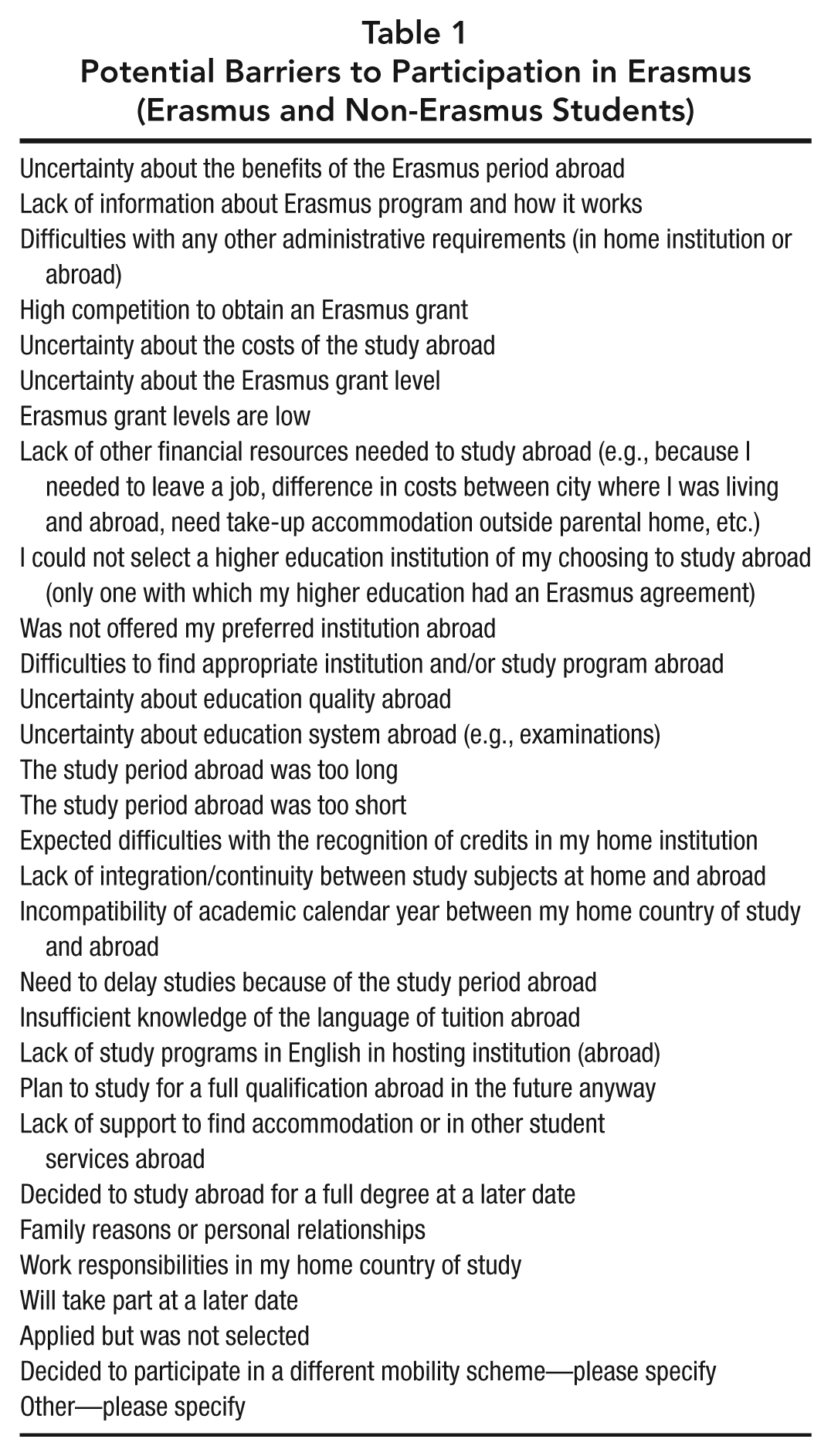
As highlighted, very few studies report on the main barriers that Erasmus students and non-Erasmus students perceive in relation to participation in the program. No study has systematically and at a large scale explored commonalities and differences in the way participants and nonparticipants perceive barriers to participation in the Erasmus program, a distinction of policy relevance when thinking about the design of incentives for participation in the program. This article aims to differentiate barriers for participants and nonparticipants and for different degree levels (bachelor, master, PhD). Against the background of the push-pull framework, we zoom in on the anxieties and risks (Maringe & Carter, 2007) that may inhibit students to engage in credit mobility. Our research goals therefore are to determine to what extent Erasmus and non-Erasmus students perceive the barriers to participation in the program differently and to identify barriers that are particularly important for nonparticipants. According to the literature reviewed, the factors or barriers explored in our study are of five types: financial barriers, barriers related to higher education system comparability, awareness and information barriers, personal background, and social background (see also Mazzarol & Soutar, 2002). On the whole, the survey upon which this article is based collected information on more than 20 individual barriers related to those five dimensions, as detailed in Table 1. Financial issues relate to the cost-covering perspective—studying abroad often implies a financial commitment on the part of Erasmus students—but also to the expected financial benefits from participation in the program. Erasmus condition barriers relate more specifically to aspects such as the administrative burden of the program, the choice of institutions, or the stipulated length of the study period abroad. Higher education system compatibility refers to aspects such as the structure of programs (e.g., whether they have the flexibility to include courses taken abroad), compatibility of academic calendars, and credit recognition. Personal characteristics can also be an important barrier to participation, including—most importantly—the ability to speak a foreign language. Social aspects, such as the nature of family and personal relationships and so on, may also hold students back. Finally, students need to be aware of the Erasmus program to participate in it, and they need to receive support in terms of finding a suitable institution or become familiar with Erasmus’s financial conditions and application procedures. Our approach thus conjectures that some variables are more important than others in differentiating between mobile and nonmobile students, consistent with previous studies (see also Ulubasoglu & Cardak, 2007). Following the results by Isserstedt and Schnitzer (2002) on the differences between Erasmus and non-Erasmus students, specifically, we hypothesize that barriers relating to family relationships, insufficient financial help for study abroad, and credit recognition problems will show the most important differences between Erasmus and non-Erasmus participants.
Potential Barriers to Participation in Erasmus (Erasmus and Non-Erasmus Students)
Data and Method
Our data set (Improving Participation in Erasmus [IMPAER]; clean data set, N = 17,845, including 11,517 Erasmus students, 4,974 students who consider participation in Erasmus but did not take part, and 1,354 students who did not consider participation in the program) is derived from a Web survey of Erasmus and non-Erasmus students commissioned by the European Parliament and carried out in 2010 in seven countries. 1 Countries were selected on the basis of variation in terms of the level of participation in Erasmus relative to their higher education population (high: Czech Republic, Finland, Germany, Spain; low: Poland, Sweden, United Kingdom), geographical spread, and size.
The survey contained questions for Erasmus students on demographic characteristics, difficulties encountered, and reasons for participation and questions for non-Erasmus students on demographic characteristics, reasons for not participating in Erasmus, and potential incentives for participation. Regarding the questions on barriers, the survey asked respondents to rate the importance of a large set of potential barriers from 1 (not important at all) to 5 (very important) in both surveys. Items were constructed on the basis of the literature review and items in earlier surveys.
The links to the surveys were distributed to institutional Erasmus coordinators in all countries, who were requested to forward these to Erasmus students (for the years 2008–2009 and 2009–2010) and non-Erasmus students in their universities. This enabled us to reach a large sample but also introduced certain limitations, as the degree to which different coordinators forwarded the survey and the quality of their contact lists cannot be fully guaranteed and certain biases may have arisen as a result. Surveys were available in seven languages to maximize response rates.
It should be noted that although Erasmus is the main route to foreign enrollment periods in Europe (Orr, Gwosć, & Netz, 2011, p. 165), a substantial share of students enroll temporarily outside of mobility programs. Our results apply to Erasmus students and their differences with non-Erasmus students only. Although the sample of non-Erasmus students could theoretically include students who have been mobile students outside the program, their proportion is likely to be marginal, as mobile students are a minority of all students. This conjecture receives further support by the marginal proportion of respondents to the survey who used the other category option in the survey question on barriers to report that they had not participated in the program because they had already undertaken a period of study abroad.
Data were analyzed through descriptive statistics and multinomial logistic regression. Multinomial logistic regression is employed when the dependent variable is categorical with more than two discrete outcomes and follows a similar logic to that of binary logistic regression. Discriminant function analysis may be used in the same situation but requires adherence to more assumptions. In multinomial logistic regression, the log odds of the outcomes are modeled as a linear combination of the predictor variables. The outcome variables in the model relate to the status of the student as Erasmus participant, non-Erasmus student who considered participation, and non-Erasmus student who did not consider participation. Predictors are dichotomous variables, coded as 0 = barrier not important and 1 = barrier important when respondents ranked the barrier between 1 and 3 and between 4 and 5, respectively, in the survey. The final selection of predictors included in the model was based on the literature review previously presented and model fit (cf. Stroud, 2010). Alternative approaches would have been using factor analysis to include factors as independent variables. However, this would have not recognized the value of prior knowledge in this area (Long & Freese, 2001) and would have made the interpretation of results more difficult and the results less amenable to inform policy.
Results
The survey sample offers a satisfactory balance across the seven countries, given that the countries differ in terms of the volume of incoming and outgoing mobile students. There was also a good representation of subject areas. The largest proportion of students came from traditional “Erasmus popular” areas: business and management, engineering and technology, language studies, social sciences and humanities. Some 54% of the respondents were studying for a bachelor’s degree, which is the main target of the Erasmus program. Approximately a fifth (21%) studied for a master’s program, and 1% for a doctoral degree. Almost a quarter of respondents (24%) did not provide information on their program of study. Most respondents (Erasmus and non-Erasmus) were younger than 24 years of age, with only a minority of respondents (less than 10%) being older than 25 years of age.
Having described main characteristics of the sample, we report survey results on the barriers faced by Erasmus and non-Erasmus students next. Table 2 shows the percentage of respondents in each category of students who reported the barrier as high or very high. The table reveals several patterns. First, there are some barriers of high importance to both participants and nonparticipants in the program. This is the case, in particular, for the level of the Erasmus grant. The grant level is considered too low by more than half of the Erasmus students, by 44% of those who considered participation in the program, and by 39% who did not consider taking part in the program. This suggests that as an individual takes participation more seriously and starts gathering information about the costs of mobility, it becomes clearer that the level of Erasmus funding may be insufficient. Two other common barriers perceived by both participants and nonparticipants as particularly strong are related to system compatibility: the lack of integration of studies at home and abroad and expected difficulties with credit transfer. This reflects that in spite of the action of the Erasmus program and compatibility efforts in the context of the Bologna process, recognition is not always a reality in practice. The scores of Erasmus students are higher than those of non-Erasmus students, suggesting that these are problems that do not deter from participation per se or that Erasmus students find the true extent of these problems only after they have started taking part in the program. The importance of financial and credit transfer aspects is in line with the results of Bracht et al. (2006) and Kehm (2005).
Self-Identified Barriers to Participation in the Erasmus Program by Type of Student (in Percentages)
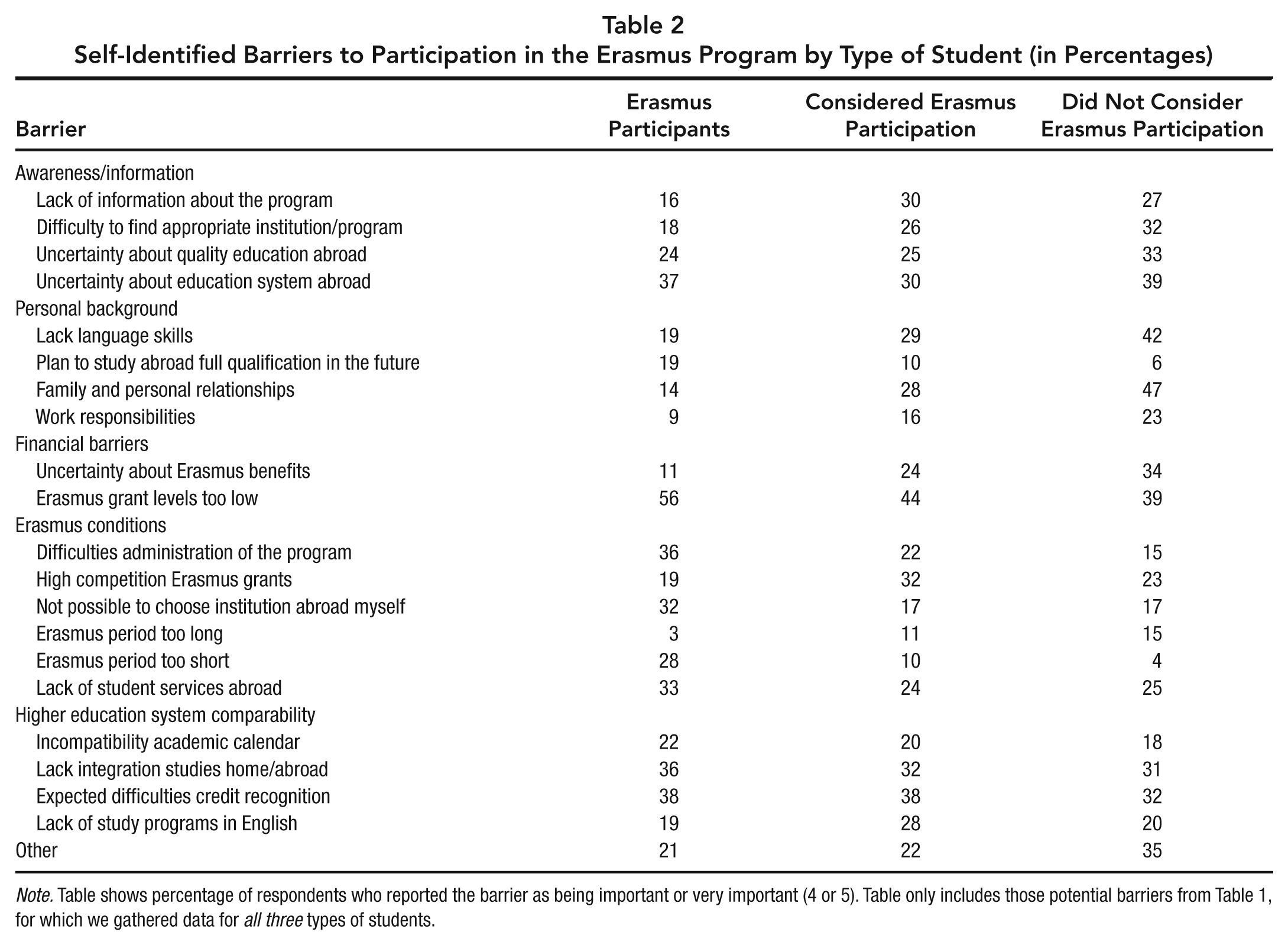
Note. Table shows percentage of respondents who reported the barrier as being important or very important (4 or 5). Table only includes those potential barriers from Table 1, for which we gathered data for all three types of students.
The table also shows important differences between Erasmus and non-Erasmus students. Some of these are not surprising, for example, the fact that Erasmus students experience problems with program administration, whereas non-Erasmus students are highly likely to have, at best, only heard of potential program administration problems. But differences are also noticeable in a range of other factors that are much more important to non-Erasmus students than to Erasmus students and therefore tell us something about core aspects that explain why those students decided not to participate in the program in the first place. Indeed, there are differences in relation to financial and informational barriers, as non-Erasmus students are much more likely to be uncertain about the benefits derived from the Erasmus program and more likely to be ill informed about the program in comparison to Erasmus participants. Regarding personal background, differences are even more evident. Those who did not consider taking part in the program are much more likely to have lower confidence in their foreign language skills and feel that personal relationships are a barrier to participation more often than those who considered participation in the program. The latter see these aspects as more of a barrier than the individuals who took part in the program. Finally, the table suggests the relevance of assumptions and possibly prejudice. For instance, the lack of information about the program and finding a suitable program abroad are considered less important barriers by Erasmus than non-Erasmus students. This finding is somewhat in contrast with the fact that information about the Erasmus program is generally easy to find. Also, as institutions need to sign agreements with foreign partner institutions within the Erasmus framework, the difficulty of finding an institution or program abroad may be exaggerated. That said, the survey reports on perceptions and views, and these should be valued as the students’ realities.
A multinomial logistic regression model helps us to understand differences between students in a more systematic way. The model presented in Table 3 regresses one outcome variable with three categories (having participated in Erasmus, having considered participation in Erasmus, and not having considered participation in Erasmus) on a set of predictors (for details on methods and tests, see Appendix A in the online supplemental material at http://edr.sagepub.com/supplemental). The best-fit model presented in Tables 3 includes as predictors barriers related to awareness and information factors (uncertainty about the quality of education abroad), personal background characteristics (language skills), social and family aspects (personal relationships), finance (the Erasmus grant is too low), and higher education system comparability (difficulties in recognition). Tables 3 shows that all variables are highly significant statistically and helps to clearly differentiate the three groups of students.
Multinomial Logistic Regression (Relative Risk Ratios): Perceived Barriers to Participation in Erasmus
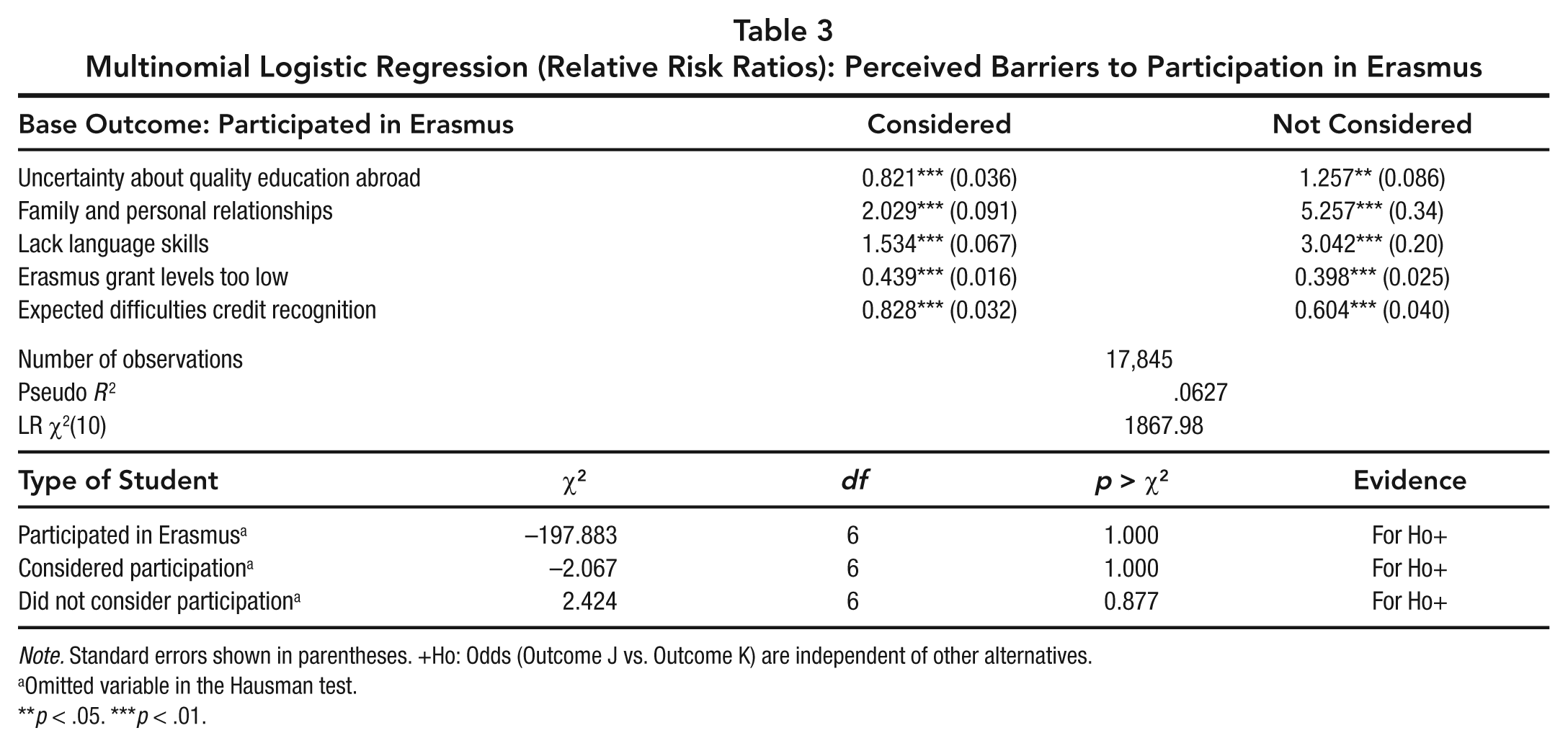
Note. Standard errors shown in parentheses. +Ho: Odds (Outcome J vs. Outcome K) are independent of other alternatives.
Omitted variable in the Hausman test.
p < .05. ***p < .01.
Since coefficients from multinomial logistic regressions are difficult to interpret, we present our regression results in the form of a relative risk ratio. A value greater than 1 indicates that the risk that the outcome will fall in the comparison group relative to the risk that the outcome will fall in the referent group increases as the value of the predictor increases—the comparison outcome is more likely. An individual in the participated in Erasmus category is thus expected to be more likely to consider educational quality a high barrier than those who considered going (other variables being equal) but more likely to consider that same factor a low(er) barrier than those who did not consider going.
On the whole, the results show a pattern whereby some barriers are more important for Erasmus students than for non-Erasmus students. Students who perceive the size of the Erasmus grant as an important barrier to participation are more likely to be Erasmus participants (the relative risk ratio [RRR] is 0.439 for those who considered participating in the program and 0.398 for those who did not). Similarly, Erasmus participants seem more alert to potential problems with credit recognition (RRRs are 0.828 for those who consider participation and 0.604 for those who did not, respectively). One explanation could be that students become more aware of these particular issues when they participate or seriously consider participating in the program. Social and personal barriers, on the other hand, are those that seem to be more important for non-Erasmus students. The relative risk of perceiving family and personal relationships as a serious obstacle are is 5 times higher (RRR = 5.257) for those students who did not consider participating in Erasmus compared to those who did participate and 2 times higher (RRR = 2.029) for those students who considered participation in the program but decided not to participate. Also the lack of foreign language skills as a perceived barrier characterizes nonparticipants (RRRs are 3.042 and 1.534 for those who did not consider and those who did consider participation, respectively). The results regarding educational quality are more mixed. The results of the comparison with the baseline group are different for those who considered and those who did not consider embarking on Erasmus.
Although the design of the study does not allow us to reach a firm conclusion on this, the findings lead us to an interpretation of a sequence in the decision making of students. They suggest that students first consider personal aspects (according to our data, these are key factors for nonparticipants). Only later do they consider other aspects, such as finances and system compatibility (factors of greater relevance for those who considered participating or actually participate in the program), even though those other aspects are still important barriers to participation. Therefore, it seems that individual characteristics and perceptions, rather than the conditions of the Erasmus program, deter students from participation in the first instance.
These general patterns were broken down by level of degree sought as reported by students. This revealed different patterns across first-degree (n = 9,591), master’s (n = 3,775), and doctoral (n = 252) students. Results for first-degree students were very close to the whole sample model, as all variables keep their levels of significance and direction of the relationship. The main differences with the whole-sample model are that the importance of family and personal relationships and difficulties with recognition diminish slightly. By contrast, the importance of lack of language skills as a differentiating factor between Erasmus and non-Erasmus students increases. For master’s students, family and personal relationships continue to be the clearest differentiating factor, being a more important barrier for non-Erasmus students, and their importance increases compared to the results for first-degree students. The level of Erasmus grant is also a statistically differentiating factor, but its importance continues to be lower for nonparticipants than for participants. Language skills and uncertainty about quality of education abroad become nonsignificant for those master’s students who considered participation, but they continue to be differentiating factors for those students who did not consider participation. Expected difficulties with recognition becomes nonsignificant for those who did not consider participation. The regression for doctoral students fits the data better than previous models (Pseudo R2 = .1230). It shows that for this group, only three variables are significant: Language problems are much less of a barrier for nonparticipants than in previous models, as is the level of the Erasmus grant. On the other hand, the effect of family and personal relationships increases strongly. Awareness and recognition issues become nonsignificant, as it could be expected, as doctoral students are likely to be savvier regarding their destination and are likely to seek progression in their doctoral projects rather than credit recognition. On the whole, the importance of family and personal relationships increases with degree level, whereas the importance of financial aspects (in particular, post–master’s level), language proficiency, and recognition as differentiating factors between Erasmus and non-Erasmus students decreases. More detailed results by level of degree sought are presented in Appendix B in the online supplemental material at http://edr.sagepub.com/supplemental. Further calculations were performed reducing missing values on the variable degree sought based on the age of the respondent and the reported duration of their studies. These calculations, available from the authors by request, showed the robustness of the results reported in Appendix B.
Conclusion
In this article, we have analyzed the importance of barriers to mobility and examined differences between Erasmus and non-Erasmus students on the basis of a large data set that included data across seven countries. The disaggregation and contrast between the perceptions of Erasmus and non-Erasmus students provides results not picked up by previous international surveys, which have tended to focus solely on students participating in Erasmus. On the basis of previous research, we hypothesized that barriers relating to family relationships, insufficient financial help for study abroad, and credit recognition problems would show the most important differences between Erasmus and non-Erasmus participants. Our results underline the effect of social and personal variables as a differentiating factor between Erasmus and non-Erasmus students. They especially highlight the importance of social and personal considerations that relate to balancing the risks (credit recognition, costs and benefits) and to managing personal anxieties (social factors). Finally, the study revealed significant differences regarding barriers by degree sought; students at different levels use very different decision criteria, an aspect that has so far been largely underplayed in both Erasmus-related research and program design. We note that our findings pertain to Erasmus mobility and stress that other factors may be at play for free movers.
The importance of social and personal aspects may suggest that the emphasis of the marketing and communication of the program should change to put greater emphasis on opportunities for personal development and the establishment of new relationships without losing old ones. Also an early intervention in terms of language learning should be supported (as suggested by previous research; Kehm, 2005; Souto-Otero, 2008). The study also points at the importance of financial support for Erasmus mobility. Yet European governments, in the light of the economic crisis, may oppose future increases the budgetary allocation for the program. If that were the case, a better communication of the benefits of international mobility may be increasingly important to continue to stimulate participation in Erasmus.