




Abstract
This study investigates the distribution of math teachers with a major or certification in math using data from the National Center for Education Statistics’ High School Longitudinal Study of 2009 (HSLS:09). The authors discuss the limitations of existing data sources for measuring teacher qualifications, such as the Schools and Staffing Survey (SASS), and show how HSLS:09 can be used to analyze the distribution of qualified teachers in mathematics. The results demonstrate that ninth-grade students in most need of a qualified math teacher are least likely to have one.
A substantial body of research confirms the importance of high-quality teaching and significant problems in ensuring qualified staff for hard-to-teach schools and classes (Wayne & Youngs, 2003). This research has paid particular attention to the phenomenon of out-of-field teaching, defined as teaching without a major, minor, or certification in a subject (Ingersoll, 1999). Out-of-field teachers are more prevalent among high-poverty schools, and teacher assignment policies within schools often pair the least-experienced teachers with the most challenging students (Kalogrides, Loeb, and Betelle 2011). For example, the least-qualified teachers in a school may be disproportionately assigned to the lowest level of mathematics, such as algebra I and remedial algebra. Reforms intended to improve the distribution of qualified and in-field teachers—including major efforts by the Obama administration such as Race to the Top—depend on the research evidence both to motivate and design appropriate ameliorative programs and policies.
Although state and local data have been used to spotlight problems in out-of-field teaching (e.g., Neild & Farley-Ripple, 2008), national-level evidence regarding teacher quality comes primarily from the National Center for Education Statistics’ (NCES’s) quadrennial survey of teachers—the Schools and Staffing Survey (SASS). SASS provides the ability to estimate rates of high school teachers with various levels of education and qualifications (Hill, 2011; Seastrom, Gruber, Henke, McGrath, & Cohen, 2004). Though a key source of information about the distribution of qualified teachers in the United States, SASS understandably has limitations in design and scope. SASS is designed to support estimates across multiple grades, such as Grades 9–12, rather than specific grades. Furthermore, SASS contains only student demographic data at the school level, which hinders direct comparisons of teacher qualifications to specific student needs.
However, SASS can be augmented through the use of other national data sets that provide detailed information about students served by teachers with different credentials. In this statistical brief, we use data from NCES’s High School Longitudinal Study of 2009 (HSLS:09) to present the new national estimates of grade-specific out-of-field teaching and new national estimates that explicitly link out-of-field teaching to individual student achievement. The findings suggest that the debate about teacher qualifications must consider specific grades, subjects, and within-school assignments in formulating corrective policies.
Data and Findings
HSLS:09 surveyed a nationally representative sample of ninth-graders in the fall of 2009. Follow-up surveys will report data from 2012, 2013, and 2016. Among other components, the base-year HSLS:09 survey included questionnaires for students, an algebra assessment, and questionnaires for sampled students’ math teachers. For this brief, we examined the qualifications of ninth-graders’ math teachers, as represented by their responses to questions about certification and college majors, against students’ algebra achievement. Out-of-field teaching in math is particularly important: As Wayne and Youngs’s (2003) systematic review notes, “high school students clearly learn more” from teachers with certifications or degrees in math. An in-field major was defined as having a bachelor’s degree or higher in mathematics or mathematics education. A certification in math was defined as holding a regular or standard state certificate, advanced professional certificate, or a certificate issued pending a probationary teaching period.
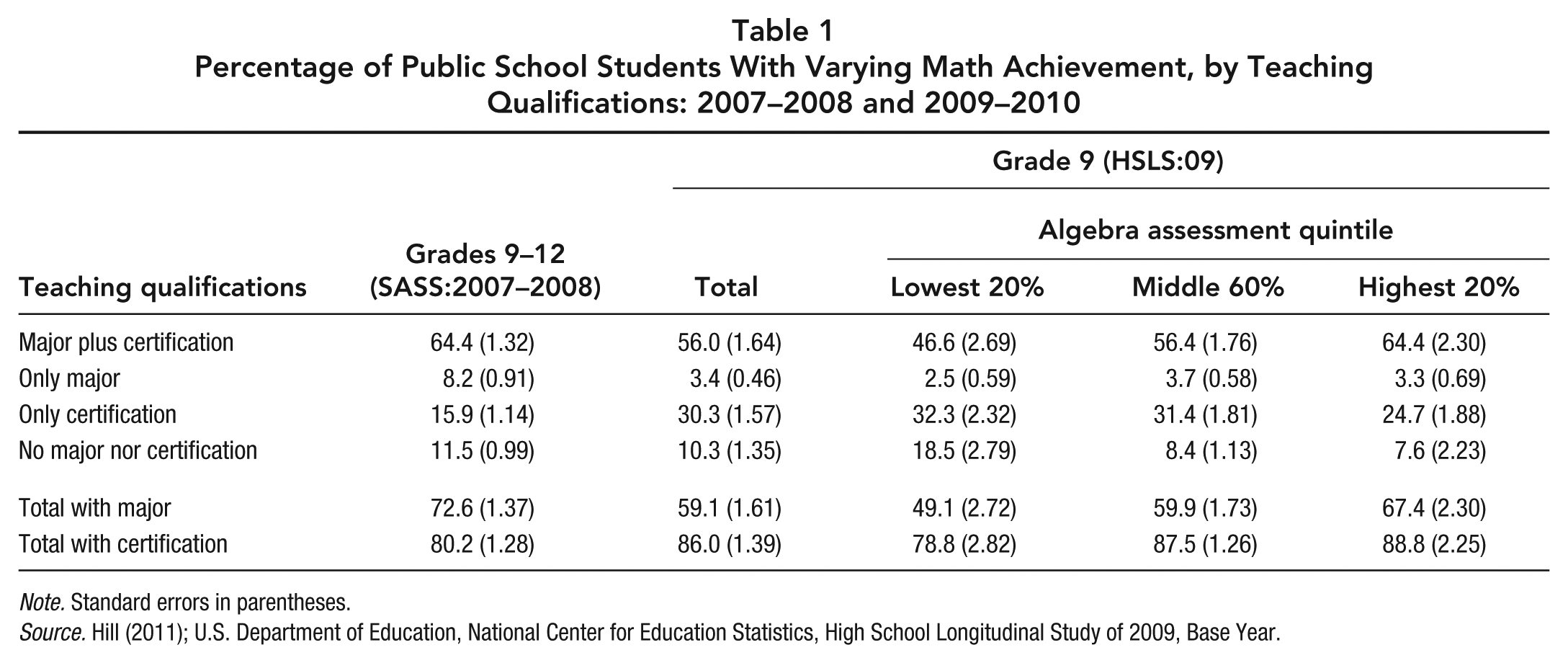
Table 1 presents the results from HSLS:09, along with published estimates from SASS for Grades 9–12. It is worth noting that in addition to being focused on a grade range rather than a specific grade, the SASS estimates are based on a slightly different definition of a qualified math teacher. NCES defines qualified math teachers in SASS as those with a major or certification in computer science or physics (in addition to math), for example. Nevertheless, as the principal source of widely published estimates on out-of-field teaching, the SASS estimates are an instructive comparison point for the HSLS:09 results.
Percentage of Public School Students With Varying Math Achievement, by Teaching Qualifications: 2007–2008 and 2009–2010
Note. Standard errors in parentheses.
Source. Hill (2011); U.S. Department of Education, National Center for Education Statistics, High School Longitudinal Study of 2009, Base Year.
Similar to findings from SASS for students in Grades 9–12, a majority of students in ninth grade have teachers with a major and certification in math. But 10% of ninth-graders have math teachers with neither a major nor certification. Furthermore, there are more ninth-graders taught by math teachers with only a certification (30%) than that suggested by the SASS data for Grades 9–12 (16%), and fewer taught by math teachers with only a major (3% vs. 8%). This result implies that more ninth-graders need expanded access to math teachers with a major in math than previously implied by overall estimates of high school students. The finding is particularly important given the foundational importance of algebra I, which is often taken in ninth grade.
Student-level achievement data add important information to the overall ninth-grade picture. HSLS:09 shows that low-achieving ninth-graders are much more likely than higher-scoring students to have a teacher with neither a major nor certification in math (19% vs. 8%). Likewise, ninth-graders in the highest-achieving quintile have a teacher with both a major and certification in math more frequently than those in the lowest-performing quintile, by 18 percentage points (64% vs. 47%, respectively). Both of these findings originate in the fact that only about half (49%) of lowest-quintile ninth-graders have a math teacher with a major in math. If decreasing out-of-field teaching specifically for low-performing students is a primary goal for policymakers, then training and assignment policies must address this dearth of math teachers with a math major among these students.
Conclusions
These findings reiterate the importance of paying close attention to the distribution of qualified teachers. The lack of qualified teachers in low-performing and high-poverty schools is well documented, but the HSLS:09 data identify specific problems in connecting qualified teachers to low-achieving students within schools. In particular, low-achieving ninth-graders, as well as ninth-graders overall, are more likely to have math teachers without a major in math than prior national results would suggest. Given the critical importance of the ninth grade to students’ educational careers, and the policy emphasis placed on mathematics education, this finding indicates that out-of-field teaching may be a greater problem than previously recognized.
More broadly, SASS should not be the only national source used to address out-of-field teaching, particularly for answering questions about individual grades or specific types of students. Although SASS will remain the premier source of information on out-of-field teaching—only SASS has the scope and charge to gather and report data across multiple grade levels and subjects—it must be supplemented with national, state, and local data to help analyze out-of-field teaching in grades of critical transitions, such as transition to high school, and elucidate relationships with student achievement and background characteristics.