



Abstract
The theoretical framework of intersectionality shows much promise in exploring how multiple social identities and their relationships with interlocking systems of power influence educational equity, particularly for historically underserved groups in education. Yet, social scientists have critiqued this framework for not adequately specifying how these dimensions shape life opportunities. This essay draws on the work of sociologist Floya Anthias to advance a conceptual model of intersectionality for educational research. This model addresses how different levels of analysis, types of practices, and relationships between social categories separately or together affect educational opportunities. To illustrate the model’s utility in research, policy, and practice, I apply this model to understand contextual influences on Latino im/migrant students’ college access.
Keywords
To address educational opportunity and equity, more educational research is exploring variation within and between racial/ethnic groups’ experiences and outcomes along social categories representing “lines of difference” (Davis, 2008, p. 81) including race, ethnicity, gender, and class. The concept of intersectionality was coined in Critical Race Feminist legal scholarship to address how some of these dimensions differentially affect life opportunities. Originally, this concept addressed how Black women’s life opportunities are constrained through interlocking systems of patriarchy and racism (Crenshaw, 1991). Collins (1990, 2007) advanced an intersectional perspective to recognize that individuals could simultaneously hold marginalized and privileged identities. Both types of identities could be salient in experiencing contexts and systems of interlocking power and oppression, such as institutionalized racism and sexism. To date, intersectionality research has continued to reveal at least 14 categories, or lines of difference, including race, ethnicity, gender, class, sexuality, national belonging, religion, language, phenotype, and able-bodiedness (Lutz, 2002, as cited in Davis, 2008, p. 81).
However, intersectionality scholarship has been critiqued across a variety of disciplines for “turning inward” (Collins, 2009, ix)—that is, emphasizing individuals’ experiences with these social identities, rather than the systems of power and oppression that shape these experiences (e.g., Cho, Crenshaw, & McCall, 2013). Without offering more specific concepts to understand power dynamics, intersectionality risks being merely a “buzzword” (Davis, 2008) that fails to address the role of structure as well as individual agency (Cho et al., 2013) in shaping life chances, and in developing the associated strategies necessary to effect structural social change (Collins, 2009, ix; Dill & Zambrana, 2009). In this essay, I advance a model of intersectionality in education research to move it beyond this potential status as a buzzword. Accordingly, I draw on the work of sociologist Floya Anthias (2013) to propose four arenas of practice as situated within particular times and places. Using the case of Latino im/migrant 1 high school students’ college outreach and access in California, I examine how this proposed model helps us to understand the factors shaping these students’ postsecondary opportunities and the associated strategies for broadening these opportunities.
With its focus on multiple and socially constructed identities, an intersectionality framework has been used to explore variations in educational experiences according to gender, among groups such as (a) Latino students in P-20 education (e.g., Covarrubias, 2011; Ramírez, 2013), (b) African American faculty (Griffin & Reddick, 2011), and (c) Filipino American college students (Maramba & Museus, 2011). Typical scholarship employing intersectionality in education and the social sciences has focused on how individuals experience privilege, marginalization, or both, according to various combinations of social categories (e.g., Anthias, 2013; Bonilla-Silva, 2013; Cho et al., 2013). Accordingly, one advantage of intersectionality is that it can be applied in a flexible manner to study how an array of social identities and associated power dynamics shape individuals’ life chances (Davis, 2008).
Intersectionality also aims to identify institutional and societal power dynamics that perpetuate marginalization and to advance strategies to challenge and diminish this marginalization (Dill & Zambrana, 2009, p. 5). However, intersectionality scholarship has predominantly focused on individual experiences rather than the workings of institutional structures (Cho et al., 2013; Collins, 2007, 2009), leaving a need to interrogate more deeply how “the broader social landscape of power and hierarchy” (Anthias, 2013, p. 12) influences life opportunities. To this point, the concept of power has been undertheorized in the social sciences (Bonilla-Silva, 2013; Roscigno, 2011) and in educational research (Pusser & Marginson, 2012). To address this limitation, some scholars have attempted to study the workings of power empirically by examining discursive strategies that (a) suppress the recognition that racially minoritized groups experience discrimination and oppression (e.g., Bonilla-Silva, 2010) or (b) rationalize the unequal treatment of women and minoritized faculty (e.g., Delgado Bernal & Villalpando, 2002) and employees (e.g., Roscigno, 2011).
To go beyond what Bonilla-Silva (2013) has termed the “first generation” of intersectionality scholarship, scholars in feminist studies (Cho et al., 2013) and sociology (Bonilla-Silva, 2013; Collins, 2007, 2009) have called for intersectionality scholarship to focus less on the “additive” (Collins, 2007) descriptions of how individuals experience holding multiple social identities and to focus more on the constitutive dynamics of power in institutions that perpetuate social reproduction of inequalities (Anthias, 2013; Collins, 2007, 2009). 2 Accordingly, sociologist Floya Anthias (2013) argues that examining power relations in an intersectional manner must involve interrogating how certain social categories are constituted as inferior in comparison to others, how people are framed as part of a larger economic project rather than encouraged to actualize their own self-defined potential, and how resources are distributed in uneven ways to limit the life chances of certain individuals in specific social categories. Examining how power relations are created and reified can take intersectionality beyond a static location where categories meet (as in descriptive analyses that compare data within one racial/ethnic group according to gender), toward actualizing intersectionality’s potential to identify and challenge dynamics that perpetuate educational inequities (Anthias, 2013).
The multidimensional lens afforded by intersectionality, as well as its focus on power dynamics, makes it an especially promising conceptual framework to address educational equity, especially among Hispanics/Latinos in the United States (Dill & Zambrana, 2009). The emergence of and comparison between the identities “Hispanic” and “Latino” deserves a brief treatment here. The U.S. Office of Management and Budget officials approved the term Hispanic in 1977 to count people of Hispanic origin (including those from Mexican, Puerto Rican, Cuban, and Spanish-speaking Caribbean, Central, and South American countries) in the 1980 Census (Mora, 2014; Rodríguez, 2000). Therefore, the term Hispanic is perceived by some to be an externally imposed, inaccurate, and marginalizing term, raising connotations of a history of Spanish colonialization and associations with Spain, rather than with countries in the Americas, which comprise the origin of most of this population’s members (Oboler, 1995). By contrast, the term Latino, though also being a social construction (Mora, 2014; Rodríguez, 2000), evolved from grassroots origins, and tends to be perceived as (a) less marginalizing, (b) more determined by the population group itself, and (c) more accurate, because the term Latino implies a connection to the Americas through the terminology of Latin America and its nations (Oboler, 1995). In this article, I will primarily use the term Latino, because it is perceived as a more self-determined or “self-referential” (Oboler, 1995, viii) term by members of this population group. However, when referring to sources that use the term Hispanic, I will use the term Hispanic.
Despite the recognition of Hispanics as a distinct group by the Census and the subsequent documentation of their inequalities in life and educational opportunities (e.g., Contreras, 2011), education policy has continued to “make more systematic [Latinos’] educational inequality” (Martínez Alemán, 2006, p. 29). For example, using the lens of Critical Race Theory (CRT) to examine Census and other data sources, Solórzano, Villalpando, and Oseguera (2005) found that Latinos would be the least likely racial/ethnic group to progress successfully through elementary school, high school, and postsecondary education. Their analysis indicated that for every 100 Latinos beginning elementary school, just 52 would graduate from high school and 10 would graduate from college (Solórzano et al., 2005, p. 278).
CRT and Latino Critical Theory (LatCrit), like intersectionality, have been used as lenses to examine intragroup inequality in life outcomes (Dill, McLaughlin, & Nieves, 2007; Núñez, 2014; Zambrana & Dill, 2009). CRT’s and LatCrit’s tenets include emphases on the following issues: (a) “the centrality of race and racism,” (b) “the challenge to dominant ideology,” (c) “a commitment to social justice and praxis,” (d) “a centrality of experiential knowledge,” and (e) “an historical context and interdisciplinary perspective” (Solórzano et al., 2005; pp. 274–275; also see Villalpando, 2004). Compared with intersectionality, CRT and LatCrit have been applied more frequently to study inequities in education. Though quite similar to CRT in most respects (Villalpando, 2004), Latino Critical Race Theory (LatCrit) also focuses on the intersection between and salience of other key social identities for Latinos, such as ethnicity, immigration, language, and citizenship status (Huber, 2009; Zambrana & Dill, 2009). Accordingly, LatCrit is particularly well aligned with intersectionality’s focus on the relationships between multiple identities (Dill et al., 2007; Zambrana & Dill, 2009). However, LatCrit does not offer guidelines about how to study the intersections of such categories or the relationships between systems of oppression related to these categories.
In this essay, I draw on recent work in intersectionality to develop a model of how to study these issues. Specifically, I advance a model of intersectionality that addresses societal arenas where dynamics of identity, power, and history play out to shape educational experiences and outcomes in differential ways (Anthias, 2013). Accordingly, I employ research on Californian Latino im/migrant high school students’ experiences in college outreach programs to illustrate how intersectionality can serve as a useful theoretical apparatus to interrogate the mechanisms creating and perpetuating educational inequities. After applying the model to this case, I address the associated implications for educational research and practice.
A Multilevel Model of Intersectionality
One way to enhance the analytic potential of intersectionality is to move beyond the micro-level considerations of positionality and to examine how one’s multiple identities intersect with other micro-, meso-, and macro-levels of analysis. Following Anthias (2013), I suggest that we can achieve this greater analytical precision when we “distinguish different levels of analysis in terms of questions about what is being referred to (social categories or concrete relations), arenas of investigation (organizational, representational, intersubjective, and experiential), and historicity (processes and outcomes)” (p. 12, emphasis original). Recognizing these distinct levels addresses the reality that social identities can vary in their saliency across multiple social contexts (Steele, 2010) and influence educational opportunity in distinctive ways.
Figure 1 illustrates a proposed model of intersectionality that addresses these three levels of analysis. The first level is represented by the inner set of ovals that together resemble atomic fields, with each oval representing a social category, based on Abes, Jones, and McEwen’s (2007) model of multiple dimensions of identity (p. 7), which, in the case of Latino im/migrant students, could include Latino, im/migrant, citizenship status (the three that will be emphasized in this article), plus race or gender. 3 This level is situated within the second level, which specifies organizational, representational, intersubjective, and experiential arenas of practice (Anthias, 2013) that can shape how those identified in particular social categories experience social relations. Both the first and second levels are situated in a third level that emphasizes the importance of a historical perspective to place into context how particular social categories, relations, and practices are constructed in specific places and times.
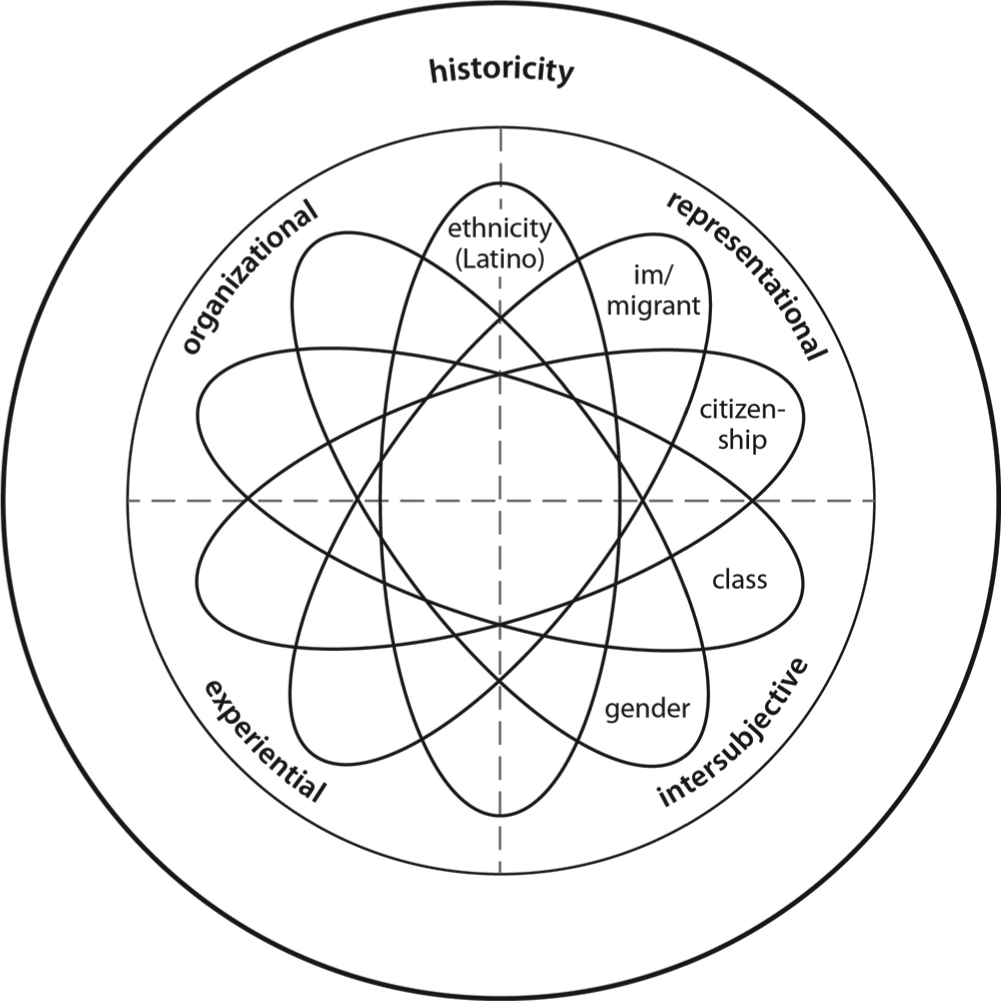
Multilevel model of intersectionality
First Level: Social Categories and Relations
The first level of analysis involves defining social categories and examining how these social categories relate to one another. According to Anthias (2013), social categories are socially constituted and influence the development of social positions, division, and hierarchies. Because social categories are not neatly bounded due to individuals’ multiple identities, within- and between-group comparisons are appropriate when exploring influences on societal inequality. Although diverse according to characteristics such as race, phenotype, nation of origin, im/migration status, language, history of colonization, and citizenship status, Latinos have come to be seen as a distinct racial group in the United States, “based on real or perceived culture or differences,” as “a group apart from whites, blacks, Asians, and others” (Telles, 2012, p. 2). For example, regardless of the fact that the U.S. Census frames “Hispanic” as an ethnicity and therefore allows Latinos to report themselves as belonging to any race, Hispanics are nonetheless treated as a separate group from other racial groups in Census publications (Mora, 2014; Rodríguez, 2000; Telles, 2012). Thus, although socially constructed (Mora, 2014), Latino has become an “irreducible” (Anthias, 2013) category among social identities in the United States.
Im/migrant status is a significant social category intertwined with Latino identity in the United States. Rodríguez (2008) recognizes how the confounding of Latino and im/migrant identities is threatening to historically dominant populations:
The current furor over illegal immigration and trepidation over the Latinoization of the United States—a line that is regularly crossed in the immigration debate . . . cannot be separated entirely from a growing sense of cultural peril experienced by vocal subsets of the Anglo or white populations of this country. (p. 256, emphasis added)
The misrecognized intersection between Latino and undocumented immigrant identities is reflected in a national public opinion poll indicating that a significant minority—three in ten—of non-Latino respondents believe that the majority (half or more) Latinos in the United States are “illegal” immigrants (National Hispanic Media Coalition, 2012), whereas national data indicate that the majority of Latinos—nearly two thirds (64%)—were actually born in the United States (Motel & Patten, 2013). Furthermore, Puerto Ricans are sometimes conflated with immigrants, although they are all U.S. citizens. Accordingly, a “Latino Threat Narrative” (Chávez, 2008, as cited in Massey & Pren, 2012) has been documented in leading newspapers, which Massey and Pren (2012) argue is connected with increases in (a) negative public opinion toward Latinos, (b) subscriptions to a conservative ideology with nativist overtones, and (c) actual border detainments and deportations of Mexicans.
Underscoring the saliency of an intersectional perspective, Latino students’ educational achievement in the K–12 system varies according to im/migrant status and ethnicity. Some research documents that first-generation Mexican American im/migrant students outscore their second- and third-generation peers in K–12 educational achievement (e.g., Kao & Tienda, 1995; Portes & Rumbaut, 2001). This pattern is attributed to a phenomenon called “immigrant optimism” (Kao & Tienda, 1995), in which immigrant students have increased hope about the potential for school achievement to result in social mobility, while being less exposed than their native-born counterparts to a discriminatory environment and related stereotypes about their abilities (Portes & Rumbaut, 2001). This research suggests that immigration is an important identity to consider in relationship to Latino educational achievement. Thus, an intersectional analysis that takes into account multiple social categories offers additional analytical purchase to considering Latino, im/migrant, and other identities simultaneously and their effects on life opportunities.
Intersectionality invites us to consider the broader social dynamics creating inequality for individuals on the basis of the multiple identities they hold. When focusing solely on the individual level of identity, however, it becomes all too easy to ascribe educational inequities to perceived characteristics and (in)abilities of marginalized individuals or groups, rather than the economic, social, and political practices that perpetuate these inequities (Zuberi, 2001). Focusing on these practices can offer insights about how to challenge educational inequities.
Second Level: Multiple Arenas of Influence
The second level addresses “embodied practices” (Anthias, 2013, p. 12) within specific domains of society, or “domains of power” (Dill & Zambrana, 2009), that contribute to inequality across social categories. According to Anthias (p. 12), these domains include (a) organizational (e.g., positions in structures of society such as work, family, and education), (b) representational (e.g., discursive processes), (c) intersubjective (e.g., relationships between individuals and members of groups), and (d) experiential (e.g., narrative sensemaking). These sectors can overlap and operate independently or interdependently, as reflected by the dotted lines that separate these sectors in Figure 1 (see Núñez, 2014, for more discussion of the interactions between these domains of power). Considering Latino im/migrant students’ educational experiences in relation to these arenas sheds light on the multiple and intersecting contexts of power that shape their opportunities.
Organizational
In the organizational arena, anti-im/migrant, anti-bilingual education, and anti-affirmative action policies are among the factors that constrain Latino im/migrant students’ college opportunity. With respect to anti-im/migrant policies, after the passage of the USA Patriot Act in 2001 (an act that generated the Department of Homeland Security, provided more resources to detain and deport foreigners, and approved deportation of undocumented individuals without due process), detainments and deportations of Mexicans rose exponentially, and state and local anti-immigrant laws and initiatives increased (Massey & Pren, 2012). Massey and Pren (2012) documented that by 2009, 23 states had implemented agreements with the federal government to facilitate detainment and deportation of individuals suspected to be undocumented. These conditions raise the constant possibility that Latinos could be targeted by law enforcement officials, solely based on their appearance. Not surprisingly, then, one study indicates that 8 in 10 (79%) Latinos express a belief that even Latinos who hold U.S. citizenship or legal immigrant status at some point “will get stopped or questioned by police” (Menjivar & Abrego, 2012, p. 2).
Furthermore, although the 2012 presidential directive Deferred Action for Childhood Arrivals (DACA) offers eligible undocumented youth temporary reprieve from deportation, it still does not provide a pathway to permanent residency or citizenship. As of 2013, the federal Development, Relief, and Education for Alien Minors (DREAM) Act, which proposes to do that, still has not passed as legislation. As of fall 2012, 10 states have measures to limit undocumented students’ access to public higher education, by denying access to in-state tuition, admission to state public institutions, or both (Institute for Higher Education Law and Governance, 2012). Meanwhile, without permanent residency or citizenship, undocumented immigrants do not have access to federal financial aid to pursue college, and, as of summer 2013, only 18 states afford undocumented immigrants the potential to access in-state college tuition, making the pursuit of public college education financially challenging (if not impossible) for many (Institute for Higher Education Law and Governance, 2013).
Anti-bilingual education laws, including voter initiatives in Arizona, California, and Massachusetts, limit the access of English Learner (EL) Latino students (many of whom are im/migrant) to the most appropriate academic content to advance their college preparation (Gándara & Orfield, 2012). Furthermore, the English Language Acquisition, Language Enhancement, and Academic Achievement Act as part of the 2001 No Child Left Behind Act (NCLB) eliminated references to bilingual education (Gándara et al., 2010). Although challenged since the 1992 launch of the case Flores v. Arizona, Arizona’s language policy of requiring EL students to spend significant amounts of time—4 hr daily—in separate classrooms where the focus of instruction is on the grammatical features of the English language, has remained standing in response to the 2009 Supreme Court decision and subsequent 2013 U.S. District Court decision (Maxwell, 2013; Rios-Aguilar & Gándara, 2012). Yet, there is no conclusive evidence that ELs’ academic achievement has improved in Arizona, California, and Massachusetts; furthermore, the gaps between ELs’ and native speakers’ academic achievement in these states have actually been found to be larger than in states that permit bilingual education offerings (Gándara & Orfield, 2012).
State anti-affirmative action laws have restricted the criteria used to consider what constitutes “merit” in several states’ public institutions, and have influenced decreases in Latinos’ application and enrollment rates in highly selective public institutions in California (Oakes et al., 2006), Texas (Tienda, 2010), and Washington (Brown & Hirschman, 2006). While the 2013 Supreme Court decision in the Fisher v. University of Texas case did not result in the categorical banning of the consideration of race in college admissions, it left room to expose such policies to increased judicial “strict scrutiny” in the future (Alder, 2013; Schmidt, 2013). Collectively, these sets of policies affect Latino im/migrant students’ educational opportunity in distinctive, yet related ways, and can influence Latino im/migrant students to feel as if postsecondary education, particularly selective postsecondary education, is out of reach (Gildersleeve, 2010; Núñez & Gildersleeve, 2014).
Representational
As noted previously, a “Latino Threat Narrative” has been documented in leading U.S. newspapers (Massey & Pren, 2012). The media’s use of the term “illegal alien” to refer to undocumented students diminishes these students’ potential, and if Latinos are conflated with undocumented im/migrants, diminishes the view of Latinos as well (Huber, 2009; Martínez Alemán, 2006; Massey & Pren, 2012). Latinos are now the racial/ethnic group perceived to experience the most discrimination (Pew Hispanic Center, 2010b). The majority of Latinos report witnessing or experiencing discrimination, most often in schools (Pew Hispanic Center, 2010a). Among Mexican American adults surveyed in Los Angeles and San Antonio in 2000, 48% reported that they had personally experienced discrimination and 58% reported that they encountered stereotyping, defined as expectations to conform to certain views of Mexican Americans (Ortiz & Telles, 2012). Perceptions of Latinos as “illegal aliens” can also exacerbate discursive stereotypes and perpetuate discrimination toward Latino students, which can shape teachers’ perceptions of Latino im/migrant students’ abilities in negative ways (Huber, 2009; Massey & Pren, 2012; Suárez-Orozco, Suárez-Orozco, & Todorova, 2008). These consequences can also play out in the intersubjective arena (discussed next), suggesting that the representational and intersubjective arenas can intersect to affect Latinos’ schooling conditions.
In relation to the organizational arena that channels Latino and im/migrant students into educational opportunities (Covarrubias, 2011), the representational arena signals who is included or excluded from these opportunities. For example, im/migrant students in a UCLA residential im/migrant college outreach program were asked to reflect on a campus walkway’s sign saying, “UCLA belongs to the people of California. All 38 million of them.” After contemplating the meaning of the sign, one student realized, “It became so clear to me: the UC did not belong to migrant families. Heck, most migrant families have never been to a UC.” Another articulated that UCLA “should belong to us” (Núñez & Gildersleeve, 2014). Because of their own and their communities’ experiences in the organizational arena, these students were challenging how the university situated itself in the representational arena, through questioning to what extent the institution enacted an espoused mission of serving all people in the state.
Intersubjective
The intersubjective arena concerns how people and groups relate to one another and influence educational opportunities. One example is how teachers perceive Latino im/migrant students’ abilities. A longitudinal mixed methods study found that several teachers of Latino im/migrant students expressed that these students were less academically capable or that their families were not interested in education (Suárez-Orozco et al., 2008). Similarly, a Latino im/migrant outreach program participant observed that, before participating in this writing-intensive program, his teacher assumed that he did not have the ability to write well, because he could not speak English. After the program, his teacher recognized that he was a capable writer, apologized to him for her oversight, and was “recommending me for college, not special education” (Núñez & Gildersleeve, 2014).
Experiential
One dimension of this arena is how Latino im/migrant students construct narratives about their educational possibilities. Research indicates that it is not uncommon for Latino im/migrant high school students in college outreach programs to have internalized negative stereotypes about Latinos and im/migrants and, in turn, their own academic abilities (Gibson & Hidalgo, 2009; Gildersleeve, 2010). Moreover, Latino im/migrant students can internalize a dominant “American” narrative that academic merit, achievement, or ability are completely due to individual factors, rather than economic and social conditions that shape access to educational resources (Pacheco & Nao, 2009). This view of merit as solely located in the individual can influence students to believe that their limited educational opportunities are primarily due to their innate academic (in)abilities, rather than educational and economic systems that do not invest in or recognize their educational potential (Martínez Alemán, 2006). When im/migrant students are invited to challenge predominant notions of merit, they can identify interlocking systems of power that have constrained their ability to actualize their potential, while drawing on their communities as cultural resources in their education (Gildersleeve, 2010; Núñez & Gildersleeve, 2014; Pacheco, 2012; Pacheco & Nao, 2009). In other words, they can recast their experiential narratives about their own merit and ability by engaging in the interrelated processes of interrogating how im/migrants (a) are channeled into educational opportunities (in the organizational arena), (b) cast in negative stereotypes (in the representational arena), and (c) viewed by teachers as having lesser abilities than other students (in the intersubjective arena).
Third Level: Historicity
Beyond the first and second levels, this intersectional model’s third level emphasizes locating social categories, associated concrete relations, and arenas of practice within a broader temporal and spatial context, what Anthias (2013) calls “historicity” (p. 12). This type of analysis focuses on broader interlocking systems of economic, legal, political, media, and social power and classification that evolve over time in specific places, as well as social movements to challenge these systems. With respect to the economic context, the U.S. backlash against the conflation of Latino and im/migrant identities has intensified in the wake of the financial crisis of 2008. Although there is resentment and fear against increasing Latino and im/migrant demographics (Massey & Pren, 2012; Rodríguez, 2008), a perspective of historicity reminds us that U.S. economic conditions historically have framed a cyclical, bipolar, and complex relationship with Latino labor, encouraging im/migration when it suits the U.S. economy’s needs, as with the implementation of the Bracero worker program, inviting Mexican im/migrant labor between 1942 and 1964 (Calavita, 2010; Mitchell, 2012), and discouraging im/migrant labor in times of increased nativism and economic struggle, as presently (Massey & Pren, 2012; Suárez-Orozco et al., 2008). Accordingly, the U.S. openness to granting citizenship and rights to Latino and other im/migrants has vacillated dramatically over time, influencing Latino im/migrant students’ access to educational resources and opportunities to develop their distinctive potentials (Martínez Alemán, 2006; Suárez-Orozco et al., 2008).
Implications
This essay advances a model for employing intersectionality in educational research by specifying different levels of analysis, types of practices, and relationships between social categories that separately or together affect educational opportunities. Focusing on arenas of practice and historicity, in addition to the more common descriptions and comparisons of racially/ethnically diverse students’ experiences (Bonilla-Silva, 2013), spotlights how dominant power relations, practices, and social systems enhance or constrain educational equity. The organizational, representational, intersubjective, and experiential arenas of practice discussed in this model are not necessarily comprehensive. Moving forward, educational researchers may conceptualize these arenas differently, or identify other domains. As noted, practices in distinctive arenas can overlap to shape experiences of Latino im/migrant students, so the model can reveal intersecting processes within systems of power (Núñez, 2014). More broadly, the model reminds the researcher to attend to historical, economic, and social contexts as well. For example, invoking historicity reminds us that the experiences of Californian Latino im/migrant students (who have been the focus of the research discussed in this article) could be quite different from those of their Latino counterparts who comprise the “New Latino Diaspora” (Murillo, 2002; Villenas, 2002; Wortham, Murillo Jr., & Hamann, 2002) and live in states that have seen more recent im/migration of Latinos, such as Georgia, North Carolina, Mississippi, South Dakota, Pennsylvania, Tennessee, Virginia, and Wisconsin (Wortham, Clonan-Roy, Link, & Martínez, 2013).
Applying an intersectionality model has critical implications for practice, too. For example, one residential university outreach program serving Latino im/migrant high school students engaged students in cultivating “sociocritical literacy” (Gutiérrez, 2008)—identifying and challenging arenas of practice that could affect their postsecondary educational opportunity. 4 These students (a) read and wrote critically about their perspectives on school and college (organizational), (b) interrogated the extent to which the sponsoring university’s claim that it served people from diverse backgrounds was aligned with their own perceptions and experiences (representational), (c) built trusting relationships with instructors (intersubjective), and (d) recast their own internal narratives about educational merit from individualistic to more community-oriented perspectives (experiential) (Gildersleeve, 2010; Pacheco & Nao, 2009). Several students expressed that they first began to envision themselves on a university campus during the program. One said, “Eventually it was like we owned that campus . . . and we knew what was wrong with the place. We just wished we could change it. But that would have to wait” (Núñez & Gildersleeve, 2014). Eventually, these students applied to and attended selective public universities at higher rates than otherwise would be expected (Núñez, 2009), expanded their postsecondary educational possibilities, and positioned themselves to challenge and transform educational and community inequities.
Through advancing a model of intersectionality that recognizes how social identities are constituted within multiple arenas of practice and broader historical conditions (Anthias, 2013), this article advances tools to address not only how the relationships between the diversity of social identities among Latinos shape educational outcomes, but also to examine the interlocking relationships between social systems of domination and marginalization in shaping Latinos’ educational equity. This model is only a departure point for investigation, however. Although this case has focused on the intersections between Latino and im/migrant identities, the model can be applied to study how other social identities, including gender, race, class, citizenship, sexuality, religion, and other dimensions of difference simultaneously influence educational experiences and outcomes (Núñez, 2014). However, more research is needed to lay bare the dynamics of the organizational, representational, intersubjective, and experiential arenas of practice that influence students’ educational opportunities according to various social identities, and to locate these arenas of practice within specific times and places. Future studies can identify practices in these arenas, refine the definition of these arenas, or pose additional conceptions of these arenas. Through identifying practices that enact asymmetrical power dynamics in specific times and locations, the potential of intersectionality to shape action and advocacy toward increasing educational equity can be more fully realized.