



Abstract
A half century of research details how segregating racial groups in separate schools corresponds with disparities in funding and quality teachers and culturally narrow curricula. But we know little about whether young Latino children have entered less or more segregated elementary schools over the past generation. This article details the growing share of Latino children from low-income families populating schools, 1998 to 2010. Latinos became more segregated within districts enrolling at least 10% Latino pupils nationwide, including large urban districts. Exposure of poor students (of any race) to middle-class peers improved nationwide. This appears to stem in part from rising educational attainment of adults in economically integrated communities populated by Latinos. Children of native-born Latina mothers benefit more from economic integration than those of immigrant mothers, who remain isolated in separate schools. We discuss implications for local educators and policy makers and suggest future research to illuminate where and how certain districts have advanced integration.
Keywords
Racially segregating students of color in certain schools—separated from White or middle-class peers—often corresponds with unfair financing of schools, regressive allocation of quality teachers, and culturally limited curricula (e.g., Noguera, Pierce, & Ahram, 2015; Vasquez Heilig, Brown, & Brown, 2012). But little is known about whether the racial or economic segregation of young Latino children—as they enter kindergarten—is easing or growing worse.
We do know that Latino children have enjoyed gains in early learning and social development during their preschool years since the 1990s (Bassok, Gibbs, & Latham, 2018; Reardon & Portilla, 2016). Yet the segregated settings that beset many Latino children as they enter school likely constrain this progress (Owens, 2018). An earlier generation of research detailed how Black children benefit from integrated schools (for review, see Cook, 1984). Yet little is known empirically about recent trends in levels of racial and economic segregation that confront Latino children at entry to elementary school.
We contribute to the segregation literature by focusing on schools that young Latino children enter, matching universe data for the nation’s schools and districts with family and child-level data, 1998 to 2010. This allows us to (a) observe trends in the isolation of Latino children within certain schools in school districts nationwide, (b) disaggregate trends for children of immigrant and native-born parents, and (c) learn how school versus neighborhood contexts are changing for Latino children. We also ask whether patterns of racial and economic segregation may move independently over time, as many Latino families spread across the nation, some enjoying upward mobility (Dondero & Muller, 2012; Reardon & Bischoff, 2011).
Overall, we find intensifying segregation of Latino children from White peers among schools in districts that enroll at least 10% Latino pupils; this set against already high levels of racial isolation. Nor have the nation’s 10 districts serving the poorest concentrations of students shown discernible progress toward integrating Latino students among their constituent schools. Children from low-income families—regardless of race or Latino ethnicity—did increasingly attend school with middle-class peers over the 1998 to 2010 period.
Our more textured child and family-level data verify that Latino kindergartners experienced declining exposure to White peers during the period. Those of foreign-born mothers entered even more sharply segregated schools, compared with Latino peers of native-born mothers. At the same time, Latino children more often resided in neighborhoods with higher educational attainment, and parents’ schooling predicted children’s entry to economically integrated schools.
We discuss implications for local educators and policy makers, then sketch future research priorities. Trends in neighborhood segregation condition school segregation and improved exposure to middle-class peers. But little is known on how education leaders and policy makers might advance gains at the community level for Latino children, progressively financing schools and fairly allocating high-quality teachers. This article does not revisit the consequences of deep-seated segregation on learning. We do unpack local variation in the school and neighborhood contexts of Latino children and how these settings are changing over time.
Integrating Latino Children—Progress or Regress?
Schools can act to ease or harden disparities experienced by children of Latino or low-income families. Yet as educators and policy makers attempt to buoy Latino children—seeking to advance their early growth and learning—little is known about whether they are entering less or more segregated schools and how trends may differ for the offspring of immigrant versus later-generation parents. The segregated facets of neighborhoods, especially housing patterns, contribute to the extent to which Latino children attend schools with White or middle-class peers. This article focuses on trends in school segregation, while also reporting on relevant features of neighborhoods in which Latino children are raised.
Tracing school and residential segregation has become more complicated as many Latino families exit urban enclaves (partly fostered by rising educational attainment), bound for what demographers term new destinations—suburbs, exurbs, or rural areas—still mainly White in their demographic composition, often hosting schools that are ill-equipped to serve diversifying children and families.
“Migration [within the United States] ostensibly permits residents to overcome place-linked disadvantages,” as Tienda and Fuentes argue (2014, p. 505). But “Institutional barriers, economic conditions, and housing constraints limit the realization of social mobility.” And even when Latino parents search out materially better-off neighborhoods, their children may not enter more integrated schools. Housing patterns and local district policies (or inaction) may limit the likelihood of finding integrated schools.
Overall, it is not clear whether school segregation for young Latino children is increasing or decreasing nationwide. Crosnoe (2005) found that Mexican-heritage children sorted into schools with greater concentrations of poor and non-White students relative to White peers, drawing on a nationally representative sample. Orfield and Lee (2007) reported that 60% of all Latino students (K–12) attended high-poverty schools nationwide (at least half in poverty), as did less than one-fifth of all White pupils (18%).
Tracking student composition in 350 metro areas, Stroub and Richards (2013) found that after peaking in the late 1980s, mean levels of racial segregation among schools within districts had fallen modestly by 2009. They also found modest gains in the integration of Latino students across K–12, in part mirroring family movement to once predominantly White suburbs (consistent with Fiel, 2013; Iceland & Sharp, 2013). Racial integration among non-White groups has improved modestly as well, but not necessarily across economic classes (Reardon & Owens, 2014). That is, the capacity of families to move into middle-class neighborhoods (independent of race or ethnicity) may condition the likelihood of selecting an integrated school.
Turning to residential segregation, Iceland and Sharp (2013) found that the average Latino resident was less likely to see a White neighbor in 2010, compared with 1980, after examining segregation among communities situated in 366 metro areas. We know that Latinos displayed slightly rising levels of residential segregation from Whites, 1970 to 2010, across 287 metro areas (Alba & Foner, 2015). And aging suburbs, although better-off economically compared with immigrant enclaves, remain quite segregated racially (Lichter, Parisi, Taquino, & Grice, 2010).
A majority of Latinos by 2010 resided in suburban parts of metro areas for the first time nationwide, in part stemming from migration to new destinations in the Midwest and South (Hirschman & Massey, 2008). Fully one-third of Mexican immigrants to the United States, between 1995 and 2000, settled into nontraditional states (Lichter et al., 2010). Many more left traditional immigrant gateways, heading out to diversifying suburbs.
These findings prompt the question of how residential segregation conditions the isolation of Latino children in certain schools. Both family selection and place-based factors appear to determine when segregation among schools diminishes or grows worse. As certain Latino families sort into new destinations, for instance, this alters the ethnic and economic mix of district enrollments. Better educated Latino parents may seek middle-class neighborhoods, while still enrolling their children in predominantly Latino schools—achieving greater exposure to middling, but not necessarily White, peers (Reeves & Busette, 2018).
Incumbent residents of neighborhoods also shape evolving levels of segregation via higher fertility rates among some groups, along with the out-migration of White families. Part of the “resegregation” of schools stems, not so much from school policy, but from higher birth rates among Latina mothers, relative to other groups residing in the same neighborhoods (Logan, 2004).
Yet we still know little about whether young Latino children are entering schools in which exposure to White or middle-class peers is improving or diminishing and how these trends vary for the offspring of immigrant versus native-born Latino parents. Nor do we know whether children from low-income children (independent of their race or ethnicity) interact more or less with middle-class peers over time. This conditions the experience of Latino children from poor households. We examine these trends over the 1998 to 2010 period, an era that witnessed unstable policies toward English learners, resurging hostility toward immigrants, and recovery from the Great Recession.
Mapping Segregation—Variation Across Geographies and Social Classes
Children of Latino heritage, of course, make up a rising share of school enrollments across the nation. Over one-fifth of all kindergartners were of Latino heritage in 17 states by 2012 (Stepler & Lopez, 2016). As Latino parents radiate out from urban enclaves, some do settle in less segregated neighborhoods. 1 This suggests that levels of residential integration may be improving in many neighborhoods, or at least variability grows wider, compared with old Latino enclaves in urban centers. This may condition trends in school segregation.
To illustrate local variation in residential segregation, Figure 1 displays the share of population, White, for Los Angeles census tracts in which at least one-fourth of all residents were Latino (based on kindergarteners in the federal Early Childhood Longitudinal Study [ECLS], 2010). We see a slight presence of White neighbors in predominantly Latino tracts downtown (near the “101” freeway label), with greater integration east and northwest of the central city.
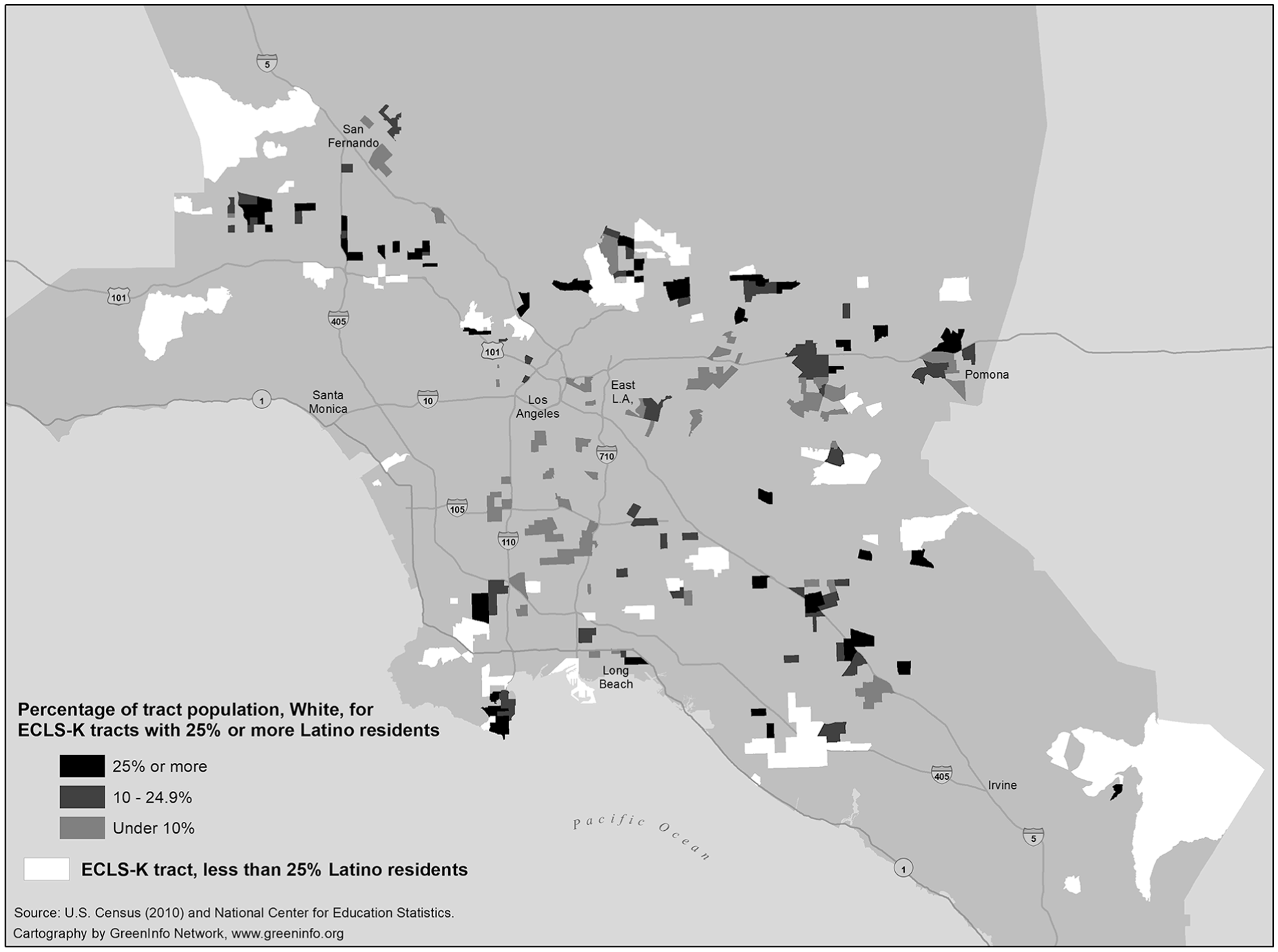
Varying levels of Latino segregation for sampled Los Angeles census tracts, 2010.
The L.A. pattern of geographic dispersal backs an optimistic theoretical position known as spatial assimilation, claiming that immigrant groups will assimilate into the middle class as they enjoy gains in education and job status over time (Alba, Kasinitz, & Waters, 2011). These advances by individuals accumulate, according to this account, to lift the economic status and racial integration of neighborhoods, increasingly populated by second- and third-generation descendants of immigrant settlers.
This theoretical lens suggests that the isolation of low-status children in particular schools will ease as residential segregation lessens, as experienced with White European immigrants a century ago. But whether this allegedly natural drift toward assimilation will be enjoyed by contemporary Latino immigrants, especially when racialized and stigmatized in many communities, remains unknown. Nor is it clear that Latinos entering racial or economically integrated neighborhoods will sort into integrated schools.
Other scholars counter with place stratification theory, arguing that class and racial markers continue to leave Latinos in subordinate and isolated positions, even as they move to promising economic destinations in which to raise children. “Economic mobility is no guarantee of residential integration,” as Lichter, Parisi, and Taquino (2015, p. 36) argue. 2 This suggests that racialized markers will segregate Latinos into separate schools, even when the larger geographic unit (metro area or school district) is becoming more diverse. One troubling case occurs when immigrant Latinos move into new destinations, where incumbent residents remain hostile or school districts are ill prepared, often assigning newcomers to highly segregated schools.
This theoretical position highlights the pivotal role of education leaders, as they allocate Latino students and scarce resources to particular schools. That is, racial status and local histories must be explicitly taken into account if school segregation is to be effectively addressed. And conscious school interventions are more likely to make a difference under this theoretical viewpoint: Levels of school segregation are not necessarily driven by residential or housing patterns alone.
Ecological theory may further explain variation in levels of segregation observed among schools within districts. Urban ecologists take a broader look, studying how the movement of people, jobs, and housing between urban centers and suburbs comes to racially segment groups among differing schools. 3 Patterns of residential segregation, housing prices, and the city’s racialized political economy all shape which families populate differently situated school districts (Reardon & Owens, 2014).
Differential fertility rates for Latinas, tied to maternal education levels, then alter the complexion of districts and school attendance zones over time. Legal histories and district policies shape efforts to ease or sustain the segregation of non-White students in separate schools as well (Henig, Hula, Orr, & Pedescleaux, 2001). Whereas the urban ecology frame stems from older structural views of the city’s political economy, the school institution may act with some autonomy to ease the isolation of particular students in certain schools.
The Latino case becomes more complicated by the wide variation in the class position of this growing population, differing between the offspring of immigrant versus later-generation Latinos. Rising school attainment, for instance, spurs exit from urban enclaves and upward mobility for some Latino parents (Bean, Brown, & Bachmeier, 2015).We know that residential segregation is higher in locales hosting greater shares of foreign-born, rather than native-born, Latinos (Iceland & Nelson, 2008). In contrast, native-born Latinos with children tend to live in higher-income areas and closer proximity to Whites (Fuller, Bein, Kim, & Rabe-Hesketh, 2015; South, Crowder, & Chavez, 2005). 4
Markers of social class, especially the nativity of parents, may interact with neighborhood attributes to shape children’s attainment (Brazil, 2016; Owens, 2010).
But it is unknown whether young Latino children have entered more or less racially segregated schools in recent decades. Recent findings show that American society overall is becoming more economically segregated, as affluent Americans increasingly reside in exclusive enclaves (Gibson-Davis & Percheski, 2018; Reardon & Bischoff, 2011). Yet for the wide middle class, we have little understanding of whether Latino children are gaining greater exposure to middle-class children (economically integrated schools) and how these trends may vary between immigrant and later-generation Latino families.
Contexts of School Reception
As Latino families spread to new areas, little is known about the kinds of schools they enter. Dondero and Muller (2012) found fewer bilingual teachers and less access to advanced courses in new-destination schools, compared with schools in older Latino enclaves. Focusing on the 30 largest “new settlement areas,” Fry (2011) found that Latino students in K–12 enjoyed greater exposure to White and more affluent peers, compared with enclaves. Other work finds that “the traditional sites … of Latino growth – where the knowledge and resources to turn around the problem are potentially in greater abundance – are no longer the sites of greatest growth” (Gándara & Mordechay, 2017, p. 151).
Place certainly matters for how schools receive immigrant and later-generation Latino children, manifest by teachers with varying cultural competence, those who speak Spanish or reach out to parents (Perreira, Fuligni & Potochnick, 2010). How districts allocate resources among schools often stems from segregated housing and schools, along with local educators’ varying commitment to racial or economic integration (Orfield & Lee, 2007; Vasquez Heilig, Khalifa, & Tillman, 2014).
Such place-based policies can hold long-term consequences: Mexican American females raised in Texas, for instance, display lower school attainment and higher fertility, compared with peers in California (Van Hook, Bean, Bachmeier, & Tucker, 2014). And we know that Black-White achievement gaps are wider in highly segregated districts (Owens, 2017).
Research Questions and Analytic Strategy
In sum, evidence remains mixed on whether Latino students attend schools that offer rising or diminishing exposure to White or middle-class peers. Nor do know whether children from poor households (independent of race or Latino ethnicity) attend schools offering greater interaction with middle-class peers over time. Even less is known about segregation trends for young Latino children as they enter kindergarten, along with the differing experiences of immigrant and native-born offspring. And as diverse Latino families spread out to diverse suburbs and exurbs, have they benefited from more racially or economically integrated schools?
This article informs these empirical gaps by asking whether Latino children’s exposure to White peers in elementary school increased or declined between 1998 and 2010. We also describe whether exposure of poor to nonpoor children (regardless of race or ethnicity) changed in districts enrolling significant shares of Latino pupils. We report standard measures of racial and economic segregation among schools within the nation’s school districts. Then, we draw on representative cohorts of individual kindergartners over the same period to replicate these patterns and, going deeper, to examine differences in school and neighborhood contexts.
Racial segregation among schools within districts—
RQ-1A: Did the racial segregation of Latino children within isolated elementary schools increase or decline in the nation’s school districts, 1998 to 2010?
RQ-1B: Did the segregation of students of low-income families from middle-class peers regardless of race or ethnicity in isolated elementary schools (economic segregation) increase or decline, 1998 to 2010?
Racial segregation for Latino kindergartners and subgroups and explaining variation—
RQ-2A: Did the nation’s average Latino kindergartner enter an elementary school with rising or declining concentrations of Latino peers (racial segregation)?
RQ-2B: Did the nation’s average Latino kindergartner enter an elementary school with rising or declining concentrations of peers from low-income families (economic segregation)?
RQ-2C: Among Latino kindergartners from economically diverse families, what markers of social class predict higher or lower levels of racial segregation?
Method
Our analysis builds from two tandem data sets. First, we assembled enrollment data for all public elementary schools and districts nationwide, drawn from the Common Core of Data (CCD) in 1998 and 2010, compiled by the National Center for Education Statistics (NCES, 2001). 5 This allowed us to construct multiple measures of racial and economic segregation among schools within districts. Then, we replicated observed patterns for Latino kindergartners at school entry, along with disaggregating trends for subgroups of Latino children, drawing on nationally representative samples of kindergartners in the same years, 1998 and 2010, from the Early Childhood Longitudinal Study (ECLS-K; NCES, 2001). 6
The CCD in 1998 includes enrollment data broken down by ethnicity and eligibility for free or reduced-price meals (FRPM) for a universe count of 50,529 elementary schools nationwide situated in 13,215 school districts. The corresponding counts in 2010 were 53,636 and 13,849, respectively. The ECLS-K data are drawn from national probability samples of 7,219 children in 1998 (nested in 442 districts) and 8,627 (in 419 districts) for 2010, after losing cases (a) with missing nativity data on the mother, (b) absent a match between school or family to the respective census tract, or (c) when all covariates necessary for regression estimates were not available for the final analysis (NCES, 2018; U.S. Census Bureau, 2011). We weighted all data using the sampling weights provided in the ECLS-K data set.
Measures
Latino children, families, and subgroups
The CCD reports enrollment counts of elementary school children identified by local education authorities as Latino. The ECLS-K data goes deeper, based on field interviews of the household respondent, usually the mother. Each self-identified as of Latino origin or another ethnic heritage and whether they were native or foreign-born. We only draw on data collected by field staff when the child was attending kindergarten. Subsequent interviews with mothers include questions about country of origin, but this information was not utilized in the present article. 7
District and school-level segregation
Multiple indicators of segregation—the extent to which one group disproportionately resides in certain units (schools) situated within a larger geographic or institutional unit (districts)—are commonly used in the demography and immigration literatures (Reardon & Owens, 2014). We describe the conceptual justification for each measure.
For each of the nation’s districts that host at least one elementary school, we calculated the two-group interaction (exposure) index, interpretable as the probability that a randomly drawn Latino student shares a school with a White peer (Massey & Denton, 1988; Owens, 2017). This measure indicates the extent to which Latinos are exposed to Whites in elementary schools. This index ranges higher—indicating strong integration—when Latino students are evenly distributed among schools within the district, relative to the distribution of White peers. (The formula for calculating each index appears in the appendix.)
Given that Latino children may attend schools populated by multiple ethnic groups, not limited to Whites, we also calculated entropy for each school, measuring the evenness of the representation of two or more groups (i.e., Black and Asian-heritage children). Finally, we include the dissimilarity index (D), the absolute value of what percentage of White students would have to exit a school to reach parity with the Latino share. Shares of pupils enrolled who are Latino, White, or FRPM-eligible are reported. Analyses were conducted for all the nation’s elementary schools and host districts, then separately for districts enrolling at least 10% Latino children.
We use the term “middle class” to describe kindergarteners whose family income exceeded the eligibility threshold for FRPM. Change in the percentage of students qualifying for FRPM does not always track against child poverty rates, one reason that we report the share of enrollment who are English learners, along with neighborhood attributes for sampled kindergartners drawn from the ECLS-K data (Hoffman, 2012; NCES, 2018). 8
Neighborhoods
Given interest in how school segregation varies among types of neighborhoods, we matched each kindergartner to her or his census tract of residence. This allows us to report from the ECLS-K data median household income, poverty rates, and educational attainment of resident adults in 1998 and 2010, as key indicators of the child’s social context. 9 We also determined whether the family resided in a new destination or traditional urban enclave, utilizing Tran and Valdez’s (2015) procedure.
Markers of family social class
We report on attributes of kindergartners and households, focusing on markers of class that help to explain variation in segregation among schools. These factors include household income (adjusted to 2018 dollars); maternal education as dichotomous indicators of less than high school, diploma, some college, or bachelor’s degree or more; non-English home language; and female-headed household or not. After reporting descriptive trends, 1998 to 2010, we estimate the extent to which the class position of Latino families contributes to the level of school segregation experienced by their kindergartner. 10
Findings
Shifting Segregation Levels for Latino Children (RQ1)?
We first replicate earlier work showing that the nation’s schools serve rising shares of Latino pupils and students from low-income families regardless of race or ethnicity, over the 1998 to 2010 period. Latino students experienced declining exposure to White peers over the period in districts with at least 10% Latino enrollment. At the same time, students from low-income households (regardless of race) were more likely to attend school with a middle-class peer.
We see in column 1 (Table 1) that Latino children’s exposure to White peers across all school districts remained constant on average (row A, index score, .61), 1998-2010; whereas the likelihood that poor children were exposed to middle-class peers increased markedly (.33 to .45, p < .001, about two-fifths SD).
Change in Segregation for the Nation’s School Districts and Elementary Schools and for ECLS-K Sample of Units Serving Kindergartners, 1998 to 2010

Note. FRPM = free or reduced-price meals; ECLS-K = Early Childhood Longitudinal Study.
Turning to districts with enrollments at least 10% Latino (row B), we see the interaction exposure index declining from .50 to .47 (p < .001) by a small level of magnitude (.11 SD). We again see a rising likelihood of poor students being exposed to middle-class students among schools (regardless of race); the index rising from .31 to .38 (p < .001, .29 SD).
Note that many more districts enrolled at least 10% Latino children in 2010 (4,277), compared with the count in 1998 (2,321). Trends did not appreciably change when comparing 1998 and 2010 levels only for the original 2,321 districts. This constant set of districts also displayed declining interaction between Latino and White children, along with improving interaction between children of poor and those of middle-class families (again, regardless of race or ethnicity). The share of students enrolled, FRPM eligible, climbed from 38% to 61% over the period. This was partly due to liberalized eligibility for free and reduced-price meals at school.
We calculated segregation indices for the nation’s 10 poorest districts (based on FRPM shares) enrolling more than 50,000 pupils and at least 10% Latino, as reported in row C. 11 Overall, we see considerably lower Latino-White interaction scores, indicating more severe segregation of Latino children in separate schools, relative to national averages. Schools in these 10 districts enrolled increasing shares of Latino students, whereas the percentage of students, White, declined over the period.
Placing these index values in context, large urban districts tend to display quite high levels of racial segregation, such as Los Angeles or San Antonio, where the interaction index dropped below .10 in 2010. On the other hand, certain subdistricts of New York City schools display stronger integration of Latinos, above .35 on the index.
Patterns are quite similar when moving to the districts from which ECLS-K kindergartners were sampled (rows D and E), except that the likelihood of Latino children’s exposure to White peers fell from .65 to .51 over the period (p < .001, .40 SD). It may be that Latino families with kindergarten-age children reside in more segregated neighborhoods relative to families with older children attending elementary school. Again, we see rising exposure of poor to middle-class children, a gain of moderate magnitude among the ECLS-K school districts (p < .001, .35 SD).
Turning to school-level indicators of segregation, we see a jump in the share of elementary students nationwide of Latino heritage, rising from 14% in 1998 to 22% in 2010, on average (row A), but no appreciable change for districts with 10% Latino enrollment (row B). The rise in FRPM pupils is larger, climbing from 38% to 61% among schools in districts with 10% Latino children or more.
The dissimilarity index fell about one-fourth SD, and entropy climbed about one-third SD—both measures indicating a more even racial distribution of students within the nation’s average elementary school. This is consistent with the rise in integration among non-White populations among neighborhoods reported above (Reardon & Owens, 2014). Yet the gains we observed are not apparent for elementary schools situated in districts with at least 10% Latino enrollment. Patterns are quite similar for schools from which ECLS-K children were sampled (rows D and E).
Differences for Latino Subgroups and Neighborhoods (RQ2)
Next, we describe school contexts experienced by individual kindergartners, focusing on Latino subgroups, drawing on the ECLS-K data. Table 2 reports changing indicators of Latino children’s exposure to White or middle-class peers. We see that the percentage of students, White, for the mean Latino kindergartner declined from 37% to 30% between 1998 and 2010 (p < .05). We observe a corresponding rise in the share of students identified as English learners, climbing from 23% to 33% (p < .01). This confirms that rising concentrations of children from poor families are not merely artifacts of liberalized FRPM eligibility. Entropy scores increased over the period for the mean kindergartner, suggesting a more even distribution among multiple ethnic groups.
Descriptive Statistics for Census Tracts and Schools in Which Sampled Families Reside, Split by Ethnicity, for 1998 and 2010 Cohorts (Means and SDs Reported)

The mean Latino kindergartner experienced deteriorating neighborhood conditions in terms of falling household income and rising poverty. Median income fell from $56,291 in 1998 to $52,348 in 2010 (current dollars), likely due to the post-2007 recession. Yet educational attainment rose for adults in the mean Latino child’s tract: 42% of all adults reporting some college in 1998, rising to 47% in 2010. Educational aspirations may operate somewhat independently of economic shocks, a hopeful finding for educators and policy makers who endeavor to combat segregation.
Table 3 reveals sharply differing contexts for Latino children, depending on maternal nativity. The share of peers, White, dropped from 47% in 1998 to 37% in 2010 for the mean Latino kindergartner with a native-born mother (p < .05). These shares equaled 31% and 25%, respectively, for the corresponding child with a foreign-born mother. Both subgroups of children entered schools with rising shares of English learners: climbing from 14% to 23% for native-born, and 30% to 39% for foreign-born over the period (p < .05 in both cases). Children of foreign-born mothers were more highly concentrated in urban enclaves and new destinations, relative to peers with native-born mothers residing in all other tracts.
Change Across Cohorts, 1998 to 2010, for Tracts and Schools in Which Sampled Native or Foreign-Born Latina Mothers Reside (Means and SDs Reported)

Cross-cohort difference in first rows and t-statistics in second rows. Significant differences in t-tests for independent samples, cross cohort.
Test for independence between immigrant destination and cohort is conducted. The Pearson χ2 statistic is corrected for survey design and converted into an F statistic.
p < .10. *p < .05.
Median household income held steady for the average Latino kindergartner with a native-born mother but fell sharply for the mean peer with a foreign-born mother (falling by $7,721, p < .05). School attainment climbed, most markedly in neighborhoods of foreign-born mothers, even in the recession’s wake (Table 4).
Descriptive Statistics at the Mother and Family Level by Ethnicity and Nativity Split by Cohort, 1998–2010 (Means and SDs Reported)

Cross-cohort difference in first rows and t-statistics in second rows. Significant differences in t-tests for independent samples, cross cohort.
p < .05. **p < .01.
Which Latino Children Sort Into Segregated Schools?
Given the wide diversity of Latino families, we asked whether certain markers of social class hold explanatory power in accounting for variation in levels of school segregation. Results appear in Table 5, when estimating three measures of segregation, regressing on social-class features of Latino families. Column 1 shows that home language is a major driver of the share of the average kindergartner’s peers who are Latino. This percentage is 17 points higher for Latino kindergartners of Spanish-speaking parents, compared with those from English-speaking homes. Family income, a second marker of class position, is negatively related to entering a school with higher concentrations of Latino peers.
Estimating Child Composition, Racial and Class Exposure in School From Family Socioeconomic Status (SES) Covariates for Latinos Families With Cross-Cohort Interactions (Unstandardized Coefficients and SEs Reported)

Family income was centered around $36,720, which is close to the median of family income in year 1998 and 2010, and divided by $1,000. Thus, a unit increase corresponds to $1,000 increase in family income.
p < .05. **p < .01. ***p < .001.
Robust results also appear when estimating the share of enrollment, FRPM eligible (column 2). Beyond household income and home language effects, Latino children whose parents completed some college entered elementary schools with lower shares of poor peers. This helps to explain why integration of children from poor and middle-class homes improved over the period. We earlier saw that the average Latino child resided in a neighborhood with higher educational attainment in 2010, relative to 1998. The regression finding now shows that Latino children with better educated parents entered schools with lower shares of FRPM peers. To the extent that low-income Latino families migrate into middle-class communities, this helps to explain improving economic integration.
Discussion
A half century of research details the corrosive effects of segregating certain groups in separate schools, distant from White or middle-class peers (e.g., Cook, 1984; Johnson, 2019; Reardon & Owens, 2014). Our results verify how levels of racial and economic segregation have been slow to move in recent decades for young Latino children, with notable gains in exposure to middle-class (often fellow Latino) peers. At the moment these children enter school, most face highly segregated settings, especially the offspring of immigrant parents.
Equity-minded reformers often assume they can tinker with the curriculum, the niceties of testing, or performance standards. Yet racial segregation, as a deep-seated structural constraint, mirrors disparities in school funding, access to quality teachers, and monistic forms of knowledge that remain insensitive to cultural variety (Vasquez Heilig, Khalifa, & Tillman, 2014). Our results confirm this deeply institutionalized and racially arranged social order.
A pair of contextual dynamics remain key: The share of elementary pupils of Latino heritage continues to grow in many districts, both in cities and out in diversifying suburbs. This means that rising percentages of children from low-income families populate the nation’s schools. Then, we find that Latino students became more racially segregated over the period—less likely to interact with White peers in the same schools—for districts enrolling at least 10% Latino pupils. The nation’s 10 poorest districts, enrolling at least 50,000 students, already quite racially segregated in 1998, backslid even further by 2010.
The textured child and family-level data show that local gains in economic integration may be driven in part by rising educational attainment in neighborhoods that are increasingly settled by young Latino families. Even as many neighborhoods populated by children of immigrants felt a sizeable decline in mean household income during the recession, school attainment of resident adults continued to climb. And our regression accounts of variation in school segregation show that Latino kindergartners enter less economically segregated schools when their parents are better educated. We also saw how elementary schools displayed a more even distribution among multiple racial groups (entropy) over time. This widening pluralistic blend of populations may advance economic integration as well.
A less optimistic hypothesis stems from the fact that some middle-class families in the recession’s wake, at times losing their homes, fell into poorer neighborhoods. The net worth of Latino households fell from $23,600 to $13,700 (42%) between 2007 and 2013, compared with the decline for Whites, from $192,500 to $141,900 (26%; Kochhar & Fry, 2014). Rising economic integration may have occurred ironically via the downward mobility of Latino families. Future research is required to learn whether upward mobility or suburban migration of second and later-generation Latinos improves the economic integration of young children.
It is encouraging that class-based integration widened for elementary students, despite the recession, although this gain was not observed in the nation’s 10 largest and poor districts. The mean Latino child resided in a tract with higher educational attainment in 2010, compared with the corresponding child in 1998. One explanation is that many Latino families exited traditional urban enclaves over the period. Other studies reveal how attainment levels climbed for adult Latinos, independent of residential movement, especially for young women. 12 The educational aspirations of many Latinos seem quite resilient, even when residing in economically fragile communities.
Our findings mesh with other work showing a significant postrecession recovery for native-born Latinos, along with sustained upward mobility when compared with first-generation Latinos (Tran & Valdez, 2015). Median income climbed for Latino households nationwide from $46,046 in 2006, on the eve of recession, to $50,486 in 2017 (9.6% gain in 2017 dollars). This recovery for Whites moved from $63,892 to $68,145 (6.7% gain; U.S. Census Bureau, 2018b). Still, lower and unstable incomes have persisted for foreign-born Latino parents (Gennetian, Rodrigues, Hill, & Morris, 2015).
Our fine-grain data on kindergartners detail a similar trend of increasing segregation as Latino kindergartners enter school. This remains troubling, as governments invest more heavily in preschool, aiming to narrow disparities in school readiness. The average Latino kindergartner entered a school with enrollments, 37% White in 1998, falling to 30% by 2010; the share of enrollment, Latino, climbed from 46% to 53%. The percentage of FRPM-eligible peers jumped from 43% to 59%, climbing more than the increment tied to liberalized program eligibility. Future research should build alternative measures of economic integration, as the federal definition of FRPM-eligible continues to shift (Domina et al., 2018).
A pressing question remains of whether and how policy makers and education leaders can effectively reduce the segregation of Latino students, independent of demographic and economic forces. These state and local actors face stiff headwinds: the steady growth of Latino populations, including poor and immigrant families. And many Latino parents continue to exit traditional urban enclaves, migrating to aging suburbs and exurbs, where the reception offered by educators and fellow residents ranges from ill-prepared to downright hostile.
At the same time, an expanding Latino middle class is moving to economically better-off neighborhoods and schools that are more integrated, at least along social-class lines. Future research should further untangle such local variations in the Latino experience and the extent to which racialized markers continue to segregate Latino children in certain schools. The interplay of demographic trends and educational policies—the incursion of market-oriented reforms, for instance—offers another ripe area of study (Fiel, 2015).
How do these trends inform contemporary policy efforts and district-level strategies for lessening the corrosive effects of segregation? First, the independence of economic integration vis-à-vis racial integration offers encouraging news for Latino families in some locales. We must learn more, however, as to whether middling Latino parents and children, in turn, benefit from higher quality schools as they enter less segregated settings. Second, the fact that adult educational levels in predominantly Latino neighborhoods continue to climb—despite the recession’s onset—offers encouraging news as well.
Third, one hopes that upward mobility and school integration benefit Latino families and young children when the economy grows. Our findings confirm how children of native-born parents do enjoy more integrated schools and materially better-off neighborhood, compared with immigrant peers. But under what economic or schooling conditions do young offspring of foreign-born mothers share in these gains? And education leaders—aiming to serve increasingly diverse Latino children—must discern how the conditions of immigrant versus later-generation families can differ dramatically, even when attending the same school.
Some education leaders have persevered in their efforts to racially integrate students among schools within their districts, for instance by expanding magnet or dual-language schools (Riel, Parcel, Mickelson, & Smith, 2018). District-managed choice efforts seek to balance parental preferences with the common cause of racial integration, as in Cambridge or San Francisco. Other district leaders, when direct integration efforts fail, at least attempt to equalize the allocation of dollars or quality teachers among racially segregated schools (Johnson, 2019; Schwartz, Rubenstein, & Stiefel, 2009; Fuller & Lee, 2018).
Still, our findings highlight how differing fertility rates among groups, out-migration from old urban enclaves, and long-term progress in educational attainment will shape whether Latino parents find better integrated schools in their neighborhoods. Local educators and policy makers must candidly confront these deep-seated structural forces that shape varying degrees of segregation, then look for institutional openings to better integrate Latino children, widening their opportunities along lines of race and social class.
Footnotes
Methods Appendix
Notes
Authors
 . His research focuses on economic mobility and the effects of poverty on children’s development.