



Abstract
Opportunities for large numbers of undergraduates to engage in authentic research experiences are limited in many large public institutions. These large public institutions serve the vast majority of students who are historically underrepresented in STEM fields, such as first-generation, low-income students of color. Although a course-based undergraduate research experience (CURE) is one scalable approach to providing such opportunities, there is limited evidence about the impact of participation, particularly for students historically underrepresented in science. This study provides evidence of the influence of student participation in a CURE on undergraduate science course grades using an experimental design and multiple years of data from students at a Hispanic-serving institution. Course grades were compared for five different science courses across five cohorts of students participating in a CURE (n = 935) and a similar group of students who did not participate in the CURE (n = 1,144). CURE students had significantly higher overall grades in a lecture course directly related to the CURE even after statistically adjusting for demographic and academic characteristics. Implications for CUREs as a model for improving science knowledge and achievement for students typically underrepresented in STEM fields are discussed.
Keywords
In fall 2019, the majority of college students in this country were enrolled in public institutions (over 14 million; National Center for Education Statistics, 2019). Since public institutions assume responsibility for providing access to learning experiences for large numbers of students who will shape STEM (science, technology, engineering, mathematics) fields, an ongoing issue is how well these institutions provide opportunities, particularly for students who are historically underrepresented in STEM fields (e.g., National Academies of Science, Engineering, and Medicine, 2016; National Science Foundation, 2019; Witherspoon et al., 2019). Without opportunities for high-quality learning experiences that promote critical thinking and innovation, it should not be surprising that students, typically underrepresented in STEM, will continue to lag in terms of representation in STEM fields and preparation to enter careers in STEM fields (National Science Board, 2007).
Recommendations from the American Association for the Advancement of Science (2011), Boyer Commission on Educating Undergraduates in the Research University (1998), National Academies of Sciences, Engineering, and Medicine (2017), National Research Council (2013), and others (Elgin et al., 2016; Laursen et al., 2010) suggested that quality undergraduate science learning experiences should include student participation in authentic research (Seymour et al., 2004; Spell et al., 2014). Across all disciplines, participation in high-quality research experiences draws from extensive research in the areas of engagement (e.g., Kuh et al., 2008), active learning outcomes (e.g., Chi & Wylie, 2014), and identity (e.g., Davis & Wagner, 2019) and is consistently associated with desirable student outcomes such as interest, engagement, and persistence (Carter et al., 2016; Kuh, 2008; Seymour et al., 2004), particularly for students typically underrepresented in STEM (Eagan et al., 2013; Hernandez et al., 2018).
One approach to provide research experiences for large numbers of undergraduates is course-based undergraduate research experiences (CUREs). CUREs are curriculum-based, instructor-led research opportunities (Auchincloss et al., 2014; Corwin et al., 2015; Linn et al., 2015; Lopatto et al., 2014). CUREs offer an opportunity for large numbers of undergraduates to gain access to high-quality research experiences (Bangera & Brownell, 2014). CUREs more closely resemble real research experiences in that course activities often do not have a single right answer, and there are opportunities for students to explore and come up with their own hypotheses (Corwin et al., 2018). There is great variation in both the content focus and the implementation of CUREs. For example, CUREs have been implemented in life sciences, chemistry, geoscience, engineering, and physics (Dolan, 2016; Hensel & Davidson, 2018; National Academies of Sciences, Engineering, and Medicine, 2015). However, Auchincloss et al. (2014) outlined five critical components of CUREs—(1) the use of science practices, (2) discovery, (3) broadly relevant or important work, (4) collaboration, and (5) iteration (also see summary in Brownell & Kloser, 2015)—that differentiate CUREs from other research experiences.
CUREs for undergraduate science majors focus on the science content knowledge necessary for pursuing science-related careers (e.g., Cianfrani & Hews, 2020; Cruz et al., 2020; Olimpo et al., 2016). An underlying assumption of these CUREs is that for such knowledge to be robust, it cannot simply be transmitted to students (Brownell et al., 2012). Instead students need to be cognitively engaged in their learning processes (e.g., Chi, 2009; Fiorella & Mayer, 2016; Greene, 2015; Sinatra et al., 2015). While science content knowledge is just one aspect of the conceptual understanding necessary to succeed in a science career (e.g., Duschl, 2008), the lack of rigorous science academic preparation prior to college (e.g., Museus et al., 2011) and inauthentic science experiences in undergraduate science courses (e.g., Brownell et al., 2012) are often cited as a reasons for the consistent underrepresentation of particular groups of students in STEM careers (e.g., Theobald et al., 2020). CUREs provide opportunities for large numbers of students who have been typically underrepresented in STEM careers to cognitively engage in relevant science content through authentic research experiences.
Despite recommendations to scale course-based research experiences, there is a lack of research-based evidence to guide efforts (D’Avanzo, 2013; National Academies of Sciences, Engineering, & Medicine, 2017; Ruiz-Primo et al., 2011). Data from self-reports, such as a survey of student conceptions of what it means to think like a scientist (Brownell et al., 2015), and administrative databases, such as degree completion (Rodenbusch et al., 2016), suggest that participation in a CURE positively influences a range of outcomes, such as students’ self-identification as a scientist, persistence toward STEM careers, understanding of discipline-specific content, and the nature of science (Hanauer & Hatfull, 2015; Shaffer et al., 2014; Thiry et al., 2012). However, this evidence is based on relatively small, homogenous samples of students without a rigorous research design that allows for a direct comparison of CURE participation for students typically underrepresented in STEM fields (Harvey et al., 2014; Olimpo et al., 2016; Staub, et al., 2016).
There is evidence that inquiry-based lab and lectures with integrated content knowledge influence content knowledge (e.g., Matz et al., 2012; Russell & French, 2002; Suits, 2004); however, missing is evidence that these positive effects translate to introductory science courses at large public institutions. To address these issues of small samples, cross-sectional nonexperimental designs, and not controlling for other factors that influence success in science, particularly for students historically underrepresented in science, this study includes an experimental design implemented across multiple cohorts of students at a large, public, research, Hispanic-serving institution (HIS; an institution of higher education with full-time undergraduate enrollment of at least 25% Hispanic students). This study focuses on students who entered the university with interests in majoring in a STEM discipline and self-selected to participate in a first-year program designed to promote student success in STEM. This study tests whether beyond the success of participating in this program there is an additional boost in science content knowledge for students who participate in a CURE integrated with an introductory biology course. Our analyses focus on the overall average effect of participation in the CURE on multiple introductory science course grades. This focus on course grades as an indicator of content knowledge builds on previous research that indicates the necessity of science content knowledge for persistence and success in science careers (Theobald et al., 2020) and that underrepresented students may have less rigorous academic science opportunities (Estrada et al., 2016). Findings indicate higher course grades for students who participated in the CURE associated with an introductory science course that is closely related to the content of the CURE. These findings are relevant to introductory science courses at large research institutions with related lab components and speak to the potential for scalability of this sort of CURE in other undergraduate science courses.
Method
Research Design
The current study employed a randomized control design where first-year students (who were placed in a program designed to support their first-year success in science) were randomly assigned to the CURE or the traditional lab experience (Figure 1). This design allowed for a randomized control group that offered a basis for comparison between the two lab experiences. In addition, this study includes multiple years of data (different cohorts), which allow us to identify potential year-to-year differences. This design was also ideal because students in the CURE and traditional biology lab took the same introductory science course sequence. This provided us with the ability to compare student academic performance in a science course that was directly related to the CURE course content and additional introductory science courses that were not closely related to the CURE course content. Structurally there was also no contamination between the CURE and traditional lab courses since students could not switch from one lab course to another and were not likely to drop out of the program (see below for description of the learning community program).
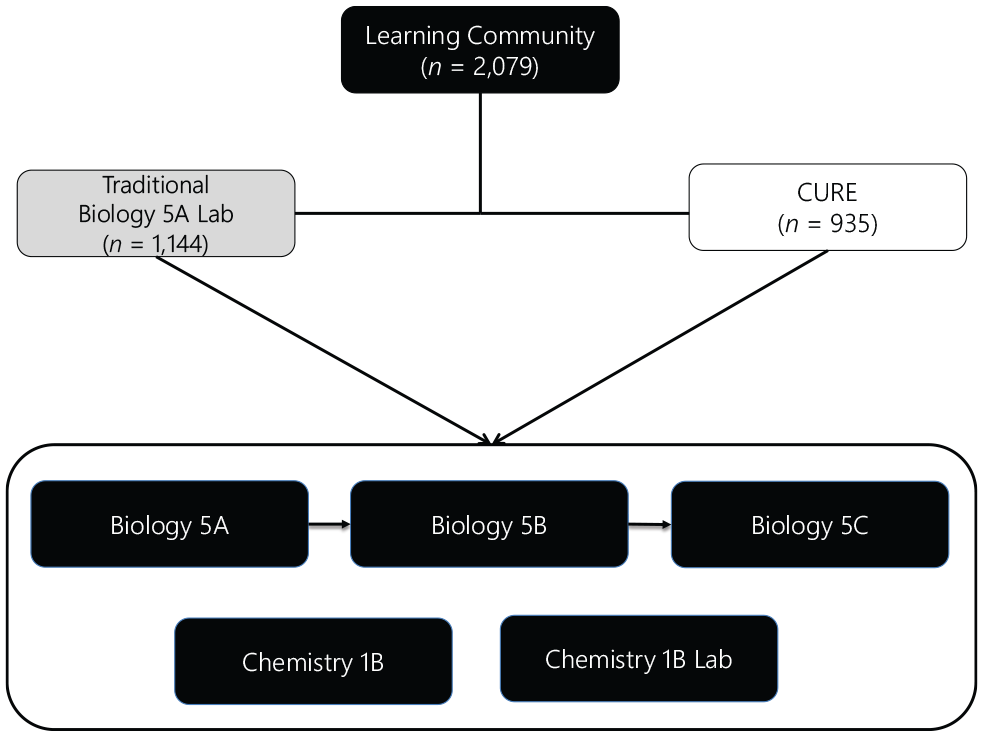
First-year lower division science courses for first-year learning community students.
Sample
The sample includes students from a single research HSI 1 with a large percentage of first-generation students (63% of first-year students designated as first-generation students in fall 2016) and students receiving financial aid (over 85% receive financial aid and 70% have full fees covered by grants and/or scholarships). All students in the sample participated in the learning community program, a highly structured and comprehensive strategy for improving first-year academic success for new mathematics and science majors. First-year students self-selected into the learning community program and then were assigned into a particular section. Students with similar math achievement (based on their performance on a mathematics placement examination) were assigned to the same section. Each of the learning community sections included 24 first-year students who enrolled in the same math and science courses during their first and second years. In addition, students received small-group career and research mentoring from faculty, study skills and time management advising from professional academic advisors, and supplementary instruction (peer tutoring, workshops). Prior evaluations of the learning communities program indicated that students form strong interpersonal bonds and reinforce each other’s academic efforts, as they collectively tackled the subject matter of the critical first-year student course series.
Each learning community section was randomly assigned to participate in the CURE or the control (traditional Biology lab course). These assignments to either the CURE or the traditional lab were conducted by learning community staff before their first quarter at the institution. The particular quarter in which students took either the CURE or the traditional lab course was based on whether students were calculus-ready or not. Students who were calculus-ready took the CURE in fall quarter or the traditional lab course in the winter quarter. Students who were not calculus-ready took the CURE or the traditional lab course in the winter or spring quarters. While all students participating in these science learning communities were already highly motivated and have higher 4-year graduation rates than students who do not participate in the learning community (40% compared to 23% for the 2007 first-year student cohort), the 4-year graduation rate for all science majors (24%) was still lower than the general campus rate (36%). The 1-year retention rate for the sample of students in this study was high (92% across all years). In the most recent year of data included in this study, 96% of the control students and 98% of the CURE students retained a science major after their first year.
The CURE: Dynamic Genome 2
Students who participated in a 10-week (one quarter) CURE experienced a hands-on bioinformatics/wet lab course (Burnette et al., 2016; Burnette & Wessler, 2013; Robb et al., 2014). Each quarter several sections of the CURE were taught 2 days per week (3-hour lab periods) by different instructors. Each instructor had an advanced degree in biology and multiple years of experience teaching undergraduate biology. The structure of the CURE experience was the same for all students. In the first half of the quarter, students learned the bioinformatics and experimental tools routinely used in molecular biology labs by participating in modules with origins in actual research experiments related to gene structure, gene expression, and genome variation. In the second half of the course, students applied these tools to authentic research problems that came out of ongoing research in various science faculty labs. Students learned how to (1) design controlled experiments, (2) keep an informative lab notebook, (3) present their data, and (4) access DNA databases and research sources, such as PubMed. The course content of the CURE was similar to the lecture course and traditional laboratory course.
Traditional Lab Course
Students who did not participate in the CURE participated in a traditional lab course (10 weeks). There were multiple sections of the traditional lab courses taught 1 day per week (3-hour lab periods) by different graduate student teaching assistants. The traditional lab courses covered similar content as the lecture course that the all students enrolled in concurrently (cellular and molecular biology) including scientific method, microscopy, diffusion and osmosis, spectrophotometry, enzymatic reactions, fermentation and respiration, transformation, and polymerase chain reaction. Undergraduates worked collaboratively (groups of 2–4) on weekly lab projects related to this content. Similar to other traditional lab courses, the projects included specific protocols for students to follow and answers to these projects were known to instructors and the scientific community prior to the undergraduates starting the projects. Graduate student teaching assistants responsible for each lab section had weekly meetings with an academic coordinator to prepare for the implementation of these projects.
Contrasting the CURE and Traditional Lab Course
This study included CURE participants (n = 935) and a comparable control group of nonparticipants (n = 1,144) from five cohorts (first-year students in fall 2013, fall 2014, fall 2015, fall 2016, fall 2017). The observed demographics for students who participated in the CURE compared to the control group are similar (Table 1). Students were similar within the five cohorts, but there were differences between the five cohorts. For example, in one year, 10% of students who were prepared to take calculus compared to another year where over half of the students were prepared to take calculus.
Demographics of First-Year Science Learning Community Students
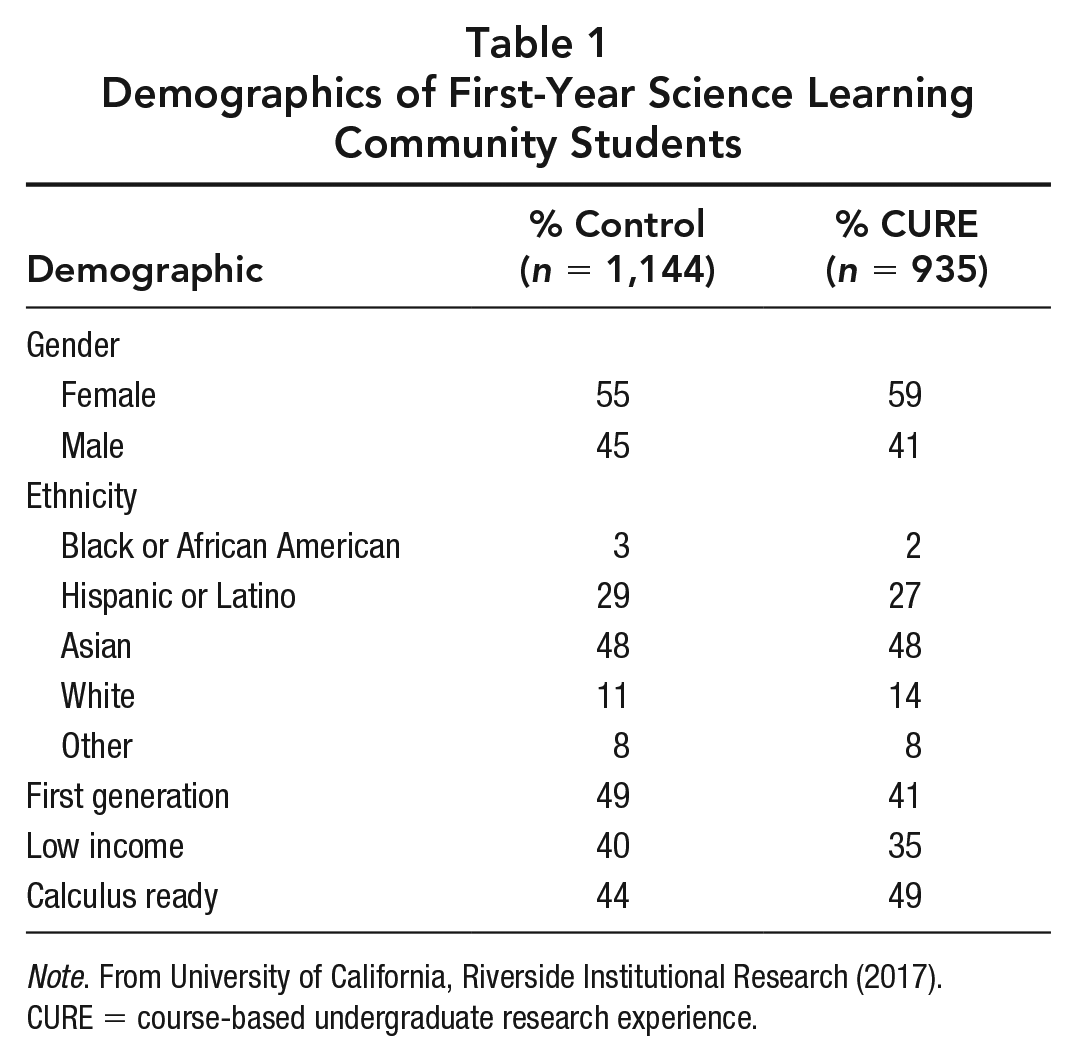
Note. From University of California, Riverside Institutional Research (2017). CURE = course-based undergraduate research experience.
Other than enrollment in the CURE or the traditional lab course, all learning community students included in this sample took the same courses in their first year and had access to similar academic supports. There were different instructors for the introductory science courses from year to year, so there was no control over potential different learning experiences in the introductory science courses. While the content covered in the traditional lab and the CURE were similar, the implementation of the content for these two conditions varied considerably. Students in the CURE spent more time in the lab (6 hours per week) compared to the traditional lab (3 hours per week). In addition, the traditional lab was taught by graduate students, and the CURE was taught by experienced instructors. The class sizes of the traditional lab and the CURE were the same, but the CURE also included an instructor, teaching assistant, and at least one undergraduate laboratory assistant (whereas the traditional lab included only a teaching assistant).
Analysis
The primary analysis strategy for this study included logistic regression models for each outcome to examine differences in the influence of CURE participation. We ran multiple models for each outcome (grade for a particular undergraduate science course). The first logistic regression model included only the primary variable of interest (CURE participation), which provided information for whether or not CURE participation influenced grades in a particular science course. The second logistic regression model included the primary variable of interest and student demographic characteristics. We ran additional checks on potential differences within and between years by running analyses separately for each year and combined all years and including a dummy variable for each year. In addition to considering these multiple dependent variables separately, we ran a multivariate analysis of variance to consider these multiple dependent variables simultaneously and estimated the effect of participating in the CURE by accounting for multiple covariates. Given expected fluctuations in student characteristics from year to year, we explored differences in the relationship between participation in the CURE and grades using several strategies: separate analyses by cohort, hierarchical analyses to account for nested structure, and accounting for cohort as a categorical predictor. We also explored the nested structure in terms of cohort differences and sections within each cohort. In addition, we considered propensity scores (e.g., Rubin, 2001). However, along with a large sample size and consistent measures (Shadish, 2013), the design of this study included a carefully selected control group of first-year students from the same institution, who were taking the same courses for the entire year (Cook et al., 2008; Shadish et al., 2008). Results were similar using these different strategies, so we decided to report results in the most straightforward approach, with cohort as a categorical predictor.
Variables Included in Analyses
The primary variable of interest was a dichotomous variable indicating whether or not a student was in the CURE (substitute for traditional Biology 5A lab course) or control group (traditional Biology 5A lab course). In addition to this variable, we included other variables that might influence student course grades such as gender and ethnicity. These variables served as statistical control variables. All variables included in these analyses were obtained from administrative databases maintained by the institution.
In addition to different sections of the CUREs taught by different instructors and focusing on different faculty research projects, there were five different cohorts of first-year students included in this study. There were significant year-to-year differences between the cohorts in terms of academic preparedness, which reflects differences in admissions decisions from one year to another. For example, in the fall 2013 cohort, 56% of first-year science majors were prepared to take calculus compared to 35% in the fall 2016 cohort.
There were several measures of student course grades included in these analyses. We considered course grades in five different lower division science courses. Biology 5A is a lower division course that is most similar to the course content in the CURE and was taken in the same quarter as the CURE. The other four lower division science courses (Biology 5B, Biology 5C, Chemistry 1B, Chemistry 1B Lab) were not similar in course content compared to the Biology 5A. Biology 5B and Biology 5C were taken after Biology 5A. Most students took Chemistry 1B and Chemistry 1B Lab in the same quarter as Biology 5A. While there were different instructors for each course, all students within the same cohort took the same courses with the same instructors. We did not find evidence for differences in grades depending on the instructor or section.
Course grades for each student were dichotomized to reflect students who earned an “A” or “B” in the course or lower than a “B.” The decision to dichotomize the variable was based on our interest in distinguishing between students who demonstrated understanding of the course content and students who did not. Instructors informally indicated that students who earned an “A” or a “B” are considered ones who demonstrated understanding of the course content. While a “C” is considered a passing grade, it does not necessarily reflect understanding of the course content. Additional information about variables included in the Supplementary Materials (available on the journal website).
Results
Equivalence of Experimental and Control Groups
Although there was random assignment of students to the CURE or control group, we compared the demographic characteristics and academic preparedness to see how well the randomization worked. Overall, there were similarities in demographics for the CURE and control group. For example, there were similar percentages of females in the CURE (59%) and control group (55%), χ2(1, N = 2,055) = 2.48, p = .12, and similar percentages of underrepresented minorities in the CURE (38%) and control group (41%), χ2(1, N = 2,079) = 1.91, p =.17. In terms of academic preparedness, CURE students (M = 1608.61, SD = 279.67) and control students (M = 1616.02, SD = 267.29) were comparable to the SAT composite scores, t(1912) = 0.59, p = .56. There were also similar percentages of CURE students (49%) and control group students (44%) who were prepared to enroll in calculus when they entered the institution, χ2(1, N = 2,079) = 5.51, p = .02.
We also tested whether there were group differences on the covariates by fitting a series of regressions in which each baseline covariate was regressed on an indicator for whether the student was in the CURE or the traditional lab course and all of the covariates in a single regression regressed on an indicator for whether the student was in the CURE or the traditional lab course. Results suggest that the groups were not statistically different (p < .01) on any of the covariates included in these analyses. This suggests that the two groups were well matched in terms of gender, ethnicity, parent education, SAT composite scores, first-generation status, low-income status, and calculus readiness.
By design, all students included in this study were interested in a career in science (signed up for a life science major in the summer before their first year at the institution) and self-selected into a learning community program specifically designed to support their academic success in their first year at the institution. We included only students who successfully completed this program to attempt to limit other variables such as interest in science or motivation that might contribute to differences in academic outcomes. In addition to completing the program, students all took the same science courses, which allowed us to compare the effect of CURE participation on the same science course grades.
Effect of CURE Participation on Grades in Science Courses
CURE students earned higher grades in Biology 5A (Figure 2), χ2(1, N = 2,067) = 17.01, p < .001; and Biology 5B, χ2(1, N = 1,824) = 0,14, p < .01; compared to the control group. There was similar performance on the other science courses: Biology 5C, χ2(1, N = 1,413) = 2.81, p = .09; Chemistry 1B, χ2(1, N = 2,057) = 4.96, p = .03; and Chemistry 1B Lab, χ2(1, N = 2,060) = 0.95, p = .33.
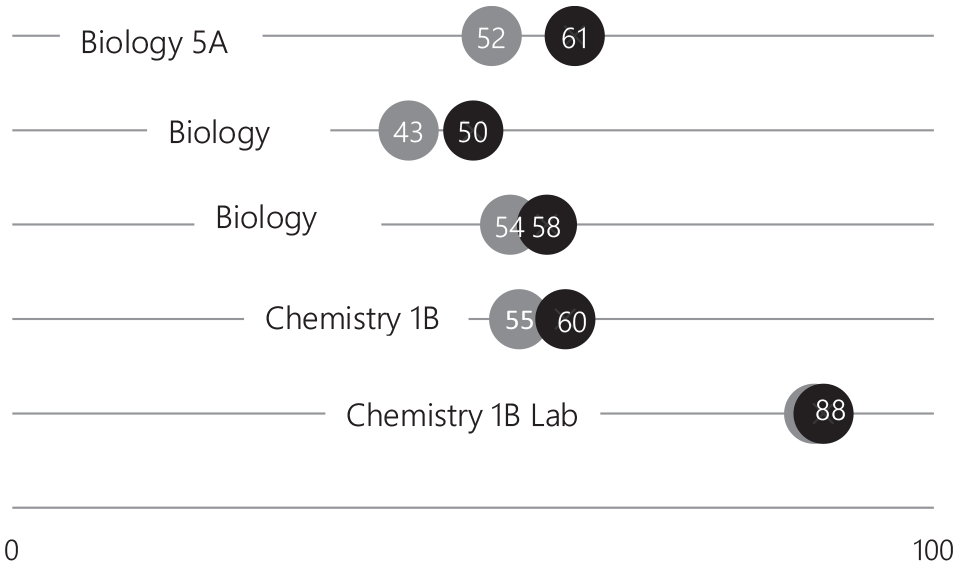
Percentage of students who earned an “A” or “B” in course.
Examination of differences in terms of demographic characteristics for Biology 5A further suggests higher grades in Biology 5A across different subgroups of students (Figure 3). For example, 56% of females who participated in CURE earned an “A” or a “B” in Biology 5A compared to 44% of females who were in the control group, χ2(1, N = 1,164) = 18.29, p < .001. Examination of differences in terms of academic preparedness (as measured by whether or not students were prepared to take calculus when they started their undergraduate experience) indicates that CURE students were also more likely to earn an “A” or a “B” in Biology 5A compared to the control group. Over half of the CURE students who were not calculus ready earned an “A” or “B” in Biology 5A (54%) compared to the control group of students who were not calculus ready (45%), χ2(1, N = 1,104) = 8.58, p < .001.
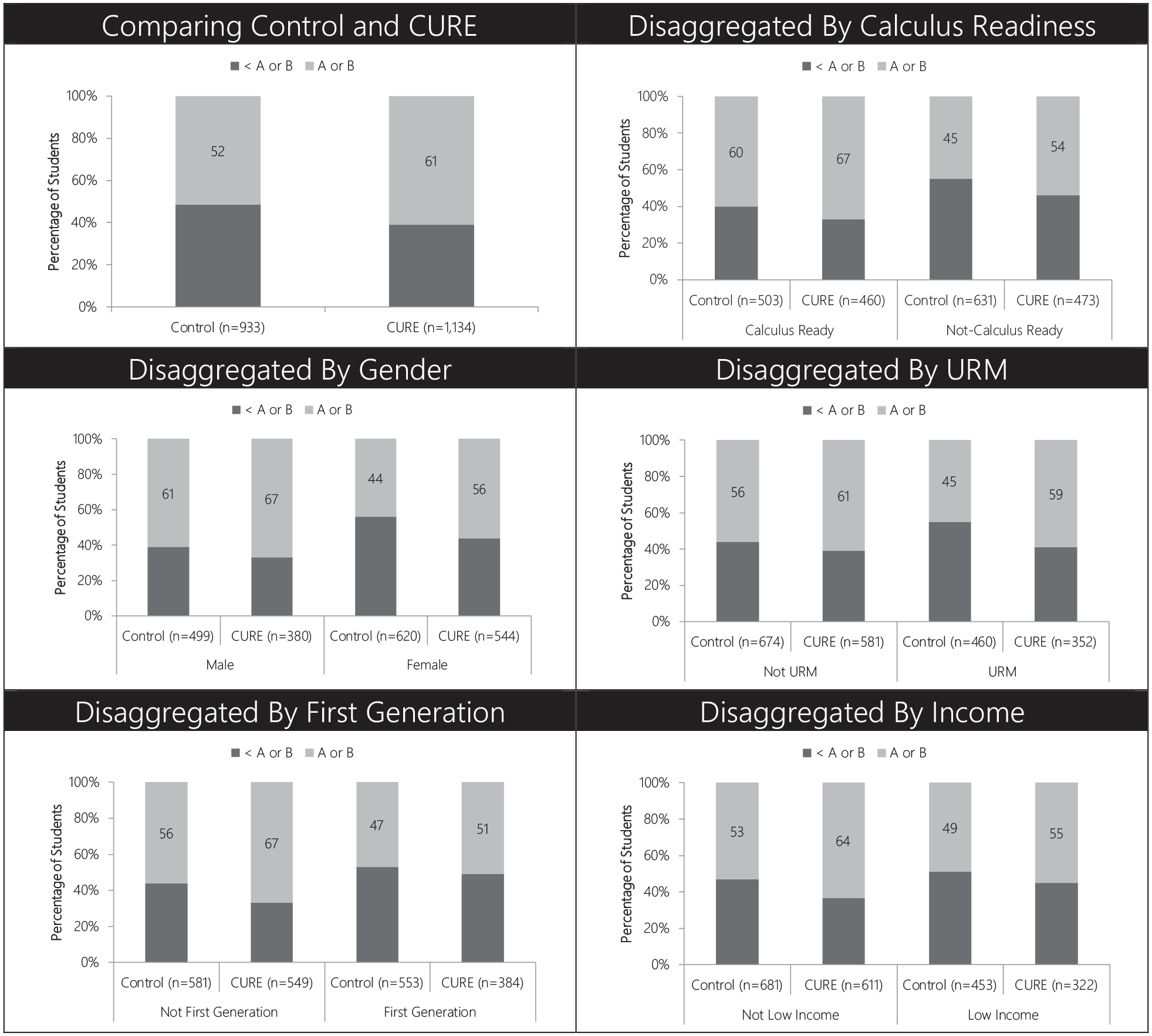
Biology 5A course grades.
For some characteristics (ethnicity, first generation status, and income), disparities between the subgroups decreased. For example, a similar percentage of students who were typically underrepresented in STEM fields who participated in the CURE (59%) earned an “A” or a “B” as students who were not typically underrepresented in STEM fields in the control group (56%). Thus, although these initial descriptive results suggest overall differences in students in Biology 5A, there were no differences in student performance for the other courses (Biology 5B, Biology 5C, Chemistry 1B, Chemistry 1B Lab).
Results of the regression analyses predicting whether or not students earned an “A” or a “B” in Biology 5A provided additional information about the positive influence of participating in the CURE (see Supplementary Materials, available on the journal website). These analyses included only students with complete demographic and course grade information. Students who participated in the CURE were 42% more likely to earn an “A” or a “B” in Biology 5A compared to students who did not participate in the CURE, χ2 (1, N = 1,149) = 7.84, p < .001. Even after statistically adjusting for academic, demographic characteristics, and cohort, students who participated in the CURE were more likely to earn an “A” or a “B” in Biology 5A compared to students who did not participate in the CURE, χ2 (11, N = 1,149) = 111.26, p < .001.
Results indicate that participation in the CURE positively influenced grades in a lower division science course that was similar in content (Biology 5A). Consistent with initial descriptive results, participation in the CURE did not influence grades in other lower division courses with different content (Biology 5B, Biology 5C, Chemistry 1B) or grades in another laboratory course with different content (Chemistry 1B Lab). The findings hold even after statistically adjusting for demographic characteristics and are consistent across five different cohorts of students. Similarly, when simultaneously considering these multiple dependent variables, there was a significant effect of participating in the CURE, F(5, 1188) = 7.79, p < .01, Wilks’s Λ = 0.99); the only difference was course grades in Biology 5A for the control group and the CURE students, F(1, 2069) = 18.96, p < .001, partial η2 = .01. These findings were also consistent using a matched sample estimate of the average effect of participating in the CURE (estimated average treatment effect = .14, standard error = .04, z = 3.78, p < .001). Additional information about results included in Supplementary Materials (available on the journal website).
Conclusion
Like other CUREs (e.g., Balster et al., 2010; Harvey et al., 2014; Kowalski et al., 2016), this CURE answers the call to improve undergraduate science education (American Association for the Advancement of Science, 2011) by providing authentic opportunities for students to integrate core concepts and competencies through a focus on student-centered learning (Kuh, 2008). While this particular CURE focused on introductory biology, the structural features of this CURE make results applicable to efforts to provide research experiences to undergraduates in a range of content areas (Auchincloss et al., 2014). For example, chemistry labs could incorporate authentic research problems into the lab content to potentially better replicate the scientific process, and the same may apply to labs that focus on mechanical/electrical engineering, physics, and a host of other STEM disciplines. Using a rigorous research design, this study offers evidence that participation in these structurally authentic experiences can positively influence grades in a course that is closely aligned to the CURE (Biology 5A), and reduce gender gaps in performance. However, the influence of participation in the CURE did not transfer to course grades in lecture or lab courses that were not closely aligned to the content of the CURE. The consistency of the findings for all students at an HSI, across multiple years, and regardless of instructor or year, suggests that participation in CUREs can benefit students typically underrepresented in STEM fields; however, the effects of participation may be limited to areas with direct overlap in science content. This implies that STEM discipline–specific CUREs (chemistry, physics, engineering etc.) may help address some of the academic gaps in higher education. One hypothesis for the lack of transfer of knowledge and skills to other introductory science courses is that unlike the CURE, the other science courses at this institution may not reflect the goals for ambitious undergraduate science education. Traditional science lecture courses, for example, may not relate abstract concepts to real-world examples (Rowland et al., 2016), and traditional lab courses are likely to provide guided hands-on experiences that emphasize finding the right answer (Buck et al., 2008).
While one strength of this study was the inclusion of outcomes that were proximal (Biology 5A), and distal to the curriculum (Biology 5B, Biology 5C, Chemistry 1B, Chemistry 1B Lab), this study did not include measures that captured different facets of knowledge (Ruiz-Primo et al., 2002). Future research on CUREs could include measures that reflect the range of knowledge needed to succeed in introductory science courses.
These findings raise the question of how the targeted impact of CURE participation could serve as a model for other science lab courses to support the success of students typically underrepresented in STEM fields (Chang et al., 2014; Hurtado et al., 2010; Riegle-Crumb et al., 2019; Saw et al., 2018). For example, one idea to explore is expanding the CURE to other lab courses where there are historically lower grades or higher attrition for particular students (e.g., Larnell, 2016). Given the resource demands for successfully implementing CUREs, expansion requires attention to how programmatic shifts fit within the broader undergraduate science experience (Dika & D’Amico, 2015; Estrada et al., 2016; Ong et al., 2017). The call for greater coordination across these courses could help focus resources in ways that support integrated science experiences for students is not new (Gross, 2004). While this study was narrowly focused on a particular CURE, it is important to recognize that this single CURE was just one of many experiences that can influence success in science. Future work of those interested in improving learning opportunities for undergraduate science major should consider comprehensive and systematic strategies for improving undergraduate science education (e.g., Bryk, 2015; Bryk et al., 2015). However, the rigorous evidence presented in this study is an indicator of the potential positive influence of participation in authentic science opportunities and is a promising step toward efforts to improve undergraduate science education.
Supplemental Material
IngEtAl._OnlineAppendix – Supplemental material for Participation in a Course-Based Undergraduate Research Experience Results in Higher Grades in the Companion Lecture Course
Supplemental material, IngEtAl._OnlineAppendix for Participation in a Course-Based Undergraduate Research Experience Results in Higher Grades in the Companion Lecture Course by Marsha Ing, James M. Burnette, Tarek Azzam and Susan R. Wessler in Educational Researcher
Footnotes

Notes
Authors
References
Supplementary Material
Please find the following supplemental material available below.
For Open Access articles published under a Creative Commons License, all supplemental material carries the same license as the article it is associated with.
For non-Open Access articles published, all supplemental material carries a non-exclusive license, and permission requests for re-use of supplemental material or any part of supplemental material shall be sent directly to the copyright owner as specified in the copyright notice associated with the article.
