



Abstract
Although adaptive teaching is considered a cornerstone of effective instruction, there remains a lack of focus on teacher adaptability in policy, professional practice, and teacher education in the United States. High-profile educational reform efforts have pressured districts and states across the nation to rely on prescriptive curricula that fail to meet the linguistic, cultural, and instructional needs of the nation’s diverse student population. In this article, we describe the development of the Adaptive Teaching Inventory and present validity evidence from our administration in the United States. These findings provide insight into the potential for widespread implementation of adaptability and its focus to support teacher professionalism and decision-making. The discussion centers on moving adaptability to the forefront of policy and practice efforts to counter the prevailing emphasis on restrictive curricula that has stymied teachers in their efforts to support students for far too long. Implications for administrators, policymakers, and researchers are discussed.
Keywords
In recent years, several policy initiatives have shifted educational practices in classrooms across the United States (Coburn et al., 2011). The No Child Left Behind Act (2001) legislated high-stakes accountability for schools and districts. Such efforts resulted in unprecedented accountability for student achievement to reduce the persistent inequity in reading and mathematics achievement of underperforming students (Milner, 2013). As a result, scripted curricula proliferated during the 1990s and 2000s (Woulfin, 2014), pressuring schools and districts to adopt prescriptive programs or lose federal funding (Powell et al., 2017). Aggressive educational policies continued with Race to the Top legislation (U.S. Department of Education, 2009) and the Every Student Succeeds Act (2015), which promised to address the persistent “education by zip code” inequities of American schooling that delineates students’ exposure to high-quality instruction based on students’ social backgrounds and geographic region (Timberlake et al., 2017). With an emphasis on teacher and leader evaluation systems, high-stakes accountability, and school turnaround models, schools faced increased pressure to adhere to scripted curricula as the primary means to bolster student achievement (Fitz & Nikolaidis, 2020).
Despite these efforts, data from National Assessment of Educational Progress (2019) indicate that reading and mathematics scores for students in Grades 4 and 8, in the bottom 10th and 25th percentiles, have decreased or remained stagnant since 2009. One hypothesis for this lack of improvement is that adopted curricula are typically designed around social norms and cultural experiences of White, middle-class America (Au, 2016). Given that districts enforce the current policy environment by pressuring teachers to implement scripted curricula with “fidelity” (Achinstein & Ogawa, 2006), little opportunity remains for teachers to redesign lessons to meet the needs of culturally and linguistically diverse learners (Von Esch & Kavanagh, 2018). However, one pathway to counter these effects is through advancing policy and practices that focus on adaptive teaching.
Adaptive teaching is using knowledge of students, content, and pedagogy to modify instructional actions in the moment (Darling-Hammond & Bransford, 2005) to strategically meet students’ social, linguistic, and instructional needs (Gitomer & Bell, 2016). Teacher adaptability, or the extent to which teachers implement adaptive teaching, is often presented as a characteristic of effective teachers. For example, the Framework for Teaching (Danielson, 2007), an empirically based framework used in schools across the nation to measure teacher effectiveness, indicates that exemplary teachers make adjustments to instruction to support student learning (e.g., Component 3e, Demonstrating Flexibility and Responsiveness). Similarly, the Interstate Teacher Assessment and Support Consortium (Council of Chief State School Officers, 2011)—a nationwide, nonprofit organization of public officials who lead departments of elementary and secondary education in the United States—emphasized the role of adaptability in quality teaching. The International Summit on the Teaching Profession, a consortium of educational leaders, outlined adaptability as essential because teachers must be able to “adapt curricula and teaching in response to student achievement” (Schleicher, 2016, p. 17).
Despite this collective understanding, teacher adaptability remains relatively elusive in studies of teachers’ day-to-day instruction (Hoffman & Duffy, 2016). There are several reasons for this scarcity. First, policies that have increased accountability pressures through high-stakes testing, heightened teacher scrutiny, and adherence to scripted curricula have inhibited teacher adaptability (Diamond, 2012). Second, variability in terminology of adaptability (e.g., responsive teaching, improvisational teaching, flexible teaching, reflective teaching, adaptive metacognition, teachable moment) has prevented robust understanding of adaptive teaching across disciplines and contexts (Parsons, Vaughn, et al., 2018), resulting in a lack of advancement in practice. Third, the field lacks a viable measure of adaptability with classroom teachers, which has impeded efforts to study the impact of teacher adaptability across racial and ethnic groups and its relation to student outcomes.
Our study contributes new insights into teacher adaptability. First, we describe the development of the Adaptive Teaching Inventory (ATI), an instrument to measure teacher adaptability, that was administered to a national sample in the United States. We describe the validity evidence for this measure, examining how scores on the ATI can be interpreted along a continuum of teacher adaptability, including the beliefs and knowledge teachers use to adapt their instruction before and during instruction. Then, we discuss implications for administrators, policymakers, and researchers to support widespread implementation of teacher adaptability.
Background
Across our research, which includes more than 315 observations in over 70 K–6 classrooms in schools throughout the nation, we have documented teachers’ adaptations and rationales for adapting (Ankrum et al., 2020; Duffy et al., 2008; Parsons, 2010, 2012; Parsons et al., 2010; Parsons, Metzger, et al., 2011; Parsons & Vaughn, 2016a; Parsons & Vaughn, 2016b; Parsons & Vaughn, 2013; Parsons, Williams, et al., 2011; Vaughn, 2015, 2016, 2019; Vaughn et al., 2020; Vaughn & Parsons, 2013; Vaughn, Parsons, Burrowbridge, et al., 2016; Vaughn, Parsons, Gallagher, et al., 2016). Our research team conducted a comprehensive research synthesis on adaptive teaching from the last 40 years (1975–2014) across disciplines and contexts (Parsons, Vaughn, et al., 2018) to extend the field’s understanding of adaptability. From these findings, we created a model of adaptive teaching (see Figure 1).
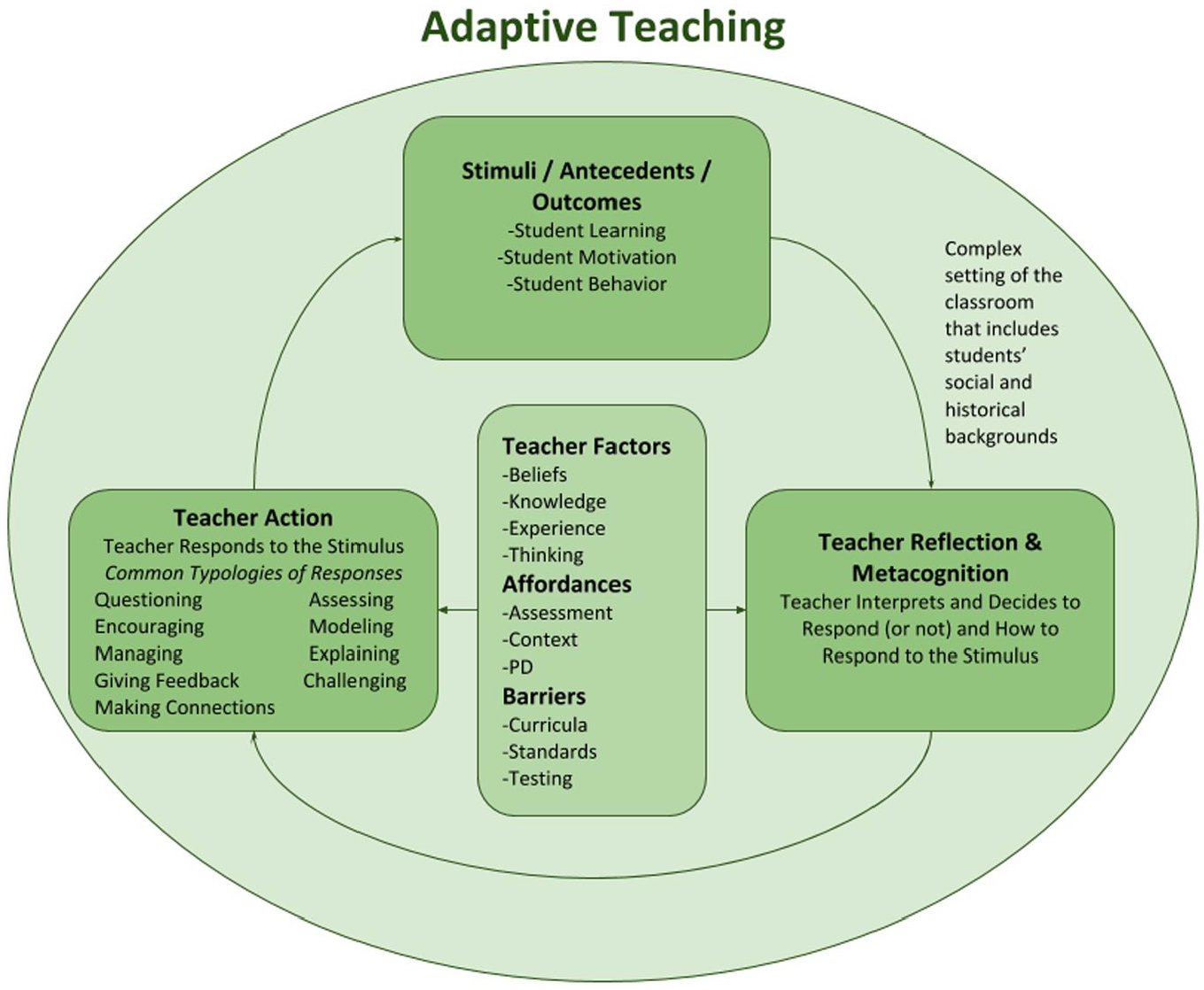
Model of adaptive teaching from Parsons, Vaughn, et al. (2018) research synthesis.
The Adaptive Teaching Feedback Loop (see Figure 1) indicates the primary features of adaptive teaching: (a) teacher factors, including beliefs about teaching and students and teacher knowledge about students’ needs and backgrounds; (b) teacher reflection and metacognition; and (c) teacher action. This conceptual model was used to guide item development for the ATI.
The Adaptive Teaching Feedback Loop also includes stimuli/antecedents/outcomes because teachers must attend to these. Instructional adaptations require teacher thinking in response to a student stimulus, which determines a teacher’s subsequent action. As such, each item of the ATI includes some aspect of student stimulus and teacher response. For instance, “I adapt learning activities based on my students’ abilities” includes the teacher’s response (adapt learning activities) to the student stimulus (based on my students’ abilities). Inherent in these items were teachers’ knowledge about their students and their beliefs about teaching and learning, which represent the constructs of the ATI (i.e., teacher beliefs, knowledge of students, teacher thinking).
Teacher beliefs
Educators’ beliefs about teaching include their perceptions of pedagogy, learning, themselves, and their students. Teacher beliefs have a long history in the literature on teaching because beliefs impact instruction (e.g., Pajares, 1992), including adaptations. Teachers who adapt their instruction believe in the capabilities of their students and believe their job is to support student learning even if that means deviating from their plan (Parsons & Vaughn, 2013; Vaughn, 2021). Teachers’ beliefs can be thought of as broad (e.g., believing in all students’ potential to achieve) or focused on the immediate context (e.g., believing in the importance of being flexible to students’ needs during a lesson).
Teacher knowledge of students
Using knowledge of students to modify instruction is a hallmark of teacher adaptability. Knowledge of student backgrounds (e.g., culture, home life) is necessary for culturally responsive teaching (Ladson-Billings, 1995) and is distinct from knowledge of student instructional needs. An adaptive teacher uses knowledge of students’ instructional needs as well as knowledge of their backgrounds to make instructional decisions (Fennema et al., 1993). To adapt instruction, a teacher must also know their students’ understandings and misunderstandings and use that knowledge to provide specific instruction for the students’ learning (Vaughn et al., 2020; Vogt & Rogalla, 2009).
Teacher thinking
Teacher thinking is the active cognition associated with teaching, including reflection and metacognition. Teachers who are reflective and metacognitive constantly monitor classroom behaviors to gauge students’ learning and adjust their instruction based on this thinking (Duffy, 2005; Duffy et al., 2009; Griffith et al., 2013). For example, Moallem (1998) found that teacher reflection led to instructional adaptations. Similarly, Artzt and Armour-Thomas (1998) found that mathematics teachers’ metacognition influenced teachers’ instructional practice.
Method
In the following, we outline the multistep development of the ATI. To evaluate validity evidence, we first proposed uses and interpretations of the ATI and then searched for validity evidence that supported or challenged these uses and interpretations (American Educational Research Association, American Psychological Association, & National Council on Measurement in Education, 2014; Kane, 2013; see Figure 2). We then used layers of claims to validate the proposed interpretation and use of the ATI. Last, we used data to examine each claim and to determine the extent to which each claim was supported.
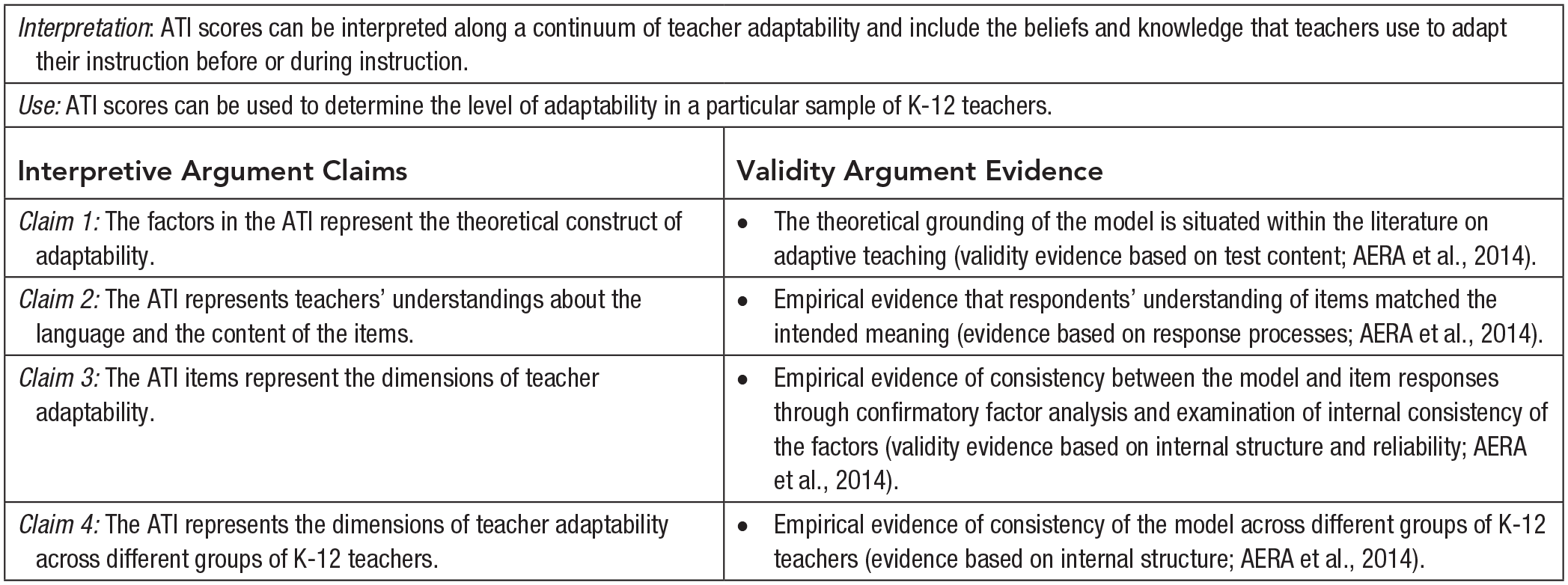
Intended interpretation, use, claims, and evidence for the Adaptive Teaching Inventory (ATI).
ATI Development
The development of the ATI progressed through two rounds of data collection. In the first round, we created items for the constructs (context, teacher beliefs, teacher knowledge, and teacher thinking) following the steps outlined below. However, we found that the items did not behave as expected in the confirmatory factor analysis (CFA). For instance, teacher beliefs items separated out into two factors, and we realized that one factor indicated teachers’ beliefs about students, whereas the other indicated teachers’ beliefs about teaching. We also found that teacher knowledge items separated into teachers’ knowledge about students’ instructional needs and teachers’ knowledge about students’ backgrounds. The teacher thinking items seemed to separate into metacognition and reflection, and some items seemed to indicate specific actions the teachers took when adapting. Thus, in the second round we collected data for the following seven constructs: teacher metacognition, teacher reflection, teacher knowledge of student needs, teacher knowledge of student backgrounds, teacher actions, teacher beliefs about students, and teacher beliefs about teaching.
Through two rounds of data collection and analysis, we were able to come to a final model that held up to our claims and was consistent with theory. In our final model, we found four factors of adaptability, rather than the hypothesized seven, as multiple factors were integrated across items. We believe this was due to the complexity of adaptability. For instance, “I notice what is occurring with my students and their learning and revise my instruction depending on what is needed” was initially created to be a teacher metacognition item, with 100% of experts agreeing with that classification. However, in the factor analysis, it was strongly related to other items indicating teachers’ knowledge of students’ needs. Closer examination of the item revealed that teachers’ knowledge of students’ learning needs was implicit in the wording. Thus, although this item was intended to capture teachers’ metacognitive process of understanding and addressing students’ needs, because teachers’ knowledge is central to this understanding, this item was more similar to items indicating teachers’ knowledge of students’ needs. A similar pattern occurred with many items we initially wrote, requiring that we collapse factors, yielding the final four-factor model. These four factors are knowledge of student needs, knowledge of student backgrounds, beliefs broad view, and beliefs immediate context.
Claim 1: The Factors in the ATI Represent the Theoretical Construct of Adaptability
In Round 1 of data collection, we generated a list of items (n = 25) for each of these constructs: context, teacher beliefs, teacher knowledge, and teacher thinking. These items were sent to adaptive teaching experts in the field who sorted each item according to the constructs. Based on these results, we eliminated items that were not sorted with the correct construct. This expert evaluation added evidence that items fit the constructs. After this process was completed, revised items were sent to additional adaptive teaching scholars who then sorted each item according to the construct. In this phase, we eliminated items that had no consensus or had the lowest ratings within each construct. In Round 2 of data collection, we eliminated some items that had performed poorly in Round 1 and created new items such that each of the seven constructs had at least eight items. We followed the same procedures for expert review. All items were written on a 5-point scale from “Strongly Disagree” to “Strongly Agree.”
Claim 2: The ATI Represents Teachers’ Understandings About the Language and the Content of the Items
We conducted cognitive interviews with teachers (n = 10 in Round 1 and n = 12 in Round 2) from across grade levels and in three different regions of the United States (Pacific Northwest, Mid-Atlantic, and South) to elicit feedback on item clarity. We made revisions based on these interviews.
Claim 3: The ATI Items Represent the Dimensions of Teacher Adaptability
In Round 1 of data collection, the ATI was sent to colleagues in the field from different regions across the nation who shared the link (n = 327). In Round 2, we sent the link to a list of teachers from across the nation (n = 498). After we administered the survey, we analyzed the items’ fit to the hypothesized factors of adaptive teaching using CFA techniques in IBM SPSS AMOS 26. Below, we describe the analysis completed in Round 2 of data collection.
Participants
The sample was made up of 498 participants, representing 45 U.S. states and six participants from outside the United States. Of the participants, 78% identified as White, 7% as African American, 2.2% as American Indian or Alaska Native, 3.3% as Asian, 0.6% as Native Hawaiian or Pacific Islander, 6.4% as Hispanic/Latino, and 2.5% as other. About 27% of the teachers primarily worked with K–6 students and about 65% worked primarily with students in Grades 7 to 12. With regard to years of experience, 31% of the teachers had 21+, 15% had 16 to 20, 19% had 11 to 15, 16% had 6 to 10, 19% had 1 to 5, and 1% were preservice teachers. Seventy-three percent of participants indicated they were female, 22% indicated they were male, 0.4% indicated their gender as other, and 5% either preferred not to answer or did not respond. When asked about their highest level of education, they reported the following: 29% bachelor’s degree, 57% master’s degree, 5% specialist degree, 7% doctoral degree, 2% other, and 3% did not respond.
Data analysis
We tested the fit of this model using CFA. We used the parameters in Table 1.
Parameters for Evaluating Model Fit
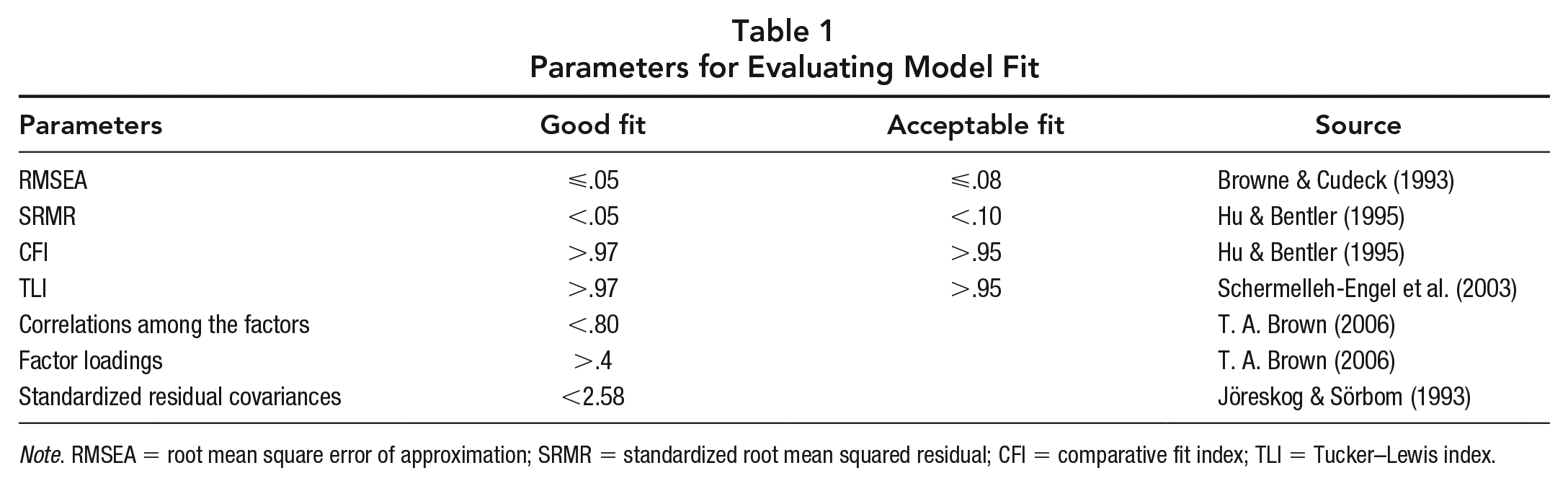
Note. RMSEA = root mean square error of approximation; SRMR = standardized root mean squared residual; CFI = comparative fit index; TLI = Tucker–Lewis index.
Results
Descriptive statistics for items in the final version of the ATI are presented in Table 2. Indices of model fit are presented in Table 3.
Item Descriptive Statistics and Factor Loadings for Final Model

Models Tested

Note. CFI = comparative fit index; RMSEA = root mean square error of approximation; SRMR = standardized root mean squared residual; TLI = Tucker–Lewis index.
The first model tested, “Model 1: Theorized Model,” included all 44 items on the seven hypothesized factors. Overall, this model had poor fit. It had acceptable values for standardized root mean squared residual (SRMR) and root mean square error of approximation (RMSEA), but poor values for comparative fit index (CFI) and Tucker–Lewis index. (TLI). Moreover, many of the factors were highly correlated.
In “Model 2: Five Factors,” we combined metacognition, teacher reflection, and teacher actions into one factor as these factors were highly correlated in Model 1 and the items all included an action. We also restructured the beliefs items into two different factors: (a) teacher beliefs broad view, which were items that examined teachers’ broader beliefs about teaching (e.g., “I believe all students have the capacity to learn”); and (b) teacher beliefs immediate context, which were items that captured teachers’ beliefs about instruction during lessons (e.g., “I think it is important to let my students lead the direction of the lesson”). This model had improved fit, with good TLI, RMSEA, and SRMR and CFI approaching an acceptable value. However, the factors teacher actions and teacher knowledge of student needs were highly correlated, r = .95.
“Model 3: Four Factors” is the final model. In this model, we combined teacher actions with teacher knowledge of student needs. Given the high correlation between these two factors as well as the fact that when we reviewed these items we noticed that they all included, at least implicitly, teachers using knowledge of their students’ needs to take action (e.g., “I change the instructional materials [e.g., texts, grouping structures, etc.] to adjust to student learning needs” includes a specific teacher action: changing instructional materials, as well as implying a knowledge of “student learning needs”), the combination of these two factors made sense. Additionally, we removed items with standardized residual scores greater than 2.5. This final model had good overall fit, with an acceptable CFI and good RMSEA, SRMR, and TLI. Furthermore, all factor correlations were <.75, all factor loadings were >.4, all standardized residual scores were <2.58, and all reliabilities were ⩾.70. Factor loadings and reliabilities for this model are presented in Table 2.
Claim 4: The ATI Represents the Dimensions of Teacher Adaptability Across Different Groups of K–12 Teachers
After testing the fit of the items to the hypothesized constructs, we examined invariance across groups (teachers who identified as White [n = 379] and non-White [n = 110] 1 ) to examine whether the measure behaved the same for different groups of people. The intended use of the ATI is to determine the level of adaptability in a sample of teachers, and we wanted to mitigate the potential for differences on such a measure to suggest that non-White teachers are more or less adaptable. Therefore, we wanted to ensure that it would perform similarly for both White and non-White teachers. We tested configural, metric, and strict invariance.
“Model 4: Configural Invariance” tested whether the factor structure holds across the groups (Byrne, 2016). It indicated a good fit on the RMSEA and SRMR and acceptable fit as measured by the TLI. This suggests that the number of factors, factor loadings, and specified factor variances hold across both White and non-White teachers. In addition to the fact that the participants represent all grade levels from K–12, the fact that the model holds across White and non-White teachers suggests that the items are interpreted similarly, regardless of teachers’ ethnicity, adding evidence for Claim 4.
Whereas configural invariance tests if the models are similar across groups, metric and strict invariance test if the models are equivalent across groups. Model 5 tested metric invariance, specifically constraining the factor loadings to be equal across the two groups (i.e., White and non-White). This model also indicated good fit on the RMSEA and SRMR and acceptable fit on the TLI. However, the Δχ2 was statistically significant at p < .05, indicating that one or more of the factor loadings were not equivalent across the groups. This may be, at least in part, due to the large difference in the White (n = 379) and non-White (n = 110) samples. For this reason, we also examined ΔCFI and ΔSRMR, which are less sensitive to sample size. Both these measures of fit indicated that factor loadings were equivalent across groups (Chen, 2007).
After testing for metric invariance, we also tested a strict model, where we constrained factor variances and covariances to be equal in addition to factor loadings. Model 6 indicated an acceptable fit according to RMSEA and SRMR. However, TLI and CFI suggested the model had room for improvement. Additionally, the Δχ2 was statistically significant at p < .05, suggesting that at least one of the factor variances, covariances, or factor loadings was not equivalent across the groups (an unsurprising finding given the Δχ2 for Model 5). Additionally, the ΔSRMR was above the acceptable threshold of .01 (Chen, 2007), although the ΔCFI was below the suggested threshold of .01 (Cheung & Rensvold, 2002). These findings suggest that the model may not fit equally across Whites and non-Whites when factor loadings, variances, and covariances are constrained to be equal. However, given the large difference in these two sample sizes and the highly constrained nature of strict invariance assumptions, additional data should be tested.
Discussion
Consistently, educational scholars and leaders present adaptive teaching as central to effective instruction (Allen et al., 2016; Beltramo, 2017; Borko & Livingston, 1989; Gitomer & Bell, 2016; Pearson, 2007; Schipper et al., 2020). However, there have been no large-scale, quantitative studies of adaptability because there did not exist, until now, a way to measure teachers’ adaptability quantitatively. At this time in the field, it is crucial to examine teachers’ adaptability given the ongoing local and national policy debates about teachers’ professional practice and the increased educational disparities for students from historically marginalized communities. Our research provides validity and reliability evidence for the use of the ATI to determine the level of adaptability in a particular sample of K–12 teachers. Educational stakeholders can use the ATI to examine teachers’ understandings about their adaptive practices. Large-scale, quantitative data linking adaptive teaching to student learning, especially for students currently achieving in the lowest quartile, has the potential to persuade policymakers of the importance of encouraging teachers to use their adaptive expertise rather than tying teachers’ hands with scripted curricula. In the following, we discuss how the ATI can support widespread implementation of teacher adaptability.
Implications for Practice, Research, and Policy
Educational policy efforts in the United States, over the last 30 years, have focused on closing the achievement gap (Ladson-Billings, 2006; Reardon, 2013; Reardon et al., 2019). With a laser focus on improving student achievement on high-stakes assessments (Au, 2007; Hung et al., 2020; Hursh, 2013), schools readily adopted scripted curricula to ensure fidelity to prescriptive, one-size-fits-all instruction (Allington, 2010; Healy, 2007). However, this focus on fidelity to curricula has limited teachers’ professional decision-making (Ford et al., 2017; Gallagher & Melancon, 2020) and has not closed the achievement gap (U.S. Department of Education, Institute of Education Sciences, National Center for Education Statistics, & National Assessment of Educational Progress, 2021). The persistent educational achievement disparities across socioeconomic levels between Black, Latinx, and Indigenous students and their White peers continues to widen in the United States (Bjorklund-Young & Plasman, 2020; Wang et al., 2020). We suggest that mitigating the effects of this gap is multifaceted and hinges on teachers’ ability to adapt their instruction to meet students’ diverse needs. Therefore, it is imperative for educators, policymakers, and other educational stakeholders to examine their efforts to meet students’ individual and specific instructional, linguistic, and socioemotional learning needs (Pease-Alvarez & Thompson, 2014; Turner, 2020) and to incorporate thoughtful and informed instructional adaptations (Fairbanks et al., 2010) to meet these ever-changing and individual needs.
Using the ATI to explore how teachers understand their adaptive instructional actions is an essential next step in countering the widespread reliance on scripted curricula across the nation. Because scripted curricula shape teachers’ daily instructional practices (Chapman & Elbaum, 2021; Milner, 2014), one practical next step is for administrators and educators to use the ATI to document teachers’ understandings of adaptive teaching. For example, if a teacher scores lower on beliefs about adaptive teaching and knowledge of students’ backgrounds, teacher leaders and administrators can work alongside that teacher to critically reflect on and engage in practices and dialogue designed to elicit adaptive approaches (Wetzel et al., 2015; Zeichner & Liston, 2013).
Additionally, as schools work toward adaptive instruction, teachers who have been held accountable to scripted curricula for years will need to be reoriented to considering adaptive approaches to students’ needs in their decision-making. Shifting from prescriptive curricula to adaptive teaching may be challenging as, for years, this decisional capital (Hargreaves & Fullan, 2012, 2013; Visone, 2018) has been taken from teachers (Vaughn et al., 2020). The ATI can be used to identify where teachers are on the continuum of adaptability and monitor their progress toward adaptability over time. As a result, the ATI could be used by administrators and teacher leaders to identify teachers who score high on adaptive teaching. These teachers’ expertise could be leveraged within their schools to support other teachers in planning to meet students’ individual needs. In this way, the ATI can be used as a formative assessment to guide teachers, instructional coaches, and administrators to provide instruction that is more responsive to students’ individual needs. The ATI can uncover areas of practice where teachers may need additional professional support as well as documenting areas of strengths that can be used to meet the targeted instructional needs of students.
Although introducing another layer of evaluation of teachers who must consistently manage larger micro and macro politics (Woulfin, 2014) may seem onerous, the rising inequity in student learning and achievement outcomes (Duncan & Murnane, 2016) warrants careful attention to professional development efforts focused on teacher adaptability. Future research should explore using the ATI as a formative tool to engage in experimental studies focused on how teachers construct instructional adaptations to reduce disparities.
The use of the ATI in large-scale research can inform policy to focus on supporting and enhancing teacher adaptability. Although teachers must be adaptive to meet students’ diverse interests, instructional needs, cultural backgrounds, and linguistic abilities (Hayden et al., 2013; Vaughn & Parsons, 2016), the lack of large-scale research that documents teacher adaptability across elementary and secondary contexts only supports the increased reliance on scripted curricula across policy and practice. The educational gaps in the United States manifest in regions of the country and across racial backgrounds (Shackelford, 2019). For example, Black and Hispanic students in urban areas have lower literacy rates relative to White suburban students (National Center for Education Statistics, 2019).
There is widespread agreement that teacher adaptability is essential in supporting student learning. However, our review of 40 years of research on adaptive teaching found only five articles that analyzed adaptive teaching and student achievement outcomes, and none of these was on a large scale. Lacking an empirical base supporting the impact of adaptive teaching on student outcomes could explain why policy has tended to restrict teacher decision-making instead of supporting teacher adaptability (Coburn et al., 2011). A deeper understanding of the relationship between adaptive teaching and student achievement has the potential to move policy away from restrictive, scripted curricula and toward the development of professional learning to support teacher adaptability and improve educational opportunities for those students in our most vulnerable communities. Future research must explore correlations between the ATI and student achievement across economic, cultural, racial, and linguistic populations.
As the nation continues to face persistent achievement gaps (Hung et al., 2020), a refocus on educational practices aimed at adaptive instruction is vital. These inequitable opportunity gaps will not be addressed by continuing our current focus on scripted curricula (Au, 2016; Hoffman & Martin, 2020). What will help is a renewed and strengthened emphasis on developing teacher adaptability, especially the components that focus on knowledge of students’ backgrounds and needs and teachers’ willingness to adapt instruction accordingly. The ability to measure adaptability supports the advancement of practice, research, and policy.
