




Abstract
Research on the attrition of teachers of color suggests that, under certain organizational conditions, they leave teaching at higher rates than other teachers. Additionally, research has identified microaggressions experienced by Black teachers. Building on the literature, we explored how racism and microaggressions may help us understand Black mathematics teachers’ attrition. We designed and administered the Black Teachers of Mathematics Perceptions Survey and found that teachers’ experiences of microaggressions accounted for most of the variance in our modeling of teachers’ thoughts of leaving the profession. These data reveal that anti-Black, racist microaggressions should be addressed as organizational conditions to be mitigated. From a critical quantitative perspective, the data reveal sociocultural and sociopolitical influences that often go unnoticed in large-scale policy work.
Keywords
Acknowledging persistent inequities in mathematics education, the National Council of Supervisors of Mathematics and TODOS (2016) cited hiring more mathematics teachers of color as an actionable step toward a “just, equitable, and sustainable system of mathematics education for all children” (pg. 1). Recruitment efforts by organizations such as Math for America and 100Kin10 address filling the science, technology, engineering, and mathematics (STEM) teacher pipeline; while programs such as Call Me Mister and grow-your-own models build cadres of teachers of color in diverse communities. These efforts are necessary, yet few of them simultaneously consider race/ethnicity and content focus. Furthermore, most research about teachers of color stops at the recruitment phase with very little attention given to “what happens to [teachers of color, in this case, Black mathematics teachers] once they are employed, or to the role of the employing organizations in teacher staffing problems” (Ingersoll et al., 2019, p. 5). To explore this query, our research team collected data that surveyed Black mathematics teachers about how racialized experiences affect their recruitment and retention. The analyses presented in this article are part of a larger study, Examining the Trajectories of Black Mathematics Teachers: Learning from the Past, Drawing on the Present, Defining Goals for the Future, that narrows the lens on teacher diversity to focus solely on retention issues facing Black mathematics teachers. Specifically, in this article, we address how negative racialized experiences, which we operationalized as work-based racialized microaggressions, affect Black mathematics teachers’ willingness to stay in the profession in a subject area that is often deemed as “hard-to-staff.”
To this end, we developed a survey instrument specific to measuring Black mathematics teachers’ perceptions of issues related to attrition and turnover, the Black Teachers of Mathematics Perceptions Survey (BTOMPS), as we found no existing survey that captured the data of interest to our research. We then validated our survey and used it to generate a dataset of responses from currently practicing Black mathematics teachers in the United States. We assessed the impact of interpersonal racialized negative experiences in teaching (i.e., microaggressions), personal factors (e.g., salary), and school factors (e.g., administrator support and salary) on Black mathematics teachers’ satisfaction with being in the teaching profession. The study was guided by the following research questions:
The State of Black Mathematics Teachers
To contextualize this work, we offer a brief overview of the state of Black mathematics teachers and how their presence and experiences are affected by anti-Blackness. They constitute about 6% of all certified public school secondary mathematics teachers and one third of 1% of all public school teachers (Neil, 2015). A small body of literature points to the significance of Black mathematics teachers. For instance, researchers highlighted how mutual lived experiences between Black teachers and Black students enhance mathematics teaching and learning. Black teachers also acknowledge that learning mathematics is a racialized experience (Clark, Badertscher, & Napp, 2013; Evans & Leonard, 2013; Frank, 2018; Frank et al., 2018; Jett, 2013; Johnson et al., 2013; McGee, 2014; Presmeg, 2000). In other studies, Black teachers used community-based knowledge to build bridges to mathematical understanding (Clark, Badertscher, & Napp, 2013; Clark, Frank, & Davis, 2013; Frank, 2018; Frank & Hickson, 2018). Frank et al. (2018) also found that Black teachers, particularly those prepared at historically Black colleges and universities, brought transformative and critically conscious lenses to the content itself, noting the glaring omission of mathematicians of African descent in mathematics education curriculum.
Black teachers are viewed as role models for all students, regardless of race (Cherng & Halpin, 2016), and teachers of color, including Black teachers, have been shown to improve academic outcomes and experiences for students of color (Goldhaber et al., 2019; Villegas & Irvine, 2010). Some studies also highlighted that Black mathematics teachers improved Black students’ achievement in mathematics (Dee, 2004; Klopfenstein, 2005). Additionally, Black teachers are more likely than White teachers to remain in urban schools that are predominantly Black (King, 1993; Villegas & Irvine, 2010). Despite these positive attributes, the retention of Black mathematics teachers is still highly affected.
Mathematics Education and Anti-Blackness
As mathematics is often falsely characterized as “culture free,” we find it necessary to address why racism, specifically anti-Blackness, and mathematics education must be considered simultaneously. Omi and Winant (2014) point to “racial projects,” that is, ideologies that engender racism at structural, institutional, and interpersonal levels. Drawing on the work of Martin (2009, 2013), we assert that mathematics education is plagued by the racial project of anti-Blackness. Anti-Blackness is the devaluing, disdaining, and disregarding of Black people in educational spaces (Joseph et al., 2015; Joseph et al., 2019). Black students who enter these spaces are presumed to be deficient, and the mathematics instruction that they receive, while operating under a veneer of neutrality, is often a reproduction of oppressive systems that hoard mathematics (and science) content and its associated proficiency as the exclusive property (Bullock, 2017; Harris, 1993; Mensah & Jackson, 2018) of White people, specifically White men (Hottinger, 2016). Even as mathematics education in the United States ebbs and flows through eras of reform and “improvement” (Ellis & Berry, 2005), Black students continue to reside at the bottom of the performance hierarchy (Martin, 2000). Remedies that are introduced are often centered on the presumed deficiency of Black students rather than known disparities from within the system itself (Berry et al., 2014). In essence, there are no real consequences for school divisions that fail to provide a mathematics education that supports the inherent brilliance of Black students (Martin, 2009).
Anti-Blackness and Black Mathematics Teacher Turnover
It is not hard to imagine, then, that mathematics classrooms become spaces where former Black students return as mathematics teachers who are allured by the promise of reform or new beginnings. However, on arrival, they run headlong into self-correcting (Martin, 2019), and as those who employ critical race theory (CRT) note, the normal presence of racism in American mathematics education (Larnell et al., 2017). In fact, a better definition that organizations might use for mathematics teaching positions that have been described as “hard-to-staff” might be “unwilling to make the necessary changes to keep” or “do not see the value of keeping.”
Black mathematics teachers who enter the classroom routinely face instances of anti-Blackness while teaching. Frank et al. (2018) interviewed over two dozen preservice and practicing Black mathematics teachers and learned how Black teachers navigate anti-Blackness in their efforts to serve Black students and other students of color. For example, the majority of the teachers noted that they were often acknowledged for their ability to build relationships while their content and pedagogical skills were overlooked. The underacknowledgement of Black mathematics teachers’ intellectual resources often limited their voices in conversations about how to teach key mathematical concepts. Frank (2019) also argued that anti-Black ideology prevents Black mathematics teachers’ access to professional development that would enhance their pedagogy and content knowledge. Black mathematics teachers tend to teach in predominantly Black spaces, and in this current era of education, predominantly Black schools are plagued with “no excuses” models for learning that often mete out “tough love” behavior management practices and focus on control (e.g., Dishon & Goodman, 2017) rather than liberation. In a yearlong mathematics professional development project in school of this nature, Frank found that the Black teachers were appreciative of content-focused professional development in lieu of their standard workshops that focused on strategies that emphasized compliance over authentic learning. Inherent in the professional development selected for predominantly Black schools is an unspoken, anti-Black ideal that informs what school leaders believe Black students and, by extension, Black teachers need.
These are just a few of the instances of how anti-Blackness ideology negatively affects Black mathematics teachers. Dumas (2016) argued that a better theorization of anti-Blackness will help policymakers better understand the lack of willingness for many Black teachers, in this case Black mathematics teachers, to remain in the teaching profession. With this in mind, we provide a lens on the experiences of Black mathematics teachers who are recruited, hired, and, far too often, pushed to the brink of leaving a profession that is entangled with anti-Black constructs, motives, and institutional arrangements (Higgins et al., 2018). From our perspective, these constructs, motives, and institutional arrangements are enacted in day-to-day microaggressive interactions, which we argue are organizational factors that have implications for teacher retention.
We offer a novel line of research at the nexus of teacher diversity and mathematics teacher education. Frequently, literature referring to “teachers of color” implies people of Indigenous, African, Hispanic/Latinx, or Asian Pacific Island heritage. We support collective identity of people of color, and yet without research that is specific to retaining Black mathematics teachers and exploring the unique perspectives and practices that they bring to mathematics education, the field will continue to push for more Black teachers without fully examining specific barriers, like anti-Black racism, that affect attrition. In this study, we use “Black” as an inclusive term to refer to anyone with ancestry in the African diaspora, including Africa, the Caribbean, South America, Europe, Asia, and the Americas, and to include the intersectional identities of Black people. Where cited authors use the term African American, we honor their language choice.
In the following section, we highlight literature that was foundational to our inquiry. We then report our findings and close with a discussion and implications for addressing anti-Black microaggesive experiences reported by the Black mathematics teachers in this study.
Relevant Literature
To ground this research, we reviewed literature that examined turnover factors for STEM teachers and teachers of color. Additionally, we examined literature that specifically examined how Black teachers experienced microaggressions. It is important to note that where possible, we review literature specific to Black teachers; however, given the emergent nature of this research, we also draw on research related to teachers of color.
Organizational Factors
Organizational factors can be described as inherent and created within an institution that reside outside the control of individual employees. Ingersoll and May (2011) and Ingersoll et al. (2019) included the following as organizational predictors when examining teacher shortages for teachers of color: teacher autonomy, content-focused professional development, student discipline professional development, classroom management, and the degree of student discipline problems. In their study, organizational factors differed among teachers of color and White teachers. For example, turnover rates were 12% for teachers of color in the best organizational conditions versus nearly 21% in the schools with the worst organizational conditions (Ingersoll & May, 2011). On the other hand, White teachers also had annual turnover rates of 12% in the best organizational conditions, yet only 15% in the worst organizational conditions (Ingersoll & May, 2011).
To think about retention with respect to race only provides a partial exploration of attrition for Black mathematics teachers. Ingersoll and May (2012) also examined teacher turnover in science and mathematics given that it is more difficult to hire teachers in these areas than any other subject areas. The predicted annual turnover rates for teachers of mathematics were 2.8% in the schools with the best organizational conditions versus nearly 42% in schools with the worst organizational conditions. The authors also found a direct relationship between teachers’ satisfaction with staying in the profession and failures in these organizational factors. Turnover related to race and subject area have each been considered individually; however, there is little to no work that examines turnover at the intersection, that is, the turnover factors of Black teachers in any STEM-focused subject areas. This study sought to analyze these issues simultaneously, through the lens of racialized microaggressions in the workplace.
Black Teachers and Microaggressions
Microaggressions are brief, subtle exchanges that send negative slights or insults to a person of color (Sue et al., 2007), often covert in nature (DeAngelis, 2009). While the term is used to refer to slights across other social factors, here we focus specifically on microaggressions related to race. “Micro” refers to the level of interaction, not necessarily the impact that the microaggressive act has on the recipient. Prior studies showed that Black educators and other educators of color in educational contexts regularly experienced racial microaggressions (Brown, 2019; DeCuir-Gunby & Gunby, 2016; Kohli, 2018). Their experiences included feeling barely visible and treated with mistrust (Kohli, 2018). Researchers highlighted similar findings in research specifically conducted with Black mathematics teachers (Frank et al., 2018; Frank et al., in press). DeCuir-Gunby and Gunby (2016) examined factors affecting African American teachers’ level of satisfaction in the workplace. They found that experiencing racial microaggressions negatively affected teachers’ job satisfaction, particularly in settings that were predominantly White.
In their most recent study of Black teachers in Southern California, Brown (2019) found that Black teachers experienced five specific kinds of microaggressions: (a) the myth of meritocracy, that is, the need to prove themselves as capable to fellow colleagues and administrators; (b) the pathologizing of their cultural norms of communication and cultural values, for example, being seen as aggressive rather than assertive; (c) cultural insensitivity that diminished Black teachers’ and students’ heritage; (d) ascription of intelligence, or the persistent devaluation of Black teachers’ intelligence and capacities for teaching to colleagues and parents; and (e) feelings of second-class citizenship in their school communities. Each of these specific kinds of microaggressions has roots in anti-Black ideology. Similar to Brown’s findings on second-class citizenship, Frank et al. (2018) found that Black mathematics teachers often felt isolated in their schools. Black mathematics teachers noted that they were expected to be the “race experts” for other teachers looking for guidance on working with Black and Latinx students. Many of the teachers interviewed believed that their positioning as “race experts” and the pervasive beliefs of Black intellectual inferiority in mathematics had implications for their career opportunities. They felt overlooked for school leadership opportunities and were often relegated to teaching low-level courses, which corroborated Neil’s (2015) finding that Black mathematics teachers are overwhelmingly assigned to basic algebra and remedial courses. The impact of these cumulative racialized experiences can be profound, affecting long-term well-being and growth (Kohli, 2018).
Based on our framing, we propose that better understanding organizational factors for Black mathematics teachers requires a deeper exploration of how racial microaggressions, particularly those rooted in anti-Blackness, interact with other organizational factors cited in the literature as linked to teacher turnover.
Theoretical Perspective
Quantitative analysis and CRT
Critical race quantitative intersectionality (CRQI) integrates CRT with quantitative methodology to frame research, policy, and practice for the purpose of working toward social justice and educational equity in a field traditionally dominated by qualitative research methods (Covarrubias et al., 2018; Covarrubias & Vélez, 2013; Sablan, 2019). CRT, which asserts the endemic and persistent nature of racism in U.S. society (e.g., Bell, 1980; Delgado & Stefancic, 2001, 2017; Ladson-Billings, 1998; Ladson-Billings & Tate, 1995; Solorzano & Yosso, 2001), is used as an explanatory framework to support the use and aims of quantitative research and its impact on race and racism for students and teachers of color. While CRT focuses on the centrality of racism at the structural level, we assert that structural racism is an organizing feature of organizations, thus endorsing and perpetuating interpersonal racialized microaggressions in school settings.
CRQI supports the disaggregating of data, by taking communities of color into account through quantitative analysis. Statistics and numbers are used to understand racism through a multidimensional approach through the intersection of race and data. In addition, scholars of CRQI assert that numbers do not speak for themselves (Covarrubias et al., 2018; Covarrubias & Vélez, 2018; Gillborn et al., 2018; Sablan, 2019). Instead, experiential knowledge is foundational for engaging quantitative research. Furthermore, CRQI aims to transform education through a social justice focus. Last, CRQI expands the dimensions of race and racism by exploring topics through innovative and intentional ways.
Grounded in CRQI, QuantCrit refined CRQI research by offering five guiding principles for doing work: (a) the centrality of racism, (b) numbers are not neutral, (c) categories are neither natural nor given for race, (d) data cannot speak for itself, and (e) numbers should be used to promote social justice (Gillborn et al., 2018). This framework also extends the understanding that numbers are often used to reflect the interests of the majority group with race being minimized as an unnecessary viewpoint in the interpretation of research. Table 1 aligns the tenets of CRT to the QuantCrit guiding principles.
Alignment of Critical Race Theory and QuantCrit Tenets
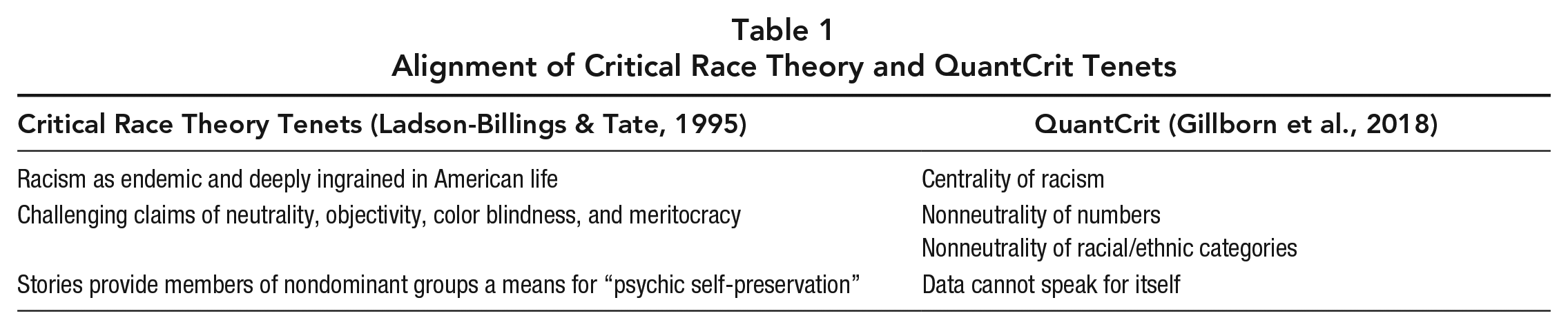
We interpreted CRQI and its offshoot QuantCrit in several ways in the development and administering of the BTOMPS survey and the broader research project. Foremost, we developed the survey guided by interviews that captured the lived experiences of practicing Black mathematics teachers. Centering their voices was key to item development. In the spirit of critical quantitative analysis, this research did not seek to compare the experiences of Black teachers with those of White teachers. We also considered the intersectional identities of the participants because socially constructed categories are not neutral. Within the demographic choices, we tried to account for the numerous ways one may come to see oneself as Black (e.g., Afro-Latino, Caribbean, African, African American, etc.) and still offered participants the option to select multiple categories and an option to qualitatively describe themselves. We also allowed participants numerous ways to respond to gender, noting that it is not fixed or static, as well as an option to describe their gender expression. In our analysis of our data, we looked at the findings in intersectional ways, such as looking at retention based on years teaching and gender, and gender and microaggressive experiences (see Frank et al., in press). Organizational conditions are highly impactful reasons why such teachers express dissatisfaction with or leave the profession (Ingersoll & May, 2011). Furthermore, we do not try to divorce our statistical findings from the salience of our qualitative data. We use the qualitative and quantitative data reflexively, not allowing the “numbers” (i.e., our quantitative findings) to stand alone in the absence of teacher voice.
Method
Participants
Little work has been done to quantify the distribution of Black mathematics teachers; thus, we relied on the limited available data about the presence of Black teachers in U.S. schools to draw our representative sample. For instance, we knew that the majority of Black teachers work in predominantly Black schools, so we anticipated that teachers in these schools would comprise the majority of our sample. We also knew that according to the 2011–2012 School and Staffing Survey (SASS), some U.S. regions have so few Black mathematics teachers that they could not be accounted for using statistical procedures (Neil, 2015). We partnered with the Benjamin Banneker Association, an organization committed to advancing Black students’ achievement and participation in mathematics, to garner participation across all eligible U.S. regions. Additionally, we recruited through district-level mathematics supervisors and organizations that focus on addressing the concerns and interests of Black teachers. All participants who completed the survey were eligible for a $25 gift card.
We surveyed 325 Black mathematics teachers nationwide (women, 57.2%). The teachers were situated in the South (38.2%), West (24.4%), Northeast (22.2%), and the Midwest (15.1%) (see Figure 1). The map of the states of our participants nearly maps onto the only other large-scale quantitative study of Black mathematics teachers done to date by Neil (2015). The participants’ age ranged between 19 and 65 years (M = 35.4 years, SD = 7.9). Most teachers identified as African American (98.4%). Other teachers specified their ethnicity as Caribbean (1.1%), African, Afro-Latino, and biracial/multiracial. The teachers taught mathematics between 0.5 and 45 years (M = 6.8 years, SD = 5.3). They taught regularly scheduled classes (at least one class weekly) at elementary (20.8%), middle (45.2%), and high schools (33.8%). The participants taught at public traditional (58.4%), public charter (22%), public magnet (13.5%), and parochial/religious schools (2.4%). Most teachers (64.1%) took a traditional route to licensure for mathematics teacher certification.
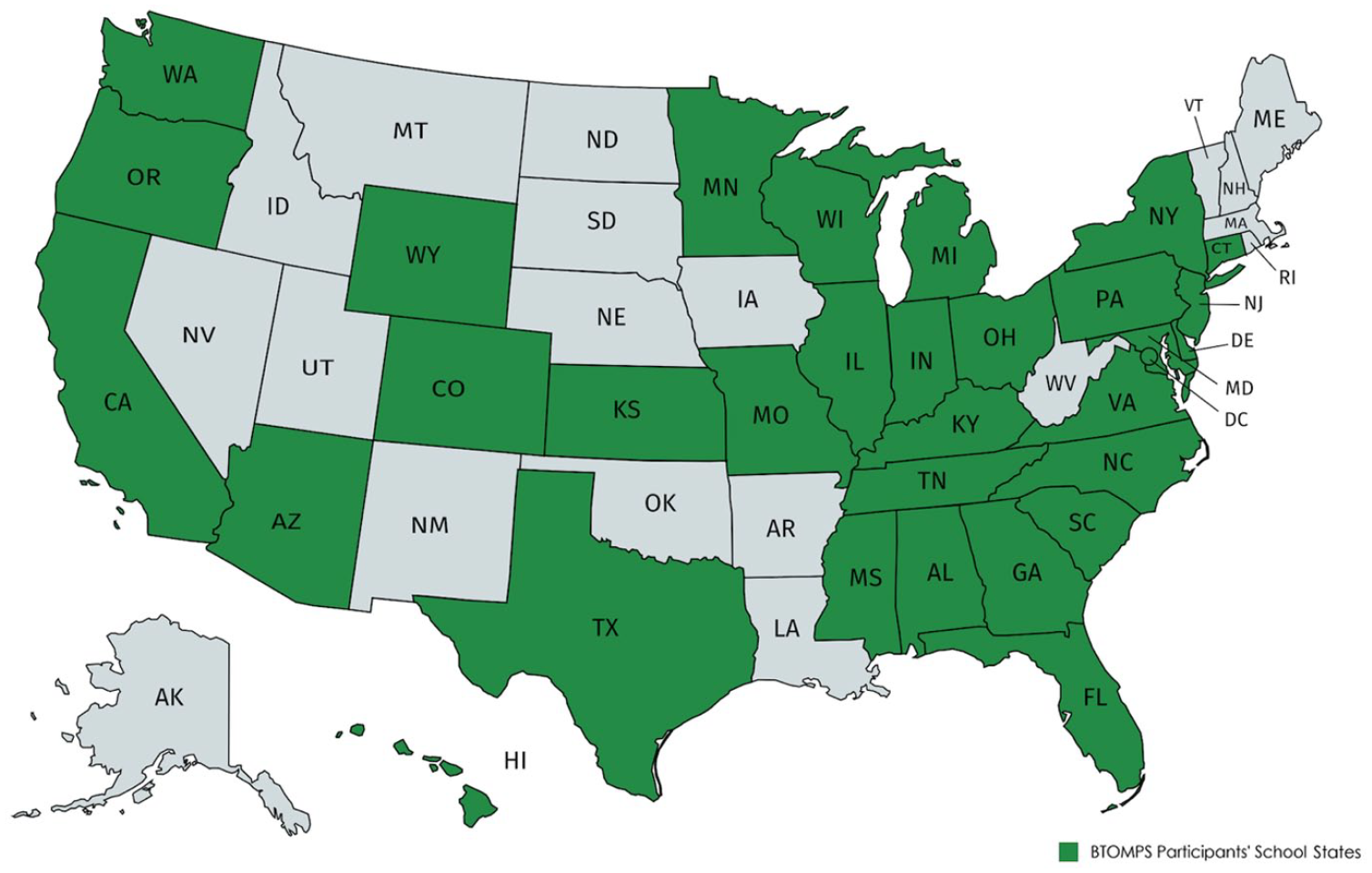
Map of BTOMPS (Black Teachers of Mathematics Perceptions Survey) participants by state.
Instrument
All participating teachers took the BTOMPS, which was designed to align with previously collected qualitative data (see Frank et al., 2018) and the literature on Black mathematics teachers with respect to teaching and learning, beliefs and awareness, and working conditions. Based on the purposes of the study, BTOMPS is composed of items from the National Center for Educational Statistics’ SASS to measure teachers’ perceptions of working conditions, as well as a microaggressions scale, modeled after Harwood et al. (2015). This 16-item measure used a 6-point Likert-type frequency scale ranging from never to once a week or more. An example question is “I have experienced feelings of isolation at my school/district based on my race.” We conducted an exploratory factor analysis to determine the factor structure of the 16 items. A one-factor model best represents the data with factor loadings ranging from .79 to .90 and accounted for 70% of the variances in all items. The scale had a high internal consistency (Cronbach’s α = .97).
We identified school climate variables as school leadership and support and school resources. School leadership and support was measured as a proxy variable using items from the SASS: “The school administration’s behavior toward the staff is supportive and encouraging,” “My principal or school head enforces school rules for student conduct and backs me up when I need it,” and “In this school, staff members are recognized for a job well done.” The three-item 4-point Likert-type scale ranging from strongly disagree to strongly agree had a Cronbach’s α of .61, which is considered acceptable for new scales (Nunnally, 1972). The school resources variable was measured as whether teachers believed the materials needed by staff were available. Finally, “thoughts of leaving the profession” was measured using a 4-point Likert-type scale ranging from strongly disagree to strongly agree. This scale had three items and an acceptable reliability coefficient (Cronbach’s α = .67). The items used to create this proxy measure of thoughts about leaving teaching are “I often think about leaving the teaching profession,” “My students’ lack of preparation makes me think about leaving teaching,” and “Lack of administrative support makes me think about leaving teaching.”
To ensure validity, the research team conducted cognitive interviews with currently practicing Black mathematics teachers and teacher leaders. Cognitive interviews aid in developing survey items by intensively questioning individuals who meet the profile of future survey participants (Willis, 2004). During each interview, lasting from 45 minutes to 1.5 hours, four currently practicing Black mathematics teachers sat with a researcher and read and discussed the survey for clarity. Additionally, they discussed the length of the instrument and the ordering of items. During the first wave of administration, the research team completed psychometric testing to reduce the overall number of items on the survey (see Powell et al., 2020). Final versions of BTOMPS, including the microaggressions scale, are available at www.blackmathteachers.org.
Data Analysis
Our research questions focus on the relational impact of variables on teachers’ thoughts on leaving the profession. As such, we employed ordinary least square regression analyses. Specifically, we conducted a hierarchical multiple regression analysis to assess the two research questions. The assumptions of normality and heteroskedasticity were assessed and met. We included structure coefficients in the analysis to determine the predictor variables with the most impactful contribution to the outcome as per the recommendation of Courville and Thompson (2001).
Results
For the first research question, the results revealed a significant model, F(8, 316) = 4.57, p < .001. Results are shown in Model 1 of Table 2. The model consisting of personal factors (salary, sex, and age) and school climate factors (school leadership and support, available resources, type school, and regularly scheduled school classes) accounted for 10% of the variance in teachers’ thoughts of leaving the profession (R2 = .104). Teachers age, t(316) = −4.04, p < .001, β = −.225, and salary, t(316) = 2.61, p = .009, β = .151, were the most effective predictors of teachers’ thought of leaving the profession. Older teachers tended to have fewer thoughts of leaving the profession. Teachers who are satisfied with their current salary had more thoughts of leaving the profession.
Coefficients for Hierarchical Regression Models

Note. Male is the focal group for the sex variable; nontraditional public/private schools (e.g., charter, magnet, parochial) and high school were the reference groups.
p < .001. * p < .05. **p < .001 (representing significant predictors).
The second research question assessed whether teachers’ racialized experiences contributed more to teachers’ thoughts of leaving the profession than the suggested factors by Ingersoll and May (2011, 2012). The results revealed that teachers’ experiences of microaggressions accounted for 17% of the variances in teachers’ thoughts of leaving the profession (ΔR2 = .171). This was a statistically significant predictor, F-Change(1, 315) = 74.40, p < .001. This was a positive relationship, t(315) = 8.63, p < .001, β = .540, when controlling for the other variables in the model (Model 2, Table 2). The more frequent the racialized experiences, the more likely teachers thought about leaving the profession. Microaggressive experiences (β = .823) and teachers’ age (β = .239) were the two most impactful variables in predicting teachers’ thought about leaving the profession as represented by the structure coefficients.
The inclusion of the microaggressions variable altered the model. Specifically, type of school, t(315) = 2.33, p = .021, β = .018, and teachers’ perception of the availability of resources, t(315) = −2.62, p = .009, β = .016, became statistically significant predictors of teachers’ thoughts of leaving the profession, albeit having negligible impact. Additionally, teachers from public traditional schools (b = 0.556) are more likely to have thoughts about leaving the profession than nontraditional, public school teachers. This positive relationship was initially negative (b = −0.076) prior to the inclusion of teachers’ microaggressive experiences in the model. Similar changes in the direction of relationships are observed with teacher salary (from b = 0.767 to b = −0.031) and middle school (from b = 0.323 to b = −0.241).
Discussion
Our first research question is “What are the effects of personal and school climate factors on Black mathematics teachers’ thoughts of leaving the profession?” In the first model, we found that as teachers’ ages increased, they expressed less desire to leave the field. We speculate that more mature teachers have had longer careers, either in teaching or in other fields; thus, they likely have had professional experiences that help them navigate their workplace environments. However, the first model also revealed that those who were satisfied with their salaries expressed more desire to leave the field, which corroborates Ingeroll and May’s (2011) finding that salary appeared to be a nonissue related to attrition of teachers of color, particularly when considered against organizational factors.
In light of the second question regarding the impact of racialized experiences over and above personal and school climate factors on Black mathematics teachers’ thoughts of leaving the profession, we found that racialized microaggressive experiences were not only statistically significant in our model that predicted Black mathematics teachers’ desire to leave the field but also explained a great deal of variance in the model. Ingersoll et al. (2019) urged researchers to determine, “which policy-amenable aspects of schools as organizations are related to their ability to retain [teachers of color]” (p. 33). Given the significance of Black mathematics teachers’ experiences of microaggressions, we assert that these data reveal that considerations of racism in the workplace for Black mathematics teachers should be considered as organizational conditions, speaking to the persistence of racism in schooling noted by critical race theorists in education, particularly given the centrality of race and subjectivity of numbers in our critical framing of this issue.
Microaggressions happen at the individual level, but, as noted earlier, they are perpetuated in institutions that are framed by discriminatory institutional practices. Lynn (2019) urged researchers who use critical race perspectives in educational research to use it as a “problem-solving tool” (p. x) that moves the work beyond critique to “new methods, pedagogies, policies and ways of knowing” (p. x) that push schools toward transformation. Thus, we argue that racialized microaggressions and their impacts should be addressed at the institutional level, particularly as they play out in school environments and negatively affect the work experiences of Black teachers (Brown, 2019). For instance, teachers overwhelmingly responded to frequently experiencing the following: “I have had my academic ability and/or intelligence minimized at my school/district because of race.” We argue that the pervasiveness of mathematical intelligence, which often serves as a proxy for Whiteness in schools, affected the teachers’ perceptions. This tacit belief shows up in the workplace as small slights or offhand comments from colleagues about Black teachers’ ability to teach higher level mathematics (Frank et al., 2018). It also has implications for how mathematics courses are staffed, leaving Black mathematics teachers overwhelmingly teaching low-level courses (Neil, 2015).
Since the administration of this survey, the research team has also collected focus group data, wherein practicing Black mathematics teachers reflected on the microaggressions survey responses (Frank et al., in press). The focus group teachers’ experiences corroborate our assertion that the pervasive nature of racism expressed via treating mathematics as White intellectual property (Bullock, 2017) plays out as racialized microaggressive slights in their daily work. In fact, one participant described teaching mathematics while Black as “teaching with thick skin” to survive the persistent insults on her intelligence, content expertise, and unique pedagogical practices. Other teachers in this study noted how they were chided by administrators for their shared language with Black students, despite teachers’ insistence that shared language helped them bridge everyday understandings to formalized mathematics vocabulary and concepts.
Trajectories also includes the collection of oral history interviews with Black mathematics teachers who taught from the early 1950s to the 1990s. Similar to the focus group participants, these teachers also described numerous instances of microaggressions, in addition to also navigating the complexities of desegregation, White flight, and gentrification (Frank, 2019). The instances of microaggressions described by the oral history participants also bring to light similar anti-Black ideologies highlighted throughout this article and further corroborate pervasiveness of anti-Black racism.
Implications and Recommendations
From our findings, we offer several recommendations for teacher education, school districts, administrators, and policy makers with respect to retaining Black mathematics teachers. However, before moving to actionable ways to address the issues outlined in this study, we insist that school leaders address philosophies and stances of anti-Blackness to meaningfully engage in action. Emphasizing the need to diversify the mathematics teaching force for the sole purpose of race-matching does no more than commodify these teachers (Frank, 2019; Frank et al., 2018).
Race and racism must be taken up in policy conversations that affect teacher education, particularly issues of work conditions and attrition. Racism, and more specifically anti-Blackness, and its impacts must be included in research models, policy conversations, and corrective policy measures. In other words, a critical lens that includes experiences like racial microaggressions should be a salient feature of any work that seeks to disaggregate teachers by race. Ultimately, this is a call for critical quantitative work that develops measures that can capture teachers’ racialized experiences. Race cannot be parsed apart from the lived realities of racism for teachers of color, whether structural, institutional, or individual, particularly in a field such as mathematics that carries the illusion of being neutral and culture free (Hottinger, 2016).
At the district and school levels, we recommend that administrators take forward-thinking approaches toward antibias and race-focused professional development that address both (a) the inherent anti-Blackness in the ways in which mathematics is taught (Martin, 2009) and (b) how racism and privilege play out in collegial and supervisory interactions. Black mathematics teachers indicated unfair practices such as being consistently assigned to lower-tracked teaching assignments or having limited opportunities for leadership (Frank, 2019; Frank et al., 2018). To address racialized microaggressions, educational leaders should reevaluate gatekeeping practices like standardized testing (Nettles et al., 2011; Petchauer, 2014) and teacher evaluation systems (Petchauer et al., 2018) that overlook the hard-to-measure practices that some Black teachers bring to the profession to determine their effectiveness, particularly in content areas like mathematics (e.g., Clark, Badertscher, & Napp, 2013). We propose that centering the experiences, complexities, and challenges of Black teachers and other teachers of color in professional development for administrators and fellow teachers could have implications for improving racialized working conditions for these teachers and making intentional shifts toward racial justice in teacher education.
Frank (2019) called for mathematics teacher education to utilize critical theory to rethink the field by acknowledging how, in its current state, it marginalizes the perspectives that Black teachers bring to mathematics teaching, often through microaggressive experiences noted in this article and also through racist organizational and institutional structures. From a research perspective, this work has implications for how and what we study with respect to diversifying STEM teaching fields. Studies of this nature challenge the field to create appropriate measures to capture Black teachers’ work experiences around racism and racial microaggressions. We provide several avenues to spark change within the field based on what we know, yet we also know that some of the most effective solutions to addressing the issues highlighted in this work come from listening to and learning with Black mathematics teachers (Frank et al., 2018).
Scholarly Significance
This study contributes to the field in terms of methodology and findings. Most work that addresses racialized experiences of teachers of color is qualitative. This study amplifies and builds on extant qualitative research to highlight racialized experiences from a large-scale perspective. Identifying the importance of teachers’ racialized experiences in education provides implications for recruiting and maintaining a more diverse mathematics teaching force. In this study, we examined the lives behind the numbers and the social structures that affect them (Covarrubias et al., 2018; Covarrubias & Vélez, 2013).
We drew on DeCuir-Gunby and Gunby’s (2016) study that examined teachers’ racialized experiences through their experiences of racial microaggressions and expanded it in several ways. First, we surveyed a U.S. cross-section of Black teachers, providing a more generalizable sample. Second, we used a measure of microaggressive experiences that is specific to teachers’ racialized experiences, rather than a general measure of experiencing social racial microaggressions. We also built on the work of Ingersoll and May (2011) and Ingersoll et al. (2019) that point to the differences between teachers of color and White teachers in terms of how organizational structures affect retention and attrition. This study and, in particular, the microaggression scale provide new insight into possible factors for Black mathematics teacher attrition. From a CRQI framing of the issue, the data reveal sociocultural and sociopolitical influences that are likely to go unnoticed in large-scale policy work.
Conclusion
Brown (2019) noted, “A quantitative examination will enable researchers to explore the linkage between institutionalized racism and the production of workplace phenomenon on the formation of toxic/hostile organizational culture and its effect on African American teachers’ experiences” (p. 195). Research on teachers of color, and of Black teachers specifically, has long noted the racialized experiences that we name as racialized microaggressions, using qualitative methodologies. Our analysis was built on this line of inquiry to introduce novel research that used quantitative analysis to examine how racialized work conditions, that is, microaggressions, should be examined and mitigated in order to improve the working conditions for Black mathematics teachers.
The goal of this study was to build on the work of attrition for teachers of color and mathematics teachers, as well as microaggressions in teaching research, using critical research methodology and to contribute to each field, respectively. In our survey of Black mathematics teachers, we found that racialized experiences, particularly microaggressive instances in their work lives, affected their thoughts of leaving the field. We know that it is no easy feat to remedy the issues related to how racism affects attrition; however, we suggest that addressing it directly is key to creating socially just environments for Black mathematics teachers in schools to become spaces where they are not only retained but are retained in ways that allow them to thrive.
