



Abstract
The comments teachers write when sending students to the office have the potential to increase our understanding of how bias may contribute to longstanding racial disparities in school discipline. However, large-scale analysis of open text has traditionally had a prohibitive cost. Through natural language processing techniques, we examined over 3.5 million office discipline records from national samples of more than 4,000 schools for whether teachers’ linguistic patterns differed when describing incidents depending on the race/ethnicity and gender of the students. Results of such analyses consistently showed that teachers wrote longer descriptions and included more negative emotion when disciplining Black compared to White students, especially for Black girls. In conjunction with psychology of language theory, the patterns suggest that teachers may perceive and process student behavior differently depending on student identities. Implications of the findings and potential for research on naturally occurring language data in education are discussed.
A substantial body of research shows that, in the United States (US), students of color, particularly Black students, are far more likely than White students to experience exclusionary school discipline (Skiba et al., 2011; Yeager et al., 2017). Beyond documenting the differences, results of recent research suggest that the disproportionate discipline likely stems, at least in part, from biases in the ways that teachers and administrators perceive, process, and respond to behaviors of students from different racial/ethnic backgrounds (Chin et al., 2020; Gregory et al., 2010; Ispa-Landa, 2018; Skiba et al., 2002). However, much of the large-scale field research on the topic focuses on quantitative analysis of disparities in discipline outcomes, along with fixed, predefined indicators of the structural, educational, psychological, and demographic characteristics associated with discipline incidents. Thus, there is a need to examine how educators describe discipline incidents involving students from different racial/ethnic backgrounds for potential disparities in how educators understand or find most important to convey about them.
The goal of the present study was to expand on the literature by exploring whether teachers who are disciplining students tend to use systematically different linguistic patterns when describing the underlying incident if it involves students of color as compared to White students. To do so, we use psychological theory and natural language processing to examine the narratives written by teachers or other school personnel in over 1.5 million discipline incidents from the 2015–2016 school year and replicating the analysis in a separate sample of 1.9 million discipline incidents that occurred in the 2018–2019 school year. By examining natural language patterns, we have a uniquely direct lens into potential differences in how teachers themselves construe discipline incidents and the information they think is most important to convey about the incidents, depending on the race/ethnicity of the student involved. Relatedly, it is rare to observe student discipline incidents on a systematic level, and therefore, using narrative descriptions of student discipline incidents provides an in-depth examination into these classroom-level interactions between students and teachers.
In parallel, we illustrate the potential for computational social science techniques to examine large bodies of information from educational records, thus helping to increase our understanding of the factors that may contribute to one of society’s greatest challenges, including educational disparities and racial justice (Ben Shahar, 2017). Improving our comprehension of how teachers understand and communicate about discipline incidents at scale will help us to develop more nuanced understandings of racial disproportionality in school discipline and more effective ways to address it.
Racial Disparities in Exclusionary Discipline
The purpose of school is to provide access to safe and supportive learning environments for all students to be successful (Girvan, 2019). When students are perceived to engage in serious behavioral infractions, educators commonly respond with exclusionary discipline, using, for example, office discipline referrals (ODRs) and ultimately suspensions or expulsions. Such exclusionary disciplinary actions vary in intensity and result in the loss of instructional time. Significant, widespread racial inequities in exclusionary school discipline pose a threat to the goal of providing safe and supportive educational environments (Bradshaw et al., 2010; Losen et al., 2021; Smolkowski et al., 2016). During the 2017–2018 school year, for example, Black students constituted 15% of public school enrollment but 30% of students suspended in school, 38% suspended out of school, 29% of students referred to law enforcement, 32% of students arrested for school-related incidents, and 43% of students transferred to alternative settings (U.S. Department of Education Office for Civil Rights, 2021). There are also pronounced gender-based differences, with boys receiving more exclusionary discipline than girls, although gender effects are often not as strong as race effects (Fabelo et al., 2011).
Evidence of Racial Bias in Discipline
Possible explanations for the causes of racial disparities in exclusionary discipline practices are often grouped into the effects of contextual or structural processes on student behavior and cultural differences in perceived norms and values (Girvan, 2019; Girvan et al., 2017; Huang, 2020; Skiba et al., 2011). Contextual or structural processes (e.g., poverty, schools, neighborhoods with limited resources) are associated with childhood stressors and poor student outcomes (e.g., lack of academic engagement, suspensions) (Sullivan et al., 2013). However, even after controlling for these variables, significant racial disparities in school discipline remain (Morgan et al., 2019; Sullivan et al., 2013).
Cultural differences in perceived social norms and values can result in discipline when there is a disconnect between behavioral expectations set in schools and homes for students of diverse cultural backgrounds (McIntosh et al., 2018; Skiba et al., 2011). For example, based on cultural expectations, school personnel may perceive Black students to be engaging in more aggressive behaviors when participating in recreational sports with peers (McIntosh et al., 2018). These cultural differences can cause school personnel to enforce harsher disciplinary actions for behaviors perceived as disrespectful and defiant (Girvan, 2019; Girvan et al., 2021; Okonofua et al., 2016; Skiba et al., 2011).
A growing body of research also suggests racial disparities in exclusionary discipline may relate to racial/ethnic biases (e.g., negative or positive attitudes or beliefs concerning members of a racial group; Allport, 1954) that impact how educators perceive and understand student behaviors (Girvan et al., 2017, 2021; Liu et al., 2022b; McIntosh et al., 2018; Riddle & Sinclair, 2019; Smolkowski et al., 2016). Because of strong norms against biases like racism, people tend to be motivated to avoid applying, or appearing to apply, racial/ethnic stereotypes or attitudes (Butz & Plant, 2009; Dovidio et al., 2017; Fazio & Olson, 2014). However, in practice, it is difficult for people to understand and respond to intergroup situations without relying to some extent on attitudes and stereotypes (Girvan, 2016; Okonofua & Eberhardt, 2015; Yzerbyt et al., 1994).
Limitations of Past Research
Previous research linking racial/ethnic biases to discipline decisions in large, naturalistic samples generally relies on quantitative analysis of fixed indicators of the conditions associated with the discipline incident (e.g., selections of behavior type or perceived motivation from broad lists) and outcomes (Girvan et al., 2021; Smolkowski et al., 2016). The results of this work have shown, for example, that racial disparities are more likely for subjectively defined behaviors (Girvan et al., 2017), in particular settings and at particular times of day (Smolkowski et al., 2016), at particular times of year (Darling-Hammond et al., 2023), and related to community levels of explicit (conscious) and implicit (automatic) racial biases (Girvan et al., 2021; Riddle & Sinclair, 2019). None of these studies directly examine teachers’ or administrators’ understandings or interpretations of the events that resulted in the discipline in their own terms. Rather, the results depend on inferences about how educators themselves understand the reason for using exclusionary discipline. Methodological advances offer the potential to address the shortcoming through examination of educators’ descriptions of incidental discipline directly.
In particular, aside from fixed response fields, ODRs typically include a single, open-ended text field (e.g., “Comments”) for school personnel to describe the incident that resulted in a referral to the office in their own words. These fields contain natural language data that can be used to explore more directly the ways in which educators’ understandings of what happened and what they thought was the most important information to convey may differ depending on the race/ethnicity of the students involved. A major benefit of using ODRs and evaluating the language within them is that they “provide increased consistency and efficiency for summaries and interpretation” of problematic events (McIntosh et al., 2010, p. 381). Understandably, given the sheer volume of the incidents, we are not aware of any previous research that attempted to examine the structure, content, and style of these narrative fields, particularly at scale. New, computational approaches to natural language processing, however, make this possible.
ODRs, Language Patterns, and Indicators of Bias
Recent advances in natural language processing have facilitated the examination of often elusive or difficult-to-study phenomena in the social sciences like bias. For example, a recent paper used language patterns to examine how physicians attended to critical care patients differently based on demographic characteristics. There, Markowitz (2022) analyzed 1.8 million critical care notes and observed physicians tended to focus more on the emotions of women than men. Physicians also used more impersonal pronouns (e.g., it, who, this) for women than men, suggesting more depersonalized care. Finally, physicians focused less on the emotions of Black and Asian patients versus White patients. These results provided some of the first evidence, at scale, that physician biases may alter perceptions, understandings, and accounting of patients using their own descriptions.
In research that follows the psychology of language tradition, content words (e.g., what people are communicating about) and style words (e.g., how people are communicating) serve as attention markers to reveal what people are thinking, feeling, and experiencing psychologically (Boyd & Schwartz, 2021; Pennebaker, 2011). We used this foundation to conduct an exploratory examination of how the language used when describing discipline incidents in ODRs differ based on the race/ethnicity of the student who was disciplined. In addition, mindful that racial/ethnic biases often interact with gender biases (Smolkowski et al., 2016; Wun, 2016), we also examined how linguistic differences may themselves differ across the intersections of student race/ethnicity and gender. Although the work is exploratory and we do not have formal hypotheses, based on prior work in other contexts (Markowitz, 2022), psychological theory regarding the operation of biases, and research on school discipline decision outcomes, we limited our examination to concepts and linguistic dimensions that may reveal how educators understand and describe discipline events involving students of different identities.
First, we investigated how much teachers wrote about their students to identify disparities in verbosity. The number of words in a disclosure provides important information about its structure and the amount of elaboration provided by the communicator (Larrimore et al., 2011; Markowitz, 2023). On the one hand, consistent with psychological theory (Yzerbyt et al., 1994), teachers may feel the need to overexplain, or elaborate in greater detail, why they are disciplining Black students compared to White students in order to satisfy the need to justify their decision and not appear discriminatory (see Hodson et al., 2002). On the other hand, teachers may use fewer words, as a reflection of effort, when describing why they disciplined Black versus White students if they felt apathetic or negatively toward the Black students (Bishop, 1989; Lafond-Brina et al., 2023). We therefore explored how the number of words used to describe a discipline referral differed based on the demographic characteristics of the student.
Second, we examined two content dimensions: negative emotion and verb use. Emotion is often a key indicator of racial/ethnic and gender bias in medical evaluations (Hagiwara et al., 2016; Markowitz, 2022). In other settings like police-civilian interactions, researchers have found that officers were less respectful and less polite to Black community members compared to White community members during traffic stops (Voigt et al., 2017). Consistent with such evidence, we expected educators to describe incidents involving Black students with more negative emotion, which could reflect perceptions of Black youth as more threatening (Goff et al., 2014), differences in affective responses such as interpreting Black students’ behavior more personally, or a form of intergroup anxiety (Stephan & Stephan, 1985). Similarly, we also examined the degree to which teachers use verbs (annoy, hope, or is mean) in discipline reporting. Verbs describe actions, and we therefore explored how teachers focused on the actions of certain students more than others depending on student race/ethnicity and gender (Skiba et al., 2002). Other evidence has observed disparities in action-oriented words by race/ethnicity (e.g., police officers were more likely to tell Black community members to put their hands on the wheel in traffic stops than White community members; Voigt et al., 2017), suggesting verbs may play an important role in revealing bias in educational ODRs as well.
Finally, with respect to linguistic style, we examined the use of impersonal pronouns. Impersonal pronouns (e.g., it, that) reflect one’s psychological or social distance from others (Markowitz & Slovic, 2020a). For example, Markowitz and Slovic (2020b) found that participants who favored longer jail sentences for immigrants labeled as illegal also depersonalized them by writing with more impersonal pronouns. Prior research has also found that impersonal pronouns are an important indicator of medical bias and depersonalization (Markowitz, 2022). We therefore examined how teachers’ use of impersonal pronouns may differ based on the race/ethnicity of students being disciplined.
Method
Database Description
Extant data in this study consisted of over 3 million ODRs issued to K–12 students by school personnel during the 2015–2016 and 2018–2019 school years. From the full set of ODRs within each wave, we created a refined dataset that excluded incident reports without text and those outside of the K–12 range. 1 We also included incident reports only for students whose gender was identified as boy or girl. 2 Incident reports were included only for students identified as Asian, Black, Latino/a/e, or White. Incident reports about students without a recorded race/ethnicity (n = 232,277; 12.01%), or that were infrequent (e.g., comprising less than 3% of the sample), were excluded (after all exclusion criteria, 17.44% of referrals were removed; 337,196/1,933,282). Data from the second wave (2018–2019) initially contained over 2.4 million incident reports from teachers, and the same inclusion and exclusion criteria were applied to this dataset as well (16.91% of referrals excluded; 404,966/2,394,539). Therefore, the final number of ODRs administered during the 2015–2016 school year included 1,596,086 regarding 407,801 students from 4,117 schools in 44 US states plus the District of Columbia. The number of ODRs in 2018–2019 was 1,989,573 regarding 462,056 students from 4,586 schools in 44 US states plus the District of Columbia. Table 1 includes a detailed summary of ODR-level data disaggregated by school year, grade level, gender, and race/ethnicity.
Descriptive Details Across Genders and Racial Groups

Percentages in bold were calculated by dividing the raw count by the total number of incident reports in the 2015–2016 wave and 2018–2019 wave, respectively. In the top panel of this table, unbolded percentages are calculated within each ethnicity group.
Data were obtained from student ODR records entered into the School-Wide Information System (SWIS) web application (Educational & Community Supports, 2021). SWIS is used by schools across the United States to document information on student discipline incidents (e.g., type of behavior, time of day, individuals involved) and use the data for school improvement. Extant data from SWIS are housed and maintained by Educational and Community Supports (ECS), a research unit at the University of Oregon. When purchasing an SWIS license, users have the option of signing a data-sharing agreement that provides permission for researchers to use their de-identified data collected through SWIS to be used for research purposes.
Automated Text Analysis
Language patterns from written teacher incident reports were quantified using the automated text-analysis program, Linguistic Inquiry and Word Count (LIWC) (Pennebaker et al., 2022). LIWC uses a simple word-counting procedure to identify if words from an input text appear in one of its many internal dictionaries, which include words related to social (e.g., words related to friends or family), psychological (e.g., words related to emotion, cognition), and part-of-speech categories (e.g., articles, pronouns). Most LIWC dimensions are counted as a percentage of the total word count per ODR note. For example, the phrase “This student behaved poorly” contains four words and identifies several LIWC categories, including but not limited to impersonal pronouns (e.g., this; 25% of the word count) and social words (e.g., student; 25%).
Measures
We took an exploratory approach to identify linguistic differences in educator descriptions of discipline incidents across student race/ethnicity and genders. Several language dimensions were selected that—based on prior work—we argue may be theoretically relevant to potential differences in how teachers perceived, processed, and explained discipline incidents depending on the race/ethnicity or gender of the student: word count (e.g., the number of words in each incident report), negative emotion (e.g., the number of words tapping negative emotions such as aggressive, terror, or anger), verbs (e.g., the number of action words such as annoy, help, or wouldn’t), and impersonal pronouns (e.g., words such as it or this). To correct for skew in the data, all dependent variables were transformed using the formula log10(X + 1). Raw descriptive statistics for each variable are in the online supplement. Please see our full analytic plan placed in the online supplement due to space considerations.
Results
Estimated marginal means across race/ethnicity, gender, and their interaction are in Table 2 for 2015–2016. After the statistical findings, we offer excerpts to demonstrate how each linguistic dimension was observed in actual ODR notes across student race/ethnicity and gender. Nearly all results were identical across years unless noted (see supplement for 2018–2019 data).
Estimated Marginal Means Across Factors and Models (2015–2016)
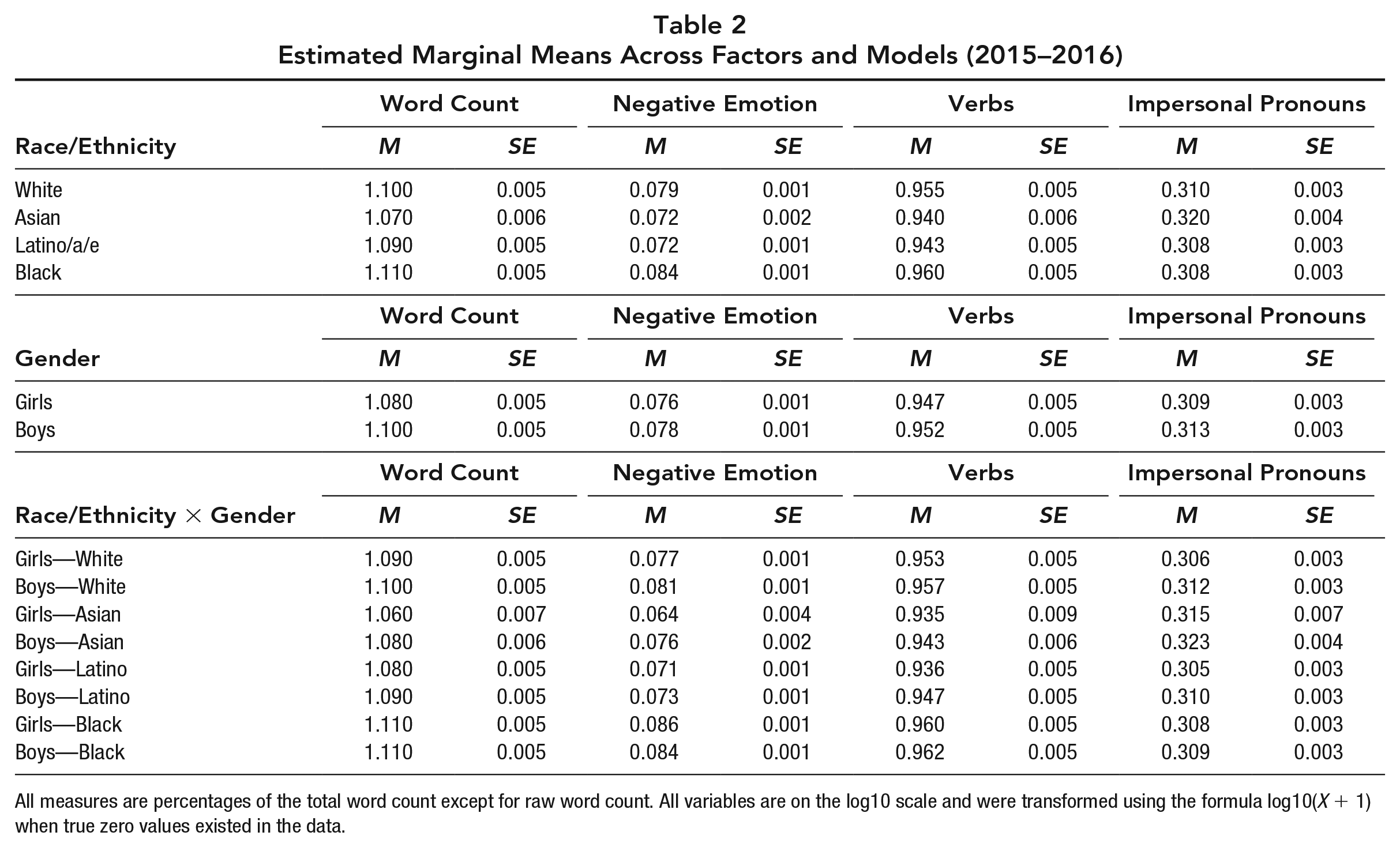
All measures are percentages of the total word count except for raw word count. All variables are on the log10 scale and were transformed using the formula log10(X + 1) when true zero values existed in the data.
Differences in Educator Descriptions Based on Student Race/Ethnicity
Narrative Length
In the 2015–2016 school year, teachers wrote longer descriptions of incidents involving Black students than those involving White students (t = 11.31, p < .001). Teachers also wrote less about Asian (t = −11.41, p < .001) and Latino/a/e students (t = −14.37, p < .001) than White students.
Linguistic Content
Negative emotion
In the 2015–2016 school year, teachers’ descriptions included more negative emotion when writing about incidents involving Black students than White students (t = 7.15, p < .001). For example, a teacher for a Black boy wrote, “[Name] turned over the chess board during inside recess, showed rude and disrespectful behavior to his peers and called them losers,” which contains one negative emotion term (e.g., rude). The same teacher for a White boy wrote, “[Name] threatened to stab another student with a pencil. He was not able to be honest although there were several witnesses,” which is descriptive and does not contain negative emotion terms. Teachers also used less negative emotion for Asian (t = −3.64, p < .001) and Latino/a/e students (t = −10.41, p < .001) than White students. 3
Verbs
In 2015–2016, teachers used more verbs when describing incidents involving Black students versus White students (t = 3.79, p < .001). A teacher for a Black boy wrote, “Was asked to sit safely w/ voice off; con’t to bother peers & talking: left room blurting math answers; displayed disrespectful attitude & body language to tchr; refused to go to CO,” which contained five verbs (e.g., was, asked, sit, talking, go). The same teacher for a White boy wrote, “Said ‘shut up’ to a peer after warnings & class rule to not say such things,” which contained two verbs (e.g., said, say). Teachers used fewer verbs when describing discipline referrals for Asian (t = −4.20, p < .001) and Latino/a/e students (t = −9.09, p < .001) than White students. That is, a teacher for a Latino/a/e boy wrote, “gum or candy after the teacher asked him to remove it,” which contains one verb (e.g., asked). The same teacher for a White boy wrote, “not having science materials to do the lab and writing,” with three verbs (e.g., having, do, writing).
Linguistic Style
Impersonal pronouns
In 2015–2016, there were no significant differences in the rate at which teachers used impersonal pronouns to describe discipline incidents of Black and White students (p = .163) nor Latino/a/e and White students (p = .101) in 2015. However, in 2018–2019, teachers used fewer impersonal pronouns when writing up Black and Latino/a/e students versus White students (see online supplement).
By comparison, in 2015–2016, teachers used more impersonal pronouns when writing up Asian students versus White students (t = 3.27, p = .001). A teacher for an Asian girl wrote, “[Student name] was escorted late to class by [Staff name]. When I was talking to another student she left. Result of conference with counselor was that she was removed from the class roster,” which contains two impersonal pronouns (e.g., another, that). The same teacher for a White girl wrote, “Student was given a hall pass and never returned to class,” which did not contain an impersonal pronoun.
Differences in Educator Notes Based on Student Gender
Narrative Length
In 2015–2016, teachers wrote more about students identified as boys than girls (t = 19.67, p < .001, R2c = 0.65). 4
Linguistic Content
Negative emotion
In 2015–2016, teachers focused on more negative emotion when writing discipline reports about boys versus girls (t = 4.36, p < .001, R2c = 0.12). For example, a teacher for a boy wrote, “Physically went after another student. He hit him and was holding him trying to hurt him. I pulled him away he would not stop,” which contains one negative emotion term (e.g., hurt). The same teacher for a girl wrote, “[Name] left class, returned and continued to disrupt class. Did not follow directions and called others names,” which does not contain a negative emotion term.
Verbs
The 2015–2016 data revealed that teachers used more verbs when writing reports about students who are boys versus girls (t = 4.87, p < .001, R2c = 0.42). For example, a teacher for a boy wrote, “Had to be addressed 4 times in 20 minutes about listening to directions and would not follow them when asked to return to his seat,” which contains seven verbs (e.g., had, to, be, listening, would, follow, asked). Comparatively, the same teacher for a girl wrote, “Stole a snack from another student’s desk. Finally admitted to doing it. Responsibility Room,” which contains two verbs (e.g., stole, doing).
Linguistic Style
Impersonal pronouns
Finally, in 2015–2016, teachers used more impersonal pronouns when writing about boys versus girls (t = 5.45, p < .001, R2c = 0.22). For example, a teacher for a boy wrote, “[Student name] spanked another student while walking down the hall,” which contains one impersonal pronoun (e.g., another). The same teacher for a girl wrote, “[Student name] began the day agitated. She constantly yelled, argued, burped and refused directions,” with no impersonal pronouns.
Differences in Educator Notes Based on the Interaction of Race/Ethnicity and Gender
Using the 2015–2016 data, interaction effects for gender × ethnicity were statistically significant (Fs > 3.67, ps < .012) for all dependent variables except for use of impersonal pronouns (F = 2.48, p = .059). Figure 1 displays trends in these relationships, with specific pairwise comparisons in the online supplement. In general, Black boys and girls were described with more words and more negatively than their counterparts, with Asian girls being described with the fewest number of words and the least amount of negative affect overall. Such findings are consistent with other work that highlights the importance of intersectionality in evaluating bias-based disparities (Annamma et al., 2019; Welsh, 2022; Wun, 2016).
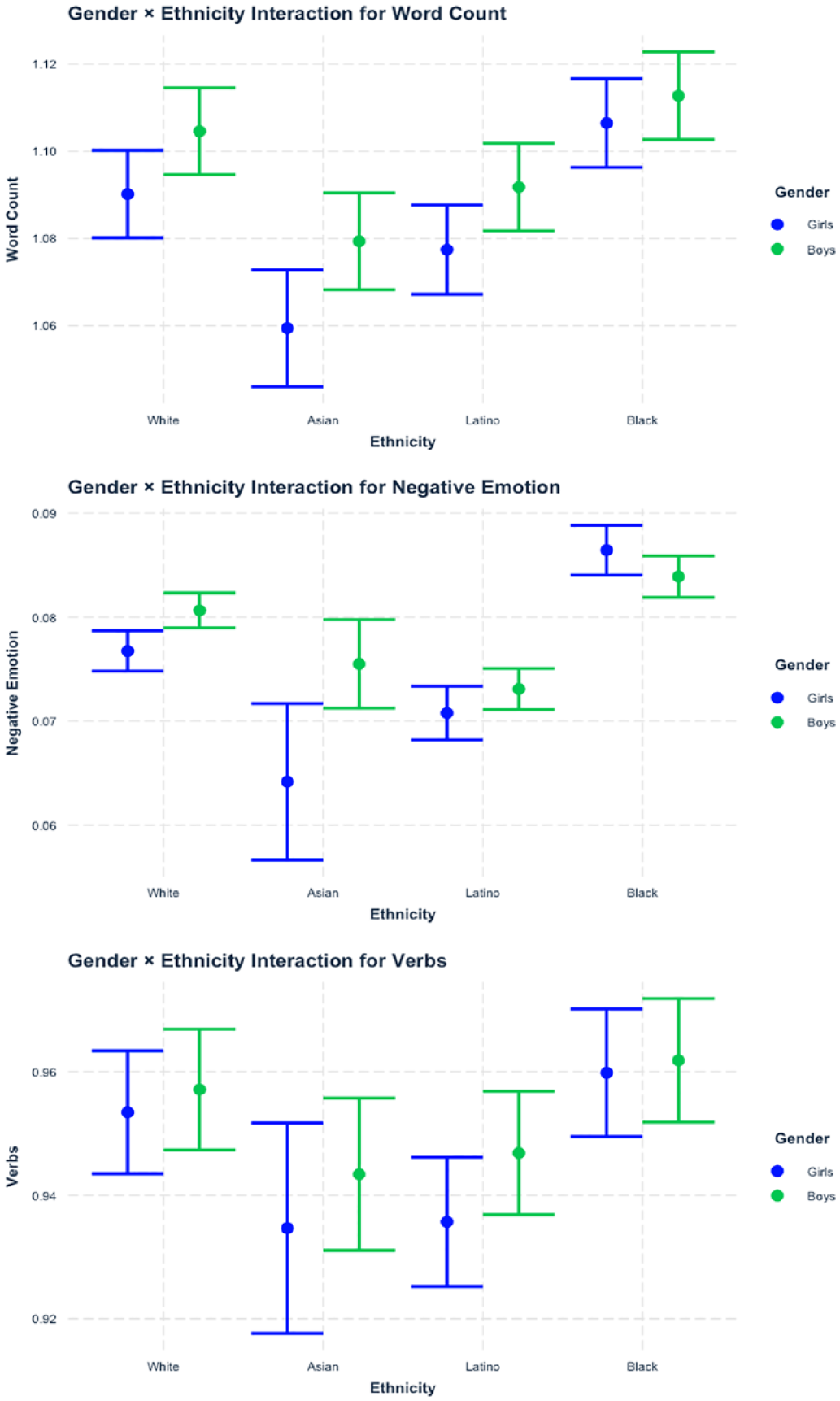
Interaction effect descriptions for word count, negative emotion, and verbs in the 2015–2016 data.
Using the 2018–2019 data, interaction effects for gender × ethnicity were statistically significant (Fs > 4.31, ps < .005) for all dependent variables except for verb use (F = 1.69, p = .167). Figure 2 displays trends in these relationships, with specific pairwise comparisons in the online supplement. In general, consistent with the 2015–2016 data, Black boys and girls were described with more words and more negatively than other students. Asian girls were described with the fewest number of words and the least amount of negative affect.
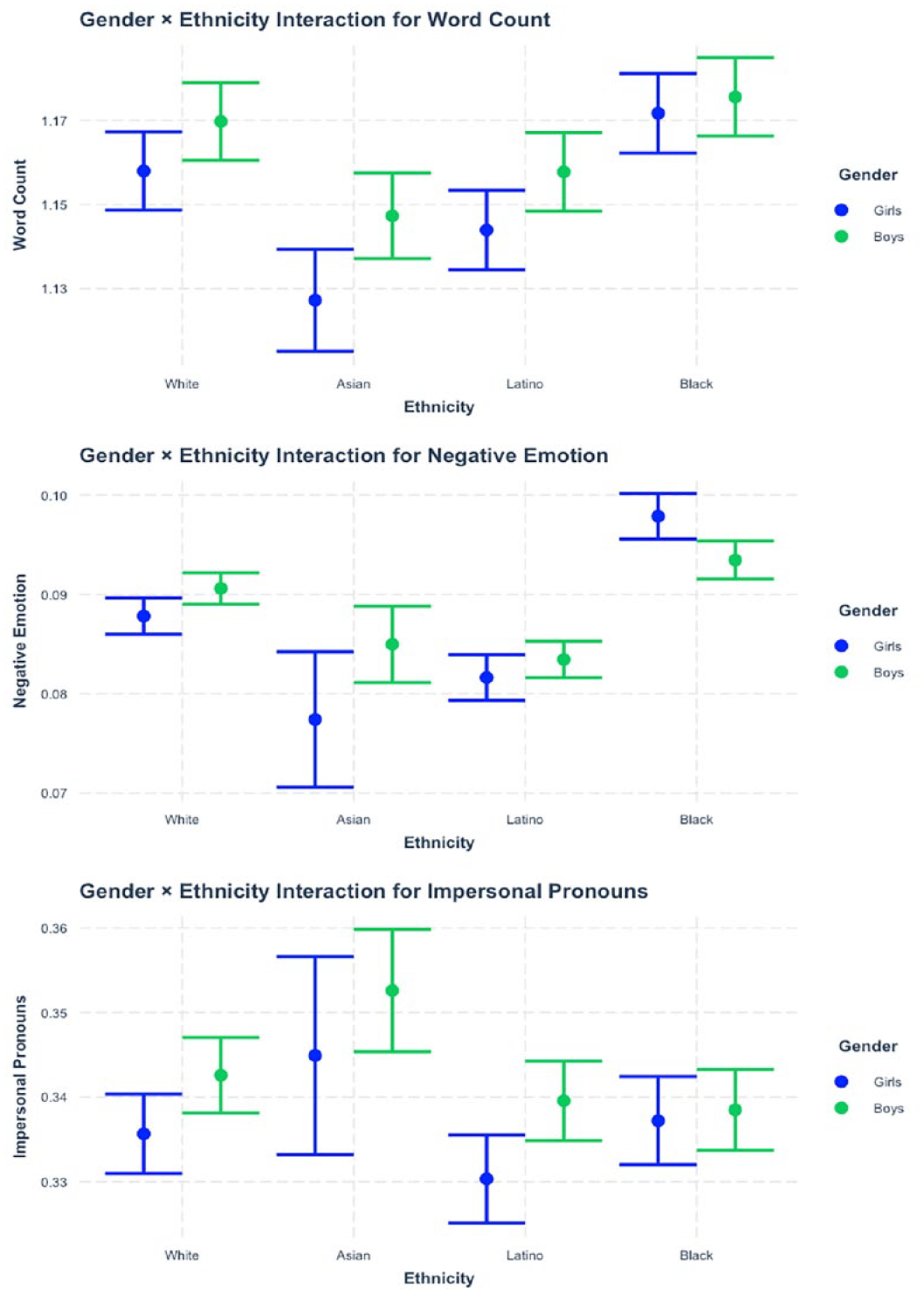
Interaction effect descriptions for word count, negative emotion, and impersonal pronouns in the 2018–2019 data.
Discussion
We present one of the first large-scale, natural language processing evaluations to reveal that students of color are attended to differently than White students. Black students were attended to in more negative terms than White students, teachers focused more on the actions of Black students compared to White students, and teachers used more impersonal pronouns when attending to Asian students compared to White students as well. Analyses also suggested teachers attending to boys wrote about them differently compared to those attending to girls. Teachers used more negative affect and impersonal pronouns when attending to boys versus girls. Disparities were greatest for Black boys and girls, as teachers referred to them more negatively than other groups and elaborated on their discipline referrals the most. In fact, Black girls were described with the most negative emotion, even more negatively than Black boys.
Findings from this study are consistent with and extend previous literature examining gender and racial disparities in exclusionary discipline in schools (Girvan et al., 2017, 2021; Losen et al. (2021); U.S. Department of Education Office for Civil Rights, 2021) and racial and gender disparities in medicine (Markowitz, 2022). For example, using 1,354,010 extant ODR records from students enrolled in 2,100 US schools, Girvan and colleagues (2021) found both explicit and implicit biases were related to prevalence of ODRs administered to Black students compared to White students. In another extant study using 483,686 student ODR records from 1,666 elementary schools in the United States, Smolkowski and colleagues (2016) examined the types of student behaviors, the time of the day, and specific settings in the school where racial disparities in exclusionary discipline practices are more likely to occur. Consistent with the current study, Smolkowski and colleagues (2016) found that Black students were more likely to receive ODRs for subjective behaviors (e.g., defiance, disrespect) and male students were much more likely to receive ODRs. While prior work suggests Black and Latino/a/e students tend to receive harsher disciplinary sentences than White students (Liu et al., 2022a; Welsh & Rodriguez, 2023), our work finds different disparities in how teachers talk about students of color. The fact that teachers writing about Latino/a/e students used fewer negative emotions in ODRs relative to White students may reflect a psychological difference in how teachers attend to students of different ethnicities. Lower rates of negative emotion (for Latino/a/e and Asian students compared to White students) reflect a disparity just as critical to understand and mitigate as do higher rates of negative emotion (for Black students compared to White students). Perhaps teachers report less negative emotion for Latino/a/e students compared to White students because of differences in infraction severity or perceived probability of a repeat offense (Shi & Zhu, 2022). These contentions deserve greater treatment in future work.
It is also important to position this research within other work that has investigated bias at the language level. At the onset, such patterns in Markowitz (2022) appear inconsistent with the evidence revealed in the current study. It is critical to remember that the populations under investigation (e.g., adults versus students), the institutions (e.g., medicine versus education), and the writers (e.g., physicians versus teachers) are substantially different across investigations. A one-size-fits-all model of bias in language cannot conceptualize how people of color are written about compared to White people. Bias is therefore context dependent (Barden et al., 2004; Warikoo et al., 2016), and even for the same linguistic dimension (e.g., negative emotion), signals of bias may be inconsistent across studies yet still reflect disparities.
Theoretical and Practical Implications
We provide one of the first investigations to identify differences in language use among a large selection of ODRs across two waves of data. This work underscores the utility and importance of evaluating educators’ own words in the process of understanding ODRs and disparities that exist in how educators construe and respond to the events that lead to them (e.g., what writers attend to psychologically). Future research might use this evidence to create applications that can track how teachers communicate about students of different demographic backgrounds and flag those who need additional training. More work would be required to identify the utility of such linguistic signals, but these findings provide an entry point for systems to be developed and to identify and hopefully attenuate bias at scale.
Limitations and Future Directions
As is generally the case with use of naturalistic data, the advantages of external validity in illuminating patterns in real-world behavior are inevitably offset somewhat by lack of experimental control and limitations in internal validity. We therefore recommend that future work experimentally examine the relationships observed in this paper. The schools under investigation also accounted for only approximately five percent of traditional US public schools. They may not be representative of the overall sample of US schools, and therefore we recommend caution when generalizing the study findings. For example, schools are likely to vary in their process and protocols for what types of student behaviors may occasion an ODR (e.g., objective vs. subjective behavior incidents, minor vs. major behavior incidents), how open text fields are utilized to describe student behaviors (e.g., details and depth of information provided), and who is responsible for administering and writing ODRs (e.g., teachers with or without school administrator authorization).
Future research could disaggregate ODR open-ended text fields further by including additional student, classroom, and teacher demographic data and conducting additional analyses to examine differences between ODRs for more subjectively vs. objectively defined behavior incidents (Girvan et al., 2017) or other vulnerable decision points (Ash & Maguire, 2023; Darling-Hammond et al., 2023; McIntosh et al., 2021). Similarly, research should examine and account for the effects of student special education status, race/ethnicity classroom composition and school enrollment, teacher race/ethnicity and experience, administrators’ discipline orientation (Skiba et al., 2014), and the extent to which the school is implementing particular discipline interventions (Ash & Maguire, 2023). Such findings could have meaningful implications for identifying where and with whom biases in student behavior incidents are most likely to occur. Given that the effect sizes in the paper are small, examination of contextual and structural moderators may inform the conditions where differences are acute or minimized.
Supplemental Material
sj-pdf-1-edr-10.3102_0013189X231189444 – Supplemental material for Taking Note of Our Biases: How Language Patterns Reveal Bias Underlying the Use of Office Discipline Referrals in Exclusionary Discipline
Supplemental material, sj-pdf-1-edr-10.3102_0013189X231189444 for Taking Note of Our Biases: How Language Patterns Reveal Bias Underlying the Use of Office Discipline Referrals in Exclusionary Discipline by David M. Markowitz, Angus Kittelman, Erik J. Girvan, María Reina Santiago-Rosario and Kent McIntosh in Educational Researcher
Footnotes

Notes
Authors
References
Supplementary Material
Please find the following supplemental material available below.
For Open Access articles published under a Creative Commons License, all supplemental material carries the same license as the article it is associated with.
For non-Open Access articles published, all supplemental material carries a non-exclusive license, and permission requests for re-use of supplemental material or any part of supplemental material shall be sent directly to the copyright owner as specified in the copyright notice associated with the article.
